
Pictures: Claude Barnardo

THE PROMISE
ADAPTATION:
Author Damon Galgut with Sylvaine Strike and suggestions by the cast
DIRECTOR
Sylvaine Strike
CAST
Chuma Sopotela, Rob van Vuuren, Kate Normington, Frank Opperman, Jane de Wet, Jenny Stead, Albert Pretorius, Sanda Shandu, Cintaine Schutte
ASSISTANT DIRECTOR AND ARCHIVIST
Kirsten Harris
SET AND LIGHTING DESIGN
Joshua Lindberg
MUSIC DIRECTOR, SOUND DESIGN AND ORIGINAL SCORE
Charl-Johan Lingenfelder
CHOREOGRAPHY AND INTIMACY CO-ORDINATOR
Natalie Fisher
COSTUME DESIGN
Penny Simpson
VENUE
The Market Theatre
DATES
Until November 5
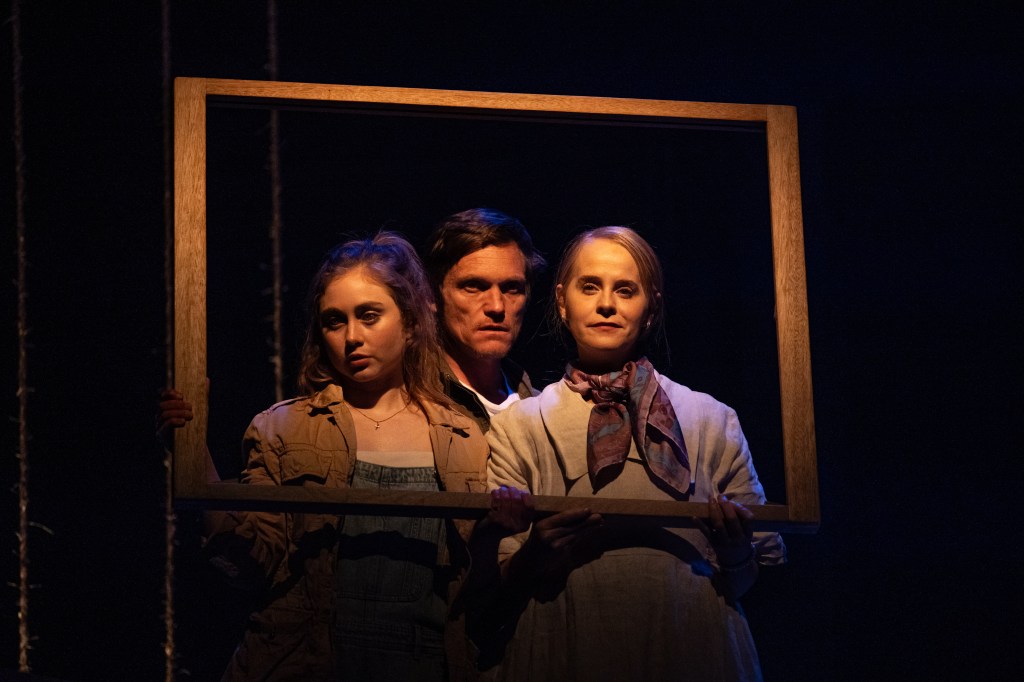
One has to admire artist Sylvaine Strike’s process when she decides on a project. It’s all systems go and in Strike’s world, the focus is unfailing.
She spent 18 months hard at work on this extraordinary piece of theatre, which has finally reached The Market Theatre.
But there are a few things to take on board before you arrive. It’s based on a book, Damon Galgut’s The Promise, and that means that it is her interpretation of Galgut’s writing and script, even if he was closely involved throughout.
Also, it is two hours 40 minutes long and for many less-experienced theatre goers, that might be quite
an ask. One has to be theatre fit.

Albert Pretorius and Sanda Shandu as two policemen
But for me there’s no question that it has to be seen, and a very packed and excited audience obviously in anticipation was ready and waiting on opening day. Even when we arrived to collect tickets there was an audible buzz and it was lovely to experience a theatre event of this kind. The last one was the August Wilson production at the Joburg Theatre last year.
Five minutes into the production, I already had a smile. For this one, Strike created her own theatre language in which to tell her story and for me, it couldn’t have been further from the language and storytelling of the book, yet both had a very individual and personal flavour which I loved.
I almost felt as though I had walked into a kind of grotesque fairy tale for adults and, while the approach might have felt comical to some, it was anything but because of the content and the story it was telling.

It was also clear that as individuals, those watching the play would have to buy into the concept – and for me that wasn’t a tough ask. It’s why we watch theatre, to catch those productions where those participating take risks to give audiences a storytelling experience that’s novel and best suited to a particular text.
The Strike brand has always been about her individual style and, while she pays close attention to the text, her language is much more than just something we listen to. She uses the stage and everything visual as part of the ensemble and then she adds very specific movements and rhythms as well – as in this instance, a soundscape by genial music man Charl-Johan Lingenfelder with a kind of music/sound box on the side of the extraordinary stage designed insightfully by Joshua Lindberg, who was also responsible for fantastic lighting (so delighted that the family name lives on in our theatre landscape).
And that in itself sets the tone for this topsy-turvy world the Swart family inhabit. The matriarch of the family, seemingly the one that held them steady with a strong hand and a moral compass, has died. Thus we find all of them in turmoil as they come together for the family funeral (one of four that determine four periods in a country gone mad).
But there’s one obstacle – Amor (Jane de Wet), the youngest sibling, had heard Ma (Kate Normington) extract a promise from Pa (Frank Opperman) that he would give Salome (Chuma Sopotela) her house on the furthest corner of the farm, mainly because she was the one who diligently and lovingly looked after the mother in her illness.
A familiar scene in many white South African households and the rest of the family simply disengage while Amor keeps at it relentlessly – determinedly – as their conscience. The ensemble of nine work well together as a group and individually, although I suspect, audiences will have different favourites.

Amongst the men, my favourite performer was Albert Pretorius who even though his many different characters often had a comical edge, he manages such a fine artistic line and knows just how to hold it back. Frank Opperman also captured his different characters masterfully. Rob van Vuuren is at the heart of the piece as Anton Swart.
Chuma Sopotela is the key of the piece as both Salome and the storyteller, and in both roles her strong presence holds The Promise, both in the production and at the centre of the story. She was the perfect fit.
Each one of the performers added to the whole. Because many roles were played by each actor, some characters worked better than others, and who you like or discard will be a personal preference. I don’t think with the adopted style there’s a right or wrong, it’s a preference thing.
So how did it all come together. It’s a HUGE production. I suspect, especially while writing this review, that one needs more than one or two viewings to truly appreciate the breadth of the drama and staging. I can simply stand back in awe.
What for me personally would have worked better, would have been to lose most of the second half (obviously not the end). Up to the interval, everything worked perfectly, but then it started to unravel. A trim of an hour would have been my ask and would have served the actors and the story better.
It was as if sustaining the production for swo long was too big an ask and detracted rather than added to the final product.
Should people go? What a question! It’s a theatrical experience. There’s a cast that does exquisite work, moments that will take your breath away, a set, costumes and lighting that all contribute to the bigger picture and, finally, a director who puts herself out there, pushes as far as she dares, breaks boundaries and develops ways of telling stories that keep you riveted.
You might not love every minute, but you have to admire the artistry, the vision and the theatricality with scope that’s daunting yet inevitable when Strike decides to do it. And we’re the beneficiaries.

 De Beer Necessities