Pictures: Reinhard Bodenstein

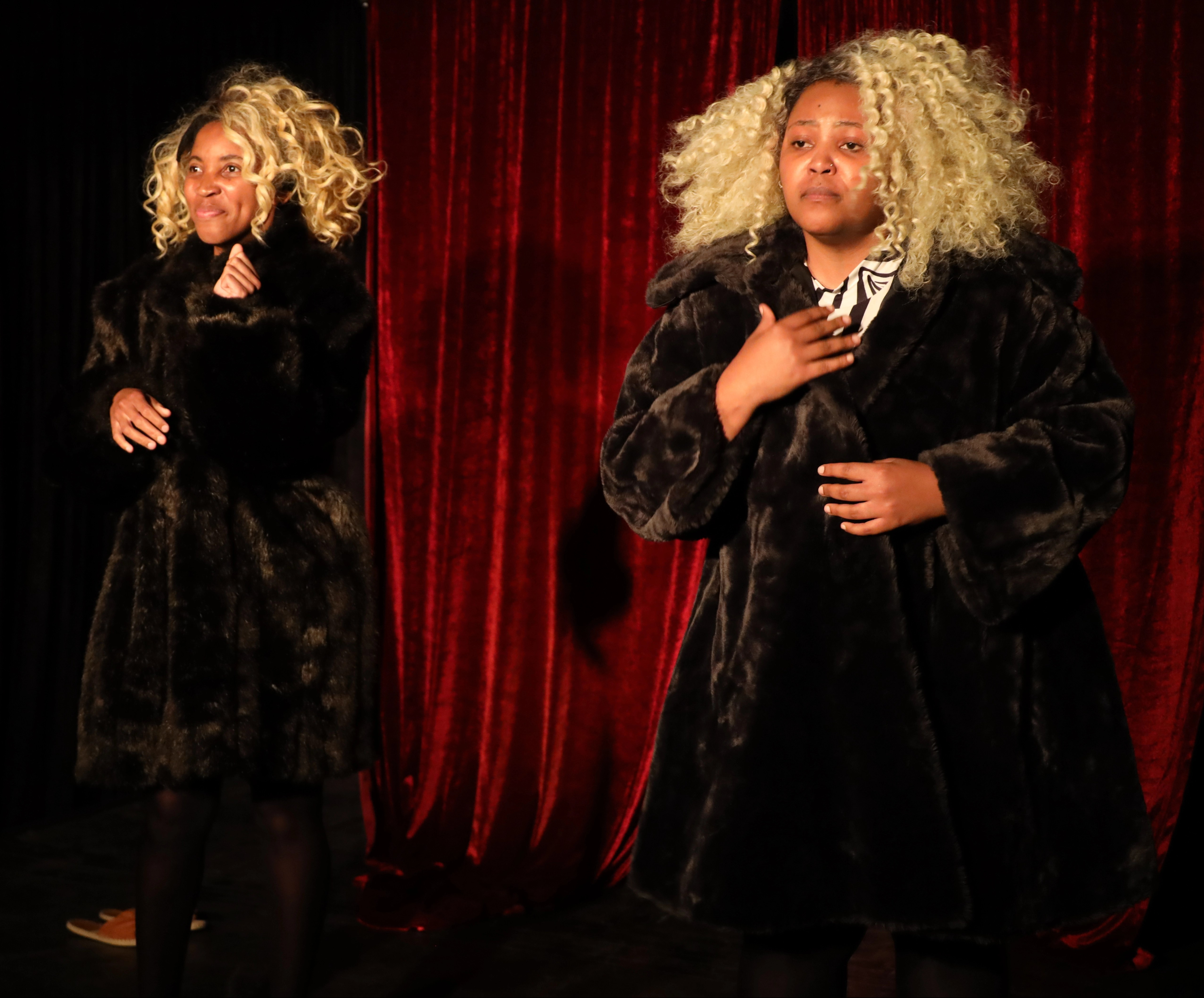
Ketsia Velaphi in Tankiso Mamabolo’s Don’t Believe a Word I Say.
Teksmark has been running for a few years now in Cape Town (see previous post) and recently KKNK CEO Hugo Theart decided it was time for Gauteng (with the helpof the well placed Foxwood team providing the venue) to show their stripes – and predictably, they came out in full force. DIANE DE BEER picks a few personal favourites:
Teksmark has been one of my favourite outings from the start because it keeps me in touch with new (and often young) playwrights, what they are thinking about and how they find the words to tell their story.
It has also opened the KKNK’s profile to embrace a much larger slice of the arts and in this somewhat geographically challenged country of ours, we need everyone in the arts community to reach out and hold hands. We have amazing stories to tell, but the audiences are limited and the cohesion of the arts community, nationally, is important.

Director and playwright Obett Motaung (centre with microphone) in conversation with CEO Hugo Theart and his cast.
Obett Motaung cleverly started with a catchy title, A Street Taxi Named Desiree, and plaed with just that. The play is a series of sketches with taxis as the hot and happening topic.
What he does especially smartly is use all the South African tropes that everyone will recognise even those who never use taxis. Coldrinks? Does anyone not know what that means when for example a traffic cop or policeman stops you?
Or the rules that are there, yet not for taxi drivers? The fact that everyone recognised these foibles in the room, says much about the South African landscape.
And this is also what made this such a smart piece of writing. It grabs you with laughter yet slips in quite a few serious issues, again, instantly recognisable.

We all know or perhaps think we know the problems special needs individuals face on a daily basis. Some of that is captured in Christo Davids’ courageous text which has him facing rather than ignoring the problems.
His play titled Laaittie Mettie Biscuits is about a differently-wired young man who gets into trouble with the police and because of a misunderstanding and the difficulty society has of dealing with anyone or anything that isn’t “normal”, things quickly get out of hand.
And making the point even more sharply, following the reading, most of the discussion was focussed on the need of a Down syndrome individual to be cast in the role. Anything else would defeat the purpose of the story, no matter the challenges.
Asked about his reason for writing the play, Davids explained that he hoped to spark a different conversation or at least, thinking about people who because of different physical or mental challenges have to operate in a world that didn’t easily acknowledge and make provision for them.
Holding a mirror to society is one of the many positives of theatre and no more so than with this truly brave attempt. Let’s hope that we see it given life on stage.

Playwright Tankiso Mamabolo’s says Don’t Believe a Word I Say was written as a play on memory and how we often embellish these remembrances over time, to protect us from trauma or to fill in the gaps that have appeared over time.
She had everyone delighted when she pointed out that the play was written in the style of ADHD, wrote it in fact in exactly the way she thinks – and luckily for those of us watching, she has an imaginative mind worth interrogating.
What do we choose to remember and what devices do we use to reach back? These are the issues she spotlights.
“I have a team of black women dissecting, reminiscing and recreating black girlhood in a way that utilises humour without dehumanising black girls and instead focusses on the nuances of their vulnerabilities with the complete understanding that they are complete bad asses. I wrote a play about my childhood that gives voice to parts of black girlhood that are often overlooked eg, we also can be hopeless romantics despite of the world and what is happening around us.”
And in the process, she gave everyone a lesson in how to present their play. This is someone who knows what to do with an opportunity and I can see it paying off – as does her play.
It’s fun as Tankiso explained, she was featuring young black women, usually an ignored section of society – and think about that! She already has an audience right off. And with her talent, there will be more. She’s got what it takes.
Farce has never been my favourite medium but if anyone can pull it off, it is Nico Luwes. And knowing all the rules to get things off on the wrong foot, which is the key to any farce, Nico also made sure the best ingredient for this kind of performance was in place – the cast.

He pulled out all the stops with Koebaai, ou Koba!: Henrietta Gryffenberg, Tobie Cronje, Elzabé Zietsman, Pietie Beyers, Rina Nienaber, Gert van Niekerk, Peter Terry and Ryno Hattingh, all veterans in the business and some not seen on stage for a very long time.
But the names are recognisable and an audience is out there waiting. They will be salivating to see this ensemble – and we could see why. Yes it will cost, they won’t make much money, but they will draw the crowds.
That’s the thing about this kind of theatre. Because it is sometimes viewed as an easy ask, not enough attention is paid to the staging and performers. But if you do it right, you have a winner as the director/playwright proved here.

When everything comes together in a play, it always makes you smile. That’s what happened with Op Die Hoek Van Styx en River is Nora Per Abuis Met die Dood Oorgeslaan written by Henque Heymans staged with actors Grethe Brazelle and David Viviers who meet at some point between life and a transfer to another place.
Their conversation is all about misunderstanding. The instructor is bored with a conversation she has regularly, while the listener doesn’t know that she’s died. This sudden meeting has her completely perplexed.
It’s confusion which turns into a conversation of much merriment and originality.
And as I run out of space, I want to include two more remarkable participants: Jane Mpholo’s And…Action! who wanted to sketch South Africa in full colour but in a bantering, light way, yet still including bite; and another example of how the Teksmark works, Ek Sal Jou Leer Om Die Melk Te Deel, a play that was accepted previously and now with some work, was featured again most successfully. With a theme of mothers raising the children of others, while not having enough time with her own, it’s something that touches all South Africans in different ways. And again, it makes everyone think especially playwright Lwanda Sindaphi who kept reworking.

As you can see, it is about the people and the plays, the topics that are addressed and argued about, the potential that is discovered and nurtured – and in conclusion, the general health of the theatre industry.
How can we not celebrate?
(Thanks to KKNK, NATi, Foxwood and ATKV.)

 De Beer Necessities