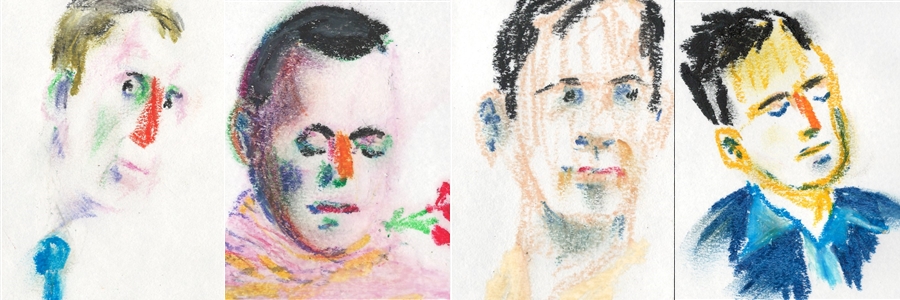
Author Justin Fox, as DIANE DE BEER discovers when speaking to him about his latest book, Place South African Literary Journey (published by UMUZI) at Garsfontein’s Boekeplek & Kuierplek, has a mind as restless as his wanderlust:
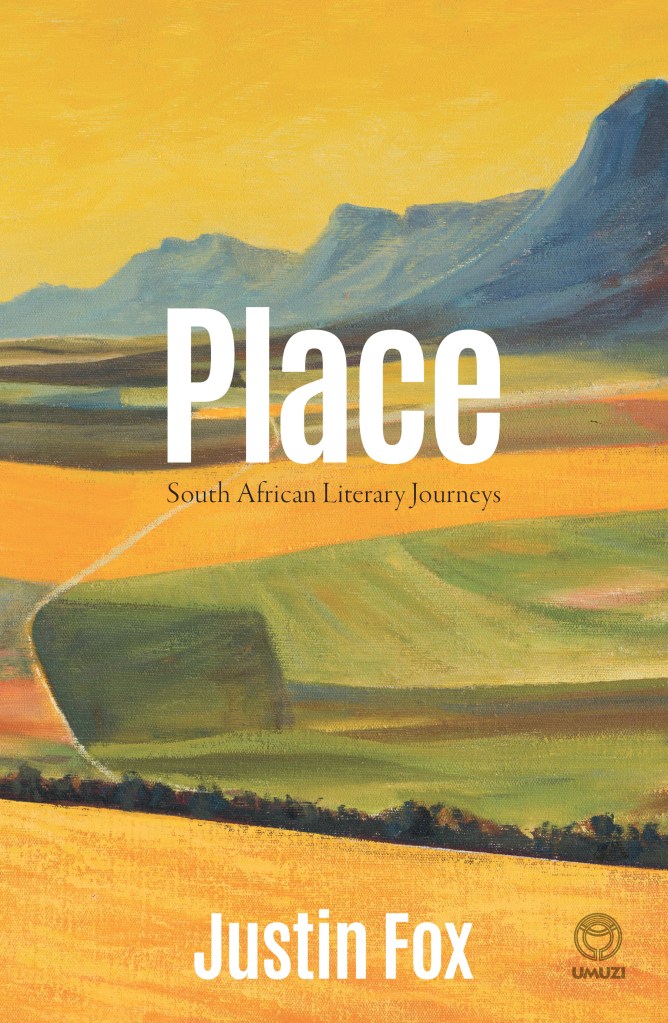
The cover is a painting by Erik Laubscher titled Overberg Landscape.
When you are sent a book and asked by a publisher to help with the launch in your city, your first instinct, especially if you don’t know the author, which I didn’t in this instance, is to hope that you won’t hate the writing or the book for that matter.
Up to now, I have been blessed and again, Justin Fox’s Place is one that I thoroughly enjoyed. I loved the writing, found it a wonderfully original concept and the reading very accessible.
What this author did was to select nine authors whose writing he found to be determined by a specific landscape or place, capturing the spirit, hence the name and the idea. Think, for example, of someone like Herman Charles Bosman and your mind automatically reaches for the Marico or Dalene Matthee’s passionate love affair so inextricably linked with the Knysna forest.
Zakes Mda with his Heart of Redness is nestled on the Wild Coast, JM Coetzee has Michael K traveling and hiding in the Moordenaars Karoo and Olive Schreiner’s Story of an African Farm has its footprint in the Eastern Karoo.
The Lowveld is Jock of the Bushveld’s stomping ground, Deneys Reitz’s adventures, Justin narrowed down to the invasion of the Cape with Eugene Marais finding solace with his baboons in Waterberg.
The only one I wasn’t familiar with and the author with whom Justin perhaps identified with most strongly is Stephen Watson, who had a strong affinity with the Cederberg.

Wondering if he had qualms about not having the perfect representation, he admitted it was something he thought about, and he did try. He had to rely on authors who had a special affinity with a particular landscape or region, which was reflected in their writing.
With this mix, he also spread the love throughout the country geographically and in the end, that’s what determined his choice.
When first reading the book and seeing that it was In Memoriam of Uys Krige, I wondered whether he was related to actress Grethe Fox, whom I have encountered in my theatre writing. And of course, she is his sister and joins him (as he writes) on one of his author adventures.
They are indeed a family truly invested in the arts. Justin’s father is the architect Revel Fox and his mother is Uys Krige’s sister, then there’s also a filmmaker … and the list goes on. And then he divulges the family secret. His grandmother Sannie Uys was determined to guide everyone in the family into the arts.
In fact, she felt this so strongly that it was highly frowned upon if someone decided to turn to medicine or law, for example! Especially in terms of for the richness of the arts, wouldn’t this country flourish if there were more of these kinds of grandmothers? Anyone linked to the arts in even a minor way will know how a life is enriched.

The Geelbek Blockhouse also features in the book.
The wealth of artists in one family when taking a peek at their family tree starts to make sense. That and Justin’s particular bent and imaginative mind. There’s not much he hasn’t tried in the artistic sphere of witing. He is listed as a travel writer, novelist, poet and photographer and, as the former editor of Getaway magazine, he could easily include most of his passions in his daily life. And now, having left them, it’s easy to see how he keeps doing what he does – writing mostly books.
For Place, for example, he travelled to all the places of his chosen authors so that he could not only write from his research on the authors but also experience the place for himself. And that’s what makes this such an intriguing read. It’s as though he has aimed his skills sharply for this endeavour – and it serves him and his reader well.
Even someone like Dalene Matthee’s favoured region (which is close to where I spent my youth) came with new insight from this reading. And probably much of this can be linked to the fact that Justin has “itchy feet”, but also that the research is what really inspires him. It is what he enjoys most and what obviously informs and enriches his writing.
Having travelled the length and breadth of Africa during his former life as a journalist also brings much knowledge to bear. And then probably his writing was further nourished and polished by his doctorate in English at Oxford as well as his time as a research fellow at the University of Cape Town. But don’t expect to find a bookish approach to his storytelling or his writing. The way he uses language is one of the joys of the reading experience.
His latest endeavour or, perhaps more accurately, the one he is hoping will receive more attention is the two books already finished and hopefully a handful to come of his fictional World War 2 novels with Jack Pembroke as the hero. Justin describes himself as a Jack of all trades, but that’s underselling his expertise.
He ascribes his writing in so many different genres (google his writing history) as “getting bored quickly”. His favourite author is Patrick O’Brian whom he describes amusingly as “Jane Austen at sea”, as well as crime stories, and then of course he loves reading anything about World War 2, hence the fictional series in which he focusses on adventures from the war, unfamiliar to many. The current one with a South African focus is a battle that has been forgotten by many.
His next focus is African islands which he hopes will have the same impact as Place, which has already sold out.

“I’m a nomad,” he says, and he concedes he has the bug worse than most. And while writing per se is not his happy place, the research, edit and travel to promote his latest invention all find favour. And that’s where his drive comes from and his determination to escape into another adventure – whether fiction or non-fiction. I’m crossing fingers that the current book, Place, will be so popular that the publishers consider a colour version richly illustrated with Justin’s photographs. That was the only missing element for me. His writing takes you to the places he describes so imaginatively and there are a handful of black and white pictures. I realise it was an issue of cost, but still …

 De Beer Necessities