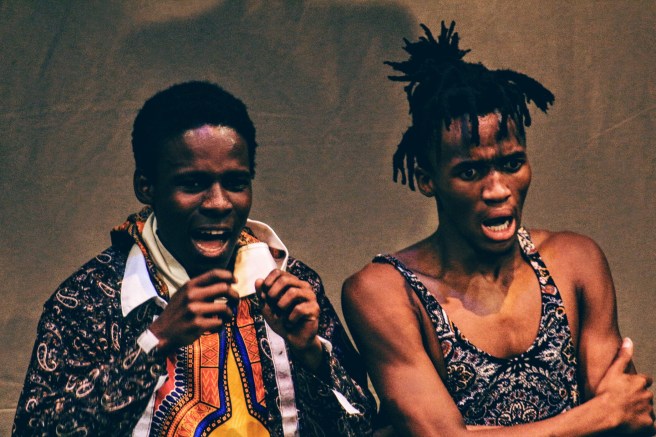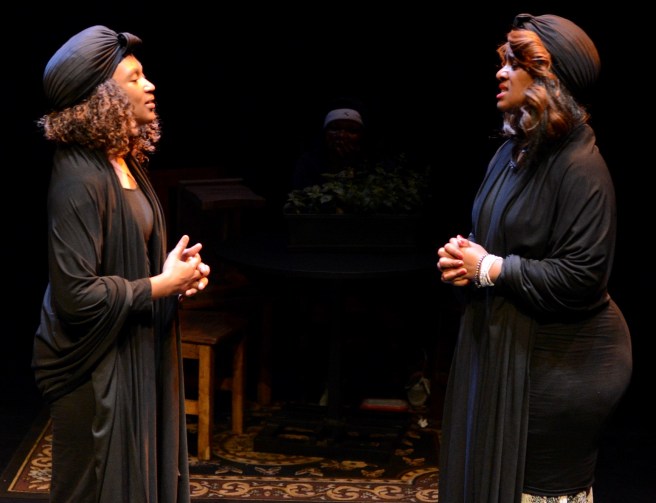
The Colour Purple is Bold, Black and Beautiful

Pictures: @enroCpics


DIANE DE BEER


color purple7
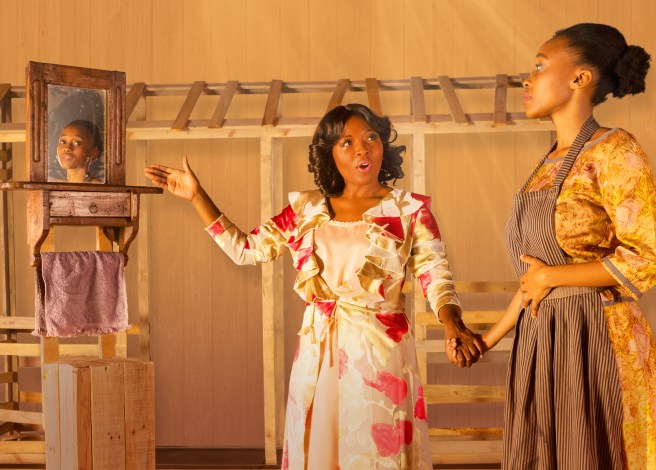
Shug Avery (Lerato Mvelase) leads the pack in The Color Purple


THE COLOR PURPLE

DIRECTOR: Janice Honeyman

CAST: Didintle Khunou (Celie), Lerato Mvelase (Shug Avery), Aubrey Poo (Mister), Neo Motaung (Sofia), Sebe Leotlela (Nettie), Yamikani Mahaka-Phiri (Harpo) and the rest of the 20-strong ensemble

EXECUTIVE PRODUCER: Bernard Jay

PRODUCTION DESIGNER: Sarah Roberts

RESIDENT DIRECTOR: Timothy LeRoux

LIGHTING DESIGNER: Mannie Mannim

SOUND DESIGNER: Richard Smith

MUSICAL DIRECTOR: Rowan Bakker (and part of an orchestra of 8)

CHORO0EGRAPHER: Oscar Buthelezi

VENUE: Nelson Mandela at the Joburg Theatre

DATES: Until March 4


It’s always a gamble these huge musical productions but following Dream Girls and King Kong specifically, we have built up enough of a track record to understand that we can pull it off.
color purple6
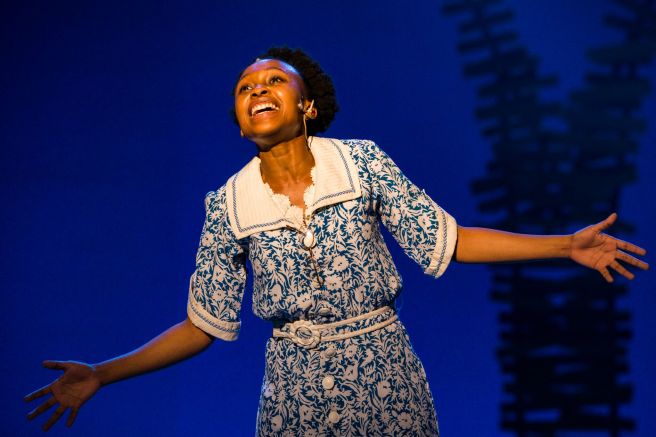
Didintle Khunou as the indomitable Celie in The Color Purple.

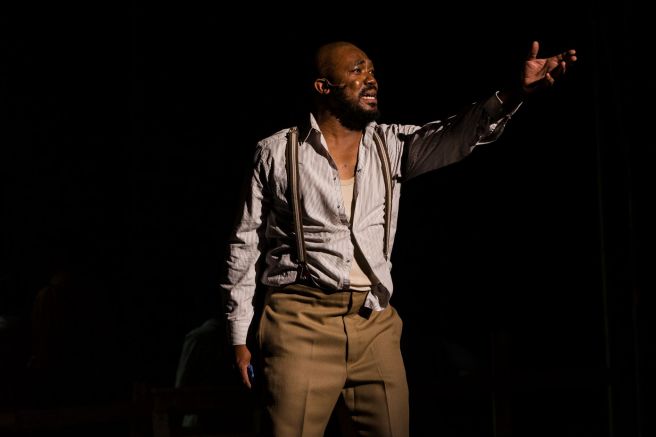
And as this one proves incontrovertibly, we easily have the depth of performance talent. This is BIG music, but what that means is that it gives a musical veteran like Aubrey Poo an opportunity to sing a number like Celie’s Curse as he has never sung before – and he has had many amazing moments on stage in the past, but here he lets rip with an emotional heft that is completely in sync with the character. On the other side of the spectrum, it gives a solo newcomer like Didintle Khunou the chance to shine as she takes Celie and gives the character life. Both make these moments majestically their own – again and again.
color purple5
Aubrey Poo as Mister opting for change in Celie’s Curse.

As a musical, it is the perfect storm for right now. Based on the acclaimed Alice Walker story, the reach is wide and covers a multitude of sins, including substance, gender and domestic abuse so dominant in our current world which is what makes this such a relevant piece.

In our country with so much strife, a celebration of especially black talent in a world where the stories are still told from a predominantly white point of view is important and poignant, hence the magical reaction and participation of the audience. There was no doubt about their appreciation of what they were encountering on stage.

And rightly so. For audiences, this is a musical to get stuck into. It’s not about pretty songs and lively dancing. It’s grappling with intense emotions while telling a story of a young girl who after being raped by her father resulting in two pregnancies, is given to a brutal man who treats her in similar fashion. She’s his to look after and he can do with her as he wishes. She has absolutely no say in the matter.
color purple3
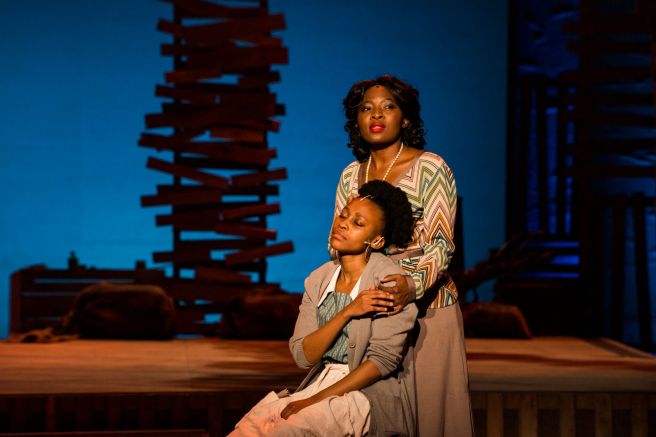
Didintle Khunou as Celie (front) with Lerato Mvelase as Shug Avery.

Anyone who could bring some light into her days is banished, like her sister Nettie, with Mister (her husband) making sure she never hears from her again. It’s a miserable life still experienced by so many voiceless in this world.

While abuse tops the list, many other issues are dealt with, including refugees – a problem of our time, but as this one shows, nothing new. But even in the worst of times, redemption is a possibility and that is what gives this musical its power. People can step up and change and others can embrace the moment in all its authenticity. It’s a musical with quite a few teary moments – which is not the norm with these kinds of spectacles.

Speaking to some of the soloists beforehand, all of them commented on the music and how tough these songs are to sing. But they have stepped up and inhabited the music – all of them, soloists and ensembles included.

color purple8

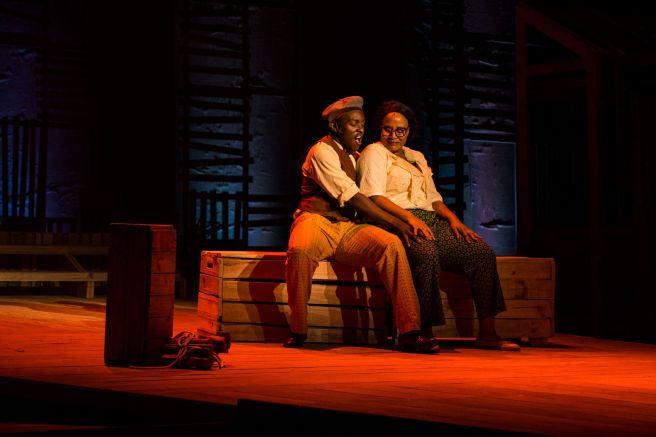
From the chorus of three women (Lelo Ramasimong, Dolly Louw, Ayanda Sibisi) who throughout comment sharply on what is on their mind, to Khunou as the earnest Celie and Mvelase as the flamboyant Shug Avery, the show-stopping Any Little Thing by Sofia (Motaung) and Harpo (Mahaka-Phiri), which brings much needed light relief, while Leotlela taps into her emotions as Nettie when she tells her sister about her children, it’s musical heaven.
color purple4
Harpo (Yamikani Mahaka-Phiri) and Sofia (Neo Motaung) performing the glorious Any Little Thing.

With a stunning set design, which is uncluttered and allows the lighting to tell magnificent tales, to the choreography that pushes boundaries, underpinned by the Honeyman staging which pulls the story together – which is no easy task – this is a sublime coming together of all the elements.

It is a musical where you have to engage, you have to listen to the lyrics and allow the performers to take over with their emotions in full flow. It’s high notes and low in both song and understanding, it’s detailed with heaps of humanity first trampled on and then celebrated.

And in the South African context, it’s about time. We have so many stories to tell and with our diversity at the forefront, it should cover the full spectrum and allow everyone to shine as they do on that stage.

It’s truly glorious to experience how we take a universal story and make it our own.

Halleluja!

Survivor’s Story of Fight Against the Islamic State and Hope to be The Last Girl

Diane de Beer

The Last Girl: My Story of Captivity and my Fight Against The Islamic State by Nadia Murad and Jenna Krajeski (foreword by Amal Clooney) (Virago):

The-Last-Girl_

We read the headlines and we see the awful images, especially those horrific beheadings but then a mudslide, another refugee crisis, drownings in the Mediterranean Sea or a Trump tweet swamp the news cycle and the ISIS terror falls through the cracks.

They were topping all the news broadcasts at a specific time but only in very specific instances. We knew much more of those leaving their own safe homes in the UK and Europe to join the Islamic fighters in their endeavours to establish a caliphate than about the people in the devastated countries like Syria and Iraq.

But it is these little lives – those we don’t read about, those who lose everything and have never had a voice – who have to live the everyday horror on the ground of what it means to become part of the statistics of these terror groups that have only their ideology (power and money) to dictate their actions.

Humanity isn’t part of what they believe which is a scary thing when you are at their mercy.

This is the story of one of the voiceless women snatched from everything she ever knew to be a sex slave for men who had all might on their side and believed they had the go-ahead of the Koran to do their worst. Nothing could stop them.

Nadia Murad was born and raised in Kocho, a small village of farmers and shepherds in northern Iraq. She is a member of the Yazidi community and with her brothers and sisters lived a quiet and quite isolated life.

On August 15, 2014 when she was just 21 years old, life as she knew and loved it, ended abruptly. Even though the village had been waiting for the Islamic State militants who were on the march in the region, no one could have predicted what was about to happen to this community.

Already regarded as a fringe of a fringe community in the wider Iraq, they believed their Arab and Iraqi neighbouring villagers would step in and come to their aid. But they were left on their own without any chance of survival. Nothing could have prepared Nadia for the devastation and emotional upheaval of her life.

Scenes of the holocaust and people being pulled from one another without any warning, or simply shot if there was any resistance, play out in your imagination as you follow this story of a young girl who had hardly ever set foot outside her village.

Once the rape begins, it isn’t only the horror of that brutality that is overwhelming but also her belief and being told that her family would reject her because she is no longer a virgin and it won’t help for any of them to escape. In the end they would be killed by friend or foe.

Survival is part of our genes and this is also how it plays out here in even the direst circumstances. Nadia never stops fighting for her life. She knows even with her family decimated, that she wants to go on, fight the good fight and tell the world what is happening to the tiny Yazidi community that is in the last spasms before being obliterated.

The frightening thing about Nadia’s story is that it is happening today in a time where no one goes unseen. But there’s so much going on, countries devastated, people wiped out by other people or natural disasters, that we can hardly keep up. So even if the means are available, the audience is overwhelmed.

Think of Rwanda. Nadia herself makes that comparison, saying that never in her life would she have thought her horrors would be compared to that of Rwandan women. It is like a cycle repeating itself over and over again and the picture is of course far bigger than this one small corner of Iraq where ISIS has now been removed to go and battle and sow chaos somewhere else.

But Nadia has done this the way that works best. She wanted to tell her story, to bring justice to her world, not to allow the Islamic State militants to further their reign of terror and to make people pay attention – one story at a time.

It must come to that or it simply becomes a mass of horror. It’s like the body of the small boy that washed ashore that stopped everyone in their tracks – for a moment at least.

Learning about the Yazidi people, listening to Nadia explain how fractured Iraq is since the fall of Saddam, understanding when she notes how ISIS occupied the roads in these outlying regions which meant that they controlled all the movement. There was no other way in or out.

This is a story not only of the atrocities but also of a country that has splintered into tiny pieces with everyone fighting and mistrusting each other and even the larger groups we are aware of, consisting of infighting, splinter collectives.

It’s madness and in amongst this, real lives are battered and destroyed. Nadia has become an activist and a Goodwill Ambassador for the United Nations but every time she tells her story – and that is often what she does – she relives the horror of every rape and the loss of every member of her family and friends.

She also remembers how they searched the horizon for help, how they hoped above all that their neighbours would be there for them. It’s an anger and a mistrust that is difficult to curb to the point where she couldn’t speak Kurdish once she managed to escape even when it meant it could save her life.

That’s what happens in these circumstances when the world turns its back.

“More than anything else,” concludes Nadia in this astonishing book, “I want to be the last girl in the world with a story like mine.”

Hence the title and the reason you should take the time and read her story.

This is our world – sadly.

The Color Purple – a Musical of our Time

TheColorPurple 07
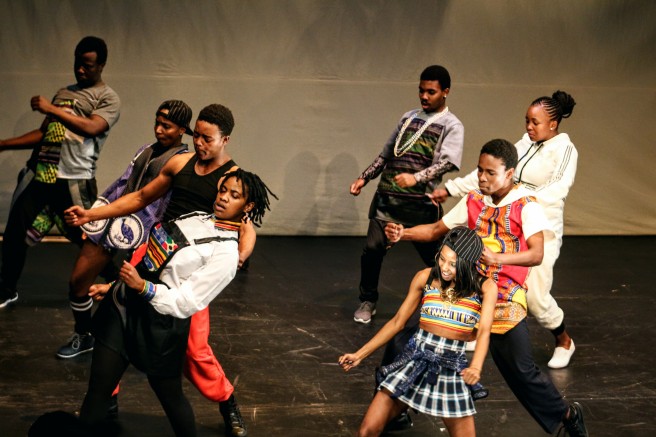
Africa Scene ensemble

Pictures: enroCpics (Corné Du Plessis)

The Color Purple; The Musical opens at the Joburg Theatre this week. Director Janice Honeyman and three of the soloists speak to DIANE DE BEER about the challenges of both the singing and storytelling in what has become an iconic production which many have attempted to stage locally – but this is the first time and arguably, the right time:


“Begeisterd” is what Janice Honeyman felt when she first saw The Color Purple.

Based on the classic cult novel by Alice Walker, she feels strongly that it speaks accurately about the black experience and reflects the influences so evocatively with the build-up and then final release of Celie. The young African American girl is the focus of this provocative story which deals with hardship and anguish yet finally joy, with abuse focussed on in the harshest light. It couldn’t reflect our times more aptly.

But, notes the experienced director, as a production, the storytelling leaves no room for manoeuvre. And that is what she loves best. The story is what propels the musical forward and that’s what she is intent on honouring in this production which has finally made it to local shores.

It’s about the top dog, people in power, feeling entitled to abuse those without voice. It’s a huge story that goes beyond gender and race and it’s a story of our time – as it has been through the ages. “It’s a story of the heart that has nothing to do with separatism,” she concludes as she gives a thumbs up to her talented cast – which she always is so good at putting up and then pulling together.

For all three the soloists, the joy and the challenges of this show go hand in hand.

TheColorPurple 06
Shug Avery (left) and Celie (right)

In the pain of the story of The Color Purple, there’s joy, says Lerato Mvelase who plays Avery Shug, the jazz singer, who becomes Celie’s (Didintle Khunou) friend and support.

When retelling this story of violence and abuse written in 1982 and filmed by Steven Spielberg in 1985, it shines a light on the  friendship and support of the women that drive the story strongly. Could it be staged at a better time? It’s now when women all over the world are reaching out to one another to break cycles of abuse that seemed never-ending looking back.

Bringing it closer to home, wi.th our high incidence of violence and abuse against women, this coming together of the women in The Color Purple tells a story many can relate to.

TheColorPurple 01
Lerato Mvelase as Shug Avery (centre) with ensemble

But, says Mvelase, who we last saw as Petal in the glorious King Kong, it’s the music that has her excited and energised. “I thought I knew it all,” she explains. “I am personally challenged not only by the people in the room, the magnificent voices, but also by the music. I am singing notes I thought were impossible,” she says about her newly-discovered range.

“It’s humbling to work on your craft in a story that is still of this time.”

“It will help us all to heal, reflect and take something away to think about,” she adds. She thinks there are many things confronted in this story that we turn away from. “It’s an extremely emotional show that underlines that no matter what we go through, there’s always laughter.”

Questions arise from the show including those so part of the zeitgeist. “What has been done to our women? But also, what have men endured to become who they are,” she continues.

Her character, Shug Avery, is the one who best embodies these dilemmas. “She has been rejected by her own people but through her liberation, the other women are given the key. They don’t know how,” says Mvelase, “but once Shug has their attention, men and women start relating to one another.”

Attention is what the auditions brought a young Didintle Khunou who plays Celie in her first solo role in this big a production. But she’s not flustered and obviously up for the challenge. As a Wits drama graduate, she has maintained her singing lessons because she knows growing as an artist is a process and she wanted to work on her craft in all areas.

She’s excited about participating in this story of oppression and liberation which her Celie so embodies. And she loves the fact that in this time of strength for women, it is a musical and a story that shows exactly that. “That’s where the focus lies.”

TheColorPurple 04
Mister (Aubrey Poo)and Celie, plus ensemble

Celie was raped and abused from the age of 14 – first by her daddy and then her husband who her father sold her to, called simply Mister.

In response to playing this aggressive, abusive character in these times of sensitivity, Aubrey Poo had to dig deep to find the source of this man’s hatred and harshness towards others. But with Mister coming from a place of slavery (and simply understanding how African American men are still treated in their own country), gave him understanding and a place to work from. It takes time for those things to change says Poo and this is how he crafted his character.

Like his two fellow artists, he is hugely excited about the score. “It’s a tough one though. It’s beautiful music but a challenge to sing. It’s quite high for my voice but very cleverly written,” he believes.

It’s interesting that after so many years (arguably decades), it is now that The Color Purple will finally be staged locally. It wasn’t planned this way, but that’s why certain stories are classics, as they stand the test of time – and can usually slot into a specific period. But, it could hardly be more appropriate than right now.

TheColorPurple 09
Shug Avery (pink pants) and Harpo (Yamikani ). Celie is at the sewing machine. with the female ensemble in dance


And while the story is set in the US, the two countries share so many similarities in their dire record of race relations that this story plays out with authenticity.

But locally, the excitement of The Color Purple is also the cast. Many of these performers have been given their first big chance and just listening to some of the big sounds, it’s no great risk to predict that they are going to rock their audience.

And if by any chance you think the topic is too much to handle in a musical, think Sarafina. It doesn’t get much heavier than that.

  • Tickets are available now: phone 0861 670 670, go online at joburgtheatre.com or book in person at the Joburg Theatre box office.  Theatre patrons can also pay at selected Pick N Pay stores. Show runs at the Joburg Theatre on the Mandela Stage until March 4.


Tshwane Foodie Adventures Plentiful in The Village Where the Mood is Mellow

Platter of dimsum
Platter of dimsum at Cowfish

DIANE DE BEER

Tshwane has become quite the foodie town in the new millennium and its playing power is diversity. There’s not much you’re not going to find in the capital city when talking cuisine.

The latest stomping ground, for the past two years at least but still growing and evolving, is an area called The Village in Hazelwood. There are many favourites starting with the Italian granddaddy, Alfie’s Italian Café in Hazelwood Road as well as its offshoot just around the corner, Alfie’s Pizzeria and Deli in 16th street.

On either side, there’s Salt that offers modern deli fare and Culture Club – Bar de Tapas that does a mean and very generous tapas menu as well as one of the popular Burger Bistros (the original is in Pierneef Street, Villieria).

The feel of The Village is modern, it’s young without being exclusionary, the prices are competitive, and the service is attentive overall. Parking is available and the mood is mellow especially on warm Pretoria nights.

The thing about The Village is the ambience. Starting in Hazelwood Road and turning into 16th Street, which is dedicated to different dining options, it represents smart pavement eating, which – with Pretoria’s fair weather – is simply the best.

In the past, because of some archaic laws, very few restaurants had an outside option, but it has become almost obligatory and suits this area to a T. The selection on all fronts is great, and you can pick something to suit your fetish for that day or night. Meals can be gargantuan or a light lunch, it’s all out there on a platter for you to sample.

Perhaps for the moment, it captures Pretoria’s strengths best. This is truly fine modern dining from hamburgers to pizzas to Portuguese balachau to Asian inspired cuisine, pasta and freshly baked breads and patisserie.

Two of the youngest kids on the block are the Portuguese flavoured Ozé Café & Bistro and Cowfish, which specialises in meat and fish.

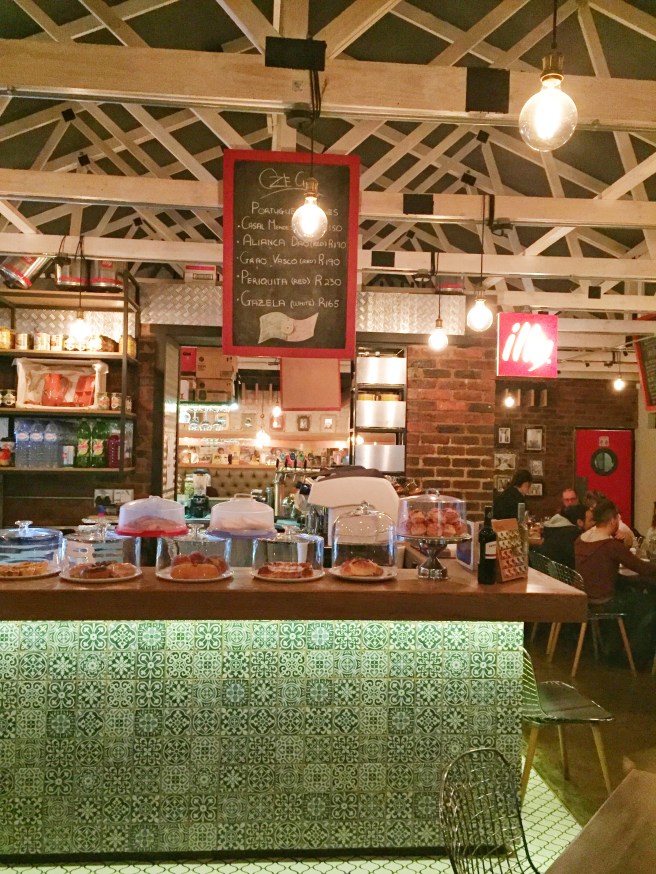
Oze interior
Ozé Café and Bistro
  • Ozé Café and Bistro, 24 16th Street, Hazelwood, Pretoria; Tel: 012 346 0150

If Portuguese is your preference, the menu is modern with a good smattering of both fish and meat. It was a fishy day for us and we opted for the sardine starter and one portion of prawns to share. They didn’t have either clams or the tentacles for the octopus salad but perhaps the festive season played havoc with availability.

The sardines, a special on the day, were extraordinary with a helping of boiled potatoes and veggies. Everything seemed very straightforward with quality ingredients doing the trick. It was the perfect choice, followed by a half-serving of the smaller portion (250g) of prawns, grilled to perfection as the menu said it would be, served with a salad. But there was a choice if you favoured chips for example.

All we needed to conclude the meal was something sweet, and again their donuts weren’t available but that wasn’t a train smash with a serving of pastéis de nata (two mini pastries per portion) not to be missed. It was one of the best I’ve had and a sweet conclusion to a lovely lunch.

Oze's pasteis de nata
Oze’s Pasteis de Nata

With a cocktail bar on the premises, their drinks menu is innovative and fun with a wine list that offers different by-the-glass options.

If meat is your food of choice, the delights are many with chourico, chicken livers, trinchado and buffalo wings on the starter menu and for mains, chicken or beef espetada or the usual steak options (300g) with a choice of either fresh cut chips, boiled potatoes, mixed vegetables, Pretoria’s ubiquitous creamed spinach, or Portuguese salad or rice.

I am also tempted by some of their sandwiches like the Portuguese bun layered with cured chourico and Terra Nostra cheese or the Portuguese French Toast (Rabanadas), buttermilk dipped, fresh cut strawberries, bacon, maple syrup and mascarpone cream. It sounds deliciously decadent.

Our bill with a tip was R400 which included two coffees (R40) as well as the drinks (wine R60, Bloody Mary, R40). That’s not a bad deal.

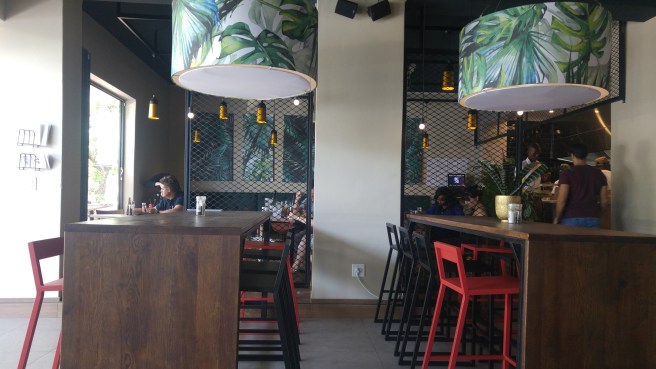
Cowfish interiors
Cowfish Interiors
  • Cowfish, 11 Hazelwood Road, Hazelwood, Pretoria; 074 111 8033

As the name suggests, Cowfish has a menu which represents a specific spectrum, with the accent on hamburgers, sushi, dim sum, signature plates and cocktails – arguably an odd mix and yet, it opens up a choice which in its quirkiness allows for a fun meal. It also encourages sharing, with, for example, a dim sum platter (R165) which was our first choice with the possibility of something else to follow.

We selected the 9-piece platter with three flavours of our choice which included beef, lamb potsticker, pork and shrimp, prawn and cream cheese, chicken, coriander and cashew nuts or chicken, ginger and spring onion or a dim sum classic, sui mai  (prawn, chicken and tobiko). For vegetarians, they have spinach, cream cheese and spring onion. It’s a broad selection and will take a few tries for you to find your favourites.

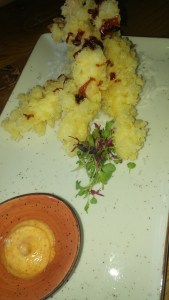
Prawn tempura at Cowfish

It was a great start to the meal, but we were ready for another small bite with the prawn tempura (three crispy prawns served with Teriyaki sauce, creamy spice and mayo, R110) a winner.

They were almost too pretty to eat and a smart accompaniment to the dim sum.

But we had only sampled a minor selection of a menu that is as intriguing as it is imaginative. Their signature plates, for example, include a tomahawk steak (ribeye on the bone – 600g – which offers great presentation and bulk), ribs (wok-grilled pork ribs served with a chilli soya barbeque basting), chicken Katsu (crispy fried chicken strips in Japanese breadcrumbs and plum sauce) and a Teriyaki salmon steak.

The hamburger menu is also enticing with a Kaizer cheese, Ravenous Pig and Belfast Boy all begging for closer inspection as do their salted prawns and squid salad or their Vietnamese calamari.

On the sweet side they have Kawasura rolls (spring rolls filled with strawberry, hazelnuts, dark and white chocolate served with ice cream), deep-fried ice cream or chocolate meltdown. They specialise in cocktails but also have a fair selection of wine and beer which is good to go with the hamburgers.

It’s a laid-back, easy vibe, the staff are friendly and attentive and with both these options, I’ll return for more foodie adventures.


The Anticipation of a New Drama Company through Collaboration with Market Lab and Windybrow Art Centre

If you don’t know anything g about the Market Theatre Laboratory in Newtown, it means you haven’t been paying attention. Some of our top talent in the acting world – from directors to actors – come from this rich and diverse training school established as a training and development arm for the Market Theatre. DIANE DE BEER spoke to the head of the Market Lab, the innovative Clara Vaughan about their latest endeavours and plans for 2018 and it’s all systems go right from the start with all kinds of new plans being hatched and executed:


clara-headshot.jpeg
Clara Vaughan, head of the Market Lab

The big news at the Market Theatre Laboratory in 2018 is the launch of a new drama company, in collaboration with the Windybrow Arts Centre.“We’re currently busy with auditions,” says Clara Vaughan, head of the Market Lab, who hopes that for a few of their graduates (from the past five years), this will function as a bridge at the beginning of their professional lives.

“For actors there are no structures in place,” she argues and especially for the newbies, this is a tough ask at the start of what is usually a taxing if rewarding career choice.

The company which will be based at the Windybrow Art Centre, will consist of six young people, four from the Lab and two from other institutions. Vaughan is excited, for example, that two of the UK actors who had participated in the Lab/UK collaboration have also applied.

The Market Theatre Foundation has appointed Keituletse “Keitu” Gwangwa, daughter of legendary SA jazz musician Jonas Gwangwa and social activist Violet Gwangwa, as the head of the Windybrow Arts Centre. She will be running the company with Vaughan and the Market Lab contributing to programming, partnerships and operations.

The Centre has been given a new lease on life as a division of the Market Theatre Foundation since April 2016. The once-mothballed theatre has been refurbished and now brands itself with the tagline “More than just a theatre” to reflect the changing nature of the space including as a base for the newly-launched drama company (still in search of a catchy name).

The programme for the company will be one of productions as well as workshops and teaching opportunities and the aim is to select six people who have the skills to work without outside intervention, while certain exciting individuals will be introduced on specific programmes.

Lab class pic
The Market Lab students in action.

One of these already in the planning stages is the current recipient of the Julie Taymor World Theatre fellowship, with the founding principle to provide travel opportunities for enterprising young theatre directors to immerse themselves in artistic experiences beyond the US borders thereby expanding their creative horisons.

He will be doing The Comedy of Errors with the company in collaboration with PopArt.

They are also looking at a site-specific work to investigate the history of this historic landmark building that will become their home for a year.


All kinds of collaborations are already envisioned with, for example, Gerard Bester and the Hillbrow Theatre Community Centre.

Vaughan knows that working in the same area both geographically and philosophically, they want to make sure they are complementing rather than replicating services. “There’s such a need,” she says and that’s what they hope to serve.

rm-theatre.jpg
The Ramolao Makhene Theatre Theatre at the Market Theatre Square in Newtown

Similarly, the actors will benefit from the teaching experience – as some of the Lab students already have when participating in the Hillbrow Theatre’s Inner-City festival, discovering their skills and love for directing, for example. “One of our students co-directed the winning production last year,” she notes.

These are just some of ways the students and graduates are guided gently into the industry where possible. It also opens learning experiences for those who will become part of the company to work with one company of actors for a full year in a diversity of projects, the value of which should not be underestimated and something that is regarded as a necessity in the industry in order to learn, develop and grow.


The other expanding enterprise at the Lab is the acting class for anyone over 16. “It is so over-subscribed,” says Vaughan which tells her that there’s a need out there for affordable classes which is what they’re offering. Theirs is a 12-week course every Saturday and it attracts people from across the board – race, gender and age. “The diversity is exciting,” says Vaughan who explains that anyone – from those acting in soap operas (“sometimes the production house pays”) to individuals who have always wanted to act but have never had any coaching – can apply.

For the Lab, it is a way to generate money for other projects as well as invest in growing their audiences.

What they have realised is that audiences who are invested in the acting process are loyal and interested in what they do. “It’s as if they suddenly care about acting and it’s not just someone randomly attending one of our shows. They’re invested which means they will keep coming back.” That, she believes, is a terrific way of building and establishing their audiences.

But they also learn, and some stay on for more courses after the first round having decided to tap into this rich vein of experience that so many have benefitted from in some way in the past.

In the meantime, there are the Lab students who will be working on exciting projects while learning their craft. Vaughan has for example obtained the services of Andrew Buckland who will be working with the students. Like with Leila Henriques who directed the successful Hani, The Legacy, she feels it’s important to use the resources available to them. “Just think of the skills we’re tapping into,” she says as she points to people like Dorothy Ann Gould and others, all who have invested in the Market Lab over the years.

Another avenue Vaughan is keeping on point with this year is international collaborations having witnessed what their UK experience taught her students last year. “It’s been amazing to witness,” she says. But also, to watch and see what they experience and how they internalise everything they have learnt.

This year she’s hoping to work with the Market Photoworkshop on a collaboration, a New York Instagram outfit with the handle Everyday Africa. It seems like the perfect fit and will bring new horisons for them to master and hopefully turn into yet another great learning experience for the then soon-to-be graduates which they can again pass on.

That’s the important thing about the set-up at the Market Lab. While there’s only immediate opportunity for a few, every student that walks through those Newtown doors can reach a much larger audience on many diverse levels.

That’s why a director like Leila Henriques waxes lyrical about her experience with the students. They understand how many lives they touch.

Viva theatre and storytelling, viva!


Hani: The Legend Celebrates a Hero’s Life with a Youthful Ensemble at Market Lab

The ensemble of Hani the Legacy1
The Ensemble of Hani: The Legacy

Pictures: Craig Chitima

DIANE DE BEER

HANI: THE LEGEND

DIRECTOR: Leila Henriques

ASSISTANT DIRECTOR: Linda Shabalala

CHOREOGRAPHER: Teresa Phuti Mojela

CAST: Graduates of the Market Lab (Boikobo Masibi, Darlington Khoza, Khanyiswa Mazwi, Mathews Rantsoma, Mthokozisi Dhludhlu, Ncumisa Ndimeni, Nosipho Buthelezi, Pereko Makgothi, Sinehlanhla Mgeyi, Thabiso Motseatsea, Tumeka Matintela and Vusi Nkwenkwezi

VENUE: The Ramolao Makhene @The Market Theatre Square

AGE RECOMMENDATION: PG12

TIMES: Tuesdays to Saturdays at 7pm and Sunday at 3pm until January 28


It’s bold, brash and brilliant just like Hani and the youthful ensemble who are celebrating a hero’s life.

How do you reimagine a hero, perhaps forgotten or not known by particularly the young, and push him to the forefront where he belongs?

In this instance, they played it smart by taking a group of energetic and enthusiastic Market Lab students under the guidance of someone with the insight and experience of director Leila Henriques and you get those young minds fine-tuned and into the zone.

You play to their strengths and then you redline it with some hip-hop and rap with beat. It hits all the right marks with the young who are the target audience but because of the quality and the exuberance, it reaches much wider.

What is impressive is the text that so encapsulates the genius of Chris Hani while cleverly shining a light on his desire and determination to give his people, especially those at the bottom of the rung, economic freedom. This is also what bumps this one brilliantly into where we are right now. It emphasises how on the mark Hani was all those years ago – almost a quarter of a century back.

Because his wishes were so all-embracing and inclusive of especially those who had nothing, his outcomes would have delivered a much different country. That’s also the country so many are pointing to right now. In a world turned upside down by greed, it’s time which is what makes him such a prefect role model for the young and this such an exciting and invigorating show.

Sinehlanhla Mgeyi
Sinehlanhla Mgeyi

But that’s just a part of it. It’s storytelling from start to finish no matter the means. It starts with Hani’s humble beginnings and how he witnessed his parents’ suffering and how that contributed to his political fire and eventually fighting spirit. And it concludes with advice on how to light that torch and take it forward.

It’s all good if you have worked wonders with the script, but then you also have to execute. Inspired by the way the US musical phenomenon Hamilton stands and delivers with hip-hop at the forefront, that’s exactly what they do with this one.

The performances – one and all – are firebrand from the movement to the emotional impact of every word uttered either in speech or in song.

How does one so youthful capture someone so iconic as Mandela? And that’s all part of the fun as well as the gauge of where they’re going in search of their heroes.

Storytelling is such a powerful tool to achieve different things. In this country with its horrific past, this is arguably the purest way to engage and to get to know one another, amongst other things. What better way to explore one another than to celebrate our extraordinary talent?

Mathews Rantsoma
Mathews Rantsoma

Once you discover the transformative excitement of theatre there’s no turning back. In Newtown, both at the main theatres and at the Market Lab, there’s a strong push to engage with young audiences by telling stories that will both educate and entertain. That’s a big ask.

But they have been making inroads on all counts with South African theatre surging ahead as the winner.

These actors were all Market Lab students when they started this production for Grahamstown’s National Arts Festival last year. They have recently graduated, and this short season is their first foray onto the professional stage.

What a way to jumpstart what is not an easy if hugely satisfying profession. And hopefully they can take this one on tour to schools around the country. It is a play that will work for scholars on so many various levels – from creating role models to showcasing the possibility and potentials of theatre and more.

It’s a win for everyone.

But there’s still a week to catch the spirit of Chris Hani as nurtured by this very exciting group of young players. And well done to the Market Lab for giving the play another airing.


Chris Hani – a Reimagined Hero and Role Model for Today’s Youth in Hani: The Legacy starts Market Lab Season 2018

Pictures:  Craig Chitima.

Darlington Xhosa as Chris Hani

DIANE DE BEER

It’s a time when we all need heroes, people we can look up to, individuals who will stand up as role models.

Who better than the late Chris Hani as re-imagined by the Market Theatre Laboratory students, graduates of 2017, in a Gold Ovation Award production in their first professional run presented at The Ramolao Makhene Theatre at the Market Theatre Square in Newtown, Johannesburg?

Hani: The Legacy originated when lecturer Leila Henriques had to create a play with a group of first year students for their acting class. “I was inspired by Hamilton and Lin-Manuel Miranda, his philosophy,” she says about the hip-hop musical about the life of American founding father Alexander Hamilton.

That took her head to Chris Hani, a man whose death is better recorded and illustrated than his life. Henriques knew that she had found her inspirational figure and someone who today’s youth know very little about.

The ensemble of Hani The Legacy

The students were all on board and they started by creating timelines which then had to be researched. How, for example, Hani had to walk 25 km to school on Mondays and back on Fridays as a young rural boy? All of this not only bode well for performance – which was rewarded with the National Arts Festival award and full houses at last year’s Festival – but also taught the students how to put something together, to workshop and improvise, to research and finally, to keep working and perfecting the product.

That’s exactly what they’ve been doing up to this latest run until January 28 following the Grahamstown run, and two short seasons at the Joburg 969 Festival and then at the Lab last year.

It’s about celebrating a life and one that is not defined by his death. And it had to be with music. “It’s been amazing because none of these actors were singers but the sounds they created has been magical,” notes Henriques. Sitting in on rehearsals as they work on a new song that has to improve and inform the transitions, it’s amazing to experience the versatility.

This is their language, they understand the rhythms required and how a movement emphasises a sound and the sounds inform the story. It all had to be an integrated part of the storytelling.

They have combined hip-hop, ballad, traditional music and choreography all pulled together by Teresa Phuti Mojela to underline the life story of a struggle hero who played such a key role in the liberation of our country.

His murder by right-wing extremists in April 1993 will never be forgotten by those of us who lived through that time when the country was on a knife’s edge of critical political negotiations and political violence.

It turned him into a martyr and Hani: The Legacy is an attempt to use theatre in an innovative way to colourfully explore the full man – the revolutionary, the freedom fighter who became a father, and the husband who became a hero.

“What could have been if Hani was still alive is what could still be his legacy,” is how Henriques captures their thinking. But more importantly, this is the youth speaking to the youth, telling our stories. It’s not that others are excluded but this is where the strength of the production lies.

Mathews Rantsoma and Sinehlanhla Mgeyi

What they tried to do was walk the life of this rural boy who became a struggle hero, the gap left by his assassination and the potency of a legacy that is nurtured in this time of enormous political and social challenges.

Once the production got traction and then went on to win awards, they knew it could travel. Henriques is thrilled that this current season also offers the new young graduates a bridge into their new professional world. And because this is one that is also geared towards learners, it is something which has legs and opportunities.

It’s a large cast, 12 actors, but that’s all they need. There’s no set or any other trappings. It’s the cast, the music and their story. “It’s easily transportable,” says Henriques, who is proud of how this production evolved from its early days.

Ncumisa Ndimeni and ensemble

She is also effusive in her praise of her young cast. Describing them as exceptional, she cannot speak generously enough about their enthusiasm, their energy and their commitment. These are also the same young students, six of whom participated in an exchange programme with a UK theatre company, who first performed together with the British students here in October last year. They all travelled to the UK in November for their final performance and some workshops.

Clara Vaughan, head of the Market Lab, hopes to revive and repeat these international contacts in different ways because they are invaluable both as a confidence-building exercise and through the exposure to a much wider world

With the help of her assistant director Linda Tshabalala, Henriques feels blessed and privileged to work with these young talents. “It’s such a worthwhile, positive experience,” she says.

At the end of the month she returns to her first love, acting. She’s working with extraordinary director Sylvaine Strike on a Sam Shepard play Curse of the Starving Class which premieres at the Woordfees in Stellenbosch (March 2 to 11). “It’s the words,” she says, of the play, “it’s beautiful and so amazing to work with such a quality text.” She’s also excited by the cast which includes actors like Rob van Vuuren, Neil McCarthy, Roberto Pombo and Anthony Coleman.

But for now, she is focussed on the immediacy of Hani, The Legacy which she knows will find its audience.

The cast for Hani: the Legacy: Boikobo Masibi, Darlington Khoza, Khanyiswa Mazwi, Mathews Rantsoma, Mthokozisi Dhludhlu, Ncumisa Ndimeni, Nosipho Buthelezi, Pereko Makgothi, Sinehlanhla Mgeyi, Thabiso Motseatsea, Tumeka Matintela and Vusi Nkwenkwezi

Venue: The Ramolao Makhene @The Market Theatre Square

Age Recommendation: PG12

Duration: 60 minutes

Show times: Tuesdays to Saturdays at 7pm and Sunday at 3pm.

To make block bookings, contact Anthony Ezeoke 011 832 1641ext 203 or Yusrah Bardien at 011 832 1641 ext 204.

Ticket Prices: Students R70; Tuesday to Sunday R90.


Funerals, Food and Feeding Schemes Fueled by Women in Full Flow

Another One's Bread. Written by Mike Van Graan. Directed by Pamela Nomvete. The play features an all-women cast in Faniswa Yisa, Chuma Sopotela (recently announced as the 2018 Standard Bank Young Artist for Performance Art), Motlatji Ditodi and Awethu Hlel
Awethu Hleli and Motlatji Ditodi

Pictures: Suzy Bernstein

DIANE DE BEER


ANOTHER’ ONE’S BREAD: A Dark Comedy about food, funerals and feeding scheme

PLAYWRIGHT: Mike van Graan

DIRECTOR: Pamela Nomvete

CAST: Faniswa Yisa, Chuma Sopotela, Motlatji Ditodi, Awethu Hleli

VENUE: Mannie Manim at the Market Theatre, Newtown

UNTIL February 4


As is his nature, Mike van Graan breaks new ground – in a fashion.

Apart from being commissioned by the Centre of Excellence in Food Security (CoE), he has also tapped into the trending world of woman power quite magnificently.

Commissions aren’t a new thing, but kudos to the CoE for taking their topics of interest and giving them to activist playwright Van Graan who in recent years has found the ideal way of juggling comedy and crisis.

His writing has always been crisp and insightful but finding a handle, in this instance food security, and tying it to something as ubiquitous as funerals which have spectacular value in black communities (“they eat Shoprite food, but want Woolworths funerals”) is sheer brilliance and allows for an abundance of hilarity.

In direct contrast to Zakes Mda’s tragic mourner in Ways of Dying, The Substitutes, whose name implies a singing group rather than a serious quartet of mourners, are four dynamic women who have come together driven by need.

The one, as the title suggests, feeds the other. Not only are they making a living, but by finding the best source of leftover food – funerals – they have discovered a way to generously keep their feeding schemes going and growing in the township.

Fashioning this one out of sketches, allows Van Graan to pick different topics with one, for example, that many would appreciate – bureaucracy. It’s the scourge of the modern world and it seems the way big business has settled on to keep their money, while endlessly frustrating their customers, until they run off screaming.

He spotlights this with an incomprehensible application being drafted to the Arts and Culture fund while on the other side of the room, one of the women is engaged in a phone conversation with a call centre as she runs through all the buttons she must push before finding life – and that quickly dies.

The razor-sharp text is combined with clever casting of four actresses cunningly individual yet speaking with one voice. The choice of giving this one to the women is dazzling not only because it’s time, but also because we so seldom see four (especially black) women running the show and with the director also female, truly ruling this one.

And they nail it! It’s fun, highlights the comedic talents of actresses like Sopotela and Yisa who often play more weighty characters and also brings a different energy to the story and the stage.

Yes, it’s slightly messy but for this one, it works as they move in and out of the stories with the light shining on different characters and their tales, or simply get them all squabbling quite deliciously around a table.

But Van Graan, while having a giggle, never lets his audience off the hook. It’s a time of trouble in our world and beyond and he won’t let you forget it. He’s simply feeding you some funny lines to hook you gently and then turns the screws.

That’s what we need in these times. We can’t turn away from what is happening around us. It’s a disaster on so many levels. But why should we be pulled down to that level at the same time? Instead, look at it from a different vantage point, laugh a little – or a lot as in this instance – and then get serious as you get the message.

He casts the net far wider than might have been asked for but in that way, you must listen carefully while enjoying the merriment. He preaches vegetarianism as the healthier option while lambasting the fat cats in parliament on the one hand. Then sweetly turns the land issue upside down with a discussion on the disastrously tiny plots of land dedicated to RDP housing.

With funerals as the backdrop, Van Graan taps into the lucrative business that this has become in the black community. Many families might end up spending more on the dead than on the living and here, he also has something to say, when one of the women talks about her own burial and how she would rather go up in smoke than lie until the end of time amongst all those strangers in a cemetery.

Holding it all together is the camaraderie of the four larger-than-life characters as they turn up at funerals where they do the mourning – with flourish – and then get paid. And with this comes some soul-baring singing and choreography to die for.

It’s a terrific way to start your theatre year and you get a chance to vent.


Gordon Forbes Plays his Best Hand

You don’t have to burn books to destroy a culture. Just get people to stop reading them.

– Ray Bradbury


DIANE DE BEER


I’ll take the Sunny Side by Gordon Forbes (Bookstorm):


Ill-Take-the-SunnysideI’m a tennis fanatic so I loved his first memoir A Handful of Summers, but that was some time ago and as I started this one and set off with a bunch of ageing guys having lunch and the discussions emanating from that, I wasn’t sure I was up for it.
Sorry guys, but many of us, not part of that demographic don’t feel the need to be privy to your conversations. They’ve been too dominant for most of our lives and we need and have found more diversity elsewhere.

But then he turned his pen to the place that interests me – again – and I was hooked. As one of his lunch companions wisely points out, this is his expertise. After all, how many of us have played tennis on his level. He still mixes and watches the best and has much to say about everyone.

Also, Forbes knows how to spin a yarn and doesn’t seem to have a mean bone in his body, hence the title. So while he tittle tattles a touch, there’s no malice and for those of us interested in the great game, he has more than enough knowledge to impart. Of course, he is nostalgic about the old ways and condemns the impact that a world with social media has had on the game, but he does speak his mind on all kinds of things relating to tennis and for those of us who were already glued to our screens from the Hopman Cup and the Brisbane Open with the Australian Open almost in full flow, this is heaven.

Who doesn’t want to know what somebody with Forbes’s expertise thinks about the game today? In his time, it was a gentleman’s sport and they weren’t purely driven by the money. Just watching Federer raise record crowds simply by being in Australia, tells you in which way the game has evolved. Even the Australian pairing at the Hopman Cup couldn’t do the same with their own people. They wanted to see The Fed, that’s it.

But Forbes is also someone who has a led a life which gives him a specific perspective. He has fun with his chums around a table in a Joburg club, one of those that started without allowing women but had to change with the times.

It is though his tennis participation – still-  in a world that those of us who follow can never learn enough especially from an insider and that Gordon Forbes is. He and his partner Abe Segal, who he writes about with great dexterity, still hold the record for the longest set in men’s doubles at Wimbledon – 32/30! Makes sense that they have discussions about matches ending in the dark at the hallowed Wimbledon courts.

With a partner like Segal, the stories abound and every occasionally, he drops titbits like the win he and his first wife Val had in Gstaad in the mixed doubles when it meant they were presented their silver cups by Liz Taylor and Richard Burton. That’s the kind of life he has led, and he spins a great yarn about these meanderings.

It’s the kind of book you read with a gentle smile about times gone by, but it also focusses you on a life worth living and how people go about sharing what they regard as stories worth telling.

While I might have been dubious at the start especially in these times when writers have more important stories to tell, it is a good thing to escape the fury of today’s world sometimes, catch your breath and listen to a voice that might not be your obvious selection from the start.

You might just learn something and for me the tennis insight was invaluable.

Bosch’s latest thrill boringly by the book

Sleep is good, he said, and books are better. 

– George R.R. Martin

DRIES DE BEER

Guest Writer


Two kinds of Truth by Michael Connelly (Orion Books)


Two Kinds of TruthHarry Bosch has been with us for a long time.

This the 23rd book in the series and I have not read all of them.

Bosch is now in his mid-60s, semi-retired and working cold cases for the San Fernando police department. The current cold case is more of a missing person case. A mother disappeared leaving behind a husband and a baby. Her body was never found.

Bosch’s current office is a police cell and his table a door that he scrounged from somewhere and placed across two stacks of file boxes.

The Los Angeles Police Department (LAPD) is lurking in the background and the action starts when they re-open an old case of Bosch when newly-discovered DNA evidence now shows that an innocent man has been imprisoned by the seasoned detective. The suspicion is that either Bosch or his now dead partner planted evidence to get a conviction.

Bosch naturally is very sure that he had the right man sent to jail but the Conviction Integrity Unit has other views; they work old cases but unlike Bosch, it is not unsolved cases, but rather badly solved ones.

Just as the LAPD is trying to get Bosch back in court, a double homicide happens at a local pharmacy and the detective gets roped in.

The police investigation about the wrongful conviction drives the timeline and Bosch must juggle his time between the double homicide, the cold case of the missing mother and the pending investigation and possible overturning of one of his old cases.

The Lincoln Lawyer, Harry Bosch’s brother in law and his motorcycle-riding sidekick, also make an appearance in the book, racing in to help Harry and his wrongful conviction case.

So, there is a small legal drama on the side with the Lincoln lawyer providing at least some sense of drama while Bosch’s other investigative ventures appear to be pretty much by the book.

_DSC0739.ARW
Titus Welliver as Harry Bosch. Check Universal Channel (DStv 117) for updates on broadcast dates. Photographer Jennifer Clasen and Amazon Studios

The double homicide leads to an undercover job for Bosch as he tries to unmask an opioid drug ring in order to find the gunmen who killed the two people in the pharmacy. This also kicks the story into the current addiction crisis in the US, and perhaps more could have been made of this.

While the opioid drug smuggling and abuse is very current and interesting, the drug bosses are portrayed stereotypically as Eastern Europeans and Russians cast as invincible and without feeling for corrupt drug runners.

Connelly is an accomplished writer and this is an easy read. But it lacked suspense. The perpetrators are revealed early on and the only mystery is how Bosch has been conned into an unlawful conviction.

I have to confess that I read this book while trawling through an awfully repetitive and at times, boring biography and I needed a break. Connelly’s crime thriller provided the breathing space, but no more than that. Perhaps the Harry Bosch genre has been over-traded and perhaps, dare I say it, it is time that he is put out to pasture.

I dread to think about the last cold case that Bosch will have to unravel. He may be using a zimmer frame by then.