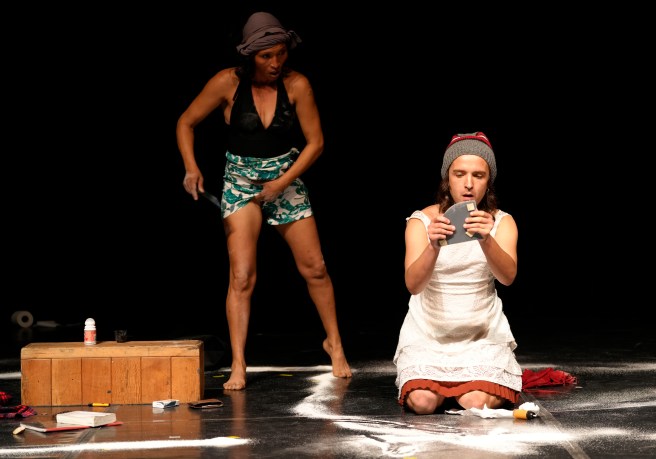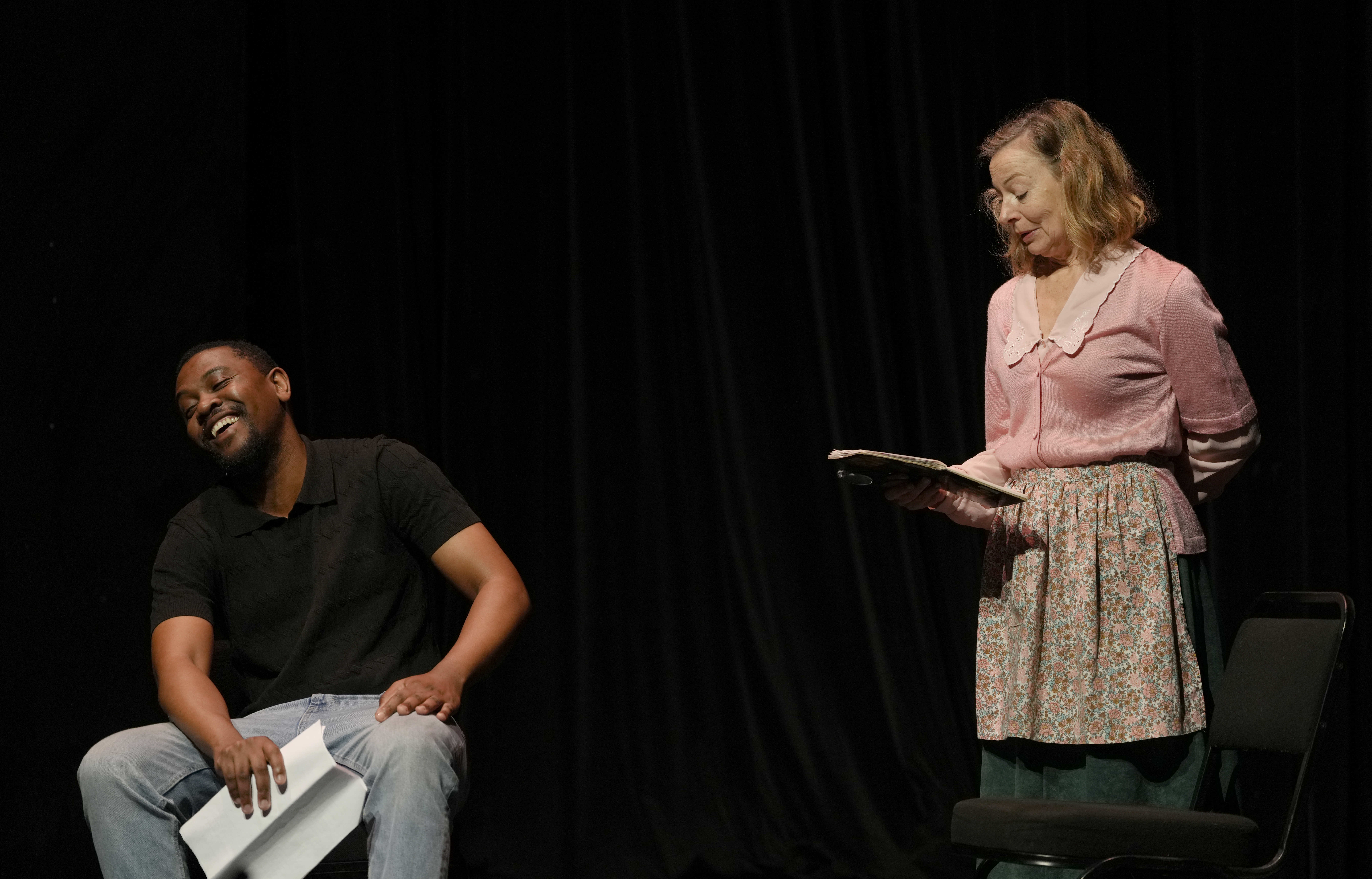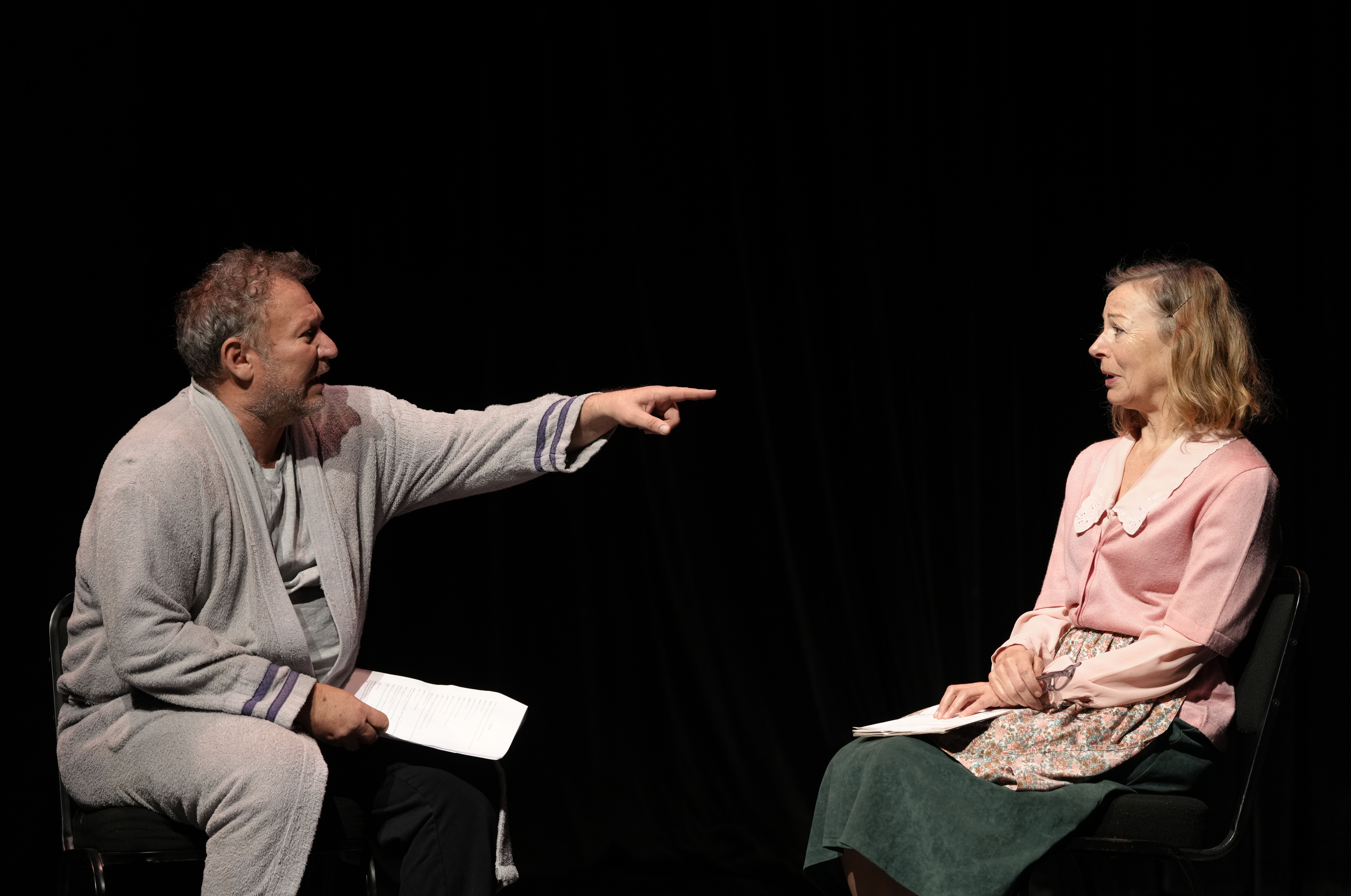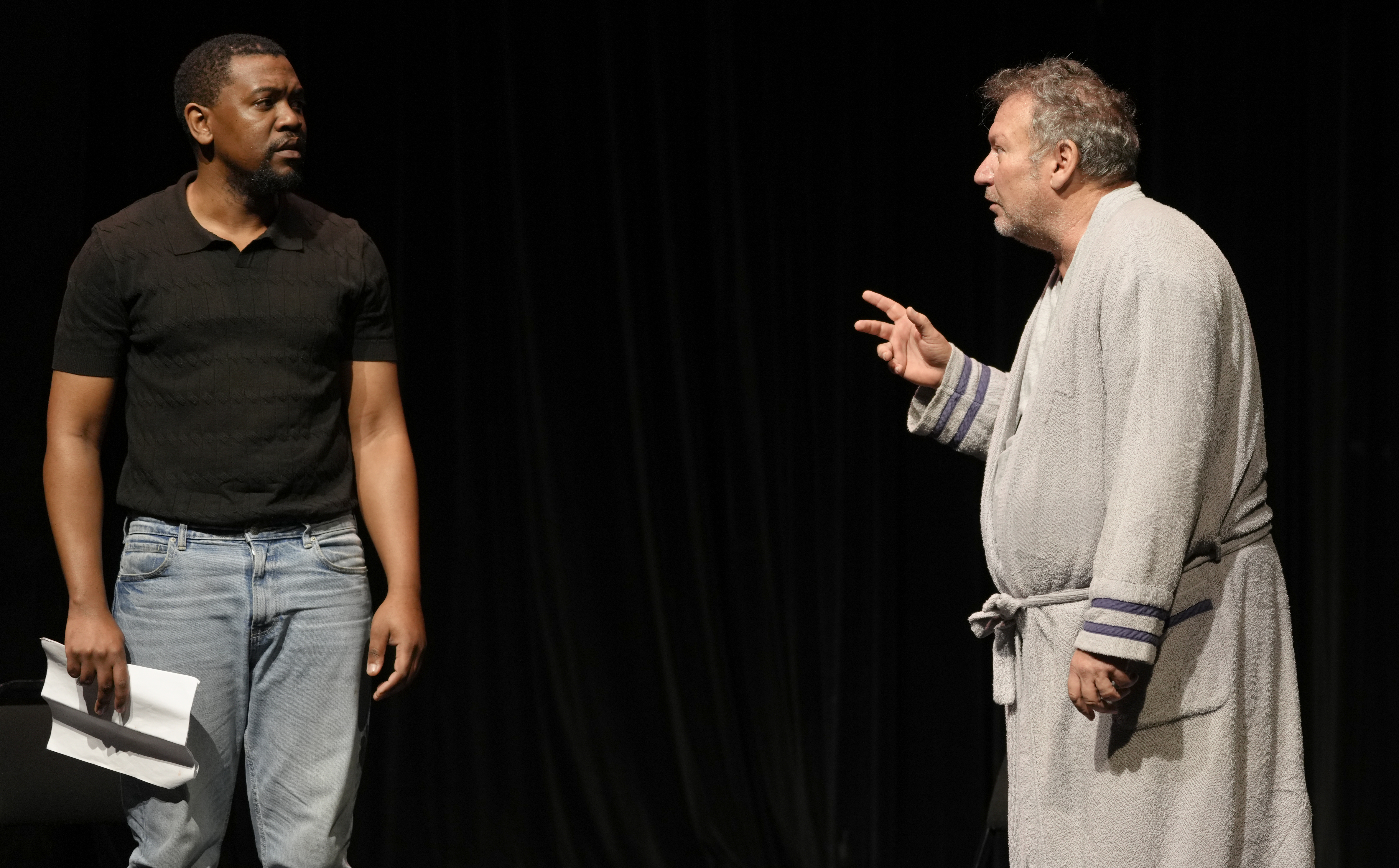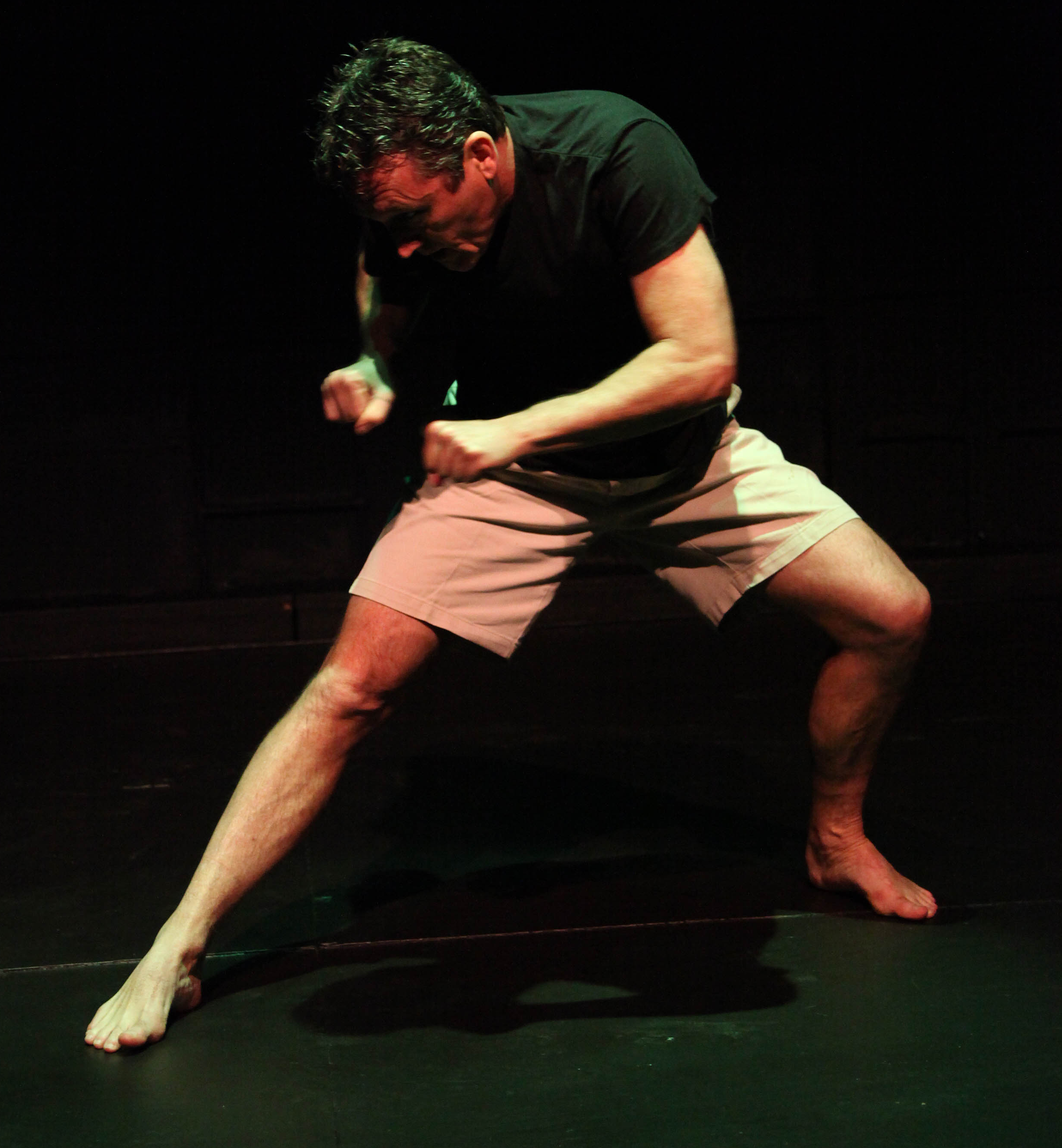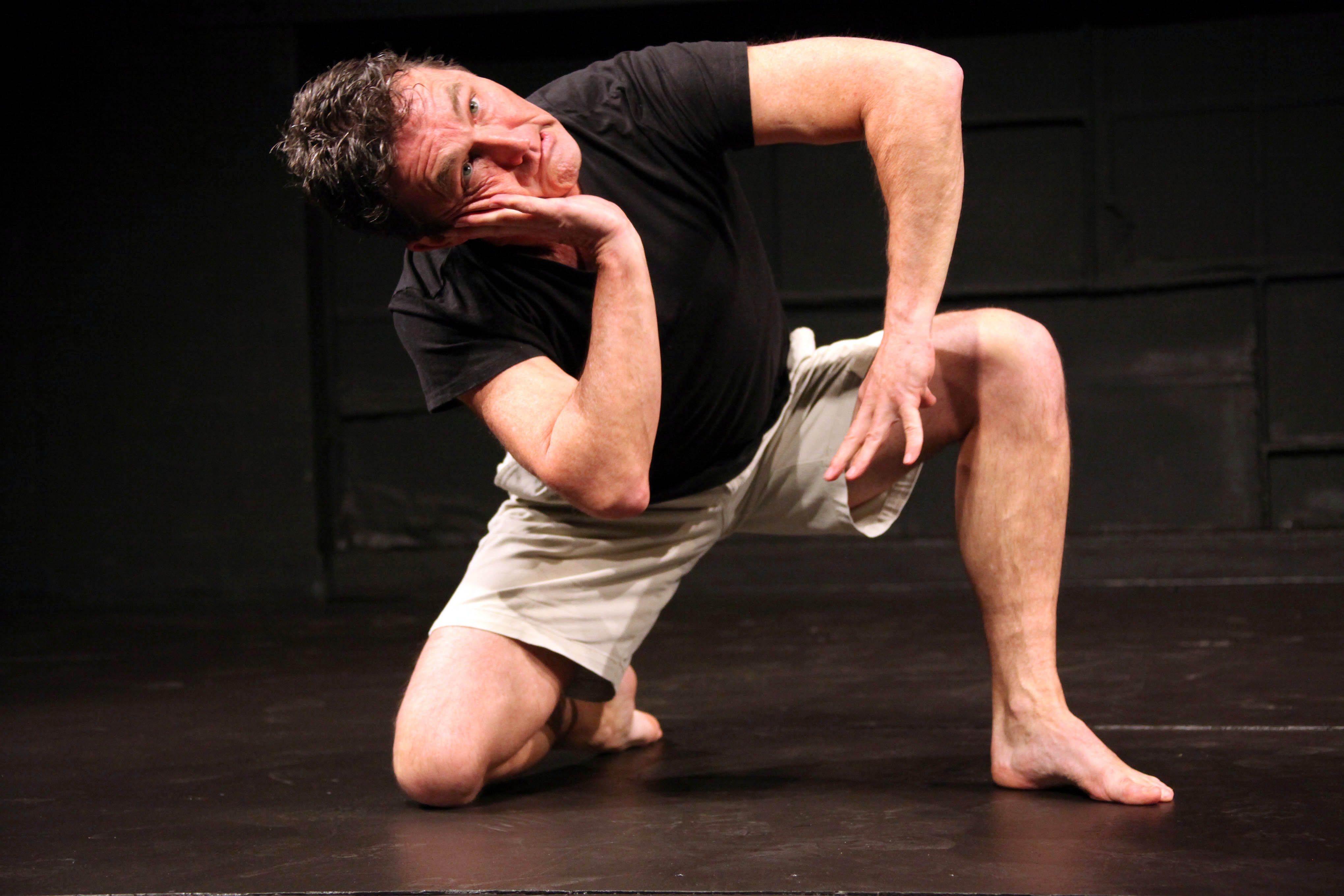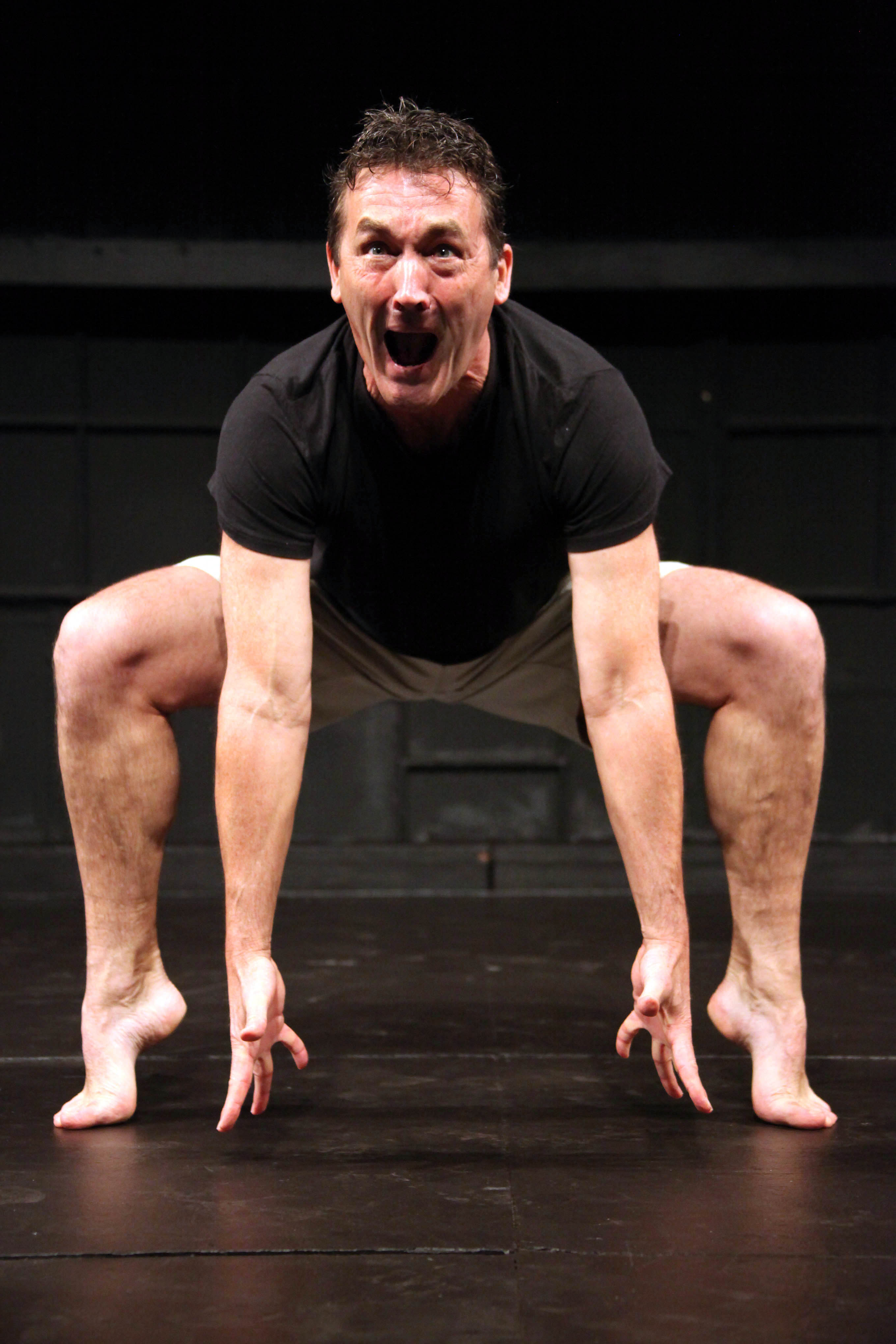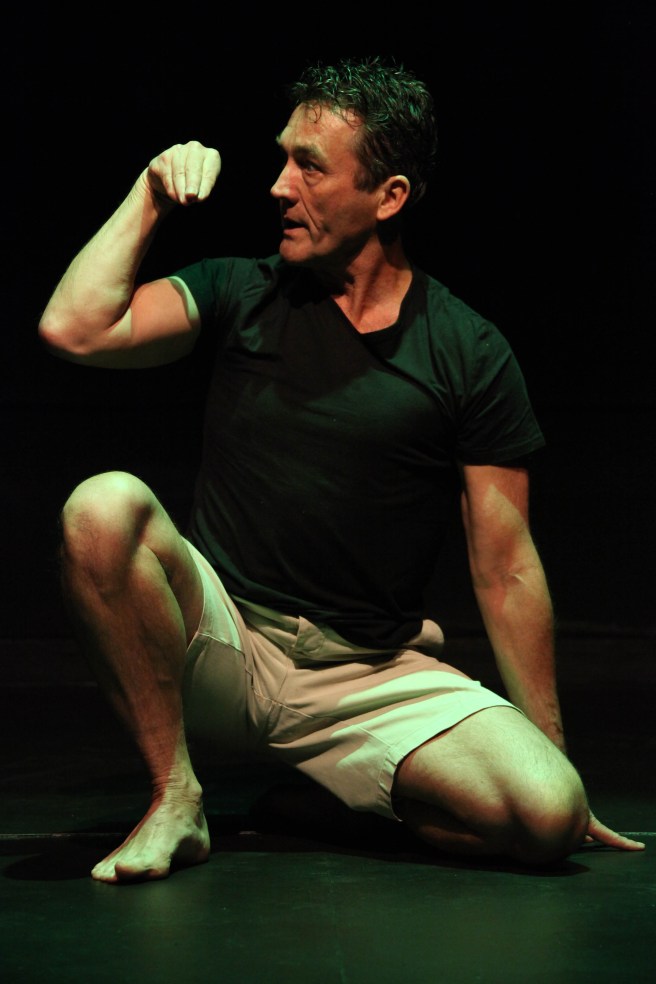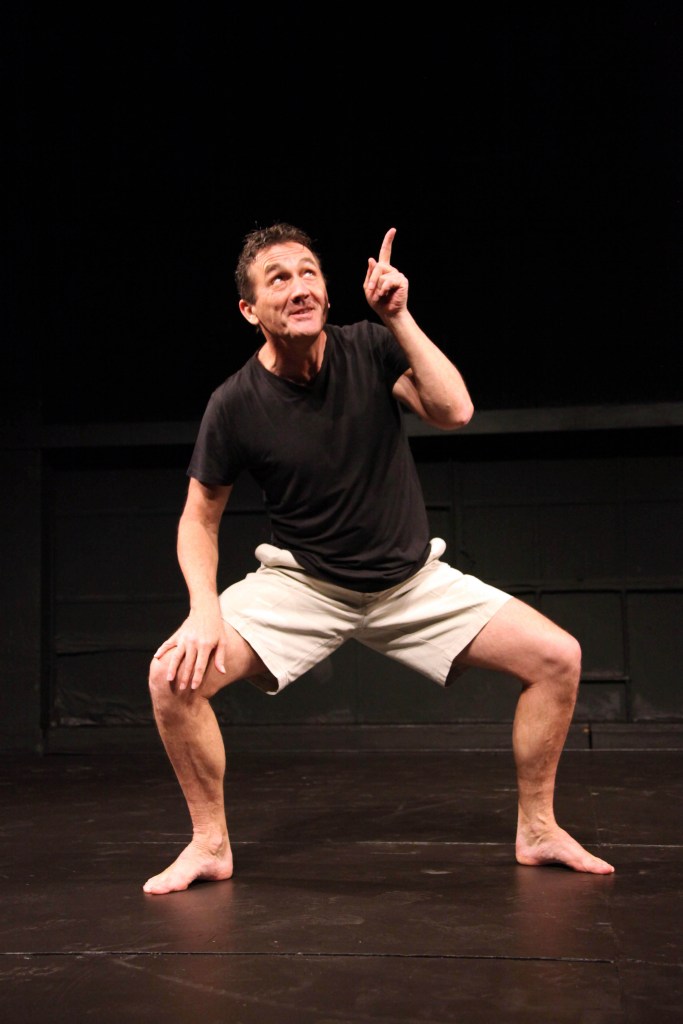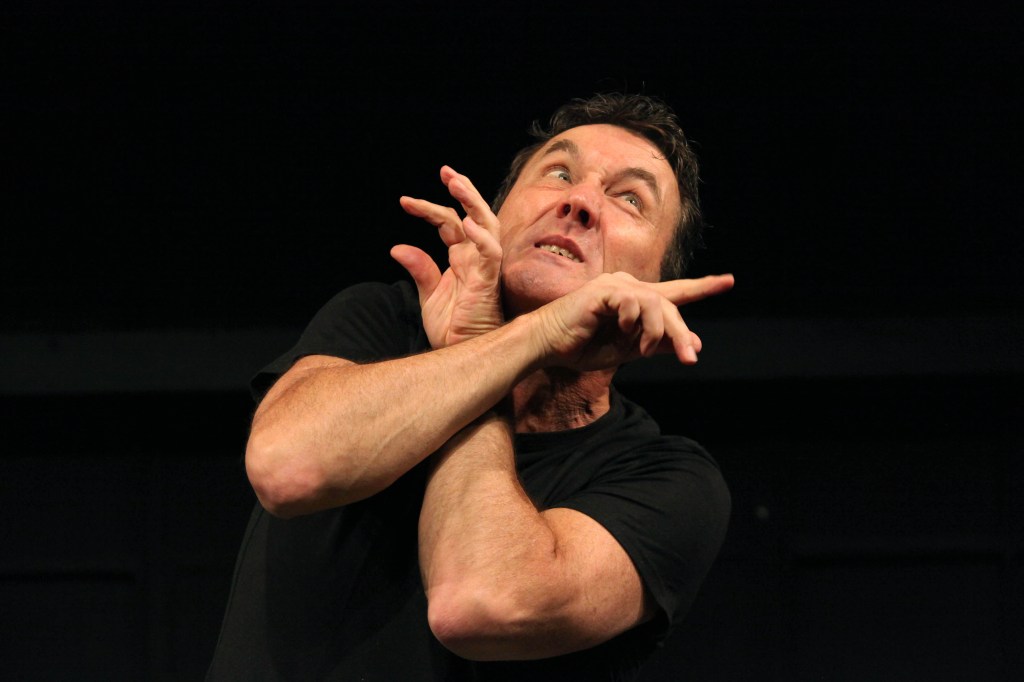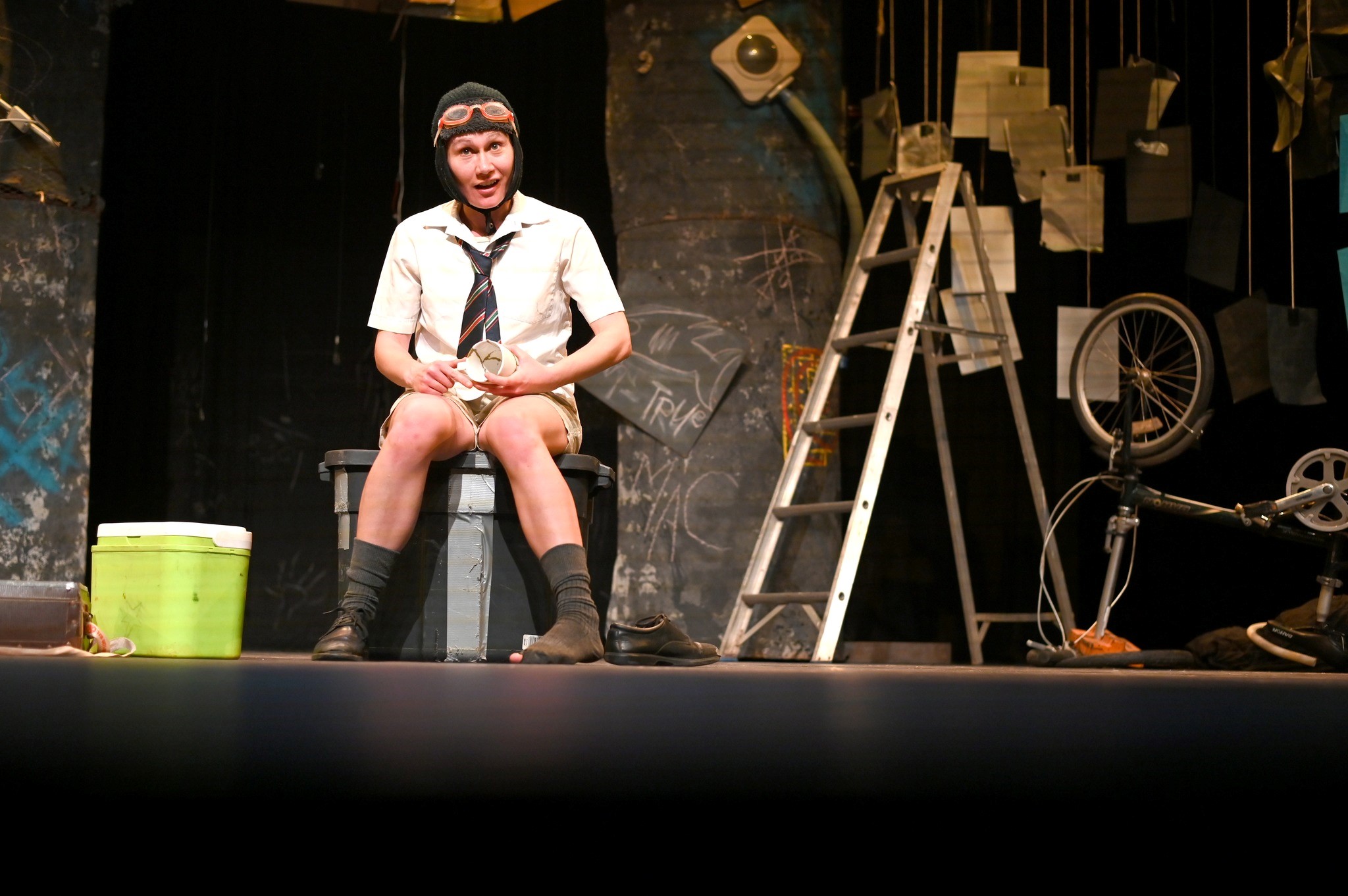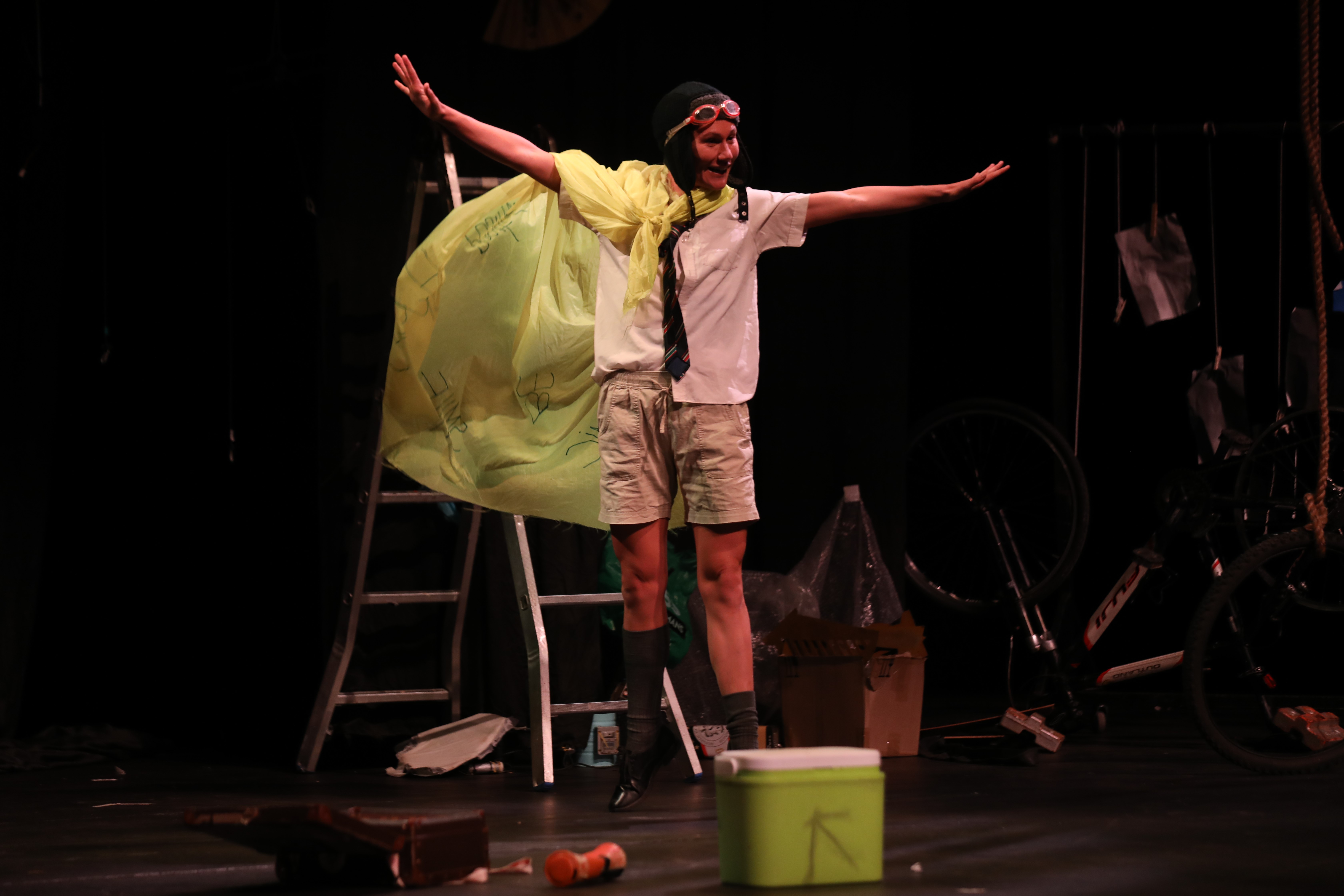
A FIERCELY FUNNY SOLO ACT AT THEATRE ON THE SQUARE WITH A SKILLED SCRIPT AND DEXTROUS PREFORMANCE BY AARON MCILROY

DIANE DE BEER

A VEGAN KILLED MY MARRIAGE

Actor: Aaron Mcilroy

Writer/director: Craig Freimond

Show times: Weekdays at 7:30pm and Saturdays at 5pm or 8pm

Dates: Until 14 July


A solo show is a difficult gig for any performer. It’s the actor and the script with no backup if things go wrong. They have to think on their feet.

But when it works, it’s usually a blast. They’re sometimes funny and often sad. But whatever the material, the performance is usually the determining factor.

That’s why I try to give solo artists at least one chance. If they’re good, you’re theirs for life and usually the progression is also special to witness.

When I saw  that Craig Freimond was the director and the scriptwriter, I knew this would be a winner. His reputation is established and I was pretty sure the trip would not be wasted.

It’s always interesting to discover new actors and Aaron Mcilroy’s performance was hugely entertaining.

The title is pretty self-explanatory and in this time of extremes, vegan is a good topic through which to exploit that particular behaviour trait. Anyone who gives up anything with success can be very painful and annoying. Perhaps “sanctimonious” captures the essence more specifically.

And that’s exactly what happens here as  this particular vegan convert decides he has to inspire the world. He has discovered the life and it is his responsibility to pass it on. Get the drift…

Especially braais – that sport of kings in the South African context – are not the place to start preaching a vegan lifestyle. But, of course, new disciples, have hardly learnt the finer nuances of taking things slowly. Trying to persuade someone to let go of their way of life because that’s what you have done is hardly a proven recipe.

And that’s exactly what happens. But without showing the play’s hand completely, rather discover it for yourself.

Mcilroy knows how to work a room, he has an abundance of tricks in his bag to layer his performance, and the script is coloured smartly with the sharpest South African shades, is extremely funny and very recognisable to anyone who has ever been in any relationship.

We all start out with good intentions and then the personalities and needs of the different parties come into play. How different individuals play their moves often determines the outcome.

Freimond and Mcilroy make a good team. It’s a sassy little play, a smart performance and, at 60 minutes long, perfect for a chilly Gauteng evening. Take some friends and have a relaxing time out.

THE WAY A CHILD’S HEART FINDS HAPPINESS

REVIEW BY DIANE DE BEER

THE KING OF BROKEN THINGS

DIRECTOR AND WRITER: Michael Taylor-Broderick

ACTOR: Cara Roberts

VENUE: Mannie Manim Theatre at the Market Theatre

DATES: Until Sunday

AGE: From 10 years old

DURATION: Approximately an hour

This is the final call for this delightful play which has been doing the rounds for some time but, is as far as I know, this is its first visit to Gauteng.

Solo plays are festival standards and a wonderful way to discover new directors and actors. In this instance, Roberts, who according to the internet, is based in Durban, has been seen on local stages but also has a number of solo productions as part m of her repertoire.

That tells you about a performer who knows how to generate her own work, something they need when trying to survive in an industry hard hit in any troubled times. Survival is part of their normal game.

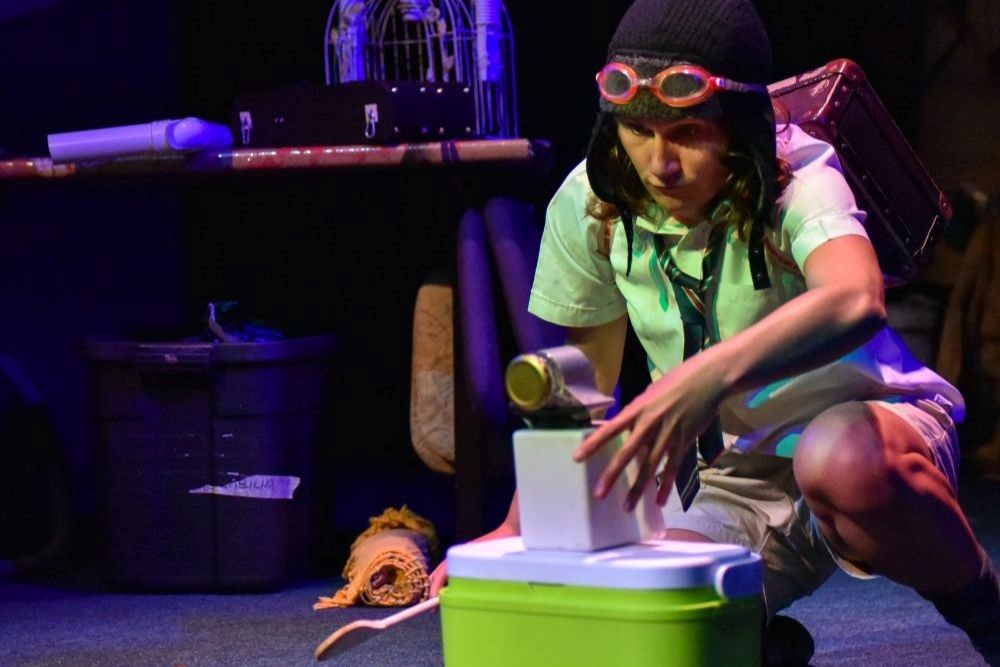
And for the character Roberts is portraying in this particular venture, a 10-year old boy, it is all about survival.

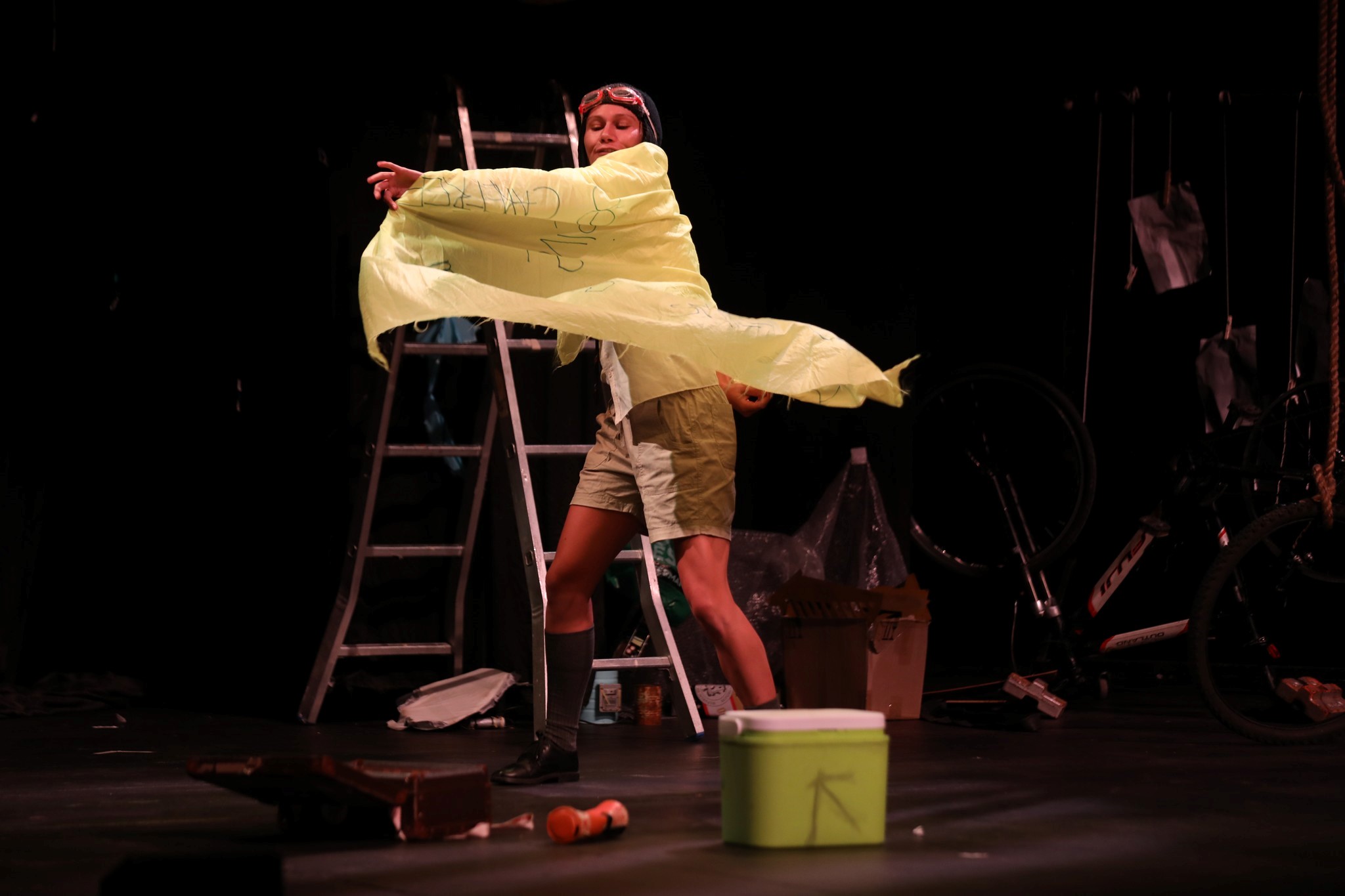
We don’t know too much about him except that he is living in a world of “broken things”, which dominate his life and the space in which we find him. If the world he was given is too difficult to navigate, it seems, his remarkably skilled solution is to create a space that can accommodate his wounded soul.

But that is how many young children react to a tough situation which they might not understand and in which the adults in their lives are sometimes the culprits who have created what seems to be a dark space.

And we all know that while communication is the best way to keep anyone’s world on track, it’s something that everyone seems to have a problem understanding. Just check around you and the problems you bump into – communication is such a handy tool if we would just go there.

Yet when your life seems to be dominated by pain, losing people you love and trying to find the reason for these tough times, you will find a way. You might not understand what is happening, but in this instance, the young child talks and creates his way to a better place.

It’s one of those plays that presents you with a moment in time, one that most of us encounter in some way, but he has found a way. If others can’t fix you, there are ways to make your dreams come true.

Roberts is an astonishing actor. Playing someone much younger is a tough ask, but with a smart script and a performer that throws herself at the role with just the right balance, it works.

It’s a charming hour and a play which I think especially teenagers should see. They would pick up a few life lessons and discover the way theatre can generate both wisdom and wit as The King of Broken Things leads them into a world of wonder where imagination is the ingredient that really matters. Shows tonight (7pm), tomorrow (3 and &pm) and Sunday (3pm). Bookings at https://www.webtickets.co.za/v2/Event.aspx?itemid=1537172754

STATE CAPTURE IN FULL COLOUR IN THE BROTHERS NUMBER ONE AND A WEEKEND SPECIAL AT JOBURG’S MARKET THEATRE

REVIEW BY DIANE DE BEER

Pictures: SUZY BERNSTEIN

THE BROTHERS NUMBER ONE AND A WEEKEND SPECIAL

A new South African Political Play

PLAYWRIGHT: Richard Calland

DIRECTOR: Greg Homann

CAST: David Dennis as Uncle; Michael Richard as Tim; Astrid Braaf as Journalist; Zane Meas as the Lawyer; Ziaphora Dakile as Tiger Claws; Melissa Haiden as Virginia

ASSISTANT DIRECTOR: Aalliyah Zama Matintela

SET AND COSTUME DESIGN: Lisa Younger

LIGHTING DESIGNER: Hlomohang ‘Spider’ Motheto

AV DESIGNER: Xolelwa ‘Ollie’Nhlabatsi

SOUND DESIGNER: Vagile Mpumlwana

VENUE: Mannie Manim Theatre at The Market

DATES: Until May 19

In the programme notes the playwright is described as a prominent political analyst, and a columnist for the Mail and Guardian newspaper as well as the author of a number of political books.

The following is also stated:

The Brothers, Number One and a Weekend Special is the story of the rise of State Capture, starting with the announcement of a new Minister of Finance in late-2015. The play, which tracks a two-year history, is written by astute political analyst, Richard Calland, who has been close to the frontline of South African politics since 1994 and a political columnist at the Mail & Guardian since 2001.

As the drama unfolds, an audience witness the high-stakes manoeuvres, clandestine dealings, and manipulation of public sentiment that fuelled further racial division across the nation. Calland weaves a narrative that connects the dots between government, media, and corrupt businessmen, laying bare the underbelly of a political landscape marked by noise, complexity, and a dangerous volatility.

This leaves you in no doubt about what is going to follow and my first thought was, this being the 30th celebration of what still feels like our young democracy, the play must be seen as a sign of our maturity as a country.

This kind of play, with a representative audience all loudly involved from start to finish, has a lot to say about what we have gone through and, how we have emerged with much more political smarts and cynicism following the Zuma years. Even though we are still suffering many financial and ideological blows from that horrific time, we are not as easily duped, no longer the silent sacrificial lambs we were then.

And at the heart of what unfolds is the playwright who as a political analyst and journalist, has the information at his fingertips.

How can we forget how the iconic Brenda Fassie song title Weekend Special became something completely different in South African minds?

Michael Richard and Melissa Haiden.

This was perhaps the turning point of the whole Zuma fiasco – his Weekend Special. You can dupe a country as much as you want it seemed, but when you go for their money, that’s a completely different ball game – and when things started to unravel for the shameless Number One. Des van Rooyen was no match for the controversially fired Nhlanhla Nene – as the rand went into free fall.

Remember those heady days for the Gupta brothers, who are still hiding out (with South African billions, mind you) somewhere in the Middle East, Switzerland or India depending on  which sources you trust.

Back to the play. We all know the facts; there were many newspaper reports as well as Thuli Madonsela and Zondo’s inquiries. With Homann smartly mixing his cast with stage veterans such as Zane Meas, Michael Richard and Dennis Becket and three young but also experienced female actors (more familiar I suspect to Cape audiences), we all had to think on our feet to work out the different characters.

David Dennis is Mac Maharaj whispered an audience member close by, but in the end it didn’t matter. You quickly gathered that the men were part of the corruption including the Guptas, as well as those handling all the shaky deals from government side, with Richard being the one watching and guiding his journalist.

David Dennis makes his point.

It was glorious to see these three in action on the same stage, masterfully matched by the young female energy in their particular roles of either ferreting out, or defying any corruption allegations, depending on their particular alliances.

It takes one back to those early days of discovery. Remember the Saxonwold shebeen? People carrying handbags stuffed with money, others denying visits to their overlords, those in command of State Capture. It feels a bit like a horror movie, but not with Calland orchestrating the manoeuvres and connecting the different dots.

And everyone was laughing. We have, after all, dodged a bullet and most of us are much less gullible than we were in those heady early days of our democracy.

The anguish is palpable.

It’s a fast-paced political thriller of sorts and it’s our own. What I would have liked is a bit more clarity in the staging. With seats on three sides, the projections were difficult to follow from the side. And some gave insight into the full affair which was unravelling at a speed.

Short and straightforward interactions would have  added more punch (from both a script and staging perspective) and added a contemporary edge. The audience obviously loved it and were fully engaged, and so was I. But, especially as we all knew the details, it simply would have elevated it into a landmark play.

WITH RULES CHANGING CONSTANTLY, KING GEORGE AT SANDTON’S THEATRE ON THE SQUARE IS ALL ABOUT THOSE WHO MANOEUVRE THE GAME BEST

REVIEW BY DIANE DE BEER

Pictures by Philip Kuhn

KING GEORGE

A new play by Brent Palmer

DIRECTOR and production design: Adrian Collins

CAST: Clyde Berning and Brent Palmer

VENUE: Theatre on the Square, Sandton

DATES: Until May 4

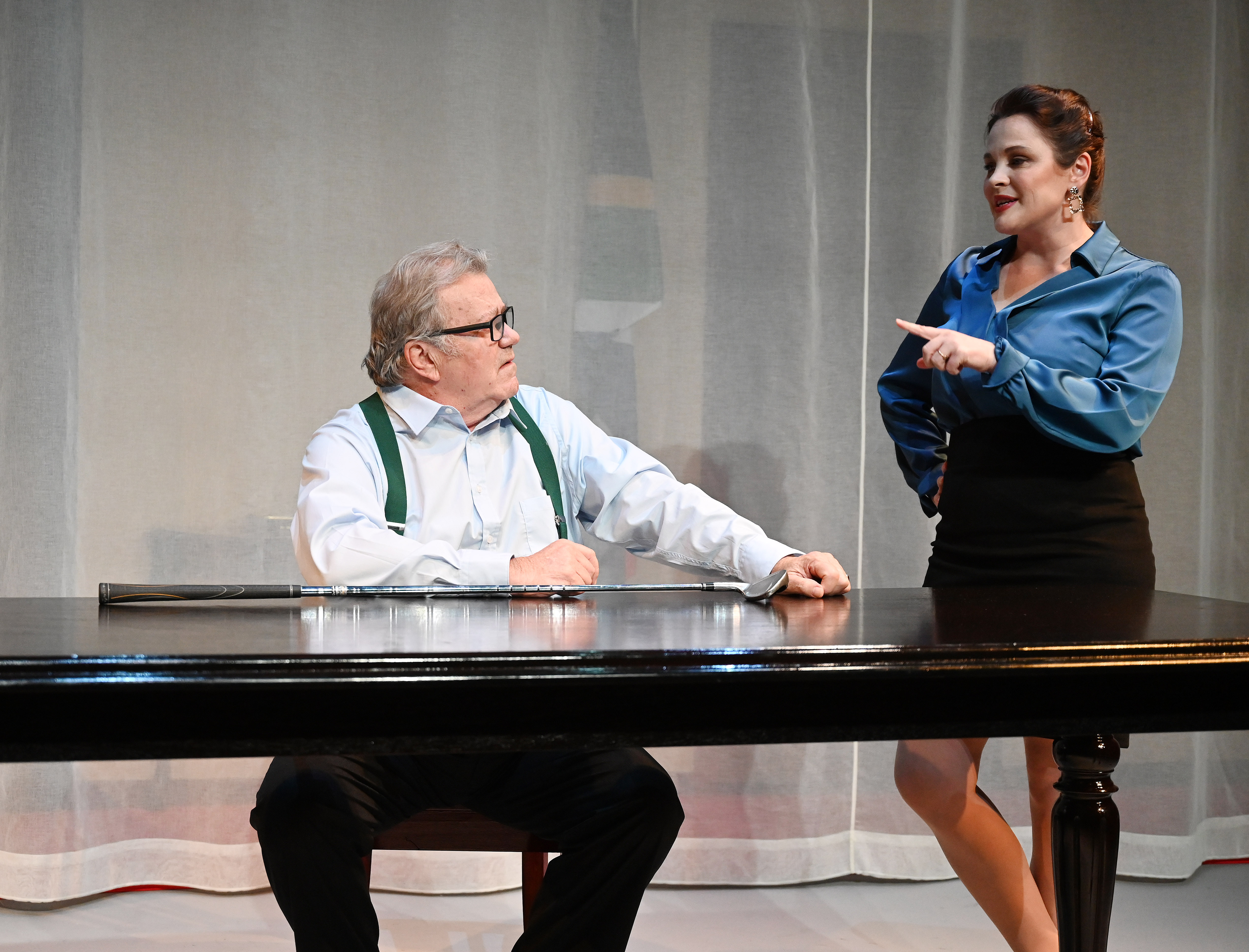
King George with Brent Palmer (left) and Clyde Berning.

It’s not an easy world we live in. Nothing seems to come without some kind of threatening event or warnings to watch out for scams when dealing with the outside world with its big bad wolves on the take.

This is exactly what you witness in this smartly crafted play by Brent Palmer – one of the actors and the playwright. In the world of theatre, it helps when you can also write the stories you want to tell and if you do it this well, it’s a bonus.

The fact that it doesn’t take much more than two male actors in a room makes this one a no-brainer, especially for independent theatres that have relentless financial restrictions. Shane Wynstock (Berning) is the slick CEO of Synergy Properties. He is in the process of starting a new development and boasting about his accomplishments to a possible investor when there’s a knock on the door.

George Megalos (Palmer, who recently won a Fleur du Cap for this particular role) is someone who slides into a room and not with the bravado of  Seinfeld’s Kramer – it’s much more of a slithering entrance. He’s trouble, and that’s immediately visible.

The gloves are off.

Not that Shane seems to be bothered. And the dilemma unfolds cunningly and with great sparring between the two obviously adversarial men. It appears that there’s a problem with an audacious development plan which Shane is about to set in motion. It means problems for homeowners in the area though, as they’re just expected to vacate their homes and move.

In a standoff, George (right) and Shane are in a heated discussion

George is determined to have nothing of this as they become embroiled in a heated argument.

 The interesting twist is the switch of villains with the more sleazy character the one who can claim the moral high ground, while the obviously moneyed man is the bully who knows he has the bucks to win this round. That’s all that counts.

It’s intriguing theatre as the two actors inhabit their characters and quickly draw you into their different worlds – with some ambivalence because we live in times where first impression is based on appearance. Shane wins hands down, but it becomes clear that the tables might be turned in this one.

The play is not about the outcome; it’s much more about the world we find ourselves navigating, where the traditional rules no longer apply. It’s all about power, and that is determined by the one who has the money.

But the manoeuvring is fun and the actors obviously delight in this fast-paced duel. I loved the originality as it’s not something I’ve seen before, and it’s perfect for our crazy world where men like Trump and Zuma think they have a second chance at the top spot in spite of their sullied reputations known to all.

And they have the followers who egg them on.

CELEBRATING THEIR 25th ANNIVERSARY MAMMA MIA AND HER THREE STARS HAVE THEM ROCKING

REVIEW BY DIANE DE BEER

MAMMA MIA

Three dynamic stars, Ilse Klink, Gina Shmukler and Kate Normington.

CAST: Gina Shmukler, Kate Normington, Ilse Klink, Emmanuel Castis, Matt Newman, Tiaan Rautenbach, Kiruna-Lind Devar, Gianluca Gironi, Ntshikeng Matooane, Sunny Yoon, Chad Baai, Bradley Smith and the rest of the ensemble

SET AND LIGHTING DESIGNER: Denis Hutchinson

MUSICAL DIRECTOR: Charl-Johan Lingenvelder

CHOREOGRAPHER: Duane Alexander

COSTUME DESIGNER: Sue Daniels

SOUND DESIGNER: Mark Malherbe

ASSOCIATE RESIDENT DESIGNER: Timothy Le Roux

PRODUCER: Hazel Feldman, Tony Feldman

DIRECTOR: Janice Honeyman

VENUE: Teatro at Montecasino

DATES: Until June

Kate Normington, Gina Shmukler and Ilse Klink in their ABBA gear with the cast.

It wasn’t that Mamma Mia was the attraction  –  been there, done that. I was intrigued by the three actors – Gina Shmukler, Ilse Klink and Kate Normington – in the latest production.

Seasoned actors and singer all, they don’t get that many chances in lead roles (there are just not that many starring roles for women once they’re out of their 30s) and I knew this would be a triple threat. These are women with sass who strut when they walk. No shrinking violets here! They would go for this one in unison and grab that stage – as they did, fulfilling my every wish.

Like many musicals, this is also a rather silly if sweet one, but with ABBA’s music, it ticks all the boxes and has an hysterically loyal fanbase, but what I wasn’t expecting were the many youngsters (I’m guessing between 8 and 12!) in the audience.

Kiruna-Lind Devar as Sophie.

Right in front of me were two (again guessing) 12-year-old girls who were totally into the musical from start to finish. At the beginning of each song, they would glance at each other and joyfully sing along ­­– pitch and word perfect! Rather than hinder my experience, I was enchanted by their enthusiasm and it switched me on to the charm of the musical, which might otherwise have felt jaded to this seasoned viewer.

Not for this audience though. When last were you in an auditorium where they were clapping along to almost every song? You cannot but be swayed to lose all your hard-earned cynicism.

Ilse Klink, Gina Shmukler and Kate Normington and the cast.

But back to the show on stage. Can those three women sing  – together and individually they rocked and easily generated the star power this kind of show needs. It’s not that they haven’t all had the chance to individually star in shows. But these days, it’s tough to find starring roles for women beyond 40, so when you get them, you’d better make good use of the opportunity.

This is exactly what Klink, Normington and Shmukler do. They know the game and have made full use of this marvellous opportunity. And, like I thought it would, it shows.

They’re directed by another wise and wily artist, Janice Honeyman, who knows all the tricks in the book. And with these three accomplished performers, she would have had loads of fun.

The two lovebirds Gianluca Gironi (Sky) and Kiruna-Lind Devar (Sophie).

They’re well supported by the youngsters, especially the love-struck couple, Kiruna-Lind Devar and Gianluca Gironi, who both have youthful stage appeal and energy.

A personal favourite was the omnipresent, soberly yet strikingly dressed in black, little old Greek lady (Chantal Stanfield), who is a constant presence as she pops up in almost every scene, for no other reason than confirming we’re on a Greek island. This lovely throughline stays amusing, if not relevant to the story.

Tiaan Rautenbach, Emmanuel Castis and Matt Newman as the three Dads.

If you don’t know the story of the young woman who hopes to recreate her mother’s romantic dream and in the process also discover the identity of her birth father, don’t delve any further.

Check the colourful pics, see if it looks like your kind of thing, gather the family or a group of friends and make a night of it.

Chad Baai, Ginaluca Girona, Bradley Smith and the Mamma Mia male ensemble.

Think of titles like Dancing Queen, I have a Dream, Lay all Your Love on Me, Mamma Mia (of course!), Super Trouper, SOS, Our Last Summer, Take A Chance on Me… and many more.

Even if you don’t consider yourself a particular fan, I bet you can sing along to most of these songs. That’s what their music is ultimately about … and so is this musical.

And this time there’s extra punch with these three dynamic dames. They are what makes this show swing.

RINGMASTER SYLVAINE STRIKE GATHERS THE BEST AROUND HER FOR A FLOURISHING SPRING AWAKENING

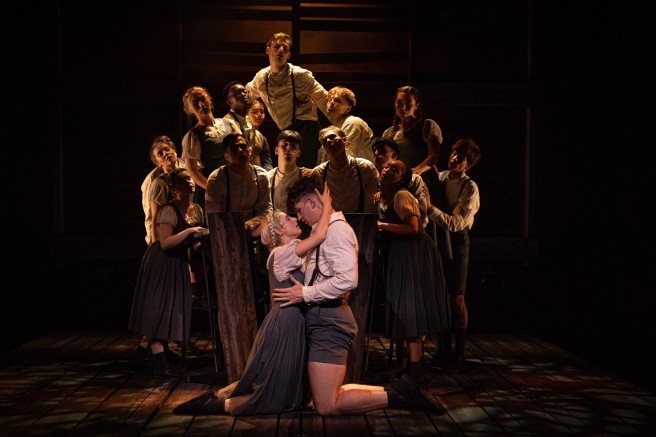
The ensemble wih the love-struck couple (Scarlett Pay and Dylan Janse van Rensburg) in the front.

REVIEW BY DIANE DE BEER

Pictures: Claude Barnardo

SPRING AWAKENING

Based on the play by Frank Wedekind

Books and lyrics: Steven Sater

Music by: Duncan Sheik

Featuring: Dylan Janse van Rensburg, Scarlett Pay and Jonathan Conrad with Gemma Bisseker, Killian Blerk, Jude Bunyan, Tatum Grace Coleman, Jayden Dickson, Noa Duckitt, Skye Themeda Goss, Ché-Jean Jupp, Gabriella Knight, Jasmine Minter, Tumelo Mogashoa, Hannah Norcott, Nandipa Nyivana, Benjamin Stannard, Tjaart van der Walt, Gerhard van Rooyen (graduates and under-graduates) and playing the two adults, also former students of LAMTA (The Luitingh Alexander Musical Theatre Academy), Francis Chouler and Natalie Robbie

PRODUCERS: Anton Luitingh and Duane Alexander

LIGHTING, SCENIC AND COSTUME DESIGN: Niall Griffin

SOUND DESIGN: David Classen

ASSOCIATE DIRECTOR AND ASSISTANT MUSICAL DIRECTOR: Anton Luitingh

CHOREOGRAPHIC SUPERVISOR: Duane Alexander

VOCAL DESIGNER: Annemari Milazzo

MUSICAL DIRECTOR: Amy Campbell

CHOREOGRAPHY: Anna Olivier and Naoline Quinzin

STAGE MANAGER: Sarah Wolhuter

DIRECTOR: Sylvaine Strike

VENUE: Pieter Toerien Theatre, Montecasino

DATES: May 5

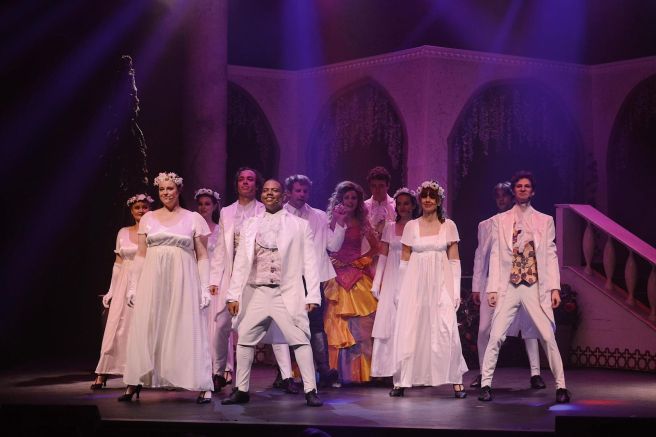
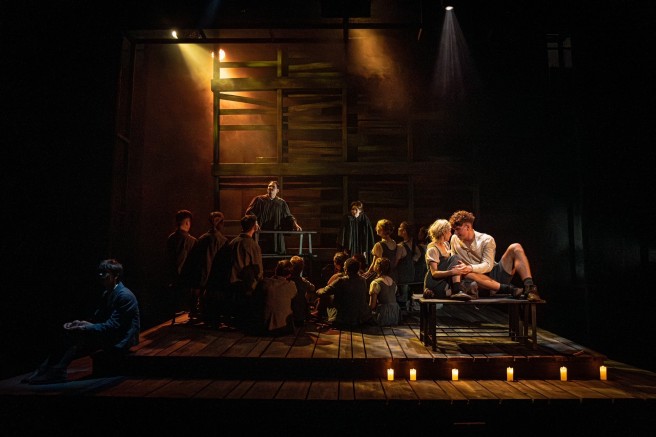
Spring Awakening a production for current times.

Perhaps Spring Awakening is the reason Sylvaine Strike is only now directing her first musical. It was destined to happen with this particular show – and she does it magnificently.

If anyone was up to this specific task, she was. Even more than I knew, because I was unaware of her teaching responsibilities at LAMTA, Luitingh and Alexander’s Musical Theatre Academy in Cape Town that invited Strike to direct.

In her programme notes, she explains that  her  students understood her approach “tackling the very controversial themes – from a physical rather than a psychological perspective – possible, and ensuring that the sexuality, heartache, and rebellion we activated during the rehearsal process always came first and foremost from the body. This was apt seeing that the impulses of adolescence also spring from this turmoiled yet effervescent well. Whether we explored the private agony of self-consciousness; the damage of self-doubt; the wreckage of hormones on both mind and soul; the pain of parents’ inability to accept a child as they are; or the blossoms of sexuality growing their gentle tendrils of yearning and fantasy throughout adolescence …”

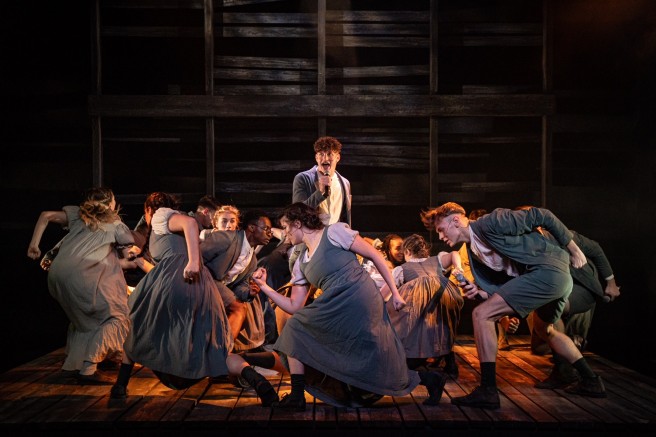
Much of the magic is in the movement.

Her mantra was to seek a physical way to manifest these feelings and to create the characters from that specific place.

And even though I didn’t know any of this before watching this production, it was the movement and the choreography that grabbed and gripped me throughout. It was so clever and crafty to use this in both solo and ensemble numbers and even with the very specific movements of the two adults to exactly capture their strictly restrained and fastidiously maintained lives.

I kept wondering who the choreographers were, as they who would have been completely aligned with Strike’s vision because of her very detailed rehearsal process. Not surprisingly, but also with kudos to the producers and director, they picked two of their talented graduates Olivier and Quinzin, who did an amazing job both incorporating and executing their work to perfection. It adds currency and electricity to the performances that translate masterfully.

But that was just the start of the cohesion of the whole. Again the programme notes capture it best when explaining the electrifying adaptation of Wedekind’s Spring Awakening into a contemporary rock musical, which Strike rightly salutes as the key to the current success of the piece. She is convinced (and I agree) that the sheer brilliance of Steven Sater’s lyrics and Duncan Sheik’s music makes the return of this classic possible and heightens the relevance of the themes as long as there are adolescents in this world.

To pull it off though, it needed the razor-sharp vision of Strike, her pinpoint accuracy in the detail and, more than anything, the artists she surrounds herself with, assigning them to their specific fields of expertise. Even though she and designer Griffin had never worked together, she trusted her instincts and tasked him with all three design elements: lighting, costume and set, all of which establish the feel and the atmosphere of where and how the story unfolds.

 It’s brilliant. From the set that transforms with only a few movable parts to the costumes that speak volumes in their simplicity but also carry an underlying theme, as he experimented with the authenticity of the fabric, to the lighting that enhanced what he had already established with the set and the costumes.

All of this would have been superfluous without the right cast. It starts with their youthfulness. Undergraduates and graduates of LAMTA, most were already familiar with the director’s ethos, and it shows. Performances are spectacular and some of the solo moments quite breathtaking.

Spectacular singing with individual tones from Johnathan Conrad and Dylan Janse van Rensburg.

There’s too much to take in and remember in one sitting, but the performer I couldn’t turn away from was the unusual Johnathan Conrad. It needed someone like Strike to cast correctly, but it was as if the theatre gods had handed her a mini Mick Jagger in looks and talent. As the overwrought and picked-upon Moritz Stiefel, his every move, the singing and the presence never faltered  –  a wonderful foil in a complex production.

The love-struck Scarlett Pay (as Wendla Bergman) and Dylan Janse van Rensburg (Melchior Gabor) are radiant as the couple who cannot resist one another, and their singing captures their hearts’ desires magnificently. Another standout was the luminous Noa Duckitt as Ilse Neuman.

Two standout performances from Noa Duckitt as Ilse and Johnathan Conrad as Moritz Stiefel.

The music holds the show and the singing had to soar for the show to come alive. Again, musical director Amy Campbell teaches at LAMTA and wisely she was in charge and harnessed all her skills to get this working perfectly. More than anything it is the individuality of the different singers surrounded by the more gentle ensemble singing (more often than not) that rocks this one.

Finally it is Strike who pulled it all together. You can have all the talent in the world, but if the story isn’t told with one voice, it has diminishing impact.

Strike doesn’t miss a beat. She has gathered artists young and old around her to tell this striking story that affects us all at some stage in life in the best way she knows how. It has purpose, it holds you in awe from beginning to end, and you are engaged in and enraged with these youngsters as they fight for their right to live their way.

I was spellbound.

SPRING AWAKENING BLOWS INTO GAUTENG’S PIETER TOERIEN THEATRE, MONTECASINO LIKE A BREATH OF FRESH AIR

PICTURES BY CLAUDE BARNARDO.

Niall Griffin dying the costumes wearing protective gear.

When Niall Griffin was invited to take on most of the design elements (set, costumes and lighting) for the Sylvaine Strike-directed Spring Awakening, he was nervous going into the process because living up to the expectations of a legend can be daunting. He tells DIANE DE BEER about the experience, which he describes as the highlight of his career:

Spring Awakening, presented by Cape Town’s Luitingh Alexander Musical Theatre Academy (LAMTA) as their first book musical, also marks the first time that Sylvaine Strike has directed a musical. 

Based on the controversial play that was written in the late 1800s by Frank Wedekind, Spring Awakening delves into the lives of a group of adolescent students discovering their changing bodies, their sexual identities, urges and desires, all while navigating the oppressive and draconian societal norms of the day. 

Under Strike’s visionary direction, this reimagined production (with a very young cast) brings the gripping and emotional story to life as it explores complex themes such as self-discovery, repression and the power of rebellion. 

Niall Griffin, a designer with a mission.

And while there was initial anxiety, once the work began, Griffin knew instantly that he was on safe ground. “The care, respect, trust and sense of magical play that Sylvaine instilled in our journey together are unmatched in my career. I think we both felt an immediate understanding of each other and were both amazed at how perfectly our style and ethos merged,” he says.

“We care immensely for our process, our casts, our team and our audiences, sometimes to our detriment, but finding someone with that same level of care has been one of the greatest gifts of my career.”

Being familiar with the level of detail Strike approaches when making a play, all of the above sounds like a match made in heaven.

The vibrant young cast in Spring Awakening

Accepting the challenge was a no-brainer for a designer who is also described as an industry legend. “There are musicals and then there are musicals. Some are light and frivolous and the perfect escapism and then some hit you harder in a place that truly moves you. Spring Awakening is the latter for me. The little rockstar hit that came out of left field to take Broadway by storm,” is how he describes it.

“It deals with things that we’ve all been through or are going through, both good and bad. All too often, in this day and age, we are driven into false beliefs and horrific mental health issues because we carry such shame from our experiences. The show, as heartbreaking as the story is, leaves one with love, compassion and a sense of togetherness. The human condition is not singular. We are not alone. We all need a little more love in our lives… and who doesn’t love a bit of Victorian-era deliciousness?”

Describing the process, he explains that what began as an exercise in replicating period fabric developed into an exploration on how possible it was to create an entire show from natural fibre. “Our planet has rapidly become saturated with ‘the synthetic’ and I believed this show needed authenticity in every aspect if it was to have the impact it deserved.

“The entirety of the show’s design is manufactured from purely natural fibre. Costumes began as neutral cotton that were dyed with natural dyes. The set is sustainably sourced wood and hessian made from vegetable fibre. It has been an incredibly educational and rewarding process.”

It is that process that piqued my interest, especially when basically the whole look depends on the outcome. Griffin understood that taking on the full production design across set, costume and lighting was a huge undertaking and not for the faint hearted.

“My driving force is to find a seamless synergy between all departments. What I term ‘one organism’. While taking on full production design is huge, it does make knitting a visual together far easier. Even though this show was Sylvaine’s and my ‘maiden voyage’, it was clearly destined, as our sensibilities and aesthetics couldn’t be better matched.”

And there’s the key, something they obviously both understood. “Theatre design to me, at its core, is about designing emotional response. I needed to immerse myself in the emotional journey of the piece, the high and low tides, in order to find its design core,” he notes.

For him texture is far more than paint and dye. “I spent a long time with the score and libretto and, to quote the Gen Z’ers, ‘felt the feels’. This is how I approach the majority of my design work, from a place of emotional honesty. It’s about finding the heart of the piece.”

Describing his process in more detail, he began with the sets, followed by costumes and finally lighting:

“When it comes to scenic design, my favourite moments in theatre are when a space manages to completely morph its texture, feeling and setting without all the ‘big toys’ and flash. A threatening storm can become something else, in mere moments, with a shaft of light breaking through the clouds. I wanted the space to morph seamlessly so that the emotional flow wasn’t interrupted by a clunky scene change. Finding the balance between something that can feel both oppressive and beautiful was a challenge. Using exposed wood was a no-brainer for me. Wood is a material that carries its growth with it forever. Its rings and knots and imperfections are part of it. This felt poetic to me.”

When it came to costuming, he wanted to create a uniform that felt prescribed by an oppressive regime, “a regime trying to erase the individual and force uniformity. I felt this would underpin the narrative journey of our characters rebelling against the blind norm by illustrating how prescribed uniformity cannot erase the burning fire of the individual.

“Every costume, from head to toe, has been lovingly made from scratch. They are all individually hand dyed and aged, and this is where I started to sneak the individual into the uniforms by aging and breaking down each individual’s garments with their own personality. Some of this detail may not be evident to the audience, but it was important to me that the cast could experience their costumes in this way. I truly believe that what the cast feels in their costumes translates into their performances.”

Lighting delivers the final flourish. “Sometimes, at the speed a musical moves, the audience needs to understand an emotional shift quickly, and this is where lighting was vital to me. I wanted the world to feel murky and rich, like an oil painting come to life.”

If the successful runs in Cape Town are an indicator, this has all been achieved, as the visuals will attest.

And Griffin has his final say: “Making theatre, especially non-replica productions, in South Africa in the current climate is hard work. Creating an entire musical from scratch was a feat second to none. I have a team of remarkable artisans that I work closely with and whom I would be nothing without. They all share my level of delivery standards and they all jump into the deep end with my crazy ideas. A tribe second to none. I couldn’t be prouder of the product, and watching audiences experience it in Cape Town has filled me with so much joy.”
* Performances run until 5 May 2024 at Pieter Toerien’s Theatre at Montecasino with shows from Wednesdays to Saturdays at 7:30pm and matinees on Saturdays and Sundays at 2:30pm. Tickets cost from R200 through Webtickets. Please note that Spring Awakening contains mature themes, partial nudity, sexual situations as well as explicit language. No persons under 13.  

A JOYOUS FESTIVAL, THIS YEAR’S KLEIN KAROO NATIONAL ARTS FESTIVAL, LIFTED THE SPIRITS

Another Klein Karoo National Arts Festival has come and gone but what lingers are the artists, their originality, dedication, blood, sweat and tears and delight that they provide in a lopsided world which is difficult to navigate. DIANE DE BEER finds nourishment, inspiration and novelty in the imaginative and ingenious artistry of our creatives:

I have to be honest from the start. Festivals always have a strong emotional impact on me. I am in the fortunate position as an arts journalist to be invited to see as many productions as I can squeeze into the run of an event and at this year’s Klein Karoo Nasionale Kunstefees (KKNK) there was still a post-Covid frisson with the festival at full strength for a second year.

When a festival goes into full swing, it can be quite daunting and I’m not sure whether I want to be there, but as excellent productions and artists climb into my head, I go into full festival mode where I’m simply thrilled at being overwhelmed by the local arts community.

Being an artist isn’t an easy profession, even if many on the outside feel that they had a choice and simply have to bite the bullet. That they have a choice is arguable and to produce excellence year after year, often with few rewards and never under ideal circumstances, can be daunting and not for the fainthearted.

And yet they go full tilt as they battle extreme circumstances like pandemics or vitriolic social media, all in the name of art.

More than anything, whatever anyone says, we cannot  resist them. For me it is a huge blessing and privilege to witness and write about our uniquely original creatives.

Post-festival, an overview of the festival is always a personal reminder of and reflection on everything extraordinary, yet it’s tough to choose which among all those actors and productions, to highlight. There are simply too many that demand attention and especially this year, the scope was exceptional.

I always feel I want to bring something of the flavour of a particular festival to those who weren’t there. Perhaps one of my favourite pieces might pop up somewhere and a reader might be encouraged to go, or even more ideally, someone who has always thought about festivals but never attended might be encouraged to go.

I have to start with Karoo Kaarte. It’s one of the dream projects of the KKNK, simply ticks all the boxes and grows more impressive every year since its first inception with special mention of last year’s winning production, Droomkrans Kronieke, which landed with such impact because of its energy and precision. How can you not win when developing the underdeveloped artistic talent of the previously disadvantaged by implementing a programme that empowers those who wish to make it in the arts.

It’s inspiring and this year’s production, Die Swartmerrie, is a site-specific piece set on dilapidated terrain with a set of train tracks, an imagined train, and a rundown platform. Two people, a man and a woman (Theo Witbooi and Chantell Phillipus) are waiting, both traveling but not with the same destination in mind. There is a past, the tracks and possible journey points to a future, but this notion disappears with the wind.

It is breathtakingly beautiful and hauntingly gripping as the two talk and tackle their issues with delicate determination.

Afrikaans is an especially emotive love language and when spoken in the specific Karoo accent, warm and intimate, the sounds are as captivating and meaningful as the actual words being spoken.

I was surprised by this couple alone on stage and also electrified that the team (in this instance Neil Coppen – a facilitator of the whole project with Vaughn Sadie – and Oudtshoorn’s Tiffany Saterdacht) decided to go this route but, of course, this is a company packed with the unexpected, and hopefully it is a production that will become an institution in Oudtshoorn and won’t be limited to the festival. You don’t want to miss out on these performances and such a quality production. They should keep pushing the repeat button and keep it as part of their arsenal.

Karoo Kaarte further packed a punch with its art exhibitions, as well as walking tours done by young Oudtshoorn inhabitants all participating in turning the town’s current and future narrative into an inclusive one. The community is constantly gaining strength thanks to Coppen and Sadie who have invested their creativity in this wonderful way, all the while bringing their local learners on board.

It’s a marvellous investment in the future of this town (and hopefully others across the country will follow) and fingers crossed that a smart investor will see the potential going forward.

Because we were born in such large numbers, our generation is referred to as the baby boomers (born from 1946 to 1964) and probably that’s why ageing and the lifestyles of those growing older has become part of today’s theatre language. We are also fortunate to have some amazing artists who keep on practising their craft while ignoring any barriers that might come their way.

They know how to choose, break out and try new things and simply keep audiences flocking to their performances. Names like Sandra Prinsloo, Antoinette Kellermann, Jana Cilliers, Elzabe Zietsman, Amanda Strydom not only arrive with new productions, they’re also constantly adding skills to their resumés.

Cilliers took up playwrighting for the first time with Veelhoek, a two-hander with herself and Ludwig Binge directed by Marthinus Basson, and the wisdom and writing were quite overwhelming. Who would have thought that, apart from all her other accomplishments, she would now add writing to the list – and then perform it with such clarity as she tells a story that lies close to the heart?

Zietsman is another one who keeps shifting those barriers and I am so delighted that she has added the magnificent Tony Bentel to accompany her on stage. He is one of those pianists who brings much more than just the music to the performance and it shows. Vier Panado’s en ‘n Chardonnay again has Zietsman expounding on life, singing brilliantly and with heart – and cherishing cabaret as it should be performed. The content, which deals with resilience,needs hardly any acting by this actor. Most of it is probably her life which she has shared heartily and hastily over the years. And she will always rise…

Do we need to say anything more about those two great dames, Sandra Prinsloo and Antoinette Kellermann? How lucky are we to witness them in performance after performance as they just keep surging ahead.

Die stoele with Antoinette Kellermann and Chris van Niekerk. Picture: Hans van der Veen.

Kellermann tackled the Ionescu tour de force Die Stoele, accompanied by a much-too-rare performance by Chris van Niekerk. Marthinus Basson adds genius to the production, which can be seen over and over again as it deals with something we all have to confront ­­– LIFE. The content might be terrifying but to watch, quite hysterical. As always Kellermann is in with everything she’s got and what she does with her body tells a story all its own.

Goed wat wag om te gebeur with an actress I would love to see more of, Emma Kotze and Gideon Lombard.

She’s also a part of the magnificent cast (Kellermann, Emma Kotze and Gideon Lombard) of Philip Rademeyer’s Goed Wat Wag Om te Gebeur. I had seen the English version most recently but also this one a few times, and this latest run proved how good theatre improves with time. It’s the best the production has been and I know the director agrees.

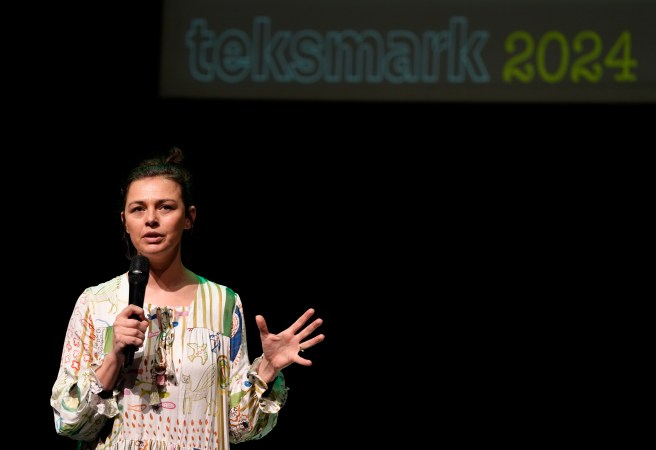
Prinsloo brought her masterful Master Class, a piece of classical theatre, to the festival and, also as is her nature, she teamed up with the exceptional David Viviers in a Teksmark original Op die hoek van Styx en River is Nora per Abuis met die Dood Oorgeslaan (playwright Henque Heymans). It’s a novel work which showed flickers of what it could be in time (always a scarce commodity).

Like Rademeyer’s Goed Wat Wag Om te Gebeur, Monsters, (produced, directed, adapted and translated by Tinarie van Wyk Loots) which has had runs at other festivals previously, found a remarkable rhythm that lifted the text and the performers into another realm . It was rewarding to experience and again I was reminded what a precious entity the different circuits are because single theatres cannot afford to take many risks and festivals add an extra buffer in this precarious world – to the benefit of arts audiences.

Michele Burgers in Monsters. Picture Stephanie M Gericke.

We haven’t seen much of the versatile Michele Burgers, who will hopefully return to stage more often in the future and who was beautifully supported by the talented René Cloete, Ntlanhla Kutu and Elton Landrew.

Die Vegetariër with Tinarie van Wyk Loots and Melissa Myburgh who as young actress has shown her mettle magnificently . Picture: Nardus Engelbrecht

Smartly directed by yet another multi-talented artist, Tinarie van Wyk Loots, she also featured in Jaco Bouwer’s hard-hitting Die Vegetariër (adapted and translated by Willem Anker) which also benefited from another run, as well as in the latest probing Anker text, Patmos, also brilliantly staged and directed by Jaco Bouwer, who always challenges and pushes boundaries with his choice of productions, casts and presentation.

Without these art warriors our art landscape would be barren. They keep us returning to theatres time and again with their unique approach, their determination to do their best under trying circumstances, including a lack of time and money, and simply their excellence.

Nataniël, for example, returned from an extensive tour to New Zealand and Australia during the festival yet put together one of his distinctive shows with flamboyant costumes, mind-blowing text and two musicians (Marcel Dednam on Piano and Leon Gropp on guitar) who created a spectacular rhythm to underpin his songs and singing quite magnificently.

I could go on forever, there were simply too many highlights, yet I cannot go without honourable mentions of the following, no less important than those already mentioned:

Jefferson J. Dirks-Korkee in a return of the soul-stretching Rooilug.
Marianne Thamm

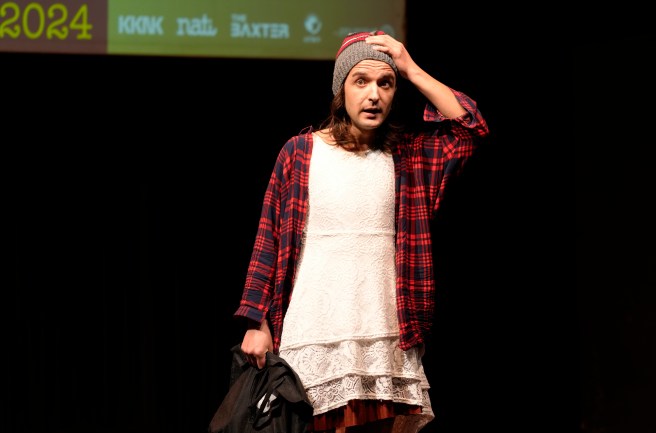
Solo shows: the return of Rooilug with the delightful Jefferson J. Dirks-Korkee; Fietsry vir Dommies (masterful text by Tiffany Saterdacht and deftly directed by Dean Balie) which showcased the enormous talent of Eldon van der Merwe, who was also rewarded with a Kunste Onbeperk prize for Young Voice. Dean John Smit shone in his now full-length solo production of Hallo, is Bettie wat Praat; the craftily current My Fellow South Africans by Mike van Graan, starring the physically and mentally dextrous Kim Blanché Adonis; Vuisvoos, maar nog regop, where journalist Marianne Thamm delivers a gloves-off and much needed monologue, incisive if laugh-out-loud, on the state of the nation; a shout-out to much missed director, Jenine Collocott, who teamed with actor Klara van Wyk to present the hysterical Monika, it’s me:

Double-up: David Viviers and Wessel Pretorius returned as a popular duo in a follow-up to their successful Klara Maas with ‘n Lewe in die die dag van ‘n vrugtevlieg, ensomeer and hopefully many more encores in the future, they were missed; an innovative new duo, Stellenbosch students Angelique Filter and Merwe van Gent, soared with the tragicomedy The Old Man who thought He had a Dog;

Stand-up (not my speciality) yet: Who can resist the always energetic and enthusiastic funny man Marc Lottering who always delivers?; as well as my comic standout of the festival, KG Mokgadi. It feels as if these two have something more to say than just one-liners.

Productions: The original Ken Jy Vir Dewie was cleverly staged with themes that target the whole family and as the play was dealing with bullying, the setting for everyone, actors and audience alike, was a classroom; and again, it was directed by yet another versatile artist, Margit Meyer-Rödenbeck, who has exchanged Dowwe Dolla for Ouma, again a sign of the times. She cleverly started the play outside with audience and cast waiting to enter the classroom!;

And Craig Morris grabs the attention in Die Rooi Ballon.

Children’s Theatre: It’s not something I usually see at festivals but, as I did, I was encouraged by the effort made by the KKNK to look after these tiny tots who are of our more enthusiastic audiences: My favourites included Braam en die Engel and Rooi Boeties.Watch out for them as they might travel.

Dance: is back with brilliance because of the clever choice of productions, only two of them but with some of the most innovative names in contemporary dance: Dada Masilo who choreographed one of three pieces, Salomé, for Joburg Ballet; and Grant van Ster and Shaun Oelf  with the Figure of 8 Dance Collective (pictured), who brought in other creatives like Nico Scheepers on text, Andi Colombo on lights and Franco Prinsloo on original music. Both companies were sublime.

Lucky Pakkie (Packet): Thanks to the brilliant team of Llandi Beeslaar and Stephanie Gericke, this is another of the KKNK delights because of their dedication and hands-on approach. It needs that because what you have is three lucky packets of four 15-minute productions each; the three sections embrace easy viewing to soft touch to pushing the envelope as much as possible, and artists who cannot manage a full production or perhaps just want to say what they need to say in this time and on this platform are vetted and included in a fun-filled programme.

The original Karli Heine. Picture by Stephanie M Gericke

There are too many to name, but for starters … what about Karli Heine, who turned herself into a pot plant and blew my mind … for script, performance and imagination!

It is impossible to cover everything and I haven’t given the art exhibitions a mention, even though curator Dineke Orton again broke down barriers and took us on a visual trip. But these are just some of my thoughts on a festival that felt like one joyous merry-go-round. Try and catch some of these through the year as they travel to different theatres and festivals.

Here’s holding thumbs!

And finally, on the last day, even the weather seemed out of sorts…

SOPHIE JOANS, AN ISLAND OF INSPIRATION

The luminous Sophie Joans in a solo performance of a play she has written.

Theatre review of ÎLE finishing this weekend at Sandton’s Theatre on the Square by DIANE DE BEER

PICTURES: PHILIP KUHN

ÎLE

WRITTEN AND PERFORMED BY: Sophie Joans

DIRECTED BY: Rob van Vuuren

DATES: Today at 7.30pm; tomorrow at 5pm and 8pm

When you’ve been around in the arts for as long as I have, it’s always an unexpected  thrill to discover a new talent.

Solo performances are obviously a handy talent to have in your bag of tricks because of the precarious nature of theatre and the performing arts. If you have to rely solely on managements, festivals and directors to keep your career going, it could be disastrous  –  and tough on your anxiety levels.

With the ability to write and perform, you can create your own work, pack a bag and travel from stage to stage or whatever entertainment platform you prefer. If you have presence, which is something that’s difficult to explain, (you either have it or you don’t), it’s a gift that should be cherished.

Sophie Joans has all of the above and more. It’s a powerful package. She’s also obviously smart to not go it completely alone but to have the skilled Rob van Vuuren on board, someone who has made the stage his home, as director.

She bounces on stage bubbling with energy and enthusiasm and launches into a travelogue with Mauritius and her mother as the main destinations – and right from the start, she holds your attention with a smart and hilarious script. She taps into the ever-fraught relationship between mothers and daughters, where the one is wise if weatherbeaten and the other knows all the answers and doesn’t want to be prompted on how to proceed in life.

We all recognise family foibles in some fashion, but this is where the writing is witty and wise. Yes, it sounds hellish and many of us will think of our mothers and their lesser indiscretions with relief, but the way Joans reflects on and rants about her family is so cleverly charged, even when it dangerously skirts the edges, that  there’s always something to hold onto as the younger Joans finds a way to explore her mother’s sometimes ferocious guidance.

It’s all about family narratives, the way mothers and daughters pass on a specific legacy that never seems to change. We all know how damage is done by those who have experienced that same pain themselves. We just have to look at the world we live in today to find all the examples needed.

While all of this might seem way too serious for someone who started in stand-up comedy, with some tweaking she has turned her sights to a more specific stage. Having just come from an arts festival, I know how  exposed the stand-up stages can be, so she obviously knows how to handle a critical crowd.

This is something quite different. She presents Île as quite a personal story, enters the stage with very little but two large boxes which she moves around, and is aided by the best weapons: her words and her warmth.

She’s a storyteller, someone who holds her audience with confidence, and with a generosity and a gentle yet gregarious approach to her performance. She aims straight for the heart. If you can possibly make it in the time left over (it only runs till Saturday), Joans is a winner.

And I can’t wait to see where and how she goes from here. We’re a rather small theatre community, so when someone with such obvious performance genes hits all the right notes, it’s a time to celebrate and embrace.

She has travelled this play from small beginnings to world stages so obviously she has made a huge splash, but for me she’s the new kid on the block. And I could not be more delighted!

Thanks Daphne Kuhn (producer and artistic director of Theatre on the Square), your theatre smarts are always appreciated.

SOCIAL MEDIA RUNS CIRCLES AROUND CLUELESS USERS, TURNING THEIR LIVES UPSIDE DOWN

Pictures: Daniel Rutland Manners.

Mother (Charmaine Weir-Smith) and son (Nicholas Hattingh) in selfie mode…

DIANE DE BEER

EXPELLED

Expelled is described as a family drama which focuses on the largely ungoverned world of social media.  Alex, a matric pupil at an elite school, gets caught up in a viral scandal and is suspended. Once shared, lives alter in seconds, what’s seen cannot be unseen.  The ramifications for his family are profound.   

Rosalind Butler’s new South African play

PRODUCERS: How Now Brown Cow Productions in association with The Market

DIRECTOR: Craig Freimond

CAST: Anthony Coleman, Charmaine Weir-Smith and Nicholas Hattingh

VENUE: Mannie Manim Theatre at the Market, Joburg

DATES: Until March 31. Performances will take place Wednesday to Saturday with evening shows at 7pm and matinees on Sunday and Saturday at 3pm. There will be additional schools’ performances at 11am on Thursdays during the run.

Living in an online world.

There are few people who won’t be aware of the devastation of social media on normal lives. We all know there’s the good and the bad but taking into  account the recent banning by the US Senate of the Tik Tok app on government devices, the results are too often disastrous and, apart from this surprising development, with few guardrails.

It is with an eye on the pitfalls that Rosalind Butler wrote this play which Freimond had huge fun putting on stage and screen – which it lends itself to. If you want to know how to get younger audiences to theatre, this is it. You’re talking their language and the play offers the chance to play with different generations and their approach to social media.

With phones an additional accessory, few people can resist writing and sending off messages in abundance and often with more haste than hesitation, which would be a tool to keep in mind. Once you push that button, the harm’s done.

Parents: Charmaine Weir-Smith (right) and Anthony Coleman.

And in this version it’s all done in full colour and with the scenarios taking real issues which will cause havoc as they go viral. We’re living in a world where too many are completely unaware of the sensitivity of certain issues.

Families allow schools to dictate norms while these institutions see their roles as strictly educational, refusing to meddle with the morals of their young charges. It is a recipe for disaster, especially with all the tools available in today’s communication circus where everyone is encouraged to participate.

Butler’s text races off at breakneck speed, almost mirroring the record times messages are sent and read while disrupting and destroying lives. There’s very little chance of pulling back once the release button has been activated. And while we all know and understand the world we live in – fast and furious – we still don’t stick to the safety precautions.

It’s a topic that encourages a contemporary social media approach and Freimond with his cast go at it full tilt. Nothing has to be explained or embroidered because we all know the playing field with all its inviting yet often devastating intrigue.

Phone gymnastics.

The cast is perfect as they play their characters and their often-vacuous natures to perfection – all at different tempo yet with a serious approach only possible in our deranged contemporary landscape that encourages these public meltdowns with humiliating outcomes. Weir-Smith’s mother and wife has captured a type we all recognise, so wrapped and isolated in her own tiny world, she’s completely unaware of the destruction she leaves in her wake.

In turn her husband (Anthonty Coleman) is blinded by his own importance, with his wife and son marginal figures in his corporate universe.

Their son (Nicholas Hattingh) is focussed on the love of his life with no understanding of the effect his public vitriol might have on his mostly invisible life.

We can all see the avalanche of disaster which will soon obliterate this family teetering on the edge already, but, fortunately because of the very nature of social media, many mini scenarios are being replicated all around them.

Because we’re all au fait with social media, it’s fun to witness something so familiar unfold as we recognise and might even have participated in similar scenarios. A good edit (a cut of approx. 15 minutes) would have avoided repetition and landed a near perfect play. It might come across as fun and games, but we all recognise that in many lives it could also be deadly serious.