Nataniël Makes the Earth Move in When Giants Waltz – 12 Monumental Concerts

nats giants3
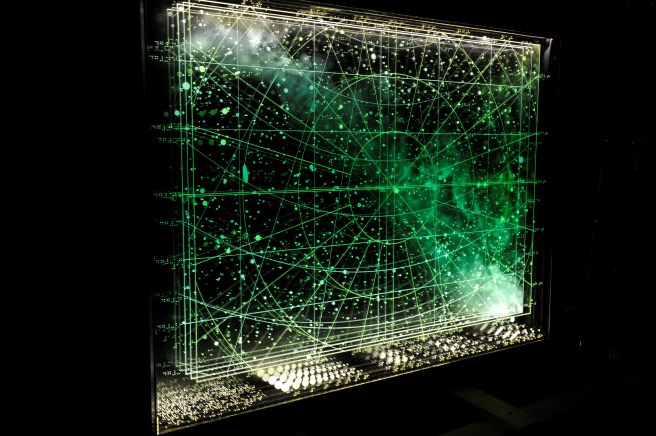
The stars from When Giants Waltz

DIANE DE BEER

WHEN GIANTS WALTZ – 12 MONUMENTAL CONCERTS  

Artist/writer/composer: Nataniël 

Musicians: Charl du Plessis (keyboards), Juan Oosthuizen (guitar), Brendan Ross (keyboards, saxophone and vocals), Werner Spies (bass), Peter Auret (drums)

Vocals: Dihan Slabbert and Nicolaas Swart

Costumes: Floris Louw

Venue: Theatre of Marcellus, Emperors Palace

Dates: Until October 27; Fridays and Saturdays at 8pm, Sundays at 3pm12 concerts only; 90 minutes long; no interval; no cellphones, sandals or shorts; no children under 15


No matter how little or how well you know this artist’s work, he surprises you.

How does he do it? I watched in wonderment and awe while experiencing the thrill of a performance that epitomises the excitement of live theatre – and it happens year after year.

It’s like a surprise party. Before the time he has much to say about what won’t be part of the concert, for example, the absence of a set, no more choreography, music that’s not accessible, no overarching story – he doesn’t speak much about what will be part of the show.

That’s Nataniël, someone who works imaginatively and creatively to catch his audience off guard, to always bring something new, not only with message as he moves with the times, but also with his evocative stage craft.

Nats giants4
Creative costumes are part of the storytelling.

Following a hiatus last year after more than a decade of annual shows at this theatre, he’s back with a vengeance in a way specifically structured to catch you unawares. The costumes are bigger and even grander in conception than before with many gigantic garments filling the giant-themed landscape.

They are heart stopping, from a different era, in royal fabric and often bright colours, with the result that many are clamouring for an exhibition of his stage couture. The finer detail is difficult to catch from an auditorium.

There’s a costume in front of a backdrop which mirrors the fabric, lamps drop from the sky and moonscapes create a lunar atmosphere, a brilliant blast of red with a sign dropping from the heavens with the word blue – in fact colour plays a huge part as his storytelling both tickles and tortures as he is wont to do. There’s always a sting in many of his tales.

Then the performance and the show, the substance and the visuals, the stories and the songs with musicians of stature who all contribute to the overall artistry, take over.

From the entrance with Nataniël tripping onto stage draped in creature couture which immediately puts you in an imaginary place, this genius storyteller takes you a-wandering in his world of merriment intertwined with melancholy.

nats giants 2
Nataniël in full flow

The language, the images he conjures up with his characters and the lives they lead, the way everything unfolds and the music which drifts between blues, jazz and a few pop classics – some original, others re-arranged – all come together sweetly.

Backed by three sassy vocalists or sometimes performing with only the sounds of a lone guitar as accompaniment, Nataniël has through the years found the music that works best for his voice and which accommodate and remark and elaborate on his stories. Sometimes he might google the saddest jazz song in the world (for example), which he then sings and when he can’t find anything for a particular story, he simply writes one.

He has never had a hit, he says only half-forlornly, but he shines when performing live, relaxed in his own skin, crooning with musos who know his style and get into the swing and rhythm (as well as a constant change of costumes for the band too) of his particular vibe. Everyone shines.

The show is presented in a series of montages, almost like paging through an album. The costumes and props do the visual fantasy and the stories fill in the details. These leave you giggling and gasping in turn as as he dips into the often hysterical lives of a woman who has arranged her life to accommodate the elephant in the room, another with blue ribbons whose knitting finds no conclusion and yet another whose names are constantly switched until she owns her identity.

He bookends the show with the history of giants and their place in the world and in conclusion, confronts those who feel larger than life with unchecked power, who believe they are mightier than the law and trample those they regard as lesser human beings and easy to destroy.
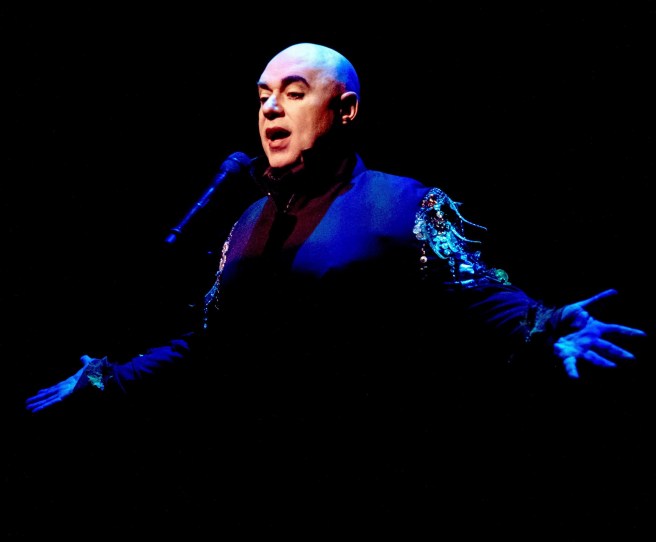
nats giant4
Nataniël in song

In each tale, once the laughter dies down, and just before the next song, the sadness of all the hilarity at what is sometimes the horrors we all encounter in normal living, hits you full on. But, with perfect timing, just before you succumb, a stunning new costume, or a song fills the empty space and we move on.

This is an artist who has perfected his craft. None of the normal rules applies. He has used a director on occasion but not for the last decade. He writes all his own scripts, guides his designer in the costumes he hopes to see, plans the lighting which sometimes only show the costumes in full light as the last note rises and designs the stage and anything he needs to accomplish a mood for a story and a song.

It’s transcendent what he achieves and in-between, he tours the platteland with shows and speaking dates, does cooking shows and TV series, and has just published his first book that didn’t first play on stage – in both Afrikaans and English.

It’s his imagination – unchecked – that never lets him down as he draws a world with his visually rich stories (in both English and Afrikaans) while entertaining in a manner few can achieve year in and year out.

When giants waltz, Nataniël says, the earth moves, which may be true. He doesn’t have to rely on size or stature, he gets everything moving with his gigantic creativity and imagination.

That’s the artist he is and it’s joyous to experience this kind of quality.


Mathews and Associates Activates Bridge Between Javett-UP’s Art and Architecture

Javett at night
Different angles of the Javett-UP

Today, October 7, is World Architecture Day. Tshwane’s latest art centre opened on Heritage Day. Featuring a clutch of galleries as well as offering a brand-new architectural feature on the edges of the University of Pretoria’s Hatfield and South campuses, DIANE DE BEER gets the lowdown from architect Pieter Mathews whose firm Mathews and Associates designed the Javett Art Centre (Javett-UP):


It’s been a long haul for Mathews and Associates with the first concept design penned in 2012, but finally the time has come for the magnificent building and the art to be revealed and to determine that their initial goal to create a space that will activate the connection between art and architecture has been achieved. Time will tell but everything seems to point in that direction.

For lead architect Pieter Mathews (helped by project architect Liam Purnell and assisted by project dedicated architects Carla Spies and Jannes Hattingh) the specific site (one of three options) was selected because of its proximity to the Boukunde Building and the Visual Arts Building which flank the Art Centre. “They should all be in conversation,” he says, which is what influenced certain aspects of the design and the materials used.

Javett art
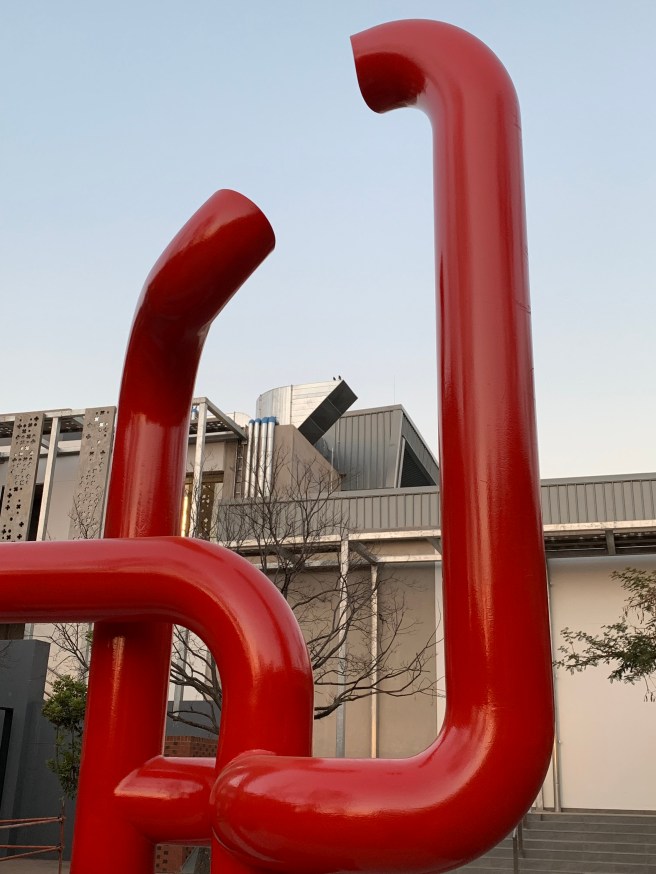
The building seen through the Eduardo Villa artwork.

It also contributes to the easy nestling of what is an enormous group of structures into the established landscape.

Mathews describes the style as Neo Brutalism. “Brutalism is part of the architecture history of South Africa (and worldwide) and was especially popular in the 60s and early 70s. What it means is to use the material in an honest way. Concrete which has a soul of its own is simply cast and left like that. Aesthetics are determined by the building method and the way the materials are used in its most brutal form.”

American architect Louis Isadore Kahn, known as the world leader in brutalism, most famously captured the concept with the following quote: “Even a brick wants to be something.”

javett-UP

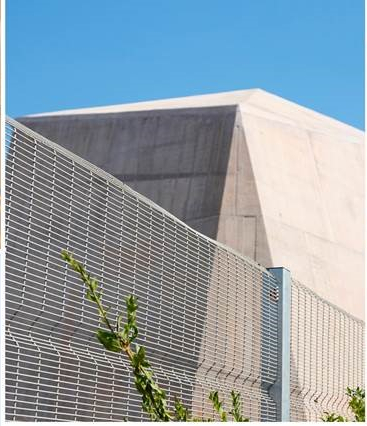
In that spirit Mathews describes the abstract and brutal “mountain” of concrete (created by a local concrete shuttering firm) and representing the Mapungubwe Gallery – which is home to the world-famous Mapungubwe Gold Collection with the golden rhino – as honouring the honesty of the construction methods of brutalism with the natural elements of concrete coming alive as it will show signs of ageing throughout its life. Natural light casts patterns changing throughout the day. It’s the standout feature of the centre.

Perhaps one of brutalism’s strongest features is what captured his imagination specifically when designing the Javett-UP. “Buildings appear as if they have been there forever,” he explains, which is important in especially this university set-up.

Linked to the Mapungubwe Gallery by Museum Square (with a restaurant to the side and an outside exhibition space) are a selection of public galleries (nine in total, together with the two student galleries below Art Square). The public art galleries will display the best from the collections of the Javett Foundation (lead donor on the project) and the University of Pretoria, as well as various temporary exhibitions with arguably a more contemporary slant.

The Centre also includes a 117-seat auditorium, administrative offices, storage, art conservation and quarantine areas.

Javett full view
Another view of Javett-UP


The Javett-UP was designed to embrace both the space and the surrounding buildings, and while it might achieve iconic status, it shouldn’t stand in isolation. He was also intent on linking the Art Centre with the campus from every possible angle which makes access easy from different vantage points. This was a Centre that had to function for both public and educational purposes.

The gallery space extends across Lynnwood Road via a bridge (Bridge Gallery) which brings together the Hatfield and South Campus. As another outstanding feature, the most visually accessible, it has been turned into an eye-catching attribute wrapped in lightweight concrete panels that reaches across the exterior and interior based on the much-loved “shweshwe” fabric. It displays different patterns and designs depending on the time of day as shadow and light come into play, turning it into a spectacular showcase when it is lit at night.

For the architect it seems as if a bank of fairy lights is sparkling in the middle of the road through this dashing design which symbolises strong, embracing South African connections across a wide spectrum.

Javett art centre
An outside view of the bridge

If you haven’t noticed the new building yet, it’s fast becoming a landmark as you travel up and down Lynnwood Road. The bridge spills out onto University Square with the student galleries positioned below and then extends into the historic Tukkie Laan linking the Art Centre with the main campus. The squares are specifically placed to gather people. “People attract people,” says Mathews with the one easily accessible to the public and the other gathering the students from the campus.

Mathews wanted a building with no bling or shine, something he has achieved with his design and building materials.

They had to find a method of linking the various elements like the bridge patterned panels, the faceted concrete shell structure of the Mapungubwe “mountain”, galvanised steel pergolas which again repeats the “shweshwe” design and all the other building elements. Colour was the most obvious solution. As the structure is dominated by the hue of  concrete – a natural light grey emerged as the leitmotif. When they wanted to separate various elements, they used charcoal as the shadow colour.

Mathews is the instigator of Cool Capitol, the world’s first uncurated, DIY guerrilla biennale that is a place for citizens of the Capital City to collectively contemplate and express their love for their city – and how to improve it. He and his Cool Capital team also hosted and designed the 2017 South African Pavilion at the Venice Biennale.

javett patterns again
An inside view.


He has declared himself an ambassador for the visual environment and it is this blend of art and architecture, part of his DNA, which made him and his team, the perfect match for the Javett Art Centre – UP.

Even though they had to survive many hills and valleys with the building of this monumental project, he declared from the start: “I am very confident in the collective brain at work here.”

Now we’re simply waiting for the art to come alive on this spectacular stage.


  • Go to https://javettup.art for more information. Open times are daily from 10am to 5pm and apart from the exquisite building also shows collections of  spectacular African art.

Two Young Artists Grab Top Prizes in 2019 Sasol New Signatures Competition Using Traditional Media in Classic Style

Pictures: Petrus Saayman

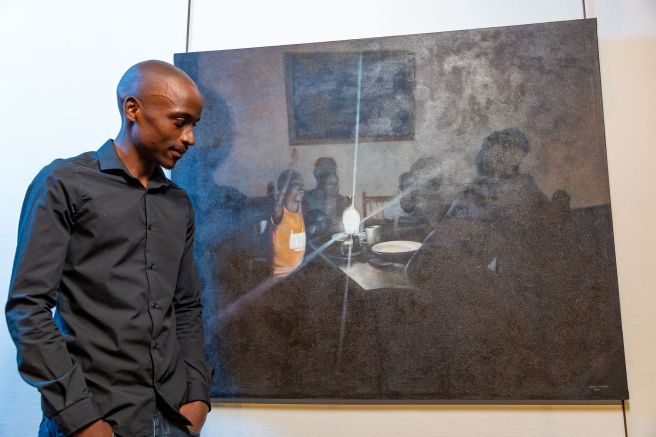
Sasol New Signatures winner Patric Rulore
Sasol New Signatures 2019 winner Patric Rulore

DIANE DE BEER


Hoping to shine a magnificent light on load shedding – both literally and figuratively – was the inspiration for Pretoria student Patrick Rulore’s winning canvas titled Stage 4 moments.

Rising to the occasion, the young artist was announced the winner of the 2019 Sasol New Signatures Art Competition at the Pretoria Art Museum last night, (Wednesday) winning a cash prize of R100 000 and the opportunity to hold a solo exhibition at the Pretoria Art Museum with the 2020 winners.

 “It was part of my family’s experience which gave me more insight into how to execute it the way I did,” explained the 24-year-old student currently completing a National Diploma in Fine Arts at the Tshwane University of Technology.

“In the beginning of this year, South Africa had to endure extreme shortages in electricity supply with electricity scheduled in stages. The most important part of the work was to teach people to turn unfavourable circumstances into a positive experience,” he said.

In his painting, Rulore depicts the typical behaviour of his family during load shedding, celebrating the absence of all activities involving electrical device during these blackouts which encouraged them to interact with each other – to talk, to laugh and to play games.

His primary medium is paint, using both oils and acrylics. “I am fascinated by the complexity of the human body (male and female) and attempt to discover its magic on the canvas. I endeavour to capture the emotions and spirit of everyone I paint. To achieve this, I manipulate and play with colours, textures, paint and brush marks,” he earnestly explains his process.

Paying tribute to his mom who has been a strong influence and supporter of his art, he believes it was her work as a fashion designer that encouraged him to pursue art.

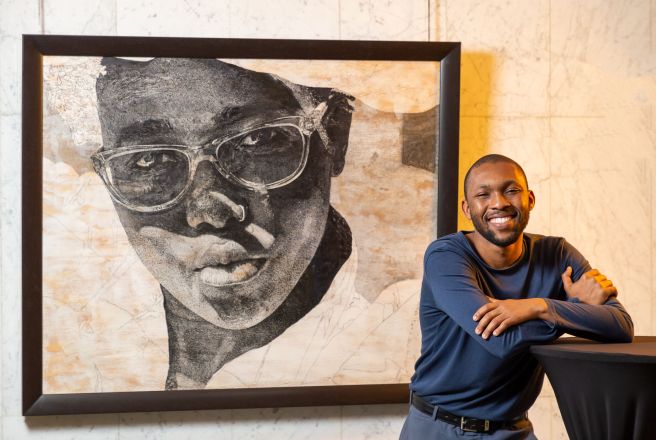
Sasol New Signatures runner up Luyanda Zindela

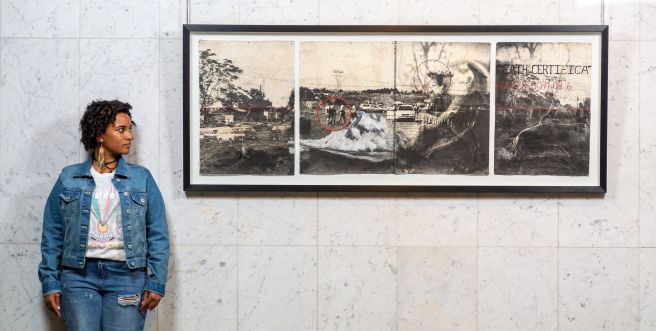
The runner-up in the 2019 competition is Durban University of Technology M student Luyanda Zindela, also using traditional media –  pen, ink and graphite – on pine-board, titled Phowthah sis’ Mgabadeli.

 The title which means Pout Miss Mgabadeli is a reference to his friend’s irreverence, says the artist. “When I was taking the pictures, she asked me whether she could pout.” With the title, he also points to the way women are assigned specific roles in society.

 The drawing is a breakaway for him in terms of scale as well as overall. “I wanted to gauge how it would be received by an art audience and to produce a body of work based on the submitted drawing.” He certainly got a generous response.

 With his chosen tools, apart from the work, he also explores the limitless possibilities of a medium so readily available that it is often taken for granted. “I have tried to capture the boundless intricacies of black skin using traditional pen and ink drawing techniques like cross-hatching and stippling.”
He tried to push his boundaries and believes if you really look, the improving technique is visible. As runner-up, he was awarded R25 000 and the knowledge that his future project has been given the go-ahead.

For most of these rewarded artists, the competition means validation and a launch into the professional world.

These Five Merit Award Winners were also announced with most of them working with the personal:

S Nico Athene (Johannesburg) After After Party (Resurrection) DiaMount

Nico Athene  (Johannesburg) After After Party (Resurrection) DiaMount

S Kgodisho Moloto (Polokwane) Disguise mask Pot scrubs and wire

Kgodisho Moloto (Polokwane) Disguise mask Pot scrubs and wire

S Angelique Patricia Mary Bougaard (University of Johannesburg) Crucified Mixed media drawing on handmade paper


Angelique Patricia Mary Bougaard (University of Johannesburg) Crucified Mixed media drawing on handmade paper

S Cecilia Maartens-Van Vuuren (Bloemfontein) A presentiment Dried roots.jpgCecilia Maartens-Van Vuuren (Bloemfontein) A presentiment Dried roots
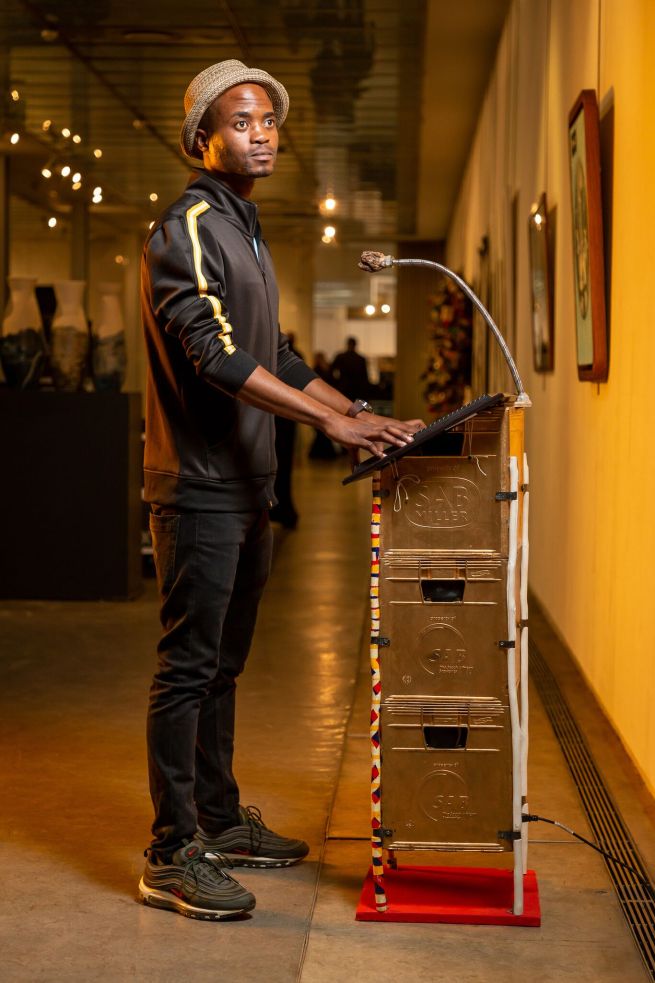
S Mlamuli Eric Zulu (Durban) Enlightened Art gathering Mixed mediaMlamuli Eric Zulu (Durban) Enlightened Art gathering Mixed media
Each of them received a R10 000 cash prize.

Acclaimed artist, judge and Sasol New Signatures Chairperson Professor Pieter Binsbergen noted that in this 30th year of Sasol sponsoring the longest-running art competition started by the Association of Arts Pretoria to encourage emerging artists, the winner and runner-up have both been recognised for works created in traditional media – ink and paint. He praised both works that have been painstakingly laboured and felt that the artists through their work showed immense drive and passion.

“Identity is still the driver, but the lens has narrowed,” he says about the work generally. “The journey has become more personal which they hope will echo widely.”

He also acknowledges that there’s a return to classicism, dealing with a more laboured surface with traditional media where technique rather than Instagram moments is at stake.

“On behalf of Sasol, we congratulate all the 2019 Sasol New Signatures winners,” said Nozipho Mbatha, Sasol Senior Manager: Group Brand Management. She also tipped her hat to all the emerging artists who have participated in the competition over the past 30 years.

“The majority of winners and merit award winners have carved out illustrious careers in the visual arts and have made significant contributions to our country’s artistic heritage. Here’s to the next 30 years of developing our cultural economy,” she concluded.

Jessica Storm Kapp, the 2018 winner, will present her solo exhibition entitled Artefacts of Belonging at the Pretoria Art Museum, alongside the 2019 finalists as part of her prize. The exhibition will feature the 2019 winner, runner-up and five merit award winners as well the 80 finalists, all of whom are included in the highly respected competition catalogue. The exhibition runs until September 29, 2019.

The final judging panel consisted of: Professor Pieter Binsbergen  (Convener), Cate Terblanche (Sasol Curator), Mary Sibande (artist), Wilhelm van Rensburg (Senior Art Specialist, Strauss & Co), Lebohang Kganye (Sasol New Signatures Winner 2017) and Pfunzo Sidogi (Lecturer, Department of Fine and Applied Arts, Tshwane University of Technology).

* Pretoria Art Museum:

Tuesday to Sunday:  10am to 5pm (Closed on Mondays and Public Holidays)

Corner Francis Baard and Wessels St, Arcadia Park.

https://select.timeslive.co.za/news/2019-08-22-power-of-art-load-shedding-inspires-artists-big-win/


Art on the Move at This Year’s RMB Turbine Art Fair from July 12 to 14

RMB Turbine Art Fair (RMB TAF) is on the move to a new and bigger venue for the 7th edition of the Fair. Since its inception in 2013, RMB TAF has grown extensively year on year and 2019 will see the most substantial Fair yet in a new location – 10 Fricker Rd, Illovo from July 12 – 14 with a preview evening on July 11.

DIANE DE BEER looks more closely:

Hannalie Taute with her work

One of the exciting art prospects is an artist who has developed her art with a view of speaking her mind – loudly – and she does that with valour.

Hannalie Taute describes her work as in a constant state of evolution, which in itself mirrors many of the ideas behind her art.  One central theme or unifying characteristic, she says, is the repeated exploration of identity and/or relationships within what she calls her paracosmic fantasy.

If all of this sounds a little out there, it is, and it isn’t. This is an artist who doesn’t shy away from putting her heart and mind out there. She often addresses gender issues – but uses both her harsher instincts as well as a sense of humour to speak her mind visually. Shock and laughter often come together when exploring her work.

Ronel Taute
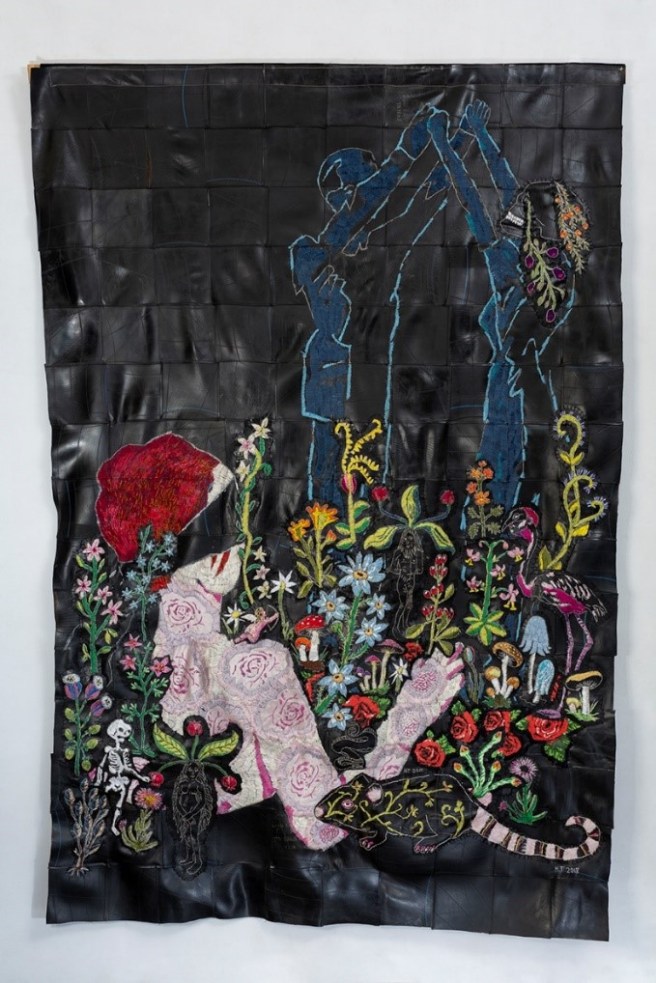
Hannalie Taute’s She Never Promised You A Rose Garden

She examines identity and relationships in a way that probes the duality and conflict people often have with many or even conflicting identities to which they answer to.

This kind of thinking is most striking in the work that Taute will be bringing to the Turbine Art Fair, ranging from figurative toy-like creatures to altered portraits as well as large embroideries.

Characteristic of the work of this Still Bay-based artist is the use of the traditionally black recycled rubber inner tractor tubes with embroidered thread with which she is continuing to create her paracosmos as a way of orienting herself in reality.

The coarseness of the rubber is counteracted by the delicacy of the thread, but this is subverted, as often the stitching and composition of the rubber inner tubes are delicate and the thread seems almost rough in its arrangement. Taute wants the medium of the piece to interact with the subject matter in a way that forces the viewer to engage and question her art. This is an artist in conversation with her prospective viewers.

She is perhaps best known for her strong showings at local art festivals where she received the Kanna award for best visual presentation at the 2014 Klein Karoo Art Festival (KKNK) as well as several nominations throughout the years. In 2017 she also gloriously represented South Africa at the Museum Rijswijk Yextile Biennale in the Netherlands.

Her work will be presented by Tshwane’s Millenium Gallery and the artist will also be present at the Fair.  Just remember before you start talking, she never promised you a rose garden, or that is what her art says.

Ronel Wilsenach Star Box
Berco Wilsenach’s Star Box

Other artists shown by Ronel van der Vyver’s Groenkloof gallery include Berco Wilsenach, currently part time lecturer at the University of Pretoria as well as presenting workshops on a regular basis at the Kunstakademie, Düsseldorf while also completing a PhD in Visual Studies. He won the PPC Young Sculpture’s Award (1997) and the ABSA L’Atelier (2005).

Ronel Colin Mashile
Cobert Mashile


Classics like Norman Catherine, Colbert Mashile and Anton Karstel will also feature.

Think Art on the Move, says TAF:  “Our vision has always been to develop young artists and grow the market for African art and elevate art collecting across a wider market. Visitors will be able to view exciting installations, larger gallery spaces and a more conceptually curated Fair but in the relaxed environment that has always been the signature of Turbine Art Fair ” says Fair Founder, Glynis Hyslop.

Proudly partnered for a second year by RMB, TAF is a unique South African art collaboration that brings together galleries and artists from around the country to present and sell works.

RMB TAF, they promise, is not just an art fair but an all-encompassing cultural experience for visitors, with artisanal food and beverages and vibrant entertainment programme. It also differentiates itself from other South African art fairs through its accessible pricing strategy. The selling price of artworks generally falls between R1 000 and R50 000, which presents opportunities to savvy investors and new buyers.

They present a series of special projects for visitors to view during the Fair as well as a multidisciplinary public programme curated by Kefiloe Siwisa and Nomvuyo Horwitz – titled The Year of the mirror which will include performance art, music, screenings, masterclasses and a children’s programme, talks and walkabout series. The talks and walkbaouts are offerd to the public for free and on a first come first serve basis.  The full list of talks, speakers panelists and talk times can be found at http://www.turbineartfair.co.za.

 Radio partner Kaya FM will be broadcasting live from the Fair on Saturday 13th July.


Dates:            12 – 14 July 2019

Venue:          10 Fricker Rd Illovo, JHB

Tickets:          R120 via Webtickets or R150 at door

Weekend pass: R250 via webtickets or R300 at door

Children R100: 4 years & older Includes access to children’s arts area and children’s walkabout on a first come first serve basis

Students & Pensioners: R100 at door and R80 via Webtickets (Friday only)

VIP opening night (11th July): R750 via Webtickets only and will include Performances by Gregory Maqoma (founder & executive  director of Vuyani Dance Group) and Mabuta


FAIR HIGHLIGHTS & SPECIAL PROJECTS


  • RMB Talent Unlocked is an emerging artist and curator mentorship program that started in 2014 under the name Fresh Produce. The workshop programme culminates with a curated booth by Fulufhelo Mobadi at the RMB Turbine Art Fair.


  • A Meeting of Minds: Louis Khehla Maqhubela and Douglas Portway Presented by Strauss & Co


  • Market Photo Workshop alumni exhibition 


  • Dumisani Mabaso benefit exhibition – as an artist and printmaker, Dumisani’s life and work is inextricably linked to the history of South African Art.


  • The Graduate Exhibition curated by Kefiloe Siwisa in collaboration with Maja Marx  for some fabulous work of artists who are at the beginning of their artistic careers.


  • The new space lends itself perfectly to installations and visitors will see the likes of Nkhensani Rihlampfu presented by M Studio Community and Jake Singer.


  • Gerard Sekoto Foundation will be presenting an exhibition.

Spirited Curator is Celebrated with Glorious Exhibition at UJ Art Gallery

20190605_192140_HDR
The Wildebeest and the swarm of African Migratory locusts by artist Hannelie Coetzee (see more info below)

It’s a rare honour when a curator is celebrated with an exhibition. DIANE DE BEER went to the launch and spoke to many involved in  this luminous exhibition:


During her two decades of curatorship at the University of Johannesburg Art Gallery, Annali Cabano-Dempsey has attempted to reach as far and wide as possible presenting a spectrum which would interest the public but also the students – one of the benefits of having an art gallery on a university campus is this potential audience which can be nurtured.

In acknowledging the dedication and passion Cabano-Dempsey has brought to the gallery, 21 Years of Curating the Cube (currently running until June 26) celebrates UJ’s continued role in supporting and embracing the diversity of art in South Africa.

The Keiskamma Guernica by members of the Keiskamma Art Project

 As the gallery’s 6th curator, Cabano-Dempsey has seen the gallery emerge as one of Johannesburg’s foremost art centres. The UJ Art Gallery (originally known as Rand Afrikaans University – RAU) opened in the 1960s and has since hosted numerous temporary exhibitions and acted as custodian of a large collection of artworks.

“My style of curatorship is collaborative.  I interact with artists on a regular basis before an exhibition, advise and shape a bit – and then I allow the artists to project their own voices.   I also hand over the reins to guest curators from time to time.  In the case of the 21 years exhibition, I felt too close to the artists, and called upon Johan Myburg to curate the show.  We worked through all the exhibitions of the past two decades and it was surprising that he found a golden thread of text, signs, signals, semiotics unveiling itself – something I never intentionally brought into my curatorship.”

Gordon Froud sculpture

In his opening address at the exhibition, artist Gordon Froud remarked on the amazing space designed by the architect, the late Jeremy Rose, which embraced and encouraged exciting exhibitions. He also praised Cabano-Dempsey for her detailed curation and the way she kept artists informed about specific exhibitions. They would know exactly how their work did, and who came to see it during the exhibition. “That’s rare,” he remarked.

He also spoke lyrically about her opening up the space to students and facilitating gallery training, for example, that would benefit them as artists in the future when they stepped into the real world. He described 21 Years of Curating the Cube as a meeting of old friends.

And fortunately for this remarkable sculptor, UJ also has an outdoor exhibition space which allows for large works to be displayed at their best (see picture).

Although she has been closely involved with a wide spectrum of artists forming part of the annual exhibition’s programmes for more than two decades, she chose to hand over the curatorship of 21 Years of Curating the Cube to respected arts writer and author Johan Myburg. They worked closely together in choosing the 38 works which was much more difficult than they expected, but the final decisions rested with him.

20190605_192722_HDR
Triple Goddess: Maiden, Mother and Crone: Artist Majak Bredell deconstructs issues of religion, women and the body and her works are strongly informed by the African continent and the Black Madonnas of Europe.

“My brief was to curate a show as a celebration of Annali’s 21 years at the UJ Gallery, something like paging through her ‘exhibition album’, so to speak. You can imagine the amount of shows, artists and individual artworks we are talking about,” explains Myburg.

That was the context he had to operate within and that formed the scope of the exhibition as well.

Panorama of Franschhoek by Titus Matiyane

“I made a selection based on a thread I detected in a number of the exhibitions/works of the past 21 years – the thread being manifestations of messages or mark makings in the form of signals/codes/text – in its widest sense of communication.”

He offers an example as explanation: On entering the gallery the first salient piece of sculpture is Marco Cianfanelli’s text-based work, referencing the quote by Desmond Tutu that truth, knowledge and beauty will triumph. “Whatever you want to understand under ‘truth, knowledge and beauty’ is subjective, but the basis, I think, is that of triumph. The message will live on. And art as carrier of message will triumph,” he says.

“I think the tweet (Jan’s Last Tweet, a work by the genial Jan van der Merwe – pictured) is a poignant little amplification of this triumph.”

IMG-20190606-WA0017
The Last Tweet refers to technology (twitter), a method of disseminating very quickly whereby a message could be conveyed on a global scale, also enabling misuse of power.

Anyone familiar with Myburg’s work and processes will witness the thought he puts into this kind of effort. “My intention was to highlight this notion (of triumph) in a subtle way. Not in your face. Should the viewer miss it, so be it. There is, right at the back of the gallery, a clue to my curatorial thinking,” he says. (And for those who like puzzles, this is like a challenge in treasure hunt!)

The artists included are the ones that had a link with the gallery in the last 21 years (to start with) but then also the ones whose artworks comment on the named “thread”.

It includes existing work (as per UJ Collection) and work on loan, but also recent work, i.e. Hannelie Coetzee, Diane Victor, Michael Meyersfeld, Angus Taylor, Mark Swart.

“My intention was a show as ‘unintrusive’ as possible in order for the work to speak. My approach was less rather than more, since the works all have an inner strength. I did not want to tamper with that. Hence a quiet show.

Bohlale-bja-mathome by Colbert Mashile

“Favourites? All of them. Being able to work so closely with these gorgeous works is a privilege. And I realised how limited my understanding of these works were. Perhaps still superficial. But that is the beauty of art: You cannot see too much of a particular piece. There is always something that you miss.”

All of these elements can be found in this remarkable snapshot of South African art in a specific period of time.

Do yourself a favour. If you’ve never visited the gallery, that’s an added bonus.

 A last word from the curator who is being honoured: “The next decade of my art journey (or what is left of it) will focus on two things:  To make the gallery accessible to wider audiences.  It has been my mission over the past few years to break down the ivory tower, to create a more informal atmosphere and to invite a younger generation to interact with the gallery programme on an interdisciplinary level. And then to recognise established and revered artists, but to also bring in younger promising artists into the fold.  I found that collaborations with corporate partners, artists’ collectives and joint exhibitions (the established with the emerging) allow for this approach.”


  • 21 Years of Curating the Cube runs until  26 June 2019 at the UJ Art Gallery. FREE OF CHARGE. Open Times: Mon to Fri from 9am to 3.30pm. Address: University of Johannesburg, Corner of Kingsway Ave and University Rd, Auckland Park, Johannesburg

Phone011 559 4674


  • More info on Hannelie Coetzee’s featured artwork: She did a succession study of humanity’s relationship with nature. Locusts eat the same amount of grass per body weight as wildebeest. A swarm consumes as much of a crop as a fire does. Disclosure: This swarm was bred and studied by Wits Scientists in the 1960s. The current curator of the AP&ES Museum, James Harrison made it available to the artist to repurpose into an artwork


Two Young Art Activists, Herschelle Benjamin and Jeremeo Le Cordeur, Shine their Creative Light with Flair

Pictures: Jeremeo Le Cordeur


Jeremeo and Herschelle
Jeremeo Le Cordeur and Herschelle Benjamin

In a world where the arts are no longer a priority, two young art activists caught DIANE DE BEER’S eye in the way they were forging ahead and establishing their careers in a space which would nourish their own creativity but where they also wanted to promote that of others:


Two young Capetonians Herschelle Benjamin and Jeremeo Le Cordeur are proof that artists often don’t have a choice. Once those creative genes kick in, they have to listen.

Benjamin, an only child, when choosing a career knew that law would be a wiser bet, but he enrolled for that as well as a drama degree – just to make sure.

“After one week of depressing law lectures, knowing that I will fail because I had no real interest or passion for it and seeing all of my drama friends at the library or at the drama department living their dreams, I changed courses without consulting my parents.”

With bursaries for Stellenbosch University studies, when switching lanes he knew he had to succeed and show his parents that he would still be a star pupil.

Jeremeo Le Cordeur
Jeremeo Le Cordeur with his award from the Suidoosterfees

Independently, Jeremeo Le Cordeur who describes himself as a creative soul, is a performer, theatre-maker and arts photographer who graduated from City Varsity, a school of media and creative arts in 2008.

Since then he has been working the arts in any way he knew how. In 2009, he joined Fresh Theatre Company, a community theatre group specialising in musical theatre, where he performed in musicals such as, Life is Rock N Roll, Love in Cyberspace, and Pinocchio.

In the following year, he created Vulture Productions, a platform to support and create new work. Since then, he has been at the helm of many successful productions such as Pizza’s Here (2011), I Know How You Screamed Last Scary Movie (2011), and Risk for the 2012 and 2013 National Arts Fringe Festival in Grahamstown and in 2013, he directed a play at Artscape titled, February 14th, which received excellent reviews.

In 2014, he directed Tannie Dora Goes Bos, which was included as part of Artscape’s 8th Women’s Humanity Arts Festival. The following year he directed John, which explored the controversial world of sex workers, working alongside SWEAT (Sex Workers Education & Advocacy Taskforce).

In the meantime, in 2016, a photography project was introduced to Vulture Productions. It was aimed at showcasing the work of South African theatre practitioners through arts journalism. In 2018, he was selected to represent Artscape Theatre in an arts-residency program called EVS (European Volunteer Service), based in Liverpool in the UK – which led to the creation of Mama, with performances at The Unity Theatre, Woordfees and Artscape.

Jeremeopic
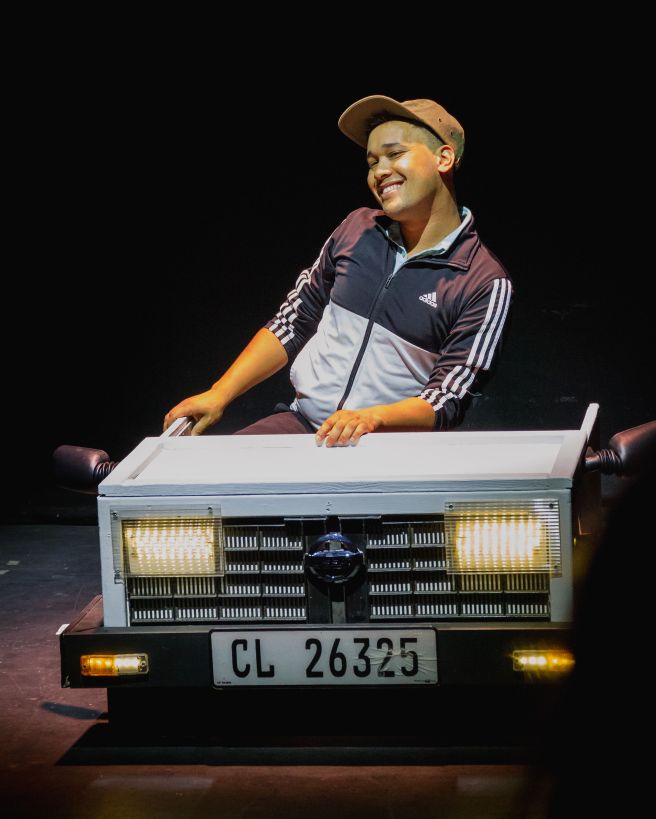
Jeremeo Le Cordeur starring in his own production Dude, Wa’s My Bakkie? Picture: Warren Meyer

And this year, he wrote and performed in two mono-dramas and collaborated with directors Ian van der Westhuizen and Dan van der Ventel to present Jerry An Unconventional Hero and Dude, Wa’s My Bakkie? (A Double Feature). These productions performed at Alexander Bar, Woordfees Fringe and Suidoosterfees, where he was the recipient of the NATi (Nationale Afrikanse Teater-inisiatief) Rising Star award for his vibrant storytelling.

As a youngster, Benjamin’s mom would tell him that a “pencil should never be left untouched”. “I didn’t think I was the best artist or writer but was forced to become friends with pencils, pens, paper and books. They were always there. Through all the phases and changes, my relationship to words and language is one constant one that has helped me in some of the darkest times of my life,” he explains.

The writing became more frequent and across different mediums. “Poetry still remains my secret love, dramas entice and challenge me, journalism makes me feel I don’t know enough and that I want to know more… It’s not the medium or genre that resonates but the power or ability of words, the imagination and the truth always being at the forefront of it all.”

Completing his initial studies, he received an internship at Media24 as an arts journalist. He also won the international Elizabeth McLennan Scholarship for Theatre & Performance from the Scottish Universities’ International Summerschool in Edinburgh. “This year, I’m going back after being picked as the first student host/tutor from Africa to the summer school.”

Slavenhuis 39
Herschelle Benjamin’s Slavenhuis 39 performed at the US Woordfees

Last year he won the Teksmark Writers Bursary, was also picked as one of Artscape’s New Voices and had a play produced and performed in the Arena Theatre under direction of Sandra Temmingh. Another play, In Slavenhuis 39, was also produced this year for the US Woordfees where it was well received and won the award for Best Upcoming Artist(s).

“I’ve written pieces for the Die Student on Netwerk24 and the new Vrye Weekblad. I am also working on my M degree. And I’m partnering on a few other projects for the future.”

Just a glance at their work and one can see these two artists were destined to meet. “We first met at Teksmark in 2017 and started working together,” explains Le Cordeur.

“He told me about his media production company, Vulture Productions, and that he needed a writer for the US Woordfees, because the company was invited as media. I was busy with my Honours degree and had time to help him during the festival. The rest is history…”

Herschelle
Herschelle Benjamin

“With Herschelle’s creative writing and my arts photography, we reported on many productions in Cape Town and at the Stellenbosch Woordfees. Our work was later recognized by Hugo Theart, artistic director of KKNK, who invited us to join Kritiek, a critical writing project to nurture new arts writers in 2018.”

This year they moved into the marketing departments at arts festivals. At the US Woordfees Benjamin ran the social media for the festival and at the KKNK, Vulture Productions were represented by the two of them as part of the social media marketing team.

“It’s all about building our industry, becoming well-rounded business-like artists and creating a career that span decades,” explains Benjamin.

Le Cordeur believes that Vulture Productions has shown the importance and value of support within the arts. “It’s provided opportunities for myself and so many others and it continues to have a significant impact on my own artistic development. I would love to have an exhibition of my photographs in the future,” he concludes.

As a performer, he’d like to sink his teeth into as many characters as he can, which is exactly why he collaborated with two directors to bring his own creations to life. He was rewarded richly for the effort. He will also be presenting three plays at the Free State arts festival from July 1 to 7.

Watching them operate at festivals is hectic, but these two youngsters understand that they have to grab every opportunity to make their way – especially in these early days. From reporting on and photographing the arts, to writing, performing and directing usually their own material, they have individually and collectively created a brand.

They deliver, are often over-used to a point of exhaustion because of the quality of their work, but this is their way of becoming fully fledged artists. Who says it’s easy? But if you’re Jeremeo Le Cordeur and Herschelle Benjamin, you have found a way. It’s hard work, but that’s how they keep those creative juices pumping – for themselves and their community.

For more information visit www.vulture-productions.com

“Take good care of it, it is my life,” said artist Charlotte Salomon about Life? or Theatre? which was also her Life’s Work

Pictures are all the work of Charlotte Salomon from Taschen’s  Life? or Theatre?

Charlotte SalomonDIANE DE BEER

Charlotte by David Foenkinos (Canongate) and Charlotte Salomon Life? Or Theatre? – Charlotte Salomon’s artistic feat under the Third Reich Charlotte Salomon Life? Or Theatre? – Charlotte Salomon’s artistic feat under the Third Reich (Taschen):

Charlotte Salomon is born into a family stricken by suicide and a country at war – but there is something very exceptional about her. She has a gift, a talent for painting. And she has a great love, for a brilliant, eccentric musician.

But just as she is coming into her own as an artist, death is coming to control her country. The Nazis have risen to power and, as a Jew in Berlin, her life is narrowing – she is kept from her art, torn from her love and her family and chased from her country. But still she is not safe, not from the madness that has haunted her family, or from the one gripping Europe…

Charlotte is a heart-breaking true story – inspiring, unflinching, awful, hopeful – of a life filled with curiosity, animated by genius and cut short by hatred. A beautifully, lucidly told memorial, it has become an international success.

20190513_140944
Inside cover of Life? or Theatre?

These are the words on the jacket of David Foenkinos’s Charlotte (Canongate).

I was given this book as a gift by an astute friend together with Taschen’s Charlotte Salomon Life? Or Theatre? – Charlotte Salomon’s artistic feat under the Third Reich which includes essays by Judith C.E. Belinfante and Evelyn Benesch as well as a selection of 450 gouaches.

Because I didn’t know the artist at all, I didn’t immediately connect the two books but soon discovered, the first, written almost in poetic prose –  like an epic poem – was inspired by Charlotte’s lightly fictionalised memoir consisting of hundreds of paintings, sketches, text and musical annotations created during the years she was in hiding.

Foekinos is an award-winning French novelist and screenwriter who won the Prix Renaudot and the Prix Goncourt des Lycéens, and Charlotte has sold more than half a million copies in France and was translated into 19 languages.

20190513_141616
And they walked home together, absorbed in silent communication.

It is excellently translated from French into English by American Sam Taylor. So once you have read the intriguing story by the novelist who simultaneously with Charlotte’s life story shares his own tale of discovering the artist, you can follow that with the Taschen art collection which again delves into Charlotte’s life but this time with the paintings and illustrations in hand.

It is an extraordinary insight into an artist who before these two books, might not have been familiar to you.

Foenkinos, for example, only discovered her work in 2004 in a museum in Germany and this propelled him to tell her story. It’s difficult to imagine that the life you encounter was such a short one and in a time as a Jewess in Germany (1917 – 1943), there wasn’t much chance of her visibility as artist flourishing.

Executing her gouache series Life? Or Theatre? she pleaded with a friend to “take good care of it, it is my entire life.” Perhaps she had a premonition because a few months later, the 26-year-old was deported to Auschwitz where she was killed shortly after her arrival.

20190513_141641
Out there in the forest there he stands – there dwells many a beautiful king’s child – in the forest there we want to listen.

The work tells her life story with a ground-breaking narrative that spans her entire short life: her complicated family life coloured by the high incidence of female suicides; her youth in Berlin marked by die rise of the Nazis and the oppression that followed; her close relationship with singing teacher Alfred Wolfsohn; her exile in France where her masterwork was accomplished; as well as abuse suffered on different levels from different people.

All these are reflected in her personal story that she embellishes with pseudonyms and fantasies to hide the actual personae, but reading both books, the story is clear. It’s an astonishing insight into her inner world, into that time, the way people lived and were terrorised, the decisions you make under duress and without foresight of course. Now we know everything in full colour, but at the time, the citizens of Germany, especially those being persecuted, had no idea of the horrors lying in wait.

But what also makes this such an intriguing read is the passions of the artist when it comes to the people and her painting and how she told her personal story in a way that kept her sane and allowed her artistic expression to flower.

Illustrated diaries, art books, aren’t uncommon anymore but at that time, given her youth and her life, what she produced is astonishing and adds greatly to her story and her art – both in equal measure and with astounding strength.

In 1947, her parents discover her life project in the South of France. They decide to donate it to the Joods Historisch Museum (Jewish Historical Museum) in Amsterdam in 1971. Throughout the years, parts of the work have been displayed in museums around the world, but many art lovers are still unaware of this artist and her body of unique and unusual art.

20190513_141437
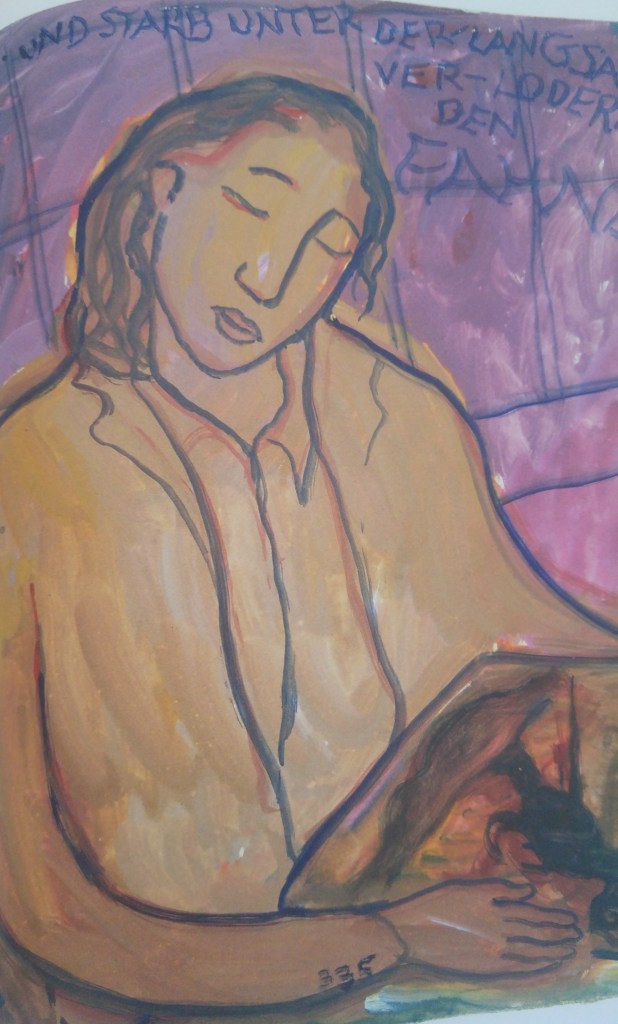
…and died under the slowly dying flames of the blazing flag.

According to Wikipedia, in 1981 the Museum presented 250 scenes in narrative sequence, and critics began to comment on the work.  An exhibition was presented at the London Royal Academy in 1998  and was an unexpected sensation, helped by the publication of a complete catalogue. Part of her anonymity, they believe, is the result of Salomon’s work not appearing on the international art market, as the whole archive belongs to the protective Charlotte Salomon Foundation based at the Joods Historisch Museum. The art historian Griselda Pollock dedicated a chapter to Charlotte Salomon in her Virtual Feminist Museum, analysing her work in terms of contemporary art, Jewish history and cultural theory.

And most recently Charlotte Salomon: Life? or Theatre? was exhibited at the Joods Historisch Museum from October 2017 to March 2018.

With these two latest books, there’s a chance of a wider audience and perhaps a deeper understanding of her work. But more than anything, it is the excitement of discovering an artist with such a strong voice, a woman to boot, who tells her story in such an individual and inspiring fashion.

It’s not an uplifting story, but it is inspiring that she could find a way to express herself so magnificently and with such a unique voice in such dark times. And leave such an luminous legacy.


The House That Jack Built Celebrates the Life and Art of Local Artist Jack Lugg

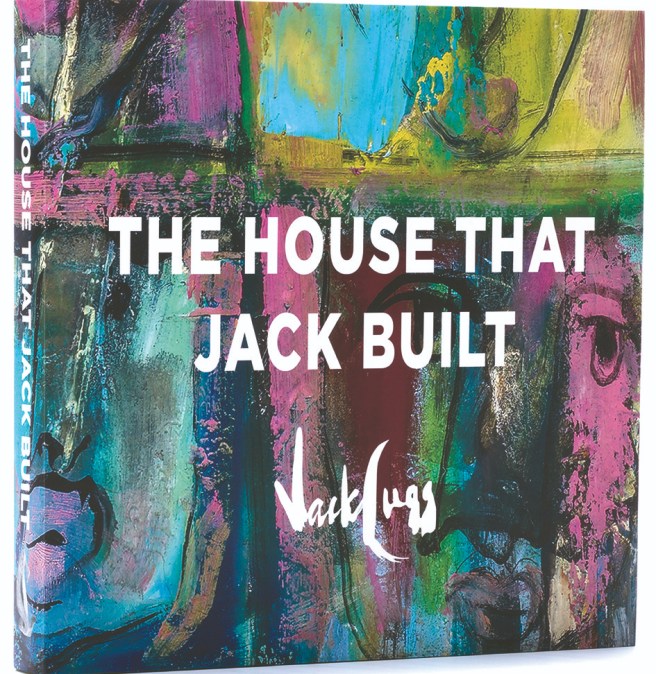
house-that-jack-built-book-cover-high-res.jpgLocal artist Jack Lugg is being celebrated with a book launch and a retrospective exhibition at the Pretoria Art Museum from May 7 until June 23. DIANE DE BEER investigates his life and work which is detailed in The House That Jack Built, an illustrated biography instigated by his daughter Pippa Lugg Verster:
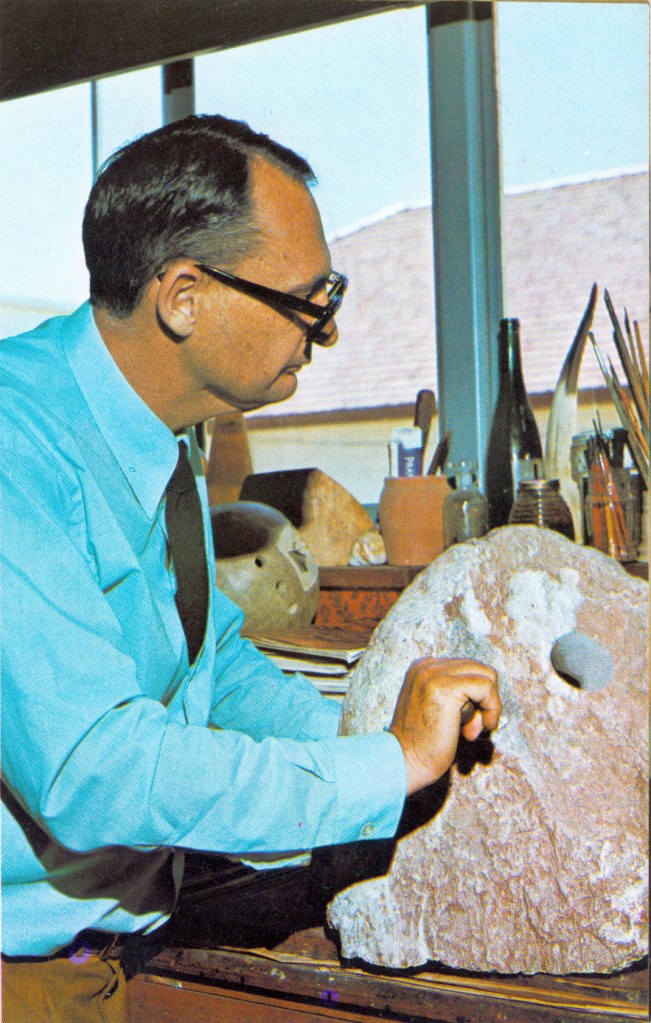
Jack sculpting in the 70's at Tech
Jack sculpting in the 70’s at Tech


Checking my artistic circle, none of them was really familiar with the artist Jack Lugg, but if you should venture into academic and artist circles, the response would be totally different.

“I first heard of Jack Lugg in about 1965 while I was still a student at Selborne College. He was the best-known artist in East London and his art was totally different from the art I had grown up with…” writes celebrated artist Norman Catherine in the foreword of The House That Jack Built – Jack Lugg (Jack Lugg Art Gallery CC).

For many, says his daughter, Pippa Lugg, in her introduction, the name brings back memories of an influential mentor, or others who own his art are reminded of a devoted and passionate artist. “My father worked tirelessly: sketching, sculpting and painting over the course of seven decades.”

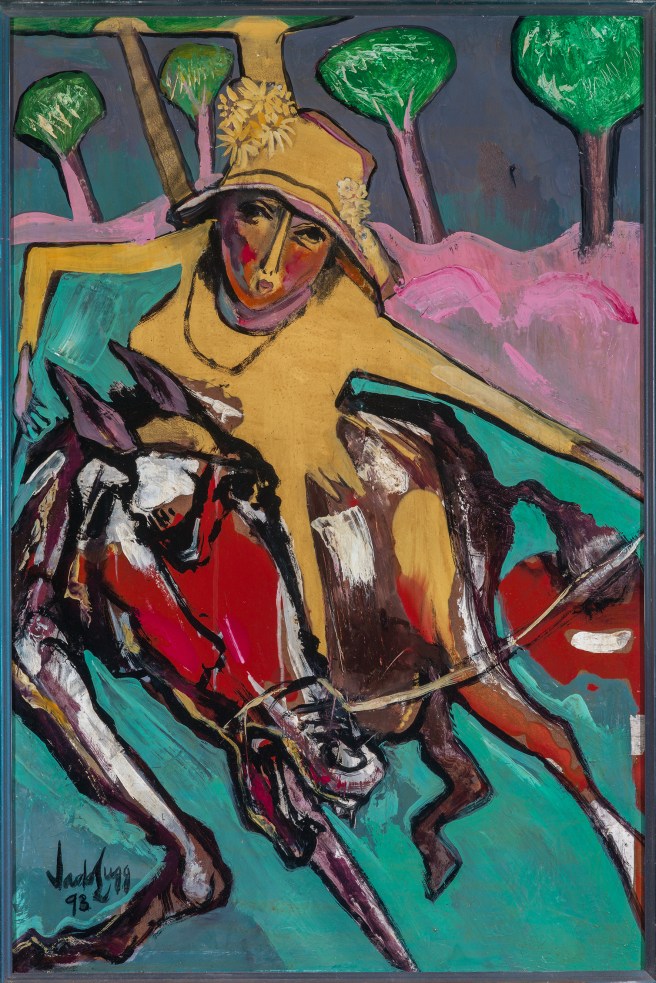
1993 Spirited ride
Spirited Ride, Oil, 1993

He was the head of the of the department at the East London Technical College Art School for 35 years and it was her hope that this book (together with the exhibition in the Pretoria Art Museum) would be a testament to “his remarkable life, and to all that he built”.

She explains that the foundations for the book were laid by the artist himself, and his wife Rosemary. They planned to publish it to celebrate his 80th birthday but sadly it didn’t happen in time for his birthday or even before his death in 2013.

But things were set in motion and part of these was a blank sketchbook that his daughter gifted to him on his 78th birthday which became an integral part of the book. She explains: “The cover of the book was decorated with a collage of his paintings and sculptures and I titled it Jack Lugg’s Memoirs.”

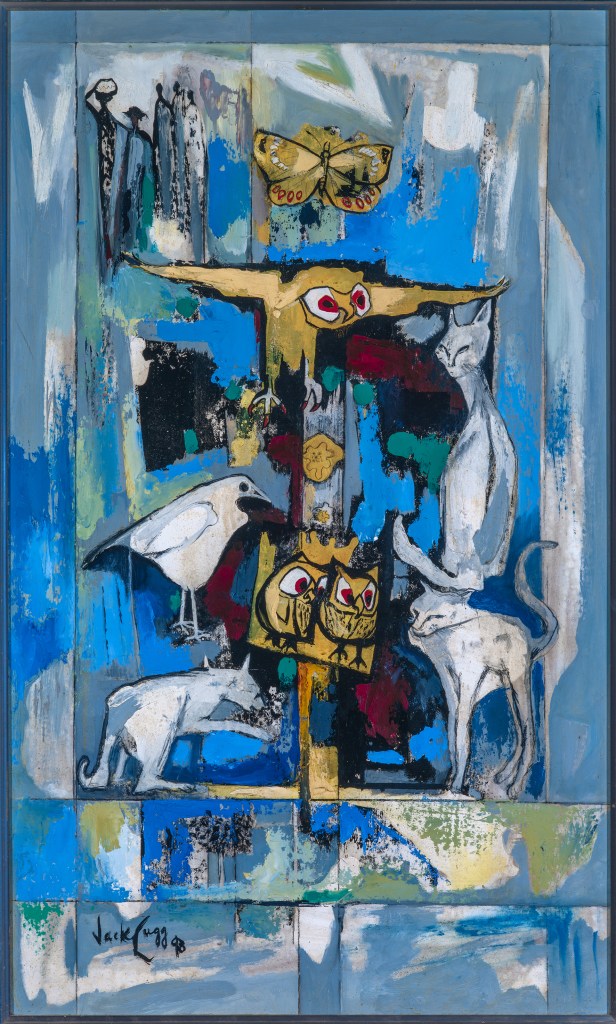
1962 African legend
The Greedy Man, Oil on cloth/board, is one of a series of twelve different African Legends.

She wrote a note encouraging her artist dad to record his memories with the aim of including it in his book. His response: “If it ever happens.” Hers: “Not if but when.”

And she proved him wrong. When she was sorting through her parents’ vast collection, including 1 000 artworks, with her brother, the last box she unpacked was the small book which her father had created, and she describes as a gem. She believed he had given her a masterpiece handwriting his entire life story and illustrating every page. “It was the actual moment of conception of this publication,” she recalls.

Once she started gathering her thoughts and the people she wanted to include, she invited Kin Bentley, at the time sub editor at Port Elizabeth’s The Herald. She describes him as an experienced art critic and also a past student of her father. “He paints a picture of a man whom he knew as an inspiring mentor and teacher.”

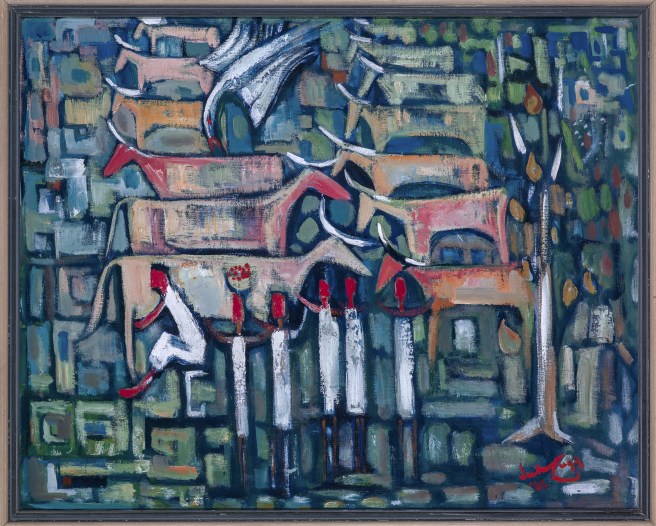
1993 Each tells the other
Each tells the other, Oil on board, 1993, is the work in mind to use for the marketing of the Pretoria Exhibition next year.

And what makes the essay special to her as the daughter is that in quoting for her dad’s memoirs, Kin has allowed the artist to tell his own story. “The result is a sensitive and personal account.”

Complementing this work, Barry Gibb, an Eastern Cape art historian who taught Lugg in the ‘50s drew on his vast art historical knowledge to present an insightful and layered analysis of the artist’s paintings and sculptures.

Because these two writers knew the artist, they brought a wealth of knowledge and perspective but, writes Lugg Verster, the book is about the artist and his extraordinary body of art.  For her it is important that “the artworks take centre stage” and together with the current exhibition, they have published many works which have never been seen in public before.

Thus, The Visual Essay is dedicated to illustrating his creativity and includes prints, sketches and paintings. The idea was to allow readers to witness the development of the artist and his particular journey.

“Short textual inserts highlight important life events, themes and anecdotes,” she notes. It follows his work through the decades from 1938 when he was a teenager to 2013, the year of his death.

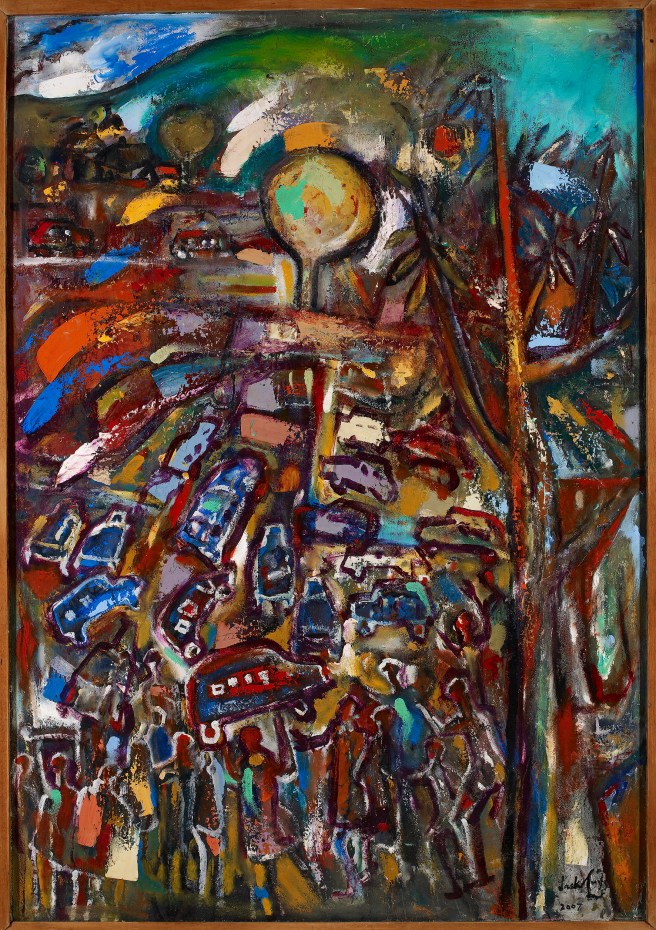
2007 Taxi rank
Taxi Rank, Oil on board, 2007


It’s quite extraordinary to be introduced to an artist in this way, if indeed that is the case as it was for me, and to have an accompanying exhibition showing a comprehensive collection of his work.

And covering a life and a prolific one at that, it is fascinating to see the way the artist has developed, where he has been influenced by his time or artists living in specific eras.

Initially, the Jack Lugg Art Gallery was based in Knysna for 18 years. Then it continued to operate in Plettenberg Bay through the gallery website and studio appointments until the author’s death in 2013. Now run by his children, the Jack Lugg Art Gallery sells artworks through the website and arranges private viewings by appointment in Port Elizabeth. The works on show range from Lugg’s teens in Pretoria where he studied under Walter Battiss, to his service in World War 2, through his studies in Durban where he won the Emma Smith scholarship, to Camberwell, London and Ecole des Beaux Arts, Paris, where he studied under Matisse.

Perusing the gallery website or his book, Lugg had a deep connection with the landscape, animals, and people of Africa. He held his first exhibition at 17 and continued to exhibit in many solo and group exhibitions throughout his expansive career. His art can be found in significant public and private art collections around the world and this current Pretoria Art Museum exhibition, which runs until June 23 in the South Gallery.

The first iteration of this current exhibition and launch of The House That Jack Built was held at the Nelson Mandela Metropolitan Art Museum, Port Elizabeth in February last year and was opened by Dirk Oegema, Director of the Pretoria Art Museum. An East London exhibition and launch took place at the Ann Bryant Art Gallery in April 2018 and was opened by Marlene Neumann, South African Master Fine Art Photographer.

Now Gauteng can catch a glimpse of this Eastern Cape painter/sculptor who should be better known and celebrated and whose family is determined to nourish and nurture his legacy.

*The exhibition will be opened on Tuesday (May 7) at 6.30 for 7pm by Prof Ora Joubert.


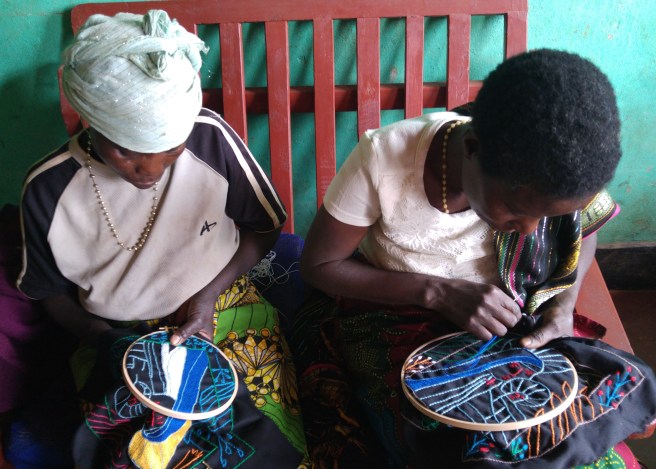
Women Capture their Stories with Needle and Thread

Bertha Rengae, Group coordinator of Group 3 of the women of the Mapula Embroidery Trust

A fundraiser for a group of Rwandan embroiderers is being held at the end of the month in Pretoria following in the footsteps and aiming for the  establishment of a unique embroidery and empowerment project which first started in the Winterveld:

DIANE DE BEER

A remarkable story has emerged from one of South Africa’s most dire areas, the Winterveld, where a group of women were trained in the early ‘90s by members of the Soroptimist International Pretoria Club for an income-generating, empowerment project.

The Sisters of Mercy provided a classroom and an embroidery project for the women of Mapula which started initially with 14 women, evolving through the years and growing to include 150 women, guided and supported by experienced individuals.

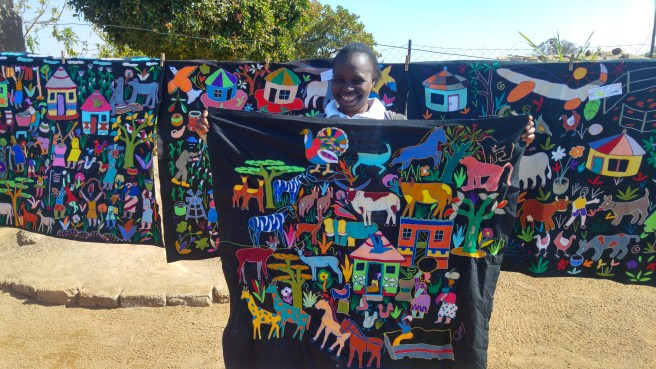
In a unique storytelling fashion, with needle and thread, these women have been sharing their stories over the past 26 years. And it is often these personal remembrances capturing our past from a unique vantage point that has captured the imagination internationally. Over the years, the high levels of technical and visual artistry with social and historical commentary have resulted in recognised works of art.

Their ideas are generated from lived realities, local magazines, newspapers, internet and television. Artists in the project draw the images while others translate them into brightly embroidered wall hangings, cushion covers, place-mats and bags, all represented in Mapula Embroideries.

Women from the Mapula Embroidery Trust in the Winterveld

These have been exhibited widely, both in South Africa but also internationally, all over the USA and Europe. Mapula embroideries and artists feature in more than 12 art publications and they have won several awards.

Women in the Mapula Group won the FNB Vita Craft Now Gold award for example; an order for 52 items for the Oprah Winfrey Academy for Girls was executed; and many different art museums across the world feature their work and celebrate the Mapula women and they are included in many private collections.

A well-researched book Mapula: Embroidery and Empowerment in the Winterveld by Prof Brenda Schmahmann was published in 2006 by David Krut Publishing.

The project now consists of three groups: two groups are situated in the Winterveld, North West of Pretoria, and one in Hammanskraal. The production of the goods is managed by the embroiderers themselves and since 2016, the Mapula Embroidery Trust with NPO status was established.

One of the members, Pinky Resenga testifies that the project saved her from a life of drinking and living on the streets. “With the income I could extend my mother’s house. After helping her I hope to build my own four rooms for myself and my children.”

The income generated through the Mapula embroidery project has assisted women over the years to clothe, feed and educate their children. Today, 28 years later, the Mapula Embroidery Project with its strong foundations is well established.

Women from the Kibeho Embroidery project

A few years ago, after visiting the Mapula Project, Netty Butera, the wife of the Rwandan High Commissioner to SA (after visiting the Mapula Project), approached the Soroptimists who initiated Mapula to start a similar project in her country with the initial training of 12 women.

Again it was to add value and the possibility of a regular income to extremely vulnerable women in the south of Rwanda at a place called Kibeho, close to the Burundi border. It is regarded as a holy place because in 1981 it is believed the Virgin Mary appeared to some teenagers. It marked the rise of the remote Kibeho to a spiritual hub on the global arena. Many pilgrims visit annually and if the women instead of begging could generate an income from the sale of an embroidery project, it would improve their self-esteem and offer their children a different future.

Following much planning, three women, Rosina Maepa and Dorah Hlongwane from the Mapula Embroidery Project and Janetje van der Merwe from Soroptimist International Pretoria left for Rwanda with suitcases packed with embroidery cotton, fabric, a brand-new sewing machine, two steam irons, needles and scissors – all to get the project started in a new country.

Local contacts, liaisons as well as facilitators were arranged to keep the process flowing and in the past few years, another training trip for a further 19 women was included which brings the total number of women who are part of the project to 31. Marketing of the products is still a huge problem and something they hope to improve dramatically so that those involved benefit to the maximum.

Rwandan embroideries

With this as the focus, a fundraising afternoon of socialising and sharing will be held at the residence of the Rwandan High Commissioner in Pretoria on March 31. It will start with the best Rwandan coffee and tea, followed by an opportunity to buy some of the unique Holy Land Kibeho Embroideries, listen to an introduction of Rwanda and an illustrated talk on the empowerment of women in that area through the embroidery project.

A Rwandan dinner with South African wines will be served after the presentation giving those attending the chance to experience another African cuisine. Tickets for the event are R200 per person and bookings can be made at 083 447 7909/082 903 1178/073 564 8215.

South Africa is a country that makes it easy for individuals to reach out. Some wonder if their efforts make a difference, but when one witnesses a project like Mapula and how the lives of people are changed – even across borders – it shows how even a little assistance can go a long way.

Books & Bones & Other Things Attempts to Unravel The Secrets and Lies of Old

An art exhibition is often exciting not only because of the creativity but also the idea that holds the project. Jan Coetzee’s Books & Bones & other things is an example of just that kind of imagination:

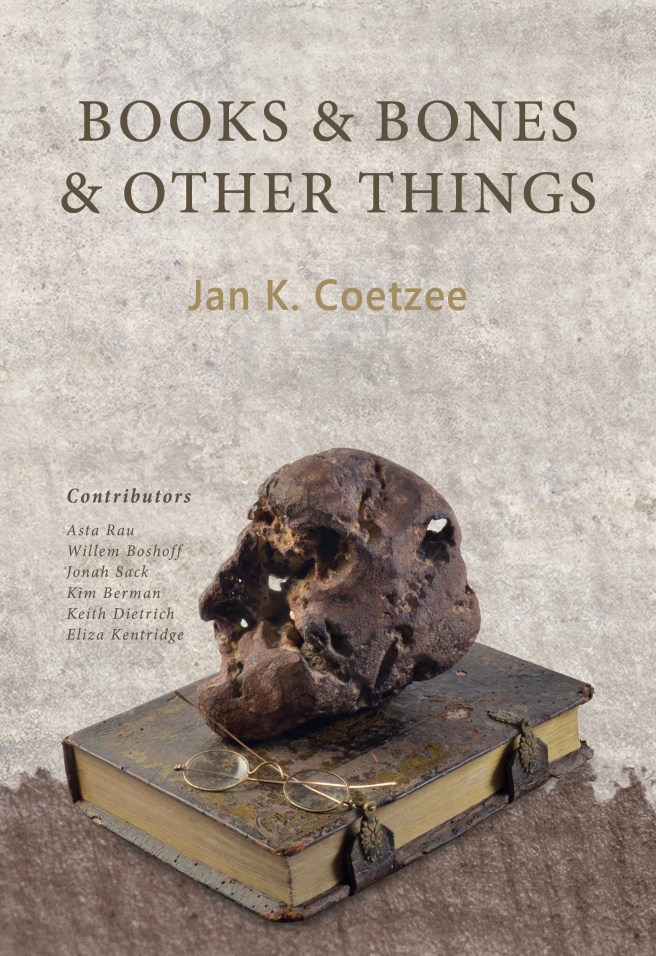
booksbonesotherthings_cover

DIANE DE BEER


From the beginning of time, individuals have at some stage of their lives questioned the meaning of life in some way.

It makes sense that a man who has spent his whole working life in academia, studying and researching, would use these tools to question his own life – and thus began what has turned into an exhibition, Books & Bones & other things, which Mark Read of Everard Read Gallery invited academic/artist Prof Jan Coetzee to present for the month of February in CIRCA.

Jan Coetzee started his career at the University of South Africa; later became Professor of Sociology at the University of the (Orange) Free State (1979‑1986); and then moved to Rhodes University (1987‑2010) as Professor and Head of Department. In 2011 he returned to the University of the Free State as Senior Professor of Sociology where he initiated and directs the programme: The narrative study of lives.

jancoetzeeportrait
Jan K Coetzee

Within this research programme, he became interested in books as documents of life. “Throughout my life I’ve always been attracted to old texts – maybe not surprising given the fact that I did classical Greek and Sociology as majors for a BA. Together with my interest in narratives, I’ve also been playing around for years with sculpting,” he explains.

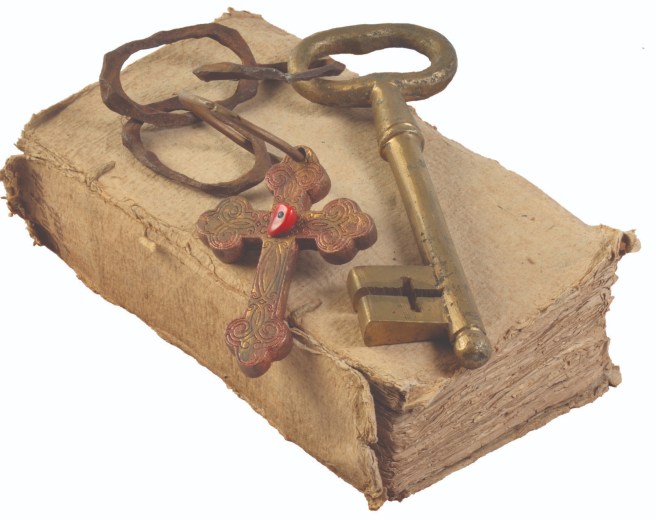
In short, he says, he put together almost 60 installations of “bookworks” consisting of old texts combined with found and sculpted objects. Most of these are enclosed in acrylic museum cases. “The object of this whole exercise is to attempt a reading of these aesthetically pleasing old texts – all of them old and many of them written in closed languages such as Latin, old German, old Slavic, etc.

“The installations attempt to unwrap/open the meaning of this collection of old texts: to try to hear what they are telling us today.”

As an academic he has thoroughly explained this complicated yet fascinating exhibition which would appeal to both scholars and the lay public.

“From the very beginning, humans have been living in storytelling societies. The earliest recordings of our stories are found in art and artefacts, and later on, in documents — the predecessors of what we call ’books‘.”

 Books & Bones & Other Things is thus a dialogue with a collection of books serendipitously encountered across Europe and South Africa. What started as a collection developed into a project to make the author’s own life, as well as life in general, more intelligible to himself and to others, he believes – and hopes.

The books in the collection are old texts which have considerable aesthetic appeal which originated from and bear witness to the actions, intentions, motivations, joys and hopes, as well as the fears and sufferings of human beings.

Each text, he says, narrates a story. But as his process developed, he realised that our ability to hear what they are trying to say is undermined: most are written in old, inaccessible languages which meant that Coetzee could not merely present these books as is.


And this is where interpretation came into play. He needed to find a way to retell the stories, to break them open and even subvert traditional narrative conventions by presenting them in a way that conjures up new stories in his mind and – hopefully – the minds of his ‘readers’.

This is when he began critically inquiring into the aims, context, and content of these books by systematically engaging with the title pages of the texts.

“Only the title pages,” he underlines. It meant that without studying the rest of the texts and without examining the meaning of the inside pages, he set out re-imagining the texts by recalling stories from his own life and readings.

He also initiated conversations between the different books so that the individual stories would resound more emphatically.

imperialprincipal.jpg
Imperial Principal

The bookworks, he says, explore the historical development of society and its structures — religion, colonialism, imperialism, racism, language, identity and time — all steeped in Western thought and tradition. “This I relate to the books themselves, and to the sculptures and the religious and cultural artefacts that accompany them.”

Coming to terms with yet another phenomenon of our time, an acknowledgement that in these European texts the voices of indigenous peoples are silent and their values, laws, and cosmologies — their very lives — are largely discounted.  He emphasises this in the use of sculls and chains for example. “What survives all individual authors, all human remembering and forgetting, I show in prehistoric fossils — a knowledge in the bones.”

He compares the results to a small private library in an ordinary family home which reflects something of the family. This collection of documents he feels, uncovers and reveals something of his own roots as it resonates with wider social, cultural, and historical refrains.

dominiumandcontrol.jpg
Dominium and Control

“I cannot think of a more accomplished scholar of stories, or the narrative study of lives, than Jan Coetzee who in this ground-breaking book demands a reckoning with all those stories, of ourselves and others entangled in this post-1994 dance. This attempt at excavating the ‘knowledge in the bones’ is truly an exceptional piece of scholarship by Coetzee and an outstanding set of authors and should be required reading not only for sociologists but story-tellers and -listeners across the disciplines. It is the curriculum we desperately need.”

This is the recommendation of Jonathan Jansen, former Rector and Vice-Chancellor at the University of the Free State of Coetzee’s book which is at the centre of this exhibition.

The exhibition will end on February 28 with an endowment auction of these bookworks – conducted by Strauss and Co – the proceeds going to Kim Berman’s Artist Proof Studio and William Kentridge’s Centre for the Less Good Idea. The exhibition/auction consists of the almost 60 bookworks/installations that form the basis of a book Books & Bones & Other Things published by Sun Press in 2018.