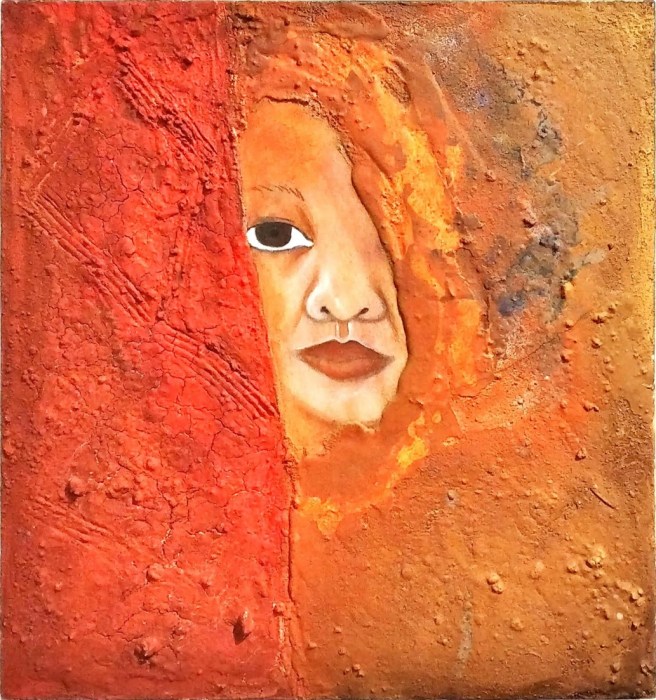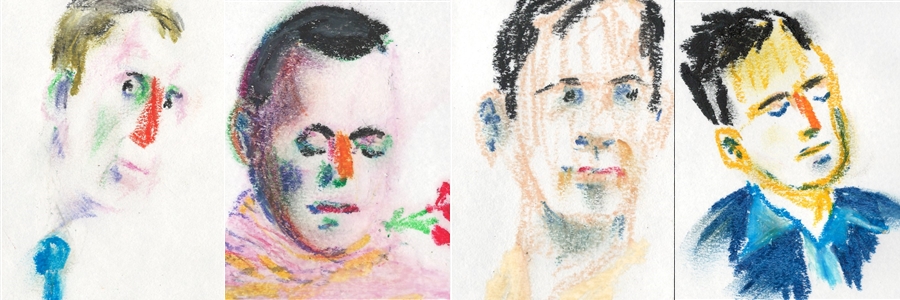
ARTIST ANSA CLACEY DIPS INTO THE SILENCE IN-BETWEEN TO FIND THE THREADS THAT BIND

When you see artist Ansa Clacey’s multimedia paintings at the exhibition The Silence in-between at the Pretoria Association of Art, stories pop into your head. It’s the fairytale quality of her work, the colours, the titles as well as the fact that she plays with paint and threads. Sometimes she paints, other times she works with needle and thread and often she combines the two. She shares her story with DIANE DE BEER:

Ansa Clacey’s current exhibition specifically explores the silence in-between the fragments and threads of our own stories.  Because she is constantly telling her own stories, she assumes everyone does that. And it is especially that presumption which informs her work.
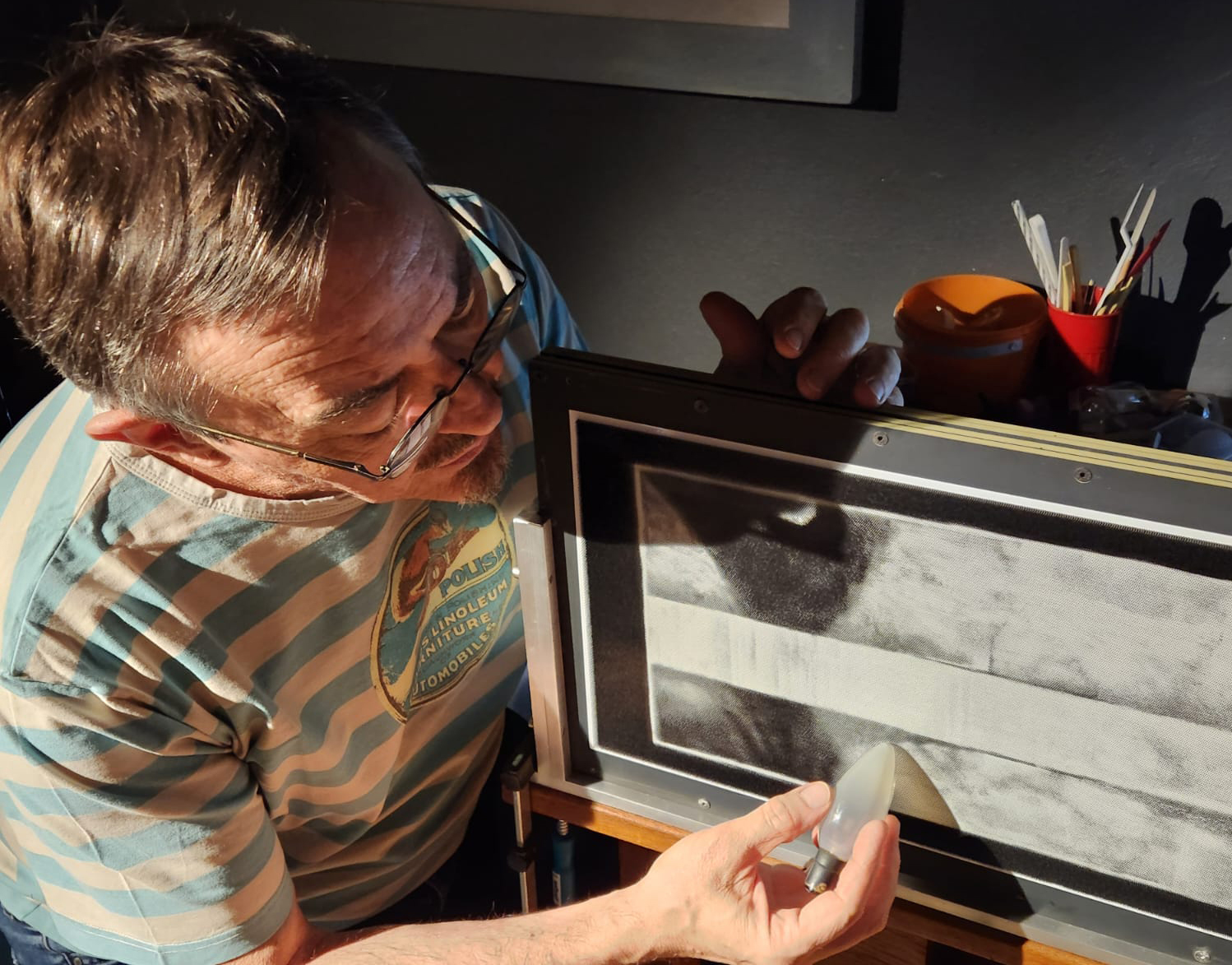
She can take you through the exhibition and tell each artwork’s story, but what she really wants, is that her audience will find their own stories as they engage with her work.

She can hardly think of a time when she wasn’t drawing and on her first school day, she was thrilled when the teacher asked them to draw specific shapes. But with her imagination and ability to draw, she chose her own shapes.
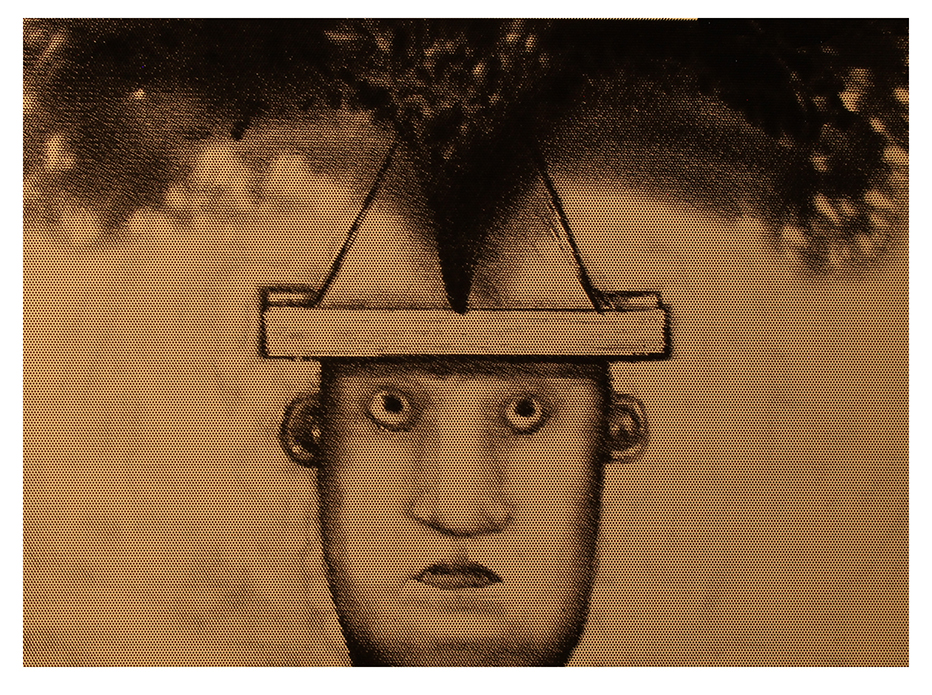
Time Weaves a Wicked Tapestry – Embriodery on Linen (002)

We are all familiar with those moments when you are expected to do things exactly as told and she was immediately taken to task for not following instructions. The trauma lingered for a long time, but fortunately, her natural instincts couldn’t be suppressed.

Years later, after arriving at Potchefstroom University where she was going to study (she thinks the initial plan was German and Geography), she spotted final auditions for a Fine Arts degree. The object she was asked to draw was a green pepper.

The result was not what was expected and she still recalls that she had no knowledge of technique. But her talent was spotted, described as raw, and she was accepted and enrolled for the degree.

Lost and found 2 – Mixed media on paper (002)

Her parents who were funding her studies first heard of this career change from their local dominee who had bumped into Ansa and she was called home to explain. But things steamed ahead fortunately.

Following her studies, she joined the SABC’s art department where she worked on children’s programmes like Liewe Heksie and Wielie Walie, drama programmes and anything that needed a prop or a puppet. “We even had to manipulate the puppets,” she tells. But she learnt a lot and expanded her skills.

Further studies were required for this restless soul always on the lookout for new knowledge. So she acquired a fashion design certificate, which turned her head into yet another direction, and also meant that she started painting again, while also teaching at different fashion academies.

The Protection of the Ancient May Fire – Embroidery on Silk Organza (002)

These days, painting is her life and she says that everything triggers stories in her head with a mind that is always switched on.

And once she has an idea, she can’t wait to get working. But the final product doesn’t resemble the initial picture. She explains that what she can’t see or hear is exactly what gets her imagination going.

Everyday objects, stories, especially folklore of Japanese origin, stimulates her as well as the people close to her, especially he granddaughter Ella, has dominated her work.

With two daughters, both living in London, she has time to work while keeping those who live afar, close in her imaginary world.

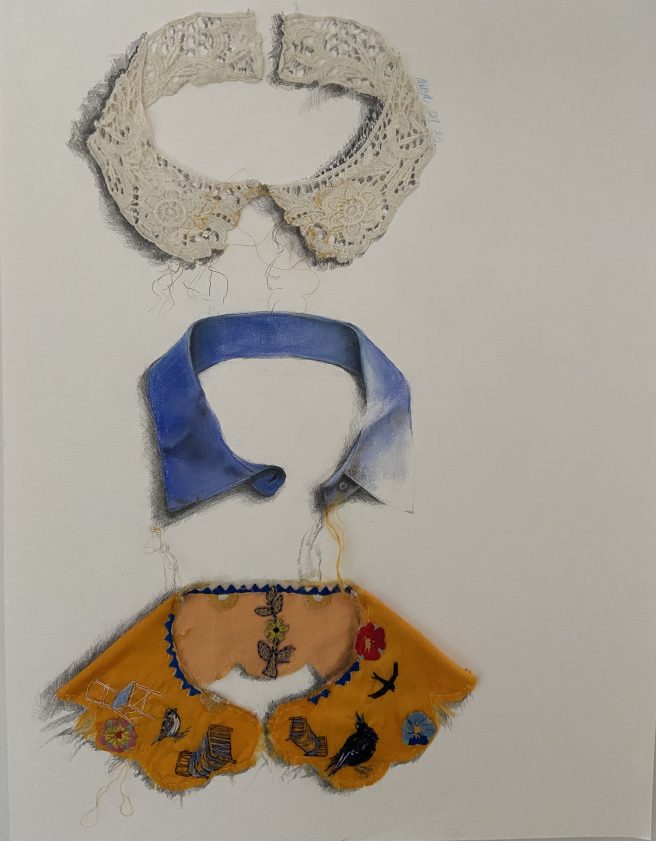
While drawing still informs her work, the needle and thread is her alphabet. Clothes and in this exhibition, the dresses her daughters wore when they were small, and now her granddaughter, are all featured in different ways.

The Threads that Bind 3

Drawing and sewing form her language – like a pen is to the writer, each stitch or line she creates is her alphabet.  For the works on display, she used mainly pencil and pastel combined with stitching as her media. 

Threads, in different cultures, represent many different things: protection, repair, mending, hope and destiny, she says.

“I’m very drawn to cultural customs. Semamori for example is a Japanese custom which means ‘back protection’. Mothers handstitched intricate patterns on the back of their children’s kimonos to protect them from harm.  Often these embroideries have long threads hanging from them to assist good spirits to prevent children from falling. 

“Red thread knots would also be sewn on cloth for soldiers going to war.  These were worn as sashes under the uniforms to protect soldiers and give mothers and wives hope for their safe return.”

All of this informs her work, and is threaded through her stories, which all manifest in different ways to shape different tales and adventures for others. For her it is all therapeutic as she works alone while shaping her stories visually and solving problems she grapples with.

The Wolf Bride – Embroidery on silk organza (002)

She could go on for days and often has to stop herself, stand back, and take a look from  afar.

She is the woman who finds a box with old and odd pieces of fabric, collars or swatches which will all form part of her language in yet another work in the future.

Ansa also turns her enemies into friends and especially the animals in her work are placed in unexpected settings to change who and what they traditionally represent.

It is a world of fantasy and make-believe but in this artist’s mind, it’s a world she can manipulate and make her own.

“The warmth and contemplation of drawing and stitching move me across places and vast timelines. They are the nostalgic markings of movement between past and present.  Like human emotions, strings and lines can entangle allowing viewers to imagine stories behind them”.

When walking through the exhibition, it takes you into another world, one where your narrative features. Clothes, colour and threads form a part of most of our lives, so the connections are varied depending on who you are and why something catches your eye.

Not only are Ansa Clacey’s creations unusual, but also exciting and stimulating as they fire the imagination.  Do not let the opportunity to view this rare collection pass you by.

Ansa Clacey

The Silence in between

Until 30 September

Association of Arts Pretoria

173 Mackie Street

Nieuw Muckleneuk

Tel:  012 346 3100

artspta@mweb.co.za | www.artspta.co.za

Gallery Hours

Tuesday to Friday:  9am to 5pm.

Saturday:  9am to 1pm.

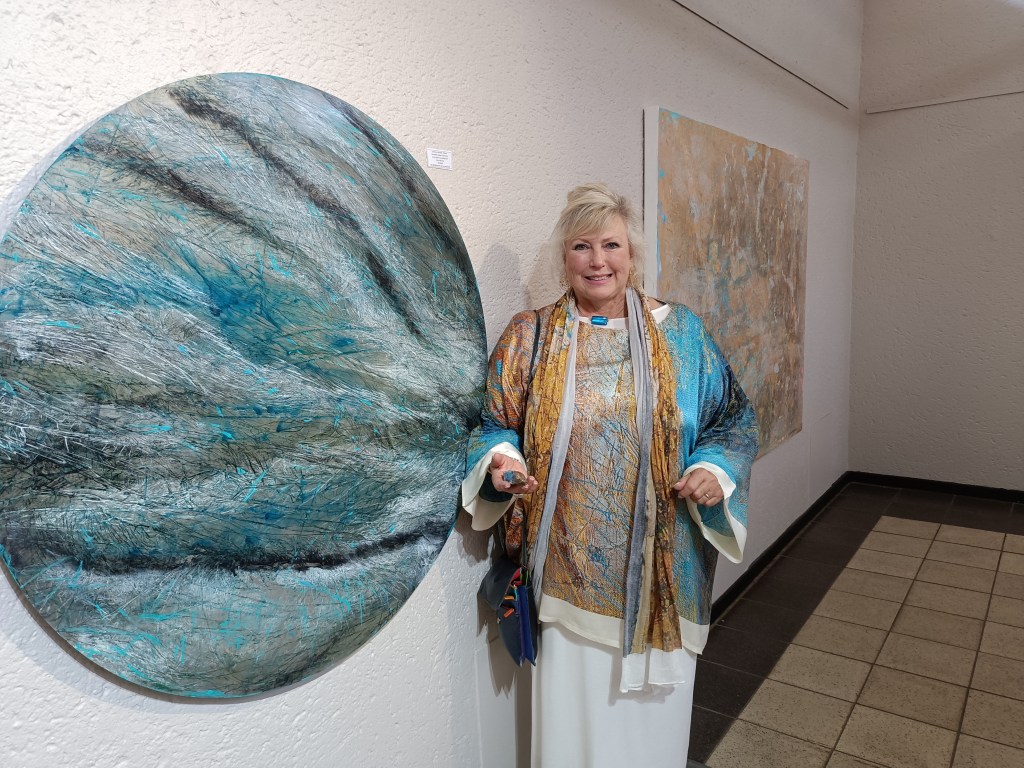
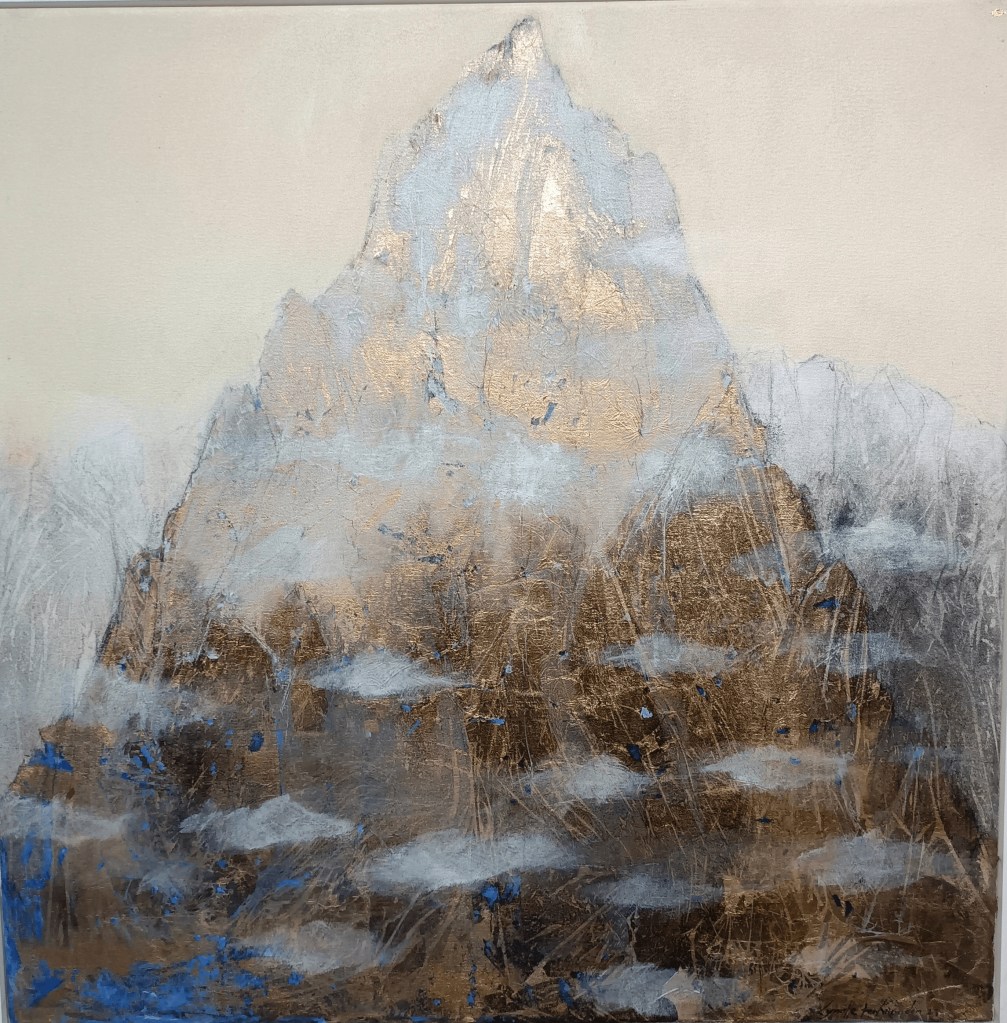
ARTIST LYNETTE TEN KROODEN IS INSPIRED BY THE MYSTERIES AND THE MIRACLES OF THE UNIVERSE

Kristalwater 1 (Crystal Water)

The Association of Arts Pretoria is currently exhibiting works by renowned local artist Lynette ten Krooden under the collective title Mirari, which is the Latin for ‘to wonder at’; admire; miracle.Through French and later English, the word mirage also came into being. It perfectly captures the artist and her work, as she tells DIANE DE BEER:

If you spot glittering gold leaf somewhere on a table, chair or even the snacks at an arts event, it’s probably a sign that artist Lynette ten Krooden’s in the room.

“It’s her involvement with the Middle East many years ago that awakened it,” notes her close friend and fellow artist Margaret Gradwell-Truter, who divulges that the two of them are celebrating her first exhibition at the Association 40 years ago and now again. “As fellow artist, I (nervously) opened the exhibition at that time.”

It was wonderful to listen to her speech and to have her reveal so much about her friend, always with the emphasis on her art.

Ancient Travel Story.

About Lynette’s trademark gold leaf she says that at the time it wasn’t something that was widely used in the art world. She even recalls some of the local art academics being quite scathing about the Austrian artist Gustav Klimt because of his use of gold leaf. Today his work records some of the highest prices paid for art and especially his trademark gold leaf receives high praise. In similar vein, another gold leaf practitioner, Alexis Preller, was also not rated. Today he is revered, she says, as we can all attest to.

Not that Lynette paid much attention. If you hear her speak about her work and where her inspiration lies, it’s always the landscape. “She viewed the universe from space, or flew across the desert or travelled through it with the Bedouins, or she found herself in awe of age-old mountains, rocks and fossils. But she doesn’t repeat what she has seen, she gives her audience the experience of wonderment which she experiences – she does it through a rich tapestry of forms and marks richly woven to form a whole,” explained Margaret.

“Lynette has used gold leaf as an integral part of the landscape that inspires her.” And that especially was again visible in this current exhibition.

Margaret embroiders: “She has unwaveringly used it as a medium for many years and has been able to master it, not as a decorative element but as a metaphor for the mirage, the mirari (miracle), that she has profoundly chased and captured, thereby enabling us, the spectator, to also wonder at the mirari.”

From her earliest days, she notes, Lynette was interested in the mysteries of the universe. The invisible – such as the effect of light on the earth – the glittering horizon, mist, sand, rocks and water. “This place that is a sanctuary for the wordless artist.”

Reenboogrots (Rainbow Rock)

And when Lynette talks unthinkingly about gold leaf, she tells how she is constantly picking up and gathering flecks of what might have fallen from something she is working on and using it again and again. And anyone who has ever picked up (or tried to handle) a sheath of gold leaf will know that it disintegrates in front of your eyes as if an invisible hand has reached out.

And still all these years later as her friend underlines, Lynette is filled with wonderment. “There’s a lifetime of art in my bones,” responds the artist. And even the fabric she wears reflects her love of what she creates.

Reisverhale – Storm on French Linen.

When she talks of her travels, she thinks of small children sitting on the sand and instinctively drawing, making pictures, capturing their world. That’s what she does. With her physical reality often a hindrance, she has found ways to work, to deal with what life gives her and to escape into the mysteries she is always exploring. “It never stops,” she says – and neither will she. “I lost my heart to the creative process. It’s good for my heart.”

Stand in front of one of her paintings and it immediately opens up a new world. Even if you’re just drawn by the colour, that in itself is a whole world that she embraces. For her, there’s a childlike excitement when she creates a new work. With this exhibition it was also returning to old ways and techniques that brought fresh meaning. As an artist she is intent on always moving forwards, somewhere new, challenging the world and everything around her.

And in the process, she passes on that depth of feeling to those of us looking on hoping to discover more . Her miracle becomes ours. For her it is simply a curiosity and wonder that started many years ago which has become the eternal play on her changing canvasses.

One cannot but be touched.

The exhibition runs until September 23.

http://www.artspta.co.za/

https://www.facebook.com/pretoriaartsassociation/sassociation/

Address: 173 Mackie St, Nieuw Muckleneuk, Pretoria, 0181

Hours

Open ⋅ Closes 5 pm

Phone012 346 3100

BONGI BENGU COLOURS THE WORLD BRIGHTLY WITH HER ART, HER LAUGHTER AND HER LIFE

The artist Bongi Bengu is having a major exhibition at the Pretoria Art Museum which runs from this Saturday (September 9) until November 5. She told DIANE DE BEER about her passion which is constantly evolving and reflecting her life, her dreams and hopes:

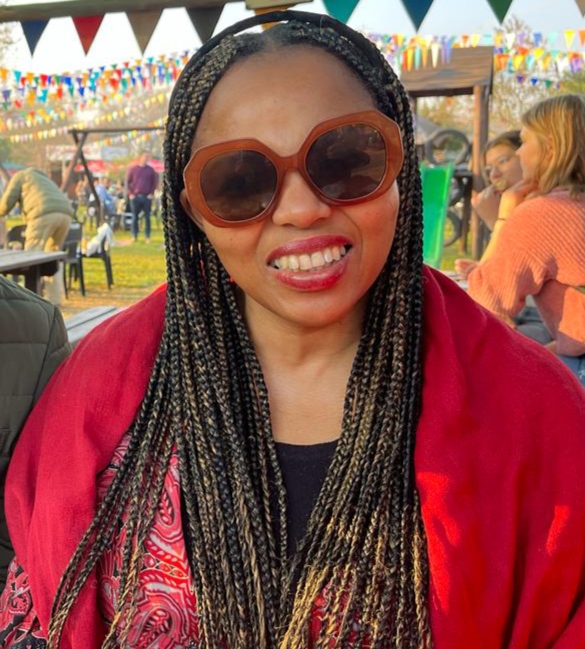
Pictures of Bongi Bengu taken at the Pretoria Farmer’s Market by Thomas Honiball.

When you first meet Bongi Bengu it is not a surprise to learn that she is an artist. She looks like an artwork herself.

She’s brightly dressed and the one characteristic most dramatic is her laughter. This is someone who loves life and her enthusiasm is contagious. She’s also not scared of showing herself.

But when you start talking about her art, her mood is reflective. “It’s a calling,” she says about this career which she has been passionate about for the past 26 years.

Her art is all about expressing herself but also healing, she says, something she hopes those who come to her exhibition will also experience. She infuses it into everything she does, her cooking, her clothes, dancing and music choices. “Art is like breathing.”

Titled The World / Umhlaba, the exhibition has been inspired by the tarot card called The World. “It means the end of a cycle and the beginning of another,” she explains. But she expands: “It could also mean that you’re in a powerful position to manifest your desires.”

The exhibition was first held at the Alliance Francaise, Pretoria where Pretoria Art Museum curator Mmutle Kgokong first saw it and felt that the space was too small for her work. “It looks cramped,” he said and invited her to show it at the museum.

Bongi feels it was meant to be. “We create our own world,” she says and that’s why this transformation from one exhibition to the next came quite naturally to this South African, who spent her youth in exile in Geneva Switzerland where she completed most of her schooling until the last few years, which she spent at Waterford Kamhlaba in Swaziland.

Bongi’s Golde Orb Mask

Her parents (her father Sibusiso Bengu was both an ambassador and Minister of Education) felt that she needed to experience some of her school years on the African continent. And this is also where she forged her future. While doing a research project for which she earned a distinction and which included interviewing established  artists, she discovered Helen Sebidi who was an inspiration and opened her eyes – and her heart – to the art world.

“That’s when I knew,” she says about her artistic beginnings. Becoming the world traveller that she is, she later enrolled and graduated with a Bachelor of Arts degree at Mount Vernon College, Washington DC, and completed a Master’s degree in Fine Arts at The University of Cape Town. She has since participated in numerous international residencies and workshops.

For this current exhibition she wanted to reflect on the different stages of her work and she has tried to select pieces from all the different periods. She started with pastels and charcoals using mostly earthy colours.

Bongi’s Rebirth IV

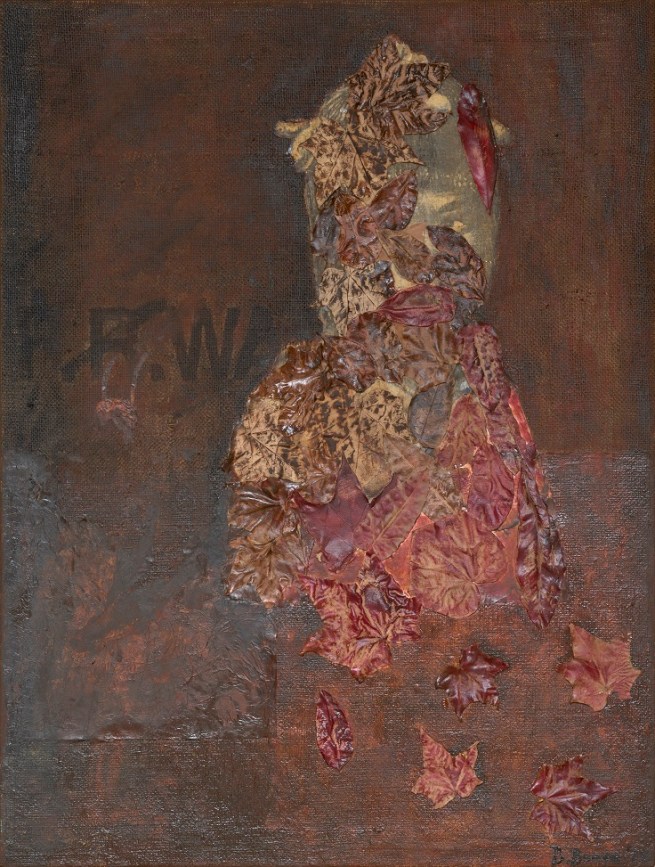
Then she joined the Bag Factory Artist Studio where she did mostly collages initially and then turned to an organic period where she focussed on leaves and soil.

Only then came colour which now seem such a part of her life. She confesses that she sees herself as an artwork and when you look at her, it’s easy to see why. What a canvas she has been given to play with. It’s not only her work that turns heads.

Once she started planning this exhibition, she started a conversation with two curators, one at Washington DC’s Hirshhorn Museum and Sculpture Garden (Teresa Bush) where she had interned for a while and the other in Sweden (a South African lecturing there, Nkule Mabaso). “It was through dialogues with them about my work that I made selections,” she says. They will also be writing for her catalogue which will be available at the end of the two month exhibition.

Bongi’s Self portrait in the sand

When discussing her work, Bongi explains that she is inspired by her life and the experiences she has had. It all begins in her head, but once she starts working on paper or canvas, it’s usually something quite different that emerges.

Working mostly on your own can be quite a lonely existence, but Bongi enjoys her own company and finds her painting therapeutic. “This is how I work through problems,” she says. “I never feel alone.”

Bongi at work.

In her life as in her work, she describes herself as someone who doesn’t conform to society’s norms. “That’s not easy in my community, a single Black woman with no children!” But it’s her life and she marches to her own beat. Growing up and travelling around the world yet returning to South Africa, she functions easily wherever she finds herself.

As I watch her finding her feet at Silverton’s famous Farmer’s Market, it’s easy to believe her. She’s colourful, has a laugh that stops a crowd and a life that’s creative and of her own making.

Bongi’s Montana Birds (left) and Life of Domesticity (right)

She says she knows she was a man in her former life and that she wanted desperately to paint, but it wasn’t possible. “At that time, the women were the painters making huge murals. I knew I would come back as a woman so that I could fulfil my dream. And now I also know when women think that men have easier lives, it’s not always true!”

The exhibition will run until 5 November at the Pretoria Art Museum.

It will be opened officially by His Excellency HE Mr Antonis Mandritis, Ambassador of Cyprus and the work can be toasted courtesy of Durbanville Hills. Everyone is welcome.

THE MESMERISING WONDROUS LIFE OF PI

Review by DIANE DE BEER:

It all happens on stage with all the bells and whistles . Credit: Johan Persson

LIFE OF PI BY YAN MARTEL ADAPTED BY LOLITA CHAKRABARTI

Director: Max Webster

Cast: Hiran Abeysekera and the magnificent puppets

Set and Costume Designer: Tom Hatley

Puppet and Movement Director: Finn Caldwell

Puppetry Designers: Nick Barnes and Finn Caldwell

Lighting Designer: Tim Lutkin

Sound Design: Carolyn Downing

Composer: Andrew T Mackay

Scheduled screenings on 27 August at 2.30, and on 30 and 31 August at 5.30, but check your area for loadshedding, when screening times might change.

Halfway through the filmed version of this spectacular West End play, the director, designer and writer (who adapted the book) have a short chat about the play and how it all began. For the writer it was about the story, finding all the important bits and pulling them together for the stage version. For the director, it was about what could work on stage and how to do it. And for the designer it all began with the Richard Parker, the tiger.

Life of Pi imagined in spectacular style. Credit: Johan Persson

Anyone who has read the book and now sees the filmed play will know that this is where the struggle on every level is centred and, once they got that right, it was all systems go. And that’s no small thing. I counted seven puppeteers just for the tiger. It’s simply spectacular – the design, the puppets, the lighting, the video and the sound. That’s why I listed all the names in the credits. It’s a production with all the bells and whistles and yet it holds the heart of the story with the performances by Abeysekera and the animals that come to life.

Seven puppeteers are listed in the credits just for the tiger. Credit: Johan Persson

It’s clear that imagination was the key requirement for this fantastic book, which tells the story of a 16-year-old boy named Pi who is stranded on a lifeboat in the middle of the ocean with four other survivors – a hyena, a zebra, an orangutan and a Royal Bengal tiger.

We know he has made it because he is telling the story to two scientific types, the one sympathetic, the other a sceptic.

Hiran Abeysekera as Pi with one of his companions, a zebra. Credit: Johan Persson

But the wizardry of the play is all achieved by the magical approach and manner of telling and showing the marvellous Mantel story with no missteps. And although just the set is enough as it moves and rises and changes form to overwhelm the story, everything holds together in the way it should with Pi and his animal friends taking centre stage.

The experience is mesmerising and the two and a half hours flies by as Pi cajoles and cunningly sweet talks and outsmarts his sometimes ferocious and reluctant companions. It’s a kind of Alice-in- Wonderland adventure yet perhaps with a touch more reality than wonder, even if that is always present.

The determination of Pi to achieve his destiny draws you into both his pain and pleasure and this journey, keeping in mind that is after all a stage play, is all about the overwhelming power of theatre when done this magnificently.

Pi in conversation with Richard Parker, the tiger. Credit: Johan Persson

I have to admit, I think Pi and his friend Richard Parker and their struggle for survival have everything to do with it!

The NT Live experience is an expensive exercise but you are seeing some of the best theatre experiences the world has to offer. If that’s your gig, don’t think twice.

Bookings at Ster Kinekor: Rosebank Nouveau in Johannesburg, Ster-Kinekor Brooklyn in Pretoria, Ster-Kinekor V&A Waterfront in Cape Town and Ster-Kinekor Gateway in Umhlanga.

THE IMAGINARIUM OF THE RELUCTANT ARTIST

DRIES DE BEER

PICTURES: ALET PRETORIUS.

Art exhibitions come and go, with some pieces remembered, some purchased and others touching your heart. When the event features the work of someone who has turned himself into your personal artist yet has decided to show his work for the first time, the feelings all round are overwhelming. For me, it was the gift of sharing the art of Dries de Beer and the emotional impact it has had on our lives. DIANE DE BEER gives her biased opinion of an artistic celebration:

Invite designed by Ursa Engelbrecht Curator Carla Spies

When architect/gallerist/curator Carla Spies suggested that her gallery, The Guildy, curate an exhibition for my husband, the reluctant artist (as I have dubbed him), I knew this was the perfect space and opportunity.

No pressure, no sales and for one day only with people we invite who we think will enjoy the work. And that is exactly what Carla and her gallery represent. As an architect, her work is not on the creative side and through the years she knew she had to find a way of scratching that itch.

Even the guests looked like artworks

The gallery was her solution and, having just gone through the whole process of an exhibition, I understand how this works as I do a similar thing by writing about the arts. There’s no direct renumeration, we’re not driven by money but rather by a passion for the arts and how it affects, touches and changes people. It’s the creativity – the process and the outcome and, finally, the joy.

But I knew my artist would feel differently. NO! was the immediate response, but I worked my cause and finally he conceded.

The fabulous thing about this exhibition, which Carla named The Imaginarium of Dries de Beer, was that all the art was there. That is what interested Carla in the first place. She had seen especially his series of faces and was intrigued. It’s her gallery and like me, who only writes about the art that inspires me personally, she only shows work that moves her.

And I was quite clear that the thing I really wanted Dries to showcase was the diversity of his art. Because he has always been compulsive in a constructive way about his art, moving from one thing to the next, exhibiting a theme, yet in very different ways. He has played around in ceramics, cartoons (which he still does daily), scrapyard found objects, which would result in anything from a small human figure to huge installations, and glass tiles in which he made pictures with objects of lesser desire found on his daily walks and changed it into something exquisite.

On the ceramic side, it all began with handmade ceramic zebras painted and then fired for the final result. Thery were unique and each one individual but labour intensive. To really make money – if that were one’s goal – it would have to be mass-produced and then lose that artistic quality that each one displays.

This led to masks and hanging faces which started out as a mass of small and larger cement and ceramic balls which all found a place in our garden. Today those hanging installations, sculpted into different faces and fishes of different kinds are on window sills, against outside and inside walls, hanging outside from poles and trees and even in the shape of gargoyles, each at the end of a pergola pole as decoration. It’s the way he changes and enhances what would just have been another ordinary garden structure. Instead a secret world of chattering ceramic faces and masks emerged

I have written about the work of many artists in an introductory rather than critical fashion. Fine art is something I had to give exposure to because as times grew tough, newspapers and magazines featured less and less specialist writers. Mine was the performing rather than the fine arts, but I knew we had to embrace as wide a range of the arts as was possible – and that’s what I still try to do.

Ceramic gargoyels.

But with this artist’s work, because he and his work are mine, working at a formal institution I couldn’t focus on any of his work. That’s why this exhibition was so important to me and gave me such pleasure. To do it with Carla and her crew, was a dream come true.

Dries, who slowly warmed to the idea of showing his work, and I made the initial selection of what we wanted to show and then Carla and her musician/entrepreneur husband Werner arrived a week before the showing to look at the final selection and help us move the work from home to gallery.

Then the fun really began, as we started hanging the work. This is where Carla and Werner took over while we helped on the side. It’s no easy thing to physically do the hanging and even more specialised is to decide how and where to display each single piece. This is where, I suspect, Carla’s creativity kicks in – and she knows what she wants. We could just stand smiling at the results.

I suspect for Dries it was a new way of experiencing his work. In our house the effect is diminished by it being all over the place. Here it was Dries de Beer in full force – and whether you like it or not, which is a personal choice and what art is all about, this was a special display and one of which even the reluctant artist approved.

I appreciated once again what inspires me most about his art. It comes from within, it’s who he is and how he has conversations with himself and the world – and me.

Also on board were a group of special friends who gathered around me and took over when I really needed help. Writing about the creatives in the food world as well, I have my own favourites and Alicea Malan of Lucky Bread Company https://www.luckybread.co.za/ and Elze Roome of Tashas, Menlyn Main feature on that short list.

I simply asked Alicea about some produce and she said “Leave it to me.” She pulled together a spread with the amazing breads from Lucky Bread https://www.luckybread.co.za/ and then, as importantly, showcased it at the gallery in a way that just adds that edge to any event. Elze Roome https://www.tashascafe.com/locations/pretoria/menlyn-maine/ jumped in with the sweet stuff which was melt-in-the-mouth.

To add yet even more sparkle to the event, Werner on bass and Rynier Prins made exquisite background music, often I think one of the more thankless jobs and yet it fills a room full of people with a sound that’s embracing.

Also part of the picture was one of Carla’s most recent employees, Ursa Engelbrecht. She’s a young woman with artistic flair, was immediately excited, designed the invite and helped out everywhere and anywhere she could. She and Estevan Kuhn also provided music when the first duo needed a break.

So when people ask me about the worth of a single day showing which is what The Guildy specialises in, I can only underline how it brings a group of creatives in different fields together to create a little bit of magic in the world of those who share this kind of passion.

Ursa and Estavan (left) andRynier and Werner (right) making wonderful music.

I know my artist looks at Carla and Werner with eyes that appreciate how they approach life and the world they hope to create. I know he saw how people like Alicea, Elze and Ursa all stepped in to add their special icing to this magnificent cake.

And more than anything, it gave my reluctant artist the chance to see how others viewed his work, to inspire fresh and novel ideas, and to view the future in a way where he shares his work with more people than just me. This was his chance to shine brightly.

Mission accomplished!

FIREFLY GLOWS WITH WONDER AS A CLUTCH OF ARTISTS CELEBRATE THE MAGIC OF THEATRE

Pictures taken off the screen by directors Toni Morkel and Jaco Bouwer during the film shoot:

If you haven’t yet seen Sylvaine Strike’s wondrous Firefly, Pieter Toerien’s Montecasino Theatre is presenting another season from May 19 to June 11. It’s a once-in-lifetime theatrical experience with two seasoned artists stepping into the magical world of storytelling in a way that plays with your imagination in the best possible sense. If you want to know more, see below. This is the story written when they first stepped onto stage following covid:

The Countess Pafanesca in the Vodka Tango

When you are excited by the group of artists who have  come together to make theatre, sparks can fly. And that’s exactly what can happen with the first live run of Firefly, a production that was created to celebrate live theatre. DIANE DE BEER speaks to a few of the artists involved:

Theatre fans are blessed with the latest Sylvaine Strike, Andrew Buckland and Toni Morkel collaboration as they bring Ferine and Ferase (which was filmed by Jaco Bouwer for the Woordfees digital programme) to life on stage – as it was originally planned.

This is the second time this trio have combined their creative talents (the first was in the much lauded Tobacco and the Harmful Effects Thereof) even if the roles have been switched. Firefly was written by Sylvaine Strike and Andrew Buckland and devised for the stage by the full company (Andrew, Sylvaine Toni Morkel, Tony Bentel) and directed by Toni Morkel with Tony Bentel on piano..

Sylvaine Strike and Andrew Buckland at play.

The initial name was derived from two chemical components luciferin and luciferase, which exist in a firefly’s bum and make it glow, explained Sylvaine. “So one without the other can’t make light, they have to be together to glow. Lots of fireflies in this show.” And that is why it is now called the more familiar Firefly.

The play was first created on commission by head of the Woordfees Saartjie Botha in September 2020, three-quarters of the way through the first tough lockdown. The idea was to create something that would show audiences why theatre is unique and exciting. Saartjie didn’t want a big set, she didn’t want audiovisuals, no multimedia, only pure theatre. “We want body and craft and what the actor is,” was the instruction.

Because of lockdown, they started writing remotely through October, November and December and in mid-January last year (2021) met in a rehearsal room with their director. With Tony Bentel on piano, they began to develop the story on their feet to find a common language between Sylvaine and Andrew, who both have very specific styles. But when this trio are tasked to make theatre, that’s exactly what they do.

It’s all in the telling of the tale.

They discovered and developed a mutual style for the two actors largely based on clowning duos. Think Laurel and Hardy, for example, that kind of world, very much a nostalgic, romantic story where they play three different characters each, with the narrators the main characters called … Ferine and Ferase. They have a backstory of their own, which they tell as travelling players of Bucket’s End. It’s a time of magic and wonder which allows you to sit back, be transported and dream, a luxury in these times.

“It’s beautiful, it’s very physical, it’s gorgeously costumed with each a standard clowning costume that transforms into a couple of things,” Sylvaine embroiders.

Every detail tells a story.

From the start it was meant to play on stage and they had a short trial run with a 45-minute version. But this all had to take on a different hue when live changed to digital and they spread their special brand of fairy dust.

The full play was filmed with Sylvaine enchanted with Jaco’s extraordinary transformation from stage into film, shot in studio, all in black and white, inspired by old movies. And those of us lucky enough to have seen it, agree.

It was delightful to witness how they adopted and adapted for the new medium with all the elements colliding and fusing.

 And now they’re back on stage and it will be marvellous to be experience yet another transformation. Personally, I can’t wait!

Crafting a clutch of characters with craft and creativity.

Sylvaine and Andrew make perfect sense together and then to have the extraordinary Toni Morkel directing is genius.

As she has often been directed by Sylvaine and performed with Andrew, she was terrified yet thrilled when asked but she trusted her instincts because all three of them know one another well and understand each other’s particular theatre language.

“I’m very excited to do it live,” says Toni, who has just started with rehearsals again. These are two actors who know how to act with their whole being and she finds herself smiling as she watches them go through their moves. “I’m living my dream,” says this consummate theatre maker.

The great difference between the screen and stage version is most specifically the sets. The two actors with their costumes and imagination have to construct their world on stage. And while it is sometimes frustrating to remember what they could do on film, the stage version is what they envisioned from the start.

“We wanted to create a play that would travel easily and anywhere – whether we had lights, curtains, even a stage,” she says. And knowing what they have achieved in the past together and individually, this is not an impossible ask. It has always been part of their theatre ethos, and while it might have been initiated by a scarcity of funds, it also focused their imaginations magnificently.

Andrew Buckland and Sylvaine Strike in Firefly.

“I know their world, their physical ability and strength and how they work,” she says about the process. “What we are relying on is good old-fashioned storytelling.”

She does have two more aces up her sleeve with Wolf Britz again making magic with his wondrous lighting and he has a few more tricks in the bag. And there’s Tony Bentel’s wizardry on piano. “I can’t help but gush when speaking of his astonishing ability. He has a world of music in his body,” is how she explains this gifted musician who accompanies the two actors live.

“For any section of the play, he comes up with five or six different musical suggestions and because he is adept with improv, he can embellish what the actors are trying to express at any moment. I am constantly in awe of what he has arranged musically.

“I am blessed,” she says.

And so are we. With these dynamic artists, expect fireworks in Firefly!

THE KLEIN KAROO NATIONAL ART FESTIVAL SHOWS HOW THEY SPEAK IN PICTURES AND INSTALLATIONS

PICTURES: Fahiem Stellenboom

Liza Grobler Festival Artist and the winner of the art prize captures the essence of her Karoo which constantly changes.

Art has always played an important role at the festivals, with the Klein Karoo National Festival one of my favourite viewing venues. DIANE DE BEER tells you why:

It has to do with the place, because they have easy access to different venues and spaces, but perhaps because of the length of the festival, it has also meant that you have time to meander and really take note of the art.

Another reason might be the more recent introduction of curator Dineke van der Walt. Her choice of themes and artists has been unusual, varied and always presenting a large number of artists who I had no knowledge of.

That doesn’t necessarily mean anything except that I don’t pay enough attention during the year and the festivals mean that artists from around the country are on display.

Curator Dineke van der Walt on one of her many walk-abouts. Picture: Hans van der Veen.

This year was no exception and I was lucky enough to catch one of Van der Walt’s walk-abouts which for this art fan is always a bonus and a learning experience. Sometimes the artists or the curators are around and do the talking, but other times, Van der Walt told the story. Keep this one in mind for the future.

This year’s theme very aptly was Hide and Seek: Reimagined Histories. It’s about taking a much wider and more representative look at the world. For far too long, stories have been told from a specific vantage. It has long been time to fling open those doors and allow the light in. We all gain from a wider and more honest perspective – on every level.

There are too many artists and  venues to include here, but that doesn’t mean that there weren’t many more worthy of a mention. Simply that I had to make a choice, and for the moment, these were my picks.

Two stood outside of the parameters of the St Vincent Building which exhibited most of the art. Another well-deserved extension of Karoo Kaarte, was yet again a fantastic example of how art can include a much wider audience as well as introduce participants to a new way of expressing themselves.

 Collages and narratives feature strongly in this project and this time they were displayed in full view of everyone in town because at some point they would have passed these beautifully illustrated windows and stopped by to see what was happening.

The pictures best tell the story that is one that should just keep on running. Here are some of the collages in the building where they presented daily workshops.They had many contributions and one they cleverly slipped into the exhibition space was the way they re-imagined children’s games from the past ,which some of us might remember like kennetjie, skaloeloe, drieblik and gaatjie. These were then explained in a pamphlet with instruction-driven drawings to show the way. It’s also another way of appealing to the youngsters attending the festival.

The other was a series of site specific installations which apparently were meant to be quite hidden, but for hurried festinos it might have been a hazard rather than an adventure.

Three derelict buildings were selected as the backdrop for Norman O’Flynn and ONE. with the trio of installations titled Transparent. The idea was to lift these structures, which have probably for many years gone unnoticed, out of their environment by applying a quite ordinary yet eye catching pattern.

What they were hoping to achieve was to show the way society deals with issues like poverty, inequality and violence in a community, by turning a blind eye.

It was a wonderful exercise apart from the difficulty in finding especially one of the installations. The point about hidden had already been drawn by picking these structures all on the edge of society.

Art is enough of a niche not to add obstacles to further shift it closer to the edge.

Kanna for Best Presentation – visual arts, sponsored by Absa: Liza Grobler – Inkommers, laatkommers & laatlammers, as well as the Droom installation”:

And then moving inside to be enveloped by the colourful explosion of the Festival Artist. Liza Grobler dabbles in many different ways of making art. With the title Inkommers, laatkommers en laatlammers, this recent Oudtshoorn inhabitant was clearly stating her case.

From her side, there’s an exuberance, an energy and enthusiasm that’s catching. She targets the imagination not only with her variety of work but also with the way she invites you to engage with her art.

Stringing along while playing with your mind.

There’s a playfulness that’s engaging and yet her work is loaded with meaning if you take the time to explore and engage. And here the title took you by the hand and pointed the way.

As did her outside installation with the word DROOM in eight different languages. She also encourages others to dream by having workshops and including other Oudtshoorn creatives to collaborate.

Another artist’s work that grabbed my heart was titled Untitled: the Dumisani Mabaso Retrospective. I was immediately bowled over by the work, the emotional impact, the diversity, the way Mabaso moved from one visual look to the next.

Only then did I wonder about the artist and why I had never seen or perhaps noticed his work before? He was a painter, a master printmaker and a jazz musician, and all of these influences played a role in his art.

His approach was gentle but, living from 1955 to 2013, his art spoke to the time and the conditions of the disenfranchised and disaffected. And he never stopped. His was always a fight for the poor and the working class and for their emancipation.

A trio of Mabaso sketches that reminds of costume portraits with their delicacy.

This retrospective resulted from consultations with the Mabaso family by the William Humphreys Gallery about the importance of underlining his importance and contribution to South African art.

We are the richer for this inheritance.

Two other notables include the work of Johan Stegman who was very articulate in explaining the title of his exhibition: ‘n Goeie dag vir ‘n Slag.

It’s all about the one who writes the history and from where it is interpreted. Rather than argue the facts, he  takes the battle of Blood River, the legendary fight between the Voortrekkers and the Zulus, and investigates it from different angles with the idea that this will offer different perspectives.

Included are other works which immediately point you to the way his mind works.

In another grouping, Is ons nog ‘n ding, he smartly invited Lawrence Lemaoana to co-curate with a title exploring the use of the term Afrikaner which can be used or abused by white Afrikaans artists to explore their shared needs and desires.

The white artists’ lager only gains huge perspective when the work of a few outsiders is included, in this instance that of Lemaoane and his wife, Mary Sibande. You cannot find a more powerful art couple to make this point.

The worth of any work only comes into play when it is compared with others.

As already said, there are many other exciting examples, and the engaging and provocative approach of the art at this year’s festival again contributed to many conversations, in general and in particular, that is what it is meant to evoke.

KENTRIDGE WIELDS HIS ARTISTRY TO SHINE THE LIGHT MAGNIFICENTLY ON THE FORGOTTEN BLACK FOOT SOLDIERS WHO FOUGHT VALIANTLY BUT WERE IGNORED IN THE WRITTEN HISTORY OF WORLD WAR ONE

The Head and the Load is about Africa and Africans in the First World War.

That is to say about all the contradictions and paradoxes of colonialism that were heated and compressed by the circumstances of the war.

It is about historical incomprehension (and inaudibility and invisibility).

The colonial logic towards the black participants could be summed up:

“Lest their actions merit recognition,

Their deeds must not be recorded.”’

The Head and the Load aims to recognise and record.

           WILLIAM KENTRIDGE

Pictures supplied

SHOW: The Head and the Load

CONCEPT AND DIRECTOR: William Kentridge

COMPOSER: Phillip Miller

MUSIC DIRECTOR AND CO-COMPOSER: Thuthuka Sibisi

CHOREOGRAPHY: Gregory Maqoma

PROJECTION DESIGN: Catherine Meyburgh

COSTUME DESIGN: Greta Goiris

SET DESIGN: Sabine Theunissen

LIGHTING DESIGN: Urs Schönebaum

And the magnificent cast and musicians – with the African premiere dedicated to the original narrator Mncedisi Shabangu who sadly died last year.

DIANE DE BEER reviews:

And the top introduction by Kentridge gives you a pretty good idea of the load the artist, in many different disciplines, (and when not, he brings in others of his ilk) had in his head.

If you’re the one watching, it might just blow your mind. And if you’re familiar with his work, there’s much you will recognise as he often works with the same artists and combines original music with references to the period and composers of the time as well as texts, movement, shadow play and lighting.

You see a body marching in the distance (they use backstage for the performance because they need that length of space), and just the way he moves already tells you he is a dancer. But not any dancer, one of the best, Gregory Maqoma.

That’s how it runs all through the performers and the musicians. When I hear the brass sounds used in this specific way, it reminds me of the cacophony Emir Kusturica used in his war drama Underground to capture the sounds he associated with war.

And Philip Miller and Thuthuka Sibisi work similarly. They transformed traditional African songs as well as quotations from composers from the time of the war like Ravel, Hindeman, Satie and Schoenberg. It’s varied, as they mimic the different sections of the story, and the way the musicians and the singers use their voices is spectacular.

Just think of wind instruments. They’re used here in the true sense of the word. It’s as if the wind witnesses and blows silently through the space.

But let’s start at the beginning when the show starts. Performers have silently been slipping in and placing themselves inconspicuously in specific spots. And almost in one fell swoop, the giant screen, the lights and the cast come to life.

The audience, in touching distance, are instantly scooped up and almost thrown into the story and the action.

In one spot there’s the most exquisite Vermeer scene with bold Kentridge drawings and sketches, all heightened by the wonderful and magnified shadow play, while individual performers have all, as if magically wound up, started moving. And then the narrator starts with the tale.

Everything is part of the fabric, the texture, the mood and essence of the whole. It’s like a giant storytelling extravaganza yet this has no fairy-tale ending. There’s melancholia and war mania, and there’s the feasting on the foot soldiers as they are put to battle almost deliberately as war fodder. In one of the war reels, the African participants displayed in uniform are barefoot!

Kentridge puts the spotlight on World War One, but this time, he tells and shows it all. This he wants to record. And in full Kentridge splendour, he unravels and reveals everything he wants you to know. With this grand theatrical flourish he imprints the pictures and performances in your mind.

Having waited for Covid restrictions to be lifted to see the production, it has become even more relevant with first the Russian invasion of Ukraine and now also the frightening war in Sudan.

It’s impossible to take all the individual flourishes in and yet, it is an immersive theatrical experience which will linger and almost lay you low. But then the sense of wonder, the way of revealing the relentless horror and the sheer scale of the endeavour, are what keep swirling in your head.

Gauteng is blessed to have Kentridge in its midst and to witness this astounding theatrical avalanche so brilliantly composed and performed, which is – sadly –  as relevant today as it was in 1918.

FOR MARINDA DU TOIT HER ART IS A PLAYFUL PARADE, A CELEBRATION, A PERFORMANCE

It is the playfulness, the sense of joy in artist Marinda du Toit’s work that first captures the imagination. But there’s much more than just laughter involved in what she describes as sculptures. They’re unusual, have a life of their own and if you listen carefully, they will tell you a story. DIANE DE BEER takes a closer look:

A colourful bunch

I lost my heart to Marinda du Toit’s sculptures the first time I saw them. She started three- dimensional work 17 years ago and I have always known her work would evolve.

There have been small changes along the way, and my most recent addition was a big one, an   installation of a kind which features in my kitchen and brings me great joy.

Since she moved to the Cape a few years back with Covid thrown in-between, she has been missing from our galleries for some time. But she’s back with So gemaak en so gelaat staan (loosely translated as Was made like this, so stays like this) at the Association of Arts, Pretoria from tomorrow (Saturday, April 22) until May 6.

She describes the latest work as a stripped figure which can still read as a character, but it becomes a tree or a branch which is still in the process of growth.

“In 2019 I had an exhibition of heads and dolls (Poppe en Koppe). In my studio, I have a cupboard with drawers and in the one drawer, I keep the heads of dolls. I rarely use these heads, because there’s such a clichéd meaning to it with the Chucky dolls and the Walt Disney movies, but I kept them nevertheless.”

And she had a lot of sticks outside, because she is constantly making fences, working with sticks or harvesting sticks in Simonsberg amongst the alien growth. So she had a lot of sticks in stock.

She wanted something different (“go a little bit mad”, she says), so she put a lot of heads on sticks. “Some people thought it was extremely weird and some people loved it.”

 And personally, she started falling in love with the stripped figure and the stick in hand that becomes something else; a weapon, a symbol, a crutch or anything you want to imagine. “We use sticks all our life, daily – think of brooms,” she explains.

So she started exploring the stick stories.

The magic of Marinda du Toit’s work (Artistic Photography)

She had to develop a way of presenting them neatly, standing upright, but how to assemble them, how to transport them, all became part of the puzzle. After many tries with cement and other  methods, she developed the Escher-like leaf base, which also represents growth, or mulch and getting rid of aliens, and leaving it in the ground for new growth, “all these different metaphors,” she says.

“I can’t actually say what these sculptures mean, I just love them. I think it’s an ode to old toys, the era of plastic that’s gone, but we sit with it now, so let’s play. It’s playful, it’s a parade, a performance dance and celebration. It’s simply play, play, play!

Marinda wearing her heart on her sleeve (Picture: Artistic Photography)

“I just want to have fun and joy, there’s so much trouble and sadness.”

The new work differs from her previous, mostly individual pieces in that the pieces are stripped with no arms and legs, no recognisable figure, and she views it as much more of an installation than before, as well as more abstract.

The use of multiple colours is new and vibrant and personally I feel it has a stronger fairy-tale quality than before. It draws you into a narrative with storytelling becoming an active invitation.

She explains her desire to be joyous. “It happened within myself after recovering from cancer, many issues followed by therapy, troubles, a rocky road and healing. Then came Covid and no money.”

The pandemic was a major turning point for her. She and fellow artist Diek Grobler commented on  the first 100 days of lockdown with postcards and multimedia, which was fun and gave them a voice. They found a way to engage the support of people who still buy and love art. And, she feels their success also followed because what they did was accessible and affordable.

Those first 100 postcards saved her life. “I then used all my savings, did one or two commissions, had fantastic clients who took care of me, and that was when all the paraphernalia and the fluff got stripped from my work.”

She discovered the essence of living and the essence of her art, which was how it manifested in the new work.

“It was all about being simplistic, being honest, being playful, being stripped, being real.”

She was also bored with the “poppe” which she felt she was almost turning into a mass-producing exercise and she became dissatisfied with the quality of her work. She felt driven by her monthly budget, what she needed to sell rather than inspiration.
 “Then you become flat, there’s no meaning, you’re just a machine.” It’s something I think every artist has to battle, with Covid heightening that kind of hysteria.

Pocket-sized poppets. (Artistic Photography)

Her response was to challenge herself with other projects and proposals and her work again started growing and evolving, but it was a difficult time.

Now she’s lost her heart and she can’t wait to show the new work. “It creates a challenge to look differently at objects and find new meaning in objects I selected or adapted,” she notes.

What she did was change the application rather than the object, which means she had to find meaningful objects.

And voilà!

 It’s not as if fans of her work will not recognise and find some familiar figures at the exhibition. They can still construct and put together their own stories as they gather the Du Toit characters in a way that makes sense individually.

Who can resist an invitation to have fun?

SANDRA PRINSLOO IN SEARCH OF PERFECTION IN TERRENCE MCNALLY’S MASTER CLASS

DIANE DE BEER reviews:

MASTER CLASS by Terrence McNally

Director: Magdalene Minnaar

Cast: Sandra Prinsloo, Alida Scheepers, Brittany Smith, Tylor Lamani and José Dias

Venue: Montecasino’s Pieter Toerien Theatre

Dates: Until April 2

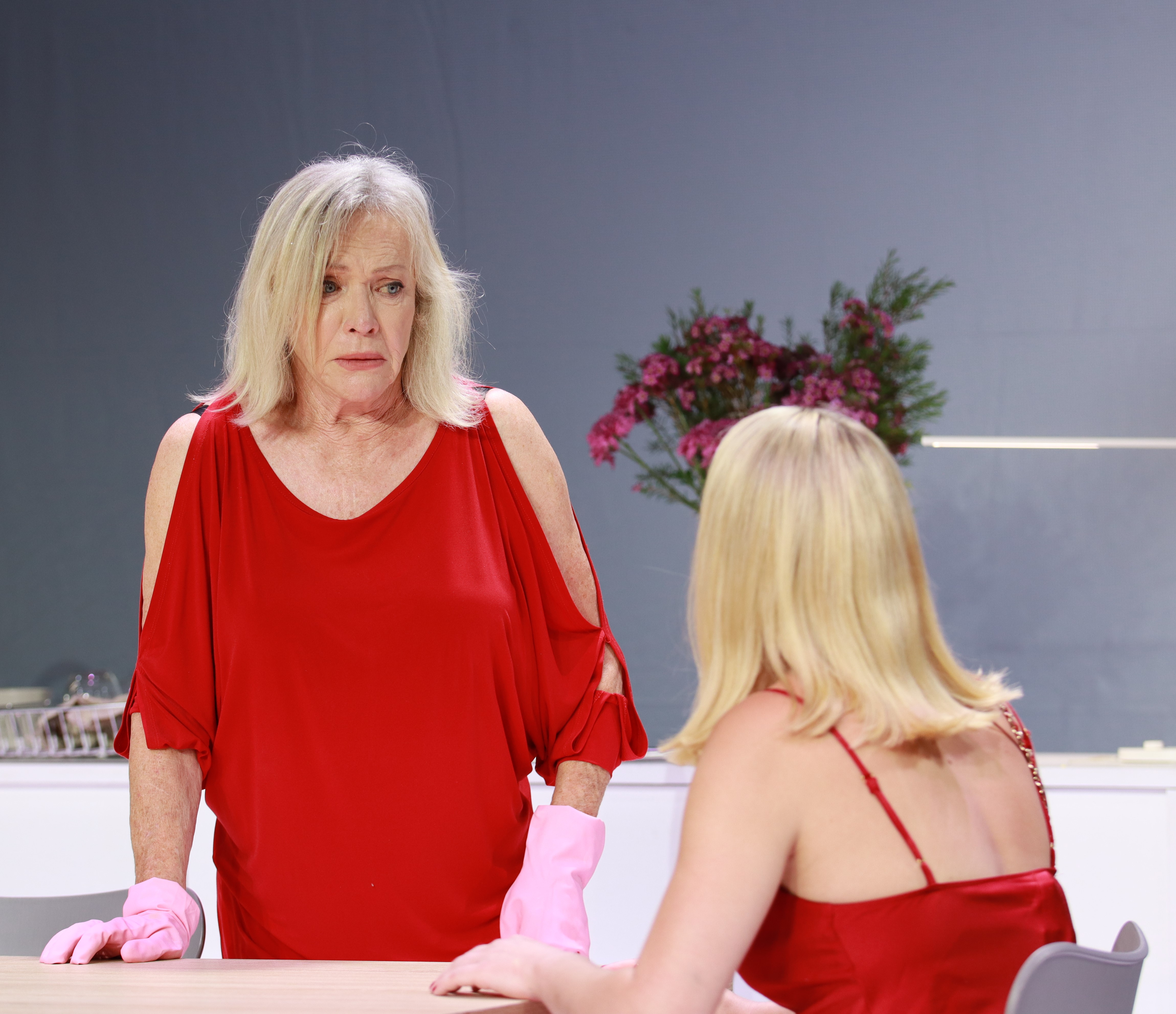
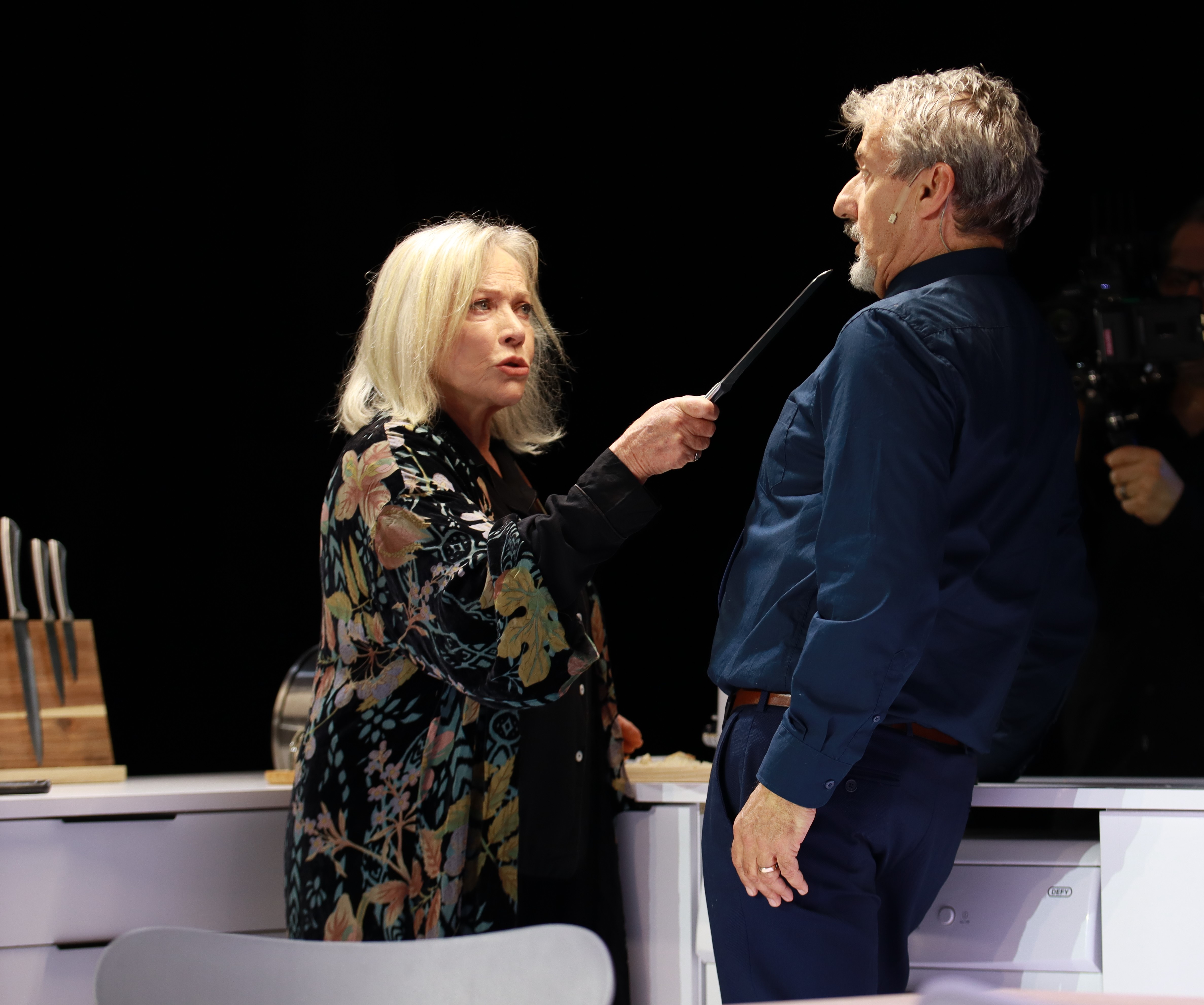
THIS is Sandra Prinsloo’s time.

Having recently seen her performance in Florian Zeller’s Moeder and now this revival of Master Class as Maria Callas in a mentorship rather than singing role, her range is astounding. For the past few years, she has been touring mainly in solo shows and it’s been a joy to have her back with ensemble casts, still reigning supreme.

If you’re expecting a Callas double, you will be disappointed, it’s not that kind of performance even though there are hints and gestures to pay homage. 

This one’s all about the process, how to become an artist and if you’re blessed by the theatre gods, you’re shown the finer points by La Divina. That’s where the focus lies, in the script and the performances.

Prinsloo turns into the fading yet never diminished star in front of your eyes. With a voice that’s dropped an octave, an attitude that displays both wisdom and wit and an accent to add to the theatricality of the piece, you’re swept into this world.

Alida Scheepers with Aandra Prinsloo in Master Class.

McNally cleverly fashioned a play that’s as much about becoming an artist as being on stage, and then he centred it around one of the world’s most dramatic divas, one who seemingly turns a master class into something that’s as much about her as it is about the students.

But in the process, she reveals as much about the artist as she does about the woman. Even at that time when social media wasn’t yet part of the publicity machine, the great ones couldn’t find anywhere to hide. Perhaps at a much slower pace, but eventually the stories would come out. This is why the reminders of her and Ari Onassis’s turbulent love life have impact.

And even if all of this adds flashy flesh to the McNally text, at its heart, it is a treatise on  the making of a true artist. All the other shenanigans, as Callas implies, are mere sideshows. But you have to pay attention to making an entrance, having a look, to understanding and investing in every word you sing and more. Everything comes together in a performance that will have you holding the audience’s attention, which is exactly what Prinsloo does in the persona of Callas as she chastises her young students when they perform with what she perceives as too much charisma and not enough care.

Master Class with Sandra Prinsloo and Tylor Lamani.

They hardly have the chance to utter a note before she destroys what might have been the smallest sign of an ego with shattering disapproval and a sharp gesture to underline her disdain. And then comes the command to sing again. Those who can’t stand the pressure are bitingly rebuked and if they still have any aspiration left, the performance is less assured.

The supporting cast, from José Dias (also musical direction) as the unperturbed répétiteur to the three courageous singers brave enough to face the harsh sometimes hysterical disdain of the tempestuous tutor, are a good foil with McNally introducing a dash of diversity with a trio of types from the nervous ingénue (Scheepers) to the self-assured poseur (Smith) and the cheeky, almost dismissive tenor (Lamani). Their singing is another highlight of the performance.

Master Class with Sandra Prinsloo and Brittany Smith.

I wasn’t sure of the flashing way the memory reels of Maria and Ari were introduced and found it quite disruptive. Perhaps loadshedding also had an impact. And perhaps Callas and Prinsloo would have been better served in another costume, one more suited to a master class.

But in the end, Prinsloo’s performance is the one that stuck as she made sure that the way Callas served her art was always at the forefront of her performance. Talent is obviously the X factor of great artists, but without blood, sweat and tears and an unwavering and selfish dedication to your art, few will achieve the ultimate prize.

That’s what Callas knew and delivered both on and off stage and what McNally so masterfully captures in Master Class with Prinsloo persistently reaching for perfection.

For bookings: https://www.webtickets.co.za/v2/Event.aspx?itemid=1524418851