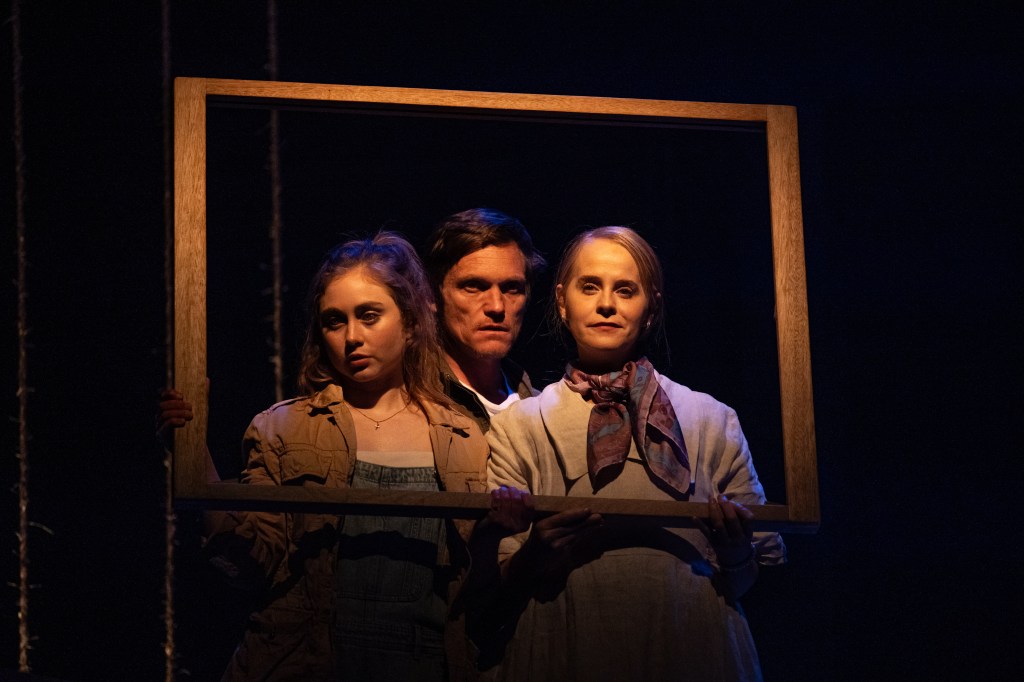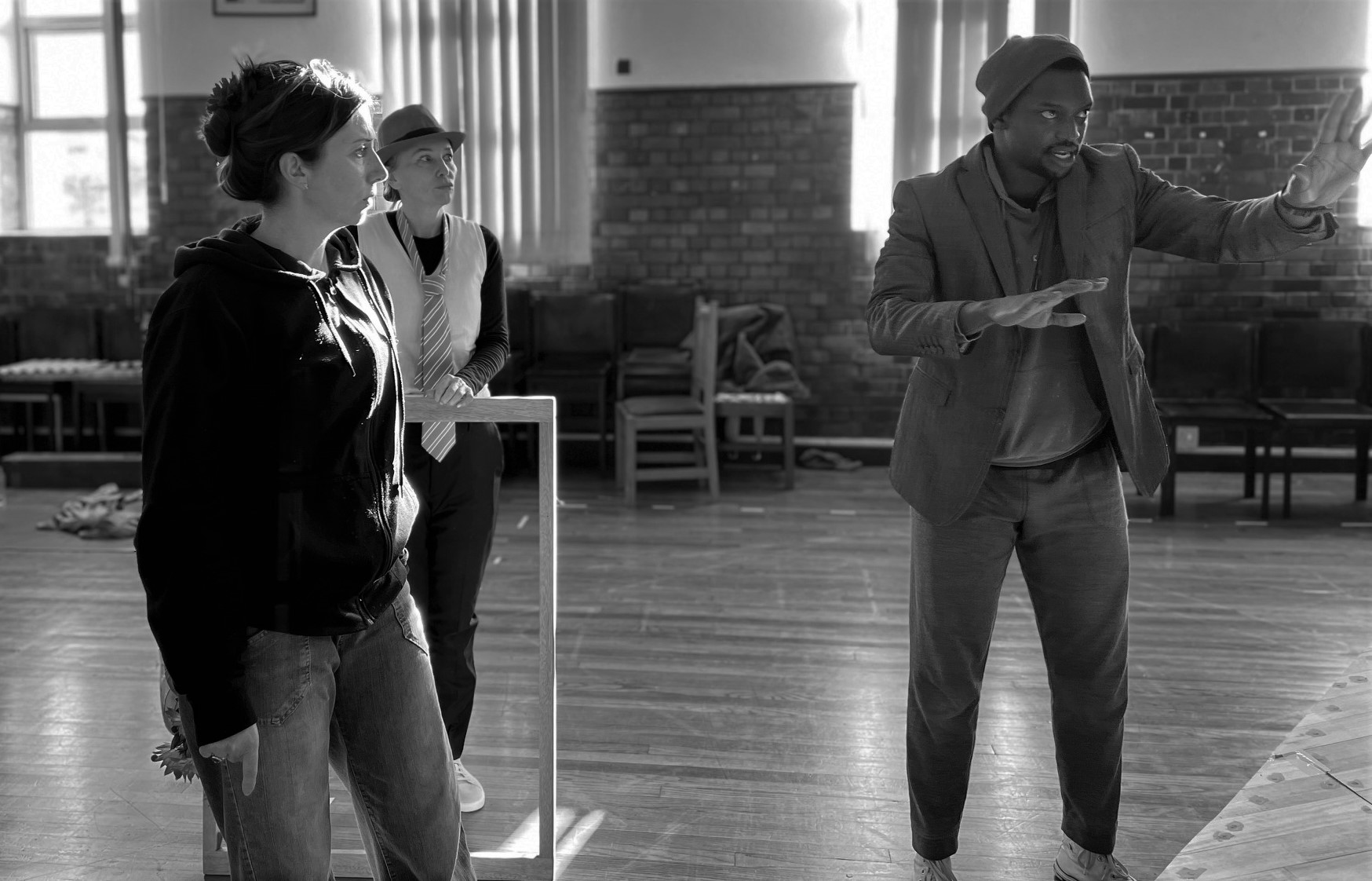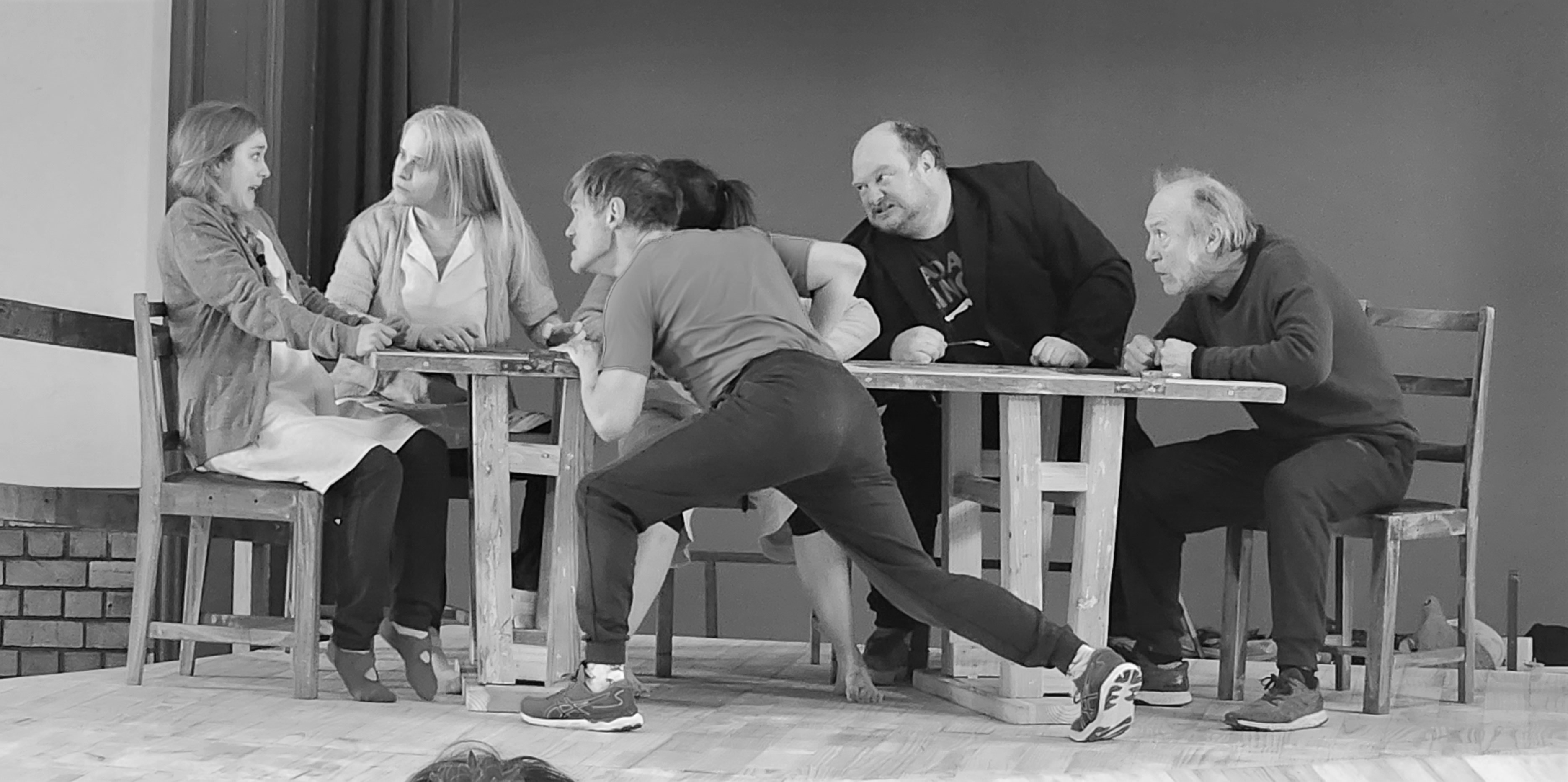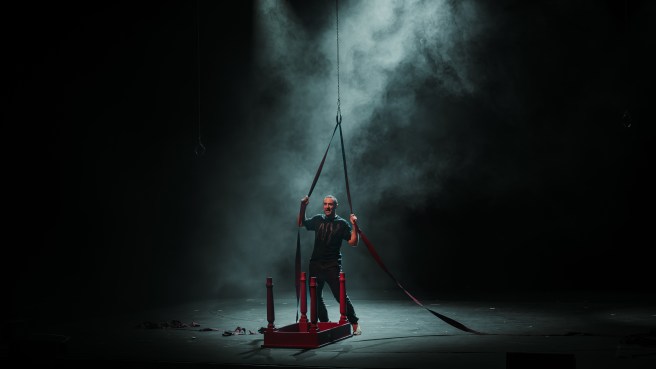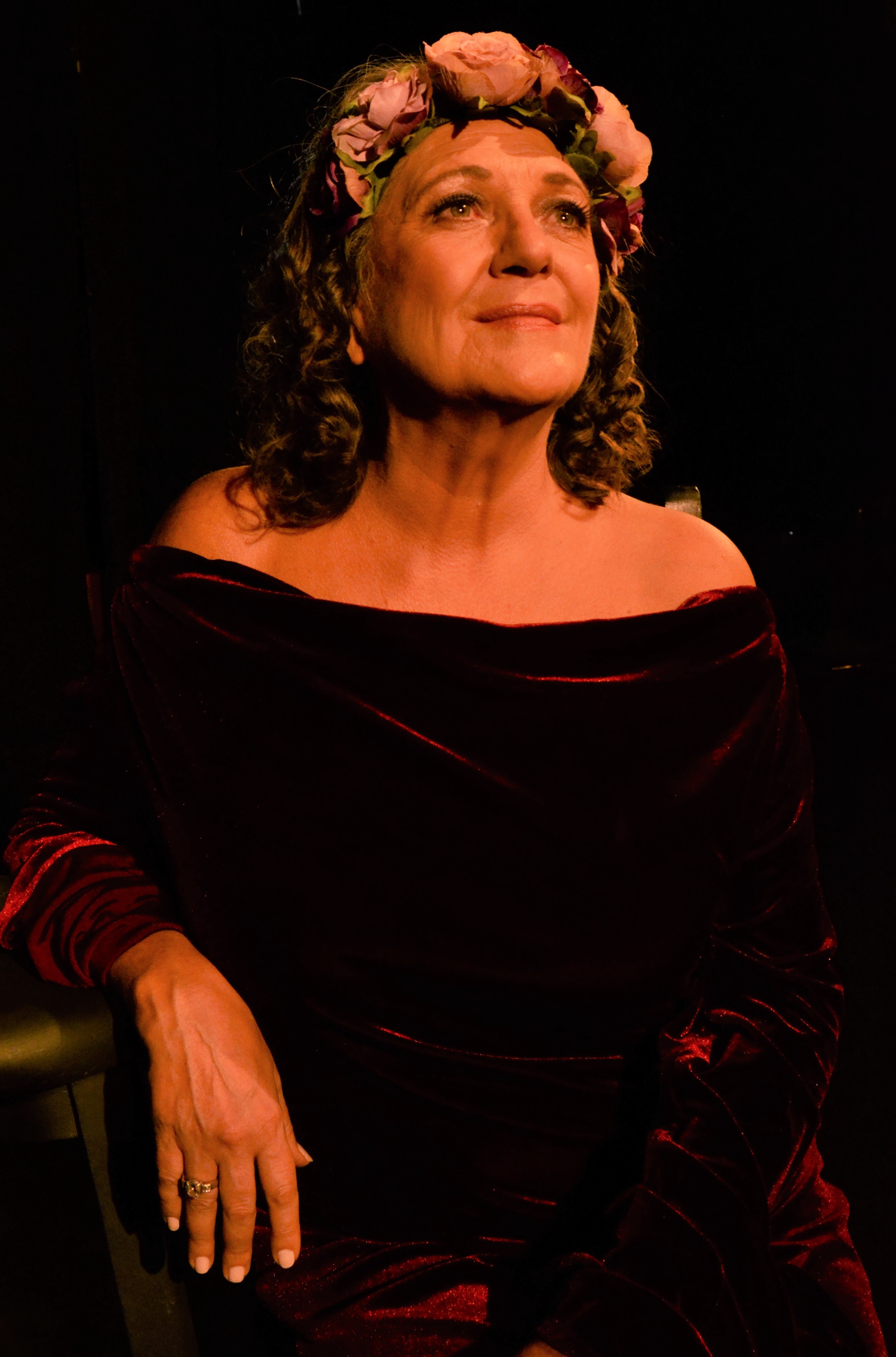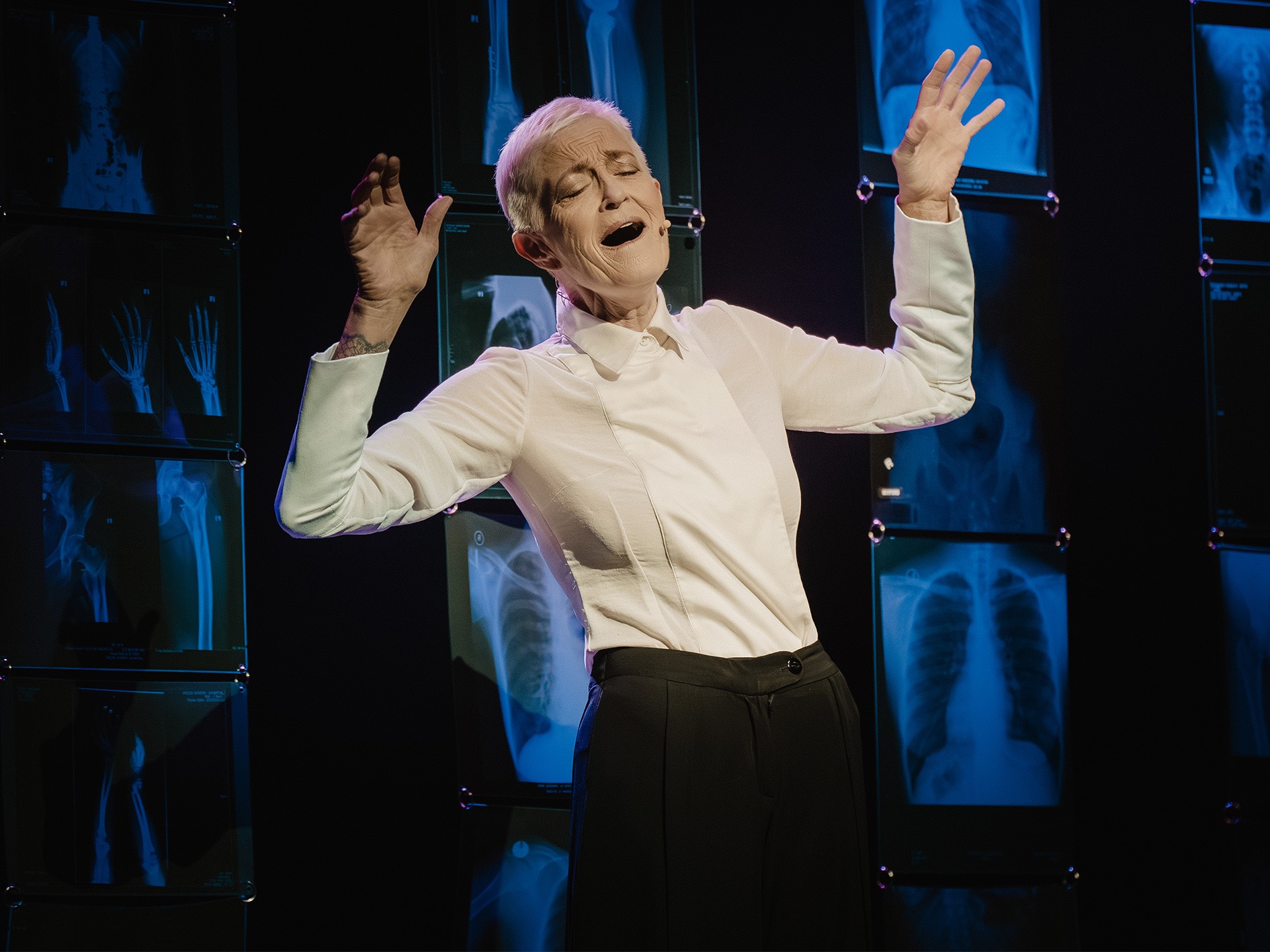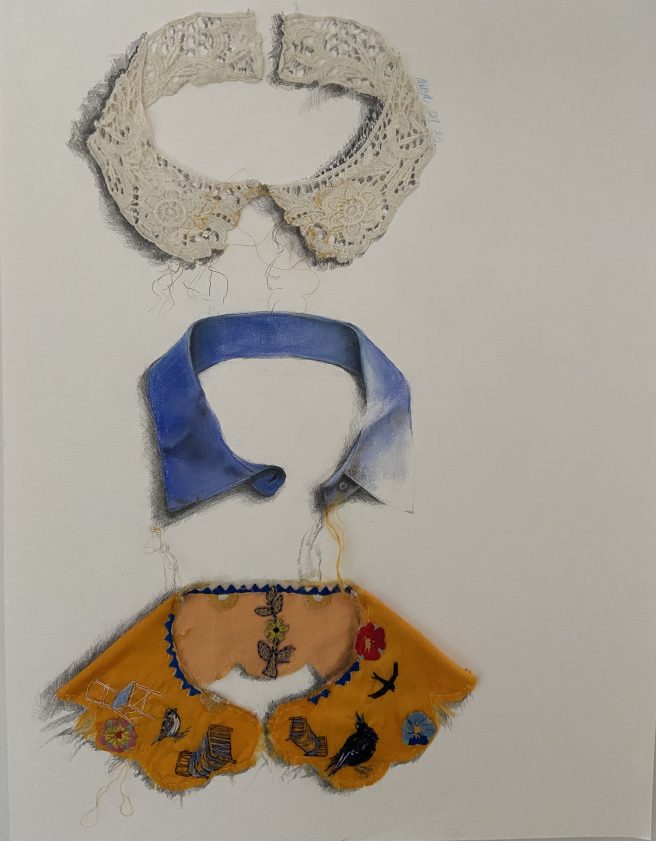
Cast: Hiran Abeysekera and the magnificent puppets
Set and Costume Designer: Tom Hatley
Puppet and Movement Director: Finn Caldwell
Puppetry Designers: Nick Barnes and Finn Caldwell
Lighting Designer: Tim Lutkin
Sound Design: Carolyn Downing
Composer: Andrew T Mackay
Scheduled screenings on 27 August at 2.30, and on 30 and 31 August at 5.30, but check your area for loadshedding, when screening times might change.
Halfway through the filmed version of this spectacular West End play, the director, designer and writer (who adapted the book) have a short chat about the play and how it all began. For the writer it was about the story, finding all the important bits and pulling them together for the stage version. For the director, it was about what could work on stage and how to do it. And for the designer it all began with the Richard Parker, the tiger.
Life of Pi imagined in spectacular style. Credit: Johan Persson
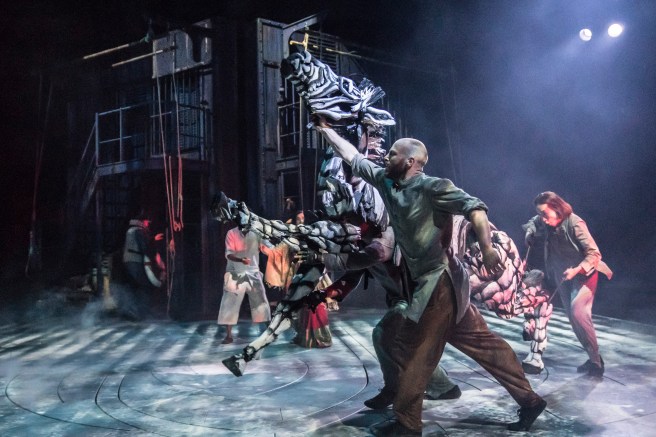
Anyone who has read the book and now sees the filmed play will know that this is where the struggle on every level is centred and, once they got that right, it was all systems go. And that’s no small thing. I counted seven puppeteers just for the tiger. It’s simply spectacular – the design, the puppets, the lighting, the video and the sound. That’s why I listed all the names in the credits. It’s a production with all the bells and whistles and yet it holds the heart of the story with the performances by Abeysekera and the animals that come to life.
Seven puppeteers are listed in the credits just for the tiger. Credit: Johan Persson
It’s clear that imagination was the key requirement for this fantastic book, which tells the story of a 16-year-old boy named Pi who is stranded on a lifeboat in the middle of the ocean with four other survivors – a hyena, a zebra, an orangutan and a Royal Bengal tiger.
We know he has made it because he is telling the story to two scientific types, the one sympathetic, the other a sceptic.
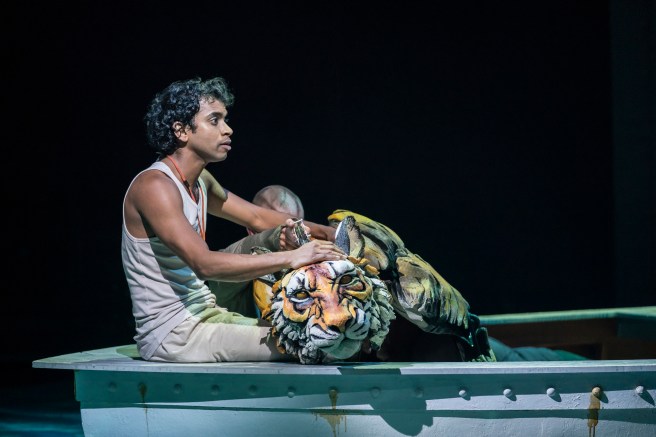
Hiran Abeysekera as Pi with one of his companions, a zebra. Credit: Johan Persson
But the wizardry of the play is all achieved by the magical approach and manner of telling and showing the marvellous Mantel story with no missteps. And although just the set is enough as it moves and rises and changes form to overwhelm the story, everything holds together in the way it should with Pi and his animal friends taking centre stage.
The experience is mesmerising and the two and a half hours flies by as Pi cajoles and cunningly sweet talks and outsmarts his sometimes ferocious and reluctant companions. It’s a kind of Alice-in- Wonderland adventure yet perhaps with a touch more reality than wonder, even if that is always present.
The determination of Pi to achieve his destiny draws you into both his pain and pleasure and this journey, keeping in mind that is after all a stage play, is all about the overwhelming power of theatre when done this magnificently.
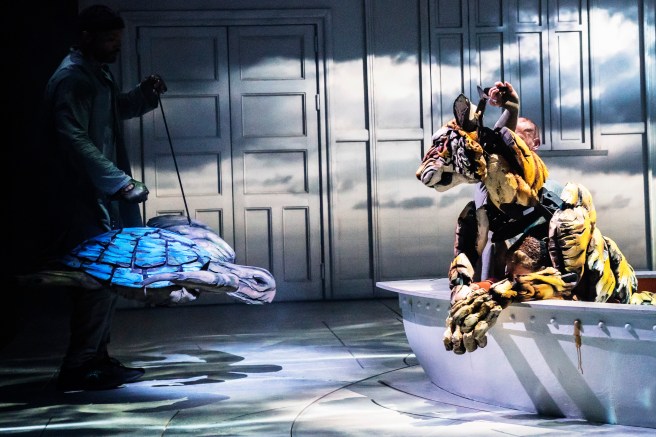
Pi in conversation with Richard Parker, the tiger. Credit: Johan Persson
I have to admit, I think Pi and his friend Richard Parker and their struggle for survival have everything to do with it!
The NT Live experience is an expensive exercise but you are seeing some of the best theatre experiences the world has to offer. If that’s your gig, don’t think twice.
Bookings at Ster Kinekor: Rosebank Nouveau in Johannesburg, Ster-Kinekor Brooklyn in Pretoria, Ster-Kinekor V&A Waterfront in Cape Town and Ster-Kinekor Gateway in Umhlanga.
DIANE DE BEER talks to Nataniël about the few weeks ahead…
After an absence of several years from any Johannesburg theatre stage, Nataniël brings his award-winning show, Prima Donna, to the Teatro at Montecasino for five performances only from August 17 to 20 at 8pm, with a matinee included on the Saturday at 3pm.
And while this is a show which he has performed before, it is a new staging with new stories or old ones updated and even the old songs have new arrangements.
Over the past few years Nataniël has written and staged more than 13 productions not seen in the Johannesburg area, and extraordinary moments from these shows as well as brand new material has been put together for five unforgettable gala concerts.
And, if you should wonder, naturally the costumes are all new, created by Floris Louw.That’s just who Nataniël is. But he’s nervous. This is a huge theatre, and even if it is similar to the seasons he used to stage annually at Emperors, he was familiar with the audience.
This time he doesn’t know because he hasn’t been in Joburg for some time. But those who know his work, won’t want to wait to buy tickets. His trademark stories will be in English and Afrikaans with songs in English.
In this tale as the title suggests, he is dealing with prima donnas. It’s a touch of fantasy, a dash of humour, some sadness, and as a reality check, a take on history, family, failures, hope and modern society.
“We all know these drama queens, know how they operate and what they’re capable of. But we indulge them, their behaviour becomes worse and only death can release us,” he warns.
Charl du Plessis Trio will join him on stage for both shows with other musicians in tow.Pictured are Werner Spies (bass), Charl du Plessis (piano) and Peter Auret (drums).
He knows he also has that reputation, but his demands are about performance and what he knows he needs on stage. “I never fight, because I don’t like confrontation,” he says.
Never able to resist raising an eyebrow, he adds that he always believed one of the perks of success was being difficult!
“We hate them so we would rather do without them,” he says. But, in case you start taking all of this seriously, he says he chose the title because it looks good on the poster!
See what an interviewer has to contend with.
Vocalists Dihan Slabbert and Nicolaas Swart
But before you lose patience, he includes one of his elaborate and irresistible descriptions: “If Sarah Bernhardt, Maria Callas and Isadora Duncan had a child, it would resemble my costumes!”
And, he adds, a touch of Florence Foster Jenkins.
His music he describes as a combination of the dramatical and accessible. “I sing many of my own songs and familiar old songs.”
With him on stage is Charl du Plessis who now travels with his own Steinway piano (and that’s a whole other story) Luke van der Merwe (guitar), Marcel Dednam (keyboard), and Werner Spies (bass), as well as Dihan Slabbert, Wiehahn Francke and Nicolaas Swart on vocals.
Having a final word, Nataniël notes that the show is vocally driven. “That’s what a prima donna does!” He’s been waiting for this one for 12 years. “I’m ready for that farewell concert,” he says.
And the force with which he speaks is almost persuasive, but I know about his addiction – performance – and he’s so good at that!
For those who are looking for something completely different, there’s a second concert of Afrikaans in Styl on September 9 presented at Sun Bet Arena in Times Square.
This time the artists included on the bill are Spoegwolf, Elvis Blue and Corlia.
“I’m the headgirl,” says Nataniël who will be staging the show. “It’s rare that artists are given a free hand to stage their own shows on this kind of platform,” he says, excited by the prospect.
Nataniël and Spoegwolf in a different kind of performance.
And if you’re not familiar with some of the performers, he explains it thus: Spoegwolf brings the war, Corlia brings the notes, Elvis, the smoothness and blues, and he brings the sequins.
The performers will almost exclusively be performing their own songs. “I love that. It’s rare that someone like Corlia who has such a huge voice is allowed to get away without singing Barcelona.”
Perhaps this time. It’s up to each one individually what they wish to perform.
He is also thrilled that this is a once-off. It won’t be filmed. If you’re not there, that’s it.
“The performers are all people who regularly perform in theatres.
“People must come and see. It will be new and not commercially driven. The artists will be adventurous with their performances and the staging will be daring.
“As artists (and audiences) we need to step out of our comfort zones when we go to shows. It’s a time for rebirth and venture.”
He always keeps in touch with what is happening in the rest of the world because it takes a time to reach our shores.
“We’re all ready to try new things!”
And why not.
“This time my brother won’t be hiding backstage. But we might have one or two surprises up our sleeve.”
And talking about that, Nataniël also has a new Christmas book in shops in October.
The title is Help, Help, it is beautifully packaged with a special cover for the festive season, and once you’ve seen it, packed with unpublished Afrikaans and English short stories, your Christmas shopping will be done.
And still there’s more: Rome 62will be staged at Atterbury Theatre later in the year, a new Mis will be performed at Aardklop Aubade in Pretoria and there’s the annual Christmas season also at the Atterbury Theatre.
And even then he’s not done. But we will wait for the final conclusion to his year.
Presented by The Market Theatre in association with Empatheatre and the National Arts Festival
Workshopped by actor Mpume Mthombeni and director Neil Coppen from an oral history project on migration
Dates: Sunday 30 July at 3pm, 2, 3, 4 August at 7pm and 5 and 6 August at 3 and 7pm
Our first encounter with Zenzile Maseko (Mthombeni) is in her women’s hostel room. She is a grandmother, partially disabled, who has just discovered that Home Affairs declared her dead two years ago. That’s why she hasn’t been receiving her grant, which would enable her to build her dream house in her childhood village, iPharadise.
What might have seemed to those of us looking at a woman, ageing, alone in a room with probably all her worldly possessions, as a small life is given towering proportions as this magnificent Shakespearean monologue starts spilling forth. All of this takes place in the midst of a nightmarish storm, which recalls the recent KwaZulu-Natal floods as well as the stormy life of Zenzile, who is being purged through this devastating, often delirious unfolding of a life of one of millions of similar women in similar circumstances in this country.
Few of us would even handle one of these events that seem to consume her whole being as the disasters roll in and out with regular intervals. Just the word Home Affairs is enough to draw sighs of despair as we think of the rows and rows of people seen in a distance on a monthly basis as they wait to collect their grants, which is often the only lifeline for an extended family.
But Zenzile has courage to fall back on and draw from as her life could not have been more dramatic.
And that’s just the broad strokes.
Yet, more than this epic life story that seems to span many lives, generations and cycles of violence that feel never-ending, is the performance by the magnificent Mthombeni. She transforms Zenzile in a matter of minutes as she draws on all her skills to explore this heart wrenching embodiment of a woman whose life depended on her being a warrior.
And that she is as she rises through each crisis that becomes her life. She simply has to survive. Nothing has been brought on by her own actions or even who she is. It is simply the way people are discarded and ignored as they battle their every daily task.
Few of us have any idea how most of our people live. We think loadshedding is our biggest struggle. For many electricity is but a dream.
Zenzile brings all of that to the light as she creates her own Lear, battling her fraught life as well as the elements. It is an awe-inspiring performance which takes you on an emotional endurance race that’s hugely exciting to witness but also daunting to compute.
Brilliant lighting design by Tina le Roux
Her performance is enhanced by the text and the way she grabs hold of it, workshopped by Coppen and Mthombeni, who never lets up, as well as the staging which is achieved with spectacular lighting that brings a magnificent intensity.
In the publicity it is said that some have referred to this as a modern day South African classic, I can see why. It’s startling yet stunning theatre which explores invisible South African lives and gives one such woman a platform.
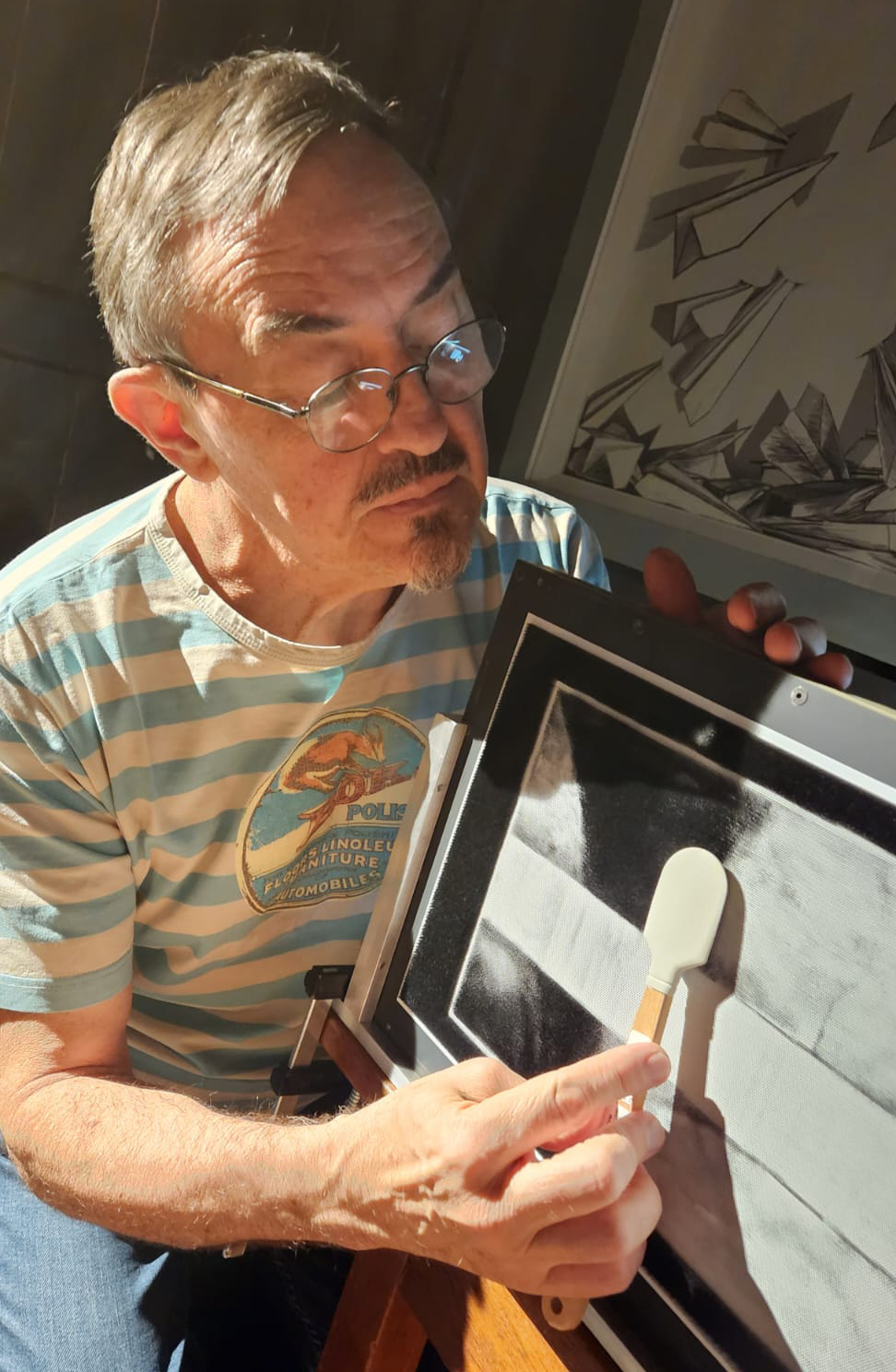
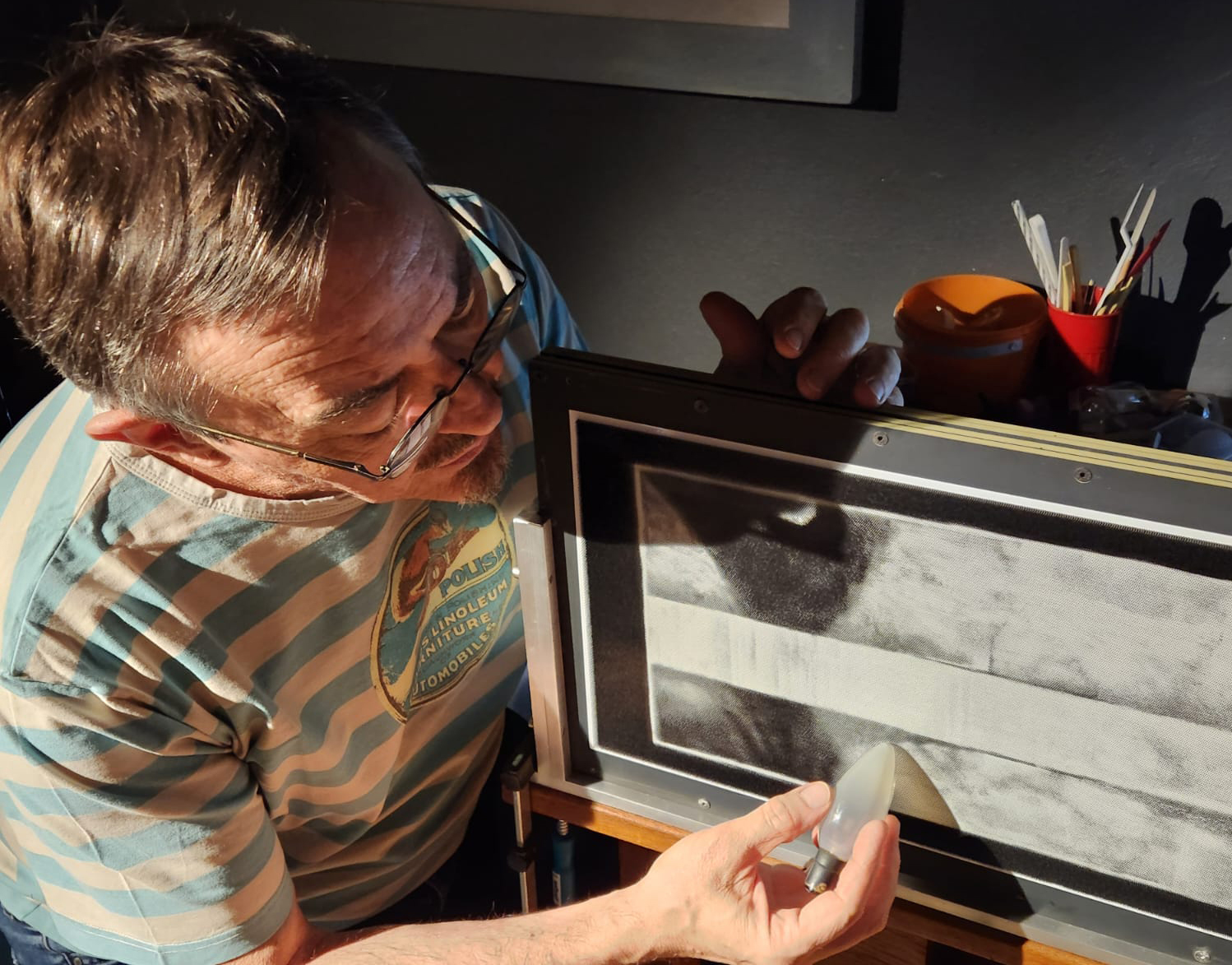
Art exhibitions come and go, with some pieces remembered, some purchased and others touching your heart. When the event features the work of someone who has turned himself into your personal artist yet has decided to show his work for the first time, the feelings all round are overwhelming. For me, it was the gift of sharing the art of Dries de Beer and the emotional impact it has had on our lives. DIANE DE BEER gives her biased opinion of an artistic celebration:
Invite designed by Ursa Engelbrecht Curator Carla Spies
When architect/gallerist/curator Carla Spies suggested that her gallery, The Guildy, curate an exhibition for my husband, the reluctant artist (as I have dubbed him), I knew this was the perfect space and opportunity.
No pressure, no sales and for one day only with people we invite who we think will enjoy the work. And that is exactly what Carla and her gallery represent. As an architect, her work is not on the creative side and through the years she knew she had to find a way of scratching that itch.
Even the guests looked like artworks
The gallery was her solution and, having just gone through the whole process of an exhibition, I understand how this works as I do a similar thing by writing about the arts. There’s no direct renumeration, we’re not driven by money but rather by a passion for the arts and how it affects, touches and changes people. It’s the creativity – the process and the outcome and, finally, the joy.
But I knew my artist would feel differently. NO! was the immediate response, but I worked my cause and finally he conceded.
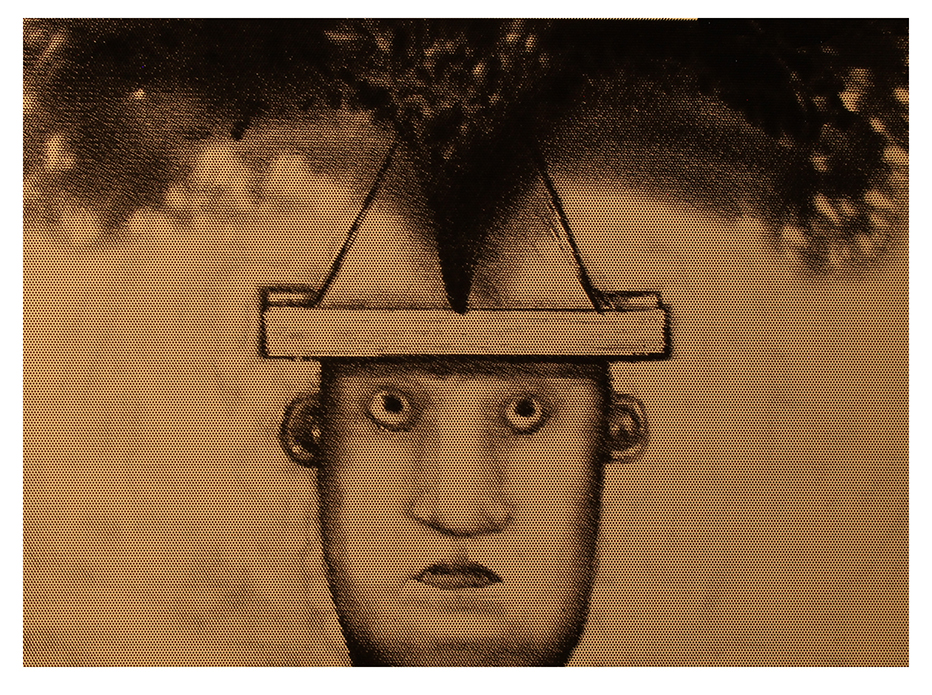
The fabulous thing about this exhibition, which Carla named The Imaginarium of Dries de Beer, was that all the art was there. That is what interested Carla in the first place. She had seen especially his series of faces and was intrigued. It’s her gallery and like me, who only writes about the art that inspires me personally, she only shows work that moves her.
And I was quite clear that the thing I really wanted Dries to showcase was the diversity of his art. Because he has always been compulsive in a constructive way about his art, moving from one thing to the next, exhibiting a theme, yet in very different ways. He has played around in ceramics, cartoons (which he still does daily), scrapyard found objects, which would result in anything from a small human figure to huge installations, and glass tiles in which he made pictures with objects of lesser desire found on his daily walks and changed it into something exquisite.
On the ceramic side, it all began with handmade ceramic zebras painted and then fired for the final result. Thery were unique and each one individual but labour intensive. To really make money – if that were one’s goal – it would have to be mass-produced and then lose that artistic quality that each one displays.
This led to masks and hanging faces which started out as a mass of small and larger cement and ceramic balls which all found a place in our garden. Today those hanging installations, sculpted into different faces and fishes of different kinds are on window sills, against outside and inside walls, hanging outside from poles and trees and even in the shape of gargoyles, each at the end of a pergola pole as decoration. It’s the way he changes and enhances what would just have been another ordinary garden structure. Instead a secret world of chattering ceramic faces and masks emerged
I have written about the work of many artists in an introductory rather than critical fashion. Fine art is something I had to give exposure to because as times grew tough, newspapers and magazines featured less and less specialist writers. Mine was the performing rather than the fine arts, but I knew we had to embrace as wide a range of the arts as was possible – and that’s what I still try to do.
Ceramic gargoyels.
But with this artist’s work, because he and his work are mine, working at a formal institution I couldn’t focus on any of his work. That’s why this exhibition was so important to me and gave me such pleasure. To do it with Carla and her crew, was a dream come true.
Dries, who slowly warmed to the idea of showing his work, and I made the initial selection of what we wanted to show and then Carla and her musician/entrepreneur husband Werner arrived a week before the showing to look at the final selection and help us move the work from home to gallery.
Then the fun really began, as we started hanging the work. This is where Carla and Werner took over while we helped on the side. It’s no easy thing to physically do the hanging and even more specialised is to decide how and where to display each single piece. This is where, I suspect, Carla’s creativity kicks in – and she knows what she wants. We could just stand smiling at the results.
I suspect for Dries it was a new way of experiencing his work. In our house the effect is diminished by it being all over the place. Here it was Dries de Beer in full force – and whether you like it or not, which is a personal choice and what art is all about, this was a special display and one of which even the reluctant artist approved.
I appreciated once again what inspires me most about his art. It comes from within, it’s who he is and how he has conversations with himself and the world – and me.
Also on board were a group of special friends who gathered around me and took over when I really needed help. Writing about the creatives in the food world as well, I have my own favourites and Alicea Malan of Lucky Bread Company https://www.luckybread.co.za/ and Elze Roome of Tashas, Menlyn Main feature on that short list.
I simply asked Alicea about some produce and she said “Leave it to me.” She pulled together a spread with the amazing breads from Lucky Bread https://www.luckybread.co.za/ and then, as importantly, showcased it at the gallery in a way that just adds that edge to any event. Elze Roome https://www.tashascafe.com/locations/pretoria/menlyn-maine/ jumped in with the sweet stuff which was melt-in-the-mouth.
To add yet even more sparkle to the event, Werner on bass and Rynier Prins made exquisite background music, often I think one of the more thankless jobs and yet it fills a room full of people with a sound that’s embracing.
Also part of the picture was one of Carla’s most recent employees, Ursa Engelbrecht. She’s a young woman with artistic flair, was immediately excited, designed the invite and helped out everywhere and anywhere she could. She and Estevan Kuhn also provided music when the first duo needed a break.
So when people ask me about the worth of a single day showing which is what The Guildy specialises in, I can only underline how it brings a group of creatives in different fields together to create a little bit of magic in the world of those who share this kind of passion.
Ursa and Estavan (left) andRynier and Werner (right) making wonderful music.
I know my artist looks at Carla and Werner with eyes that appreciate how they approach life and the world they hope to create. I know he saw how people like Alicea, Elze and Ursa all stepped in to add their special icing to this magnificent cake.
And more than anything, it gave my reluctant artist the chance to see how others viewed his work, to inspire fresh and novel ideas, and to view the future in a way where he shares his work with more people than just me. This was his chance to shine brightly.
Sylvaine Strike, director/actor/playwright and any other creative word one can dream up, teamed with three other brilliant creatives, Toni Morkel (director), Andrew Buckland (fellow actor) and Tony Bentel, musical genius to create the dreamily magical Firefly currently in its last week at the Pieter Toerien Theatre at Montecasino. Having seen it for the third time at the weekend, this is a copy of my original review to encourage anyone who hasn’t yet seen it, to go. It will warm your heart and the glow will last for the longest time.
DIANE DE BEER reviews:
Scenes from Firefly with Sylvaine Strike and Andrew Buckland:
Pictures by Nardus Engelbrecht
I was blessed to see Firefly at Cape Town’s Baxter Theatre with the emergence of live theatre following the pandemic.
The bewitching Firefly, which as one of the first Covid-19 impacted productions saw light of day as a Woordfees digital production, made a magically mesmerising transition. I had lost my heart earlier to the filmed production and was excitedly inquisitive at how that particular story – with many filmic tricks up its sleeve – would translate and transform on stage.
But this particular creative quartet (Strike, Andrew Buckland, Toni Morkel as director and Tony Bentel on piano) are the perfect combo. This is their theatrical landscape. Give them a stage and they will be telling stories in such an imaginative way, it becomes a visual feast.
Because they have all worked together, they understand each other’s strengths, and Morkel could stretch that piece of string intuitively with fantastically imaginative and explosive pyrotechnics.
Buckland and Strike are a brilliant blend of artistry with an instinct for detail that holds your attention gently yet persistently. Storytelling is their forte, aided by the fact that they have an endless supply of tools to draw on to embellish a wink or the final lift of a foot to express and underline the tiniest emotion.
It is theatre at its best when it has you smiling from start to finish because of the artistry, the wizardry of the production, the perfection of the coupling, and just the sheer audacity of the storytelling.
No matter how or why, just immerse yourself and see what happens when Saartjie Botha commands two artists to give her a production in the purest style of theatre.
If you have seen the digital version that’s a bonus, because to witness how one story can be told in such magnificent splendour in two completely different approaches is truly special and quite rare. The one had all the bells and whistles and worked like a charm. But here, with Strike and Buckland live on stage with just themselves to grab hold of their audience and cast that spell, the essence of theatre comes into play – and again I willingly lost my heart.
Add to the two artists on stage, the magnificence of Wolf Britz’s set and props as well as starstruck-inducing lighting and the keyboard genius of Bentel’s soundtrack that holds every emotion so thrillingly in a familiar yet completely Bentel-constructed composition.
If you want to see how the best make theatre with their instincts, intuition and imagination, don’t miss the sparkling Firefly. Yet don’t think for one second that the miracle unfolding on stage didn’t come with buckets of blood, sweat, tears and ENDLESS talent. Part of the theatrical trickery of this foursome is to present something that is this skilled as seemingly effortless.
It’s brilliant and personally I hope to see this travel around the country casting its spell throughout. We are desperately in need of this kind of adult fairy tale in these tumultuous times.
And with every fresh viewing, they’ve added fresh insight and sparkle if that’s even possible.
Book at Webtickets for any of the shows from tonight until Friday at 8pm, Saturday at 3 and 8pm; and Sunday at 2pm for their final bow.
Pictures taken off the screen by directors Toni Morkel and Jaco Bouwer during the film shoot:
If you haven’t yet seen Sylvaine Strike’s wondrous Firefly, Pieter Toerien’s Montecasino Theatre is presenting another season from May 19 to June 11. It’s a once-in-lifetime theatrical experience with two seasoned artists stepping into the magical world of storytelling in a way that plays with your imagination in the best possible sense. If you want to know more, see below. This is the story written when they first stepped onto stage following covid:
The Countess Pafanesca in the Vodka Tango
When you are excited by the group of artists who have come together to make theatre, sparks can fly. And that’s exactly what can happen with the first live run of Firefly, a production that was created to celebrate live theatre. DIANE DE BEER speaks to a few of the artists involved:
Theatre fans are blessed with the latest Sylvaine Strike, Andrew Buckland and Toni Morkel collaboration as they bring Ferine and Ferase (which was filmed by Jaco Bouwer for the Woordfees digital programme) to life on stage – as it was originally planned.
This is the second time this trio have combined their creative talents (the first was in the much lauded Tobacco and the Harmful Effects Thereof) even if the roles have been switched. Firefly was written by Sylvaine Strike and Andrew Buckland and devised for the stage by the full company (Andrew, Sylvaine Toni Morkel, Tony Bentel) and directed by Toni Morkel with Tony Bentel on piano..
Sylvaine Strike and Andrew Buckland at play.
The initial name was derived from two chemical components luciferin and luciferase, which exist in a firefly’s bum and make it glow, explained Sylvaine. “So one without the other can’t make light, they have to be together to glow. Lots of fireflies in this show.” And that is why it is now called the more familiar Firefly.
The play was first created on commission by head of the Woordfees Saartjie Botha in September 2020, three-quarters of the way through the first tough lockdown. The idea was to create something that would show audiences why theatre is unique and exciting. Saartjie didn’t want a big set, she didn’t want audiovisuals, no multimedia, only pure theatre. “We want body and craft and what the actor is,” was the instruction.
Because of lockdown, they started writing remotely through October, November and December and in mid-January last year (2021) met in a rehearsal room with their director. With Tony Bentel on piano, they began to develop the story on their feet to find a common language between Sylvaine and Andrew, who both have very specific styles. But when this trio are tasked to make theatre, that’s exactly what they do.
It’s all in the telling of the tale.
They discovered and developed a mutual style for the two actors largely based on clowning duos. Think Laurel and Hardy, for example, that kind of world, very much a nostalgic, romantic story where they play three different characters each, with the narrators the main characters called … Ferine and Ferase. They have a backstory of their own, which they tell as travelling players of Bucket’s End. It’s a time of magic and wonder which allows you to sit back, be transported and dream, a luxury in these times.
“It’s beautiful, it’s very physical, it’s gorgeously costumed with each a standard clowning costume that transforms into a couple of things,” Sylvaine embroiders.
Every detail tells a story.
From the start it was meant to play on stage and they had a short trial run with a 45-minute version. But this all had to take on a different hue when live changed to digital and they spread their special brand of fairy dust.
The full play was filmed with Sylvaine enchanted with Jaco’s extraordinary transformation from stage into film, shot in studio, all in black and white, inspired by old movies. And those of us lucky enough to have seen it, agree.
It was delightful to witness how they adopted and adapted for the new medium with all the elements colliding and fusing.
And now they’re back on stage and it will be marvellous to be experience yet another transformation. Personally, I can’t wait!
Crafting a clutch of characters with craft and creativity.
Sylvaine and Andrew make perfect sense together and then to have the extraordinary Toni Morkel directing is genius.
As she has often been directed by Sylvaine and performed with Andrew, she was terrified yet thrilled when asked but she trusted her instincts because all three of them know one another well and understand each other’s particular theatre language.
“I’m very excited to do it live,” says Toni, who has just started with rehearsals again. These are two actors who know how to act with their whole being and she finds herself smiling as she watches them go through their moves. “I’m living my dream,” says this consummate theatre maker.
The great difference between the screen and stage version is most specifically the sets. The two actors with their costumes and imagination have to construct their world on stage. And while it is sometimes frustrating to remember what they could do on film, the stage version is what they envisioned from the start.
“We wanted to create a play that would travel easily and anywhere – whether we had lights, curtains, even a stage,” she says. And knowing what they have achieved in the past together and individually, this is not an impossible ask. It has always been part of their theatre ethos, and while it might have been initiated by a scarcity of funds, it also focused their imaginations magnificently.
Andrew Buckland and Sylvaine Strike in Firefly.
“I know their world, their physical ability and strength and how they work,” she says about the process. “What we are relying on is good old-fashioned storytelling.”
She does have two more aces up her sleeve with Wolf Britz again making magic with his wondrous lighting and he has a few more tricks in the bag. And there’s Tony Bentel’s wizardry on piano. “I can’t help but gush when speaking of his astonishing ability. He has a world of music in his body,” is how she explains this gifted musician who accompanies the two actors live.
“For any section of the play, he comes up with five or six different musical suggestions and because he is adept with improv, he can embellish what the actors are trying to express at any moment. I am constantly in awe of what he has arranged musically.
Liza Grobler Festival Artist and the winner of the art prize captures the essence of her Karoo which constantly changes.
Art has always played an important role at the festivals, with the Klein Karoo National Festival one of my favourite viewing venues. DIANE DE BEER tells you why:
It has to do with the place, because they have easy access to different venues and spaces, but perhaps because of the length of the festival, it has also meant that you have time to meander and really take note of the art.
Another reason might be the more recent introduction of curator Dineke van der Walt. Her choice of themes and artists has been unusual, varied and always presenting a large number of artists who I had no knowledge of.
That doesn’t necessarily mean anything except that I don’t pay enough attention during the year and the festivals mean that artists from around the country are on display.
Curator Dineke van der Walt on one of her many walk-abouts. Picture: Hans van der Veen.
This year was no exception and I was lucky enough to catch one of Van der Walt’s walk-abouts which for this art fan is always a bonus and a learning experience. Sometimes the artists or the curators are around and do the talking, but other times, Van der Walt told the story. Keep this one in mind for the future.
This year’s theme very aptly was Hide and Seek: Reimagined Histories. It’s about taking a much wider and more representative look at the world. For far too long, stories have been told from a specific vantage. It has long been time to fling open those doors and allow the light in. We all gain from a wider and more honest perspective – on every level.
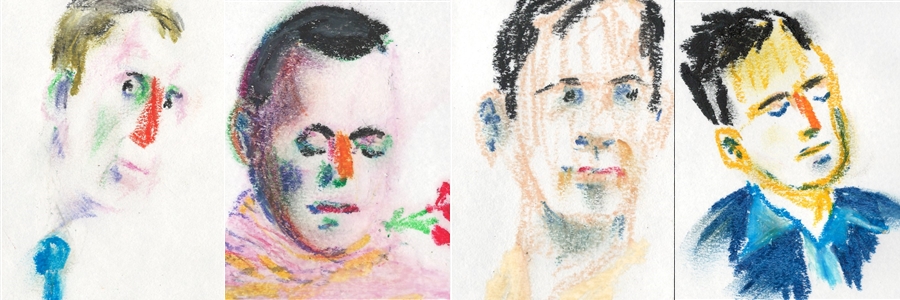
There are too many artists and venues to include here, but that doesn’t mean that there weren’t many more worthy of a mention. Simply that I had to make a choice, and for the moment, these were my picks.
Two stood outside of the parameters of the St Vincent Building which exhibited most of the art. Another well-deserved extension of Karoo Kaarte, was yet again a fantastic example of how art can include a much wider audience as well as introduce participants to a new way of expressing themselves.
Collages and narratives feature strongly in this project and this time they were displayed in full view of everyone in town because at some point they would have passed these beautifully illustrated windows and stopped by to see what was happening.
The pictures best tell the story that is one that should just keep on running. Here are some of the collages in the building where they presented daily workshops.They had many contributions and one they cleverly slipped into the exhibition space was the way they re-imagined children’s games from the past ,which some of us might remember like kennetjie, skaloeloe, drieblik and gaatjie. These were then explained in a pamphlet with instruction-driven drawings to show the way. It’s also another way of appealing to the youngsters attending the festival.
The other was a series of site specific installations which apparently were meant to be quite hidden, but for hurried festinos it might have been a hazard rather than an adventure.
Three derelict buildings were selected as the backdrop for Norman O’Flynn and ONE. with the trio of installations titled Transparent. The idea was to lift these structures, which have probably for many years gone unnoticed, out of their environment by applying a quite ordinary yet eye catching pattern.
What they were hoping to achieve was to show the way society deals with issues like poverty, inequality and violence in a community, by turning a blind eye.
It was a wonderful exercise apart from the difficulty in finding especially one of the installations. The point about hidden had already been drawn by picking these structures all on the edge of society.
Art is enough of a niche not to add obstacles to further shift it closer to the edge.
Kanna for Best Presentation – visual arts, sponsored by Absa: Liza Grobler – Inkommers, laatkommers & laatlammers, as well as the Droom installation”:
And then moving inside to be enveloped by the colourful explosion of the Festival Artist. Liza Grobler dabbles in many different ways of making art. With the title Inkommers, laatkommers en laatlammers, this recent Oudtshoorn inhabitant was clearly stating her case.
Pictures Hans van der VeenThe work is titled Queen of the Night and beaded by a group called
Qaqambile Bead Studio., a small business who work with contemporary artists who produce these panels out of glass seed beads. They have been working together since 2004 and have produced more than a 100 panels.
From her side, there’s an exuberance, an energy and enthusiasm that’s catching. She targets the imagination not only with her variety of work but also with the way she invites you to engage with her art.
Stringing along while playing with your mind.
There’s a playfulness that’s engaging and yet her work is loaded with meaning if you take the time to explore and engage. And here the title took you by the hand and pointed the way.
A croched installation with the word dream done in eight different languages by Liza Grobler and local creatives the ReWOLusie. Picture Fahiem StellenboomThe collective responsible from ReWOLusie. Picture: Hans van der Veen
As did her outside installation with the word DROOM in eight different languages. She also encourages others to dream by having workshops and including other Oudtshoorn creatives to collaborate.
Another artist’s work that grabbed my heart was titled Untitled: the Dumisani Mabaso Retrospective. I was immediately bowled over by the work, the emotional impact, the diversity, the way Mabaso moved from one visual look to the next.
A city scape.Playing with the rainbow nation. Dumisani Mabaso’s Visiting the Sick.
Only then did I wonder about the artist and why I had never seen or perhaps noticed his work before? He was a painter, a master printmaker and a jazz musician, and all of these influences played a role in his art.
His approach was gentle but, living from 1955 to 2013, his art spoke to the time and the conditions of the disenfranchised and disaffected. And he never stopped. His was always a fight for the poor and the working class and for their emancipation.
A trio of Mabaso sketches that reminds of costume portraits with their delicacy.
This retrospective resulted from consultations with the Mabaso family by the William Humphreys Gallery about the importance of underlining his importance and contribution to South African art.
We are the richer for this inheritance.
Johan Stegman’s solo ‘n Goeie dag vir ‘n slag
Two other notables include the work of Johan Stegman who was very articulate in explaining the title of his exhibition: ‘n Goeie dag vir ‘n Slag.
It’s all about the one who writes the history and from where it is interpreted. Rather than argue the facts, he takes the battle of Blood River, the legendary fight between the Voortrekkers and the Zulus, and investigates it from different angles with the idea that this will offer different perspectives.
Included are other works which immediately point you to the way his mind works.
In another grouping, Is ons nog ‘n ding, he smartly invited Lawrence Lemaoana to co-curate with a title exploring the use of the term Afrikaner which can be used or abused by white Afrikaans artists to explore their shared needs and desires.
Mary Sibande as part of another perspective in Is ons nog ‘n dingThe zone of being and non being explored in Is ons nog ‘n ding
The white artists’ lager only gains huge perspective when the work of a few outsiders is included, in this instance that of Lemaoane and his wife, Mary Sibande. You cannot find a more powerful art couple to make this point.
The worth of any work only comes into play when it is compared with others.
As already said, there are many other exciting examples, and the engaging and provocative approach of the art at this year’s festival again contributed to many conversations, in general and in particular, that is what it is meant to evoke.
Festivals, each one of them, are their own creatures. They’re put together in a way that hopes to attract audiences and once they’re there, will feed and nourish them in many different ways. That’s exactly what this year’s Klein Karoo National Festival achieved and here are just a handful of reasons why. DIANE DE BEER gives her impressions of some of the best:
Pictures: Hans van der Veen
Picture (above) capturing the Karoo by Fahiem Stellenboom.
First the music productions:
Stylish simplicity of Woordmusiek staging.
Woordmusiek: One of the toughest things is to keep a stage/performance career going. Coenie de Villiers knows this.
Stylish simplicity of Woordmusiek staging. (Van der Veen)
Especially on the music side. Even if someone like De Villiers is hugely popular, his music part of the Afrikaans lexicon, and his performance style slick and always smartly rehearsed.
It’s quite something to keep reinventing yourself, however. How long will an audience keep listening to the same songs done in exactly the same style and presentation?
Coenie de Villiers (Van der Veen)
De Villiers has always had the key to renewal: collaboration. And while that can also work against you because it can be seen as too gimmicky, he has the musical and performance nous to make it work – and in this instance, brilliantly.
With this one, he decided to focus on his lyrics. He cleverly invited three of our top actors, all with distinct voices – Jana Cilliers, Vinette Ebrahim and Antoinette Kellermann – to read his lyrics as if poems, which they are when done in this way. And in between, he performed his music, some with, and others without song.
Voices that opened vistas.
The staging was stylish without any frills, and guitar genius Mauritz Lotz provided another musical element – and voila, it was a sublime performance with not a note or sound out of place.
Anders/Eenders: a musical ensemble that sparkled. Each individual performer had his/her own style and together, they blend and cook musically.
There’s the superb songbird Sima Mashazi with the extraordinary voice and stage presence; African guitar genius Louis Mhlanga who is as gentle as his music is glorious; the exuberant Riaan van Rensburg on percussion; keyboard king Ramon Alexander; and brilliant producer/bass Schalk Joubert who always looks as if he is enjoying making music while finding the best sounds.
The fact that they all compose and perform their own music adds to the special sound they create as a group. It is the best of who we are, with music that covers the spectrum and tells stories that criss-crosses the country and holds us all together.
You walk out of there overwhelmed and bouncing with African rhythms. It’s a blast and so much part of the South African fabric.
Kanna for Best Presentation – music, sponsored by Castle Lager: Ver innie wêreld Kittie ; Kanna for Best Ensemble, sponsored by Kunste Onbeperk; Ver innie wêreld Kittie
David Kramer in conversation with Hugo TheartDavid and André Terblanche.
Ver Innie Wêreld Kittie: It might be an intimate setting, but it’s a huge story with heart – and one of David Kramer’s best. I loved the intimacy of the staging with only four dazzling actors/singers (Dean Balie, Rushney Ferguson, Jenny Stead and André Terblanche) and two musicians, Nick Turner and Yvan Potts.
In 1952, Doris Day and Frankie Lane had a hit with Sugarbush, which was apparently written by Josef Marais (the stage name of Joseph Pessach). Marais and his wife Rosa de Miranda became hugely successful in the US as a folk duo who sang Afrikaans songs translated by Marais into English.
Back home and much later, Kramer hears about Marais’s talent because these two musos both grew up in Worcester. But no one remembers Marais, except Renaye Kramer’s aunt Lily Lange who was courted in her youth by Pessach, who wasn’t considered a good enough catch by the family.
From left: , Jenny Stead , dean Balie, Rushney Ferguson, André Terblanche with David and KKNK CEO Hugo Theart.
Weaving all these stories together, Kramer adds meat to the story by telling a tale of appropriation, something which has long been a problem on especially the African continent. The performers, the staging, the story, the words, used very sparsely but specifically, and the way Kramer tells the story, all contribute to a magical musical affair.
As usual, Kramer has excelled in the casting, with this quartet bursting with talent. And keeping it small, hopefully this one will travel far and wide. It’s a universal story told with heartiness and honesty by performers who are world class.
And then theatre:
Kanna for Best Interpretation, sponsored by Wicus Pretorius: Dawid Minnaar – Mirakel
Dawid Minnaar in a delicious performance with a brave Bettie Kemp who sailed through the play brilliantly as a last-minute replacement.
I have to start with Reza de Wet’s Mirakel ,directed by by her close friend Marthinus Basson. This has always been a stage match made in heaven.
But I hadn’t realised that this was a play I had never seen – and what a delight with a darkness captured in the script. De Wet can be quite melancholy with stories that tear you apart as she scratches around in the psyche of her people.
The cast of Mirakel with a fully cooked dinner including roast lamb … every performance!
But here she looks at a theatrical touring group with a much more gentle eye as she captures all the stereotypes in what can be a very melodramatic world. All the world’s a stage and nowhere is this more true than here.
And Basson’s first masterstroke was the casting. Dawid Minnaar’s performance sets the tone and gives free rein to the rest of the cast as they all swing into over-the-top storytelling that will have you in stitches.
But what lingers is the toughness that is here hidden by play, the struggle to practise something that brings pleasure. The way we regard and value our artists and allow them the space to breathe and to grow. All of which in the long run will bring huge rewards.
The drama of a traveling theatre company.The staging of Mirakel
I hope this can travel all over and play as many runs as can possibly be imagined. If ever you want to flee the problems of the present, this is where you want to go. It’s fun, it sketches a world we are all familiar with but perhaps not often part of and it allows the actors to go at it full tilt – and no one does it quite as deliciously and with so much relish (one can almost see him smacking his lips as he enters the stage) as Minnaar.
This is one I will cherish for a long time as the depth of what De Wet wanted us to contemplate lingers.
Kanna for Best Design and Technical Contribution, sponsored by Herotel: Craig Leo and Neil Coppen for the concept and design of Droomkraan Kronieke; For a second year running and deservedly so Herrie Prize for innovation or ground-breaking work, sponsored by Kunste Onbeperk: Karoo Kaarte
The enchanting cast of Droomkraan Kronieke stole hearts and more.
And as with Mirakel, similar things can be said of Karoo Kaarte’s Droomkraan Kronieke.
If anyone were wondering about the viability and sustainability of this dream project driven by Neil Coppen and Vaughn Sadie, they simply had to witness the leap this team has made in just a year following last year’s Op Hierdie Dag, which also received much praise, seven nominations and a win for artist Marinda Ntantiso.
This time they were aided by internationally renowned puppet master Craig Leo as well as actor Carlo Daniels, and the full team of actors worked much more in a cohesive unit, than the previous time.
It was a fun, emotionally fulfilling and rewarding experience as the actors displayed their performance skills, exuberance and energy and their growth in professional approach and execution.
This is a production that will play anywhere without any explanation needed of where they come from and who they are. That’s simply embellishment and heightens the admiration one feels for what they have achieved and the lives that are changed. Both for those performing and watching.
I wrote a huge piece on Karoo Kaarte last year (check for it in my blog if you want background), but it should also stand as a blueprint of how to make a festival (or any event) inclusive in an attempt to upend the status quo.
What Droomkraan Kronieke achieves more than anything else is to show and point to the potential right in front of our eyes and what happens when two artists (with the help of gracious donors and many other hands) can achieve with a community that has previously been held back and not given the opportunities.
Kanna for Best Director, sponsored by the ATKV Nicola Hanekom – Mirre en aalwyn; Kanna for Best Presentation – theatre, sponsored by the Het Jan Marais Nationale FondsMirre en aalwyn; Kanna for Best Literary Contribution, sponsored by NATi; Nicola Hanekom – Mirre en aalwyn (original script).
Leading the way, a heartbreaking performance by Amalia Uys.
Finally, Nicola Hanekom is back with yet another of her shattering site-specific pieces Mirre en Aalwyn, and as always she’s tuned into the zeitgeist, with abuse the one issue that has for many years grabbed the headlines. More than ever, it is critical in communities worldwide and in South Africa in particular.

There’s hardly a woman who reaches adulthood who cannot speak of an incident and often worse that can be ticked off as abuse. (If anyone heard Trump’s recent monstrous ramblings, that says it all). And instead of things improving and more people taking up the cause, it’s as if people turn their heads away and ignore those talking too loudly.
Elzabé Zietsman is doing the festival circuit with her devastating solo Femme is Fatale and now Hanekom has also stepped into the arena with a piece that doesn’t flinch as they go full on to investigate this scourge in especially women’s lives.
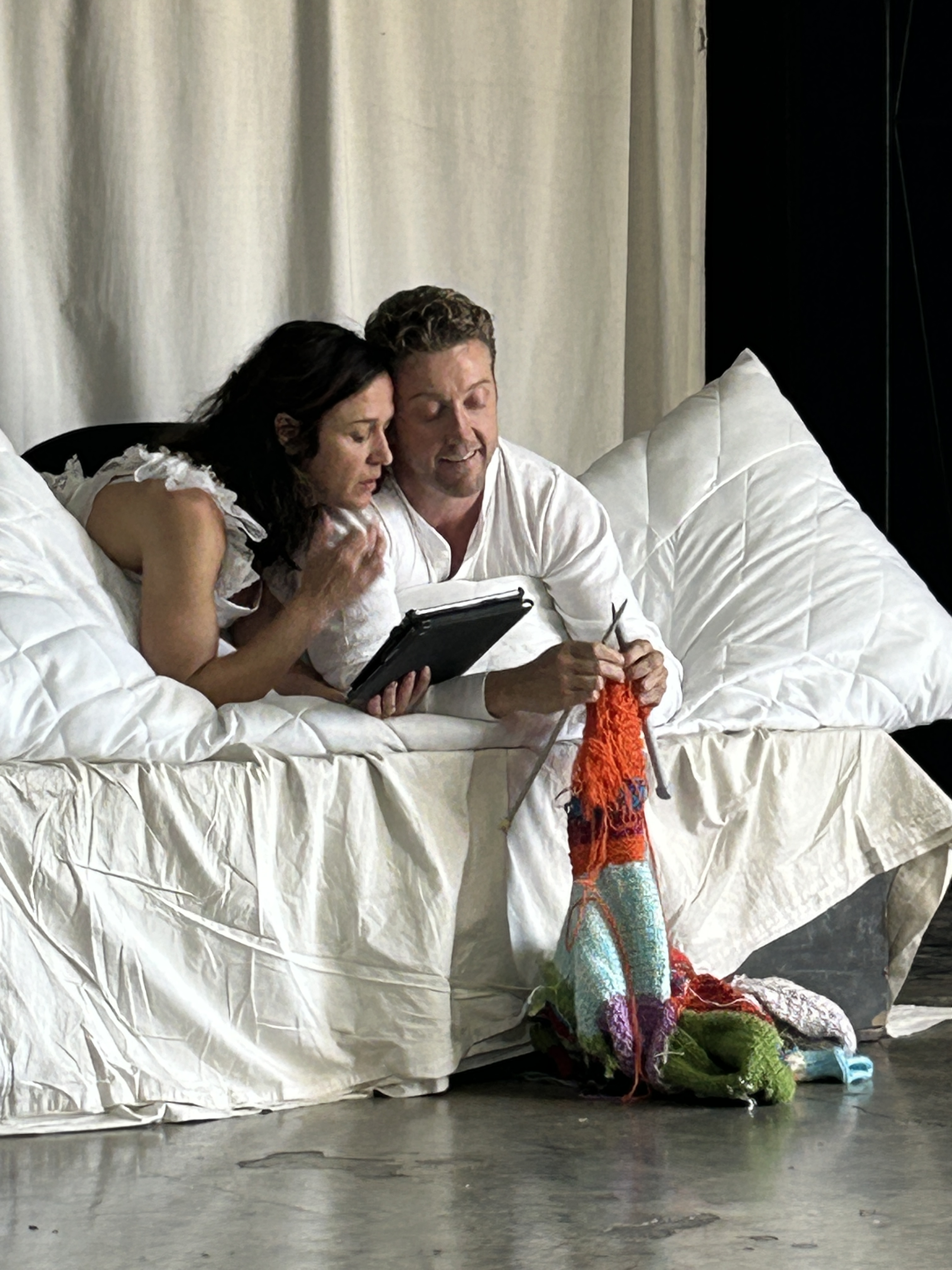
And in this instance where it besets families and the women have no protection, no one to turn to, no positive role models, it’s almost as if they turn on themselves. It’s the only thing of value they have to display and that’s where they go. And to add to the dilemma, they have found a voice in social media where everything is amplified, not always in especially the vicitms’s interest.
Oudtshoorn with its spectacular weather and environment offers the perfect canvas and Hanekom has refined this gloves-off type of approach when dealing with tough topics.
Her cast, always handpicked with great care, tell a story that audiences have to hear, and Hanekom introduces enough darkness and light to hold the attention and make the most explosive impact.
If you don’t leave this one shattered, think again.
And watch out, it might be difficult to play somewhere else because it is site-specific, but when there’s a will, there’s a way. And for this one, that’s how it should be.
Until next year, meanwhile there’s the Karoo Klassique from 4 to 7 August later this year. Also check the next story on the fabulous art.
The Head and the Load is about Africa and Africans in the First World War.
That is to say about all the contradictions and paradoxes of colonialism that were heated and compressed by the circumstances of the war.
It is about historical incomprehension (and inaudibility and invisibility).
The colonial logic towards the black participants could be summed up:
“Lest their actions merit recognition,
Their deeds must not be recorded.”’
The Head and the Load aims to recognise and record.
WILLIAM KENTRIDGE
Pictures supplied
SHOW: The Head and the Load
CONCEPT AND DIRECTOR: William Kentridge
COMPOSER: Phillip Miller
MUSIC DIRECTOR AND CO-COMPOSER: Thuthuka Sibisi
CHOREOGRAPHY: Gregory Maqoma
PROJECTION DESIGN: Catherine Meyburgh
COSTUME DESIGN: Greta Goiris
SET DESIGN: Sabine Theunissen
LIGHTING DESIGN: Urs Schönebaum
And the magnificent cast and musicians – with the African premiere dedicated to the original narrator Mncedisi Shabangu who sadly died last year.
DIANE DE BEER reviews:
And the top introduction by Kentridge gives you a pretty good idea of the load the artist, in many different disciplines, (and when not, he brings in others of his ilk) had in his head.
If you’re the one watching, it might just blow your mind. And if you’re familiar with his work, there’s much you will recognise as he often works with the same artists and combines original music with references to the period and composers of the time as well as texts, movement, shadow play and lighting.
You see a body marching in the distance (they use backstage for the performance because they need that length of space), and just the way he moves already tells you he is a dancer. But not any dancer, one of the best, Gregory Maqoma.
That’s how it runs all through the performers and the musicians. When I hear the brass sounds used in this specific way, it reminds me of the cacophony Emir Kusturica used in his war drama Underground to capture the sounds he associated with war.
And Philip Miller and Thuthuka Sibisi work similarly. They transformed traditional African songs as well as quotations from composers from the time of the war like Ravel, Hindeman, Satie and Schoenberg. It’s varied, as they mimic the different sections of the story, and the way the musicians and the singers use their voices is spectacular.
Just think of wind instruments. They’re used here in the true sense of the word. It’s as if the wind witnesses and blows silently through the space.
But let’s start at the beginning when the show starts. Performers have silently been slipping in and placing themselves inconspicuously in specific spots. And almost in one fell swoop, the giant screen, the lights and the cast come to life.
The audience, in touching distance, are instantly scooped up and almost thrown into the story and the action.
In one spot there’s the most exquisite Vermeer scene with bold Kentridge drawings and sketches, all heightened by the wonderful and magnified shadow play, while individual performers have all, as if magically wound up, started moving. And then the narrator starts with the tale.
Everything is part of the fabric, the texture, the mood and essence of the whole. It’s like a giant storytelling extravaganza yet this has no fairy-tale ending. There’s melancholia and war mania, and there’s the feasting on the foot soldiers as they are put to battle almost deliberately as war fodder. In one of the war reels, the African participants displayed in uniform are barefoot!
Kentridge puts the spotlight on World War One, but this time, he tells and shows it all. This he wants to record. And in full Kentridge splendour, he unravels and reveals everything he wants you to know. With this grand theatrical flourish he imprints the pictures and performances in your mind.
Having waited for Covid restrictions to be lifted to see the production, it has become even more relevant with first the Russian invasion of Ukraine and now also the frightening war in Sudan.
It’s impossible to take all the individual flourishes in and yet, it is an immersive theatrical experience which will linger and almost lay you low. But then the sense of wonder, the way of revealing the relentless horror and the sheer scale of the endeavour, are what keep swirling in your head.
Gauteng is blessed to have Kentridge in its midst and to witness this astounding theatrical avalanche so brilliantly composed and performed, which is – sadly – as relevant today as it was in 1918.
It is the playfulness, the sense of joy in artist Marinda du Toit’s work that first captures the imagination. But there’s much more than just laughter involved in what she describes as sculptures. They’re unusual, have a life of their own and if you listen carefully, they will tell you a story. DIANE DE BEER takes a closer look:
A colourful bunch
I lost my heart to Marinda du Toit’s sculptures the first time I saw them. She started three- dimensional work 17 years ago and I have always known her work would evolve.
There have been small changes along the way, and my most recent addition was a big one, an installation of a kind which features in my kitchen and brings me great joy.
Since she moved to the Cape a few years back with Covid thrown in-between, she has been missing from our galleries for some time. But she’s back with So gemaak en so gelaat staan (loosely translated as Was made like this, so stays like this) at the Association of Arts, Pretoria from tomorrow (Saturday, April 22) until May 6.
She describes the latest work as a stripped figure which can still read as a character, but it becomes a tree or a branch which is still in the process of growth.
“In 2019 I had an exhibition of heads and dolls (Poppe en Koppe). In my studio, I have a cupboard with drawers and in the one drawer, I keep the heads of dolls. I rarely use these heads, because there’s such a clichéd meaning to it with the Chucky dolls and the Walt Disney movies, but I kept them nevertheless.”
And she had a lot of sticks outside, because she is constantly making fences, working with sticks or harvesting sticks in Simonsberg amongst the alien growth. So she had a lot of sticks in stock.
She wanted something different (“go a little bit mad”, she says), so she put a lot of heads on sticks. “Some people thought it was extremely weird and some people loved it.”
Managing the process
And personally, she started falling in love with the stripped figure and the stick in hand that becomes something else; a weapon, a symbol, a crutch or anything you want to imagine. “We use sticks all our life, daily – think of brooms,” she explains.
So she started exploring the stick stories.
The magic of Marinda du Toit’s work (Artistic Photography)
She had to develop a way of presenting them neatly, standing upright, but how to assemble them, how to transport them, all became part of the puzzle. After many tries with cement and other methods, she developed the Escher-like leaf base, which also represents growth, or mulch and getting rid of aliens, and leaving it in the ground for new growth, “all these different metaphors,” she says.
“I can’t actually say what these sculptures mean, I just love them. I think it’s an ode to old toys, the era of plastic that’s gone, but we sit with it now, so let’s play. It’s playful, it’s a parade, a performance dance and celebration. It’s simply play, play, play!
Marinda wearing her heart on her sleeve (Picture: Artistic Photography)
“I just want to have fun and joy, there’s so much trouble and sadness.”
The new work differs from her previous, mostly individual pieces in that the pieces are stripped with no arms and legs, no recognisable figure, and she views it as much more of an installation than before, as well as more abstract.
The use of multiple colours is new and vibrant and personally I feel it has a stronger fairy-tale quality than before. It draws you into a narrative with storytelling becoming an active invitation.
She explains her desire to be joyous. “It happened within myself after recovering from cancer, many issues followed by therapy, troubles, a rocky road and healing. Then came Covid and no money.”
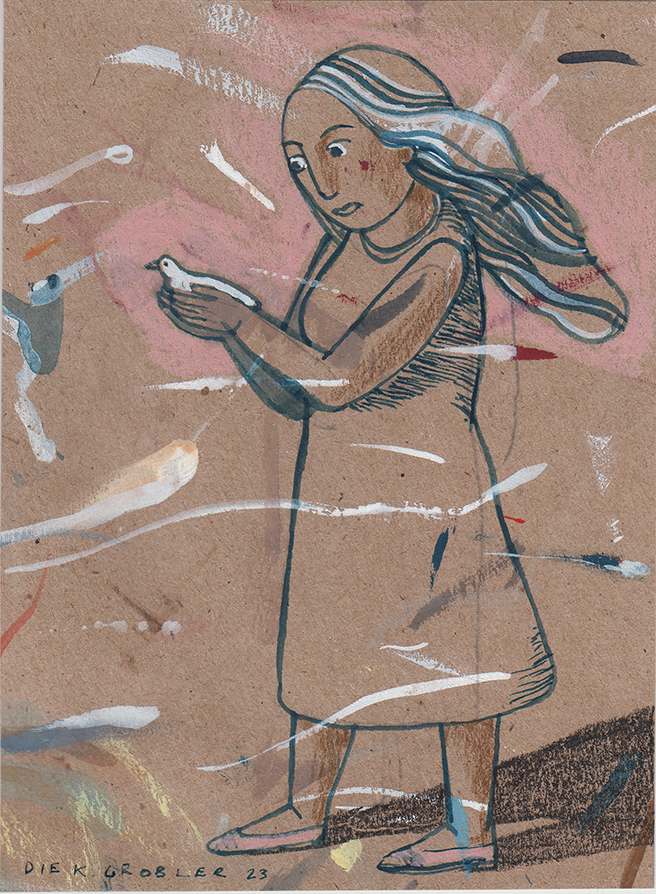
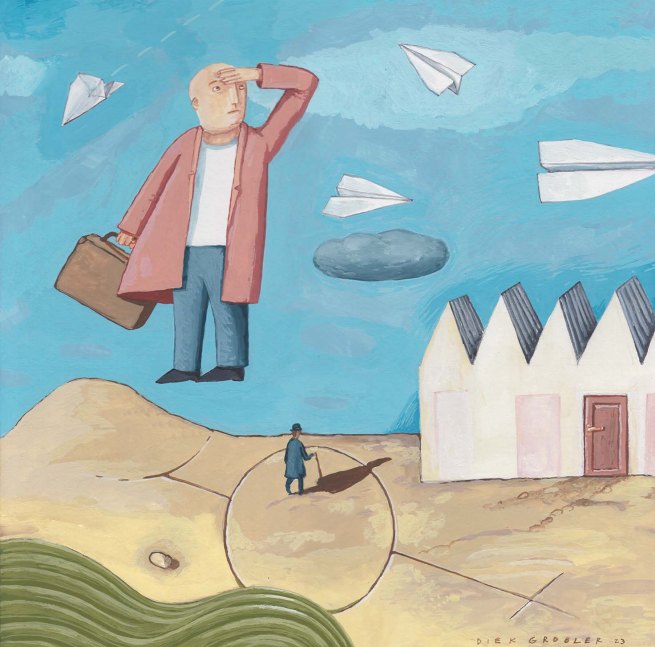
The pandemic was a major turning point for her. She and fellow artist Diek Grobler commented on the first 100 days of lockdown with postcards and multimedia, which was fun and gave them a voice. They found a way to engage the support of people who still buy and love art. And, she feels their success also followed because what they did was accessible and affordable.
Those first 100 postcards saved her life. “I then used all my savings, did one or two commissions, had fantastic clients who took care of me, and that was when all the paraphernalia and the fluff got stripped from my work.”
She discovered the essence of living and the essence of her art, which was how it manifested in the new work.
“It was all about being simplistic, being honest, being playful, being stripped, being real.”
She was also bored with the “poppe” which she felt she was almost turning into a mass-producing exercise and she became dissatisfied with the quality of her work. She felt driven by her monthly budget, what she needed to sell rather than inspiration. “Then you become flat, there’s no meaning, you’re just a machine.” It’s something I think every artist has to battle, with Covid heightening that kind of hysteria.
Pocket-sized poppets. (Artistic Photography)
Her response was to challenge herself with other projects and proposals and her work again started growing and evolving, but it was a difficult time.
Now she’s lost her heart and she can’t wait to show the new work. “It creates a challenge to look differently at objects and find new meaning in objects I selected or adapted,” she notes.
What she did was change the application rather than the object, which means she had to find meaningful objects.
And voilà!
It’s not as if fans of her work will not recognise and find some familiar figures at the exhibition. They can still construct and put together their own stories as they gather the Du Toit characters in a way that makes sense individually.