FOR THE LOVE OF BOOKS, READING AND AUTHORS

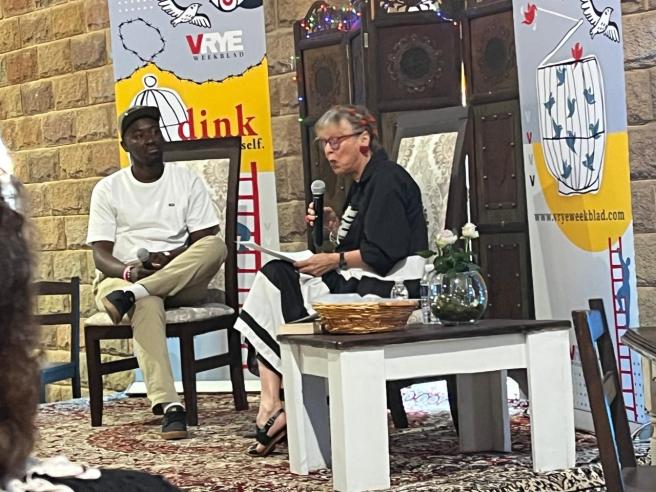
With Vrye Weekblad and journalist Deborah Steinmair establishing new book festivals in the wake of their success in Stilbaai, followed by the first one in Gauteng in Cullinan earlier this year and most recently in Clarens in the Free State, DIANE DE BEER, invited as an interviewer at the last two, gives her impressions of book festivals in general as VWB announce their next Cullinan festival from 10 to 12 May 2024::

Pictures: Deborah Steinmair

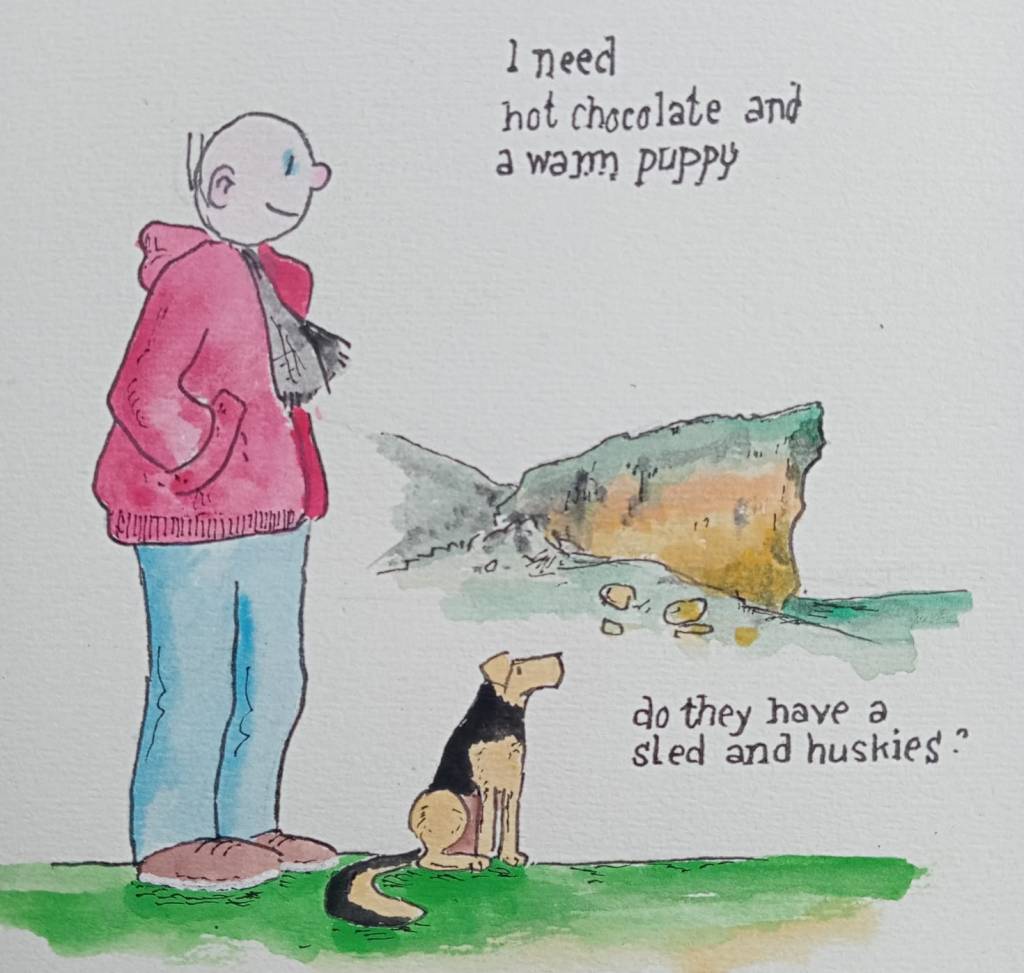
A man and his dog cartoons by Dries de Beer (Fatman).

Getting together a crowd of book lovers is no easy thing in these days of social media and streaming  –  there’s just too much on offer  – but if you choose your specific book festival well, take the time and spend the money, it is a glorious get-away where you get to mingle and meet like-minded people and listen to a handful of authors talking about their latest work.

While my preferences won’t sound objective, as I was invited to participate as an interviewer at the last two festivals, what appealed to my sensibility was the curation of the festivals.

First off, smart of the powers-that-be at Vrye Weekblad to know that Deborah, someone with a fantastic knowledge of books, an author herself, and a brilliant columnist, also has a deliciously quirky sensibility which then becomes part of the programme.

If you’re having a festival in the Free State, Antjie Krog is a name that would be impossible to ignore. But then to ask her to read from her latest delightful Vetplant Feëtjies (Vetplant Fairies), creatively written and illustrated, together with some poetry from her latest collection Plunder (also translated and published as Pillage) was genius.

It’s obvious why she won the Herzog Prize for poetry twice, most recently in 2017.

Just selecting at random:

It no longer comes to me

Everything is iron    everything has congealed

I read how others write:

Clove brown, Prussia blue, and creamy, creamy your neck

Your long, long, long legs fill me with fury

But to me?

To me it simply no longer comes

once I belonged to the ones on fire

now my voice wants to drift

it trembles repulsively clammy with care and forgiveness

For me, personally, she should never stop, with a mind that’s razor-sharp, older yes, but that also makes it even more wise and witty. What does she have in mind next?

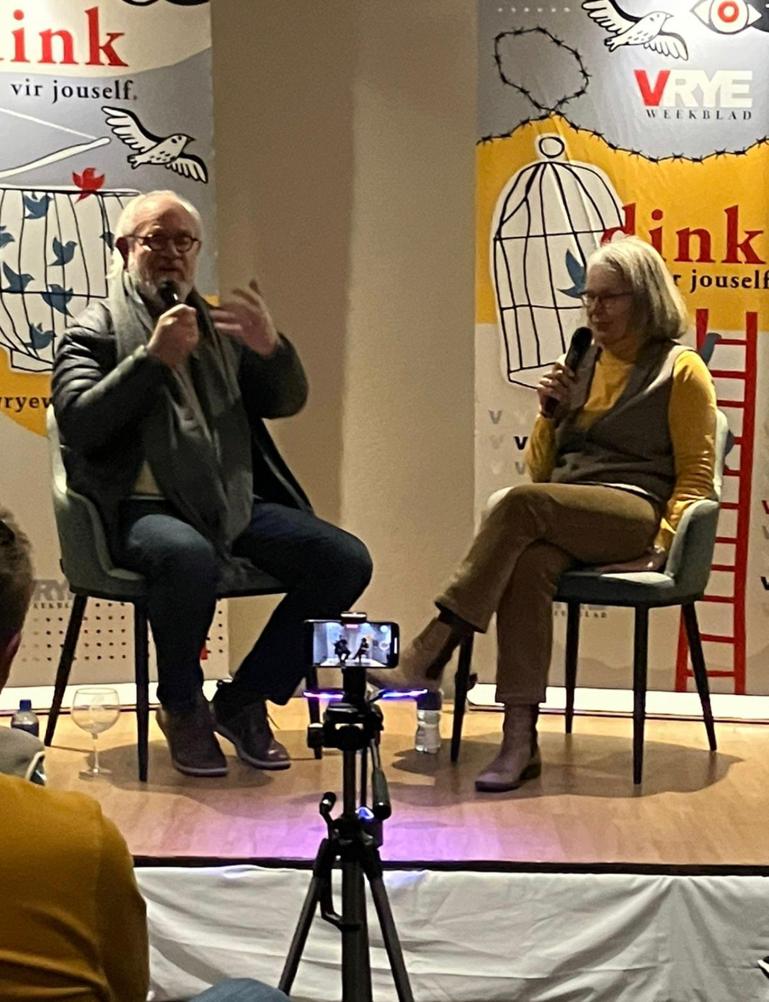
And, cleverly, Deborah knew how to pair two wise journalists. It was a great idea to get two Free State born journalists/writers Max du Preez and Antjie Krog talking and reminiscing.

Max du Preez and Antjie Krog in conversation.

Both grew up in Kroonstad and Antjie spent more of her time there, while Max talks about missing this part of the world, while also celebrating his home city of Cape Town, where he says everything works.

And then he launches into a few famous authors who have left the country, some, he says, with a Nobel Prize under the arm …

And Antjie wonders about living in a country where no one knows who Gerrit Maritz is.

Max, who had passed through Winburg on his way to Clarens, wishes to become the champion of this neglected town.

But Cyril, they say, has said that the people shouldn’t be treated like charity cases. Everyone has something to give. Yet Max laments the process of Africa that is slowly engulfing the town, even if not quite done yet.

Antjie suggests that if you want to change or fix a problem, you have to bring the township with you. But Max questions how to criticise this country while contemplating the damage you might have caused. Even if you joined the struggle. You still have the privilege of whiteness which is something everyone needs to acknowledge.

As is obvious, it was a conversation between two people who know one another, who have similar backgrounds so that they can exchange thoughts and grievances without too much explanation.

And they progress…

“Wonderful things are happening in Afrikaans,” says Antje while sympathising with the Indigenous languages that suffered under apartheid.

We all have to acknowledge that we had more of everything: more Afrikaans radio stations and TV stations, more magazines and newspapers than any of the other languages. Now we have to do it for ourselves.

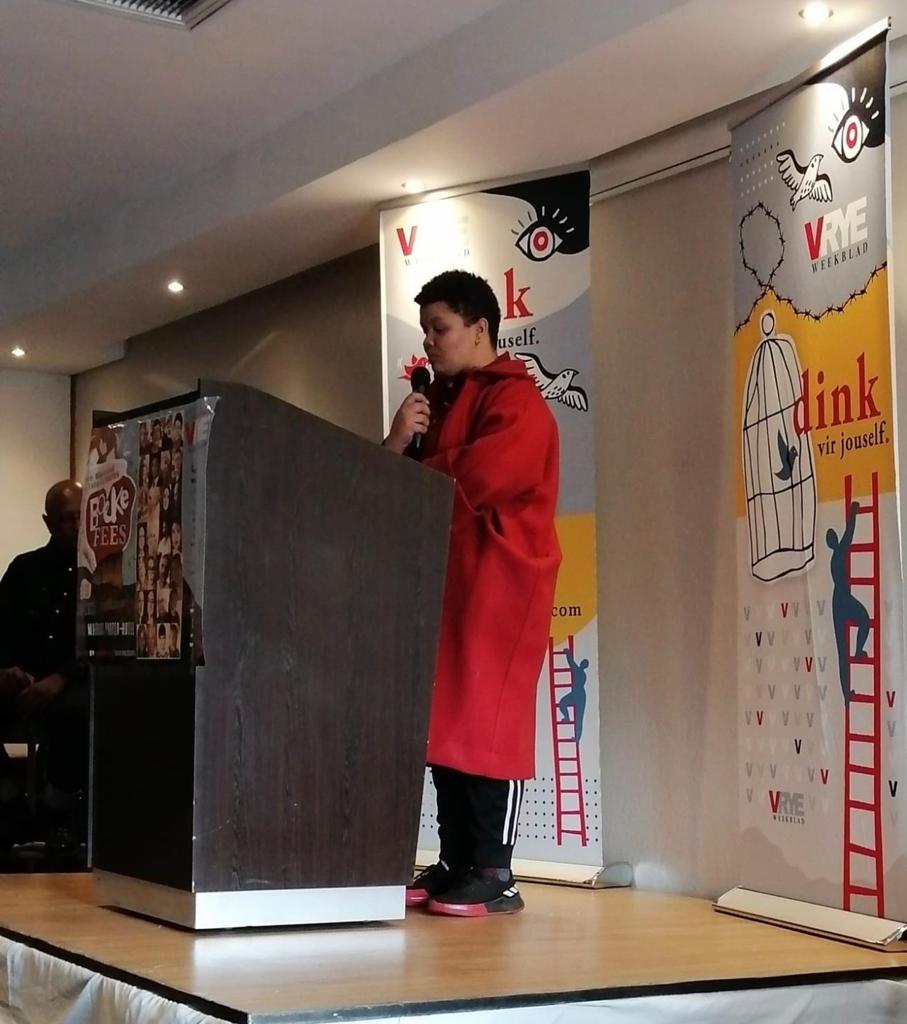
And it is happening with Vrye Weekblad and these kinds of book festivals. And again Deborah’s special touch emerges as she includes young poets and authors like Joylyn Philips, who launches into song when starting her poetry presentation.

Bibi SlIppers

Or the bright-eyed Bibi Slippers who cunningly whets the appetite with readings from her then soon-to-be-published poetry book, which was recently launched.

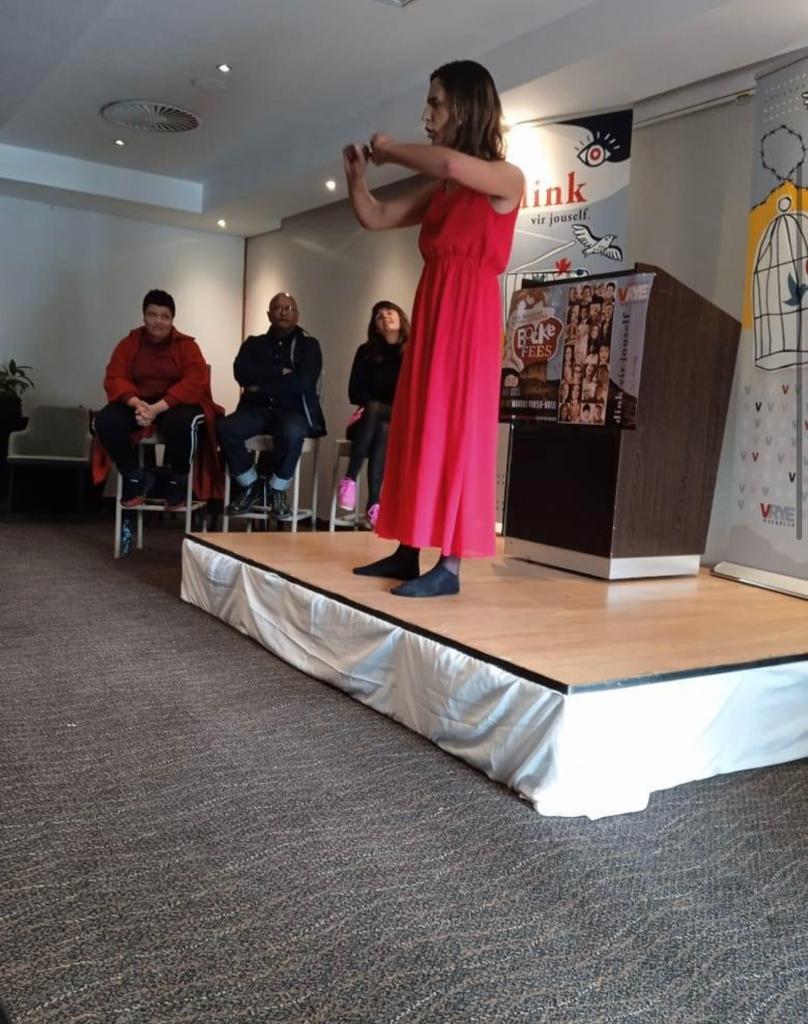
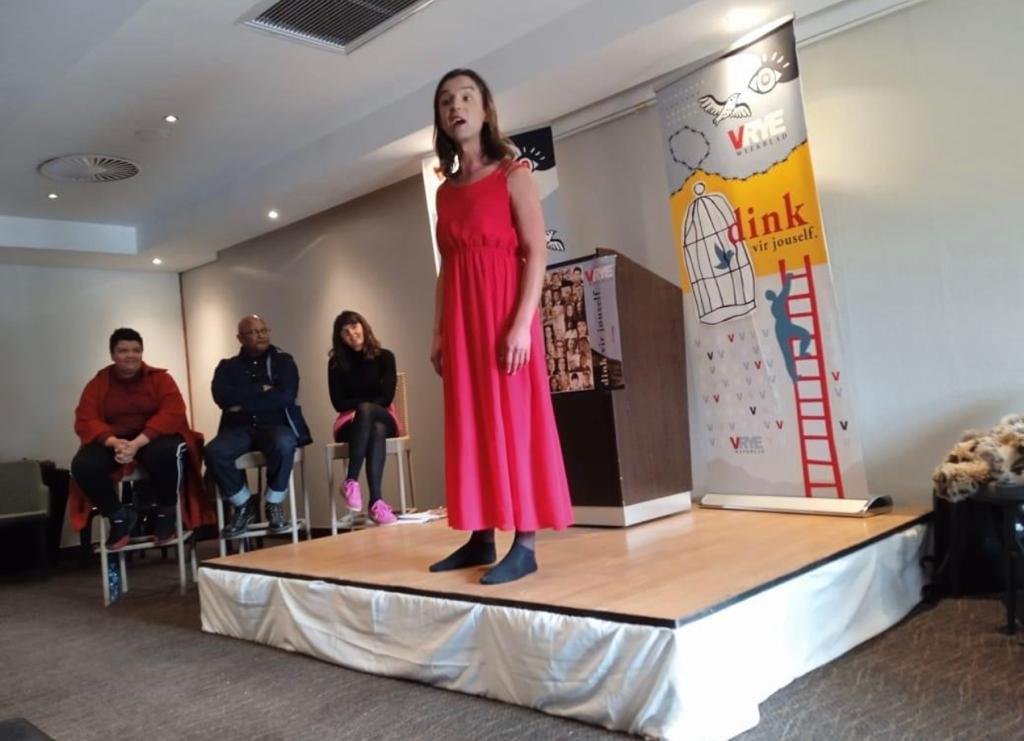
Yet, no one can rattle the rafters like the gloriously fragile Dianne Du Toit Albertze or, as they would say, Lady D. It was joyous to see them perform almost randomly dressed to kill in a shattering red dress which immediately screamed attitude, and then to back it all up with the talent of someone who knows they can take a stage while speaking in tongues … and they do.

This fresh breath of youthful exuberance during the gathering of the poets as the final salute of the weekend, captured it all. The dazzle and dare of Deborah is what makes you an ardent fan of her outspoken columns, all of which you wish you had said. And she brings that same flair and fanciful fanfare to a book festival  –  which is why these Vrye Weekblad festivals are worth watching out for. And a grand addition to the Afrikaans literary scene.

Yes, I know it’s mostly in Afrikaans, but Deborah knows about diversity even when limited most of the time, to a specific audience.  

So get booking on Quicket for the next one, you won’t be disappointed and it’s in driving distance from Pretoria and Joburg!        

Last year’s festival at the stone church in Cullinan.

PROGRAMME: The Vrye Weekblad-CULLINAN-BOOK FESTIVAL 10 – 12 May 2024

Will be held @Church venue. Books to be sold by Graffiti on the premises, food and drink will be on sale. Book at Quicket.

Queries: deborah.steinmair@gmail.com

Friday 10 May:

17:30: En tog die deuntjie draal (and still the music plays): Gielie Hoffmann chats on the birthday of singer/songwriter/poet Koos du Plessis with his wife, Mornay, about Erfdeel. His songs are also performed.

Saterday:

08:30: Skarminkels en speurders (Rogues and detectives): Phyllis Green speaks to Sidney Girlroy, Marie Lotz and Irna van Zyl.

09:30: Van rekenaarskerm na silwerskerm (From the computer screen to the movie screen : Mercy Kannemeyer chats to Zelda Bezuidenhout and Henriëtta Greyffenberg about the filming of Die dekonstruksie van Retta Blom.

10:30 The Near North: Louis Gaigher chats to Ivan Vladisivic about his latest book.

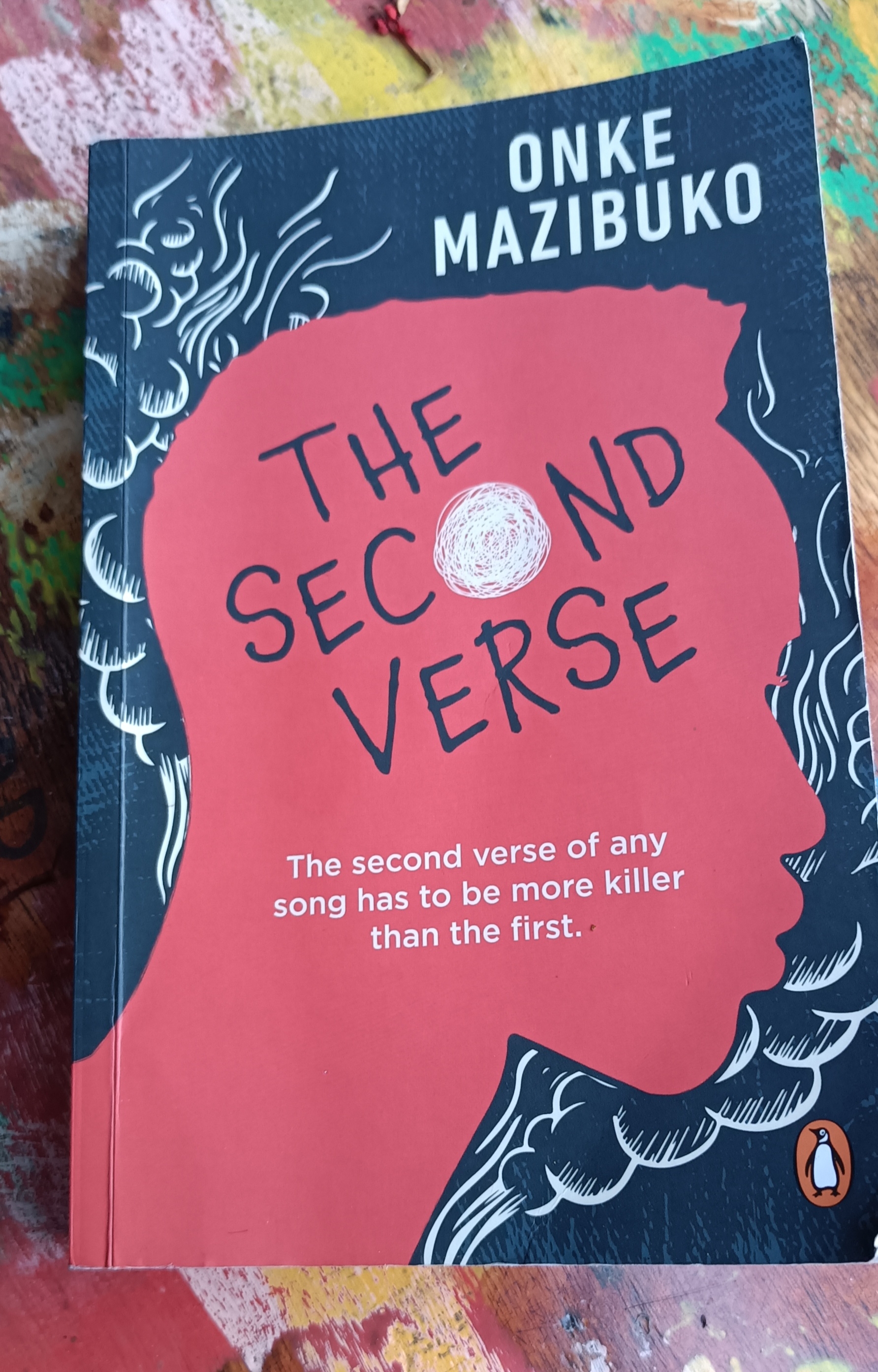
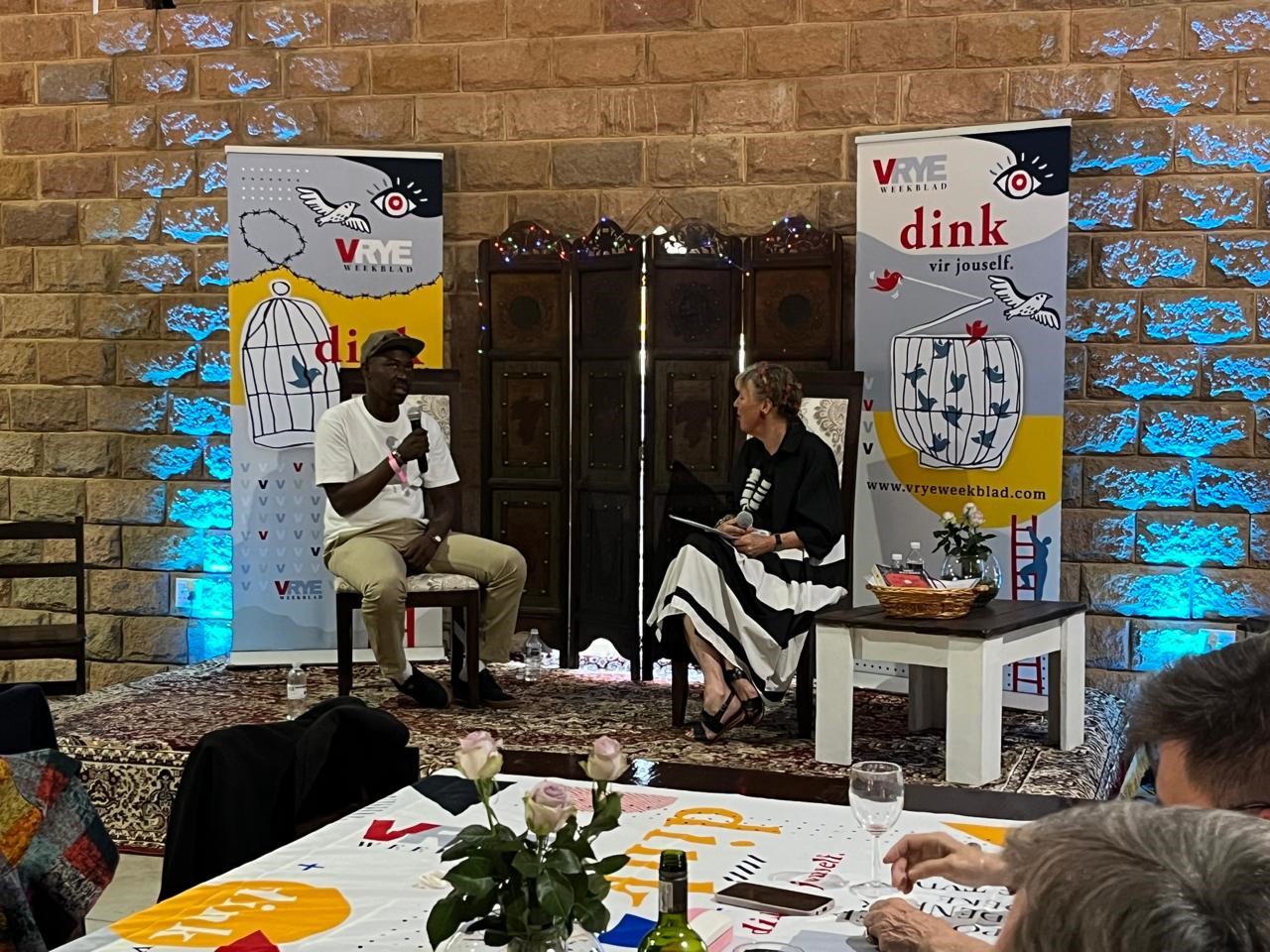
11:30: O, die vrolike, O die SALA! (Oh the happiness, oh the Salvation) Diane de Beer in conversation with Onke Mazibuko about his celebrated YA novel, The Second Verse.

12:30 Lunch

14:00: Vaders wat haper (Fathers who stutter): Jean Meiring chats to S.J. Naudé about Van vaders en vlugtelinge

15:00: Vywervrou woeker: (Pond woman works): Ilse Salzwedel chats to Chanette Paul about her character driven series.

16:00: Zonderwater en ver van die huis: (Zonderwater and far from home): Deborah Steinmair talks to Karen Horn about her novel about Italian prisoners of war: Prisoners of Jan Smuts

17:00: Psigopatiese nasie: (Psychopathic nation): Anneliese Burgess speaks to Karl Kemp about his book Why We Kill.

18:00: Kopstukke (Think pieces): A sizzling political debate about the election and other topics of the day with Piet Croucamp and JP Landman.

Sunday

10:00: Boekevat: (Devotions): Kleinboer, Lucinda Neethling and Pieter Odendaal read and sing their poetry in the beautiful stone church.

TWO DIFFERENT FILMS, “POOR THINGS” AND “THE ZONE OF INTEREST” ARE BOTH IN LINE FOR OSCARS

For film fanatics, this is the time to catch up with the Oscar-nominated films with the winners to be announced on March 10. It will add some extra fun to the whole movie experience. DIANE DE BEER opted for Poor Things andThe Zone of Interest from the current crop on the Ster Kinekor circuit and, apart from excellence and originality, the appeal was that the two films could not be more different.

Let’s first have a look at their Oscar nominations: both for Best Picture; Emma Stone from Poor Things for Best Actress; Mark Ruffalo from Poor Things for Best Supporting Actor; Best Adapted Screenplay for both Poor Things and The Zone of Interest; Best Production Design for Poor Things; Best International Film for The Zone of Interest; Best Editing for Poor Things; Best Cinematography for Poor Things; Best Costume Design for Poor Things; Best Makeup and Hairstyling for Poor Things; Best Sound for The Zone of Interest; Best Original Score for Poor Things.

And these are a strong indication of the kind of movies we’re dealing with. Let’s start with the fun, energy and exuberance of Poor Things. Emma Stone and director Yorgos Lanthimos are forming a powerful partnership following their first encounter The Favourite and it is as if this second creative endeavour was given permission by the success of the first to go all out – and they do.

Apart from the obvious deliciousness of the story depicting steam-punk retelling of a female Frankenstein, its also the landscape that Lanthimos picks and paints in which to tell the story.

With the emergence of our weird and wild scientist Dr Godwin Baxter’s (Willem Defoe) Bella (Stone), colour plays an important emotional role. As she grows into what she believes her role to be, everything becomes brighter and more visible and there’s also a quality of wonderment that runs from start to finish – both for the characters and for the audience.

Much of that can be attributed to Stone and her director, who have obviously taken the plunge and permitted themselves to tell the story that’s important to their minds – a woman with a mind of her own unfettered by the rules and morals of a society (read: men) that knows it knows best. In their world (and still today), they decide about a woman’s mind and body and the way she has to live.

From Stone’s elaborate wardrobe, her acting mobility and scope, the language in which they depict this adult fable-lesque adventure, the almost romp- and rakish elements enhanced by the beautifully bizarre yet unusual performance from the usually more affable and straight-down-the-middle Mark Ruffalo, all of these take you along on this madcap Alice-in-Wonderland – but a much more specifically driven – trip.

As the title suggests, Stone as Bella is the one in command and the one driving the process of her emancipation. In fact, she isn’t even aware she needs guidance or permission for anything in her life. She is prompted by her senses, her joy in experiencing life without any guardrails and completely unaware of the fact that the men who enter her sphere expect compliance and a dogged determination to adhere to their every command.

There’s so much more going on, but this is a film that should overwhelm, be allowed to enter your imagination and take you on their flight of fantasy. Enjoy – and then meditate on the radical directions they explore: a woman with a mind of her own!

And then for something completely different. Think World War 2, the Holocaust and the many stories told from every which way to explore the nightmarish horrors of that time. The Zone of Interest adapted from a Martin Amis novel by the same name, had to give us something new, something different to have any impact with one of the most gruesome acts in recent memory and one familiar to most of the world.

How to put the viewer into that space of horror in a different way? That was director/writer Jonathan Glazer’s task and mission. And the word that grips you from start to finish is chilling.

Glazer understood that he could tell the story without showing the victims which has been the focus of so many magnificent depictions previously. There’s Schindler’s List and The Pianist, to mention the obvious.

Rudolf Höss (Christian Friedel) is the commandant of the Auschwitz concentration camp. With his wife Hedwig (Anatomy of a Fall’s Sandra Hüller) and their houseful of children, they are living the ideal family life in what is sketched vividly as a bucolic idyll.

Yet looming in the background of their comfortable home is the camp. The smoke never stops rising, soldiers are spotted on occasion, the mistress of the house reprimands one of the staff with a warning of what her husband could do with her ashes, and Rudolf leaves every morning for work in his smartly pressed Nazi uniform on top of a magnificent steed.

This carefully choreographed, painfully pristine world of the Höss family does not miss the tiniest detail to deny the horrors that lie just beyond their perfectly  crafted  home life. Denial is a powerful tool that is deftly applied in many situations to deal with something happening to everyone’s knowledge, yet, by turning their heads, the all-powerful reality is completely dismissed and ignored.

Thát is chilling. How often in these scary situations do we hear that explanatory phrase: we didn’t know? That is why this film knocks you sideways while watching, impacts brutally and then lingers.

Hüller, arguably Europe’s hottest actress of the moment, apparently didn’t want to participate in this film. She’s magnificent and I’m thrilled she did. But it is easy to see why you wouldn’t want to immerse yourself in that dark period of Germany’s life. These kind of suppressions, oppressions and killings constantly repeat themselves across the world in many different yet no less intolerable fashions. Look at our current situation in the world. That’s why this is such an important and impactful cinematic experience. It’s smart in the way it tells a story of the past with what is happening in our world today, as cleverly injected as the camp was in the lives of the determinedly optimistic Nazi family.

LAST CHANCE TO FLY TO PANTOLAND WITH HONEYMAN AND HER FABULOUS PLAYERS

By Diane de Beer

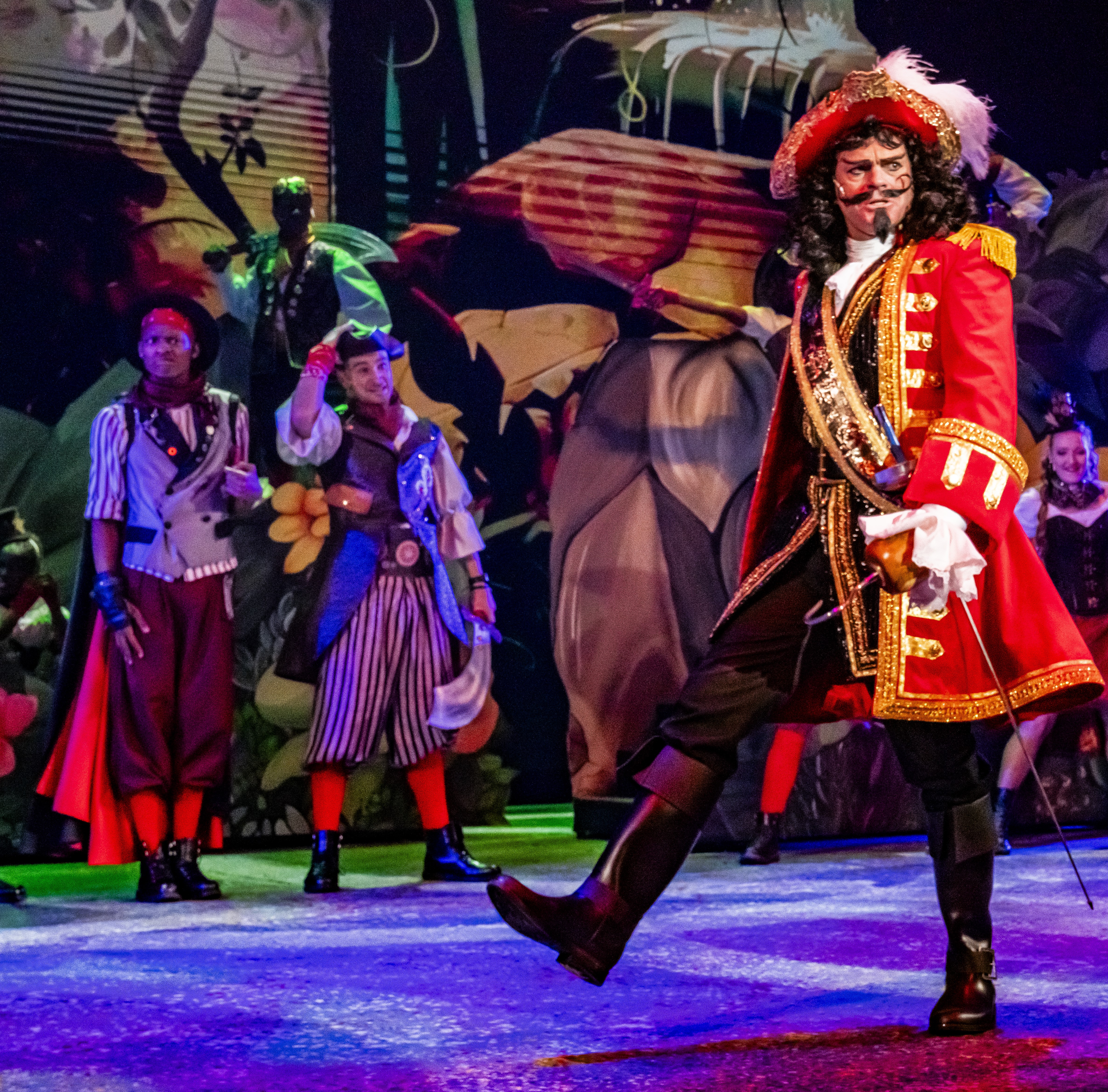
Janice Honeyman’s Peter Pan at Joburg Theatre’s Nelson Mandela Theatre

Cast: Richard Richard (Smelly Smee), Ben Voss (Mr Darling and Captain Hook), Kensiwe Tshabalala (Mrs Darling), Kiruna-Lind Devar (Wendy), Matthew Berry (John), Diego Hamity (Michael), David Arnold Johnson (Clementina Coconut), Manyano Ngoma (the dog, Nana), Virtuous KIandemiri (Thokolina Tinkerbell), Sandi Dlangalala (Peter Pan), Lesedi Rich (Sam Spaginyol), Gareth Meijsen (Seb Scumdawg), Dirk Joubert (Sparkey), Gugu Dhlamini (Curley), Sarah Leigh (Nibs), Brian Ngobese (Tootles), Bo Molefe (Slightly) and Tania Mteto (Princess Lotus Lily) and the ensemble

Associate Director: Timothy le Roux

Production Designer: Andrew Timm

Lighting Director: Johan Ferreira

Sound Designer: Akhona Bozo

Choreographer: Khaya Ndlovu

Costume Designer and Co-ordinator: Mariska Meyer

Dates: Until December 24 (so get going!)

If you have seen as many pantomimes as I have, you need some incentive (especially when you’re no longer the target market).

For me there were two big ones; Janice Honeyman and my two favourite little ones. Just the fact that I can still stomach a pantomime has everything to do with someone who is completely ruled by her inner child when writing and staging the annual panto.

Not only does she know how to negotiate an audience of young and older children but she also shares her panto story with loads of fun clues for those with many more years on the planet to keep their minds spinning once they’ve seen enough of all the silliness and have had enough festive cheer.

She has also found a compromise with the LED screens and all the bells and whistles they add to this production, while holding on to some of the more old-fashioned sets and designs, which breathe life into the rapidly developing technology.

It’s a miracle just to watch her each year as she finds ways to build novel glitz into the show. She has established her nimble dance to deliver the goods – and that she does with sparkle – time and time again. Small wonder they can’t let her go as she just keeps pushing those stakes higher and higher each time.

This is probably somewhere in the region of my 30th Honeyman panto production and the fact that I can keep going and writing willingly, says everything.

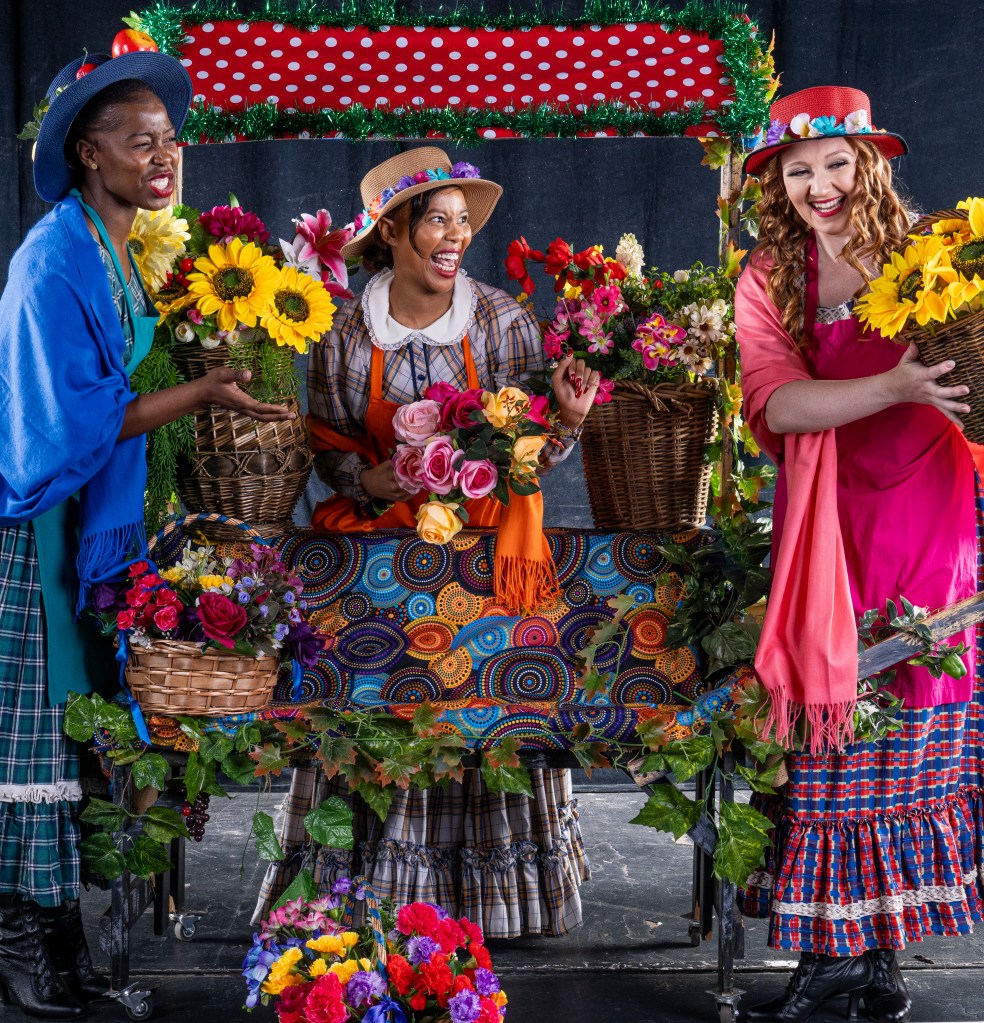
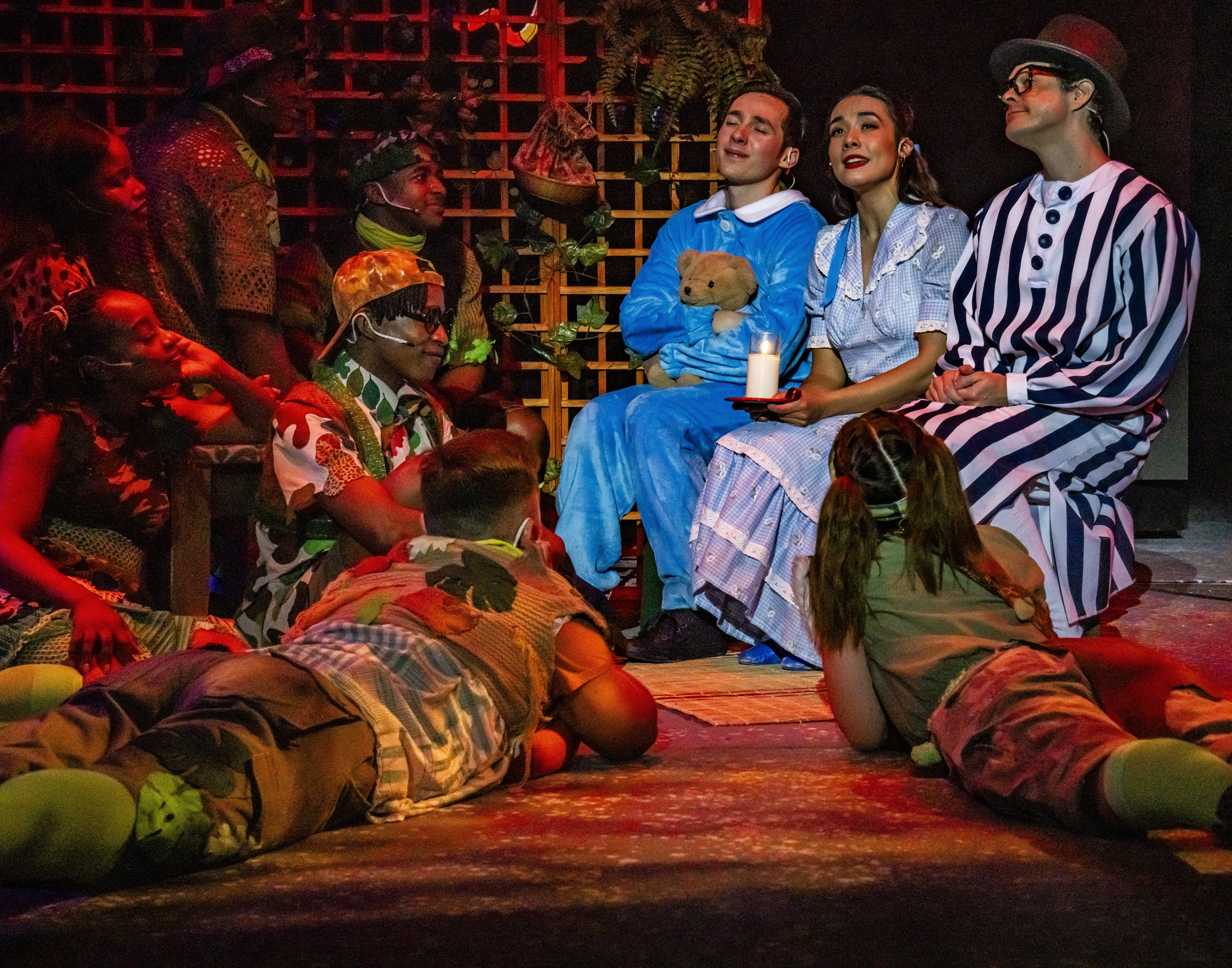
This time it’s Peter Pan and one of the delights which has been been happening for a few decades is the transformation of the South African stage. I know some might ask whether we still have to touch on these colour issues, but it is especially the popular shows that had to get it right and had the most impact. Of course Ms Honeyman did just that. And it easily gets better every year.

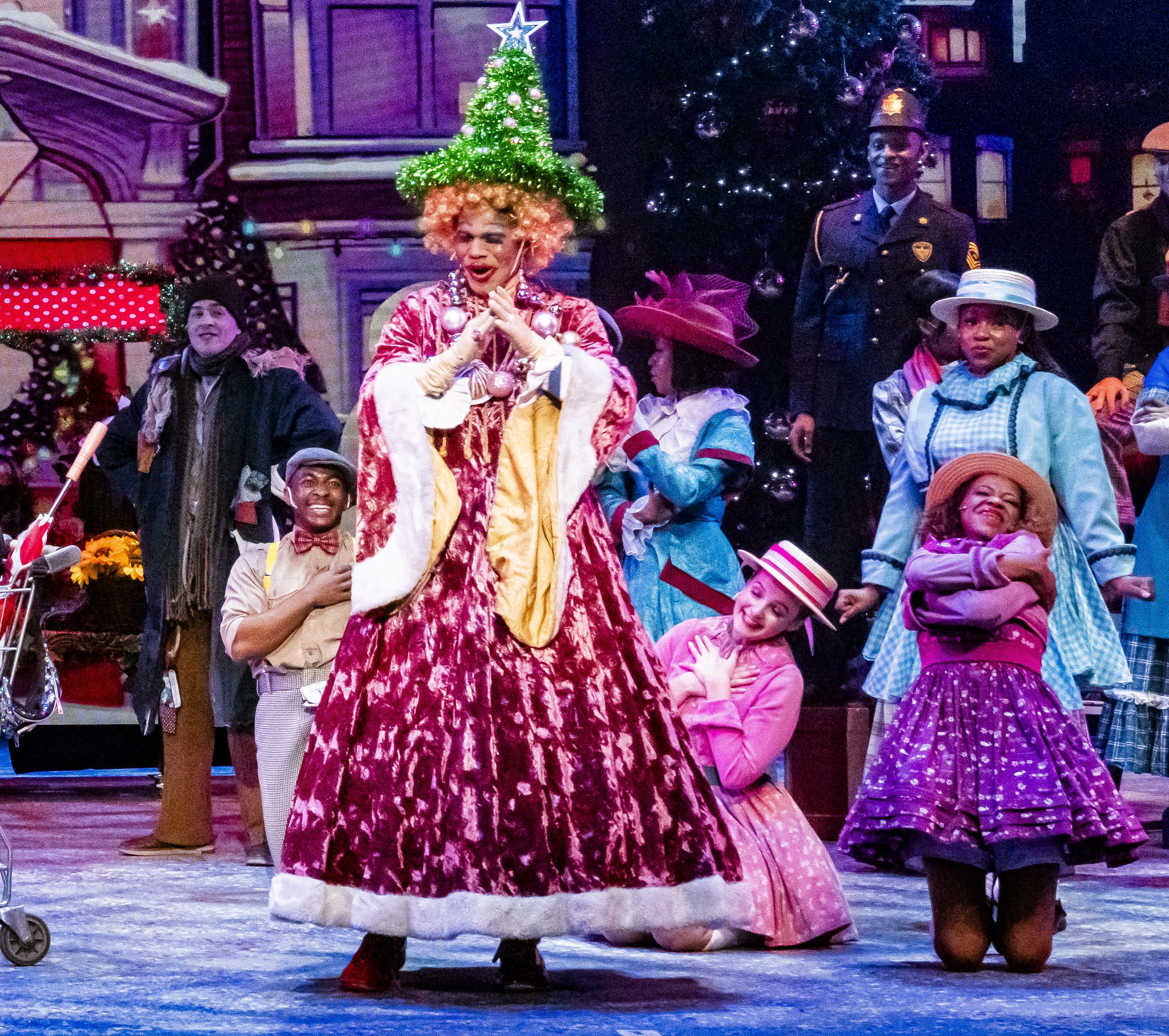
                     David Johnson as Clementine Coconut.

She has created many stars and again, a few are stepping out smartly to show their stuff. I have to confess, I have always been a David Johnson fan. Perhaps he’s not the obvious choice for the panto dame, but that’s another of Janice’s tricks up her sleeve. She doesn’t opt for the obvious and then she delivers another bit of magic by getting a performance that’s different, yet works. Clementine Coconut could have some fun with her costumes which already delivered the goods and to boot, Johnson added some swish and style to his panto tart.

                    Ben Voss as Captain Hook

Ben Voss, another panto and Honeyman regular, did double duty and delivered a devilishly evil Captain Hook with a smart swagger and punch, which might have scared some and tickled others, and then quietly slipped into the shoes of the more demure Mr Darling.

         Virtuous Klandemiri as Thokolina Tinkerbell with Sandi Dlangalala as Peter Pan.

If you have a very traditional view of what and who Thokolina Tinkerbell should be, Honeyman flipped that applecart as well and gave us the sparkly Virtuous (could there be a more apt name!) Klandemiri as well as the light-on-his-feet Sandi Dlangalala who starred and shone as as Peter Pan in this debut performance.

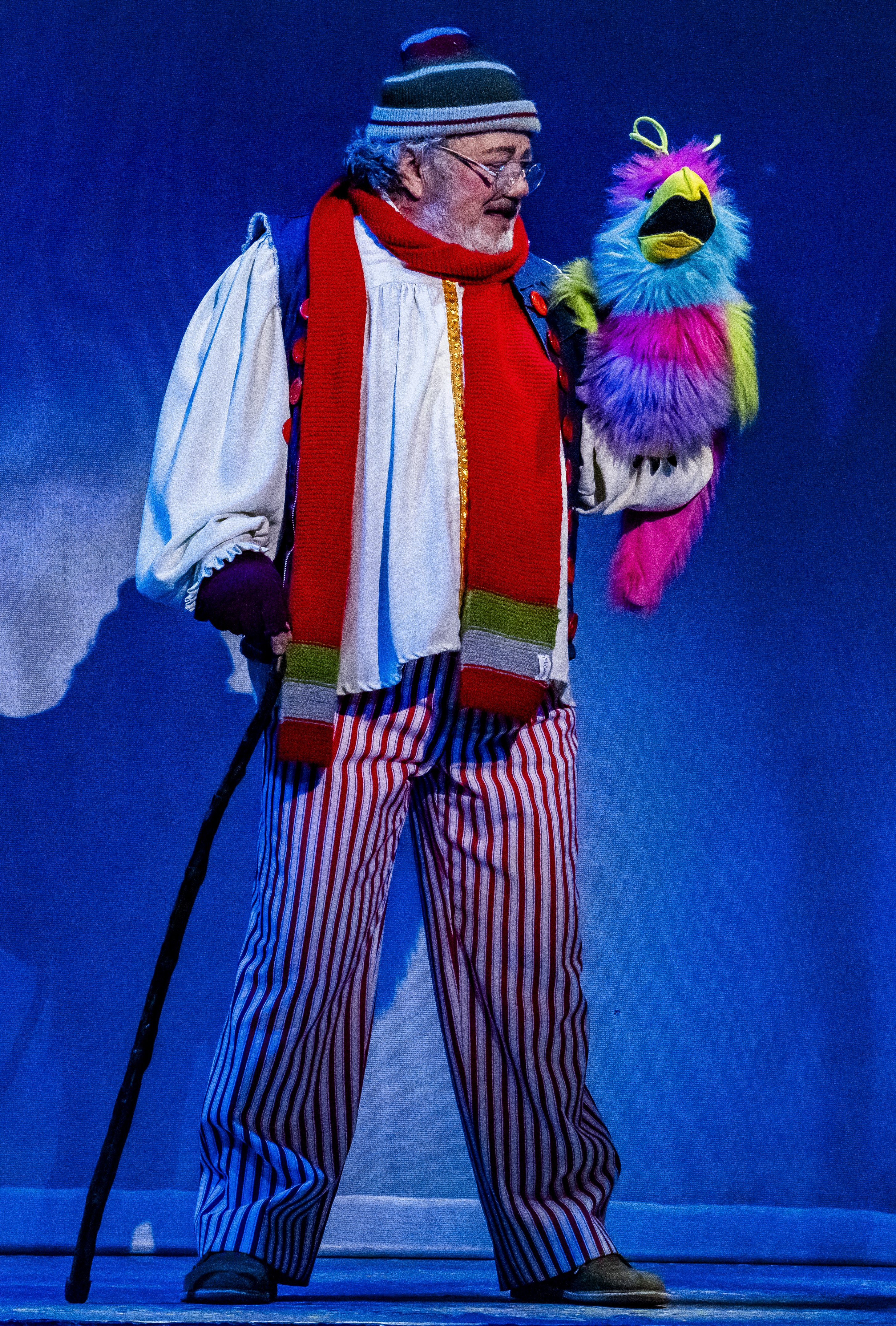
                  Michael Richard as Smelly Smee.

Michael Richard added a performance with flair and wisdom enhanced by decades of experience as Smelly Smee and the youngsters in the cast kept the energy up and the artistry pumping.

It’s a gran show. This time we sat on the balcony and it was fascinating to get this different yet complete view. I know many people regard the lower level as the better seats. My small companions had seen last year’s panto from the front row.

                          The full splendour.

But in the end, the balcony offers a complete appreciation of the Honeyman approach. It allows you to focus on the whole rather than individual performances for example but also accentuates the detail that comes together in the design. It’s easy to understand why Honeyman draws you in time and again.

AUTHOR JUSTIN FOX IS A NOMAD WHO CONCEDES THE TRAVELING BUG IS WHAT DRIVES HIM IN LIFE

Author Justin Fox, as DIANE DE BEER discovers when speaking to him about his latest book, Place South African Literary Journey (published by UMUZI) at Garsfontein’s Boekeplek & Kuierplek, has a mind as restless as his wanderlust:

The cover is a painting by Erik Laubscher titled Overberg Landscape.

When you are sent a book and asked by a publisher to help with the launch in your city, your first instinct, especially if you don’t know the author, which I didn’t in this instance, is to hope that you won’t hate the writing or the book for that matter.

Up to now, I have been blessed and again, Justin Fox’s Place is one that I thoroughly enjoyed. I loved the writing, found it a wonderfully original concept and the reading very accessible.

What this author did was to select nine authors whose writing he found to be determined by a specific landscape or place, capturing the spirit, hence the name and the idea. Think, for example, of  someone like Herman Charles Bosman and your mind automatically reaches for the Marico or Dalene Matthee’s passionate love affair so inextricably linked with the Knysna forest.

Zakes Mda with his Heart of Redness is nestled on the Wild Coast, JM Coetzee has Michael K traveling and hiding in the Moordenaars Karoo and Olive Schreiner’s Story of an African Farm has its footprint in the Eastern Karoo.

The Lowveld is Jock of the Bushveld’s stomping ground, Deneys Reitz’s adventures, Justin narrowed down to the invasion of the Cape with Eugene Marais finding solace with his baboons in Waterberg.

The only one I wasn’t familiar with and the author with whom Justin perhaps identified with most strongly is Stephen Watson, who had a strong affinity with the Cederberg.

Wondering if he had qualms about not having the perfect representation, he admitted it was something he thought about, and he did try.  He had to rely on authors who had a special affinity with a particular landscape or region, which was reflected in their writing.

With this mix, he also spread the love throughout the country geographically and in the end, that’s what determined his choice.

When first reading the book and seeing that it was In Memoriam of Uys Krige, I wondered whether he was related to actress Grethe Fox, whom I have encountered in my theatre writing. And of course, she is his sister and joins him (as he writes) on one of his author adventures.

They are indeed a family truly invested in the arts. Justin’s father is the architect Revel Fox and his mother is Uys Krige’s sister, then there’s also a filmmaker … and the list goes on. And then he divulges the family secret. His grandmother Sannie Uys was determined to guide everyone in the family into the arts.

In fact, she felt this so strongly that  it was highly frowned upon if someone decided to turn to medicine or law, for example! Especially in terms of for the richness of the arts, wouldn’t this country flourish if there were more of these kinds of grandmothers? Anyone linked to the arts in even a minor way will know how a life is enriched.

The Geelbek Blockhouse also features in the book.

The wealth of artists in one family when taking a peek at their family tree starts to make sense. That and Justin’s particular bent and imaginative mind. There’s not much he hasn’t tried in the artistic sphere of witing. He is listed as a travel writer, novelist, poet and photographer and, as the former editor of Getaway magazine, he could easily include most of his passions in his daily life. And now, having left them, it’s easy to see how he keeps doing what he does – writing mostly books.

For Place, for example, he travelled to all the places of his chosen authors so that he could not only write from his research on the authors but also experience the place for himself. And that’s what makes this such an intriguing read. It’s as though he has aimed his skills sharply for this endeavour – and it serves him and his reader well.

Even someone like Dalene Matthee’s favoured region (which is close to where I spent my youth) came with new insight from this reading. And probably much of this can be linked to the fact that Justin has “itchy feet”, but also that the research is what really inspires him. It is what he enjoys most and what obviously informs and enriches his writing.

Having travelled the length and breadth of Africa during his former life as a journalist also brings much knowledge to bear. And then probably his writing was further nourished and polished by his doctorate in English at Oxford as well as his time as a research fellow at the University of Cape Town.  But don’t expect to find a bookish approach to his storytelling or his writing. The way he uses language is one of the joys of the reading experience.

His latest endeavour or, perhaps more accurately, the one he is hoping will receive more attention is the two books already finished and hopefully a handful to come of his fictional World War 2 novels with Jack Pembroke as the hero. Justin describes himself as a Jack of all trades, but that’s underselling his expertise.

He ascribes his writing in so many different genres (google his writing history) as “getting bored quickly”. His favourite author is Patrick O’Brian whom he describes amusingly as “Jane Austen at sea”, as well as crime stories, and then of course he loves reading anything about World War 2, hence the fictional series in which he focusses on adventures from the war, unfamiliar to many. The current one with a South African focus is a battle that has been forgotten by many.

His next focus is African islands which he hopes will have the same impact as Place, which has already sold out.

The Fox Family (Justin left) on a Greek sojourn, one of his earliest travels.

“I’m a nomad,” he says, and he concedes he has the bug worse than most.  And while writing per se is not his happy place, the research, edit and travel to promote his latest invention all find favour. And that’s where his drive comes from and his determination to escape into another adventure – whether fiction or non-fiction. I’m crossing fingers that the current book, Place, will be so popular that the publishers consider a colour version richly illustrated with Justin’s photographs. That was the only missing element for me. His writing takes you to the places he describes so imaginatively and there are a handful of black and white pictures. I realise it was an issue of cost, but still …

A CELEBRATION OF KKNK’S TEKSMARK IN GAUTENG

Pictures: Reinhard Bodenstein

Ketsia Velaphi in Tankiso Mamabolo’s Don’t Believe a Word I Say.

Teksmark has been running for a few years now in Cape Town (see previous post) and recently KKNK CEO Hugo Theart decided it was time for Gauteng (with the helpof the well placed Foxwood team providing the venue) to show their stripes – and predictably, they came out in full force. DIANE DE BEER picks a few personal favourites:

Teksmark has been one of my favourite outings from the start because it keeps me in touch with new (and often young) playwrights, what they are thinking about and how they find the words to tell their story.

It has also opened the KKNK’s profile to embrace a much larger slice of the arts and in this somewhat geographically challenged country of ours, we need everyone in the arts community to reach out and hold hands. We have amazing stories to tell, but the audiences are limited and the cohesion of the arts community, nationally, is important.

Director and playwright Obett Motaung (centre with microphone) in conversation with CEO Hugo Theart and his cast.

Obett Motaung cleverly started with a catchy title, A Street Taxi Named Desiree, and plaed with just that. The play is a series of sketches with taxis as the hot and happening topic.

What he does especially smartly is use all the South African tropes that everyone will recognise even those who never use taxis. Coldrinks? Does anyone not know what that means when for example a traffic cop or policeman stops you?

Or the rules that are there, yet not for taxi drivers? The fact that everyone recognised these foibles in the room, says much about the South African landscape.

And this is also what made this such a smart piece of writing. It grabs you with laughter yet slips in quite a few serious issues, again, instantly recognisable.

Christo Davids (playwright) with his cast for Laaitie Mettie Biscuits.

We all know or perhaps think we know the problems special needs individuals face on a daily basis. Some of that is captured in Christo Davids’ courageous text which has him facing rather than ignoring the problems.

His play titled Laaittie Mettie Biscuits is about a differently-wired young man who gets into trouble with the police and because of a misunderstanding and the difficulty society has of dealing with anyone or anything that isn’t “normal”, things quickly get out of hand.

And making the point even more sharply, following the reading, most of the discussion was focussed on the need of a Down syndrome individual to be cast in the role. Anything else would defeat the purpose of the story, no matter the challenges.

Asked about his reason for writing the play, Davids explained that he hoped to spark a different conversation or at least, thinking about people who because of different physical or mental challenges have to operate in a world that didn’t easily acknowledge and make provision for them.

Holding a mirror to society is one of the many positives of theatre and no more so than with this truly brave attempt. Let’s hope that we see it given life on stage.

Tankiso Mamabolo selling her delightful Don’t Believe a Word I Say.

Playwright Tankiso Mamabolo’s says Don’t Believe a Word I Say was written as a play on memory and how we often embellish these remembrances over time, to protect us from trauma or to fill in the gaps that have appeared over time.

She had everyone delighted when she pointed out that the play was written in the style of ADHD, wrote it in fact in exactly the way she thinks – and luckily for those of us watching, she has an imaginative mind worth interrogating.

What do we choose to remember and what devices do we use to reach back? These are the issues she spotlights.

“I have a team of black women dissecting, reminiscing and recreating black girlhood in a way that utilises humour without dehumanising black girls and instead focusses on the nuances of their vulnerabilities with the complete understanding that they are complete bad asses. I wrote a play about my childhood that gives voice to parts of black girlhood that are often overlooked eg, we also can be hopeless romantics despite of the world and what is happening around us.”

And in the process, she gave everyone a lesson in how to present their play. This is someone who knows what to do with an opportunity and I can see it paying off – as does her play.

It’s fun as Tankiso explained, she was featuring young black women, usually an ignored section of society – and think about that! She already has an audience right off. And with her talent, there will be more. She’s got what it takes.

Farce has never been my favourite medium but if anyone can pull it off, it is Nico Luwes. And knowing all the rules to get things off on the wrong foot, which is the key to any farce, Nico also made sure the best ingredient for this kind of performance was in place – the cast.

A cast to die for with playwright Nico Luwes (right)

He pulled out all the stops with Koebaai, ou Koba!: Henrietta Gryffenberg, Tobie Cronje, Elzabé Zietsman, Pietie Beyers, Rina Nienaber, Gert van Niekerk, Peter Terry and Ryno Hattingh, all veterans in the business and some not seen on stage for a very long time.

But the names are recognisable and an audience is out there waiting. They will be salivating to see this ensemble – and we could see why. Yes it will cost, they won’t make much money, but they will draw the crowds.

That’s the thing about this kind of theatre. Because it is sometimes viewed as an easy ask, not enough attention is paid to the staging and performers. But if you do it right, you have a winner as the director/playwright proved here.

Op die hoek van Styx en River is Nora Per Abuis Met die Dood Oorgeslaan by Henque Hymans with David Viviers and Gretha Brazelle.

When everything comes together in a play, it always makes you smile. That’s what happened with Op Die Hoek Van Styx en River is Nora Per Abuis Met die Dood Oorgeslaan written by Henque Heymans staged with actors Grethe Brazelle and David Viviers who meet at some point between life and a transfer to another place.

Their conversation is all about misunderstanding. The instructor is bored with a conversation she has regularly, while the listener doesn’t know that she’s died. This sudden meeting has her completely perplexed.

It’s confusion which turns into a conversation of much merriment and originality.

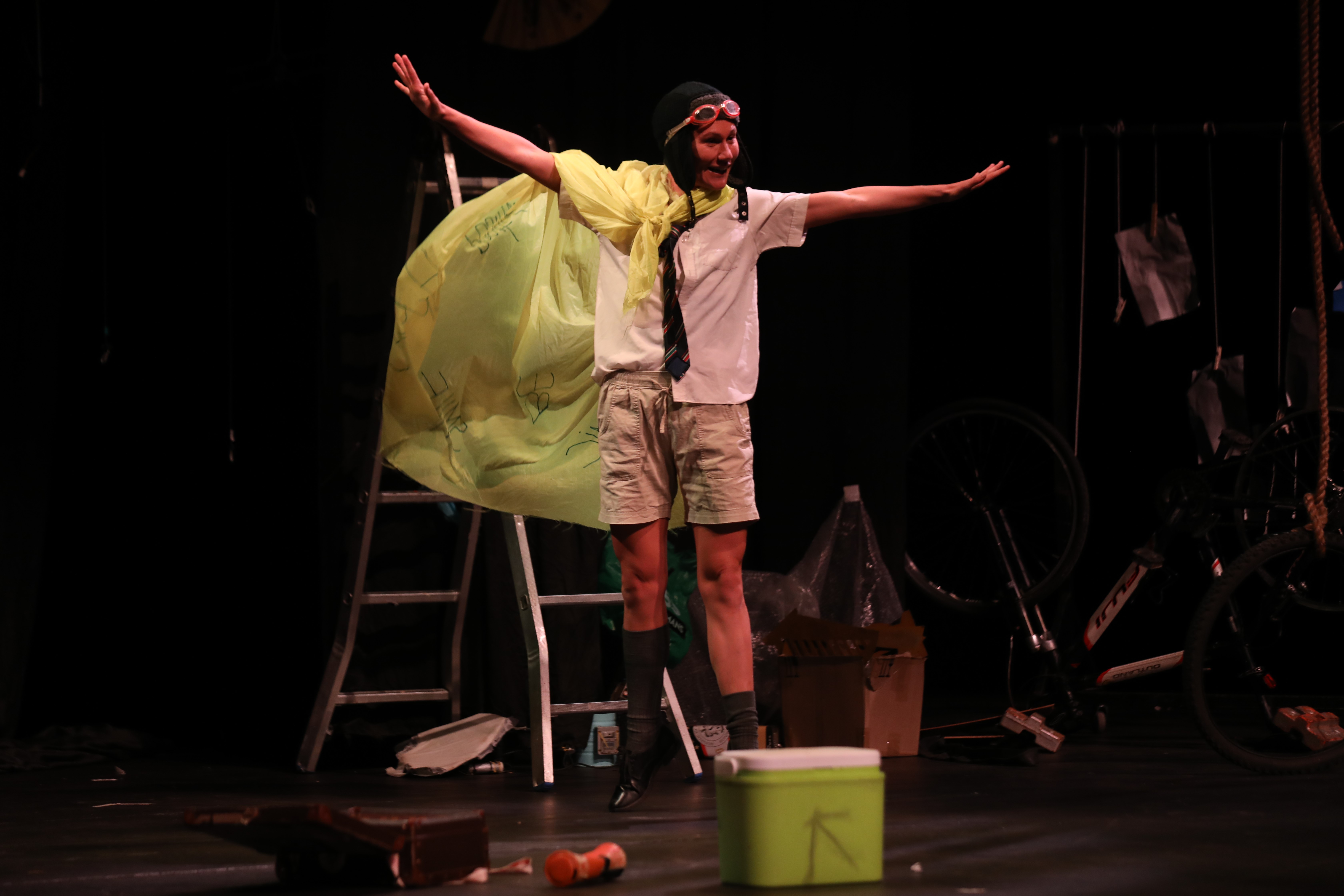
And … Action! with Jane Mpholo (playwright) and Ronda Mpiti.

And as I run out of space,  I want to include two more remarkable participants: Jane Mpholo’s  And…Action! who wanted to sketch South Africa in full colour but in a bantering, light way, yet still including bite; and another example of how the Teksmark works,  Ek Sal Jou Leer Om Die Melk Te Deel, a play that was accepted previously and now with some work, was featured again most successfully. With a theme of mothers raising the children of others, while not having enough time with her own, it’s something that touches all South Africans in different ways. And again, it makes everyone think especially playwright Lwanda Sindaphi who kept reworking.

Anele Situlweni (sitting) and Maude Sandham in Ek Sal Jou Leer om die Melk te Deel.

As you can see, it is about the people and the plays, the topics that are addressed and argued about, the potential that is discovered and nurtured – and in conclusion, the general health of the theatre industry.

How can we not celebrate?

(Thanks to KKNK, NATi, Foxwood and ATKV.)

KKNK INITIATIVE TO DEVELOP TEXTS AND OFFER PLAYWRIGHTS OPPORTUNITIES, TEKSMARK, ONE OF THE MOST EXCITING ARTISTIC ENDEAVOURS

Pictures: NARDUS ENGELBRECHT.

The delightful cast from Khanya and her Golden Dream.

The 8th Teksmark in collaboration with NATi, the Baxter Theatre Centre and the Het Jan Marais Nasionale Fonds again presented a wealth of 18 scripts by 20 playwrights, performed by 60 actors with 18 directors which was showcased to potential investors with lively discussions following every performance. The brilliant brainchild of Klein Karoo Nasionale Kunstefees artistic director Hugo Theart, generating 125 texts through the years with 36 text ideas becoming fully fledged productions. DIANE DE BEER gives her impressions of her favourites at the most recent market held as always at Cape Town’s Baxter Theatre from August 30 to September 1:

*To follow is a report on the first Gauteng Teksmark which was held earlier this month.

With established writers like Mike van Graan, Philip Rademeyer and Ingrid Winterbach featuring, some celebrated Teksmark virgins like Andi Colombo delivering a second time round and a handful of new finds, all round, it was as always a revealing event.

Some contemporary issues were addressed, some writers ventured into new territory and others expanded on familiar themes yet tackled with a fresh eye. Covid didn’t necessarily feature, but it did offer quite a few playwrights the time to write a new play, which just shows that there is always a silver lining.

Ingrid Winterbach (centre) speaking about her play Moedswil en Muitery with director Gideon Lombard and interviewer Kabous Meiring.

Take insightful writer Ingrid Winterbach for example, probably serious will always be somewhere in the description about her novel writing. Yet when she decided to turn to playwriting again, it was playfulness that became the focus.

With a show of skilful writing, she looked at our past, Jan van Riebeek and his wife Maria in fact, and had some fun as she put a fresh spin on the arrival of the early colonialists with the stated intention of planting a flag.

But we all know there was much more planting intended than what was divulged – and it’s here where she has some fun with her wise words, which she so craftily uses to play devil’s advocate.

Part of the fun of Teksmark is that Theart in discussion with the writers assigns a director and then actors to specific plays and often this is where a meeting of true minds can make real magic. This was indeed what happened with this one as director Gideon Lombard bought into the text and his sassy cast with Wessel Pretorius (who is becoming the Tobie Cronje of his generation) setting the tone for the rest of the team including Hannah Borthwick, Geon Nel and Lombard.

It’s going to be a hit with audiences as the writing, directing and acting all promise sublime merriment.  And then we haven’t even started with setting and style yet.

Prolific playwright Mike van Graan always keeps the South African pulse beating vigorously.

The prolific Mike van Graan hit a high note (while his latest My Fellow South Africans aimed at the ’24 elections was running concurrently at Gauteng’s Theatre on the Square see https://bit.ly/3PdseY7) with his Teksmark offering.

Typically titled The Good White, what I find so appealing about his current work is that he sharply hones in on touchstones in our political life that everyone is aware of but few speak about. And there are no holy cows here.

Some weren’t happy with what they referred to as stereotypes, but in the current state of the world (and it has really come to that if you look around), if our writers don’t have some serious fun with some sharp truths that makes for wincing if weirdly wonderful introspection, how else do we deal with it?

In The Good White, it is especially the older generations that will react because it zooms in specifically on a struggle white man, that rare species who was part of the cause pre ’94. He was considered one of the good guys, as there weren’t that many.

Now he is teaching at University but the students are unaware of his model past and his struggle credentials don’t absolve him anymore and he constantly finds himself moving on quicksand. It’s hilarious if perhaps too close to the bone for some, but that’s always the Van Graan medicine. It cuts deeply across the full spectrum, which means everyone pays and performs.

And clever of him to throw this one into the lion’s den at Teksmark. Why not hear what prospective audiences have to say before it goes on stage?

He has found his niche and no one else is doing it this focussed, and with such fierceness and regularity. Until they listen, I will keep shouting, is his premise.

Packing up in Dying in the Now with Celeste Loots

Two of the most promising texts came from Andi Colombo who had previously made her mark with her first work Dying in the Now and like then, when I wrote about the gentleness, generosity and probing text, she has done it again.

Her writing and the ideas she plays with are exciting and something you want to hold close. Hers is a rare talent which is paying dividends and hopefully she will be encouraged to keep writing

This time she takes a place, Verlorenvlei, which she visits and knows and has obviously given her heart. The name already says it all.

Emma Kotze and Shaun Oelf in Andi Colombo’s Verloren.

Verloren started as a short film which won a Standard Bank ovation prize and Colombo decided to expand the text for the Teksmark. It’s poetic, it catches you by the throat and she deals in issues that are crucial yet in a way human- rather than issue-driven. She is a playwright with a wonderfully rare talent who has stolen my heart.

And someone entering this realm, Nell van der Merwe, captured many hearts not only with her playwriting but also with her obviously overwhelming passion for theatre. It’s all in the writing. There’s a classic feel about her approach to language which is captivating and stops you in your tracks.

It’s almost not about what she’s saying, but how she says it. Whimsical and wise, dealing in myths and fairytales, which she feels is a way to play with the politics of people. And basing her text on Leipoldt’s Die Laaste Aand, Dryfhout deals in much that has gone wrong in this country as it looks at heritage, the entitlement of the ruling class and the changing perceptions and acknowledgement of the painful past inflicted on people.

Others that also made their mark included Sibahle Mabaso with Khanya and her Golden Dream, a family production with many lessons embedded cleverly in the text; Jason Jacobs and Devon Delmars’ Kontrapunt, which is an exciting shift for Jacobs and a clever idea which should be explored further; Praat Gou Weer by exciting theatre contributor, Khanya Viljoen, who interrogates internet dangers; and then included in quite a few texts was gender based violence, the South African scourge which cannot be tackled enough.

As with all the previous years, the excitement was tangible, the texts tantalising and the productions just a taste of their eventual potential. I cannot wait to see which of these will be developed to take on the bigger stages.

What has been clear apart from new playwrights emerging, many who found initial success just keep going and some established names have discovered what an explosive platform this can be. It is constantly expanding and the results simply mean that theatre gains.

Well done to Hugo Theart and his amazing team for this initiative which benefits and reaches far wider than the Klein Karoo Nasionale Kunstefees. And to Baxter CEO Lara Foot for the support.

Read more next week about the first Teksmark held in Gauteng early in November.

FEISTY FESTIVALS ARE BACK IN FANTASTIC FORM

With two festivals, Aardklop in Gauteng and Woordfees in Stellenbosch, following one on the other, everyone was keen to see what would happen both on stage and in the auditoriums post Covid. Would they come, was perhaps the most worrying. DIANE DE BEER visited both and was excited by the bounce back of the arts on the festival circuit – with the audiences to support them:

If you look at the winners of this year’s Aardklop productions, it is the veterans who grabbed all the awards.

A very surprised but bursting with pride Elzabé Zietsman reigned supreme with three wins for Femme is Fatale.

I remember when I first saw this in-your-face production at the Vrye Fees last year – it hit hard. In a  country where gender-based violence reaches pandemic-like numbers, you need to grab audiences by the throat. And that’s exactly what this singer/actress does with a magnificent gloves-off script and an attitude that dares anyone not to  take notice.

From her initial on-stage look until she strips down to throw the horror of what is happening to individuals in this country in your face, she doesn’t make a wrong move. It’s attention grabbing for all the right reasons and takes someone as experienced, brave and talented as Ms Zietsman to swing high and low with your emotions.

It’s one of those performances that will stay with you forever and it is her intention, even before winning for Best Musical Performance, Best Music-Driven Production and Best Overall Winner, to find a way to take the show to schools across the country. And in her acceptance speech, she sung the praises of her accompanist Tony Bentel – with reason.

Hopefully, this has empowered her plan of action and promotional campaign. If she can’t encourage change with this one, the world is a really sad place.

Sandra Prinsloo’s performance in Moeder also never flagged. Again, I’ve seen it many times, mostly for her performance and an astonishing script as well as a near-flawless production directed by Christiaan Olwagen.

I’ve said a few times that his place is on stage, it’s where he shines brightest, even though he will probably prove me wrong sooner rather than later.

But he has such a good eye, a filmic vision and the heart to realise that Prinsloo could and should play this woman. It’s one of her best performances ever and I’ve seen many. At the festival I heard people often praising her performance in Masterclass because, of course, Ms Prinsloo hardly ever appears at a festival in just a single production.

I hope she leaves notes for her younger counterparts about concentration, focus and stamina. And again, as so many times in her life, she was rewarded for an astonishing performance in Moeder with the production named the Best Theatre  Production as well as Best Production by an independent group of art lovers, Aardklop Hartsvriende (Friends of the heart).

A scene with Bettie Kemp and Dawid Minnaar in Mirakel.

Another stalwart, David Minnaar, played her flawed partner and, as always, he knew how to pitch just the right tone as the errant husband, but it was in Marthinus Basson’s tour de force Mirakel where he was given a part which especially revealed his comedic qualities.

It is one of Reza de Wet’s lighter works although the message is as hard-hitting and relevant as anything she has written. But Minnaar with Basson as his champion walked a fine line with great relish which added to the performance.

I felt that he was enjoying the play as much as anyone watching it. Because of the travelling theatre company and its dramatics that rule this play, he could charge with dramatic fervour through the hysterics of the flailing players all trying their best to make their lives and livelihood work.

It captures that world which has remained almost unchanged with such dexterity as only a De Wet/Basson partnership can achieve thus allowing a Dawid Minnaar to soar and win as Best Actor and Basson to pick up yet another Best Director award.

An ENTRANCE by the delightful Eben Genis while the company’s leading couple sleep on.

In the same play, Eben Genis (above) also announced his welcome return to the stage to great delight of theatre goers and was warmly received with a Best Supporting Actor award. It is his subtlety, his nuanced excursion into this world, which is a reminder of the fine actor he is.

The Best new Afrikaans text was claimed by Philip Rademeyer who wrote and directed Goed wat wag om te gebeur, the Afrikaans version of The Graveyard starring Gideon Lombard, Antoinette Kellerman and Emma Kotze.

It deals with Hendrik’s return to his childhood home where he struggles with past demons including violence, blame and addiction, all the while trying to suppress his anger and hurt with drink. The only niggle was a text that would have been even better with some clever culling, and this was probably the most common culprit in too many productions.

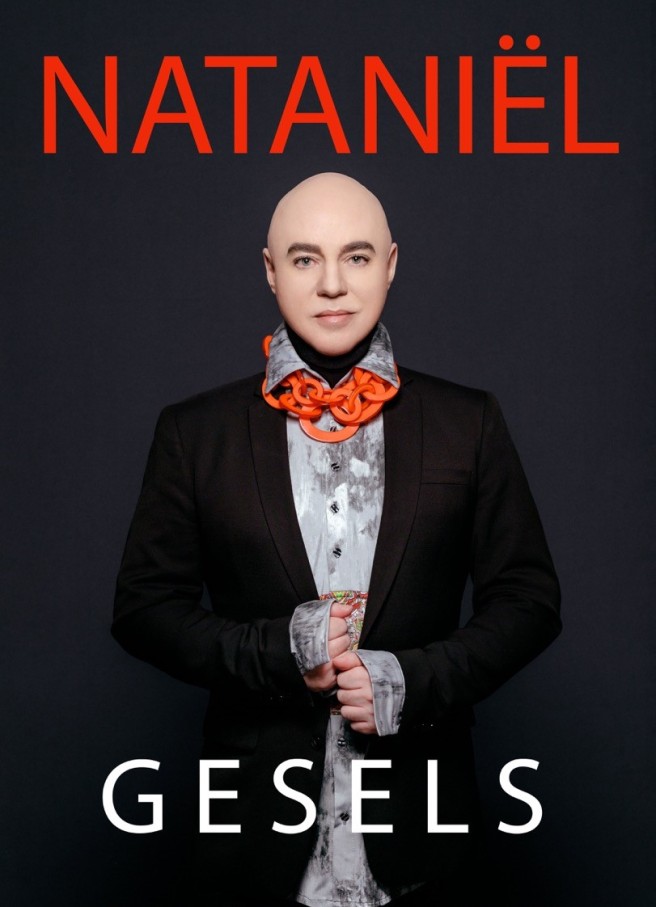
At a festival where the experienced artists were the ones who often captured the audiences and my praise, I was again overwhelmed by Nataniël’s Ring van Vuur. It is no secret that he is one of my most cherished performers, but there’s reason for that. And again he proved me right with a show that was simply sublime. Not only did he give one of his best performances, he also introduced me to guitarist Loki Rothman whose name was familiar, but no one had ever mentioned his particular flamboyance on a guitar.

Not only does Nataniël give us a quality show, he is also generous with the artists he introduces to a wider audience. That’s the sign of a great and confident artist. I know most music fans will be familiar with Rothman’s prowess on the guitar, but because I am mainly a theatre writer/critic, I have never had the privilege.

Most of these productions made sharp u-turns as they winged their way down to Stellenbosch with the much larger Woordfees, welcoming audiences as Aardklop was waving goodbye.

And again, there was much to praise with a festival bulging with new presentations and productions, enough to have everyone smiling. It’s not about the one or the other. Both have equal right to their audiences, they shouldn’t compete and if I have to make deductions about attendance, both have a strong following for their particular brand. Mostly it probably has to do with where audiences live and how far they’re willing to travel. Convenience, I suspect, will be the determining factor.

As a working journalist, I was blessed to go to both.

And if I have to start with a production that had me thinking, shocked me to my core because of content yet filled me with admiration for the inspirational Jaco Bouwer and cast for tackling such a daring and dangerous text – in the best sense of the word.

Melissa Myburgh (left) with Tinarie van Wyk Loots pictured with Myburgh (right) in the startling Die Vegetariër.

Bouwer, one of our most exciting directors has been working in the television and film world for the last while and has been missed because of his brand of theatre, which always pushes boundaries and challenges audiences to engage with tough issues rather than turning away and tuning out.

From the moment you enter and witness the amazing set of Die Vegetariër, your mind starts racing. There’s something pristine and perfect about the space and yet it’s a slaughterhouse, which is an ominous sign even before the action starts.

Die Vegetariër pictured by Nardus Engelbrecht

But in typical Bouwer fashion, he hits you in the solar plexus from start to finish and while you might be reeling throughout trying to contain your emotions racing ahead, it’s the unflinching text and cast that stay with you as you keep unravelling the lives of the people who share their stories.

And you keep coming back to the slab of meat you keep staring at as you enter and the meat hook that just hangs there menacingly until it captures the crux of what you are witnessing. It’s hardcore, but in the world we live in with gender-based violence such a scourge (as already mentioned), we have almost become immune not only as individuals but as a society.

The cast – Stian Bam, Wilhelm van der Walt, Tinarie van Wyk Loots and Melissa Myburgh – are staggering in this brutally honest portrayal of life for far too many as physical and psychological abuse becomes the common language in relationships. And the young Myburgh deserves a special mention because her character’s youth embodies vulnerability and defencelessness in all its harshness and is the most exposed.

It’s not easy to watch, but because of the approach of everyone involved, from Willem Anker’s adaptation of Han Kang’s The Vegetarian to Bouwer’s brilliant conception and the way he seamlessly pulls it all together from the enveloping visuals to the overwhelming performances, it’s simply a privilege – and one that stays and niggles at you forever.

On a different spectrum but as challenging, Jay Pather’s Hold Still with an extraordinary text by Nadia Davids tackles refugees, one of the toughest issues in today’s unravelling world as we roll from one crisis to the next. And if you look closer, refugees are at the centre of most of them. Think Gaza.

But what she does is take a model modern couple and make them face today’s harsh reality. There’s a reason refugees cause such heartache and often horror. There aren’t solutions or none that is workable, so many simply turn their backs.

It’s gritty yet glorious theatre as two veteran actors (Andrew Buckland and Mwenya Kabwe) star as a delightful couple who lovingly banter away until the very essence of their family relationships is blown apart. Both these actors take your breath away with performances that are in your face and completely in the moment. They’re complemented by the two youngsters in the cast, Lyle October as their son and Tailyn Ramsamy as his friend in search of refugee status, hence the dilemma.

As the mother so aptly confesses:  they sold their son a story about their moral selves which they themselves had come to believe. It’s real world issues, tough to work through and easier to ignore, yet this is the perfect platform to grapple with our reality today.

An exuberant Caleb Swanepoel in A Midsummer Night’s Dream.
Picture: Llewellyn de Wet.

And the third piece that blew me away was Geoffrey Hyland’s Maynardville Shakespeare production, which I am thrilled to announce is coming to Pieter Toerien’s Montecasino in November. If you see nothing else this year, don’t miss this production.

It is simply glorious and will have you screaming with laughter from beginning to end. I cannot imagine a better introduction to Shakespeare than this play that symbolises everything that this fantastic playwright is about. It’s entertainment writ LARGE and simply the perfect end-of-year production with an astounding cast put together magnificently.

My only qualm is that it was first staged at Maynardville, Cape Town’s glorious outdoor theatre venue, and I saw it at the Libertas amphitheatre in Stellenbosch, but with Hyland’s astonishing artistry, I’m sure you won’t even notice. Never before would I have thought that I would be so happy to see a Shakespeare at a festival. That it was included in the programme, was simply a stroke of genius.

A Midsummer Night’s Dream is a spectacle in colour and charm.
Picture: Mark Wessels.

Just go – and tell everyone around you not to miss this fantastic show. You won’t regret it and start this festive season in the best possible way. (See full review once it has opened with a run from 8 to 19 November.)         

  • I have singled out only a handful of productions which I saw at the festivals. There are many more to praise, but I grabbed those few that grabbed both my head and heart and wouldn’t let go …                                                                                                                                                                                                                                                                                                                                                                                                                                                                                                                                                                                                                                                                                                                                                                                                                                                                                                                                                                                                                                  

THE PROMISE DELIVERS CHALLENGING THEATRE WITH DIRECTOR SYLVAINE STRIKE AT THE HELM

DIANE DE BEER

Pictures: Claude Barnardo

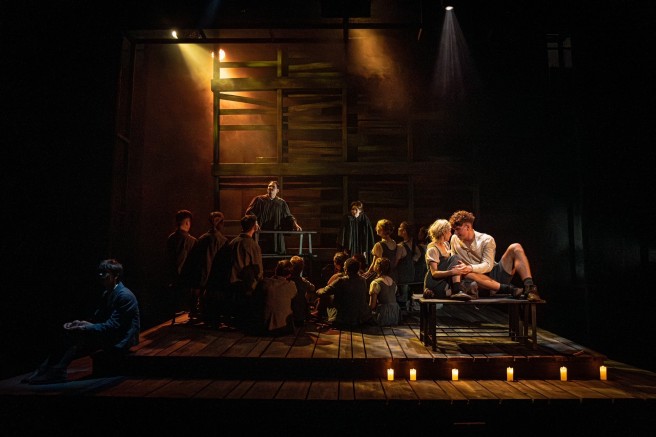
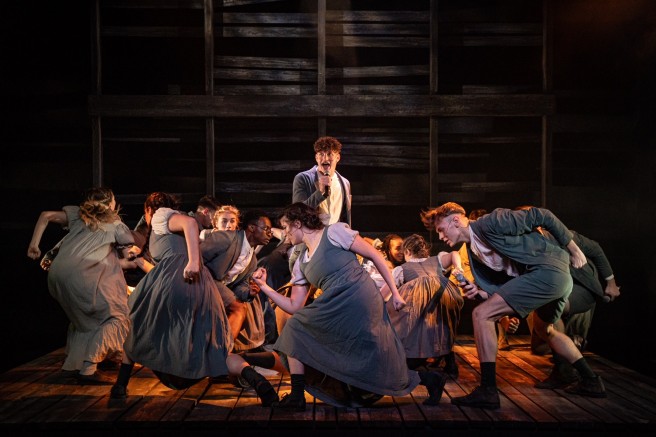
The Promise cast on stage.

THE PROMISE

ADAPTATION:

Author Damon Galgut with Sylvaine Strike and suggestions by the cast

DIRECTOR

Sylvaine Strike

CAST

Chuma Sopotela, Rob van Vuuren, Kate Normington, Frank Opperman, Jane de Wet, Jenny Stead, Albert Pretorius, Sanda Shandu, Cintaine Schutte

ASSISTANT DIRECTOR AND ARCHIVIST

Kirsten Harris

SET AND LIGHTING DESIGN

Joshua Lindberg

MUSIC DIRECTOR, SOUND DESIGN AND ORIGINAL SCORE

Charl-Johan Lingenfelder

CHOREOGRAPHY AND INTIMACY CO-ORDINATOR

Natalie Fisher

COSTUME DESIGN

Penny Simpson

VENUE

The Market Theatre

DATES

Until November 5

Jane de Wet, Rob van Vuuren and Jenny Stead.

One has to admire artist Sylvaine Strike’s process when she decides on a project. It’s all systems go and in Strike’s world, the focus is unfailing.

She spent 18 months hard at work on this extraordinary piece of theatre, which has finally reached The Market Theatre.

But there are a few things to take on board before you arrive. It’s based on a book, Damon Galgut’s The Promise, and that means that it is her interpretation of Galgut’s writing and script, even if he was closely involved throughout.

Also, it is two hours 40 minutes long and for many less-experienced theatre goers, that might be quite

 an ask. One has to be theatre fit.

Albert Pretorius and Sanda Shandu as two policemen

But for me there’s no question that it has to be seen, and a very packed and excited audience obviously in anticipation was ready and waiting on opening day. Even when we arrived to collect tickets there was an audible buzz and it was lovely to experience a theatre event of this kind. The last one was the August Wilson production at the Joburg Theatre last year.

Five minutes into the production, I already had a smile. For this one, Strike created her own theatre language in which to tell her story and for me, it couldn’t have been further from the language and storytelling of the book, yet both had a very individual and personal flavour which I loved.

I almost felt as though I had walked into a kind of grotesque fairy tale for adults and, while the approach might have felt comical to some, it was anything but because of the content and the story it was telling.

Frank Opperman.

It was also clear that as individuals, those watching the play would have to buy into the concept – and for me that wasn’t a tough ask. It’s why we watch theatre, to catch those productions where those participating take risks to give audiences a storytelling experience that’s novel and best suited to a particular text.

The Strike brand has always been about her individual style and, while she pays close attention to the text, her language is much more than just something we listen to. She uses the stage and everything visual as part of the ensemble and then she adds very specific movements and rhythms as well – as in this instance, a soundscape by genial music man Charl-Johan Lingenfelder with a kind of music/sound box on the side of the extraordinary stage designed insightfully by Joshua Lindberg, who was also responsible for fantastic lighting (so delighted that the family name lives on in our theatre landscape).

And that in itself sets the tone for this topsy-turvy world the Swart family inhabit. The matriarch of the family, seemingly the one that held them steady with a strong hand and a moral compass, has died. Thus we find all of them in turmoil as they come together for the family funeral (one of four that determine four periods in a country gone mad).

But there’s one obstacle  –  Amor (Jane de Wet), the youngest sibling, had heard Ma (Kate Normington) extract a promise from Pa (Frank Opperman) that he would give Salome (Chuma Sopotela) her house on the furthest corner of the farm, mainly because she was the one who diligently and lovingly looked after the mother in her illness.

A familiar scene in many white South African households and the rest of the family simply disengage while Amor keeps at it relentlessly – determinedly – as their conscience. The ensemble of nine work well together as a group and individually, although I suspect, audiences will have different favourites.

Cintaine Schutte and Albert Pretorius .

Amongst the men, my favourite performer was Albert Pretorius who even though his many different characters often had a comical edge, he manages such a fine artistic line and knows just how to hold it back. Frank Opperman also captured his different characters masterfully. Rob van Vuuren is at the heart of the piece as Anton Swart.

Chuma Sopotela is the key of the piece as both Salome and the storyteller, and in both roles her strong presence holds The Promise, both in the production and at the centre of the story. She was the perfect fit.

Each one of the performers added to the whole. Because many roles were played by each actor, some characters worked better than others, and who you like or discard will be a personal preference. I don’t think with the adopted style there’s a right or wrong, it’s a preference thing.

So how did it all come together. It’s a HUGE production. I suspect, especially while writing this review, that one needs more than one or two viewings to truly appreciate the breadth of the drama and staging. I can simply stand back in awe.

What for me personally would have worked better, would have been to lose most of the second half (obviously not the end). Up to the interval, everything worked perfectly, but then it started to unravel. A trim of an hour would have been my ask and would have served the actors and the story better.

It was as if sustaining the production for swo long was too big an ask and detracted rather than added to the final product.

Should people go? What a question! It’s a theatrical experience. There’s a cast that does exquisite work, moments that will take your breath away, a set, costumes and lighting that all contribute to the bigger picture and, finally, a director who puts herself out there, pushes as far as she dares, breaks boundaries and develops ways of telling stories that keep you riveted.

You might not love every minute, but you have to admire the artistry, the vision and the theatricality with scope that’s daunting yet inevitable when Strike decides to do it. And we’re the beneficiaries.

SYLVAINE STRIKE’S INSIGHTFUL PLAY WITH DAMON GALGUT’S BOOKER PRIZE WINNER THE PROMISE

Time was the rare gift that celebrated director Sylvaine Strike was given with her latest production, The Promise, written and adapted (from his novel) by author Damon Galgut. She tells DIANE DE BEER more about the extraordinary process which started more than 18 months ago and is on at The Market (until November 5) following its recent Cape Town run:

“In a way, The Promise selected me,” she explains, because Damon approached her to adapt it for the stage, thinking that she would probably be the right fit because he had foreseen that it would have to be done very theatrically and very physically if it were to have a theatrical life at all.

She was utterly smitten by the idea, but insisted that Damon adapt it alongside her because she was reluctant to tinker with his text. “I needed him to travel the road and structure it in a way that he would feel could live as theatrical version.” She had read the novel twice even before he contacted her and was delighted.

The Promise with the full cast as well as author, Damon Galgut (left) and Sylvaine Strike (right).

When it came to casting, it began with finding the right person to set the bar from a physical perspective and she knew from the outset when reading The Promise and imagining who her Anton could be, that it was Rob van Vuuren.

Gifted this opportunity of a role that is a once-in-a-lifetime experience, Rob was thrilled just to delve into this exquisite character and the very many facets of it. Sylvaine knew he would be the one who she would work off in finding the rest of the family, which includes Frank Opperman as Anton’s father, an Afrikaans patriarch, Kate Normington as his mother, jenny Stead as Astrid, his middle sister, and the young Jane de Wet as Amor

“The pivotal and most important character of Salome is played by Chuma Sepotela, who holds this exquisite part in two dimensions in the sense that she’s also the narrator of the piece, as Chuma herself, who plays the story conjuror.”

Sandu Shando plays Lukas, Salome’s son, and “the amazing Albert Pretorius and Cintaine Schutte, both adding deep dimension, comedy and pathos in the roles of Tannie Marina and Okkie as well as the many characters they portray,” she concludes.

In total it’s a cast of 9 and, before anything else, they did a workshop with Sylvaine to discover the physical language as the blueprint to the play.

In rehearsals: the cast and director Sylvaine Strike.

With both the director and writer growing up in Pretoria, their coming together was almost written in the stars. “I think growing up in Pretoria and being aware of the glaring chasm between the haves and the have nots, the ability for Pretoria to ride that knife edge between ignoring the political reality, the lies that have been woven to its children, the incredible duality between darkness and light, tragedy and comedy that this book engages with and its calling out for us to face the shame for how we lived,” all of that made the book irresistible.

“There’s no escape but to look it in the eye, which is what this was and showing what it felt like for me. The novel forced me to do it as it named everything I was feeling growing up there as a child and being a teenager there and sensing that something was so terribly wrong with it.

The full cast on stage. Photographer: Claude Barnardo.

“Four decades of Pretoria so distinctly captured, I rose to the challenge of telling the story on stage because I wanted to reach people with it and make them feel what it felt like for me to read it and everything it made me feel to confront our whiteness in its brutal hideousness and its complexity and own it.”

Once the decision was made, she and Damon sat for two solid weeks unpacking the novel. At first he really battled with seeing how it could be put on stage. Sylvaine thinks that in his mind the locations were so specific that it took some time for them to understand the kind of language it would need in order to tell the story.

“We both agreed that the very fluid narrative that Damon captures and writes in, a narrative that changes perspective all the time, changes its mind all the time, needed to come from a chorus almost in the Greek tragedy sense, to comment on the action, to speak to the hero or the anti-hero, to contain their thoughts, and to move swiftly through the action alongside it.”

Scenes on stage. (Pictures: Claude Barnardo)

Neither the reader nor the writer could hold on to all their darlings. They knew they had to lose certain bits of the novel, cutting and culling, choosing only the very essential parts of the story, and look at compressing it into a time frame that would suit theatre, so much more condensed than in a book.

 They also needed to find a theatrical language and a physical language that was able to edit between time and place very swiftly, where actors could age from one decade to the next simply by using their bodies. Damon then proceeded to write five drafts which incorporated this language and refined it more and more and more.

In between the first and second draft they had a workshop which Damon attended in which she worked with her cast and at which Charl-Johan Lingenfelder (music/soundscape) and Joshua Lindberg (set and lighting design ) as well as Penny Simpson (costumes) were present. “It was a collaborate effort to reach a place  where script was done and created,” she explains.

Wearing her heart on her sleeve, director Sylvaine Strike.

Photographer: Martin Kluge

In conclusion, after all the hard work, the introspection, a fantastic cast, long hours and hard work, she hopes audiences take a good hard look  at our country  –  and a soft look as well. “And by that I mean allowing us to enter its deep humanity and inhumanity, looking into a mirror, admitting our own whiteness, hearing it, not making excuses for it,  not trying to explain it, but most of all really looking at the relationship we have as South Africans with each other.

“There’s also the microcosm of a family and its domestic worker Salome, which is a microcosm for  the dynamics within our country, the difficulties, the obstacles, the promises made and broken, the lack of care we have for one another, the care in some aspects, about our country looking at itself, not being spoken down to, but simply observing itself, taking a step back to see more clearly, not back in time, just to get more focus on where we’re at.

“And what I love about The Promise is that it doesn’t offer any solutions, just gives us a glimpse of what we have done and what we have become over the last four decades of our country’s democracy.”

A CELEBRATORY MOMENTUM BELEGGINGS AARDKLOP RETURNS WITH A SPARKLING SMORGASBORD OF EXCELLENT THEATRE

It’s the time of festivals with Aardklop opening with a celebration of jacaranda showers and shows from October 3 until 8. DIANE DE BEER points to a few of her favourites:

When I look at festivals, what they have to offer, I always go to theatre first. It’s my passion, people who tell stories.  Fortunately, I know that stories are an integral part of the arts and are told in different ways. That’s what makes a festival such a delight.

Die Moeder with Sandra Prinsloo and Dawid Minnaar. Picture: Emma Wiehman.

But let’s start with theatre. If you haven’t seen Sandra Prinsloo’s Die Moeder yet or even if you have, see it again. It’s one of those once-in-a-lifetime performances even if she has had many of those. It’s a story of a woman ageing who has lost her heart and her soul as she feels discarded and left out of the dance of life.

That might sound horrific, but the text and the ensemble cast, including the magnificent Dawid Minnaar, Ludwig Binge and Ashley de Lange with exciting directing by Christiaan Olwagen, present huge rewards.

Bettie Kemp and Dawid Minnaar in Mirakel.

On a lighter note, Marthinus Basson, a Reza de Wet genius, presents probably her funniest play, titled Mirakel. With another fantastic cast, including Rolanda Marais, Carla Smith, Dawid Minnaar, Edwin van der Walt, Bettie Kemp and Ebin Genis, it takes us back in time when theatre was presented by traveling companies, which went from town to town, region to region.

That already puts a smile on my face, and when you get this almost ragtag band of actors together, trying to save their lives by enhancing their livelihood with all the drama of the time and the company, it’s a scream. Just seeing Minnaar, who we are used to seeing on stage in serious mode, is a delight as he lights up the room with his angst and artistic temperament.

Braam en die Engel with Joannie Combrink, de Klerk Oelofse, Rehane Abrahams and Shaun Oelf, directed by Nico Scheepers, has all the elements for something quite enchanting. Add to that Kanya Viljoen who adapted the text from a YA book with the eponymous title, Grant van Ster as choreographer, Franco Prinsloo as composer and Scheepers and Nell van der Merwe on props and puppets as well as set, costume and lighting design, it’s a no-brainer.

Described as a magic realism experience for the whole family, this sounds worth driving for and not to be missed. I don’t even know the book although the title does the trick, but the artists involved get my backing all the way.

Geon Nel in Hoerkind. Picture: Gys Loubser.

Also based on a book, Hoerkind, written by Herman Lategan and adapted by Francois Toerien, tells the writer’s own story about a life in tatters when as a six-year-old he is sent to an orphanage. His stepfather shoots at him, at 13 he is stalked by a paedophile, and he turns to drink and drugs to stay sane, this solo production is directed by Margit Meyer-Rödenbeck, with Geon Nel in the title role.

The young boy’s missteps are many as he tries to survive. It’s a hair-raising story of loss and triumph in a world that is feels as if it is against him as he valiantly fights to survive.

Goed wat wag om te gebeur. Picture: Nardus Engelbrecht

Another debut production, Goed Wat Wag Om te Gebeur, has impeccable credentials with a cast featuring Antoinette Kellerman, Gideon Lombard and Emma Kotze with Philip Rademeyer as playwright and director (reworked in Afrikaans from The Graveyard).

Hendrik returns home after 15 years but, because the house is deserted, he decides to wait in the cellar where he spent his childhood years. It is empty, but the family’s secrets and history thicken the air and form part of the foundation of the house. Three figures keep appearing – his hardened sister, his petite mother and his lively girlfriend … and secrets and lies come to the surface.

Droomwerk. Picture: Lise Kuhn.

Droomwerk spotlights Jill Levenberg, Ben Albertyn, Johann Nel, Tyrish Mili and Johann Vermaak, directed by Kanya Viljoen and Lwanda Sindaphi. It unfolds as a dream as the title suggests. Petrus is the one who dreams about his family’s complex past: his ancestral mother, Diana of Madagascar, is looking for her daughter; and his grandfather, an apartheid senator, is dying.

The play deals with conflict, alienation and disillusionment. Will Petrus find the answers that bring him peace? Written by Pieter Odendaal, the text has already garnered an award for the best drama by the ATKV Woordveertjies.

Cindy Swanepoel and Zak Henrdrikz star in Henrietta Gryffenberg’s text 1 (Een) – described as a tragicomedy about love. Directed by Alby Michaels with choreography by Craig Morris and original music by Coenraad Rall (Amanda Strydom’s accompanist), it’s all about once upon a time … there were two people so fond of one another that they grew,the one into the other.

With too much togetherness, the two eventually decide it’s time to separate … but which one will survive this miraculous ordeal?

This tongue-in-cheek production looks with a slight jaundiced eye at the ancient themes of love and transience while placing it in an absurd context. Are human beings likely to find their perfect partner or are the chances just endlessly slim?

It’s a challenging piece, which should translate perfectly on stage with hopefully much laughter at the fallibility of man.

Two strong solo productions include Marion Holm, a seasoned actress who works wonderfully with words and life as she experiences it. She has her own style, a way of sharing her stories that are hysterical and sometimes quite harrowing but everything is done with such hilarity, it’s laughter from beginning to end.

On a dramatic note, Je-ani Swiegers stars in Die Vrou Op Die Dak, which tells the story of a woman who flees to the roof of her house where she hopes to find the answers to a life that has suddenly become impossible. Everything she thought she knew is disintegrating and she hopes this fresh perspective might bring fresh insights.

And don’t miss out on the latest offerings from the grand dames of cabaret, Elzabé Zietsman(with Tony Bentel in the perfectly pitched Femme is Fatale) and Amanda Strydom (Amber/Ombré). Their staying power is unique as they keep refining their artistry.

It’s a lucky packet of plays with a selection of everything one could possibly wish for when going to a festival.

And then there’s more and many different entertainment options waiting to be discovered at https://aardklop.co.za/program-2023/

Also to follow, is Nataniël’s Aardklop production as well as the rest of his surprise packages.