AUTHORS MICHAEL LEWIS AND TA-NEHISI COATES WRITE AND MAKE SENSE OF OUR CRAZY WORLD

DIANE DE BEER

Two of my favourite authors wrote books recently focussing on issues that are part of how we function and why. I want to urge anyone interested in the world and how we view it, to tap into their insight:

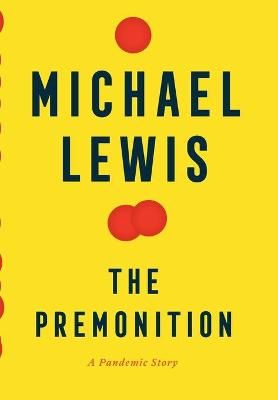
THE PREMONITION:  A PANDEMIC STORY BY MICHAEL LEWIS:

“I would read an 800 page history on the stapler if Michael Lewis wrote it,” writes a New York Times book reviewer and that is pretty much exactly what I feel about Lewis and anything he writes.

His last book, The Fifth Risk, looked at the federal bureaucracy during the Trump years and how things unravelled because of incompetence, or if you want to give them the benefit of the doubt, ignorance.

So it was perhaps justified to expect this latest book, The Premonition: A Pandemic Story, to put all the blame on Trump and his coterie of civil servants. But not so.

What he does is to go and fetch the facts from way before the pandemic, when a group of medical specialists started warning about the possibility of a pandemic like Covid-19 and how best to prepare for it. The problem was that few people were listening and the government specifically didn’t want to listen.

He has a handful of heroes and one of the most intriguing individuals in this story is a California health official, Charity Dean. Lewis has a knack of discovering these characters who seem to almost hand him his story on a plate – but it’s perhaps not that easy. You have to find them and then you have to both listen and pay attention; and that he does quite brilliantly.

He also has the instincts to know which story to follow. And if anything, Dean wasn’t obviously the voice that many would listen to. She admits that who she really is has nothing to do with her exterior, which is apparently more Barbie than Florence Nightingale.

But that’s only part of the story. Two doctors, Richard Hatchett and Carter Mecher, were part of a pandemic planning team set up during the George W. Bush administration and then they hooked up with some other extraordinary individuals who were all extremely good at what they were doing.

Almost by accident these people all get together or connect in some kind of fashion. Rather than predicting what was going to happen, as one might expect, all these people in some kind of form become interested in pandemics and start looking out for the possibility of future disaster(s).

The frightening thing though is not the incompetency of the Trump administration or even Trump’s wild claims during some of the worst times of the pandemic, but rather that this first-world country with all its expertise and some of the best brains in the world was so ill prepared.

 Most of the rest of the world is less alarmed by some of the incompetency in their own countries, having a much more jaundiced eye, but most of us will be surprised that those who constantly hold themselves up as being the best, can do so badly.

It’s worrying when even the “best” fail so miserably. And to this day, people are dying because of a refusal to take the vaccine. How is it possible to keep on refusing to take it seriously even after the high death counts? And now many of those naysayers are starting to die, so it will be interesting to see how that changes the dynamic.

The best of the Lewis style is the way he finds and fetches the story, dresses it up in the most palatable fashion and then allows the story to unfold. It’s powerful and will keep me reading – yes even when the topic doesn’t grab me. I know his storytelling abilities will.

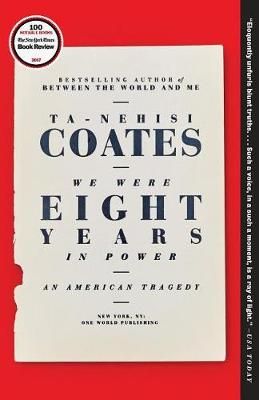
WE WERE EIGHT YEARS IN POWER BY TA-NEHISI COATES (Hamish Hamilton):

In a sense, Ta-Nehisi Coates has a similarly mesmerising voice. He deals in a different world but also with the lives of people; and perhaps that’s the common thread.

This time it is the late Toni Morrison who is quoted on the back page: “I’ve been wondering who might fill the intellectual void that plagued me after James Baldwin died. Clearly it is Ta-Nehisi Coates.”

This one was published in 2017, but I’ve only recently received a copy and can’t resist bringing it to anyone’s attention who doesn’t know about it or is unfamiliar with this particular voice.

The premise is the Obama presidency and what Coates did was to take eight articles written during the eight years of the first black presidency. Before each of these essays, there is as the author explains “a kind of extended blog post, one that attempts to capture why I was writing and where I was in my life at the time.”

He describes what he has put together as almost a “loose memoir”. And at the end of the book, he attempts to assess the post-Obama age in which we find ourselves. He wanted all these eight essays (originally published in The Atlantic) assembled in a single volume.

It’s as smart as it is clever and I can’t think of anyone else I would rather have guide me through that particular time in American history. And because of these times of George Floyd and the renewed urgency of Black Lives Matter, it almost lands with more penetration because of current events than when it was first published.

He deals with so much that is out there right now and for years to come. About reparations, for example, he says the following: “What would it mean for American policy so often rooted in its image as the oldest enlightened republic and pioneer of the free world, to forthrightly note that freedom and enlightenment were only made possible through plunder that stretched from the country’s prehistory up into living memory?”

And that’s just a tiny snippet and sits sweetly next to Prince’s brand new album (posthumously, of course) and the searing lyrics:

“Land of the free, home of the brave

“Oops, land of the free, home of the slaves…”

Coates doesn’t mince his words either. If you want to hear, he will tell it like it is. And if anything, you could read it just to see what he has to say about Trump, the man he describes as America’s first white president. And that already is a fascinating story.

He writes in his incisive epilogue that Barack Obama delivered to black people the hoary message that in working twice as hard as white people, anything is possible. “But Trump’s counter is persuasive  ̶  work half as hard as black people and even more is possible.”

Much was explained about both the Obama and Trump presidency (according to Coates, the result of having had a black president) and again Coates steps up as the voice of a new generation, insightful about the world in which we live in, and more importantly, not one where he sees white supremacy disappearing anytime soon.

It was reported recently that Mitch McConnell expressed initial satisfaction about the Obama presidency because he felt this would put a stop to the kind of complaints heard from the Black Lives Matter movement.

Which says everything about his understanding of the lives of others especially those of colour. And again underlines the importance of this book.

ESCAPE FROM LUBUMBASHI IS ABOUT A REFUGEE’S DETERMINED STRUGGLE TO REUNITE HER FAMILY

The 1951 United Nations Refugee Convention is a key legal document and defines a refugee as: “someone who is unable or unwilling to return to their country of origin owing to a well-founded fear of being persecuted for reasons of race, religion nationality, membership of a particular social group, or political opinion”.

mde

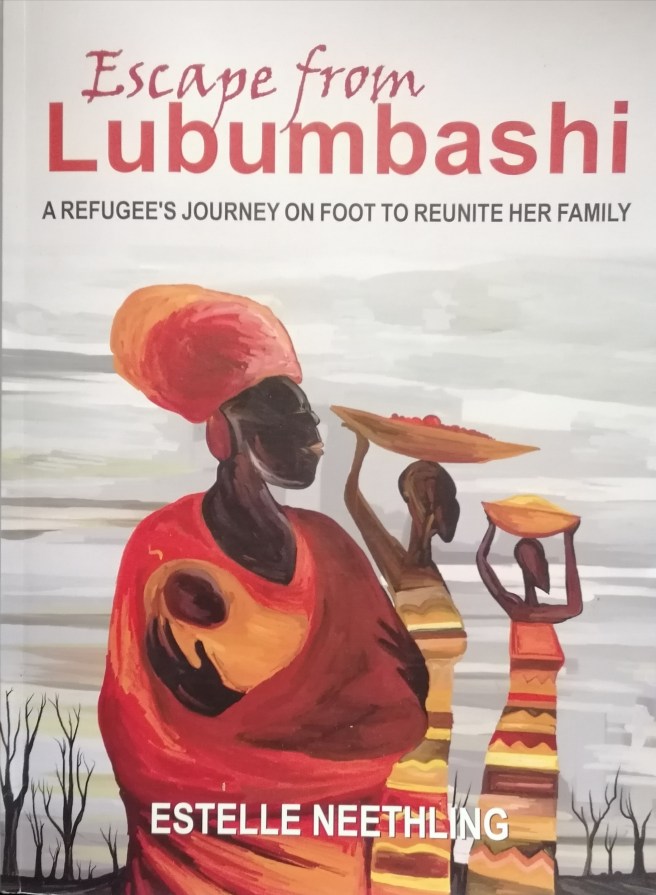
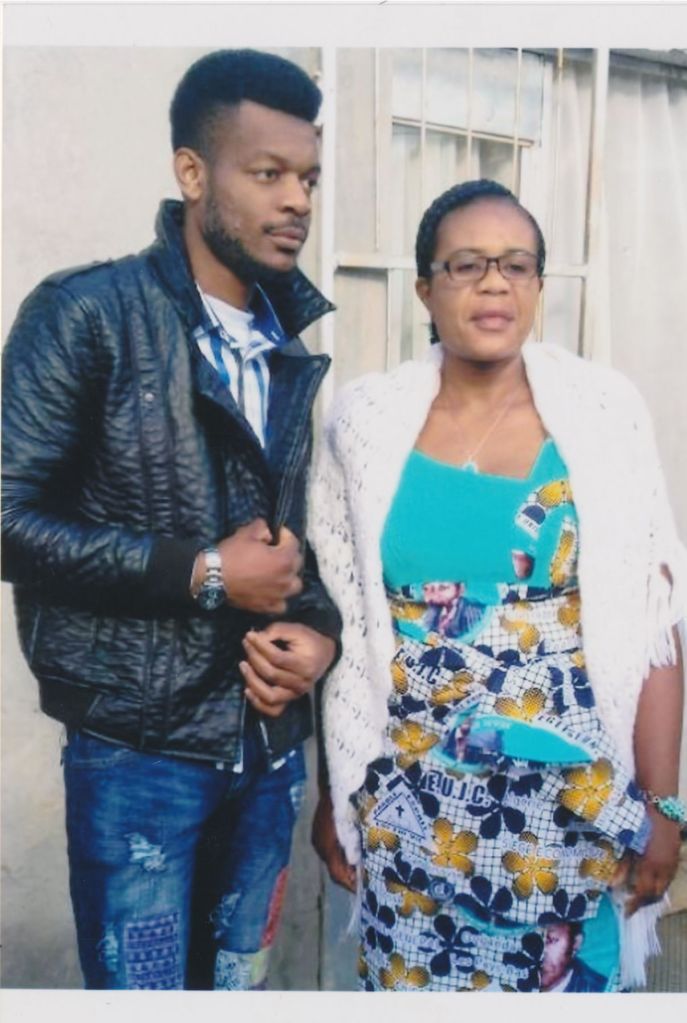
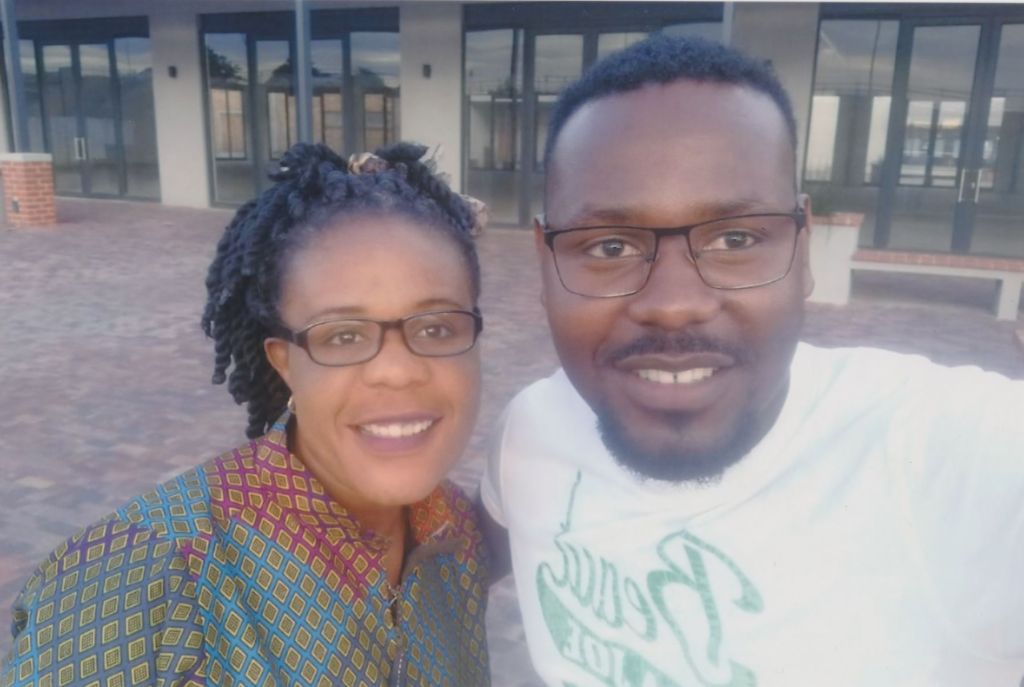
With The Escape from Lubumbashi (published by Unisa Press), author Estelle Neethling tells a story that she felt compelled to share especially of this particular woman and her excruciating journey and circumstances to find a life and home for her family. And more than ever, this is the time to share the stories of refugees she tells DIANE DE BEER :

When author Estelle Neethling first met Adolphine Misekabu, her dignity and obvious honesty struck her forcibly. “From the very first time I saw her sitting in a makeshift classroom at a refugee centre in Cape Town in the mid-2000’s, teaching refugee children,” she says.

At the time Neethling was working for the South African Red Cross Society as the national tracing coordinator (restoring of Family Links Programme, International Committee of the Red Cross).

When the South African Red Cross, where she was based in Cape Town, relocated to Pretoria, she chose to remain in Cape Town. “I felt the need to write about the hardships of the genuine refugee, something I came to know all too well during my 10 years working in the refugee sector, my main mandate being to restore family links in cases where people had been displaced due to conflict and political turmoil over which they had no control.”

She was especially affected by the sorrow felt by women and children. And this is how her book Escape From Lubumbashi: A Refugee’s Journey On Foot To Reunite Her Family was given life.

“My life-changing ten years at the Red Cross also made me realise that there are other forms of displacement and I needed to explore and come to terms with my own personal history of emotional displacement,” she explains.

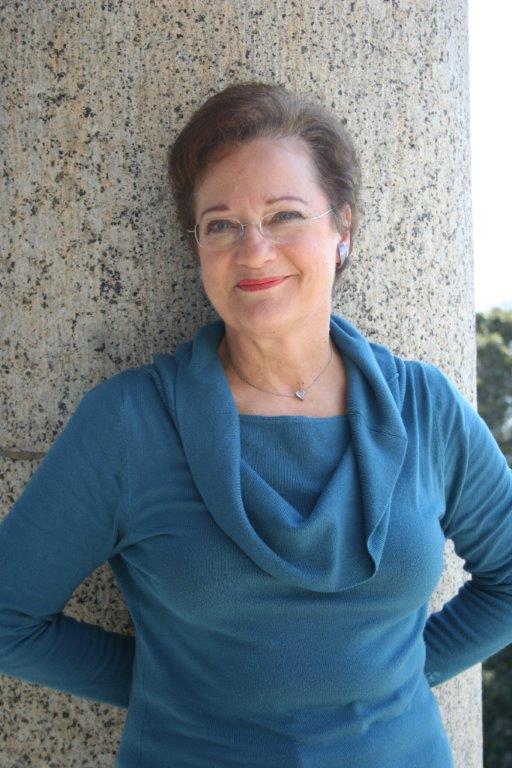
The author Esteller Neethling.

“Because Misekabu’s story so poignantly represents what the refugee goes through, I wanted her story to be ‘out there’, to combat the scourge of xenophobia so rampant in the world, but particularly among our communities in South Africa. It can be said that displacement – brought even more into focus because of the Covid-19 pandemic – is the theme of our time, second only to the ravages of World War 2.”

And fortunately or so it seems, the world is very slowly waking up to this reality with books like these and more and more real-life stories emerging. It is becoming harder and harder to simply ignore.

For Neethling this dignified woman’s story reflects the power of the human spirit to combat unimaginable challenges. “When Misekabu was finally reunited with her husband, Sepano, in Cape Town after almost two years through a confluence of circumstances, some kind of synchronicity that baffles me to this day, she suffered enormously because of cruel xenophobic attitudes, including the 2008 xenophobic violence that raged in South African for many months.”

And when you read her story, at this stage, this young woman had endured and survived what most of us will never see or experience in a lifetime. In fact, it’s impossible to understand how she motivates herself to keep going. That took willpower and courage, something not asked from many of us

“Emotionally drained at times due to the humiliation inflicted by local people and crime she encountered here after her gruelling search for her husband all the way from Lubumbashi in the DRC, she remained undaunted,” writes the author as she highlights Misekabu’s strength of character. And that’s what it takes once you’re part of that world, one you’re not a willing part of – but without any choice.

“In trains and on buses, when she was called amakwerekwere and other derogatory names, she would speak out: “Excuse me. Are you talking to me? Forget about other people’s business. Think development!” In telling me, she’d add, with eyes flashing: ‘I didn’t come to Cape Town to give up’,” explains Neethling.

She knew that this was a story that needed to be told. But she was also aware of the responsibility towards Misekabu to honour her truth. She was especially aware that she was delving however respectfully, into the life of a highly traumatised human being who had lost all her family, except for her baby, her small brother and eventually her husband.

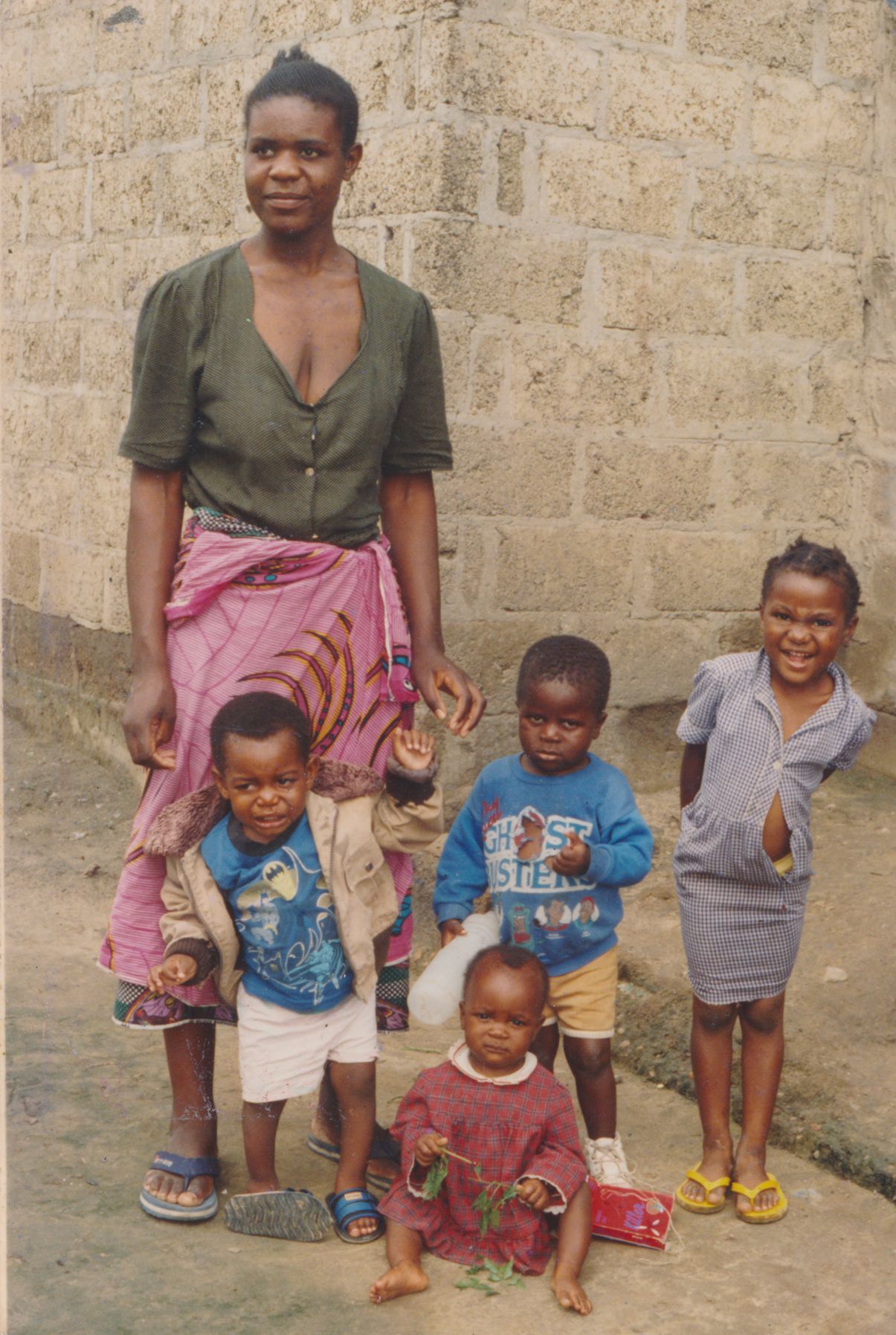
Adolphine in the Meheba-camp in Zambia.

She explains that the enormity of this remarkable woman’s loss was due to the First Congo War during which Mobutu Sese Seko’s ruinous reign destroyed innumerable lives. “Probably only my work with people in crisis made it possible for me to take on such an onerous task, albeit with the utmost respect and sensitivity.

“Misekabu immediately agreed when I initially approached her. The problem of re-traumatisation was always foremost in my mind, but slowly we pieced together her story, because there were times when I needed to do extensive research regarding the history of the times she lived in as a Kasaian, and a member of a family which was persecuted by Mobutu’s army and the factions which supported him.

“Her enduring love, especially for her dead father shone through all our interactions. Nkudimba’s name means ‘man of peace’ was a trained doctor, an internationally recognised artist and a leading politician in opposition to Sese Seko, who had disappeared mysteriously months before she and Sepano had to flee Lubumbashi in 1976.

“Our interactions over four years, with a few intermissions when I had to earn my daily bread, were of course often emotionally draining for me. Undoubtedly these intermissions gave her respite from verbally relating her memories. However, she expressed that our work together had had a healing effect on her. But of course that is an ongoing process,” Neethling stresses.

The impact of reading  her story is one of admiration but also trying to understand why such a gruelling journey, probably the toughest you could ever make on every level possible, is turned into even more of a nightmare because of the impossibly difficult hoops refugees are asked to jump through when applying for the necessary status.

Neethling explains that there are organisations which assist refugees as best they can, but the process to obtain refugee status is gruelling, shared with migrants, persons who have come to South Africa ‘in search of a better life’, some whose goal is to be resettled in an overseas country of their choice.

“The Department of Home Affairs needs to deal with applications to become, first, an asylum seeker, secondly, a recognised refugee and, if it is the final goal, to seek permanent residency. The road to the latter is arduous, very long and not easily achieved.”

And she explains further: “The ‘refugee question’ is convoluted and many refugees become desperate. Some do ‘fall through the cracks’ or remain in the country illegally. Refugees often speak of corruption during their efforts to remain in South Africa. Our country has also had its fair share of troublemakers among these ‘immigrants’ or ‘foreigners’, as they are often called, and those who turn to crime, just as one would find in most groups of people.”

Add to that xenophobia which Neethling describes as a universal problem and based on the difficulty diverse groups have of accepting the ‘otherness’ of people who are strangers to the ways of their adopted country. “Lack of respect for human rights, an absence of tolerance, the burning issue of scarce resources and jobs play a huge part in the cruelty on which xenophobia is based,” she notes.

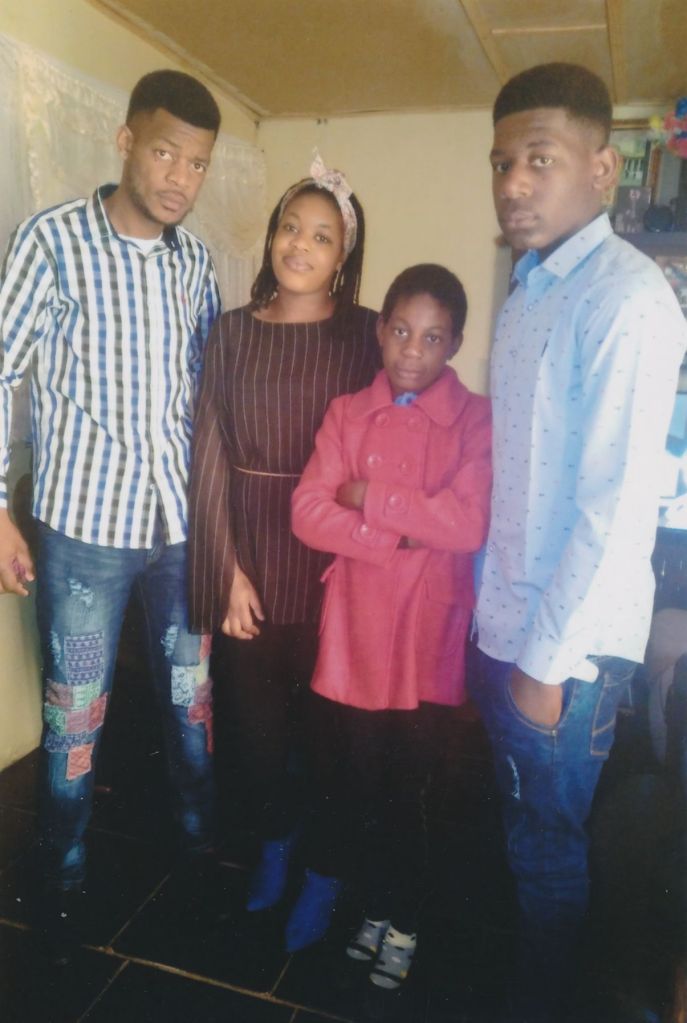
And how is the family doing now? In many ways fortunately after many years of unthinkable hardship and miraculous survival, three more children were born to Adolphine and Sepano.

Adolphine with her brother Joseph who finally has also received his residency papers.

There was much distress when her young brother, Joseph (five when she fled Lubumbashi with her baby, Ilunga, as a 22-year-old woman) was not granted permanent residency with the rest of the family through some bureaucratic error, but after persistent efforts, he is now also a permanent resident.

But that doesn’t mean their lives aren’t still a daily struggle. Despite being a permanent resident, finding stable work is difficult for this warrior woman. “As a strong, confident woman, a trained teacher, she should in my opinion have more employment opportunities. But as it is, she plays a significant part in assisting refugees and in helping local communities to accept refugees,” Neethling says.

She concludes that the world has in many ways become a perilous place, especially during the Covid-19 pandemic and the effect it has on people and the economy. “My hope for the future is that people will stand up for and support basic human rights. All of us have agency – even the most humble among us. Tolerance and a word of kindness to someone ‘at sea’ in their desperation can go a long way in alleviating distress and even open the door to hope of acceptance – and a good life.”

And as a final word: “The journey with Adolphine started in 2010. Writing her story was an experience I wouldn’t change for the world. However, I always knew it would be difficult to find a publisher, because it is nonfiction, although a memoir in many ways, because most of her story is told in her own words. Further, the book isn’t about a famous person or a politician. Therefore, much of the time it took before I held the book in my hands was harrowing.

I have Unisa Press to thank for believing in Escape from Lubumbashi. When all’s said and done, it is in many ways a life’s work that has become an integral part of my very being.”

And in this time when millions in the world are either refugees or displaced people, all of us have to understand exactly what that means.

At a price of R137, the book can be ordered from Emily Monyai at monyaen@unisa.ac.za or from Johannes Morodi at morodjm@unisa.ac.za.

THE BEST TIME TO ESCAPE INTO A WORLD OF WORDS – PLAYFULLY SOMETIMES WOEFULLY PUT TOGETHER BY WIZARDS – FOR US TO DREAM

IF THERE ARE ANY POSITIVES IN THIS TIME OF PANDEMIC, IT IS THE DETERMINATION OF THE WORLD TO GET VACCINATED AS WELL AS THE TIME IT HAS ALLOWED SOME OF US TO CATCH UP ONOUR READING. HERE IS A MIXED BAG REVIEWED BY DIANE DE BEER… WITH MORE TO COME SOON…

KLARA AND THE SUN BY KAZUO ISHIGURO (FABER):

If, like me, in these isolated times youhave been listening to podcasts on books and authors, it would have been tough avoiding Kazuro Ishiguro interviews talking about his latest book, with one also surfacing on DStv’s BBC World.

Klara and the Sun is an intriguing novel and that’s equalled by some of the author’s insight into his own work. He never talks about robots but instead refers to Klara as an AF (artificial friend), with the friend part being that she was specifically created to serve as company for a teenager – which I suspect is perhaps not the easiest thing to be.

For Ishiguro it was about looking at the future through the eyes of an artificial friend who is watching and listening to the people in her/his environment and reacting to their behaviour. And naturally, this is also the way the author can explore certain types of human behaviour in this imagined world he has created. Something he loves doing.

Quoted on the back cover of the book: “Do you believe in the human heart? I don’t mean simply the organ, obviously. I’m speaking in the poetic sense. The human heart. Do you think there is such a thing? Something that makes each of us special and individual.”

And perhaps more than anything, it is this idea about being special and individual that drives Ishiguro in this particular story. He always dives deep in his novels to scratch almost microscopically at specific human conditions and here he is also looking more closely at gene editing specifically.

Once you start fiddling with who you want to bring into the world, we’re talking about a race that might all have similar characteristics – and who decides what those might be? And who would love to live in an homogenous world like that?

But also, what makes humans so fascinating is their flaws and what they do with them. Choices – for those privileged enough to have those – are what most of our lives are driven by and whether we make the right ones. But for whom?

And typically Ishiguro, while he does concede that this novel offers “pathetically futile hope”, he has no solutions or comments on what he thinks about particular problems. He is simply guiding you down a particular road and asking the questions, hoping to make you think.

What is left unsaid (and these silences, he says, are as much work as what has actually been written) is often where he wants you to play with your imagination and hopefully in this way his other desire is allowed to prosper – that the novel lingers and lingers.

And while he is playing in the future, it is one that is plausible. With everything happening in the AI world, much of what he is writing about isn’t far-fetched. Just think of the pandemic, for example, and fully automated restaurants or the speed at which everything medically is happening.

So as Klara stands in the shop window watching the people go by, her observations might just echo those of the people who made her, but once that is fiddled with, how far can we go? That’s why the question –  poetic as it might be – about individuality becomes important and quite scary.

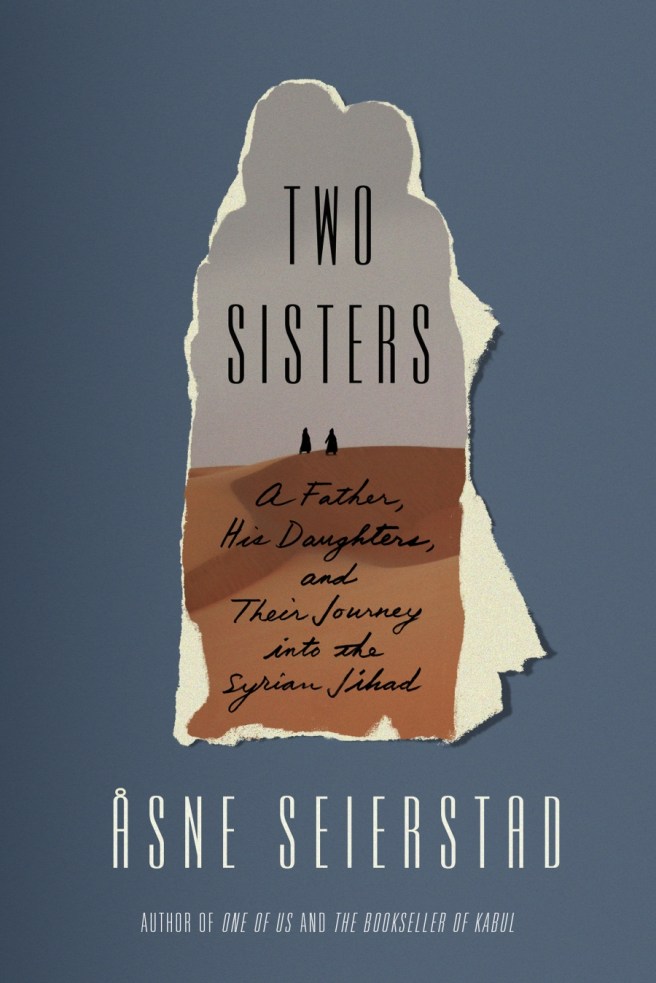
TWO SISTERS: INTO THE SYRIAN JIHAD BY ÅSNE SEIERSTAD (TRANSLATED BY SEÁN KINSELLA) (VIRAGO):

The previous book I have read by this author, One of Us, was about the massacre of young Norwegians, which was also turned into a film. While I found it fascinating, like reading a documentary (which is what it is), I also thought that it could have done with some editing as some things were dealt with in such detail it felt almost as obsessive as the shooter. Perhaps that was exactly the point.

Yet it also showed that Seierstad is a remarkable journalist and her attention is drawn to events that affect especially her own society.  Because of their seemingly successful country, the story and how it unravels reaches across borders and nationalities in a way that captures the terrifying modern world we live in.

Think, for example of Syria, and what has been happening in that country these past few years. For quite some time it dominated headlines, starting with the Arab Spring, but with Covid, you hardly hear anything more about that failed state, which seems to have collapsed. Not only in their world but also in the eyes of those of us who pay attention to what is happening in the world.

Dying has been happening all around us and those embroiled in particular struggles starting pre-covid seem to have taken a back seat – like Syria.

As the title explains, Two Sisters deals with two siblings who travel to Syria to participate in the jihad. And a father sits drinking tea and thinking about his two young daughters. Who would even have imagined that they would want to wage jihad?

In October 2013, teenage sisters Ayan and Leila Juma leave their family home near Oslo. Later they send an email to their family confessing that they are on their way to Syria. They had been planning their “escape” for months –  in secret.

 Think of any family and what they would do if two young children decide to go to a war zone where they join ISIS, at the time and still regarded as one of the most deadly groups operating in what they view as vacuums in many different countries.

While Ayan and Leila’s father decides to follow them to try and bring them back home, by the time he reaches Turkey they have already crossed into Syria. Their story is followed through email and phone contact with the family, who worked closely with the author.

What turns this into such a fascinating read is not only the journey of the two girls and the family tragedy that unfolds as lives are shattered, but also the detailed story about Syria. What is unfolding in what started as part of the Arab Spring is still in progress with no end in sight.

Anyone just watching who says they know what is going on in that tragic war is probably delusional, but at least when reading the tale of these two young women who hope to find a future with men they have never met, embroiled in what some consider a holy war, throws some light.

I just remember watching the fall of Aleppo  ̶   at the time the largest city in Syria being turned into rubble. And when you read about the father crossing into Syria from Turkey and how the family’s funds were being wiped out, another tragedy is playing out just on this border. As with all war, someone is making money.

One can only read in horror as these two young women set a series of events into motion. How could they not? What family does just allow their daughters to slip away …

But that’s the world we live in.

DIE DAO VAN DAAN VAN DER WALT BY LODEWYK G. DU PLESSIS (TAFELBERG):

If you’re steeped in Afrikaans literature, you’ve probably read this one, which won among others the UJ Debut Prize, the Eugene Marais prize; the WA Hofmeyr Prize; the ATKV Prosa prize and the kykNET-Rapport prize for fiction. He didn’t leave much for anyone else in 2019.

But I came to it late and only then discovered that the author was writing under a pseudonym, but had revealed who he was when becoming a serial winner of many of the book prizes available locally.

He fooled me in many different ways, the first being that I so fell for his description of Daan that I didn’t want to read further. It not being my favourite kind of man, I mistook the character of Daan for that of the author. Took me a while and a sheepish grin … I have done this before when something is one of my personal bugbears, so much for objectivity.

Nevertheless, I fortunately spotted my feet of clay and made a u-turn. The language was the thing that initially grabbed me. It’s something that has been popping up all over the show in Afrikaans literature and I’m no specialist in this particular genre, but when a book makes strong enough waves, I jump.

Those fearing for the loss of their mother tongue need not fear, it has been given wings, I suspect –  slowly but surely. Readers especially those as sporadic as this one, are reaping all the benefits. Because it is such a young language still, it has always been the playground of the creatives and gloriously so. It is wonderful to experience the celebration!

But back to Daan, the title is actually your guiding light as it tells you that we are going on both a physical and spiritual journey as the ageing widower and father of two sons reviews his life and the people who were a part of his daily existence – amongst others his wife, whom he starts writing to.

Before too long, this reflective debut novel worked its magic and the praise heaped on it came as no surprise. So if you don’t want to miss out on the important stories that emerge from our country, this is one of them and a most novel and invigorating way of reflecting on a life.

NIGHT FEEDS AND MORNING SONGS – HONEST, FIERCE AND BEAUTIFUL POEMS ABOUT MOTHERHOOD COMPILED BY ANA SAMPSON (TRAPEZE):

With no children of my own and way past my sell-by date, I was stunned that the publisher thought I was a candidate to review this one, but on closer reflection and paging through the book I saw some method in the madness.

The  compiler/collector probably says it best:  “Poetry was a luxurious comfort to me during the newborn days when my bone-deep exhaustion rendered reading a novel a wild and distant fantasy. It was something I could gulp down during a night feed, or while liquidising a blameless vegetable. These poems granted me windows into other dark bedrooms and, when I read about infant-speed toddles, I could see something of our own haphazard progress reflected there.

“As the years passed, I squirrelled away more of these verses. In the company of these poets, I could forgive myself the piled laundry, the toast-for-tea, the not-now-I’m-busy’s and the school-run screeching.

“They helped me to approach some of the tender feelings often buried under the avalanche of weaning and wiping, cheering or chivvying, and give them a moment – those quiet moments that are for some years, so few and precious – to be felt.

“These women invite us into their homes and their hearts, and we understand ourselves- and this deep, wild, ever-evolving bond – better for hearing the voices.”

All of us, with children or without, have had those periods of time where nothing you do gives you enough time to catch up. And especially for young mothers, this is a soft reprieve embraced with the words of other worthy souls, who share their innermost thoughts about something those reading have experienced or might in the future. It’s a great idea. I would have liked a touch more diversity and yet, now we know the gaps, we can look for something to augment that. Or perhaps a local poet or lover of poetry can compile that book, which speaks from all corners of our country and show what we mean by diversity!

WITH HIS LATEST EXHIBITION WORD/WOES, WILLEM BOSHOFF GETS THE WORLD READING

It’s glorious to know that one of our most exciting and enchanting artists Willem Boshoff is currently exhibiting in the Javett Art Centre at the University of Pretoria. DIANE DE BEER tells more:

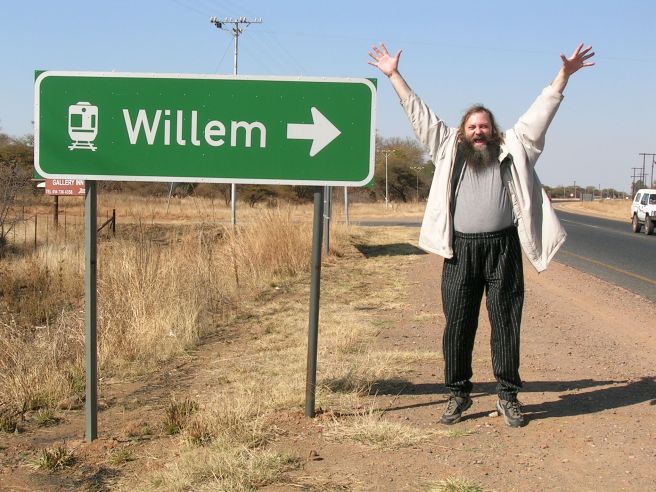
No better introduction of Willem Boshoff possible!

When genius artist/wordsmith Willem Boshoff appointed Hélène Smuts as his curator a few years back, his instincts were as savvy as his art.

Bless the Javett Centre that in these tough times they had one of the few art exhibition openings worthy of a creator of Willem Boshoff’s calibre.

And with the wealth of experience of the curator and artist combined, they have stretched this one to early January 2022, so that South Africans will have more than enough time to experience both the earlier and latest work of one of our most exciting artists. Also keep an eye out for all the events, workshops, launching of an extensive catalogue, druid walks by Boshoff, all of which will be announced and will be huge fun to engage in.

Willem Boshoff’s BLUE close-up of making process

The exhibition (as the press release states so succinctly) Word Woes is a retrospective of works spanning the duration of  Boshoff’s artistic practice. The exhibition title, taken from a signature work by Boshoff, is understood in English and in Afrikaans. In either language the two words look identical, but their meanings differ sharply. Read in English, the title WORD WOES bemoans difficult issues around words and language. Read in Afrikaans, the same words liberate, prompting us to let go and be wild.
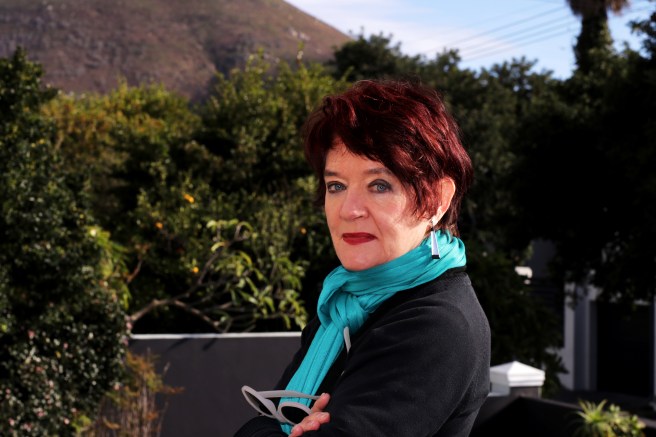
Detail of Word Woes etching (2014)

And so it goes with Boshoff’s art. It is as awe-inspiring as it is accessible, and huge fun as the artist works with words in a way that is genius while those who look, first have fun with the vocabulary and then get lost in the artwork and the way the artist produces something so spectacular. His work is always detailed and can take the viewer exploring indefinitely.

He has already moved on, he says. Busy with approximately 30 works currently, he had a breakthrough that morning (of the opening) and was itching to get back to test his solution – something that will probably brilliantly bewitch viewers in the future.

Boshoff’s concern according to the curator and entrenched in his work is often with the context in which we receive language and the power it yields to exclude or to privilege. He uses unconventional tactics, she points out, to challenge the use of language as an instrument of cultural identity or exclusion. He describes all his works, whether sculptural or graphic, as conceptual books. That’s why it needs time to view as you not only look at the work but also read the different “books”.

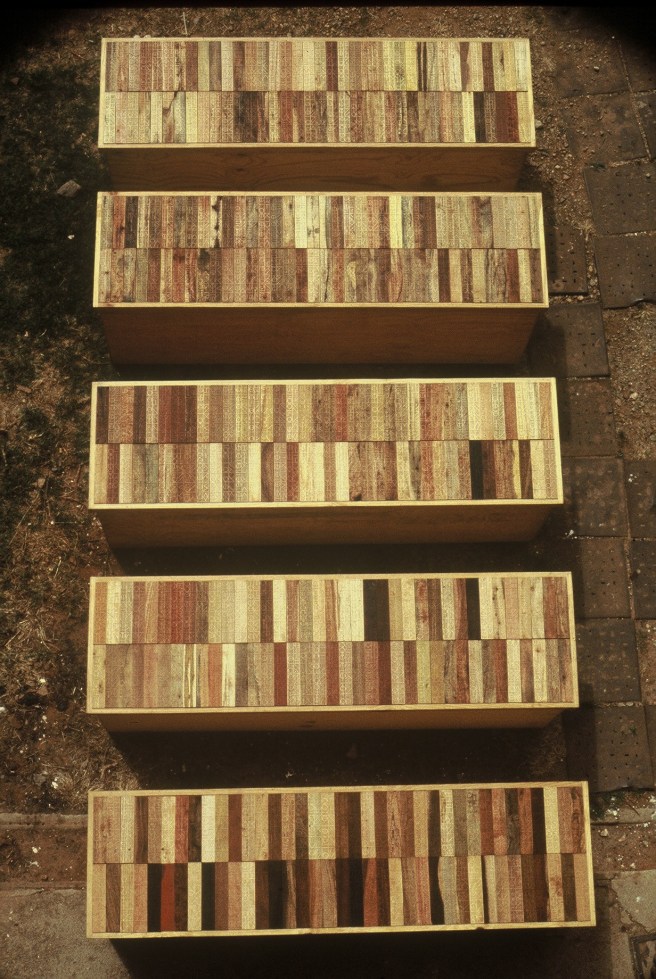
City Book

As art writer/critic Dr Johan Myburg, the opening speaker noted: “Although meaning (what does it mean?) is an important aspect of Willem Boshoff’s art – in order to get the meaning, to get the hang of the words, requires a performative input from the viewer (the viewer has to change his or her position: either to under+stand or to vêr-staan or to get up close to (I am thinking of Abamfusa Lawula)) – the presence of the artwork – from the earliest aluminium Cube to the recent Blue, made from wood, cut paper and glue – has the ability to communicate immediately. In the words of the poet TS Eliot: ‘genuine poetry can communicate before it is understood’.

It is the way he states his case – not with the obvious but in a way that is often playful yet deadly serious in message.

Myburg also explains that WORD WOES/WORD WOES (and a preamble to this current exhibition as are many other works), the mural made in Richmond in 2018, has been dedicated to a fellow artist, the writer Karel Schoeman – known for his novels (translated) such as Promised Land, Another Country and This Life.  He died the year before in 2017.

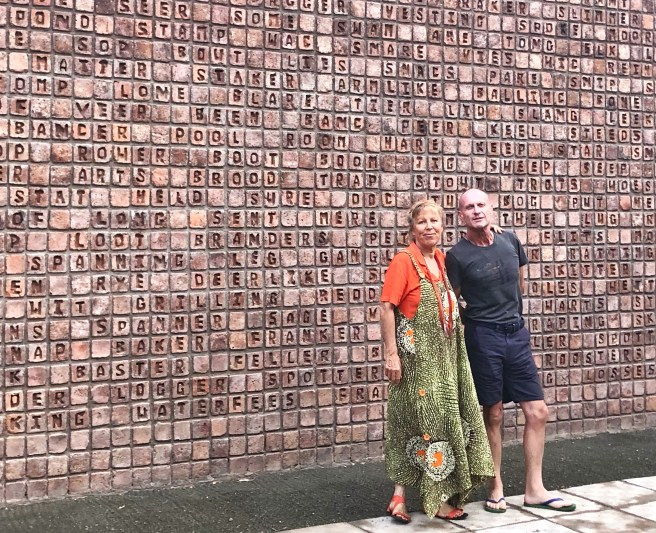
In front of the word wizardry of artist Willem Boshoff at MAP

The similarities between these giants are remarkable, says Myburg in his speech. “Both Boshoff and Schoeman are writing with stones and slabs of granite, both are writing with thorns and sand.  Both are employing words searching for meaning, for double meanings, for hidden meanings, for meaning lost in translation. Both are employing woeful words to lament the lack of meaning. Above all, both require to know: What is the meaning of it all.”

And that, he says, is what Hélène Smuts as creator, translator of meaning, states so clearly with this remarkable retrospective exhibition.

“The ability to marvel – and not to know for sure.

The ability to doubt woes – without any one firm belief.

The ability to question, om te bly torring, to unravel, om te ontrafel.

Die vermoë om te speel, om te goël, om woes met woorde om te gaan. (The ability to play, to cast a spell, to work fiercely with words.)


And then concludes: There is only one Willem Boshoff.”

 And it takes one poet to recognise and explain another.

Smuts elaborates that the wanderings of Word Woes started in 2019 when a smaller version of the current exhibition was curated for the Yorkshire Sculpture Park (YSP) in the UK by Smuts and Louise Lohr (YSP) to introduce the spectacular artist after he had a work included in the YSP’s permanent collection.

As with this current exhibition, the Claire and Edoardo Villa Trust facilitated the Yorkshire exhibition after Boshoff had received the trust’s award in 2018. And with this current one,also co-sponsored with the Matthias and Gervanne Leridon Collection.

Smuts explains that she has expanded the curatorial focus “to a locking and unlocking of knowledge and meaning through the artist’s life-long exploration of language”.                          .

A supporting educational and public programme will offer guided tours, school/student workshops, printed educational resources and weekend events with invited guests.​ Watch this space. It will be worth watching out for walkabouts with the artist talking about his work. He is as much an artist when he talks.

Willem Boshoff Druid Walk Main Reef road (2010)

Venue: The Javett Art Centre at the University of Pretoria, 23 Lynnwood Road, Hatfield, Pretoria. https://javettup.art/contact for more detail. Open daily from 10 am to 5pm and they have a number of free entrance days throughout the year  listed.

Guided tours on the hour from 1pm to 4pm.

To book for tours email: bookings@javettup.art

IN A TIME OF ISOLATION, GOOD BOOKS ARE YOUR MOST COMFORTING COMPANIONS

Some brand new, some around for a few months and all worth reading as writers watch and write about their world and develop the ideas that they think are worth turning into stories. DIANE DE BEER reviews:

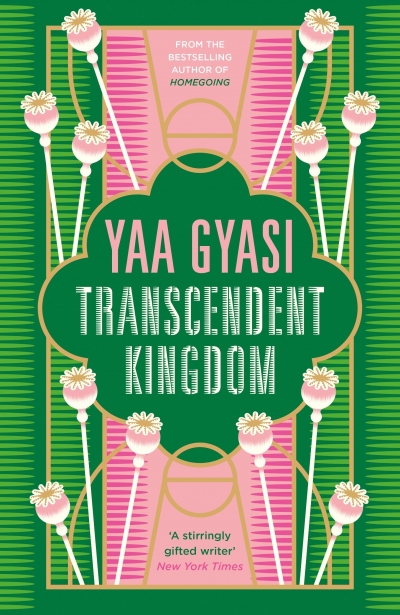
TRANSCENDENT KINGDOM by Yaa Gyasi (Penguin Viking):

If you’re familiar with Yaa Gyasi’s Homegoing, you will know she has a unique voice. With her latest, Transcendent Kingdom, dealing with Gifty’s family journey, which takes them from Ghana to Alabama, you know it will be a story dealing in extremes. The two places are much more than continents apart.  And that is how Gifty’s family splinters apart, with each one of them trying their best to hold on to some kind of sanity. Halfway through the book, Gifty explains: “I miss thinking in terms of the ordinary, the straight line from birth to death that constitutes most people’s lives.” It’s not that the writer is dealing in the extraordinary – many families bump into this kind of hellish existence – it is Gyasi’s storytelling and the way she scratches around for deeper meaning reaching far wider than just this single immigrant family.

DIE HEELAL OP MY TONG by Anoeschka von Meck (Penguin):

Anyone who has spent any time with this author will know that much of her protestation  about this not being autobiographical will fall on deaf ears. It is as close to her life as is possible. And apart from the fact that she describes this as “bisaro-fiksie” which is directly translatable, she also dedicates the book to her father whose name an older generation might remember. But read the book. Von Meck isn’t only a gifted and imaginative storyteller, her way with the Afrikaans language is astonishing. “Die is ook die storie van Pa. ‘n Lagslimme Afrikaanse Al Capone, wie se innoverende sakeondernemings  hom soms gedwing het om sy kantoor van agter tralies te bedryf.” The author is on a quest to outrun her body, the baggage she carries from her past, and a life she tries to get a grip on – with not much luck. Personally, I felt she could have lost the italic bits at the end of each chapter dealing with another realm completely, but you need not include that in your reading. Her language alone will take you helter skelter on this gloriously madcap journey.

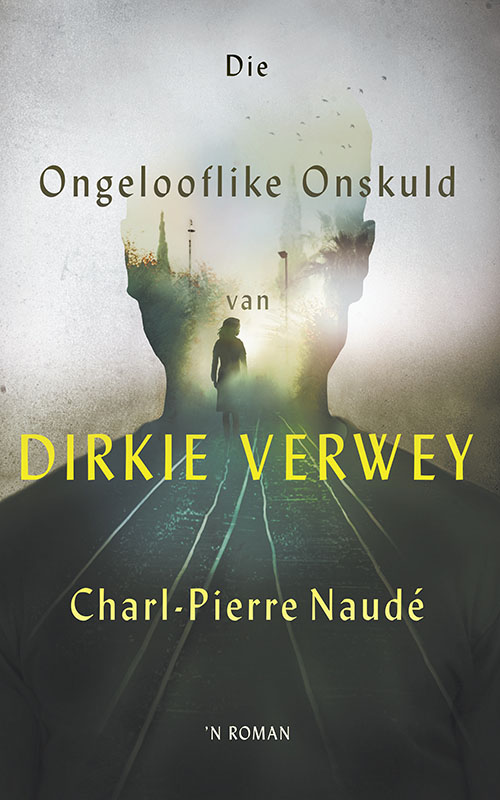
DIE ONGELOOFLIKE ONSKULD VAN DIRKIE VERWEY by Charl-Pierre Naudé (Tafelberg):

A mysterious metal monolith has appeared in northern Romania … reads a story in these past months as a number of these strange structures have been noticed around the world, only to disappear as soon as they are noticed.

Similarly, in Naudé’s novel, or the one written by a certain journalist named Hermanus Verdomp who has distanced himself from the manuscript, a certain building suddenly makes an appearance in a town on a previously desolate plot of ground.

And the ground is constantly shifting for the characters and the reader as you navigate this fascinating tale of a country which seems to exist in another universe.

Much has been written about this country’s horrific past, but when a writer finds a novel way to tell a story that everyone knows or think they know and navigates what many may view as tired territory in such a way that it grabs even reluctant readers, you discover something quite extraordinary.

This is the highly praised poet’s first novel and again, if you only read it for the language, the way sentences are constructed, the way the language creates its own pictures, the choice of a word or an idea and the characters who emerge with strong beating hearts, you will have a fantastic time.

But there’s even more. And while he’s dealing in horror, he deftly keeps you smiling most of the way.

AFTERLAND by Lauren Beukes (Umuzi):

I know this review is after the fact but the thing about Beukes is that she pre-empts life, and then it happens. She has this astonishing gift of tuning into the world and its zeitgeist in a way that’s quite uncanny.

She’s also a fabulous writer. Not only does she write about a world dealing with a pandemic but she also taps into #metoo and all the gender and sibling issues one could dream of. We live in a cruel world and she uses all those issues to tell a story of a mother who wants to protect her child from a world where the men have all gone – except for her young son.

But also trust Beukes to turn things on their head and make men the most sought after commodity – just as they are seemingly not that much in fashion.

It’s a grand romp and one that keeps you entertained throughout – bar the nuns who seemed to take up just too much space.

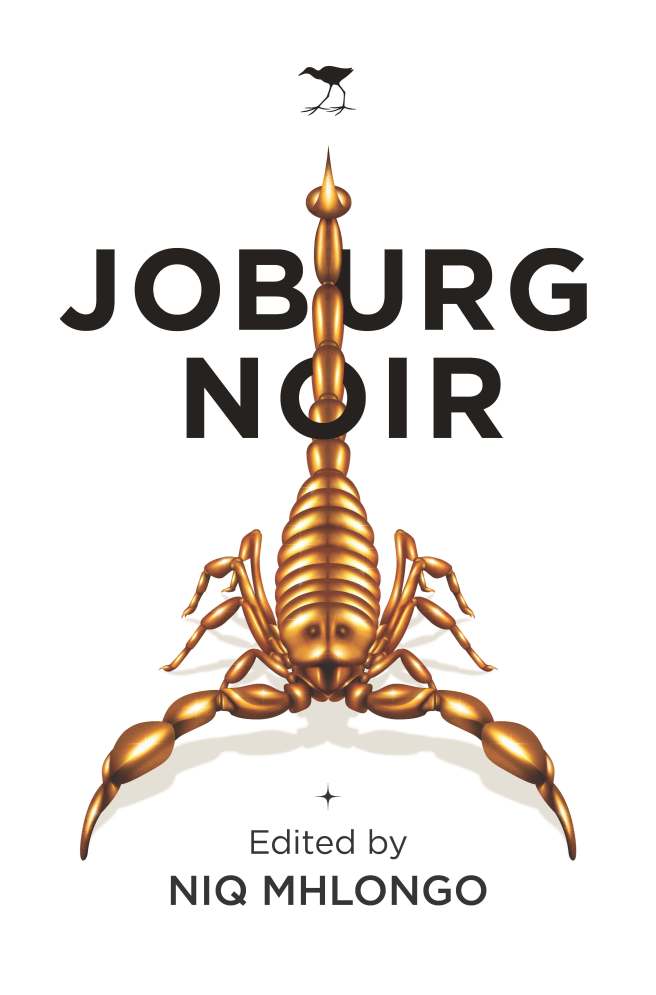
JOBURG NOIR edited by Niq Mhlongo (Jacana):

As good a writer he is, he is as smart an editor. In the foreword he explains: “Each time I read the stories, it seems that the whole history of Joburg and its diversity is brought to the fore. The best way to read this book then Dear Reader, is to imagine it was water – let your mind and body float with it.”

The diversity of the writers also play a part as their influence and experience is wide-ranging and determines the writing. But also the title, Joburg Noir lends itself to something quite mysterious and the writing plays its part as the stories truly – like the city – run wild.

Writer/editor Niq Mhlongo

The writing is extraordinary, the topics vary magnificently and the city, as the title suggests, plays a bigger role in some than others where it may simply be the backdrop. Not that the city of gold can easily be just a backdrop.

The way a short story book reads is especially handy when on holiday as you can simply read a story at a time without worrying when you open the book again and start with a fresh story. This is one to go back to but also to pass around to family and friends. A great selection.

TRESPASS by Rose Tremain (Vintage):

This was was first published in 2010 and reissued by Vintage this year (2020). While I knew the author’s name, this was my first encounter and what especially appealed was her storytelling ability. She grabs you from the start and her mind goes á wandering in most unusual fashion.

Speak about dysfunctional families, a topic that is never exhausted. Here we have two sets – two extremes. The one is a sister and brother who live in rural France. Aramon Lunel, an alcoholic with a violent past, lives in Mas Lunel with his sister Audrun, alone in her bungalow within sight of the main dwelling. It’s an uncomfortable if slightly mysterious co-existence.

Across the channel, a wealthy but weary antique dealer who is losing some of his celebrity shine, Anthony Verey, decides to visit his sister and her lover, whom he easily dismisses, in the French countryside. Glowing in his sibling’s attention, he decides that this is where he wants to reinvent himself – the French  countryside.

And then he visits Mas Lunel – but the bungalow is an eyesore. It’s an explosive run-up and the conclusion doesn’t disappoint.

Reluctant Author Zoë Wicomb Gets It Right Time After Time With A Story Of Its Time

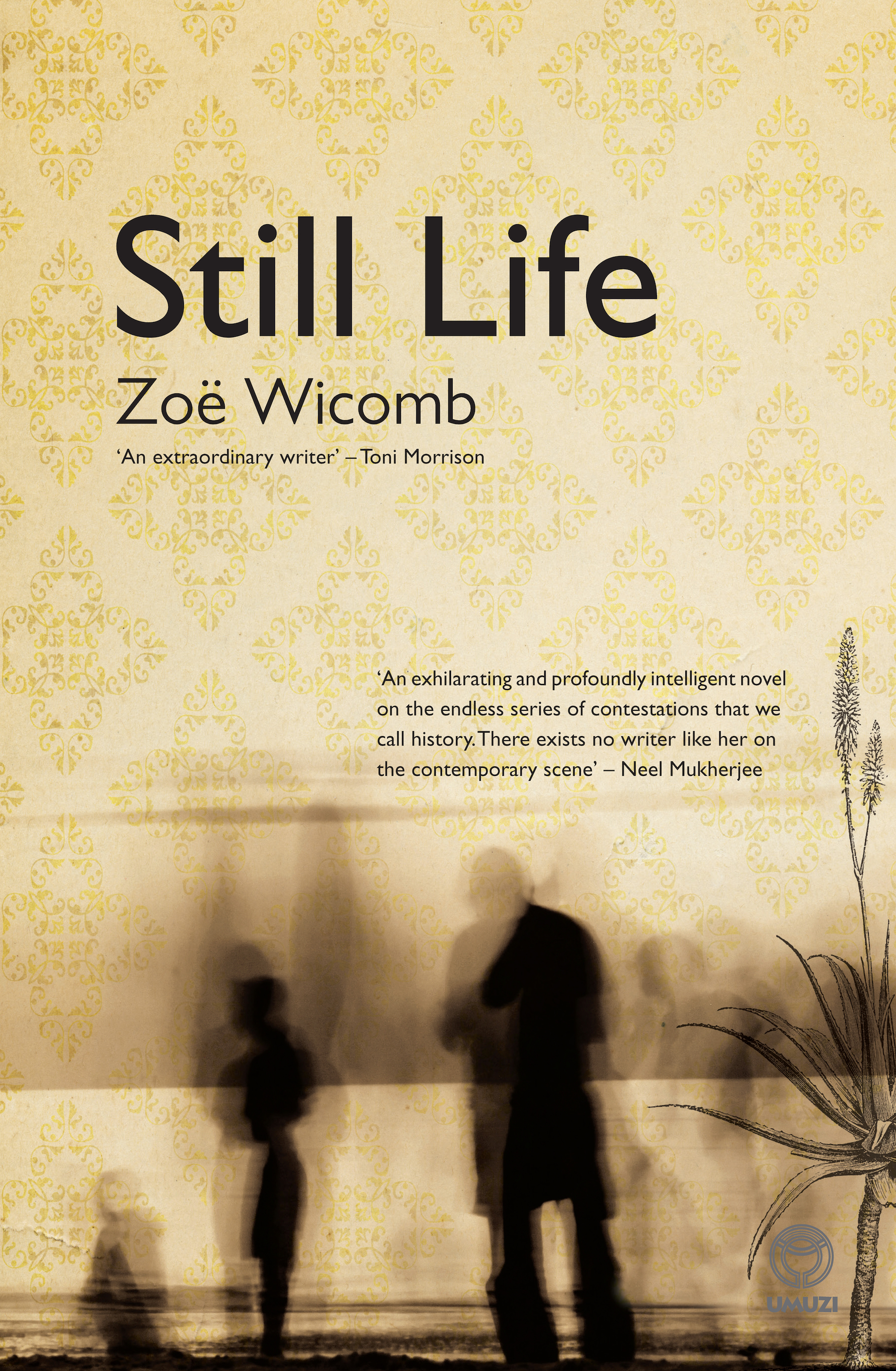
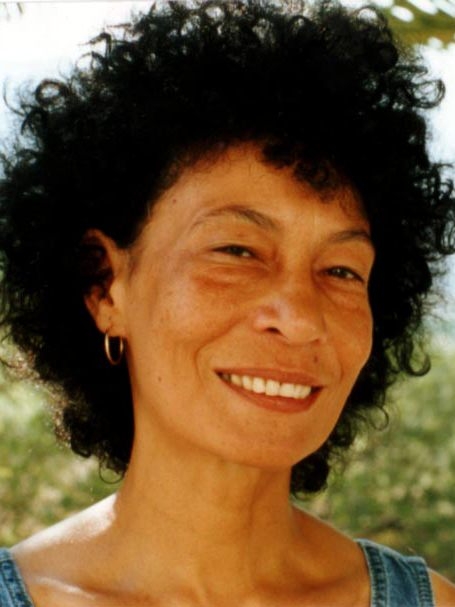
Author Zoë Wicomb has a tough time writing, but once she has an idea, she works at it relentlessly, which results in a read that sits masterfully in its time and plays with the reader’s imagination quite magically. She tells DIANE DE BEER about her latest work, Still Life (Umuzi):

BK StillLife-small

What struck me first and stayed with me while reading Still Life (Umuzi), is the originality with which the story is told.

 Zoë Wicomb, a South African-born author living in Scotland says she has for a long time been interested in Thomas Pringle, “not so much as a poet, but rather in his writings about being a settler and his encounters with native people.”

The blurb on the back of her book describes the Scotsman as an “abolitionist, publisher – and some would say – Father of South African poetry. A biography of Pringle is in order, and a reluctant writer takes up the task.”

But what really captured this reluctant writer’s imagination were his political conflicts in the Cape which seem to embody the problems and contradictions of colonialism.

“But as always my ideas about a subject, in spite of research and knowing much about them, remain inchoate, and with Pringle I really did not know how to write about him,” she explains.

And that is what makes her, reluctant or not, an extraordinary writer. It is in the solution that she tells a fascinating tale.

 “After several false starts, self-reflexivity offered a solution –– I decided to exploit my inability to write, to fictionalise the writer herself, and to make the actual writing of Pringle’s history the framework of the novel.”

And that works magnificently.

What she does is ‘create’ three characters and through them tell her story, which is one smartly centred on colonialism, something that one might think would have been more written and talked about with perhaps much more resolution (and understanding) than currently exists.

She tells the story mainly through Mary Prince, a West Indian slave whose history Pringle had published, the ghost of Hinza Morossi, Pringle’s adopted Khoesan son, and the time-traveller Sir Nicholas Greene, a character she exhumes from  the pages of a book.

Author Zoë Wicomb

How she arrives at this motley crew she explains thus:

“Hinza Marossi, Pringle’s adopted son, was of interest from the outset. Not only is his story recorded in a poem, but I wanted to explore the question of interracial adoption under colonial conditions as well as what that story looks like from Hinza’s point of view.

 “The character Mary Prince was an obvious choice because her slave narrative was the first by a woman. It was published in London by Pringle in spite of opposition and litigation by British people who  benefitted from slavery. He was also reviled by fellow Scottish settlers at the Cape, who persisted with the myth that slavery in South Africa was an altogether more benign affair.

“Nicholas Greene, a character from Virginia Woolf’s novel Orlando (one of my favourite novels) is a more controversial choice, and really I don’t remember how he entered the story. But I was drawn to the fact that he is a time-traveller and to his fictionality as opposed to the other real historical figures. Thus he enabled me to address yet another level of the real within my fictional account. Given that the novel is about the writing of Pringle’s story, Greene also offered another version of the writer.”

Then there also a young woman, Vytjie, a character from one of Pringle’s poems. “According to his notes, she is based on an actual servant. Her perspective on the man therefore differs from that of Hinza who occupies a more privileged position in that household.”

Zoë Wicomb

If that doesn’t have you salivating, this isn’t your book. Even though Zoë notes that the publishers see this as a “difficult book”, that’s not the way it reads.

What she found with her chosen route of exploring Pringle is that the variety of characters enables her to represent different aspects of his life. But she underlines, “although the nature of the story itself is such that no comprehensive picture of the poet emerges; in fact, in my novel the project of writing his history fails.”

But that’s again the reluctant novelist protesting. I beg to differ. What emerges is a far more imaginative reflection on our past with a clutch of characters whose voices of that time are never heard. And for some of us, given the superficially privileged colour of our skin, questioning that is something that only began in larger numbers very recently.

Ask  Zoë about writing and she’s quick to respond how difficult she finds the process. “I’m drawn to a subject, do the necessary research, and then the problem of how to represent that subject arises. A struggle of trying to write something that may or may not lead towards a solution, and really it’s a matter of faith, of believing that something will come out of the daily routine.

“There are periods of giving up on the project, then inexplicably I return to wrestle with my material until finally the first draft shapes itself through the process of writing. Then follows many more drafts, less torturous than the first, in which I straighten out events and try to refine the prose, but doubts about the value of what I’m doing persist ––I am after all not read by many; in fact, my readership is more or less limited to students of Postcolonial Writing.”

But hopefully this one will change that … as it should. It is a tough topic for many but one we should engage and deal with – especially and finally in this time.

She makes it easy to start doing so if you never have. When I ask her about the lighter tone of the writing, her response is as amusing and direct as the banter between her characters: “It is impossible to overlook the comic aspects of white supremacy. Worth representing, I think.”

For readers, who like me, don’t know much about this writer, she left in the heyday of apartheid and made a life for herself elsewhere.

“But,” she says, “you can’t ever think of yourself as belonging in Europe. In terms then of an interior life, I remained South African, through teaching and writing about South Africa – both fiction and literary criticism. I returned for a few years and taught at UWC but then I couldn’t manage the family separation, and returned to Scotland.”

“I imagined that when I retired from teaching, I would live mainly in South Africa, but in the meantime the promise of liberation has been hollowed out and I’m not attracted to the pathologies of historical colonialism that persist. Still, I do spend a couple of months every year in the Cape and return to the north with great reluctance.”

For her sins, she says, she lives in Glasgow, where the awful weather is by no means the worst thing.

“Now having grandchildren means that I’m stuck here, although they’ve done much by way of ameliorating my stay here. I’ve worked at the University of Strathclyde, but have retired as Emeritus Professor.”

And she’s no less harsh about her writing and how she views it. “Having always had a demanding job, I saw teaching as my primary responsibility, so writing, both fiction and critical writing, was something that I did in the summer breaks or during sabbaticals. It is in that sense that I do not think of myself primarily as a writer. Then there is the fact that I find writing so very difficult, so dispiriting for much of the time, that I can’t help thinking that there must be a category of ‘real’ writers who find it less of a struggle.”

Read her book and see how you disagree. I was pulled into the lives of her characters but especially the way she found to tell this very important story of our time. There’s no longer a running away from the past.

And next on her agenda?

“I have not managed a book in the past without self-isolating for extended periods. But it is not a good idea to talk about a next book; in fact, given the difficulty I have with writing plus my faculties being impaired by ageing, who knows if I’ll manage another.”

Here’s hoping…

Changing Lanes, Hilary Prendini Toffoli Turns to Italy and Food for Debut Novel


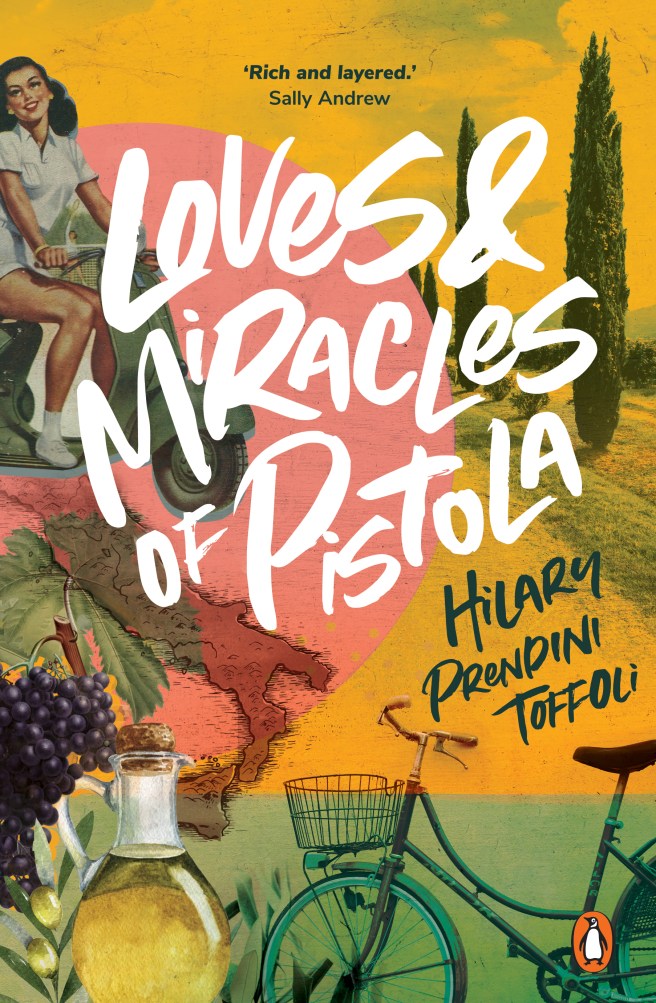
With Covid19 hastening the demise of print media (in this country but also across the world) as we know it, journalist Hilary Prendini Toffoli knew she had to reinvent herself – and she has, in most intriguing fashion. DIANE DE BEER chats to the veteran journalist about her first novel Loves & Miracles of Pistola (Penguin):

“I worked on Pistola on and off for several years when I was a journalist, but it was only when the media industry was really crumbling that I decided to reinvent myself and complete the novel,” explains Hilary Prendini Toffoli (Penguin).

Yet it is something that started even before her journalism career. She had her first short story published in what was then The Cape Argus when she was about 20, a BA student at UCT. Later she joined The Argus and became the company’s first female sub-editor.

Then she moved to Joburg and ran the Star Woman with Sue Grant Marshall (another journalist turned author) doing the Woman’s Page.

Where I became hooked on her writing was during her time as  a journalist for Style (remember them?) from 1983 to 2006 covering everything “from social and political satire and profiles (21 eligible bachelors in one story), to features about high profile local murders and rapes, as well as writing edgy short stories.”

Then she went freelance doing features and columns for a wide variety of publications including Noseweek, Insig, Financial Mail, City Press, Business Day, House&Leisure etc.

For her the move from journalism wasn’t difficult. “Over the years I’d written a few terrible unpublished novels, both here and overseas in my twenties, living in Spain, France, England and Japan, trying to find myself, that old cliché enacted out by a lot of us those days.”

What also came into play were all these interesting characters she’s interviewed over the years which gave her a helluva lot of material. “I think much of it went into the subconscious, to come spilling out when I write. So the process of writing fiction is not for me a case of ‘Open a vein and bleed’ as someone once described it. My MO is more on the lines of what Stephen King says. ‘Put interesting characters in interesting situations and see what happens.’”

She does however make it sound easier than it is. Not all journalists have books in them even though it is also about writing, it is something completely different. Yet those familiar with her work will not be surprised. Hilary’s interviews were special. She had an acerbic eye but was never unkind – funny yes, and capturing the zeitgeist of her time, absolutely. And she never took life – or herself – too seriously.

She is right when she notes in our correspondence that Love & Miracles of Pistola came at the right time. “In these tricky Covid times the book’s nostalgic flavour has given a lift to readers. Plus they love the food angle because they’re all cooking more than ever before. And they love Pistola because he had his own battles and survived,” she reports.

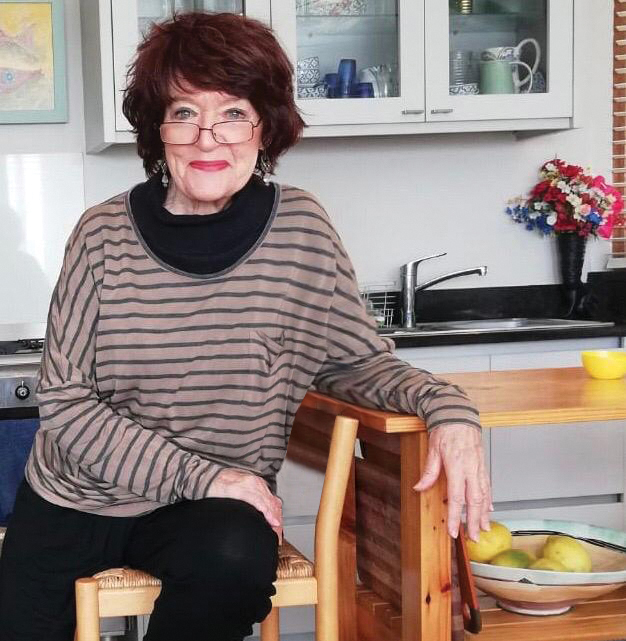
Hilary in her kitchen

The characters of Pistola and his grandfather Nonno Mario first popped into her mind during the long stretches of an Eastern Cape road trip. “I’d wanted to write about the life of my husband Emilio who grew up in a post-war Northern Italian village in the fertile Po Valley with pigs as big as small Fiats, and where people have survived in spite of the battles that have raged for centuries over these maize and rice fields. This was a way to do it.”

But for local readers especially, it’s more than just looking back. It’s also the diversity of our  people – always a South African strength – that captures the reader’s imagination. We’re all lovers of Italian food (and that isn’t an exaggeration), and this is a story which gives us insight into some  of the roots of all that glorious Italian food … today still.

Hilary explains: “At first the story revolved around food and its importance in this place where the daily greeting is “So have you had a good meal?” Then I remembered the piece I’d written for Style magazine on the young Italians brought to South Africa in the fifties as train stewards by the Nationalist Government. I’d got great anecdotes from several who were still here running restaurants.

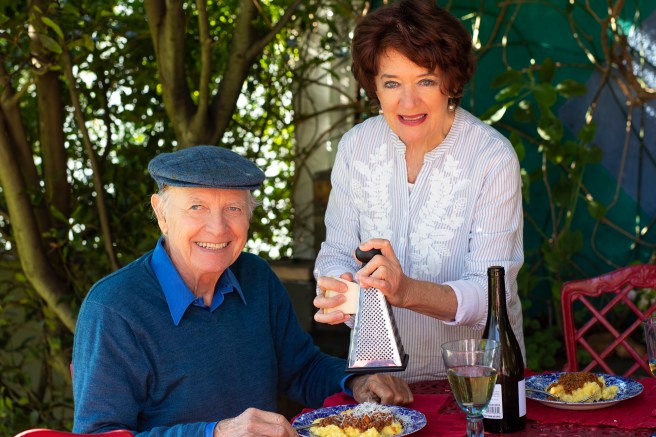
Hilary and her husband Emilio
Picture: Alex Moss

“So I put Pistola into this story and it really worked. I could show that repressive political era through the eyes of these naive young foreigners, most of them in their teens, with Pistola going to places like Sophiatown and the Malay Quarter. For an Italian village boy, South Africa’s increasingly racist laws were a challenge, but also a journey of self-discovery – Pistola’s miracles.”

And she says it herself: “What makes the story particularly interesting for South Africans is the fact that many of those Italians then stayed on and opened restaurants all over the country, introducing Italian cuisine to people whose only knowledge of Italian food was Heinz spaghetti on toast. Places like La Perla in Sea Point gave South Africans not only great pastas and pizzas but also a taste of Italy’s extraordinary range of culinary masterpieces.”

We can all agree when she says that it was the beginning of a love affair with Italy.

What is also evident is that her husband, Emilio, being a great cook, played no small role. At one stage he had a deli in Oranjezicht, and he made most of the takeaway foods. Lasagne, ravioli, cannelloni, gnocchi, parmigiana di melanzane, minestrone, osso buco, chicken cacciatore, pesto Genovese, and tubs of sauce – arrabbiata, amatriciana, napolitana. “Clients loved to come and talk to him about their Italian holidays. It was then I began to realise how South Africans love Italy. Not only the food. Also the art, the music and the picturesque towns and villages with their fountains, piazzas and romantic Roman ruins.”

Personally, she has no Italian blood. “My first encounter with Italians and their culture was on the Lloyd Triestino ships that used to sail between Venice and Cape Town in the sixties. Far cheaper than airflight In those days. Those two-week trips were heaven. Great food and music, and good-looking officers!

“I’m a WASP, born and brought up in Cape Town. My mother Constance Young was a prolific journalist for the old Outspan magazine. She also wrote short stories that won prizes on the radio. So for me writing has been a lifelong obsession. Especially fiction.”

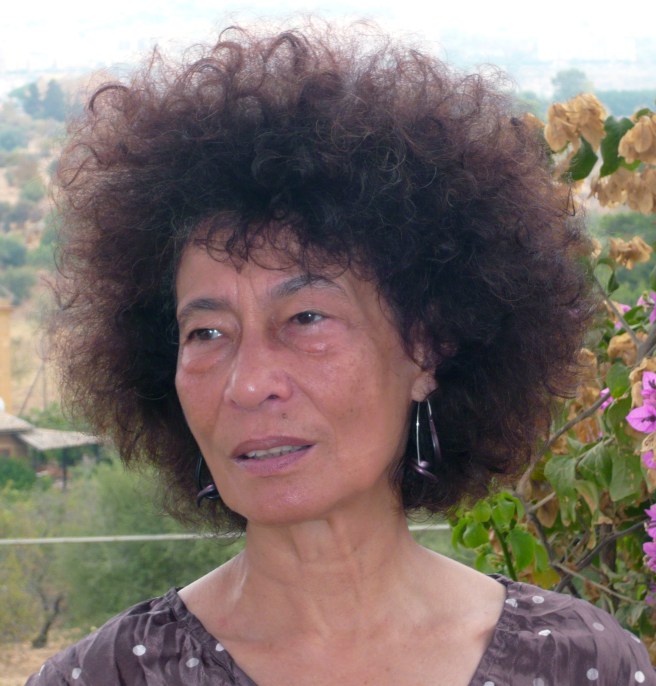
Author Hilary Prendini Toffoli

The book has also been a family affair in other ways. “I was lucky to have my daughter Caterina, a graphic designer with Yuppiechef, do the vibrant cover. 

“Meanwhile I so enjoyed writing Pistola I’ve just finished the second in my Italian trilogy. Not a sequel to Pistola but the story of another young Italian migrant, Furio, an opera-singing romantic with a broken heart and a volcanic core, who finds himself working on the farm of a great white hunter in Kenya at the time of the Mau Mau. Challenging stuff he has to find ways to deal with.”

And that’s done in Hilary’s typical Sjournalist style! While still in the throes of doing publicity for her first, she has already completed the second – and I would not put it past her to be already working on the third.

So start where it matters, and get onto this first one. It’s a great read, informative, and captures a country and its people in a particular time.

NATANIЁL – A MAN ON THE MOVE

Nataniel ToegangMany can argue about who suffered (s) most with the appearance of Covid 19 but few will disagree that artists, who make a living by performing to a live audience, have been hit hard. Even the world’s top concert halls are struggling with no end in sight. One of our most prolific artists, Nataniël, tells DIANE DE BEER how he tries to navigate his career during the pandemic:

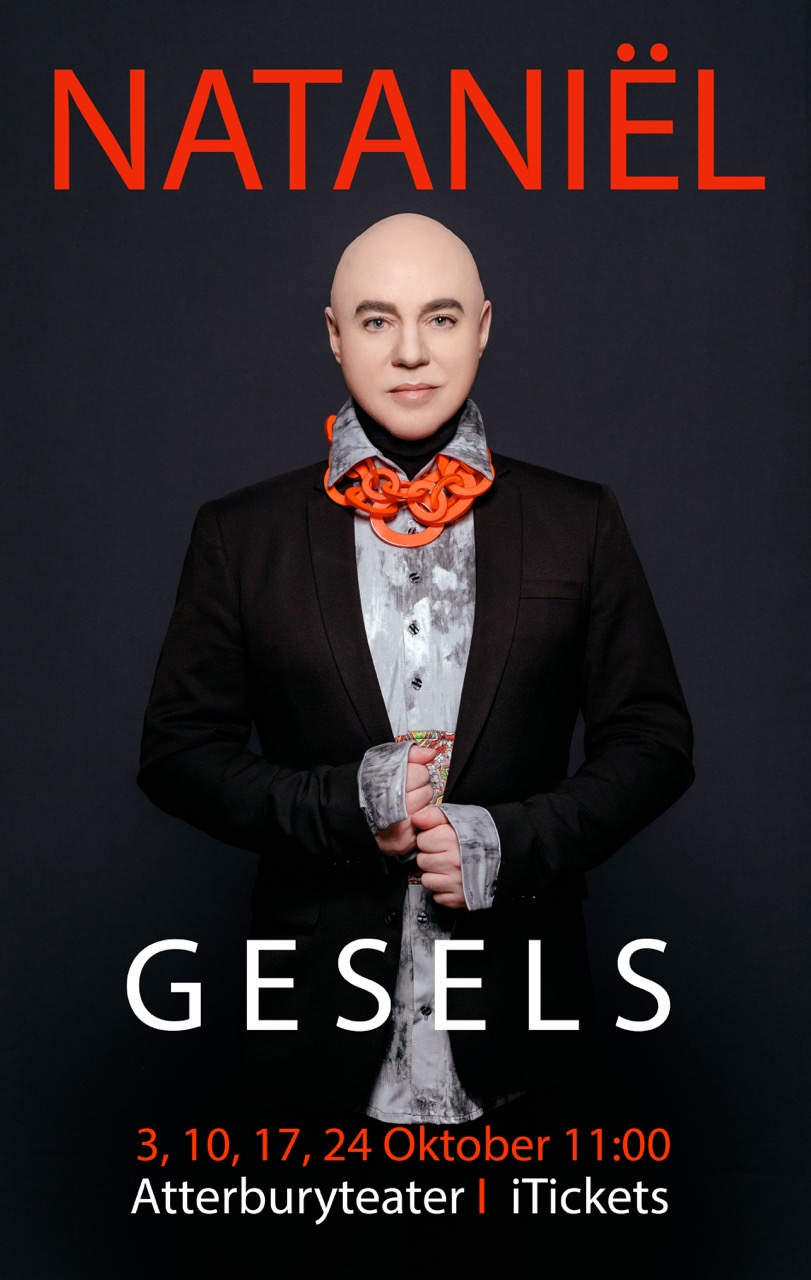
 

 With NANTES KOOKBOEK finishing this week, Nataniël’s latest series, TOEGANG, starts the following week – but getting that done, as everything else during Covid, was no easy task.

“The series originally planned will hopefully be done next year,” explains the artist. “The concept was a logical follow-up to the series shot in Nantes, to be filmed on the original le Roux farm just outside Kuilsriver.”

Things kept changing but because of lockdown and the necessary protocol, Nataniël  had to do some quick thinking when he realised they had to shoot where they all lived. And that was Pretoria.

“The concept came from being alone in my house for months and realising how simply I actually live and how simple my meals were,” he says. For him, delicious food, made in just one pan, became the limit for for washing-up activities. That sorted the food for the series.

He also realised how many gorgeous buildings in the city would be deserted because of the pandemic, buildings he always wanted to spend time in, but not with the crowds that would usually be there. “So I took my pan and a very small crew and went there.”

Speaking about these lightning-fast changes and the way the series had to be shot, he admitted it suited his way of working. It actually meant a spike in his already high-powered creativity levels. “I loved it. We could do what we wanted, all these fantastic spaces gave us the opportunity to create beautiful scenes, film very dramatic visuals and work without disturbances. KykNET let me be, nobody looked over my shoulder and all the strict rules made me feel safe. I had a tough time with the make-up part, because somebody had to touch me, but I bit my lip and got through it.”

Those who have interviewed Nataniël  will know that getting info about an upcoming programme or concert is like pulling teeth. Not the gist of it, but the detail. He is a man who lives for surprises. When you sit down to watch a programme or enjoy a show, he believes the less you know the better. “I tell nobody about the places we went to, that will be revealed in every episode.”

“Tragically there are no surprises on TV since Oprah left, everything is blurted out for marketing, so there is nothing to look forward to.”

But he reluctantly admits that they work according to themes, every episode has an inspired menu for which he got his ideas from the locations, history, plus his life in isolation. (“Apart from going back on stage now, I am still in lockdown, because I love it. And I will wear the mask for the rest of my life, I look fantastic and it is much cheaper than Botox.”)

nataniel oils2

He also introduces artists who made things for the programmes, including artworks, ceramics, fabrics, prints, jewellery and, of course, some surprises. 

And another secret he allows to slip … Very often a local magazine series get an original theme tune, but there rest comes from a library of canned music. “This time I had the opportunity to write and produce a full soundtrack and be in the studio for all the sessions. (With a mask and bottles of sanitiser!) That was a great experience and fantastic to work with all the musicians after months without performing a single note.”

Shooting locally for the first time in some time following a revamp of the Nantes series, was quite strange. “The European visuals are very filmic, there’s a castle or a cathedral or a museum everywhere you turn and you need to do very little to make a scene beautiful. Also finding props here was a challenge as (at the time) many shops were still closed and nothing new had come into the country for months,” always a Nataniël requirement. He hates introducing and showing things people know.

Looking ahead, Covid has given Nataniël  time to think and make some decisions. “First of all I want to dress more wildly. I realised I am still scared of what people think, but the virus took that away.

Nataniel in full colour
Nataniël in full colour

“I will also stop dumbing down musically because of my fears that the audience will not like complicated or eccentric or sophisticated or unfamiliar songs. At the Woordfees in March I performed a very modern cover song with a very abrupt ending and there was absolute silence afterwards. Then I realised nobody in the audience has heard that song yet, although it was a worldwide hit. So I stopped singing it. During isolation I decided, to hell with that, that song will be back in the new show. Life is too short to compromise.”

It’s about time!

Nataniel gesels

Now he needs to get back on stage which, not surprisingly is what he misses most. “I start with GESELS, my lifestyle talk series, every Saturday in October at the Atterbury Theatre (in Pretoria) starting this coming Saturday. Bookings on iTickets.

“Then in November Charl du Plessis and I will finally do our gala concert to celebrate working together for 20 years.” TWINTIG, the gala Concert with Charl, Sunday November 15 at 3pm in the  Atterbury Theatre. Bookings on iTickets. “In December I will stage a new production, as always.” Bookings will also be on iTickets.

He has also launched the LIVE LIKE N collection of healthy cooking oils which can be ordered at https://liveliken.com/. And a new book (a collection of short stories) will be available in October. 

Nataniël has been working on his blog called SmallCoronation.com, which was quietly released recently. “It is all about simple food in beautiful settings, creating atmosphere. I see it as sharing my personal archive with others with all the food coming from dinners at my house.

“There’s no interaction and talking nonsense with people I do not know, just an online magazine to be looked at with a cup of tea when somebody needs a break. No strange ingredients, no modern techniques, just fun, ideas and hopefully inspiration.

“It will be launched with the TOEGANG series next Monday at 8.30pm on kykNET and the English version of all the recipes will also be available on the blog.”

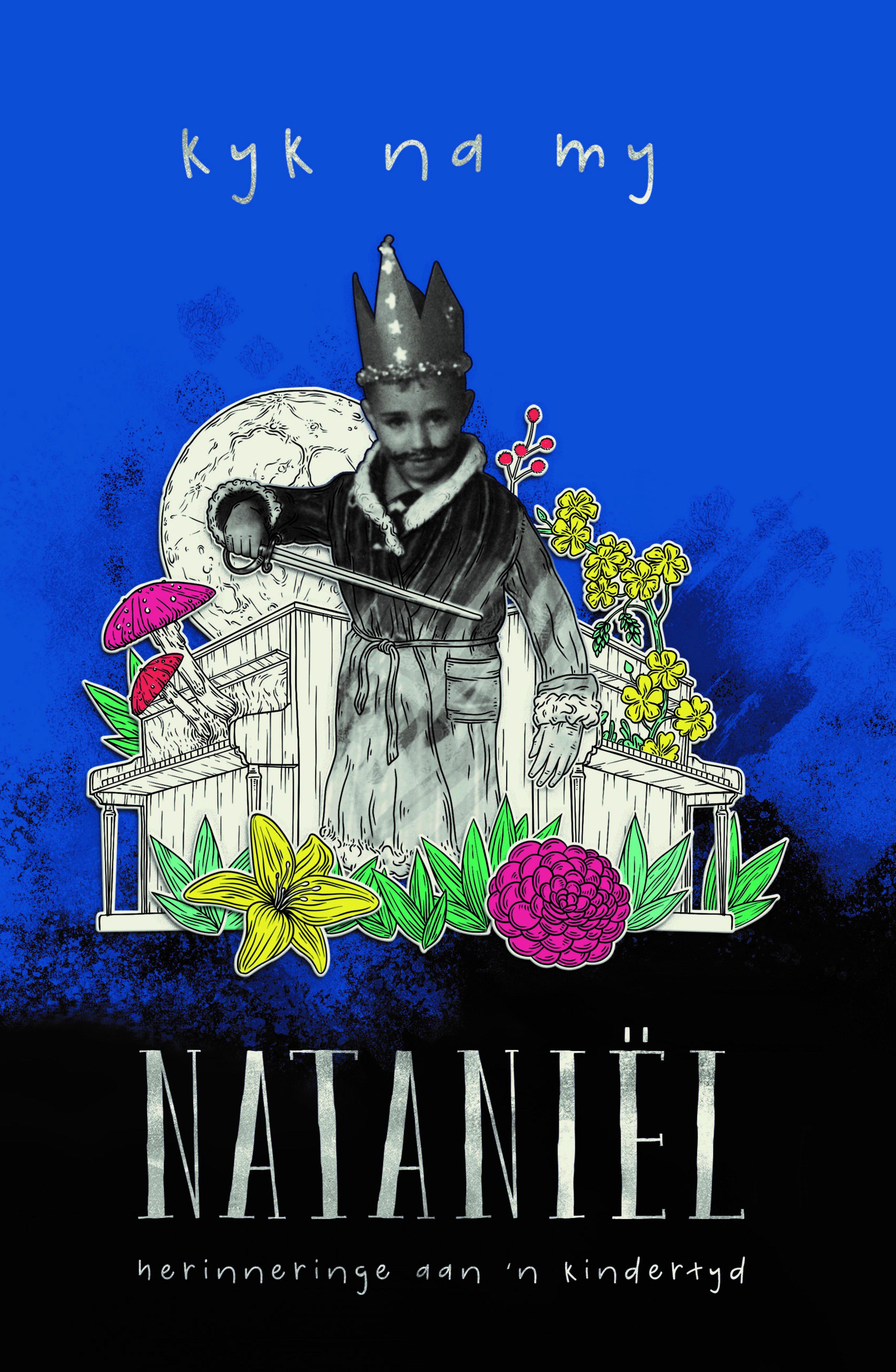
And if you were wondering  in anticipation about the next memoir…

Nataniel boek

That will have to wait says the author. “Too many of the characters are still alive. And LOOK AT ME (KYK NA MY) still needs to get the attention it deserves. Everything stopped when I had to stop performing and touring.”

But for the moment, the new normal kicks into action and Nataniël in full colour steps into the spotlight with even more than his usual fanfare.

I’ll be watching for those outlandish costumes and outfits as well as the music he really loves to sing … whether they like it or not!

TOEGANG starts on Monday October 5 at 8.30pm on DStv’s kykNET.

Shakespeare Is The Man For All Seasons With Women Breaking The Acting Mould

DIANE DE BEER

“My words fly up, my thoughts remain below: Words without thoughts never to heaven go” William Shakespeare, Hamlet

Shake Chilling with the Bard Poster Image_ (002)

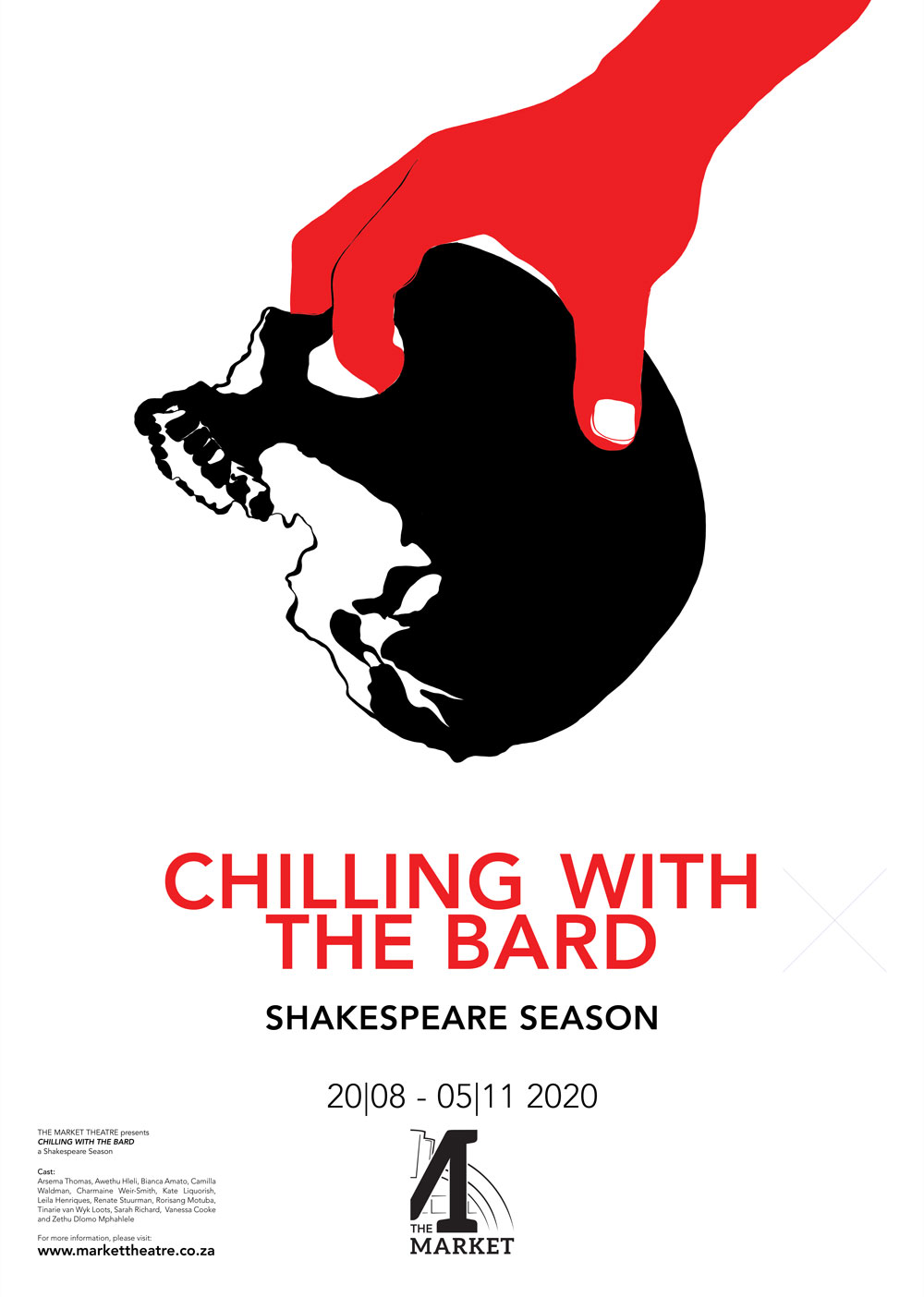
Stories are never on pause, explains Artistic Director of the Market Theatre, James Ngcobo, as he reveals their latest theatrical celebration which starts during this Women’s Month: Chilling with the Bard, a Shakespeare Season.

And for those of us trying to keep track of the creative juices of Ngcobo, it’s been a sweet ride as he tries to navigate the Covid 19 curve ball which has almost brought the world to a standstill.

I knew the creatives would find different ways to market and move their stories even when their winning ticket – live theatre – was cancelled and closed from the start and will probably be prohibited for the rest of the year.

Yet from the start of the first lockdown, Ngcobo knew he had to find ways to keep theatre going, to embrace rather than defy lockdown. “I commissioned 10 new works all of which are available on our social media platforms and some of which will be reworked next year to stage live,” he says.

Then he turned to a handful of especially young actors to do monologues reflecting on their world and the life we are inhabiting now. “Theatre will rise again,” he says but in the meantime it has given him the opportunity to showcase some performers who are Market regulars but also others he has always hoped to put on stage.
“Covid hasn’t stifled our passion, just moved it into another space.”

He also connected with dancers like Vincent Mantsoe in Paris, writers like Napo Masheane were given a scenario and asked to write something and others to tell their own stories while an international jazz hook-up was also made. He had to find ways to woo audiences to watch and is thrilled by the response – with numbers watching rising constantly as all the work can be easily accessed for free.

Many of these plays will also be staged at the Market once live performances are given the go-ahead. “I envision two weekends of short plays for example where audiences move around from one 20 minute play to another,” he says. For him it is important to stage new work and not just look at what they had available.

This latest season is based on speeches from some of Shakespeare’s iconic plays, mostly written for male characters. They have been carefully picked and partnered with the perfect actress, according to Ngcobo.

These past few months and those ahead have been all about finding ways to work not only for audiences but also for actors. Reversing the roles in this Shakespeare season, Ngcobo hoped to excite both parties with roles that where written more than 400 years ago but are still relevant today.

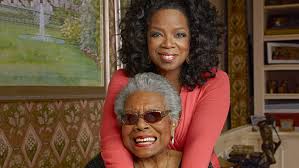
shake maya and oprahIn an Oprah Masterclass podcast with Maya Angelou, relevance is underlined with the following Angelou musings:

“I read Shakespeare,” she says speaking of herself at a very young age, approximately 12. “I memorised 50 sonnets or something. But I read one sonnet that made me think, Shakespeare must be a black girl from the South who may have been molested. How could he know?”

And then she recites…

In disgrace with  fortune and men’s eyes,

 I all alone beweep my outcast state,

And trouble deaf heaven with my bootless cries,

And look upon myself and curse my fate.

“Shakespeare knew what it was to be raped and scorned, so of course, (and she laughs) I thought he was a black girl, barefoot in the South. It spoke to me.” And who can argue that!

Ngcobo expounds: “I think it’s important that we’re not locked in by the myopia of gender and race,” he says, something that world theatre has embraced as audiences become more adventurous in their viewing choices.

“It is really a marvel that almost 400 years after he wrote this great literature, we are still intrigued and engulfed in this magnificent work of brilliance. Shakespeare poured his heart and imagination into these wonderous stories that have been acclaimed, enjoyed, and staged over the years.” said Ngcobo.

Running through his options he talks about his choices for the season:


Eleven of Mzansi finest female actresses take on performing one hander plays on the John Kani stage, showcasing their diverse talent with extraordinary acting. “I’m hoping that this amazing combination of talent will breathe new life to these ancient yet living texts,” says Ngcobo.


Shake Arsema Thomas
Arsema Thomas

Arsema Thomas is an American actress currently working in South Africa. She has African parents and wanted to work on the continent. Encouraged by Moonyeenn Lee, Ngcobo auditioned her and was delighted she could participate. The first part is a speech by Rosland in As You Like It (Act 3 scene 5) and then as Lady Percy from Henry 4 Part II (Act 2 scene 3)

Shake Awethu Hleli
Awethu Hleli

Awethu Hleli first caught Ngcobo’s attention working for Cape Town’s Magnet Theatre. She’s multi-talented, a UCT graduate and moves easily from theatre to the screen. Her monologue is as Malvolio from Twelfth Night, Act 5 scene 1.

Shake Bianca Amato
Bianca Amato

Bianca Amato will be remembered by Isidingo fans before she left for the US where she has been amassing a stream of awards. But she’s back home and her contribution is Brutus’s speech from Julius Caesar Act 3, scene 2.

Shake Camilla Waldman
Camilla Waldman

Camilla Waldman has perhaps been seen more often on TV screens than on stage lately, but anything she touches turns to gold as one can witness in the monologue from The Tragedy of King Richard the Third –  Act 1, scene 1 as Richard, Duke of Gloucester, afterwards King Richard III.

Shake Charmaine Weir-Smith
Charmaine Weir-Smith

Charmaine Weir-Smith, a director, writer, actor was last seen in a stunning performance in Paul Slabolepszy’s Suddenly The Storm and also directing Dawid Minnaar and John Kani with a full heart in Fugard’s The Train Driver. She will be doing one of two sonnets, Sonnet 29 “When in disgrace with Fortune and men’s eyes …”

Shake Kate Liquorish
Kate Liquorish

Kate Liquorish was most recently seen in M-Net’s Still Breathing and on Netflix’s Queen Sono (with Ngcobo) and on stage in a dramatic turn in Sam Shepard’s Fool for Love. She will be playing King Richard II, Act 3 Scene 2 in King Richard II.

Shake Leila Henriques
Leila Henriques

Leila Henriques  starred luminously in the Greg Homann-directed Florence and  with great insight directed the award-winning Hani: The Legacy with  the Market Lab students. She will be playing Viola in Twelfth Night.

Shake Renate Stuurman
Renate Stuurman

Renate Stuurman, also part of Suddenly the Storm cast and very familiar to television audiences will be doing the second sonnet – Sonnet 13 – My mistress’ eyes are nothing like the sun.

Shake Rorisang Motuba
Rorisang Motuba

Rorisang Motuba jumps in at the deep end with Shylock from Merchant of Venice’s To  Bait Fish Withal. She’s a storyteller who approaches her craft from many exciting and different angles.

Shake Tinarie van Wyk Loots
Tinarie van Wyk Loots

Tinarie van Wyk Loots performed at the Market in a Zakes Mda play directed by John Kani, but she is better known for her Afrikaans stage work, which is seen most often at festivals. Versatile and with the bravado of someone who dares to try anything and fly, she opts for Hamlet in no less than the title role – and pulls it off magnificently.

Shake Sara Richard
Sarah Richard

Sarah Richard comes from local theatre royalty (daughter of Michael Richard and Louise Saint Claire) and Ncgobo, who loves giving young actors their chance on stage, leapt at the opportunity for her to play Launce from Two Gentlemen of Verona.

Shake Vanessa Cooke
Vanessa Cooke

Vanessa Cooke is synonymous with the Market Theatre and the Lab and as such becomes what Ngcobo refers to as the ringmaster for this Shakespeare celebration. She plays Jaques in As You Like it with The Ages of Man speech, Act 2 Scene 7.

Shake Zethu Dlomo Mphahlele
Zethu Dlomo Mphahlele

 Zethu Dlomo Mphahlele is a dynamic force on stage and screen with a big international presence. A WITS graduate, she doesn’t flinch while playing Macbeth, Act 3 scene 1.

The Market will start releasing the different performances from this Thursday  with an explosive Camilla Waldman opening the season and following with a new monologue each week on Thursdays at 12. Check their website http://www.markettheatre.co.za and their facebook page for details.

Precious Lives Interrupted Yet Never Silenced in Stories Sensitively Shared

DIANE DE BEER

These three books all deal with children who have lost their mothers and how that influenced their lives:

BK girl


The Girl with the Louding Voice

  by Abi Daré (Sceptre):

“I tell you true, the day I stop school and the day my mama was dead is the worst day of my life.”

And that sentence explains  what is to follow in the 14-year-old Adunni’s life. Her mother is the one who paid both to keep her at school and the exorbitant rent for their house.

But since her death, Adunni has become a valuable commodity. In fact, her life amounts to four goats, two bags of rice, some chicken and a new TV, as she is sold as the third wife to an old man. With a dedication to the author’s mother (the first female professor of taxation in Nigeria) and someone who promoted the importance of education and sacrificed so much that her daughter could get the best of it; and a prologue that points to Nigeria as the 6th largest crude oil exporter in the world (and with a GDP of $568.5 billion, the richest country in Africa, yet with 100 million people who live in poverty surviving on less that a $1 a day) that’s who this story deals with, one of the many young girls who become the sole provider for their family, not by choice but because they don’t have any.

Whatever your level of interaction with the rest of Africa, we have all heard of the plight of the Boko Haram girls who were abducted. Some will never be returned to their families, while those who do are often rejected, with the children forced upon them by their vicious captors.

Think about those 16 year-old girls kidnapped by the marauding monsters only to be blamed on their return at a time when being a teenager should be your only worry. It’s the kind of book that hopefully opens new worlds and reminds you how lucky we are to have the luxury of only discovering this kind of terror in a book.

I loved the story and the writing. It’s a unique voice, as so many from Africa are.


bk crawdads


Where the Crawdads Sing

by Delia Owens (Corsair)

Kya was only six when her mother walked out on the family. In the following few weeks, an older brother and two sisters also drifted off and Kaya was left with her favourite brother Jodie and her drinking dad.

Jodie didn’t last that long and neither did her father, only a few more years. By the time she approached her teens, without any schooling, neither writing nor reading, she was on her own living in their shack in the marsh on the edge of Barkley Cove.

Not only had this young girl been deserted by her entire family, the town also rejected her and she had no one to turn to. Dumped on by everyone who saw her as the Marsh Girl, she was laughed out of school, her only resource the marsh and its embracing flora and fauna that taught her about life.

It reads like a modern-day folktale, almost too far-fetched to hold on to and yet, we all know the Kyas of the world, those living on the edge, some who manage to get ahead in spite of the struggle and the way the world has turned its back on them.

The author Delia Owens has three internationally best-selling non-fiction books about her life as a wildlife scientist in Africa including Cry of the Kalahari, and this is her debut novel, which is probably why it has such an almost naive yet wondrously unique voice.

It’s beautifully written and takes you to another world as Kya tries to face a world that keeps turning its back on her.

bk dutch


The Dutch House

by Ann Patchett (Bloomsbury)

From the time that Danny and Maeve’s mother leaves home – and this time doesn’t come back – their lives are about longing, which is very closely linked to the Dutch House.

“Like swallows, like salmon, we were helpless captives of our migratory patterns. We pretended that what we had lost was the house, not our mother, not our father.”

And thereby hangs the tale in a fascinating story that is viewed from many different perspectives, all of this packaged with a delicious caricature of the evil stepmother at the centre. But this isn’t her story.

Patchett is a familiar name but this is the first of her novels I have read and from the first page just loved the writing. It’s clean yet charming, shows an insight that is uncanny and hitches your heart to the characters whose lives have been thrown into a storm that is beyond their means and abilities to deal with – yet they do.

Because the brother and his older sister are dealing with the same trauma, it’s also intriguing to see how they deal with their loss, abandonment and sheer misery of what they have to come to terms  with in their upended circumstances.

It has to do with age and gender, how a mother’s absence plays into their lives and how they deal with these emotions – whether it is anger or longing that lingers most strongly. The older daughter might find it difficult to resist clinging to old feelings because there are clear memories to return to time and again, while the younger brother might be more broody and resentful about a mother leaving her children still so young.

Yet it is these close family ties that are tied up and thrown about in different scenarios to see how they play out.

And in the end, although all three the books hold a certain longing from those who have lost what is one of their most impactful relationships, it is also the different voices, the way the authors tell their stories and their writing, that is finally quite extraordinary in all three.

I will certainly want to read more by Patchett who has quite a resumé, but am also hopeful that the other two writers will keep writing following these brilliant debut attempts.