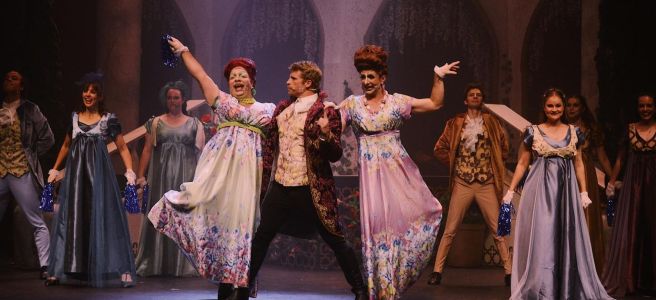
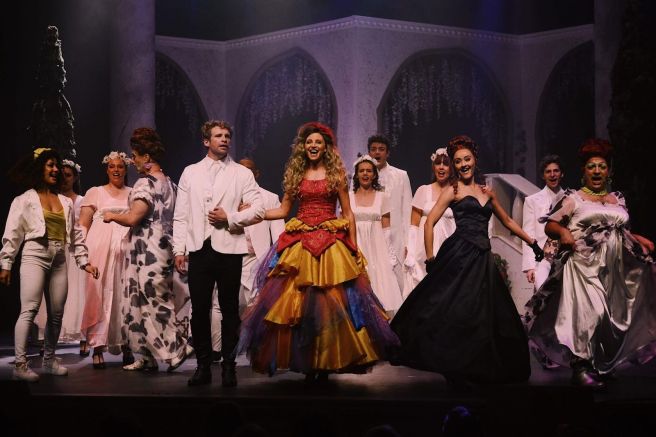
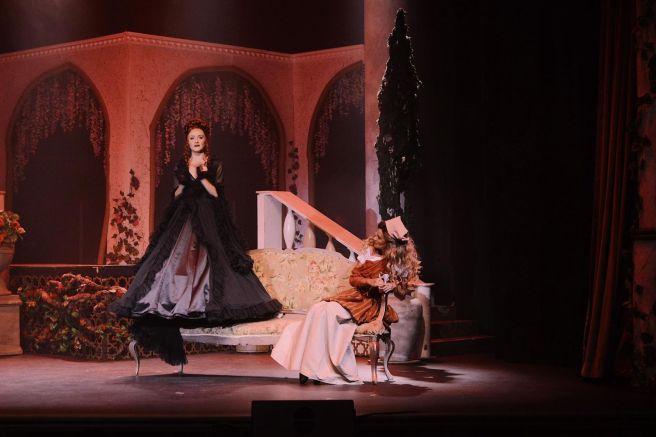
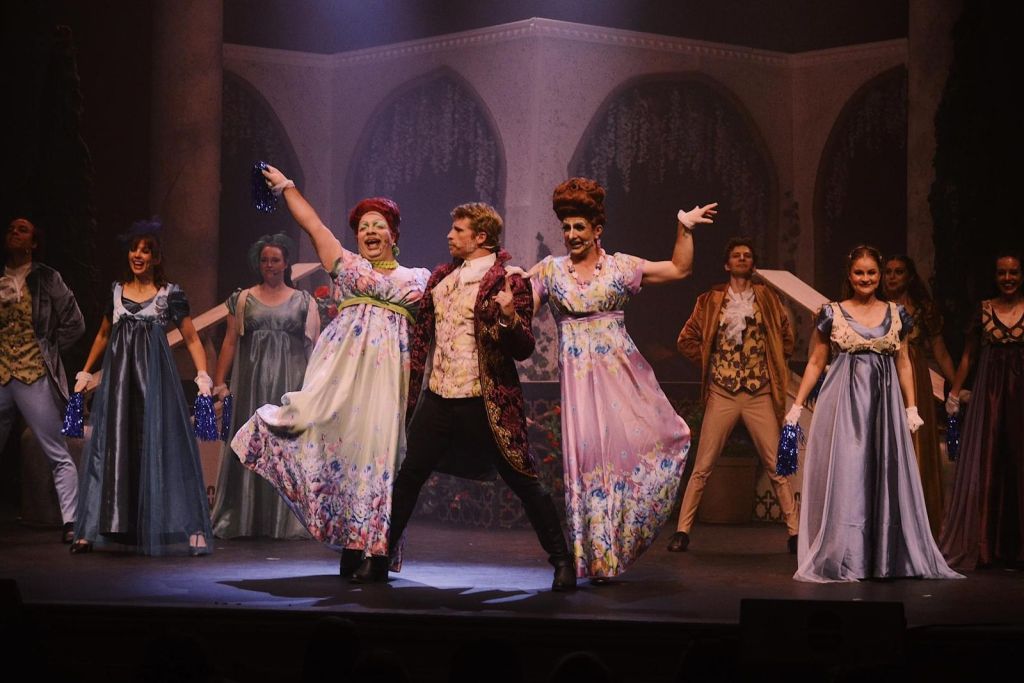
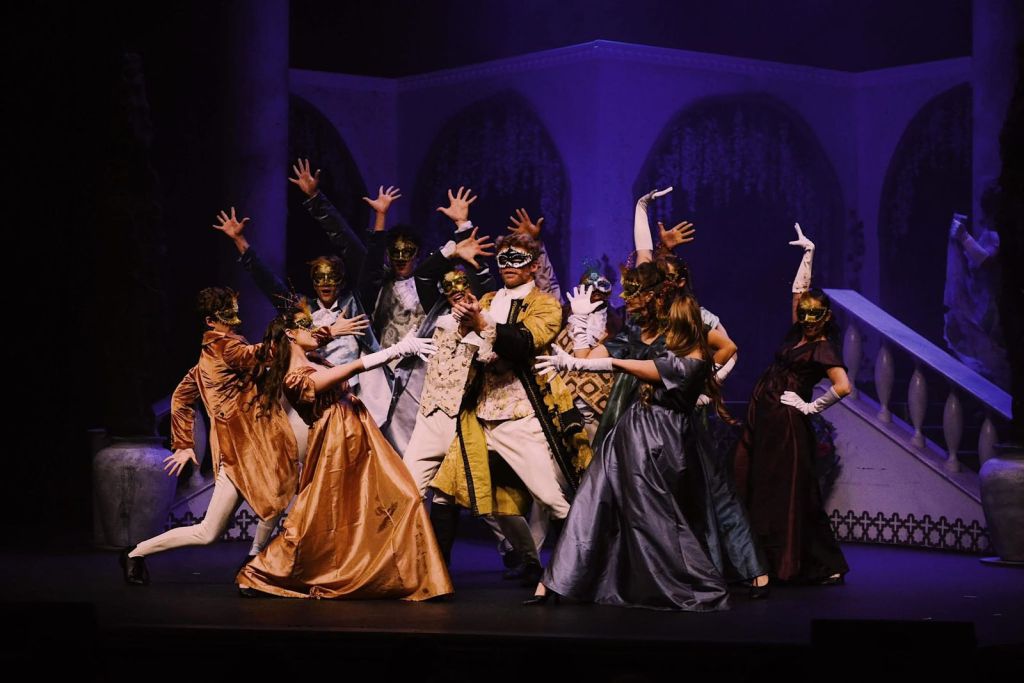
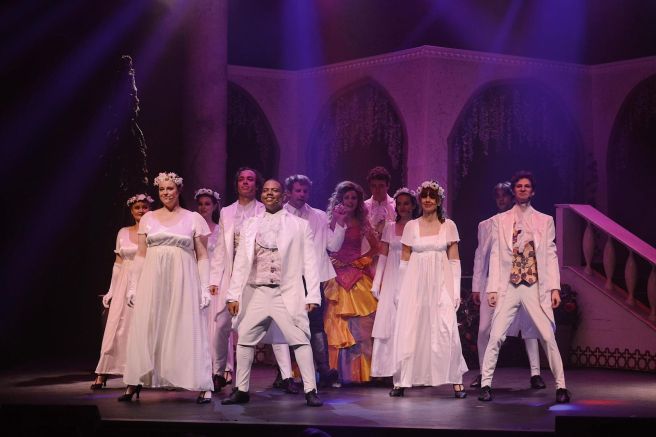
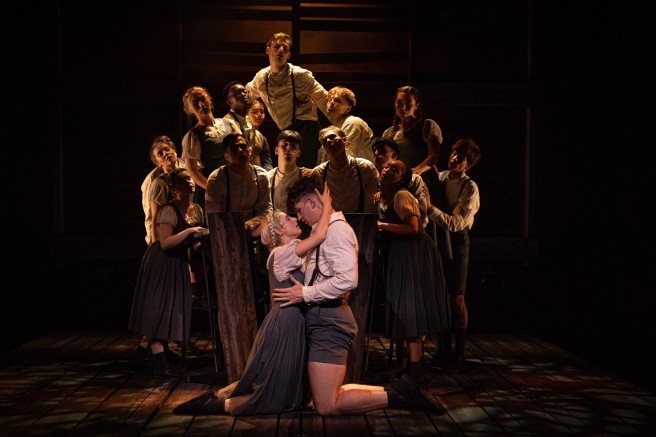
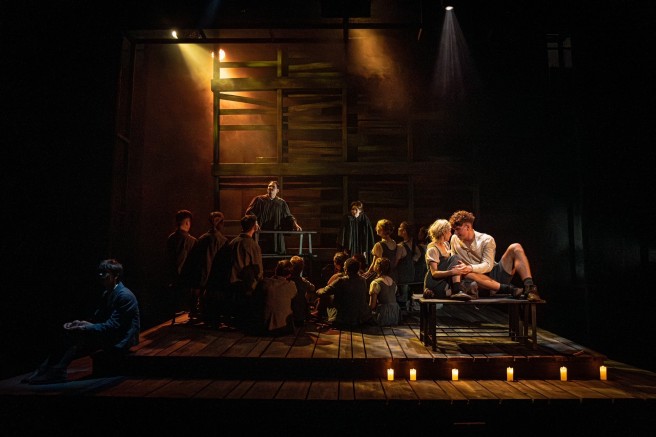
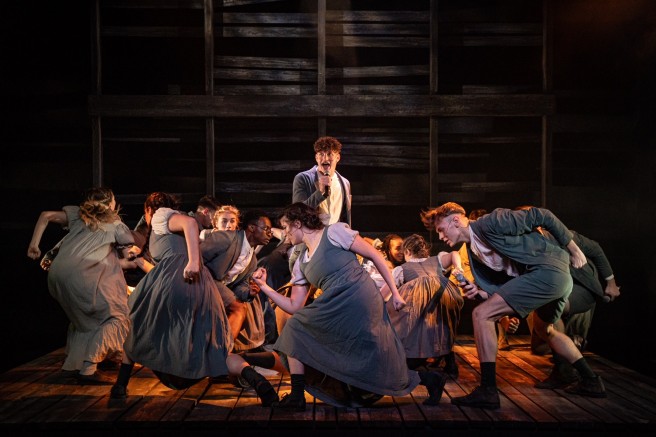
The ensemble wih the love-struck couple (Scarlett Pay and Dylan Janse van Rensburg) in the front.
REVIEW BY DIANE DE BEER
Pictures: Claude Barnardo
SPRING AWAKENING
Based on the play by Frank Wedekind
Books and lyrics: Steven Sater
Music by: Duncan Sheik
Featuring: Dylan Janse van Rensburg, Scarlett Pay and Jonathan Conrad with Gemma Bisseker, Killian Blerk, Jude Bunyan, Tatum Grace Coleman, Jayden Dickson, Noa Duckitt, Skye Themeda Goss, Ché-Jean Jupp, Gabriella Knight, Jasmine Minter, Tumelo Mogashoa, Hannah Norcott, Nandipa Nyivana, Benjamin Stannard, Tjaart van der Walt, Gerhard van Rooyen (graduates and under-graduates) and playing the two adults, also former students of LAMTA (The Luitingh Alexander Musical Theatre Academy), Francis Chouler and Natalie Robbie
PRODUCERS: Anton Luitingh and Duane Alexander
LIGHTING, SCENIC AND COSTUME DESIGN: Niall Griffin
SOUND DESIGN: David Classen
ASSOCIATE DIRECTOR AND ASSISTANT MUSICAL DIRECTOR: Anton Luitingh
CHOREOGRAPHIC SUPERVISOR: Duane Alexander
VOCAL DESIGNER: Annemari Milazzo
MUSICAL DIRECTOR: Amy Campbell
CHOREOGRAPHY: Anna Olivier and Naoline Quinzin
STAGE MANAGER: Sarah Wolhuter
DIRECTOR: Sylvaine Strike
VENUE: Pieter Toerien Theatre, Montecasino
DATES: May 5
Spring Awakening a production for current times.
Perhaps Spring Awakening is the reason Sylvaine Strike is only now directing her first musical. It was destined to happen with this particular show – and she does it magnificently.
If anyone was up to this specific task, she was. Even more than I knew, because I was unaware of her teaching responsibilities at LAMTA, Luitingh and Alexander’s Musical Theatre Academy in Cape Town that invited Strike to direct.
In her programme notes, she explains that her students understood her approach “tackling the very controversial themes – from a physical rather than a psychological perspective – possible, and ensuring that the sexuality, heartache, and rebellion we activated during the rehearsal process always came first and foremost from the body. This was apt seeing that the impulses of adolescence also spring from this turmoiled yet effervescent well. Whether we explored the private agony of self-consciousness; the damage of self-doubt; the wreckage of hormones on both mind and soul; the pain of parents’ inability to accept a child as they are; or the blossoms of sexuality growing their gentle tendrils of yearning and fantasy throughout adolescence …”
Much of the magic is in the movement.
Her mantra was to seek a physical way to manifest these feelings and to create the characters from that specific place.
And even though I didn’t know any of this before watching this production, it was the movement and the choreography that grabbed and gripped me throughout. It was so clever and crafty to use this in both solo and ensemble numbers and even with the very specific movements of the two adults to exactly capture their strictly restrained and fastidiously maintained lives.
I kept wondering who the choreographers were, as they who would have been completely aligned with Strike’s vision because of her very detailed rehearsal process. Not surprisingly, but also with kudos to the producers and director, they picked two of their talented graduates Olivier and Quinzin, who did an amazing job both incorporating and executing their work to perfection. It adds currency and electricity to the performances that translate masterfully.

But that was just the start of the cohesion of the whole. Again the programme notes capture it best when explaining the electrifying adaptation of Wedekind’s Spring Awakening into a contemporary rock musical, which Strike rightly salutes as the key to the current success of the piece. She is convinced (and I agree) that the sheer brilliance of Steven Sater’s lyrics and Duncan Sheik’s music makes the return of this classic possible and heightens the relevance of the themes as long as there are adolescents in this world.
To pull it off though, it needed the razor-sharp vision of Strike, her pinpoint accuracy in the detail and, more than anything, the artists she surrounds herself with, assigning them to their specific fields of expertise. Even though she and designer Griffin had never worked together, she trusted her instincts and tasked him with all three design elements: lighting, costume and set, all of which establish the feel and the atmosphere of where and how the story unfolds.
It’s brilliant. From the set that transforms with only a few movable parts to the costumes that speak volumes in their simplicity but also carry an underlying theme, as he experimented with the authenticity of the fabric, to the lighting that enhanced what he had already established with the set and the costumes.
All of this would have been superfluous without the right cast. It starts with their youthfulness. Undergraduates and graduates of LAMTA, most were already familiar with the director’s ethos, and it shows. Performances are spectacular and some of the solo moments quite breathtaking.
Spectacular singing with individual tones from Johnathan Conrad and Dylan Janse van Rensburg.
There’s too much to take in and remember in one sitting, but the performer I couldn’t turn away from was the unusual Johnathan Conrad. It needed someone like Strike to cast correctly, but it was as if the theatre gods had handed her a mini Mick Jagger in looks and talent. As the overwrought and picked-upon Moritz Stiefel, his every move, the singing and the presence never faltered – a wonderful foil in a complex production.
The love-struck Scarlett Pay (as Wendla Bergman) and Dylan Janse van Rensburg (Melchior Gabor) are radiant as the couple who cannot resist one another, and their singing captures their hearts’ desires magnificently. Another standout was the luminous Noa Duckitt as Ilse Neuman.
Two standout performances from Noa Duckitt as Ilse and Johnathan Conrad as Moritz Stiefel.
The music holds the show and the singing had to soar for the show to come alive. Again, musical director Amy Campbell teaches at LAMTA and wisely she was in charge and harnessed all her skills to get this working perfectly. More than anything it is the individuality of the different singers surrounded by the more gentle ensemble singing (more often than not) that rocks this one.
Finally it is Strike who pulled it all together. You can have all the talent in the world, but if the story isn’t told with one voice, it has diminishing impact.
Strike doesn’t miss a beat. She has gathered artists young and old around her to tell this striking story that affects us all at some stage in life in the best way she knows how. It has purpose, it holds you in awe from beginning to end, and you are engaged in and enraged with these youngsters as they fight for their right to live their way.
Niall Griffin dying the costumes wearing protective gear.
When Niall Griffin was invited to take on most of the design elements (set, costumes and lighting) for the Sylvaine Strike-directed Spring Awakening, he was nervous going into the process because living up to the expectations of a legend can be daunting. He tells DIANE DE BEER about the experience, which he describes as the highlight of his career:
Spring Awakening, presented by Cape Town’s Luitingh Alexander Musical Theatre Academy (LAMTA) as their first book musical, also marks the first time that Sylvaine Strike has directed a musical.
Based on the controversial play that was written in the late 1800s by Frank Wedekind, Spring Awakening delves into the lives of a group of adolescent students discovering their changing bodies, their sexual identities, urges and desires, all while navigating the oppressive and draconian societal norms of the day.
Under Strike’s visionary direction, this reimagined production (with a very young cast) brings the gripping and emotional story to life as it explores complex themes such as self-discovery, repression and the power of rebellion.
Niall Griffin, a designer with a mission.
And while there was initial anxiety, once the work began, Griffin knew instantly that he was on safe ground. “The care, respect, trust and sense of magical play that Sylvaine instilled in our journey together are unmatched in my career. I think we both felt an immediate understanding of each other and were both amazed at how perfectly our style and ethos merged,” he says.
“We care immensely for our process, our casts, our team and our audiences, sometimes to our detriment, but finding someone with that same level of care has been one of the greatest gifts of my career.”
Being familiar with the level of detail Strike approaches when making a play, all of the above sounds like a match made in heaven.
The vibrant young cast in Spring Awakening
Accepting the challenge was a no-brainer for a designer who is also described as an industry legend. “There are musicals and then there are musicals. Some are light and frivolous and the perfect escapism and then some hit you harder in a place that truly moves you. Spring Awakening is the latter for me. The little rockstar hit that came out of left field to take Broadway by storm,” is how he describes it.
“It deals with things that we’ve all been through or are going through, both good and bad. All too often, in this day and age, we are driven into false beliefs and horrific mental health issues because we carry such shame from our experiences. The show, as heartbreaking as the story is, leaves one with love, compassion and a sense of togetherness. The human condition is not singular. We are not alone. We all need a little more love in our lives… and who doesn’t love a bit of Victorian-era deliciousness?”
Describing the process, he explains that what began as an exercise in replicating period fabric developed into an exploration on how possible it was to create an entire show from natural fibre. “Our planet has rapidly become saturated with ‘the synthetic’ and I believed this show needed authenticity in every aspect if it was to have the impact it deserved.
“The entirety of the show’s design is manufactured from purely natural fibre. Costumes began as neutral cotton that were dyed with natural dyes. The set is sustainably sourced wood and hessian made from vegetable fibre. It has been an incredibly educational and rewarding process.”
It is that process that piqued my interest, especially when basically the whole look depends on the outcome. Griffin understood that taking on the full production design across set, costume and lighting was a huge undertaking and not for the faint hearted.
“My driving force is to find a seamless synergy between all departments. What I term ‘one organism’. While taking on full production design is huge, it does make knitting a visual together far easier. Even though this show was Sylvaine’s and my ‘maiden voyage’, it was clearly destined, as our sensibilities and aesthetics couldn’t be better matched.”
And there’s the key, something they obviously both understood. “Theatre design to me, at its core, is about designing emotional response. I needed to immerse myself in the emotional journey of the piece, the high and low tides, in order to find its design core,” he notes.
For him texture is far more than paint and dye. “I spent a long time with the score and libretto and, to quote the Gen Z’ers, ‘felt the feels’. This is how I approach the majority of my design work, from a place of emotional honesty. It’s about finding the heart of the piece.”
Describing his process in more detail, he began with the sets, followed by costumes and finally lighting:
“When it comes to scenic design, my favourite moments in theatre are when a space manages to completely morph its texture, feeling and setting without all the ‘big toys’ and flash. A threatening storm can become something else, in mere moments, with a shaft of light breaking through the clouds. I wanted the space to morph seamlessly so that the emotional flow wasn’t interrupted by a clunky scene change. Finding the balance between something that can feel both oppressive and beautiful was a challenge. Using exposed wood was a no-brainer for me. Wood is a material that carries its growth with it forever. Its rings and knots and imperfections are part of it. This felt poetic to me.”
When it came to costuming, he wanted to create a uniform that felt prescribed by an oppressive regime, “a regime trying to erase the individual and force uniformity. I felt this would underpin the narrative journey of our characters rebelling against the blind norm by illustrating how prescribed uniformity cannot erase the burning fire of the individual.
“Every costume, from head to toe, has been lovingly made from scratch. They are all individually hand dyed and aged, and this is where I started to sneak the individual into the uniforms by aging and breaking down each individual’s garments with their own personality. Some of this detail may not be evident to the audience, but it was important to me that the cast could experience their costumes in this way. I truly believe that what the cast feels in their costumes translates into their performances.”
Lighting delivers the final flourish. “Sometimes, at the speed a musical moves, the audience needs to understand an emotional shift quickly, and this is where lighting was vital to me. I wanted the world to feel murky and rich, like an oil painting come to life.”
If the successful runs in Cape Town are an indicator, this has all been achieved, as the visuals will attest.
And Griffin has his final say: “Making theatre, especially non-replica productions, in South Africa in the current climate is hard work. Creating an entire musical from scratch was a feat second to none. I have a team of remarkable artisans that I work closely with and whom I would be nothing without. They all share my level of delivery standards and they all jump into the deep end with my crazy ideas. A tribe second to none. I couldn’t be prouder of the product, and watching audiences experience it in Cape Town has filled me with so much joy.” * Performances run until 5 May 2024 at Pieter Toerien’s Theatre at Montecasino with shows from Wednesdays to Saturdays at 7:30pm and matinees on Saturdays and Sundays at 2:30pm. Tickets cost from R200 through Webtickets. Please note that Spring Awakening contains mature themes, partial nudity, sexual situations as well as explicit language. No persons under 13.
Stellenbosch singer/songwriter Luna Paige will be in Pretoria and Philadelphia for rare performances to celebrate the launch of two new albums; the one in Afrikaans (Dis die Dors), the other in English (Harmony). DIANE DE BEER chats to the singer whose career she has followed from her early days – with admiration:
Storielied Reunion.Picture: Pierre Rommelare
For singer/songwriter Luna Paige the last few years has been a sharp learning curve. Since her early start in the industry (late 1999), she has been one of the most dedicated artists I know – and she usually does it all herself.
Her first look-in was when she was invited to record three of her songs on a compilation album alongside Lesley Rae Dowling and other female artists at the time. “It is what catapulted me into a music career,” she says. But driven as she is, and one has to be when you drive your own career as she does, she would have found a way.
Since those early days she has released five solo albums and one SAMA-nominated collaborative album. And since 2015, she has released numerous songs digitally and she believes, she has come into her own this past decade. That is until Covid struck.
She established her own music production company which developed music-driven productions, hosted and organised, concert series and co-ordinated music workshops five years ago. In her capacity at Iluminar Productions, she also represented other musicians and musical groups.
She found herself collaborating with many artists and produced shows such as Her Blues, Korreltjie Kantel and Smeltkroes. She also played a supporting and promotional role in the popular My Miriam Makeba Story featuring the luminous Sima Mashazi.
Because her business was still young and primarily focussed on servicing art festivals and live entertainment venues and clubs, the pandemic was disastrous as for so many other artists who depend on audiences.
Luna knew it was time to join the workforce and between 2021 and 2024 she worked as a marketer and fundraiser for Paul Roos Gymnasium, a prestige Stellenbosch school. But she’s back in the music business, armed with many new skills and ideas she wants to implement in the music industry – as well as two new albums.
During Covid she had time to reflect, and, coming out of the pandemic, her thinking and that of the world around her, has changed. That is also what her songs reflect; her collaborative intent as well as the fast-paced changes in our society. “The last time I released an album, the world looked a lot different. The digital era is now in full sway. It has affected everything outside of us, but also our own internal way of processing information, and life in general.”
And that is exactly what she sings about.
When you ask Luna about her life, she speaks about the difficulty of packaging herself. “Let’s be honest, I am so many things!” She is a singer-songwriter. She writes in her mother tongue but also in English. She doesn’t compose in a specific genre. “For me, the song, and the story behind it, dictates the genre the song needs to be in. I find my influences from a wide array of genres.”
But then she is also a social worker, an altruist and an organiser. She feels she is a catalyst of sorts. “I know how to bring an interesting group of people together to do great things.” And with those words in mind, I predict exciting performances in the future.
Luna has always had to fight for her place in the industry. Performing isn’t an easy way to make a living. Music is her life, and she has always known that’s where she wants to be. Armed with new skills and insight, she believes that private investment in the arts is essential for its survival. “I believe artists have a huge responsibility to not only expect funds, but to also give back to their own communities. And the causes they believe in.”
While fundraising and marketing something other than herself, she became aware of her own different facets. “I have always seen them as separate things, one not having anything to do with the other. But now I know it’s the combination of these elements that makes me unique.”
She’s excited to explore what she calls “fusion of self”, how it will unfold and the kind of creative endeavours it will lead to.
These two latest album releases also reflect her new-found knowledge, showing the different sides of self.
“My Afrikaans side and my English side. Why? Because I do express myself differently in these two languages. It is interesting to me how I almost have a different voice in each of them,” she explains.
And speaking of voices, Luna also does different voices when she speaks and when she sings. If you have a conversation and have never heard her sing, it sounds like a completely different person.
On her Afrikaans album, Dis die Dors, she pays homage to two iconic poets – Jeanne Goosen and Antjie Krog. Their poems, which she puts to music, touch on the subject of either loneliness or aloneness. “It’s a theme I am quite interested in – especially the difference between the two. The power of the one versus the sadness of the other.” Both poets, she notes, also touch on our thirst – for something meaningful in what can be a challenging world. “I sing about purpose, about nature’s generous supply of lessons, and about the labels we embrace for our own self-preservation.” She also addresses online nastiness and real-life kindness, and borrowed time.
And as always with the soulful singer, the genres vary from gypsy jazz and world music to folk rock, rock ‘n roll, troubadour-style songs and one typical Luna-style piano rock ballad.
On the English album, Harmony, she included some of the songs released digitally during 2021 and 2022, as they didn’t reach enough people. She believes they deserve a good resting place. She describes the album as bolder in sound and voice. “I am sharing ideas that I have never previously introduced in my music. Ideas about a lot of –isms. In my song Whose life is it anyway I am encouraging freedom of expression, of individualism, freedom from whatever the mainstream demands. In Circle of witches she addresses the sensitivity towards feminism (even from women themselves). “It is a modern take on feminism and why I believe it is still relevant.”
Not one to stand on the sidelines, Middle Class Shoes is dedicated to May 29 when we stand in line to vote for our next ruling party. “It is a song about classism – something we don’t acknowledge remotely enough when talking politics in SA,” she says.
Luna Paige. Picture: Nardus Engelbrecht
Real news that feels like fiction, alcohol abuse, the power of owning aloneness as well as her love of the continent all feature. And there’s much more.
What she does with her music is speak her mind. All she asks is that we take the time to listen. And I certainly can’t wait. She has a voice that melts your heart and touches the soul. And she offers wisdom and wit with her thoughtful lyrics.
Much thought and research went into producing these albums and how to package them for this digital age.
What she has decided is to release her music in USB-format.
The 2024-USB will include the two new albums, poster art, lyric sheets and two music videos. The Full Collection-USB, will offer all her releases since 2003, multiple videos and live footage. She will also be selling personalised Luna Paige notebooks – with lyric extracts inside.
Her first performance was in Stellenbosch this past weekend and these two follow in Gauteng and Philadelphia:
Sunday, 14 April. Moonshot Café. Pretoria. 2.30pm. Tickets cost R200 at Quicket. Ticket link: https://qkt.io/tR9Nhd. On stage: Luna Paige and Mauritz Lotz.
Wednesday, 17 April. BV Hall. Philadelphia. 8pm. Pre-drinks and dinner at The Pepper Tree from 5.30 to 7.30pm (Reservations: (+27) 84 707 3177. Show time: 8pm. Tickets cost R200 at Quicket. Ticket link: https://qkt.io/DAlG8G. On stage: Luna Paige, Mauritz Lotz, Schalk Joubert, Kevin Gibson.
And then she’s off for the rest of the year as she recharges her creative instincts and inspiration. She will be visiting places she has always dreamt of like Italy, Greece, Spain, Portugal and possibly Slovenia. She will be walking and writing, researching business ideas and checking in with artists who work in a social impact sphere.
Another Klein Karoo National Arts Festival has come and gone but what lingers are the artists, their originality, dedication, blood, sweat and tears and delight that they provide in a lopsided world which is difficult to navigate. DIANE DE BEER finds nourishment, inspiration and novelty in the imaginative and ingenious artistry of our creatives:
I have to be honest from the start. Festivals always have a strong emotional impact on me. I am in the fortunate position as an arts journalist to be invited to see as many productions as I can squeeze into the run of an event and at this year’s Klein Karoo Nasionale Kunstefees (KKNK) there was still a post-Covid frisson with the festival at full strength for a second year.
When a festival goes into full swing, it can be quite daunting and I’m not sure whether I want to be there, but as excellent productions and artists climb into my head, I go into full festival mode where I’m simply thrilled at being overwhelmed by the local arts community.
Being an artist isn’t an easy profession, even if many on the outside feel that they had a choice and simply have to bite the bullet. That they have a choice is arguable and to produce excellence year after year, often with few rewards and never under ideal circumstances, can be daunting and not for the fainthearted.
And yet they go full tilt as they battle extreme circumstances like pandemics or vitriolic social media, all in the name of art.
More than anything, whatever anyone says, we cannot resist them. For me it is a huge blessing and privilege to witness and write about our uniquely original creatives.
Post-festival, an overview of the festival is always a personal reminder of and reflection on everything extraordinary, yet it’s tough to choose which among all those actors and productions, to highlight. There are simply too many that demand attention and especially this year, the scope was exceptional.
I always feel I want to bring something of the flavour of a particular festival to those who weren’t there. Perhaps one of my favourite pieces might pop up somewhere and a reader might be encouraged to go, or even more ideally, someone who has always thought about festivals but never attended might be encouraged to go.
The enchanted Die Swartmerrie withTheo Witbooi and Chantell Phillipus. Pictures: Ryan Dammert.
I have to start with Karoo Kaarte. It’s one of the dream projects of the KKNK, simply ticks all the boxes and grows more impressive every year since its first inception with special mention of last year’s winning production, Droomkrans Kronieke, which landed with such impact because of its energy and precision. How can you not win when developing the underdeveloped artistic talent of the previously disadvantaged by implementing a programme that empowers those who wish to make it in the arts.
It’s inspiring and this year’s production, Die Swartmerrie, is a site-specific piece set on dilapidated terrain with a set of train tracks, an imagined train, and a rundown platform. Two people, a man and a woman (Theo Witbooi and Chantell Phillipus) are waiting, both traveling but not with the same destination in mind. There is a past, the tracks and possible journey points to a future, but this notion disappears with the wind.
It is breathtakingly beautiful and hauntingly gripping as the two talk and tackle their issues with delicate determination.
Afrikaans is an especially emotive love language and when spoken in the specific Karoo accent, warm and intimate, the sounds are as captivating and meaningful as the actual words being spoken.
I was surprised by this couple alone on stage and also electrified that the team (in this instance Neil Coppen – a facilitator of the whole project with Vaughn Sadie – and Oudtshoorn’s Tiffany Saterdacht) decided to go this route but, of course, this is a company packed with the unexpected, and hopefully it is a production that will become an institution in Oudtshoorn and won’t be limited to the festival. You don’t want to miss out on these performances and such a quality production. They should keep pushing the repeat button and keep it as part of their arsenal.
Karoo Kaarte further packed a punch with its art exhibitions, as well as walking tours done by young Oudtshoorn inhabitants all participating in turning the town’s current and future narrative into an inclusive one. The community is constantly gaining strength thanks to Coppen and Sadie who have invested their creativity in this wonderful way, all the while bringing their local learners on board.
It’s a marvellous investment in the future of this town (and hopefully others across the country will follow) and fingers crossed that a smart investor will see the potential going forward.
Because we were born in such large numbers, our generation is referred to as the baby boomers (born from 1946 to 1964) and probably that’s why ageing and the lifestyles of those growing older has become part of today’s theatre language. We are also fortunate to have some amazing artists who keep on practising their craft while ignoring any barriers that might come their way.
They know how to choose, break out and try new things and simply keep audiences flocking to their performances. Names like Sandra Prinsloo, Antoinette Kellermann, Jana Cilliers, Elzabe Zietsman, Amanda Strydom not only arrive with new productions, they’re also constantly adding skills to their resumés.
Cilliers took up playwrighting for the first time with Veelhoek, a two-hander with herself and Ludwig Binge directed by Marthinus Basson, and the wisdom and writing were quite overwhelming. Who would have thought that, apart from all her other accomplishments, she would now add writing to the list – and then perform it with such clarity as she tells a story that lies close to the heart?
Zietsman is another one who keeps shifting those barriers and I am so delighted that she has added the magnificent Tony Bentel to accompany her on stage. He is one of those pianists who brings much more than just the music to the performance and it shows. Vier Panado’s en ‘n Chardonnay again has Zietsman expounding on life, singing brilliantly and with heart – and cherishing cabaret as it should be performed. The content, which deals with resilience,needs hardly any acting by this actor. Most of it is probably her life which she has shared heartily and hastily over the years. And she will always rise…
Do we need to say anything more about those two great dames, Sandra Prinsloo and Antoinette Kellermann? How lucky are we to witness them in performance after performance as they just keep surging ahead.
Die stoele with Antoinette Kellermann and Chris van Niekerk. Picture: Hans van der Veen.
Kellermann tackled the Ionescu tour de force Die Stoele, accompanied by a much-too-rare performance by Chris van Niekerk. Marthinus Basson adds genius to the production, which can be seen over and over again as it deals with something we all have to confront – LIFE. The content might be terrifying but to watch, quite hysterical. As always Kellermann is in with everything she’s got and what she does with her body tells a story all its own.
Goed wat wag om te gebeur with an actress I would love to see more of, Emma Kotze and Gideon Lombard.
She’s also a part of the magnificent cast (Kellermann, Emma Kotze and Gideon Lombard) of Philip Rademeyer’s Goed Wat Wag Om te Gebeur. I had seen the English version most recently but also this one a few times, and this latest run proved how good theatre improves with time. It’s the best the production has been and I know the director agrees.
Prinsloo brought her masterful Master Class, a piece of classical theatre, to the festival and, also as is her nature, she teamed up with the exceptional David Viviers in a Teksmark original Op die hoek van Styx en River is Noraper Abuis met die Dood Oorgeslaan (playwright Henque Heymans). It’s a novel work which showed flickers of what it could be in time (always a scarce commodity).
Like Rademeyer’s Goed Wat Wag Om te Gebeur, Monsters, (produced, directed, adapted and translated by Tinarie van Wyk Loots) which has had runs at other festivals previously, found a remarkable rhythm that lifted the text and the performers into another realm . It was rewarding to experience and again I was reminded what a precious entity the different circuits are because single theatres cannot afford to take many risks and festivals add an extra buffer in this precarious world – to the benefit of arts audiences.
Michele Burgers in Monsters. Picture Stephanie M Gericke.
We haven’t seen much of the versatile Michele Burgers, who will hopefully return to stage more often in the future and who was beautifully supported by the talented René Cloete, Ntlanhla Kutu and Elton Landrew.
Die Vegetariër with Tinarie van Wyk Loots and Melissa Myburgh who as young actress has shown her mettle magnificently . Picture: Nardus Engelbrecht
Smartly directed by yet another multi-talented artist, Tinarie van Wyk Loots, she also featured in Jaco Bouwer’s hard-hitting Die Vegetariër (adapted and translated by Willem Anker) which also benefited from another run, as well as in the latest probing Anker text, Patmos, also brilliantly staged and directed by Jaco Bouwer, who always challenges and pushes boundaries with his choice of productions, casts and presentation.
The visually captivating Patmos with Melvyn Minnaar and Tinarie van Wyk Loots. Picturess Hans van der Veen.
Without these art warriors our art landscape would be barren. They keep us returning to theatres time and again with their unique approach, their determination to do their best under trying circumstances, including a lack of time and money, and simply their excellence.
Nataniël, for example, returned from an extensive tour to New Zealand and Australia during the festival yet put together one of his distinctive shows with flamboyant costumes, mind-blowing text and two musicians (Marcel Dednam on Piano and Leon Gropp on guitar) who created a spectacular rhythm to underpin his songs and singing quite magnificently.
I could go on forever, there were simply too many highlights, yet I cannot go without honourable mentions of the following, no less important than those already mentioned:
Jefferson J. Dirks-Korkee in a return of the soul-stretching Rooilug.
Fietsry vir dommies. Picture: Gys Loubser Hallo, is Bettie wat praat with Dean John Smith.
Marianne Thamm
Solo shows: the return of Rooilug with the delightful Jefferson J. Dirks-Korkee; Fietsry vir Dommies (masterful text by Tiffany Saterdacht and deftly directed by Dean Balie) which showcased the enormous talent of Eldon van der Merwe, who was also rewarded with a Kunste Onbeperk prize for Young Voice. Dean John Smit shone in his now full-length solo production of Hallo, is Bettie wat Praat; the craftily current My Fellow South Africans by Mike van Graan, starring the physically and mentally dextrous Kim Blanché Adonis; Vuisvoos, maar nog regop, where journalist Marianne Thamm delivers a gloves-off and much needed monologue, incisive if laugh-out-loud, on the state of the nation; a shout-out to much missed director, Jenine Collocott, who teamed with actor Klara van Wyk to present the hysterical Monika, it’s me:
The mesmerising ‘n Lewe in die dag van ‘n vrugtevlieg ensomeer with David Viviers and Wessel Pretorius. Picture: Hans van der Veen The Old Man Who Thought He Had a Dog with Merwe van Gent and Angelique Filter.
Double-up: David Viviers and Wessel Pretorius returned as a popular duo in a follow-up to their successful Klara Maas with ‘n Lewe in die die dag van ‘n vrugtevlieg, ensomeer and hopefully many more encores in the future, they were missed; an innovative new duo, Stellenbosch students Angelique Filter and Merwe van Gent, soared with the tragicomedy The Old Man who thought He had a Dog;
The delightfully funny Marc Lottering.KG Mokgadi- Weighing In.
Stand-up (not my speciality) yet: Who can resist the always energetic and enthusiastic funny man Marc Lottering who always delivers?; as well as my comic standout of the festival, KG Mokgadi. It feels as if these two have something more to say than just one-liners.
Ken Jy Vir Dewie with , Joshwin Dyson, Crystal Donna Roberts and Robert Hindley
Productions: The original Ken Jy Vir Dewie was cleverly staged with themes that target the whole family and as the play was dealing with bullying, the setting for everyone, actors and audience alike, was a classroom; and again, it was directed by yet another versatile artist, Margit Meyer-Rödenbeck, who has exchanged Dowwe Dolla for Ouma, again a sign of the times. She cleverly started the play outside with audience and cast waiting to enter the classroom!;
The joyous Braam en die engel with Rehane Abrahams, De Klerk Oelofse and Timothy Isaacs. Picture Hans van der Veen
And Craig Morris grabs the attention in Die Rooi Ballon.
Children’s Theatre: It’s not something I usually see at festivals but, as I did, I was encouraged by the effort made by the KKNK to look after these tiny tots who are of our more enthusiastic audiences: My favourites included Braam en die Engel and Rooi Boeties.Watch out for them as they might travel.
Dance: is back with brilliance because of the clever choice of productions, only two of them but with some of the most innovative names in contemporary dance: Dada Masilo who choreographed one of three pieces, Salomé, for Joburg Ballet; and Grant van Ster and Shaun Oelf with the Figure of 8 Dance Collective (pictured), who brought in other creatives like Nico Scheepers on text, Andi Colombo on lights and Franco Prinsloo on original music. Both companies were sublime.
Lucky Pakkie (Packet): Thanks to the brilliant team of Llandi Beeslaar and Stephanie Gericke, this is another of the KKNK delights because of their dedication and hands-on approach. It needs that because what you have is three lucky packets of four 15-minute productions each; the three sections embrace easy viewing to soft touch to pushing the envelope as much as possible, and artists who cannot manage a full production or perhaps just want to say what they need to say in this time and on this platform are vetted and included in a fun-filled programme.
The original Karli Heine. Picture by Stephanie M Gericke
There are too many to name, but for starters … what about Karli Heine, who turned herself into a pot plant and blew my mind … for script, performance and imagination!
It is impossible to cover everything and I haven’t given the art exhibitions a mention, even though curator Dineke Orton again broke down barriers and took us on a visual trip. But these are just some of my thoughts on a festival that felt like one joyous merry-go-round. Try and catch some of these through the year as they travel to different theatres and festivals.
Here’s holding thumbs!
And finally, on the last day, even the weather seemed out of sorts…
For film fanatics, this is the time to catch up with the Oscar-nominated films with the winners to be announced on March 10. It will add some extra fun to the whole movie experience. DIANE DE BEER opted for Poor Things andThe Zone of Interest from the current crop on the Ster Kinekor circuit and, apart from excellence and originality, the appeal was that the two films could not be more different.
Let’s first have a look at their Oscar nominations: both for Best Picture; Emma Stone from Poor Things for Best Actress; Mark Ruffalo from Poor Things for Best Supporting Actor; Best Adapted Screenplay for both Poor Thingsand The Zone of Interest; Best Production Design for Poor Things; Best International Film for The Zone of Interest; Best Editing for Poor Things; Best Cinematography for Poor Things; Best Costume Design for Poor Things; Best Makeup and Hairstyling for Poor Things; Best Sound for The Zone of Interest; Best Original Score for Poor Things.
And these are a strong indication of the kind of movies we’re dealing with. Let’s start with the fun, energy and exuberance of Poor Things. Emma Stone and director Yorgos Lanthimos are forming a powerful partnership following their first encounter The Favourite and it is as if this second creative endeavour was given permission by the success of the first to go all out – and they do.
Apart from the obvious deliciousness of the story depicting steam-punk retelling of a female Frankenstein, its also the landscape that Lanthimos picks and paints in which to tell the story.
With the emergence of our weird and wild scientist Dr Godwin Baxter’s (Willem Defoe) Bella (Stone), colour plays an important emotional role. As she grows into what she believes her role to be, everything becomes brighter and more visible and there’s also a quality of wonderment that runs from start to finish – both for the characters and for the audience.
Much of that can be attributed to Stone and her director, who have obviously taken the plunge and permitted themselves to tell the story that’s important to their minds – a woman with a mind of her own unfettered by the rules and morals of a society (read: men) that knows it knows best. In their world (and still today), they decide about a woman’s mind and body and the way she has to live.
From Stone’s elaborate wardrobe, her acting mobility and scope, the language in which they depict this adult fable-lesque adventure, the almost romp- and rakish elements enhanced by the beautifully bizarre yet unusual performance from the usually more affable and straight-down-the-middle Mark Ruffalo, all of these take you along on this madcap Alice-in-Wonderland – but a much more specifically driven – trip.
As the title suggests, Stone as Bella is the one in command and the one driving the process of her emancipation. In fact, she isn’t even aware she needs guidance or permission for anything in her life. She is prompted by her senses, her joy in experiencing life without any guardrails and completely unaware of the fact that the men who enter her sphere expect compliance and a dogged determination to adhere to their every command.
There’s so much more going on, but this is a film that should overwhelm, be allowed to enter your imagination and take you on their flight of fantasy. Enjoy – and then meditate on the radical directions they explore: a woman with a mind of her own!
And then for something completely different. Think World War 2, the Holocaust and the many stories told from every which way to explore the nightmarish horrors of that time. The Zone of Interest adapted from a Martin Amis novel by the same name, had to give us something new, something different to have any impact with one of the most gruesome acts in recent memory and one familiar to most of the world.
How to put the viewer into that space of horror in a different way? That was director/writer Jonathan Glazer’s task and mission. And the word that grips you from start to finish is chilling.
Glazer understood that he could tell the story without showing the victims which has been the focus of so many magnificent depictions previously. There’s Schindler’s List and The Pianist, to mention the obvious.
Rudolf Höss (Christian Friedel) is the commandant of the Auschwitz concentration camp. With his wife Hedwig (Anatomy of a Fall’s Sandra Hüller) and their houseful of children, they are living the ideal family life in what is sketched vividly as a bucolic idyll.
Yet looming in the background of their comfortable home is the camp. The smoke never stops rising, soldiers are spotted on occasion, the mistress of the house reprimands one of the staff with a warning of what her husband could do with her ashes, and Rudolf leaves every morning for work in his smartly pressed Nazi uniform on top of a magnificent steed.
This carefully choreographed, painfully pristine world of the Höss family does not miss the tiniest detail to deny the horrors that lie just beyond their perfectly crafted home life. Denial is a powerful tool that is deftly applied in many situations to deal with something happening to everyone’s knowledge, yet, by turning their heads, the all-powerful reality is completely dismissed and ignored.
Thát is chilling. How often in these scary situations do we hear that explanatory phrase: we didn’t know? That is why this film knocks you sideways while watching, impacts brutally and then lingers.
Hüller, arguably Europe’s hottest actress of the moment, apparently didn’t want to participate in this film. She’s magnificent and I’m thrilled she did. But it is easy to see why you wouldn’t want to immerse yourself in that dark period of Germany’s life. These kind of suppressions, oppressions and killings constantly repeat themselves across the world in many different yet no less intolerable fashions. Look at our current situation in the world. That’s why this is such an important and impactful cinematic experience. It’s smart in the way it tells a story of the past with what is happening in our world today, as cleverly injected as the camp was in the lives of the determinedly optimistic Nazi family.
Janice Honeyman’s Peter Pan at Joburg Theatre’s Nelson Mandela Theatre
Cast: Richard Richard (Smelly Smee), Ben Voss (Mr Darling and Captain Hook), Kensiwe Tshabalala (Mrs Darling), Kiruna-Lind Devar (Wendy), Matthew Berry (John), Diego Hamity (Michael), David Arnold Johnson (Clementina Coconut), Manyano Ngoma (the dog, Nana), Virtuous KIandemiri (Thokolina Tinkerbell), Sandi Dlangalala (Peter Pan), Lesedi Rich (Sam Spaginyol), Gareth Meijsen (Seb Scumdawg), Dirk Joubert (Sparkey), Gugu Dhlamini (Curley), Sarah Leigh (Nibs), Brian Ngobese (Tootles), Bo Molefe (Slightly) and Tania Mteto (Princess Lotus Lily) and the ensemble
Associate Director: Timothy le Roux
Production Designer: Andrew Timm
Lighting Director: Johan Ferreira
Sound Designer: Akhona Bozo
Choreographer: Khaya Ndlovu
Costume Designer and Co-ordinator: Mariska Meyer
Dates: Until December 24 (so get going!)
If you have seen as many pantomimes as I have, you need some incentive (especially when you’re no longer the target market).
For me there were two big ones; Janice Honeyman and my two favourite little ones. Just the fact that I can still stomach a pantomime has everything to do with someone who is completely ruled by her inner child when writing and staging the annual panto.
Not only does she know how to negotiate an audience of young and older children but she also shares her panto story with loads of fun clues for those with many more years on the planet to keep their minds spinning once they’ve seen enough of all the silliness and have had enough festive cheer.
She has also found a compromise with the LED screens and all the bells and whistles they add to this production, while holding on to some of the more old-fashioned sets and designs, which breathe life into the rapidly developing technology.
It’s a miracle just to watch her each year as she finds ways to build novel glitz into the show. She has established her nimble dance to deliver the goods – and that she does with sparkle – time and time again. Small wonder they can’t let her go as she just keeps pushing those stakes higher and higher each time.
This is probably somewhere in the region of my 30th Honeyman panto production and the fact that I can keep going and writing willingly, says everything.
This time it’s Peter Pan and one of the delights which has been been happening for a few decades is the transformation of the South African stage. I know some might ask whether we still have to touch on these colour issues, but it is especially the popular shows that had to get it right and had the most impact. Of course Ms Honeyman did just that. And it easily gets better every year.
David Johnson as Clementine Coconut.
She has created many stars and again, a few are stepping out smartly to show their stuff. I have to confess, I have always been a David Johnson fan. Perhaps he’s not the obvious choice for the panto dame, but that’s another of Janice’s tricks up her sleeve. She doesn’t opt for the obvious and then she delivers another bit of magic by getting a performance that’s different, yet works. Clementine Coconut could have some fun with her costumes which already delivered the goods and to boot, Johnson added some swish and style to his panto tart.
Ben Voss as Captain Hook
Ben Voss, another panto and Honeyman regular, did double duty and delivered a devilishly evil Captain Hook with a smart swagger and punch, which might have scared some and tickled others, and then quietly slipped into the shoes of the more demure Mr Darling.
Virtuous Klandemiri as Thokolina Tinkerbell with Sandi Dlangalala as Peter Pan.
If you have a very traditional view of what and who Thokolina Tinkerbell should be, Honeyman flipped that applecart as well and gave us the sparkly Virtuous (could there be a more apt name!) Klandemiri as well as the light-on-his-feet Sandi Dlangalala who starred and shone as as Peter Pan in this debut performance.
Michael Richard as Smelly Smee.
Michael Richard added a performance with flair and wisdom enhanced by decades of experience as Smelly Smee and the youngsters in the cast kept the energy up and the artistry pumping.
It’s a gran show. This time we sat on the balcony and it was fascinating to get this different yet complete view. I know many people regard the lower level as the better seats. My small companions had seen last year’s panto from the front row.
The full splendour.
But in the end, the balcony offers a complete appreciation of the Honeyman approach. It allows you to focus on the whole rather than individual performances for example but also accentuates the detail that comes together in the design. It’s easy to understand why Honeyman draws you in time and again.
CAST: Chi Mhende (Oberon/Hippolyta), Caleb Swanepoel (Puck), Roberto Kyle (Theseus/Tatiana), Mark Elderin (Bottom), Jock Kleynhans (Demetrius), Aidan Scott (Lysander), Lisa Tredoux (Helena), Kylie Fisher (Hermia), Sizwesandile Mnisi (Egeus/Snug/Faerie), Tankiso Mamabolo (Mechanical Faerie), Tailyn Ramsamy (Flute/Faerie), Zach Esau (Snout/Faerie) and Roland du Preez (Starveling/Faerie)
SET: Jesse Brooks
LIGHTING: Oliver Hauser
COSTUMES: Michaeline Wessels
VENUE: Pieter Toerien’s Montecasino Theatre
DATES: Until November 19
Tailyn Ramsamy (Flute)
It’s not often that a press release is so audacious as to claim that a Shakespeare will be one of the biggest hits of a season!
But with the ingenious Geoffrey Hyland at the helm, aided by his magnificent cast, I have no qualms if they grab those particular bragging rights.
Swept off my feet at the recent Woordfees with this production staged at the openair Libertas Amphitheatre, I was keen to go a second round with these players.
The setting (outside, specifically) might have added an extra sprinkle of magic, but with this Shakespeare, as is usually the case, the players and the play are what count, the director assured me.
And if I look back, even with the magnificent original outdoor setting which lent itself especially to this madcap and weirdly wonderful, romantic bouquet, it was the marvellously talented, youthful cast, fully representative of the clichéd rainbow nation and seen here with such genuine gusto, that stole my heart.
The director was confident that they would pull off the indoor setting and, as we entered the theatre, I immediately loved the stage, which had been transformed into a colourful green space. With a little imagination, you could almost spot the twinkling stars once the auditorium lights went off. And all round there was a sprinkle of fairy dust, I’m sure of it.
That is what brings this colourful play to life so brilliantly. It is the way it has been staged, dressed and lit, as well as an exuberance from the full cast from start to finish. There’s a glorious abundance of brightly coloured cloaks for example, which become part of the emotional impact in the way they are carried and manipulated with every movement. It’s a brightly-coloured, sweeping spectacle.
Robert Kyle (Tatiana) and Mark Elderin (Bottom)
It is in essence a romantic romp and as with any Shakespeare, you have to close off everything around you and take a leap into that world to allow the words to take charge and the actors to whisk you away.
It’s not a play where you want to single out performances because with such a big cast, there are always roles that steal the limelight. But, it is the patchwork of performances, which knits it all together so magnificently. And that is where the true magic lies – the choice of cast. Everyone seemed perfect for their part.
Hyland has quite a few tricks up his sleeve, knows when to throw in a quick slip of a local tongue, trusts audiences to buy into the local accents rather than the Queen’s (sorry, has it changed to King’s?) English, introduces original music which is sung with wonderful whimsy and pushes the production’s energy impulses with great enthusiasm.
It’s difficult not to buy into the dream world of luscious language and love adventures which transports you to a place of laughter and merriment in a way which is a perfect nod to the coming festive season.
Perhaps I was late in discovering Geoffrey Hyland’s theatre smarts, but then it’s not often that plays of this magnitude with so many players are swapped between the Cape and Gauteng.
What a brave move Mr Toerien. And one that hopefully Gauteng audiences will embrace wholeheartedly .
The play absolutely deserves all our attention and accolades. May this be the start of much more touring theatre of this kind.
Experiencing director Geoffrey Hyland’s A Midsummer Night’s Dream at this year’s Woordfees a few weeks back, was a revelation. Thrilled to hear that the production was coming to Pieter Toerien’s Montecasino Theatre, I immediately touched base with the director to find out more about this astonishing not-to-be-missed Shakespeare. DIANE DE BEER reports:
Scenes from A Midsummer Night’s Dream: Photographers Llewellyn de Wet and Mark Wessels.
Tankiso Mamabolo as one of the Faerie’s.
It’s difficult to resist nagging everyone to get tickets for this amazing Shakespeare. I almost missed seeing it at the Woordfees, because I thought I might have lost my head booking for a Shakespeare during a very hectic festival schedule.
Fortunately I was persuaded to go and it was one of the best decisions I made at the festival. Chatting to the director about this particular production, I have even more reason to plead with theatre enthusiasts to go.
“This was the first Shakespeare at Maynardville post Covid,” explains Geoffrey and he elaborates. “Having been through some dark times, the organisers and myself thought: WOW! it’s time to celebrate love, life and exuberance with fantasy and dreams in a wonderful colourful and passionate production.
“Are there deeper things, of course there are deeper things, there always are in Shakespeare, but I think one goes along on this wonderful joyride of misadventure and laughs and that celebration of love and the funny things that humans do to pursue love,” he encourages prospective audiences.
It’s time to take some time-out from the world, to remind ourselves about how wonderful life in all its permutation is, notes Geoffrey. That’s why he selected this particular Shakespeare to kick off Maynardville post-covid, to re-energise this space. The wonderful forest setting in the play was a reflection, which meant it was doubly joyous.
He is often asked about his favourite Shakespeare and of course, it is the one he’s working on at that moment. “That’s the one you dive into and you’re investigating and you’re finding new things all the time,” he says.
When he start with any play, his approach is getting to know the play, reading and more reading, imagining, and listening to music that resonates just to get a feeling of what this thing means to him.
“I can’t do it if it doesn’t mean something to me, if it doesn’t light my fuse. I know I’m not going to be able to light the fuse of the actors, or that of the audience, so I have to find my way into a particular production.”
What got him going was watching kids playing with bubbles, and suddenly he thought, this is the play, “these wonderful bubbles flying, joyously, madly, they make no sense whatsoever and yet they lift the spirit.”
He had found his first connection, the lightness of fun, and the absolute beauty of those brief moments of life that are so captivating.
Only then came the company – the actors. The producers gave him a free hand in choosing who he wanted.
“It’s never about individuals. It’s about people you know are going to meld and enjoy each other. I needed people who would be team players rather than individual stars. They’re all stars believe me, but they needed to give and come to the play with an open heart and to come along with me as a director,” he emphasises.
Because they had a very short time to work, he also needed a cast who would be willing to give extra time. They needed to understand instinctively that they had to give everything to the role, he stressed.
What he enjoys about actors, is their ability (with him) to find their character. “I don’t come with a preconceived notion. You are the character and we must find that character in you,” is what he shares with his actors.
“My part as the director is to evoke the performance from what is in front of me and I need people who will continue to give to me and allow me to shape what is already in there as part of them.”
“I’ve never worked with a group of people together who are so much part of each other and giving and taking in equal measure between each other. The important thing for me as a director is to make the actors feel beautiful, then they will give of their best and I think the way we’ve come to do the production, they do.”
He describes the way they want to be on stage, bringing an exuberance and an energy, and because they’re tapping into themselves, into their life force, they are enjoying playing in front of an audience who then plays with them.
But all of that happens in a wonderful discipline of recreating a performance, never overdoing it, but sparking off each other all the time.
They’ve been very lucky, the audiences have responded beautifully and have enjoyed every single performance. And I can attest to that.
With Shakespeare especially, Geoffry thinks this is where teachers play a huge role in young people’s lives. “I was drawn to Shakespeare by a teacher. I think I was in grade five and went to see a production at Maynardville. I was captured for life and I went on reading and being interested. It inspired and unlocked something in me and probably was one of the impulses that made me the creative person that I feel I am today.
“Having had that experience as a young person, it has been one of my goals to inspire the same kind of experiences in other people. It’s a desire I have to make them feel the same things that Shakespeare had made me feel. I don’t think it is only about feeling, but rather unlocking yourself, potential things within yourself and once actors get it, there’s no going back.”
Because the two previous seasons were both performed outdoors, how would Geoffrey counter that missing element at Montecasino, but he seems to have all the answers and as a recent devotee, I’m going to take his word.
“There’s always give and take. With outdoor theatre, because you don’t have so much control on the technicalities, you need to focus completely on the actor in front of you and anything else that comes with that is a bonus.
“It’s a decoration and added depth of flavour, so that magical forest setting of Maynardville is impossible to duplicate.
“However, this production was created for and by Maynardville. We can’t physically duplicate it, but it has inspired the actors and in a sense they have got Maynardville, that beautiful energy, inside their performance. So having strongly focussed on the actors in creating this production, I still believe that they are what is the essential heart of the show.”
There will be small changes, he agrees, but the actors will be there to tell this wonderfully mad story and that is what you focus on when changing a venue. “It’s that live person in front of you that creates the magic.”
That’s exactly what he has achieved with this amazing A Midsummer Night’s Dream. One of the things I thought while watching it for the first time, was that this was the perfect introduction to Shakespeare if you’ve never seen any of his great works.
Writer/director Janice Honeyman loves pantomime because it is also her time to play – even when putting it all together is serious work. “If the cast don’t genuinely believe in their characters, it won’t work,” she says. And that is what she works hard to get through to all the panto novices in her cast.
It all started for her when she was asked to do a panto by Lynette Marais, who headed the drama department of the Performing Arts Council in the province at the time. “I found a book open panto titled Oh Yes It Is”, a phrase used in every panto to involve the audience and get them fully on board.
That happened more or less 36 years ago, but we’re not really counting and in-between she might have missed three shows. But not only does she direct the pantos, even more importantly, she writes them. And this is where her imagination often runs riot – in the best sense of the word. Her child who is always lurking emerges and it is blast-off time.
So much ther queen of the pantomime, Janice Honeyman has her own pictureIn in the children’s room in Peter Pan.
the writing, her dad is ever present. “He loved telling jokes around the dining room table,” she explains. “They weren’t always that funny,” she admits. But still, this year, she has again included two. And she smiles…
It’s nostalgia, it’s a traditional story, like this year’s Peter Pan with the awful Captain Hook and his sidekick Smee who cause trouble for the hero Peter Pan, the Darling children, lost boys and of course, Tinkerbell. One of the delights of any panto is always the dame and in this instance, Dame Clementina Coconut who introduces much of the Honeyman wit, fun and playfulness, double-entendres and, of course, her dad’s jokes.
Don’t forget about the audience participation and, naturally, a few surprises.
Dame Clementina Coconut (David Arnold Johnson) with Smee (Michael Richard), two of the colourful characters in this year’s panto.
Her last foray into Neverland was 14 years ago and since then many things have changed on stage. For the past few years, because of Covid, she has swapped the sets for LED screens, but she has missed the tangibility and theatricality of the sets and this year, she decided to combine the two, using the best of both worlds. Expect a spectacle of sorts!
“I found it tough to adapt to no furniture,” she says about the LED screens, but all that changes with the combo.
More than anything, pantomime is an invitation to Janice to do all the stuff she feels great affection for. “I jol straight through this.”
And moving from the look of the latest panto to the cast with its combination cast – youth and experience – that’s what she most enjoys, working with the actors. She loves the energy of the young cast, while the experienced actors can show the way to the youngsters. “They represent the well-trained professionals who set the example,” she says.
And Janice herself learns from her casts who keep her on her toes. That’s where especially the youth plays a particular role. They know what is happening on the ground, what is buzzing and what has fallen off the trend scale for example. It’s part of her script to play with her audience’s world so that her jokes can land smoothly.
On stage, Sandi Dlangalala, who will be playing the brave hero Peter Pan, says: “I am beyond excited to be in the Panto this year. It is my first Janice Honeyman pantomime. I am ready and so excited for rehearsals to start and to be given the lead role is such a huge honour.”
For veteran Ben Voss, it’s different: “Playing Captain Hook in this year’s magical romp, Peter Pan will be my fourth year dishing out mayhem, malice and mischief. It’s the silliness, the scale and the slickness that I love so much. I am already making great progress growing my four- inch moustache, mending my pantaloons and carving my cutlass. Hopefully, like me, you will be HOOKED too!”
Some scene stealers in this year’s panto.
Michael Richard, who has also performed in panto many times, will be playing Smee, Captain Hook’s right hand. “This is my fifth or sixth pantomime for Janice over many years and I am still so excited about embarking on this new adventure. I may not be able to prance around as much I used to in my younger days, but the thrill is still there.”
Kiruna Lind-Devar will be playing Wendy. “Some of my most precious friends and memories come from Pantoland, so I cannot wait to step back into that space and dance, sing and fly. All with a little faith, trust and pixie dust!”
Their Dame Clementina Coconut will be played by David Arnold Johnson: “Being a Dame is always a treat. Working with Janice even more so.”
This time around, Virtuous Kandemiri will be sprinkling fairy dust as Tinkerbell: “I’m so excited, I’m soaked in fairy dust. I can’t wait to play Tinkerbell, a character that I’ve always loved as a child, and one that I know many people love equally, if not more. I’m really looking forward to my first Honeyman Pantomime.”
The rest of the cast year include Matthew Berry, Inge Breytenbach, Gugu Dhlamini, Diego Hamity, Tarryn Heard, Dirk Joubert, Sarah Leigh, Charity Madhlazi, Siya Makakane, Gareth Meijsen, Noni Mkhonto, Bo Molefe, Lesedi Mpshe, Tania Mteto, Sibusiso Mxosana, Tshepo Ncokoane, Brian Ngobese, Manyano Ngoma, Zamaswazi Nkosi, Micah Stojakovic, and Kensiwe Tshabalala.
And always by her side is her appreciated associate director Timothy le Roux
In conclusion, the one thing she truly believes is that everyone needs end-of-year entertainment. With panto, it’s recognisable, has heart and gives her an opportunity to make them laugh.
Everyone also relates to Once upon a time… and Everyone lived happily ever after.
If you look at the winners of this year’s Aardklop productions, it is the veterans who grabbed all the awards.
A very surprised but bursting with pride Elzabé Zietsman reigned supreme with three wins for Femme is Fatale.
I remember when I first saw this in-your-face production at the Vrye Fees last year – it hit hard. In a country where gender-based violence reaches pandemic-like numbers, you need to grab audiences by the throat. And that’s exactly what this singer/actress does with a magnificent gloves-off script and an attitude that dares anyone not to take notice.
From her initial on-stage look until she strips down to throw the horror of what is happening to individuals in this country in your face, she doesn’t make a wrong move. It’s attention grabbing for all the right reasons and takes someone as experienced, brave and talented as Ms Zietsman to swing high and low with your emotions.
It’s one of those performances that will stay with you forever and it is her intention, even before winning for Best Musical Performance, Best Music-Driven Production and Best Overall Winner, to find a way to take the show to schools across the country. And in her acceptance speech, she sung the praises of her accompanist Tony Bentel – with reason.
Hopefully, this has empowered her plan of action and promotional campaign. If she can’t encourage change with this one, the world is a really sad place.
Sandra Prinsloo’s performance in Moeder also never flagged. Again, I’ve seen it many times, mostly for her performance and an astonishing script as well as a near-flawless production directed by Christiaan Olwagen.
I’ve said a few times that his place is on stage, it’s where he shines brightest, even though he will probably prove me wrong sooner rather than later.
But he has such a good eye, a filmic vision and the heart to realise that Prinsloo could and should play this woman. It’s one of her best performances ever and I’ve seen many. At the festival I heard people often praising her performance in Masterclass because, of course, Ms Prinsloo hardly ever appears at a festival in just a single production.
I hope she leaves notes for her younger counterparts about concentration, focus and stamina. And again, as so many times in her life, she was rewarded for an astonishing performance in Moeder with the production named the Best Theatre Production as well as Best Production by an independent group of art lovers, Aardklop Hartsvriende (Friends of the heart).
A scene with Bettie Kemp and Dawid Minnaar in Mirakel.
Another stalwart, David Minnaar, played her flawed partner and, as always, he knew how to pitch just the right tone as the errant husband, but it was in Marthinus Basson’s tour de force Mirakel where he was given a part which especially revealed his comedic qualities.
It is one of Reza de Wet’s lighter works although the message is as hard-hitting and relevant as anything she has written. But Minnaar with Basson as his champion walked a fine line with great relish which added to the performance.
I felt that he was enjoying the play as much as anyone watching it. Because of the travelling theatre company and its dramatics that rule this play, he could charge with dramatic fervour through the hysterics of the flailing players all trying their best to make their lives and livelihood work.
It captures that world which has remained almost unchanged with such dexterity as only a De Wet/Basson partnership can achieve thus allowing a Dawid Minnaar to soar and win as Best Actor and Basson to pick up yet another Best Director award.
An ENTRANCE by the delightful Eben Genis while the company’s leading couple sleep on.
In the same play, Eben Genis (above) also announced his welcome return to the stage to great delight of theatre goers and was warmly received with a Best Supporting Actor award. It is his subtlety, his nuanced excursion into this world, which is a reminder of the fine actor he is.
The Best new Afrikaans text was claimed by Philip Rademeyer who wrote and directed Goed wat wag om te gebeur, the Afrikaans version of The Graveyard starring Gideon Lombard, Antoinette Kellerman and Emma Kotze.
It deals with Hendrik’s return to his childhood home where he struggles with past demons including violence, blame and addiction, all the while trying to suppress his anger and hurt with drink. The only niggle was a text that would have been even better with some clever culling, and this was probably the most common culprit in too many productions.
At a festival where the experienced artists were the ones who often captured the audiences and my praise, I was again overwhelmed by Nataniël’s Ring van Vuur. It is no secret that he is one of my most cherished performers, but there’s reason for that. And again he proved me right with a show that was simply sublime. Not only did he give one of his best performances, he also introduced me to guitarist Loki Rothman whose name was familiar, but no one had ever mentioned his particular flamboyance on a guitar.
Not only does Nataniël give us a quality show, he is also generous with the artists he introduces to a wider audience. That’s the sign of a great and confident artist. I know most music fans will be familiar with Rothman’s prowess on the guitar, but because I am mainly a theatre writer/critic, I have never had the privilege.
Most of these productions made sharp u-turns as they winged their way down to Stellenbosch with the much larger Woordfees, welcoming audiences as Aardklop was waving goodbye.
And again, there was much to praise with a festival bulging with new presentations and productions, enough to have everyone smiling. It’s not about the one or the other. Both have equal right to their audiences, they shouldn’t compete and if I have to make deductions about attendance, both have a strong following for their particular brand. Mostly it probably has to do with where audiences live and how far they’re willing to travel. Convenience, I suspect, will be the determining factor.
As a working journalist, I was blessed to go to both.
And if I have to start with a production that had me thinking, shocked me to my core because of content yet filled me with admiration for the inspirational Jaco Bouwer and cast for tackling such a daring and dangerous text – in the best sense of the word.
Melissa Myburgh (left) with Tinarie van Wyk Loots pictured with Myburgh (right) in the startling Die Vegetariër.
Bouwer, one of our most exciting directors has been working in the television and film world for the last while and has been missed because of his brand of theatre, which always pushes boundaries and challenges audiences to engage with tough issues rather than turning away and tuning out.
From the moment you enter and witness the amazing set of Die Vegetariër, your mind starts racing. There’s something pristine and perfect about the space and yet it’s a slaughterhouse, which is an ominous sign even before the action starts.
Die Vegetariër pictured by Nardus Engelbrecht
But in typical Bouwer fashion, he hits you in the solar plexus from start to finish and while you might be reeling throughout trying to contain your emotions racing ahead, it’s the unflinching text and cast that stay with you as you keep unravelling the lives of the people who share their stories.
And you keep coming back to the slab of meat you keep staring at as you enter and the meat hook that just hangs there menacingly until it captures the crux of what you are witnessing. It’s hardcore, but in the world we live in with gender-based violence such a scourge (as already mentioned), we have almost become immune not only as individuals but as a society.
The cast – Stian Bam, Wilhelm van der Walt, Tinarie van Wyk Loots and Melissa Myburgh – are staggering in this brutally honest portrayal of life for far too many as physical and psychological abuse becomes the common language in relationships. And the young Myburgh deserves a special mention because her character’s youth embodies vulnerability and defencelessness in all its harshness and is the most exposed.
It’s not easy to watch, but because of the approach of everyone involved, from Willem Anker’s adaptation of Han Kang’s The Vegetarian to Bouwer’s brilliant conception and the way he seamlessly pulls it all together from the enveloping visuals to the overwhelming performances, it’s simply a privilege – and one that stays and niggles at you forever.
Hold Still with the astounding acting couple Mwenya Kabwe and Andrew Buckland.
On a different spectrum but as challenging, Jay Pather’s Hold Still with an extraordinary text by Nadia Davids tackles refugees, one of the toughest issues in today’s unravelling world as we roll from one crisis to the next. And if you look closer, refugees are at the centre of most of them. Think Gaza.
But what she does is take a model modern couple and make them face today’s harsh reality. There’s a reason refugees cause such heartache and often horror. There aren’t solutions or none that is workable, so many simply turn their backs.
It’s gritty yet glorious theatre as two veteran actors (Andrew Buckland and Mwenya Kabwe) star as a delightful couple who lovingly banter away until the very essence of their family relationships is blown apart. Both these actors take your breath away with performances that are in your face and completely in the moment. They’re complemented by the two youngsters in the cast, Lyle October as their son and Tailyn Ramsamy as his friend in search of refugee status, hence the dilemma.
As the mother so aptly confesses: they sold their son a story about their moral selves which they themselves had come to believe. It’s real world issues, tough to work through and easier to ignore, yet this is the perfect platform to grapple with our reality today.
An exuberant Caleb Swanepoel in A Midsummer Night’s Dream. Picture: Llewellyn de Wet.
And the third piece that blew me away was Geoffrey Hyland’s Maynardville Shakespeare production, which I am thrilled to announce is coming to Pieter Toerien’s Montecasino in November. If you see nothing else this year, don’t miss this production.
It is simply glorious and will have you screaming with laughter from beginning to end. I cannot imagine a better introduction to Shakespeare than this play that symbolises everything that this fantastic playwright is about. It’s entertainment writ LARGE and simply the perfect end-of-year production with an astounding cast put together magnificently.
My only qualm is that it was first staged at Maynardville, Cape Town’s glorious outdoor theatre venue, and I saw it at the Libertas amphitheatre in Stellenbosch, but with Hyland’s astonishing artistry, I’m sure you won’t even notice. Never before would I have thought that I would be so happy to see a Shakespeare at a festival. That it was included in the programme, was simply a stroke of genius.
A Midsummer Night’s Dream is a spectacle in colour and charm. Picture: Mark Wessels.
Just go – and tell everyone around you not to miss this fantastic show. You won’t regret it and start this festive season in the best possible way. (See full review once it has opened with a run from 8 to 19 November.)
I have singled out only a handful of productions which I saw at the festivals. There are many more to praise, but I grabbed those few that grabbed both my head and heart and wouldn’t let go …