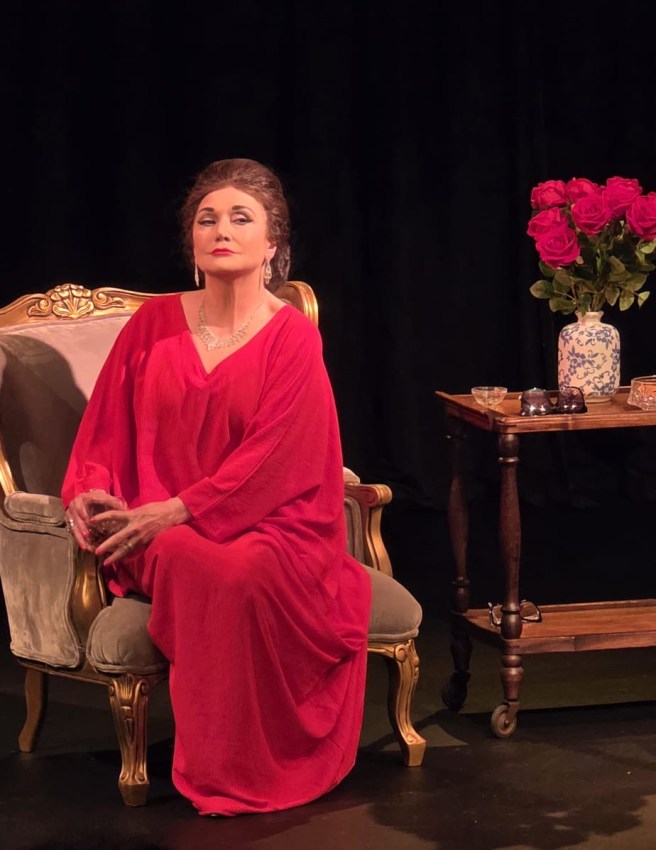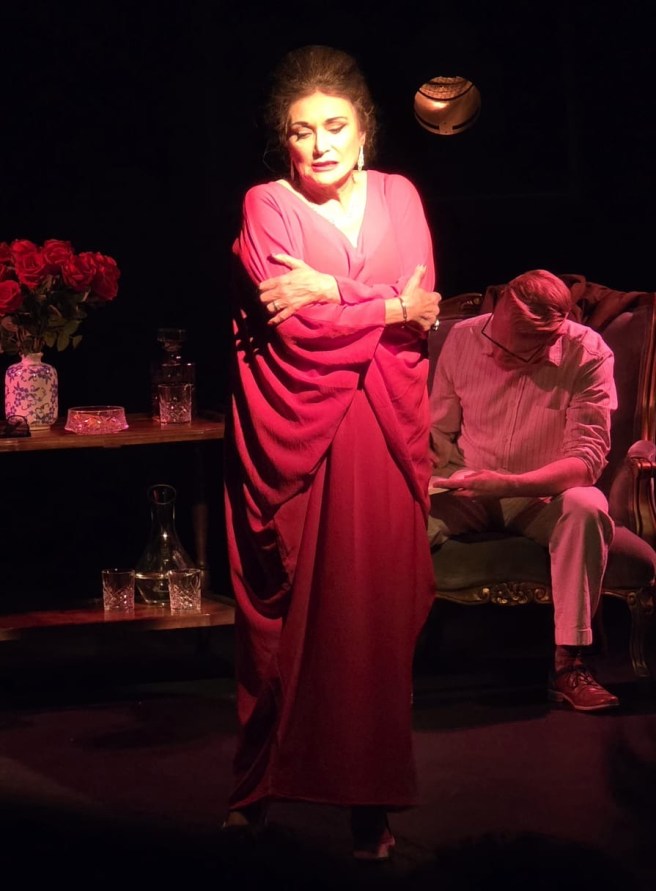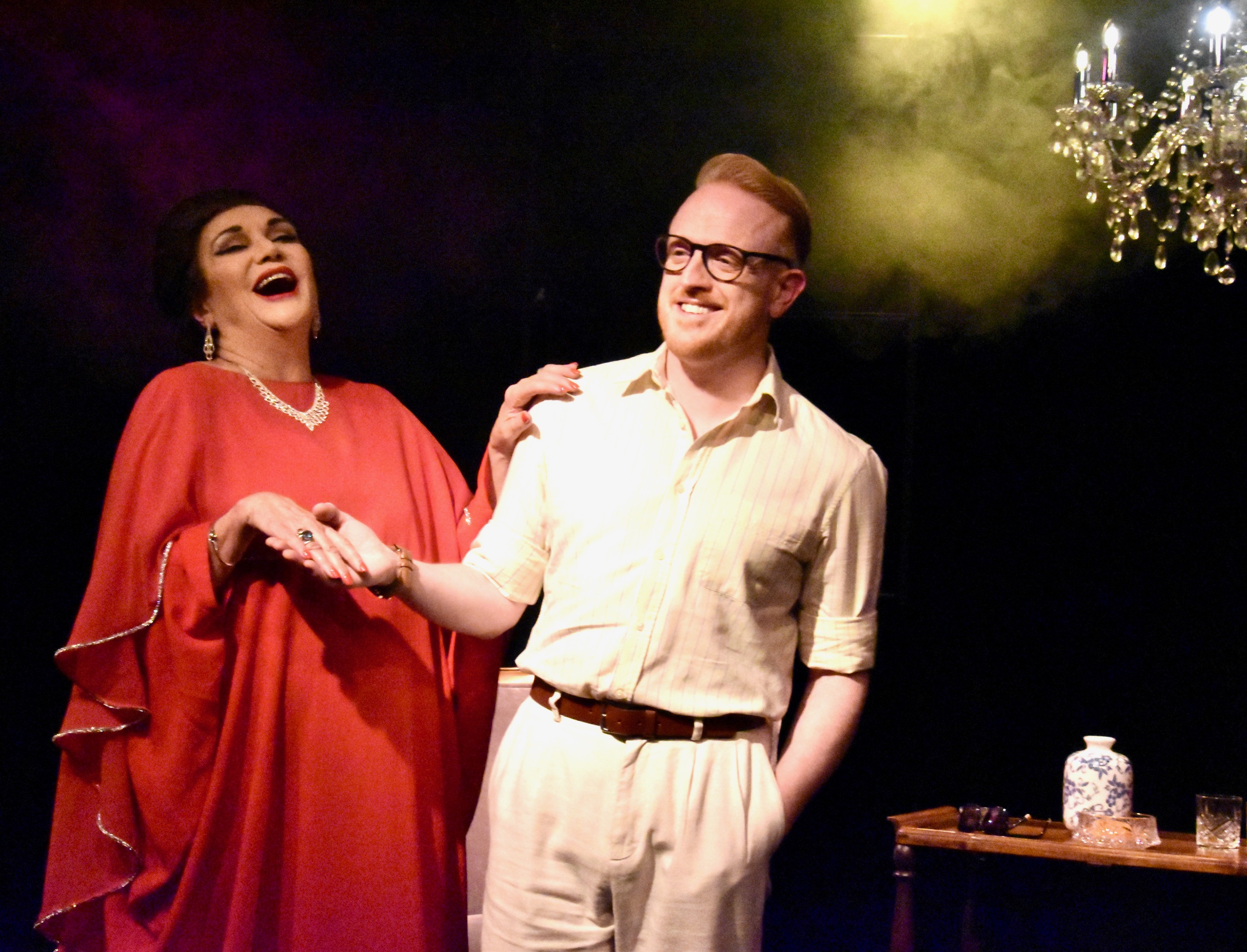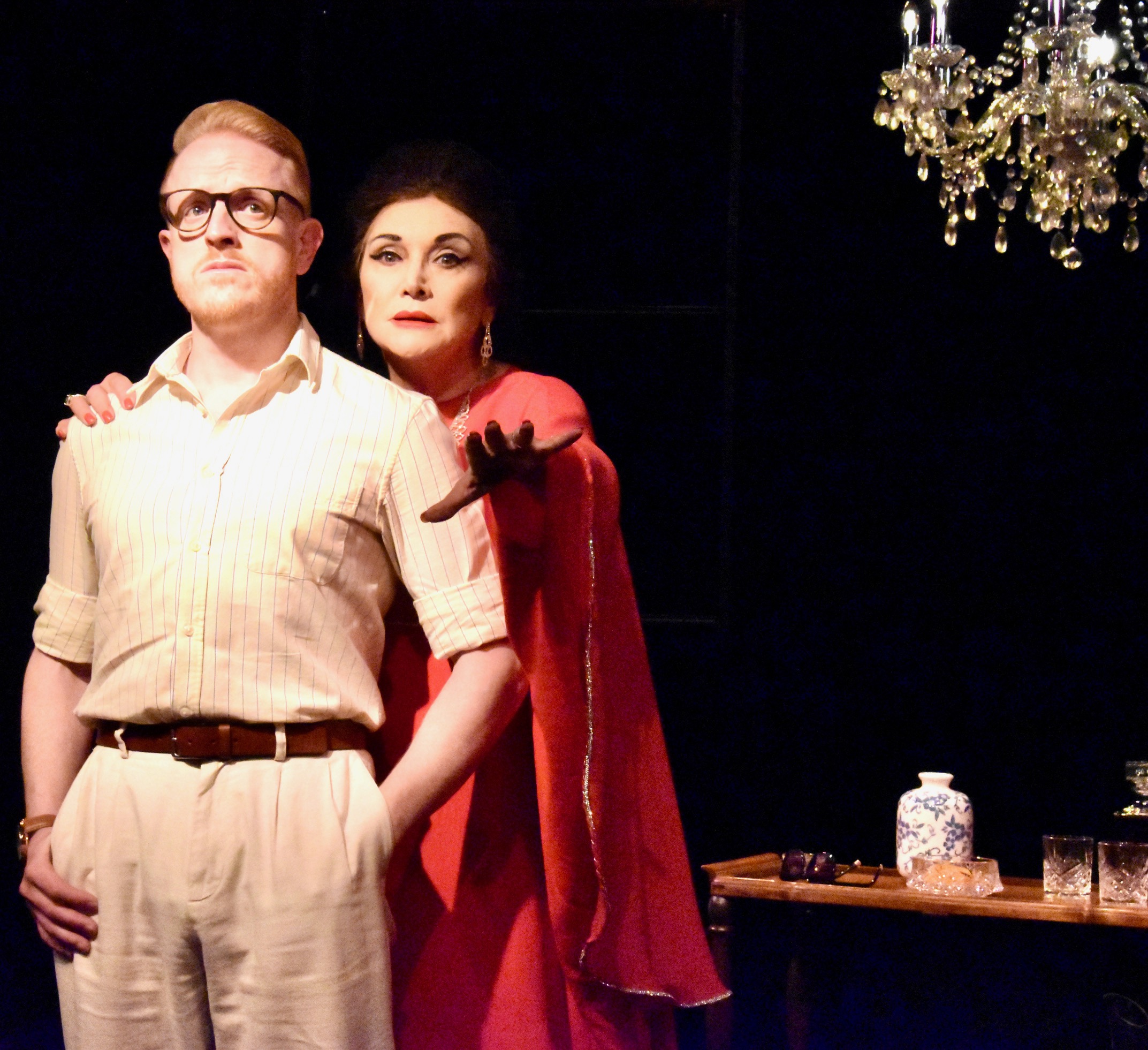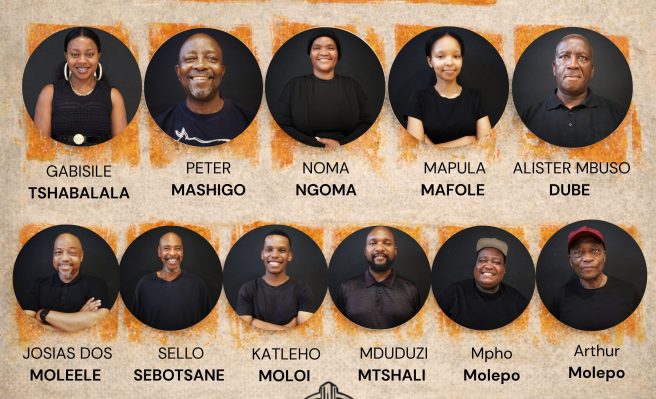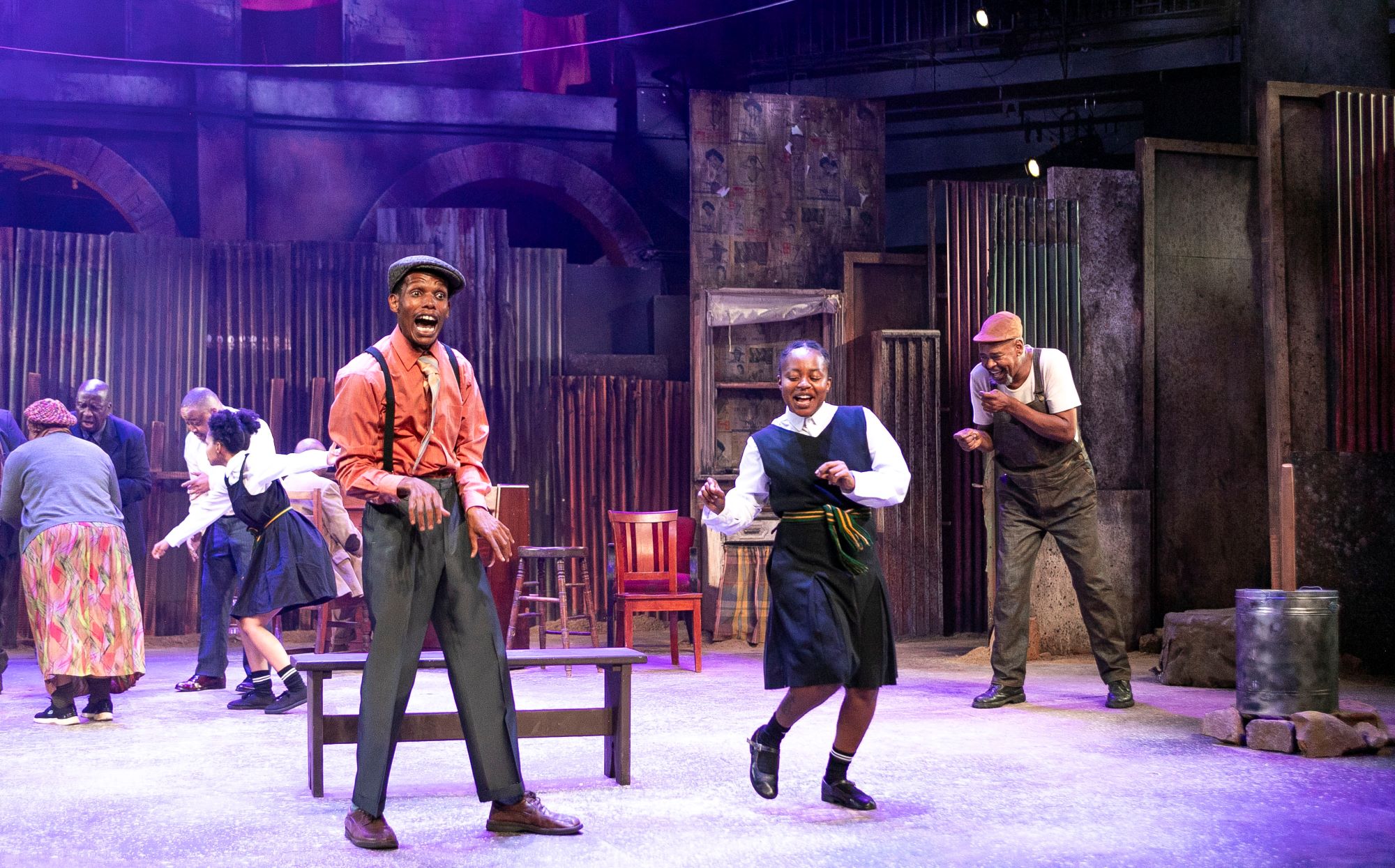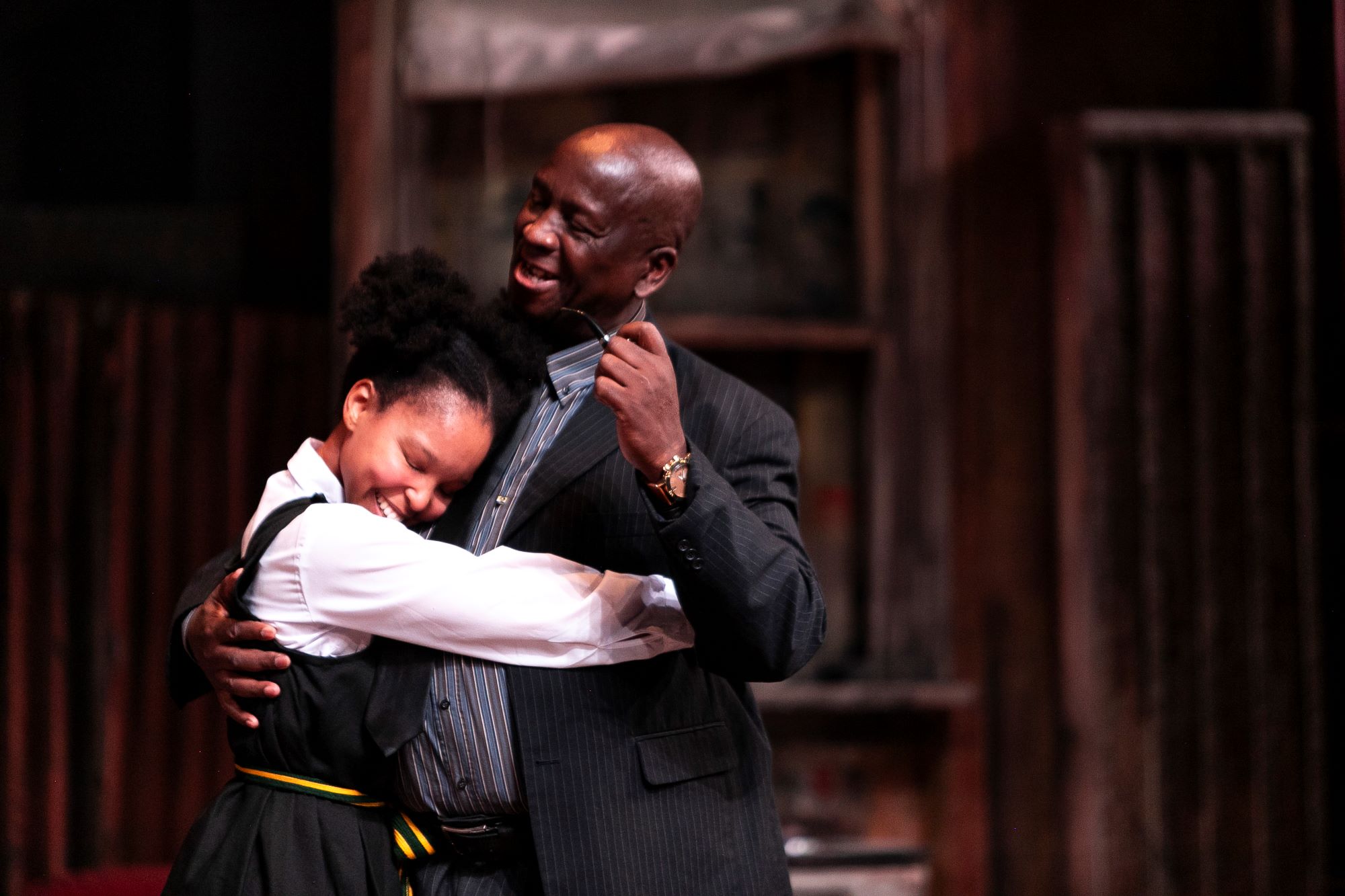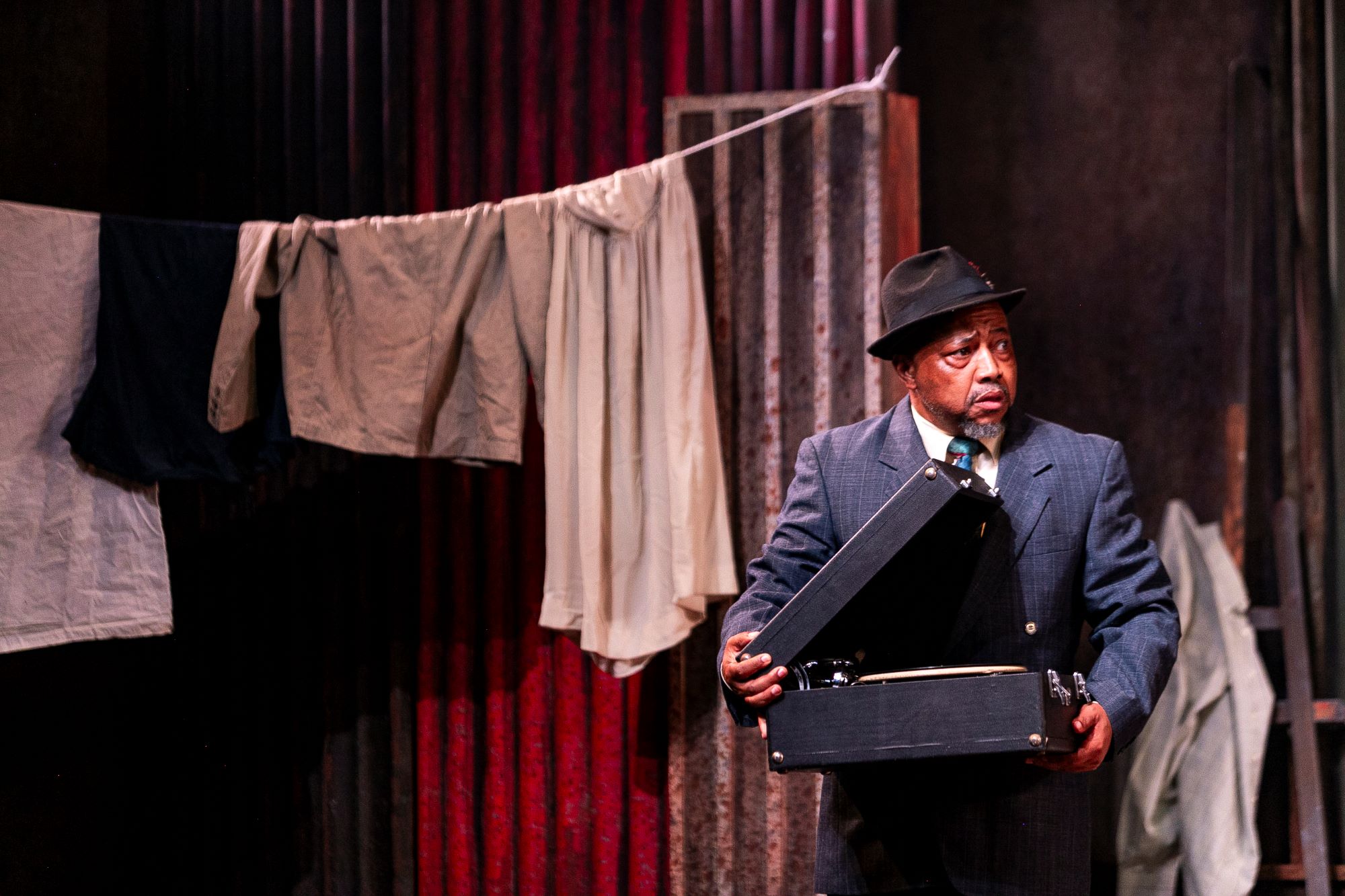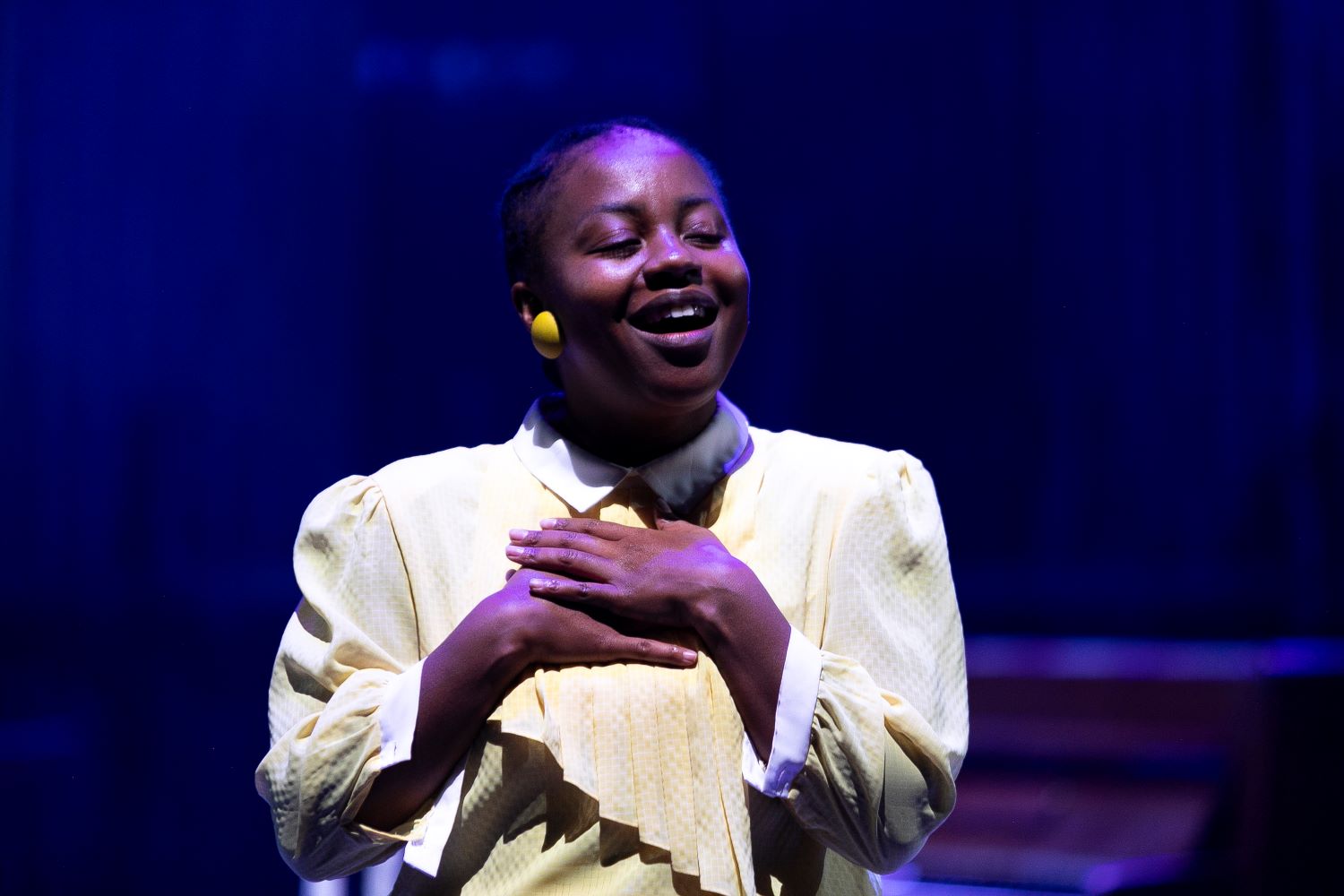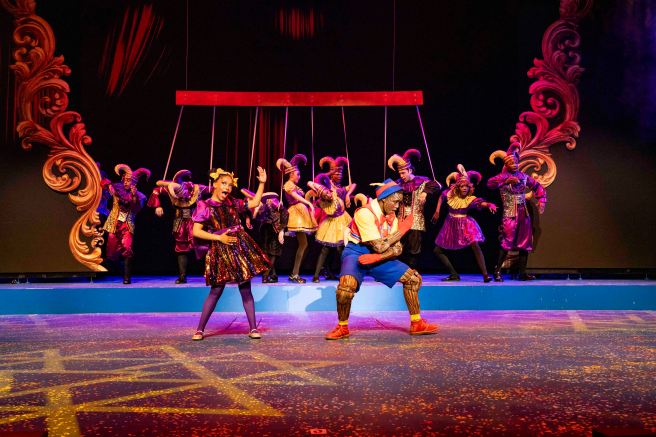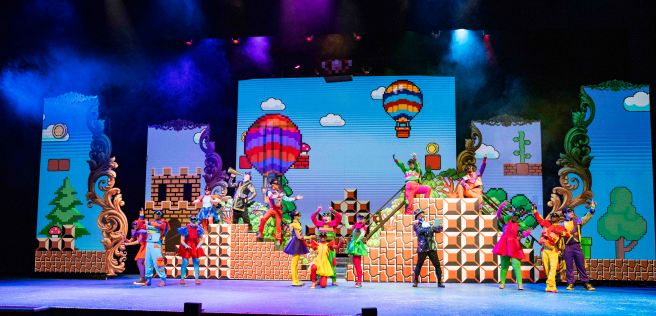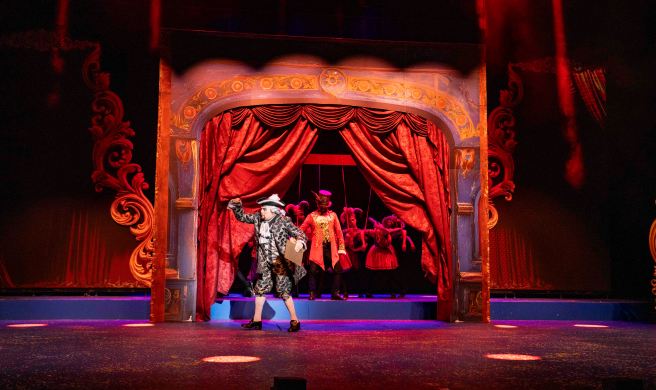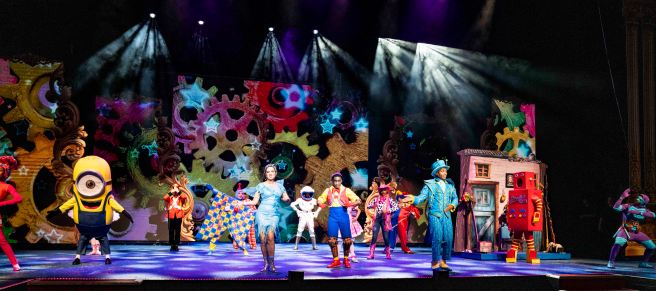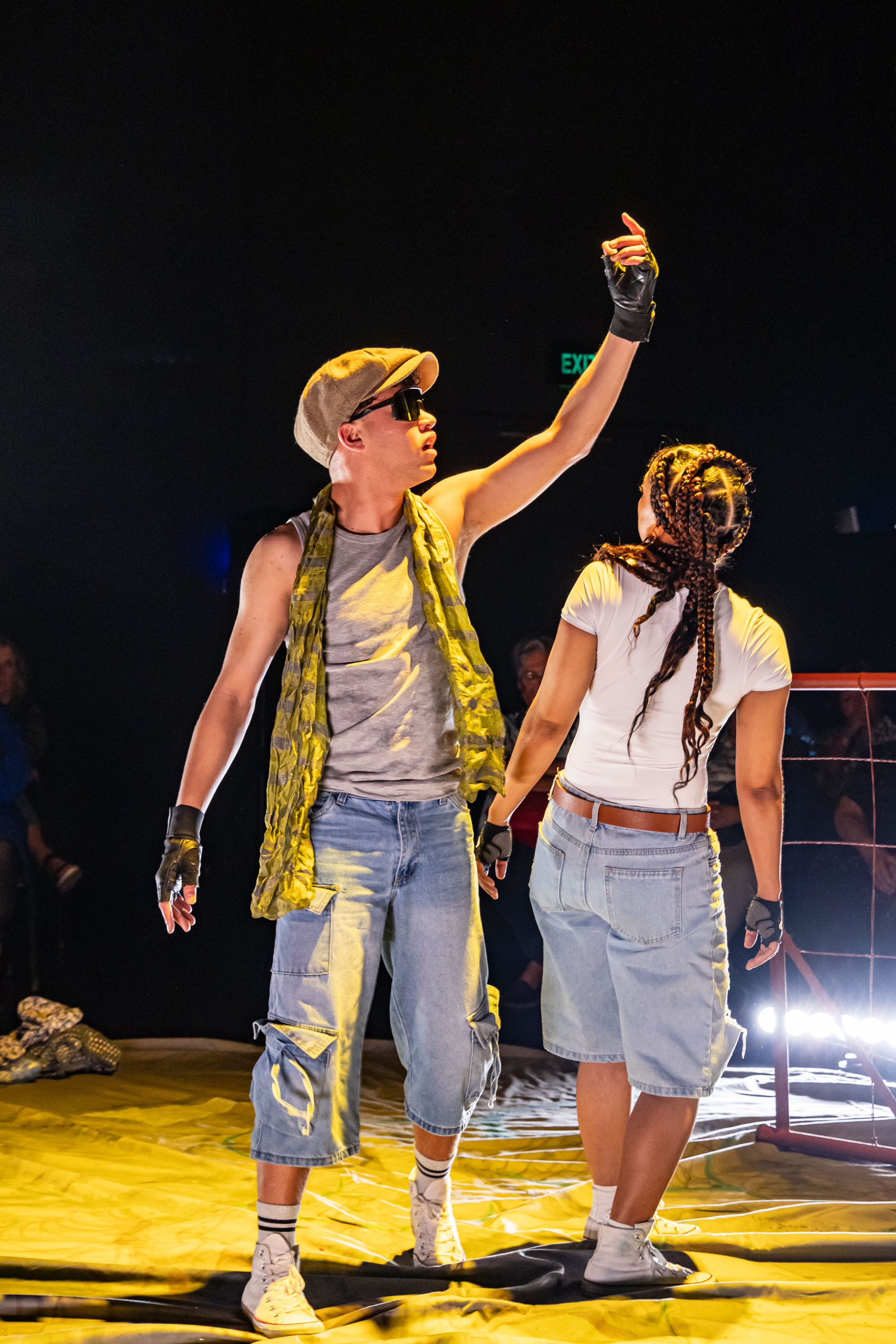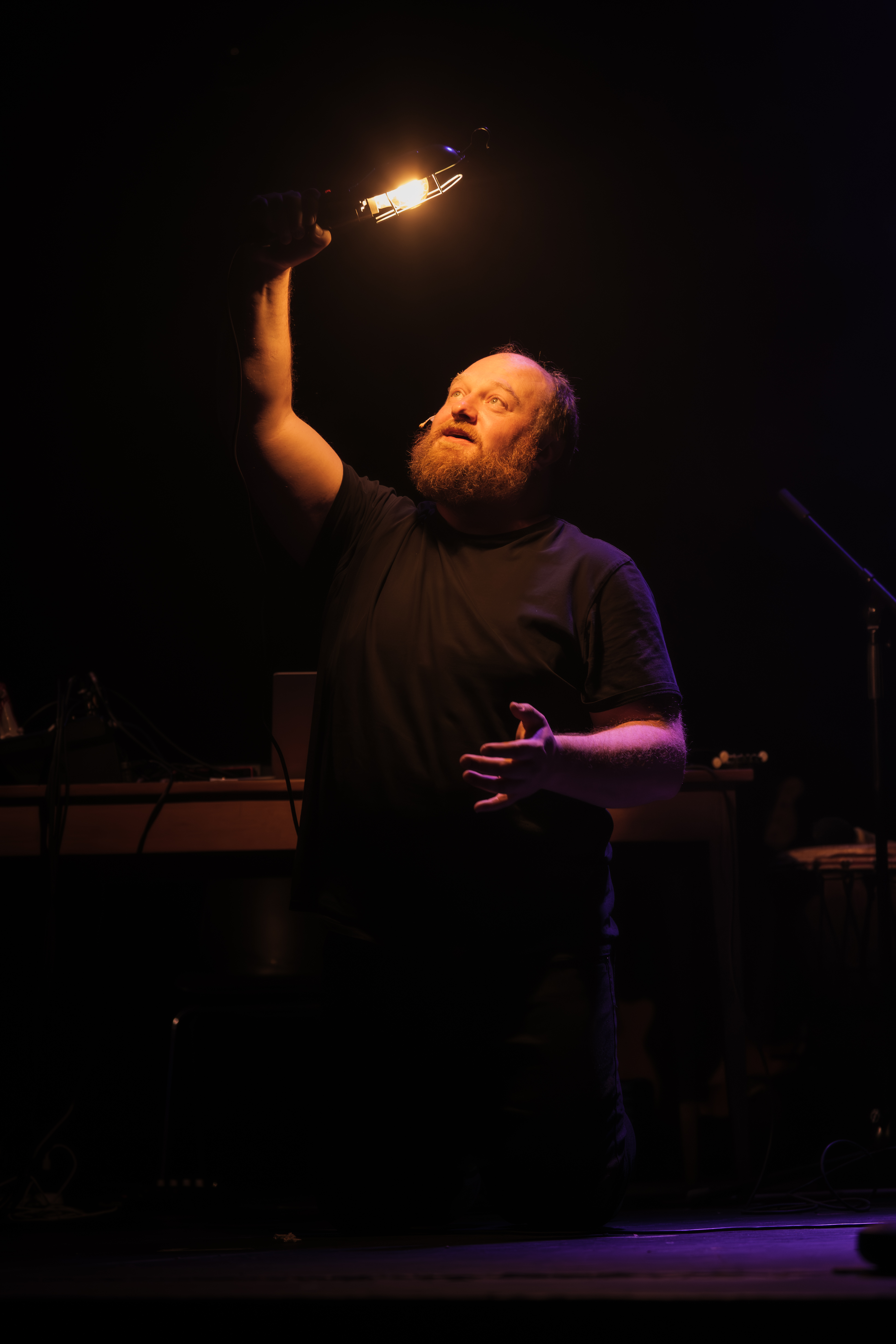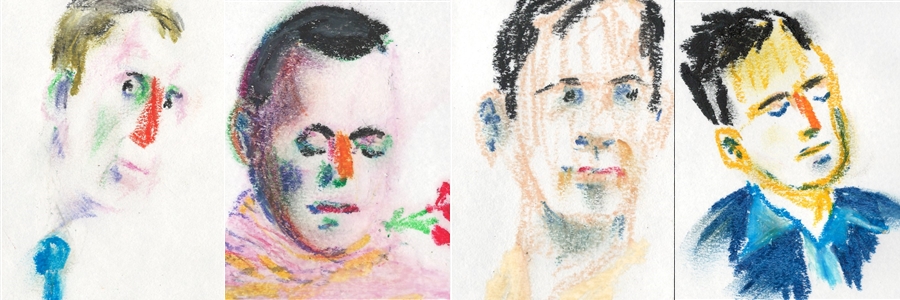
CAST: Katlego Nche (Pinocchio); Gina Shmukler (Bella Bouboulina – the Blue Fairy); Sandi Dlangalala (Jiminy Cricket (Gepetto Spoletto); Lesedi Rich (Lampwick Spaghetti); Brenda Radloff (Madame Ill’Fortunato – The Fox; Camilla Waldman (Madame Pussy Galore – The Fat-Cat); Tiaan Rautenbach (Dame Arletti Spaghetti ); Mark Richardson (Senor Napolio Strombolio – (Puppeteer/Gambvling Lord/Donkey Pirate); Luciano Zuppa (Fiddelomino – Traindriver/Donkeydealer); Noluthando Mathebula (Dainty Dolly – a puppet); Dale Ray (Benny Basie Blue MD);and the ensemble of 15 performers
DATES: Until December 24
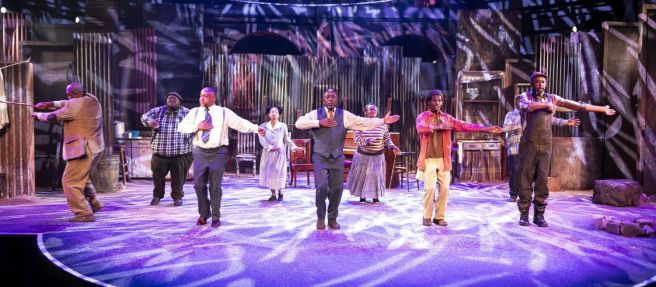
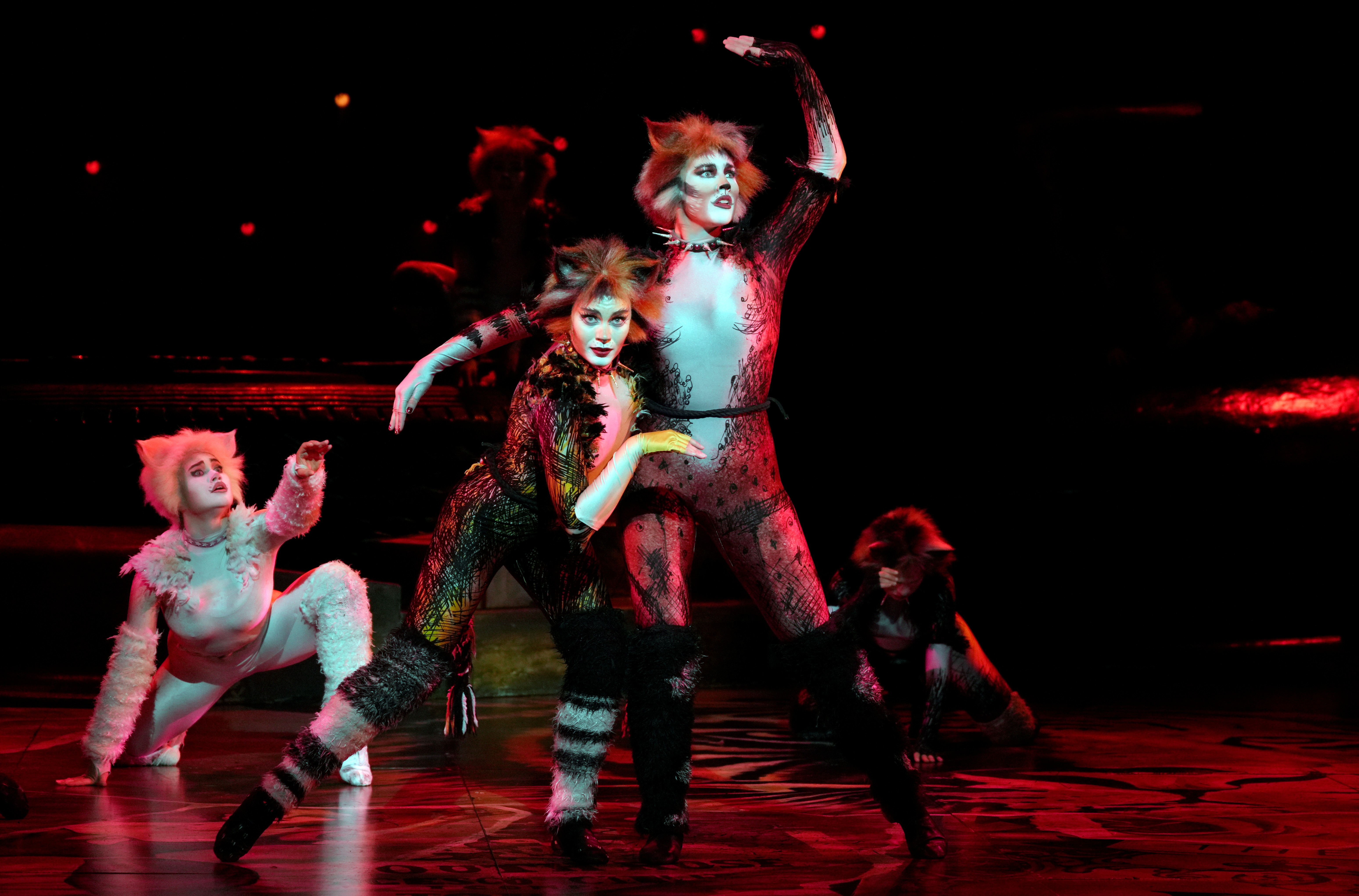
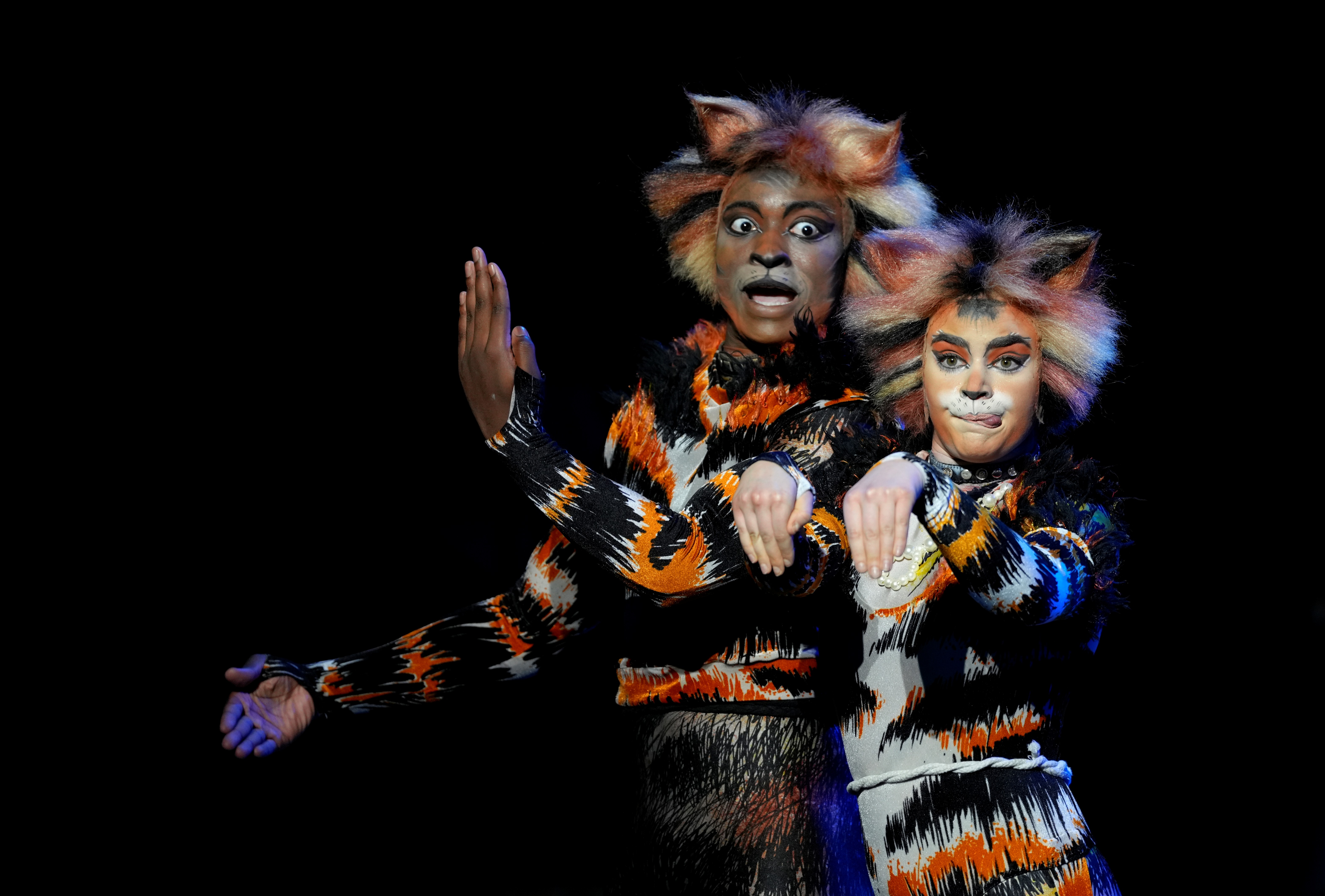
A colourful explosion.
Oh Janice! Why am I not surprised? This your 38th outing … I think? And you’re still pulling it off? There’s simply no end to your genius, is there?
I know you can do many other shows as well and you have the CV to prove that. But Gauteng audiences simply refuse to let you go.
Not only do you pull it off year after year, you also have the perfect team, led by Timothy le Roux, assistant director, who has introduced his own stage charm to the proceedings as well as holding on to all that panto knowledge you have imparted since those very early years.
Doesn’t matter when you go … as we did on a Sunday at noon. You simply pack them in … young and old, it doesn’t matter, they all love it. And I was sitting in the perfect chair to catch the show as well as the audience. They’re having so much fun it’s almost a show on its own.
The colours capture the emotions of the panto.
And there’s a reason for that. You have honed your skills through the years. You never sat back thinking you’ve made it. With each outing you set the bar higher.
You know how to cast, both the veterans and the fresh young things. They’re all rehearsed to an inch of their lives, yet there’s nothing mechanical. They, it seems, are having as much fun as the audience. Even on a day when they will be back in 90 minutes for a second show, it’s all systems go go go.
Let’s start with the costumes! Those colours simply smash it! It’s bright and cheery with a strong Italian flavour of green, red and white running through, but that’s augmented by the brightest brights so that every one on that stage is shining as bright as can be. It’s as happy as well as hip, which immediately sets the tone and the flavour of what’s to come.
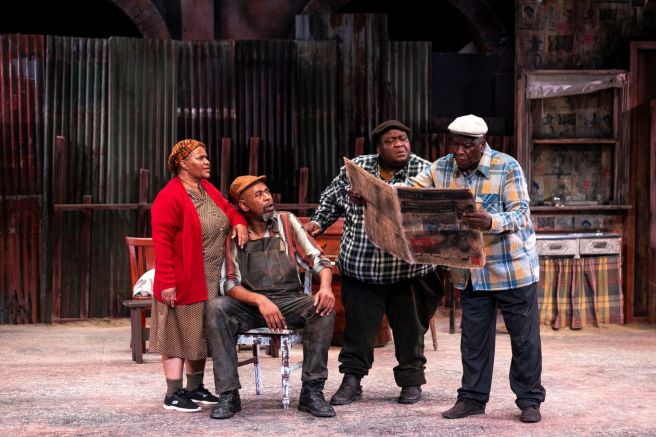
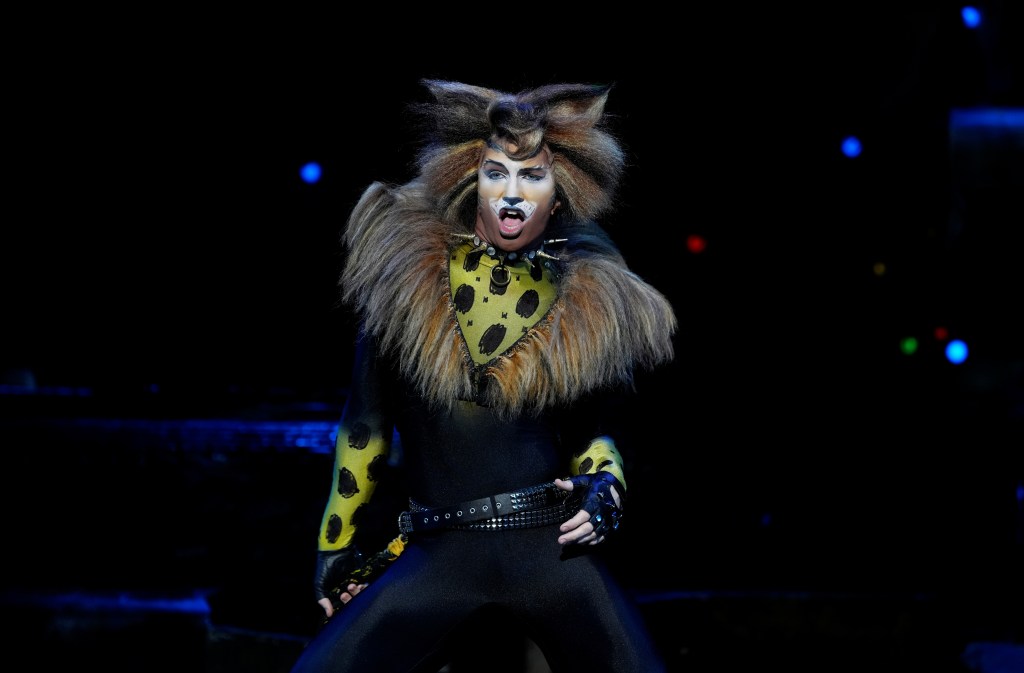
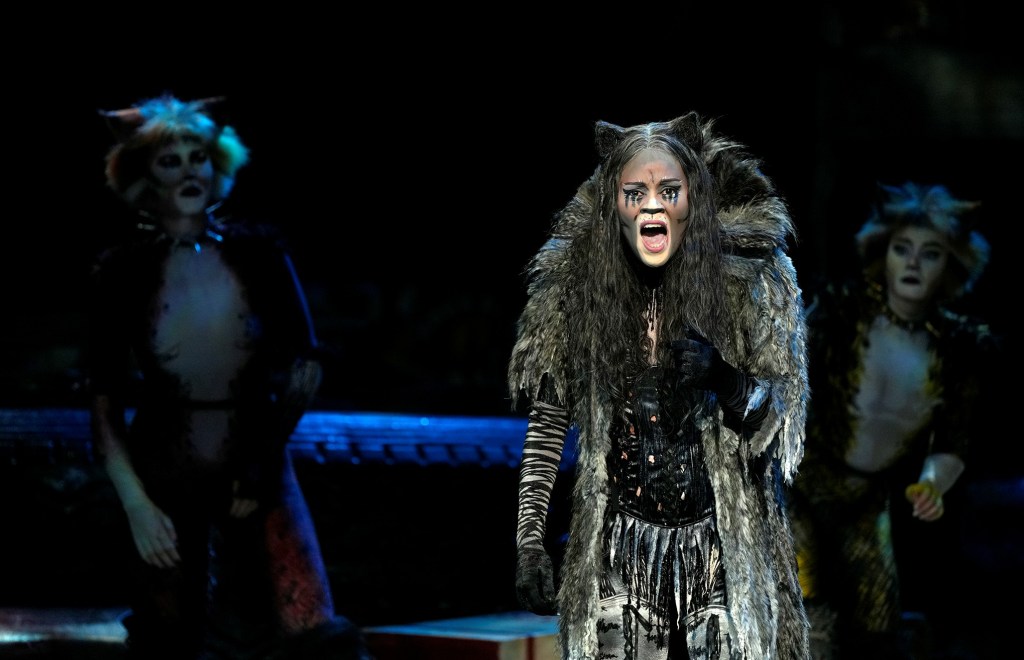
A cast of colourful characters.
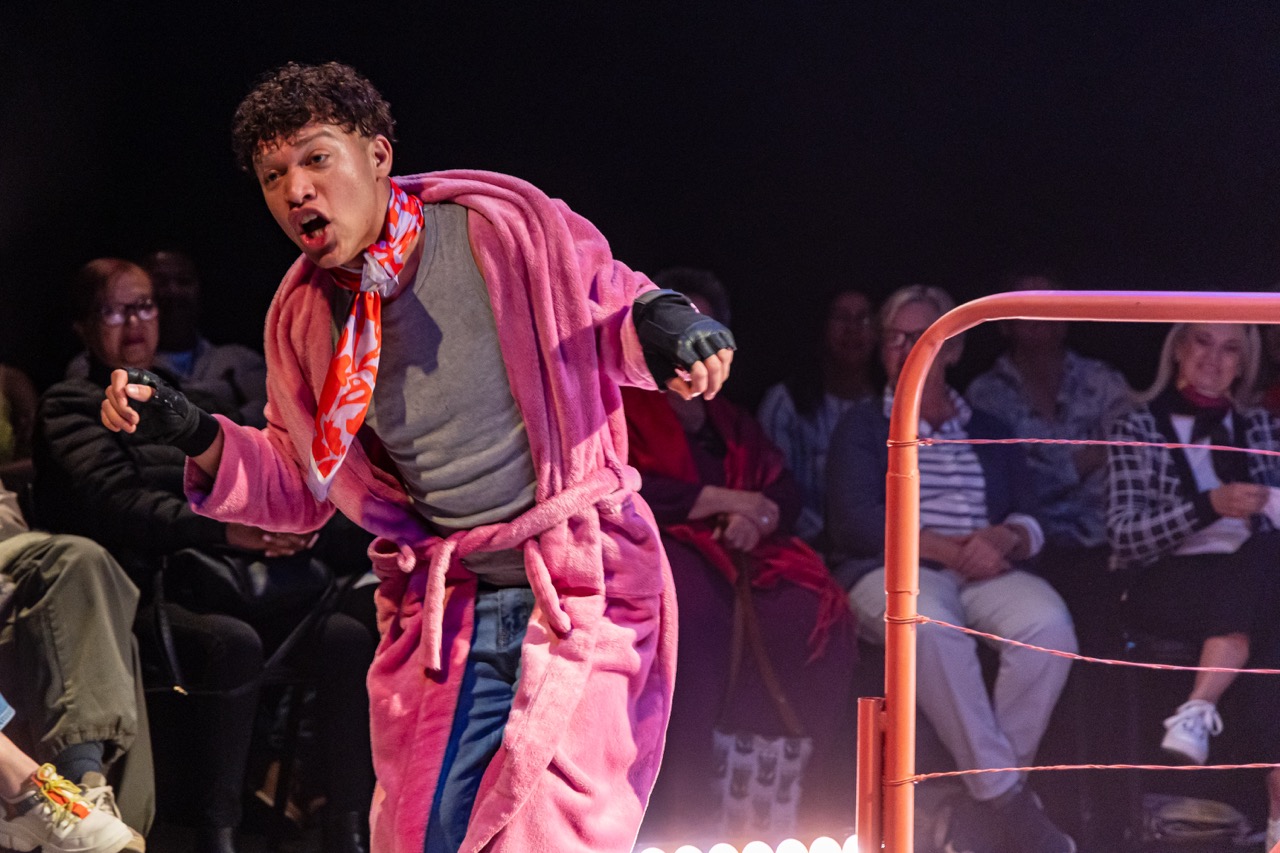
There’s the cheery Pinocchio (Katlego Nche) and his perky puppet friend (Noluthando Mathebula), Jiminy Cricket (Sandi Dlangalala) with the exquisite voice, the two foxy madames (Brenda Radloff and Camilla Waldman), so deliciously delightful, old hands Mark Richardson and Luciano Zuppa who skate through a cast of characters with ease, as well as another wise and wittty veteran Tiaan Rautenbach who knows how to dazzle as Dame Arletti Spaghetti – and how could you not with a name like that! There’s also Gina Shmukler’s sassy Bella Bouboulina, the Blue Fairy, and a supporting cast who bounce with the exuberant energy that keeps the audience on their toes.
Through the years the magic tricks as well as the sparkle and splendour have doubled in size and grandeur and expanded with advances in technology, but what Janice has done so magnificently is hold onto the spirit of the traditional panto.
Every year she enhances what could have become tired tropes. She adds all the necessary and unexpected dazzle, but her brilliance lies in her holding tightly onto the heart.
“It’s about how we become an ensemble, whether we are performers, audience members, or neighbours. It’s how the city performs itself through us, and also how we choose to perform the city. Johannesburg is a place that requires a collective navigation, a mutual reliance, a particular call and responses.” Neo Muyanga, Impressario of the Centre for the Less Good Idea in Maboneng.
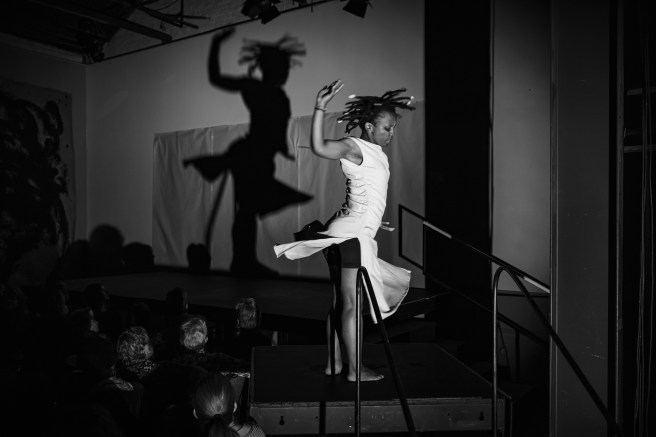
Dancer Thulisile Binda
By DIANE DE BEER
The best would have been to attend all the evenings of the 11th season to experience the full impact of what co-founder and director of The Centre, Bronwyn Lace describes as a multi-limbed, complex organism which she believes is what the Less Good Idea has evolved into. “…our arms reaching into various directions but connected to the same robust body. It makes sense for us to share a season at the end of this year, because we have an abundance of new strategies, forms, and artworks to test, show, and celebrate.”
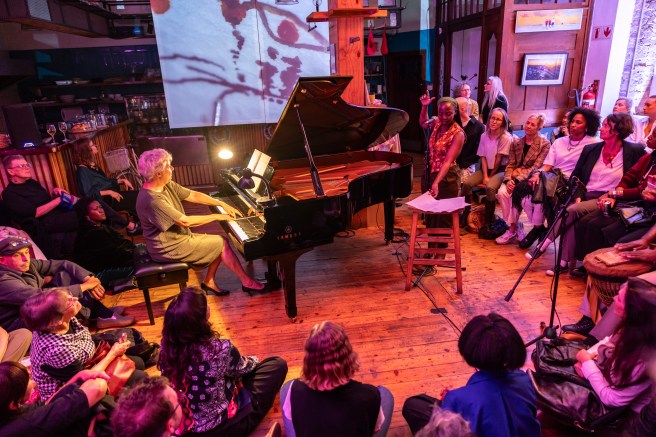
Pianist Jill Richards with vocalist Pertunia Msani.
And it certainly was all of that, exploding with a sense of creative abandon in two hours of exuberant performance which ranged from the glorious musically driven showcase by classically trained improviser Jill Richards who performed magnificently with the Benin drummer, percussionist, composer and arranger Angelo Moiustapha accompanied by the melodic voice of Pertunia Msaniiwith Marcus Neustetter’s digital storytelling adding yet another dimension to the experience. The musicianship was breathtaking.
It set the tone for what was to come as the audience moved to William Kentridge’s studio to experience a collection of mindblowing artists, starting with the spiritually immersive Vincent Mantsoe, one of our finest choreographers/dancers in one of his rare local appearances. Translike in his movement and tearing at the soul of those witnessing his deep level of engagement, the evening merged from one artist to another as Kentridge stepped from one stage to the next as he expressed his creativity with body and soul.
It was all about the merging of art and movement, Moving the Mark, as the event was titled, exploring the relationship between visual art and dance. What they wanted to achieve was to explore the relationship between these unusual pairings and what would emerge.
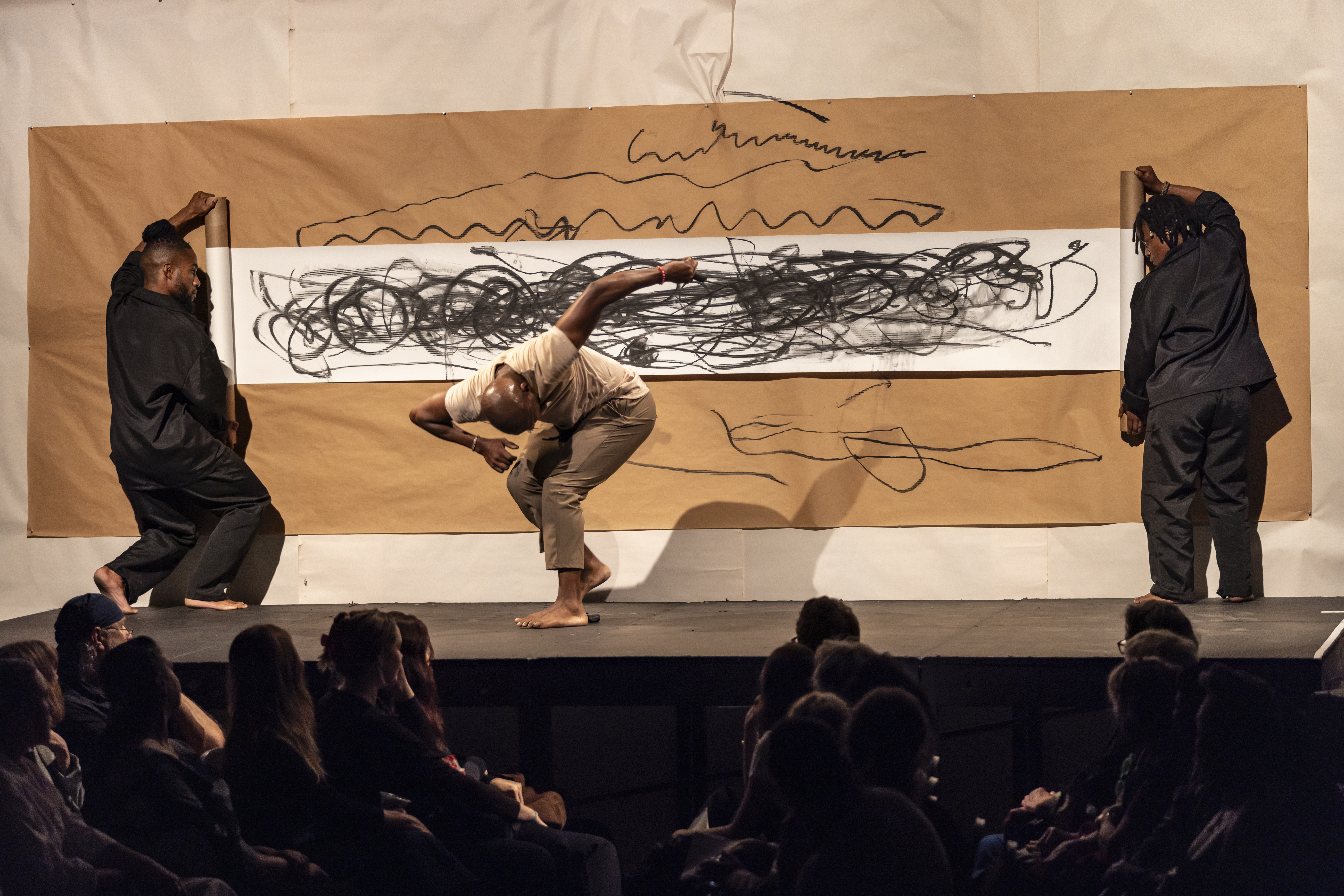
Vincent Mantsoe in action with percussionist Micca Manganye
How would the pure art of collaboration determine new creative decisions for an audience to experience and absorb? What happens when a dancer like Mantsoe mimics the ink stains of an artist like Kentridge, or from a different vantage, when the painter choreographs their brushstrokes?
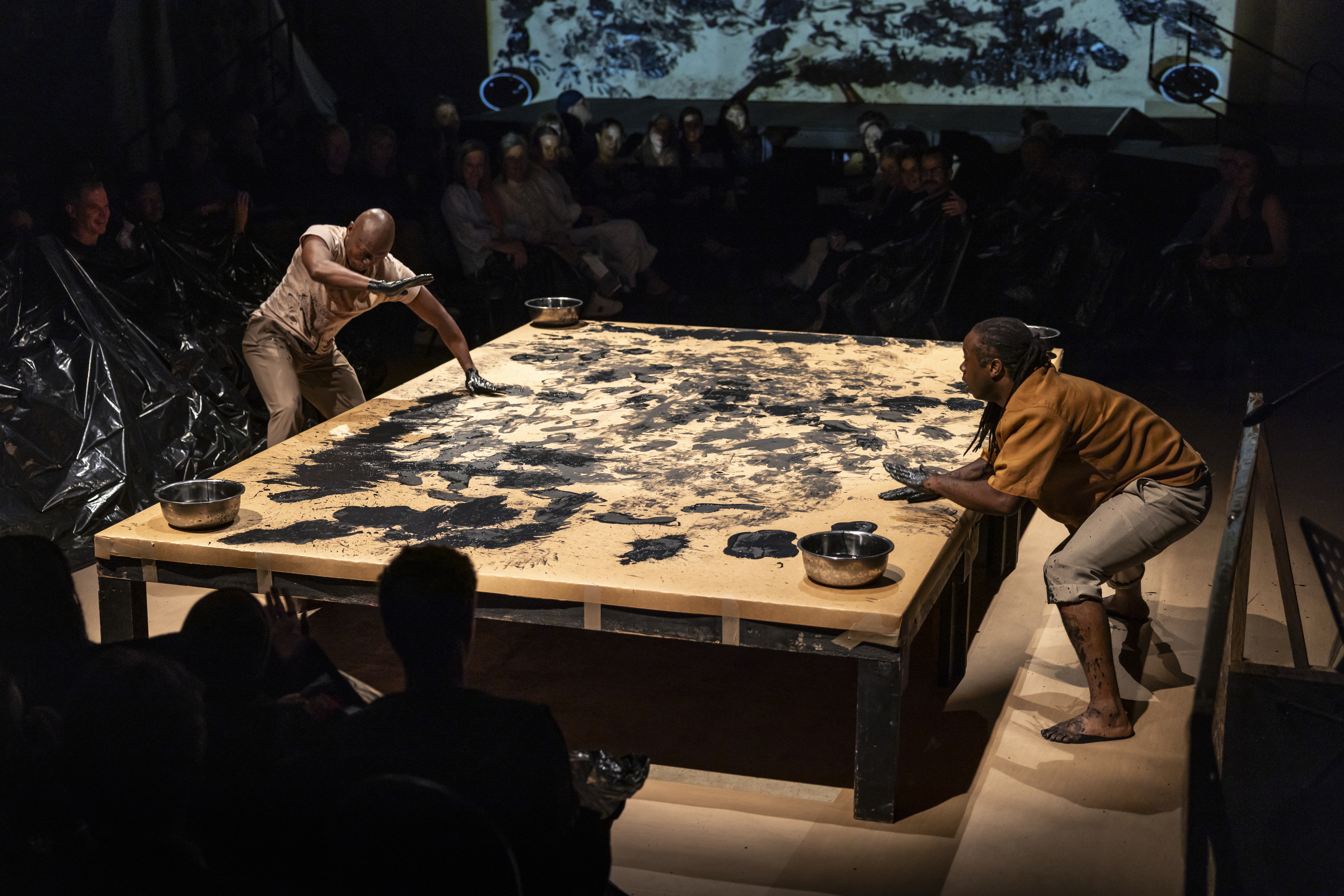
Artist Penny Siopis took to the air in almost trapeze-like fashion, painting her canvas on the floor from up high while choreographer/dramaturg Shannel Winlock-Pailman worked her magic below in mesmerizing fashion, the two artists in total union while expressing their heightened emotions.
All the while, the musical accompaniment captured the experience of the moment, enveloping the audience in the round, some wrapped in black bags to protect them from the explosive expression of art as artists flung paint creatively with fearsome flair.
The Centre for the Less Good Idea is all about the collective voice expressed in collaborative pairings, artists who work in different mediums but have creativity and exploration that binds them, pushing the boundaries, trying different ways of making new work to excite themselves as artists while also challenging and stimulating audiences constantly searching for art and creativity exploring the evolving world we live in.
Curator Neo Muyanga (left) and Kentridge (right, in the left corner) choreographing with brushstrokes while Mantsoe is on stage following the moves.
It’s exciting when artists go beyond the expected, and are given free rein to explore their storytelling genres. How can they beat that drum differently? Given the chance to fail is often the best way to reach excellence but the restrictions are many. And more than anything, it is the encouragement to stretch far beyond the boundaries, to take that leap and to experience the beginning of experiments which are allowed to grow and flourish.
This first sold-out performance of the 11th season proved that the audience is willing and determined to experience artists moving the mark. The rest of the season sounded as extraordinary and my wish would have been to witness the full week of extraordinary creativity encouraged to dare to go beyond the expected.
How blessed are Gauteng audiences (who showed their appreciation) to experience these glorious experiments inspired and empowered by William Kentridge who could have staged them anywhere in the world. Kentridge gives us the opportunity to grow together and to expand our idea of what anything and everything is. Step into the void and see what happens comes to mind.
Photographers: Jeremeo Le Cordeur; Llewelyn de Wet and Gys Loubser
The Stellenbosch Woordfees can be quite a daunting prospect because there is so much on offer. It is perhaps easier if you have specific artistic passions, as most of them will be on offer here and it is possible to make a selection. DIANE DE BEER spotlights what caught her fancy
There’s not even a chance that you can include all your darlings in a festival wrap or even try to see them all.
I did my best, was constantly on the move and writing, and still I hear of more productions you just had to see.
Personal favourites (don’t discount others because I probably didn’t see them):
My best theatre productions were stories that turned me into an emotional wreck but did so with authenticity (I know this is a woke word, but …).
Tinarie van Wyk-Loots and Kristen Raath (left) and Jefferson J Dirks-Korkee(right) in
Dianne du Toit Albertze’s Huis van Sand.Pictured by Jeremeo Le Cordeur
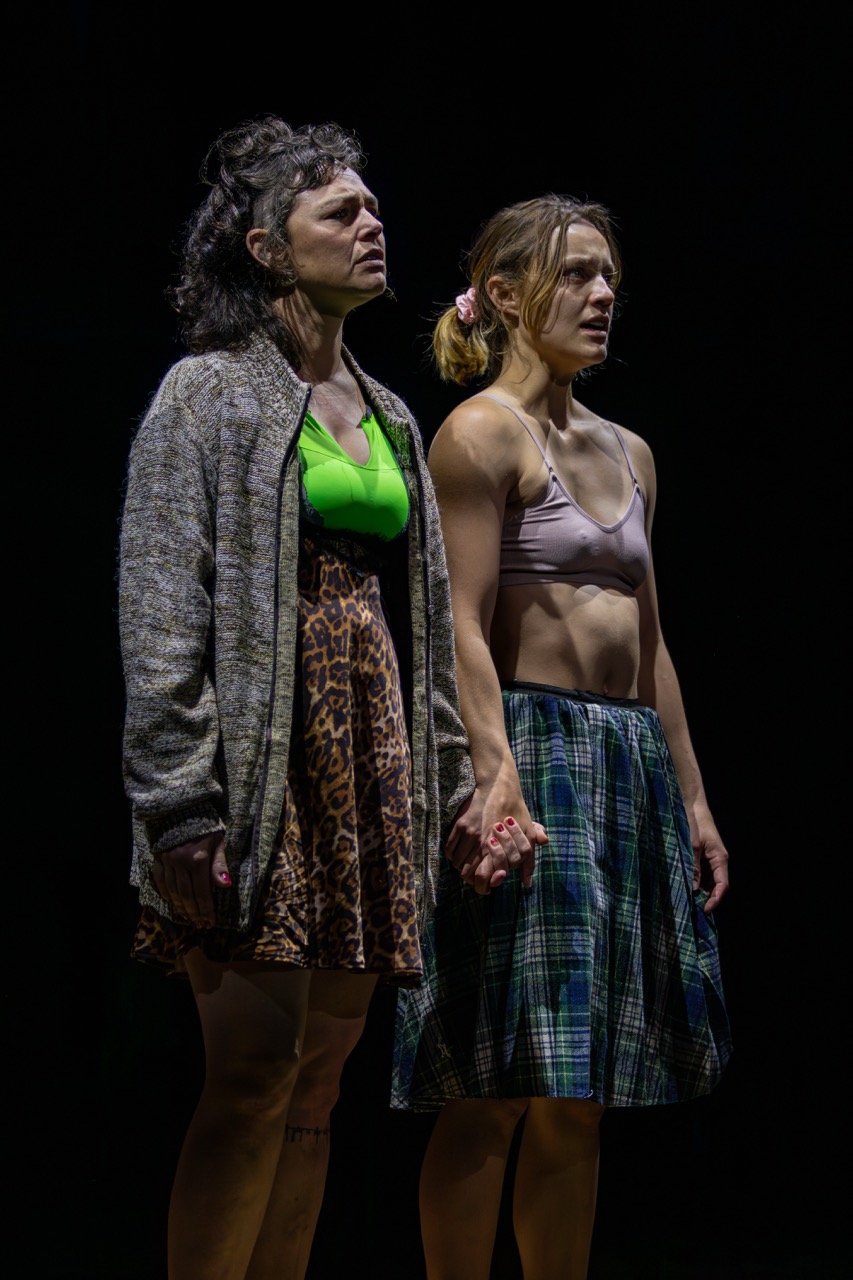
The winning text of the prestigious Reinet Nagtegaal prize, Dianne du Toit Albertze’s Huis van Sand, with her honest portrayal of a dysfunctional family that’s probably not even part of most audiences’ consciousness. She writes about what she knows and where she comes from, the Northern Cape. But she does this in her self-made tongue, which shoots right to the heart and guts of the matter, no pussyfooting around with this one.
It is not a place many of the traditional Woordfees audiences will know. The backdrop is the N7, a route that runs from one end of the country to the other. It is her little spot next to the highway that Sandy knows. She and her daughter share Rodney’s caravan and too much of his life, especially the dark side. They’re trapped and yet the lifestyle is passed on from one generation to the next with the whole family fully engaged. A seemingly never-ending devastating cycle.
What drives Huis van Sand are Albertze’s words, her imagination, and the way she plays wildly with your head and emotions. Throw into the mix director Wolfie Britz’s strong casting and determined direction. With the remarkable Tinarie van Wyk-Loots launching herself body and soul into this one, Sandy’s daughter (Kristen Raath) trying to duck the missiles and resist diving headfirst into the temptations, Jefferson J Dirks-Korkee’s chilly capture of the toxic male scent always hovering menacingly and René Cloete showing she is much more than just an innocent bystander, everything about this production hits you like an onslaught.
Yet this is one you want to struggle and engage with because of the sharp edges and the unblinking gaze at the harsh reality of so many lives. It’s heartwrenching, but that is something this playwright has never turned away from. She stares straight into the skewered glare of too many unseen lives and throws us all in at the deep end. The brilliance is well worth the battle.
Melissa de Vries as Nadia and Angelo Bergh as her friend Zavie
Walking the same tightrope, is the adaptation by Jolyn Phillips of Ronelda Kampher’s ravaging novel starring two vulnerable yet resilient teen cousins who try their best to navigate a world they don’t understand while instinctively understanding that they are their only protection.
For Nadia (Melissa de Vries) and her chum Zavie (Angelo Bergh) their bond while tenuous and often fragile is what keeps them breathing.
With this one it is again the magnificence of the performances and the staging by Lee-Ann van Rooi that holds the attention as these two baby-adults going about their lives as if it is normal – and for them it is, it’s all they know.
That’s precisely the point. This is their normal, their life and the one Kampher’s words in her searing novel lay bare. Their whole existence is determined by outside factors, never certain or expected. Yet they do know how to grab the small slices of life when given the chance which isn’t often. They should not even be aware of the things happening in their lives, yet that’s the only way they know how to roll.
Kampher’s language is brilliantly captured by Phillips’ adaptation. How she even knew where to start! It’s such a complex and almost crippling story about these children whose future is determined purely by the happenstance of their birth.
Both of them have bucketsful of gifts which will never be realized because there’s simply no support or networks for these drifting families where not one generation manages to get even a foothold on a real life.
If anything good happens in their lives, it is luck and often, at that particular moment, the recipient doesn’t know how to deal with it.
When reading Kampher’s book the first time, you’re in awe of the writing and the storytelling. It’s the way she focused on the stories never told, the way she draws the characters, gives them flesh and emotions, which in this instance are perfectly re-created by the choices of Van Rooi and the adaptation by Phillips.
What a beautiful acting team. I don’t know them, don’t watch television if that’s where they perform, but I do know that they have inhabited these two kids with so much energy and guts, it’s hard to resist.
And that’s the joy of festivals, the opportunities that arise for artists so that when the stars align (a good script, director and actors), nothing can hold them back.
All of these performances should and will hopefully travel. For far too long too many voices have been silenced. We are so much richer as a country, as audiences and as performers when all our stories are shared.
Albert Pretorius (actor) and Schalk Joubert (guitarist) in Ek is nie Danie pictured by Llwellyn de Wet and Gys Loubser.
What four middle-aged men did with what they had, was inspirational. They took something which if not handled with the same delicacy as the poetry, could have been disastrous. But because of deft hands and hearts, it feels as though you are dealing with an emotional vortex, but one driven with artistic insight and instinct which holds the audience tightly and sharply in focus from start to finish.
It worked because of the truly exquisite writing and then the choice of the right participants. The concept was Niel van Deventer’s according to the programme, but then handed to one of our smartest directors, Nico Scheepers. He is given a topic which would turn most people away – the angst and anxiety of ageing white men, not a species that many have much sympathy for.
Yet this company with actor Albert Pretorius and musical director/guitarist Schalk Joubert has shown that, given the right elements, a director who knows how to shape something yet value his actor and musician by allowing them the freedom to be and to do, it will work – and in this instance, explosively.
It’s one of those performances that you want to see again as soon as you leave the theatre. I hope it travels the country.
I took these three stunning plays to give some flavour to the Woordfees which is far too dense and diverse to dilute, but that there’s something for everyone, that’s a certainty and you won’t have to look too far or hard.
They have achieved much in only a short time and in the future with everything changing so rapidly, we can only expect to experience even more.
And then just a small PS: I was asked to interview Nataniël on a book Bloei+Blom and being who he is, the first lunch was booked out swiftly and another date the next day was included and again fully booked. But hey, the more the merrier.
As an interviewer, this is the one date I don’t have nerves. I know I am in safe hands and he is the master of chat.
It was the easiest gig in town. Even though he and I had talked about topics of conversation before the time, once on a roll, and only three questions down, I could sit back, relax and enjoy one of our best (and naturally funniest) conversationalists in action.
There was no way to ask anything else. He was in full flight on his own. He did glance my way once or twice, but there was no interrupting the flow. And even better, he was the one they wanted to see and hear.
I felt blessed, centre stage and could watch the wizard in full flights of fantasy.
*There were many others I loved, many of which I had written on at the Woordfees or previously including Boklied, Seun, Bridling, Kuns, Magda en haar Erhard, Ont-, and always The Ugly Noo Noo …
Screened exclusively at Ster-Kinekor cinemas, with select livestreams at V&A Waterfront
Deborah Nansteel as Teresa, Nadine Sierra as Amina, Sydney Mancasola as Lisa, Xabier Anduaga as Elvino, and Nicholas Newton as Alessio in Bellini’s “La Sonnambula.” Photo: Marty Sohl / Met Opera
It’s time for the 25/26 Met Opera season and what a spectacular worldwide season they’ve put together for the opera cognoscenti including South African opera enthusiasts.
This is the 18th Met: Live in HD, the Metropolitan Opera’s award-winning series of live high-definition cinema simulcasts and will locally be seen exclusively at select Ster-Kinekor and Cinema Nouveau cinemas.
With eight productions screening from this Sunday to mid-June 2026, the 2025-26 Live in HD season features one premiere, three new productions of much-loved operas and four revivals.
“With The Met: Live in HD productions screening in our cinemas, local audiences get to experience some of the world’s best-loved opera productions in a near-live situation, from The Met’s opulent stage to our big screens. The theatre-like setting enables cinemagoers to become an extension of the live production’s audience, making these world-class productions from the Met in New York accessible to anyone who enjoys and appreciates great opera,” says Lynne Wylie, chief marketing officer at Ster-Kinekor Theatres.
“What began as an experiment 18 years ago has become a staple experience for opera lovers all over the world,” said Peter Gelb, the Met’s Maria Manetti Shrem General Manager.
“Our 2025–26 season in cinemas reflects how opera is changing at the Met, where we’re balancing timeless classics with accessible new work that is advancing the art form and attracting younger and more diverse audiences.”
Don’t miss this world-class opera production, filmed and transmitted from the Met stage to the big screen at Cinema Nouveau and select Ster-Kinekor cinemas: Eastgate and Rosebank Nouveau in Johannesburg; Brooklyn in Tshwane; Watercrest in Hillcrest, KZN; Garden Route in George; Somerset in Somerset West; and Blue Route and V&A Waterfront (with live streams) in Cape Town. Loyalty card discounts apply, as does Ster-Kinekor’s Half-Price Tuesdays ticket price offering.
Bookings are open, with each production limited to two screenings only. Book your tickets now on the new-look Ster-Kinekor website at www.sterkinekor.com or download the new SK App on your smartphone. For news and updates, go to Facebook: Ster-Kinekor Theatres | follow Ster-Kinekor on Twitter: @Ster-Kinekor. For all queries, call Ticketline on 0861-Movies (668 437).
Here is the 2025-26 Met: Live in HD season at a glance, hold on to the programme for bookings:
Nadine Sierra as Amina in Bellini’s La Sonnambula. Photo: Marty Sohl / Met Opera
La Sonnambula – Bellini (new production)
Screening dates: 02 and 04 November 2025 (3h 15min)
Music by Vincenzo Bellini | Libretto by Felice Romani
Conductor: Riccardo Frizza
Cast: Amina – Nadine Sierra; Lisa – Sydney Mancasola; Elvino – Xabier Anduaga; Rodolfo – Alexander Vinogradov
Roméo et Juliette, Verdi’s La Traviata, and Donizetti’s Lucia di Lammermoor, Nadine Sierra (seen in previous seasons of Roméo et Juliette, Verdi’s La Traviata, and Donizetti’s Lucia di Lammermoor) summits another peak of the soprano repertoire as Amina, who sleepwalks her way into audiences’ hearts in Bellini’s poignant tale of love lost and found.
In this new production, Rolando Villazón—the tenor who has embarked on a brilliant second career as a director—retains the opera’s original setting in the Swiss Alps but uses its somnambulant plot to explore the emotional and psychological valleys of the mind.
Tenor Xabier Anduaga co-stars as Amina’s fiancé, Elvino, alongside soprano Sydney Mancasola as her rival, Lisa, and bass Alexander Vinogradov as Count Rodolfo. Riccardo Frizza takes the podium for one of opera’s most ravishing works.
Juliana Grigoryan as Mimì and Freddie De Tommaso as Rodolfo in Puccini’s La Bohème. Photo: Karen Almond / Met Opera
La Bohème – Puccini (revival)
Screening dates: 08 November (livestream at V&A Waterfront); 23 and 25 November 2025
(3h 29min)
Music by Giacomo Puccini | Libretto by Luigi Illica and Giuseppe Giacosa
Conductor: Keri-Lynn Wilson | Production: Franco Zeffirelli
Cast: Mimì – Juliana Grigoryan; Musetta -Heidi Stober; Rodolfo – Freddie De Tommaso; Marcello – Lucas Meachem; Schaunard – Sean Michael Plumb; Colline – Jongmin Park; Benoit/Alcindoro – Donald Maxwell
With its enchanting setting and spellbinding score, the world’s most popular opera is as timeless as it is heartbreaking. Franco Zeffirelli’s picture-perfect production brings 19th-century Paris to the Met stage as Puccini’s young friends and lovers navigate the joy and struggle of bohemian life. Soprano Juliana Grigoryan is the feeble seamstress Mimì, opposite tenor Freddie De Tommaso as the ardent poet Rodolfo. Keri-Lynn Wilson conducts the 08 November performance, which will be transmitted live from the Met stage to cinemas worldwide, including at Ster-Kinekor V&A Waterfront in Cape Town.
A scene from Strauss’s Arabella. Photo: Marty Sohl / Met Opera
Arabella – Strauss (revival)
Screening dates: 07 and 09 December 2025
(4h 12min)
Music by Richard Strauss | Libretto by Hugo von Hofmannsthal
Conductor: Nicholas Carter
Cast: Arabella – Rachel Willis-Sørensen; Zdenka – Louise Alder; Matteo – Pavol Breslik; Mandryka – Tomasz Konieczny; Waldner – Brindley Sherratt
Strauss’s elegant romance brings the glamour and enchantment of 19th-century Vienna to cinemas worldwide in a sumptuous production by legendary director Otto Schenk that “is as beautiful as one could hope” (The New York Times). Soprano Rachel Willis-Sørensen stars as the title heroine, a young noblewoman in search of love on her own terms. Radiant soprano Louise Alder is her sister, Zdenka, and bass-baritone Tomasz Konieczny is the dashing count who sweeps Arabella off her feet.
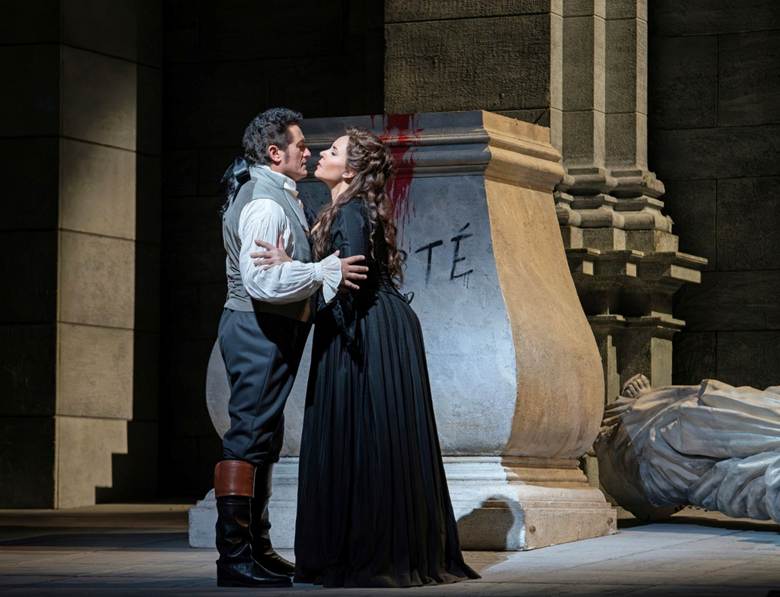
Soprano Sonya YonchevaA scene from Giordano’s Andrea Chénier. Photo: Marty Sohl / Met Opera
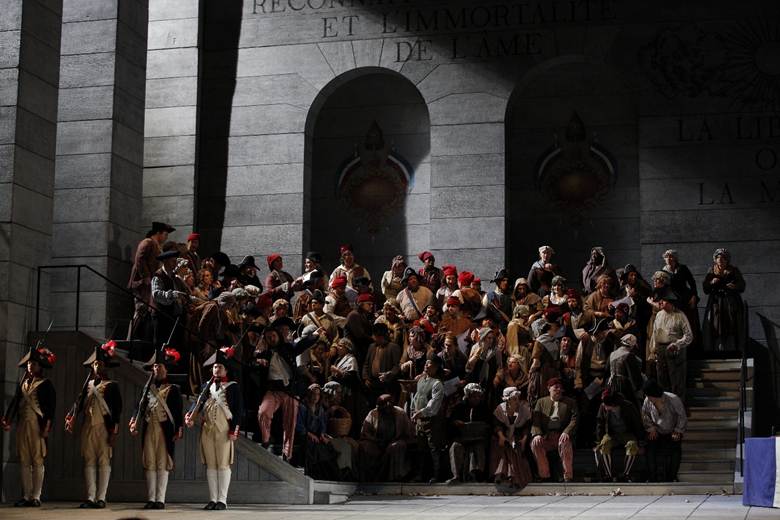
Andrea Chénier – Giordano (revival)
Screening dates: 13 December 2025 (livestream at V&A Waterfront); 04 and 06 January 2026
(3h 31min)
Music by Umberto Giordano | Libretto by Luigi Illica
Conductor: Daniele Rustioni
Cast: Maddalena di Coigny – Sonya Yoncheva; Andrea Chénier – Piotr Beczała; Carlo Gérard – Igor Golovatenko
Giordano’s passionate tragedy stars tenor Piotr Beczała as the virtuous poet who falls victim to the intrigue and violence of the French Revolution. Following their celebrated recent partnership in Giordano’s Fedora in the 2022–23 Live in HD season, Beczała reunites with soprano Sonya Yoncheva as Chénier’s aristocratic lover, Maddalena di Coigny, with baritone Igor Golovatenko as Carlo Gérard, the agent of the Reign of Terror who seals their fates. Met Principal Guest Conductor Daniele Rustioni takes the podium to lead Nicolas Joël’s gripping staging.
Lisette Oropesa as Elvira in Bellini’s I Puritani. Photo: Paola Kudacki / Met Opera
I Puritani – Bellini (new production)
Screening dates: 10 January (livestream at V&A Waterfront); 08 and 10 February 2026
(3h 31min)
Music by Vincenzo Bellini | Libretto by Carlo Pepoli
Conductor: Marco Armiliato
Cast: Elvira Walton – Lisette Oropesa; Lord Arturo Talbot – Lawrence Brownlee; Riccardo Forth – Artur Ruciński; Giorgio Walton – Christian Van Horn
For gorgeous melody, spellbinding coloratura, and virtuoso vocal fireworks, I Puritani has few equals. The first new Met production of Bellini’s final masterpiece in nearly 50 years – a striking staging by Charles Edwards, who makes his company directorial debut after many successes as a set designer – arrives in cinemas worldwide. The Met has assembled a world-beating quartet of stars, conducted by Marco Armiliato, for the demanding principal roles. Soprano Lisette Oropesa and tenor Lawrence Brownlee are Elvira and Arturo, brought together by love and torn apart by the political rifts of the English Civil War, with baritone Artur Ruciński as Riccardo, betrothed to Elvira against her will, and bass-baritone Christian Van Horn as Elvira’s sympathetic uncle, Giorgio.
Lise Davidsen as Isolde in Wagner’s Tristan und Isolde. Photo: Paola Kudacki / Met Opera
Tristan und Isolde – Wagner (new production)
Screening dates: 05 and 07 April 2026
(5h 12min)
Music by Richard Wagner | Libretto by the composer
Conductor: Yannick Nézet-Séguin
Cast: Isolde – Lise Davidsen; Brangäne – Ekaterina Gubanova; Tristan – Michael Spyres; Kurwenal – Tomasz Konieczny; King Marke – Ryan Speedo Green
After years of anticipation, a truly unmissable event arrives in cinemas as the electrifying Lise Davidsen tackles one of the ultimate roles for dramatic soprano: the Irish princess Isolde in Wagner’s transcendent meditation on love and death. Heroic tenor Michael Spyres stars opposite Davidsen as the love-drunk Tristan. The momentous occasion also marks the advent of a new, Met-debut staging by Yuval Sharon – hailed by The New York Times as “the most visionary opera director of his generation” and the first American to direct an opera at the famed Wagner festival in Bayreuth, as well as Music Director Yannick Nézet-Séguin’s first time leading Tristan und Isolde at the Met. Mezzo-soprano Ekaterina Gubanova reprises her portrayal of Brangäne, alongside bass-baritone Tomasz Konieczny, who sings Kurwenal after celebrated Met appearances in Wagner’s Der Fliegende Holländer and Ring cycle. Bass-baritone Ryan Speedo Green makes an important role debut as King Marke.
Soprano Asmik Grigorian A scene from Tchaikovsky’s Eugene Onegin. Photo: Ken Howard / Met Opera
Eugene Onegin – Tchaikovsky (revival)
Screening dates: 02 May (livestream at V&A Waterfront); 17 and 19 May 2026
(4h 05min)
Music by Pyotr Ilyich Tchaikovsky | Libretto by the composer and Konstantin Stepanovich Shilovsky
Conductor: Timur Zangiev*
Cast: Tatiana – Asmik Grigorian; Olga – Maria Barakova; Filippyevna – Stephanie Blythe; Lenski – Stanislas de Barbeyrac; Eugene Onegin – Igor Golovatenko; Prince Gremin – Alexander Tsymbalyuk
Following her acclaimed 2024 company debut in Puccini’s Madama Butterfly, soprano Asmik Grigorian returns to the Met as Tatiana, the lovestruck young heroine in this ardent operatic adaptation of Pushkin, which will be transmitted live from the Metropolitan Opera stage to cinemas worldwide on 02 May, including at Ster-Kinekor V&A Waterfront, on 02 May. Baritone Igor Golovatenko reprises his portrayal of the urbane Onegin, who realises his affection for her all too late. The Met’s evocative production, directed by Tony Award–winner Deborah Warner, “offers a beautifully detailed reading of … Tchaikovsky’s lyrical romance” (The Telegraph).
El Último Sueño de Frida y Diego – Frank (Metropolitan Opera premiere)
3 / 5
A set design by Jon Bausor for the Met premiere of Gabriela Lena Frank’s El Último Sueño de Frida y Diego.
Screening dates: 30 May (livestream at V&A Waterfront); 14 and 16 June 2026
(2h 48min)
Music by Gabriela Lena Frank* | Libretto by Nilo Cruz*
Conductor: Yannick Nézet-Séguin
Cast: Catrina – Gabriella Reyesl; Frida – Isabel Leonard; Leonardo – Nils Wanderer; Diego – Carlos Álvarez
A scene from Tchaikovsky’s Eugene Onegin. Photo: Ken Howard / Met Opera
On 30 May, the Metropolitan Opera’s 2025–26 Live in HD season comes to a close with a live transmission (only at V&A Waterfront) of American composer Gabriela Lena Frank’s first opera, a magical-realist portrait of Mexico’s painterly power couple Frida Kahlo and Diego Rivera, with libretto by Pulitzer Prize–winning playwright Nilo Cruz. Fashioned as a reversal of the Orpheus and Euridice myth, the story depicts Frida, sung by leading mezzo-soprano Isabel Leonard, leaving the underworld on the Day of the Dead and reuniting with Diego, portrayed by baritone Carlos Álvarez. The famously feuding pair briefly relive their tumultuous love, embracing both the passion and the pain before bidding the land of the living a final farewell. Music director Yannick Nézet-Séguin conducts the Met-premiere staging of Frank’s opera, a “confident, richly imagined score” (The New Yorker) that “bursts with colour and fresh individuality” (Los Angeles Times). This vibrant new production, taking enthusiastic inspiration from Frida and Diego’s paintings, is directed and choreographed by Deborah Colker.
JOSEPH AND THE AMAZING TERCHNICOLOR DREAMCOAT BY TIM RICE AND LLOYD WEBBER
DIRECTOR: Anton Luitingh and Duane Alexander
CHOREOGRAPHER: Duane Alexander and Jared Schaedler
MUSICAL SUPERVISOR: Charl-Johan Lingenfelder
MUSICAL DIRECTOR: Amy Campbell
SET, COSTUMES AND PROP DESIGN: Niall Griffin
LIGHTING DESIGN: Oliver Hauser
SOUND DESIGN: David Classen
PRODUCERS: Pieter Toerien and Lamta
CAST: Lelo Ramasimong (narrator), Dylan Janse van Rensburg (Joseph), Chris Jaftha (Jacob/Potiphar/Pharaoh)
DATES: Until the end of September
This iconic musical had its first performances 50 years ago and if we take the current revivals, it’s still going strong. And with reason.
It’s always worth watching what Luitingh, Alexander, Lingenfelder, Griffin and Hauser are doing. They know how to breathe new life into what might have become a tired musical without losing its soul.
It’s a young and exciting cast who are being given wonderful opportunities to shine but they have also been gifted the tools to make it work.
From start to finish, the clarity of what they wanted to present and achieve was clear and that’s a joy to behold.
From the clever and uncluttered design which works in these smaller theatres to the choreography which flows and adds to the energy, everything is thought through and then executed to perfection. There’s just no leeway for things to go wrong.
Even when it comes to the look, it’s the way they have selected the costumes. Many were bought rather than freshly designed and, in this instance, a good choice not opting for the traditional dungerees the brothers more typically used to wear.
The only one that had me flummoxed was the narrator. Ramasimong’s blue jeans and shirt with the oddest jersey/jacket was an eyesore rather than using some imagination. Perhaps just a simple flowing robe would have had more impact. She plays a major role, is probably the one who has the most stage time and yet, she sticks out for the wrong reasons visually.
Fortunately she’s a marvelous performer and soars in her role as narrator. She has an unusual voice and a lovely stage presence. She knows this is where she belongs.
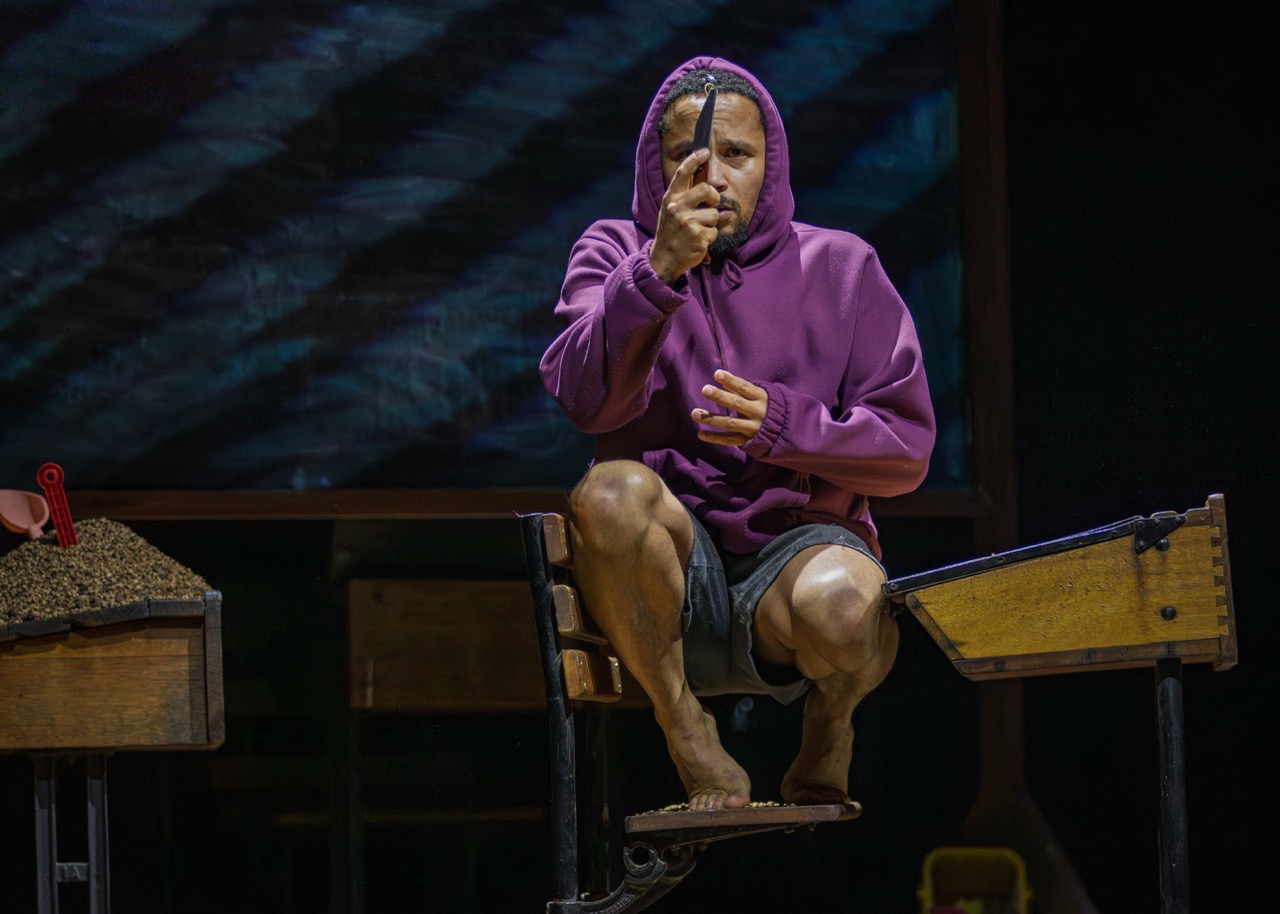
And so do the rest of the cast. One has to start with Janse van Rensburg’s Joseph, after all he is in the title role. It’s quite a responsibility on young shoulders in such an intimate large theatre. There’s nowhere to hide and if you don’t bring the goods as well as the charm, you’re in trouble. Janse Van Rensburg has already proved himself in challenging shows like Spring Awakening and he does it again here. He has a strong voice and a vulnerability that works in this part.
And someone who played his part in stealing some of the limelight is Jaftha, who had fun with his trio of roles as Jacob, Potiphar and in particular Pharaoh, the rocker who has a large moment in the musical which has rocketed other local actors (think Alvin Collison) to fame.
It’s a tricky role, but Jaftha has charisma and sass and was more than willing and able to step into any large shoes.
But as much as there are solo moments, it is a musical that involves the full cast because of the nature of the story – a bunch of brothers, for example – and then you have to balance that with the other roles.
If you’ve lived with a musical as long as I have with this one, it’s not easy to catch my attention. But I was stunned. I have seen a few musicals by this production team and I know they usually deliver. From the casting to the costume (bar one!) to the ensemble performances, the singing, the cast in full, it had a joyous feel about it in what can only be described as difficult times.
As well as the music, which was spirited into the new millenium as only Lingenfelder can do. “It was my third production of Joseph and I really didn’t want to do it,” he says. But when he was given the chance to pull the emphasis back to the story and to make sure everything worked for this time, he stepped on board. And it shows, with a score that’s as familiar as it is musically edgy. It’s something he achieves with astonishing regularity.
With the right people, that’s what entertainment can do in times of trouble. It offers respite and has you singing along with a bunch of brothers who hatch a plan to get rid of their father’s favourite son. An unlikely story but many decades ago a clever collaborating team started a much-envied partnership with this one as their first worldwide success.
And if you get it right, it still works. As it does in this latest version.
Nataniël is on the go – again – and it was time for DIANE DE BEER to pop in and find out more about upcoming shows, events and anything else happening in this prolific artist’s life:
What is keeping him up at night and awake at the crack of dawn is the work on his latest podcast series, which has become yet another of his performance features since his first series a while back. Kwessie van die Dag, his brand-new video column, starts on August 4 on Netwerk24.
As with anything he does, Nataniël approaches these latest podcasts with everything he’s got. “It’s as much work as a TV series,” he notes. And for this perfectionist, it is. He simply cannot do things haphazardly, with quality a constant taskmaster.
He is aware that everybody has turned to podcasts and his will be the best. This isn’t boasting because he is genius when it comes to storytelling. There’s no competing with this conversationalist.
It is all about the words which he has to learn by heart – 3 000 a week! They are his words, he has written each one, but then he has to get them tripping off the tongue. While it comes easily, he believes in scripts and knows exactly what he has to do and how he wants it to sound. So while there are many copycats, few can master him at his craft.
I often see pieces written by “Nataniël”, but it’s easy to spot when someone tries to capture his style because it is so unique. And this is where his podcast will pass with flying colours. “I don’t like waffling,” he says as he launches an attack on what he has labelled “electronic pollution”!
“There’s enough rubbish around.” He has an opinion which his followers will be familiar with, but he also loves facts when he is dealing in a specific subject. One of the many hurdles is the battle of language. He will be speaking in Afrikaans and to capture a language in this way is fraught with many pitfalls especially the way we mix our languages in our daily conversations.
It is clear that this is his latest challenge but also part of the excitement that charges his existence.
He is always busy creating and many of the things might seem as though they have a familiar pattern which, if you study them, they don’t. Into that mix, he is also constantly injecting new accomplishments which keep him on his toes.
“Everyone invites me to be a guest on their podcasts.” But for him there is a specific reason to engage with people in this fashion. “I want to address issues and for me it is about inspiration.”
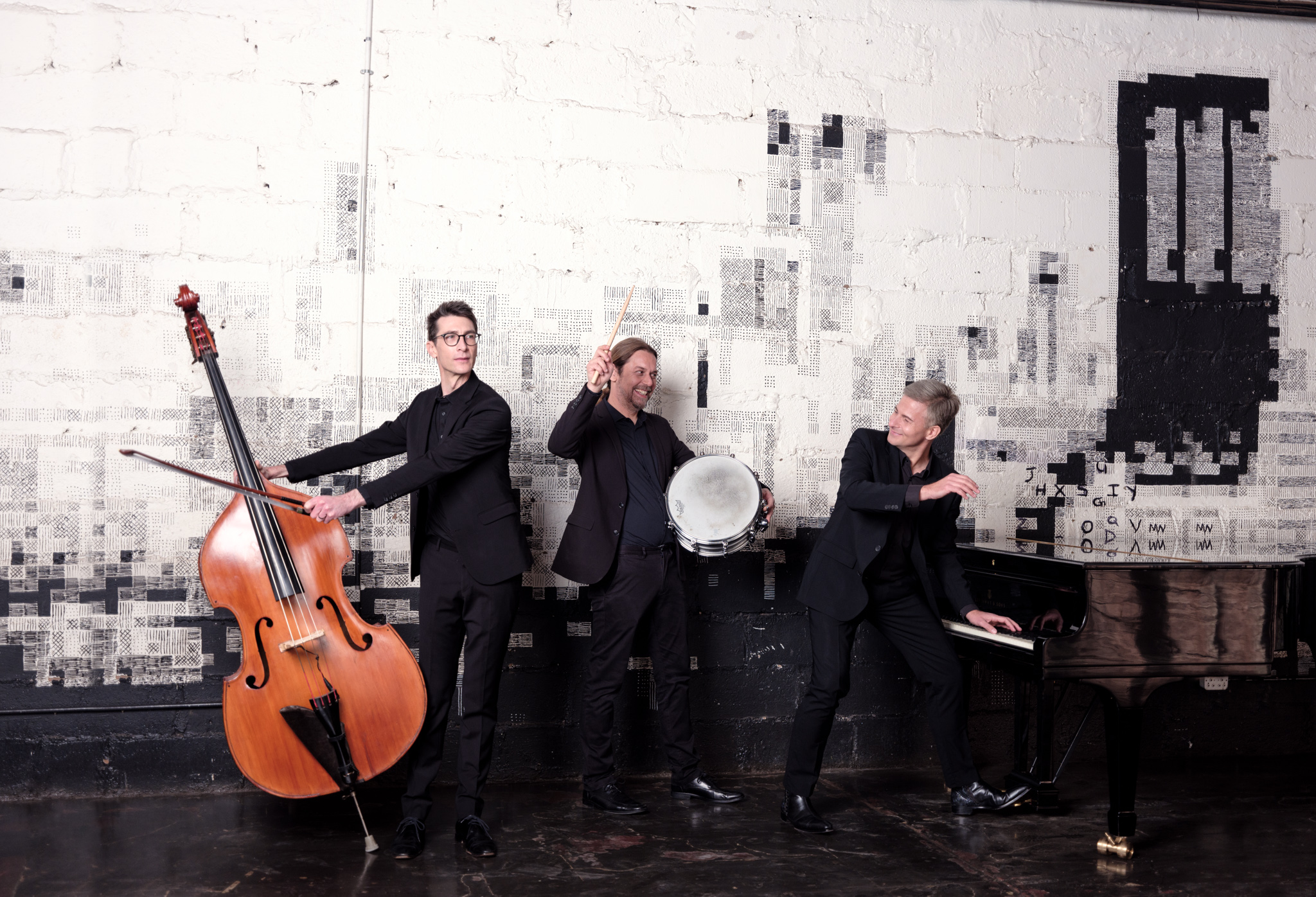
BOEK • BYBEL • BIOSKOOP is the title of the show he is doing with organist Zorada Termmingh, a friend from varsity, together with his accompanist, pianist Charl du Plessis. Knowing something about his creative mind, he will be pulling all their respective talents together in a spectacular bouquet.
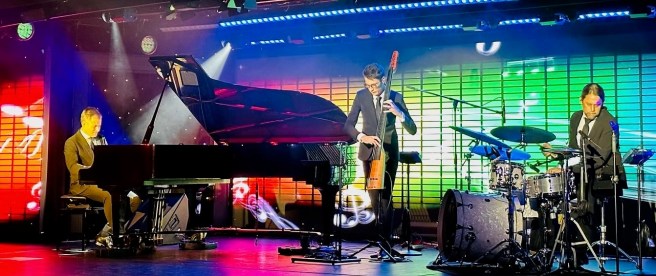
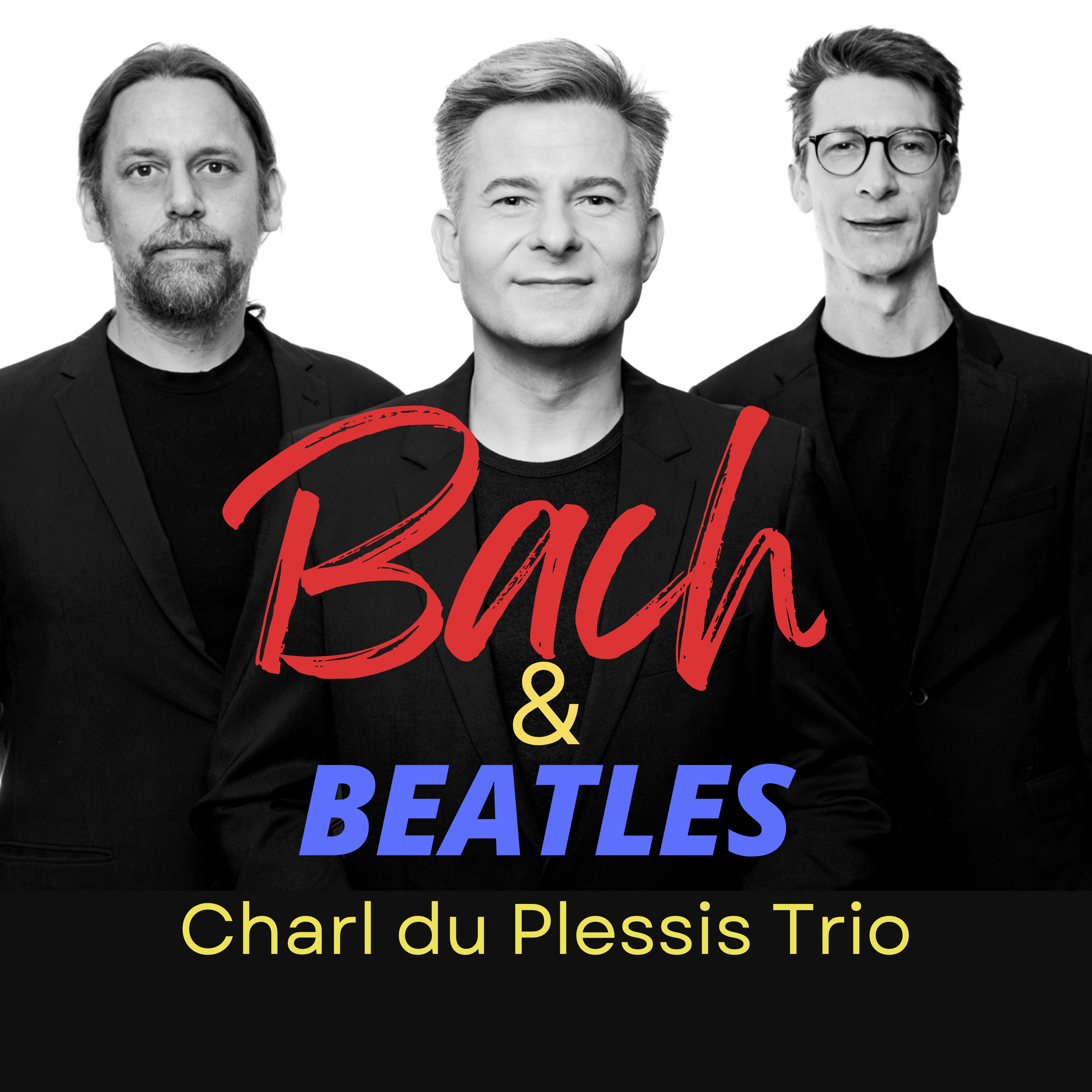
We’re in August and it is all about women. Composers, writers, singers, designers, as well as timeless characters from movies, classic literature, Biblical tales, art and theatre are their inspiration in this colourful show full of stories and songs. Zorada and Nataniël have performed on stage many times, starting during their student years. Charl has been his accompanist (apart from establishing his own career as a solo artist and performing with the Charl du Plessis Trio) for the past 25 years. And this is not the first outing for this trio of consummate performers.
It is a one-off in the capital city on August 13 at 7pm and the Ned Geref Universiteitsoord Kerk. The show is 90 minutes (more or less) long.
In September he returns to one of his most ambitious projects, Mass for the Good Princes (recently released on CD), which will be performed in the Cape for the first time thanks to the goodwill of the Atterbury Trust.
It’s a double whammy for Nataniël – one of both joy and hysteria. This was one of those accomplishments he had dreamt of for a very long time. Writing it was an almost impossible feat with his kind of schedule, and with each performance he has to once again memorise the Latin text, which is a killer.
This will be the 3rd time that he attempts this daunting exercise and while it stretches even his seemingly limitless determination, he can’t resist it. It is based on the classical structure of a Latin church mass with a sacred composition by Nataniël in six parts which includes a prayer for goodness, new leadership and the hope of a new generation. It will be sung in English and Latin with descriptions and translations in Afrikaans.
It will be presented at the Ned Geref Welgemoed Church on Saturday September 20 at 5pm. He will be joined by the Charl du Plessis Trio (Charl with Werner Spies and Peter Auret) as well as organist Ockie Vermeulen, guitarist Luke van der Merwe and the Akustika Chamber Choir led by Christo Burger.
In March this year, Nataniël and Charl celebrated 25 years on stage together and they seal this with a Gala Concert at Aardklop – on October 7 (7pm) and October 8 (10 am) in the University of Potchefstroom Auditorium.
This won’t be an ordinary concert. These two artists haven’t only shared 25 years on stage and many kilometres of travel through the South African countryside for one-off shows, but this was also the start of Charl’s stage career, which has been quite stunning to witness from the start – one he has since established both nationally and internationally – a feat for someone who started out as a classical pianist (one of the most difficult careers to pursue) and accompanist. Today he has a doctorate and is celebrated as both a classical and jazz artist. I can’t wait to see these two face off on stage on equal footing. For those fortunate enough to see one of these concerts, I predict something unique.
Nataniël is already making promises that this won’t be a rundown of what they have already accomplished. They will be celebrating today and tomorrow. “Who are we now and how do we see the future” will be their aim.
“Why would we return to the past? That’s done and we have all been there.” And in typical Nataniël fashion he predicts: “I want to hear an intake of breath when I walk on stage!”
As he so astutely confirms, it will be 70 years of experience when the two of them mark their stage partnership.
While talking partnerships and friendships, one of his closest friends, actress/comedian Marion Holm, will be interviewing Nataniël on his latest book of short stories titled Sweetie. Book discussions aren’t his favourite, but if he has to do it, Marion would be his choice. “She can physically shut me up just by barking.” You’ll have to be there to understand exactly what that means. They go way back and to experience these two like-minded actors sparring verbally, you don’t want to miss that. They’re a scream individually, together it’s an exuberance.
Your ticket will be a copy of Sweetie which can either be bought before the time or at the Exclusive Pop-Up in the book tent. The first 200 people with a book in hand will be allowed into the space, which will be closed off for this event. You won’t be able to listen in on the sidelines. The Sweetie discussion is going to be that exclusive and is happening on October 8 at 3pm at Aardklop.
And it’s not over yet by a long stretch. A photographer who for more than two decades documented Nataniël’s career, Clinton Lubbe, who immigrated a few years back, is back in town for an exhibition of life-size Nataniël pictures titled Parade, another first for Aardklop. Their collaboration has also been running for more than two decades and Nataniël describes Clinton’s camera as a paintbrush, because of the way he creates pictures. They’re not simply pictures, they’re artworks, he notes. “I’m going to be the Naomi Campbell of Aardklop,” he says with a smile and a wink.
Finally, but just for the moment, there’s his latest production, Catch Me, Love, which will be staged at Artscape from November 13 to 16. He is already busy writing, which is unheard of. He usually works on his scripts much closer to his performance than a few months, but looking at his schedule, he knew he had to get ahead.
This one is going to be visually and structurally different to his former shows, he says. And although it is still early days, I know he has already dreamt and planned it in detail. It will only feature in Gauteng in the New Year because in-between there’s the promise of a French countryside holiday, his annual escape (when he can manage) to one of his favourite places, which is what motivates him these days.
Watch this space for fresh announcements or changes. They will be coming …
“What we love about music is not that it sounds good. What we love about music is that it sounds inevitable. It’s playing the thing that we all know is unfolding. Whether we want to accept it or not …”
Jon Batiste (American Symphony)
This is the quote artist Frieda van den Heever sent me when we started a conversation on email.
I became aware of her as a producer. She was mostly involved with poetry-driven productions, but what I noticed was the sensibility of what is a very tough stage production.
How do you get people to attend poetry productions at a festival where there is so much on the go? But she did and she knew how.
She describes herself as a novice who preaches, because she studied drama not theology. She explains that in Springbok, where she grew up, they called it people’s church when a normal person preached because the preacher couldn’t be there.
“I have been doing it for almost 14 years, and no one has ever asked for my credentials,” she says. Having encountered her on stage, I understand why.
She is part of InVia congregation in Cape Town and describes this community as a group of people who love music and people. Her father was a minister and while she spent most of her free hours as a child in his study rather than on her own, she never thought that she would either enter the church or become a musician like her mother. “I had spent enough time in churches with music in my ears for a lifetime,” was what she thought.
Still, when she read something impactful she always caught herself speaking rather than just reading that passage. She simply couldn’t escape and then there was a time when she didn’t want to any longer. It has always been a juggling game, because it wasn’t something she could practise fulltime. But she missed theatre.
She believes in the power of stories, fables, poetry and metaphors. “Both theology and theatre navigate a place beyond knowledge, something like mysticism, and tell stories that often hold warm truths rather than cold facts,” she explains.
The part of her work that she favours most is what she describes as “accompanying rituals”, including marriages, funerals, christenings and the like. She regards it as her calling to add to the honouring of these events. It’s not that she participates only in religious ceremonies; she is often involved when people aren’t particularly interested in a church but still have a need for some kind of ritual which they share with their loved ones.
She also presents talks and retreats for congregations or groups of people who approach her. These are creative workshops specifically for women, but she stresses, “it has nothing to do with pancakes, crochet and tea parties.”
She knows these certainly have a place, but for her it is about togetherness, breathing, chanting, laughing and crying.
That’s just the beginning of all her activities. She is also involved in yoga and the transformation that ensues and has a deep fascination with people and how they struggle and survive. And while she would have loved to study psychology, a lack of time made her opt for an intensive 14-month course in integral coaching which will be incorporated in her other work.
And still, she keeps going. Once a week, she travels to Stellenbosch, her alma mater, and teaches cabaret facilitating the practical execution and texts of the honours students in the US Drama Department . As a student of the legendary Marthinus Basson, she is delighted that she can pass on her experience to a younger generation.
There’s also her radio work which started on small scale, but her talents were quickly recognized. And she still benefits from her innovative moves during Covid which resulted in her producing programmes in the basement of her home.
That led to her producing most of her radio and television work in her home. It means that she doesn’t have to spend too much time away from her children and allows her to do much of that work early in the morning. “It all happens before the children and the cars have to wake,” she says.
I’m breathless and haven’t yet come to her performance, which is really what I want to promote.
On Wednesday at 7pm, Frieda will be performing at the Fairtree Atterbury Theatre in Lynnwood, Pretoria for the first time in a magnificent production, Spoorsny (tracking) .
“I really went into grief. I sensed that I had to go in if I wanted to come out. I don’t mean that I’m perfect now, but I’ve been through the perfect storm and that moulds one to find more light because I was mining the darkness. I can sense, I almost want to say I can smell light and when I sense it I look for it everywhere. The material for my debut album came from a show I did on what would have been the night of Leon’s (Kruger) 50th birthday. (He had died very suddenly in 2021) I saw the Woordfees was during that time and I didn’t know on which date I was going to perform and then when they sent me the date, I went for it to really celebrate him with this work and this script. I could have gone to sit somewhere in the quiet and the dark which isn’t wrong, I have done it. But for that night I wanted to share what was left of me, so that it could multiply and I’m grateful for that.”
Her previous productions as director, Die Poet – Wie’s Hy?, Die Oerkluts Kwyt and Met Woorde Soos Kerse all shared a particular sensibility that made me aware of a rare director at work. She knows she didn’t have the technical experience, but her affinity with poetry and performance outweighed anything else. I didn’t notice any imperfections with any of those mind-blowing shows.
She works with love, a fine-tuned ear and excellent evalution. Also, part of the package was a childlike “unknowing”, an unwavering belief in the collective intelligence and the process, endless curiosity as well as an excellent production team and artists. Her motto was to always be present in the process. Whatever the requirements, it worked.
If you’re crying halt, there’s more. For 10 years she has been involved in a process with farm workers who boast magnificent voices. Each year she selects 10 of the best and offers them the opportunity to learn and to show off their talent. “I try to bring each individual something, give some of my experience, but I can’t teach them anything about singing. I have worked with voices that compare with the best in the world and it is a burning passion to create more platforms to showcase these voices.”
Her own musical talent, writing and composing songs and performing, has never been the only thing she wants to rely on to make a living. She wanted to be a free spirit when going on stage.
She is much more of a homebody than someone who wants to be out there but she also has a need to be challenged by the alchemy of a live performance. She obviously has a blueprint when she goes on stage, but she also reads the room and has the talent to shape her performance in different ways.
If she had a choice, she would write songs, play music, dance and jam with other voices and instruments all day long. “That feels like the best and most unvarnished version of myself,” she concedes.
To my mind, that is exactly who we watch and listen to during a performance of Spoorsny.
But let me give wordsmith Frieda van den Heever the last word: “The sudden death of my husband in 2021 and the impact of mortality and loss give perspective to everything I do and am. I am much more than a widow and single mom, but it gives context to my decisions and relationships, the spaces I find myself in and how I engage with people. The raw material which emerged in my debut album Skoonveld and formed the platform for the stage show Spoorsny as well as the anthology (published by NB) ‘n Asem Lank says everything about my search for meaning and light.”
The latest Ryan Coogler movie Sinners is an off-the-charts invigorating experience.DIANE DE BEER speaks her mind:
Currently showing at Ster-Kinekor
Michael B Jordan and Miles Canton face their fears in Sinners
SINNERS
DIRECTOR: Ryan Coogler
CAST: Michael B Jordan, Delroy Lindo, Wunmi Mosaku, Hailee Steinfeld, Lu Jun Li, Yao, Omar Benson Miller
If you are familiar with the movies Fruitvale Station, Creed and Black Panther, you will also know the director as well as the star of Sinners. Apart from the fact that Coogler knows how to go big, work with issues and pick a star cast, everything else will be new.
Horror and vampires aren’t exactly my favourite genres, in fact, I avoid them, but here Coogler’s name was just too much of a draw. That and the fact that much of what he seemed to be aiming at in this film comes across like the themes in one of my favourite movies, Get Out.
Too many people like steering clear of issue-driven movies, but in our world where the divide is still so big in so many areas, as an older white film fanatic, I want to hear what the dynamic young black voices have to say; which stories they want to tell and also, how do they get those stories across.
That was what I was looking forward to in this one. The cast is huge and the actors are quite something. Coogler has worked with Jordan in most of his films and here he literally doubles up as the twin brothers Smoke and Stack (yip, that’s what they’re called). They’re equally dandily dressed, but their clothes, although similar, have distinctive features, and the one’s behaviour is more out there than the other’s. Fortunately, technology can pretty much perfectly deliver anything directors want these days.
Michael B Jordan and his friends stand together.
The rest of the cast are as cleverly picked and especially the two women, a stunningly statuesque Mosaku and the smouldering Steinfield, will knock your socks off with their performances. And if you don’t know the names, you will recognize them and after this movie, you will certainly also remember the names.
But everyone in the film impresses. The look and the style will grip you from start to finish and then you can add the music, which for me truly dominated in the best sense of the word. It is quite simply brilliant – both from the black brethren as well as the white trash.
The first are seriously into the blues and the latter have a more gentle, contained country folk sound. You will be rocking in your chair and the cast are seemingly given free rein to make those moves rhythmically magical. It’s one party you don’t want to miss.
The first half of the film is pretty much about the two brothers returning from Chicago where they have collected rolls and rolls of cash and boxes of Irish beer (courtesy Al Capone circa 1930) and returning to the Mississippi Delta (which already spells trouble), where they establish a juke joint in a rundown mill belonging to a supremacist landlord, who is only interested in the lucre and not the colour of their skin when he rents them the place … or so he says.
Then the hard labour begins as everybody gets ready to get the place rocking. As the night hovers on the horizon, when the sun sets the trouble begins.
Michael B Jordan and director Ryan Coogler discussing the scene about to be shot.
This is where it became a bit too much, as the seriously partying crowd are stopped in their tracks by a family of vampires who threaten to deliver them all into a permanent state of wandering.
And yet, those are all just the package in which this film is wrapped. What Coogler is really playing with is the grand divide which has been ongoing for millennia. Every time I questioned the rage and the explosive catastrophe that turns a festive night into a slaughter madness, I was reminded of the damage inflicted by their relentless savage treatment.
As always, critics differ, but here the critical thinking swings viciously from one end of the spectrum to the other – and I found myself on both sides in certain instances.
The originality was the standout feature for me. The epic extremes the director decided to launch when he truly wanted to make his point felt like the result of dealing with an unexplained hatred which has been raging for ages. And if you had to be on the receiving end of such constant humiliation, hardship and absence of humanity which have run through generations of your brothers and sisters, perhaps the results have to be of volcanic proportions.
I was wondering how many of especially the older generation would stomach this particular version but, for me, it is the weight of the story, the magnificence of the performances of especially the two female leads, the sublime singing, musicmaking and acting by the young Miles Canton, the doubling up of the Jordan performances, or just to witness the making of the movie in this single instance, and the list goes on.
It didn’t all work for me, but as usual Coogan is epic in his filmmaking approach. Brace yourself, participate in the ride. Already the staff at Brooklyn Ster-Kinekor is saying it has been their busiest show yet. And techy podcaster Kara Swisher is celebrating the fact that Coogan negotiated good money on worldwide ticket sales as well as owning the intellectual property after a few years, something almost unheard of in Hollywood. Don’t miss the changing of the guard. It’s going to be one helluva wave – and perhaps just
Diversity was the element that dominated this year’s fantastic KKNK Festival (in Oudtshoorn at the beginning of the month) – from the audiences to the artists, also including the plays and performances. DIANE DE BEER reports:
PICTURES: Hans van der Veen (unless otherwise stated.)
On one day you could see a solo show, a play with both words and movement, a translated modern classic and a new work that will outlast some of us watching.
Yet as is often the case at this festival, theatre was what really captured the imagination – and true to the diversity theme, it played out in many ways.
For me it started with a bang with a piece titled Die Een Wat Bly (which can also be seen at the upcoming Cape Town Suidooster) with a cast consisting of the two talented dancers from Figure of 8 Dance Theatre (Grant van Ster and Shaun Oelf) who in this instance combined their extraordinary movement with the insightful words of Wessel Pretorius who seems to deliver an endless stream of brilliance. And the third member of this inspired cast is Daneel van der Walt who is an actor who has emerged these past few years as someone to watch.
Everything seemed to combine beautifully, from the story, how it was written, the excellence of the casting and the way movement underlined and emphasized every emotion so magnificently. I couldn’t resist catching it a second time and it confirmed my initial instincts that all the elements just flowed together seamlessly to present perfect theatre. I could easily watch it again … and again… and again.
In a different guise, Pretorius performed in Yasmina Reza’s translated text Kuns (which had previously been performed by two of the actors, also directed by Marthinus Basson in the English version titled Art). Pretorius and Wilhelm van der Walt (part of the former cast) were joined by Ludwig Binge in a play that satirises the often achingly precious way people view and talk about art.
Because of the NOW, a time where an anti-wokeness and fake news seem to dominate everything, it worked even better than the first time I saw it and with these three adventurous actors (all three Basson graduates who have established exciting theatre careers), it was perfect for this festival which always celebrates.
Basson also delighted with a play which has been on the circuit for a while, and I was thrilled to finally experience. Who would not be intrigued by a play titled Kruispad, of die legende van die goue vis.
Picture: Nardus Engelbrecht.
Again the casting blew me away with Eben Genis giving one of his finest performances in the role of the eccentric recluse Oswald whose life is rudely interrupted by two lost and rain-drenched youngsters played by two of the best, Edwin van der Walt and Carla Smith, with a glorious copper-coloured wig which completely changed her character without her having to say a word.
Because it plays with temptation and loyalty, it reminded me of the film Indecent Proposal in which Robert Redford offers to buy Demi Moore for a million dollars for the night.
Masterfully written and performed with great gusto you are never sure what is real or not, whether something is fact or fiction, and in fact when someone is being honest or not. It’s like trying to solve a puzzle that tortures and teases with a few disruptive detours that keep you slightly unbalanced as an audience.
There was so much more in the theatrical realm with solid performances in the Hennie van Greunen translated and directed Annie+Helen with Cintaine Schutte as Annie, the governess/teacher in the Hellen Keller story and Judi Hattingh as the severely damaged teenager who cannot see, hear or talk.
A mighty struggle ensues and from beginning to end, the two actors battle, and sometimes, bruise one another in a fight for something so much more than survival.
I have always been a huge fan when some of our younger directors (and he might take exception to that description) take on the classics, and I was excited to see Speelgoed van Glas translated, directed and designed by Nico Scheepers.
Casting was a further incentive with Annamart van der Merwe, Carla Smith, Ben Albertyn and Mark Elderkin on board, and was also alerted by all the awards they had already received, all of them thoroughly deserved. Van der Merwe’s bravura performance as the brittle mother is bruising as she embodies a woman who is desperately fighting to hold on to the only power available to her, that of motherhood (and in this instance also victimhood).
Her children, especially her son, have no such illusions and their confrontation reminds one of how a home which should be a protected space for a family can become a warzone which holds only fear and a frantic will of those threatened, to flee and find emotional freedom.
It’s devastating writing, smartly translated and, set in the present with a cast who have had the time to hone their craft and honour the play.
Also Die Potplant: ‘n Tragedie written and played by Karli Heine who changed what had previously been part of something now called Blitsteater into a longer piece had an interesting effect on me. It’s a wonderful idea with a script that’s inventive with underlying pathos – and yet, while it still had the impact and was cleverly stretched into a more comprehensive play, I think I preferred the shorter version.
It might have had something to do with the impact it had the first time round as well as having lost my heart to that version, I was more aware of the padding. Yet Heine is worth watching. She is someone that thinks out of the box as well as having the courage to take chances. You need all of that in this challenging profession.
Another joy at a festival is discovering new talent as well as witnessing the creativity of artists and how they find ways to explore their craft in a world with no boundaries yet many obstacles. Bibi Slippers, who can only be described as a compulsive creative did two shows as part of the Blitsteater (a bit like fast food, fast theatre), but there’s nothing fast about what she does with her imagination.
Picture: Stephanie M. Gericke.
I have always been fascinated by this young woman who has carved her own career in a very individual way. She pops up all over the show and her strengths lie in her words. She knows how to use them and has two spectacular poetry books that run like a thread through her performances.
Everything she does has thought behind it, is usually novel and it works. If anyone wants to see how to be an artist in today’s world and be in command of your own life, this is it.
In similar vein Sandi Dlangalala and Ilana Cilliers combined style and swagger to present an interlude of theatrical magic with Smak. The way they told the story in very little time with their whole being and soul was quite extraordinary.
A regular festival contributor, Llandi Beeslaar, who with her partner has been running a series of short performances by various artists, in the above mentioned Blitsteater, decided it was her turn to shine individually. She was ready to test herself as a comic with her first stand-up piece.
She participates in the arts in different ways, but this is a chance to use her own voice – and that she does with a particular style. Most importantly she has something to say and should keep going while honing her craft. There aren’t enough women in this space and the only thing she lacks is confidence.
Picture: Mia Truter.
A solo performance that stood out was that of singer/songwriter Frieda van den Heever. I first noticed her as producer with a fine sensitivity as well as an imagination which seemed to be strongly independent.Picture
She has obviously decided it is her time and instead of producing others, she staged her own show. She’s got all the goods and probably if you start counting, has more talents than a triple threat. In this her first solo show (that I know of) at a festival, she did the performance as well as the production. She brought in Mauritz Lotz on guitar, but the rest was all done by this astonishing performer.
I’m more of a theatre girl than music, but she blew me away with her presentation, the way she put together her show, her music (on piano as well as singing and songwriting), her lyrics and her singing. I know I can find her album Ontspoor, onlineand that’s what I’ll do.
But to find new music so accessible and a performance that’s fresh, daring and quite darling. I’m a groupie. Once I checked her previous work (which I had seen, with her as producer rather than performer) I understood why I liked the show so much.
Karoo Kaarte is one of my favourite experiences every year at this festival. They pick their battles, how best to explore them and this year they joined forces with the District Six Museum and GALA queer archive and used the Kewpie: Daughter of District Six picture archive as a platform to develop this years’ experience.
It all culminated in a queer festival with a multi-disciplinary drama titled Kroon en Konfetti which incorporated three elements: Kewpie’s life and legacy as dancer and artist; the rich culture of Oudtshoorn’s beauty competitions called “models”; and 25 personal stories collected from Oudtshoorn’s queer community.
Dressed in all their finery, the “models” all gathered in a dressing room to start their show with the dialogue smart, sassy and with an edge. It was quite magnificent as are all the Karoo Kaarte productions and more than anything it’s the topics they choose to spotlight that’s so important.
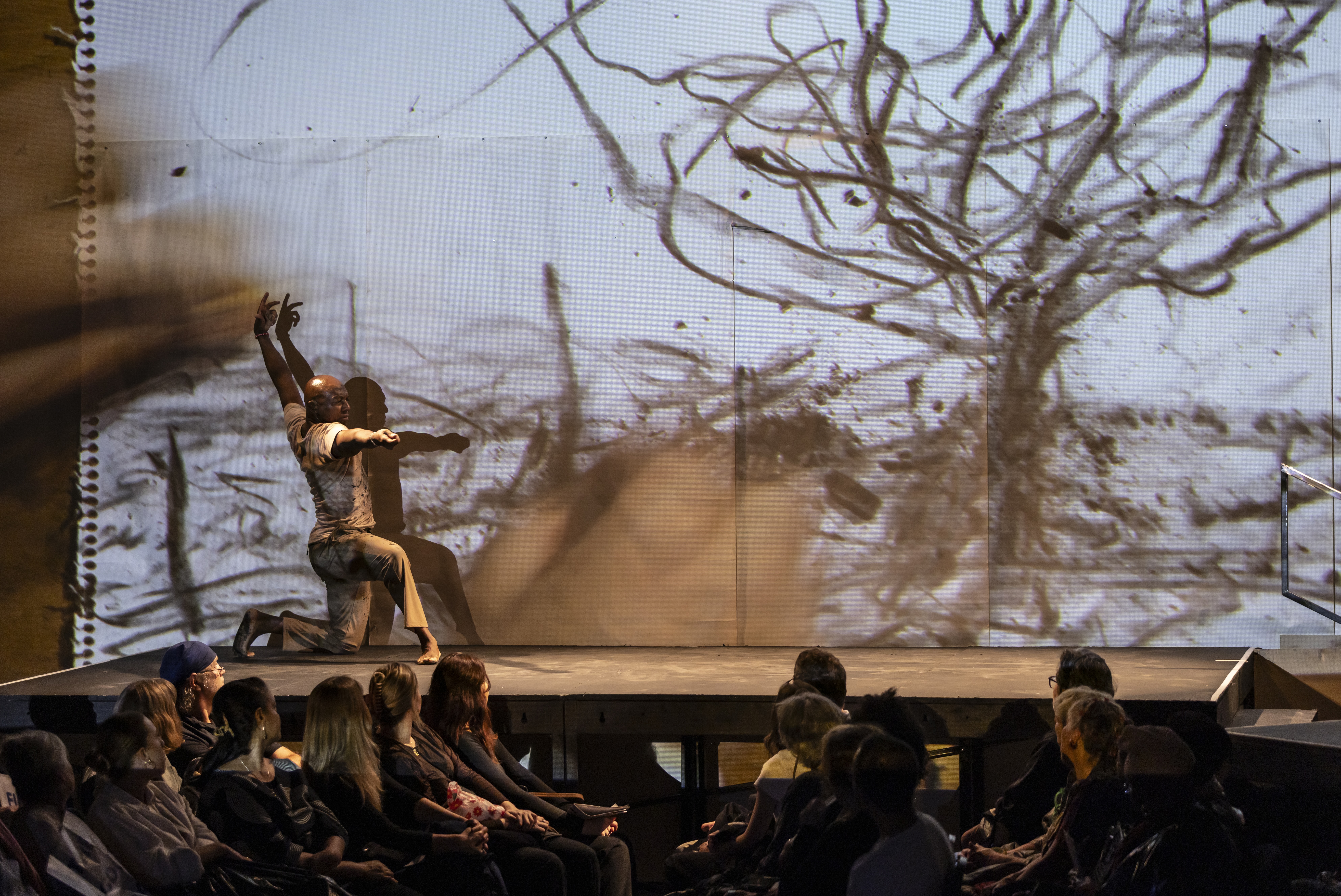
Here is deals with a group of people who are already sidelined in a country where prejudice is still rife. With their queer status they are in search and hoping to find safe spaces in their community where they can celebrate their culture, yet behind all the glitz and glamour, the shadow of oppression is hard to ignore.
As always Neil Coppen, Vaughn Sadie and Tiffany Witbooi are the creative team responsible and my only regret – as happens every year – is that I couldn’t participate in all their offerings. It’s one of those projects that’s imaginative and innovative and even more importantly, they’re constantly working with elements that result in real change in a community that has always been neglected.
And then cleverly the festival ended with Nataniël and a company of 10 on the openair stage under the Oudtshoorn night skies. The elements aren’t his friends, but it was a glorious way to end the festival with a performance that showcased new voices and performers as well as the glorious artist himself with stories and songs that suited the occasion.
Tracy-Lee Oliver was the artist he chose to spotlight on the night, and she made full use of the occasion with spunk and singing that added spark to this final show. It was great to see someone step into the limelight with such poise. As usual, making sure he gave his audience all the hysterical stories and masterful songs they expected with his superb band and backup singers, he also paid it forward with this sassy introduction of new voices for this audience.
He first spotted her when she was a contestant on a television show he judged, and astute as he always is when it comes to producing for an occasion, this was where he decided to showcase her – for all the world to witness.
Rehearsal picture.
I haven’t even touched on the festival artist Henk Serfontein’s magnificent exhibition Die Stomme Aarde complimented by a performance piece by the artist and his collaborator Hannah Loewenthal as he made a painting to which she contributed while both of them participated in an expressive dance which further enhanced this particular emotional landscape of both the St Jude’s Church as well as the art displayed in this holy space .
It was the perfect example of how art and artists when working with an emotional intelligence can transport you in a way that seldomly happens in what has become quite a cranky world.
Similarly, Mareli Stolp, a pianist with a particular penchant for avant garde music invited animation artist Diek Grobler to illustrate her chosen compositions for a programme Die Gevlerktes. It was a stroke of genius.
The exquisite animation was imaginative in the way it enhanced the music and the listening experience which then also transformed into a visual feast.
I could go on, but this is simply one art lover’s experience …
See if you can catch any of these gems at other festivals and theatres in the year ahead.
Awards can mean nothing or EVERYTHING. It really depends on each individual and perhaps the most important ingredient is to witness especially the individual artists when they get over their surprise, gather their thoughts and express their wonderment at receiving such accolades.
Rocco Pool (Best Design), Christian Olwagen, (Best Festival Production), Rolanda Marais, (Best Actress) all for Hedda Gabler.
Astonished yet astonishing actress Rolanda Marais perhaps captured the moment best when she reflected on the 17-year-old schoolgirl she had been and how she would have experienced this achievement.
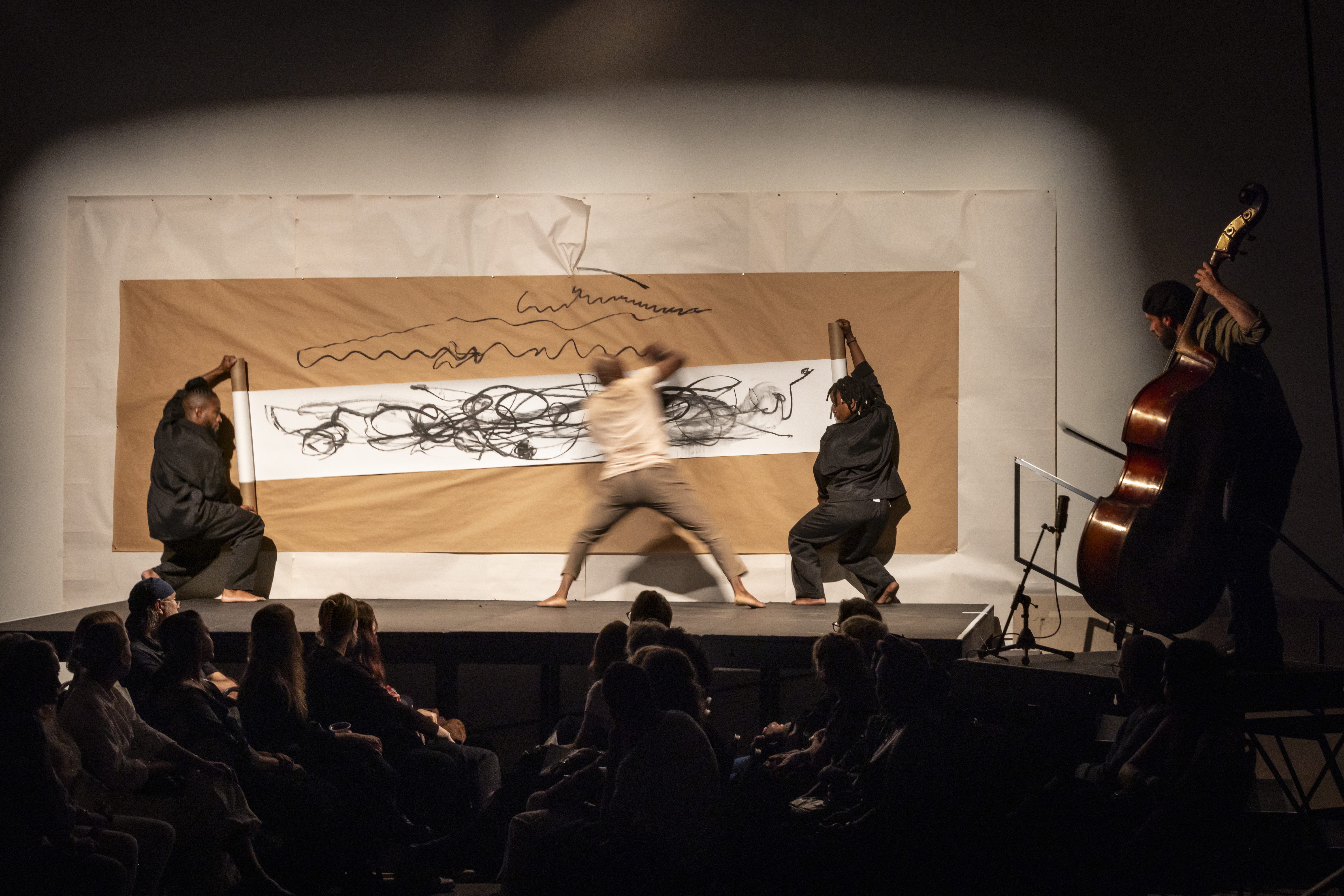
It’s one of the most vulnerable yet vibrant careers to choose, as your whole life is always dependent on the vision of others. If a director selects you, if the play is one that shows you at your best, if the audiences come, if they like the play and the cast and the list is endless.
Aardklop Fiësta winners: Joshwin Dyson (Laaitie mettie biscuits for Best Upcoming Artist and Best Actor), Artistic Director Alexa Strachan, Conroy Cupido, (Best Achievement in Classical Music for Die groot Finalé) and Philip Rademeyer (Stinkhout for Best Text ).
And yet, time and again, the actors put themselves on the line and out there to hopefully change the world for some in the audience. They probably do it more than they give themselves credit for and I have often been in awe of what they manage to achieve with too many obstacles for anyone to deal with, let alone create magic.
The Fiëstas panel attended every debut production at seven arts festivals (KKNK, Suidoosterfees, Innibos, Vrystaat Kunstefees, Klein-Karoo Klassique, Momentum Beleggings Aardklop and Toyota Stellenbosch Woordfees) last year. Following an extensive voting process audited by auditors, the winners in 14 categories were determined and announced at the end of last month at a glamorous awards ceremony held at the Kirstenbosch National Botanical Garden in Cape Town.
kykNET also announced that the kykNET Fiëstas will have a new home. After 15 years of management by kykNET, the Tribuo Trust will now coordinate the Fiëstas, with kykNET taking on the role of naming sponsor.
“The decision was made so that the kykNET Fiëstas can continue and flourish as a vibrant celebration of the arts in Afrikaans. kykNET remains the main sponsor and naming sponsor of the Fiëstas,” said Waldimar Pelser, M-Net Channel Director of Premium Channels.
“In discussions with the festival directors, kykNET emphasised that we will strengthen our support for the arts festivals in a way that we hope will also make the festivals more sustainable. We look forward to reimagining the new kykNET Fiëstas together with Tribuo and are excited about the road ahead.”
Karen Meiring, Executive Chairperson of Tribuo, said: “It is an important objective of Tribuo to invest in the future and the sustainability of the entertainment industry’s ecosystem. The kykNET Fiëstas seamlessly align with this goal as the awards recognise and celebrate excellent work. They also encourage crucial audience engagement and honour the people who carry the performing and creative arts. Tribuo looks forward to continuing this project together with kykNET, who remains the naming sponsor.”
The winners are:
BEST ACHIEVEMENT IN CLASSICAL MUSIC
Die groot finale (Momentum Beleggings Aardklop)
BEST CONTEMPORARY MUSIC PRODUCTION
kykNET-konsert (Innibos)
BEST MUSIC-DRIVEN THEATRE
Ontban (Suidoosterfees)
BEST ADAPTATION OR TRANSLATION OF A TEXT
Naòmi Morgan – Ons wag vir Godot (Vrystaat Kunstefees)
BEST NEW TEXT
Philip Rademeyer – Stinkhout (Momentum Beleggings Aardklop)
BEST ACHIEVEMENT IN VISUAL ARTS
Marlene Steyn – Between my i’s: tussen my oë (Toyota Stellenbosch Woordfees)
BEST ACHIEVEMENT IN DESIGN
Rocco Pool – Hedda Gabler (Toyota Stellenbosch Woordfees)
BEST ACTOR IN A SUPPORTING ROLE
Gerben Kamper – Ons wag vir Godot (Vrystaat Kunstefees)
BEST DIRECTION
Dion van Niekerk – Ons wag vir Godot (Vrystaat Kunstefees)
Joshwin Dyson (right) with his playwright/director Christo Davids
The winner of the Blou Fiësta, awarded for commendable work that does not fall into any of the other categories, is the Suidoosterfees project 21. In celebration of the festival’s 21st anniversary, 21 productions were staged, each lasting 21 minutes with a ticket price of R21.
Amanda Strydom and Frank Opperman were honoured for their contributions to the arts.