The Fabulous Flavours of French Food are Celebrated by #SoChef! in SA

French flagFrench flag

French chefs and their cuisine will always catch the shine internationally. DIANE DE BEER explains the magic:

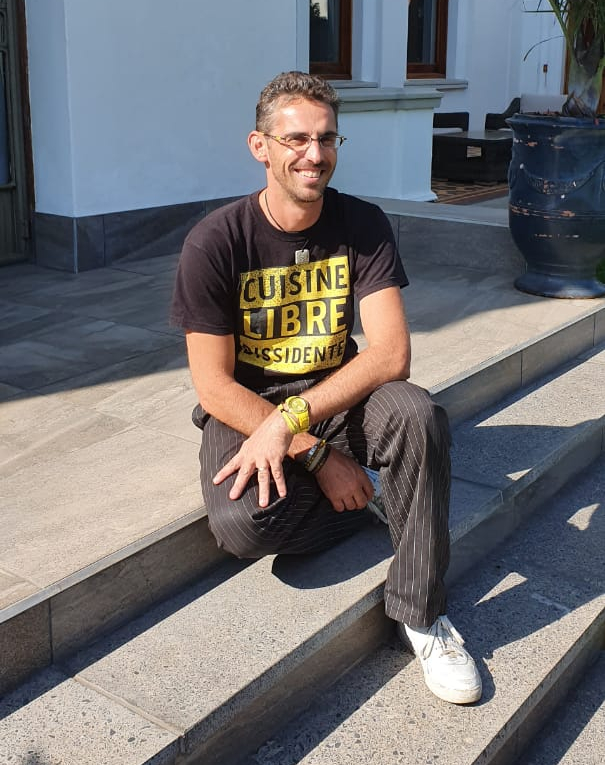
Vincent Lucas
Chef Vincent Lucas

Michelin-star chef Vincent Lucas is someone who expects diners at his Sainte-Sabine-Born (in Dordogne) restaurant to make a culinary leap and eat what he prepares on the night.

Chef-patron of Etinecelles (sparks), a restaurant that only seats 20 diners, he wants them to take a risk with his “adventures in the land of flavours”.

“That’s where I am King, and I decide for them.” Makes perfect sense to me because I have always thought when visiting a specific restaurant that one should defer to the chef. Especially when visiting Michelin-starred restaurants, it’s a time to experiment and play.

For Lucas it’s a case of challenging diners and not allowing them to become too comfortable. Currently in South Africa as part of So Chef! (A Taste of France in South Africa), this is your chance to meet four talented French chefs who will be travelling the country.

Showing off his skills at an informal lunch at the French Embassy in Pretoria courtesy of the relatively new French Ambassador to South Africa, Aurélien Lechevallier, Lucas talked a little about his food preferences. In South Africa, it starts with local produce.

In preparation for the lunch, he first talked to the resident chefs to find out what they had available. When he heard there was Cape lobster and fresh fish, he could start to play.

As a starter he used bouillon (one of his favourites) as an inspiration. “I love serving a bouillon, but it is very different to the traditional meat or fish-based varieties,” he explains.

Flavours and textures are a big part of his cooking and at home, he uses a wild apple in his garden which is too small to do anything else with. It’s about a fresh explosion and with this type of light, floral based bouillon it combined well with the lobster, onion, hazelnuts for flavour and crunch and mushrooms. Everything is very lightly cooked to keep the it all fresh.

This was followed by the mains; a fish I wasn’t familiar with, sourced from the Cape, called Denti. This was presented with deceptive simplicity with crisp greens including celery, peas and asparagus which was cooked in water used to prepare the fresh maize which pops up the in the dessert. All of this was lightly doused with a beurre blanc.

20191011_141808_HDR
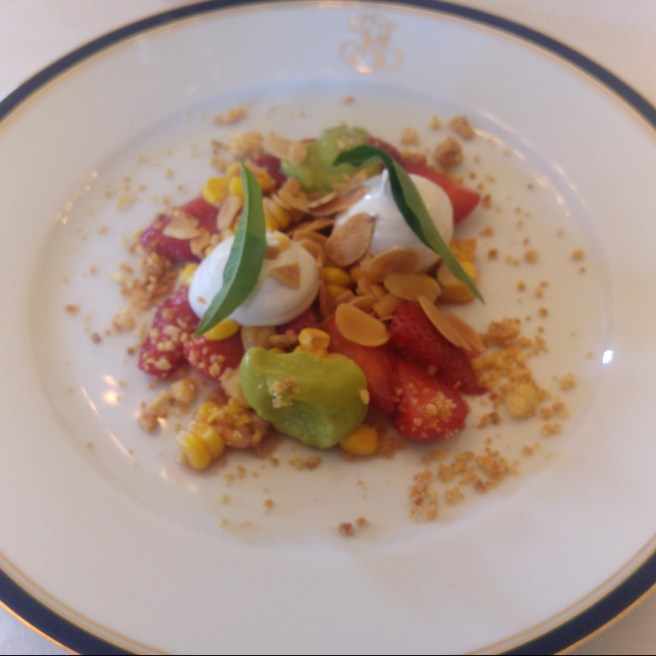
Strawberries/Avocado lime green/unbaked meringue/almond crumble/Fennel flavoured fresh maize/Thyme

For many around the table, the highlight was the dessert combining contrasting ingredients such as strawberries in olive oil, lightly sauteéd fresh maize, sweet avo with lime and something he is very fond of, drops of raw meringue. Fresh sage added another texure and taste as we were told to eat the dessert with every ingredient on the plate on the spoon. It’s perhaps the one that most visibly captures his food philosophy which is creating an explosion of contrasting tastes. Sweet, sour and salty is something he’s very comfortable with.

Some of his other favourites include a peach studded with anchovies as an appetizer or a foie gras seared with coconut for dessert. He is also fond of rolling it in biltong powder for an extra meaty kick.

It was the perfect meal on a Friday afternoon and a thrill to get a taste of contemporary French cuisine. None of the stodginess of cuisine or chef that one might stereotypically expect in these circumstances and the ambassador cheekily suggested that the conversation was as charming as the cuisine and perhaps we should just linger at the table until dinner.

But the four chefs are much too busy for that. They are touring the country and Lesotho with So Chef! Offerings still available include eat-alongs which is an immersive food experience where the audience eat along with the participants in a chosen film. (October 16 in Cape Town; October 17 in Johannesburg); disco soupe which is a collective and open cooking session of scrapped or unsold vegetables and fruit to sensitise people to food waste but also to eat healthy and tasty food and to heighten the awareness of the fun of cooking together. (October 19 in Soweto , a brief that fits chef Lucas perfectly as he loves using everything – from the husk to the pulp): workshops to be held at schools through the partnership with the Department of Basic Education and their National Nutrition week; as well as for the general public more specifically at the Alliance Francaise network in South Africa and Lesotho; 4-handed gastronomic dinners to eat at partner restaurants to eat food that a French chef and the restaurant’s chef cook together. (October 18 in Durban at the Sugar Club Restaurant in Umhlanga);

The other three French chefs participating include Joey Atchama, one of the most promising chefs on Reunion islands having won this year’s Best Chef Reunion Island award. His focus is traditional cooking skills and mixing them with rigour and culinary techniques; Frédéric Jaunault who has cooked all over the world, has won the Meilleur Ouvrier de France in the “Fruitier Primeur” category, is French and European champion of sculpture art using fruit and vegetables. He now teaches at the Academy of Fruits and Vegetables and promotes France and its cuisine all over the world; Florion Py completes the quartet with a background of pastry and as head chef working in several 3-star Michelin restaurants. Currently he is teaching at his alma mater Lycée Hyancinthe Friant in the Jura wine-growing region. He is passionate about the history of gastronomy and eager to share his discoveries and his knowledge.

All of this is brought to the South African public and scholars by: The French Institute of South Africa (IFAS), The Alliance Francaise network in Southern Africa; Atout France; The Reunion Island Tourism Board; The Bourgogne-Comté Province; The Lycée Hyancinthe Friant and in partnership with the South African Department of Basic Education.

For general information on So Chef! contact mylene.loubiere@ifas.org.za; for more on specific events, thomas.vassort@ifas.org.za.


Journalist Tanya Farber Explores the Lives of SA’s Notorious Female Killers

Pictures: JEREMY DANIEL

bloodbook.jpg


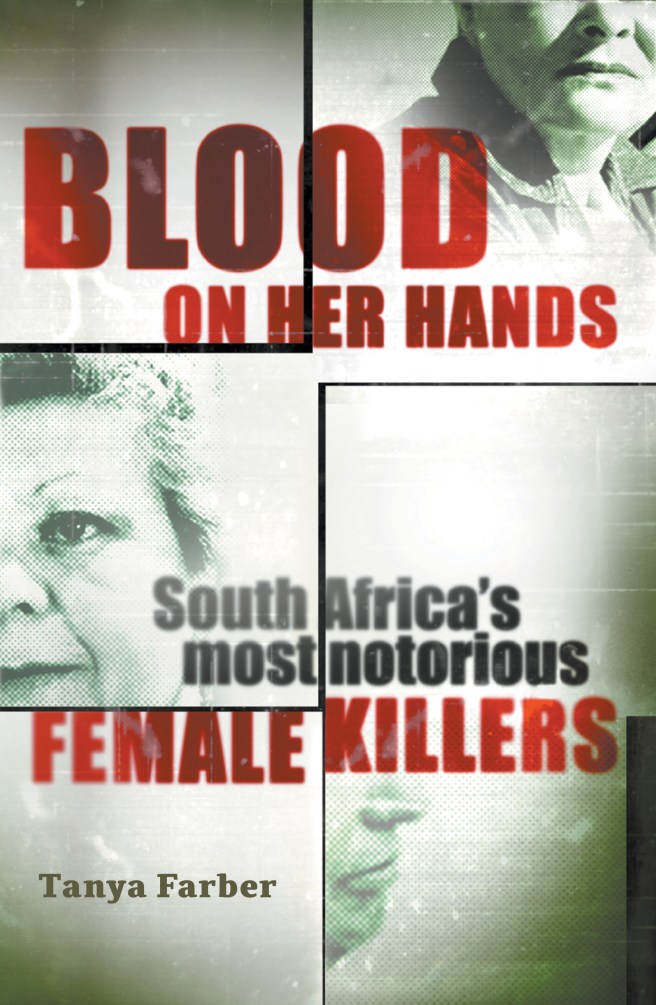
The statistics speak for themselves: 95 per cent of people who commit murder are male writes journalist/author Tanya Farber about her choice of subject for her book – Blood on her Hands – South Africa’s Most Notorious Female Killers (Jonathan Ball Publishers). DIANE DE BEER gets the lowdown on the book, why she wrote it and why it is so compelling:

It is precisely the percentage of female killers that  makes the stories of the murderers in Blood on her Hands – South Africa’s Most Notorious Female Killers unusual: they come from the small 5 per cent of killers who are female. And this is what intrigued author Tanya Farber – that and covering one of the court cases, which drew her in.

While that already makes them more interesting, especially when coupled with the fact that they are seldom impulsive acts of violence, it also intrigued her to delve into the plotting and planning that went into each murder.

“Dina Rodrigues is a case in point – she had several opportunities to rethink her decision to murder a baby, and yet she stuck to it like glue. Daisy de Melker’s serial killing took place over several years, so what was going on in that mind of hers? I find it fascinating that the wiring could be so wrong inside the human brain.”

As a journalist, her interest was sparked when she was tasked to write court stories. “I am actually a science reporter, but as newsrooms have shrunk, one often writes stories outside of one’s own beat. That said, I have been utterly spellbound by the trials that I have covered, and I am particularly interested in forensics. This, of course, includes forensic psychology: I am particularly interested in the mind of a deviant person, and how that plays out in the courtroom.

“I begin the Najwa Petersen chapter in the actual court room because her public facade in the courtroom, and her interior world, were so very different.”

With the writing, her goal was to imagine a ‘day in the life of this particular woman’. “In some cases, I began with the day of the murder, so we see, for example, Celiwe Mbokazi on the phone om the day of her husband’s murder and we get a sense that she is speaking to her accomplices, knowing full well that this murder might take place in front of the children.

“In other cases, I described a day that would give the reader insight into the murderer’s background. Like in the Phoenix Racing Cloud Theron chapter, it starts off with her as a toddler living in a caravan with her often-absent mother, so I tried to imagine the world through her little-girl eyes,” she explained.

And when it came to choosing the women she would write about, she firstly excluded any woman who one could feel was justified in committing murder.

“Ellen Pakkies, for example, killed her son who was a tik addict and was literally tormenting the family, so she has no place in this book.”

blood author

She wanted to study women who in her opinion could not be absolved of their crime due to circumstances. “Even Charmaine Phillips – one can recognize the wretched and violent childhood she had but does that give her the right to take part in the cold-blooded murder of four men by shooting them at point blank range?” So, she made the cut.

And while she doesn’t think society is softer on women killers, they certainly illicit more interest than do their male counterparts. “As I discuss in the analytical chapter at the end, female killers in the past were often seen as being mad (as in seriously deranged and out of touch with reality) or else what would explain their deviance from being a nurturer?

“The point I make in the book, however, is that female killers can also just kill because they are murderous and bloody-minded just like any male killer who goes about plotting and planning someone else’s demise.”

Marlene Lehnberg, she argues, was just a teenager when she began plotting the murder of her boss’s wife because she was having a red-hot affair with him. “Her ultra conservative upbringing might explain how her brain was shaped, but then consider that there are thousands of others in our country who grew up in conservative households but didn’t go about killing people!”

The chapter dealing with Joey Haarhoof gave her nightmares – literally.

“Even more so than the Chane van Heerden chapter, even though she mutilated and decapitated her victim, and skinned his face.” Haarhoff had this impact for two reasons: Farber was not much older than the victims and remembers clearly the sheer terror of what was going on and the warning issued by her parents. She is also now a mother with two daughters who both fall within the age range of Joey’s victims and so, imagining the pain of the parents, is much more real for her now.

“In short: back then, I could relate to the victims. Now I can relate to the parents.”

It’s fascinating stuff and reading it, because of the way the topic has been approached has you turning the pages – even when in some instances you believe you know the stories. It is the psychological angle, the way this hard-nosed journalist tackles her subjects and then the softer approach, an almost a gentle voice, telling the story, which makes it so insightful.

It’s also telling which of the stories got greater play in the newspapers and media while some, perhaps just in my case, slipped completely under the radar. Even though each one is a story of horror, Van Heerden, Mbokazi and Theron were unknown to me. Why?

That’s probably also part of the greater story. And as a newspaper journalist at the Sunday Times, Farber has special insight into a world of stories that catch the attention and play out in specific ways. And she makes a strong case in a world of fake news and populism.

“Despite all the ‘noise’ of social media, and the power of citizen journalism, it is still crucial to have reliable reporters who can deliver the facts. My approach always with court reporting is to blend the facts of the case with observations in the court room – the silent power of body language, the fascinating way in which the English language is used and abused to paint a picture depending on which side you’re coming from … all of that.

“The media, be it newspapers or reliable digital sites, still have a crucial role to play in conveying this to a readership.”

In conclusion, for those considering telling their own stories or perhaps venturing into the world of  writing, she issues a warning and sound advice: “Writing a book is HARD work and if anyone is considering doing it, make sure it is a topic that absolutely draws you in as a writer or else you will find yourself hating the process.”


Filmmaker Adam Heyns tells a Personal Story in Short Film; Exorcist of Apartheid

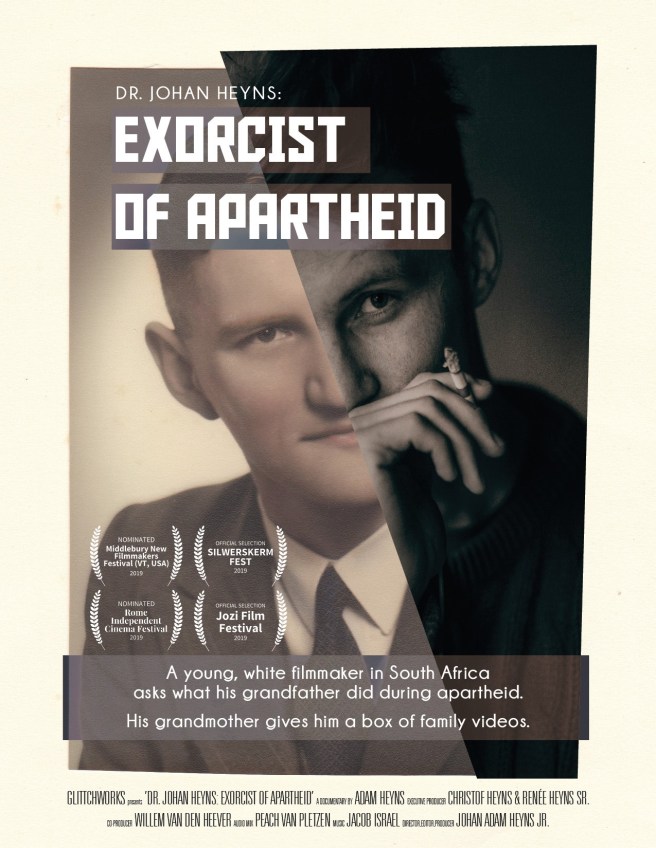
adam's posterWhat does a young man do when he loses his grandfather at the age of five and more than two decades later, still doesn’t know who this man, who has one of the main arteries in the capital city named after him, was. DIANE DE BEER speaks to filmmaker Adam Heyns about the short film tribute to his grandfather, moderator of the Dutch Reformed Church, Dr Johan Heyns:
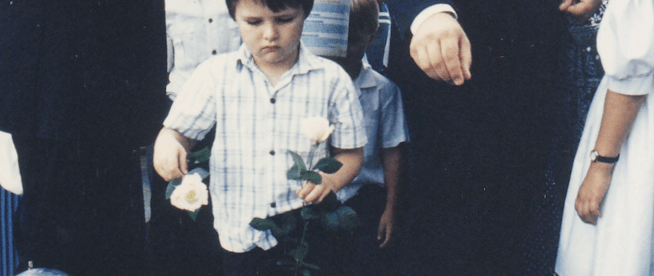

 

Adam Heyns was five years old and living in Germany with his parents when they heard about his grandfather’s assassination. “I can’t remember much,” he says, but he does recall a sombre atmosphere in the car (they were on a road trip for the weekend) because his father Prof Christof Heyns, had heard about his father’s death on German radio.

The young filmmaker remembers a friendly black man at his aunt’s home when they returned home for the funeral, called Nelson Mandela. He also remembers realising, as he stood at the grave, the permanence of death. “I understood that I would never see him again.”

Adam Heyns at his grandfather's grave
Adam Heyns at his grandfather’s grave.

When he started with filmmaking it was a desire to tackle something more authentic than fiction and adverts, which started him enquiring about his family history. “I knew my grandfather was a well-known man, but I didn’t know much else about him,” he explains.

When his grandmother (one of the producers on the doccie) gave him a box of VHS cassettes, it was like meeting him for the first time. Here was someone who could take a moral point of view during very troubled times in our country’s history, he learnt. “Today I battle to establish a moral compass for myself and I often think he could have advised me. Fortunately, I got to know him better with the making of the film.”

Once you watch the doccie, you’re struck by the approach, the brevity as well as the story that emerges – a homage from a young man to his grandfather as he, together with us, gets to know what must have been a remarkable man in a difficult time and place.

“At one stage I almost stopped with production because there were so many directions and options. It just felt overwhelming,” says Heyns Jr. A speech his grandfather made on December 16 1988 at the Voortrekker Monument on what was then known as Geloftedag (Day of the Covenance – a holy day for Afrikaners) became the backbone of the film.

Adam's grandfather Dr Johan Heyns
Adam’s grandfather Dr Johan Heyns

On the day, his sermon from the Book of Amos deals with God’s harsh words to the Israelites about their immoral lifestyle. He compares this with that of the Afrikaners in the late ‘80s. “I was struck by his use of the Bible to encourage Afrikaners to rethink their mythology,” says his grandson.

But he was still worried about the edit until a filmmaker friend, Willem van den Heever, had a look and brought a new perspective.

Adam's opening and concluding clip

It starts with Adam walking into a room and putting a VHS cassette into a TV – and then watching with his audience his personal take on his grandfather’s life – yet another of those remarkable South African stories.

This was a man, the leader/moderator at that time of the main Afrikaans church, the Dutch Reformed Church, who had a complete change of heart about the political system in his country established by his people. He understood as he grappled with what he was experiencing that what would have to be reconciled were white fear and black aspiration. A wise man then , he would have had the same impact today, which is why this is such an important moment in time.

Titled Dr. John Heyns: Exorcist of Apartheid, the poster tagline reads: A young white filmmaker in South Africa asks what his grandfather did during apartheid. His grandmother gives him a box of family videos.

It is beautifully crafted weaving between family reels with the grandfather and his grandchildren at play, the momentous sermon at the Voortrekker Monument, television interviews with Dr Heyns about his beliefs and his change of heart and that fatal day and his assassination in front of some of his grandchildren and his wife as well as the shockwaves experienced in the country in the face of the brutality of this dastardly deed.

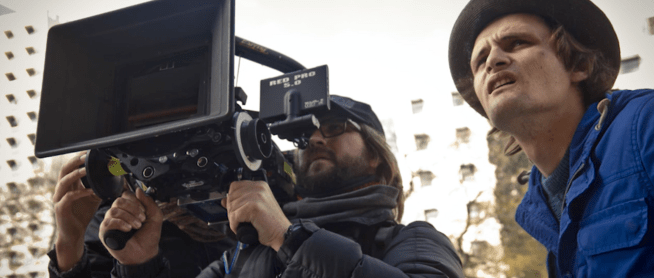
Adam Heyns on setSharing his grandfather’s names, and honouring the man he has discovered in the making of this very personal film, Heyns Jr used his full names in the final credit as homage: Johan Adam Heyns (JR) (left).


It will be screened on October 6 at The Bioscope Independent Cinema in Maboneng starting at 12.30pm.

It is part of the Jozi Film Festival which began in 2012 and was initially created to provide a platform for local filmmakers and reach audiences under serviced by traditional cinemas. The festival began accepting entries from around the world in 2014 and is now firmly established as one of the sub-continent’s leading film festivals. They are proudly independent, and a supporter of independent films. They also support and showcase both upcoming talent and veteran filmmakers.

For more info check https://www.jozifilmfestival.com/schedule.html for the festival which runs from October 3 to 6 in Jozi.

Nataniël, Master Storyteller of his Life, in Look At  Me: Recollections of a Childhood

“If you have a garden and a library, you have everything you need.”
― Cicero


DIANE DE BEER

When starting to write what was going to become a memoir, Nataniël first googled the meaning of the word and liked what appeared.

A memoir, he gleaned, is a book based on what you remember and what you feel. He doesn’t have ANY memories from before he was five – and that had me thinking too.

So memoir it would be, rather than an autobiography. For him it is all about making sense of his young world. “I didn’t write this book because of a need to share my life or about being famous,” he notes. “It’s about how I tried to figure out my life.”

That’s how it started…

“It’s a story of a young boy’s absolute fear of the ordinary,” he elaborates. “I needed to discover how it worked – families, friends, schools, towns, countries … everything.”

To him it felt as if everything was already in place when he arrived on this planet and only now, after a lifetime of research, does he feel more equipped … to live.

“The ‘70s was one of the worst times to land on the planet,” he concedes. To him it seemed as if the world was trending with bad fashion and zealotry.

“For those who know me, it will read like a memoir and for those who don’t, I hope it will be an incredible story.”

That’s also the reason the book will be published simultaneously in both Afrikaans and English. “It’s aimed at those readers who understand how big the inner life of a child is. It’s much bigger than the universe,” he notes. And that was really what fast-tracked him to tell this story.

It was the first time he was putting pen to paper not to be funny. Most of his other books were first written as sketches for the stage, which inevitably had to be funny. “It’s freeing,” he says of his memoir-writing experience. And nice to be old enough not to be intimidated by the whole gig, the process.

Nataniël has been writing all his life. From his stage scripts to magazine columns, which arguably should have made this another caper. But that’s not how this works, most authors will tell you. Even Nataniël, a man for whom creativity seems to come easily, found it hard going. Next time, he says, he will escape somewhere just to write, not try to do it in-between the rest of his life.

But he doesn’t feel he is asking for any literary feedback or judgement. The only thing he didn’t stick to are the real names in all instances. “I changed some,” he says and according to his explanation, he changed the names of people he didn’t want to glorify. “I have always been very specific with selecting names when writing anyway,” he says.

That’s true. Think of his shows. There’s Sabella, Romany Dippenaar, Mr Fazakas, Hildatjie … go to any  of his stage stories, open any page.

Once you start reading this one, you will realise that in his young life, he gave titles to everything – from streets to houses to trees and more. “The show has always been in my head,” he notes. People who knew him as a child will get that. “The book is about me functioning in the world.”

And if one goes by his shows, which have been thinly disguised life stories, his was never an easy fit. Ordinary is how he would describe it, while others might point to his non-conformity which has always been a problem, even in today’s world.

Please just don’t stick out was his solitary desire. “Ordinary,” underlines Nataniël, is what he was looking for. Creativity has always been second nature to him which immediately obliterated his longing to disappear in the crowd – at that young age.

This is not about him and his neighbours though, he says. It’s not about his life, it’s about how he navigated that life.

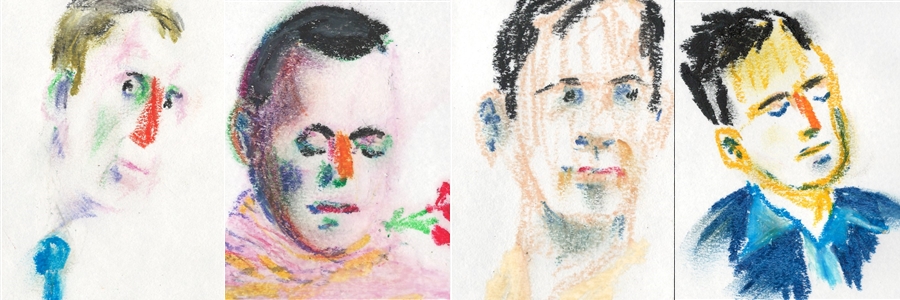
nataniel-.jpgTalking about the Afrikaans and English version, he wrote the Afrikaans and his translator, Iolandi Pool, did the English version. But, says Nataniël, it is not strictly speaking a translation. “She understood how I would have written it in English,” is how he best explains it.
“English is much more poetic and musical,” he explains. “Afrikaans is staccato and rhythmic.” If he had written the English version, it would have resulted in a very distant cousin of Jane Austen, is how he tells it. But he needed someone who got his distinct voice. They needed to capture that – and Pool certainly did that.

Reading it first in Nataniël’s own words and then the translation, the differences are fascinating. It’s exactly the same story but to get the voice strong enough in both versions took some vision – and the two worked very closely together with much toing and froing between them. The English almost has an old-fashioned feel, comes from this country but without moving into strictly speaking South Africanisms, which would have been the easier option. There’s a certain elegance in the telling.

“I live in Afrikaans and I read in English,” he says. “My Afrikaans is vocal and my English is written.” The challenge for him and Pool was not to become Herman Charles Bosman. For example, rather than use stoep they used porch. But writing in both languages was important.

“I wanted this to be a universal story and I wanted something of my own to give to foreign friends.”

“Those who want insight will get that, for others it will be entertaining and intriguing,” he believes. “It’s about someone who refuses to follow any rules.”

It’s memories of a childhood more than anything else, which he describes as “50% horror and 50 % complete fantasy amongst his paper dolls and rugby balls. It is the best shape on which to practise make-up,” he vows. “It’s the same shape as my face!”

“My childhood was the perfect storm of fear and fearlessness,” with the horror beginning as soon as  he stepped into the world. Back home he could create his own fantasy world. “I couldn’t understand what was wrong with the rest of the world. How could or should we obey, if it wasn’t deserved?

What I really loved about the book was that, like anything Nataniël does, he isn’t following a recipe. He tells his story as only he would. Through the years I have watched many talented artists trying to copy his successful “recipe”. You can’t. It’s about his identity, who he is, how he operates in the world and how he likes to show and tell. All of that is quite unique and what gives him his cachet in whatever he wants to do.

And it could almost be anything, because he has such a determined and decisive attitude about who he is, what he wants and what he won’t do.

That’s the right time to write your memoir and to share your life with the world. And thank goodness it could be done in English too so that his magical stories could spread wider than an Afrikaans only audience.

His wisdom is witty and wacky and takes you into a world that is weird and wonderful. I have watched him on stage for almost his whole career and was still surprised by how he chose to tell us about his young life.

I should know by now that Nataniël always does it his unique way – and his success relies on that individuality.

As with his stage stories, it is his voice and language that captures your heart, that makes you listen and laugh and perhaps in what was the saddest moment in the book, have you screaming in laughter and pain.

If you understand the language, read it in Afrikaans. Yet, for English readers, the experience will be as rich and intense as they follow one young boy’s determination to find his way. I loved having the choice of reading both.

Look At  Me – recollections of a childhood/Kyk Na My – herhinneringe aan ‘n kindertyd (Human&Rousseau) should be read widely as we pay attention to the world as seen through the eyes of a child.


Artists Lara Foot and Sandra Prinsloo Create the Perfect Storm for Kamphoer

Sandra Prinsloo
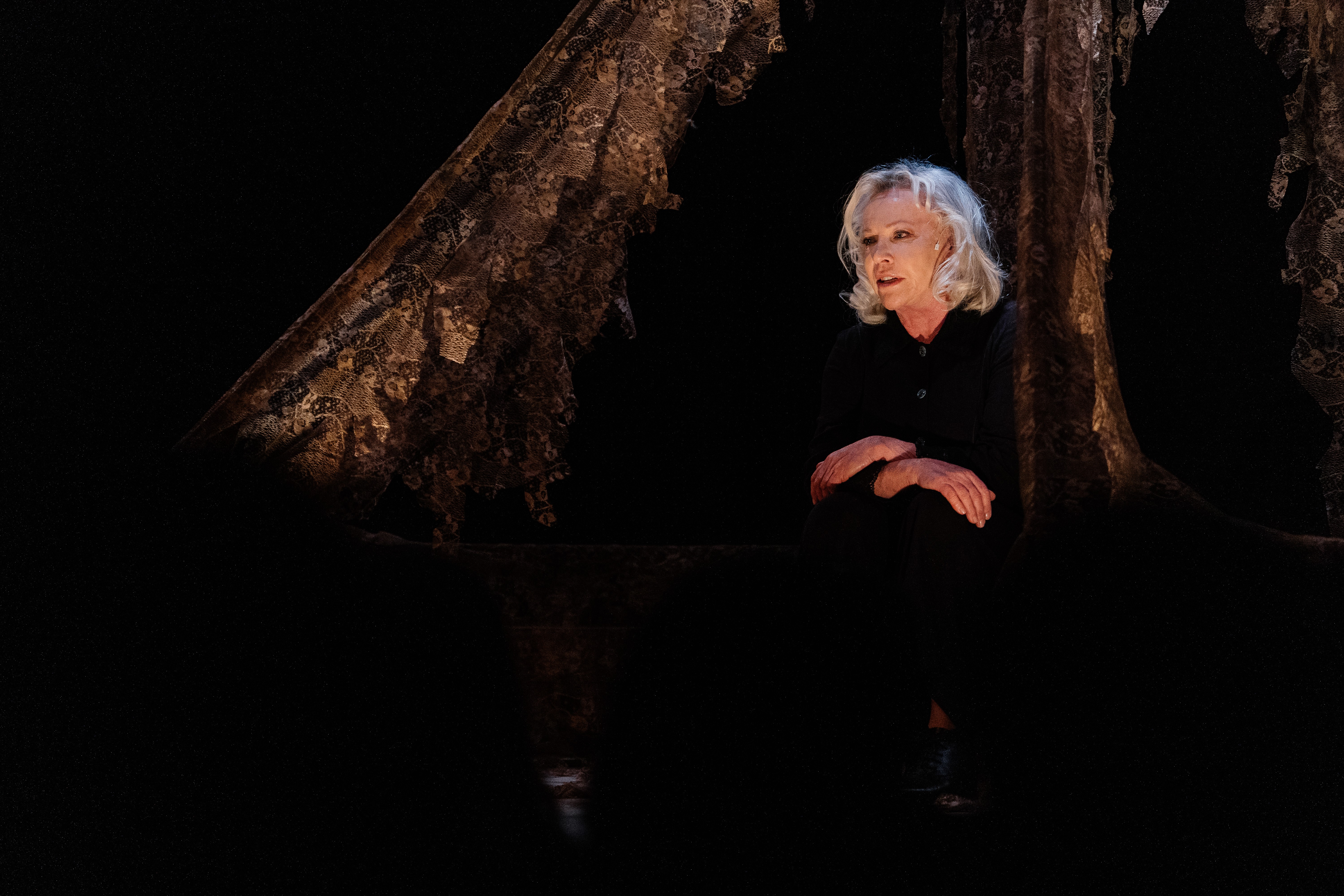
Sandra Prinsloo as Susan Nell in Kamphoer Pictures: Eye Poetry Photography

Sandra Prinsloo has established herself as the queen of solo shows. She knows how to pick them and with whom to collaborate. She tells DIANE DE BEER about her latest venture, Kamphoer – die verhaal van Susan Nell, with Lara Foot, CEO/artistic director of The Baxter, as director:

That was then, 2019, when Kamphoer made its debut at the Vrystaat Arts Festival and this is now, with its latest (and for now, last) run. The times slots for the run of Kamphoer  opening on January 27 until February 14 at Joburg’s Market Theatre are Tuesday – Saturday 6pm; and Sunday 3pm. This is to accommodate the curfew times imposed by level 3 regulations. The Market Theatre  celebrates 45 years and marks this milestone with this solo production presented by two audacious artists. They urge patrons to arrive at 5.30pm so they can allow sufficient time for getting screened. Masks need to be worn at all times. The production transfers to the Roodepoort Theatre from 16 – 28 February also performing to the new time slots Tuesday – Saturday 6pm and Sunday 3pm.

Here follows the initial story (updated) about this marvellous production which should be seen as widely as possible in Gauteng. With so little theatre around because of Covid19, to see one of the best in these times, is thrilling:

It’s the coming together of two talented artists who haven’t worked together before that can create fireworks on stage.

That’s exactly what has happened with leading actress Sandra Prinsloo and dynamic director Lara Foot. When they bumped into one another and Prinsloo said that Kamphoer was her next project, Foot acknowledged interest – and they made it happen.

That was probably the only simple element in their coming together. They were handed the initial script by their producers and with scriptwriter Cecilia du Toit in tow, they knew they still had a long way to go.

Kamphoer – die verhaal van Susan Nell (based on the best-selling and debut novel Kamphoer by Francois Smit and the non-fiction publication The Boer Whore by Nico Moolman and produced by Theatrerocket Productions) is the amazing true story set against the backdrop of the Anglo Boer War. A prisoner in the Winburg Concentration Camp, Nell is brutally raped by two British soldiers and a joiner and left for dead. She is confronted by one of her rapists many decades later when she tends war victims in a British hospital – where she starts reliving the old trauma.

“It was a process,” says Prinsloo, but as Foot is also a writer, it was also a huge but fascinating learning curve for Prinsloo. Because of the way the books are written, the main character, the one Prinsloo portrays, doesn’t emerge strongly.

What she does is more prominent than who she is. But the breadth of her experiences also presented them with many obstacles. “She manages to go through so much in a relatively short period of time,” explains the actress.

But being the experienced theatre makers they are, they found the solutions and if you have read any of the books and see the production, you will understand how brilliantly it was pulled off. (Talk of an English translation and travel to the Edinburgh Festival which both director and actress have experienced before, has been put on hold which has happened to almost everything planned in the theatre world.)

Once they got talking, the women knew they had to discover who this woman was and how to present her. Who was she talking to? And what part of her journey do they cover and which parts do they leave out?

Foot made a construction graph, signposting the different features important in a text – to begin with. “It was very technical but taught me a great deal,” notes Prinsloo.

The presentation they decided should almost play in a kind of Truth and Reconciliation format. It also starts with the words, “Ek is Susan Nell…”(I am Susan Nell…)

There were however many more headscratchers, such as the eventual confrontation between Nell and one of her rapists and  again, the solution, a brainwave by Foot, is the perfect one.

Sandra Prinsloo1

This is a dramatic and traumatic story of one woman’s life and in present times, particularly relevant as the more things change, the more they stay the same. The dignity she fought for in her own life is exactly what so many women are still fighting for. Few will not identify with some of her life and that is the truly sad thing.

When she finds herself in the same room as her rapist, as a therapist she has sworn a medical oath to save lives – even if the only thing she wants to do is to kill this man who had so damaged her life.

What Prinsloo loves about the piece is how they are telling the story. “I play the character at different ages, but there are no huge shifts, even when I switch into different characters,” she says. It flows seamlessly.

She also embraces the staging, adores the set and has lost her heart to the music and the fact that composer Simon Kohler attended rehearsals and did quite a measured yet magical soundtrack to what was being said on stage. It hugely benefits the final result.

Prinsloo has become a master of the solo show and while she enjoys huge ensemble casts and does many of those too, this journey has been a joyous if tough one. She loved the encouragement from her director, the choices Foot made, the consultation – in fact the full process.

Kamphoer is an epic tale but Foot managed the timelines and flew across continents and back to honour the Susan Nell story. “It was amazing to rehearse in a theatre space (Cape Town’s Baxter Theatre in 2019) and to have everything we needed on hand,” says an actress who has gone through many phases of the South African theatre landscape. The last few decades have often been rough on individual players with very little support from outside. And now there’s Covid19 to contend with.

Her most recent production was also her most recent solo show, Spertyd,  based on Elsa Joubert’s autobiographical book dealing with the author at 95 reflecting on her life. Directed and adapted by the innovative Philip Rademeyer, it had a short run at Cape Town’s Boer Theatre but has also come to a sudden halt with the harsh Covid19 restrictions.

A plucky Prinsloo has always had a gritty approach to her work. From her early days she has been a force in the profession which she has served magnificently – and still does. She is one of the few names who always draws full auditoriums and she seldomly fails to deliver.

She works hard as she flies between provinces to play in different solo productions. She can currently be seen in the film Racheltjie de Beer on DStv and there’s more on the horizon. She feels rejuvenated by the young guns like Rademeyer, Christiaan Olwagen and Nico Scheepers who have opened new vistas on stage and screen and with yet more accolades for Kamphoer which has come full circle starting with a festival opening in 2019,  followed by Aardklop 2019, the Baxter Theastre in October 2019 and Woordfees 2020, which could still be accommodated before the Covid19 restrictions and now a protected run at Joburg’s Market Theatre.

For Prinsloo the positives around this production accumulated. But more than anything, she is excited not only about the performance but also about the timing of this particular story.  It’s the right time for women to tell stories about strong women who overcome extreme adversity. “Healing can only start if you touch the scar,” she says referring to the play – but also valid in a much wider context.

So much time has passed, so many battles fought and still the issues for women remain the same. It’s time those with the voices start raising them – loudly. And if you can do it with Prinsloo’s power, it really counts.

If you understand Afrikaans, this is a story that will speak to everyone – and with two great dames coming together, actor Sandra Prinsloo in spectacular form guided by the inspirational director Lara Foot, it’s theatre that should be cherished. Everything about this production is pure gold but because of the pandemic, as a live performance on a local stage, it’s also rare and precious.


Kamphoer – die verhaal van Susan Nell made its debut at Vrystaat Arts Festival 2019 in Potchefstroom before a run that same year at Aardklop and Cape Town’s Baxter Theatre. It played its last season at the 2020 Woordfees but its concluding KKNK festival run  was cancelled because of Covid19. For the time being, this current Market and Roodepoort Theatre season is its final tour de force. This might change in the future as new opportunities present.

Little Nataniël Waltzes With Giants

If you know Nataniël, you won’t be able to resist his latest season. If you don’t, DIANE DE BEER coaxed him to share the story of his upcoming show:

nataniel1

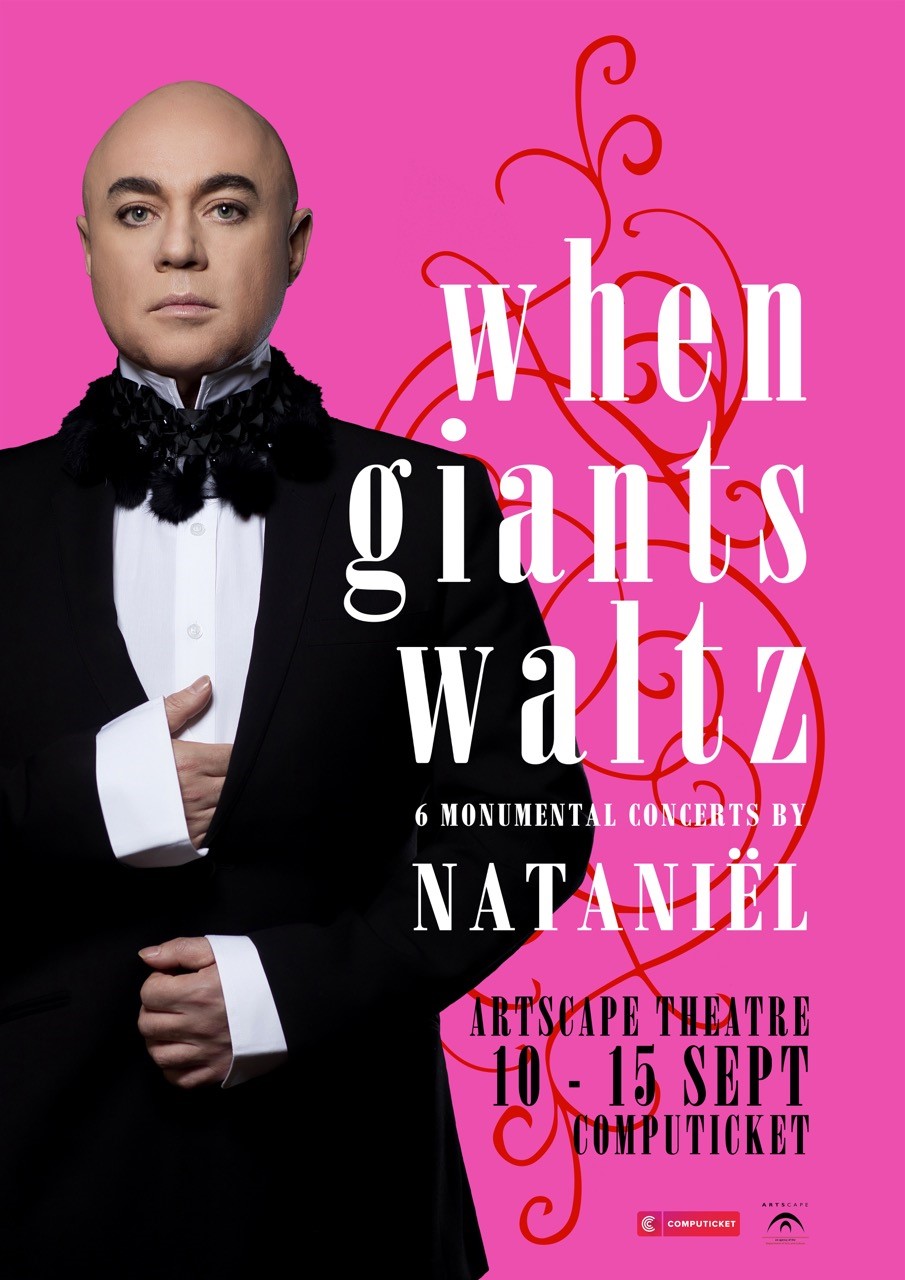
The title alone will stop you in your tracks: When Giants Waltz – 12 Monumental Concerts by Little Nataniël.

But that has always been his power – getting you to gasp – at his costumes, his words, his gestures – or simply the spectacular staging of his shows.

Not this time says the performer – but we won’t quite take his word for it.

The title dictates that the costumes will be monumental – and that is where he starts – always with the way he looks when on stage.

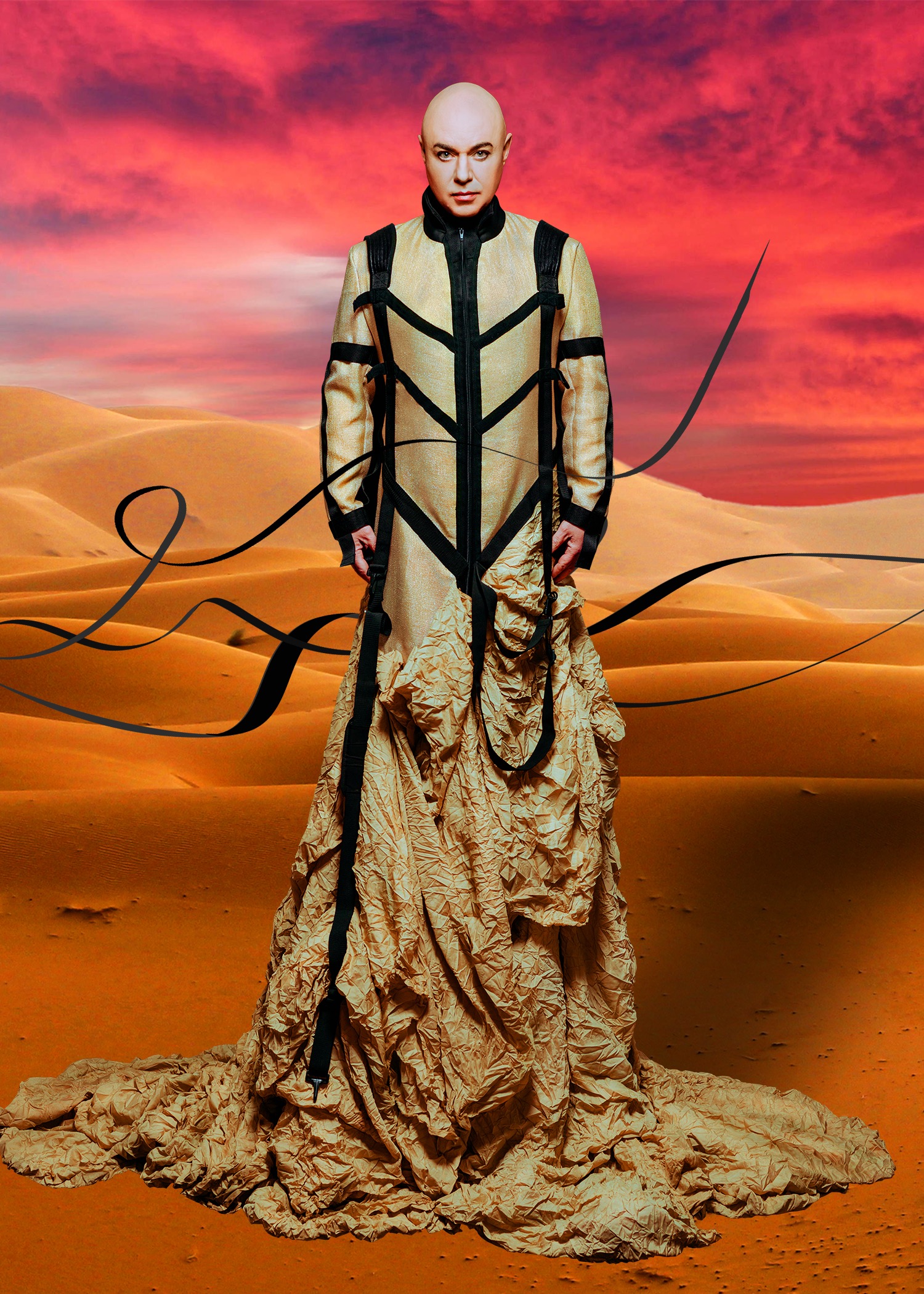
 Singer, songwriter and storyteller Nataniël returns to the Theatre of Marcellus for his 17th production at Emperors Palace after a year’s sabbatical. This latest creation will first be staged at Artscape, one of his favourite theatres, from September 10, with a smaller band but the same set, props and costumes as well as script to be presented as 12 concerts from October 4 to 27,  Fridays and Saturdays at 8pm; and Sundays at 3pm.

nataniel poster

A typical Nataniël year consists of three original stage productions, one at Artscape, one at Emperors Palace and one at the Atterbury Theatre. The rest of the year is filled with numerous concert tours.

These concerts (“the friendly shows”) are as structured and detailed as all his work, but allow him more freedom for improvisation and informal banter. For the first time he will present this format at Artscape and Emperors Palace.

And as a bonus, there will be as many costume changes as he can manage! With the show title as an example, he is going grand and gigantic. “Expect them to be epic,” he says. “I can hardly move them. Every time I do, I find myself with a sleeve in my hand.”

Last year’s sabbatical (only from the grandly staged shows) obviously gave him the chance to reassess. He believes audiences prefer his solo stories rather than a single story told from the beginning to end of the show.

This also gives him more time to play around, allows for a mini-sermon slipped in at some stage which also gives you a measure of where his head is at for the moment – always a bonus.

But then the title should do that too, he explains. “When giants waltz, the earth moves. Apparently,” he says, “size does matter!”

“As far back as your childhood, everything is a battle between big and small. This is my chance to lead a well-dressed rebellion against institutions. I despise any structure that involves a boardroom. Some people, however, will be victims of this stupidity.”

NatanielEmperorsPortrait (1)

If all of this simply sounds too serious, don’t fear, the shows are focused on entertainment yet “from a pedestal of profound values and issues,” he says with what may to some sound like a heavy heart.

“It’s fun from beginning to end. If we can’t have fun in this mess …” And if anyone can turn the prediction of the end of the world into something hilarious, Nataniël is your man.

The way he thought about this season was to start with a costume that he imagined as the outfit he would wear at the last ball held on the Titanic!

Staged with his trademark stylish lighting, he has visualised this concert as a series of portraits. It reminds him of those tableaux from a time, long, long ago when photography was in its infancy. “It will hopefully remind people of paging through an album,” he suggests. “When the lights go on, everything stops on stage! In the dark, out of sight, is when everything happens,” he notes. “During the blackouts we move.”

With his stories, he isn’t only comparing big versus small, but also the constant struggle between the indestructible and the threatened, the always present war between the individual and the establishment, and the exhausting debate between the political and the intelligent.

Nataniël performs music from an endless catalogue of blues and jazz evergreens, pop classics and original songs.

This time even the music has been simplified and made as accessible as he knows how.

And no more choreography. While some will miss those quirky hops, skips and jumps so beautifully executed with often military precision, he feels as if someone has handed him his freedom. “I would panic through every show that I would forget my steps,” he explained. “Why did I do that all these years? What was I thinking?”

He shares the stage with his brilliant band led by Charl du Plessis (keyboards), Juan Oosthuizen (guitar), Brendan Ross (keyboards, saxophone and vocals), Werner Spies (bass), Peter Auret (drums), and on vocals, Dihan Slabbert and Nicolaas Swart.

The minimalist set (notwithstanding the multitude of props) will be complemented by another collection of extraordinary costumes created by Floris Louw, Nataniël’s award-winning designer of the past 18 years.

Describing this as a concert for the connoisseur, he never fails to entertain. His stories and songs, the staging and the costumes, when they all come together – that’s showbiz, and perfect for these tough times.

Cds, dvds, books (including his brand new book – a memoir in Afrikaans and English), ceramics and products from Nataniël’s lifestyle range will be available at all performances.

*Artscape, Cape Town; September 10 to 15.

*Theatre of Marcellus, Emperors Palace; October 4 to 27, 2019

Fridays & Saturdays at 8pm, Sundays at 3pm

12 concerts only; 90 minutes long; no interval; no cellphones, sandals or shorts; no children under 15.


Bookings at Computicket.


Two Young Artists Grab Top Prizes in 2019 Sasol New Signatures Competition Using Traditional Media in Classic Style

Pictures: Petrus Saayman

Sasol New Signatures winner Patric Rulore
Sasol New Signatures 2019 winner Patric Rulore

DIANE DE BEER


Hoping to shine a magnificent light on load shedding – both literally and figuratively – was the inspiration for Pretoria student Patrick Rulore’s winning canvas titled Stage 4 moments.

Rising to the occasion, the young artist was announced the winner of the 2019 Sasol New Signatures Art Competition at the Pretoria Art Museum last night, (Wednesday) winning a cash prize of R100 000 and the opportunity to hold a solo exhibition at the Pretoria Art Museum with the 2020 winners.

 “It was part of my family’s experience which gave me more insight into how to execute it the way I did,” explained the 24-year-old student currently completing a National Diploma in Fine Arts at the Tshwane University of Technology.

“In the beginning of this year, South Africa had to endure extreme shortages in electricity supply with electricity scheduled in stages. The most important part of the work was to teach people to turn unfavourable circumstances into a positive experience,” he said.

In his painting, Rulore depicts the typical behaviour of his family during load shedding, celebrating the absence of all activities involving electrical device during these blackouts which encouraged them to interact with each other – to talk, to laugh and to play games.

His primary medium is paint, using both oils and acrylics. “I am fascinated by the complexity of the human body (male and female) and attempt to discover its magic on the canvas. I endeavour to capture the emotions and spirit of everyone I paint. To achieve this, I manipulate and play with colours, textures, paint and brush marks,” he earnestly explains his process.

Paying tribute to his mom who has been a strong influence and supporter of his art, he believes it was her work as a fashion designer that encouraged him to pursue art.

Sasol New Signatures runner up Luyanda Zindela

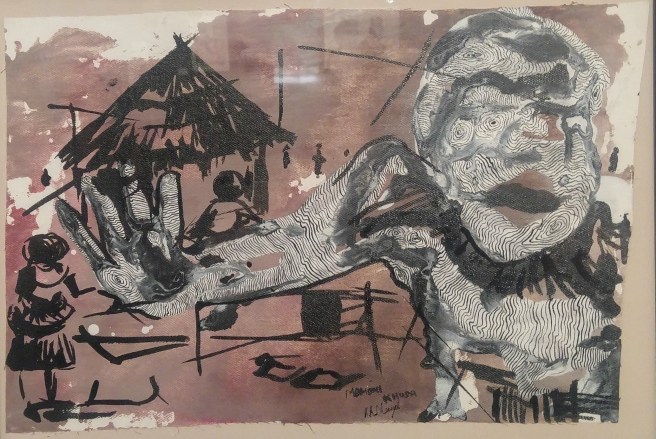
The runner-up in the 2019 competition is Durban University of Technology M student Luyanda Zindela, also using traditional media –  pen, ink and graphite – on pine-board, titled Phowthah sis’ Mgabadeli.

 The title which means Pout Miss Mgabadeli is a reference to his friend’s irreverence, says the artist. “When I was taking the pictures, she asked me whether she could pout.” With the title, he also points to the way women are assigned specific roles in society.

 The drawing is a breakaway for him in terms of scale as well as overall. “I wanted to gauge how it would be received by an art audience and to produce a body of work based on the submitted drawing.” He certainly got a generous response.

 With his chosen tools, apart from the work, he also explores the limitless possibilities of a medium so readily available that it is often taken for granted. “I have tried to capture the boundless intricacies of black skin using traditional pen and ink drawing techniques like cross-hatching and stippling.”
He tried to push his boundaries and believes if you really look, the improving technique is visible. As runner-up, he was awarded R25 000 and the knowledge that his future project has been given the go-ahead.

For most of these rewarded artists, the competition means validation and a launch into the professional world.

These Five Merit Award Winners were also announced with most of them working with the personal:

S Nico Athene (Johannesburg) After After Party (Resurrection) DiaMount

Nico Athene  (Johannesburg) After After Party (Resurrection) DiaMount

S Kgodisho Moloto (Polokwane) Disguise mask Pot scrubs and wire

Kgodisho Moloto (Polokwane) Disguise mask Pot scrubs and wire

S Angelique Patricia Mary Bougaard (University of Johannesburg) Crucified Mixed media drawing on handmade paper


Angelique Patricia Mary Bougaard (University of Johannesburg) Crucified Mixed media drawing on handmade paper

S Cecilia Maartens-Van Vuuren (Bloemfontein) A presentiment Dried roots.jpgCecilia Maartens-Van Vuuren (Bloemfontein) A presentiment Dried roots

S Mlamuli Eric Zulu (Durban) Enlightened Art gathering Mixed mediaMlamuli Eric Zulu (Durban) Enlightened Art gathering Mixed media

Each of them received a R10 000 cash prize.

Acclaimed artist, judge and Sasol New Signatures Chairperson Professor Pieter Binsbergen noted that in this 30th year of Sasol sponsoring the longest-running art competition started by the Association of Arts Pretoria to encourage emerging artists, the winner and runner-up have both been recognised for works created in traditional media – ink and paint. He praised both works that have been painstakingly laboured and felt that the artists through their work showed immense drive and passion.

“Identity is still the driver, but the lens has narrowed,” he says about the work generally. “The journey has become more personal which they hope will echo widely.”

He also acknowledges that there’s a return to classicism, dealing with a more laboured surface with traditional media where technique rather than Instagram moments is at stake.

“On behalf of Sasol, we congratulate all the 2019 Sasol New Signatures winners,” said Nozipho Mbatha, Sasol Senior Manager: Group Brand Management. She also tipped her hat to all the emerging artists who have participated in the competition over the past 30 years.

“The majority of winners and merit award winners have carved out illustrious careers in the visual arts and have made significant contributions to our country’s artistic heritage. Here’s to the next 30 years of developing our cultural economy,” she concluded.

Jessica Storm Kapp, the 2018 winner, will present her solo exhibition entitled Artefacts of Belonging at the Pretoria Art Museum, alongside the 2019 finalists as part of her prize. The exhibition will feature the 2019 winner, runner-up and five merit award winners as well the 80 finalists, all of whom are included in the highly respected competition catalogue. The exhibition runs until September 29, 2019.

The final judging panel consisted of: Professor Pieter Binsbergen  (Convener), Cate Terblanche (Sasol Curator), Mary Sibande (artist), Wilhelm van Rensburg (Senior Art Specialist, Strauss & Co), Lebohang Kganye (Sasol New Signatures Winner 2017) and Pfunzo Sidogi (Lecturer, Department of Fine and Applied Arts, Tshwane University of Technology).

* Pretoria Art Museum:

Tuesday to Sunday:  10am to 5pm (Closed on Mondays and Public Holidays)

Corner Francis Baard and Wessels St, Arcadia Park.

https://select.timeslive.co.za/news/2019-08-22-power-of-art-load-shedding-inspires-artists-big-win/


Books That Gift You The Time To Dream

“If there’s a book that you want to read, but it hasn’t been written yet, then you must write it.”
― Toni Morrison


Diane de Beer reviews a a few fascinating reads:


Book Zulus of New York

The Zulus of New York by Zakes Mda (Umuzi):

It’s a remarkable story that Zakes Mda has unearthed here.

He knew just how to approach the telling of it in a time when finally it seems there’s more awareness in the world of problems in the past that have never been acknowledged. It meant that these persist in exacerbated form to this day. And with people like Trump and Johnson leading powerful nations, it only gets worse.

Nevertheless, just the title should pull you in. Who would have thought? In New York and paraded in all their powerful mysticism of the time, yet naturally, at their cost. They had to play the savage because that’s what gawkers came to see, hearing the stories of the infamous King Cetshwayo. And in the process, the performers were losing their souls. Until a love story of sorts unfolds in all this darkness and brings some light.

Mda has a magical touch and a way of drawing his readers into a world that might not be familiar. And then he punches you in the gut as he holds up the mirror of what people do to those they don’t recognise as themselves.

Book Theo Flora coverTheo and Flora by Mark Winkler (Umuzi) which has just been shortlisted for the Sunday Times fiction list:

It’s an intriguing tale and really reminds me of the idiom to spin a yarn. With novelist Charlie Wasserman left by his investment-banker wife with the means to stay on in their home, he discovers a box of her family letters written between 1940 and 1944. The letters reveal a love affair between her grandfather, a 40something lawyer at the time and Flora, a much younger journalist.

Even though Wasserman’s former wife instructs him to destroy the letters, he has found a way to revive his somewhat slumped writing career. Interesting characters wander in and out of this novel tale which keeps you engaged from beginning to end.

It’s an addictive yarn.

Book Milkman

Milkman by Anna Burns (Faber&Faber):

This is a book that probably accidentally came in a time of #MeToo and Brexit which compounds the meaning in a story that is set in an unnamed Irish city where the aim of living is to blend in.

To be noticed is not only damaging but dangerous. Middle sister is leading a life of terror and it is all exacerbated because she tries to keep it quiet that she has a maybe-boyfriend and that she is being terrorised by a very scary character called Milkman.

If you want to know what it feels like to live in a world where people are terrified to breathe yet some are determined to live their lives in spite of a rumour mill that can destroy the little you have, this is one, hand-in-hand with Margaret Atwood’s television adapted Handmaid’s Tale, to immerse yourself in.

Then re-look the life you have been gifted and smile.

Book Cul de SacCul de Sac A Memoir by Elsa Joubert (Tafelberg):

A moving farewell from one of our great writers. That’s JM Coetzee writing about this memoir and indeed it is that – moving.

But what it also reminded me of was the different ways people approach any stage of their life.
In her 95th year, she explores the continent of old age says the blurb on the back cover. And that plays a role – her age. A few decades ago, not many people were reaching their 90s, but now with modern medicine and more emphasis on health during your lifetime, it’s possible.

But she lost her life partner and with that her independent spirit – somewhat – which rather colours her perspective it seems.

Also, the choice of where she lives and how she copes with the devastation of a diminishing world, even with caring family around, is quite harrowing. “That’s why they have this big, long lift, to take out the coffins at night when we’re asleep,” she writes.

I found it moving and admirable that she is still determined to tell her story, a life so great and so rewarded, and so magnificently captured.

And yet, I’m still determined to go out singing!

Book TranscriptionsTranscription by Kate Atkinson (Doubleday):

This is another of those writers you don’t want to miss. From her early writing to the present, she keeps swinging with stories that surprise and delight.

Atkinson has a specific smartness about her writing which always keeps you engaged. I recall years back when reading the description of Life after Life and wondering how she would pull me into the lives of people whose lives kept turning on the same dime, but in different directions – and she did – masterfully.

It was simply a masterpiece. Perhaps following that one and the companion,  A God in Ruins, she should have turned away from War stories to something completely different. Think of this as an adventure, one of the characters say at the beginning of what turns out to be a rather pedestrian spy story.

If not even Atkinson can light a fire under a Girl’s Own type of adventure, perhaps it’s not to be. It doesn’t grab you and neither do the characters who all seem a touch lukewarm – as do their actions.

I didn’t think it possible to feel indifferent about an Atkinson story – sorry – but about this one I do.


Book The DistanceThe Distance by Ivan Vladislavic (Umuzi):

Anyone who has read this author will know you can drift on clouds in his words. He just has a unique way.

Similarly, with the topics he tackles and the stories he tells. While it might feel as if it is about one thing, there are different things going on.

This one is ostensibly about siblings and their life stories. Is one voice more important that the other, who remembers the truth and who decides about that?

These are some of the questions posed. But he also spotlights the country and the time we live in, and the harshness of our lives while living in a time when life isn’t valued. Yet with the number of refugees battling out there in an unwelcome world, is it even possible to think of more ordinary lives in this way?

Everything begins with a young Pretoria boy’s obsession with Muhammad Ali. Now, as an adult, he turns back to the scrapbooks of his youth, asks for help from a somewhat unwilling brother but also tries to unravel the mystery of writing, how it happens and why he does it.

It’s simplicity itself and yet there are underlying streams that keep popping into the story and strangling any thoughts you might have had about what this story is about and why it is being told.

And that is precisely this astonishing writer’s strength.


Book There Goes English teacherThere Goes English Teacher A Memoir by Karin Cronje (Modjaji Books):

As a huge Korean fan, having visited the country twice as a guest of the government, I was hugely intrigued by this book which deals with someone teaching English.

We all know South Africans who have done that but in Cronje’s case, she’s slightly older than most graduates who almost use this as a gap period. For her, it was is a gap year while ageing and coping with major life changes that had her almost gasping for life.

Perhaps that’s not the best time to jump into this kind of adventure. A third into the book, I almost put it down which isn’t something I often consider, choosing my reading matter carefully.

Nevertheless, I decided to keep going because while I found her writing frustrating in many instances, I was also enchanted by others.

I still feel that it needs a strong edit which would (for me) turn her into the brilliant writer she is some of the time. Too often, it was just too much, she had made the point clearly. And yet, there she goes on again… and again.

But then again, it might just be me.


UP Consumer and Food Sciences Students Celebrate the Indigenous Ingredients Foraged on the Future Africa Campus

UPAloes at the Admin Building
Aloes take a stand at the UP Admin Building

The Department of Consumer and Food Sciences of the University of Pretoria is hosting a special dinner to celebrate our indigenous food of which some of these ingredients will be foraged on their Future Africa Campus. DIANE DE BEER spoke to botanist and curator Jason Sampson as well as some of the other participants about this exciting concept:


This is not the first time the students of Consumer and Food Sciences will focus on indigenous ingredients, but it is their first foray into the Future Africa Campus.

The gardens at Future Africa were purposefully designed and developed to cultivate and produce edible and indigenous plants.  “We developed a menu to celebrate and use some of these ingredients in the menu that were available and as it was the end of the season for some of these products, we were able to harvest them and include them in our menu (like water chestnuts and makataan),” explained associate professor Gerrie Du Rand in charge of the Hospitality Management Final year students who will be preparing the dinner.IMG-20190730-WA0026

“What is exciting about this garden is the fact that many of these plants are unusual and not freely available and it provided our students the opportunity to celebrate these ingredients in a challenging manner with an unusual menu.”

Much of the expertise and help was given by botanist Jason Sampson from the Department of Plant and Soil Sciences, the man responsible for among others the botanical garden on the main campus of the University of Pretoria which holds a collection of living plants that is scientifically managed for the purposes of education, research, conservation as well as community service.

Known as the Manie van der Schiff Botanical Gardens, the aim is to raise awareness of our indigenous plant heritage and if you’re fortunate to be taken around the campus by Sampson, it’s as if the campus becomes a living organism with aloe walks on the Hillcrest campus and his magnificent fully fledged plant wall for the masterfully designed Plant Science building which functions as insulation as well as an aesthetically pleasing feature while also mimicking the natural habitat of some very unique plants.

up water transformer
The rainwater harvesting plant (part of the Mining Engineering Study Centre of UP) with rain garden ponds and a storage tank

From the rose garden which was replaced by an aloe garden in front of the admin building (possibly the most visible ship structure on the most southern point of the campus), to what is referred to as a living laboratory, the rainwater harvesting plant (which is part of the Mining Engineering Study Centre of UP with a series of rain garden ponds and a storage tank which was installed as a reactive storm-water control system), someone has a firm eye on sustainability in these expansive grounds and to the scarcity of water in the future.

Working with UP’s resident architect, Neal Dunstan, they saved the university a stack of money but also created a system that harvests enough water for the glorious botanical gardens.

“The aloes haven’t been watered for six months,” he says and of course, that’s the point. And as you drive further through the campus, the signs of replanting and water-resistant plants are overwhelming. You just have to pay attention. This is truly forward thinking.

2016-01-04 10.56.06
The pod of the Lowveld chestnut. Inside is a handful of large, black, oily nuts with a soft shell. Delectable!

All of these projects and unique plant species are also available for study purposes as are the gardens that Sampson is involved in on the Future Africa campus. “There are quite a few master and doctorate studies to be done here,” says the man who describes his role on the new campus as “advising and interfering”.

And believe me he will. But with his passion for and knowledge of especially indigenous flora and to the benefit of the Consumer and Food Sciences students, a love for food, he will walk you through those gardens, still only in their infancy, and if you listen to him talking, have dishes rolling off his tongue.

IMG-20190730-WA0028
African Horned Melon , ripe and harvested. Picture: Hennie Fisher

His conversation centres on edible gardens, food forests and the need to diversify food crops which also leads to wild food plants. Today the world is dependent on five staples – none of which come from Africa. He points to the Irish food famine for example as a country that was solely dependent on one staple – and then starved. He knows this is a simplistic version but is also a reminder of food shortages and famine in the future.

“We need to focus on our little known orphan and African crops,” and here he points to examples like African berries (of which there are different kinds), a local grape version that instead of a bunch, forms single large grapes on a rounded bush or as an exotic example, the dragon fruit cactus which he is especially keen on as a vining waterwise fruit which could substitute for grapes to make what he believes will be excellent wine.

Cactus is a thing that he feels can be used in different ways (“eat the weeds”) and he is also keen on a sugar sorghum which delivers two food crops: wheat and sugar.

It’s one of the strengths he argues one finds in African crops. Most modern crops are single usage crops where a marula for example has multiple outputs. We would use the fruit, the nut, the bark and there would be a medicinal purpose introduced as well.

UP plant wall
Fully fledged plant wall for the UP Plant Science building

He feels we have been behind the times with indigenous planting (and he’s not against bringing in a few exotics). Some of his current plants in the Future Africa gardens include big-leafed spekboom (a different version of the plant that has become so fashionable in the past few years), Lowveld chestnuts that grow only around Mbombela and Barberton, the Pondoland coconut which is almost extinct in the wild, a horned cucumber which is farmed commercially in New Zealand and grows wild throughout Southern Africa, a makataan (wild watermelon) – and he can go on and on and give numerous ways of using these edible plants in innovative ways.

That’s exactly what the students were tasked to do. Research a menu, take the guidance from Sampson and then harvest what they need for their specific menu. What they have come up with is a truly innovative forward-thinking meal under the guidance of a student tasked with putting together a menu: Zandile Finxa. They also had to stick to a curriculum which not only introduces the different local ingredients but also a range of cooking methods.

IMG-20190730-WA0027
Makataan (wild watermelons) being processed Pictures: Hennie Fisher

It starts with an arrival snack consisting of a savoury Msoba (nightshade berry) panna cotta, aloe and spekboom salad and wild African sage (of which Sampson says, there are 27 different species in South Africa alone!).

The starter is a panfried Amadumbe gnocchi with African water chestnut mash (found with what will become a huge crop of waterblommetjies in the rainwater harvesting pond), roasted balsamic beetroot, guinea fowl with beetroot extract and biltong; followed by a mains of seared sous-vide Kudu loin with ting (sorghum) prepared risotto style, butter-tossed waterblommetjies, rooibos smoked carrots, creamed marogo and a venison red wine jus.

To end on a sweet note, there’s a chocolate and carob (of which the trees also grow at the university) macaron with milktart cream filling, amarula ice cream, horned melon and plumbago gell with a cinnamon and wild rosemary crumb.

Guests are then presented with a gift of glazed makataan (wild watermelon) and according to Sampson, this is a fruit of which the peel is considered to make the best watermelon preserve/jam and if you mix the fruit itself with pap, it’s lip-smacking.

UP Aloes on the Campus
The vibrant and revitalising aloe revolution at UP

The dinner will be pre-empted by a public lecture by Prof Herb Meiselman, an internationally known expert in sensory and consumer research, product development and food service who will deliver a public lecture on The influence of context/environment and psycho-graphics on product design and evaluation prior to the dinner for those who are interested.

Sensory and Consumer Research has changed dramatically over the past 20 years, moving from pure sensory research to a broad array of tests involving the psychology of the consumer and the place where testing and product consumption are done. While testing used to focus on the product being tested, it now includes the consumer and the environment.


 Booking details:

Date: 7 August 2019 Time: 7pm for 7.30pm Venue: Future Africa Complex RSVP and Enquiries: Prof Gerrie du Rand, 012 420 3547 or gerrie.durand@up.ac.za Tickets R300 per person.


Pietie and his Tannie Evita make #hetwo


Tannie Evita and Pieter Dirk Uys photo by Stefan Hunter
Tannie Evita and Pieter-Dirk Uys

It’s the great standoff between Pieter-Dirk Uys and his celebrity creation Tannie Evita Bezuidenhout. He tells DIANE DE BEER about the battle of sharp tongues and minds in #hetwo:


It’s difficult to imagine how actor/writer/director (and the list goes on) Pieter Dirk Uys (PDU) keeps producing fresh material – but a few minutes in his company, listening to those ideas almost tumble over one another, the answer is simple.

It’s his vocation, his passion, and PDU (with all his personae) is unique. I am reminded of a day decades ago when I slipped into a lecture hall at the then Pretoria Technikon (now TUT) and listened to him chatting to drama students.

Quick and nimble, thinking on his feet, and everyone eating out of his hand, I was quickly won over, but was certain that even though seemingly impromptu, this speech was rehearsed. It was only many years later that I understood how foolish I was. It’s simply the way he works and thinks and has fashioned a career not only brilliantly but with versatility and such longevity.

It’s always new as out pops yet another gag – whether it’s that of Piet Koornhof or who knows, decades later turned into Trump. He brilliantly used one of the Koornhof-driven apartheid laws and moved to British immigration officers to show the world for what it really is – up close.

Tannie Evita is one who just won’t let go. Ever since she slipped onto stage in 1981 (just short of four decades ago), she’s been misbehaving but as her creator explains: Because she doesn’t exist, she can’t be real and then, she proves them wrong.

PDU and his master creation have never come face to face on stage until now. As his publicity announces à la the LA Times: Uys dons false eyelashes and presidents listen. And even if that’s perhaps no longer a compliment, Tannie Evita’s long list of celebrity fans have been committed from the start and still remain true.

When he started impersonating her in 1978, it was illegal to have an opinion about anything political, so he reasoned, maybe an Afrikaans woman with an NP husband could spill the beans. “The fact that she was portrayed by a man dressed as a woman when cross-dressing was also illegal, could force the edge of the envelope. Or maybe that she was there for only one reason: to eventually make Nelson Mandela laugh. And she did.”

And many others.

PDU knows a good thing when he has one. The myth keeps running: “For nearly 40 years she has had to tolerate the impersonation of her by a local comedian,” reads the publicity blurb. “She tried to sue him for libel; she swore never to allow him into her life and yet, now in the 25th year of her democracy, she will be on the stage with Pieter-Dirk Uys at the same time.”

_Evita_Bezuidenhout_stand_up)
Stand up the real Evita Bezuidenhout

There’s a hitch though says PDU with a dramatic pause: “It starts with her death…” and sadly, you will have to go and see the rest for yourself because that will be the fun of #hetwo –  another of PDU’s gifts, titles, always read them carefully, as therein also lies a tale.

Know that it will be fresh and new but never clean – tralala. He recently picked up some flack because of Ouma Ossewania’s language. PDU is puzzled but not troubled. “The title is Ouma Ossewania Praat Vuil.” They have warning notices, age restrictions AND that title. Feels like old times as the wheels keep turning – round and round.

He has been put through the censorship wringer for most of his career. But that keeps challenging him. There are so many taboos, some where he will bend the knee but others he will keep challenging. In the apartheid years, the security police and the censorship board presented him with sold-out shows, but he’s not going to do things for expediency alone. Whatever happens, he deals with it. If people have a point, he will listen, if not, he will tell them that too.

That both PDU and Tannie Evita will have you giggling in #metwo while banishing the truoubles of the outside world is a no-brainer. While he is aware of everything in the entertainment basket, he’s never had a problem packing them in.

Apart from this latest creation, he currently has 10 shows in his repertoire. At the drop of a hat, he can pack up his wardrobe and go.

He has teetered around on those high heels, donned too many wigs and battled the elements whatever they might be on his own for decades. When people ask him about his swansong, he’s retorts  that every show might be one, he doesn’t know. But those who have watched him through the years will know that he has always claimed that he won’t stop.

He might do things differently, and with this coming face to face of PDU and Tannie Evita, he pulls yet another trick out of his shimmering stage hat. There isn’t an end to his inventiveness. He has done it his whole life, that’s how he rolls – to his audience’s benefit  and delight.

An artist isn’t always appreciated in his own land and PDU has been around so long, many tend to take him for granted. Don’t! Live theatre has become a luxury and many artists have had to turn to television or film just to pay the rent.

There are a few like PDU who knew from the start they would have to do it all. It is the only way he can achieve everything he wants to. “I’m writing a new solo play,” he says. “It has to be for one man only because I can’t afford to pay actors.” That’s the reality and has been for quite a while.

Bambi, Evita’s sister is on her way to Berlin for a few shows. There’s life in quite a few of his dames yet – and that’s how you do it.

And Tannie Evita shares her weekly comments on YouTube and Daily Maverick about the state of her nation, where her Evita’s Free Speech has gathered supporters from all the corners of the globe. Her 140 000 Twitter followers are also tuned in around the clock.

“My instinct drove me. I’m a terminal optimist which we have to be as artists because what we do is total madness,” he said last year when speaking to Marthinus Basson at a text market in Cape Town. This is what he wanted to do and where he wanted to be – on stage among people with passion and humour.

He also had a message for artists: “You have to be a unique talent. Don’t be a copy, we have enough of those. Be original. Don’t specialise, do everything. You must learn the alphabet of the theatre – everything. Read, watch documentaries by people who do what you want to achieve. Don’t be afraid to adore talent.”

And we do.

#HeTwo will perform in Johannesburg at Pieter Toerien’s Montecasino Theatre from July 31 to August 18. The run in Cape Town is at Theatre on the Bay from 27 August 27 to September 14. Book at Computicket or theatres.