A walkabout of the newly installed exhibition 2020 Through the Eye of a Needle: Remembering the Covid-19 Pandemic in 2025 curated by Julia Charlton, senior curator at WAM (Wits Art Museum), reminded everyone who was present how quickly we move on from events that change the world dramatically. DIANE DE BEER gives her impression of the way women rule the charity world:
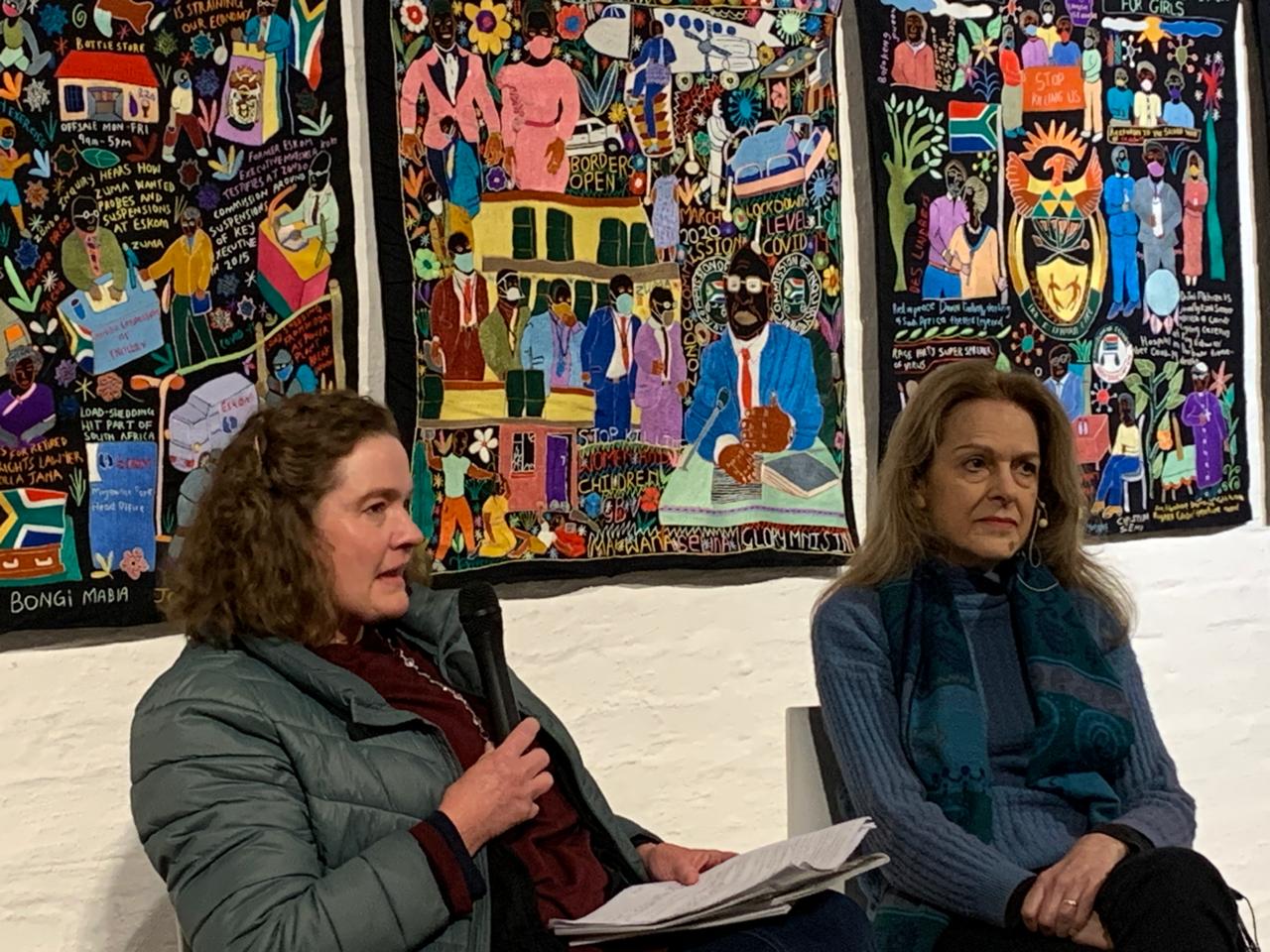
As Professor Brenda Schmahmann — South African art historian and current South African Research Chair in South African Art and Visual Culture (SARChI) at the University of Johannesburg’s Faculty of Art, Design and Architecture (FADA) — was in conversation with Julia, I was again reminded of women and the way they participate in the world where people are negatively impacted simply because of their circumstances, not because of anything they did wrong.
Living in Africa has many advantages, and for me, one of them is the constant reminder of how the real world functions. Privilege is usually something that is bestowed on you at birth and in a sense with the roll of the universal dice, it could just as well have been the other way.
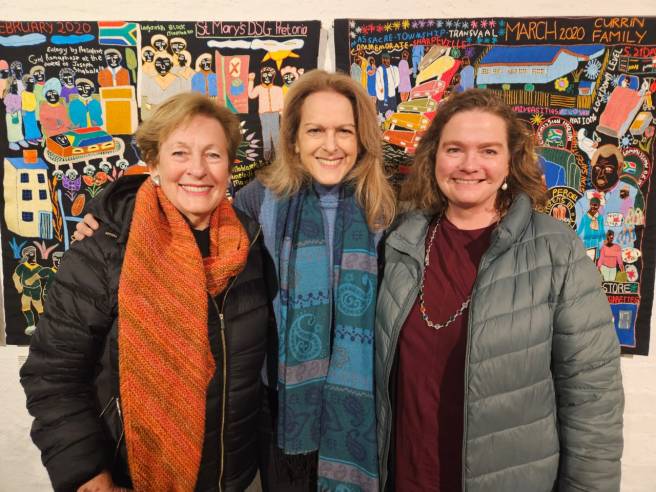
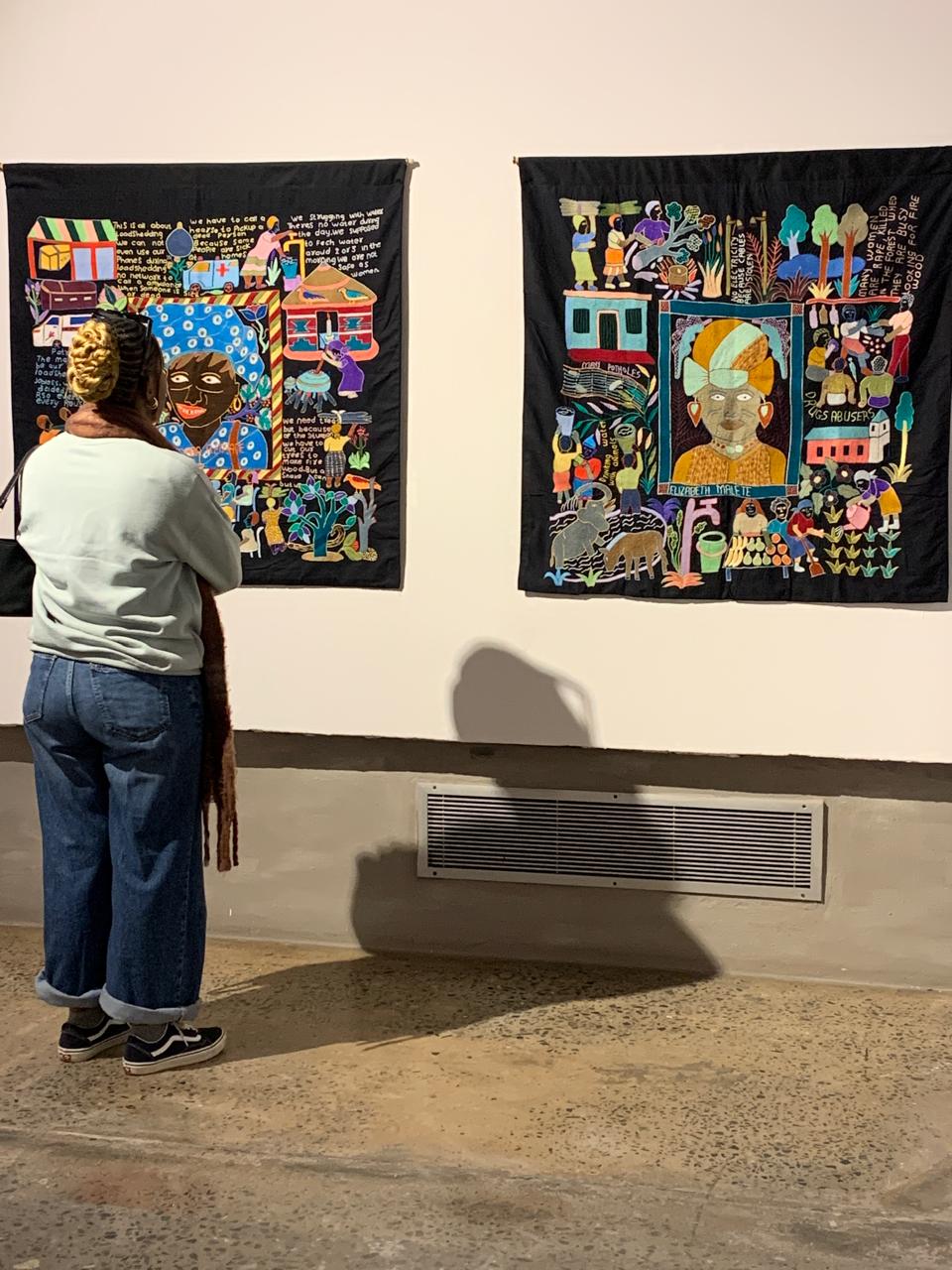
But listening to these women as they share reflections and insights into the embroideries on exhibition, created by members of the Mapula Embroidery Project, a community art collective of women embroiderers based in the Winterveld and Hammanskraal, I again witnessed the part three women played and in the process changing the lives of many families in the Winterveld.
It’s as though the time since Covid passed in a flash, but this year marks five years since the World Health Organisation declared Covid-19 a global pandemic.
We all know how the disease has devastated the whole world. There was the astronomical loss of life, terrible emotional strain, extreme social disruption and economic devastation. We were also reminded of the impact of so many things in personal lives: first year students who in the end never had the opportunity to experience campus life and live lectures; exacerbating the horror of the high number of deaths, no one could attend funerals which had to happen in isolation; and following that time, we’ve simply had to get on with recapturing some of the life we had lost.
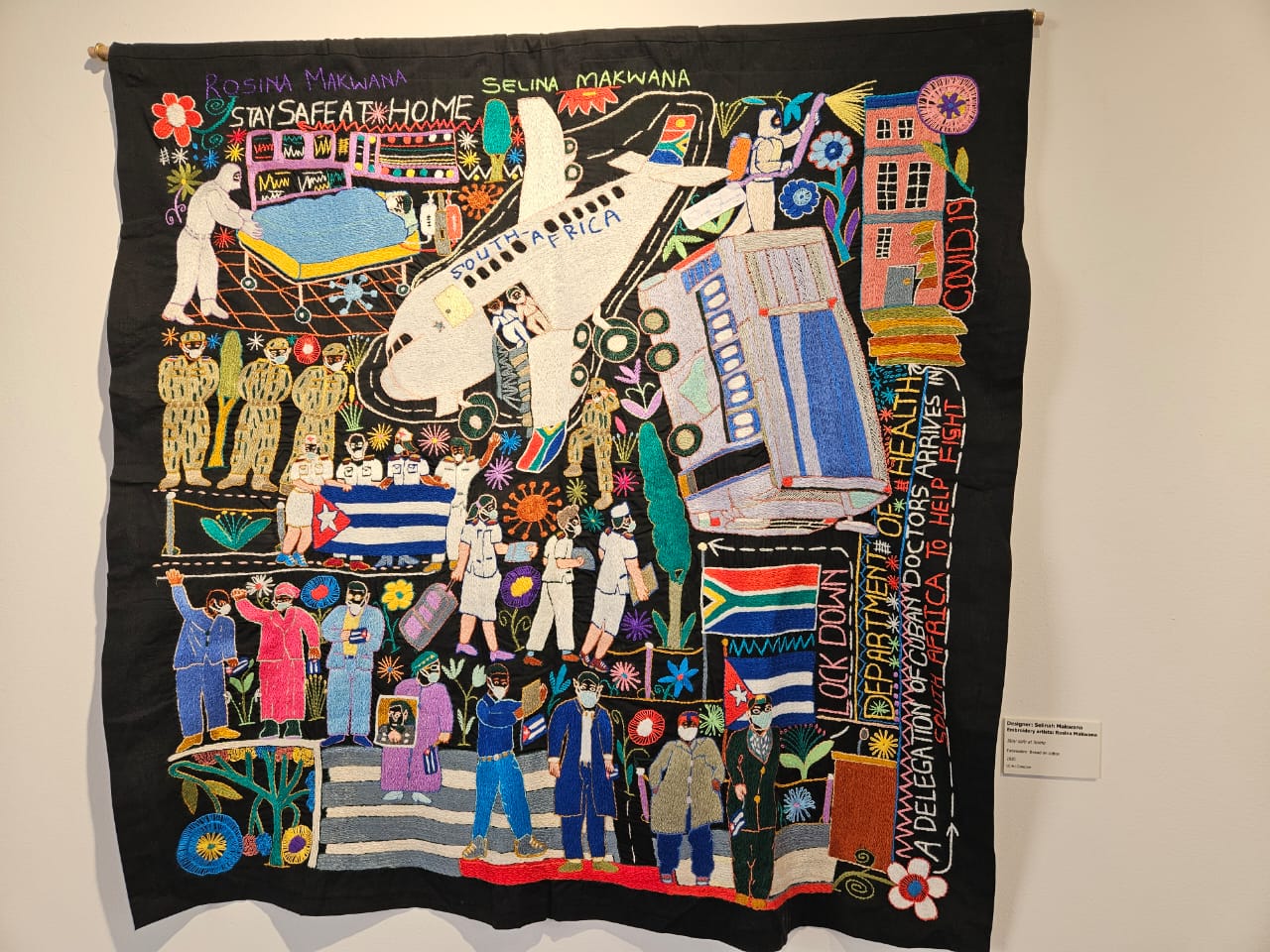
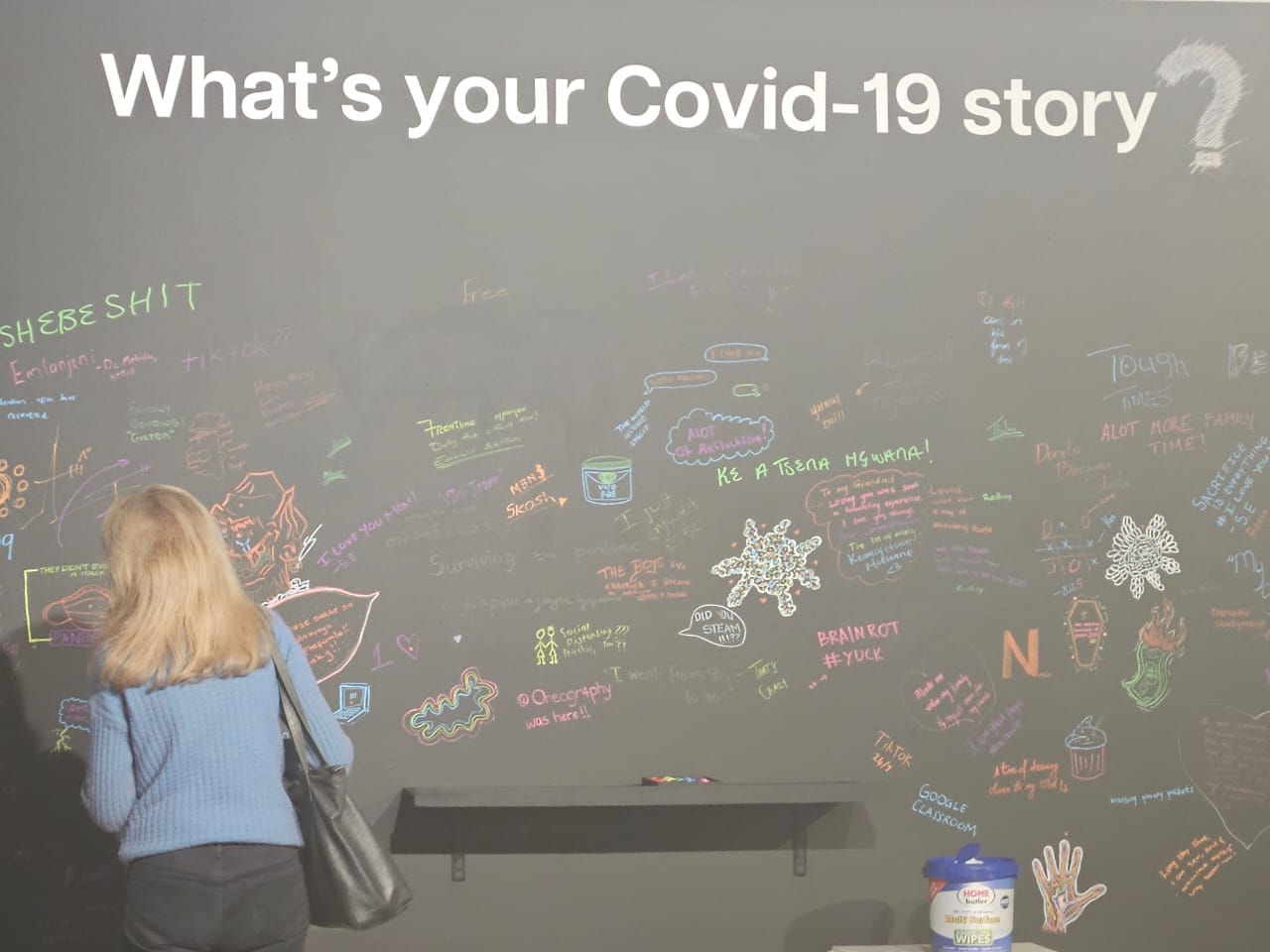
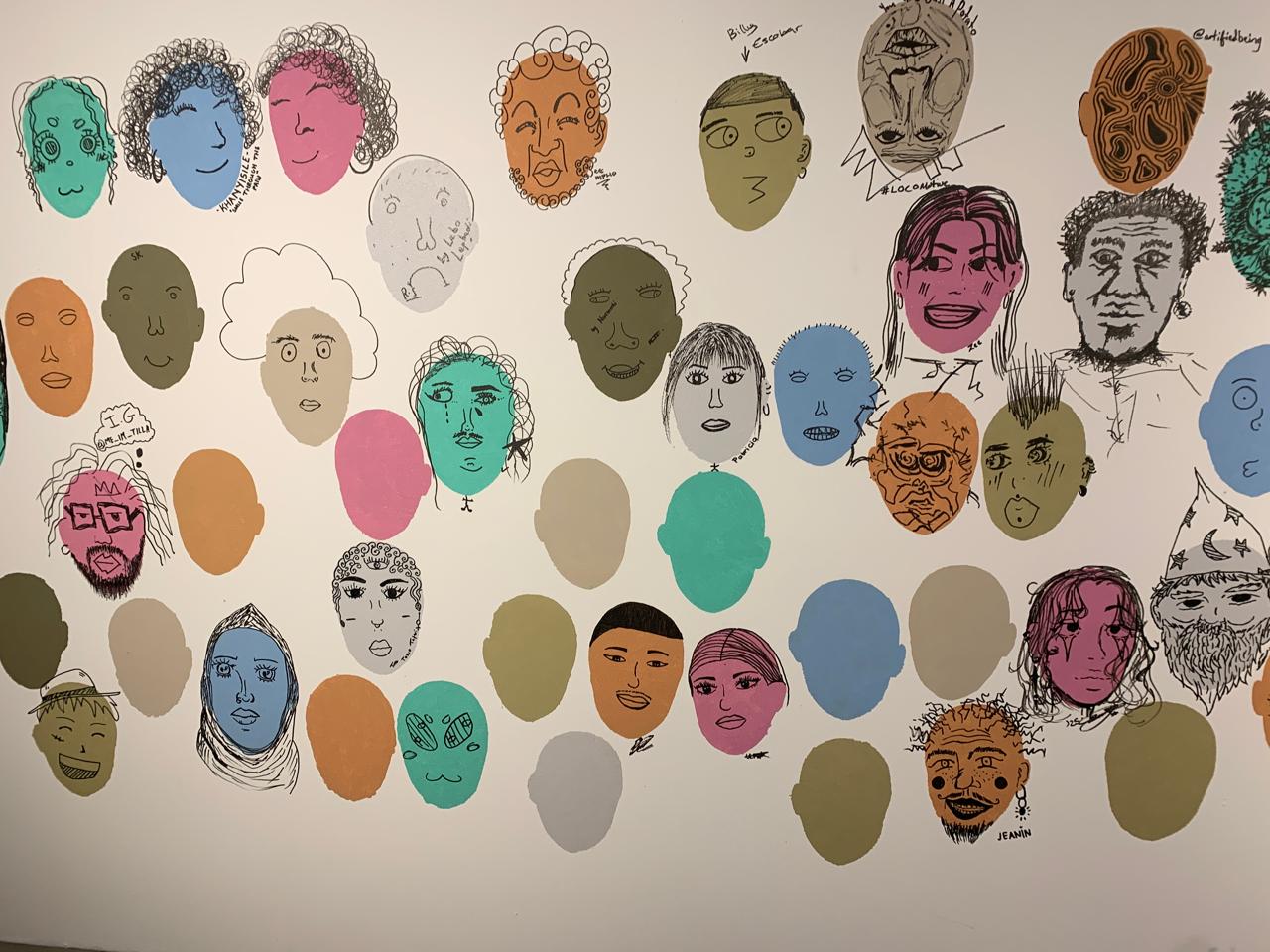
This exhibition on the five year anniversary offers an opportunity to reflect on that time by considering an interactive exhibition of embroidered textiles dealing with Covid-19 and its impact on a community. Without the Mapula project, it would have been an even worse catastrophe for this community and other groups also part of the Mapula family.
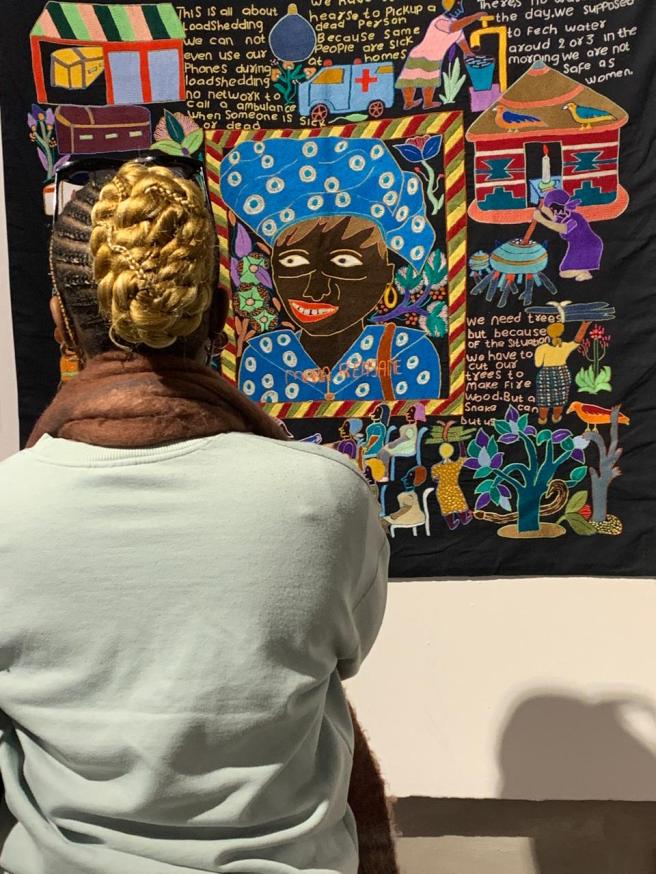
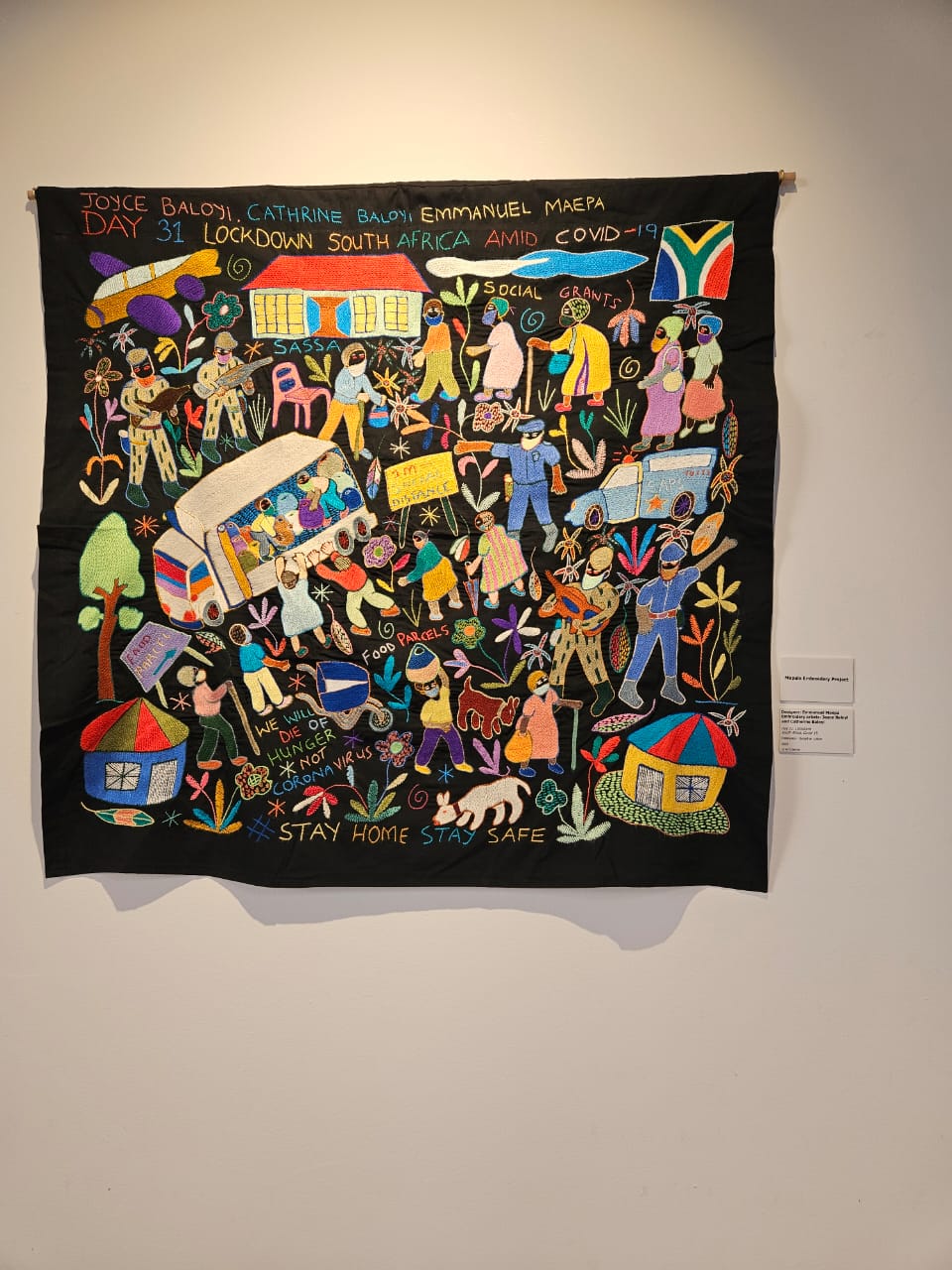
When engaging with the exhibition it is clear that the women use these hangings to depict their own lives. One of the first things you notice in the Covid panels for example, are the people featured all wearing masks, a vivid reminder of a time we had to isolate from others.
The hangings also serve as an historical document of a specific time. Whether it is the floods in Mozambique, the pandemic or even the tsunami in different parts of the world, these events are first captured by different artists in the group and then the individual women get sewing to create these artworks, hence the title Through the eye of the needle.
Other themes that pop up are food parcels during the pandemic, which were made up out of samp, rice and sugar, the absolute basics. Many of the cloths are also inspirational, not depicting what their lives are, but what they would like them to be.
What would we be as human beings without dreaming? “There’s always a focus on positive things,” noted Brenda
Janetje, who is involved with the embroiderers on almost a daily basis, explaining the logistics of keeping this group going. Because distances are sometimes huge due to the past, it takes planning and organizing to purchase the raw materials, get them delivered and establish pathways amongst the women to make it all work and come together.
In today’s hectic lives with family demands another obstacle, many women would have thrown their hands up in the air.
But these three are amazing examples of how women often work tirelessly to improve the lives of people who, but for the grace, might have been any of us.
Go and remind yourself in the coming months. Entrance is free and no booking is required.
It’s an enriching experience which the whole family can witness and enjoy. And along the way, a few lessons are imparted with quite a few fun interactive features, which will get everyone participating.
Museum hours: Tuesday – Saturday 10am to 4pm with the exhibition on until 13 September 2025.Physical address University Corner, Corner Bertha (extension of Jan Smuts Avenue) and Jorissen Streets, Braamfontein, Johannesburg. 011 717 1365 (Week-days) and 011 717 3158 (Weekends) E-mail: info.wam@wits.ac.za
JOSEPH AND THE AMAZING TERCHNICOLOR DREAMCOAT BY TIM RICE AND LLOYD WEBBER
DIRECTOR: Anton Luitingh and Duane Alexander
CHOREOGRAPHER: Duane Alexander and Jared Schaedler
MUSICAL SUPERVISOR: Charl-Johan Lingenfelder
MUSICAL DIRECTOR: Amy Campbell
SET, COSTUMES AND PROP DESIGN: Niall Griffin
LIGHTING DESIGN: Oliver Hauser
SOUND DESIGN: David Classen
PRODUCERS: Pieter Toerien and Lamta
CAST: Lelo Ramasimong (narrator), Dylan Janse van Rensburg (Joseph), Chris Jaftha (Jacob/Potiphar/Pharaoh)
DATES: Until the end of September
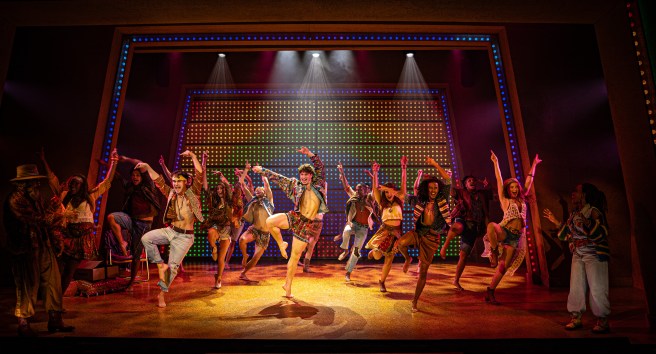
This iconic musical had its first performances 50 years ago and if we take the current revivals, it’s still going strong. And with reason.
It’s always worth watching what Luitingh, Alexander, Lingenfelder, Griffin and Hauser are doing. They know how to breathe new life into what might have become a tired musical without losing its soul.
It’s a young and exciting cast who are being given wonderful opportunities to shine but they have also been gifted the tools to make it work.
From start to finish, the clarity of what they wanted to present and achieve was clear and that’s a joy to behold.
From the clever and uncluttered design which works in these smaller theatres to the choreography which flows and adds to the energy, everything is thought through and then executed to perfection. There’s just no leeway for things to go wrong.
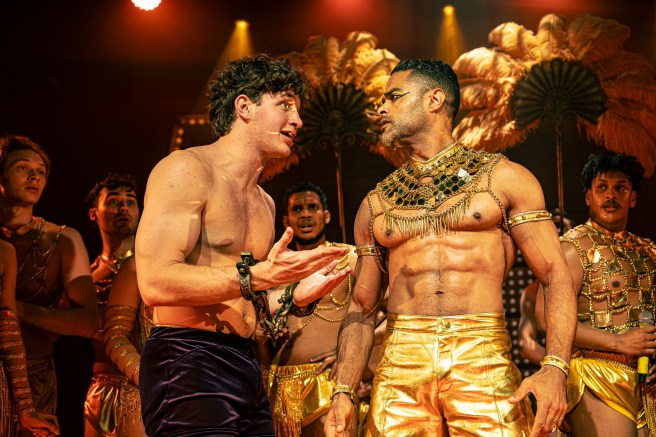
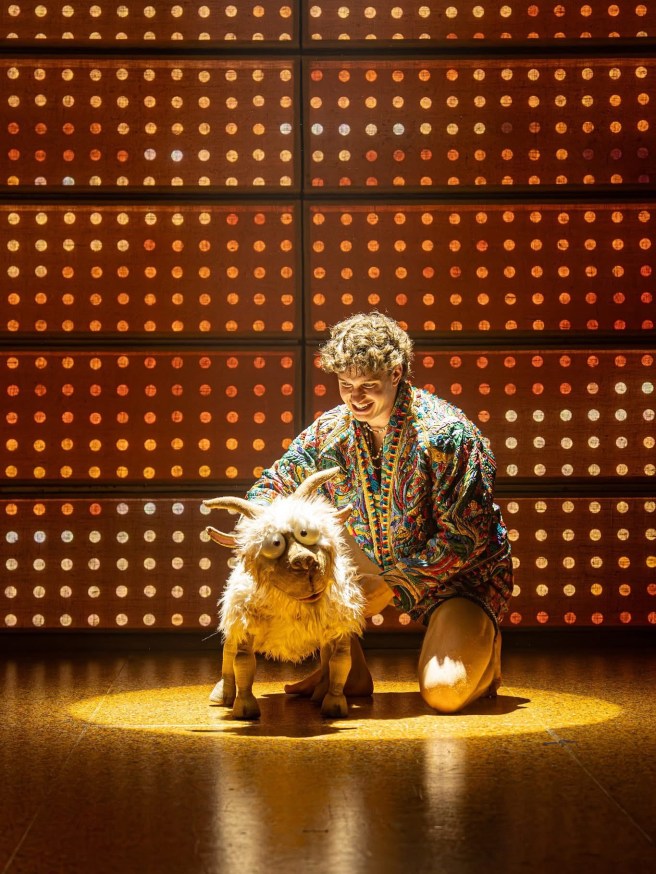
Even when it comes to the look, it’s the way they have selected the costumes. Many were bought rather than freshly designed and, in this instance, a good choice not opting for the traditional dungerees the brothers more typically used to wear.
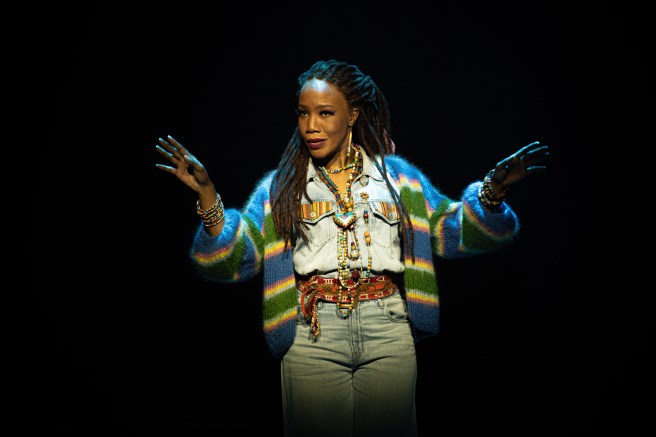
The only one that had me flummoxed was the narrator. Ramasimong’s blue jeans and shirt with the oddest jersey/jacket was an eyesore rather than using some imagination. Perhaps just a simple flowing robe would have had more impact. She plays a major role, is probably the one who has the most stage time and yet, she sticks out for the wrong reasons visually.
Fortunately she’s a marvelous performer and soars in her role as narrator. She has an unusual voice and a lovely stage presence. She knows this is where she belongs.
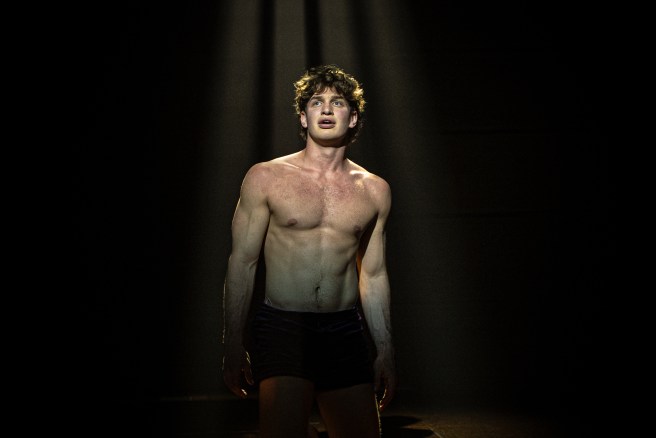
And so do the rest of the cast. One has to start with Janse van Rensburg’s Joseph, after all he is in the title role. It’s quite a responsibility on young shoulders in such an intimate large theatre. There’s nowhere to hide and if you don’t bring the goods as well as the charm, you’re in trouble. Janse Van Rensburg has already proved himself in challenging shows like Spring Awakening and he does it again here. He has a strong voice and a vulnerability that works in this part.
And someone who played his part in stealing some of the limelight is Jaftha, who had fun with his trio of roles as Jacob, Potiphar and in particular Pharaoh, the rocker who has a large moment in the musical which has rocketed other local actors (think Alvin Collison) to fame.
It’s a tricky role, but Jaftha has charisma and sass and was more than willing and able to step into any large shoes.
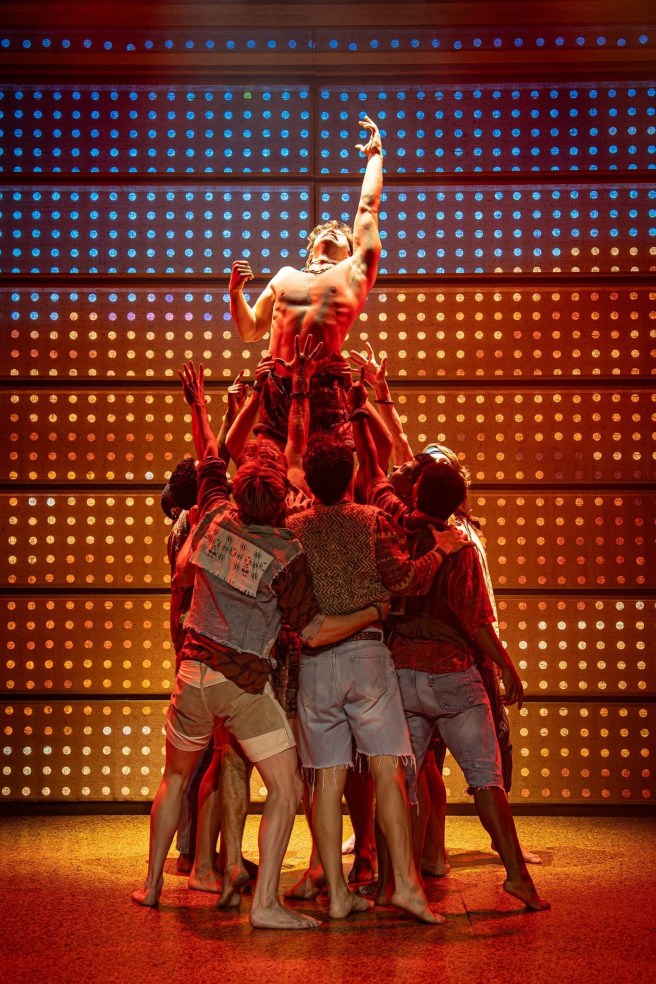
But as much as there are solo moments, it is a musical that involves the full cast because of the nature of the story – a bunch of brothers, for example – and then you have to balance that with the other roles.
If you’ve lived with a musical as long as I have with this one, it’s not easy to catch my attention. But I was stunned. I have seen a few musicals by this production team and I know they usually deliver. From the casting to the costume (bar one!) to the ensemble performances, the singing, the cast in full, it had a joyous feel about it in what can only be described as difficult times.
As well as the music, which was spirited into the new millenium as only Lingenfelder can do. “It was my third production of Joseph and I really didn’t want to do it,” he says. But when he was given the chance to pull the emphasis back to the story and to make sure everything worked for this time, he stepped on board. And it shows, with a score that’s as familiar as it is musically edgy. It’s something he achieves with astonishing regularity.
With the right people, that’s what entertainment can do in times of trouble. It offers respite and has you singing along with a bunch of brothers who hatch a plan to get rid of their father’s favourite son. An unlikely story but many decades ago a clever collaborating team started a much-envied partnership with this one as their first worldwide success.
And if you get it right, it still works. As it does in this latest version.
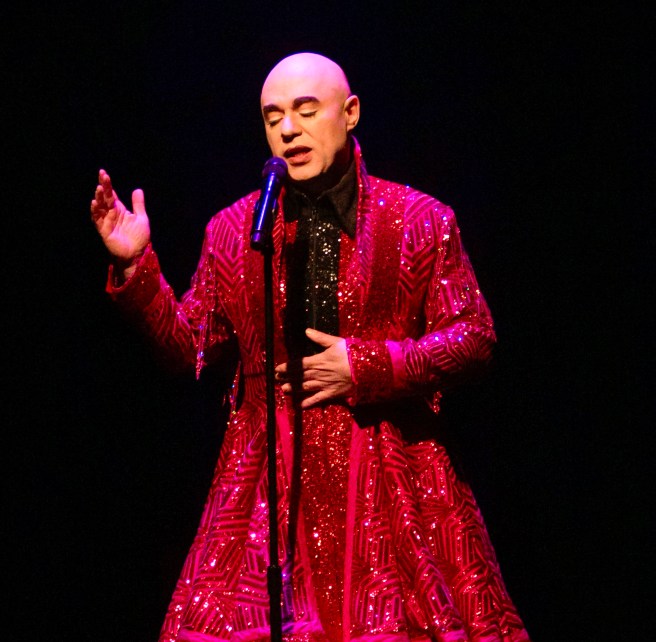
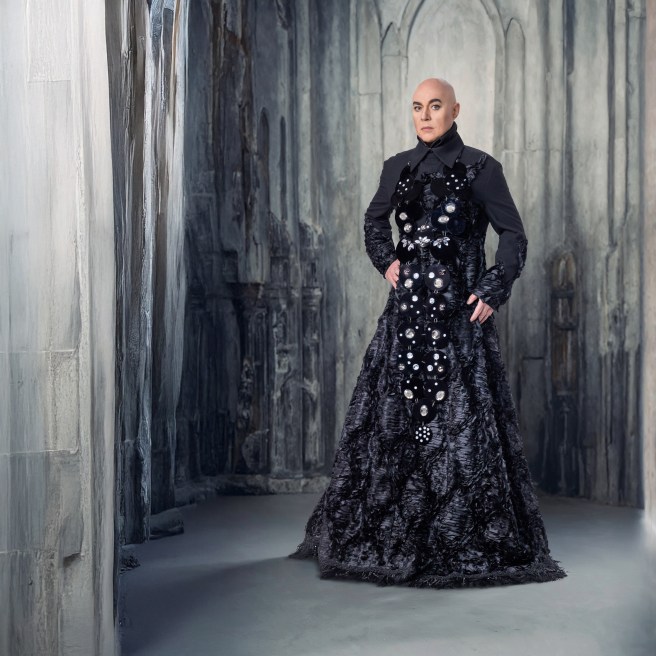
Nataniël is on the go – again – and it was time for DIANE DE BEER to pop in and find out more about upcoming shows, events and anything else happening in this prolific artist’s life:
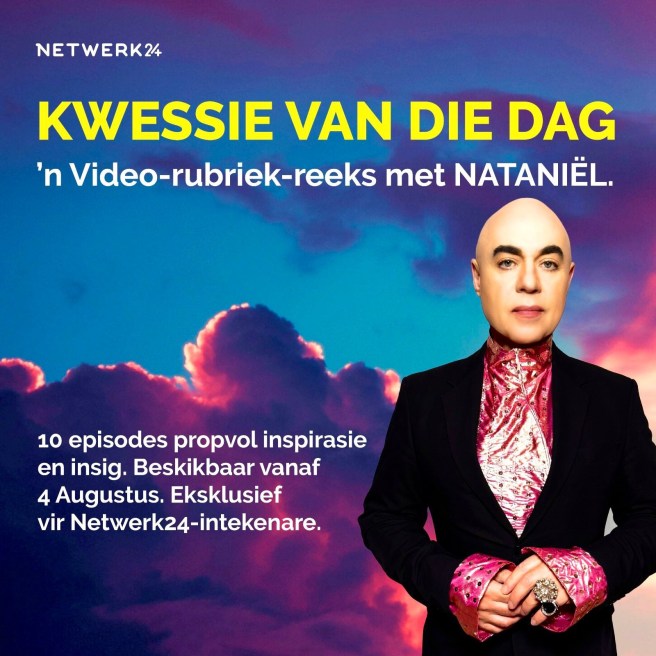
What is keeping him up at night and awake at the crack of dawn is the work on his latest podcast series, which has become yet another of his performance features since his first series a while back. Kwessie van die Dag, his brand-new video column, starts on August 4 on Netwerk24.
As with anything he does, Nataniël approaches these latest podcasts with everything he’s got. “It’s as much work as a TV series,” he notes. And for this perfectionist, it is. He simply cannot do things haphazardly, with quality a constant taskmaster.
He is aware that everybody has turned to podcasts and his will be the best. This isn’t boasting because he is genius when it comes to storytelling. There’s no competing with this conversationalist.
It is all about the words which he has to learn by heart – 3 000 a week! They are his words, he has written each one, but then he has to get them tripping off the tongue. While it comes easily, he believes in scripts and knows exactly what he has to do and how he wants it to sound. So while there are many copycats, few can master him at his craft.
I often see pieces written by “Nataniël”, but it’s easy to spot when someone tries to capture his style because it is so unique. And this is where his podcast will pass with flying colours. “I don’t like waffling,” he says as he launches an attack on what he has labelled “electronic pollution”!
“There’s enough rubbish around.” He has an opinion which his followers will be familiar with, but he also loves facts when he is dealing in a specific subject. One of the many hurdles is the battle of language. He will be speaking in Afrikaans and to capture a language in this way is fraught with many pitfalls especially the way we mix our languages in our daily conversations.
It is clear that this is his latest challenge but also part of the excitement that charges his existence.
He is always busy creating and many of the things might seem as though they have a familiar pattern which, if you study them, they don’t. Into that mix, he is also constantly injecting new accomplishments which keep him on his toes.
“Everyone invites me to be a guest on their podcasts.” But for him there is a specific reason to engage with people in this fashion. “I want to address issues and for me it is about inspiration.”
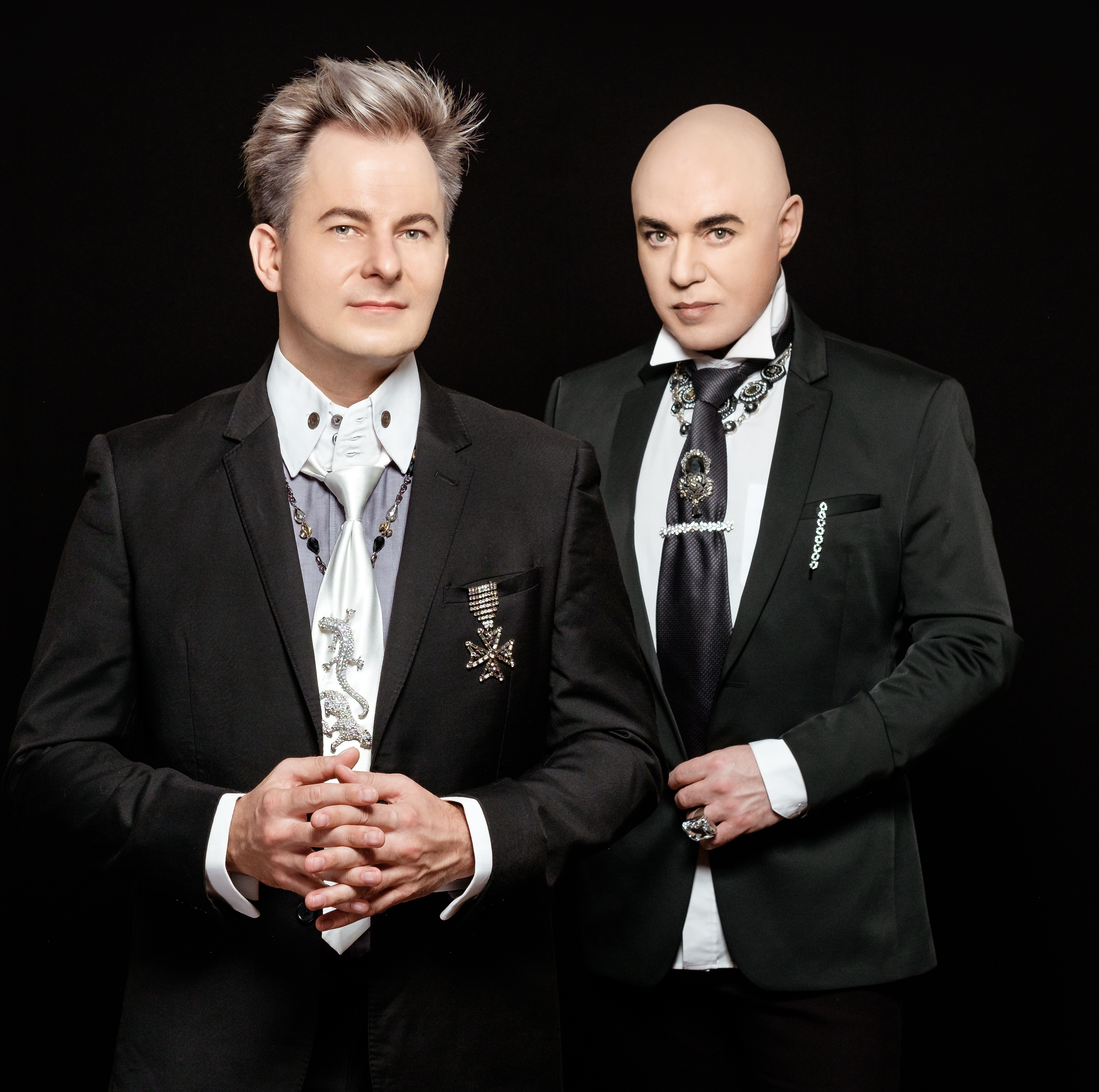
BOEK • BYBEL • BIOSKOOP is the title of the show he is doing with organist Zorada Termmingh, a friend from varsity, together with his accompanist, pianist Charl du Plessis. Knowing something about his creative mind, he will be pulling all their respective talents together in a spectacular bouquet.
We’re in August and it is all about women. Composers, writers, singers, designers, as well as timeless characters from movies, classic literature, Biblical tales, art and theatre are their inspiration in this colourful show full of stories and songs. Zorada and Nataniël have performed on stage many times, starting during their student years. Charl has been his accompanist (apart from establishing his own career as a solo artist and performing with the Charl du Plessis Trio) for the past 25 years. And this is not the first outing for this trio of consummate performers.
It is a one-off in the capital city on August 13 at 7pm and the Ned Geref Universiteitsoord Kerk. The show is 90 minutes (more or less) long.
In September he returns to one of his most ambitious projects, Mass for the Good Princes (recently released on CD), which will be performed in the Cape for the first time thanks to the goodwill of the Atterbury Trust.
It’s a double whammy for Nataniël – one of both joy and hysteria. This was one of those accomplishments he had dreamt of for a very long time. Writing it was an almost impossible feat with his kind of schedule, and with each performance he has to once again memorise the Latin text, which is a killer.
This will be the 3rd time that he attempts this daunting exercise and while it stretches even his seemingly limitless determination, he can’t resist it. It is based on the classical structure of a Latin church mass with a sacred composition by Nataniël in six parts which includes a prayer for goodness, new leadership and the hope of a new generation. It will be sung in English and Latin with descriptions and translations in Afrikaans.
It will be presented at the Ned Geref Welgemoed Church on Saturday September 20 at 5pm. He will be joined by the Charl du Plessis Trio (Charl with Werner Spies and Peter Auret) as well as organist Ockie Vermeulen, guitarist Luke van der Merwe and the Akustika Chamber Choir led by Christo Burger.
In March this year, Nataniël and Charl celebrated 25 years on stage together and they seal this with a Gala Concert at Aardklop – on October 7 (7pm) and October 8 (10 am) in the University of Potchefstroom Auditorium.
This won’t be an ordinary concert. These two artists haven’t only shared 25 years on stage and many kilometres of travel through the South African countryside for one-off shows, but this was also the start of Charl’s stage career, which has been quite stunning to witness from the start – one he has since established both nationally and internationally – a feat for someone who started out as a classical pianist (one of the most difficult careers to pursue) and accompanist. Today he has a doctorate and is celebrated as both a classical and jazz artist. I can’t wait to see these two face off on stage on equal footing. For those fortunate enough to see one of these concerts, I predict something unique.
Nataniël is already making promises that this won’t be a rundown of what they have already accomplished. They will be celebrating today and tomorrow. “Who are we now and how do we see the future” will be their aim.
“Why would we return to the past? That’s done and we have all been there.” And in typical Nataniël fashion he predicts: “I want to hear an intake of breath when I walk on stage!”
As he so astutely confirms, it will be 70 years of experience when the two of them mark their stage partnership.
While talking partnerships and friendships, one of his closest friends, actress/comedian Marion Holm, will be interviewing Nataniël on his latest book of short stories titled Sweetie. Book discussions aren’t his favourite, but if he has to do it, Marion would be his choice. “She can physically shut me up just by barking.” You’ll have to be there to understand exactly what that means. They go way back and to experience these two like-minded actors sparring verbally, you don’t want to miss that. They’re a scream individually, together it’s an exuberance.
Your ticket will be a copy of Sweetie which can either be bought before the time or at the Exclusive Pop-Up in the book tent. The first 200 people with a book in hand will be allowed into the space, which will be closed off for this event. You won’t be able to listen in on the sidelines. The Sweetie discussion is going to be that exclusive and is happening on October 8 at 3pm at Aardklop.
And it’s not over yet by a long stretch. A photographer who for more than two decades documented Nataniël’s career, Clinton Lubbe, who immigrated a few years back, is back in town for an exhibition of life-size Nataniël pictures titled Parade, another first for Aardklop. Their collaboration has also been running for more than two decades and Nataniël describes Clinton’s camera as a paintbrush, because of the way he creates pictures. They’re not simply pictures, they’re artworks, he notes. “I’m going to be the Naomi Campbell of Aardklop,” he says with a smile and a wink.
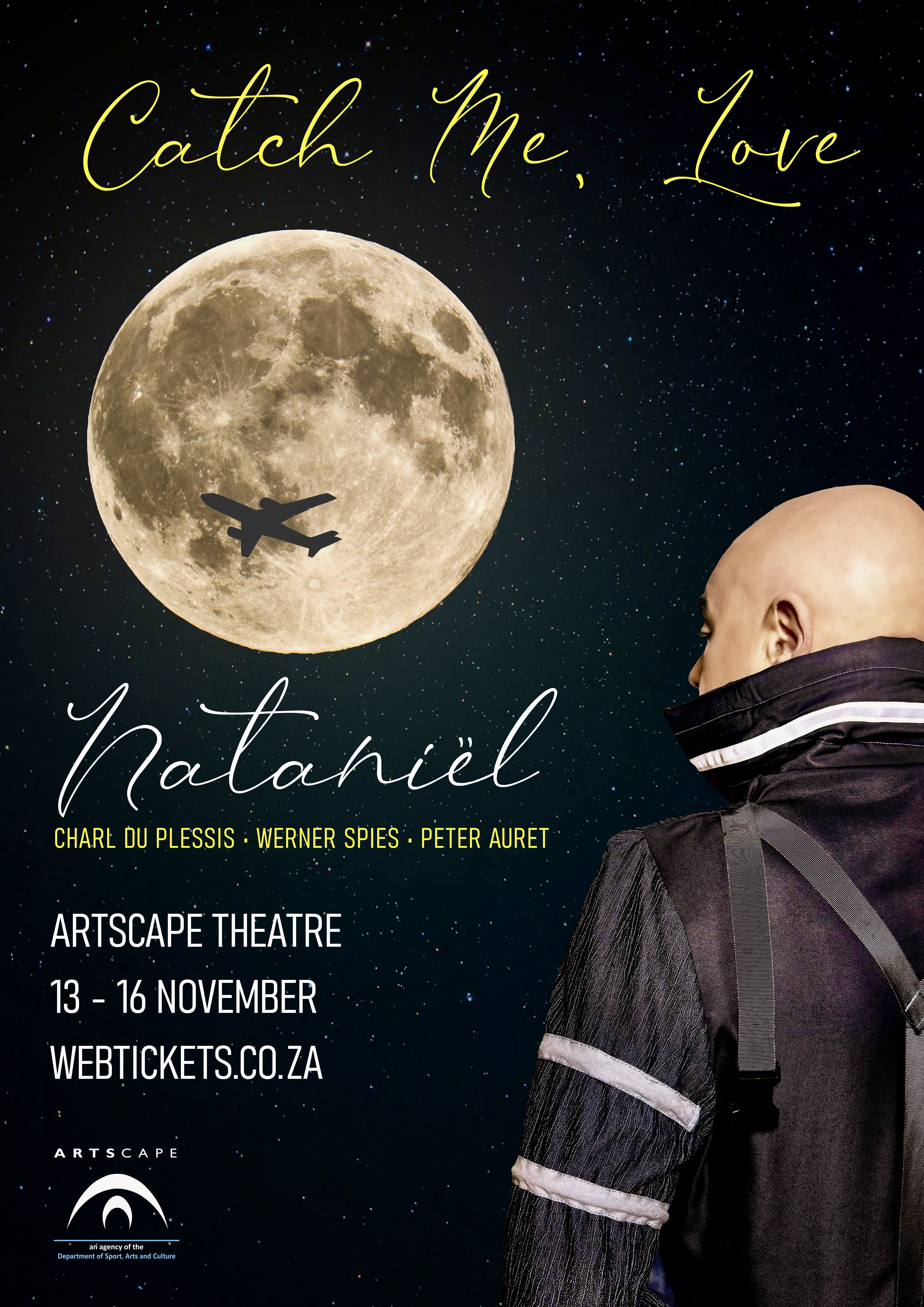
Finally, but just for the moment, there’s his latest production, Catch Me, Love, which will be staged at Artscape from November 13 to 16. He is already busy writing, which is unheard of. He usually works on his scripts much closer to his performance than a few months, but looking at his schedule, he knew he had to get ahead.
This one is going to be visually and structurally different to his former shows, he says. And although it is still early days, I know he has already dreamt and planned it in detail. It will only feature in Gauteng in the New Year because in-between there’s the promise of a French countryside holiday, his annual escape (when he can manage) to one of his favourite places, which is what motivates him these days.
Watch this space for fresh announcements or changes. They will be coming …
“What we love about music is not that it sounds good. What we love about music is that it sounds inevitable. It’s playing the thing that we all know is unfolding. Whether we want to accept it or not …”
Jon Batiste (American Symphony)
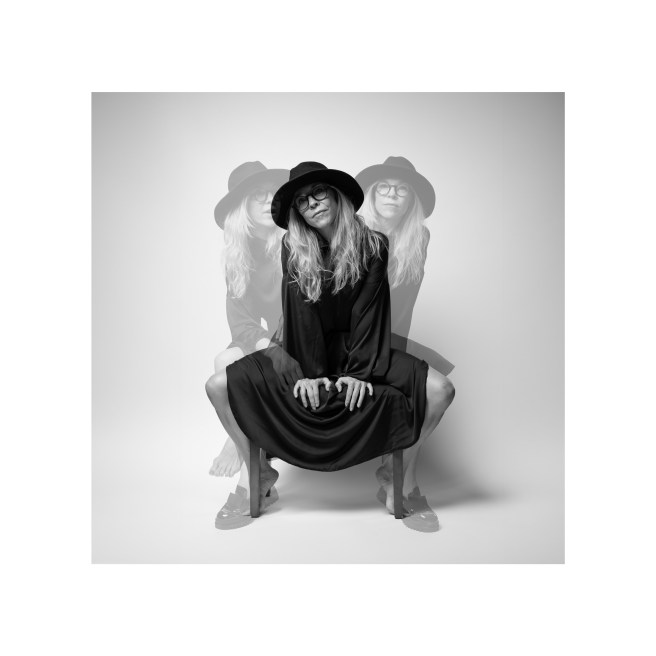
This is the quote artist Frieda van den Heever sent me when we started a conversation on email.
I became aware of her as a producer. She was mostly involved with poetry-driven productions, but what I noticed was the sensibility of what is a very tough stage production.
How do you get people to attend poetry productions at a festival where there is so much on the go? But she did and she knew how.
She describes herself as a novice who preaches, because she studied drama not theology. She explains that in Springbok, where she grew up, they called it people’s church when a normal person preached because the preacher couldn’t be there.
“I have been doing it for almost 14 years, and no one has ever asked for my credentials,” she says. Having encountered her on stage, I understand why.
She is part of InVia congregation in Cape Town and describes this community as a group of people who love music and people. Her father was a minister and while she spent most of her free hours as a child in his study rather than on her own, she never thought that she would either enter the church or become a musician like her mother. “I had spent enough time in churches with music in my ears for a lifetime,” was what she thought.
Still, when she read something impactful she always caught herself speaking rather than just reading that passage. She simply couldn’t escape and then there was a time when she didn’t want to any longer. It has always been a juggling game, because it wasn’t something she could practise fulltime. But she missed theatre.
She believes in the power of stories, fables, poetry and metaphors. “Both theology and theatre navigate a place beyond knowledge, something like mysticism, and tell stories that often hold warm truths rather than cold facts,” she explains.
The part of her work that she favours most is what she describes as “accompanying rituals”, including marriages, funerals, christenings and the like. She regards it as her calling to add to the honouring of these events. It’s not that she participates only in religious ceremonies; she is often involved when people aren’t particularly interested in a church but still have a need for some kind of ritual which they share with their loved ones.
She also presents talks and retreats for congregations or groups of people who approach her. These are creative workshops specifically for women, but she stresses, “it has nothing to do with pancakes, crochet and tea parties.”
She knows these certainly have a place, but for her it is about togetherness, breathing, chanting, laughing and crying.
That’s just the beginning of all her activities. She is also involved in yoga and the transformation that ensues and has a deep fascination with people and how they struggle and survive. And while she would have loved to study psychology, a lack of time made her opt for an intensive 14-month course in integral coaching which will be incorporated in her other work.
And still, she keeps going. Once a week, she travels to Stellenbosch, her alma mater, and teaches cabaret facilitating the practical execution and texts of the honours students in the US Drama Department . As a student of the legendary Marthinus Basson, she is delighted that she can pass on her experience to a younger generation.
There’s also her radio work which started on small scale, but her talents were quickly recognized. And she still benefits from her innovative moves during Covid which resulted in her producing programmes in the basement of her home.
That led to her producing most of her radio and television work in her home. It means that she doesn’t have to spend too much time away from her children and allows her to do much of that work early in the morning. “It all happens before the children and the cars have to wake,” she says.
I’m breathless and haven’t yet come to her performance, which is really what I want to promote.
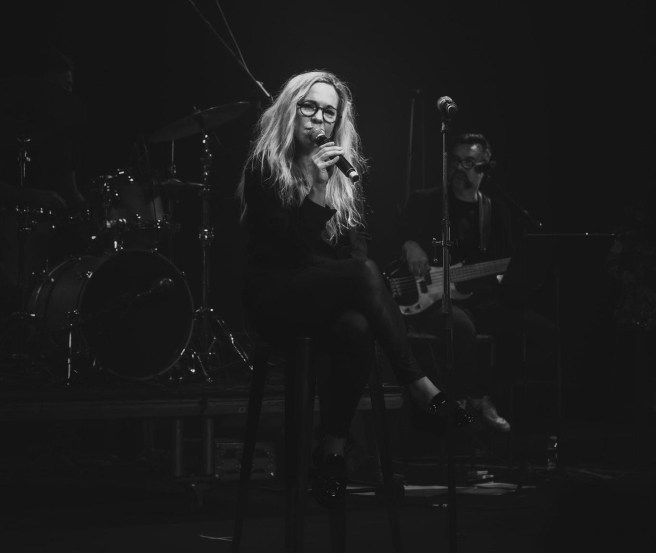
On Wednesday at 7pm, Frieda will be performing at the Fairtree Atterbury Theatre in Lynnwood, Pretoria for the first time in a magnificent production, Spoorsny (tracking) .
“I really went into grief. I sensed that I had to go in if I wanted to come out. I don’t mean that I’m perfect now, but I’ve been through the perfect storm and that moulds one to find more light because I was mining the darkness. I can sense, I almost want to say I can smell light and when I sense it I look for it everywhere. The material for my debut album came from a show I did on what would have been the night of Leon’s (Kruger) 50th birthday. (He had died very suddenly in 2021) I saw the Woordfees was during that time and I didn’t know on which date I was going to perform and then when they sent me the date, I went for it to really celebrate him with this work and this script. I could have gone to sit somewhere in the quiet and the dark which isn’t wrong, I have done it. But for that night I wanted to share what was left of me, so that it could multiply and I’m grateful for that.”
Her previous productions as director, Die Poet – Wie’s Hy?, Die Oerkluts Kwyt and Met Woorde Soos Kerse all shared a particular sensibility that made me aware of a rare director at work. She knows she didn’t have the technical experience, but her affinity with poetry and performance outweighed anything else. I didn’t notice any imperfections with any of those mind-blowing shows.
She works with love, a fine-tuned ear and excellent evalution. Also, part of the package was a childlike “unknowing”, an unwavering belief in the collective intelligence and the process, endless curiosity as well as an excellent production team and artists. Her motto was to always be present in the process. Whatever the requirements, it worked.
If you’re crying halt, there’s more. For 10 years she has been involved in a process with farm workers who boast magnificent voices. Each year she selects 10 of the best and offers them the opportunity to learn and to show off their talent. “I try to bring each individual something, give some of my experience, but I can’t teach them anything about singing. I have worked with voices that compare with the best in the world and it is a burning passion to create more platforms to showcase these voices.”
Her own musical talent, writing and composing songs and performing, has never been the only thing she wants to rely on to make a living. She wanted to be a free spirit when going on stage.
She is much more of a homebody than someone who wants to be out there but she also has a need to be challenged by the alchemy of a live performance. She obviously has a blueprint when she goes on stage, but she also reads the room and has the talent to shape her performance in different ways.
If she had a choice, she would write songs, play music, dance and jam with other voices and instruments all day long. “That feels like the best and most unvarnished version of myself,” she concedes.
To my mind, that is exactly who we watch and listen to during a performance of Spoorsny.
But let me give wordsmith Frieda van den Heever the last word: “The sudden death of my husband in 2021 and the impact of mortality and loss give perspective to everything I do and am. I am much more than a widow and single mom, but it gives context to my decisions and relationships, the spaces I find myself in and how I engage with people. The raw material which emerged in my debut album Skoonveld and formed the platform for the stage show Spoorsny as well as the anthology (published by NB) ‘n Asem Lank says everything about my search for meaning and light.”
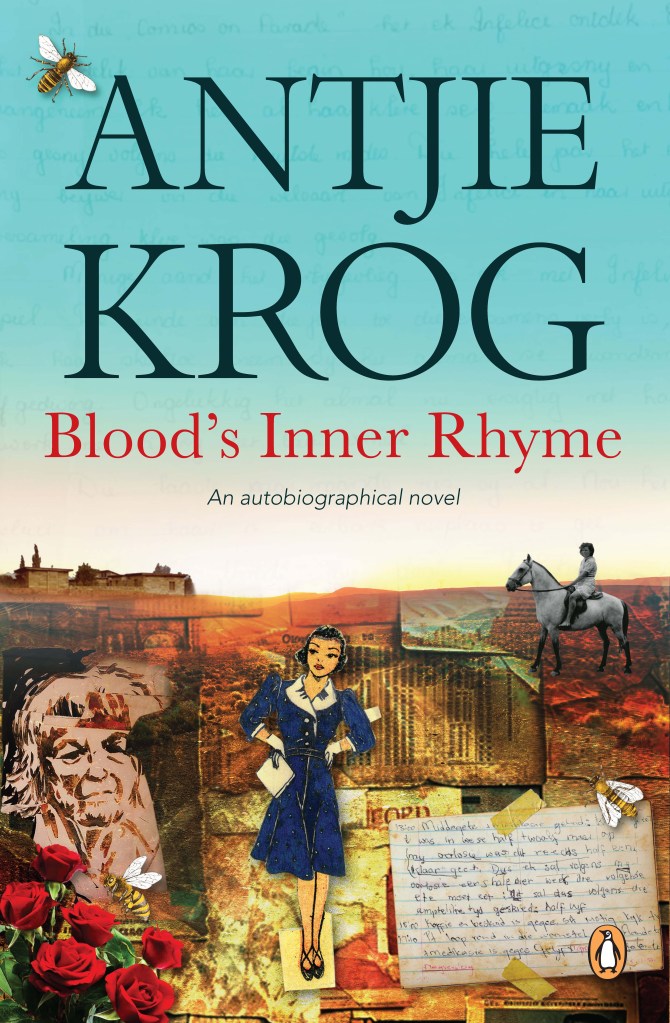
When you have one writer in the family, I would imagine you feel blessed. Two? Perhaps not so much but someone who makes a meal of this is ANTJIE KROG who in her latest memoir writes about the relationship between her and her mother, the author Dot Serfontein. DIANE DE BEER started out reading the English version, followed that with the one in Krog’s home language and then listened to her talk about the book:
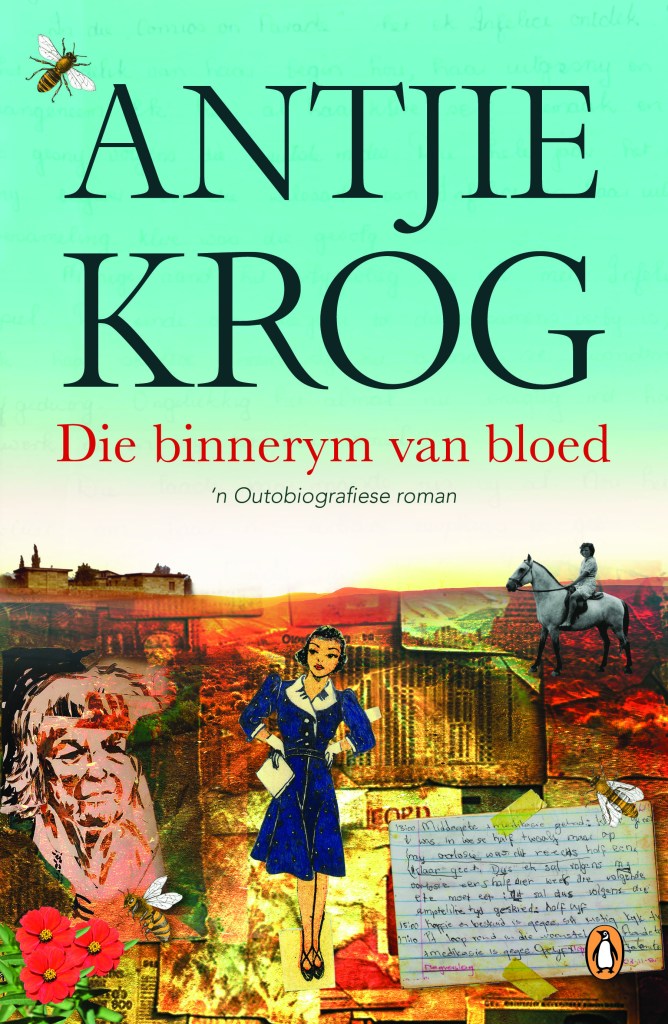
It’s a personal thing, I know, but if I can read a writer in her home language, I do. And again I was proved right with Antjie Krog’s latest offerings, Blood’s Inner Rhyme or the Afrikaans version Binnerym van die Bloed, which she describes as an autobiographical novel.
Because I write in English, I thought it might be easier to read that version, but after hearing her speak, I knew I had to get my hands on the Afrikaans book. It’s the way she Krog uses the Afrikaans language which enriches the reading.
If I didn’t have the option, I would have given the English a similar review, it’s simply that the Afrikaans introduces a different heartbeat.
Even in the best pairings, mothers and daughters have complicated relationships. When you are competing with one another even if that’s not the intention, which I’m sure it wasn’t, it’s going to be tough. Add to that two headstrong women who arguably stand on opposite sides of the political spectrum, expect fireworks – and that’s what you get.
Women all have mothers, that’s obvious, and some have their own daughters. All of us know the intricacies of that relationship – and that is when it isn’t public. Writing for an English newspaper, I wasn’t part of the Afrikaans writers’ circles and even I, not your natural gossip girl, heard rumours. And that’s where I admire Krog for doing this extraordinary book.
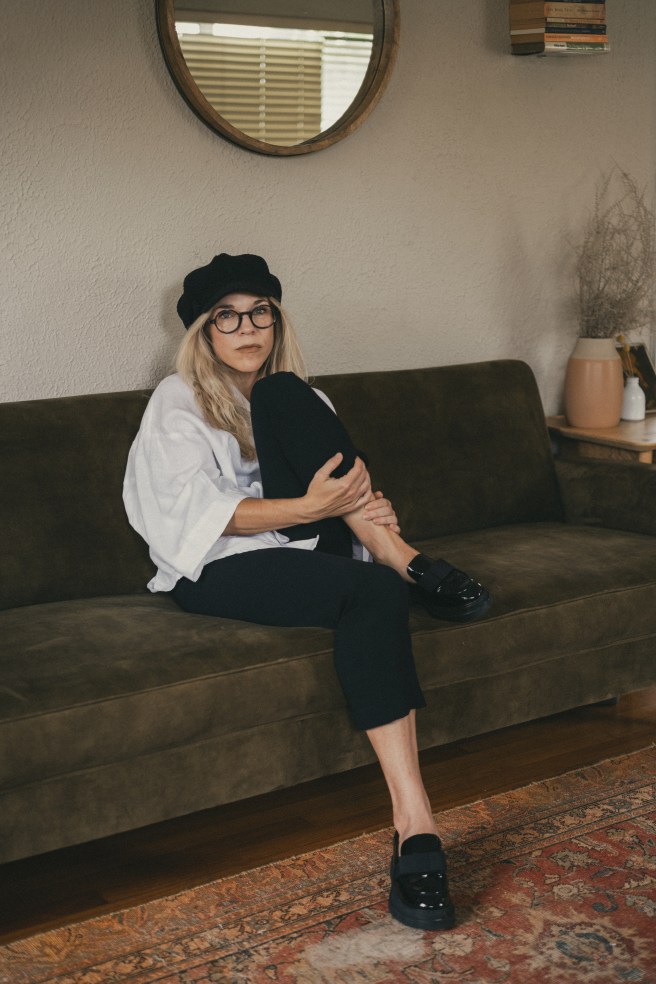
Antjie Krog, author extraordinaire.
Both of these women are celebrated writers who lived their lives in the spotlight. To then delve even more publicly into that life must have been an excruciating decision. And then to travel the country as one does to promote the book – what extraordinary courage. It reminds me that artists sometimes don’t have a choice, it has to come out. And usually it is the reader who benefits.
Thanks goodness Krog decided to write about this often fraught, sometimes fragile but also intense relationship. I can only guess that while sometimes devastating it must also have been therapeutic and the way to mourn and celebrate what she once had. Death has a way of shining a new light on something that was just too overwhelming to observe as it was happening.
For those of us ageing ourselves who have also shared a close relationship with a mother in her last years, it is especially meaningful. My eldest sister booked my parents into a retirement home which was on the way home from my work and I could pop in as often as possible without any inconvenience. I coped with the sometimes-daily trauma of witnessing this ageing process by communicating with a third sister who could only get the news via whatsapp or email. It was a lifesaver.
I could appreciate the daily diary of Krog’s mother’s most basic needs. That is in fact what happens when people age as we are forced to focus on the brutal minutiae of their lives. For example:
Night report:
20.00 Medication. Pt (patient) didn’t want to drink half a sleeping pill. Wanted a whole one
22.45 PT said her toes hurt. Applied Turlington + gave another half sleeping pill
00.30 Pt wanted another half sleeping pill. She was uncomfortable. She wanted to get up, I had to hold her by the sides. Pt wanted to make food. Pt was angry that the freezer had no meat.
These diaries were kept day and night – every day and night. It constantly reminds one of the process that is unfolding. As Krog tells it, focussing on her mother’s “excrement which happens daily is to own that which is being rejected, that which is such a part of her waning existence, her body’s extremities.” Krog who tells things exactly how they are explains: “There’s actually a very profound thing about shit,” she says as she captures the importance of change as life starts running out.
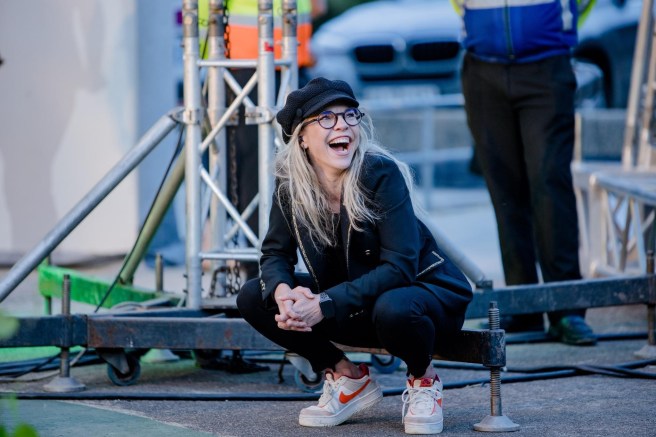
In full flow.
Yet there’s so much more happening around the family. It is an especially fraught time for farmers and for Dot Serfontein the family farm represents who she is. It was her inheritance. For Krog, even though she has similar bonds to the farm, she also knows and is burdened by the privilege it represents – something in this country that was often at the cost of someone else.
It is fascinating to read and witness the lives of different generations, especially in that time when everyone in the country knew things were going to change dramatically. She acknowledges that the relationship between mother and daughter is complex. In this family and between this mother and daughter perhaps even more than most.
While Krog is at pains to write about this sometimes combative relationship, it is also a celebration of Dot Serfontein, who she was and what she achieved with her writing. This is where and how Krog first discovered her words and both she and her readers have benefited.
There are so many stories captured in what can be described as a memoir. Having lived through the ageing process of my parents, that is what drew me to the writing. One learns so much about your own mortality, growing old gracefully and celebrating life whatever your age.
And thus her mother concludes only a couple of chapters into the book: “I keep all your letters,” she writes to her daughter. “One day you can compile us in a plundered book like Audrey Blignault’s daughter. Initially I wondered whether the sudden revival of my oevre was thanks to you, but when I saw so many Dot Serfonteinisims in your work and some of our private family phantom(b)s, I thought we constitute each other.”
Having lived in each other’s shadow most of their lives, it couldn’t be any other way. That is what this astonishing writer captures so magnificently. Yes it is about a mother and daughter, but there is so much more. It’s insightful, entertaining, both sad and extremely funny, and even historical in many instances. But what captured my heart was Krog’s writing. She has a way with words that is unequaled.
DIANE DE BEER reviews the latest Mike van Graan play
THE GOOD WHITE
DIRECTOR: Greg Homann
PLAYWRIGHT: Mike van Graan
CAST: Shonsani Masutha, Russel Savadier, Vusi Kunene and Renate Stuurman
SET DESIGNER: Patrick Curtis
LX DESIGNER: Themba Stewart
COSTUMES: Nadia Kruger
VENUE: Market Theatre
RUNNING TIME: Until June 1
Pictures: Ngoma Ka Mphahlele
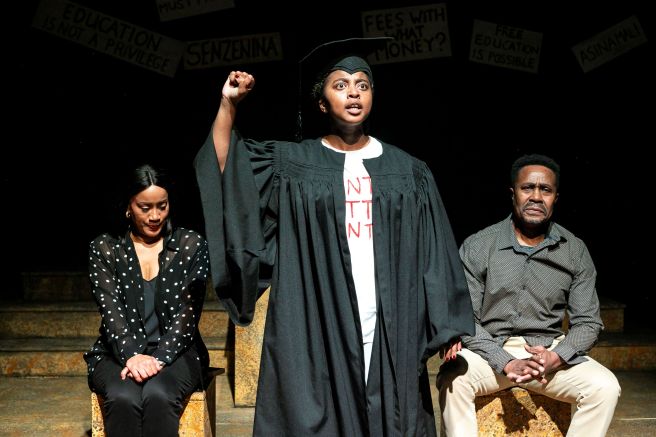
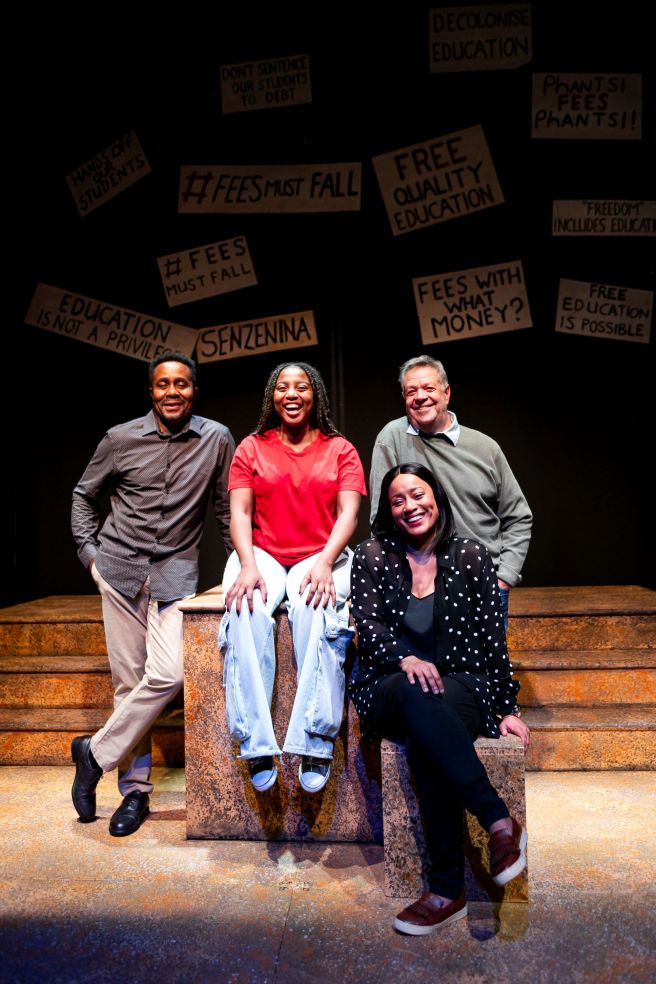
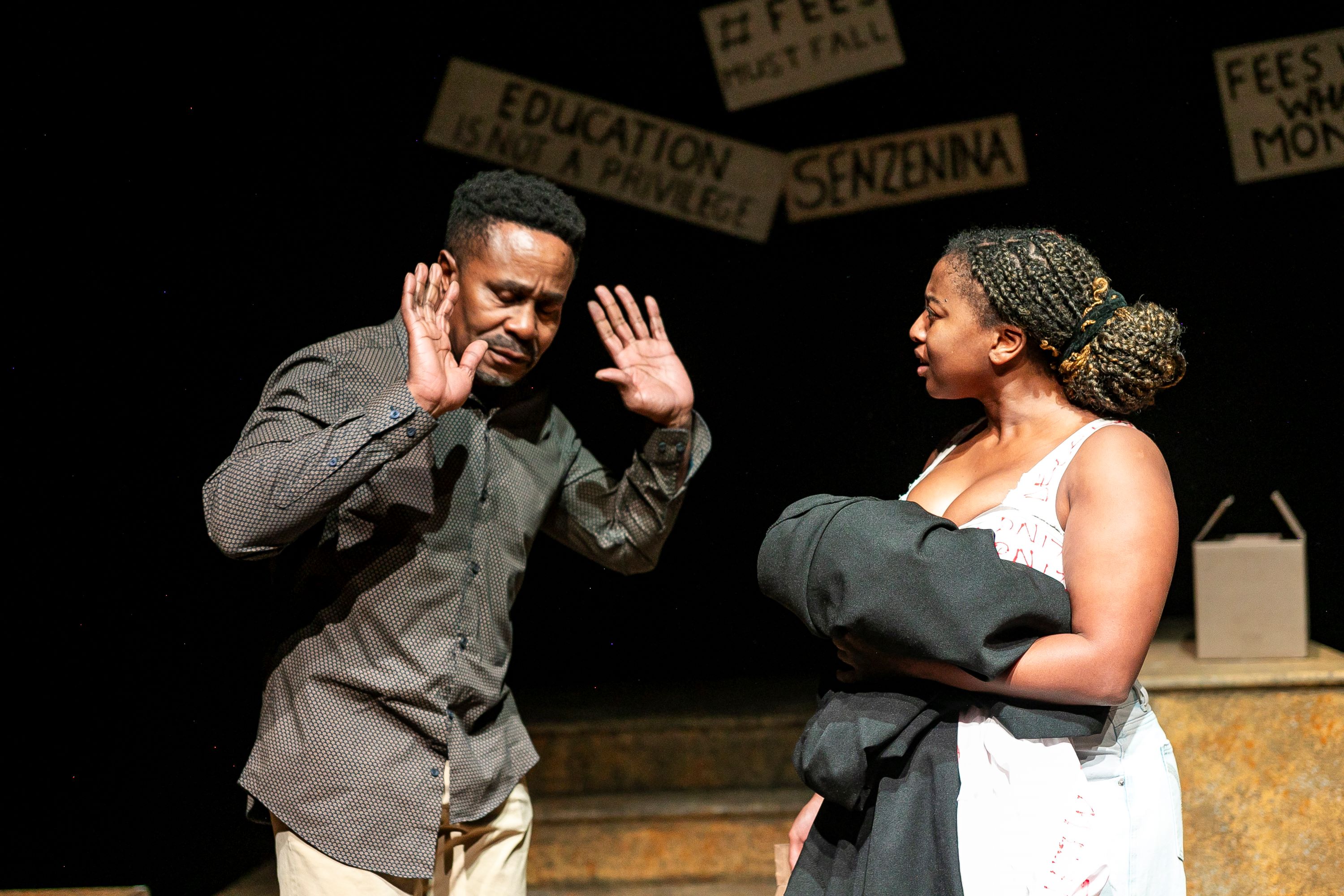
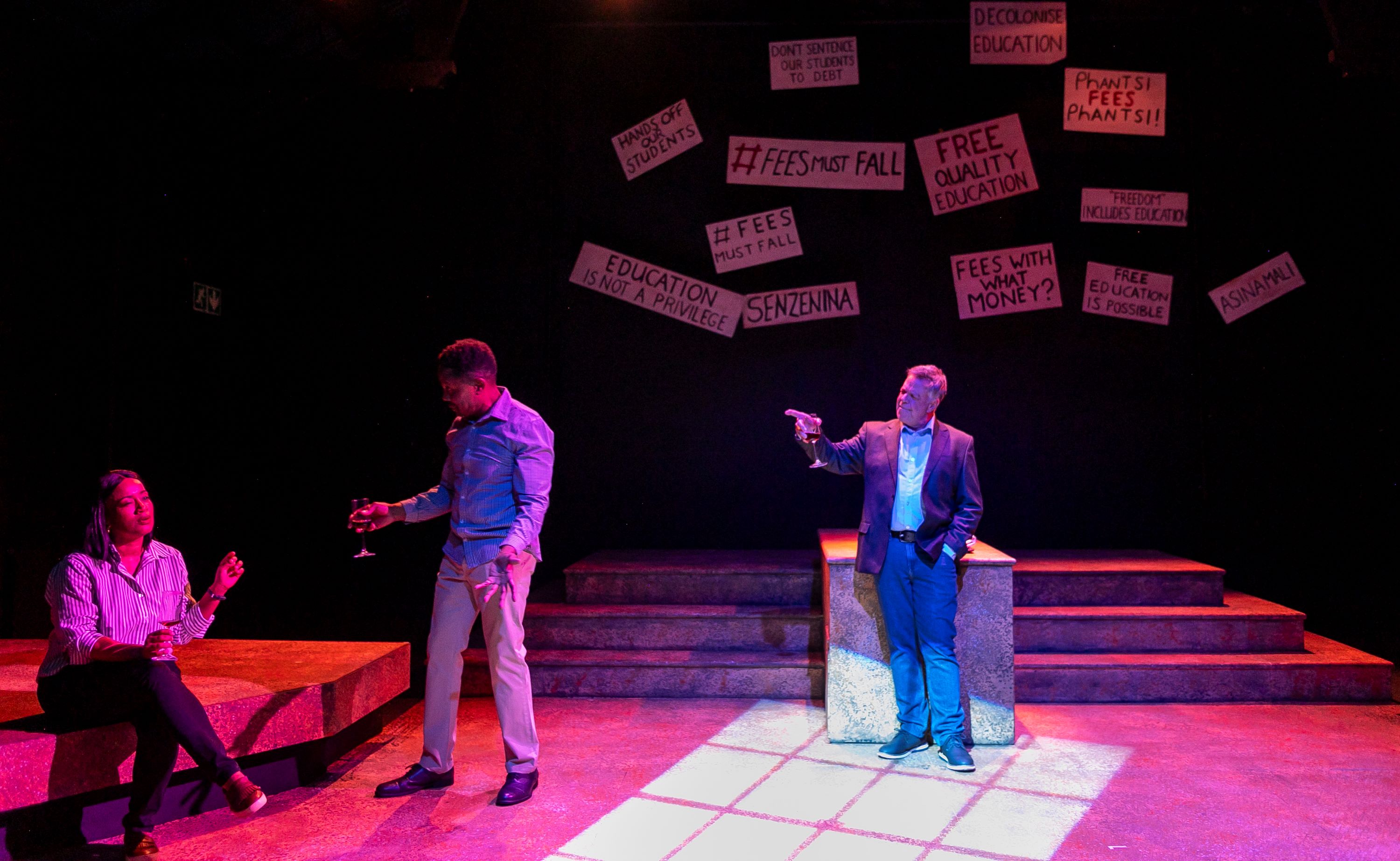
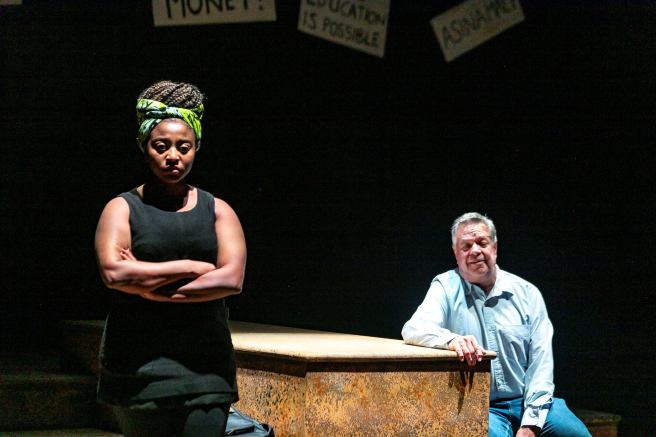
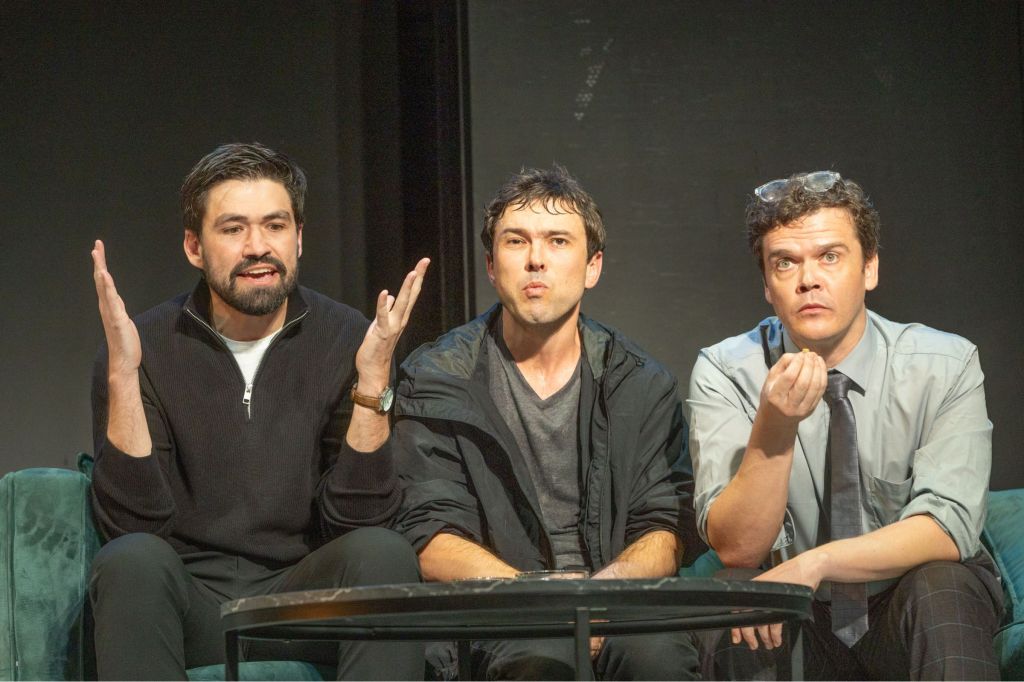
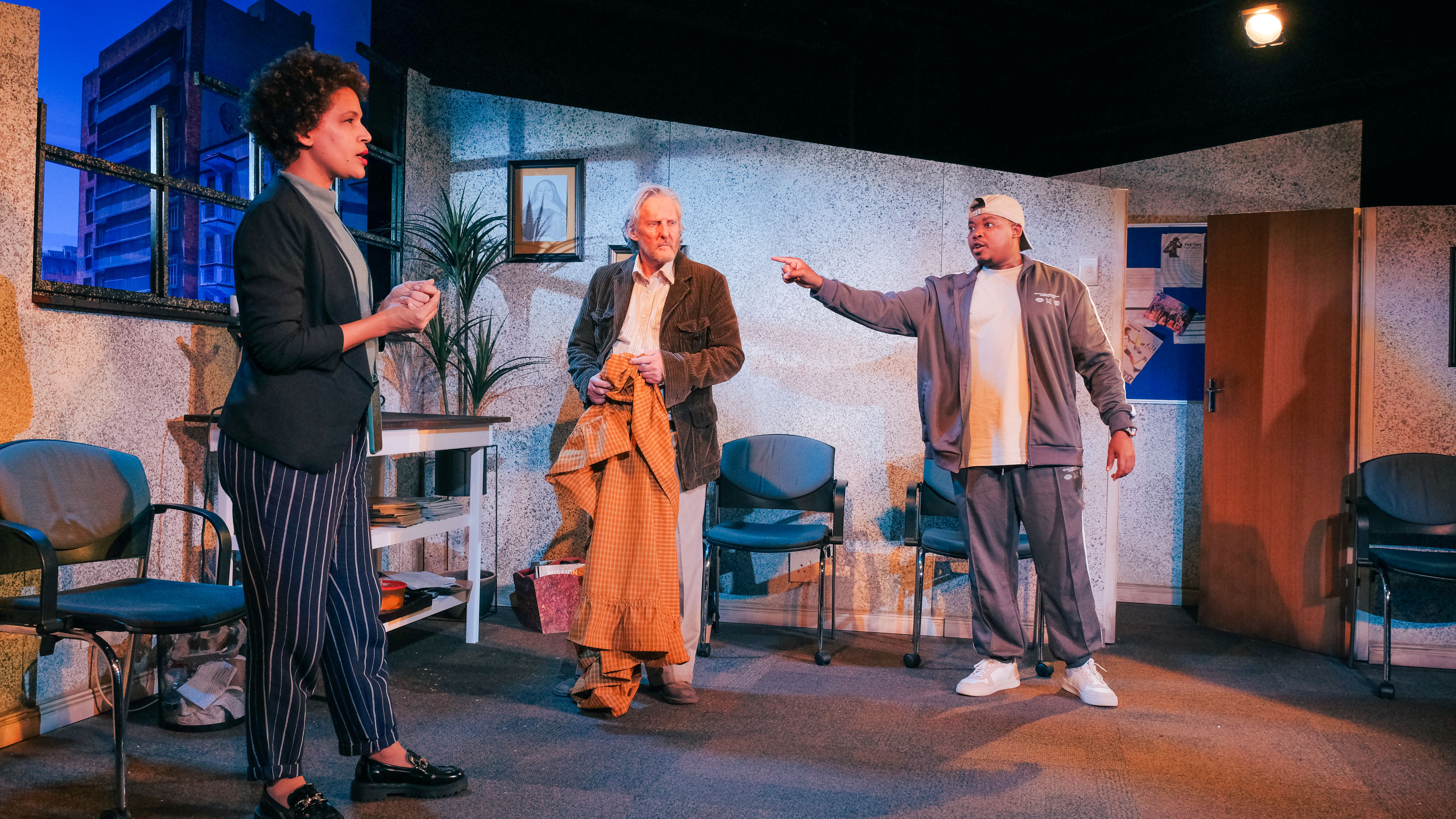
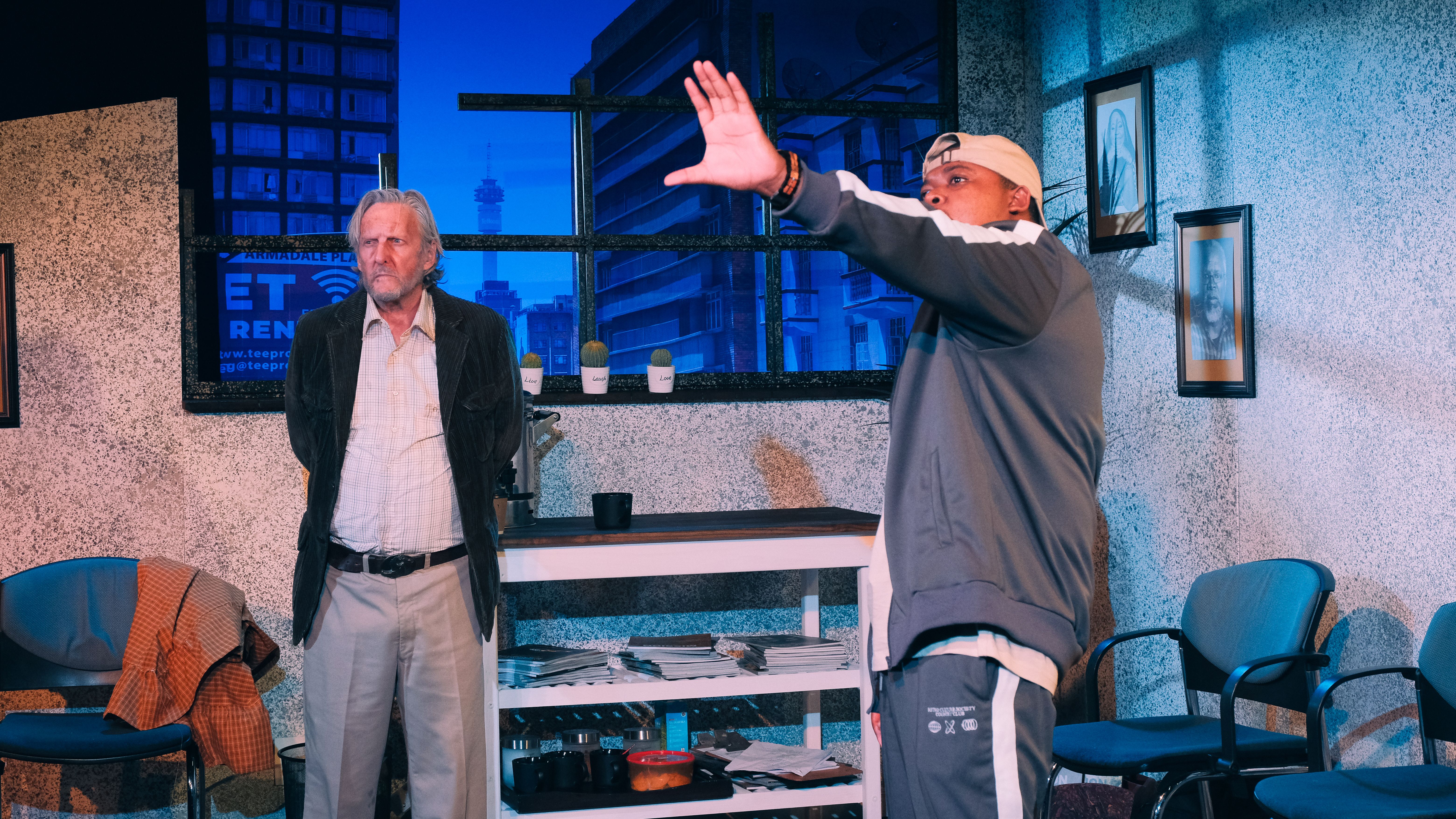
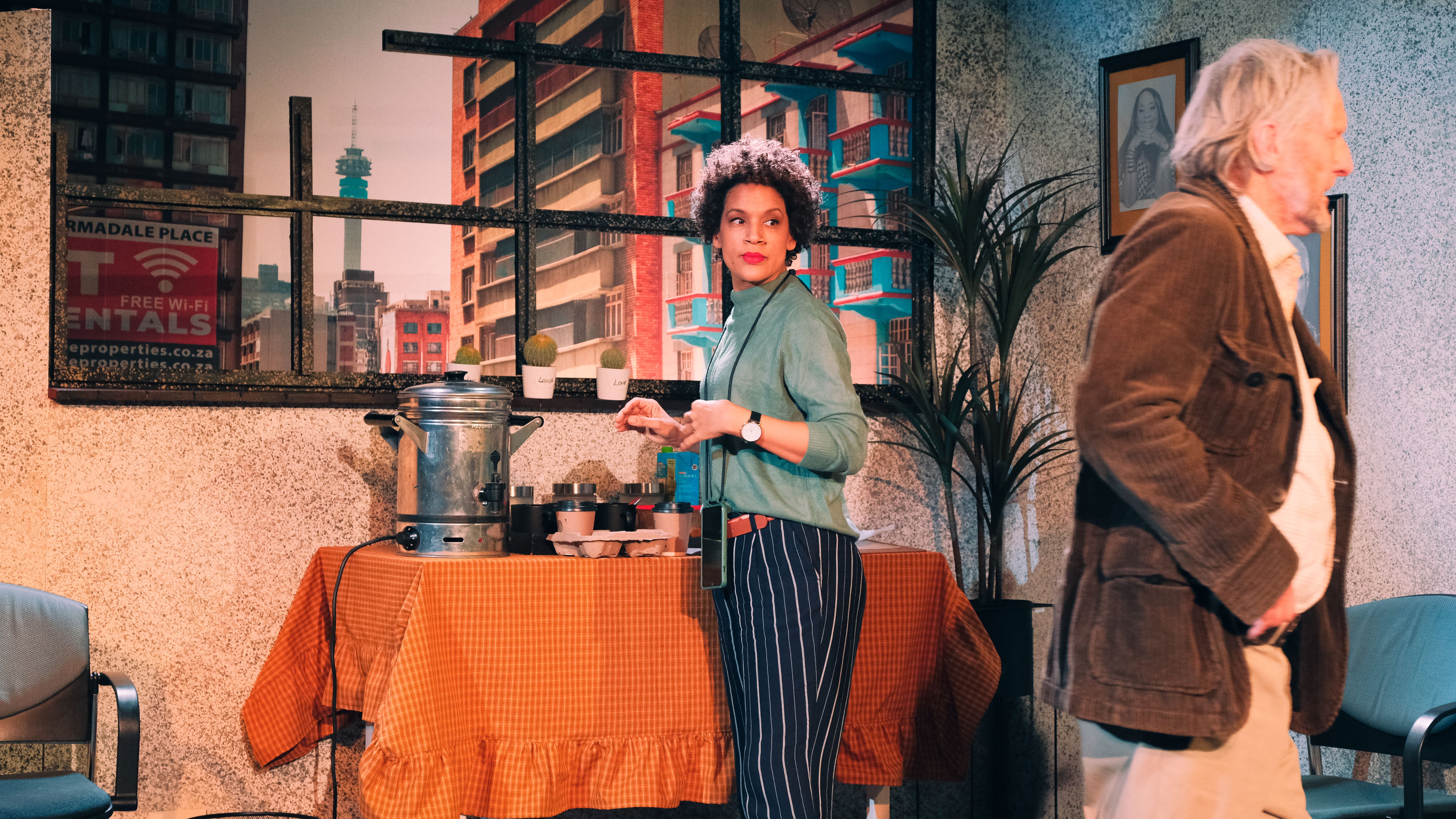
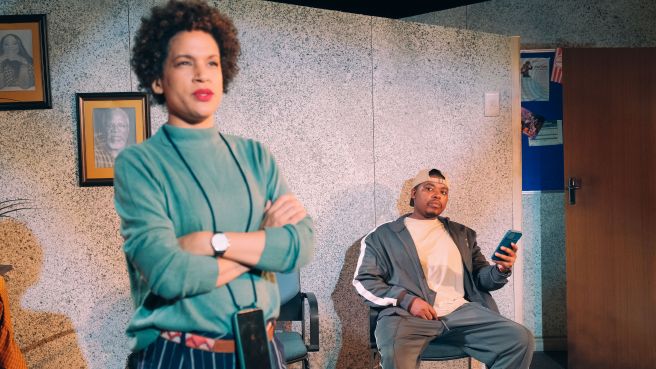
Pair the title with the four characters on stage – Vusi Kunene (Black, pictured right), Russel Savadier (White), Renate Stuurman, (Coloured, pictured left) and Shonsani Masutha, (Black, centre front), — and, in the South African context, sparks will fly.
That is what Mike van Graan’s latest play leans into. He says in the programme notes that he hasn’t written anything but solo shows since 2018 and it feels as though this one has been bubbling under and then just exploded – in the best possible way. It’s an epic piece of writing which will have you gasping as he appeals to each one in the audience, whoever they are, to grapple with the issues – our inner core – of South Africa.
While Nelson Mandela did many things for this nation, coining the phrase Rainbow Nation was arguably not one of them. It is as though he constantly reminds us what we are not, but if you were part of the opening audience on what seemed to be a quiet Sunday afternoon in the theatre, you would have witnessed that we could be.
The perfect quartet: Vusi Kunene, Shonsani Masutha, Russel Savadier and Renate Stuurman.
The audience pretty much reflected the mixed bunch we are and from the deadly silence following the first poem of strength recited by the astonishing Masutha to the immediate participation during the rest of the play, it was as though there was another solo performer on that stage – the audience.
It captured the heartfelt emotions Van Graan has always been able to harness as he tackles the South African nation. And no one does gloves-off like this playwright. Setting the play in academia, he has chosen his boxing ring and then selected his characters to represent every foible in the human race, it felt like. And then he lets them rip.
As always, he doesn’t hold back, everyone and each weakness is held up for scrutiny and the constant audience gasping and finger clicks told you how he hit the mark throughout the play.
Through the years Van Graan has been honing his very own way of dealing with what he views as our fatal flaws and this time it feels as though he has unleashed it all in glorious colour.
It might sound like something you don’t want to hear or see but, because South Africans will all relate to everything, it’s like witnessing the full South African story from Once Upon A Time …Prejudices in all their pitiful hostility, power plays, colour bashing, gender gore, poor vs privilege and the list is endless. He plays all those cards to their fullest.
Those who know his work, also know that he can write and he has never been scared to speak his mind. He does it to the Department of Arts and Culture and he does it on stage. When he has a platform, he steps up and tells it like it is and believe me, he is one of the few who speaks his mind unabashedly whenever he can.
He has been maligned to the high heavens, but nothing has stopped him. And finally, to my mind, here is his magnus opus and it is flawless and delicious to witness. And when (not if) you go and see it, I hope you have the same audience we had; it added to the fun and spectacle of the drama.
Add the director and the cast to complete the perfect coming together. Homann allowed the Van Graan words to do the work, which was the best thing to do. It should be unfettered because you really have to engage and listen to get the full extent, which here you do.
The cast delivers magnificently. I didn’t know Masutha’s work but she made sure I would never forget her. What a performance! From start to finish she’s there with all her energy and might and that’s what her volatile character needs. Stuurman is an old favourite and to my mind, this is her best performance yet. Savadier and Kunene also fit the bill and, as seasoned actors, they never put a foot wrong.
It’s a play I will try to see again towards the end of the run, because there’s just too much to take in at one sitting. It’s something — even though it doesn’t sound like it — that gives hope. If, as Van Graan suggests, this is exactly who we are, at some stage togetherness will take hold. As for now, we are still that dysfunctional family who needs a stern word to set us on the right path – and this is it.
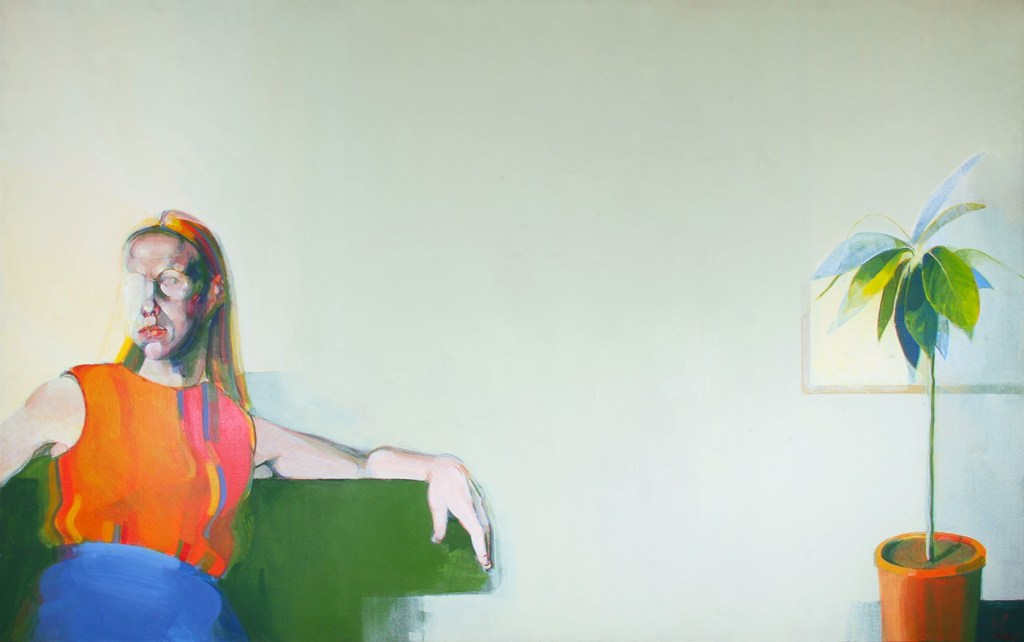
Margaret Nel on the journey of a painting: – “This work, titled Corner seat was completed in 1976 and was sold to Mrs Dora Scott when it was exhibited in Bloemfontein. Dora Scott and her husband were very involved in the arts in the Free State and her son Fred Scott is a founding partner of Walker Scott Art Advisory. When Dora Scott died, some of her large collection of art works, including this one, were put on auction and it was bought by the collector, art dealer \and erstwhile gallery owner Warren Siebrits. I bumped into him at an art fair and he invited me to see the painting at his house. I asked him to let me know if he wanted to sell the work at some stage and he later contacted me to say it was for sale. It is a good example of my figurative work painted during the 1970’s. I have very few paintings from this period in my possession and I was very glad to be able to buy it to add to my personal collection. It is about 50 years old and quite frail.”
Before starting to write this story, I quickly glanced through an interview I had done a few years back with one of my favourite artists, Margaret Nel, when she held a major retrospective at the Pretoria Art Museum in conjunction with the Association of Arts Pretoria where her latest exhibition titled Aftermath opens on Saturday May 10 running until the end of the month.
As she says so clearly in her Artist Statement, the theme that dominates her work from her earliest days hasn’t changed. It has always been about loss. She believes we have all witnessed and experienced loss in some form during our lives. “The debilitating effects of age and consequent loss of power and a voice and sense of self are perhaps the ultimate cruel and unexpected loss that all of humanity has to encounter eventually.”
Yet while her driving force hasn’t changed for this exhibition, her subject matter has. She has turned to objects rather than her usual figurative work, which has become more and more difficult to apply. “It’s easier to work with a theme and a new way of exploring the things I want to say,” she explains.
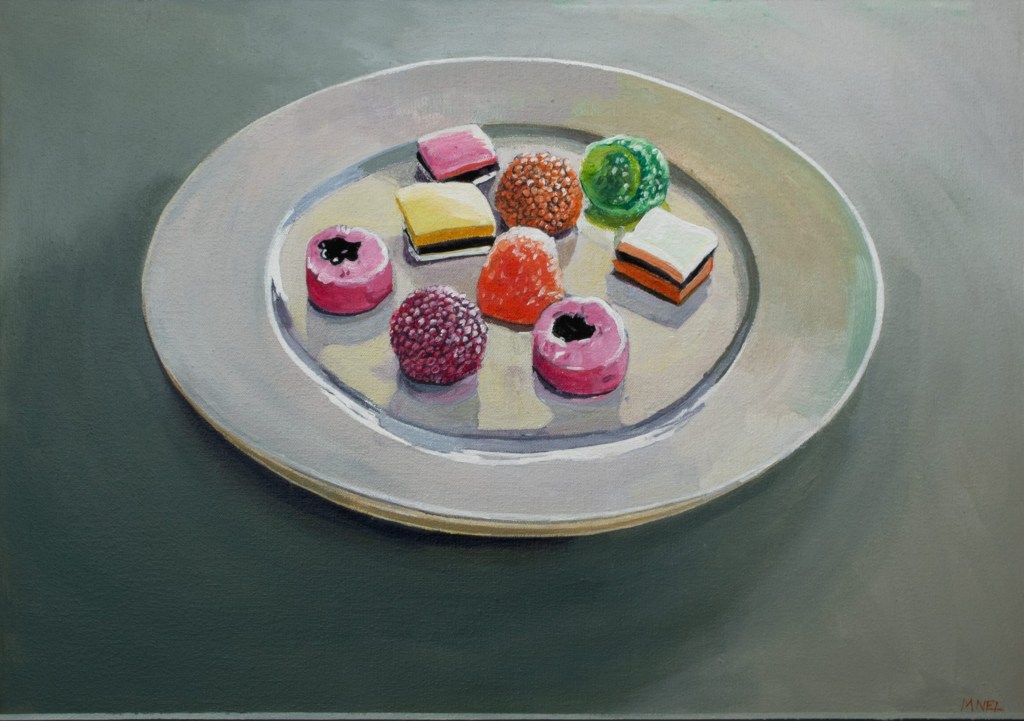
Allsorts 1
It is also a tough ask to find models willing to take the time, she says.
When listening to her talk about life and the harshness of loss, which the word almost unconsciously implies, I was surprised at my immediate reaction to her current work.
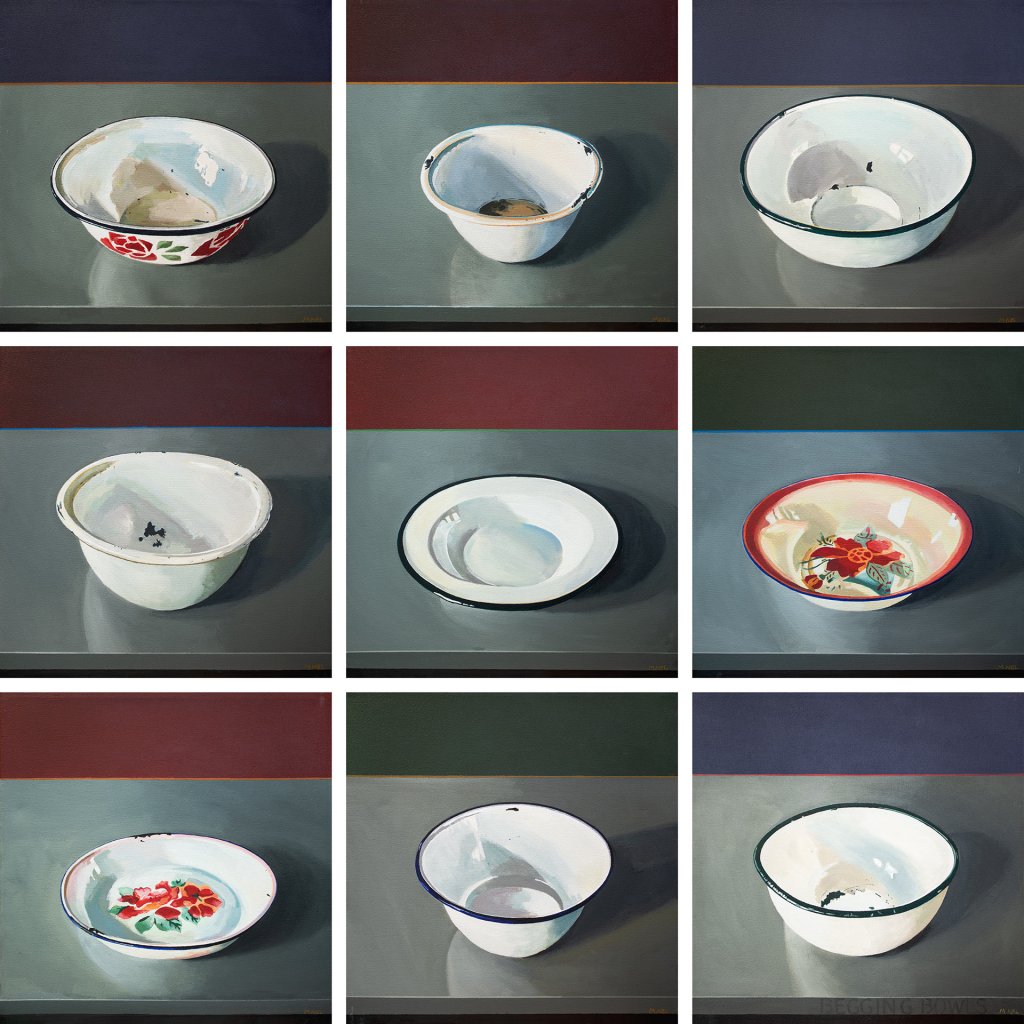
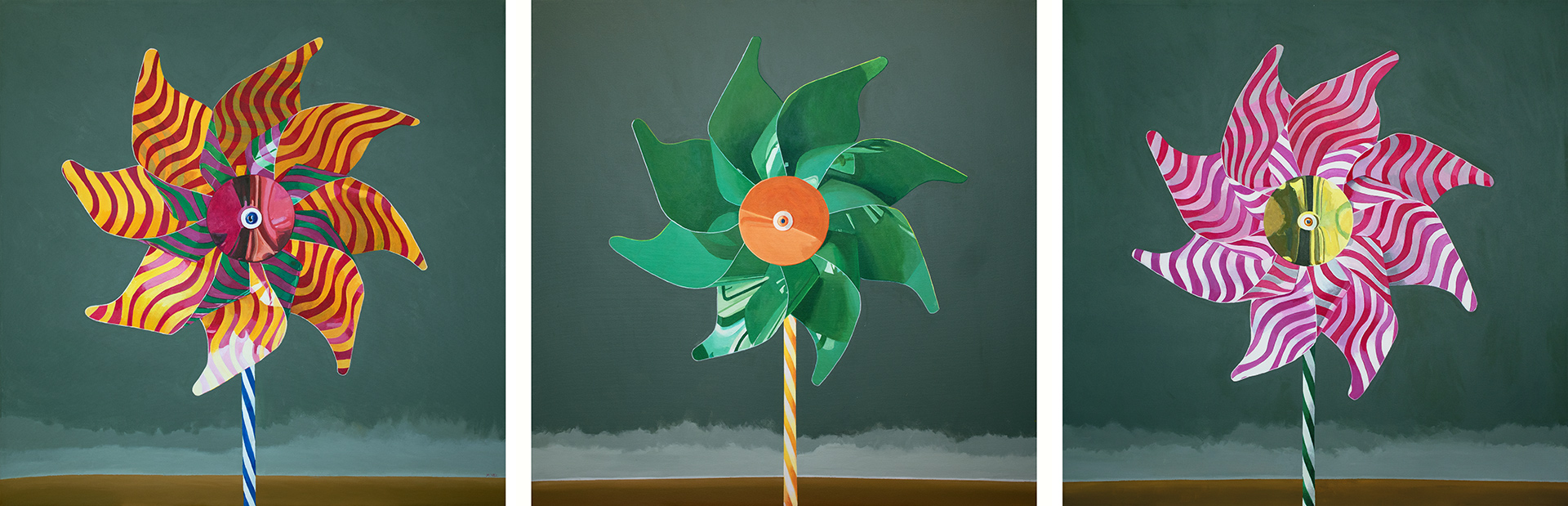
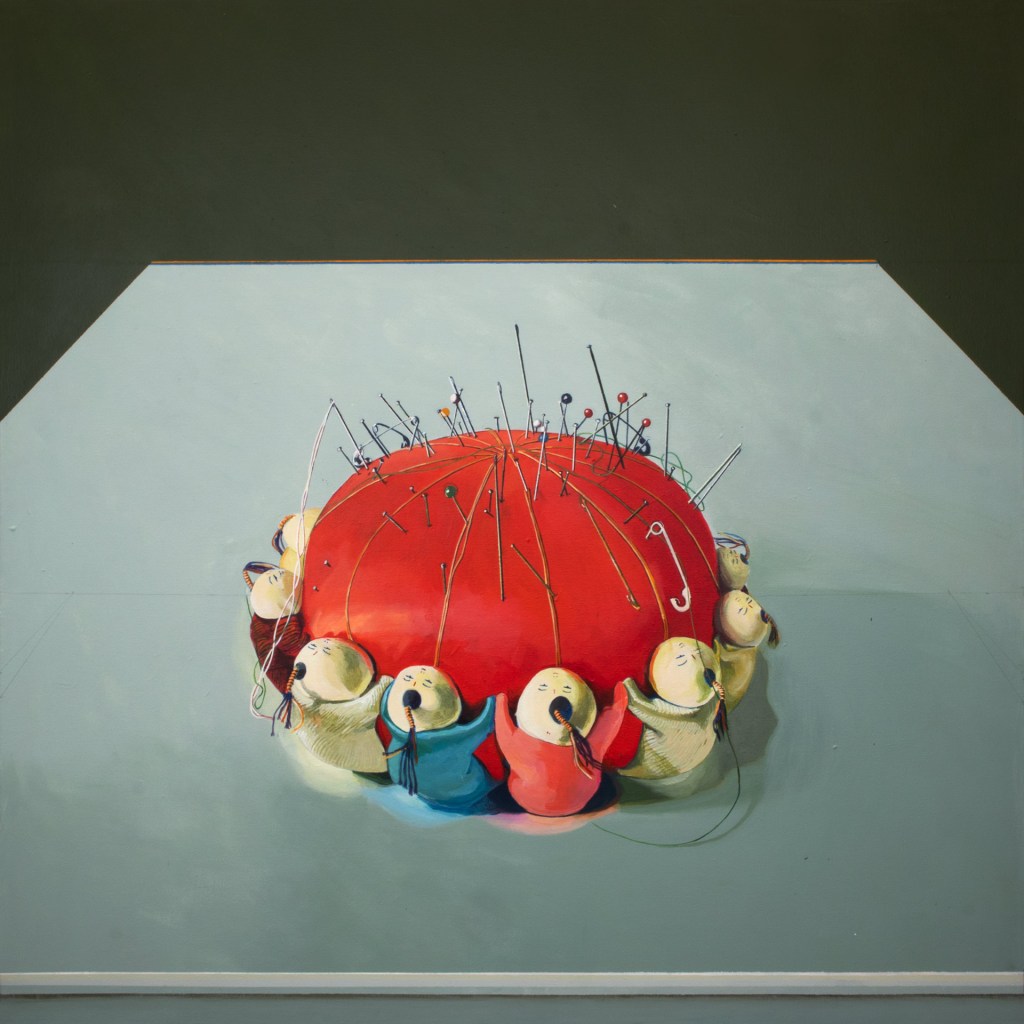
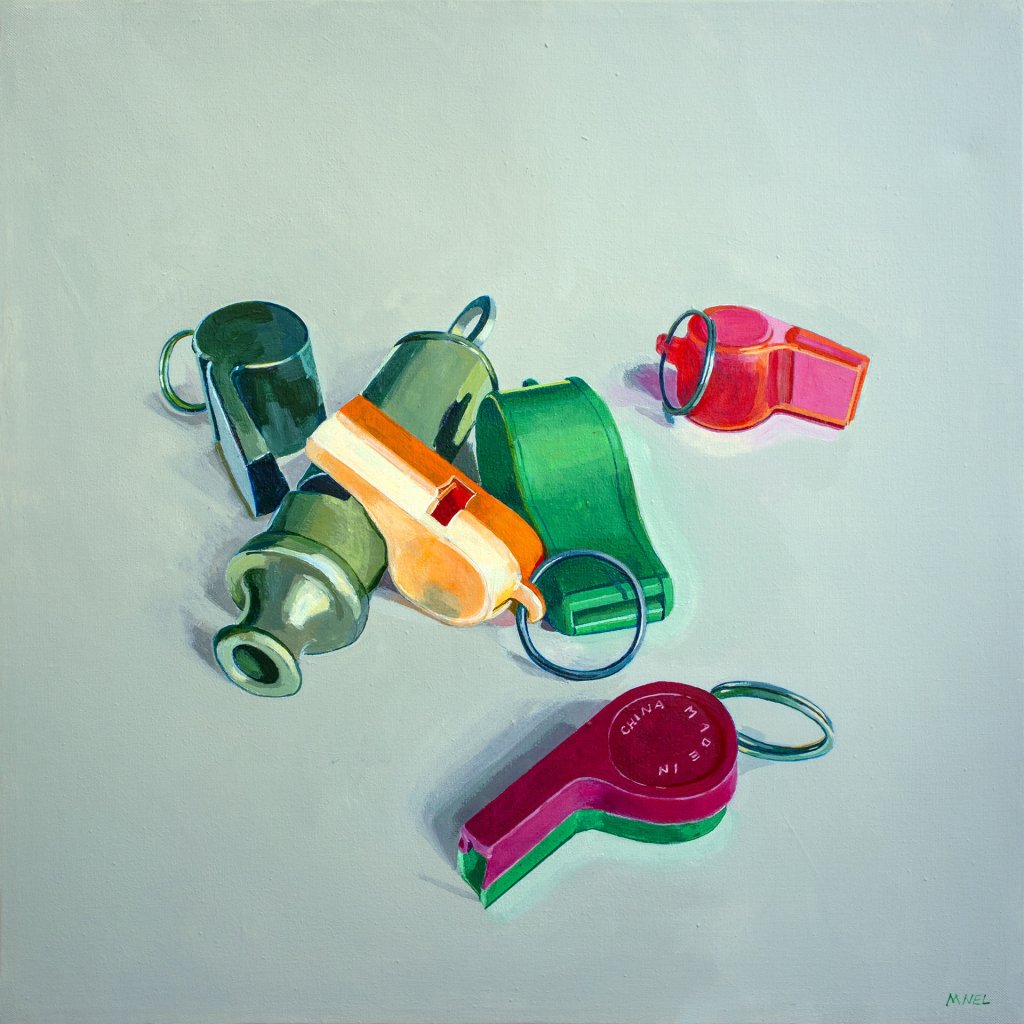
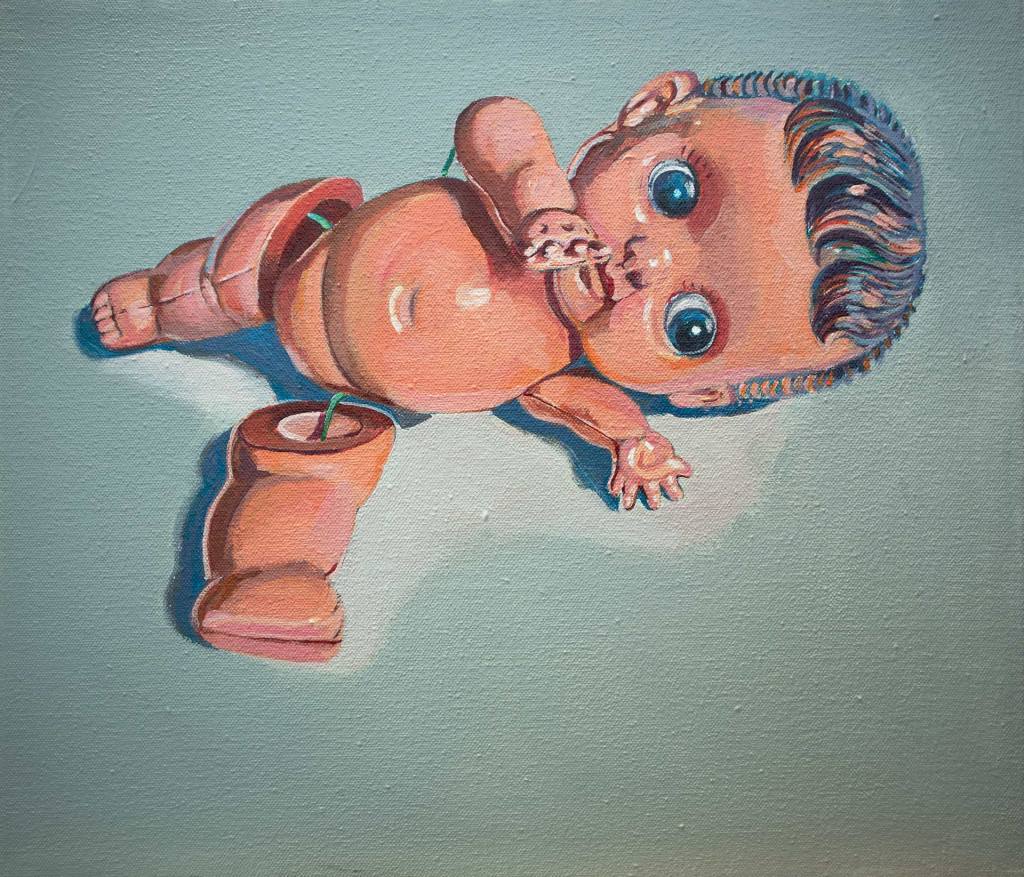
She is dealing mostly in things from her past, which means that many of us would find them familiar too: shiny pinwheels, old fashioned pincushions, Liquorice Allsorts, sweets in shiny wrappers in different stages of unwrapping or even the unfolded, now empty wrapper without the sweet, tinfoil containers, mechanical birds, wrapped flowers, colourful whistles, enamel bowls and a rather disconsolate plastic doll.
And even though I concede there is a certain melancholy, it also brings me great joy in a nostalgic kind of way. And who would not be tempted by her bright sunshine colours?
As important as the paintings themselves are, the names she gives each work also play a huge role and will point many in a certain direction. The enamel bowls for instance are titled Begging Bowls (see below). The name alone will encourage viewers to uncover their own stories. Alert is how she identifies the whistles, and it is as though you can immediately hear that shrill sound or visualize a school sports event.
All these objects were carefully selected by Margaret, who understands and is happy if everyone viewing the paintings gives them a different meaning. It’s not something she wishes to impose and if the work is simply seen as pretty pictures, which they certainly also are, she is fine with that.
For her, the objects in the individual works all play with the meanings of loss. And there certainly is a feeling of melancholy when you look at the exquisitely rendered paintings. Personally, it takes me back to childhood. I have always had a fascination with pinwheels, which because of their colours as well as their joyous twirling when the wind blows, have always held that hint of magic.
As someone who sews, I was immediately enchanted by the pincushions, the like of which I had never seen before, but Margaret explains : “I am not sure if the Chinese pincushions are made any more. Mine are antique and probably about 80 years old, the material is silk and the stuffing is some sort of organic material like grass. We regularly holidayed in Lourenco Marques (now Maputo), when I was a child and the pincushions were bought at small Chinese curio shops. Nothing similar was available in post war South Africa.
Curio 111
In her world, when it comes to her peers, she says she feels like the last man standing, which also explains why loss at present conjures up such heartfelt emotions. There’s no one around who witnessed her childhood or even young adulthood, she says, and expresses envy as an only child for those of us who have siblings. There’s no one who can hold on with her and share her memories.
Talking about the process of painting, she declares that she often feels quite high when a painting is completed.She also does all her framing and with these paintings has changed from aluminium frames to wood which she can also paint and feels adds to the painting. She’s also in the habit of reworking old paintings and precisely that compulsion will be the subject of her next exhibition.
She will be looking at old work, all locked away in a storeroom, figurative work, which will be reworked.
Alert.
“I’m full of self-doubt,” she notes, and one can understand why. Her work is usually done in isolation with no one to encourage or discuss issues or share her thoughts about the work. Yet her beautiful home, the iconic round house close to the Union Buildings, is an interior masterpiece and glorious example of how exquisitely she curates her own life.
The house has been furnished magnificently to capture a very specific mood with, at the time of my visit, her exhibition paintings displayed on all the walls throughout the house. Because of the prolific windows, the backdrop is the sunny highveld skies while the furniture has an industrial feel with added warmth due to her cunning colour choices.
It is a pity that in today’s often hostile world, she has decided against a home exhibition because this is where Margaret so obviously feels at ease. And for the visitor it is an exciting extension of her creativity.
She knows she has to take her whole body of work into consideration, yet she’s constantly worrying about certain decisions and whether she has got it right. But still, she welcomes and encourages criticism and is sad that art criticism has all but vanished. She talks about very harsh criticism she received at a previous showing and feels that the writer opened new avenues for her. They probably simply confirmed something that had worried her and that set her off in a new direction.
Doll.
“I can’t promote myself,” she says and, because she is quite solitary, she finds it hard to put herself out there. Yet she is keen to have proper conversations about her art. “How else would I learn?” she wants to know.
What she believes though is that her experiences of life captured so stunningly in this body of work would be familiar to viewers. “Life is just full of loss,” she laments – and she’s right, yet there’s so much more captured in this magnificent display of her latest exhibition.
The exhibition will be complemented by a selection of ceramic vessels by Dale Lambert. Her delicate, decorative stoneware is characterised by minimal, bold forms and vibrant, primary colours. The artist states: “My obsessive fascination with clay goes back to my early childhood and remains to this day. I currently enjoy the thrill of working with porcelain, and the translucent pieces I create are an expression of my being.”
Diversity was the element that dominated this year’s fantastic KKNK Festival (in Oudtshoorn at the beginning of the month) – from the audiences to the artists, also including the plays and performances. DIANE DE BEER reports:
PICTURES: Hans van der Veen (unless otherwise stated.)
On one day you could see a solo show, a play with both words and movement, a translated modern classic and a new work that will outlast some of us watching.
Yet as is often the case at this festival, theatre was what really captured the imagination – and true to the diversity theme, it played out in many ways.
For me it started with a bang with a piece titled Die Een Wat Bly (which can also be seen at the upcoming Cape Town Suidooster) with a cast consisting of the two talented dancers from Figure of 8 Dance Theatre (Grant van Ster and Shaun Oelf) who in this instance combined their extraordinary movement with the insightful words of Wessel Pretorius who seems to deliver an endless stream of brilliance. And the third member of this inspired cast is Daneel van der Walt who is an actor who has emerged these past few years as someone to watch.
Everything seemed to combine beautifully, from the story, how it was written, the excellence of the casting and the way movement underlined and emphasized every emotion so magnificently. I couldn’t resist catching it a second time and it confirmed my initial instincts that all the elements just flowed together seamlessly to present perfect theatre. I could easily watch it again … and again… and again.
In a different guise, Pretorius performed in Yasmina Reza’s translated text Kuns (which had previously been performed by two of the actors, also directed by Marthinus Basson in the English version titled Art). Pretorius and Wilhelm van der Walt (part of the former cast) were joined by Ludwig Binge in a play that satirises the often achingly precious way people view and talk about art.
Because of the NOW, a time where an anti-wokeness and fake news seem to dominate everything, it worked even better than the first time I saw it and with these three adventurous actors (all three Basson graduates who have established exciting theatre careers), it was perfect for this festival which always celebrates.
Basson also delighted with a play which has been on the circuit for a while, and I was thrilled to finally experience. Who would not be intrigued by a play titled Kruispad, of die legende van die goue vis.
Picture: Nardus Engelbrecht.
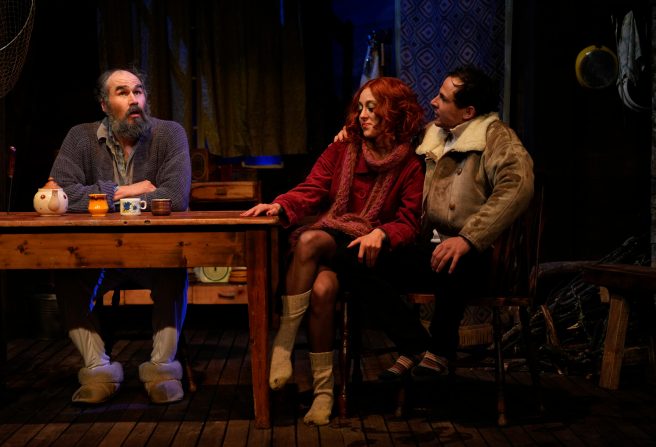
Again the casting blew me away with Eben Genis giving one of his finest performances in the role of the eccentric recluse Oswald whose life is rudely interrupted by two lost and rain-drenched youngsters played by two of the best, Edwin van der Walt and Carla Smith, with a glorious copper-coloured wig which completely changed her character without her having to say a word.
Because it plays with temptation and loyalty, it reminded me of the film Indecent Proposal in which Robert Redford offers to buy Demi Moore for a million dollars for the night.
Masterfully written and performed with great gusto you are never sure what is real or not, whether something is fact or fiction, and in fact when someone is being honest or not. It’s like trying to solve a puzzle that tortures and teases with a few disruptive detours that keep you slightly unbalanced as an audience.
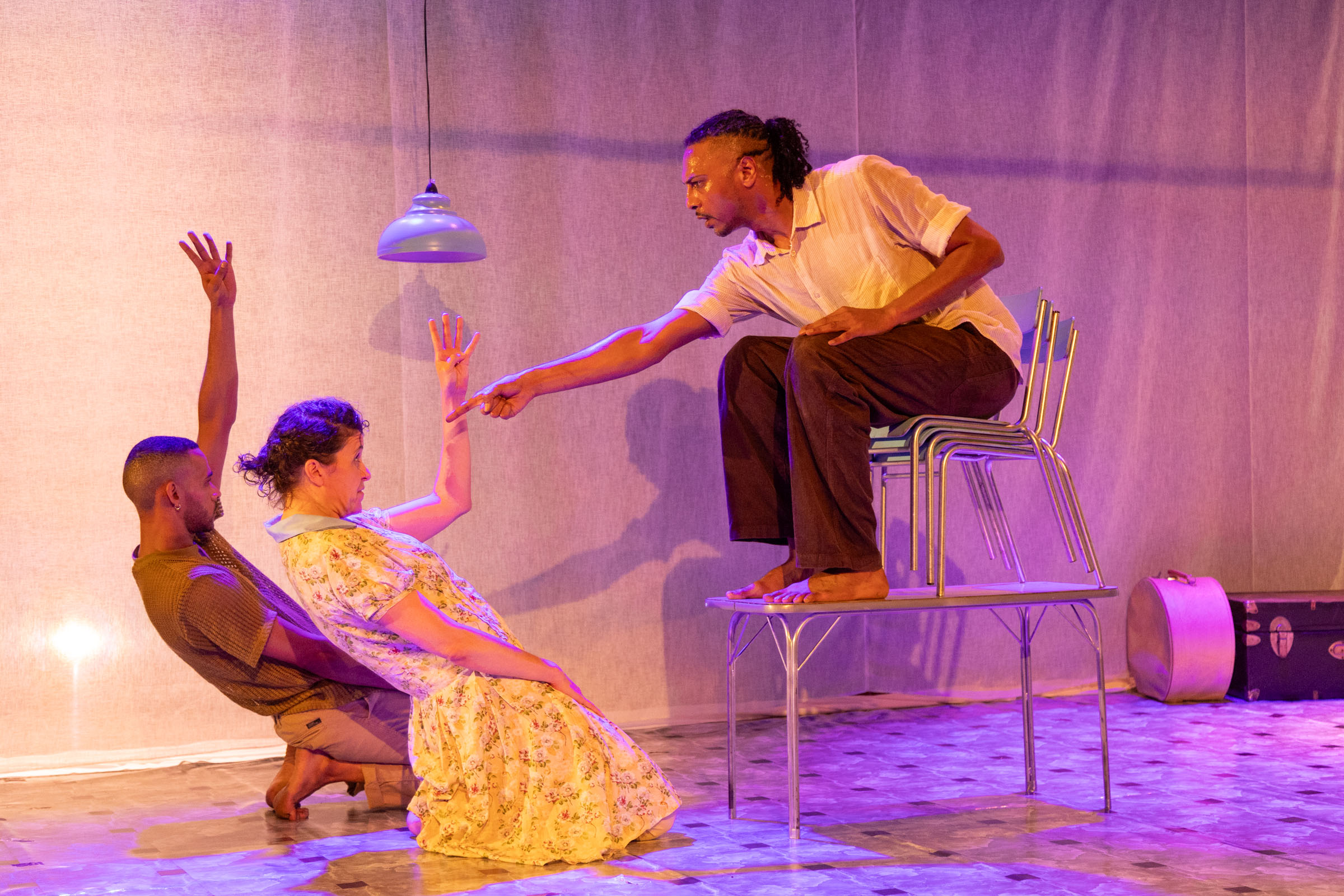
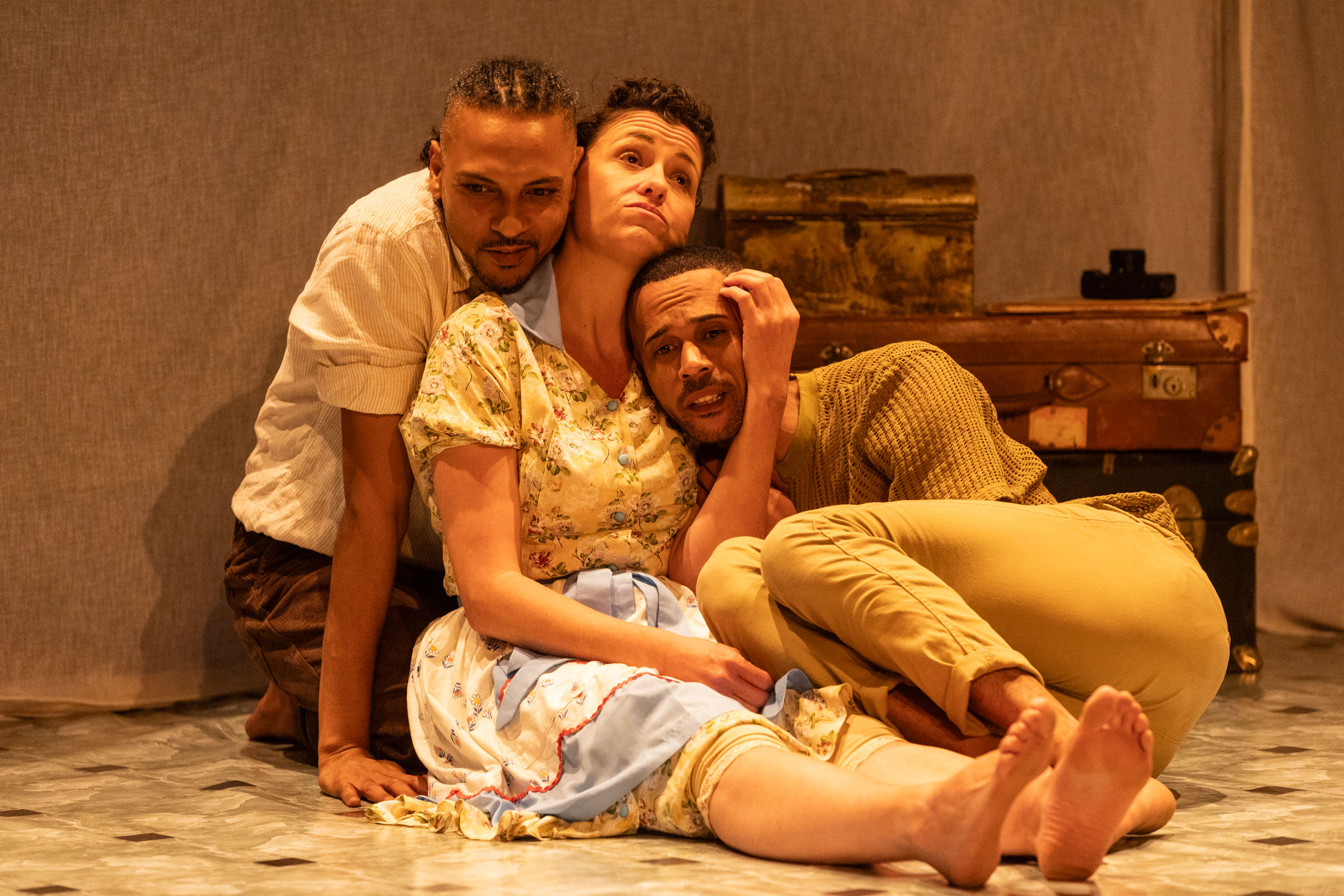
There was so much more in the theatrical realm with solid performances in the Hennie van Greunen translated and directed Annie+Helen with Cintaine Schutte as Annie, the governess/teacher in the Hellen Keller story and Judi Hattingh as the severely damaged teenager who cannot see, hear or talk.
A mighty struggle ensues and from beginning to end, the two actors battle, and sometimes, bruise one another in a fight for something so much more than survival.
I have always been a huge fan when some of our younger directors (and he might take exception to that description) take on the classics, and I was excited to see Speelgoed van Glas translated, directed and designed by Nico Scheepers.
Casting was a further incentive with Annamart van der Merwe, Carla Smith, Ben Albertyn and Mark Elderkin on board, and was also alerted by all the awards they had already received, all of them thoroughly deserved. Van der Merwe’s bravura performance as the brittle mother is bruising as she embodies a woman who is desperately fighting to hold on to the only power available to her, that of motherhood (and in this instance also victimhood).
Her children, especially her son, have no such illusions and their confrontation reminds one of how a home which should be a protected space for a family can become a warzone which holds only fear and a frantic will of those threatened, to flee and find emotional freedom.
It’s devastating writing, smartly translated and, set in the present with a cast who have had the time to hone their craft and honour the play.
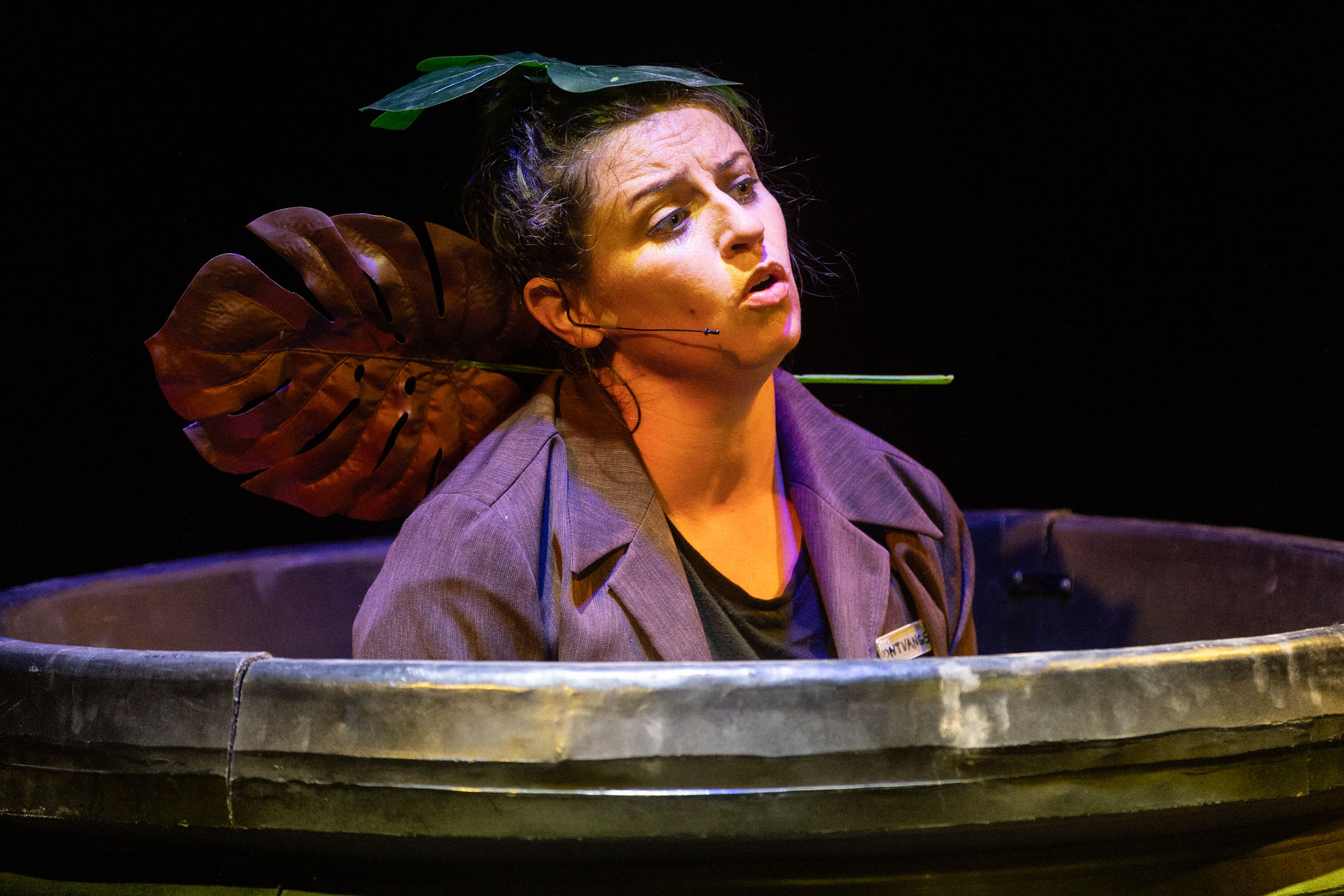
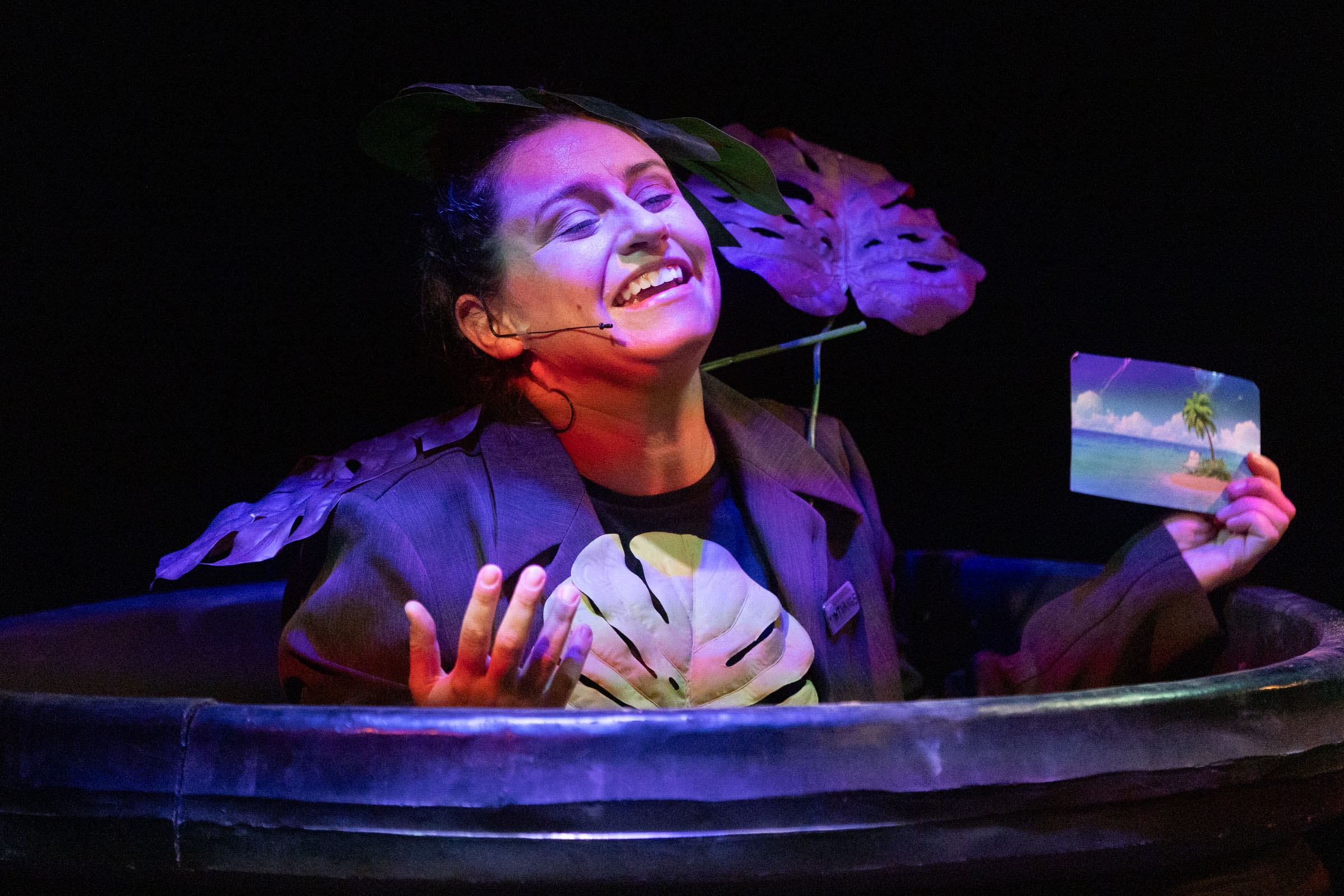
Also Die Potplant: ‘n Tragedie written and played by Karli Heine who changed what had previously been part of something now called Blitsteater into a longer piece had an interesting effect on me. It’s a wonderful idea with a script that’s inventive with underlying pathos – and yet, while it still had the impact and was cleverly stretched into a more comprehensive play, I think I preferred the shorter version.
It might have had something to do with the impact it had the first time round as well as having lost my heart to that version, I was more aware of the padding. Yet Heine is worth watching. She is someone that thinks out of the box as well as having the courage to take chances. You need all of that in this challenging profession.
Another joy at a festival is discovering new talent as well as witnessing the creativity of artists and how they find ways to explore their craft in a world with no boundaries yet many obstacles. Bibi Slippers, who can only be described as a compulsive creative did two shows as part of the Blitsteater (a bit like fast food, fast theatre), but there’s nothing fast about what she does with her imagination.
Picture: Stephanie M. Gericke.
I have always been fascinated by this young woman who has carved her own career in a very individual way. She pops up all over the show and her strengths lie in her words. She knows how to use them and has two spectacular poetry books that run like a thread through her performances.
Everything she does has thought behind it, is usually novel and it works. If anyone wants to see how to be an artist in today’s world and be in command of your own life, this is it.
In similar vein Sandi Dlangalala and Ilana Cilliers combined style and swagger to present an interlude of theatrical magic with Smak. The way they told the story in very little time with their whole being and soul was quite extraordinary.
A regular festival contributor, Llandi Beeslaar, who with her partner has been running a series of short performances by various artists, in the above mentioned Blitsteater, decided it was her turn to shine individually. She was ready to test herself as a comic with her first stand-up piece.
She participates in the arts in different ways, but this is a chance to use her own voice – and that she does with a particular style. Most importantly she has something to say and should keep going while honing her craft. There aren’t enough women in this space and the only thing she lacks is confidence.
Picture: Mia Truter.
A solo performance that stood out was that of singer/songwriter Frieda van den Heever. I first noticed her as producer with a fine sensitivity as well as an imagination which seemed to be strongly independent.Picture
She has obviously decided it is her time and instead of producing others, she staged her own show. She’s got all the goods and probably if you start counting, has more talents than a triple threat. In this her first solo show (that I know of) at a festival, she did the performance as well as the production. She brought in Mauritz Lotz on guitar, but the rest was all done by this astonishing performer.
I’m more of a theatre girl than music, but she blew me away with her presentation, the way she put together her show, her music (on piano as well as singing and songwriting), her lyrics and her singing. I know I can find her album Ontspoor, onlineand that’s what I’ll do.
But to find new music so accessible and a performance that’s fresh, daring and quite darling. I’m a groupie. Once I checked her previous work (which I had seen, with her as producer rather than performer) I understood why I liked the show so much.
Karoo Kaarte is one of my favourite experiences every year at this festival. They pick their battles, how best to explore them and this year they joined forces with the District Six Museum and GALA queer archive and used the Kewpie: Daughter of District Six picture archive as a platform to develop this years’ experience.
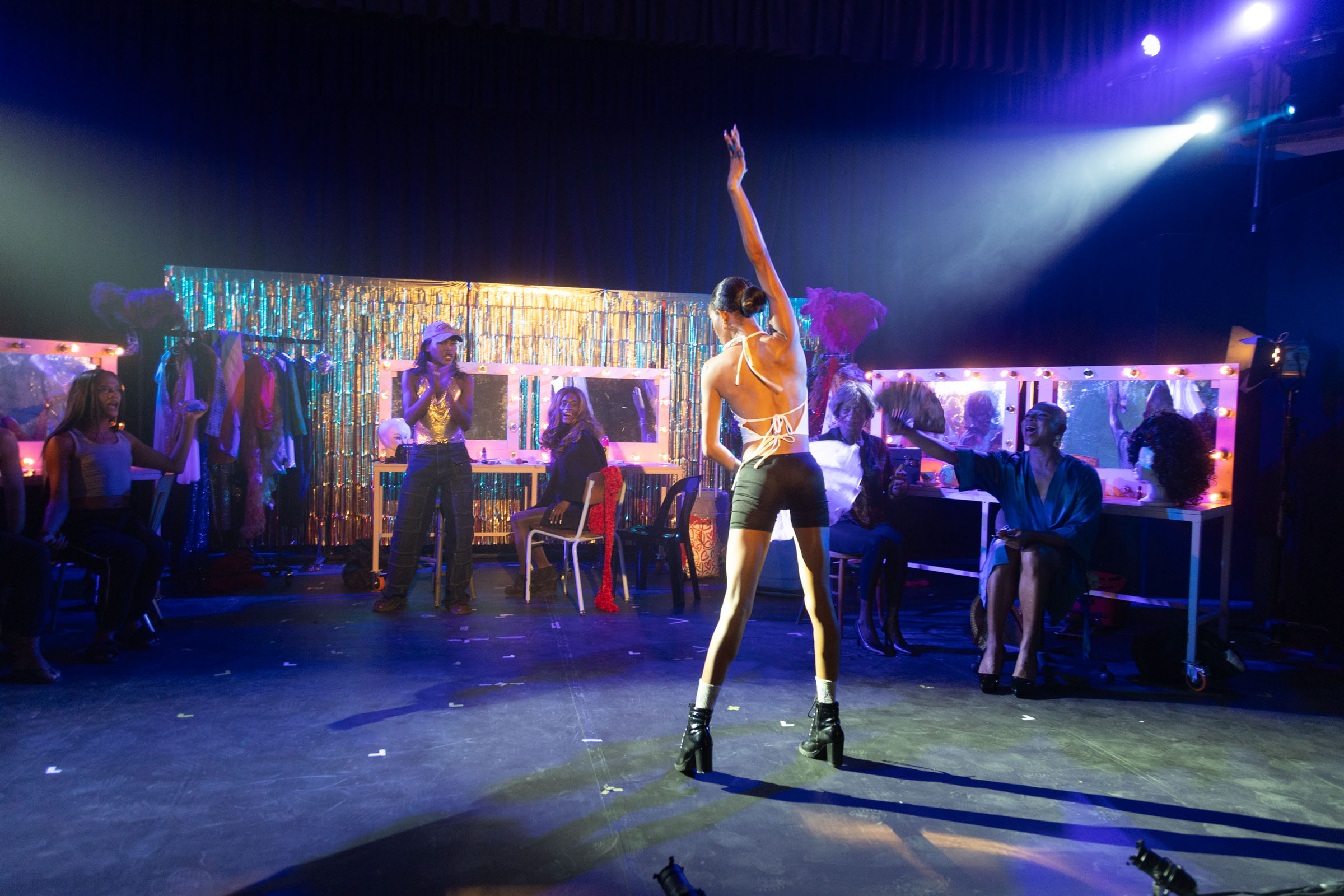
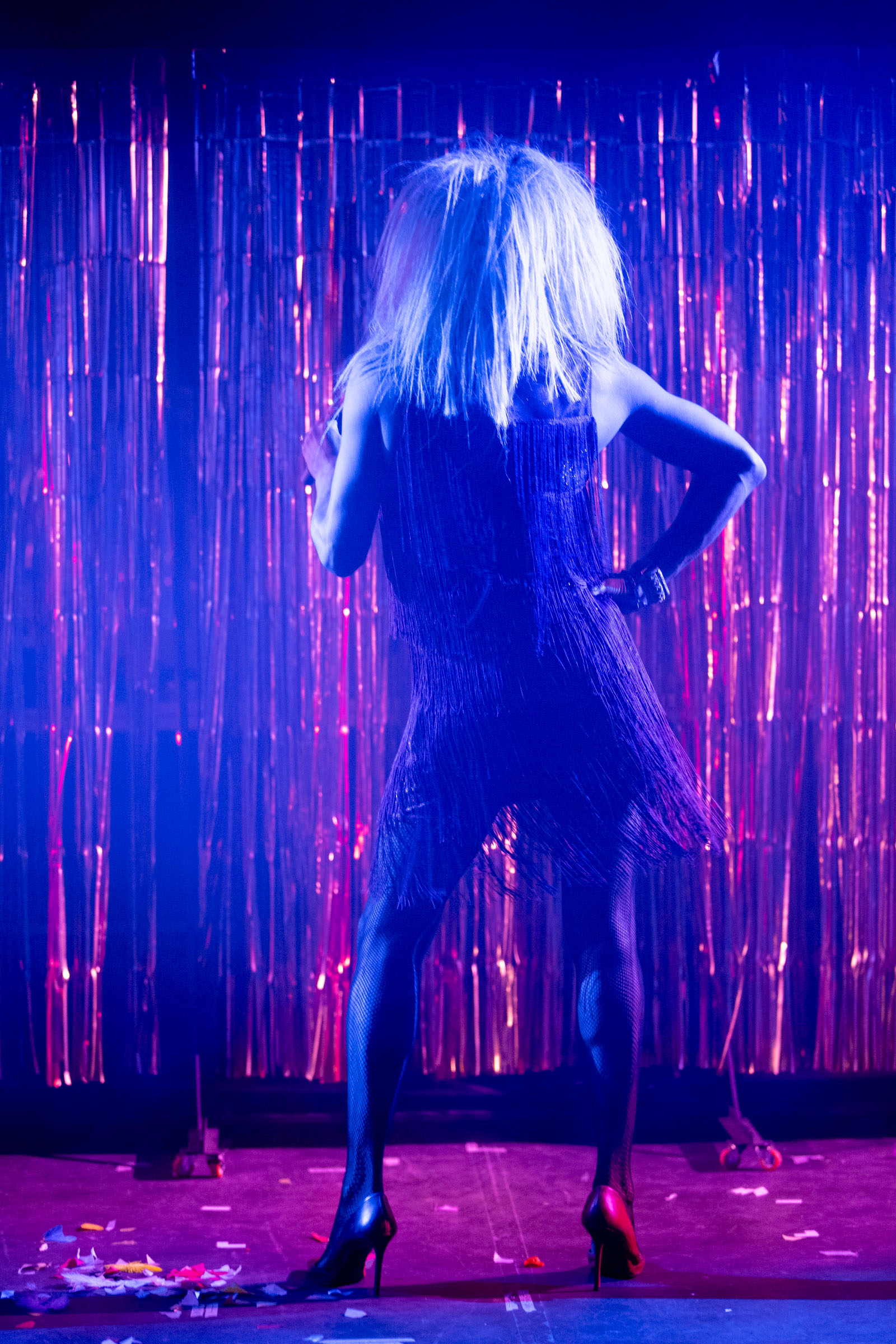
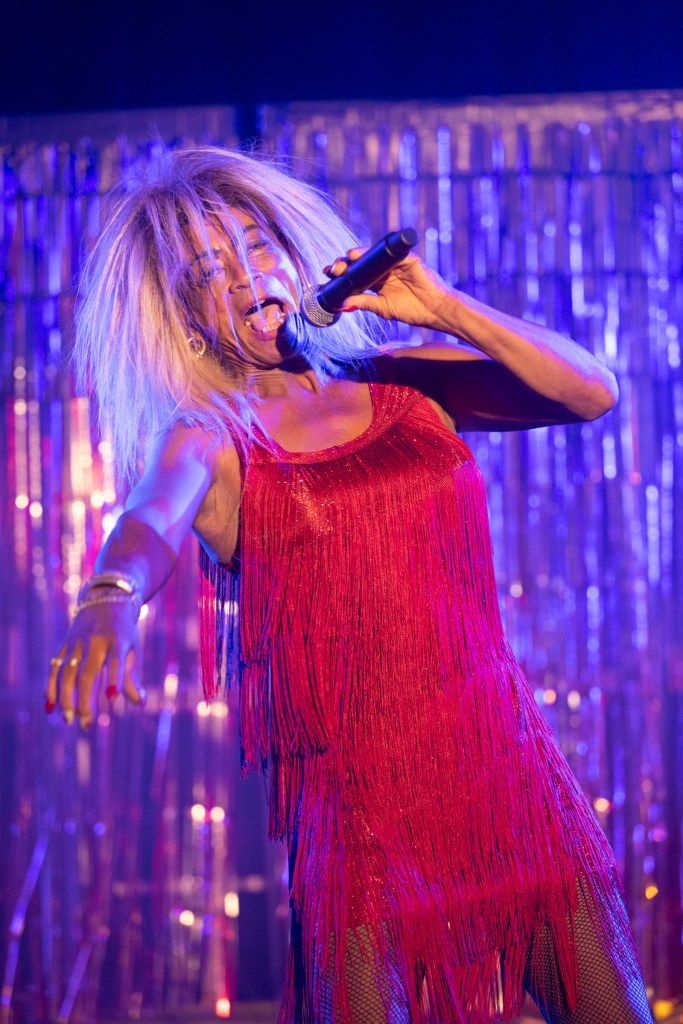
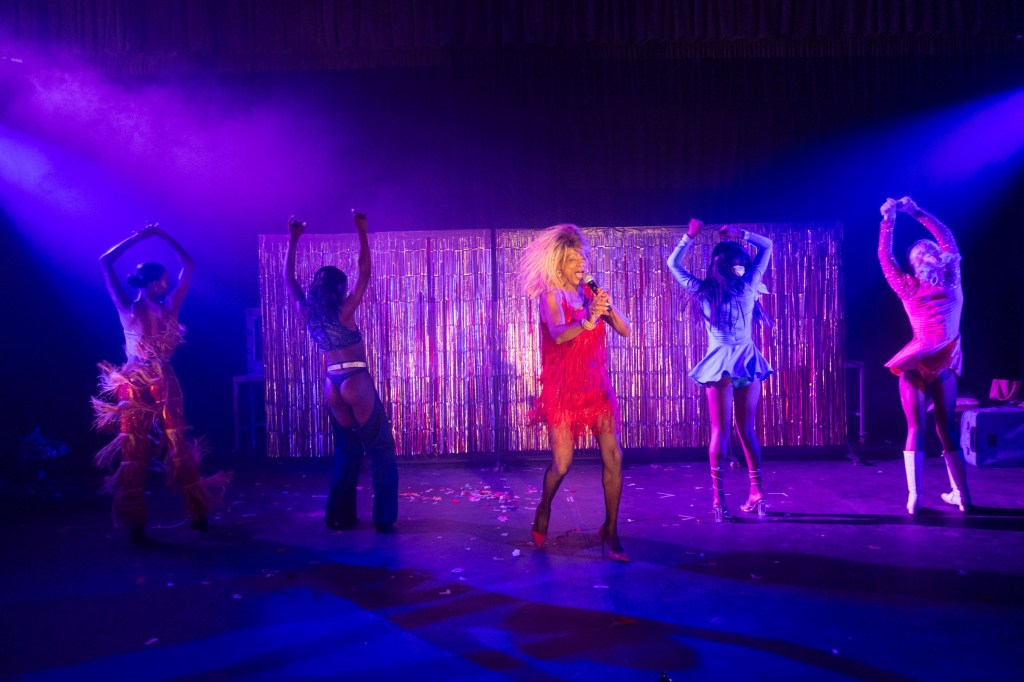
It all culminated in a queer festival with a multi-disciplinary drama titled Kroon en Konfetti which incorporated three elements: Kewpie’s life and legacy as dancer and artist; the rich culture of Oudtshoorn’s beauty competitions called “models”; and 25 personal stories collected from Oudtshoorn’s queer community.
Dressed in all their finery, the “models” all gathered in a dressing room to start their show with the dialogue smart, sassy and with an edge. It was quite magnificent as are all the Karoo Kaarte productions and more than anything it’s the topics they choose to spotlight that’s so important.
Here is deals with a group of people who are already sidelined in a country where prejudice is still rife. With their queer status they are in search and hoping to find safe spaces in their community where they can celebrate their culture, yet behind all the glitz and glamour, the shadow of oppression is hard to ignore.
As always Neil Coppen, Vaughn Sadie and Tiffany Witbooi are the creative team responsible and my only regret – as happens every year – is that I couldn’t participate in all their offerings. It’s one of those projects that’s imaginative and innovative and even more importantly, they’re constantly working with elements that result in real change in a community that has always been neglected.
And then cleverly the festival ended with Nataniël and a company of 10 on the openair stage under the Oudtshoorn night skies. The elements aren’t his friends, but it was a glorious way to end the festival with a performance that showcased new voices and performers as well as the glorious artist himself with stories and songs that suited the occasion.
Tracy-Lee Oliver was the artist he chose to spotlight on the night, and she made full use of the occasion with spunk and singing that added spark to this final show. It was great to see someone step into the limelight with such poise. As usual, making sure he gave his audience all the hysterical stories and masterful songs they expected with his superb band and backup singers, he also paid it forward with this sassy introduction of new voices for this audience.
He first spotted her when she was a contestant on a television show he judged, and astute as he always is when it comes to producing for an occasion, this was where he decided to showcase her – for all the world to witness.
Rehearsal picture.
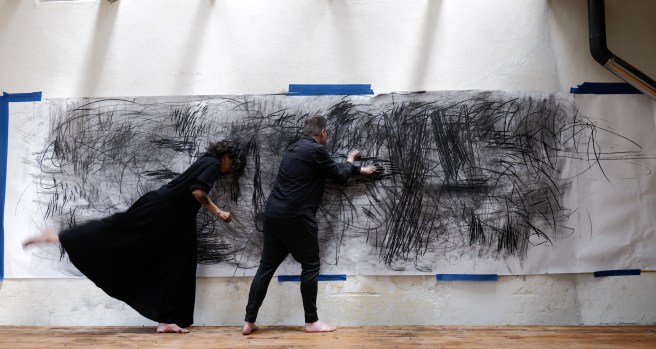
I haven’t even touched on the festival artist Henk Serfontein’s magnificent exhibition Die Stomme Aarde complimented by a performance piece by the artist and his collaborator Hannah Loewenthal as he made a painting to which she contributed while both of them participated in an expressive dance which further enhanced this particular emotional landscape of both the St Jude’s Church as well as the art displayed in this holy space .
It was the perfect example of how art and artists when working with an emotional intelligence can transport you in a way that seldomly happens in what has become quite a cranky world.
Similarly, Mareli Stolp, a pianist with a particular penchant for avant garde music invited animation artist Diek Grobler to illustrate her chosen compositions for a programme Die Gevlerktes. It was a stroke of genius.
The exquisite animation was imaginative in the way it enhanced the music and the listening experience which then also transformed into a visual feast.
I could go on, but this is simply one art lover’s experience …
See if you can catch any of these gems at other festivals and theatres in the year ahead.
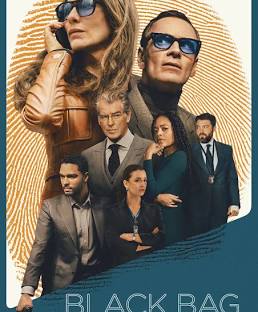
CAST: Michael Fassbender, Cate Blanchett, Gustav Skarsgǻrd
RATING: *** and a half
It’s quite serendipitous that while watching and then thinking about this latest espionage thriller currently showing on local Ster Kinekor screens, the US is again struggling with the latest scandal by what seems a most inept group of security heads.
That’s how seriously spying is taken in our modern world as different governments keep check on different countries to try to manage a world where we will all be safe.
Obviously the making of the movie happened long before all this played out, but be warned of a slew of spy movies popping up in the not too distant future. Those telling stories are already encouraged by the popularity of series such as Slow Horses and Day of the Jackal, both brilliantly made.
Casting plays a huge role, with Gary Oldman and Eddie Redmayne the stars in those two shows and here Soderbergh has gone for star power – Michael Fassbender and Cate Blanchett. Strengthening his case even more, they’re playing husband and wife.
And upping the ante, the one is investigating the serious offense of leaking sensitive information to the enemy. The stakes couldn’t be higher.
The scene is immediately set with a dinner party to which all the possible suspects are invited and we find them seated around the dinner table. Naturally, it takes a while to discover who is who but that’s the fun part of a spy movie. The story shouldn’t be so oblique that you never get to unravel it, but it also shouldn’t be too obvious so that you get to the solution long before it is revealed in the movie.
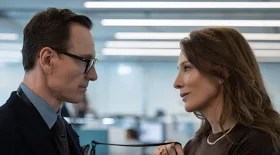
That certainly isn’t the case here. George (Fassbender), however, is facing a dilemma. What if his wife Kathryn (Blanchett) is the culprit? And that is where the tension and the intrigue lie.
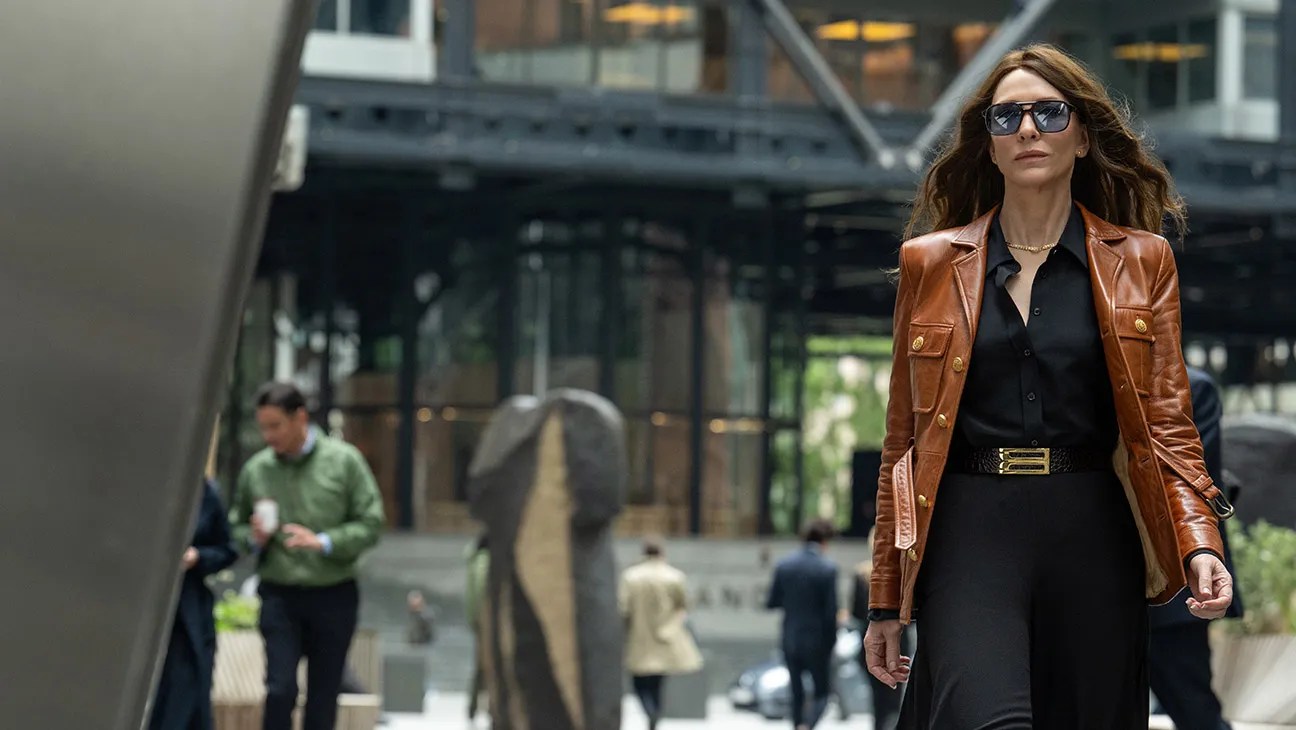
It’s all about style and luckily enough substance as these two actors play the game with great skill. Fassbender is the perfect spy with his inscrutable expression and formal manner while Blanchett, very fetching with long brunette hair, is much more vibrant and the one that you suspect could get in trouble because of her exuberant nature.
These might sound flimsy, but this couple have no problem playing their different roles and keeping you guessing. Is the story important? Not so much, which is fortunate because it could take you some time to get it worked out.
But that’s probably the point. If that’s what you like from your movies, this is it. You won’t get a better combination than Soderbergh and his pick of actors, which include an ageing Pierce Brosnan as their boss with Naomi Harris, Marisa Abela (recently seen in Industry) and Tom Burke completing the strong line-up.
It’s fast, extremely easy on the eye and yet the tension takes hold right from the start because the stakes are high. All the ingredients of the spy thriller are there, perhaps too perfectly to give it a strong beating heart.
Both the television series mentioned above focus more on the characters. With Oldman as the odd ball Jackson Lamb you’re immediately hooked and, with the tension created by the high stakes with Redmayne as the assassin, you’re also pulled in. With a movie, it relies more on the story because of the time constraints. This one falters because it has less time to embroider, but it is a much faster ride and more exhilarating as the denouement is the ultimate goal. Need a few hours of escape? This will do it!
CAST: André Odendaal, Oarabile Ditsele, Chantal Stanfield
DIRECTOR: Lesedi Job
VENUE: Pieter Toerien’s The Studio at Montecasino
DATES: Until March 16
Everything to my mind seemed aligned for this one. I found the casting as well as the director intriguing, a new local play is always something to be excited about and Paul Slab has a way of climbing into a story.
At the same time, it also makes me nervous. I don’t want to raise my expectations by thinking ahead, but one can hardly prevent it.
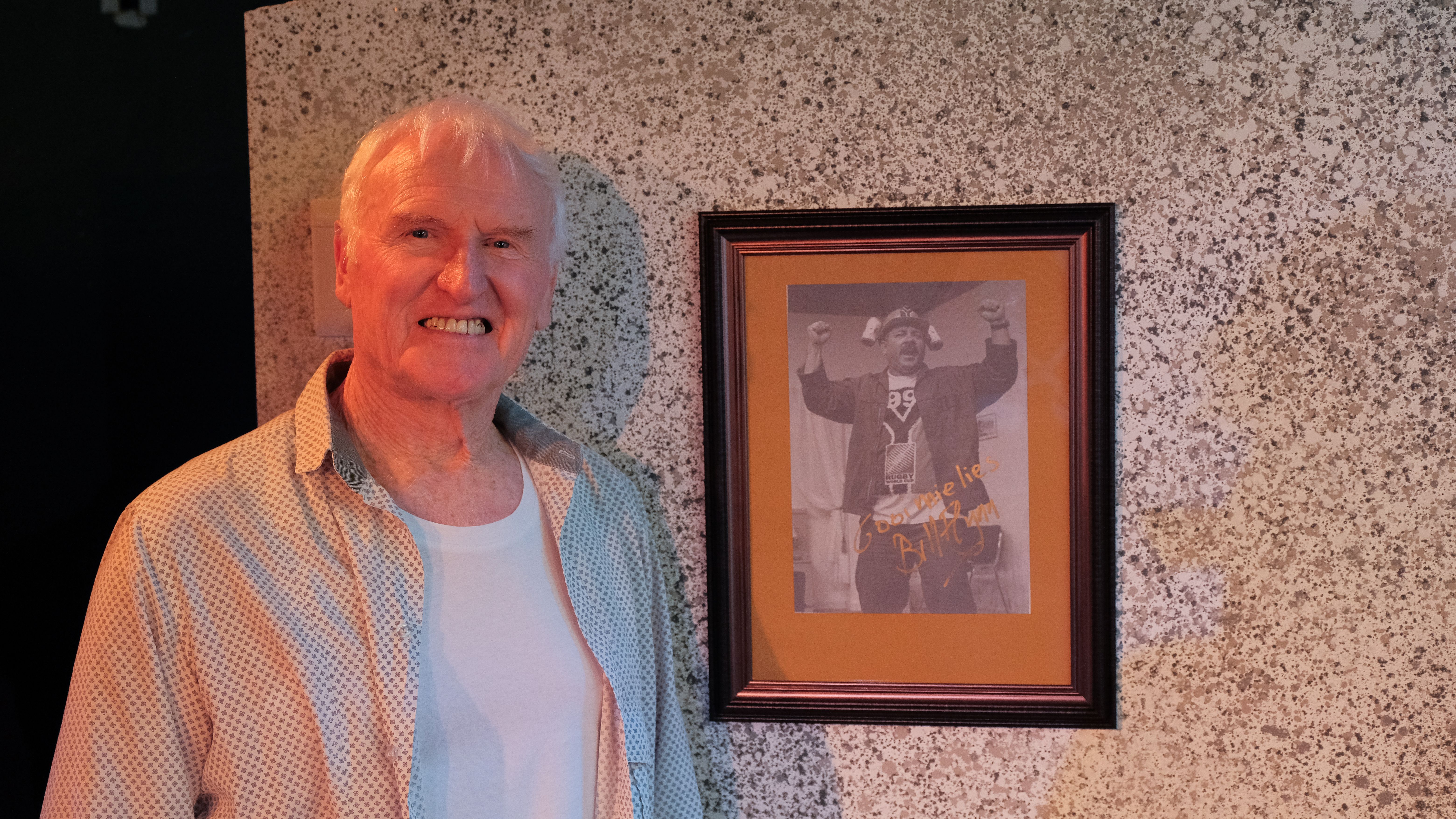
Ensemble cast (Chantal Stanfield, André Odendaal and Oarabile Ditsele) and playwright Paul Slabolepszy
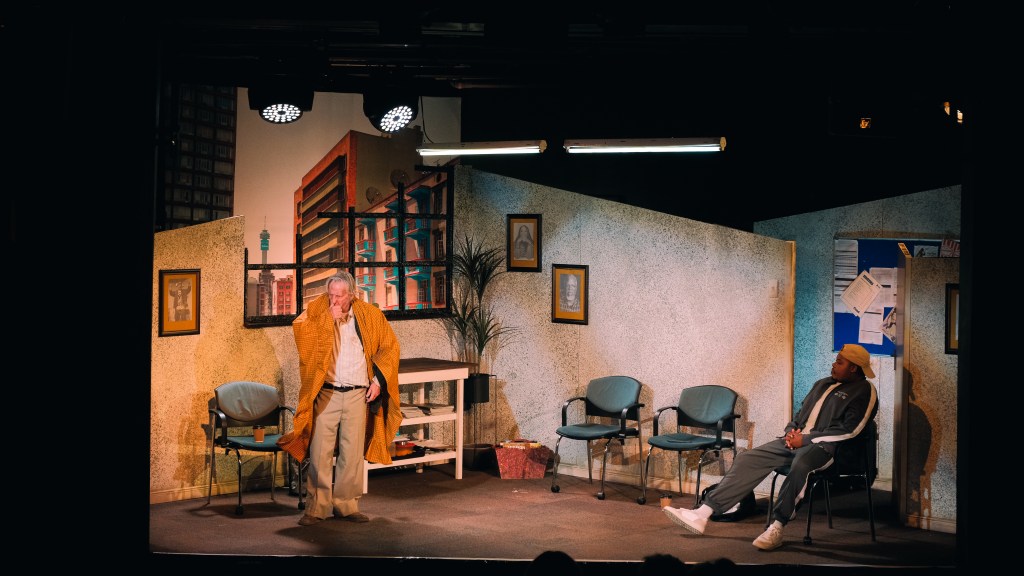
Either way, I was quick to exhale once the actors found their way on stage. One feels it immediately. It’s two actors in a room waiting (rather like a doctor’s waiting room) to be auditioned.
Anyone who knows anything about theatre knows that this is both an exhilarating and a scary experience. Not many of us have to sell ourselves in such a public way each time when applying for a new job. And like most things in life, there’s not really anything that can be done to alleviate the nerves crashing into one another at high speed in these circumstances.
Not only that. If there’s something Paul knows everything about, it’s this. Both as a writer and an actor, it’s a scenario that he has lived most of his life – and one feels all of that when watching the play.
The two hopeful actors (the one at the end of his career, the other excited about the life ahead) who don’t know one another are sitting in a room checking each other out. Times are tough – not only for actors – and this is not a friendly space. There’s no one around trying to soften the gig they’re waiting for.
Every once in a while, a rather officious woman enters and, while she’s charming to the one actor, she bristles when the other asks anything. The tension is palpable.
Already a scary space for all involved, it is also heightened in the South African context. And this is what the playwright handles so well. He plays the moment and not the context, which he leaves to the audience to experience.
It’s subtle yet clichéd but with this clever script and a team who works with everything they’re given, it sweeps you along.
The title could work in two of our languages, English and Afrikaans, and that’s another trick up Slab’s sleeve. He has both languages (as well as three more indigenous languages inluding Sesotho, isiZulu and Tsotsi) flowing throughout and, in this instance appropriately and with some delicious irony in hand as he points to the state of the arts in general.
The choice of actors and director, novel and genius, adds to the grit and weightiness of what we’re dealing with. It’s not an easy world to navigate in current times and if your particular career choice constantly also takes you to the edge of life’s challenges, it can be excruciating.
And yet, that is where these people involved choose to play. That is exactly what this play explores. It’s part of who they are and what they have to do.
Bitter Winter is a fantastic vehicle for someone who has been in the game for some time and knows the territory, the people and their insecurities, and the fears involved. But then he also knows how to capture the magnetism of live theatre, how it cherishes the soul, captures our imagination and makes you think.
It works because everyone pulls together. The acting, the directing and the text all play their part.
I can hear Paul say Local is Lekker in his exuberant manner. And he’s right. When it works this wonderfully, it’s a joy to behold.
Bitter Winter is donating a portion of ticket sales to the Theatre Benevolent Fund and every cent counts.





 De Beer Necessities