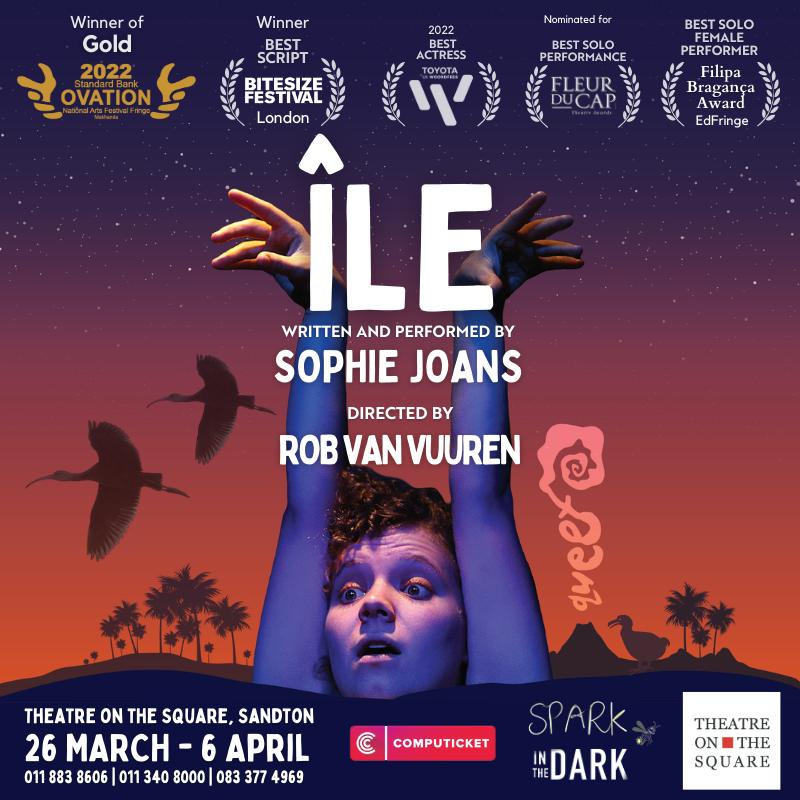
The luminous Sophie Joans in a solo performance of a play she has written.
Theatre review of ÎLE finishing this weekend at Sandton’s Theatre on the Square by DIANE DE BEER
PICTURES: PHILIP KUHN
ÎLE
WRITTEN AND PERFORMED BY: Sophie Joans
DIRECTED BY: Rob van Vuuren
DATES: Today at 7.30pm; tomorrow at 5pm and 8pm
When you’ve been around in the arts for as long as I have, it’s always an unexpected thrill to discover a new talent.
Solo performances are obviously a handy talent to have in your bag of tricks because of the precarious nature of theatre and the performing arts. If you have to rely solely on managements, festivals and directors to keep your career going, it could be disastrous – and tough on your anxiety levels.
With the ability to write and perform, you can create your own work, pack a bag and travel from stage to stage or whatever entertainment platform you prefer. If you have presence, which is something that’s difficult to explain, (you either have it or you don’t), it’s a gift that should be cherished.
Sophie Joans has all of the above and more. It’s a powerful package. She’s also obviously smart to not go it completely alone but to have the skilled Rob van Vuuren on board, someone who has made the stage his home, as director.
She bounces on stage bubbling with energy and enthusiasm and launches into a travelogue with Mauritius and her mother as the main destinations – and right from the start, she holds your attention with a smart and hilarious script. She taps into the ever-fraught relationship between mothers and daughters, where the one is wise if weatherbeaten and the other knows all the answers and doesn’t want to be prompted on how to proceed in life.
We all recognise family foibles in some fashion, but this is where the writing is witty and wise. Yes, it sounds hellish and many of us will think of our mothers and their lesser indiscretions with relief, but the way Joans reflects on and rants about her family is so cleverly charged, even when it dangerously skirts the edges, that there’s always something to hold onto as the younger Joans finds a way to explore her mother’s sometimes ferocious guidance.
It’s all about family narratives, the way mothers and daughters pass on a specific legacy that never seems to change. We all know how damage is done by those who have experienced that same pain themselves. We just have to look at the world we live in today to find all the examples needed.
While all of this might seem way too serious for someone who started in stand-up comedy, with some tweaking she has turned her sights to a more specific stage. Having just come from an arts festival, I know how exposed the stand-up stages can be, so she obviously knows how to handle a critical crowd.
This is something quite different. She presents Île as quite a personal story, enters the stage with very little but two large boxes which she moves around, and is aided by the best weapons: her words and her warmth.
She’s a storyteller, someone who holds her audience with confidence, and with a generosity and a gentle yet gregarious approach to her performance. She aims straight for the heart. If you can possibly make it in the time left over (it only runs till Saturday), Joans is a winner.
And I can’t wait to see where and how she goes from here. We’re a rather small theatre community, so when someone with such obvious performance genes hits all the right notes, it’s a time to celebrate and embrace.
She has travelled this play from small beginnings to world stages so obviously she has made a huge splash, but for me she’s the new kid on the block. And I could not be more delighted!
Thanks Daphne Kuhn (producer and artistic director of Theatre on the Square), your theatre smarts are always appreciated.
With Vrye Weekblad and journalist Deborah Steinmair establishing new book festivals in the wake of their success in Stilbaai, followed by the first one in Gauteng in Cullinan earlier this year and most recently in Clarens in the Free State, DIANE DE BEER, invited as an interviewer at the last two, gives her impressions of book festivals in general as VWB announce their next Cullinan festival from 10 to 12 May 2024::
Pictures: Deborah Steinmair
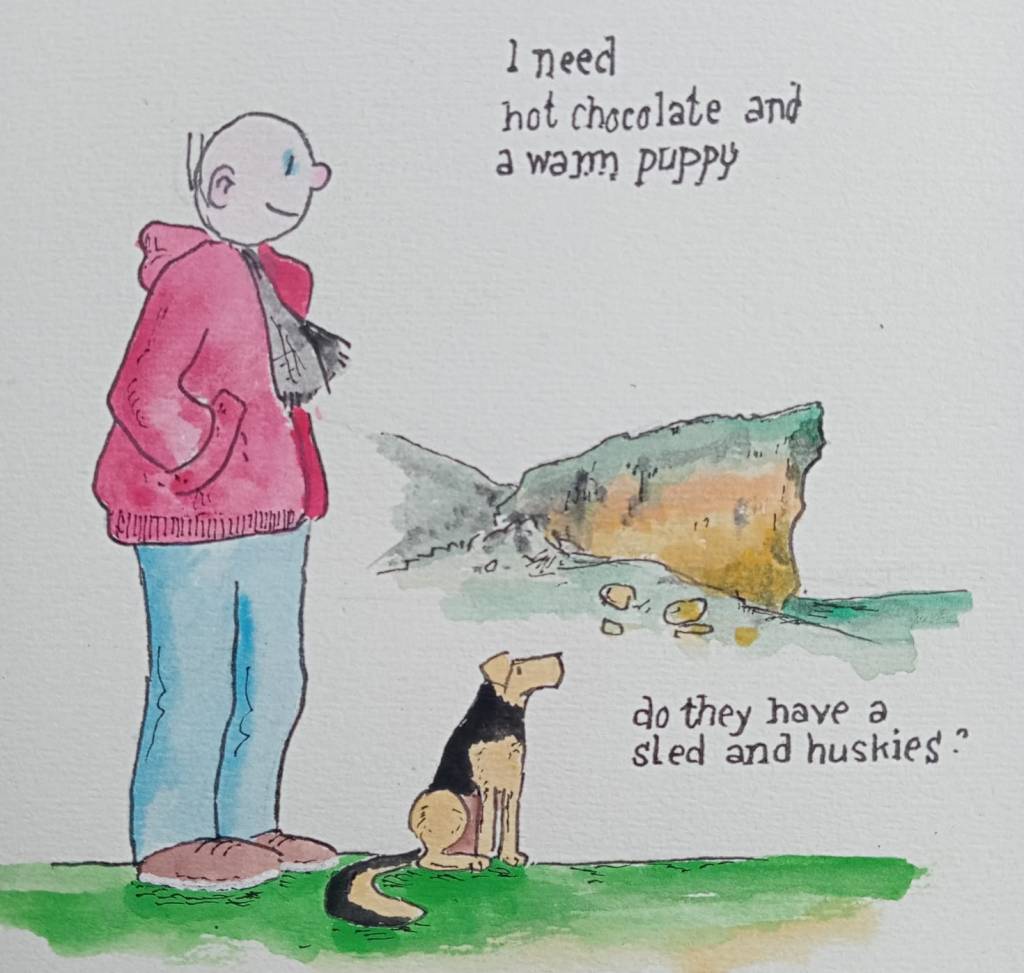
A man and his dog cartoons by Dries de Beer (Fatman).
Getting together a crowd of book lovers is no easy thing in these days of social media and streaming – there’s just too much on offer – but if you choose your specific book festival well, take the time and spend the money, it is a glorious get-away where you get to mingle and meet like-minded people and listen to a handful of authors talking about their latest work.
While my preferences won’t sound objective, as I was invited to participate as an interviewer at the last two festivals, what appealed to my sensibility was the curation of the festivals.
In conversation with two illustrators, Hanli Deysel, myself and Angela Tuck
First off, smart of the powers-that-be at Vrye Weekblad to know that Deborah, someone with a fantastic knowledge of books, an author herself, and a brilliant columnist, also has a deliciously quirky sensibility which then becomes part of the programme.
If you’re having a festival in the Free State, Antjie Krog is a name that would be impossible to ignore. But then to ask her to read from her latest delightful Vetplant Feëtjies (Vetplant Fairies), creatively written and illustrated, together with some poetry from her latest collection Plunder (also translated and published as Pillage) was genius.
It’s obvious why she won the Herzog Prize for poetry twice, most recently in 2017.
Just selecting at random:
It no longer comes to me
Everything is iron everything has congealed
I read how others write:
Clove brown, Prussia blue, and creamy, creamy your neck
Your long, long, long legs fill me with fury
But to me?
To me it simply no longer comes
once I belonged to the ones on fire
now my voice wants to drift
it trembles repulsively clammy with care and forgiveness
For me, personally, she should never stop, with a mind that’s razor-sharp, older yes, but that also makes it even more wise and witty. What does she have in mind next?
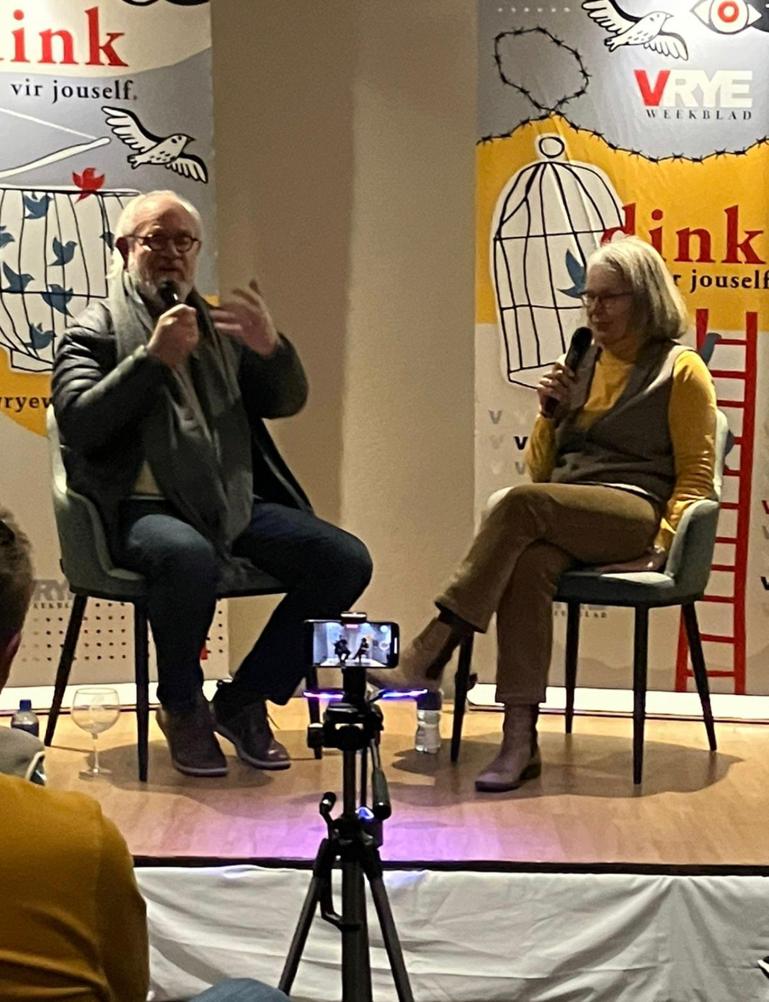
And, cleverly, Deborah knew how to pair two wise journalists. It was a great idea to get two Free State born journalists/writers Max du Preez and Antjie Krog talking and reminiscing.
Max du Preez and Antjie Krog in conversation.
Both grew up in Kroonstad and Antjie spent more of her time there, while Max talks about missing this part of the world, while also celebrating his home city of Cape Town, where he says everything works.
And then he launches into a few famous authors who have left the country, some, he says, with a Nobel Prize under the arm …
And Antjie wonders about living in a country where no one knows who Gerrit Maritz is.
Max, who had passed through Winburg on his way to Clarens, wishes to become the champion of this neglected town.
But Cyril, they say, has said that the people shouldn’t be treated like charity cases. Everyone has something to give. Yet Max laments the process of Africa that is slowly engulfing the town, even if not quite done yet.
Antjie suggests that if you want to change or fix a problem, you have to bring the township with you. But Max questions how to criticise this country while contemplating the damage you might have caused. Even if you joined the struggle. You still have the privilege of whiteness which is something everyone needs to acknowledge.
As is obvious, it was a conversation between two people who know one another, who have similar backgrounds so that they can exchange thoughts and grievances without too much explanation.
And they progress…
“Wonderful things are happening in Afrikaans,” says Antje while sympathising with the Indigenous languages that suffered under apartheid.
We all have to acknowledge that we had more of everything: more Afrikaans radio stations and TV stations, more magazines and newspapers than any of the other languages. Now we have to do it for ourselves.
Joylyn Philips
And it is happening with Vrye Weekblad and these kinds of book festivals. And again Deborah’s special touch emerges as she includes young poets and authors like Joylyn Philips, who launches into song when starting her poetry presentation.
Bibi SlIppers
Or the bright-eyed Bibi Slippers who cunningly whets the appetite with readings from her then soon-to-be-published poetry book, which was recently launched.
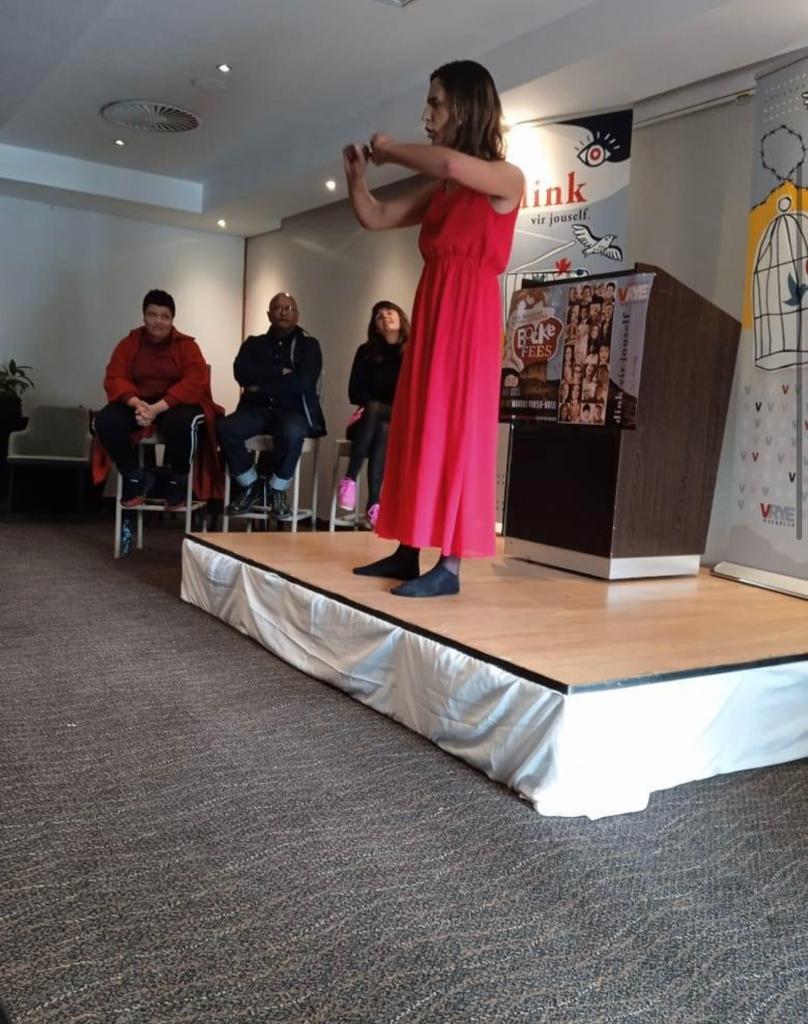
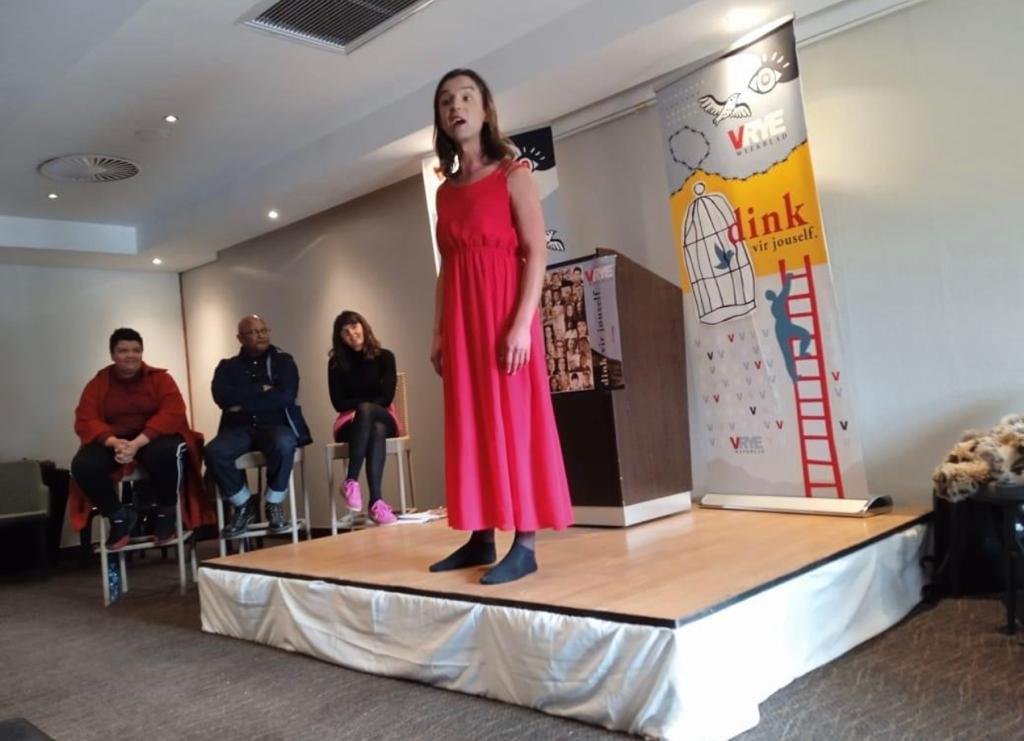
Dianne Du Toit AlbertzeIn performance.
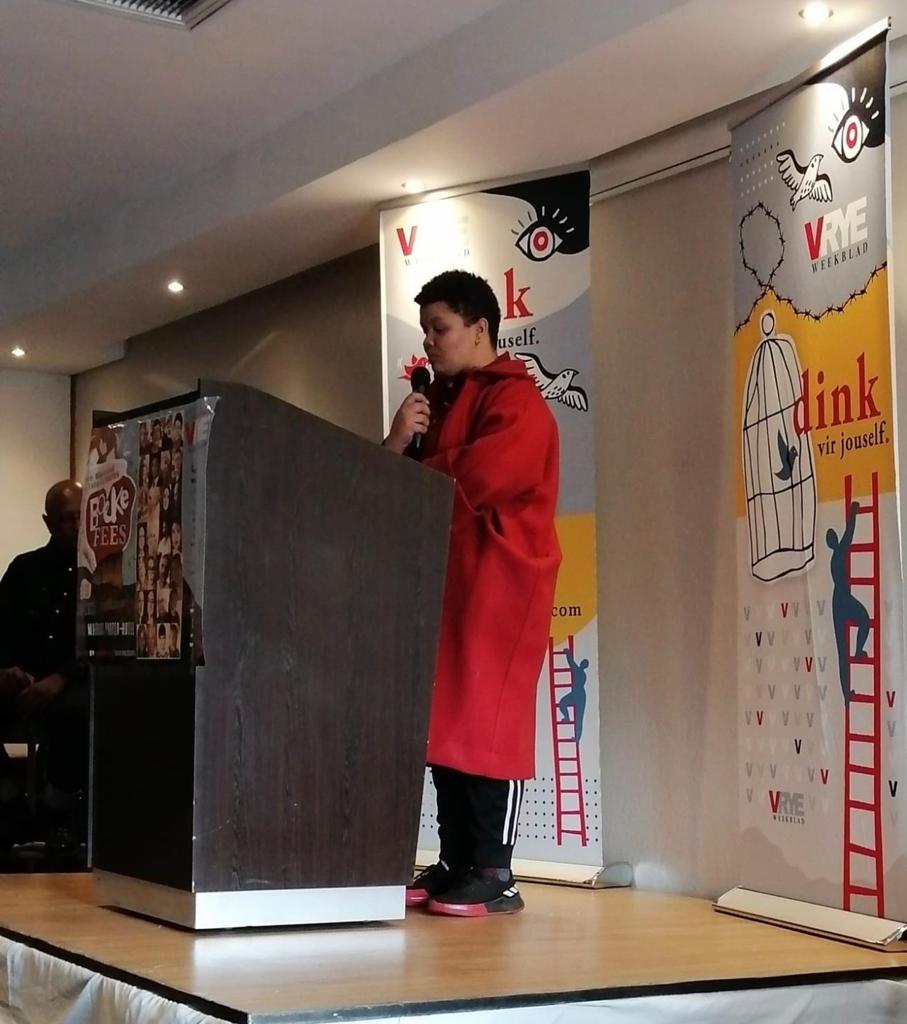
Yet, no one can rattle the rafters like the gloriously fragile Dianne Du Toit Albertze or, as they would say, Lady D. It was joyous to see them perform almost randomly dressed to kill in a shattering red dress which immediately screamed attitude, and then to back it all up with the talent of someone who knows they can take a stage while speaking in tongues … and they do.
This fresh breath of youthful exuberance during the gathering of the poets as the final salute of the weekend, captured it all. The dazzle and dare of Deborah is what makes you an ardent fan of her outspoken columns, all of which you wish you had said. And she brings that same flair and fanciful fanfare to a book festival – which is why these Vrye Weekblad festivals are worth watching out for. And a grand addition to the Afrikaans literary scene.
Yes, I know it’s mostly in Afrikaans, but Deborah knows about diversity even when limited most of the time, to a specific audience.
So get booking on Quicket for the next one, you won’t be disappointed and it’s in driving distance from Pretoria and Joburg!
Last year’s festival at the stone church in Cullinan.
PROGRAMME: The Vrye Weekblad-CULLINAN-BOOK FESTIVAL 10 – 12 May 2024
Will be held @Church venue. Books to be sold by Graffiti on the premises, food and drink will be on sale. Book at Quicket.
17:30: En tog die deuntjie draal (and still the music plays): Gielie Hoffmann chats on the birthday of singer/songwriter/poet Koos du Plessis with his wife, Mornay, about Erfdeel. His songs are also performed.
11:30: O, die vrolike, O die SALA! (Oh the happiness, oh the Salvation) Diane de Beer in conversation with Onke Mazibuko about his celebrated YA novel, The Second Verse.
16:00: Zonderwater en ver van die huis: (Zonderwater and far from home):Deborah Steinmair talks to Karen Horn about her novel about Italian prisoners of war: Prisoners of Jan Smuts
17:00: Psigopatiese nasie:(Psychopathic nation): Anneliese Burgess speaks to Karl Kemp about his book Why We Kill.
18:00: Kopstukke (Think pieces): A sizzling political debate about the election and other topics of the day with Piet Croucamp and JP Landman.
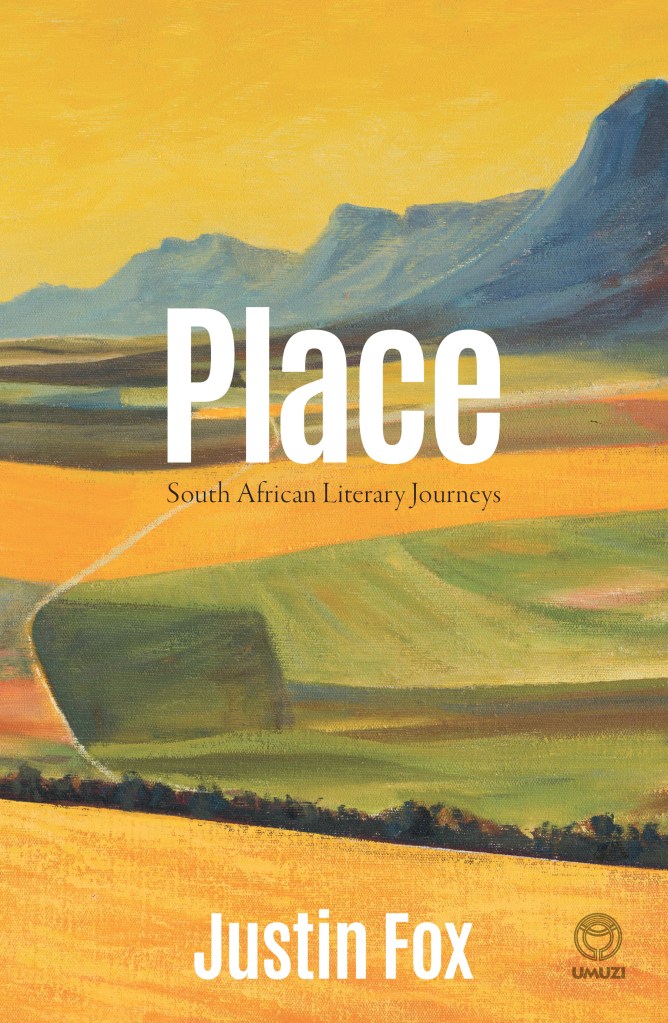
Author Justin Fox, as DIANE DE BEER discovers when speaking to him about his latest book, Place South African Literary Journey (published by UMUZI) at Garsfontein’s Boekeplek & Kuierplek, has a mind as restless as his wanderlust:
The cover is a painting by Erik Laubscher titled Overberg Landscape.
When you are sent a book and asked by a publisher to help with the launch in your city, your first instinct, especially if you don’t know the author, which I didn’t in this instance, is to hope that you won’t hate the writing or the book for that matter.
Up to now, I have been blessed and again, Justin Fox’s Place is one that I thoroughly enjoyed. I loved the writing, found it a wonderfully original concept and the reading very accessible.
What this author did was to select nine authors whose writing he found to be determined by a specific landscape or place, capturing the spirit, hence the name and the idea. Think, for example, of someone like Herman Charles Bosman and your mind automatically reaches for the Marico or Dalene Matthee’s passionate love affair so inextricably linked with the Knysna forest.
Zakes Mda with his Heart of Redness is nestled on the Wild Coast, JM Coetzee has Michael K traveling and hiding in the Moordenaars Karoo and Olive Schreiner’s Story of an African Farm has its footprint in the Eastern Karoo.
The Lowveld is Jock of the Bushveld’s stomping ground, Deneys Reitz’s adventures, Justin narrowed down to the invasion of the Cape with Eugene Marais finding solace with his baboons in Waterberg.
The only one I wasn’t familiar with and the author with whom Justin perhaps identified with most strongly is Stephen Watson, who had a strong affinity with the Cederberg.
Wondering if he had qualms about not having the perfect representation, he admitted it was something he thought about, and he did try. He had to rely on authors who had a special affinity with a particular landscape or region, which was reflected in their writing.
With this mix, he also spread the love throughout the country geographically and in the end, that’s what determined his choice.
When first reading the book and seeing that it was In Memoriam of Uys Krige, I wondered whether he was related to actress Grethe Fox, whom I have encountered in my theatre writing. And of course, she is his sister and joins him (as he writes) on one of his author adventures.
They are indeed a family truly invested in the arts. Justin’s father is the architect Revel Fox and his mother is Uys Krige’s sister, then there’s also a filmmaker … and the list goes on. And then he divulges the family secret. His grandmother Sannie Uys was determined to guide everyone in the family into the arts.
In fact, she felt this so strongly that it was highly frowned upon if someone decided to turn to medicine or law, for example! Especially in terms of for the richness of the arts, wouldn’t this country flourish if there were more of these kinds of grandmothers? Anyone linked to the arts in even a minor way will know how a life is enriched.
The Geelbek Blockhouse also features in the book.
The wealth of artists in one family when taking a peek at their family tree starts to make sense. That and Justin’s particular bent and imaginative mind. There’s not much he hasn’t tried in the artistic sphere of witing. He is listed as a travel writer, novelist, poet and photographer and, as the former editor of Getaway magazine, he could easily include most of his passions in his daily life. And now, having left them, it’s easy to see how he keeps doing what he does – writing mostly books.
For Place, for example, he travelled to all the places of his chosen authors so that he could not only write from his research on the authors but also experience the place for himself. And that’s what makes this such an intriguing read. It’s as though he has aimed his skills sharply for this endeavour – and it serves him and his reader well.
Even someone like Dalene Matthee’s favoured region (which is close to where I spent my youth) came with new insight from this reading. And probably much of this can be linked to the fact that Justin has “itchy feet”, but also that the research is what really inspires him. It is what he enjoys most and what obviously informs and enriches his writing.
Having travelled the length and breadth of Africa during his former life as a journalist also brings much knowledge to bear. And then probably his writing was further nourished and polished by his doctorate in English at Oxford as well as his time as a research fellow at the University of Cape Town. But don’t expect to find a bookish approach to his storytelling or his writing. The way he uses language is one of the joys of the reading experience.
His latest endeavour or, perhaps more accurately, the one he is hoping will receive more attention is the two books already finished and hopefully a handful to come of his fictional World War 2 novels with Jack Pembroke as the hero. Justin describes himself as a Jack of all trades, but that’s underselling his expertise.
He ascribes his writing in so many different genres (google his writing history) as “getting bored quickly”. His favourite author is Patrick O’Brian whom he describes amusingly as “Jane Austen at sea”, as well as crime stories, and then of course he loves reading anything about World War 2, hence the fictional series in which he focusses on adventures from the war, unfamiliar to many. The current one with a South African focus is a battle that has been forgotten by many.
His next focus is African islands which he hopes will have the same impact as Place, which has already sold out.
The Fox Family (Justin left) on a Greek sojourn, one of his earliest travels.
“I’m a nomad,” he says, and he concedes he has the bug worse than most. And while writing per se is not his happy place, the research, edit and travel to promote his latest invention all find favour. And that’s where his drive comes from and his determination to escape into another adventure – whether fiction or non-fiction. I’m crossing fingers that the current book, Place, will be so popular that the publishers consider a colour version richly illustrated with Justin’s photographs. That was the only missing element for me. His writing takes you to the places he describes so imaginatively and there are a handful of black and white pictures. I realise it was an issue of cost, but still …
The AVBOB poetry competition is a smart way to pay it forward in a country where words help to heal the past as well as celebrate hope. DIANE DE BEER celebrates the way the company has opted to play its part:
The AVBOB Poetry Trophies
If you think of projects companies could back to boost their philanthropic profile, poetry doesn’t immediately come to mind. But that’s exactly the route AVBOB, the funeral company, selected.
The link, of course, is the words. What do people need when attending a funeral or dealing with relatives or friends who have lost someone? And that’s what they have so cleverly done – while casting a wide net.
Not only did they decide to spotlight poetry, they also chose to feature all South Africa’s 11 languages in the process. What they have achieved even more smartly is to pay attention to the small stuff and to get it right.
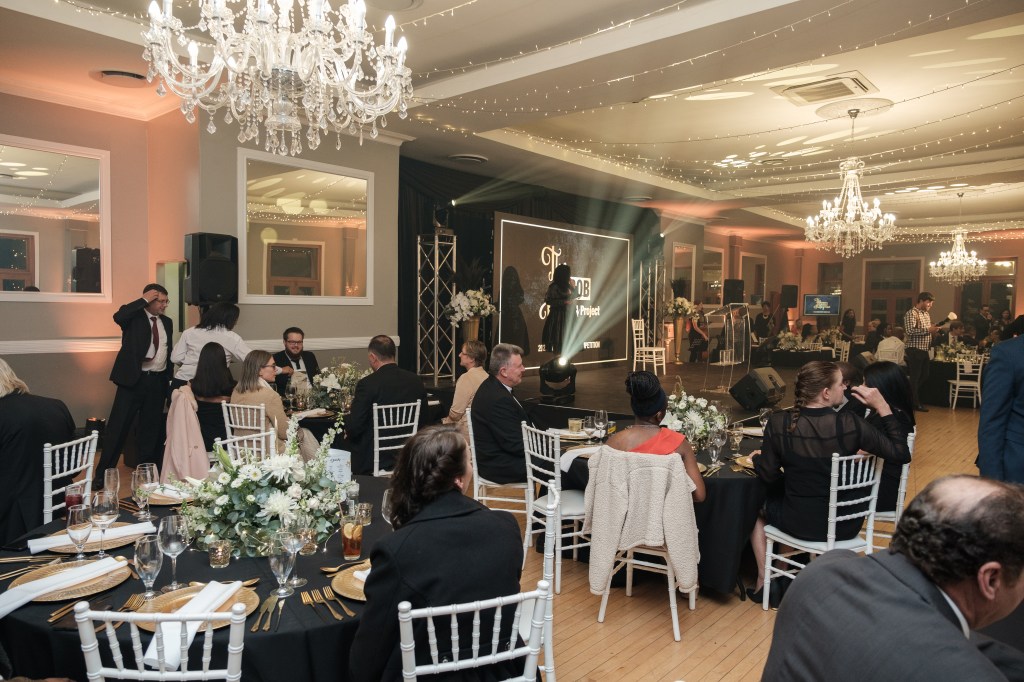
the two fabulous presenters who got the show on the road, Rozanne McKenzie and Bolele Polisa.Urban Strings Acoustic String Trio at AVBOB Poetry Competition2022 AVBOB Pretoria Country Club
It’s no small challenge to run a national poetry competition in 11 languages. And to then select 11 winners, one for each official language. Once these are selected, all the poems are translated and each year a poetry anthology is published to further celebrate the poems, and in the bigger picture, poetry as a whole.
Eleven talented poets were announced as the overall winners of the 2022 AVBOB Poetry Competition at a gala prize-giving at the Pretoria Country Club at the end of last month. The evening was a glorious celebration of the power of poetry to bring people together, to build community, and to offer uplifting words in times of loss.
AVBOB CEO Carl van der Riet in his keynote address described poetry as an art that has a unique ability to bypass the rational mind and logical intellectual process and to speak directly to the heart.
AVBOB’s CEO, Carl van der Riet
“We have a rich heritage of poetry in South Africa. So, as we each observe Heritage Day on 24 September, I would like to encourage all of us to also remember this unique part of our heritage which has served as such a beacon of hope and inspiration for people.”
Each winner received a prize which included R10 000 cash, a R2 500 book voucher, and an elegant trophy. Each guest also received a copy of the annual anthology containing the winning poems, I wish I’d said… Vol. 5, which was launched at the event.
Van der Riet explained, “The support of mother-tongue voices has been a primary aim of the AVBOB Poetry Project since the very beginning and so the editors were encouraged that 65% of all poems entered were written in South Africa’s vernacular languages.” He further noted that the AVBOB Poetry Library now contains over 17 000 poems, each of which earned the poet a usage fee of R300. That amounts to over R5.2m spent on building a cultural repository of poems available to those who need words of comfort and consolation.
The top six poems in each language appear in the anthology accompanied by an English translation. A selection of commissioned poems and four Khoisan poems from the Bleek and Lloyd collection round out the anthology. This comprehensive collection was compiled by the editor-in-chief of the AVBOB Poetry Competition, Johann De Lange, and the esteemed Xitsonga academic, literary translator and founding chair of the PAN South African Language Board, Professor Nxalati CP Golele.
De Lange said, “Poetry bears witness to our lives, our loves and our losses. It helps us traverse major transitions, giving us the words to name the feelings and to tame the emotions. It helps us to fathom what we must live for, define what we must protect, and focus on what we must promote in a changing world.”
Viewers around the country participated simultaneously via livestream on AVBOB Poetry’s social media channels.
The 2022 AVBOB Poetry Prize winners are: Clinton V. du Plessis (Afrikaans), Letitia Matthews (English), Nkosinathi Mduduzi Jiyana (isiNdebele), Sipho Kekezwa (isiXhosa), Nomkelemane Langa (isiZulu), Pabalelo Maphutha (Sepedi), Kgobani Mohapi (Sesotho), Molebatsi Joseph Bosilong (Setswana), Prisca Nkosi (Siswati), Mashudu Stanley Ramukhuba (Tshivenda) and Pretty Shiburi (Xitsonga).
To order I Wish I’d Said… Vol.5 SMS the word ‘POEM’ to 48423 (at a standard cost of R1.50 per SMS) to have it posted to you at a total cost of R240. Alternatively, email your order to tertia@naledi.co.za or find it at selected bookstores. Visit www.avbobpoetry.co.za to find elegiac poems for reading aloud at funerals or to include in memorial leaflets, and to register to enter the 2023 AVBOB Poetry Competition (which closes on 30 November 2022).
AVBOB POETRY PRIZE WINNERS IN MORE DETAIL:
2022 AFRIKAANS WINNER – Clinton V. du Plessis
Clinton V. du Plessis lives in Cradock in the Eastern Cape where he works as an accountant. He is a prolific poet with many poetry collections to his name and his work has appeared in translation in the international arena. Listening to stories on the radio was a powerful formative influence in his childhood. He particularly loved listening to PH Nortje’s Die groen ghoen and was desperately keen to read the book. His father, who was a labourer on the railways, persuaded his boss to borrow the book from the library on young Clinton’s behalf. His winning poem Leemte is an achingly tender tribute, written in honour of his father.
2022 ENGLISH WINNER – Letitia Matthews
Letitia Matthews feels blessed to live on the southern border of the Kruger National Park with her husband, Peter. She’s a freelance web and graphic designer who found that helped her through heart-breaking losses. As a cancer survivor, she realised that loss also leads to new life and adventures. These experiences showed her how to navigate bereavement. Her poem Time Of Death comes from the dark nights and empty days that eventually led to her embracing life again.
2022 ISINDEBELE WINNER – Nkosinathi Mduduzi Jiyana
Nkosinathi Mduduzi Jiyana is known in spoken word poetry circles as Gembe Da Poet. He comes from KwaDlawulale in Limpopo, and after discovering a love of writing poetry in 2018, established a reputation as a vibrant slam poet. His poem Ithemba alibulali encourages youth to be strong, to resist fear, and to remain faithful when grief strikes. He believes that by entering the poetry competition he is exhibiting his writing talent.
2022 ISIXHOSA WINNER – Sipho Kekezwa
Sipho Kekezwa is a prolific and multi-award-winning author of children’s books, dramas, short stories and YA novels. He started his writing life as a voracious reader. Various of his titles have wearned significant acclaim over the years, but this is his first poetry award. His dramatic work, Ubomi, ungancama!, published by Oxford University Publishers in 2020, won the 2021 SALA Award in the Youth Literature category. Sipho’s winning poem ICocekavaras is a plea to heed common sense and to get vaccinated. After living in Khayelitsha for 26 years, he recently returned to East London to continue his work as a freelance editor, proofreader, translator, book reviewer and creative writing facilitator.
2022 ISIZULU WINNER – Nomkelemane Langa
Nomkelemane Langa claims the majestic rolling hills of northern KwaZulu-Natal as his geographic and cultural heritage. Born in the deep rural village of Nkandla he now lives in Richards Bay where he freelances as a TV producer and presenter, Maskandi singer and guitarist, author, poet, crafter, actor and MC.
His winning poem Mhla lishona ilanga is an aching portrait of grief set between the last light of dusk and the first light of dawn. He started writing poetry in high school as a member of the Isulabasha Dancing Pencils Writing Club. He attributes his success to the ancestral promptings that guide his words.
2022 SEPEDI WINNER – Pabalelo Maphutha
Praise poems and powerful words were Pabalelo Maphutha’s inheritance at birth. He was born into a family of traditional praise poets and writers in rural Ga-Mphahlele in Limpopo, and grew up with a deep love of the written and spoken word. He began writing and performing his own poems in the mid-2000s, while still at school. He has appeared in various theatrical and film productions and is committed to serving his artistic goals with passion, focus, and dedication. His poem Se išeng dipelo mafiša reflects on the process of aging and death and will comfort all who have lost an elder.
2022 SESOTHO WINNER – Kgobani Mohapi
Kgobani Mohapi comes from the eastern Free State town of Lindley. He has entered the AVBOB Poetry Competition every year since its inception to test his poetic skills against the best in the country and came second in 2019. His poem Ke o entseng deals with the issues lovers would ask after a separation. He was inspired to write poetry by his Sesotho teacher, Mr NJ Malindi. Kgobani is also a novelist, with a novel titled Lerato.
2022 SETSWANA WINNER – Molebatsi Joseph Bosilong
Molebatsi Joseph Bosilong is an educator and a published author from the North West province with an enormous passion for the arts. He is an engaged member of the regional writers community, committed to sharing opportunities and information with fellow Setswana writers. His poems appear in Volume 4 of the poetry anthology, ‘I wish I’d said…’ He used the form of the Mosikaro, which uses the first letter of the first word of each line going downwards to spell out the word Tsholofelo, which means hope. Tsholofelo is both the title and the theme of his poem, which pays tribute to the health workers who battled the pandemic and the hope for a vaccine to defeat the virus. He wrote this poem to heal from the pain of losing his mother.
2022 SISWATI WINNER – Prisca Nkosi
Nomvula Prisca Nkosi started writing short stories and poems at a very young age. She lives in Ermelo, where she works at a hamburger joint. While she makes fast food, she has many deep thoughts. She decided to enter the competition to improve her writing skills and to give voice to her rich imagination. Her poem Imihuzuko explores the scars that tell of life’s injuries. “Some people lose hope while others gain strength through their suffering,” says Prisca, “and to share the experience inside me.” This is her first poetry award.
2022 TSHIVENDA WINNER – Mashudu Stanley Ramukhuba
Mashudu Stanley Ramukhuba was born in Ha-Rabali village in Limpopo’s Nzhelele Valley. He attended Rabali Primary School and, later, Patrick Ramaano Mphephu Secondary School, where his love of poetry grew strong. He was inspired to enter the competition on the death of beloved family members. “When my sister died very young, it was hard to believe I would never see her again,” he says of his winning poem Maḓuvha a mudali. This carefully crafted and formal work honours his sister’s life. The poet reminds the reader in a wise and gentle tone that we are all visitors on this earth, and encourages us to consider our legacy. Mashudu is married and currently unemployed.
2022 XITSONGA WINNER – Pretty Shiburi
Pretty Shiburi is a poet making powerful connections. Born and raised in Madobi village in the far northern part of South Africa and currently studying electrical engineering at Westcol TVET College in Krugersdorp, this is a poet who makes sparks fly. Her darkly funny poem N’hwembe explores the idea of home and ownership by examining a pumpkin vine, which causes consternation in its wanderings into the neighbour’s yard. This playful metaphor demonstrates her love of her mother tongue and offers a wry glance at other wanderers.
















 De Beer Necessities