SYLVAINE STRIKE’S INSIGHTFUL PLAY WITH DAMON GALGUT’S BOOKER PRIZE WINNER THE PROMISE

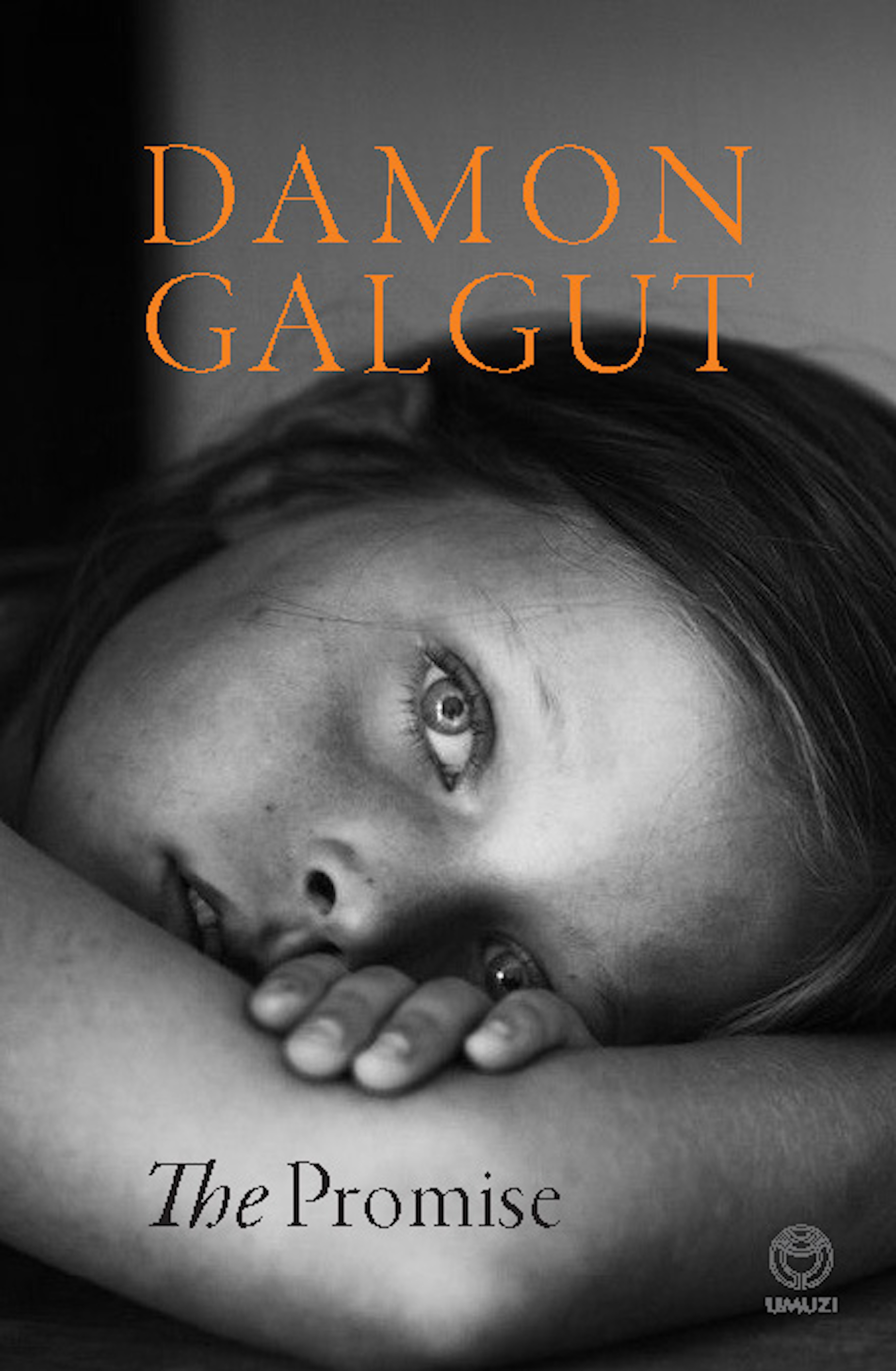
Time was the rare gift that celebrated director Sylvaine Strike was given with her latest production, The Promise, written and adapted (from his novel) by author Damon Galgut. She tells DIANE DE BEER more about the extraordinary process which started more than 18 months ago and is on at The Market (until November 5) following its recent Cape Town run:

“In a way, The Promise selected me,” she explains, because Damon approached her to adapt it for the stage, thinking that she would probably be the right fit because he had foreseen that it would have to be done very theatrically and very physically if it were to have a theatrical life at all.

She was utterly smitten by the idea, but insisted that Damon adapt it alongside her because she was reluctant to tinker with his text. “I needed him to travel the road and structure it in a way that he would feel could live as theatrical version.” She had read the novel twice even before he contacted her and was delighted.

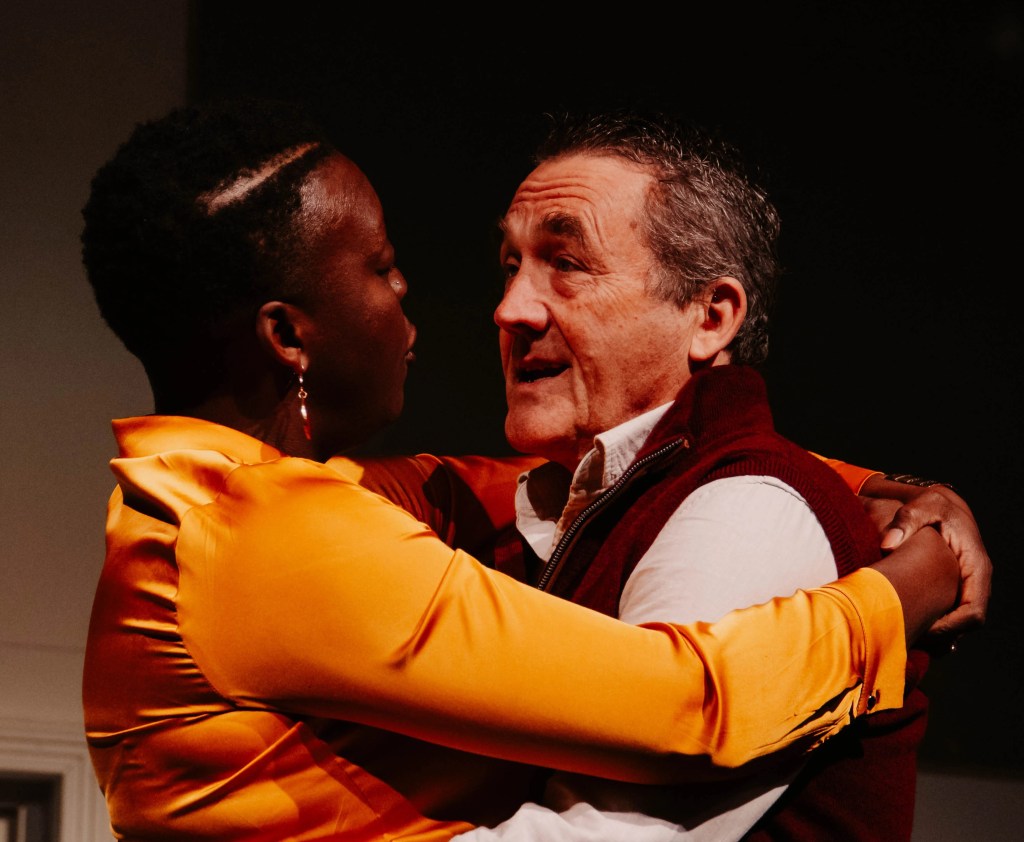
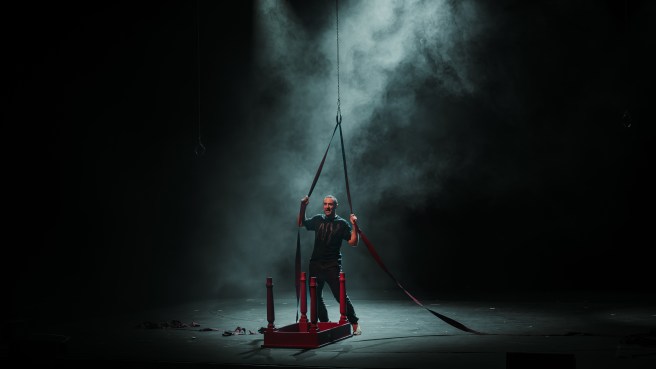
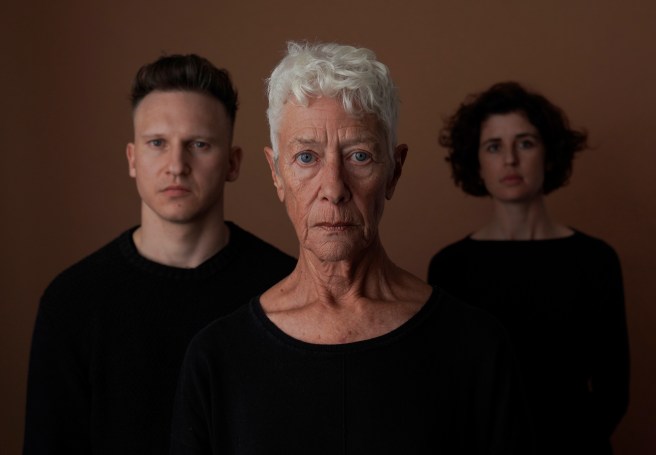
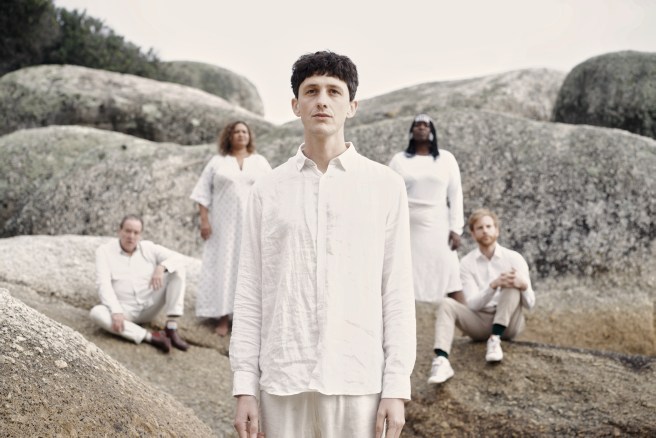
The Promise with the full cast as well as author, Damon Galgut (left) and Sylvaine Strike (right).

When it came to casting, it began with finding the right person to set the bar from a physical perspective and she knew from the outset when reading The Promise and imagining who her Anton could be, that it was Rob van Vuuren.

Gifted this opportunity of a role that is a once-in-a-lifetime experience, Rob was thrilled just to delve into this exquisite character and the very many facets of it. Sylvaine knew he would be the one who she would work off in finding the rest of the family, which includes Frank Opperman as Anton’s father, an Afrikaans patriarch, Kate Normington as his mother, jenny Stead as Astrid, his middle sister, and the young Jane de Wet as Amor

“The pivotal and most important character of Salome is played by Chuma Sepotela, who holds this exquisite part in two dimensions in the sense that she’s also the narrator of the piece, as Chuma herself, who plays the story conjuror.”

Sandu Shando plays Lukas, Salome’s son, and “the amazing Albert Pretorius and Cintaine Schutte, both adding deep dimension, comedy and pathos in the roles of Tannie Marina and Okkie as well as the many characters they portray,” she concludes.

In total it’s a cast of 9 and, before anything else, they did a workshop with Sylvaine to discover the physical language as the blueprint to the play.

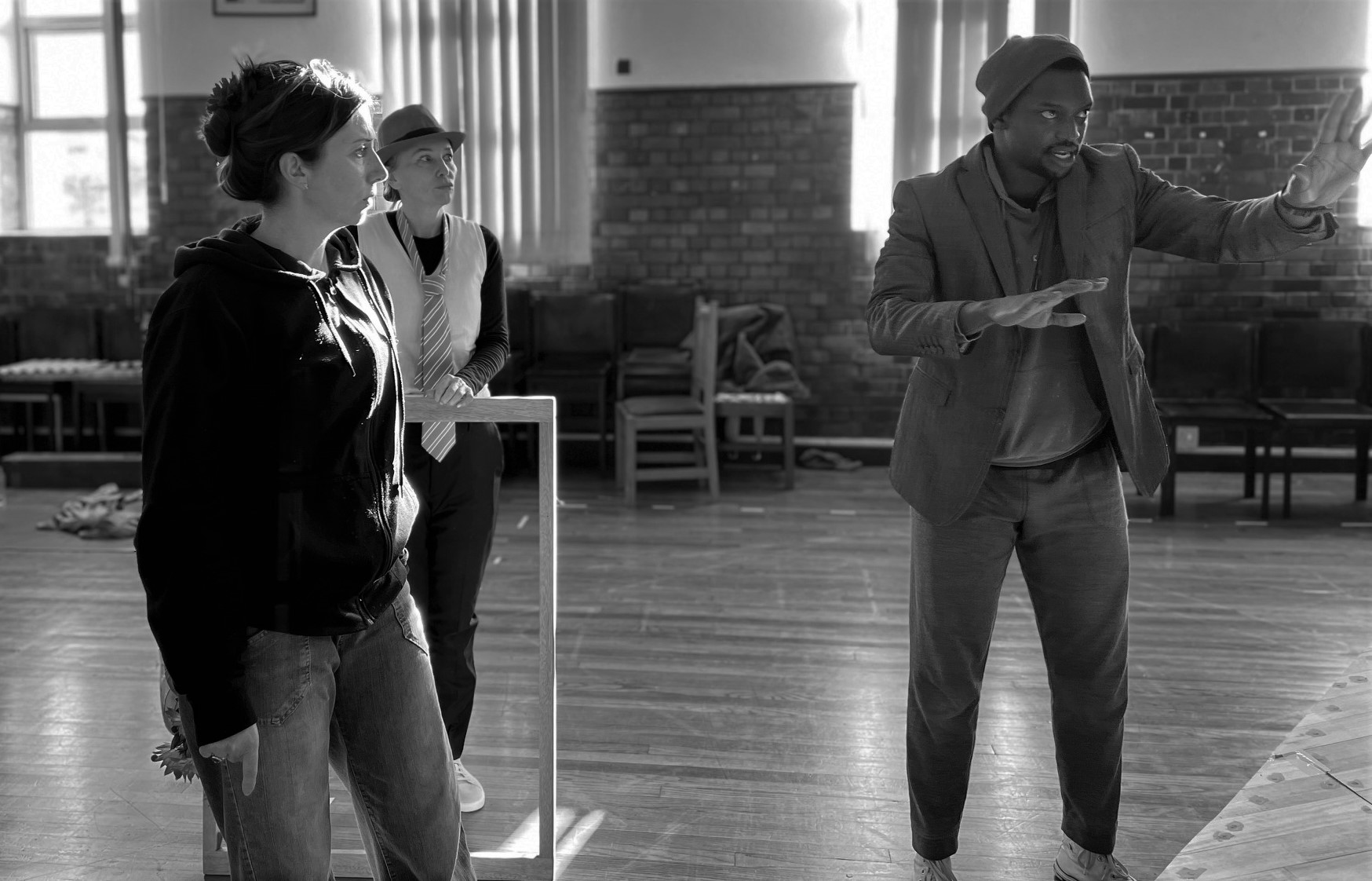
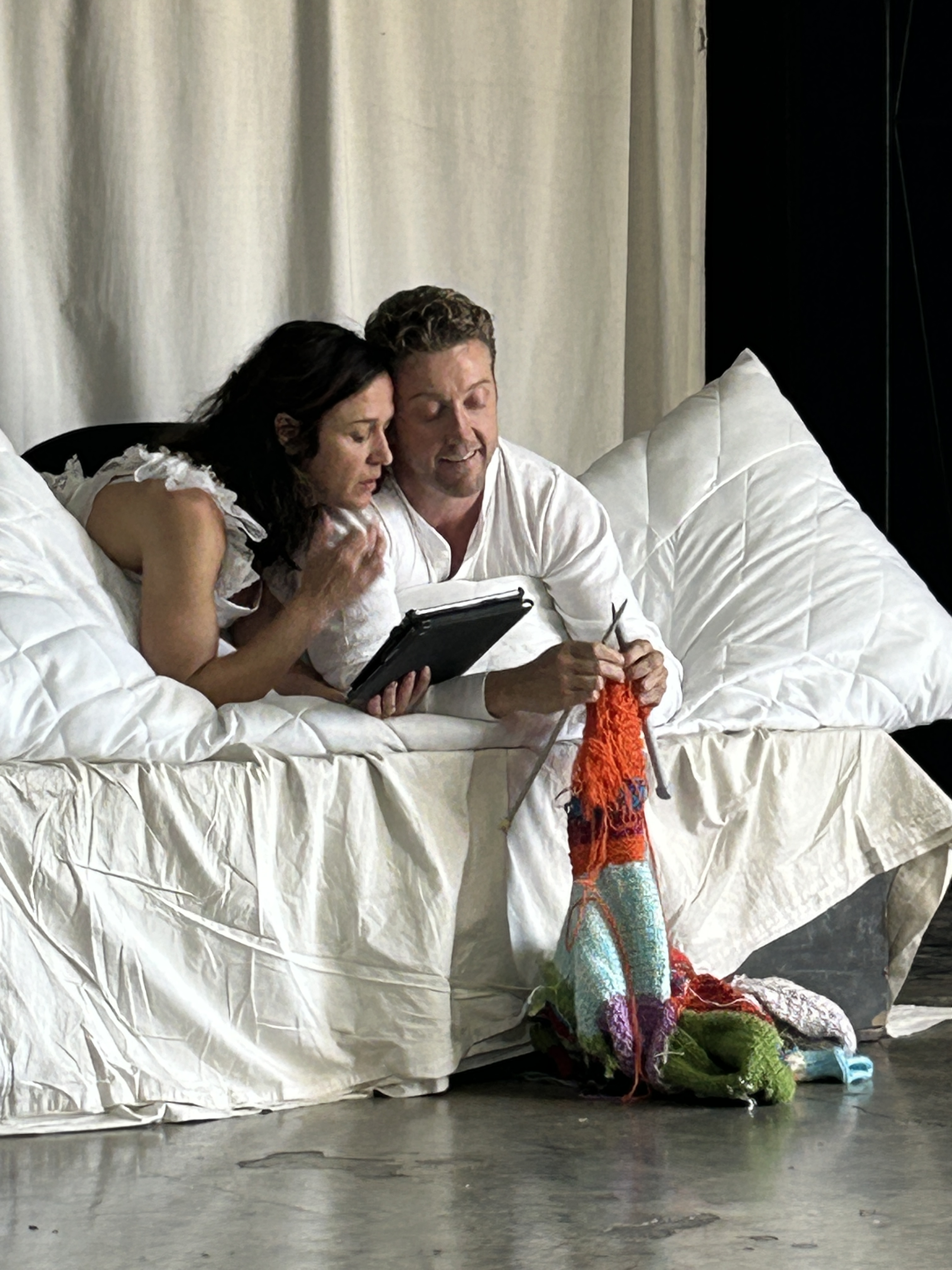
In rehearsals: the cast and director Sylvaine Strike.

With both the director and writer growing up in Pretoria, their coming together was almost written in the stars. “I think growing up in Pretoria and being aware of the glaring chasm between the haves and the have nots, the ability for Pretoria to ride that knife edge between ignoring the political reality, the lies that have been woven to its children, the incredible duality between darkness and light, tragedy and comedy that this book engages with and its calling out for us to face the shame for how we lived,” all of that made the book irresistible.

“There’s no escape but to look it in the eye, which is what this was and showing what it felt like for me. The novel forced me to do it as it named everything I was feeling growing up there as a child and being a teenager there and sensing that something was so terribly wrong with it.

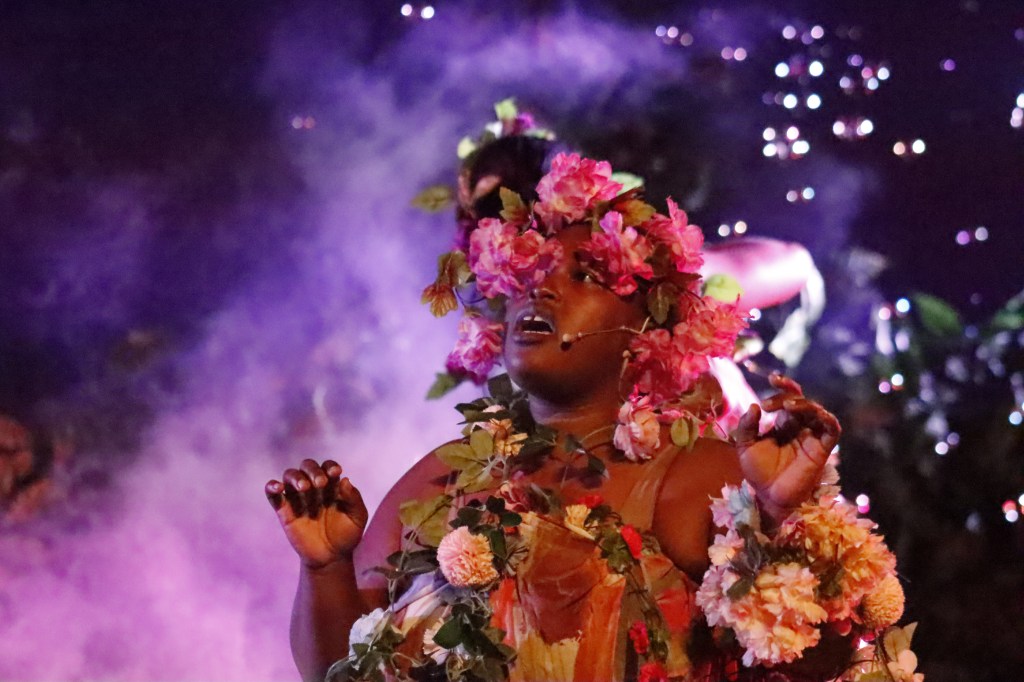
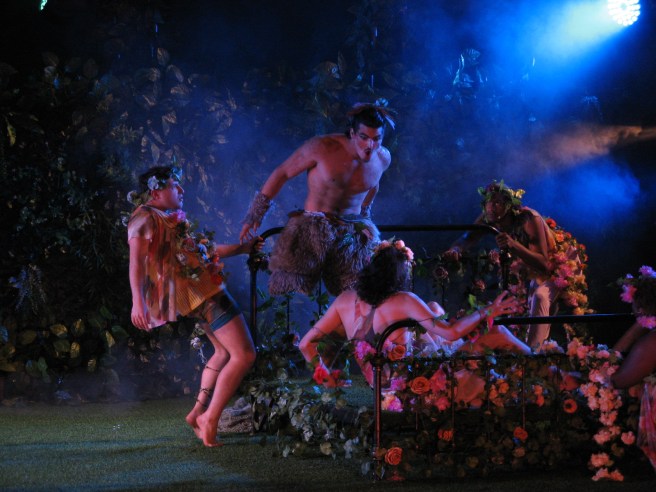
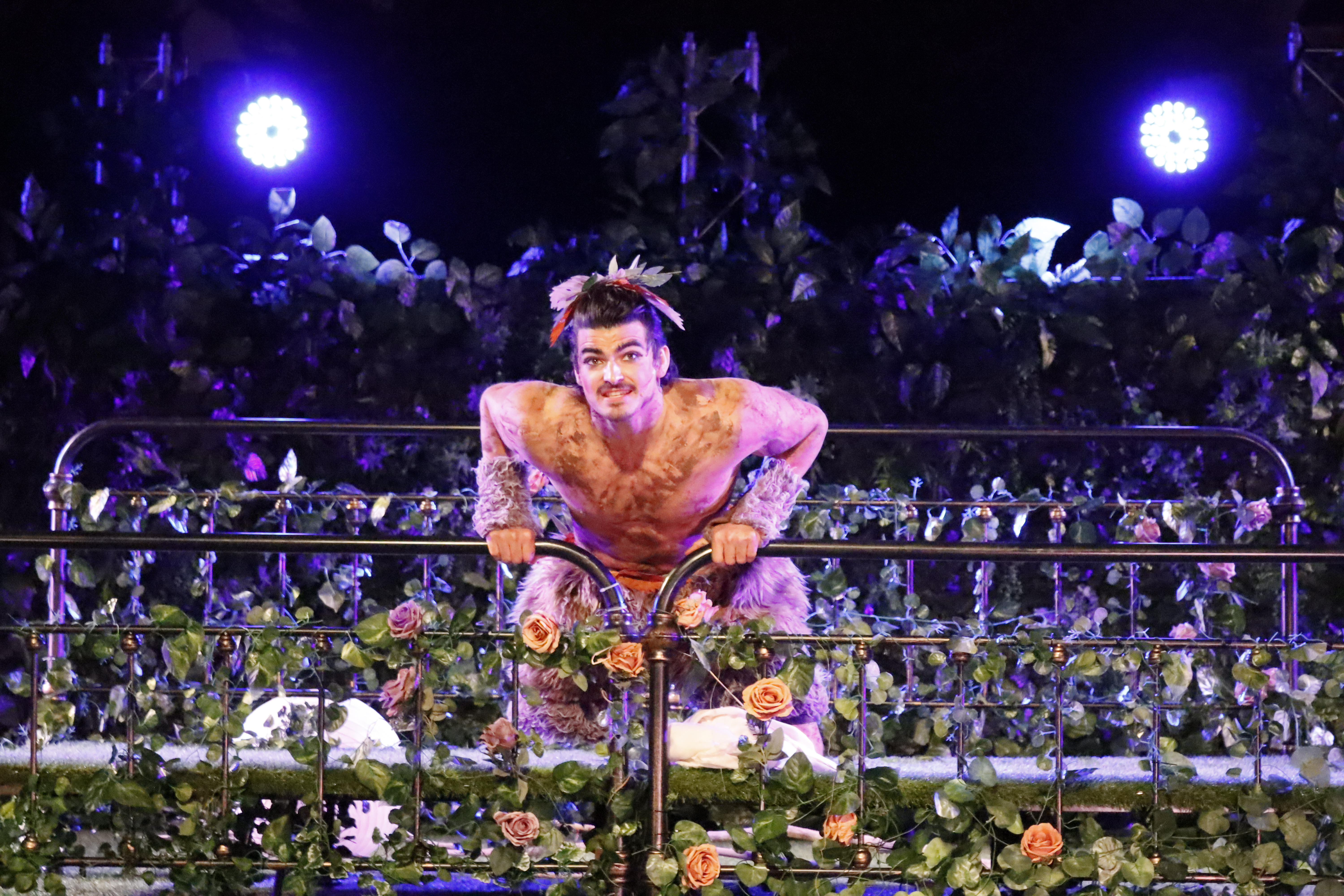
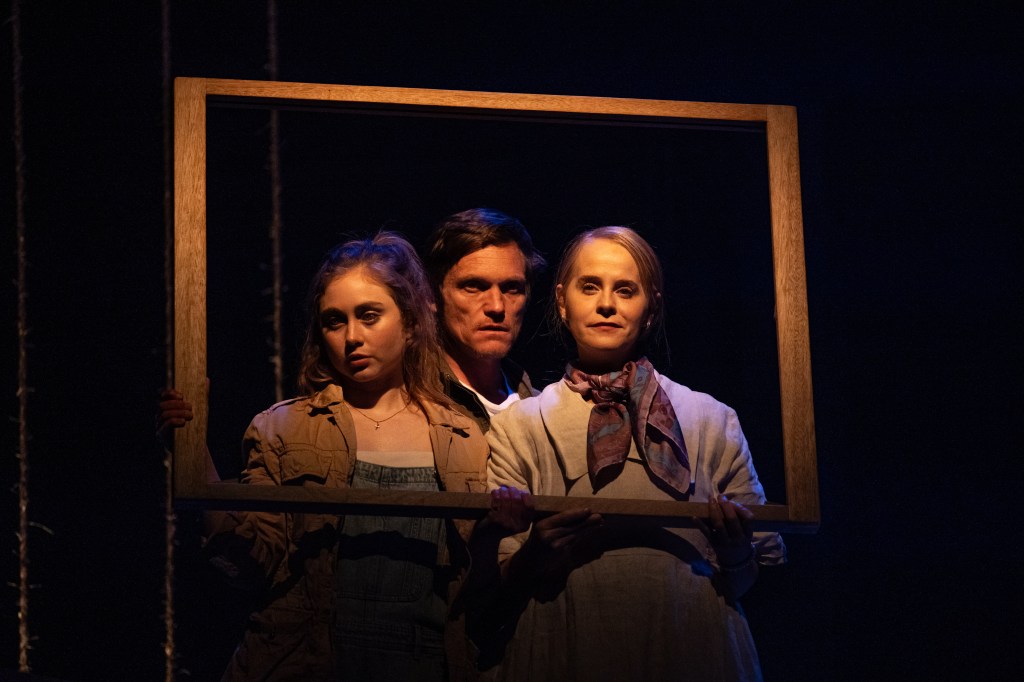
The full cast on stage. Photographer: Claude Barnardo.

“Four decades of Pretoria so distinctly captured, I rose to the challenge of telling the story on stage because I wanted to reach people with it and make them feel what it felt like for me to read it and everything it made me feel to confront our whiteness in its brutal hideousness and its complexity and own it.”

Once the decision was made, she and Damon sat for two solid weeks unpacking the novel. At first he really battled with seeing how it could be put on stage. Sylvaine thinks that in his mind the locations were so specific that it took some time for them to understand the kind of language it would need in order to tell the story.

“We both agreed that the very fluid narrative that Damon captures and writes in, a narrative that changes perspective all the time, changes its mind all the time, needed to come from a chorus almost in the Greek tragedy sense, to comment on the action, to speak to the hero or the anti-hero, to contain their thoughts, and to move swiftly through the action alongside it.”

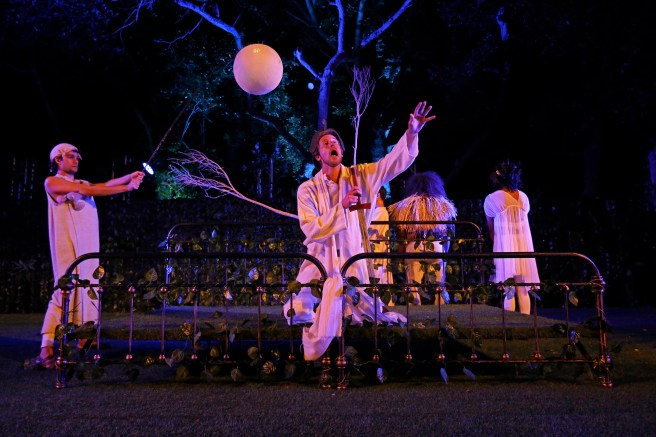
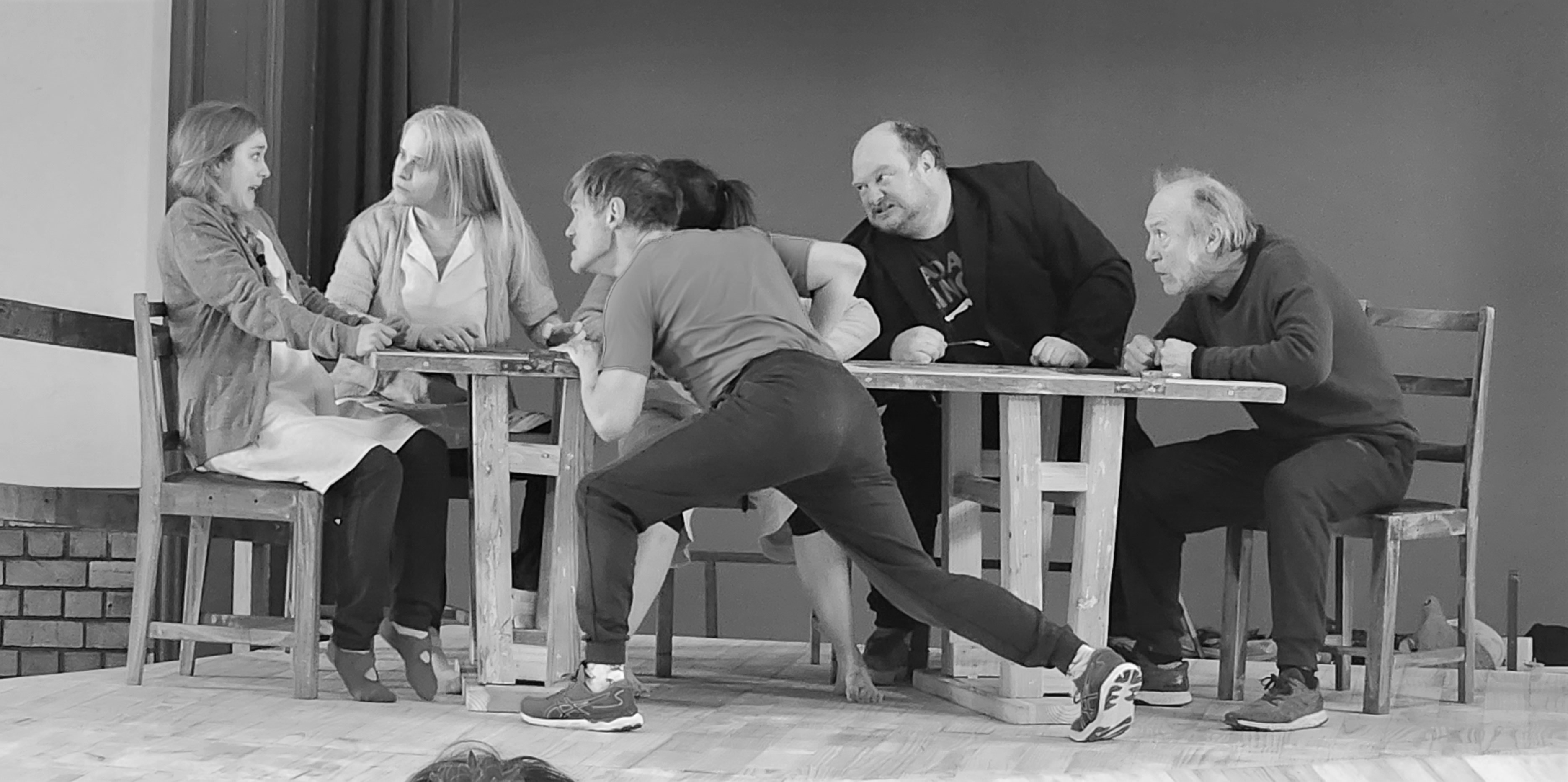
Scenes on stage. (Pictures: Claude Barnardo)

Neither the reader nor the writer could hold on to all their darlings. They knew they had to lose certain bits of the novel, cutting and culling, choosing only the very essential parts of the story, and look at compressing it into a time frame that would suit theatre, so much more condensed than in a book.

 They also needed to find a theatrical language and a physical language that was able to edit between time and place very swiftly, where actors could age from one decade to the next simply by using their bodies. Damon then proceeded to write five drafts which incorporated this language and refined it more and more and more.
In between the first and second draft they had a workshop which Damon attended in which she worked with her cast and at which Charl-Johan Lingenfelder (music/soundscape) and Joshua Lindberg (set and lighting design ) as well as Penny Simpson (costumes) were present. “It was a collaborate effort to reach a place  where script was done and created,” she explains.

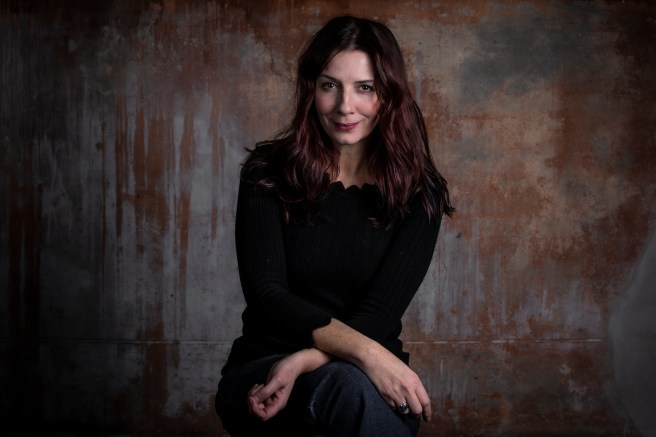
Wearing her heart on her sleeve, director Sylvaine Strike.

Photographer: Martin Kluge

In conclusion, after all the hard work, the introspection, a fantastic cast, long hours and hard work, she hopes audiences take a good hard look  at our country  –  and a soft look as well. “And by that I mean allowing us to enter its deep humanity and inhumanity, looking into a mirror, admitting our own whiteness, hearing it, not making excuses for it,  not trying to explain it, but most of all really looking at the relationship we have as South Africans with each other.

“There’s also the microcosm of a family and its domestic worker Salome, which is a microcosm for  the dynamics within our country, the difficulties, the obstacles, the promises made and broken, the lack of care we have for one another, the care in some aspects, about our country looking at itself, not being spoken down to, but simply observing itself, taking a step back to see more clearly, not back in time, just to get more focus on where we’re at.

“And what I love about The Promise is that it doesn’t offer any solutions, just gives us a glimpse of what we have done and what we have become over the last four decades of our country’s democracy.”

THE COLOURFUL MERRY-GO-ROUND OF ARTIST DIEK GROBLER’S CREATIVE WORLD

Prolific artist Diek Grobler is always creating and busy with different art projects, each of which feeds the other. DIANE DE BEER popped in to his studio for a visit to see what he’s up to and what is exciting him at the moment. It is never just one thing and it changes frequently:

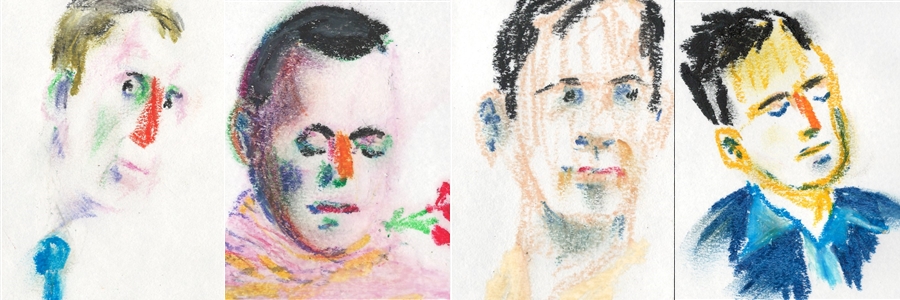
Self-portrait 1 and 2.

When you visit artist Diek Grobler in his studio (now at his home), he is hard at play. And his current object of desire making demands on his time is his latest most precious piece of equipment called a pinscreen.

There are only a handful of these animation machines in the world, and for the longest time, Diek has been playing with the idea of being one of those exclusive artists who could work on what he calls the slowest animation tool in the world.

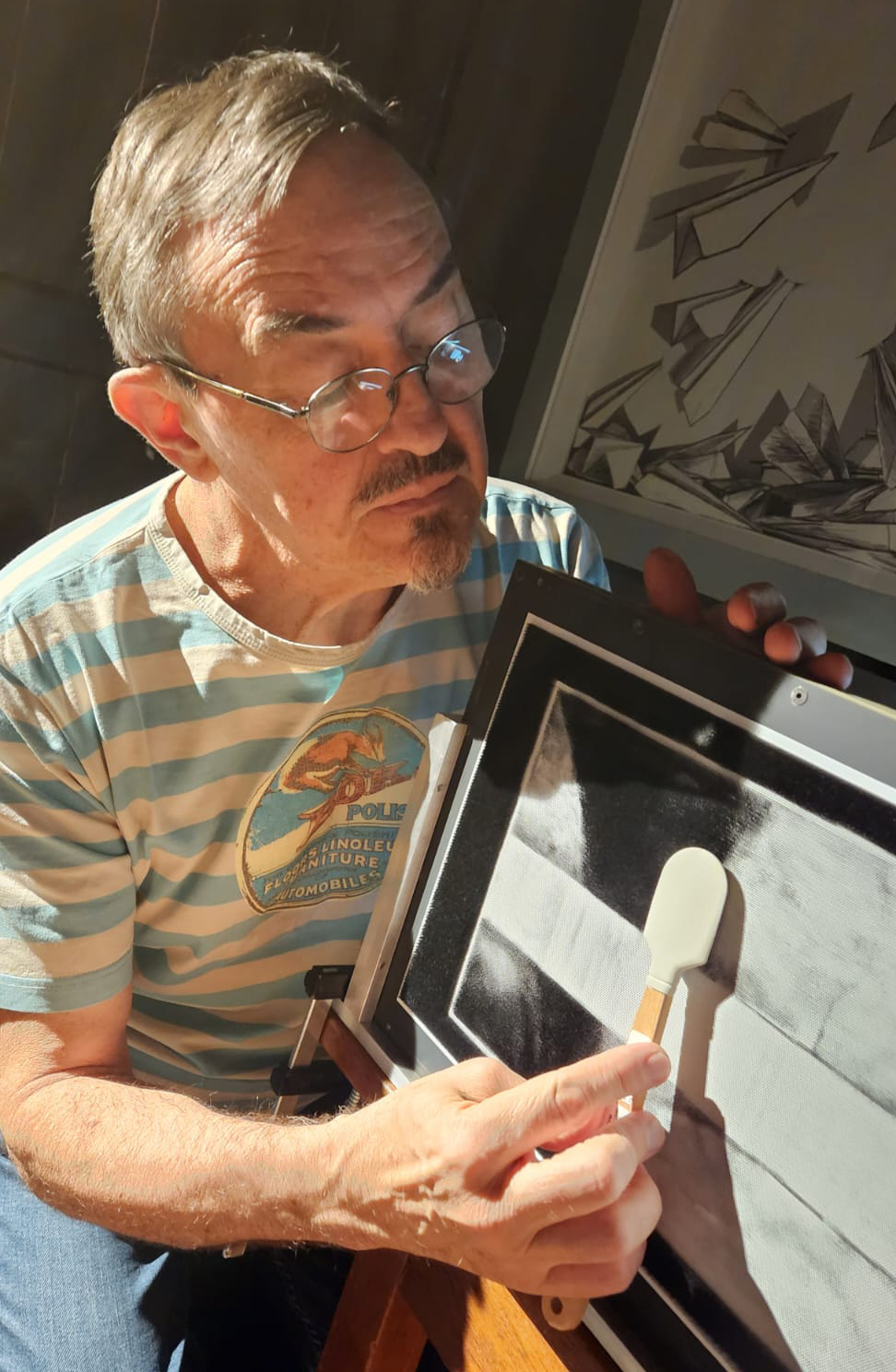
The artist at play on his latest animation tool, the pinscreen.

Being one of our most avid and successful animators (amongst all his other artistic accomplishments), he has been visiting different animation festivals around the world. It was at one of these where he first saw and lost his heart to the pinscreen. And he was really at the festival to pitch his most recent animation film Laaste Woord (Last Word).

It took quite a while for him to take action, but when it means you have to sell your studio to make that final move, that’s what it takes. And even though that sounds pretty drastic, that’s what artists do when they are driven to create.

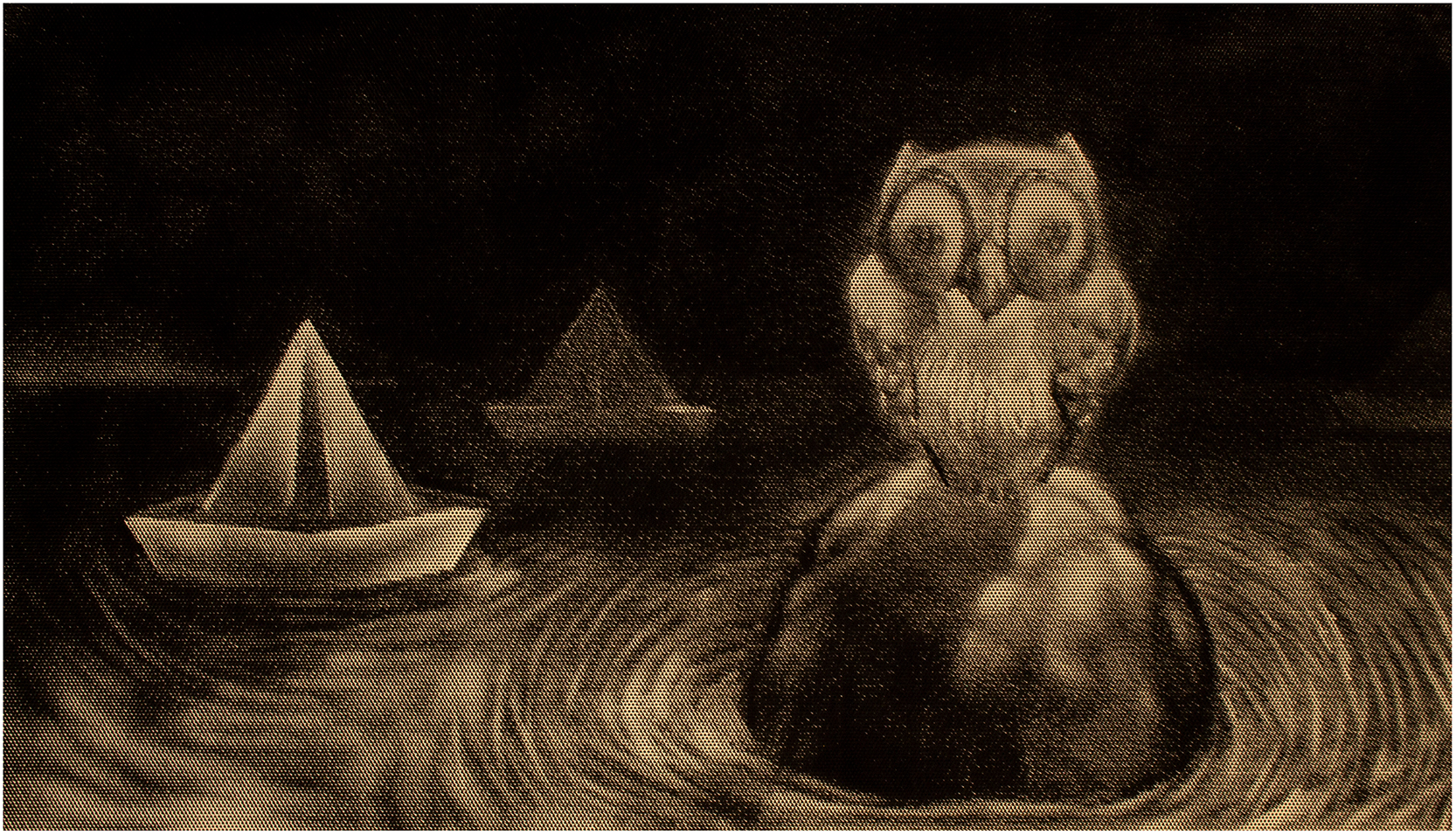
This is how he explains this latest acquisition: “It’s a screen with 100 000 pin-sized holes with very thin needles stuck into them. The screen is lit from a particular angle and the needles throw shadows. They are manipulated by the artist from the back and front of the screen to ‘paint’ a picture.”
(Here’s Wikipedia’s explanation: https://en.wikipedia.org/wiki/Pinscreen_animation#The_animation_technique)

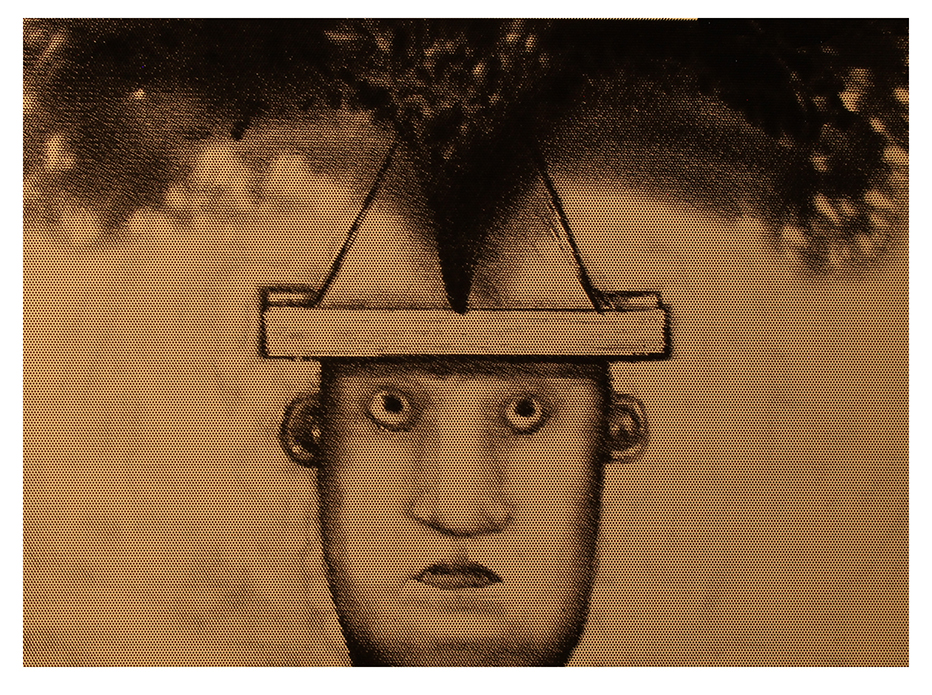
Pinscreen images: Human volcano (left) and Three domesticated foxes on a field trip.
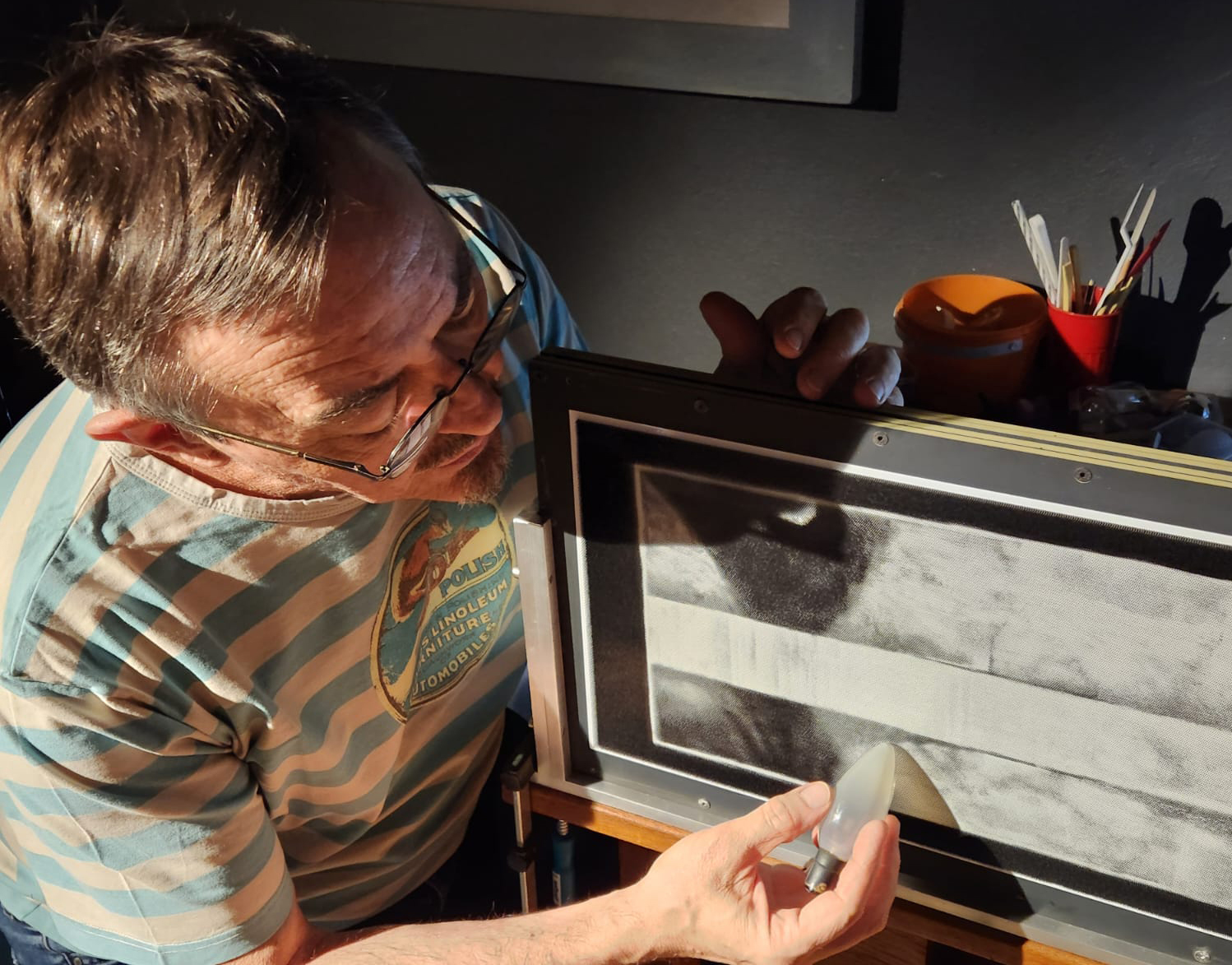
It’s painstakingly slow but quite magnificent to watch the picture emerge. And what intrigued this particular animator is that it has taught him to draw in a new and different way. You can see his eyes light up as he explains to someone with no clue how the contraption works.

But I can see the results, both in the artist and on the pinscreen. And as he is mostly teaching himself, learning by trial and error, he is going to develop new techniques and applications for years to come. I have long been a Grobler fan and can’t wait to see how it is going to influence his work.

Already with his upcoming exhibition at the Association of Arts Pretoria on October 7, he will be showing some of the stills he has made.

And while it seems to be all-consuming at the moment, don’t think this is it.  Another endeavour that keeps him busy is genius because it serves many purposes. For quite some time now, Diek has found a novel yet artistic way to make money which he then uses to finance bigger ventures.

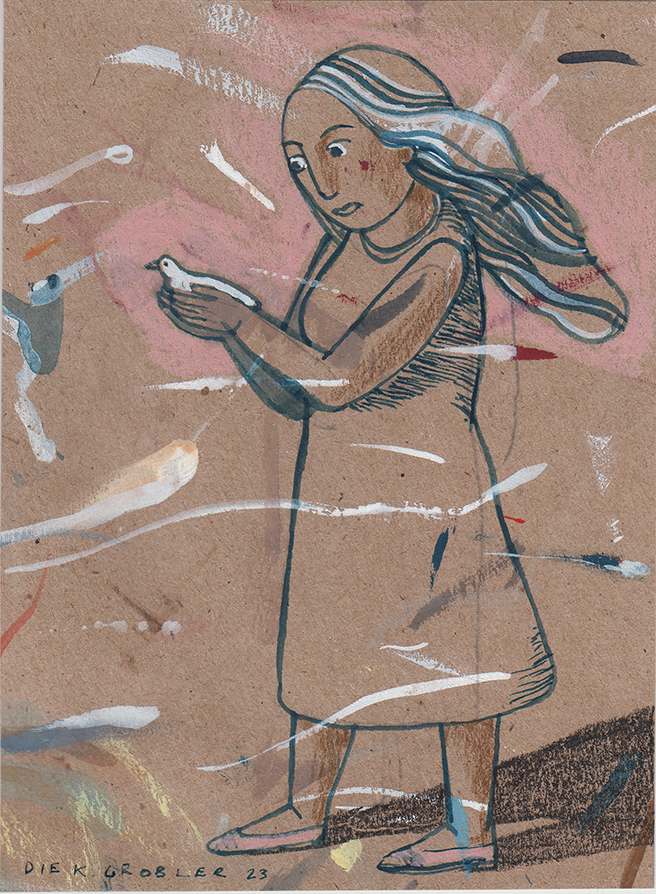
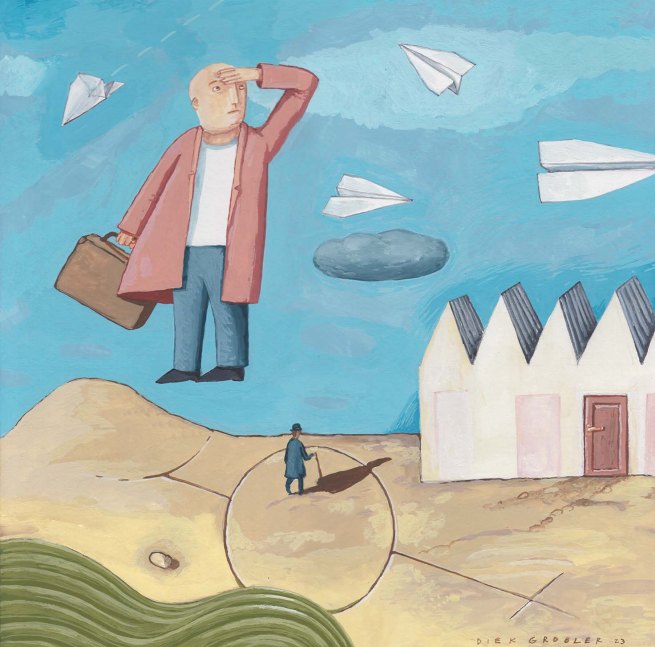
He makes an artwork every day, postcard size and quite exquisite. These he sells online to the first bidder, each one for R500. It sounds easy, I know, until you have to do it. Come up with a particular concept, execute it and have it be good enough to send into the world. This current series is titled Stories of Sunlight and Shadow. What he enjoys is the immediacy, the spontaneity and even the reimagining from other work.

Diek says he has put some out there that he personally didn’t like, yet sent them anyway and someone loved them. Even artists don’t always like what they produce, which doesn’t mean that there’s no artistic merit. I have watched longingly as these tiny nuggets appear and are snapped up before I can react. And when something hasn’t sold, he might always rework or repurpose it at another stage.

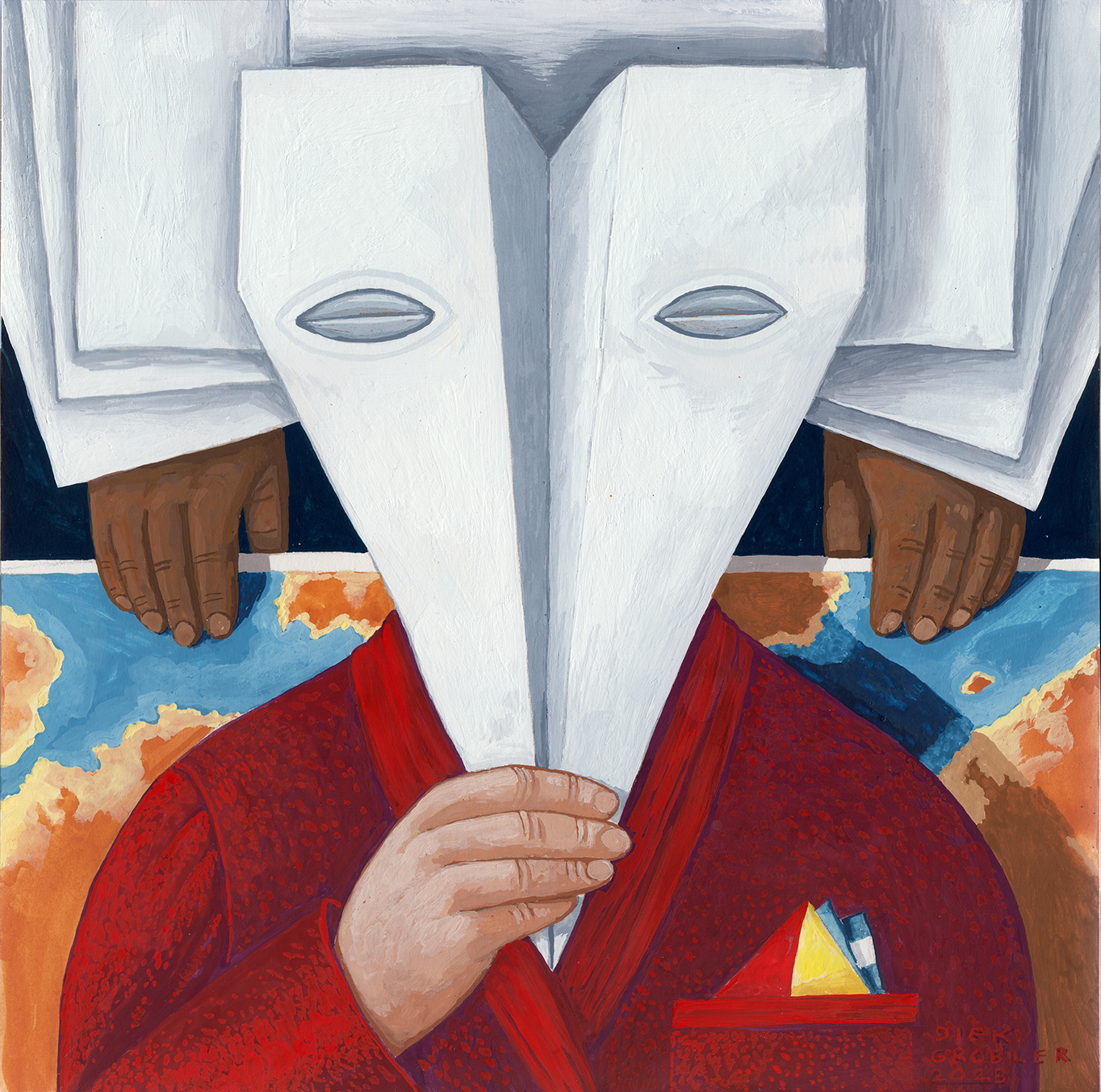
Déjà Vu.

But back to the exhibition, which is titled Déjà Vu, and the name suggests everything about the intent of the artist. “It came very easily,” says Diek who buys into the thinking that there’s nothing new in the world that hasn’t been done somewhere else or even by yourself.

And yet in quite novel fashion he was inspired to paint in more colourful fashion by a particular need. “I still had paint left, but in the brightest colours I don’t often use. I decided to use these before I went out to purchase even more,” he explains.

Teaching the black dog new tricks.

As I looked at the work, I knew there was something different but couldn’t put my finger on it … immediately. The style was perhaps a touch busier than usual, the stories more layered and then there’s this shock of colour. Diek notes that he’s always been an admirer of the German painter Max Beckmann, described as a draughtsman, printmaker, sculptor and writer.

It is especially his compositions that intrigued him. “He positions people, for example, where they shouldn’t be,” says Diek and when you see his latest work, you will see what he means.

He is also an MA supervisor at the Open Window University in Zambia, which he enjoys and then, because of his travels to various animation festivals, he has become a popular speaker specifically on South African animation across the world. He has a particular soft spot for a festival in Zagreb (Capital of Croatia) and a Chinese visitor who attended a talk of his, has invited him to speak at a festival in China at the end of October .

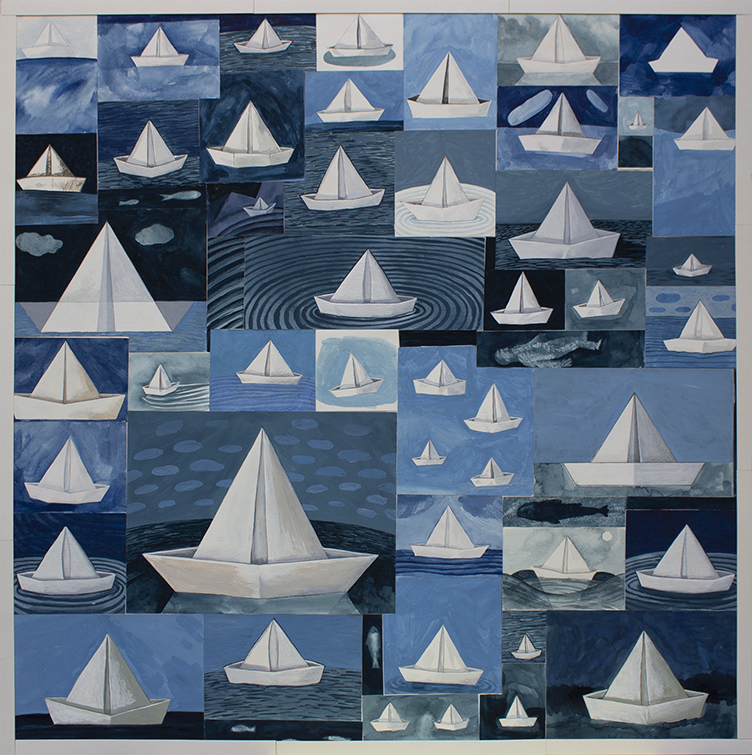
Clockwise: Chorus line: Harbour guard; Flotilla.

In the meantime, he is also spending two months (November and December) at the Cité Internationale des Arts in Paris where the Association of Arts, Pretoria has two apartments. His new toy will not be traveling along so Diek will be practising and working with the concept palimpsest (something reused or reworked but still bearing traces of its earlier self) for the next Venice Biennale in April 2024.

Take a breath, and let’s return to Déjà Vu which is first on the agenda. “It was all about taking stock of all the things I’ve worked on,” he says. And that’s quite something but if you know his work, you will recognise that distinctive Diek Grobler touch – yet with a new edge. And that’s exactly what artists do. They find a way of changing and developing while always holding on to their very particular style.

Diek Grobler is no different and I love it!

Diek Grobler – Déjà Vu

6 October to 28 October 2023

Association of Arts Pretoria

173 Mackie Street

Nieuw Muckleneuk

Tel:  012 346 3100 | artspta@mweb.co.za | www.artspta.co.za

Gallery Hours

Tuesday to Friday:  09:00 to 17:00

Saturday:  09:00 to 13:00

THE PHENOMENAL NATANIËL IN FULL FLOW

October is a month packed with performances for one of our most prolific performers, Nataniël. He tells DIANE DE BEER about his punishing schedules as he presents three shows – all completely different, yet all with one thing in common, the artist and his creativity:

It all begins with Momentum Beleggings Aardklop which is back in Potchefstroom following the upheavals of the pandemic

Ring van Vuur attempts to bind five fiery elements together: original music from more than three decades; original stories as only he can imagine; the rhythms and techniques of countries such as Mexico, Argentina, Chile and Peru; a shimmering set of costumes designed by his personal designer Floris Louw; and seven world class musicians.

Charl du Plessis on keyboards is joined by Werner Spies (bass) and Peter Auret (bass) as well as four brilliant guitar players: Juan Oosthuizen, Loki Rothman, Leon Gropp and Luke van der Merwe.

He promises to present 90 minutes of heartache, humour, heat, virtuosity and rhythms.

As part of the Aardklop festivities, the show will be presented on October 3 at 3 and 7pm in the Beeld Auditorium

Book at ticketpros.co.za.

Nataniël follows this with a short new season titled ROME ’62

On October 10 to 15, he returns to Pretoria’s Atterbury Theatre.

At a fair in the Free State, there’s a stall that sells second hand clothes. In between the rather tired-looking garments, there’s an unusual outfit, handmade by an acclaimed Italian designer. This discovery a few years back, was the first sighting of what has eventually turned into this particular show.

From family secrets, suspicion, stunning strangers, international travel, legendary films, timeless radio hits to exuberant fashion and the most dramatic designs, everything is included with stories in both English and Afrikaans, as well as music in abundance, brand new as well as six decades old.

Charl du Plessis (piano), Werner Spies (bass), Peter Auret (drums) and Wernd van Staden (cello) will be the accompanying orchestra.

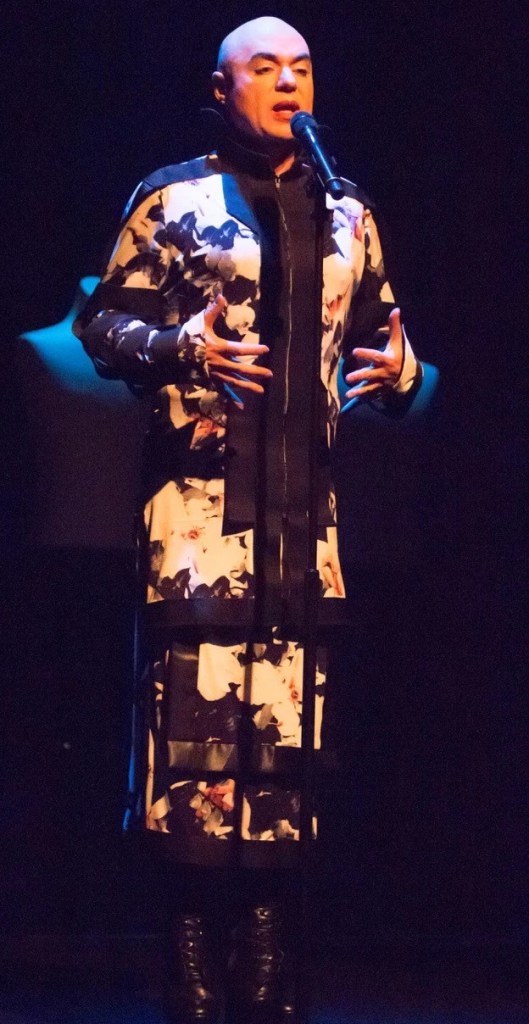
Costumes by Floris Louw.

ROME ’62

Atterbury Theatre

From 10 to 15 October

Book at Seat Me

Finally a performance that Nataniël is hugely excited about and describes as his best:

Titled MASS FOR THE GOOD PRINCES it is a follow-up of last year’s successful DIE SMITSTRAAT SUITE. This one though is his first full length musical mass based on the classical structure of a composition with five, six or seven parts, which is a prayer for goodness, new leadership and the hope of a new generation.

The mass will be sung in Latin and English with stories and descriptions in Afrikaans.

As before, he shares the stage with Ockie Vermeulen (organ),

Charl du Plessis (keyboard), Juan Oosthuizen (guitar), Werner Spies (bass), Peter Auret (drums and percussion) and the Akustika Chamber Choir led by Christo Burger.

Aardklop Aubade

Sunday October 29

Afrikaans Hoër Seunskool

11am and 3pm

Book at ticketpros.co.za

At all these shows, he begs for no cell phones, no short pants and promises no intervals!

A CELEBRATORY MOMENTUM BELEGGINGS AARDKLOP RETURNS WITH A SPARKLING SMORGASBORD OF EXCELLENT THEATRE

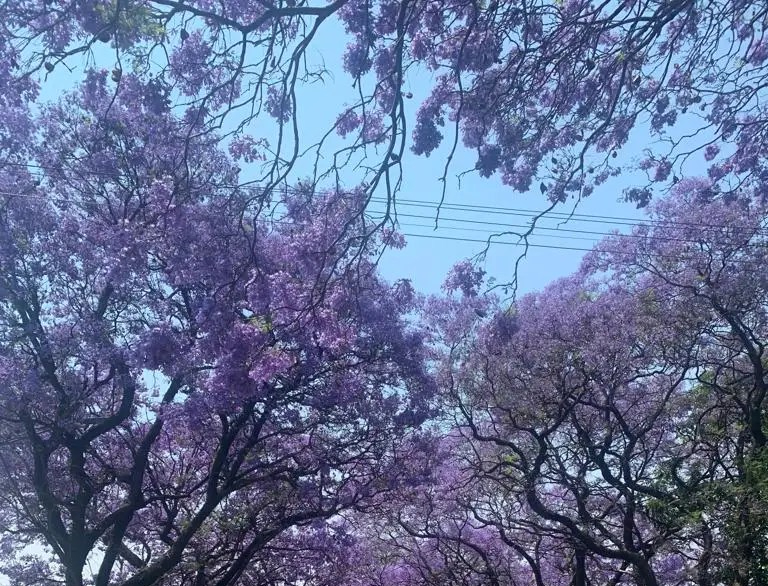
It’s the time of festivals with Aardklop opening with a celebration of jacaranda showers and shows from October 3 until 8. DIANE DE BEER points to a few of her favourites:

When I look at festivals, what they have to offer, I always go to theatre first. It’s my passion, people who tell stories.  Fortunately, I know that stories are an integral part of the arts and are told in different ways. That’s what makes a festival such a delight.

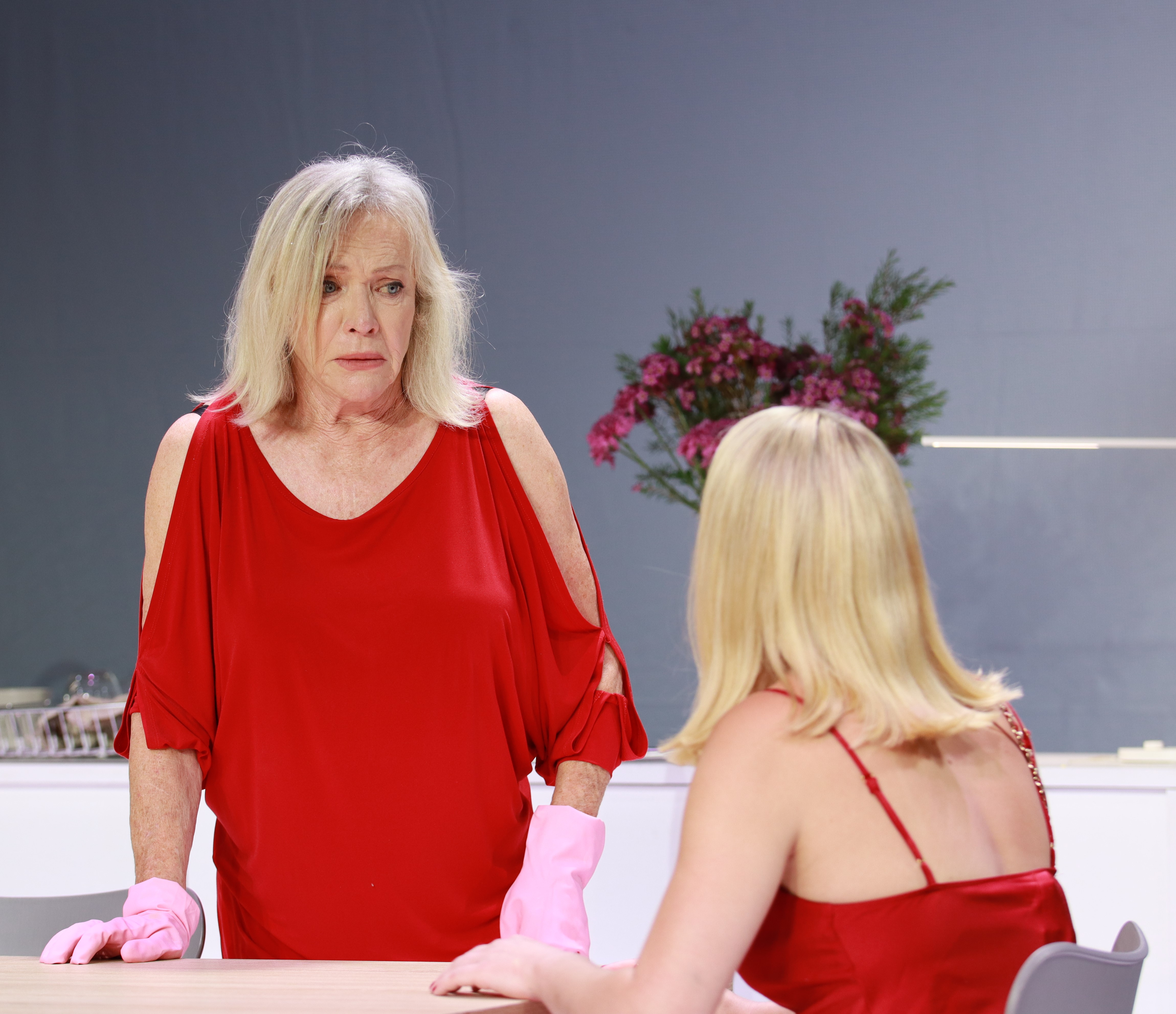
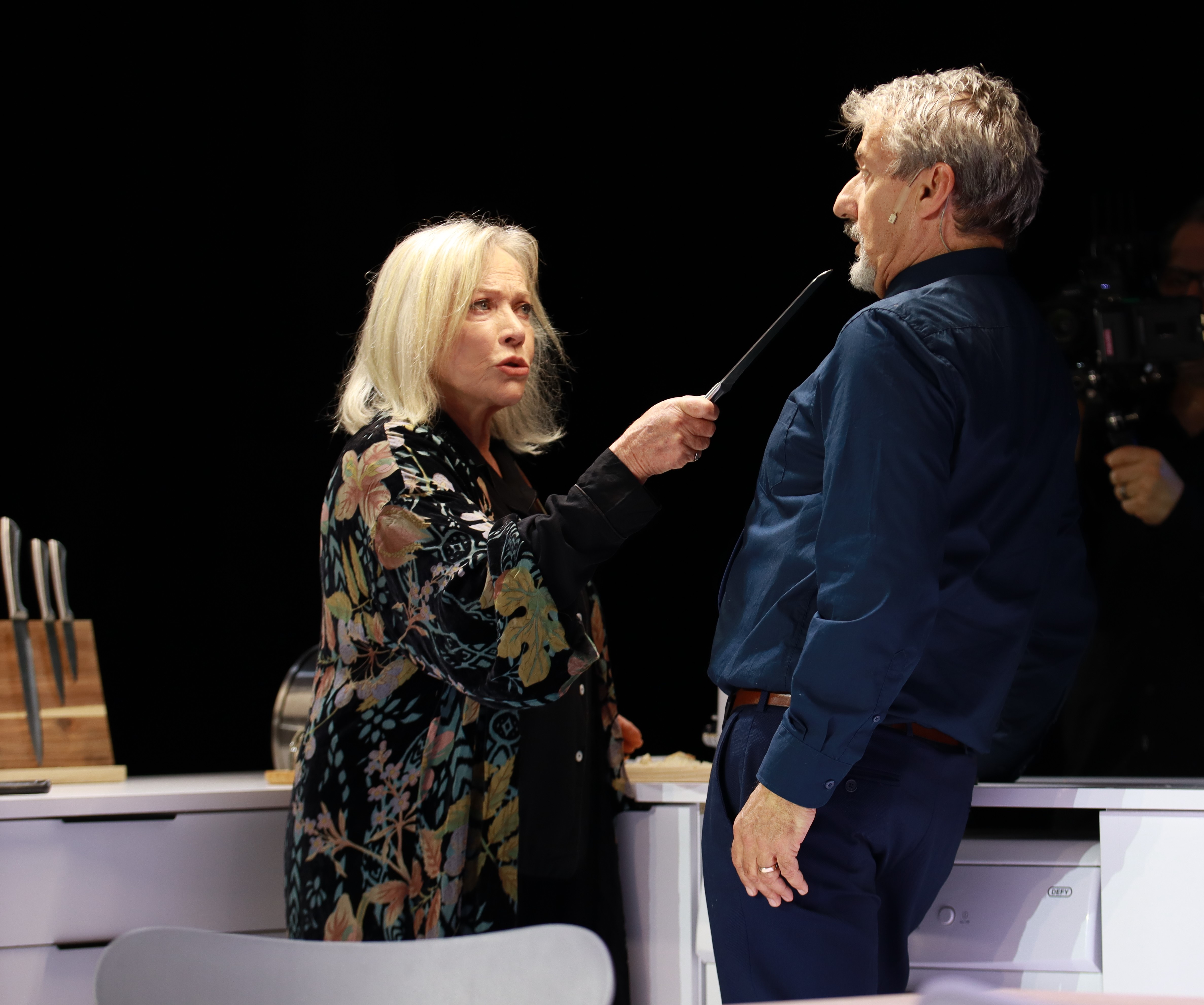
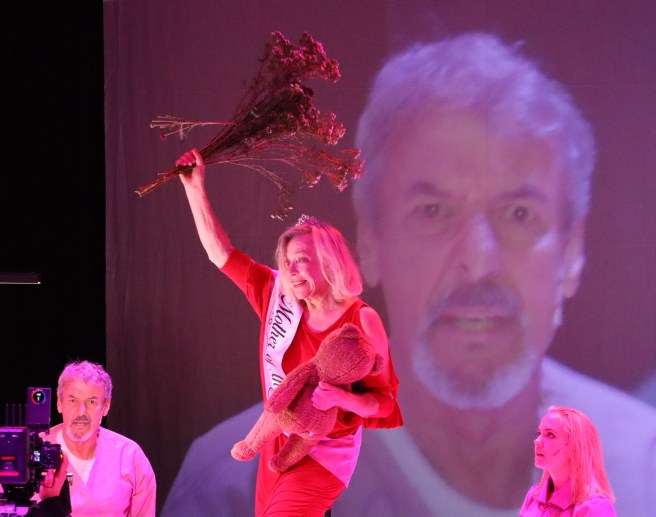
Die Moeder with Sandra Prinsloo and Dawid Minnaar. Picture: Emma Wiehman.

But let’s start with theatre. If you haven’t seen Sandra Prinsloo’s Die Moeder yet or even if you have, see it again. It’s one of those once-in-a-lifetime performances even if she has had many of those. It’s a story of a woman ageing who has lost her heart and her soul as she feels discarded and left out of the dance of life.

That might sound horrific, but the text and the ensemble cast, including the magnificent Dawid Minnaar, Ludwig Binge and Ashley de Lange with exciting directing by Christiaan Olwagen, present huge rewards.

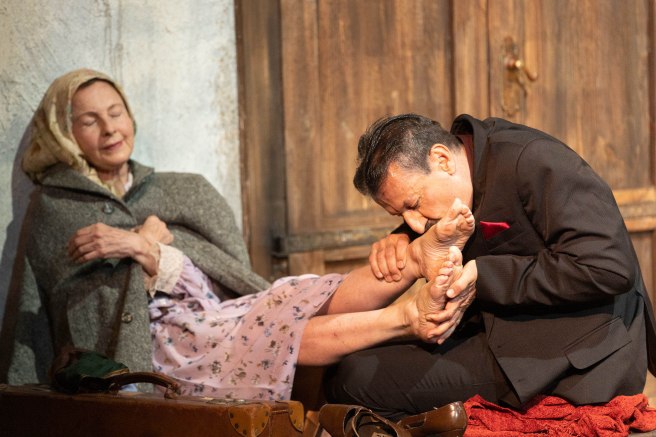
Bettie Kemp and Dawid Minnaar in Mirakel.

On a lighter note, Marthinus Basson, a Reza de Wet genius, presents probably her funniest play, titled Mirakel. With another fantastic cast, including Rolanda Marais, Carla Smith, Dawid Minnaar, Edwin van der Walt, Bettie Kemp and Ebin Genis, it takes us back in time when theatre was presented by traveling companies, which went from town to town, region to region.

That already puts a smile on my face, and when you get this almost ragtag band of actors together, trying to save their lives by enhancing their livelihood with all the drama of the time and the company, it’s a scream. Just seeing Minnaar, who we are used to seeing on stage in serious mode, is a delight as he lights up the room with his angst and artistic temperament.

Braam en die Engel with Joannie Combrink, de Klerk Oelofse, Rehane Abrahams and Shaun Oelf, directed by Nico Scheepers, has all the elements for something quite enchanting. Add to that Kanya Viljoen who adapted the text from a YA book with the eponymous title, Grant van Ster as choreographer, Franco Prinsloo as composer and Scheepers and Nell van der Merwe on props and puppets as well as set, costume and lighting design, it’s a no-brainer.

Described as a magic realism experience for the whole family, this sounds worth driving for and not to be missed. I don’t even know the book although the title does the trick, but the artists involved get my backing all the way.

Geon Nel in Hoerkind. Picture: Gys Loubser.

Also based on a book, Hoerkind, written by Herman Lategan and adapted by Francois Toerien, tells the writer’s own story about a life in tatters when as a six-year-old he is sent to an orphanage. His stepfather shoots at him, at 13 he is stalked by a paedophile, and he turns to drink and drugs to stay sane, this solo production is directed by Margit Meyer-Rödenbeck, with Geon Nel in the title role.

The young boy’s missteps are many as he tries to survive. It’s a hair-raising story of loss and triumph in a world that is feels as if it is against him as he valiantly fights to survive.

Goed wat wag om te gebeur. Picture: Nardus Engelbrecht

Another debut production, Goed Wat Wag Om te Gebeur, has impeccable credentials with a cast featuring Antoinette Kellerman, Gideon Lombard and Emma Kotze with Philip Rademeyer as playwright and director (reworked in Afrikaans from The Graveyard).

Hendrik returns home after 15 years but, because the house is deserted, he decides to wait in the cellar where he spent his childhood years. It is empty, but the family’s secrets and history thicken the air and form part of the foundation of the house. Three figures keep appearing – his hardened sister, his petite mother and his lively girlfriend … and secrets and lies come to the surface.

Droomwerk. Picture: Lise Kuhn.

Droomwerk spotlights Jill Levenberg, Ben Albertyn, Johann Nel, Tyrish Mili and Johann Vermaak, directed by Kanya Viljoen and Lwanda Sindaphi. It unfolds as a dream as the title suggests. Petrus is the one who dreams about his family’s complex past: his ancestral mother, Diana of Madagascar, is looking for her daughter; and his grandfather, an apartheid senator, is dying.

The play deals with conflict, alienation and disillusionment. Will Petrus find the answers that bring him peace? Written by Pieter Odendaal, the text has already garnered an award for the best drama by the ATKV Woordveertjies.

Cindy Swanepoel and Zak Henrdrikz star in Henrietta Gryffenberg’s text 1 (Een) – described as a tragicomedy about love. Directed by Alby Michaels with choreography by Craig Morris and original music by Coenraad Rall (Amanda Strydom’s accompanist), it’s all about once upon a time … there were two people so fond of one another that they grew,the one into the other.

With too much togetherness, the two eventually decide it’s time to separate … but which one will survive this miraculous ordeal?

This tongue-in-cheek production looks with a slight jaundiced eye at the ancient themes of love and transience while placing it in an absurd context. Are human beings likely to find their perfect partner or are the chances just endlessly slim?

It’s a challenging piece, which should translate perfectly on stage with hopefully much laughter at the fallibility of man.

Two strong solo productions include Marion Holm, a seasoned actress who works wonderfully with words and life as she experiences it. She has her own style, a way of sharing her stories that are hysterical and sometimes quite harrowing but everything is done with such hilarity, it’s laughter from beginning to end.

On a dramatic note, Je-ani Swiegers stars in Die Vrou Op Die Dak, which tells the story of a woman who flees to the roof of her house where she hopes to find the answers to a life that has suddenly become impossible. Everything she thought she knew is disintegrating and she hopes this fresh perspective might bring fresh insights.

And don’t miss out on the latest offerings from the grand dames of cabaret, Elzabé Zietsman(with Tony Bentel in the perfectly pitched Femme is Fatale) and Amanda Strydom (Amber/Ombré). Their staying power is unique as they keep refining their artistry.

It’s a lucky packet of plays with a selection of everything one could possibly wish for when going to a festival.

And then there’s more and many different entertainment options waiting to be discovered at https://aardklop.co.za/program-2023/

Also to follow, is Nataniël’s Aardklop production as well as the rest of his surprise packages.

ARTIST ANSA CLACEY DIPS INTO THE SILENCE IN-BETWEEN TO FIND THE THREADS THAT BIND

When you see artist Ansa Clacey’s multimedia paintings at the exhibition The Silence in-between at the Pretoria Association of Art, stories pop into your head. It’s the fairytale quality of her work, the colours, the titles as well as the fact that she plays with paint and threads. Sometimes she paints, other times she works with needle and thread and often she combines the two. She shares her story with DIANE DE BEER:

Ansa Clacey’s current exhibition specifically explores the silence in-between the fragments and threads of our own stories.  Because she is constantly telling her own stories, she assumes everyone does that. And it is especially that presumption which informs her work.

She can take you through the exhibition and tell each artwork’s story, but what she really wants, is that her audience will find their own stories as they engage with her work.

She can hardly think of a time when she wasn’t drawing and on her first school day, she was thrilled when the teacher asked them to draw specific shapes. But with her imagination and ability to draw, she chose her own shapes.

Time Weaves a Wicked Tapestry – Embriodery on Linen (002)

We are all familiar with those moments when you are expected to do things exactly as told and she was immediately taken to task for not following instructions. The trauma lingered for a long time, but fortunately, her natural instincts couldn’t be suppressed.

Years later, after arriving at Potchefstroom University where she was going to study (she thinks the initial plan was German and Geography), she spotted final auditions for a Fine Arts degree. The object she was asked to draw was a green pepper.

The result was not what was expected and she still recalls that she had no knowledge of technique. But her talent was spotted, described as raw, and she was accepted and enrolled for the degree.

Lost and found 2 – Mixed media on paper (002)

Her parents who were funding her studies first heard of this career change from their local dominee who had bumped into Ansa and she was called home to explain. But things steamed ahead fortunately.

Following her studies, she joined the SABC’s art department where she worked on children’s programmes like Liewe Heksie and Wielie Walie, drama programmes and anything that needed a prop or a puppet. “We even had to manipulate the puppets,” she tells. But she learnt a lot and expanded her skills.

Further studies were required for this restless soul always on the lookout for new knowledge. So she acquired a fashion design certificate, which turned her head into yet another direction, and also meant that she started painting again, while also teaching at different fashion academies.

The Protection of the Ancient May Fire – Embroidery on Silk Organza (002)

These days, painting is her life and she says that everything triggers stories in her head with a mind that is always switched on.

And once she has an idea, she can’t wait to get working. But the final product doesn’t resemble the initial picture. She explains that what she can’t see or hear is exactly what gets her imagination going.

Everyday objects, stories, especially folklore of Japanese origin, stimulates her as well as the people close to her, especially he granddaughter Ella, has dominated her work.

With two daughters, both living in London, she has time to work while keeping those who live afar, close in her imaginary world.

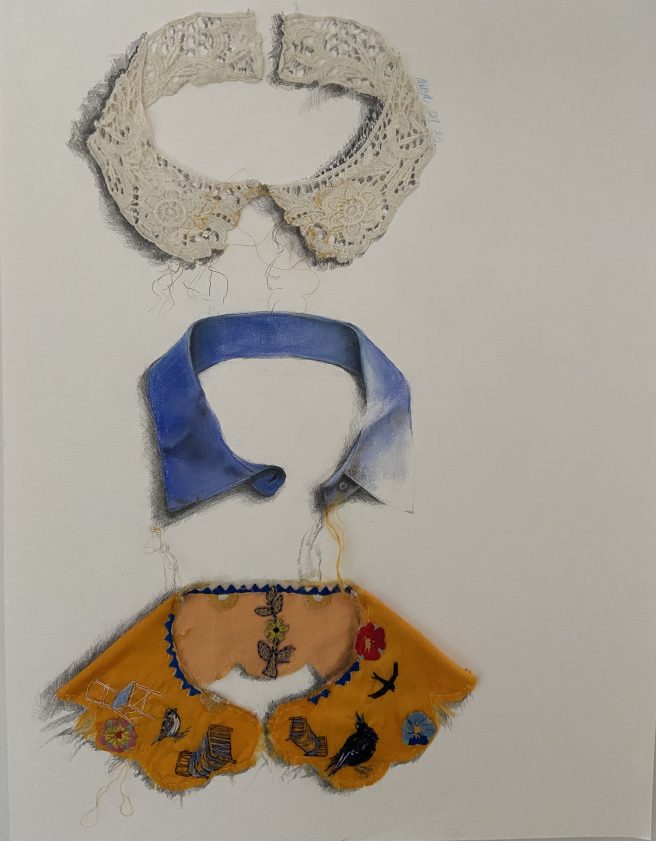
While drawing still informs her work, the needle and thread is her alphabet. Clothes and in this exhibition, the dresses her daughters wore when they were small, and now her granddaughter, are all featured in different ways.

The Threads that Bind 3

Drawing and sewing form her language – like a pen is to the writer, each stitch or line she creates is her alphabet.  For the works on display, she used mainly pencil and pastel combined with stitching as her media. 

Threads, in different cultures, represent many different things: protection, repair, mending, hope and destiny, she says.

“I’m very drawn to cultural customs. Semamori for example is a Japanese custom which means ‘back protection’. Mothers handstitched intricate patterns on the back of their children’s kimonos to protect them from harm.  Often these embroideries have long threads hanging from them to assist good spirits to prevent children from falling. 

“Red thread knots would also be sewn on cloth for soldiers going to war.  These were worn as sashes under the uniforms to protect soldiers and give mothers and wives hope for their safe return.”

All of this informs her work, and is threaded through her stories, which all manifest in different ways to shape different tales and adventures for others. For her it is all therapeutic as she works alone while shaping her stories visually and solving problems she grapples with.

The Wolf Bride – Embroidery on silk organza (002)

She could go on for days and often has to stop herself, stand back, and take a look from  afar.

She is the woman who finds a box with old and odd pieces of fabric, collars or swatches which will all form part of her language in yet another work in the future.

Ansa also turns her enemies into friends and especially the animals in her work are placed in unexpected settings to change who and what they traditionally represent.

It is a world of fantasy and make-believe but in this artist’s mind, it’s a world she can manipulate and make her own.

“The warmth and contemplation of drawing and stitching move me across places and vast timelines. They are the nostalgic markings of movement between past and present.  Like human emotions, strings and lines can entangle allowing viewers to imagine stories behind them”.

When walking through the exhibition, it takes you into another world, one where your narrative features. Clothes, colour and threads form a part of most of our lives, so the connections are varied depending on who you are and why something catches your eye.

Not only are Ansa Clacey’s creations unusual, but also exciting and stimulating as they fire the imagination.  Do not let the opportunity to view this rare collection pass you by.

Ansa Clacey

The Silence in between

Until 30 September

Association of Arts Pretoria

173 Mackie Street

Nieuw Muckleneuk

Tel:  012 346 3100

artspta@mweb.co.za | www.artspta.co.za

Gallery Hours

Tuesday to Friday:  9am to 5pm.

Saturday:  9am to 1pm.

ARTIST LYNETTE TEN KROODEN IS INSPIRED BY THE MYSTERIES AND THE MIRACLES OF THE UNIVERSE

Kristalwater 1 (Crystal Water)

The Association of Arts Pretoria is currently exhibiting works by renowned local artist Lynette ten Krooden under the collective title Mirari, which is the Latin for ‘to wonder at’; admire; miracle.Through French and later English, the word mirage also came into being. It perfectly captures the artist and her work, as she tells DIANE DE BEER:

If you spot glittering gold leaf somewhere on a table, chair or even the snacks at an arts event, it’s probably a sign that artist Lynette ten Krooden’s in the room.

“It’s her involvement with the Middle East many years ago that awakened it,” notes her close friend and fellow artist Margaret Gradwell-Truter, who divulges that the two of them are celebrating her first exhibition at the Association 40 years ago and now again. “As fellow artist, I (nervously) opened the exhibition at that time.”

It was wonderful to listen to her speech and to have her reveal so much about her friend, always with the emphasis on her art.

Ancient Travel Story.

About Lynette’s trademark gold leaf she says that at the time it wasn’t something that was widely used in the art world. She even recalls some of the local art academics being quite scathing about the Austrian artist Gustav Klimt because of his use of gold leaf. Today his work records some of the highest prices paid for art and especially his trademark gold leaf receives high praise. In similar vein, another gold leaf practitioner, Alexis Preller, was also not rated. Today he is revered, she says, as we can all attest to.

Not that Lynette paid much attention. If you hear her speak about her work and where her inspiration lies, it’s always the landscape. “She viewed the universe from space, or flew across the desert or travelled through it with the Bedouins, or she found herself in awe of age-old mountains, rocks and fossils. But she doesn’t repeat what she has seen, she gives her audience the experience of wonderment which she experiences – she does it through a rich tapestry of forms and marks richly woven to form a whole,” explained Margaret.

“Lynette has used gold leaf as an integral part of the landscape that inspires her.” And that especially was again visible in this current exhibition.

Margaret embroiders: “She has unwaveringly used it as a medium for many years and has been able to master it, not as a decorative element but as a metaphor for the mirage, the mirari (miracle), that she has profoundly chased and captured, thereby enabling us, the spectator, to also wonder at the mirari.”

From her earliest days, she notes, Lynette was interested in the mysteries of the universe. The invisible – such as the effect of light on the earth – the glittering horizon, mist, sand, rocks and water. “This place that is a sanctuary for the wordless artist.”

Reenboogrots (Rainbow Rock)

And when Lynette talks unthinkingly about gold leaf, she tells how she is constantly picking up and gathering flecks of what might have fallen from something she is working on and using it again and again. And anyone who has ever picked up (or tried to handle) a sheath of gold leaf will know that it disintegrates in front of your eyes as if an invisible hand has reached out.

And still all these years later as her friend underlines, Lynette is filled with wonderment. “There’s a lifetime of art in my bones,” responds the artist. And even the fabric she wears reflects her love of what she creates.

Reisverhale – Storm on French Linen.

When she talks of her travels, she thinks of small children sitting on the sand and instinctively drawing, making pictures, capturing their world. That’s what she does. With her physical reality often a hindrance, she has found ways to work, to deal with what life gives her and to escape into the mysteries she is always exploring. “It never stops,” she says – and neither will she. “I lost my heart to the creative process. It’s good for my heart.”

Stand in front of one of her paintings and it immediately opens up a new world. Even if you’re just drawn by the colour, that in itself is a whole world that she embraces. For her, there’s a childlike excitement when she creates a new work. With this exhibition it was also returning to old ways and techniques that brought fresh meaning. As an artist she is intent on always moving forwards, somewhere new, challenging the world and everything around her.

And in the process, she passes on that depth of feeling to those of us looking on hoping to discover more . Her miracle becomes ours. For her it is simply a curiosity and wonder that started many years ago which has become the eternal play on her changing canvasses.

One cannot but be touched.

The exhibition runs until September 23.

http://www.artspta.co.za/

https://www.facebook.com/pretoriaartsassociation/sassociation/

Address: 173 Mackie St, Nieuw Muckleneuk, Pretoria, 0181

Hours

Open ⋅ Closes 5 pm

Phone012 346 3100

BONGI BENGU COLOURS THE WORLD BRIGHTLY WITH HER ART, HER LAUGHTER AND HER LIFE

The artist Bongi Bengu is having a major exhibition at the Pretoria Art Museum which runs from this Saturday (September 9) until November 5. She told DIANE DE BEER about her passion which is constantly evolving and reflecting her life, her dreams and hopes:

Pictures of Bongi Bengu taken at the Pretoria Farmer’s Market by Thomas Honiball.

When you first meet Bongi Bengu it is not a surprise to learn that she is an artist. She looks like an artwork herself.

She’s brightly dressed and the one characteristic most dramatic is her laughter. This is someone who loves life and her enthusiasm is contagious. She’s also not scared of showing herself.

But when you start talking about her art, her mood is reflective. “It’s a calling,” she says about this career which she has been passionate about for the past 26 years.

Her art is all about expressing herself but also healing, she says, something she hopes those who come to her exhibition will also experience. She infuses it into everything she does, her cooking, her clothes, dancing and music choices. “Art is like breathing.”

Titled The World / Umhlaba, the exhibition has been inspired by the tarot card called The World. “It means the end of a cycle and the beginning of another,” she explains. But she expands: “It could also mean that you’re in a powerful position to manifest your desires.”

The exhibition was first held at the Alliance Francaise, Pretoria where Pretoria Art Museum curator Mmutle Kgokong first saw it and felt that the space was too small for her work. “It looks cramped,” he said and invited her to show it at the museum.

Bongi feels it was meant to be. “We create our own world,” she says and that’s why this transformation from one exhibition to the next came quite naturally to this South African, who spent her youth in exile in Geneva Switzerland where she completed most of her schooling until the last few years, which she spent at Waterford Kamhlaba in Swaziland.

Bongi’s Golde Orb Mask

Her parents (her father Sibusiso Bengu was both an ambassador and Minister of Education) felt that she needed to experience some of her school years on the African continent. And this is also where she forged her future. While doing a research project for which she earned a distinction and which included interviewing established  artists, she discovered Helen Sebidi who was an inspiration and opened her eyes – and her heart – to the art world.

“That’s when I knew,” she says about her artistic beginnings. Becoming the world traveller that she is, she later enrolled and graduated with a Bachelor of Arts degree at Mount Vernon College, Washington DC, and completed a Master’s degree in Fine Arts at The University of Cape Town. She has since participated in numerous international residencies and workshops.

For this current exhibition she wanted to reflect on the different stages of her work and she has tried to select pieces from all the different periods. She started with pastels and charcoals using mostly earthy colours.

Bongi’s Rebirth IV

Then she joined the Bag Factory Artist Studio where she did mostly collages initially and then turned to an organic period where she focussed on leaves and soil.

Only then came colour which now seem such a part of her life. She confesses that she sees herself as an artwork and when you look at her, it’s easy to see why. What a canvas she has been given to play with. It’s not only her work that turns heads.

Once she started planning this exhibition, she started a conversation with two curators, one at Washington DC’s Hirshhorn Museum and Sculpture Garden (Teresa Bush) where she had interned for a while and the other in Sweden (a South African lecturing there, Nkule Mabaso). “It was through dialogues with them about my work that I made selections,” she says. They will also be writing for her catalogue which will be available at the end of the two month exhibition.

Bongi’s Self portrait in the sand

When discussing her work, Bongi explains that she is inspired by her life and the experiences she has had. It all begins in her head, but once she starts working on paper or canvas, it’s usually something quite different that emerges.

Working mostly on your own can be quite a lonely existence, but Bongi enjoys her own company and finds her painting therapeutic. “This is how I work through problems,” she says. “I never feel alone.”

Bongi at work.

In her life as in her work, she describes herself as someone who doesn’t conform to society’s norms. “That’s not easy in my community, a single Black woman with no children!” But it’s her life and she marches to her own beat. Growing up and travelling around the world yet returning to South Africa, she functions easily wherever she finds herself.

As I watch her finding her feet at Silverton’s famous Farmer’s Market, it’s easy to believe her. She’s colourful, has a laugh that stops a crowd and a life that’s creative and of her own making.

Bongi’s Montana Birds (left) and Life of Domesticity (right)

She says she knows she was a man in her former life and that she wanted desperately to paint, but it wasn’t possible. “At that time, the women were the painters making huge murals. I knew I would come back as a woman so that I could fulfil my dream. And now I also know when women think that men have easier lives, it’s not always true!”

The exhibition will run until 5 November at the Pretoria Art Museum.

It will be opened officially by His Excellency HE Mr Antonis Mandritis, Ambassador of Cyprus and the work can be toasted courtesy of Durbanville Hills. Everyone is welcome.

WHILE SHIMMERING IN GLITTER AND GOLD NATANIËL WILL BE TRIPPING THE LIGHT FANTASTIC

DIANE DE BEER talks to Nataniël about the few weeks ahead…

After an absence of several years from any Johannesburg theatre stage, Nataniël brings his award-winning show, Prima Donna, to the Teatro at Montecasino for five performances only from August 17 to 20 at 8pm, with a matinee included on the Saturday at 3pm.

And while this is a show which he has performed before, it is a new staging with new stories or old ones updated and even the old songs have new arrangements.

Over  the past few years Nataniël has written and staged more than 13 productions not seen in the Johannesburg area, and extraordinary moments from these shows as well as brand new material has been put together for five unforgettable gala concerts.

And, if you should wonder, naturally the costumes are all new, created by Floris Louw.That’s just who Nataniël is. But he’s nervous. This is a huge theatre, and even if it is similar to the seasons he used to stage annually at Emperors, he was familiar with the audience.

This time he doesn’t know because he hasn’t been in Joburg for some time. But those who know his work, won’t want to wait to buy tickets. His trademark stories will be in English and Afrikaans with songs in English.

(Book at SeatMe).      

In this tale as the title suggests, he is dealing with prima donnas. It’s a touch of fantasy, a dash of humour, some sadness, and as a reality check, a take on history, family, failures, hope  and modern society.

“We all know these drama queens, know how they operate and what they’re capable of. But we indulge them, their behaviour becomes worse and only death can release us,” he warns.

Charl du Plessis Trio will join him on stage for both shows with other musicians in tow. Pictured are Werner Spies (bass), Charl du Plessis (piano) and Peter Auret (drums).

He knows he also has that reputation, but his demands are about performance and what he knows he needs on stage. “I never fight, because I don’t like confrontation,” he says.

Never able to resist raising an eyebrow, he adds that he always believed one of the perks of success was being difficult!

“We hate them so we would rather do without them,” he says. But, in case you start taking all of this seriously, he says he chose the title because it looks good on the poster!

See what an interviewer has to contend with.

Vocalists Dihan Slabbert and Nicolaas Swart

But before you lose patience, he includes one of his elaborate and irresistible descriptions: “If Sarah Bernhardt, Maria Callas and Isadora Duncan had a child, it would resemble my costumes!”

And, he adds, a touch of Florence Foster Jenkins.

His music he describes as a combination of the dramatical and accessible. “I sing many of my own songs and familiar old songs.”

With him on stage is Charl du Plessis who now travels with his own Steinway piano (and that’s a whole other story) Luke van der Merwe (guitar), Marcel Dednam (keyboard), and Werner Spies (bass), as well as Dihan Slabbert, Wiehahn Francke and Nicolaas Swart on vocals.

Having a final word, Nataniël notes that the show is vocally driven. “That’s what a prima donna does!” He’s been waiting for this one for 12 years. “I’m ready for that farewell concert,” he says.

And the force with which he speaks is almost persuasive, but I know about his addiction – performance –  and he’s so good at that!

For those who are looking for something completely different, there’s a second concert of Afrikaans in Styl on September 9 presented at Sun Bet Arena in Times Square.

This time the artists included on the bill are Spoegwolf, Elvis Blue and Corlia.

“I’m the headgirl,” says Nataniël who will be staging the show. “It’s rare that artists are given a free hand to stage their own shows on this kind of platform,” he says, excited by the prospect.

Nataniël and Spoegwolf in a different kind of performance.

And if you’re not familiar with some of the performers, he explains it thus: Spoegwolf brings the war, Corlia brings the notes, Elvis, the smoothness and blues, and he brings the sequins.

The performers will almost exclusively be performing their own songs. “I love that. It’s rare that someone like Corlia who has such a huge voice is allowed to get away without singing Barcelona.”

Perhaps this time. It’s up to each one individually what they wish to perform.

He is also thrilled that this is a once-off. It won’t be filmed. If you’re not there, that’s it.

“The performers are all people who regularly perform in theatres.

“People must come and see. It will be new and not commercially driven. The artists will be adventurous with their performances and the staging will be daring.

“As artists (and audiences) we need to step out of our comfort zones when we go to shows. It’s a time for rebirth and venture.”

He always keeps in touch with what is happening in the rest of the world because it takes a time to reach our shores.

“We’re all ready to try new things!”

And why not.

“This time my brother won’t be hiding backstage. But we might have one or two surprises up our sleeve.”

Book NOW at www.webtickets.co.za

And talking about that, Nataniël also has a new Christmas book in shops in October.

The title is Help, Help, it is beautifully packaged with a special cover for the festive season, and once you’ve seen it, packed with unpublished Afrikaans and English short stories, your Christmas shopping will be done.

And still there’s more: Rome 62 will be staged at Atterbury Theatre later in the year, a new Mis will be performed at Aardklop Aubade in Pretoria and there’s the annual Christmas season also at the Atterbury Theatre.

And even then he’s not done. But we will wait for the final conclusion to his year.

In the meantime,  he’s busy on stage – performing.