Aardklop pumping with innovation, imagination and creative possibilities

DIANE DE BEER

With arts festivals still being the surest thing for many actors in this country, many of our best plays are premiered at these events before they start touring to mainstream theatres.

This year’s Aardklop (Potchefstroom’s annual festival from 2 to 8 October) while Afrikaans-driven, has many options for everyone simply interested in the arts and tehatre. An understanding of the language helps with a wider choice of course, but here are a few options worth checking.

Innovation is always part of a festival, and one of the most exciting is a one-on-one theatre experience that opens up all kinds of possibilities.

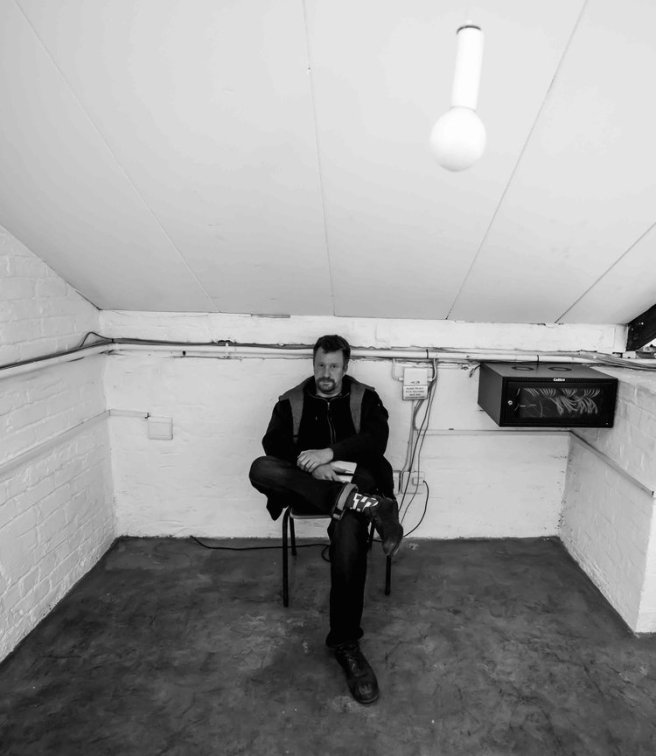
DEURnis is a one-on-one site-specific theatrical production with a very intimate yet cutting-edge and experimental approach. It involves a single audience member  who views three separate dramatic pieces per package (there are four different ones to choose from), with each of these having one performer and one audience member.

Each piece is is approximately 20 minutes long and written for a particular room/space in a house, so as a viewer, you move from one room to the next to see your three chosen plays.

It is the social issues that permeate the different works that affect individuals in different ways depending who you are. And for those who aren’t interested in gimmicky theatre, that’s exactly the trap they have avoided by aiming for excellence and substance in the texts.

“We have been inundated by people interested in writing for this venture,” says Johan van der Merwe, who with Rudi Sadler has started a production company Theatrerocket responsible for this exciting and well-executed concept.

They understand that the control has to be constant to see that everything works superbly. And as they had many plays to choose from, they have managed to execute their strict code.

It’s a fascinating experience, being the only one in the room in situations with a stranger telling a story that is often inclusive (never intrusive) but affects you as the viewer in very specific ways.

This is not a financial venture for the company. With only single actors and audience members, the numbers don’t add up. But because of the way it has been done, the performance experience the actors (at this stage mostly young) accumulate can’t be calculated. And chatting to a few of them in-between performances, they are equally thrilled by how much they are learning in the process. “Each performance is different because of the reaction of the individual viewing,” says one performer.

Having sat through a day of all of the plays (even a cabaret included), it doesn’t matter which package you choose. They’re all extremely well crafted and in sometimes scary ways, fun to experience. I loved it and more than anything, it is a concept with great potential. Personally I can’t wait to see how Theatrerocket is going to grow and expand this novel experiment.

One of their current quests is to find some older actors who want to participate. “It’s been a problem because most of them have families and the money isn’t the motivating factor here,” explains Van der Merwe.

Among the other shows and events to check out, including their searing production of Reuk van Appels, are the following:

  • The visual arts always feature strongly at this festival. With the title Saamklop (roughly translated as togetherness), it deals with South Africa’s rich history of collaboration, community engagement and artistic freedom. The focus is on artistic collaborations and community art projects exhibited together in a curated exhibition that spans many venues. Participants include the Bag Factory, Keleketla Library, The Found Collective, The Dead Bunny Society, NIROX Foundation Trust, The Artist Proof Studios and the Centre for the Less Good Idea, a William Kentridge initiative. A broad range of artworks, including paintings, drawings, videos, live performances, workshops, poetry and experimental new media projects will be on show. It’s worth traveling for. Curator (from Pretoria) Dr Johan Thom highlights the vital, creative role of community projects and artistic collaborations in contemporary South Africa’s art scene.
  • If you haven’t yet seen Pieter-Dirk Uys do either an Afrikaans or English version of his (in essence) life’s story, The Echo of a Noise, tick that box.  “I allowed myself to investigate the story behind the stories,” he explains.
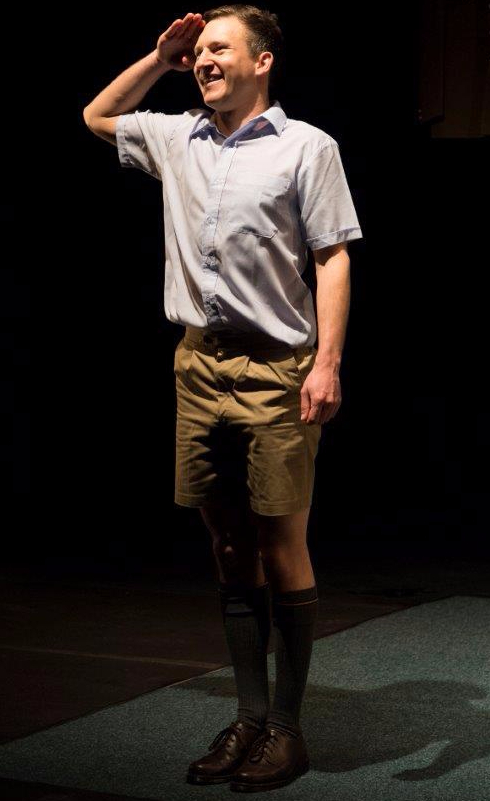
  • A mover and shaker on the musical front, Charl du Plessis has two noteworthy productions. Stemme vir Môre (Voices of Tomorrow) combines the voices of Noluvuyiso Mpofu (soprano) and Bongani Kubheka (bass baritone) with Du Plessis on piano and features opera highlights. With Veertig Vingers (pictured) which points to four sets of hands, he creates a musical storm. Joining him on keyboards are Elna van der Merwe, Albie van Schalkwyk and Pieter Grobler as they perform favourite tunes from the classical, pop, jazz and rock genres.
  • For those who are au fait with the language, some theatre highlights include the Marthinus Basson directed Asem and Melk en Vleis; Dawid Minnaar in Monsieur Ibrahim en die blomme van die Koran; Weerkaats starring Milan Murray; Klara Maas se Hart is Gebreek, ensomeer: Die Vloeistoftrilogie with Wessel Pretorius, David Viviers; Nêrens, Noord-Kaap starring Albert Pretorius, De Klerk Oelofse and Geon Nel; and Elize Cawood and Wilson Dunster in Mike en Mavis (pictured).

There are more details about the festival or shows available at http://www.aardklop.co.za. Tickets at Computicket.

“The Alchemy of Words” plays with different disciplines creatively

DIANE DE BEER

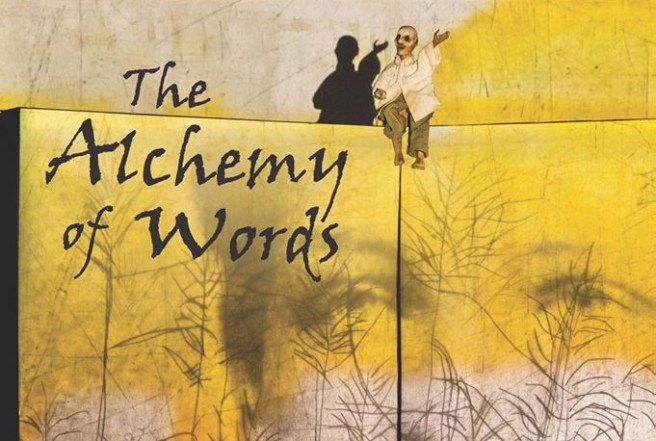
alchemy of words

Photographer: Dee-Ann Kaaijk

After premiering with a sold-out run at the National Arts Festival in Grahamstown, Naomi van Niekerk’s The Alchemy of Words will be touring Southern Africa: landing in Johannesburg at the Market Lab’s Ramolao Makhene theatre from Thursday to 1 October, on 5 and 6 October at Cape Town’s Theatre Arts Admin Collective, 11 October at CCFM in Maputo and on October 14 and 15 at the Etienne Rousseau Theatre in Sasolburg.

Arthur Rimbaud, says Van Niekerk, for those who don’t know, is regarded as the ‘enfant terrible’ of French poetry who published his first immortal poem at the age of 16 only to completely abandon writing poetry at the age of 21! During this short period he managed to create a body of work that has had a profound impact on the poetry of his own time and on that of the 20th Century. André Breton, Dylan Thomas, Jack Kerouac, Bob Dylan, Patti Smith and Jim Morrison are some of the artists and musicians that have been influenced by his writing.

Who is this literary pioneer and creative genius who continues to receive letters from fans all over the world even 123 years after his death?

I am now making myself as scummy as I can. Why? I want to be a poet, and I am working at turning myself into a seer… The idea is to reach the unknown by the derangement of all the senses. It involves enormous suffering but one must be strong and be born a poet… – Arthur Rimbaud, 1871.

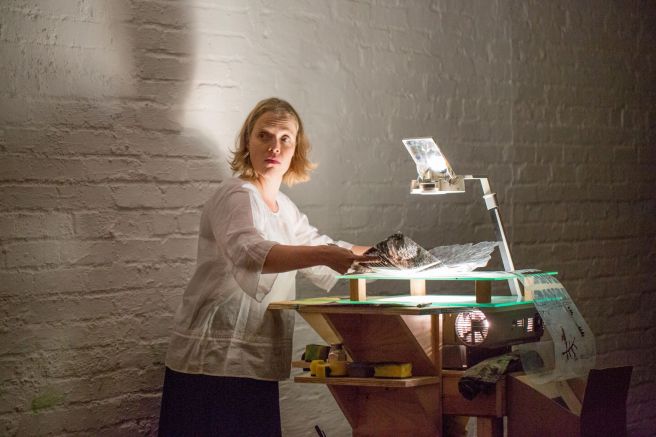
In The Alchemy of Words, three artists from different disciplines –puppetry, film and music – search to capture the enigma of this French poet and what it means to be a pioneer. It aims to be an immersive experience that combines artistic projections, puppetry and live music inspired by the diverse imagery from Rimbaud’s poems – smoke filled battlefields, the lush countryside of the French Ardennes, colourful vowels, crimson seas and more.

Naomi van Niekerk

Van Niekerk’s personal affinity to Rimbaud started when she studied for three years in a small town in northern France, Charleville-Mézières which also happens to be the birth town of Rimbaud. His face is everywhere and all the shops are named after him. “I discovered his poetry and started translating it from French with a dictionary (as part of learning the  language) and was intrigued though I never really got into it, it was too complex!”

If you have seen any of Van Niekerk’s collaborations, you will know that she works in a unique way. “I don’t describe or see myself as a theatre-maker. I’m an artist and performance is one of the mediums I work with,” she explains.  “I’ve always been working in many mediums such as scenography, puppetry, filmmaking and most recently printmaking. I was always drawn to shadow puppetry because it fits into a frame like a graphic novel and within that frame anything is possible. My light box gives me the same freedom – to create a world in a frame without needing too much. In my case some sand, cardboard and scissors… I also love to draw, its an obsession that started when I studied in France and could not speak French, it was a way of communicating ideas and absorbing new experiences.”

Experiencing her work on stage is like seeing many different artworks appear and disappear as you watch them being made.

partners at play

With The Alchemy of Words, she collaborates with two artists, composer Arnaud van Vliet (a regular collaborator) and puppeteer Yoann Pencolé, someone she studied with in France. It wasn’t an easy process because of living on different continents, but Van Vliet who is also the dramaturge of the piece, selected a series of Rimbaud poetry and set it to music. During a short time together in June (just before the National Arts Festival where the piece premiered) Pencolé and Van Niekerk would work out scenes which Van Vliet would see in the evenings and critique. “The music existed before we started and so did many of the projected imagery. Our challenge was to create a narrative thread,” explains Van Niekerk.

While she is currently hooked on film, she enjoys working in different mediums and the one feeds off the other. “With theatre it feels like I’m taking my prints/drawings off the gallery walls and into the street, making it accessible to a broader public than the elite Fine Art community. Theatre is a shared experience that happens once, within a specific framework of time. The performance then continues to exist in the memory of the audience.”

She believes that The Alchemy of Words has wide appeal. “Some people connect with the words of Rimbaud’s poetry, others enjoy the visuals and the music and we’ve had some fantastic responses from children as well. Anyone who would like to engage with imagery and poetry on both emotional and intellectual level, should see it.”

“This is one of my goals – giving the public a memory that they can linger on.”

  • This collaboration between South African and French artists was made possible by the generous support of the French Institute of South Africa (IFAS)


All-black South African cast explosive in the rewarding King Kong revival at Joburg Mandela Theatre

DIANE DE BEER


Pictures: Daniel Rutland Manners


KING KONG Legend of a Boxer

DIRECTOR: Jonathan Munby

ASSOCIATE DIRECTOR: Mdu Kweyama

REVISED BOOK AND Additional LYRICS: William Nicholson

ADDITIONAL MUSIC AND ARRANGEMENTS: Charl-Johan Lingenvelder

CHOREOGRAPHY: Gregory Maqoma

SET: Paul Wills

LIGHTING: Tim Mitchell

COSTUMES: Birrie le Roux

MUSICAL DIRECTORS: Charl-Johan Lingenvelder, Sipumzo Trueman Lucwaba

SOUND: Mark Malherbe

CAST: Andile Gumbi (King Kong), Nondumiso Tembe (Joyce), Sne Dladla (Pop), Lerato Mvelase (Petal), Tshamano Sebe (Jack), Ntambo Rapatla (Miriam) and the ensemble

BAND: A live 9-piece band, under the direction of Sipumzo Trueman Lucwaba

VENUE: Mandela Theatre at the Joburg Theatre

DATES: Until October 8, Tuesdays to Saturdays at 8pm with a 3pm matinee performance on Saturdays and a 2pm matinee performance on Sundays

King Kong Online 19 JK
Andile Gumbi  as King Kong                                                            Picture: Jesse Kramer

It’s about time but perhaps that’s what was needed to do justice to such an iconic show.

What King Kong proved again was how important it is to tell our own stories by our own people – and how an audience responds.

If anyone dares tells me again that we don’t have enough musical theatre talent in this country, I will have my arguments and evidence handy.

The talent that pops on that stage is astounding. There’s not a voice or a step out of place and when counting the performers during the encore and realising that there are only 22 to keep the whole thing going, it’s even more astonishing.

It’s a glorious show from beginning to end and it is the detail in every second that adds a truly superior quality. Not only is it well done, it’s innovative and keeps unfolding one surprise after the other in the staging, the music, the performances, the sets and the costumes.

On entering the Mandela Theatre, I was surprised by the quite austere looking set, which appeared to be wood. I liked it but was slightly puzzled by the context. It was only with lighting that I realised it was corrugated iron, which reflected and displayed differently because of specific lighting. It’s a clever set, masterfully designed to change and offer different settings and allow the cast to pop on and off stage depending on the scene through different entrances and exits.

There’s an authenticity which is enhanced by the costumes that buy into the period; an understated, realistic portrayal of the time, which immediately transports one to that place. The synched waists, the collars, the billowing skirts for the women while the temptress is in a dress that fits like skin with two-toned black and white shoes for Lucky, the snappily-dressed gangster. And the way they move encapsulates the period and the place magnificently, with the explosive style of Gregory Maqoma blending the past with the present perfectly. It keeps the mood swinging throughout.

More than anything, though, it is the cast that completely overwhelms with their excellence, enthusiasm and energy. From the leads to the ensemble, there’s a compelling urgency as they step onto stage to unveil the story of a brilliant boxer on the brink of breaking through the barriers presented by his blackness to conquer the world. And while this plays at the height of apartheid, this reworked story embraces both the present and the past to bring all ages on board. It resonates as strongly in a world where #BlackLivesMatter still needs to be spelled out.

There is substance to the story but with a score that holds many familiar and haunting songs from the past which have been emboldened by some additions by the gifted Charl-Johan Lingenvelder. This is a musical and we’re never allowed to stop that foot-tapping for long. It is so unmistakably South African with the Kwela, Marabi and Mbaqanga mixed through with some heart-stopping jazz. Even the ubiquitous Back of the Moon still has that unstoppable power only music achieves time after time.

King Kong Online 05 DM
Left to right: Sabelo Radebe, Edith Plaatjies, Lungelwa Mdekazi

It’s thrilling to watch for the performances, from Sne Dladla’s remarkable narrator Pop who seamlessly weaves the story for his young charges with their dreams of sporting greatness to the magnificence of Andile Gumbi who seems, physically and in song, born for the part of the majestic King Kong. It’s as if he towers above the rest, which immediately gives him a presence that’s hard to resist and as he falls before reaching dizzying heights, it breaks your heart. In contrast, the petite Nondumiso Tembe as his fickle girlfriend is the perfect Joyce, perhaps the most difficult part to play because of the Miriam Makeba memories. But she steps up, lets that gorgeous voice rip and claims the part – and as a reward, Joyce is the one who elicits the loudest audience groans because of her betrayal! Her distinct voice is offset by the honey-toned sounds of Lerato Mvelase (Petal) and Ntambo Rapatla (Miriam) that further embolden the lead group.

There’s also the gregarious Jack skilfully crafted by Tshamano Sebe and the wily Lucky played with slimy slickness by Sanda Shandu, as the gangster who wants his gal while humiliating the guy who won her heart. But money and power talks. It did then and does even more so today. With the ensemble underpinning the production in all areas and killing it in the dance, it’s a joy to watch.

If you like musicals – and there’s no doubt South Africans do – don’t miss this one. It’s one of the best and it’s homegrown. If you like shows with substance, it’s all there from the historic awe-inspiring beginnings of King Kong to everyone that participated in it then and in this remarkable revival.

But most of all, the spectacular cast speak volumes. What they have achieved is phenomenal and adds immeasurably to the richness of our theatre landscape – and will hopefully in the future make our musicals more representative.

Gauteng audiences missed out on the spellbinding Dreamgirls a few years back. Don’t allow it to happen again.

  • King Kong returns to Cape Town at the Fugard Theatre from December 12 for the holiday season.


A provocative scent of the past as Die Reuk van Appels plays at State Theatre

2017-09-01-PHOTO-00000035

DIANE DE BEER

DIE REUK VAN APPELS

DIRECTOR: Lara Bye

SCRIPT: Johann Smith (adapted from Mark Behr novel)

PERFORMER: Gideon Lombard

VENUE: Momentum, State Theatre

DATES: until September 24


If you don’t know how to reply to that ubiquitous question, “When have we had enough?”, see the provocative Die Reuk van Appels.

If we don’t investigate and explore the past, how do we learn? How do we not make the same mistakes and punish ourselves and others all over again?

So many have pointed to specific cultures that have made others suffer like they have suffered. They understood the pain and yet had no qualms to dish it out themselves. But if we look at why certain decisions were made and actions were taken and have the in-depth conversations leading from that, which might be uncomfortable yet necessary, we can perhaps forgive and be forgiven. Never forget.

The past looks very different when time has elapsed and what might have been acceptable to some, is viewed from a much different perspective. That’s one of the things that knocks you when listening to the young Marnus chatter about his life in Apartheid South Africa circa 1973.

It’s the way innocence was politicized in the smallest way. Certain words, spark the memories and take you back to that very dark place. How could the same people for example use a pet name like the K-word in diminutive form for their young sons while at the same time telling their children never to use the K-word? How does a child deal with that in his head?

The other was always painted in the darkest terms and children were taught to do everything in the name of Christianity because then they would go to heaven. If you were young and white in this country, life was a breeze. You were protected from the harsh reality and your days passed easily with few hassles. Or that’s what Marnus was led to believe.

The biggest problems in his protected world were the issue of his sister’s confirmation as head girl the following year and the identity of a house guest which was not to be revealed to anyone but the family.

2017-09-01-PHOTO-00000044

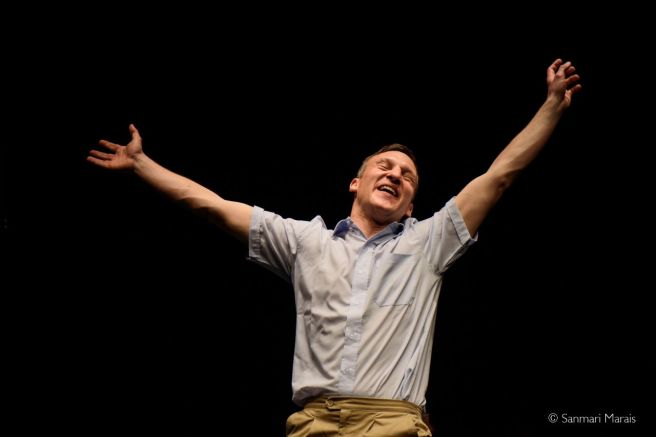
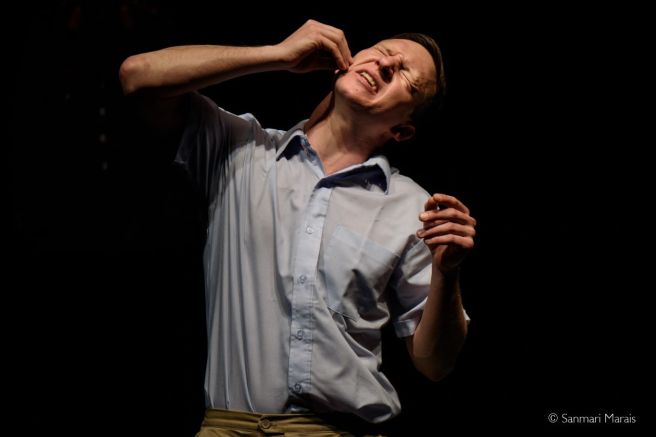
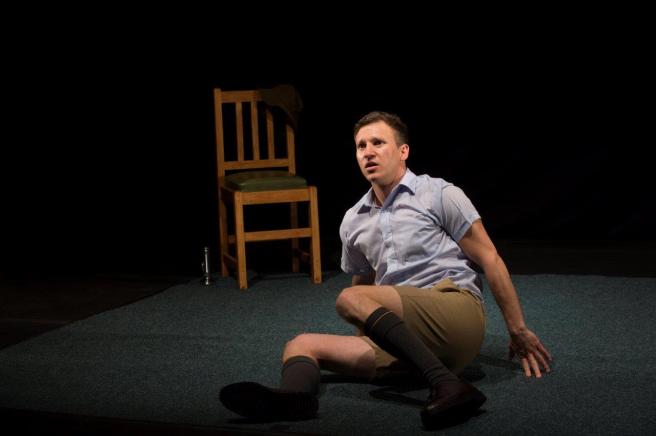
But as with most things, life was more complex and this is where Lombard’s acting skills soar. He holds the floor easily as the young Marnus and the many characters he has to adopt and with the director’s help, the story is skillfully massaged to keep the audience hooked.

As a solo show which is played almost stationary, the movement they manage to incorporate is stunning. It lifts both the emotional level and introduces a physicality which is at the heart of the horror of this young boy’s history.

He might not understand everything that’s happening in his life and his country, but he can feel when things aren’t what they should be and once the questions start, there’s no going back.

Lombard displays an innocence without being too childlike which is charming and encapsulates the 11-year-old who is baffled by his surroundings which seem to be crumbling around him.

It is an intimate piece of storytelling that embraces a much wider world and one that resonates as strongly today with everything happening out there. Judgement is such an easy thing while your own life warrants no scrutiny. How could it, you’re a god-fearing man?

With the seemingly gentle script with brutally dark undertones, a searingly sensitive performance by Lombard and Bye’s brilliantly sculptured direction, it is powerful theatre that both illuminates and pummels you emotionally.

If not in this way, how will the lessons ever be learnt?

Die Reuk van Appels will be staged at Potchefstroom’s annual arts festival Aardklop from October 3 to 7 October and at Cape Town’s Fugard Theatre from 17 October to 11 November.

Sassy choices like Die Reuk van Appels give Theatrerocket fantastic blast off

 DIANE DE BEER

Fledgling theatre production company Theatrerocket is making waves with its first production Die Reuk van Appels, which runs at the State Theatre until September 24;

Die reuk van appels 4 - credit photo by Jan Potgieter
Gideon Lombard in Die Reuk van Appels                  Pictures: Jan Potgieter


When Johan van der Merwe and Rudi Sadler started talking about their passion for theatre while traveling many kilometers between Pretoria and Joburg as theatre  judges, they decided to start their own production company Theatrerocket.

Van der Merwe previously owned a catering company in-between attending all the major art festivals in South Africa as well as going on an almost annual visit to the Edinburgh Festival (averaging 700 theatre shows a year). Sadler is a theatre journalist and graphic artist. Both have recently left their day jobs because they realised while trying to achieve their dream, producing is a full time job. They’re determined to make it work and throw everything at it to see that happen.

Their first production, Die Reuk van Appels, which opens at the State Theatre’s Momentum tonight (Saturday September 2), adapted from the celebrated Mark Behr novel, hasn’t been an easy one, but it has been successful on every possible level, already raking in the awards – and they’re not done yet. It still has runs at Aardklop in October and a season in Joburg next year.

“We have been told that you never make money on your first production, but we are starting to see the light,” they explain. Anyone in and out of theatre would agree that it can only be passionate madness for these two theatre fanatics to take on this formidable task. And yet it has paid off big time. They have had many more offers than they can accept.

Their first option was a good one (as it seems with everything they have done thus far), and it was an easy choice because Van der Merwe since first reading the book, has hankered to produce this for stage – as a solo show.  The main character tells the story from his point of view, thus a solo stage show was the way to go.

die-reuk-van-appels-2-photo-by-jan-potgieter.jpg

After much work, they were finally given the rights and the book, after some detours was passed on to award winning scriptwriter Johann Smith to adapt for stage. Once that was done, the two producers as well as actor Gideon Lombard and director Lara Bye had discussions with input and finally they had the completed script.

For those who don’t know the story’s bare essentials, it’s about an 11-year old Afrikaans boy Marnus who lives in a country where the black and coloured majority are governed by a white minority. He gradually becomes more aware of the injustice of the system and has to make complex decisions especially at his age about right and wrong as he witnesses certain things. His life is irrevocably changed when a foul deed destroys his existence.

“It is the story of so many white South Africans,” says Van der Merwe about living as a youngster in a country where everything was presented as normal, and he also believes that a younger generation should learn about and understand our horrific past. “They have no clue about the world we lived in, how closed it was,” he says of that period of our past.

For Lombard, this has been an extraordinary experience. Working with this particular director (and producers) was an added bonus because they knew one another. “I have worked with her before and she was a lecturer at UCT when I studied,” he says. Trust was a given and helped enormously with this very difficult text, especially as this is Lombard’s first solo performance.

Die reuk van appels 3 - by Jan Potgieter

For him and Bye, the text as it currently stands has to be just that. Everything is justified in context and what some may see as inappropriate wholly serves the story and is not included to shock. To go into more detail would be a spoiler because the experience of the play is all about the unusual and unexpected unfolding and unraveling of this young boy’s experience.

“It’s a play that needs patience when viewing,” says Lombard. The rewards come at the end but in the telling, lies the detail and the poetry of the text. “Bye has created a wonderful safe space on stage,” says Lombard which also shapes an unnerving intimacy that is part of this extraordinary play.

Lombard loves the metaphorical essence of the play and is ecstatic about the experience even if like anything else – and here the producers nod in agreement – it took hard work. For all of them this has been a learning experience because it is all about firsts. But because of their dedication and their knowledge of the industry and more importantly, what it takes to make good theatre, they are painstaking about the details, and it shows.

Van der Merwe and Sadler have up to now usually been audience members. They know what they want when going to the theatre, from the practical issues like being on time and having the right sight lines to the production. But more importantly it is the content and with their first production and all its participants included, they have set a benchmark to be proud of.

If theatre is your particular bent, take a closer look at this coming-of-age story.  It grapples with the Afrikaner mentality in the late ’70s early ’80s and the brutal consequences of apartheid and the militarisations of South African life.

It will tear at your heart.

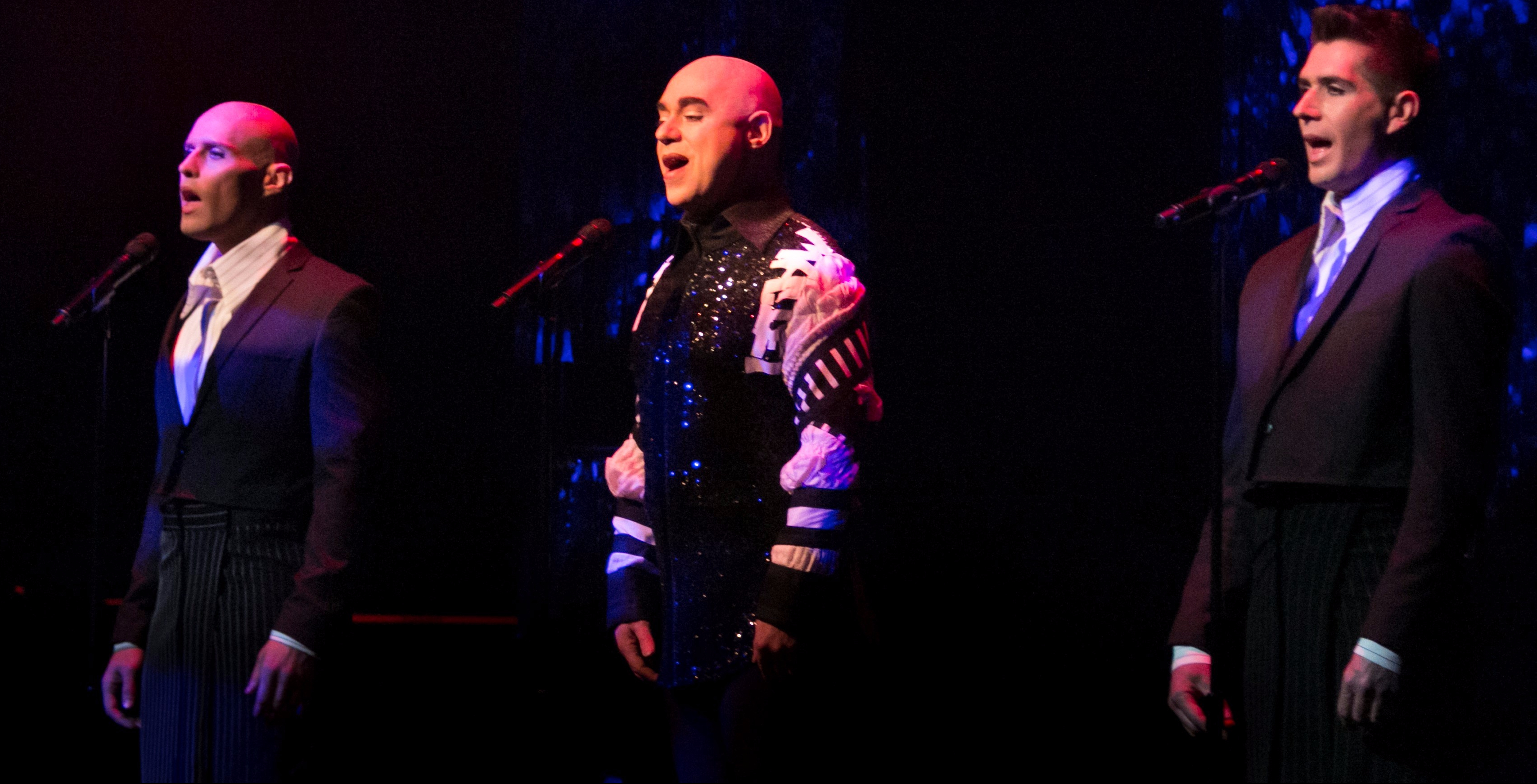
Nataniël’s Blast of Brilliance, 30 Years in 90 Minutes at Emperors Palace

Pictures: Lorinda van den Berg

Nats3

DIANE DE BEER

30 YEARS 90 MINUTES

WRITER, DIRECTOR, PERFORMER: Nataniël

SINGERS: Nicolaas Swart, Dihan Slabbert

MUSICIANS: Charl du Plessis (piano), Juan Oosthuizen (guitars), Hugo Radyn (drums), Werner Spies (bass)

COSTUMES: Floris Louw

UNTIL September 24

Celebrating 30 years as a solo artist is quite something. Doing it in the spectacular style as Nataniël does in 30 Years, 90 Minutes is awesome but not unexpected.

Having watched him for most of those 30 years bar the first few, what has excited me most is to watch his work evolving with time, to witness the confidence grow slowly allowing him to take more and more risks until his stage brand was completely embedded.

That doesn’t mean that he keeps doing the same. This current show says everything about his past but also gives us glimpses into the future.

Nataniël has always noted that the vision for his shows begins with the costumes. It sets the tone for everything else. The costumes are the thing visually. Not that they haven’t always been but they have competed with everything else happening on stage. One always knew that you would be missing some effects at first viewing of his shows, because there was so much going on.

This time though, the stage is stripped and more than anything, the costumes and his breath-taking lighting give the visual cues. A red shimmering jacket sparkles in the light or is turned into a black jacket with flashes of red and a closing outfit is transformed in colour and texture from the beginning to the end of the song. It’s magical!

Nats1
Nicolaas Swart, Nataniël and Dihan Slabbert

All of that, as well as the set, are completely woven into the fabric of the storytelling, even when his stories don’t form one narrative other than being proof of his extraordinary ability to capture the imagination and paint pictures with words.

It’s not only the content of the stories, it’s the way they are germinated and have been constructed. In one, for example, he gives you a sentence that could be interpreted in diverse ways depending on how and when it is said, and then he ends that tale with the exact same construct as where it all started. It’s more than smart, it also gives the audience many aspects to engage and play with throughout the show. For those who think he is all about telling a story and singing a song, think again. There’s so much more – even if the former is more than enough. That’s why the longevity and the loyal fanbase.

As someone who has probably seen 90 plus percent of the shows he has created, it was a first for me when one story (spoiler alert: there’s a red Citroen with black stripes involved) was so funny, that my eyes burnt from all the tears caused by laughter.

And then there’s the music. Nataniël has always professed a deep love for singing. It’s what he enjoys most and when you see him live, it shows. His cover versions for those familiar with his music are legendary. His arrangements are so astute, they turn something familiar into something fabulous and he does a handful exquisitely in the show.

The choice of music for this season also includes something old and something new in his self-penned repertoire. To be reacquainted with some of the old tunes and being gifted something new, all adds to the richness of the production.

In addition to all of that you have the accompaniment of four supreme musicians (all in their own right) as well as two gifted singers that add even more tone and texture to the different songs. It is the complete package.

That’s the thing about a Nataniël show. Every detail is covered.

And to top it all, there’s the performer himself. It is his individuality, his unique gift for storytelling and song (creating and performing), his vision and his obsession to keep it fresh that transforms the stage and auditorium into the perfect dreamscape for 90 minutes.

He gives you what you want but in a new guise.

That’s genius!


War of Words: Freud and CS Lewis

DIANE DE BEER

FREUD’S LAST SESSION

DIRECTOR: Alan Swerdlow

CAST: Graham Hopkins (Sigmund Freud), Antony Coleman (CS Lewis)

VENUE: Sandton”s Auto and General Theatre on the Square

DATES: Until September 14

Freud3
Graham Hopkins as Sigmund Freud and Antony Coleman as CS Lewis. Pictures: Philip Kuhn


Take two great minds with opposing points of view, make the subject religion and let them go at it.

But load up some extra tension. Make it a looming World War (2), as well as one of the protagonists suffering a debilitating disease which will kill him sooner than later. And he knows that. It becomes a war in oneself  and a war of words set against the backdrop (and constantly brought into the room) of  war on the horison.

That’s exactly what this intriguing play juggles as these two great actors slip into their respective personas with great ease while tackling some of life’s most vexing issues. If this doesn’t pull you in, it’s perhaps not your play but think about two adults having a discussion with opposing points of view without coming to blows. It doesn’t happen that often anymore – or not so one can witness. And perhaps not in real life?

Freud4

Freud2
Conversational classic with Antony Coleman and Graham Hopkins

Freud1


It’s huge fun. With Hopkins and Coleman really getting stuck into the roles, it makes for mesmerising viewing.

How can you not get into the Germanic, almost austere world in which Hopkins has cloaked his Freud. He completely sucks you into his character, an atheist at the end of his life who seems to be battling with life’s issues that might not be as crystal clear as he always thought they were.

Coleman’s CS Lewis is a more affable chap, recently converted from a similar position his adversary is defending, yet not at all thrown out because of their wildly differing points of view. The only time he is caught off balance is when the war-time sirens go off and having confessed to participating in World War 1, it seems like post traumatic stress disorder (PTSD).

Both are battling their own demons.

As the distractions dissipate, the two men continue their conversation about religion, mainly, as they argue their different stances, both with superior minds which they apply to showcase their opinions. It’s not as if we can’t all participate while watching. None of what they’re talking about is new. It’s just fascinating to see these two giants of old, fight to the end, to imagine what could have happened in that room if indeed they  had this particular discussion.

It’s a good piece of writing. American playwright Mark St Germain is quick with his wit and wisdom and keeps the flow of the ideas fast while giving time to digest. And with this premise, director Swerdlow could have over-exerted his actors to keep them from turning into talking heads. Wisely he didn’t and with actors of this stature, that was the right choice. They have a good text to work with and ideas that are both challenging and engaging, and the actors have a great time sparring with each other.

It’s gloves off and may the best man win. But this is a civilised clash of great minds happy to have some fun while running through their own beliefs and testing them against the best.

Have Suitcase, Will Travel

The Suitcase6
Siyabonga Thwala, Desmond Dube and John Lata

Pictures: Brett Rubin

Diane de Beer

Sitting in the rehearsal room at Joburg’s Market Theatre complex where the cast of the latest revision of The Suitcase is busy rehearsing, it is easy to see why this is such an impactful piece of writing.

Add to that the evocative music (arranged by Bheki Khoza) that James Ngcobo has incorporated into the fabric of the story, it catches your heart from the start.

This was the play that first brought actor James Ngcobo’s directorial skills to everyone’s attention.

Adapted from Es’kia Mphahlele’ s short story by Ngcobo, it is set in the 1950s in Sophiatown (here it has been moved to Durban). The Suitcase is a haunting love story of a couple who try to pursue their dreams with nothing more than each other yet they believe that will carry them through. Set in the bitter apartheid years, it is the tale of countless couples who try to make a simple living in extraordinarily harsh times. Everywhere they turned, doors closed without even a glimmer of hope except perhaps that chance of a lifetime which might change their lives.

It is also a universal and timeless story which can be set anywhere, at any time.

Having watched it in all its reincarnations, I thought I would be immune to the sadness that gently yet determinedly envelops you but, as Ngcobo always points out, it is a love story before anything else, and it has a devastating yet mesmerising effect.

The Suitcase5
James Ngcobo and Siyabongo Thwala.

The pressures of the city, unemployment and poverty strip away the husband`s self-esteem and he starts to lose his moral compass. He is so desperate to provide for his pregnant wife that he steals a suitcase left on a bus.

This third reincarnation has come about because  of a 5-week tour of Northern England (see schedules below). For the artistic director of The Market who was invited to bring this piece, it is about honouring this time by reinterpreting  The Suitcase and in that way, to keep shining those classics for a contemporary world.

If one sometimes wonders why a stage production works, The Suitcase is ample proof that it helps when all the elements come together so emphatically.

From the poetic script which remains true to the original text and captures the haunting powers of a short story to an ensemble cast that work so sweetly together like a tightly knit family.

The cast includes original members Siyabonga Thwala as the husband Timi and John Lata, while Desmond Dube as the storyteller and other characaters and Masasa Mbangeni as the wife Namhla, joins the play.

Solo guitarist Bheki Khosa accompanies three singers – Nomfundo Dlamini-Sambo, Gugu Shezi  and Nokukhanya Dlamini.

The way it is told and performed is all about this country. It’s in the music, the gestures, the sound effects, the movement and the classic storytelling that pulls you right into the eye of the storm as the characters emerge painfully from their dreams.

It’s a beautiful piece of theatre to travel and represent this country as it incorporates so much of our own storytelling yet it is a universal story and with a cast and performers that just in rehearsals (and not quite on their game yet) had me enthralled. I am so proud that this team will be representing us in the world.

Ngcobo is intent on furthering The Market brand and understands the benefits of reaching out and forming international partnerships, to exchange the riches particular to the different countries.

For him it has always been about outside exposure, introducing and involving the young to also learn from these international adventures and to return to plough back. He has wanted to re-position the brand and has worked hard to be brave and to try new content for their space. “Post 94 we started experiencing a new and changing country which meant that as curators we had to exhibit the change in how we programme and that is exactly what we have done, to cast our net wide and not only be a theatre that is driven by a political narrative but to find a way that sees us operating in a continental and universal space,” he says.

In a previous review I had remarked that The Suitcase is pure theatre. “Hopefully it tours both nationally and internationally.”

And that blissfully (with a previous tour to Scandanavia) has come to pass.

Here are the British schedules which will be followed by a home run at The Market from 20 October to 26 November:

Hull: Friday 1 September – Saturday 9 September at Hull Truck; Newcastle: Tuesday 12 September – Saturday 16 September at Northern Stage; Derby : Tuesday 19 September –Saturday 23 September at Derby Theatre; Lancaster: Tuesday 26 September – Saturday 30 September at Lancaster Dukes; Liverpool: Tuesday 03 October – Saturday 07 October at Liverpool Everyman & Playhouse.

Freud and CS Lewis tackle Religion – and more – on stage at Theatre on the Square

freudpic3
Graham Hopkins, Alan Swerdlow and Antony Coleman


Diane de Beer

Throw the names of actors Graham Hopkins and Antony Coleman into a hat and I pay attention.

There are also the play (Freud’s Last Session) and the director, Alan Swerdlow, that add weight. There’s no way the description “cerebral play with warmth” does this project justice though, it is one of those seasons you will have to take a chance on.

At worst you will have the acting talents of these two extraordinary actors – each in their own right. They have in fact never worked together on stage, only in TV’s Scandal, and Coleman remembers that they were fighting a court case in that particular session while Hopkins recalls the reams and reams of dialogue he had to memorise. “I had to devise a special method of pictograms to get it all down,” he says.

Freud’s Last Session which opens on Tuesday (August 22) at the Auto and General Theatre on the Square in Sandton, running until September 14, was imagined by Marc St Germain following the premise of a meeting between  legendary psychotherapist Dr. Sigmund Freud (Hopkins)  and the rising Oxford don C.S. Lewis (Coleman). He tellingly sets this particular tête–à–tête in London on the eve of World War 2.

The one is famous for his views on sex, the other for his religious beliefs (and the Narnia books, some of his life story captured in the play/film Shadowlands), and this will be much more than talking heads – and with these three artists involved, you’d better believe it.

As these two opinionated men argue about the existence of God, whether the belief in God is merely a childish fantasy, or a crucial element of leading a meaningful life, the BBC keeps interrupting with the latest bulletins on the impending war.

With the possibility of a war looming in the background and foremost in their minds, they might start out with religion, the conflict between science and religion, but their conversation veers to their parents, music, meaning of Hitler – and even the entertainment value of flatulence! It would have to have all that to keep us listening I suspect.

The whole affair is of course heightened because of the Hitler’s presence heavy on the horison, Freud being an 83-year-old Jewish refugee from Vienna and Lewis, a 40-year-old World War 1 veteran, both with their own set of worries.

For both actors, finding their particular persona was top of the agenda and Hopkins notes that there’s not much live footage on Freud, while for Coleman there’s obviously much more. But neither of these two actors would be inclined to go for mimicry, it’s simply finding a truth to the men they’re portraying. “It’s so skilfully written,” explains Hopkins, that their characters are revealed in the conversation.

“It’s what theatre does best,” says Swerdlow as he talks about the actors and the way they give life to the people they play. And in this case, it will be part of the enjoyment of the piece – to watch these two skillful artists at work on the same stage – and playing great men, so often larger than life.

For Hopkins the play deals with that age-old question of why we’re here? “It’s something all of us ask at some stage,” he says and there will be both squabbles and serious, thought-provoking debate.

At the time of our chat, the actors were enjoying their first outing together, both thrilled that they have a rapport with much laughter ensuing during rehearsals. Swerdlow is a director who allows his actors to find their way, especially with two as stage savvy as Hopkins and Coleman. While he worries about the play finding its people, he knows when it does, the audiences will stream in and discover the delights of this rich work.

This is the kind of theatre we don’t get to see that often; it’s quite wordy, its about topics that might blow a few minds, and many managements in these tough times aren’t able to take the risk.

Once in a while like in this instance, Daphne Kuhn allows herself this leap of faith. In the end, to get you to go and to pay attention (and win New York theatre awards), Freud’s Last Sessions has to be entertaining.

This trio (Swerdlow and his actors) are determined to showcase the best and prove a point.


Nataniël Celebrates 30 Years on Stage

By Diane de Beer

Nataniël celebrates three decades on stage with 30 years, 90 minutes running from Friday August 24 until Sunday September 24 at Theatre of Marcellus, Emperors Palace. He will be joined by Charl du Plessis (piano), Juan Oosthuizen (guitar), Werner Spies (bass), Hugo Radyn (drums), Dihan Slabbert (vocals), and Nicolaas Swart (vocals).The show starts at 8pm from Thursdays to Saturdays, and at 3pm on Sundays. No children under the age of 15 will be permitted.  Fans can also purchase a limited-edition luxury souvenir programme at the show.

Nataniel show pic
30 years, 90 minutes

Even in those early years it was clear that this would never be a problem. Apart from being a mover with a mission, he has always been a solo creative soul that could slip easily between genres, conjure up creative endeavours and, more than anything to keep himself entertained, come up with something completely different and new at the snap of a finger.

That is what keeps so many intrigued. I was always amazed at critics who complained that his shows were always about telling stories followed by songs. That has always just been the packaging for him but once you creep inside that head, nothing stands still and there’s no time for stagnation. The framework might appear the same, but everything inside has been turned upside down and inside out.

For Nataniël it has always been about change, surprising his audience and keeping them entertained. And that is also how he has gone about planning his 30-year celebration. He wants to make some noise for his audience.

His annual show at Emperors (a stripped-down version played in Cape Town at the beginning of the year) 30 Years, 90 Minutes which opens on August 24, will be a display of his life on stage. Not that he thinks people remember things like that. Or that anything of that nature lasts.

Yet he has very loyal fans and he relishes a sense of occasion. Everyone knows about his obsession for example with Christmas and how he turns this into a magical spectacle for himself and those close to him. A similar principle applies

“My career is 30 years old, I’m not dying,” he says about the celebrations. And that is why he will focus on longevity rather than legendary status. “This will be the mother of all celebrations!” That’s all he basically says about the show. In typical Nataniël fashion, he doesn’t reveal too much.

Take him by his word though and get ready to party. Nataniël is serious about the secrecy in which he shrouds his shows. As a journalist, he gives you enough to do a story and there is something of what he will put on stage but on opening night, when you see what he has created, it’s as much a revelation as if you hadn’t been told anything.

That’s his thing, his magic trick. It is all about the unexpected, the way he tells stories, even his song choices and how he performs them. How will they be arranged, musically performed and how will they fit into a show. There’s nothing left to chance for this perfectionist performer.

He wants to celebrate those who performed with him in the past as well as unveil some of who he is for those who perform with him now and weren’t born then. That’s just the way his mind meanders. “It’s about looking ahead,”he says “What will the new chapter look like?”

Rehearsals, when the whole show comes together, that’s some of his happiest moments. That’s what he wants to show. “It opens like a rehearsal,” he says. “I want the audience to know about the process.” He describes the show as a “night of the forgotten”, stories and shows as he went in search of archive material, that he had forgotten about. “Everything that appears on stage has been on stage before – all my favourite elements of the past 30 years.” It even means re-staging some of his biggest flop moments

Those who follow his career will need little encouragement. They know they have a formidable artist in their midst, someone extraordinarily special, who on a night will blow their mind … perhaps their world!

Nataniel CD cover
Packaging is the appeal

But that’s only half of it. Already part of the celebrations, Nataniël also released a celebratory CD this year, One Day In A Castle. “I like that booklet packaging,” he says about his decision to produce it in CD format. He describes this one as one of the most honest productions he has done. “I wasn’t doing it for airtime, didn’t want it to sound plastic-y, wanted lush arrangements and rich sounds,” he says. He’s achieved all that!

And then there’s the book. He cleverly decided to tell his story with visuals – his costumes no less. That’s how he views his world. When he does a show, or thinks up his next story, it is to the costumes he turns first. It’s all about the look, the pictures he will present and how he shows the world his life.

That’s what this costume book represents – the story of his stage shows and, if you listened carefully through the years, his life. But that’s not all. The way he orchestrates his world is a lesson for those trying to forge a career.

Because he is always doing three things at a time, he tends to intertwine, pull those strands together that can work many streams and explore everything in different ways. His last TV show, shot in an old chateau just outside Nantes, also benefited from his extravagant costumes. With his brother Erik, the photographer of these costume pictures, also part of the production team and co-presenter with Nataniël on his Nantes TV series, these costume sessions would conclude each episode while also presenting the chance to capture the images for his book and posterity.

Because of the way his imagination runs wild, each shoot turned into a production itself. Not all the costumes were shot in the charming French countryside and sometimes it would mean building the fantasy he hoped would best tell the tale on his return back home. “We built sets which exploded into a circus in a forest,” he notes. But they also had to recreate some of the sets from previous shows. It’s the kind of detail his precision demands.

His practical side also slips into the equation though. Even if he wants this to be the most exquisite book in the world, he doesn’t want a coffee table book that gathers dust. It must be affordable and something that people will dip into with delight.

Nataniel in costume
Nataniël’s work of art

He has always been clear about his costumes: “It can’t go on stage if it isn’t a work of art,” he says simply.

For him, the costumes are the best representation of his life. “It is the only thing I collect,” he says, which for this super compulsive shopper (generous to a fault, so usually for others) is some confession.

In the end, looking back, he’s shocked. “I have been making a career for 30 years living in obscurity. And I’m not even a politician,” he claims.

And he does giggle when he finds himself in the middle of a shoot, a male in a tutu surrounded by a clutch of colourful chairs! Outside of context, he knows this is ridiculous. But that is his life and that’s why people listen to every word and follow each step he takes.

It is his extraordinary mind, the way he draws the curtain on the way he thinks, embraces the world and invites them to share his fantastical vision.