Janice Honeyman’s Peter Pan at Joburg Theatre’s Nelson Mandela Theatre
Cast: Richard Richard (Smelly Smee), Ben Voss (Mr Darling and Captain Hook), Kensiwe Tshabalala (Mrs Darling), Kiruna-Lind Devar (Wendy), Matthew Berry (John), Diego Hamity (Michael), David Arnold Johnson (Clementina Coconut), Manyano Ngoma (the dog, Nana), Virtuous KIandemiri (Thokolina Tinkerbell), Sandi Dlangalala (Peter Pan), Lesedi Rich (Sam Spaginyol), Gareth Meijsen (Seb Scumdawg), Dirk Joubert (Sparkey), Gugu Dhlamini (Curley), Sarah Leigh (Nibs), Brian Ngobese (Tootles), Bo Molefe (Slightly) and Tania Mteto (Princess Lotus Lily) and the ensemble
Associate Director: Timothy le Roux
Production Designer: Andrew Timm
Lighting Director: Johan Ferreira
Sound Designer: Akhona Bozo
Choreographer: Khaya Ndlovu
Costume Designer and Co-ordinator: Mariska Meyer
Dates: Until December 24 (so get going!)
If you have seen as many pantomimes as I have, you need some incentive (especially when you’re no longer the target market).
For me there were two big ones; Janice Honeyman and my two favourite little ones. Just the fact that I can still stomach a pantomime has everything to do with someone who is completely ruled by her inner child when writing and staging the annual panto.
Not only does she know how to negotiate an audience of young and older children but she also shares her panto story with loads of fun clues for those with many more years on the planet to keep their minds spinning once they’ve seen enough of all the silliness and have had enough festive cheer.
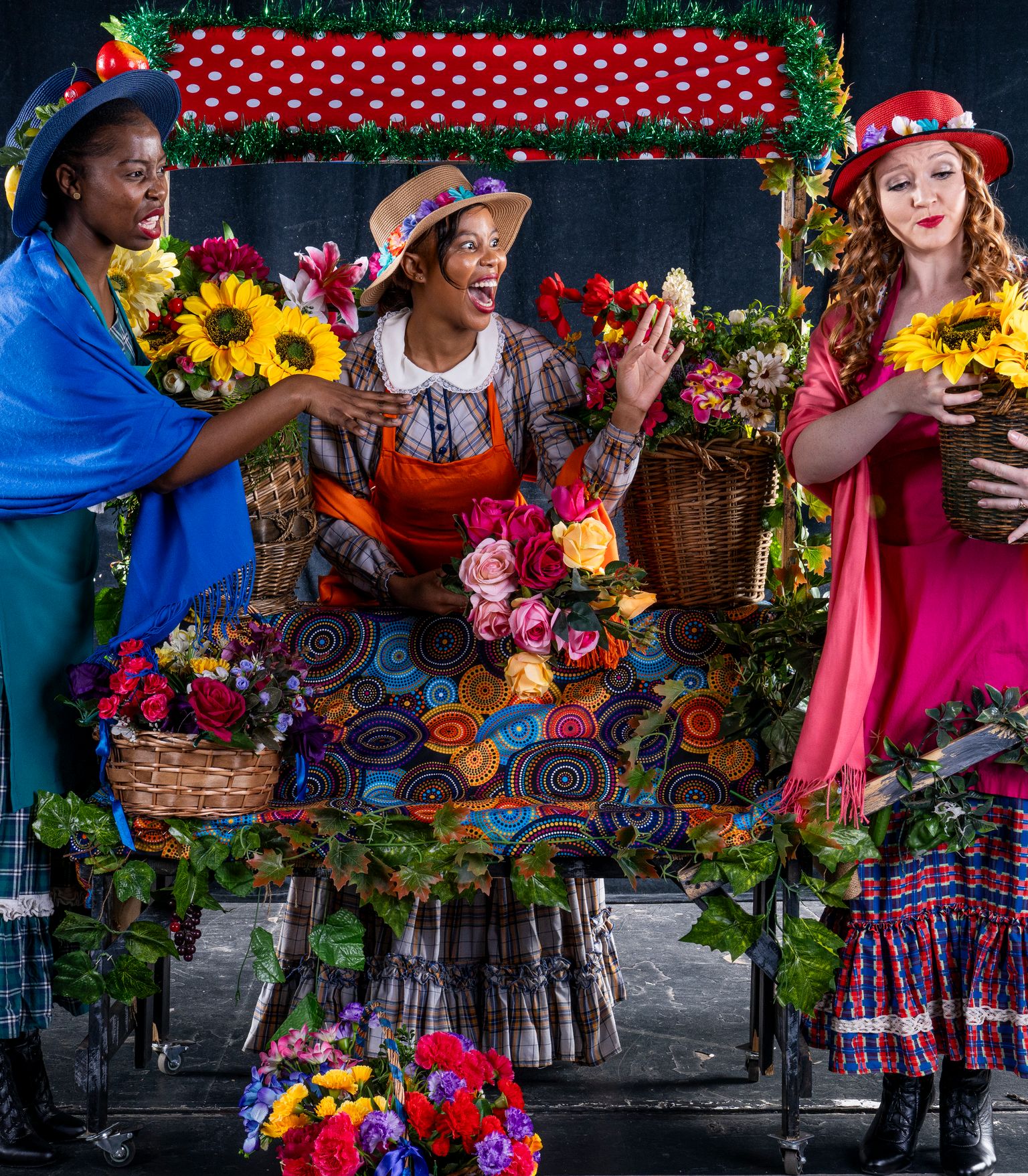
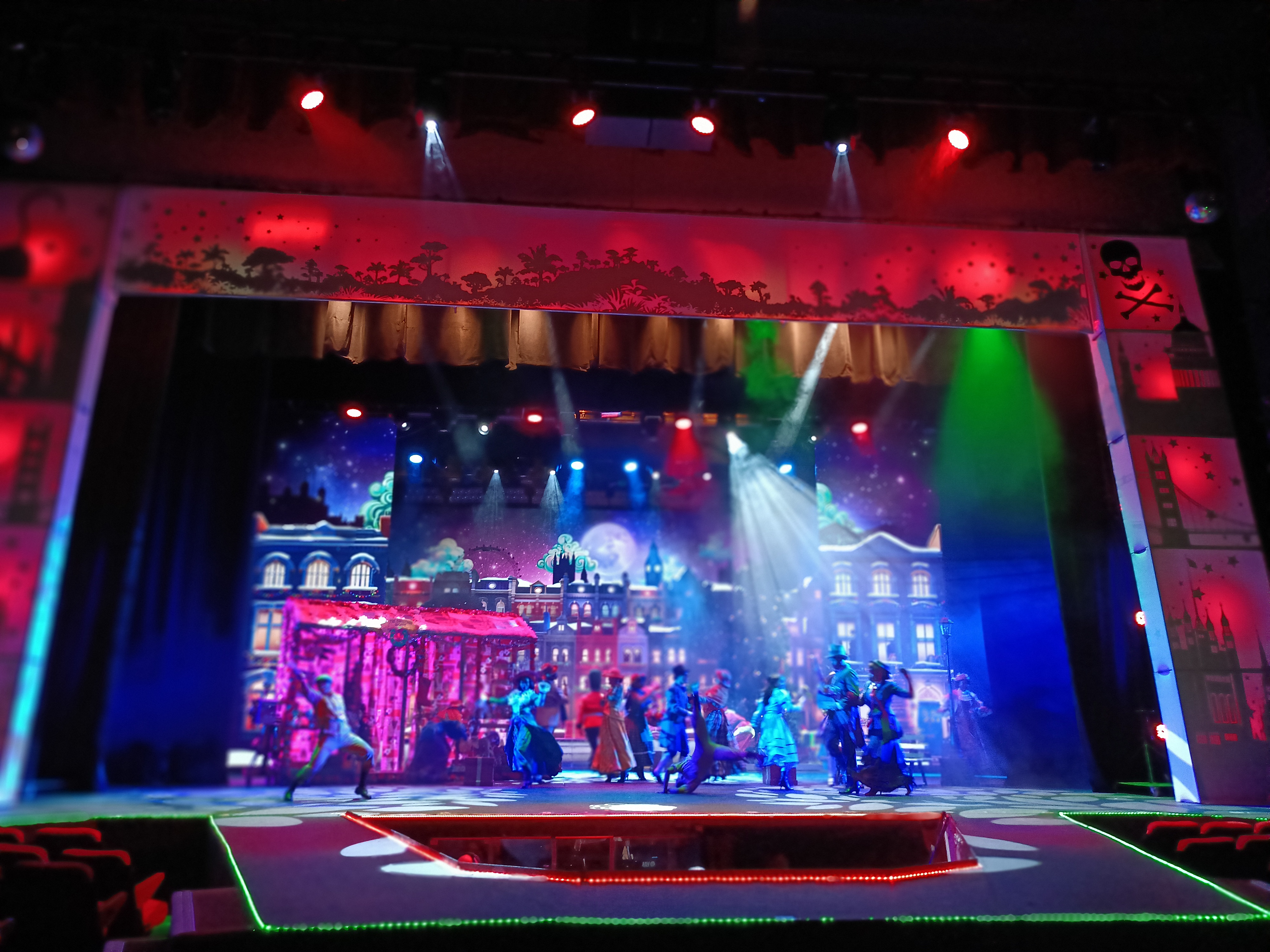
She has also found a compromise with the LED screens and all the bells and whistles they add to this production, while holding on to some of the more old-fashioned sets and designs, which breathe life into the rapidly developing technology.
It’s a miracle just to watch her each year as she finds ways to build novel glitz into the show. She has established her nimble dance to deliver the goods – and that she does with sparkle – time and time again. Small wonder they can’t let her go as she just keeps pushing those stakes higher and higher each time.
This is probably somewhere in the region of my 30th Honeyman panto production and the fact that I can keep going and writing willingly, says everything.
This time it’s Peter Pan and one of the delights which has been been happening for a few decades is the transformation of the South African stage. I know some might ask whether we still have to touch on these colour issues, but it is especially the popular shows that had to get it right and had the most impact. Of course Ms Honeyman did just that. And it easily gets better every year.
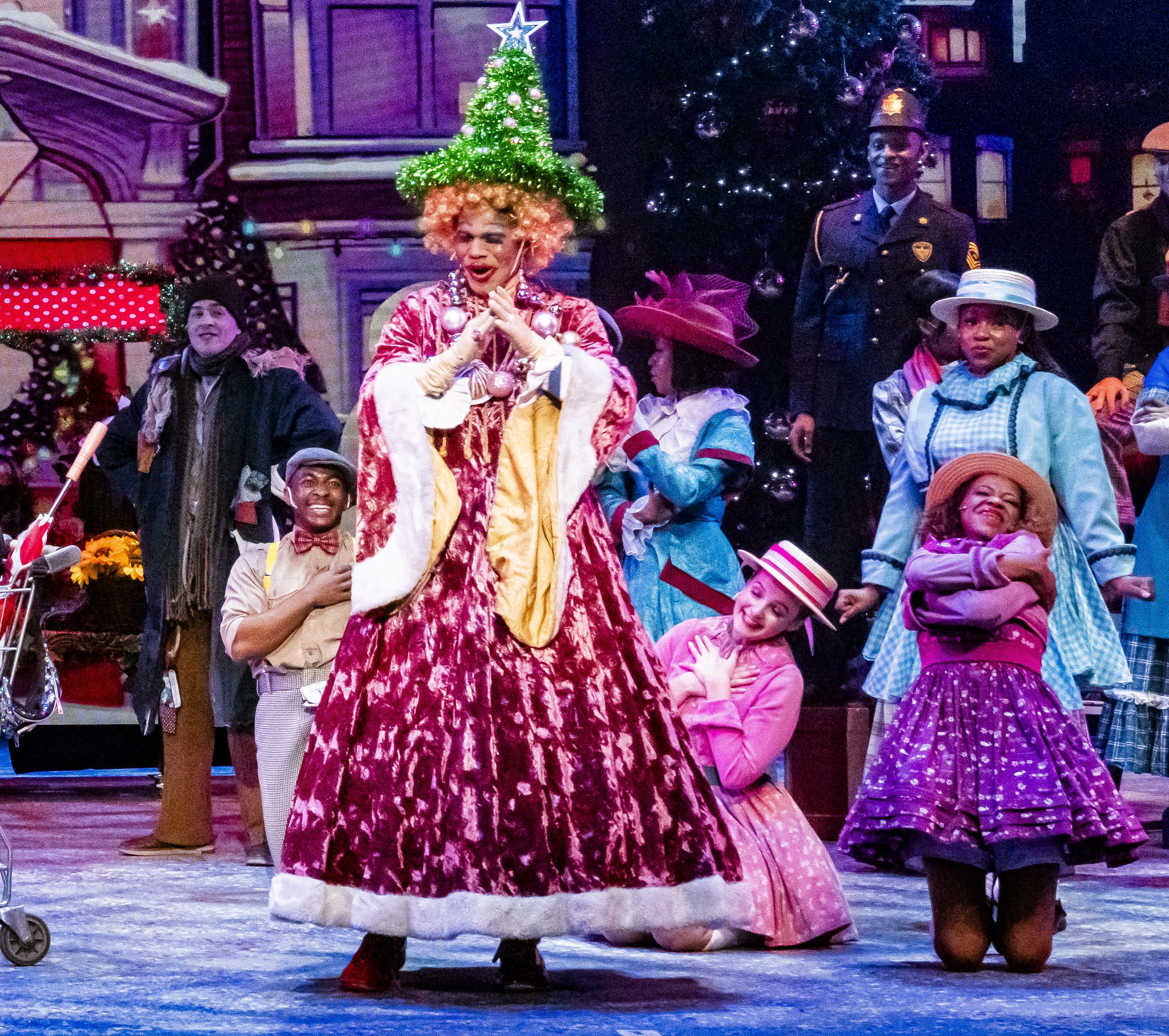
David Johnson as Clementine Coconut.
She has created many stars and again, a few are stepping out smartly to show their stuff. I have to confess, I have always been a David Johnson fan. Perhaps he’s not the obvious choice for the panto dame, but that’s another of Janice’s tricks up her sleeve. She doesn’t opt for the obvious and then she delivers another bit of magic by getting a performance that’s different, yet works. Clementine Coconut could have some fun with her costumes which already delivered the goods and to boot, Johnson added some swish and style to his panto tart.
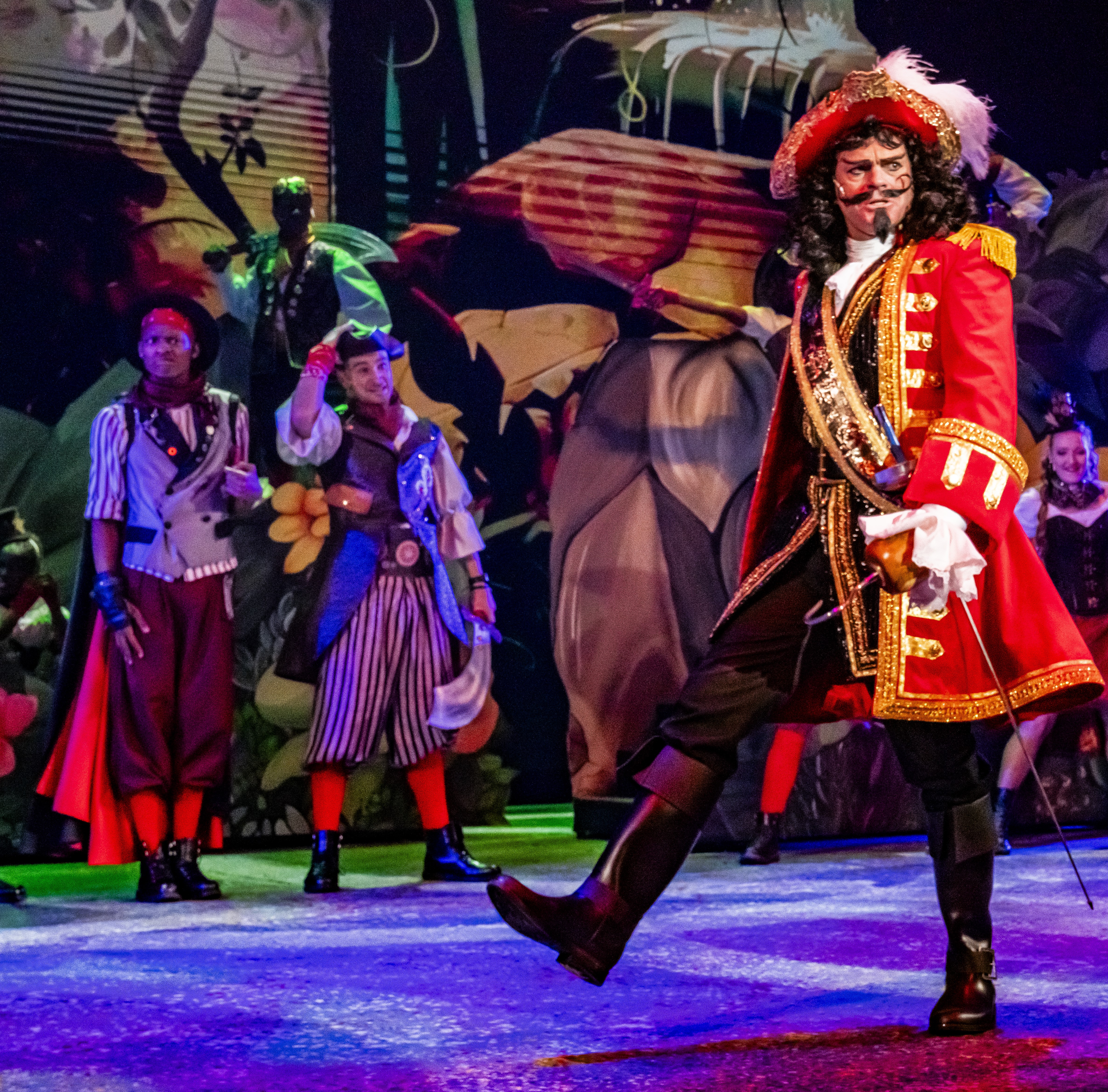
Ben Voss as Captain Hook
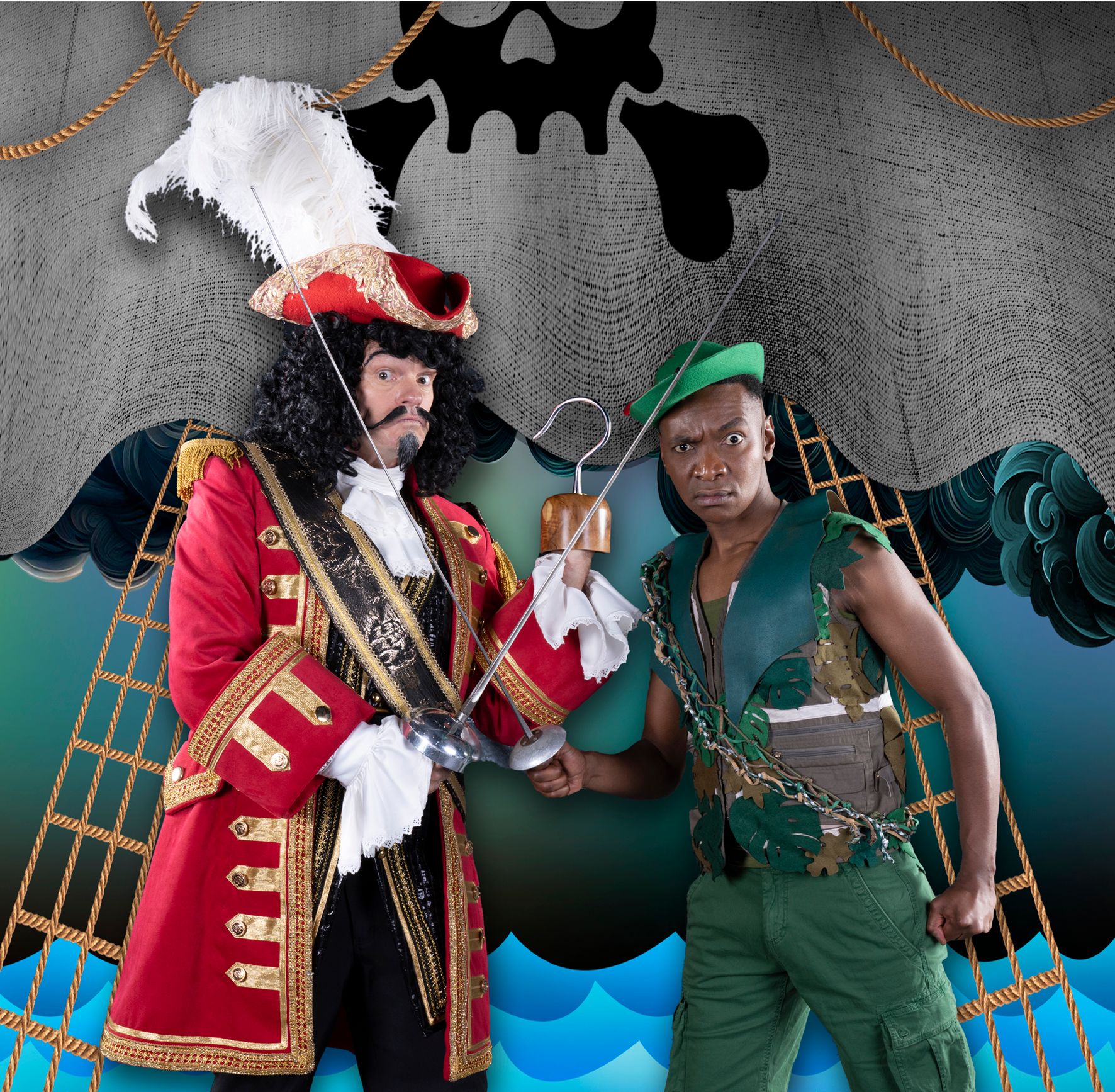
Ben Voss, another panto and Honeyman regular, did double duty and delivered a devilishly evil Captain Hook with a smart swagger and punch, which might have scared some and tickled others, and then quietly slipped into the shoes of the more demure Mr Darling.
Virtuous Klandemiri as Thokolina Tinkerbell with Sandi Dlangalala as Peter Pan.
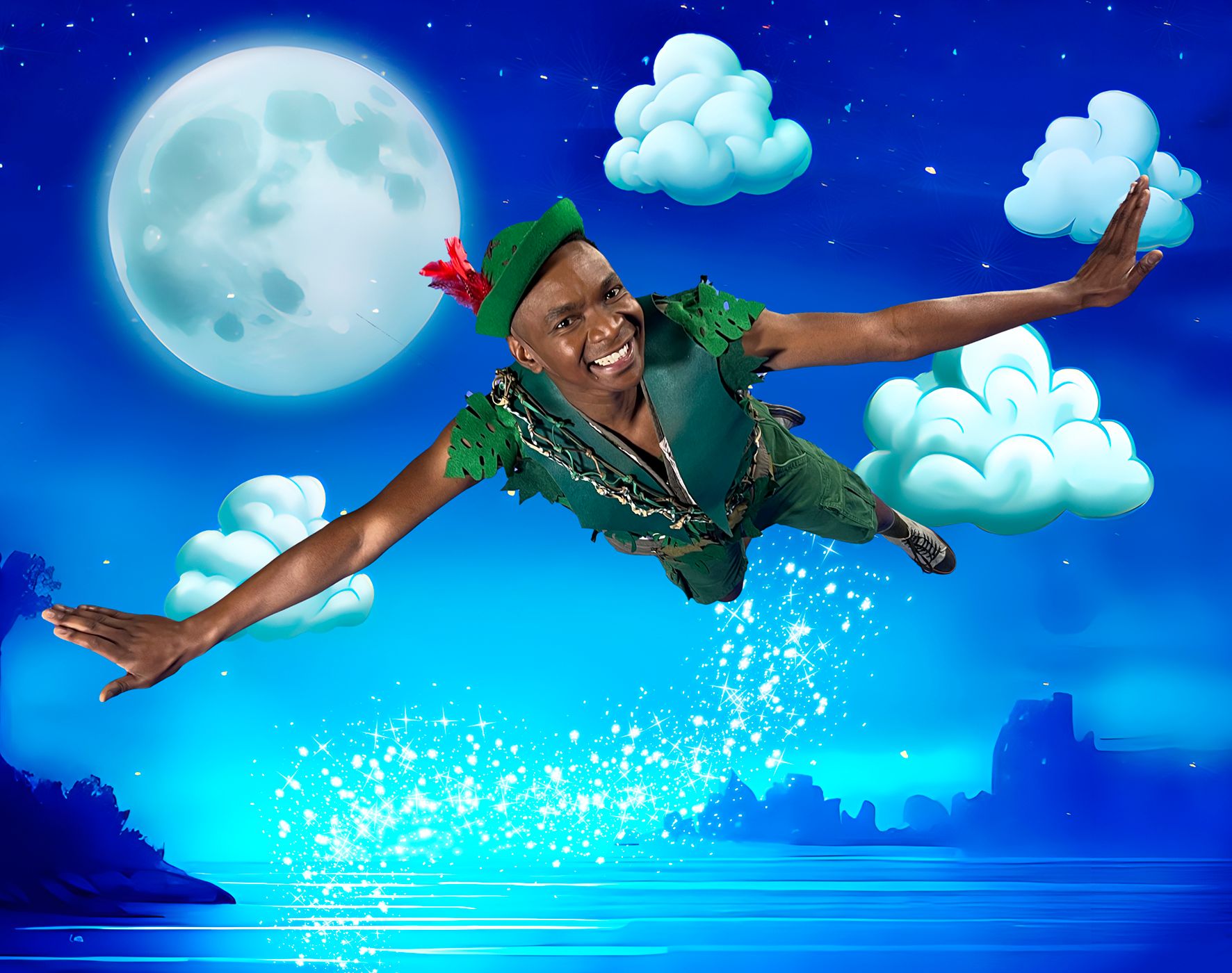
If you have a very traditional view of what and who Thokolina Tinkerbell should be, Honeyman flipped that applecart as well and gave us the sparkly Virtuous (could there be a more apt name!) Klandemiri as well as the light-on-his-feet Sandi Dlangalala who starred and shone as as Peter Pan in this debut performance.
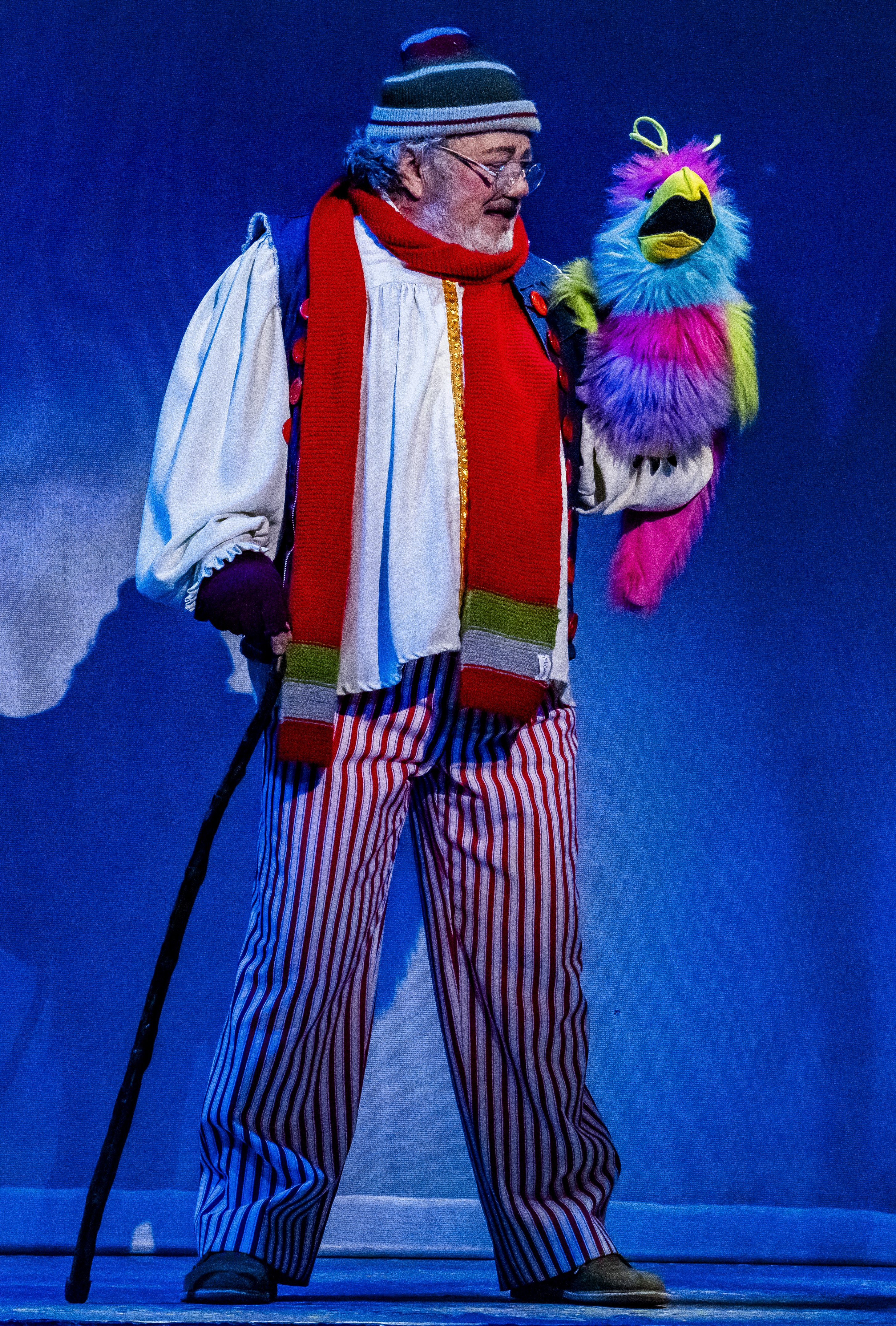
Michael Richard as Smelly Smee.
Michael Richard added a performance with flair and wisdom enhanced by decades of experience as Smelly Smee and the youngsters in the cast kept the energy up and the artistry pumping.
It’s a gran show. This time we sat on the balcony and it was fascinating to get this different yet complete view. I know many people regard the lower level as the better seats. My small companions had seen last year’s panto from the front row.
The full splendour.
But in the end, the balcony offers a complete appreciation of the Honeyman approach. It allows you to focus on the whole rather than individual performances for example but also accentuates the detail that comes together in the design. It’s easy to understand why Honeyman draws you in time and again.
Ketsia Velaphi in Tankiso Mamabolo’s Don’t Believe a Word I Say.
Teksmark has been running for a few years now in Cape Town (see previous post) and recently KKNK CEO Hugo Theart decided it was time for Gauteng (with the helpof the well placed Foxwood team providing the venue) to show their stripes – and predictably, they came out in full force. DIANE DE BEER picks a few personal favourites:
Teksmark has been one of my favourite outings from the start because it keeps me in touch with new (and often young) playwrights, what they are thinking about and how they find the words to tell their story.
It has also opened the KKNK’s profile to embrace a much larger slice of the arts and in this somewhat geographically challenged country of ours, we need everyone in the arts community to reach out and hold hands. We have amazing stories to tell, but the audiences are limited and the cohesion of the arts community, nationally, is important.
Director and playwright Obett Motaung (centre with microphone) in conversation with CEO Hugo Theart and his cast.
Obett Motaung cleverly started with a catchy title, A Street Taxi Named Desiree, and plaed with just that. The play is a series of sketches with taxis as the hot and happening topic.
What he does especially smartly is use all the South African tropes that everyone will recognise even those who never use taxis. Coldrinks? Does anyone not know what that means when for example a traffic cop or policeman stops you?
Or the rules that are there, yet not for taxi drivers? The fact that everyone recognised these foibles in the room, says much about the South African landscape.
And this is also what made this such a smart piece of writing. It grabs you with laughter yet slips in quite a few serious issues, again, instantly recognisable.
Christo Davids (playwright) with his cast for Laaitie Mettie Biscuits.
We all know or perhaps think we know the problems special needs individuals face on a daily basis. Some of that is captured in Christo Davids’ courageous text which has him facing rather than ignoring the problems.
His play titled Laaittie Mettie Biscuits is about a differently-wired young man who gets into trouble with the police and because of a misunderstanding and the difficulty society has of dealing with anyone or anything that isn’t “normal”, things quickly get out of hand.
And making the point even more sharply, following the reading, most of the discussion was focussed on the need of a Down syndrome individual to be cast in the role. Anything else would defeat the purpose of the story, no matter the challenges.
Asked about his reason for writing the play, Davids explained that he hoped to spark a different conversation or at least, thinking about people who because of different physical or mental challenges have to operate in a world that didn’t easily acknowledge and make provision for them.
Holding a mirror to society is one of the many positives of theatre and no more so than with this truly brave attempt. Let’s hope that we see it given life on stage.
Tankiso Mamabolo selling her delightful Don’t Believe a Word I Say.
Playwright Tankiso Mamabolo’s says Don’t Believe a Word I Say was written as a play on memory and how we often embellish these remembrances over time, to protect us from trauma or to fill in the gaps that have appeared over time.
She had everyone delighted when she pointed out that the play was written in the style of ADHD, wrote it in fact in exactly the way she thinks – and luckily for those of us watching, she has an imaginative mind worth interrogating.
What do we choose to remember and what devices do we use to reach back? These are the issues she spotlights.
“I have a team of black women dissecting, reminiscing and recreating black girlhood in a way that utilises humour without dehumanising black girls and instead focusses on the nuances of their vulnerabilities with the complete understanding that they are complete bad asses. I wrote a play about my childhood that gives voice to parts of black girlhood that are often overlooked eg, we also can be hopeless romantics despite of the world and what is happening around us.”
And in the process, she gave everyone a lesson in how to present their play. This is someone who knows what to do with an opportunity and I can see it paying off – as does her play.
It’s fun as Tankiso explained, she was featuring young black women, usually an ignored section of society – and think about that! She already has an audience right off. And with her talent, there will be more. She’s got what it takes.
Farce has never been my favourite medium but if anyone can pull it off, it is Nico Luwes. And knowing all the rules to get things off on the wrong foot, which is the key to any farce, Nico also made sure the best ingredient for this kind of performance was in place – the cast.
A cast to die for with playwright Nico Luwes (right)
He pulled out all the stops with Koebaai, ou Koba!: Henrietta Gryffenberg, Tobie Cronje, Elzabé Zietsman, Pietie Beyers, Rina Nienaber, Gert van Niekerk, Peter Terry and Ryno Hattingh, all veterans in the business and some not seen on stage for a very long time.
But the names are recognisable and an audience is out there waiting. They will be salivating to see this ensemble – and we could see why. Yes it will cost, they won’t make much money, but they will draw the crowds.
That’s the thing about this kind of theatre. Because it is sometimes viewed as an easy ask, not enough attention is paid to the staging and performers. But if you do it right, you have a winner as the director/playwright proved here.
Op die hoek van Styx en River is Nora Per Abuis Met die Dood Oorgeslaanby Henque Hymans with David Viviers and Gretha Brazelle.
When everything comes together in a play, it always makes you smile. That’s what happened with Op Die Hoek Van Styx en River is Nora Per Abuis Met die Dood Oorgeslaan written by Henque Heymans staged with actors Grethe Brazelle and David Viviers who meet at some point between life and a transfer to another place.
Their conversation is all about misunderstanding. The instructor is bored with a conversation she has regularly, while the listener doesn’t know that she’s died. This sudden meeting has her completely perplexed.
It’s confusion which turns into a conversation of much merriment and originality.
And … Action! with Jane Mpholo (playwright) and Ronda Mpiti.
And as I run out of space, I want to include two more remarkable participants: Jane Mpholo’s And…Action! who wanted to sketch South Africa in full colour but in a bantering, light way, yet still including bite; and another example of how the Teksmark works, Ek Sal Jou Leer Om Die Melk Te Deel, a play that was accepted previously and now with some work, was featured again most successfully. With a theme of mothers raising the children of others, while not having enough time with her own, it’s something that touches all South Africans in different ways. And again, it makes everyone think especially playwright Lwanda Sindaphi who kept reworking.
Anele Situlweni (sitting) and Maude Sandham in Ek Sal Jou Leer om die Melk te Deel.
As you can see, it is about the people and the plays, the topics that are addressed and argued about, the potential that is discovered and nurtured – and in conclusion, the general health of the theatre industry.
The delightful cast from Khanya and her Golden Dream.
The 8th Teksmark in collaboration with NATi, the Baxter Theatre Centre and the Het Jan Marais Nasionale Fonds again presented a wealth of 18 scripts by 20 playwrights, performed by 60 actors with 18 directors which was showcased to potential investors with lively discussions following every performance. The brilliant brainchild of Klein Karoo Nasionale Kunstefees artistic director Hugo Theart, generating 125 texts through the years with 36 text ideas becoming fully fledged productions. DIANE DE BEER gives her impressions of her favourites at the most recent market held as always at Cape Town’s Baxter Theatre from August 30 to September 1:
*To follow is a report on the first Gauteng Teksmark which was held earlier this month.
With established writers like Mike van Graan, Philip Rademeyer and Ingrid Winterbach featuring, some celebrated Teksmark virgins like Andi Colombo delivering a second time round and a handful of new finds, all round, it was as always a revealing event.
Some contemporary issues were addressed, some writers ventured into new territory and others expanded on familiar themes yet tackled with a fresh eye. Covid didn’t necessarily feature, but it did offer quite a few playwrights the time to write a new play, which just shows that there is always a silver lining.
Ingrid Winterbach (centre) speaking about her play Moedswil en Muitery with director Gideon Lombard and interviewer Kabous Meiring.
Take insightful writer Ingrid Winterbach for example, probably serious will always be somewhere in the description about her novel writing. Yet when she decided to turn to playwriting again, it was playfulness that became the focus.
With a show of skilful writing, she looked at our past, Jan van Riebeek and his wife Maria in fact, and had some fun as she put a fresh spin on the arrival of the early colonialists with the stated intention of planting a flag.
But we all know there was much more planting intended than what was divulged – and it’s here where she has some fun with her wise words, which she so craftily uses to play devil’s advocate.
Part of the fun of Teksmark is that Theart in discussion with the writers assigns a director and then actors to specific plays and often this is where a meeting of true minds can make real magic. This was indeed what happened with this one as director Gideon Lombard bought into the text and his sassy cast with Wessel Pretorius (who is becoming the Tobie Cronje of his generation) setting the tone for the rest of the team including Hannah Borthwick, Geon Nel and Lombard.
It’s going to be a hit with audiences as the writing, directing and acting all promise sublime merriment. And then we haven’t even started with setting and style yet.
Prolific playwright Mike van Graan always keeps the South African pulse beating vigorously.
The prolific Mike van Graan hit a high note (while his latest My Fellow South Africans aimed at the ’24 elections was running concurrently at Gauteng’s Theatre on the Square see https://bit.ly/3PdseY7) with his Teksmark offering.
Typically titled The Good White, what I find so appealing about his current work is that he sharply hones in on touchstones in our political life that everyone is aware of but few speak about. And there are no holy cows here.
Some weren’t happy with what they referred to as stereotypes, but in the current state of the world (and it has really come to that if you look around), if our writers don’t have some serious fun with some sharp truths that makes for wincing if weirdly wonderful introspection, how else do we deal with it?
In The Good White, it is especially the older generations that will react because it zooms in specifically on a struggle white man, that rare species who was part of the cause pre ’94. He was considered one of the good guys, as there weren’t that many.
Now he is teaching at University but the students are unaware of his model past and his struggle credentials don’t absolve him anymore and he constantly finds himself moving on quicksand. It’s hilarious if perhaps too close to the bone for some, but that’s always the Van Graan medicine. It cuts deeply across the full spectrum, which means everyone pays and performs.
And clever of him to throw this one into the lion’s den at Teksmark. Why not hear what prospective audiences have to say before it goes on stage?
He has found his niche and no one else is doing it this focussed, and with such fierceness and regularity. Until they listen, I will keep shouting, is his premise.
Packing up in Dying in the Now with Celeste Loots
Two of the most promising texts came from Andi Colombo who had previously made her mark with her first work Dying in the Now and like then, when I wrote about the gentleness, generosity and probing text, she has done it again.
Her writing and the ideas she plays with are exciting and something you want to hold close. Hers is a rare talent which is paying dividends and hopefully she will be encouraged to keep writing
This time she takes a place, Verlorenvlei, which she visits and knows and has obviously given her heart. The name already says it all.
Emma Kotze and Shaun Oelf in Andi Colombo’s Verloren.
Verloren started as a short film which won a Standard Bank ovation prize and Colombo decided to expand the text for the Teksmark. It’s poetic, it catches you by the throat and she deals in issues that are crucial yet in a way human- rather than issue-driven. She is a playwright with a wonderfully rare talent who has stolen my heart.
And someone entering this realm, Nell van der Merwe, captured many hearts not only with her playwriting but also with her obviously overwhelming passion for theatre. It’s all in the writing. There’s a classic feel about her approach to language which is captivating and stops you in your tracks.
It’s almost not about what she’s saying, but how she says it. Whimsical and wise, dealing in myths and fairytales, which she feels is a way to play with the politics of people. And basing her text on Leipoldt’s Die Laaste Aand, Dryfhout deals in much that has gone wrong in this country as it looks at heritage, the entitlement of the ruling class and the changing perceptions and acknowledgement of the painful past inflicted on people.
Others that also made their mark included Sibahle Mabaso with Khanya and her Golden Dream, a family production with many lessons embedded cleverly in the text; Jason Jacobs and Devon Delmars’ Kontrapunt, which is an exciting shift for Jacobs and a clever idea which should be explored further; Praat Gou Weer by exciting theatre contributor, Khanya Viljoen, who interrogates internet dangers; and then included in quite a few texts was gender based violence, the South African scourge which cannot be tackled enough.
As with all the previous years, the excitement was tangible, the texts tantalising and the productions just a taste of their eventual potential. I cannot wait to see which of these will be developed to take on the bigger stages.
What has been clear apart from new playwrights emerging, many who found initial success just keep going and some established names have discovered what an explosive platform this can be. It is constantly expanding and the results simply mean that theatre gains.
Well done to Hugo Theart and his amazing team for this initiative which benefits and reaches far wider than the Klein Karoo Nasionale Kunstefees. And to Baxter CEO Lara Foot for the support.
Read more next week about the first Teksmark held in Gauteng early in November.
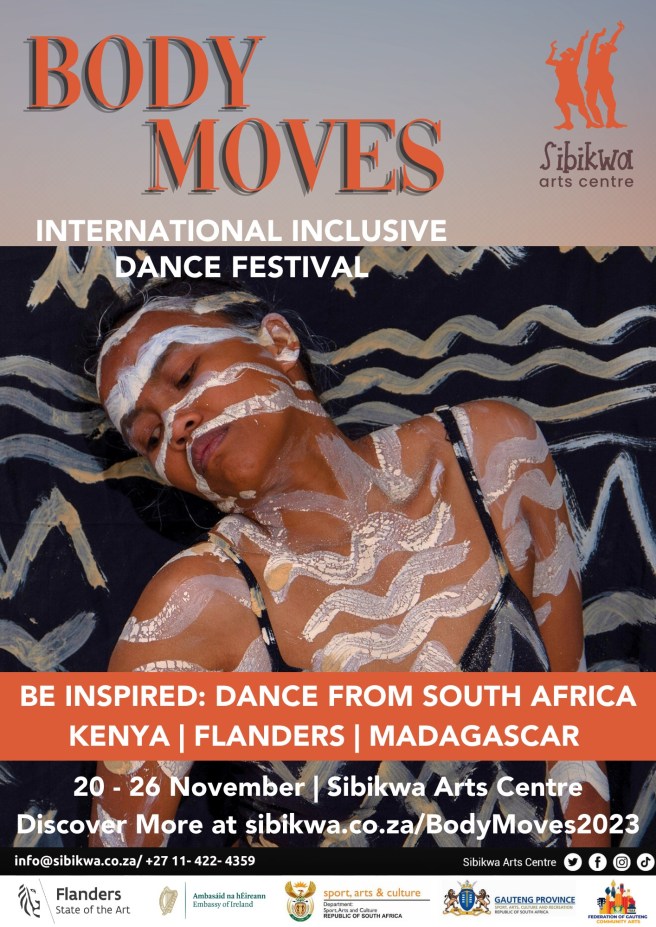
From the whirlwind success of last year’s debut, the Body Moves International Inclusive Dance Festival returns for what promises to be a triumphant second edition.
Set against the backdrop of Disability Awareness Month, the festival showcases an unparalleled array of workshops by esteemed international and local facilitators, live-streamed discussions, and breathtaking afternoon performances on November 25 and 26.
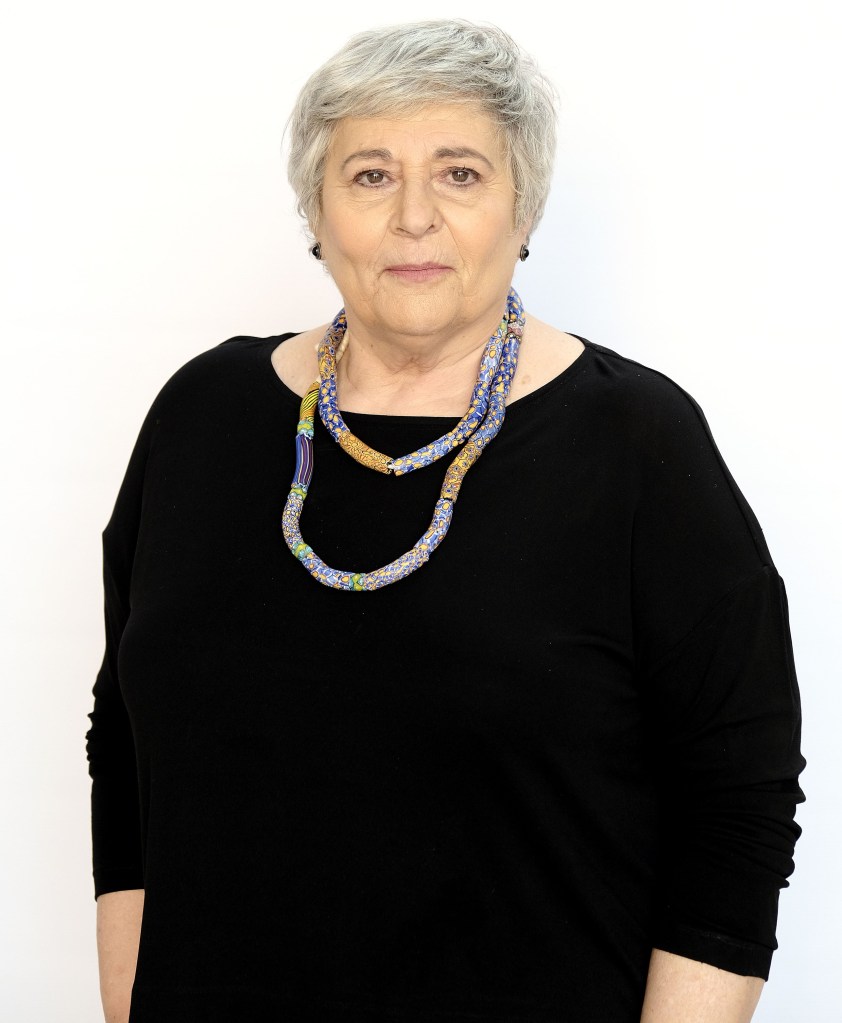
Once again according to the unshakeable Sibikwa mover and shaker Phyllis Klotz, Body Moves steps up the beat, accentuating cultural exchanges and collaborations. With participating companies spanning from Kenya, Madagascar to Ireland, Flanders and various regions of South Africa, the festival embodies the spirit of diversity and unity. Among the highlights:
Flatfoot Company in performance.
Workshops: From a sign workshop with the talented deaf dancer, Andile Vellem of Unmute, to Ondiege Mathew’s exploration of choreography through improvisation, Fanny Vandesande’s deep dive into the lived experiences of people with disabilities, a satellite workshop at Moving Into Dance in Newtown, and more.
Performances: Featuring works such as Chosen, highlighting the plight of a village through the eyes of a visually impaired dancer; to TWOTFAM, a thought-provoking piece that brings to the forefront the overlooked challenges faced by individuals with disabilities.
Live-Streamed Discussion: To be hosted in partnership with ADDN, at Sibikwa and on the Sibikwa Arts Centre Facebook page, at 6pm on November 23, their aim is engaging conversations inspired by the impactful 5-minute videos from Introdans and Unmute.
Moving away from the hustle of town, yet not too far from the comforts of home, Sibikwa offers a perfect locale for audiences. See below for a detailed line-up of Festival events, or visit sibikwa.co.za/BodyMoves2023.
Mover and shaker Phyllis Klotz, founder of Sibikwa.
Supported by the General Representation of the Government of Flanders, Embassy of Ireland, Department of Sport, Arts & Culture, Gauteng Department of Sport, Arts, Culture & Recreation, and Federation of Gauteng Community Arts, the festival is more than just an event; it’s a celebration of local and international talent, a nod to cultural vibrancy, and a testament to the belief that arts and dance know no bounds.
Tickets for performances at 2.30pm on November 25 and 26 are now available on Quicket link https://qkt.io/BODYMOVES23 at R120 per person. Special group rates apply at R100 for groups of 10 or more. On-the-day tickets will be available at the door for R140. For those travelling from Johannesburg, a shuttle will be available from Rosebank Mall, the price for this ticket (including shuttle and entry) is R250.
For organisations interested in hosting a workshop or for more details, reach out to caryn@sibikwa.co.za. Additional performance and event specifics are available upon request or at sibikwa.co.za/BodyMoves2023.
About Body Moves:
A pioneer in its field, Body Moves Inclusive International Dance Festival seeks to disrupt societal norms, championing inclusive dance and fostering collaboration across borders. It stands as a symbol of hope, understanding, and the transformative power of the arts.
Flatfoot Dance Company has a 28-year history of working in integrated arts. It is particularly well known for its 6-year-old integrated programme fondly referred to as Flatfoot Downie Dance Company. This unique dance programme is unprecedented in South Africa and is a celebration of the power of dance to shift lives and to negotiate difference and inclusivity. This particular dance programme celebrates community across the divide of race, gender and ability.
Title: The Infinite Space Between Us
Choreography: Lliane Loots in collaboration with the dancers
Dancers: Jabu Siphika, Ndumiso ‘Digga’ Dube and Julia Pitt
Short Description of dance work: In an intimate dance journey taken by three dancers, Lliane Loots’s collaborative “the infinite space between us”, delves into how we hold, walk and wheel past or towards one another as we attempt to find or break connections. Working with FLATFOOT’s Jabu Siphika, Ndumiso Dube, and Julia Pitt, Loots’s own on-going choreographic interrogations into the intimate politics of relationships, is given a unique spin as the dancers play around with duet, trio, solo formats – and a wheelchair.
Company: Moving into Dance (Johannesburg)
Happiness in dance.
MID was born in the cruel turbulence of 1978 Apartheid South Africa. It was an artistic response to the destructive policy of apartheid. The vision was to draw on the creative capacity of the human spirit to connect enliven and transcend. In keeping with its founding vision Moving into Dance introduced its ‘Enable Through Dance’ programme in 2016 which seeks to inspire confidence and self-esteem in the physically disabled through creative means especially dance.
Title: Remember our Time
Choreographer: Lesego Dihemo
Short Description of dance work: This piece is a reflection on the change that time brings and how it has affected culture. It is looking back and acknowledging the what we had and celebrating how we have adapted and progressed.
Company: Unmute Dance Theatre (Cape Town)
Unmute Dance Theatre is a company of artists with mixed ability/disability using physical theatre, contemporary and integrated dance to create awareness on accessibility, integration and inclusion of people with disability within the main stream of society. The company came into existence in 2013 after a performance entitled Unmute. Within the past 9 years, Unmute Unmute has developed various inclusive projects that have created access and integrated people with and without disability in one environment.
Title: Isikhalo Sendoda (The Cry of a Man)
Choreographer and Dancer: Andile Vellem
Short Description of dance work: As an African man, culturally, he is not permitted to show emotion or to cry. This dance piece, inspired by his late son, is the beginning of Vellem’s healing.
Short Description of dance work: For most young queer individuals club life is an important element of self-image. The club is a place of refuge, a protected space where they are able, and allowed, to enjoy a little freedom. The nightlife means an opportunity to become self or at least who and how they wish to be seen. While at the same time this is not always a true reflection of their day to day lives. The work explores themes relating to queer bodies escaping into the night.
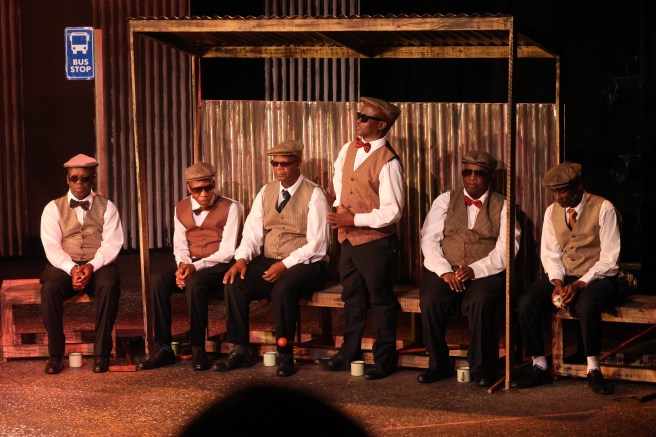
Ga-Rankuwa Requesters.
The Ga-Rankuwa Requesters began in 1984 under the leadership of music composer Lucas Kopaopa. The group initially had 9 male members in total, 8 were visually impaired and 1 was partially sighted. The group worked together at Are Itereleng Centre for the Blind, in Zone 2 in Ga-Rankuwa. After the formation of the group, now known as the Ga-Rankuwa Happy Boys, they released 3 acapella albums. As the group’s journey continued and new members joined and old members left, they formed the Ga-Rankuwa Requesters in 2005. They have entered music competitions convened by the South Africa Disabled Musicians Association and have won a recording deal. Over the past year they have been performing Lifted – Let the Blind Sing at the State Theatre under the musical direction of Zakehele Mabena.
FLANDERS
Title: TWOTFAM The Works Of The Flesh Are Manifest
Choreographer: Fanny Vandesande
Dancer: Anna Dujardin
Music Composition & Performance:Kobe Boom
Short Description of dance work: The works of the flesh are manifest and focuses on the creation of intimacy on stage and the power relations that it carries forward. The performance departs from Anna D’s diary entries, illustrations and poetry, which is presented through movement.
FANNY VANDESANDE is currently conducting research in intimacy, sexual agency, autonomy, and social perception with people living with disability.
MADAGASCAR
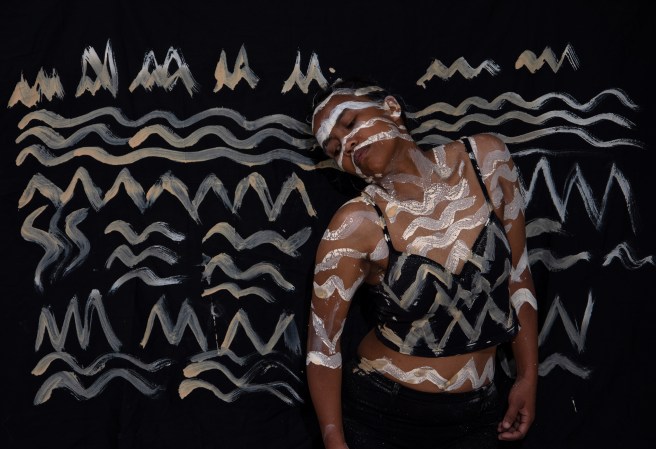
Nacelle Somoh (also seen on poster) from Madagascar
Company: Lovatiana
Created in 2002 in Antananarivo by the choreographer Lovatiana Erica Rakotobe. In 2009, people with disabilities were integrated into the company and the company currently has 8 members who work in the artistic, social and educational sectors in Madagascar. The company organises different events, including a multidisciplinary in inclusive festival Miaraka, which takes place every two years.
Title: Chosen
Choreographer: Lovatiana Erica Rakotoba
Dancer: Nacelle Somoh
Short Description of dance work: Dance piece inspired by the story of young children chosen to save the people of the village often threatened by floods.
Short Description of dance work: Re-imagining a Kenyan myth that has previously promoted patriarchal behavior. Nyanam challenges the traditional power play by demystifying myths and suggesting new narratives where women are seen to be empowered and play a stronger role in the hierarchy.
WORKSHOPS (2 to 2 and a half hour in length)
Ondiege Matthew: A mixed abled dance workshop discovering how the body with disability in contrast to the body without a disability explores space, direction, levels and approaches choreography through improvisation.
Lovantiana Erica Rakotoba: The workshop will be based on inclusive dance working through body weight and fluidity and exploring different bodies in space; sharing the choreographic repertoire of the piece running at the Festival.
Andile Vellem: Presenting a sign dance technique workshop established by UNMUTE, using the basics of sign language and finding ways to translate it into creative movement.
Fanny Vandesande: This workshop delves into the difficult challenges people living with disabilities confronts regularly, which includes, intimacy and sexual agency.
Cindy Cummings: This workshop, titled ‘Serious Play’, will focus on the ever-changing dialogue between people. Pairs and small groups will use improvisational structures to experiment with specific tools for this kinesthetic dialogue to reveal how everyday actions can be crafted into a unique and original dance through the lens (and practice) of Noticing.
IRELAND
CINDY CUMMINGS is a freelance dance artist who creates original collaborative works with dance, theatre, visual, sound, literary and media artists around the world for live performance, installation and film. Cindy is based in Kilkenny, Ireland where she has choreographed productions at the National Theatre of Ireland and most recently, with the award-winning Asylum Productions. Currently she is movement director with Equinox Theatre Company at KCAT Arts Centre and is a facilitator on the Inclusive Dance Cork course at Dance Cork Firkin Crane. Since 2007 Cindy has been a member of Aosdána, the affiliation of creative artists in Ireland.
DISCUSSION
To be hosted at Sibikwa, in partnership with ADDN, and live-streamed to Facebook, it promises engaging conversations inspired by the impactful 5-minute videos from Introdans and Unmute.
The AFRICAN DANCE DISABILITY NETWORK (ADDN) is part of a UKRI – AHRC funded research project entitled ‘Encountering disability through contemporary dance in Africa’. It aims to gather academics, artists and educators in a free and open space of community, sharing and support. Their approach is intersectional, considering how disability as an experience sits alongside our ethnic, gendered, racial, class and national identities.
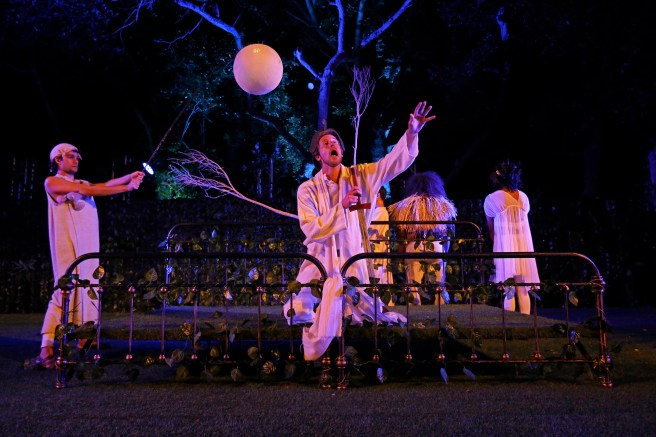
CAST: Chi Mhende (Oberon/Hippolyta), Caleb Swanepoel (Puck), Roberto Kyle (Theseus/Tatiana), Mark Elderin (Bottom), Jock Kleynhans (Demetrius), Aidan Scott (Lysander), Lisa Tredoux (Helena), Kylie Fisher (Hermia), Sizwesandile Mnisi (Egeus/Snug/Faerie), Tankiso Mamabolo (Mechanical Faerie), Tailyn Ramsamy (Flute/Faerie), Zach Esau (Snout/Faerie) and Roland du Preez (Starveling/Faerie)
SET: Jesse Brooks
LIGHTING: Oliver Hauser
COSTUMES: Michaeline Wessels
VENUE: Pieter Toerien’s Montecasino Theatre
DATES: Until November 19
Tailyn Ramsamy (Flute)
It’s not often that a press release is so audacious as to claim that a Shakespeare will be one of the biggest hits of a season!
But with the ingenious Geoffrey Hyland at the helm, aided by his magnificent cast, I have no qualms if they grab those particular bragging rights.
Swept off my feet at the recent Woordfees with this production staged at the openair Libertas Amphitheatre, I was keen to go a second round with these players.
The setting (outside, specifically) might have added an extra sprinkle of magic, but with this Shakespeare, as is usually the case, the players and the play are what count, the director assured me.
And if I look back, even with the magnificent original outdoor setting which lent itself especially to this madcap and weirdly wonderful, romantic bouquet, it was the marvellously talented, youthful cast, fully representative of the clichéd rainbow nation and seen here with such genuine gusto, that stole my heart.
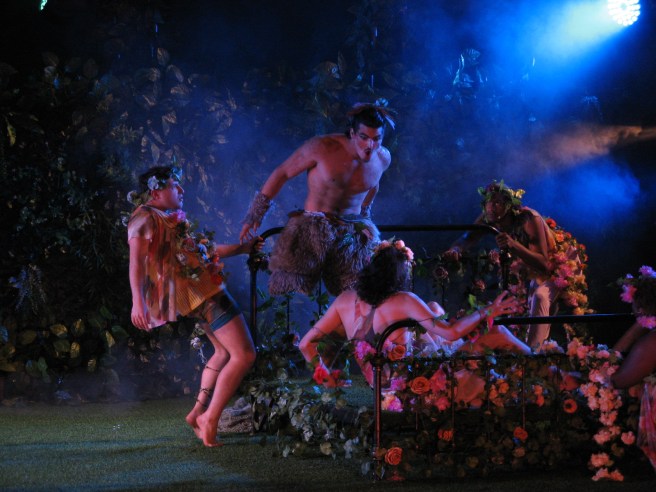
The director was confident that they would pull off the indoor setting and, as we entered the theatre, I immediately loved the stage, which had been transformed into a colourful green space. With a little imagination, you could almost spot the twinkling stars once the auditorium lights went off. And all round there was a sprinkle of fairy dust, I’m sure of it.
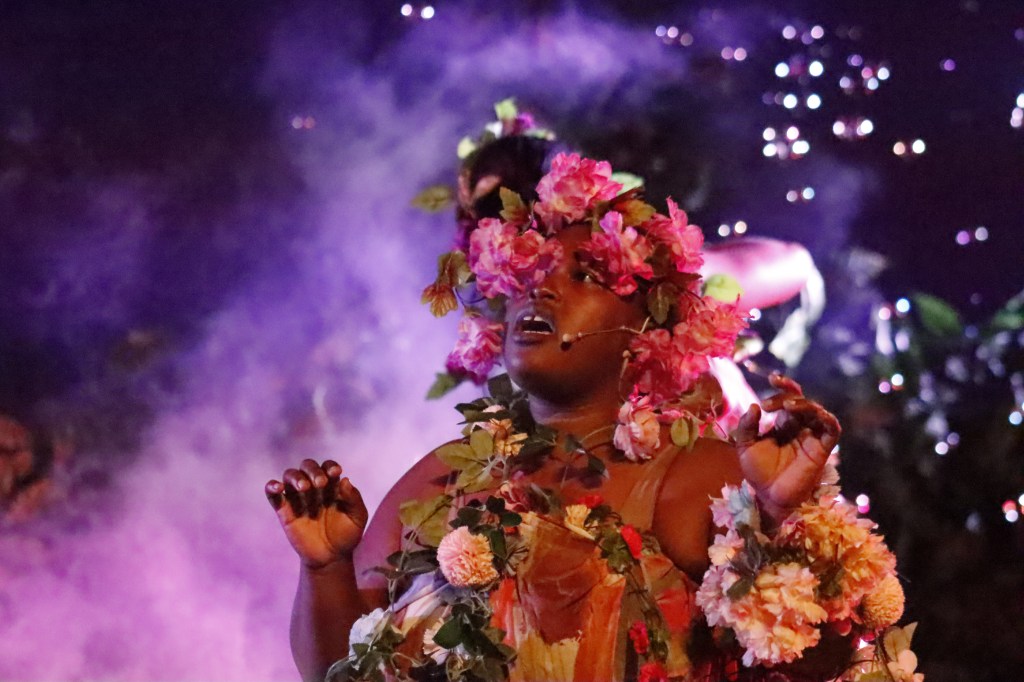
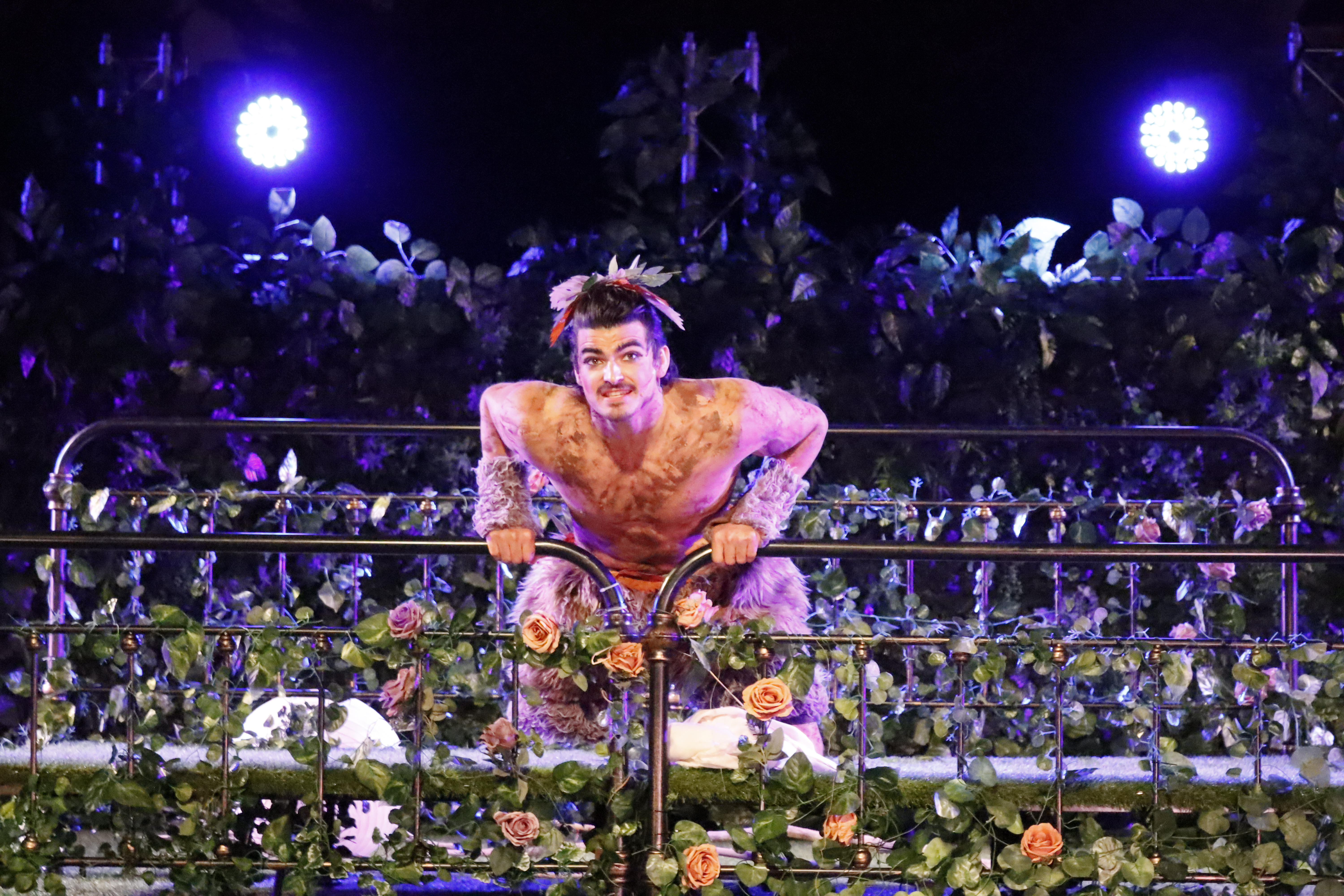
That is what brings this colourful play to life so brilliantly. It is the way it has been staged, dressed and lit, as well as an exuberance from the full cast from start to finish. There’s a glorious abundance of brightly coloured cloaks for example, which become part of the emotional impact in the way they are carried and manipulated with every movement. It’s a brightly-coloured, sweeping spectacle.
Robert Kyle (Tatiana) and Mark Elderin (Bottom)
It is in essence a romantic romp and as with any Shakespeare, you have to close off everything around you and take a leap into that world to allow the words to take charge and the actors to whisk you away.
It’s not a play where you want to single out performances because with such a big cast, there are always roles that steal the limelight. But, it is the patchwork of performances, which knits it all together so magnificently. And that is where the true magic lies – the choice of cast. Everyone seemed perfect for their part.
Hyland has quite a few tricks up his sleeve, knows when to throw in a quick slip of a local tongue, trusts audiences to buy into the local accents rather than the Queen’s (sorry, has it changed to King’s?) English, introduces original music which is sung with wonderful whimsy and pushes the production’s energy impulses with great enthusiasm.
It’s difficult not to buy into the dream world of luscious language and love adventures which transports you to a place of laughter and merriment in a way which is a perfect nod to the coming festive season.
Perhaps I was late in discovering Geoffrey Hyland’s theatre smarts, but then it’s not often that plays of this magnitude with so many players are swapped between the Cape and Gauteng.
What a brave move Mr Toerien. And one that hopefully Gauteng audiences will embrace wholeheartedly .
The play absolutely deserves all our attention and accolades. May this be the start of much more touring theatre of this kind.
Experiencing director Geoffrey Hyland’s A Midsummer Night’s Dream at this year’s Woordfees a few weeks back, was a revelation. Thrilled to hear that the production was coming to Pieter Toerien’s Montecasino Theatre, I immediately touched base with the director to find out more about this astonishing not-to-be-missed Shakespeare. DIANE DE BEER reports:
Scenes from A Midsummer Night’s Dream: Photographers Llewellyn de Wet and Mark Wessels.
Tankiso Mamabolo as one of the Faerie’s.
It’s difficult to resist nagging everyone to get tickets for this amazing Shakespeare. I almost missed seeing it at the Woordfees, because I thought I might have lost my head booking for a Shakespeare during a very hectic festival schedule.
Fortunately I was persuaded to go and it was one of the best decisions I made at the festival. Chatting to the director about this particular production, I have even more reason to plead with theatre enthusiasts to go.
“This was the first Shakespeare at Maynardville post Covid,” explains Geoffrey and he elaborates. “Having been through some dark times, the organisers and myself thought: WOW! it’s time to celebrate love, life and exuberance with fantasy and dreams in a wonderful colourful and passionate production.
“Are there deeper things, of course there are deeper things, there always are in Shakespeare, but I think one goes along on this wonderful joyride of misadventure and laughs and that celebration of love and the funny things that humans do to pursue love,” he encourages prospective audiences.
It’s time to take some time-out from the world, to remind ourselves about how wonderful life in all its permutation is, notes Geoffrey. That’s why he selected this particular Shakespeare to kick off Maynardville post-covid, to re-energise this space. The wonderful forest setting in the play was a reflection, which meant it was doubly joyous.
He is often asked about his favourite Shakespeare and of course, it is the one he’s working on at that moment. “That’s the one you dive into and you’re investigating and you’re finding new things all the time,” he says.
When he start with any play, his approach is getting to know the play, reading and more reading, imagining, and listening to music that resonates just to get a feeling of what this thing means to him.
“I can’t do it if it doesn’t mean something to me, if it doesn’t light my fuse. I know I’m not going to be able to light the fuse of the actors, or that of the audience, so I have to find my way into a particular production.”
What got him going was watching kids playing with bubbles, and suddenly he thought, this is the play, “these wonderful bubbles flying, joyously, madly, they make no sense whatsoever and yet they lift the spirit.”
He had found his first connection, the lightness of fun, and the absolute beauty of those brief moments of life that are so captivating.
Only then came the company – the actors. The producers gave him a free hand in choosing who he wanted.
“It’s never about individuals. It’s about people you know are going to meld and enjoy each other. I needed people who would be team players rather than individual stars. They’re all stars believe me, but they needed to give and come to the play with an open heart and to come along with me as a director,” he emphasises.
Because they had a very short time to work, he also needed a cast who would be willing to give extra time. They needed to understand instinctively that they had to give everything to the role, he stressed.
What he enjoys about actors, is their ability (with him) to find their character. “I don’t come with a preconceived notion. You are the character and we must find that character in you,” is what he shares with his actors.
“My part as the director is to evoke the performance from what is in front of me and I need people who will continue to give to me and allow me to shape what is already in there as part of them.”
“I’ve never worked with a group of people together who are so much part of each other and giving and taking in equal measure between each other. The important thing for me as a director is to make the actors feel beautiful, then they will give of their best and I think the way we’ve come to do the production, they do.”
He describes the way they want to be on stage, bringing an exuberance and an energy, and because they’re tapping into themselves, into their life force, they are enjoying playing in front of an audience who then plays with them.
But all of that happens in a wonderful discipline of recreating a performance, never overdoing it, but sparking off each other all the time.
They’ve been very lucky, the audiences have responded beautifully and have enjoyed every single performance. And I can attest to that.
With Shakespeare especially, Geoffry thinks this is where teachers play a huge role in young people’s lives. “I was drawn to Shakespeare by a teacher. I think I was in grade five and went to see a production at Maynardville. I was captured for life and I went on reading and being interested. It inspired and unlocked something in me and probably was one of the impulses that made me the creative person that I feel I am today.
“Having had that experience as a young person, it has been one of my goals to inspire the same kind of experiences in other people. It’s a desire I have to make them feel the same things that Shakespeare had made me feel. I don’t think it is only about feeling, but rather unlocking yourself, potential things within yourself and once actors get it, there’s no going back.”
Because the two previous seasons were both performed outdoors, how would Geoffrey counter that missing element at Montecasino, but he seems to have all the answers and as a recent devotee, I’m going to take his word.
“There’s always give and take. With outdoor theatre, because you don’t have so much control on the technicalities, you need to focus completely on the actor in front of you and anything else that comes with that is a bonus.
“It’s a decoration and added depth of flavour, so that magical forest setting of Maynardville is impossible to duplicate.
“However, this production was created for and by Maynardville. We can’t physically duplicate it, but it has inspired the actors and in a sense they have got Maynardville, that beautiful energy, inside their performance. So having strongly focussed on the actors in creating this production, I still believe that they are what is the essential heart of the show.”
There will be small changes, he agrees, but the actors will be there to tell this wonderfully mad story and that is what you focus on when changing a venue. “It’s that live person in front of you that creates the magic.”
That’s exactly what he has achieved with this amazing A Midsummer Night’s Dream. One of the things I thought while watching it for the first time, was that this was the perfect introduction to Shakespeare if you’ve never seen any of his great works.
Writer/director Janice Honeyman loves pantomime because it is also her time to play – even when putting it all together is serious work. “If the cast don’t genuinely believe in their characters, it won’t work,” she says. And that is what she works hard to get through to all the panto novices in her cast.
It all started for her when she was asked to do a panto by Lynette Marais, who headed the drama department of the Performing Arts Council in the province at the time. “I found a book open panto titled Oh Yes It Is”, a phrase used in every panto to involve the audience and get them fully on board.
That happened more or less 36 years ago, but we’re not really counting and in-between she might have missed three shows. But not only does she direct the pantos, even more importantly, she writes them. And this is where her imagination often runs riot – in the best sense of the word. Her child who is always lurking emerges and it is blast-off time.
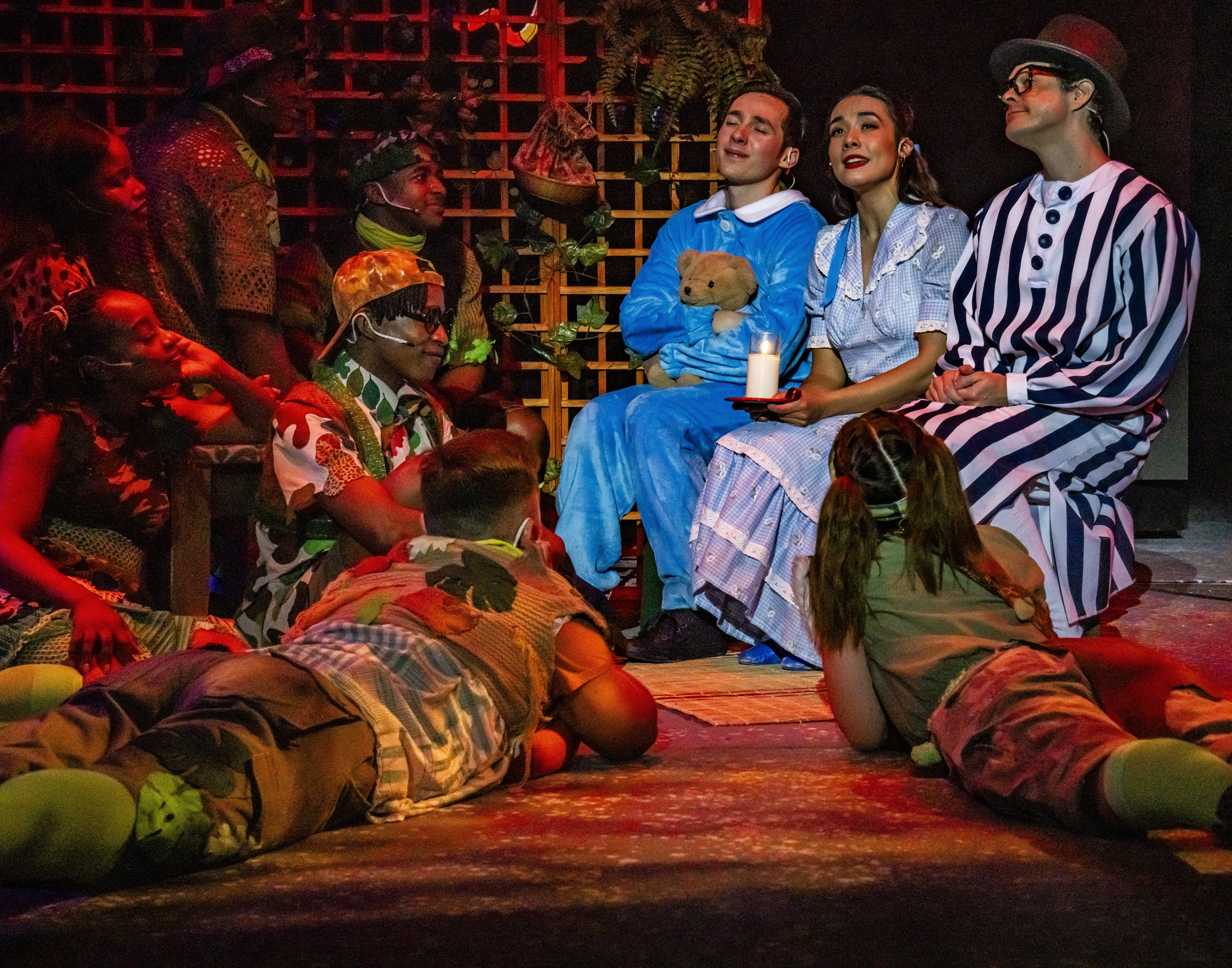
So much ther queen of the pantomime, Janice Honeyman has her own pictureIn in the children’s room in Peter Pan.
the writing, her dad is ever present. “He loved telling jokes around the dining room table,” she explains. “They weren’t always that funny,” she admits. But still, this year, she has again included two. And she smiles…
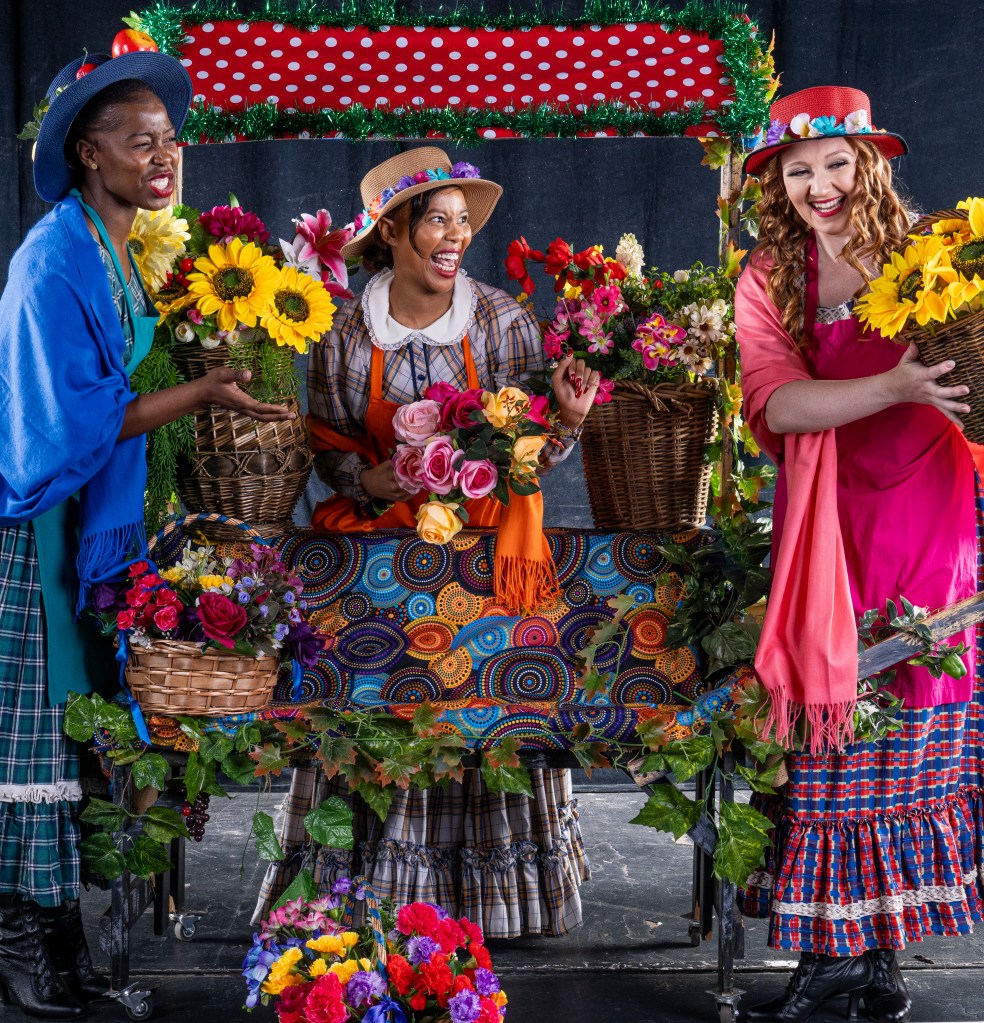
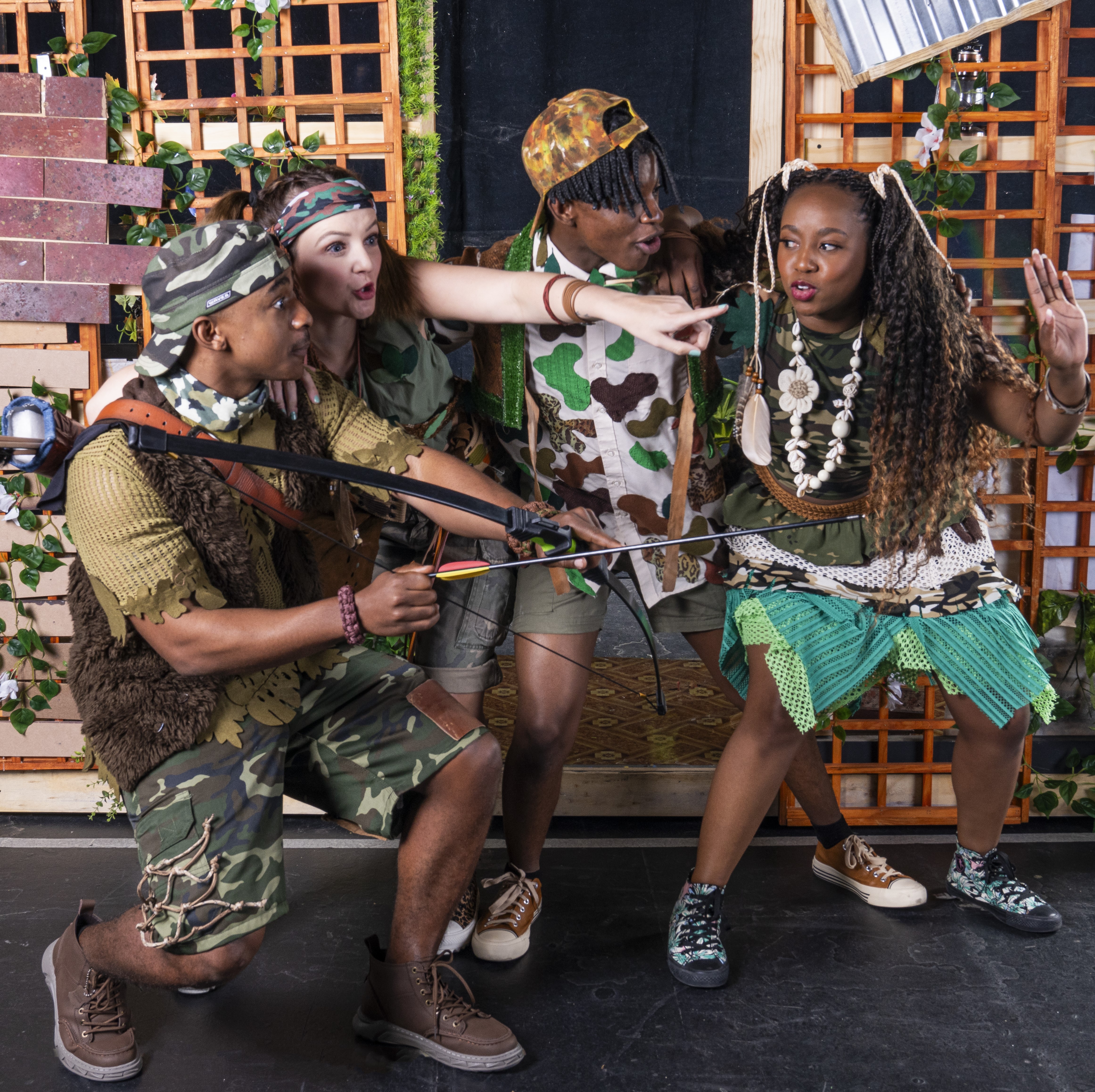
It’s nostalgia, it’s a traditional story, like this year’s Peter Pan with the awful Captain Hook and his sidekick Smee who cause trouble for the hero Peter Pan, the Darling children, lost boys and of course, Tinkerbell. One of the delights of any panto is always the dame and in this instance, Dame Clementina Coconut who introduces much of the Honeyman wit, fun and playfulness, double-entendres and, of course, her dad’s jokes.
Don’t forget about the audience participation and, naturally, a few surprises.
Dame Clementina Coconut (David Arnold Johnson) with Smee (Michael Richard), two of the colourful characters in this year’s panto.
Her last foray into Neverland was 14 years ago and since then many things have changed on stage. For the past few years, because of Covid, she has swapped the sets for LED screens, but she has missed the tangibility and theatricality of the sets and this year, she decided to combine the two, using the best of both worlds. Expect a spectacle of sorts!
“I found it tough to adapt to no furniture,” she says about the LED screens, but all that changes with the combo.
More than anything, pantomime is an invitation to Janice to do all the stuff she feels great affection for. “I jol straight through this.”
And moving from the look of the latest panto to the cast with its combination cast – youth and experience – that’s what she most enjoys, working with the actors. She loves the energy of the young cast, while the experienced actors can show the way to the youngsters. “They represent the well-trained professionals who set the example,” she says.
And Janice herself learns from her casts who keep her on her toes. That’s where especially the youth plays a particular role. They know what is happening on the ground, what is buzzing and what has fallen off the trend scale for example. It’s part of her script to play with her audience’s world so that her jokes can land smoothly.
On stage, Sandi Dlangalala, who will be playing the brave hero Peter Pan, says: “I am beyond excited to be in the Panto this year. It is my first Janice Honeyman pantomime. I am ready and so excited for rehearsals to start and to be given the lead role is such a huge honour.”
For veteran Ben Voss, it’s different: “Playing Captain Hook in this year’s magical romp, Peter Pan will be my fourth year dishing out mayhem, malice and mischief. It’s the silliness, the scale and the slickness that I love so much. I am already making great progress growing my four- inch moustache, mending my pantaloons and carving my cutlass. Hopefully, like me, you will be HOOKED too!”
Some scene stealers in this year’s panto.
Michael Richard, who has also performed in panto many times, will be playing Smee, Captain Hook’s right hand. “This is my fifth or sixth pantomime for Janice over many years and I am still so excited about embarking on this new adventure. I may not be able to prance around as much I used to in my younger days, but the thrill is still there.”
Kiruna Lind-Devar will be playing Wendy. “Some of my most precious friends and memories come from Pantoland, so I cannot wait to step back into that space and dance, sing and fly. All with a little faith, trust and pixie dust!”
Their Dame Clementina Coconut will be played by David Arnold Johnson: “Being a Dame is always a treat. Working with Janice even more so.”
This time around, Virtuous Kandemiri will be sprinkling fairy dust as Tinkerbell: “I’m so excited, I’m soaked in fairy dust. I can’t wait to play Tinkerbell, a character that I’ve always loved as a child, and one that I know many people love equally, if not more. I’m really looking forward to my first Honeyman Pantomime.”
The rest of the cast year include Matthew Berry, Inge Breytenbach, Gugu Dhlamini, Diego Hamity, Tarryn Heard, Dirk Joubert, Sarah Leigh, Charity Madhlazi, Siya Makakane, Gareth Meijsen, Noni Mkhonto, Bo Molefe, Lesedi Mpshe, Tania Mteto, Sibusiso Mxosana, Tshepo Ncokoane, Brian Ngobese, Manyano Ngoma, Zamaswazi Nkosi, Micah Stojakovic, and Kensiwe Tshabalala.
And always by her side is her appreciated associate director Timothy le Roux
In conclusion, the one thing she truly believes is that everyone needs end-of-year entertainment. With panto, it’s recognisable, has heart and gives her an opportunity to make them laugh.
Everyone also relates to Once upon a time… and Everyone lived happily ever after.
If you look at the winners of this year’s Aardklop productions, it is the veterans who grabbed all the awards.
A very surprised but bursting with pride Elzabé Zietsman reigned supreme with three wins for Femme is Fatale.
I remember when I first saw this in-your-face production at the Vrye Fees last year – it hit hard. In a country where gender-based violence reaches pandemic-like numbers, you need to grab audiences by the throat. And that’s exactly what this singer/actress does with a magnificent gloves-off script and an attitude that dares anyone not to take notice.
From her initial on-stage look until she strips down to throw the horror of what is happening to individuals in this country in your face, she doesn’t make a wrong move. It’s attention grabbing for all the right reasons and takes someone as experienced, brave and talented as Ms Zietsman to swing high and low with your emotions.
It’s one of those performances that will stay with you forever and it is her intention, even before winning for Best Musical Performance, Best Music-Driven Production and Best Overall Winner, to find a way to take the show to schools across the country. And in her acceptance speech, she sung the praises of her accompanist Tony Bentel – with reason.
Hopefully, this has empowered her plan of action and promotional campaign. If she can’t encourage change with this one, the world is a really sad place.
Sandra Prinsloo’s performance in Moeder also never flagged. Again, I’ve seen it many times, mostly for her performance and an astonishing script as well as a near-flawless production directed by Christiaan Olwagen.
I’ve said a few times that his place is on stage, it’s where he shines brightest, even though he will probably prove me wrong sooner rather than later.
But he has such a good eye, a filmic vision and the heart to realise that Prinsloo could and should play this woman. It’s one of her best performances ever and I’ve seen many. At the festival I heard people often praising her performance in Masterclass because, of course, Ms Prinsloo hardly ever appears at a festival in just a single production.
I hope she leaves notes for her younger counterparts about concentration, focus and stamina. And again, as so many times in her life, she was rewarded for an astonishing performance in Moeder with the production named the Best Theatre Production as well as Best Production by an independent group of art lovers, Aardklop Hartsvriende (Friends of the heart).
A scene with Bettie Kemp and Dawid Minnaar in Mirakel.
Another stalwart, David Minnaar, played her flawed partner and, as always, he knew how to pitch just the right tone as the errant husband, but it was in Marthinus Basson’s tour de force Mirakel where he was given a part which especially revealed his comedic qualities.
It is one of Reza de Wet’s lighter works although the message is as hard-hitting and relevant as anything she has written. But Minnaar with Basson as his champion walked a fine line with great relish which added to the performance.
I felt that he was enjoying the play as much as anyone watching it. Because of the travelling theatre company and its dramatics that rule this play, he could charge with dramatic fervour through the hysterics of the flailing players all trying their best to make their lives and livelihood work.
It captures that world which has remained almost unchanged with such dexterity as only a De Wet/Basson partnership can achieve thus allowing a Dawid Minnaar to soar and win as Best Actor and Basson to pick up yet another Best Director award.
An ENTRANCE by the delightful Eben Genis while the company’s leading couple sleep on.
In the same play, Eben Genis (above) also announced his welcome return to the stage to great delight of theatre goers and was warmly received with a Best Supporting Actor award. It is his subtlety, his nuanced excursion into this world, which is a reminder of the fine actor he is.
The Best new Afrikaans text was claimed by Philip Rademeyer who wrote and directed Goed wat wag om te gebeur, the Afrikaans version of The Graveyard starring Gideon Lombard, Antoinette Kellerman and Emma Kotze.
It deals with Hendrik’s return to his childhood home where he struggles with past demons including violence, blame and addiction, all the while trying to suppress his anger and hurt with drink. The only niggle was a text that would have been even better with some clever culling, and this was probably the most common culprit in too many productions.
At a festival where the experienced artists were the ones who often captured the audiences and my praise, I was again overwhelmed by Nataniël’s Ring van Vuur. It is no secret that he is one of my most cherished performers, but there’s reason for that. And again he proved me right with a show that was simply sublime. Not only did he give one of his best performances, he also introduced me to guitarist Loki Rothman whose name was familiar, but no one had ever mentioned his particular flamboyance on a guitar.
Not only does Nataniël give us a quality show, he is also generous with the artists he introduces to a wider audience. That’s the sign of a great and confident artist. I know most music fans will be familiar with Rothman’s prowess on the guitar, but because I am mainly a theatre writer/critic, I have never had the privilege.
Most of these productions made sharp u-turns as they winged their way down to Stellenbosch with the much larger Woordfees, welcoming audiences as Aardklop was waving goodbye.
And again, there was much to praise with a festival bulging with new presentations and productions, enough to have everyone smiling. It’s not about the one or the other. Both have equal right to their audiences, they shouldn’t compete and if I have to make deductions about attendance, both have a strong following for their particular brand. Mostly it probably has to do with where audiences live and how far they’re willing to travel. Convenience, I suspect, will be the determining factor.
As a working journalist, I was blessed to go to both.
And if I have to start with a production that had me thinking, shocked me to my core because of content yet filled me with admiration for the inspirational Jaco Bouwer and cast for tackling such a daring and dangerous text – in the best sense of the word.
Melissa Myburgh (left) with Tinarie van Wyk Loots pictured with Myburgh (right) in the startling Die Vegetariër.
Bouwer, one of our most exciting directors has been working in the television and film world for the last while and has been missed because of his brand of theatre, which always pushes boundaries and challenges audiences to engage with tough issues rather than turning away and tuning out.
From the moment you enter and witness the amazing set of Die Vegetariër, your mind starts racing. There’s something pristine and perfect about the space and yet it’s a slaughterhouse, which is an ominous sign even before the action starts.
Die Vegetariër pictured by Nardus Engelbrecht
But in typical Bouwer fashion, he hits you in the solar plexus from start to finish and while you might be reeling throughout trying to contain your emotions racing ahead, it’s the unflinching text and cast that stay with you as you keep unravelling the lives of the people who share their stories.
And you keep coming back to the slab of meat you keep staring at as you enter and the meat hook that just hangs there menacingly until it captures the crux of what you are witnessing. It’s hardcore, but in the world we live in with gender-based violence such a scourge (as already mentioned), we have almost become immune not only as individuals but as a society.
The cast – Stian Bam, Wilhelm van der Walt, Tinarie van Wyk Loots and Melissa Myburgh – are staggering in this brutally honest portrayal of life for far too many as physical and psychological abuse becomes the common language in relationships. And the young Myburgh deserves a special mention because her character’s youth embodies vulnerability and defencelessness in all its harshness and is the most exposed.
It’s not easy to watch, but because of the approach of everyone involved, from Willem Anker’s adaptation of Han Kang’s The Vegetarian to Bouwer’s brilliant conception and the way he seamlessly pulls it all together from the enveloping visuals to the overwhelming performances, it’s simply a privilege – and one that stays and niggles at you forever.
Hold Still with the astounding acting couple Mwenya Kabwe and Andrew Buckland.
On a different spectrum but as challenging, Jay Pather’s Hold Still with an extraordinary text by Nadia Davids tackles refugees, one of the toughest issues in today’s unravelling world as we roll from one crisis to the next. And if you look closer, refugees are at the centre of most of them. Think Gaza.
But what she does is take a model modern couple and make them face today’s harsh reality. There’s a reason refugees cause such heartache and often horror. There aren’t solutions or none that is workable, so many simply turn their backs.
It’s gritty yet glorious theatre as two veteran actors (Andrew Buckland and Mwenya Kabwe) star as a delightful couple who lovingly banter away until the very essence of their family relationships is blown apart. Both these actors take your breath away with performances that are in your face and completely in the moment. They’re complemented by the two youngsters in the cast, Lyle October as their son and Tailyn Ramsamy as his friend in search of refugee status, hence the dilemma.
As the mother so aptly confesses: they sold their son a story about their moral selves which they themselves had come to believe. It’s real world issues, tough to work through and easier to ignore, yet this is the perfect platform to grapple with our reality today.
An exuberant Caleb Swanepoel in A Midsummer Night’s Dream. Picture: Llewellyn de Wet.
And the third piece that blew me away was Geoffrey Hyland’s Maynardville Shakespeare production, which I am thrilled to announce is coming to Pieter Toerien’s Montecasino in November. If you see nothing else this year, don’t miss this production.
It is simply glorious and will have you screaming with laughter from beginning to end. I cannot imagine a better introduction to Shakespeare than this play that symbolises everything that this fantastic playwright is about. It’s entertainment writ LARGE and simply the perfect end-of-year production with an astounding cast put together magnificently.
My only qualm is that it was first staged at Maynardville, Cape Town’s glorious outdoor theatre venue, and I saw it at the Libertas amphitheatre in Stellenbosch, but with Hyland’s astonishing artistry, I’m sure you won’t even notice. Never before would I have thought that I would be so happy to see a Shakespeare at a festival. That it was included in the programme, was simply a stroke of genius.
A Midsummer Night’s Dream is a spectacle in colour and charm. Picture: Mark Wessels.
Just go – and tell everyone around you not to miss this fantastic show. You won’t regret it and start this festive season in the best possible way. (See full review once it has opened with a run from 8 to 19 November.)
I have singled out only a handful of productions which I saw at the festivals. There are many more to praise, but I grabbed those few that grabbed both my head and heart and wouldn’t let go …
Author Damon Galgut with Sylvaine Strike and suggestions by the cast
DIRECTOR
Sylvaine Strike
CAST
Chuma Sopotela, Rob van Vuuren, Kate Normington, Frank Opperman, Jane de Wet, Jenny Stead, Albert Pretorius, Sanda Shandu, Cintaine Schutte
ASSISTANT DIRECTOR AND ARCHIVIST
Kirsten Harris
SET AND LIGHTING DESIGN
Joshua Lindberg
MUSIC DIRECTOR, SOUND DESIGN AND ORIGINAL SCORE
Charl-Johan Lingenfelder
CHOREOGRAPHY AND INTIMACY CO-ORDINATOR
Natalie Fisher
COSTUME DESIGN
Penny Simpson
VENUE
The Market Theatre
DATES
Until November 5
Jane de Wet, Rob van Vuuren and Jenny Stead.
One has to admire artist Sylvaine Strike’s process when she decides on a project. It’s all systems go and in Strike’s world, the focus is unfailing.
She spent 18 months hard at work on this extraordinary piece of theatre, which has finally reached The Market Theatre.
But there are a few things to take on board before you arrive. It’s based on a book, Damon Galgut’s The Promise, and that means that it is her interpretation of Galgut’s writing and script, even if he was closely involved throughout.
Also, it is two hours 40 minutes long and for many less-experienced theatre goers, that might be quite
an ask. One has to be theatre fit.
Albert Pretorius and Sanda Shandu as two policemen
But for me there’s no question that it has to be seen, and a very packed and excited audience obviously in anticipation was ready and waiting on opening day. Even when we arrived to collect tickets there was an audible buzz and it was lovely to experience a theatre event of this kind. The last one was the August Wilson production at the Joburg Theatre last year.
Five minutes into the production, I already had a smile. For this one, Strike created her own theatre language in which to tell her story and for me, it couldn’t have been further from the language and storytelling of the book, yet both had a very individual and personal flavour which I loved.
I almost felt as though I had walked into a kind of grotesque fairy tale for adults and, while the approach might have felt comical to some, it was anything but because of the content and the story it was telling.
Frank Opperman.
It was also clear that as individuals, those watching the play would have to buy into the concept – and for me that wasn’t a tough ask. It’s why we watch theatre, to catch those productions where those participating take risks to give audiences a storytelling experience that’s novel and best suited to a particular text.
The Strike brand has always been about her individual style and, while she pays close attention to the text, her language is much more than just something we listen to. She uses the stage and everything visual as part of the ensemble and then she adds very specific movements and rhythms as well – as in this instance, a soundscape by genial music man Charl-Johan Lingenfelder with a kind of music/sound box on the side of the extraordinary stage designed insightfully by Joshua Lindberg, who was also responsible for fantastic lighting (so delighted that the family name lives on in our theatre landscape).
And that in itself sets the tone for this topsy-turvy world the Swart family inhabit. The matriarch of the family, seemingly the one that held them steady with a strong hand and a moral compass, has died. Thus we find all of them in turmoil as they come together for the family funeral (one of four that determine four periods in a country gone mad).
But there’s one obstacle – Amor (Jane de Wet), the youngest sibling, had heard Ma (Kate Normington) extract a promise from Pa (Frank Opperman) that he would give Salome (Chuma Sopotela) her house on the furthest corner of the farm, mainly because she was the one who diligently and lovingly looked after the mother in her illness.
A familiar scene in many white South African households and the rest of the family simply disengage while Amor keeps at it relentlessly – determinedly – as their conscience. The ensemble of nine work well together as a group and individually, although I suspect, audiences will have different favourites.
Cintaine Schutte and Albert Pretorius .
Amongst the men, my favourite performer was Albert Pretorius who even though his many different characters often had a comical edge, he manages such a fine artistic line and knows just how to hold it back. Frank Opperman also captured his different characters masterfully. Rob van Vuuren is at the heart of the piece as Anton Swart.
Chuma Sopotela is the key of the piece as both Salome and the storyteller, and in both roles her strong presence holds The Promise, both in the production and at the centre of the story. She was the perfect fit.
Each one of the performers added to the whole. Because many roles were played by each actor, some characters worked better than others, and who you like or discard will be a personal preference. I don’t think with the adopted style there’s a right or wrong, it’s a preference thing.
So how did it all come together. It’s a HUGE production. I suspect, especially while writing this review, that one needs more than one or two viewings to truly appreciate the breadth of the drama and staging. I can simply stand back in awe.
What for me personally would have worked better, would have been to lose most of the second half (obviously not the end). Up to the interval, everything worked perfectly, but then it started to unravel. A trim of an hour would have been my ask and would have served the actors and the story better.
It was as if sustaining the production for swo long was too big an ask and detracted rather than added to the final product.
Should people go? What a question! It’s a theatrical experience. There’s a cast that does exquisite work, moments that will take your breath away, a set, costumes and lighting that all contribute to the bigger picture and, finally, a director who puts herself out there, pushes as far as she dares, breaks boundaries and develops ways of telling stories that keep you riveted.
You might not love every minute, but you have to admire the artistry, the vision and the theatricality with scope that’s daunting yet inevitable when Strike decides to do it. And we’re the beneficiaries.
Time was the rare gift that celebrated director Sylvaine Strike was given with her latest production, The Promise, written and adapted (from his novel) by author Damon Galgut. She tells DIANE DE BEER more about the extraordinary process which started more than 18 months ago and is on at The Market (until November 5) following its recent Cape Town run:
“In a way, The Promise selected me,” she explains, because Damon approached her to adapt it for the stage, thinking that she would probably be the right fit because he had foreseen that it would have to be done very theatrically and very physically if it were to have a theatrical life at all.
She was utterly smitten by the idea, but insisted that Damon adapt it alongside her because she was reluctant to tinker with his text. “I needed him to travel the road and structure it in a way that he would feel could live as theatrical version.” She had read the novel twice even before he contacted her and was delighted.
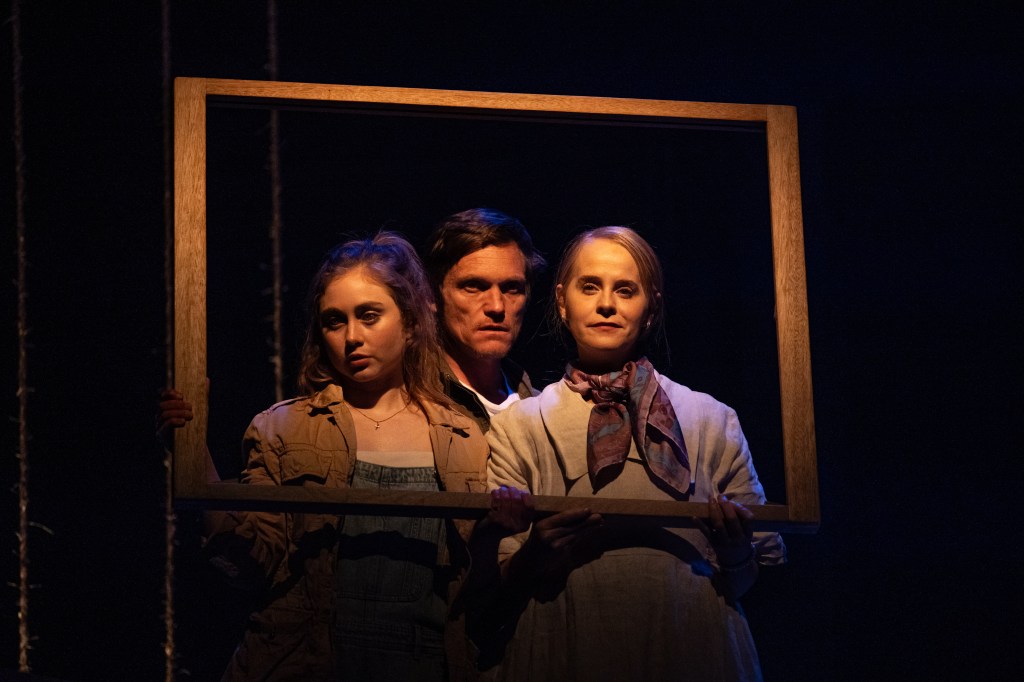
The Promise with the full cast as well as author, Damon Galgut (left) and Sylvaine Strike (right).
When it came to casting, it began with finding the right person to set the bar from a physical perspective and she knew from the outset when reading The Promise and imagining who her Anton could be, that it was Rob van Vuuren.
Gifted this opportunity of a role that is a once-in-a-lifetime experience, Rob was thrilled just to delve into this exquisite character and the very many facets of it. Sylvaine knew he would be the one who she would work off in finding the rest of the family, which includes Frank Opperman as Anton’s father, an Afrikaans patriarch, Kate Normington as his mother, jenny Stead as Astrid, his middle sister, and the young Jane de Wet as Amor
“The pivotal and most important character of Salome is played by Chuma Sepotela, who holds this exquisite part in two dimensions in the sense that she’s also the narrator of the piece, as Chuma herself, who plays the story conjuror.”
Sandu Shando plays Lukas, Salome’s son, and “the amazing Albert Pretorius and Cintaine Schutte, both adding deep dimension, comedy and pathos in the roles of Tannie Marina and Okkie as well as the many characters they portray,” she concludes.
In total it’s a cast of 9 and, before anything else, they did a workshop with Sylvaine to discover the physical language as the blueprint to the play.
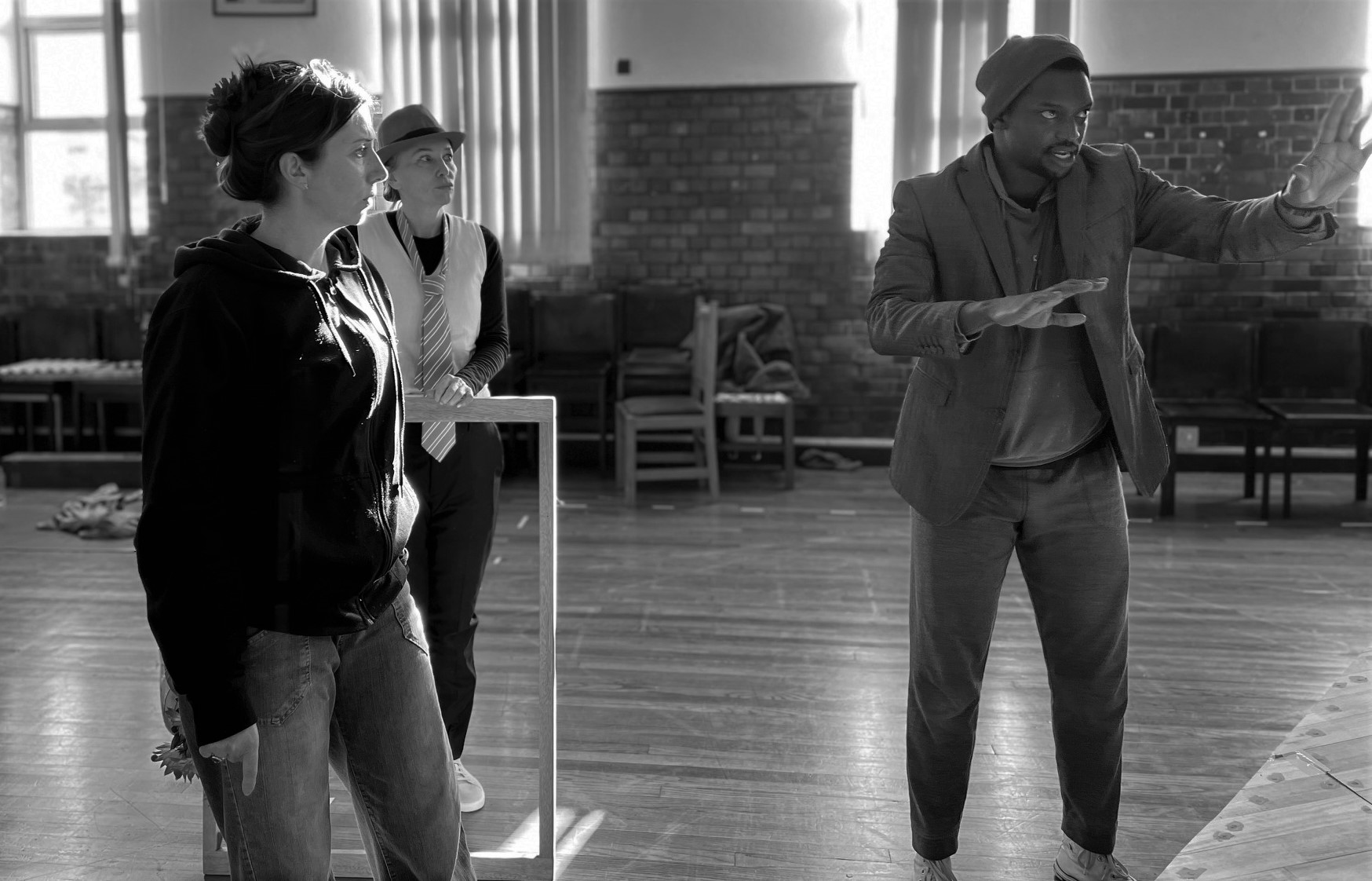
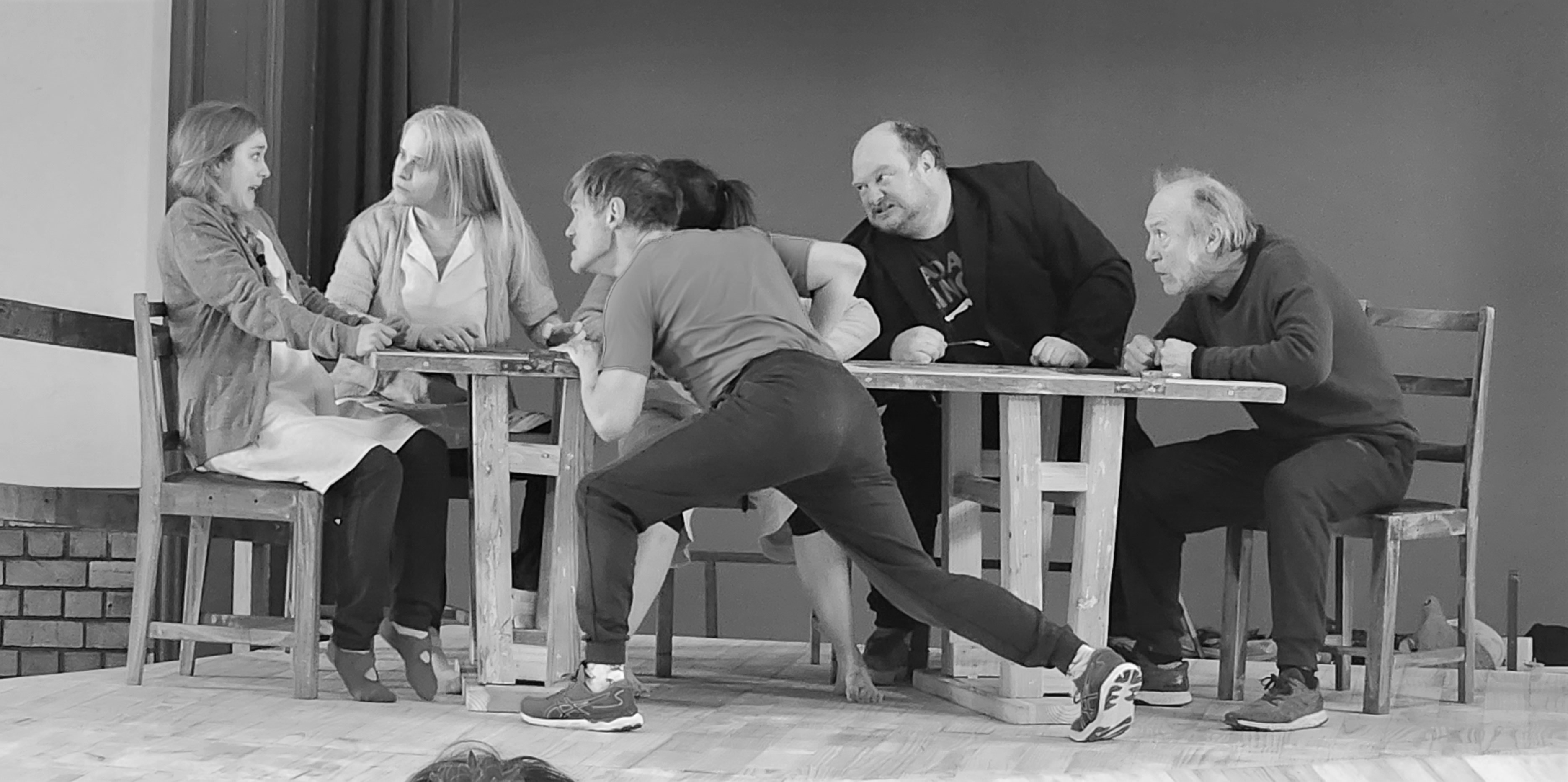
In rehearsals: the cast and director Sylvaine Strike.
With both the director and writer growing up in Pretoria, their coming together was almost written in the stars. “I think growing up in Pretoria and being aware of the glaring chasm between the haves and the have nots, the ability for Pretoria to ride that knife edge between ignoring the political reality, the lies that have been woven to its children, the incredible duality between darkness and light, tragedy and comedy that this book engages with and its calling out for us to face the shame for how we lived,” all of that made the book irresistible.
“There’s no escape but to look it in the eye, which is what this was and showing what it felt like for me. The novel forced me to do it as it named everything I was feeling growing up there as a child and being a teenager there and sensing that something was so terribly wrong with it.
The full cast on stage. Photographer: Claude Barnardo.
“Four decades of Pretoria so distinctly captured, I rose to the challenge of telling the story on stage because I wanted to reach people with it and make them feel what it felt like for me to read it and everything it made me feel to confront our whiteness in its brutal hideousness and its complexity and own it.”
Once the decision was made, she and Damon sat for two solid weeks unpacking the novel. At first he really battled with seeing how it could be put on stage. Sylvaine thinks that in his mind the locations were so specific that it took some time for them to understand the kind of language it would need in order to tell the story.
“We both agreed that the very fluid narrative that Damon captures and writes in, a narrative that changes perspective all the time, changes its mind all the time, needed to come from a chorus almost in the Greek tragedy sense, to comment on the action, to speak to the hero or the anti-hero, to contain their thoughts, and to move swiftly through the action alongside it.”
Scenes on stage. (Pictures: Claude Barnardo)
Neither the reader nor the writer could hold on to all their darlings. They knew they had to lose certain bits of the novel, cutting and culling, choosing only the very essential parts of the story, and look at compressing it into a time frame that would suit theatre, so much more condensed than in a book.
They also needed to find a theatrical language and a physical language that was able to edit between time and place very swiftly, where actors could age from one decade to the next simply by using their bodies. Damon then proceeded to write five drafts which incorporated this language and refined it more and more and more.
In between the first and second draft they had a workshop which Damon attended in which she worked with her cast and at which Charl-Johan Lingenfelder (music/soundscape) and Joshua Lindberg (set and lighting design ) as well as Penny Simpson (costumes) were present. “It was a collaborate effort to reach a place where script was done and created,” she explains.
Wearing her heart on her sleeve, director Sylvaine Strike.
Photographer: Martin Kluge
In conclusion, after all the hard work, the introspection, a fantastic cast, long hours and hard work, she hopes audiences take a good hard look at our country – and a soft look as well. “And by that I mean allowing us to enter its deep humanity and inhumanity, looking into a mirror, admitting our own whiteness, hearing it, not making excuses for it, not trying to explain it, but most of all really looking at the relationship we have as South Africans with each other.
“There’s also the microcosm of a family and its domestic worker Salome, which is a microcosm for the dynamics within our country, the difficulties, the obstacles, the promises made and broken, the lack of care we have for one another, the care in some aspects, about our country looking at itself, not being spoken down to, but simply observing itself, taking a step back to see more clearly, not back in time, just to get more focus on where we’re at.
“And what I love about The Promise is that it doesn’t offer any solutions, just gives us a glimpse of what we have done and what we have become over the last four decades of our country’s democracy.”


































 De Beer Necessities