ZIMBABWEAN AUTHOR SIPHIWE GLORIA NDLOVU DELIGHTS WITH THE GLORIOUS QUALITY OF MERCY

With the launch of the third in a trilogy, The Quality of Mercy (Penguin), author Siphiwe Gloria Ndlovu has firmly established herself as a writer not to be ignored. As an admirer, DIANE DE BEER writes about the way she captivates with her unique storytelling:

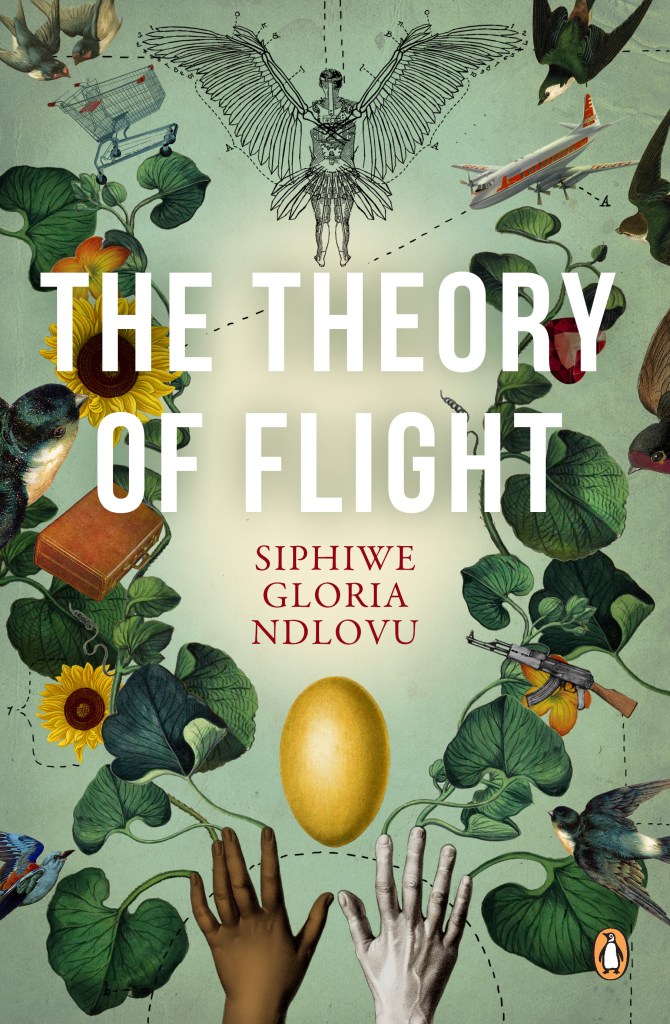
WHEN handed the third book in a trilogy by Zimbabwean author Siphiwe Gloria Ndlovu to review, my heart went up an extra beat. I had launched the first book The Theory of Flight in Pretoria a few years back, had done an email interview and reviewed the second The History of Man during lockdown and again, to my delight,  I was invited to launch this latest, The Quality of Mercy.

The last is always my best, arguably because I remember it best. But I can still recall how thrilled Iwas, not yet having met the sublime Siphiwe yet, on reading the first. I immediately recognised a unique and very particular voice – and then came the second, which approached writing in a completely different style.

Third time was not such a surprise, because by now, I knew the author better and realised that for her own imagination (a wild one, early in her life activated by her grandmother) and playful nature, she had to write in this way.

Asking about the three novels and what each one represents, she embroidered: “The three novels that make up the City of Kings trilogy – The Theory of Flight, The History of Man and The Quality of Mercy – all deal with aspects of Africa’s modern history. The History of Man deals with the colonial moment and its many (often limiting) narratives; the story of Emil Coetzee serves as a critique of colonial power.

“The Quality of Mercy is a story of transition and delineates a country’s journey from being a colonial state to a postcolonial state. The Theory of Flight is concerned with the postcolonial moment and its gradual loss of ‘ease’ as it becomes a place of increasing dis ‘ease’; the story of Imogen Zula Nyoni calls for a different kind of revolution from the one that led to independence.”

If she were simply telling stories it would have been fine, because she is such a superb storyteller and probably we would have loved it still, but it is also the way she goes about capturing the history of her land (ours and more) in a time of transition and beyond  – as well as, of course, before.

There’s a lightness in the telling, but don’t let her deceive you. She has found her own subversive way of saying exactly all the serious things she wants to, subtly without being preachy.

For example, she had no qualms, as a black female writer, to step into the shoes of a white male protagonist, and then one who was running a deeply secretive intelligence office in a colonial land which we all know but which she never names. And pulls it off with aplomb and terrifying insight.
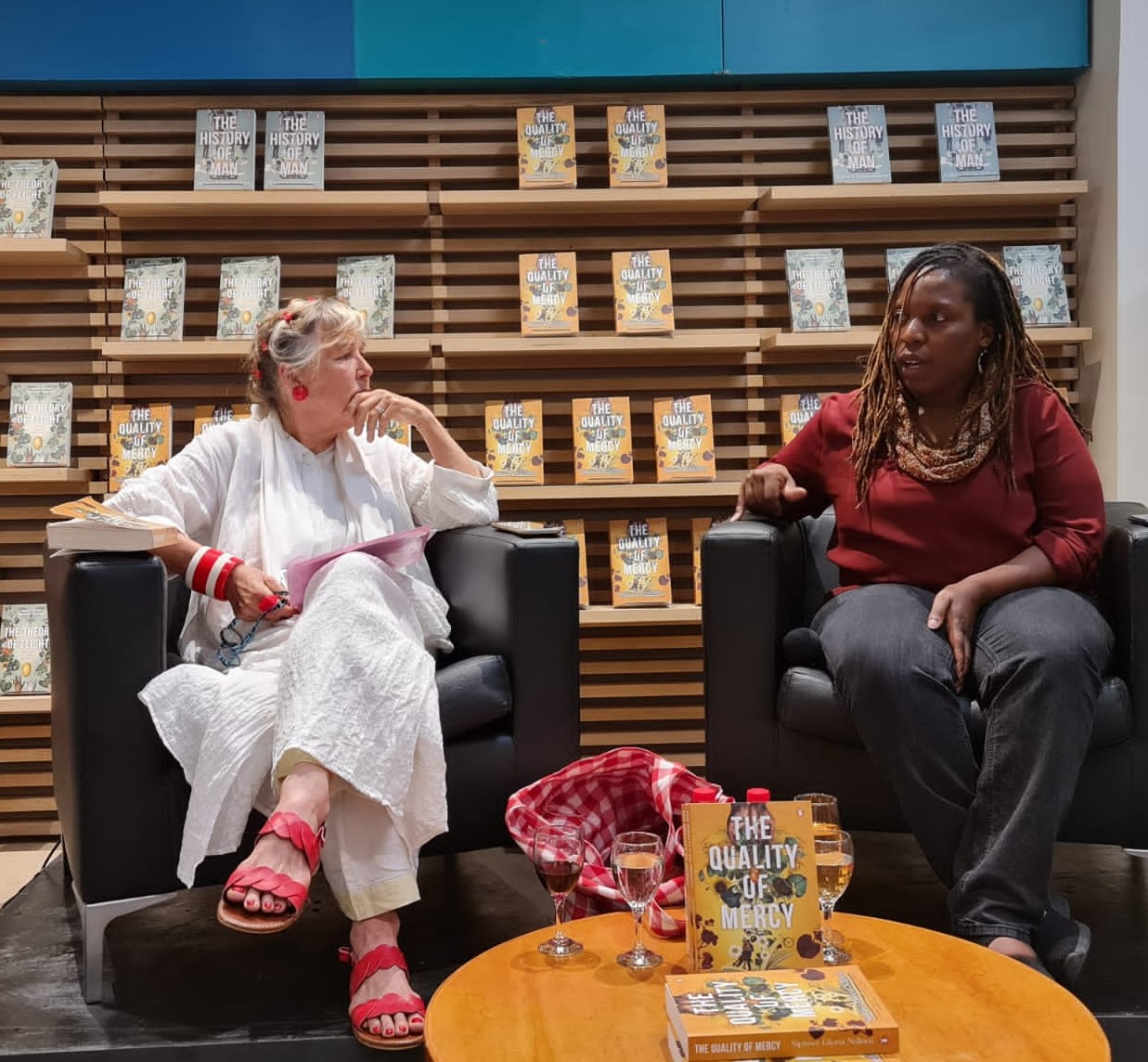
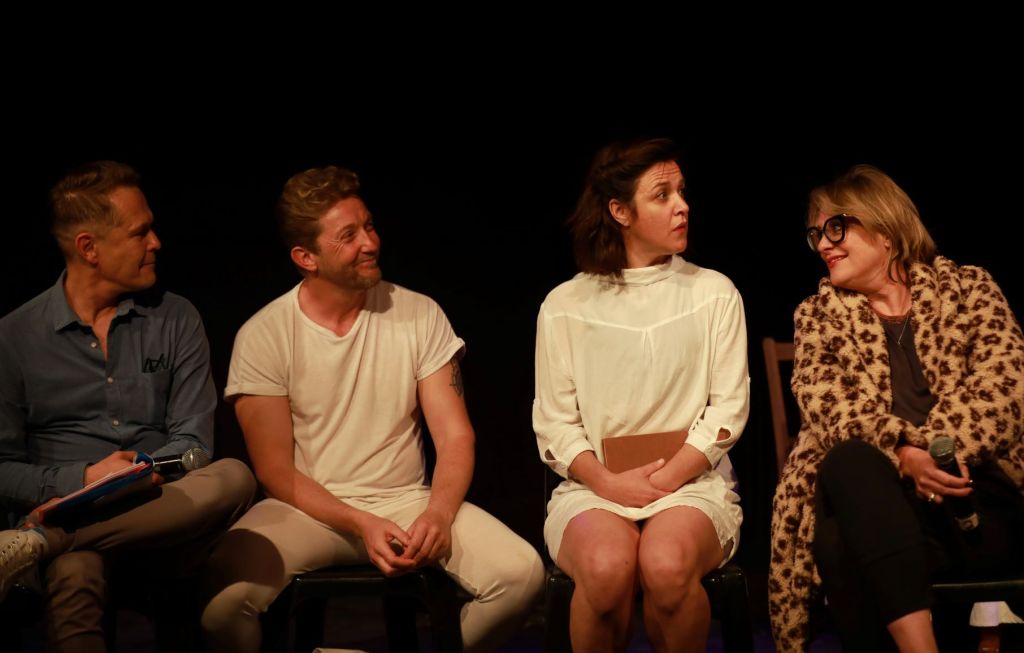
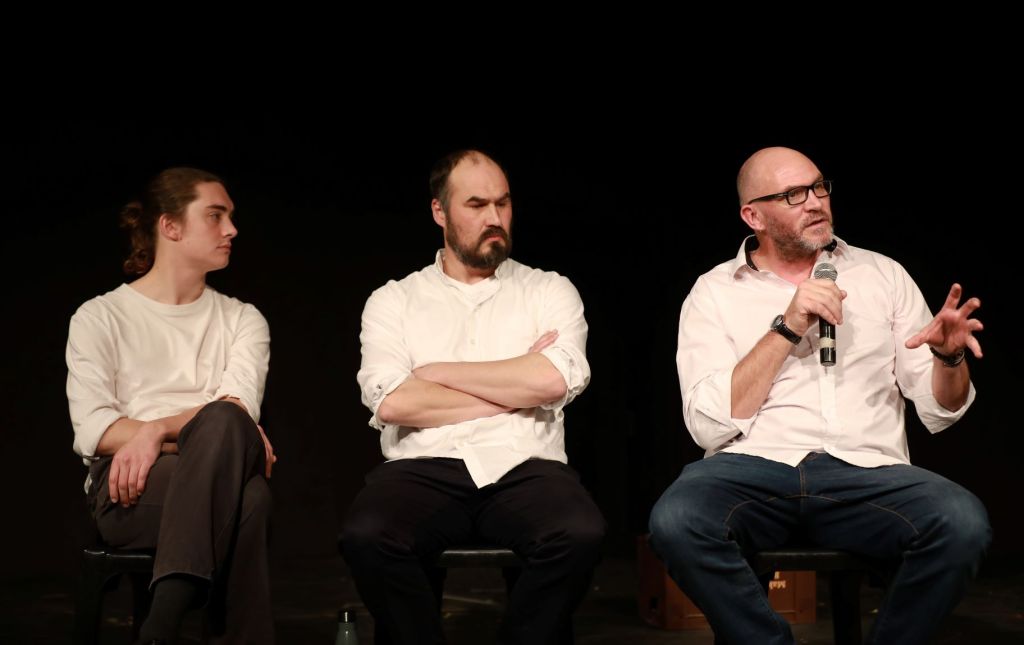
In conversation with Siphiwe at the Centurion Mall for the launch of The Quality of Mercy.

It is the way she climbs under the skin of a man who grew up privileged, but as he moved up in the world into the world, turned into a man difficult to recognise, driven from the outside rather than a true belief in what he was doing.

And that’s where her gift lies. The insight she shares about things that we all think we know and understand. This writer has a different take which she launches with a light yet incisive heft.

Talking about the period she has chosen to set this trilogy, she explains that the major plot of The Quality of Mercy, the investigation of a crime, takes place over a span of five months, December 1979 to April 1980. “Since this is a story about how a country transitions from being a colonial to a post-colonial state, these dates correspond with two very important dates in Rhodesian and Zimbabwean history – the date when the ceasefire that brought an end to the civil war was announced (December 21, 1979) and the date when independence was officially granted (April 18, 1980).

“This period of transition holds within it both hope and uncertainty  ̶  what will the post-colonial moment be like, how will power change and shift, what will the experience of ‘independence’ feel like, will we all feel equally free, what will we do about the past injustices created by the many forms of colonial violence, will we seek vengeance or justice for the wrongs of the past…”

With this latest novel, even if I knew to expect the unexpected I was still caught out. I wasn’t expecting her to come at me with such a surge of visual delight, and much of it has to do with her protagonist, Spokes M Maloi. Only the toughest heart wouldn’t  immediately embrace this detective who is married to the light of his life, Loveness.

There’s a reason for the loveliness and charm of Spokes, his particular job description and the fact that this one is a crime novel. Siphiwe explains: “The main protagonist of The Quality of Mercy is Chief Inspector Spokes M. Moloi, a long-serving policeman in the British South Africa Police (BSAP). Part of what I wanted to examine about the period that the novel covers is how the idea of ‘independence’ was different for different groups of people because settler colonialism had created very narrow definitions of citizenship and belonging that were based on extremely binary and limiting views on race, gender, ethnicity, class etc.
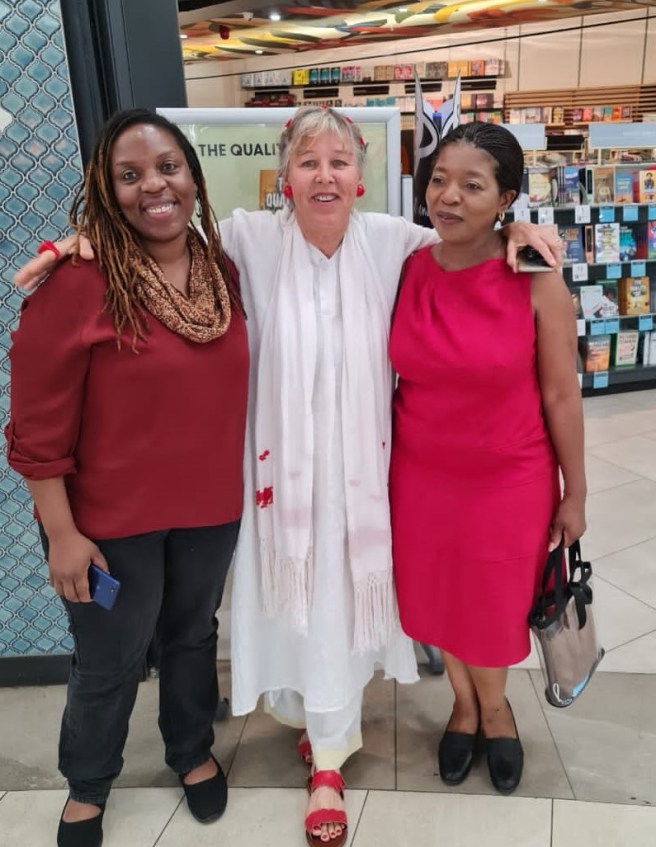
In the company of Siphiwe and her mom Sarah celebrating the latest book The Quality of Mercy.

“In order to achieve a more inclusive and bird’s eye view of this moment, I had Spokes, as a black man who had lived his entire life in a segregated country, investigate a crime that would take him into the homes and lives of an incredibly diverse group of characters. Given the particular period of history that the novel deals with, Spokes’ mobility and ease of access would have been extremely restricted and curtailed by his race (and in some instances) his gender and class were it not for the fact that his country was actively moving towards being post-colonial and he had in his possession a detective’s badge.”

He’s also at the end of his career, and as his country is attempting to move into a new phase, so he and especially his wife, are set on slipping into a much gentler realm.

There are a few hold-ups though. There’s a case that just won’t let go. Daisy was a woman killed quite brutally and spokes has never found the monster who did the dastardly deed. But no more give-aways.

This is a book you want to read without too much knowledge in hand. It has to be approached with the energy and exuberance the writer intended, and if you haven’t read any of her novels yet, you’re in for a treat.

While they are viewed as a trilogy, Siphiwe is happy to talk about interconnectedness, and I suspect there are a few still to come. Writing about the City of Kings, where she was born and has given her heart to, she has created a community with some figures more prominent than others in each of the books.

And because the protagonist in one might pop into another very scantily, once you know a bit more, there’s a curiosity to go back and re-discover where you first met someone and what all the connections are.

When she sat down to write her fist one, Theory of Flight which won the Barry Ronge Fiction Prize, Siphiwe had an idea of what her story was going to be, but it is only as she writes that everything becomes fleshed out in glorious detail   ̶  and she is also caught unawares.

“What I have enjoyed most in writing the City of Kings trilogy is the slow revelation of how the different stories fit together – The Quality of Mercy begins where The History of Man ends and ends where The Theory of Flight begins, bringing everything full circle. If I had known from the first that I was setting out to write a trilogy, I would have been too overwhelmed by the prospect, so I am very happy and relieved that it was all a process of gradual discovery.”

Perhaps none of us, not even the writer, knows what’s coming. What we do know is that she will sweep you off your feet all over again.
THE TRANSFORMATIONAL TEKSMARK HERE TO STAY, CELEBRATING STORYTELLING, DIVERSE STYLES AND DISTINCT VOICES

PICTURES: Nardus Engelbrecht

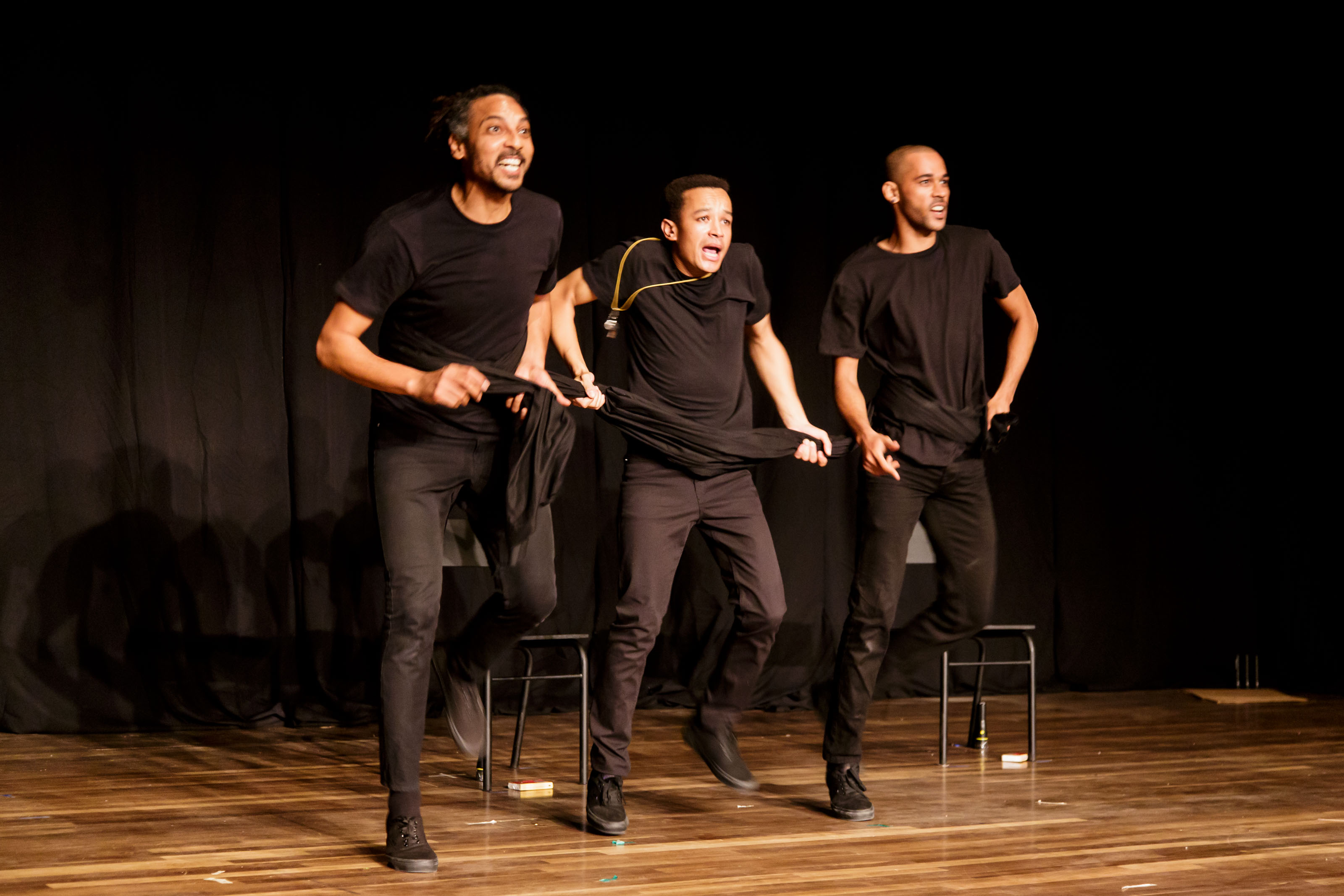
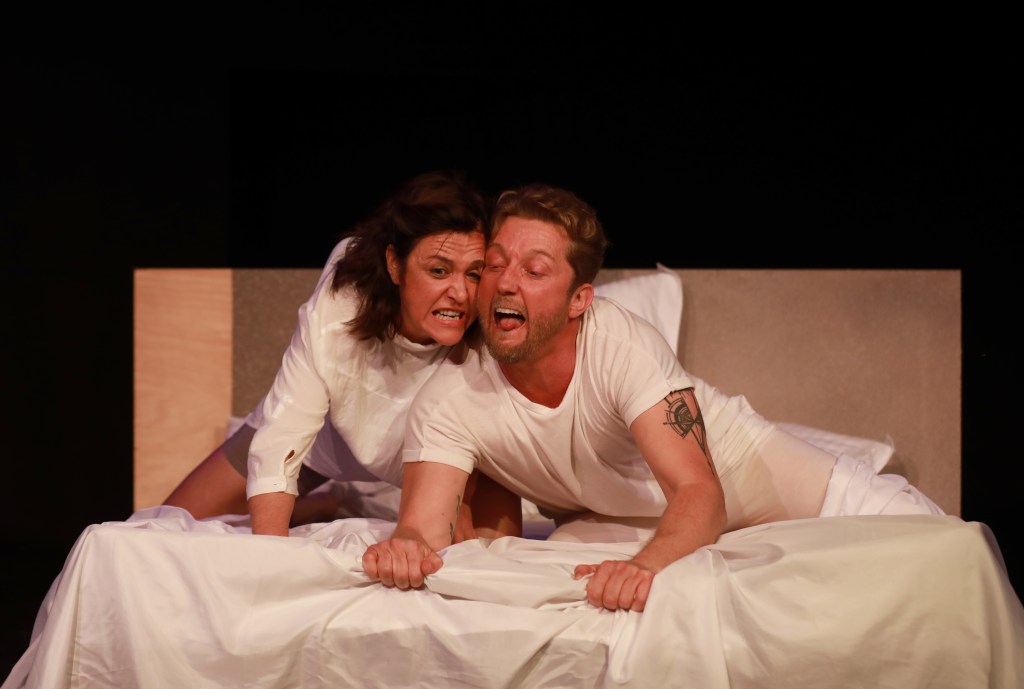
Alby Michaels and Henriëtta Gryffenberg’s 1 starring Cindy Swanepoel and Zak Hendrikz.

Teksmark 2022 was presented at the Baxter Theatre in Cape Town from 24 to 26 August and could be attended by interested parties free of charge. A total of 22 playwrights presented their script ideas and 90 actors and directors participated to present excerpts from the scripts as play readings. DIANE DE BEER spotlights her personal highlights and announces the texts that gained recognition and further development:

It is the storytelling, the distinct voices, the diverse styles and the enthusiasm that turn the tide each year as I watch the artists present their work, perform extracts and show all of us what is on their minds.

While the world seems to be falling apart all around us – locally and internationally – artists do exactly what Nina Simone said all those years ago: An artist’s duty is to reflect the times.

And that’s also what the Teksmark does year after year as the artists come up with work that’s invigorating, pushes boundaries and allows us to makes sense of the world – or at least reflect on it.

It’s been a marvellous innovation on the artistic landscape and especially for theatre (one of the many struggling artforms), it’s a huge boost and an encouraging injection.

It’s fascinating to read 80 plus texts – some just examples of what’s to come and others fully written – to wonder how some of them could work on stage and then to see how the artists  find solutions to present their work in the best possible light.

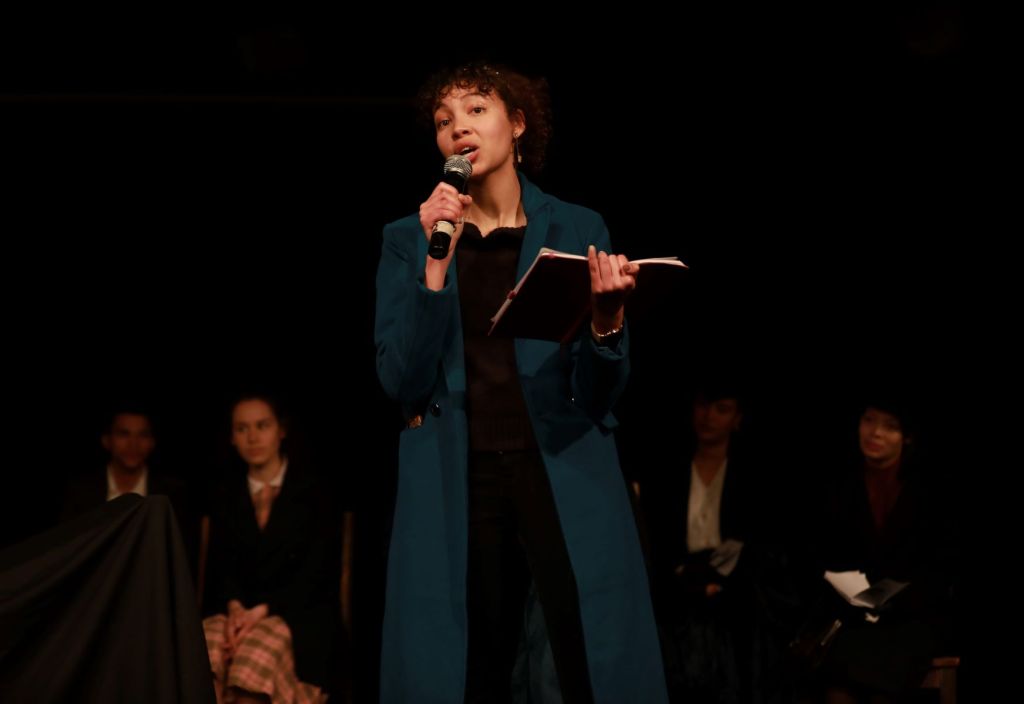
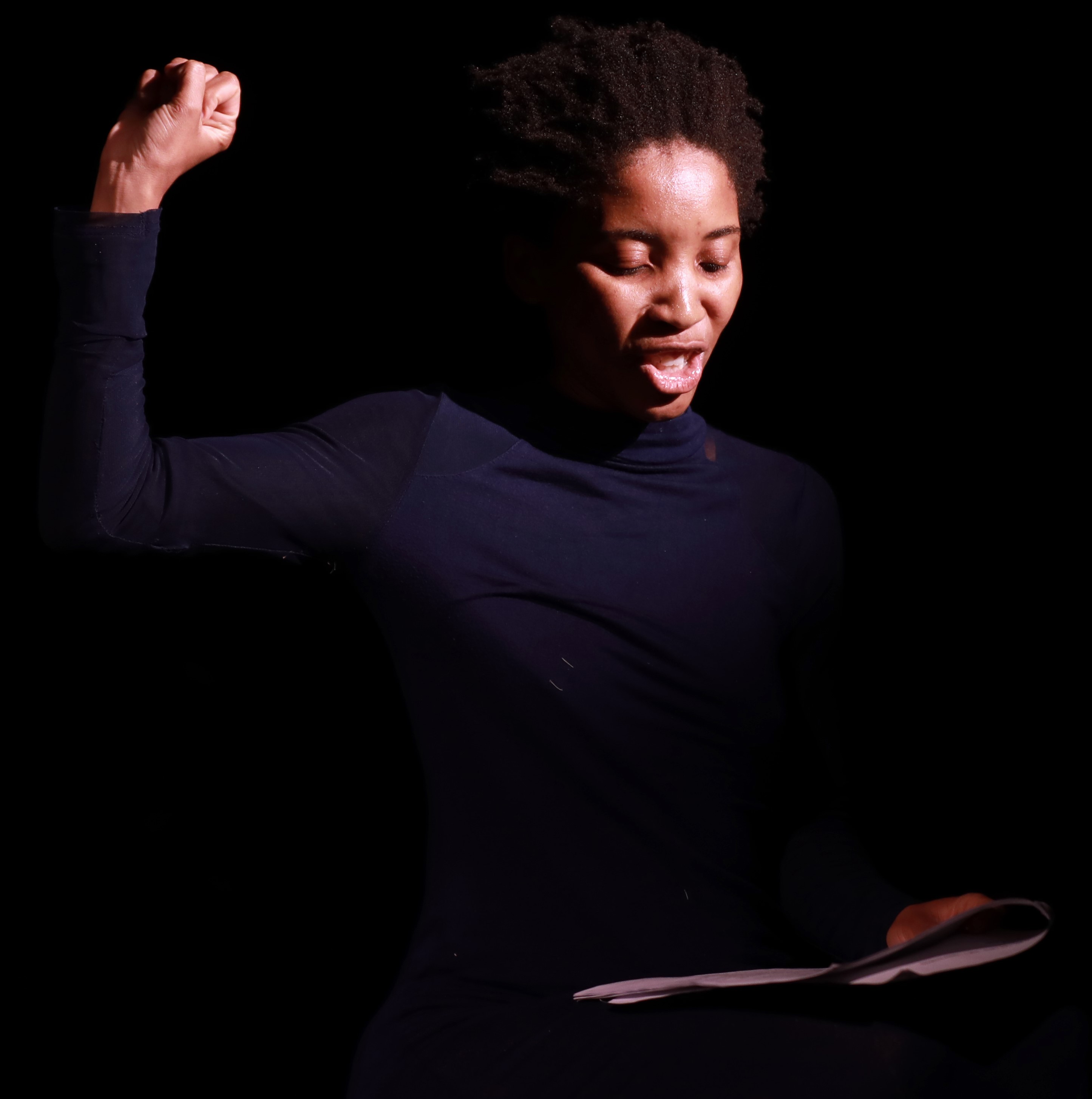
Actor/writer Jane Mpholo in Fragmented.

It was especially some of the tougher texts that surprised me. Take, for example, Jane Mpholo’s Fragmented. When reading the text, I found it too rambling and sometimes overstating or too determinedly explaining something and yet, dealing with something as urgent as gender violence, probably the most horrific scourge in our society.

She’s a smart theatre maker/writer/performer and she pulled in director Heloïne Armstrong, who a night before the performance, cut, dragged and rearranged the text to sharpen the power of the words and message Mpholo wanted to put across – and all this was the result of Teksmark and the opportunity it offers young artists to try out their work in front of their peers and other interested parties.

Another text, smartly written and in a genre that doesn’t usually have much appeal for me, is Gita Fourie’s Afval, which was also staged at October’s Woordfees.

She has already hinted at things to come with  a text  Mamma, ek wil ‘n man hê!, winning the University of Stellenbosch’s Toneelkompetisie, while Afval already this year won the US Première Teaterfees.

When reading the text, I knew it had the potential necessary to be performed, unaware that it had already received many accolades and a potential run at one of our largest festivals, which was achieved to great acclaim.

Watch out for this dark farcical tale about Johan the serial killer, whose wife is desperate to keep his killer instincts from his daughter, who innocently brings many possible victims home for her parents’ approval.

Two established theatre makers/writers Henriëtta Gryffenberg and Albie Michaels teamed up for a workshopped text written by Michaels under the guidance of Gryffenberg as he combined two fascinations, Greek mythology and the phenomenon of Siamese twins, to explore the concept of marriage in the madness of the contemporary world.

Their’s was the perfect example of a text cleverly realised on stage. Titled 1, the couple Hiss and Hirr, Siamese twins, have grown so accustomed to a life lived in the closest proximity with both needs constantly juggled or compromised, they hardly dare investigate other options – to try living separately for example. It’s smart and the scope of putting this on stage is intriguing. And the wisdom of having someone to bounce off and shape ideas, is a winning recipe.

Another writer who has already proved her ability is Dianne Albertze, who wrote a poem combined with dance, not an easy concept to pull off. But again, she dabbles in mythology in a region of the country that lends itself to this kind of imaginative storytelling.

It’s not an easy text, but she has proved her stage craft before and if she puts in the work, she could pull it off. She has lost her heart to Namakwaland and with the help of the legendary choreographer Alfred Hinkel, her text, which plays with the mythology of the region will be incorporated in a piece that presents the spoken word, dance and multimedia.

She has set aside more than a year and if all her dreams and desires come to fruition, this could be something quite extraordinary, capturing the landscape and the people, all of them off the beaten track and not really part of the theatrical landscape – but one that grabs the imagination and again underlines the potential of Teksmark and everything it achieves.

One of the texts I knew from the start I would love to see on stage is Andi Colombo’s Dying in the Now. It deals with grief in a most unusual and human fashion. How many of us just want to run away when things get tough. It’s not that one thinks that will make the problem disappear but perhaps you can just forget about it – even for a while.

It’s about the gentleness, generosity and probing of the text and the issues it deals with especially coming from such a young yet wise perspective that  makes it exciting.

Ten scripts have been selected for further development following this seventh Teksmark.

An extract from the extraordinary Karatara.

Fahiem Stellenboom, Marketing Manager of the Baxter Theatre, mentioned during the event that Karatara by Wilken Calitz and Shaun Oelf, presented on the Teksmark stage three years ago, is a wonderful example of the success of this project. “Following Karatara’s run at the KKNK, where it received the Kanna for Best Debut, it recently returned to the Baxter Theatre, for a short season. We are very proud to be associated with this production and project.”

Hugo Theart, Artistic Director of the KKNK, confirmed that bursaries for playwrights valued at R150 000 – funded by the Nasionale Afrikaanse Teaterinisiatief (NATi) and the KKNK – were awarded to eight scripts. “Furthermore, we are proud to present a run at the KKNK and Suidoosterfees to one script and to record another script as a full-length playreading.”

Six scripts presented at the 2022 Teksmark were selected for further development. Mikayla Joy Brown’s Jantjies and the Pearls, (which has a new take on forced removals again from a young yet informed place) receives a run at the KKNK and the Suidoosterfees in 2023 and bursaries to complete their scripts were awarded to five scripts: Philip Theron for Babilon, Babilon (and this is his second text in so many years that has been picked), Henriëtta Gryffenberg and Alby Michaels for 1, Wessel Pretorius for Kamermusiek, (which with some thoughtful editing could be a brilliant text), Anele Kose for the heart-wrenching Mhla ndiqala idibana naye and Louw Venter for Albatros, a text that deals with the relationship – or lack thereof – between a father and son, not often seen on stage.

Writer and performer Anele Kose of the extraordinary Mhla ndiqala udibana naye.

Four scripts from Teksmark 2021 have also been selected for further development. Marí Borstlap receives a bursary to complete her script Koning van die Diereriem. Nisa Smit receives a bursary to translate her script Nipped in the butt into Afrikaans, as well as Michaela Weir for her script What happens in Russia … Another Philip Theron text, Die kontemporêre kuns komplot is recorded as full-length play reading by The Playwright’s Laboratory (TPL). TPL is a new initiative that offers an online platform for playwrights to share their work with an international audience.

“Teksmark began as a small project and has started to feel like a festival that built its own audiences over the past seven years. We are truly grateful for their support and cooperation of partners like NATi and the Baxter Theatre, as well as other development partners including festivals, theatres, The Playwright’s Laboratory, Suidoosterfees, the Jakes Gerwel Foundation and the Het Jan Marais Nasionale Fonds,” concluded Theart.