Featuring Both Old Worlds and New As European Film Festival 2020 Goes Virtual

Polish film Sweat

It’s movie bonanza in November with the annual European Film Festival going virtual for free. The movies are premiere productions from different European countries with topics ranging from serious to silly, depending on your mood. DIANE DE BEER takes a closer look:

In the ‘70s and ‘80s, European movies were commonplace on our screens. Not so much anymore – sadly. But it has been remedied, the blow softened by the emergence of the annual European Film Festival from November 12 to 22. And in the past couple of years, the contributions have been quite extraordinary.

Not much good has come from this year, yet trust the innovation of the arts to save the day every once in a while. This year’s European Film Festival goes virtual and the good news is that it comes for free – bar one which many will gladly pay to see.

With a diverse line-up of 12 brand new films, all of which are premiere screenings in South Africa, for those who have been lost without movies it’s a bonanza with a wide range of topics and performers from different European countries.

Making a personal pick of four films to watch in advance, I started with two very different war movies – a sign of the times:

Belgian contribution Home Front directed by Lucas Belvaux is set in a small French village where the 60th birthday of one of its female inhabitants is being celebrated.

But times stops when her estranged brother (in the imposing yet almost brutish form of Gerard Depardieu) suddenly interrupts the festivities.

The implosion is almost immediate but apparently also not unexpected. That he turns up with a gift is what surprises everyone, but he quickly eradicates any possible goodwill by upending the proceedings – and thus the film unfolds in a horrific story of war set in the past but with the present of this small community held in a vice grip that seems immovable.

It’s a thoughtful and beautifully wrought film, unexpected in its powerful storytelling of a past that is hidden, mostly in shame, but also in denial as happens with war and the atrocities (in this instance mostly) men do, in situations of entitlement and terror.

Delicately told, it also unveils a story of racism between two countries of which everyone is aware but the victors rarely acknowledge – and those times are illuminated by a harsh spotlight that cannot be ignored – and hopefully allow people to move on .

It’s of its time yet perfect for our current times when marginalised lives matter.

War is also the subject of Lithuania’s In The Dusk directed by Sharunas Bartas and part of the Official Cannes Selection 2020.

It is post-World War 2, 1948, but it is as if no one has noticed that the war has ended. “You can find the same war in Ukraine – and its happening today,” says the director by way of explanation. And it is exactly that.

Imagine that the rest of the world is still in shock and recovering from a world war but yours is still ongoing. Yet no one cares, they’re done. And that’s when those who want to invade find fertile ground. “It’s a world of real wars, not Cold Wars or hybrid wars,” the director elaborates.

Lithuanian film In The Dusk

Living in the forest near the family farm to which the  19-year-old Unte returns from the war, is a partisan group resisting Soviet occupation. While the invaders are promising better times, having just come through a long period of war, those defending their country are suspicious. They know not to trust and are determined to stick it out.

It’s a grey and grim reality for those who can hardly survive in peaceful times and now have to keep fighting for their homeland. But that’s what war is.

And perhaps these two films want to make exactly that point. There are no winners. For those dying to keep the fight going all around the world, what is the end game?

But again it is hauntingly shot, the performances detailed and emotional, especially from the young Unte and his father, and the harsh reality simply cannot be kept at bay.

Talking about marginalised people, especially with extremists again causing mayhem and murder in Europe, they don’t come more targeted than the British Pakistani rapper in Mogul Mowgli starring the extraordinary Riz Ahmed, such an exciting young actor who makes such interesting role choices.

British film Mogul Mowgli

As Zed, he is on the cusp of a huge career breakout tour, but is suddenly struck down by a terrifying illness and forced to move back into his conservative family home. Here he has to battle not only the disappointment but also the traditions of his parents which are far removed from what he hoped his life would be.

Quite a few films and TV series have been made about second generation immigrants who have to balance the imbalance between their land of birth and the traditions of their parents, but this is a novel approach and one that reaches across genres and generations.

It’s the UK’s offering and a smart one at that, with the whole world trying to come to terms with shifting borders and identities. Directed by Bassam Tariq, it won the Fipresci Prize in the Panorama section of the 2020 Berlinale. It’s both thought-provoking and cunningly told with rap playing a vital role.

Herman Hesse’s Narcissus and Goldmund could sound quite daunting, but I was quite fascinated as I wasn’t familiar with the book but had seen director Stefan Ruzowitzky’s Oscar-winning film The Counterfeiters.

This is something completely different and even though the film disappointed, I was pleased to engage with the story.

Austrian film Narcissus and Goldmund

This Austrian entry is set in the dark Middle Ages where two very different characters meet in a monastery, become close friends, but choose very different lives. Narcissus prefers to spend his life in prayer and meditation even though he has fallen in love with his adventurous friend Goldmund. He in turn decides to escape into the more enticing life outside of the restrictions of religion to lead a more hedonistic life.

The problem was in the script rather than the filmmaking. It felt as if the scope could have been narrowed down to bring more substance instead of a sketchy retelling of the basic storyline. Too much information and too little enquiry.

Despite the challenges presented by the coronavirus pandemic, EU Ambassador to South Africa, Dr Riina Kionka, said: “Twelve films in 11 days shows the determination of this European partnership to overcome difficult circumstances. Since my arrival in South Africa this is my second European Film Festival:  I can tell you that it is a cultural highlight not to be missed. In addition, I invite you to participate in the various special events lined up during the Festival!”  

Dutch film Becoming Mona

Other films include: 

  • Marco Bellocchio’s award-winning film The Traitor  about an ‘80s whistleblowing  mafia boss-turned-informer who triggers the largest prosecution of the Sicilian mafia in Italian history.
  • The German film Curveball is a sober warning about how terribly easy it is to slip into war, with this fact-based story about how a lie regarding chemical weapons sets in motion a chain of events that results in the US invasion of Iraq in 2003, forever changing the global political landscape.
  • The Spanish film One Careful Owner tells how a woman buys a new home with a certain ‘inconvenience’, namely that the 80-year old current owner will remain living in it until she dies. It’s a story filled with tenderness, emotion and much laughter. 
  • Also honing in on female relationships, the French film Proxima, by director Alice Winocour, is about a French woman astronaut who is forced to consider her priorities of family versus career. *
  • Becoming Mona, directed bySabine Lubbe Bakker and Niels van Koevorden, deals with Mona’s struggle to break free from the stifling constraints of a life lived in service of other people’s egos.  
  • The Polish film Sweat by director Magnus van Horn focuses on a fitness motivator who has become a social media celebrity and influencer, highly pertinent issues in this modern digital era.

 The line-up also includes two powerful documentaries.   The Irish representative, The 8th, is about the highly emotive and divisive topic of abortion and women’s reproductive rights. And Nathan Grossman’s deeply personal Swedish documentary I am Greta follows the teenage climate activist Greta Thunberg from her one-person school strike to her astonishing wind-powered voyage across the Atlantic Ocean to speak at the UN Climate Action Summit in New York City. 

The festival is accessible online across South Africa only. The film screenings are free, except for I am Greta, whose entry fee of R50 serves as a fundraiser for a climate action group that will be awarded screening proceeds after the festival.

Look out for the full programme of screenings and special events as well as bookings on  https://films.eurofilmfest.co.za/ only available for viewing in South Africa.

Reluctant Author Zoë Wicomb Gets It Right Time After Time With A Story Of Its Time

Author Zoë Wicomb has a tough time writing, but once she has an idea, she works at it relentlessly, which results in a read that sits masterfully in its time and plays with the reader’s imagination quite magically. She tells DIANE DE BEER about her latest work, Still Life (Umuzi):

BK StillLife-small

What struck me first and stayed with me while reading Still Life (Umuzi), is the originality with which the story is told.

 Zoë Wicomb, a South African-born author living in Scotland says she has for a long time been interested in Thomas Pringle, “not so much as a poet, but rather in his writings about being a settler and his encounters with native people.”

The blurb on the back of her book describes the Scotsman as an “abolitionist, publisher – and some would say – Father of South African poetry. A biography of Pringle is in order, and a reluctant writer takes up the task.”

But what really captured this reluctant writer’s imagination were his political conflicts in the Cape which seem to embody the problems and contradictions of colonialism.

“But as always my ideas about a subject, in spite of research and knowing much about them, remain inchoate, and with Pringle I really did not know how to write about him,” she explains.

And that is what makes her, reluctant or not, an extraordinary writer. It is in the solution that she tells a fascinating tale.

 “After several false starts, self-reflexivity offered a solution –– I decided to exploit my inability to write, to fictionalise the writer herself, and to make the actual writing of Pringle’s history the framework of the novel.”

And that works magnificently.

What she does is ‘create’ three characters and through them tell her story, which is one smartly centred on colonialism, something that one might think would have been more written and talked about with perhaps much more resolution (and understanding) than currently exists.

She tells the story mainly through Mary Prince, a West Indian slave whose history Pringle had published, the ghost of Hinza Morossi, Pringle’s adopted Khoesan son, and the time-traveller Sir Nicholas Greene, a character she exhumes from  the pages of a book.

Author Zoë Wicomb

How she arrives at this motley crew she explains thus:

“Hinza Marossi, Pringle’s adopted son, was of interest from the outset. Not only is his story recorded in a poem, but I wanted to explore the question of interracial adoption under colonial conditions as well as what that story looks like from Hinza’s point of view.

 “The character Mary Prince was an obvious choice because her slave narrative was the first by a woman. It was published in London by Pringle in spite of opposition and litigation by British people who  benefitted from slavery. He was also reviled by fellow Scottish settlers at the Cape, who persisted with the myth that slavery in South Africa was an altogether more benign affair.

“Nicholas Greene, a character from Virginia Woolf’s novel Orlando (one of my favourite novels) is a more controversial choice, and really I don’t remember how he entered the story. But I was drawn to the fact that he is a time-traveller and to his fictionality as opposed to the other real historical figures. Thus he enabled me to address yet another level of the real within my fictional account. Given that the novel is about the writing of Pringle’s story, Greene also offered another version of the writer.”

Then there also a young woman, Vytjie, a character from one of Pringle’s poems. “According to his notes, she is based on an actual servant. Her perspective on the man therefore differs from that of Hinza who occupies a more privileged position in that household.”

Zoë Wicomb

If that doesn’t have you salivating, this isn’t your book. Even though Zoë notes that the publishers see this as a “difficult book”, that’s not the way it reads.

What she found with her chosen route of exploring Pringle is that the variety of characters enables her to represent different aspects of his life. But she underlines, “although the nature of the story itself is such that no comprehensive picture of the poet emerges; in fact, in my novel the project of writing his history fails.”

But that’s again the reluctant novelist protesting. I beg to differ. What emerges is a far more imaginative reflection on our past with a clutch of characters whose voices of that time are never heard. And for some of us, given the superficially privileged colour of our skin, questioning that is something that only began in larger numbers very recently.

Ask  Zoë about writing and she’s quick to respond how difficult she finds the process. “I’m drawn to a subject, do the necessary research, and then the problem of how to represent that subject arises. A struggle of trying to write something that may or may not lead towards a solution, and really it’s a matter of faith, of believing that something will come out of the daily routine.

“There are periods of giving up on the project, then inexplicably I return to wrestle with my material until finally the first draft shapes itself through the process of writing. Then follows many more drafts, less torturous than the first, in which I straighten out events and try to refine the prose, but doubts about the value of what I’m doing persist ––I am after all not read by many; in fact, my readership is more or less limited to students of Postcolonial Writing.”

But hopefully this one will change that … as it should. It is a tough topic for many but one we should engage and deal with – especially and finally in this time.

She makes it easy to start doing so if you never have. When I ask her about the lighter tone of the writing, her response is as amusing and direct as the banter between her characters: “It is impossible to overlook the comic aspects of white supremacy. Worth representing, I think.”

For readers, who like me, don’t know much about this writer, she left in the heyday of apartheid and made a life for herself elsewhere.

“But,” she says, “you can’t ever think of yourself as belonging in Europe. In terms then of an interior life, I remained South African, through teaching and writing about South Africa – both fiction and literary criticism. I returned for a few years and taught at UWC but then I couldn’t manage the family separation, and returned to Scotland.”

“I imagined that when I retired from teaching, I would live mainly in South Africa, but in the meantime the promise of liberation has been hollowed out and I’m not attracted to the pathologies of historical colonialism that persist. Still, I do spend a couple of months every year in the Cape and return to the north with great reluctance.”

For her sins, she says, she lives in Glasgow, where the awful weather is by no means the worst thing.

“Now having grandchildren means that I’m stuck here, although they’ve done much by way of ameliorating my stay here. I’ve worked at the University of Strathclyde, but have retired as Emeritus Professor.”

And she’s no less harsh about her writing and how she views it. “Having always had a demanding job, I saw teaching as my primary responsibility, so writing, both fiction and critical writing, was something that I did in the summer breaks or during sabbaticals. It is in that sense that I do not think of myself primarily as a writer. Then there is the fact that I find writing so very difficult, so dispiriting for much of the time, that I can’t help thinking that there must be a category of ‘real’ writers who find it less of a struggle.”

Read her book and see how you disagree. I was pulled into the lives of her characters but especially the way she found to tell this very important story of our time. There’s no longer a running away from the past.

And next on her agenda?

“I have not managed a book in the past without self-isolating for extended periods. But it is not a good idea to talk about a next book; in fact, given the difficulty I have with writing plus my faculties being impaired by ageing, who knows if I’ll manage another.”

Here’s hoping…

Changing Lanes, Hilary Prendini Toffoli Turns to Italy and Food for Debut Novel


With Covid19 hastening the demise of print media (in this country but also across the world) as we know it, journalist Hilary Prendini Toffoli knew she had to reinvent herself – and she has, in most intriguing fashion. DIANE DE BEER chats to the veteran journalist about her first novel Loves & Miracles of Pistola (Penguin):

“I worked on Pistola on and off for several years when I was a journalist, but it was only when the media industry was really crumbling that I decided to reinvent myself and complete the novel,” explains Hilary Prendini Toffoli (Penguin).

Yet it is something that started even before her journalism career. She had her first short story published in what was then The Cape Argus when she was about 20, a BA student at UCT. Later she joined The Argus and became the company’s first female sub-editor.

Then she moved to Joburg and ran the Star Woman with Sue Grant Marshall (another journalist turned author) doing the Woman’s Page.

Where I became hooked on her writing was during her time as  a journalist for Style (remember them?) from 1983 to 2006 covering everything “from social and political satire and profiles (21 eligible bachelors in one story), to features about high profile local murders and rapes, as well as writing edgy short stories.”

Then she went freelance doing features and columns for a wide variety of publications including Noseweek, Insig, Financial Mail, City Press, Business Day, House&Leisure etc.

For her the move from journalism wasn’t difficult. “Over the years I’d written a few terrible unpublished novels, both here and overseas in my twenties, living in Spain, France, England and Japan, trying to find myself, that old cliché enacted out by a lot of us those days.”

What also came into play were all these interesting characters she’s interviewed over the years which gave her a helluva lot of material. “I think much of it went into the subconscious, to come spilling out when I write. So the process of writing fiction is not for me a case of ‘Open a vein and bleed’ as someone once described it. My MO is more on the lines of what Stephen King says. ‘Put interesting characters in interesting situations and see what happens.’”

She does however make it sound easier than it is. Not all journalists have books in them even though it is also about writing, it is something completely different. Yet those familiar with her work will not be surprised. Hilary’s interviews were special. She had an acerbic eye but was never unkind – funny yes, and capturing the zeitgeist of her time, absolutely. And she never took life – or herself – too seriously.

She is right when she notes in our correspondence that Love & Miracles of Pistola came at the right time. “In these tricky Covid times the book’s nostalgic flavour has given a lift to readers. Plus they love the food angle because they’re all cooking more than ever before. And they love Pistola because he had his own battles and survived,” she reports.

Hilary in her kitchen

The characters of Pistola and his grandfather Nonno Mario first popped into her mind during the long stretches of an Eastern Cape road trip. “I’d wanted to write about the life of my husband Emilio who grew up in a post-war Northern Italian village in the fertile Po Valley with pigs as big as small Fiats, and where people have survived in spite of the battles that have raged for centuries over these maize and rice fields. This was a way to do it.”

But for local readers especially, it’s more than just looking back. It’s also the diversity of our  people – always a South African strength – that captures the reader’s imagination. We’re all lovers of Italian food (and that isn’t an exaggeration), and this is a story which gives us insight into some  of the roots of all that glorious Italian food … today still.

Hilary explains: “At first the story revolved around food and its importance in this place where the daily greeting is “So have you had a good meal?” Then I remembered the piece I’d written for Style magazine on the young Italians brought to South Africa in the fifties as train stewards by the Nationalist Government. I’d got great anecdotes from several who were still here running restaurants.

Hilary and her husband Emilio
Picture: Alex Moss

“So I put Pistola into this story and it really worked. I could show that repressive political era through the eyes of these naive young foreigners, most of them in their teens, with Pistola going to places like Sophiatown and the Malay Quarter. For an Italian village boy, South Africa’s increasingly racist laws were a challenge, but also a journey of self-discovery – Pistola’s miracles.”

And she says it herself: “What makes the story particularly interesting for South Africans is the fact that many of those Italians then stayed on and opened restaurants all over the country, introducing Italian cuisine to people whose only knowledge of Italian food was Heinz spaghetti on toast. Places like La Perla in Sea Point gave South Africans not only great pastas and pizzas but also a taste of Italy’s extraordinary range of culinary masterpieces.”

We can all agree when she says that it was the beginning of a love affair with Italy.

What is also evident is that her husband, Emilio, being a great cook, played no small role. At one stage he had a deli in Oranjezicht, and he made most of the takeaway foods. Lasagne, ravioli, cannelloni, gnocchi, parmigiana di melanzane, minestrone, osso buco, chicken cacciatore, pesto Genovese, and tubs of sauce – arrabbiata, amatriciana, napolitana. “Clients loved to come and talk to him about their Italian holidays. It was then I began to realise how South Africans love Italy. Not only the food. Also the art, the music and the picturesque towns and villages with their fountains, piazzas and romantic Roman ruins.”

Personally, she has no Italian blood. “My first encounter with Italians and their culture was on the Lloyd Triestino ships that used to sail between Venice and Cape Town in the sixties. Far cheaper than airflight In those days. Those two-week trips were heaven. Great food and music, and good-looking officers!

“I’m a WASP, born and brought up in Cape Town. My mother Constance Young was a prolific journalist for the old Outspan magazine. She also wrote short stories that won prizes on the radio. So for me writing has been a lifelong obsession. Especially fiction.”

Author Hilary Prendini Toffoli

The book has also been a family affair in other ways. “I was lucky to have my daughter Caterina, a graphic designer with Yuppiechef, do the vibrant cover. 

“Meanwhile I so enjoyed writing Pistola I’ve just finished the second in my Italian trilogy. Not a sequel to Pistola but the story of another young Italian migrant, Furio, an opera-singing romantic with a broken heart and a volcanic core, who finds himself working on the farm of a great white hunter in Kenya at the time of the Mau Mau. Challenging stuff he has to find ways to deal with.”

And that’s done in Hilary’s typical Sjournalist style! While still in the throes of doing publicity for her first, she has already completed the second – and I would not put it past her to be already working on the third.

So start where it matters, and get onto this first one. It’s a great read, informative, and captures a country and its people in a particular time.

Innovative Charl du Plessis Trio Play With Our Imaginations In Times of Stress

With a new album, in hand, it’s time for the Charl du Plessis Trio to launch their latest musical feast titled Imagine, apt for our times when the world has been turned upside down. But music will always be there to stimulate the imagination, Charl du Plessis tells DIANE DE BEER:

Because he works fanatically on so many different levels, it’s surprising to hear musician Charl du Plessis say that his jazz trio hasn’t released a CD for two years. He is someone who fast-tracks everything.

But this one wouldn’t have happened at this time either if they hadn’t been approached to record with Swiss speaker company as part of their Stenheim Acoustic Sessions which give artists the chance to record original tracks in unusual places and in exceptional acoustic conditions. “We were fortunate to record this project with their world-class acoustic treatment to ensure the most organic and powerful listening experience,” explains Charl about the sessions recorded at the Espace Consonance in Saxon, Switzerland.

These days with music recordings so problematic, no one is going to disregard this kind of invitation, but what really excited the trio was the quality inherent in the full process. Stenheim’s quality products are the guarantee of a superb recording in a state-of-the-art studio.

Charl du Plessis Trio

This is the first recording by the Charl Du Plessis Trio in its new format, following the departure of the former drummer for China. Peter Auret, one of Gauteng’s most sought-after jazz drummers, joins original members Charl on piano and Werner Spies on bass.

“It’s been invigorating,” says Charl, who with this album wanted to include tracks that share their respect for the original score which has always been their strong suit – a crossover between jazz and the classics, with Charl a master in both genres.

And he emphasises that with Peter joining their team, imaginative moves have been flourishing. One needs change every once in a while and when it is as positively organic as this one was, it can also be hugely beneficial. “We all work together extremely well,” adds Charl.

It also helps that Peter is an award-winning recording engineer and producer with his own studio while Werner adds techno buff to his skills. Charl, always someone who keeps adding yet another string to his bow (see Episode 2 of Toegang on kykNET), also recently added piano tuner to his repertoire. “One often battles to find someone at specific times,” he says and as the owner of two Steinways (being a Steinway musician), he can now do his own when required.

Peter Auret on drums

They say you have to know the rules before you can bend and  break them. That truly applies here and you will hear that immediately as you start listening to their music which seems to have taken on a world in trouble while offering an easy escape – for just a while.

Their music reflects their passion. These are musicians who travel the world with their special brand of music, something that translates well and appeals to both jazz and classical audiences – and that isn’t always a given. Think of the way classical or jazz music has sometimes been dumbed down for a more general audience. This is not that.

It’s about combining and infusing all their multiple influences but in a way that is smart, honours the original music and delivers a sound that is both fresh and refreshing. Included in the lineup, which should have you smiling, is Mozart’s Magic Flute, Beethoven’s Für Elise, Ode to Joy and the Adagio cantabile from Sonata Pathetique, Bizet’s Seguidilla from Carmen, Verdi’s Va Pensiero from Nabucco and to conclude, John Lennon’s Imagine!

Werner Spies on bass

They’ve been at it for 12 years and in that time while not stagnating, they know what works and how to keep it challenging. They wouldn’t have had this recording if that weren’t the case. This is a difficult area to make your name – and a living. You have to deliver for it to work and they do.

They have won major music awards including a Fiësta, two SAMA awards and a Ghoema for Best Instrumental Album. They frequently perform in Europe and Asia as well as at major music festivals in South Africa. Highlights include Grachtenfestival – the Netherlands, Musikdorf Ernen – Switzerland, and Standard Bank Joy of Jazz – Johannesburg as well as most recently digitally as part of the National Arts Festival platform. 

This launch of their new album Imagine will be held at the Atterbury Theatre in Pretoria on November 1 at 3pm. Tickets can be booked at iTickets. It’s all about familiar music with “daring textures, exciting rhythms and lush harmonic landscapes” which come together in their unconventional arrangements.

Charl on keyboards

And if you’ve never attended one of their shows, this is an ideal time to sit back (in controlled circumstances) with music that will be a balm for your soul.

The trio is constantly evolving in their quest to explore uncharted musical terrains in an imaginative manner and, like the title suggests, this is not borrowing from the extraordinary John Lennon but rather paying homage.

That’s the kind of music they make and I easily recommend. For those who cannot attend the concert (and I predict there will be more around the country as things start opening up in the new year), get the album. It’s one to cherish.

For more information visit www.charlduplessis.com

Charl du Plessis Trio with Peter Auret (drums) Charl (centre) and Werner Spies (bass)

Renée Rautenbach Conradie Perfectly Blends Storytelling and a Rich French/SA History

When you start listing al Renée Rautenbach Conradie’s skills and accomplishments, it becomes quite overwhelming, but there’s a common thread that runs through her many activities: an exuberant love of life. She tells DIANE DE BEER more about her debut novel, Met Die Vierkleur in Parys (With the flag of Transvaal in Paris, Protea Boekhuis):

How many people know about the South African participation in the 1900 International Exhibition in Paris? Or who De Villebois-Mareuil (after whom  a street in the east of Pretoria is named) was? Or that Paul Kruger and the Boer Republics had crept into the hearts of the ordinary French at the turn of the last century?

In fact says Renée Rautenbach Conradie, when she and her Foreign Affairs husband Leo Conradie spent time first in Marseilles and then in Paris late in the last century and early in this one, they discovered many links between South Africa and France in centuries past.

When they lived in Paris in 2000, many of the exhibitions were repeated to commemorate the 1900 world event. “Exhibitions of Rodin, the USA and Russia whose most memorable contribution was the landmark Pont Alexandre 111, which connects the Champs-Élysées quarter with those of the Invalides and Eiffel Tower,” she explains.

With more research, one of the passions of this long-time journalist, she discovered that we had a memorable pavilion, which included a gold mine and a pioneer’s house (very much like those still seen at the Pioneer’s Museum in Silverton still today) and that this was indeed one of the most visited features at the Show.

She had found her hook for the novel she wanted to write and the serious research began. The Anglo Boer War had always featured in her life as someone from the last generation to hear stories from those who were directly involved – starting with two grandmothers with very different world views: her paternal grandmother from Oudtshoorn looked down on the Voortrekkers and anything beyond the “colony” and her maternal grandmother was six when her mother died next to her in a tent in the Standerton Concentration Camp. Hér grandfather (72) was taken to St Helena where he later died and that same grandmother also experienced the day the sheep were set alight and pigs were mutilated with sables …

Renée also shared this Anglo Boer passion with both her father and her late husband Leo, who collected turn of the century newspapers when they spent time in France. “They included many pictures of Paul Kruger arriving in Marseille as well as etchings and pictures of the Anglo Boer War,” she notes.

Knowing that she wanted to write, a few years ago, she enrolled for a masters in creative writing at the University of Pretoria. It started with short stories but slowly her interest around a story set in 1900 in Paris took hold.

“Paris was at its wildest in 1900. It was the Belle Epoque, the Bohemian lifestyle amongst artists was accepted and the buzzword of the time was avant garde,” she says. “And I have always been fascinated that Pretoria was burdened by the strict mores of the Dutch Reformed and in addition, there was the influence of the Victorians who buttoned everything up to the neck, taking little pleasure in anything!”

It was this dichotomy of different lifestyles (with the accent on hedonistic pleasures versus the restrictive narrow-mindedness) that also had a huge impact on architecture, which captured her imagination as something she wanted to explore.

She elaborates that Art Nouveau was prominent in 1900 with artists like Toulouse-Lautrec and the theme of the Paris Exhibition was Progress. “That was a time of steel and glass which can still be seen in the Grand Palais and the Petit Palais. Unfortunately some of the other structures were pulled down when the Exhibition had run its course.”

It was a time of architectural curves rather than stark lines and her more than four years in this exquisite city gave her a chance to fully appreciate the architecture of Paris. “I also participated in history classes for four years,” she says.

Her main character with a name like Paul Roux and a profession in architecture meant that research became very important. “At that time you received inhouse training and because of the timing, I could incorporate Herbert Baker as his tutor. I could also showcase the influence of French architect Thibault in Cape Town,” she adds.

It also suited her story that Pretoria was extremely busy at the turn of the century (1900), typical of a ‘sudden’ capital city. “The old Department of Works was responsible for the buildings surrounding Church Square. The Beaux Art style was used with the department headed by Sytze Wopke Wierde with many French and Dutch architects,” she says

And all of this dominates Met Die Vierkleur in Parys with the plot centred on the dishy if dishevelled architect Paul Roux who was responsible for the Pioneer House at the South African pavilion. Of course there’s intrigue, a Jewish miss who has to flee Cape Town to escape a meddling mother and makes her way to England and closer to her prospective beau.

That’s the lifeblood but the intrigue is the wheeling and dealing around the exhibition, the time and the two cities and its people on two vastly different continents in a time now very distant and far away. Yet strangely familiar and appealing …

As a veteran journalist writing about a longtime passion, her research is impeccable and something that grabbed me from start to finish. I am not someone who follows a historic lead and will see a foreign name like DeVillebois-Mareuil and wonder but then forget to follow it up. To discover the person’s identity is a real thrill as are many other historical titbits Renée has cunningly woven into her story.

Because she lived in Paris and established her own historical background, she could incorporate the landmarks that are familiar, but with detail that informs, adding to the charm of the city and the story.

As an outsider, her main character appealed to her because “I understand and empathise deeply,” she says. “Especially in Paris. You lose your heart to the city, but the city is a character and you are not really engaged or accepted by the ordinary people. My disdain for affectation also becomes clear.”

As a journalist, she is also much more accustomed to flash writing in a fast-moving world. Yet she discovered when writing a debut novel at a more advanced age, you have a full hard drive with riches to explore. And if her laziness can be circumvented, she hopes to get stuck into another one.

She writes in Afrikaans, and if it is a language you understand, it’s an unusual read. It’s much more than just a love story, in fact, she had to work very hard not to make her historical background dominate – and that she has done masterfully. But it does give an edge to the storytelling which puts the book in a class of its own.

A perfect escape for this time.

A discussion of the book with the author Renée Rautenbach Conradie will be held on October 18 at Foxwood House in Joburg. Bookings at www.skybookings.net or with Theresa at theatre@foxwood.co.za.

A Cape Town launch will also be held in November.

NATANIЁL – A MAN ON THE MOVE

Nataniel ToegangMany can argue about who suffered (s) most with the appearance of Covid 19 but few will disagree that artists, who make a living by performing to a live audience, have been hit hard. Even the world’s top concert halls are struggling with no end in sight. One of our most prolific artists, Nataniël, tells DIANE DE BEER how he tries to navigate his career during the pandemic:


 With NANTES KOOKBOEK finishing this week, Nataniël’s latest series, TOEGANG, starts the following week – but getting that done, as everything else during Covid, was no easy task.

“The series originally planned will hopefully be done next year,” explains the artist. “The concept was a logical follow-up to the series shot in Nantes, to be filmed on the original le Roux farm just outside Kuilsriver.”

Things kept changing but because of lockdown and the necessary protocol, Nataniël  had to do some quick thinking when he realised they had to shoot where they all lived. And that was Pretoria.

“The concept came from being alone in my house for months and realising how simply I actually live and how simple my meals were,” he says. For him, delicious food, made in just one pan, became the limit for for washing-up activities. That sorted the food for the series.

He also realised how many gorgeous buildings in the city would be deserted because of the pandemic, buildings he always wanted to spend time in, but not with the crowds that would usually be there. “So I took my pan and a very small crew and went there.”

Speaking about these lightning-fast changes and the way the series had to be shot, he admitted it suited his way of working. It actually meant a spike in his already high-powered creativity levels. “I loved it. We could do what we wanted, all these fantastic spaces gave us the opportunity to create beautiful scenes, film very dramatic visuals and work without disturbances. KykNET let me be, nobody looked over my shoulder and all the strict rules made me feel safe. I had a tough time with the make-up part, because somebody had to touch me, but I bit my lip and got through it.”

Those who have interviewed Nataniël  will know that getting info about an upcoming programme or concert is like pulling teeth. Not the gist of it, but the detail. He is a man who lives for surprises. When you sit down to watch a programme or enjoy a show, he believes the less you know the better. “I tell nobody about the places we went to, that will be revealed in every episode.”

“Tragically there are no surprises on TV since Oprah left, everything is blurted out for marketing, so there is nothing to look forward to.”

But he reluctantly admits that they work according to themes, every episode has an inspired menu for which he got his ideas from the locations, history, plus his life in isolation. (“Apart from going back on stage now, I am still in lockdown, because I love it. And I will wear the mask for the rest of my life, I look fantastic and it is much cheaper than Botox.”)

nataniel oils2

He also introduces artists who made things for the programmes, including artworks, ceramics, fabrics, prints, jewellery and, of course, some surprises. 

And another secret he allows to slip … Very often a local magazine series get an original theme tune, but there rest comes from a library of canned music. “This time I had the opportunity to write and produce a full soundtrack and be in the studio for all the sessions. (With a mask and bottles of sanitiser!) That was a great experience and fantastic to work with all the musicians after months without performing a single note.”

Shooting locally for the first time in some time following a revamp of the Nantes series, was quite strange. “The European visuals are very filmic, there’s a castle or a cathedral or a museum everywhere you turn and you need to do very little to make a scene beautiful. Also finding props here was a challenge as (at the time) many shops were still closed and nothing new had come into the country for months,” always a Nataniël requirement. He hates introducing and showing things people know.

Looking ahead, Covid has given Nataniël  time to think and make some decisions. “First of all I want to dress more wildly. I realised I am still scared of what people think, but the virus took that away.

Nataniel in full colour
Nataniël in full colour

“I will also stop dumbing down musically because of my fears that the audience will not like complicated or eccentric or sophisticated or unfamiliar songs. At the Woordfees in March I performed a very modern cover song with a very abrupt ending and there was absolute silence afterwards. Then I realised nobody in the audience has heard that song yet, although it was a worldwide hit. So I stopped singing it. During isolation I decided, to hell with that, that song will be back in the new show. Life is too short to compromise.”

It’s about time!

Nataniel gesels

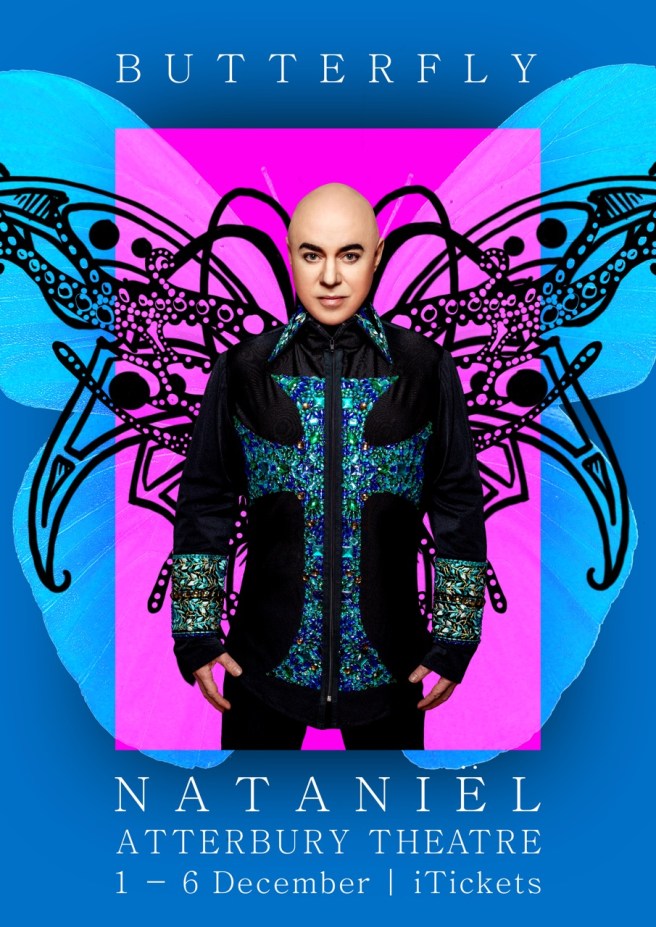
Now he needs to get back on stage which, not surprisingly is what he misses most. “I start with GESELS, my lifestyle talk series, every Saturday in October at the Atterbury Theatre (in Pretoria) starting this coming Saturday. Bookings on iTickets.

“Then in November Charl du Plessis and I will finally do our gala concert to celebrate working together for 20 years.” TWINTIG, the gala Concert with Charl, Sunday November 15 at 3pm in the  Atterbury Theatre. Bookings on iTickets. “In December I will stage a new production, as always.” Bookings will also be on iTickets.

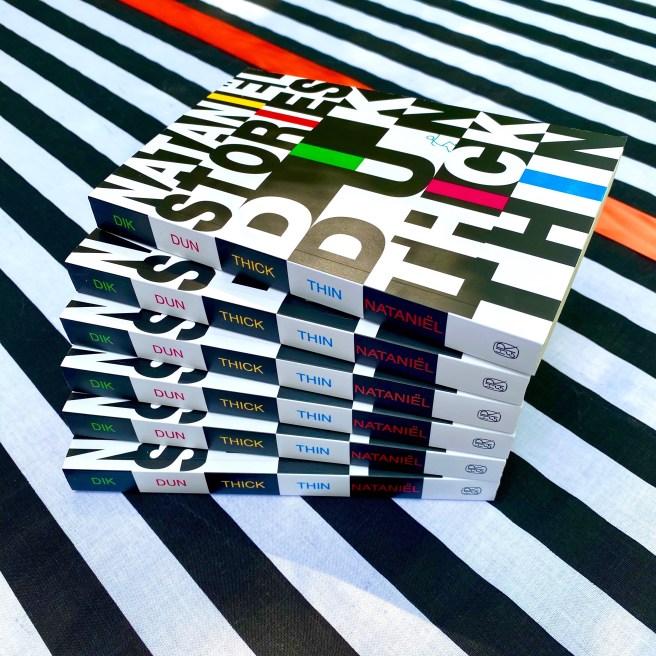
He has also launched the LIVE LIKE N collection of healthy cooking oils which can be ordered at https://liveliken.com/. And a new book (a collection of short stories) will be available in October. 

Nataniël has been working on his blog called SmallCoronation.com, which was quietly released recently. “It is all about simple food in beautiful settings, creating atmosphere. I see it as sharing my personal archive with others with all the food coming from dinners at my house.

“There’s no interaction and talking nonsense with people I do not know, just an online magazine to be looked at with a cup of tea when somebody needs a break. No strange ingredients, no modern techniques, just fun, ideas and hopefully inspiration.

“It will be launched with the TOEGANG series next Monday at 8.30pm on kykNET and the English version of all the recipes will also be available on the blog.”

And if you were wondering  in anticipation about the next memoir…

Nataniel boek

That will have to wait says the author. “Too many of the characters are still alive. And LOOK AT ME (KYK NA MY) still needs to get the attention it deserves. Everything stopped when I had to stop performing and touring.”

But for the moment, the new normal kicks into action and Nataniël in full colour steps into the spotlight with even more than his usual fanfare.

I’ll be watching for those outlandish costumes and outfits as well as the music he really loves to sing … whether they like it or not!

TOEGANG starts on Monday October 5 at 8.30pm on DStv’s kykNET.

The Sample Workshop is Stunning Example of Cool Capital’s Eye Catching Guerrilla Tactics

Cowmash showcasing her art

When architect Pieter Mathews gathered his coterie of Pretoria artists to stage a typical Cool Capital guerrilla exhibition in the basement of his firm, Mathews and Associates Architects’, most high-profile building to date, the Javett Art Centre at UP, they all leapt to participate. He shares the excitement of the event with DIANE DE BEER who encourages those visiting the Centre, which again reopens on Heritage Day (September 24), to also check what’s left of the glorious art in the basement parking area:

“A basement is an underground space…the humblest of spaces specifically in the Javett: UP”, writes Pieter Mathews in the explanatory notes of The Sample Workshop, the catalogue documenting the guerrilla exhibition. The exhibition took place under the radar of the conventional gallery space above. Many factors including the transient nature of art, the way art is viewed in the world and the fact that the artisans who participated in construction of the gallery would possibly never see the actual art, were the driving force behind The Sample Workshop.

Creative Carla Crafford.

The project initially grew from a practical need to test samples of ideas and patterns to be used in the building. It however evolved into a project in its own right which allowed Mathews to specifically honour Pretoria artists. It all started forming in his mind when the temporary building site offices, constructed from drywall, had to be shifted to the basement and while he was looking for possible sandblasting options for certain parts of the building. This space, a wet basement which is largely naturally ventilated and to some extent vulnerable to nature’s elements receives unique light through the voids.

As the white boxes (of the art centre) above ground offers opportunities for the often elite art afficionados and students to enjoy exhibitions made possible by curators, he believed that in the spirit of ‘art for the people’ it would be appropriate for an underground exhibition to be held in the area that only the construction team had access to.

Jan van der Merwe making art

He wanted to show temporary artworks by some of South Africa’s foremost artists from Diane Victor, Gordon Froud, Malose Pete, Dr Jan van der Merwe, Annette Pretorius (2019 runner up of the Sanlam Portrait award), Guy du Toit, Carl Jeppe, Eric Du Plan, Heidi Fourie & Alain Lang (2019 Ampersand fellows) as well as some of the hottest new kids on the block like Cowmash (2019 PPC Imaginarium  winner), Keneilwe Mokoena, Nazirite Tam and Helena Uambembe (2019 recipient of  the David Koloane Award).

As the instigator of Cool Capital, described as the “world’s first uncurated, DIY, guerrilla biennale which explores the possibility of creative expression that Pretoria has to offer”, he knew that the artists would understand the concept and buy into the transient nature of what they were creating.

In essence, they were going to create art in a building site which was at that stage of the process, under the custodianship of the main contractor. This meant each artist had to be inducted according to the health and safety act. It created huge excitement amongst the construction workforce who by the very nature of their work seldom have anything to do with the finished project.

Lukhanyo Dyasi stakes his claim for the worker posse.

This was going to be a joint project and the workers were also asked to contribute and nominate someone whose art would be representative of the group. The artistic individual, Lukhanyo Dyasi, is a crane driver guide who was personally involved in the construction of the basement, created an apt site-specific artwork of an excavator hand.

Excavator in hand played with the idea of his hand resembling the bucket of the machine simply stating that he and his co-workers “had a hand in its creation”.

Their contribution was further enhanced by the photographs (also seen here) of Alet Pretorius who was archiving the process of the building, but for this particular exhibition, did portraits of the construction workers and put them up on a temporary drywall a part of this gift economy. All of the workers who recognised their picture, got their own copy (of art) to keep as a memory.

Heidi Fourie at play with plastic

All of these interventions blurred the lines of what is seen as a traditional art and artists which included all the different issues floating around this almost clandestine artistic endeavour on a site that was soon to become an art haven in the capital city.

For his own interpretation of art, Mathews played with the construction site and found material and give a nod to similar work by Kendell Geers. “He was my inspiration,” explains Mathews, who took photographs of a composition of tyres and danger signage he discovered by accident on the site. In similar fashion, he paid homage to collaborating Swiss artists Fischilli/Weiss with a found composition of fire pipes scattered around the building site.

Carl Jeppe in action

Another fascinating aspect of the experimental exhibition is what artists do when they know their work will probably disappear sooner rather than later. Artist extraordinaire Carl Jeppe has been drawing large imaginary landscapes these past few years. His challenge was to find a way to do something larger than he’s ever done and in only one day. “Instead of my usual ‘Mythical’ landscape, I decided to draw from memory some of the iconic buildings that we see around Pretoria realizing that the Javett: UP will soon be regarded as iconic as well!” He was also intrigued by the notion that the work itself was not permanent but would remain on record as an event that took place.

Playing with that impermanence, Allen Laing’s work titled Fossil of Pedagogosaurus Defunctus, crushed under its own weight (wood found on site, olive wood, screw and nails) dealt with a fossil that was “discovered in 2018 by the acclaimed and highly esteemed Mr Allen Laing (MTech, BA, matric, etc.) at a depth of 10 meters below ground in Brooklyn, Pretoria. Although rivals and detractors of Laing’s career have claimed that the fossil is falsified, Laing’s outstanding academic credentials seem to solidly counteract these claims”.

Nazrite Tam reworks Pierneef

Hong Kong based artist, Nazirite Tam (UP Alumnus) decided to go fake Pierneef (a la station panels). Tam carved moulds, then melted sheets of plastic to make a permanent impression of the Pierneef moulds. Tam created five different panels for The Sample Workshop. The work is titled Station panel rip off (1-5), proudly proclaiming that a Chinese artist created fakes of Pierneef’s works.

Keneilwe Mokoena created a mural by stretching pvc tape on drywall. Her artwork creatively explored a single point in space-time, which is connected to everyone and everything else that exists and will ever exist.

Well known artist Gordon Froud created a piece related to his 2018 Standard Bank exhibition entitled Harmonia, Sacred geometry, the pattern of existence. This exhibition and the piece Metaron’s cube in bronze, silver and gold, investigated the platonic shapes as well as ancient geometries – through these he explored the interconnectedness of all things and how our perspective changes the way we see or interpret the world around us.

There are of course many more while these artists were seriously having fun as they allowed their imaginations to take flight in the spirit of the exhibition which was always tongue in cheek with the art establishment firmly in their sight.

But there was also a serious side with The Sample Workshop addressing some of the inequalities prevalent in a world that is constantly struggling with ‘us’ and ‘them’ on so many different levels.

Lynette ten Krooden’s art in the making

For architect/artist Pieter Mathews it was a way of bringing many worlds together and of adding the artistic to the architecture in a fundamental way. The Javett Art Centre at the University of Pretoria opened to the public on heritage day 24 September last year and again reopens to the public this Heritage Day 2020.

 While there are still remnants of art visible when you park in the basement at the Javett Art Centre at UP, the full body of work can be seen in The Sample Workshop catalogue available on ISSUU:


https://issuu.com/coolcapital/docs/the_sample_workshop

ALBIE SACHS THE MAN, THE FATHER, THE SURVIVOR

Review by Diane de Beer Pictures: Philip Kuhn ALBIE SACHS, FATHERS, SONS, AND SOFT VENGEANCE Presented by Troupe Theatre Company in association with Daphne KuhnPlaywright: Gail LouwActor: Graham HopkinsDirector: Fiona Ramsay Venue: Theatre on the Square, Sandton Dates: Until May 24 If you were witness to the birth of the South African democracy in 1994, Albie Sachs will…

THE DELIGHTFUL DILEMMA OF DEALING WITH LIFE

Review by Diane de Beer Pictures: Ngoma Mphahlele AFROPOCALYPSE DIRECTOR: Daniel Buckland CAST: Market Theatre Laboratory 2nd Year Students DATES: Until May 23 VENUE: Mannie Manim Theatre at the Joburg Market It bubbles and bristles with energy, enthusiasm and excitement in this return season of a play which started as a student production in 2024…

PASSION IS IN ABUNDANCE FOR THE CREATIVE JO STEENKAMP, BOTH AT WORK AND AT PLAY

My favourite psychologist, JO Steenkamp, is playing in a different medium and yet, like his focus on spontaneous healing and internal transformation, which he has developed into his own modality, SHIP (Spontaneous Healing Intrasystemic Process), his art and more specifically sculpture follow the same principles of spontaneity. He talks to DIANE DE BEER about his…

Shakespeare Is The Man For All Seasons With Women Breaking The Acting Mould

DIANE DE BEER

“My words fly up, my thoughts remain below: Words without thoughts never to heaven go” William Shakespeare, Hamlet

Shake Chilling with the Bard Poster Image_ (002)

Stories are never on pause, explains Artistic Director of the Market Theatre, James Ngcobo, as he reveals their latest theatrical celebration which starts during this Women’s Month: Chilling with the Bard, a Shakespeare Season.

And for those of us trying to keep track of the creative juices of Ngcobo, it’s been a sweet ride as he tries to navigate the Covid 19 curve ball which has almost brought the world to a standstill.

I knew the creatives would find different ways to market and move their stories even when their winning ticket – live theatre – was cancelled and closed from the start and will probably be prohibited for the rest of the year.

Yet from the start of the first lockdown, Ngcobo knew he had to find ways to keep theatre going, to embrace rather than defy lockdown. “I commissioned 10 new works all of which are available on our social media platforms and some of which will be reworked next year to stage live,” he says.

Then he turned to a handful of especially young actors to do monologues reflecting on their world and the life we are inhabiting now. “Theatre will rise again,” he says but in the meantime it has given him the opportunity to showcase some performers who are Market regulars but also others he has always hoped to put on stage.
“Covid hasn’t stifled our passion, just moved it into another space.”

He also connected with dancers like Vincent Mantsoe in Paris, writers like Napo Masheane were given a scenario and asked to write something and others to tell their own stories while an international jazz hook-up was also made. He had to find ways to woo audiences to watch and is thrilled by the response – with numbers watching rising constantly as all the work can be easily accessed for free.

Many of these plays will also be staged at the Market once live performances are given the go-ahead. “I envision two weekends of short plays for example where audiences move around from one 20 minute play to another,” he says. For him it is important to stage new work and not just look at what they had available.

This latest season is based on speeches from some of Shakespeare’s iconic plays, mostly written for male characters. They have been carefully picked and partnered with the perfect actress, according to Ngcobo.

These past few months and those ahead have been all about finding ways to work not only for audiences but also for actors. Reversing the roles in this Shakespeare season, Ngcobo hoped to excite both parties with roles that where written more than 400 years ago but are still relevant today.

shake maya and oprahIn an Oprah Masterclass podcast with Maya Angelou, relevance is underlined with the following Angelou musings:

“I read Shakespeare,” she says speaking of herself at a very young age, approximately 12. “I memorised 50 sonnets or something. But I read one sonnet that made me think, Shakespeare must be a black girl from the South who may have been molested. How could he know?”

And then she recites…

In disgrace with  fortune and men’s eyes,

 I all alone beweep my outcast state,

And trouble deaf heaven with my bootless cries,

And look upon myself and curse my fate.

“Shakespeare knew what it was to be raped and scorned, so of course, (and she laughs) I thought he was a black girl, barefoot in the South. It spoke to me.” And who can argue that!

Ngcobo expounds: “I think it’s important that we’re not locked in by the myopia of gender and race,” he says, something that world theatre has embraced as audiences become more adventurous in their viewing choices.

“It is really a marvel that almost 400 years after he wrote this great literature, we are still intrigued and engulfed in this magnificent work of brilliance. Shakespeare poured his heart and imagination into these wonderous stories that have been acclaimed, enjoyed, and staged over the years.” said Ngcobo.

Running through his options he talks about his choices for the season:


Eleven of Mzansi finest female actresses take on performing one hander plays on the John Kani stage, showcasing their diverse talent with extraordinary acting. “I’m hoping that this amazing combination of talent will breathe new life to these ancient yet living texts,” says Ngcobo.


Shake Arsema Thomas
Arsema Thomas

Arsema Thomas is an American actress currently working in South Africa. She has African parents and wanted to work on the continent. Encouraged by Moonyeenn Lee, Ngcobo auditioned her and was delighted she could participate. The first part is a speech by Rosland in As You Like It (Act 3 scene 5) and then as Lady Percy from Henry 4 Part II (Act 2 scene 3)

Shake Awethu Hleli
Awethu Hleli

Awethu Hleli first caught Ngcobo’s attention working for Cape Town’s Magnet Theatre. She’s multi-talented, a UCT graduate and moves easily from theatre to the screen. Her monologue is as Malvolio from Twelfth Night, Act 5 scene 1.

Shake Bianca Amato
Bianca Amato

Bianca Amato will be remembered by Isidingo fans before she left for the US where she has been amassing a stream of awards. But she’s back home and her contribution is Brutus’s speech from Julius Caesar Act 3, scene 2.

Shake Camilla Waldman
Camilla Waldman

Camilla Waldman has perhaps been seen more often on TV screens than on stage lately, but anything she touches turns to gold as one can witness in the monologue from The Tragedy of King Richard the Third –  Act 1, scene 1 as Richard, Duke of Gloucester, afterwards King Richard III.

Shake Charmaine Weir-Smith
Charmaine Weir-Smith

Charmaine Weir-Smith, a director, writer, actor was last seen in a stunning performance in Paul Slabolepszy’s Suddenly The Storm and also directing Dawid Minnaar and John Kani with a full heart in Fugard’s The Train Driver. She will be doing one of two sonnets, Sonnet 29 “When in disgrace with Fortune and men’s eyes …”

Shake Kate Liquorish
Kate Liquorish

Kate Liquorish was most recently seen in M-Net’s Still Breathing and on Netflix’s Queen Sono (with Ngcobo) and on stage in a dramatic turn in Sam Shepard’s Fool for Love. She will be playing King Richard II, Act 3 Scene 2 in King Richard II.

Shake Leila Henriques
Leila Henriques

Leila Henriques  starred luminously in the Greg Homann-directed Florence and  with great insight directed the award-winning Hani: The Legacy with  the Market Lab students. She will be playing Viola in Twelfth Night.

Shake Renate Stuurman
Renate Stuurman

Renate Stuurman, also part of Suddenly the Storm cast and very familiar to television audiences will be doing the second sonnet – Sonnet 13 – My mistress’ eyes are nothing like the sun.

Shake Rorisang Motuba
Rorisang Motuba

Rorisang Motuba jumps in at the deep end with Shylock from Merchant of Venice’s To  Bait Fish Withal. She’s a storyteller who approaches her craft from many exciting and different angles.

Shake Tinarie van Wyk Loots
Tinarie van Wyk Loots

Tinarie van Wyk Loots performed at the Market in a Zakes Mda play directed by John Kani, but she is better known for her Afrikaans stage work, which is seen most often at festivals. Versatile and with the bravado of someone who dares to try anything and fly, she opts for Hamlet in no less than the title role – and pulls it off magnificently.

Shake Sara Richard
Sarah Richard

Sarah Richard comes from local theatre royalty (daughter of Michael Richard and Louise Saint Claire) and Ncgobo, who loves giving young actors their chance on stage, leapt at the opportunity for her to play Launce from Two Gentlemen of Verona.

Shake Vanessa Cooke
Vanessa Cooke

Vanessa Cooke is synonymous with the Market Theatre and the Lab and as such becomes what Ngcobo refers to as the ringmaster for this Shakespeare celebration. She plays Jaques in As You Like it with The Ages of Man speech, Act 2 Scene 7.

Shake Zethu Dlomo Mphahlele
Zethu Dlomo Mphahlele

 Zethu Dlomo Mphahlele is a dynamic force on stage and screen with a big international presence. A WITS graduate, she doesn’t flinch while playing Macbeth, Act 3 scene 1.

The Market will start releasing the different performances from this Thursday  with an explosive Camilla Waldman opening the season and following with a new monologue each week on Thursdays at 12. Check their website http://www.markettheatre.co.za and their facebook page for details.

Precious Lives Interrupted Yet Never Silenced in Stories Sensitively Shared

DIANE DE BEER

These three books all deal with children who have lost their mothers and how that influenced their lives:

BK girl


The Girl with the Louding Voice

  by Abi Daré (Sceptre):

“I tell you true, the day I stop school and the day my mama was dead is the worst day of my life.”

And that sentence explains  what is to follow in the 14-year-old Adunni’s life. Her mother is the one who paid both to keep her at school and the exorbitant rent for their house.

But since her death, Adunni has become a valuable commodity. In fact, her life amounts to four goats, two bags of rice, some chicken and a new TV, as she is sold as the third wife to an old man. With a dedication to the author’s mother (the first female professor of taxation in Nigeria) and someone who promoted the importance of education and sacrificed so much that her daughter could get the best of it; and a prologue that points to Nigeria as the 6th largest crude oil exporter in the world (and with a GDP of $568.5 billion, the richest country in Africa, yet with 100 million people who live in poverty surviving on less that a $1 a day) that’s who this story deals with, one of the many young girls who become the sole provider for their family, not by choice but because they don’t have any.

Whatever your level of interaction with the rest of Africa, we have all heard of the plight of the Boko Haram girls who were abducted. Some will never be returned to their families, while those who do are often rejected, with the children forced upon them by their vicious captors.

Think about those 16 year-old girls kidnapped by the marauding monsters only to be blamed on their return at a time when being a teenager should be your only worry. It’s the kind of book that hopefully opens new worlds and reminds you how lucky we are to have the luxury of only discovering this kind of terror in a book.

I loved the story and the writing. It’s a unique voice, as so many from Africa are.


bk crawdads


Where the Crawdads Sing

by Delia Owens (Corsair)

Kya was only six when her mother walked out on the family. In the following few weeks, an older brother and two sisters also drifted off and Kaya was left with her favourite brother Jodie and her drinking dad.

Jodie didn’t last that long and neither did her father, only a few more years. By the time she approached her teens, without any schooling, neither writing nor reading, she was on her own living in their shack in the marsh on the edge of Barkley Cove.

Not only had this young girl been deserted by her entire family, the town also rejected her and she had no one to turn to. Dumped on by everyone who saw her as the Marsh Girl, she was laughed out of school, her only resource the marsh and its embracing flora and fauna that taught her about life.

It reads like a modern-day folktale, almost too far-fetched to hold on to and yet, we all know the Kyas of the world, those living on the edge, some who manage to get ahead in spite of the struggle and the way the world has turned its back on them.

The author Delia Owens has three internationally best-selling non-fiction books about her life as a wildlife scientist in Africa including Cry of the Kalahari, and this is her debut novel, which is probably why it has such an almost naive yet wondrously unique voice.

It’s beautifully written and takes you to another world as Kya tries to face a world that keeps turning its back on her.

bk dutch


The Dutch House

by Ann Patchett (Bloomsbury)

From the time that Danny and Maeve’s mother leaves home – and this time doesn’t come back – their lives are about longing, which is very closely linked to the Dutch House.

“Like swallows, like salmon, we were helpless captives of our migratory patterns. We pretended that what we had lost was the house, not our mother, not our father.”

And thereby hangs the tale in a fascinating story that is viewed from many different perspectives, all of this packaged with a delicious caricature of the evil stepmother at the centre. But this isn’t her story.

Patchett is a familiar name but this is the first of her novels I have read and from the first page just loved the writing. It’s clean yet charming, shows an insight that is uncanny and hitches your heart to the characters whose lives have been thrown into a storm that is beyond their means and abilities to deal with – yet they do.

Because the brother and his older sister are dealing with the same trauma, it’s also intriguing to see how they deal with their loss, abandonment and sheer misery of what they have to come to terms  with in their upended circumstances.

It has to do with age and gender, how a mother’s absence plays into their lives and how they deal with these emotions – whether it is anger or longing that lingers most strongly. The older daughter might find it difficult to resist clinging to old feelings because there are clear memories to return to time and again, while the younger brother might be more broody and resentful about a mother leaving her children still so young.

Yet it is these close family ties that are tied up and thrown about in different scenarios to see how they play out.

And in the end, although all three the books hold a certain longing from those who have lost what is one of their most impactful relationships, it is also the different voices, the way the authors tell their stories and their writing, that is finally quite extraordinary in all three.

I will certainly want to read more by Patchett who has quite a resumé, but am also hopeful that the other two writers will keep writing following these brilliant debut attempts.

The First Klein Karoo National Arts Festival Virtual Gallery Is Visual Feast

DIANE DE BEER

KKNKBarbara Wildenboer in die 3D Virtuele Galery 2
Festival Artist Barbara Wildenboer in the 3D Virtual Gallery 2

The arts have been reeling from Covid19 from the word go especially as it all began locally right at the start of the festival season when many artists earn the bulk of their bread and butter money.

It’s been a frantic scramble for artists to find a way to function in this new world and as many of us realise, this (which we don’t yet understand in its fullest) is the new normal. Awful phrase, but we might as well get used to it because it is what it is and even though Donald Trump is trying his best to ignore the many dying from the virus, the whole world has had to reinvent and find a way to start functioning again.

In the arts, it has been fascinating to watch because this is what artists do – they reinvent themselves – but for some like visual artists, it is perhaps an easier process. They’re not quite as dependent on live audiences in close proximity as actors and musicians for example.

With this in mind, the Klein Karoo National Arts Festival (KKNK) was quick to react.

Their festival, which would have been held at the end of March, like all those following, had to be cancelled and they are still scratching their heads about how to proceed in the future.

KKNK Barbara Wildenboer in die 3D Virtuele Galery
Barbara Wildenboer in the 3D Virtual Gallery

But what became pretty obvious fairly soon was that they could create a virtual art gallery of the 11 exhibitions which were on their way to Oudtshoorn just as the festival was closed down.

“We are extremely excited to launch the first Klein Karoo National Arts Festival (KKNK) Virtual Gallery, where art enthusiasts from all over the world will now have the opportunity to engage with the festival’s visual arts exhibitions,” explained Hugo Theart, Artistic Director of the KKNK.

Theart says the festival has built a reputation for its extraordinary visual arts exhibitions over two decades and this year has encouraged them to take the virtual leap. “Although the cancelation of the 2020 festival due to the current Covid-19 pandemic remains a great disappointment, we are excited about this new digital experience”, he says.

And that’s exactly the thing. In this new world artists have to get creative and find new ways to do their work.

KKNK Usha Seejarim Nesting installation SMAC Gallery Photo Credit Zivani Matangi (002)
Usha Seejarim Nesting installation SMAC Gallery. Photo: Zivani Matangi.

As chance and luck should have it, their brand-new visual arts curator, Dineke van der Walt, is young and probably grew up in a digital world. She was excited about the possibilities of this virtual gallery and says that in the future it can only get better. What it does is allow an international as well as local audience to visit this year’s art contribution with the theme Down to Earth.

KKNK Maryna Cotton and Sarel van Staden, MeerKat, Exhibition Karoo Stories
Maryna Cotton and Sarel van Staden, MeerKat, Exhibition: Karoo Stories

According to Van der Walt, art can be viewed and bought directly in the Virtual Gallery. “Festivalgoers, art enthusiasts and collectors now have the opportunity to roam the digital halls of our visual arts programme, viewing the splendour of 11 exhibitions without the crowds. The offering includes works from 45 artists and more than 200 artworks”, she explains.

And she’s not exaggerating. Even though the exhibitions weren’t created with the digital space in mind, the curator and artists have been extremely creative, finding a unique way to show the work in a way that works specifically with each individual exhibition.

KKNK Sbongiseni Khulu The Creation of Famine Exhibition Another Kind of Blue Curator Amé Bell David Krut Projects (002)
Sbongiseni Khulu: The Creation of Famine Exhibition: Another Kind of Blue; Curator Amé Bell, David Krut Projects

Running through the different exhibitions, Van der Walt points to a few talented young curators, including Amé Bell, Tammy Langtry, Tlotlo Lobelo and Suen Muller. “Artists include Usha Seejarim, Lisl Barry, Manyaku Mashilo, Strijdom van der Merwe, Heidi Fourie, Linda Ballen, Zhi Zulu, Olivia Botha, Ronél de Jager, JP Hanekom, Keneilwe Mokoena, Maryna Cotton, Sarel van Staden, Owen Claassen, Vincent Osemwegie and Nanette Ranger – as well as a collaborative exhibition between Jenna Burchell, Jaco van Schalkwyk and Wayne Matthews”, she says.

She notes that artworks by three young artists from Oudtshoorn are also presented by the Absa Gallery. Colin Meyer, Zietske Saaiman and Earlyn Cloud.

KKNK Barbara Wildenboer, Festival Artist Portrait with Pareidolia series
Barbara Wildenboer, Festival Artist Portrait with Pareidolia series

“A highlight of this project is a remarkable retrospective of this year’s festival artist, Barbara Wildenboer,” Van der Walt explains.

“Translating exhibitions which were planned for very specific brick and mortar spaces to the digital sphere proved to be specifically challenging,” she notes. A particular struggle was to find the best way to showcase installations as well as an interactive “sound painting”. “Due to the immersive and interactive qualities of these works, they are designed to be experienced by bodies in spaces,” she says.

“I also wanted to make sure the virtual rooms didn’t feel too empty and therefore thought it best to make as much information as possible available around the artworks and the exhibitions. The inclusion of the audio walkabouts also really helped to add voices to the spaces and give visitors accessible information delivered by the respective curator or artist. I enjoyed adding these different voices talking about their exhibitions in their own words – it helps add personality to each exhibition.

“I’m very interested in utilising curatorial strategies to effectively engage audiences and throughout the process tried to keep in mind how visitors might move in the space, and what could be included to facilitate a pleasant experience in the virtual gallery. I realised that different visitors might prefer different modes of viewing work online, and subsequently tried to include more than one way to access the work.”

And this is what I find particularly fascinating. Often at festivals, we don’t have an abundance of time to go through the different galleries and I find myself limited in the viewing experience because I haven’t done enough of homework.

KKNK Jenna Burchell, Sound portrait - Wayne Matthews in F Minor, Exhibition - A Land I Name Yesterday, Barnard Gallery
Jenna Burchell, Sound portrait – Wayne Matthews in F Minor, Exhibition – A Land I Name Yesterday, Barnard Gallery

Van der Walt has gone out of her way to make sure the exhibitions become alive with a fount of information to dip into.

She has also included a visitor’s book in an attempt to help put faces (“or rather names”) to the visitors, as a way to allow exhibitors and artists a form of interaction with their viewing audience.

“I enjoyed confronting my preconceived ideas of what curatorial strategies should and could be and considering what form presenting exhibitions might take when it solely exists digitally.

“It’s been a wonderful learning curve for me, especially working on creative ways to attract visitors and create a new exhibition experience. Because I don’t believe virtual exhibitions should merely try to imitate brick and mortar exhibitions, it can be a unique curatorial method.”

KKNK Ronél de Jager In a quiet corner of the room Exhibition Vanishing Act Curator Suen Muller (002)
Ronél de Jager: In a quiet corner of the room; Exhibition: Vanishing Act; Curator Suen Muller

This is hugely exciting. The live experience can never be replaced by the digital world. It is important to play with the different strengths – not try to imitate, which is exactly what Van der Walt did.

She also pointed out that this had to happen after the fact. With this experience and (perhaps) in future doing both, the digital is simply going to go from strength to strength and enlarge rather than diminish future audiences.

“This initiative creates an important platform to visual artists to sell their work and generate an income from works that were created for the KKNK this year,” Theart says.

He adds that this will be the first of many exhibitions. “We believe this will become another KKNK institution which will add more value to our supporters and add more opportunities for visual artists in future.”

The first ever full scale KKNK Virtual Gallery is open at www.kknk.co.za  and can be viewed until 22 July 2020.

It’s truly a spectacular experience.