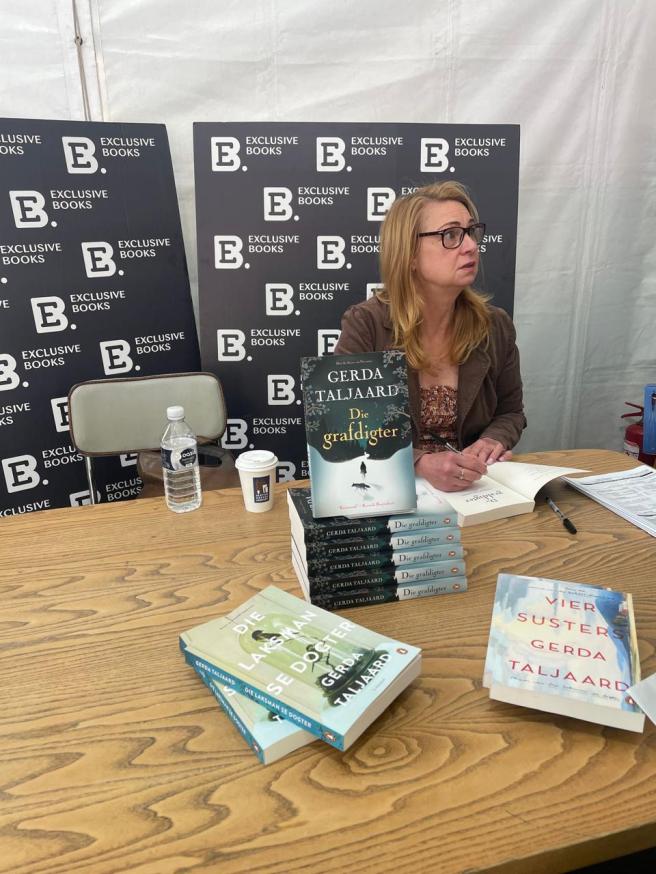
In her latest book, Die Grafdigter (Tomb poet), author Gerda Taljaard plays imaginatively with language and story and it is the unusual title that gets your mind racing. DIANE DE BEER speaks to the author about this remarkable novel:
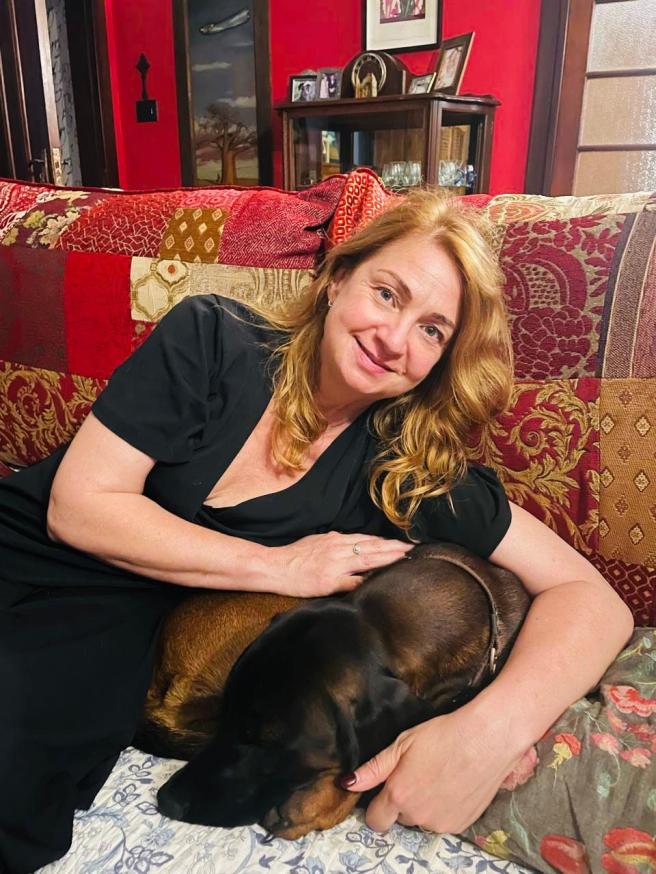
Author Gerda Taljaard with her dog Iggy Pop.
It is the fairytale quality of the story meshed with a realism that keeps you questioning from beginning to end. That, as well as the double destination of motherlands with Russia and South Africa as the main focus, hooks you from the start.
I’m writing about Pretoria author Gerda Taljaard’s latest book Die Grafdigter, which has those in the know in the Afrikaans literature world talking.
She writes, she says, for the same reason she reads: to escape harsh reality. With this one, she wanted to explore a completely different universe from her own. And what she picked was the world of Chekhov, Tolstoy and Dostoevsky with snow-covered landscapes, lakes and forests.
She remembers an uncle who could tune in to Radio Moscow during the apartheid years, a time when Russia and its people were referred to as the rooi gevaar. “I think he and my father were keen to find out what was behind the Iron Curtain,” she says.
During one of these radio adventures, she heard a most evocative piece of music, which she tracked down many years later. “It is an original Ukrainian song titled Ukrainian Poem written by O. Kolichev and performed by the orchestra of the Russian army. “It immediately captured my imagination,” she explains. “I could see the steppe, mountains and frozen lakes in my mind’s eye. That was the original spark!”
She also points to a time when she was very young and had to share a bedroom with her grandmother for six months. “Naturally against my will,” she hastily adds.
It was only much later that she realized what an impact it had and how richly she was rewarded by a woman who had a wonderful way with rhymes and riddles as well as macabre fairytales like the Baba Jaga stories.
“With her facial expressions and voice maneuvers she conjured up a magical world for me. These included tales from the subconscious, emotional, irrational and primitive streams of thought. It means you could capture people’s deepest fears and desires in an authentic way.
“Jung said it best when noting that myths show life more accurately than the sciences can.”
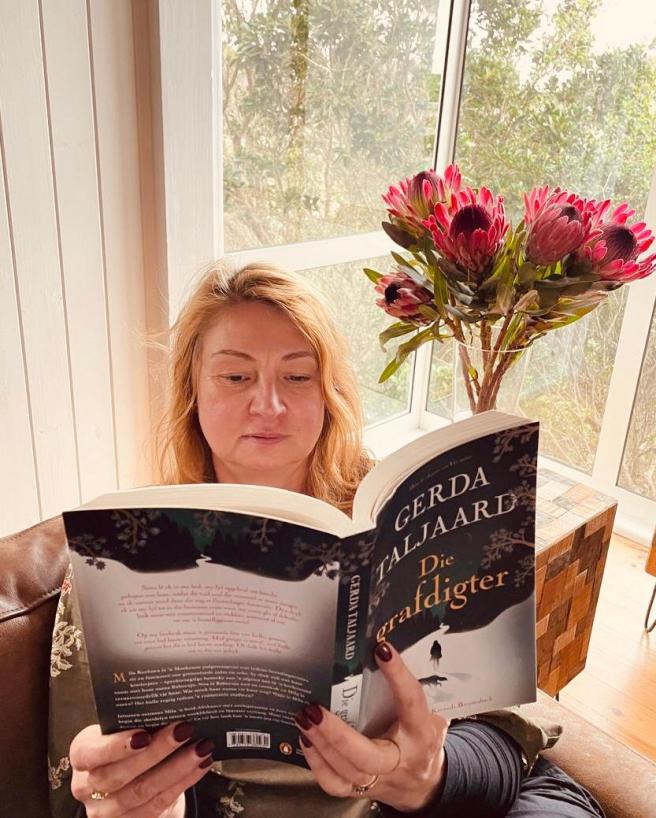
And then there’s another plus, Taljaard’s language. As a South African who speaks Afrikaans but writes in English, I was mesmerized. It’s the flow of the story being told in a language that’s familiar and accessible, yet completely novel. “Afrikaans is part of my being,” is how she explains the astonishing use of her home language. “It’s the language that formed me and in which I am driven to write.”
She loves buying old dictionaries in which she finds many unfamiliar Afrikaans words. “I am astonished by how many words I discover and how many simply disappear from our vocabulary. And these are exactly the words I need to give new life,” she says.
“Afrikaans, like Zulu, is a very poetic language, which is the aspect I want to elevate to aesthetically tell my stories.” And she does this with great gusto and success, resulting in an extraordinarily pleasurable reading experience. I had huge fun discovering all these novel words and phrases I had never heard before.
As far as the choice of countries in this tale, it is the many points of contact between Russia and South Africa which first caught her attention: the oppression of the majority by a privileged minority; the isolation by the rest of the world, followed by freedom and reform and the hope of a democracy; the disappointment caused by corruption; the stop and start between progress and decay; equality and inequality … and there’s more.
Because she uses a child to tell much of the story, the balance between reality and imagination is blurred, which adds to the glorious fairy-tale quality and also keeps the reader off balance throughout. It feels as though there is a constant battle between good and evil, which again locks strongly into the reality of what is happening internationally today.
She introduces two thoughts which illustrate what she is hoping to achieve with this wondrous book:
We should show life neither as it is, nor as it should be, but as we see it in our dreams. ― Anton Chekhov, The Seagull
While you are living, part of you has slipped away to the cemetery. ― Elizabeth Hardwick, Sleepless Nights
And then, of course, the title, Die Grafdigter (The Grave Poet) which immediately propels you into a far-away landscape.
Roughly translated, this is how it starts:
It is the beginning of an endless winter. A grandmother and her granddaughter find themselves in the heart of a forest.
They are desperately looking for food when they spot a reindeer. The grandmother, or Baboesja as her young charge Mila calls her, tells her that you should look a deer in the eye. If you then cannot find the courage to shoot it, you aren’t hungry enough.
These are life lessons for the young girl who will have to fend for herself someday. But her elder is so thorough that Milla’s world is filled with a richness that never absconds.
Nothing simply happens; it is as though you are there. For example, the twilight drapes itself across the house, grows like an ink smudge over the kitchen and sleeping quarters and stretches beyond the sideboard on which Baboesja places the reindeer’s head.
It is detailed yet subtle, never overwhelming – to find that balance with such rich language is a feat. It could so easily lapse into writing that is more about the language than the story and that is the quickest way to antagonize readers.
That’s what I found so astonishing and why this is a book that will be read again and again as the story keeps unfolding with rich meaning.
She doesn’t simply write that it rains; rather, the wind hurls sleet against the windows and without saying it directly, the names of the two characters, the ferocity of the storm, and the reindeer, all point to the place this story is set.
It’s sassy and smart, seemingly without much thought as it sweeps you along in an icy cold wilderness where a young girl is being fiercely protected by a cantankerous older woman, raised in a manner that is determined not to hide the harshness that might be waiting in her future.
And yet, because of the fairytale-enhanced dreamworld that constantly appears, the writing also evokes a visual quality that magnificently illustrates these characters we are accompanying and getting to know.
Taljaard is someone who has developed a unique voice that matches her storytelling qualities. I thoroughly enjoyed her last book Vier Susters, because I am one of three sisters and there was much to identify with.
This one knocked me sideways because it was so original and yet so relevant in a world where war is raging all around us and threatening a life’s order we have become accustomed to navigating.
It’s as though she not only read the zeitgeist smartly but also latched onto a future which feels more frightening every day.

 De Beer Necessities