By DIANE DE BEER
PICTURES: LAUGE SORENSEN

This is a year of anniversaries, with theatres and institutions celebrating milestones. One of these is Joburg Ballet whose 25thAnniversary Season promises a monumental year of dance with a range of exciting productions that will showcase the company’s rich history, artistic vision and institutional growth, according to their CEO, Elroy Fillis-Bell at the launch of their milestone Silver Jubilee year.
With this in mind and in partnership with Arts & Culture at the University of Johannesburg, a division of the Faculty of Art, Design & Architecture (FADA), is currently staging “a world-first Choral Ballet that reimagines Euripides’ iconic tragedy through a uniquely South African lens – The Bacchae: An African Choral Ballet”.
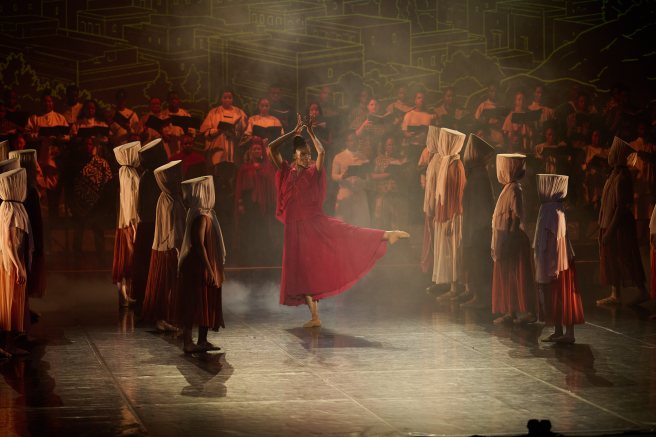
Kitty Phetla centrestage with the Joburg Ballet and the UJ Choir in the background.
And for this spectacular event, they have put together an extraordinary creative team which will excite art lovers across the country. There’s director Jay Pather with his second work on stage this month (see previous review of Constellations at Sandton’s Theatre on the Square), award-winning choreographer Mthuthuzeli November, and most impressively, composer Neo Muyanga, who conceptualised, wrote and composed this first African choral birthday celebration. On stage the Joburg Ballet came together with the UJ Choir and guest artist Kitty Phetla with a production team of note in the wings.
Muyanga started dreaming about the project a number of years ago when he first read a translation of Euripides’s text. “Later,” he writes in the programme, “I was able to locate versions of the story authored by the legendary Wole Soyinka as well as poet Anne Carson, and at each reading I found the story resonated deeply with expressions of worry I hear shared over the media as well as in my own personal interactions regarding what feels like an impending societal crisis, both locally and globally.”
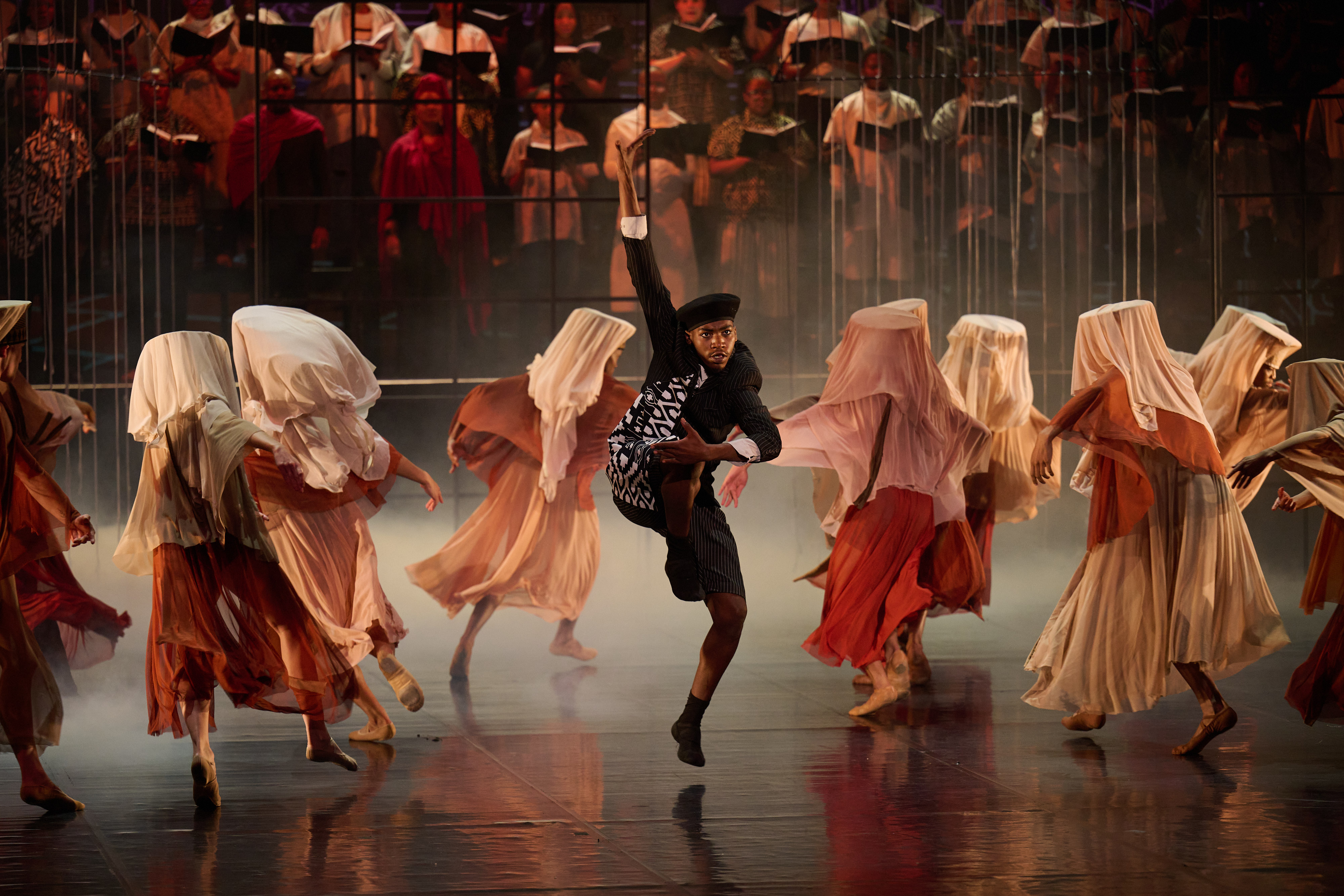
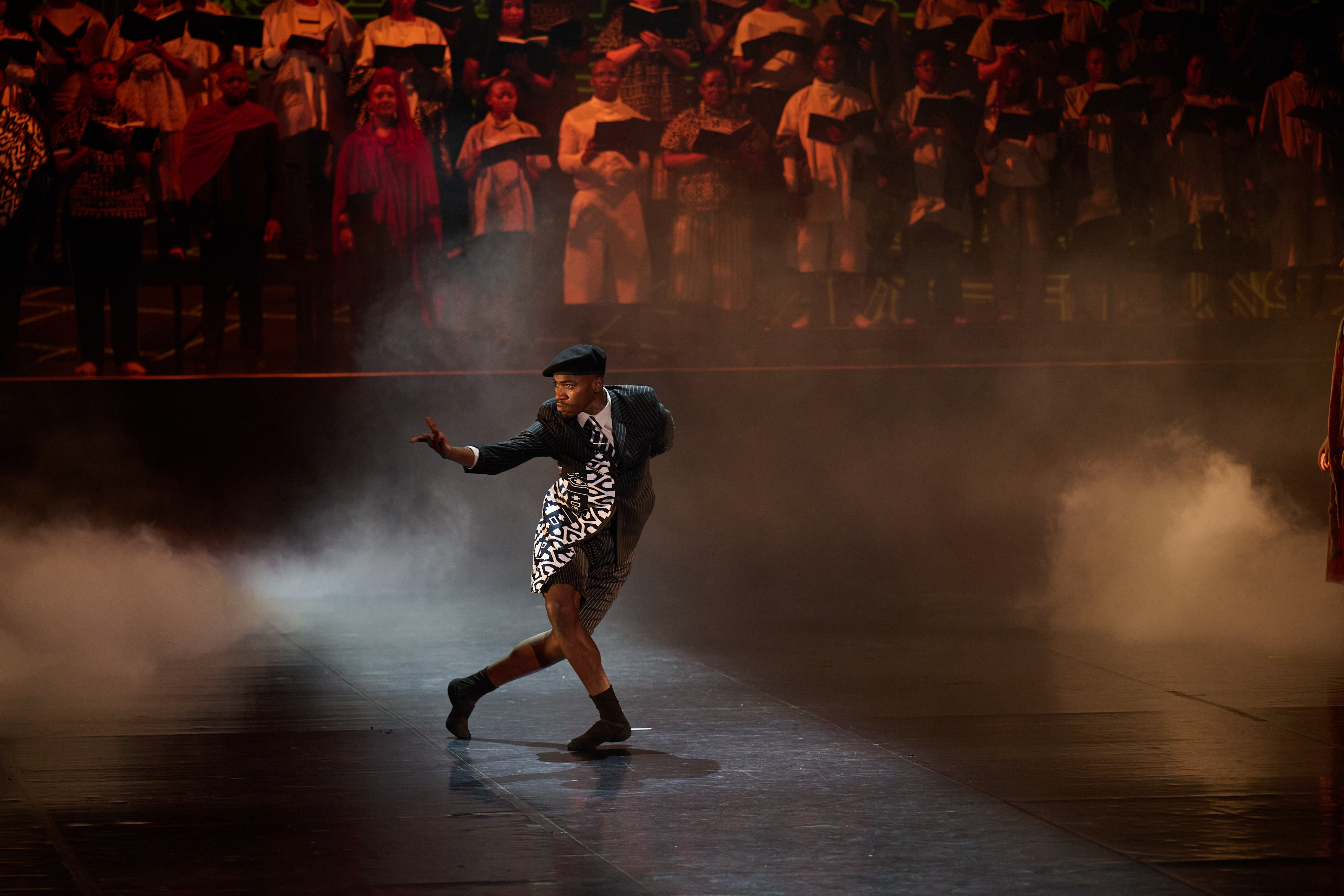
The illustrious dancer Thando Mgobihozi, Joburg Ballet dancers and the UJ Choir in the background.
He describes The Bacchae as “a harrowing tale of what the ancient Greeks called Sparagmos – a festival of violence and mayhem involving the tearing of one another from limb to limb of spilling blood in order to work through periods of upheaval.” He explains that the ancient Greeks devised the genre of tragedy as a way of helping a troubled society navigate towards a catharsis – reaching a point of resetting the city and returning to the ‘right behaviour’.
He started the project by firstly writing a libretto that elaborates on the themes of magic, power, violence and seduction which feature powerfully in the original work to illustrate how these topics could be found in our own contemporary context: the spectre of a political force running roughshod over a systematically disempowered populace, but which is ultimately halted by a saviour figure derisively called ‘a foreigner’ by detractors.
He composed a musical score that hopefully speaks to the pre-eminence of ritual and trance, making deliberate use of brass, percussion and choral, which he argues are meant to reflect our own practices of ritualised worship in the African Christian tradition.
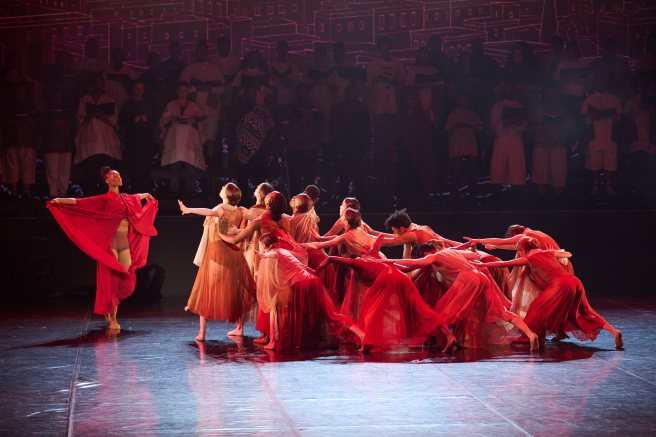
November, the choreographer, realised that for him, it was meant to be a sort of epic ballet. “It’s huge in scope but deeply human,” he emphasises.
“As an artist, I come from many different backgrounds, from traditional African dance, kwaito, pantsula, ballet, contemporary dance and have gone to a performing arts school. A lot of that then informed what felt important at what point.
“I believe this work is about community, and time and time again South Africans have been a strong community that comes together, to fight, to celebrate.”
Bringing it all together, director Pather views The Bacchae as an unbearably tragic story and sums it up as follows: “The slighted and banished God of wine, ecstasy and fertility, Dionysus” (in this instance cast as a woman, the statuesque Kitty Phetla) “returns to Thebes and exacts revenge on the autocratic ruler Pentheus. Swept up in the magical energy of Dionysus (also known as Bacchus), the citizens (who become Bacchae, hence the title) experience ecstasy and freedom as never before. But like all excess, this also has its toll and leads to clashes and violence.”
He notes that the work is variously seen as an ancient tale that demonstrates that disrespect for the Gods will have consequences. And it is also read as a metaphor for, and a warning that, oppressive patriarchal regimes cannot last forever, that they maintain that volcano beneath them at their peril and will explode.
We can all certainly agree that we are living in a world that is dominated by these kinds of excesses, with rulers who are more worried about themselves and their immediate family and friends than about their fellow countrymen.
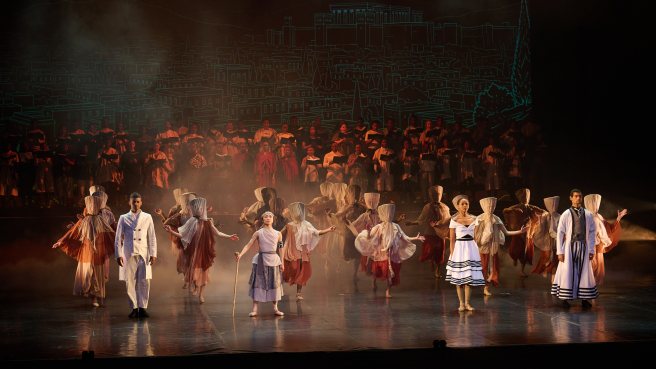
It’s a glorious proposition to explore and one worthy of the spectacular production in the Joburg Theatre. It’s a chance to see our artists when they come together for a grand collaborative effort on a grand scale.
Personally, however, I felt it lacked that African spirit of originality which I was expecting. Theatre is my area of expertise, but I have always loved especially local music and dance. For me the production was magnificently staged and yet, being the first African choral and ballet of its kind, I was charmed by the performance but left wanting for something more explosively original and African, something that would blow my mind.
Even so, I would urge everyone to go. The fact that something like this was attempted on such a gigantic scale is magnificent. That it didn’t succeed for everyone is what happens in the arts when something new is attempted.
If you’re not constantly shifting boundaries, what’s the point? If anything, this production speaks volumes about the healthy state of the arts.