AUTHOR GERDA TALJAARD CAPTURES REALITY IN HER MESMERISING FAIRYTALE DIE GRAFDIGTER

In her latest book, Die Grafdigter (Tomb poet), author Gerda Taljaard plays imaginatively with language and story and it is the unusual title that gets your  mind racing. DIANE DE BEER speaks to the author about this remarkable novel:
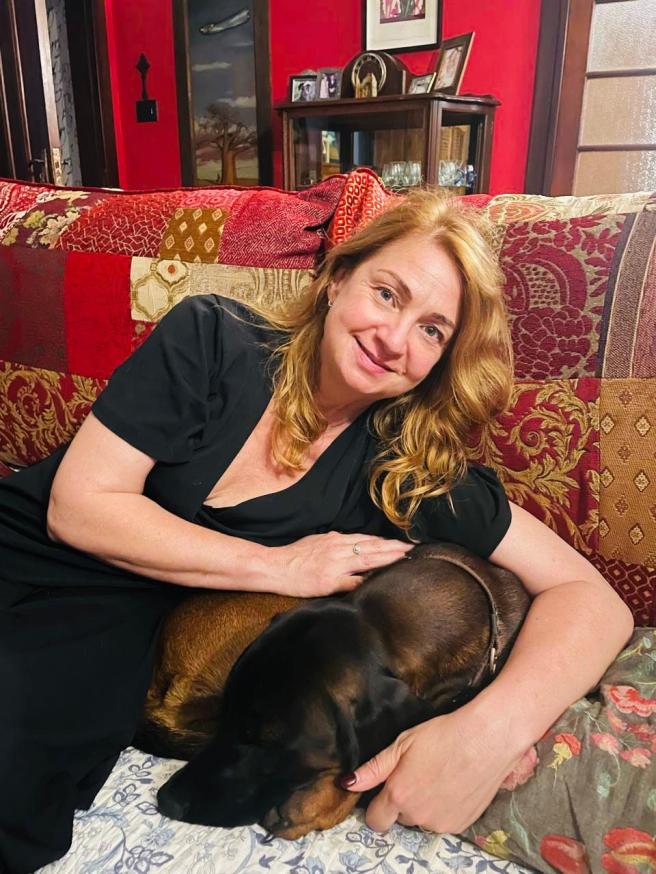
Author Gerda Taljaard with her dog Iggy Pop.

It is the fairytale quality of the story meshed with a realism that keeps you questioning from beginning to end. That, as well as the double destination of motherlands with Russia and South Africa as the main focus, hooks you from the start.

I’m writing about Pretoria author Gerda Taljaard’s latest book Die Grafdigter, which has those in the know in the Afrikaans literature world talking.

She writes, she says, for the same reason she reads: to escape harsh reality. With this one, she wanted to explore a completely different universe from her own. And what she picked was the world of Chekhov, Tolstoy and Dostoevsky with snow-covered landscapes, lakes and forests.

She remembers an uncle who could tune in to Radio Moscow during the apartheid years, a time when Russia and its people were referred to as the rooi gevaar. “I think he and my father were keen to find out what was behind the Iron Curtain,” she says.

During one of these radio adventures, she heard a most evocative piece of music, which she tracked down many years later. “It is an original Ukrainian song titled Ukrainian Poem written by O. Kolichev and performed by the orchestra of the Russian army. “It immediately captured my imagination,” she explains. “I could see the steppe, mountains and frozen lakes in my mind’s eye. That was the original spark!”

She also points to a time when she was very young and had to share a bedroom with her grandmother for six months. “Naturally against my will,” she hastily adds.

It was only much later that she realized what an impact it had and how richly she was rewarded by a woman who had a wonderful way with rhymes and riddles as well as macabre fairytales like the Baba Jaga stories.

“With her facial expressions and voice maneuvers she conjured up a magical world for me. These included tales from the subconscious, emotional, irrational and primitive streams of thought. It means you could capture people’s deepest fears and desires in an authentic way.

“Jung said it best when noting that myths show life more accurately than the sciences can.”
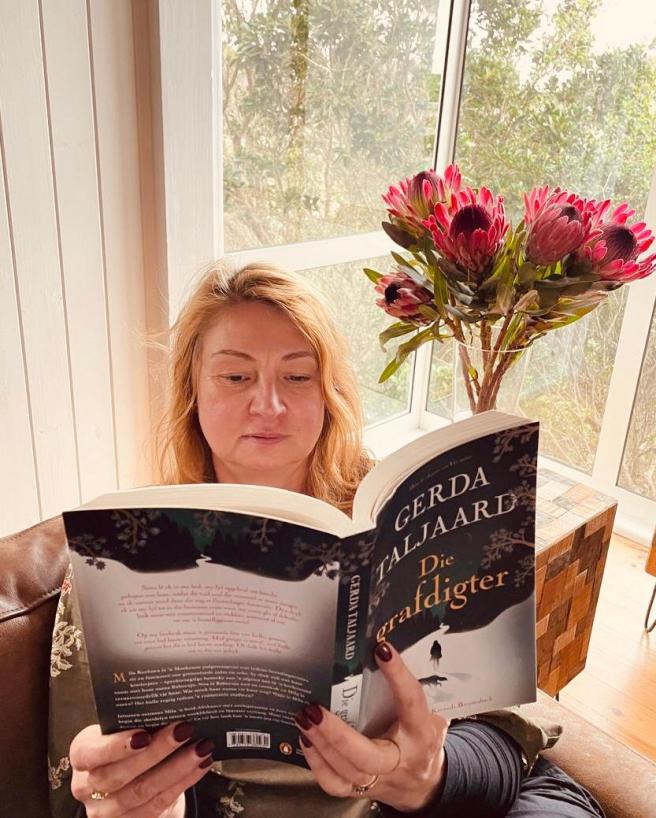
And then there’s another plus, Taljaard’s language. As a South African who speaks Afrikaans but writes in English, I was mesmerized. It’s the flow of the story being told in a language that’s familiar and accessible, yet completely novel. “Afrikaans is part of my being,” is how she explains the astonishing use of her home language. “It’s the language that formed me and in which I am driven to write.”

She loves buying old dictionaries in which she finds many unfamiliar Afrikaans words. “I am astonished by how many words I discover and how many simply disappear from our vocabulary. And these are exactly the words I need to give new life,” she says.

“Afrikaans, like Zulu, is a very poetic language, which is the aspect I want to elevate to aesthetically tell my stories.” And she does this with great gusto and success, resulting in an extraordinarily pleasurable reading experience. I had huge fun discovering all these novel words and phrases I had never heard before.

As far as the choice of countries in this tale, it is the many points of contact between Russia and South Africa which first caught her attention: the oppression of the majority by a privileged minority; the isolation by the rest of the world, followed by freedom and reform and the hope of a democracy; the disappointment caused by corruption; the stop and start between progress and decay; equality and inequality … and there’s more.

Because she uses a child to tell much of the story, the balance between reality and imagination is blurred, which adds to the glorious fairy-tale quality and also keeps the reader off balance throughout. It feels as though there is a constant battle between good and evil, which again locks strongly into the reality of what is happening internationally today.

She introduces two thoughts which illustrate what she is hoping to achieve with this wondrous book:

We should show life neither as it is, nor as it should be, but as we see it in our dreams. ― Anton Chekhov, The Seagull

While you are living, part of you has slipped away to the cemetery. ― Elizabeth Hardwick, Sleepless Nights

And then, of course, the title, Die Grafdigter (The Grave Poet) which immediately propels you into a far-away landscape.
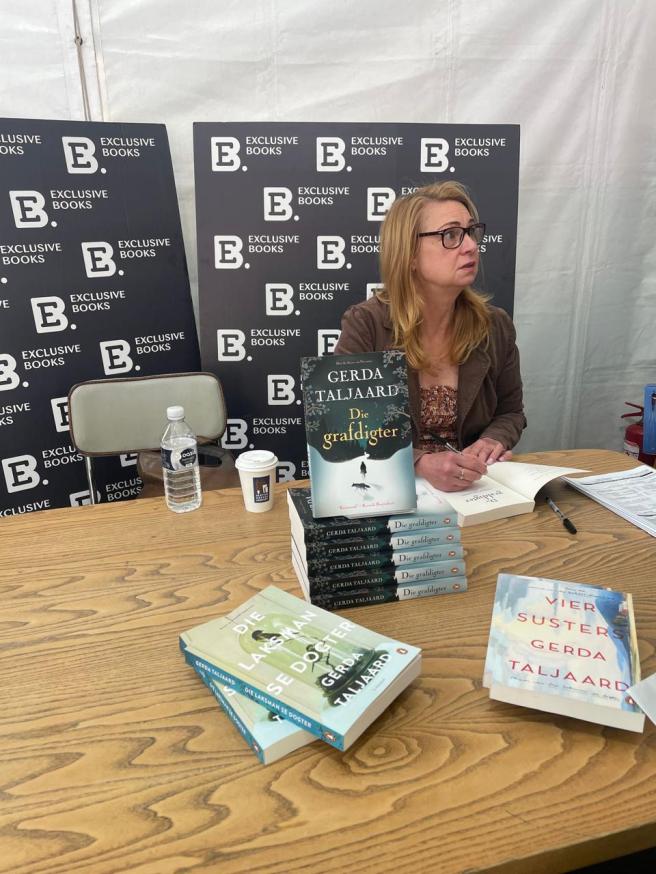
Roughly translated, this is how it starts:

It is the beginning of an endless winter. A grandmother and her granddaughter find themselves in the heart of a forest.

They are desperately looking for food when they spot a reindeer. The grandmother, or Baboesja as her young charge Mila calls her, tells her that you should look a deer in the eye. If you then cannot find the courage to shoot it, you aren’t hungry enough.

These are life lessons for the young girl who will have to fend for herself someday. But her elder is so thorough that Milla’s world is filled with a richness that never absconds.

Nothing simply happens; it is as though you are there. For example, the twilight drapes itself across the house, grows like an ink smudge over the kitchen and sleeping quarters and stretches beyond the sideboard on which Baboesja places the reindeer’s head.

It is detailed yet subtle, never overwhelming – to find that balance with such rich language is a feat. It could so easily lapse into writing that is more about the language than the story and that is the quickest way to antagonize readers.

That’s what I found so astonishing and why this is a book that will be read again and again as the story keeps unfolding with rich meaning.

She doesn’t simply write that it rains; rather, the wind hurls sleet against the windows and without saying it directly, the names of the two characters, the ferocity of the storm, and the reindeer, all point to the place this story is set.

It’s sassy and smart, seemingly without much thought as it sweeps you along in an icy cold wilderness where a young girl is being fiercely protected by a cantankerous older woman, raised in a manner that is determined not to hide the harshness that might be waiting in her future.

And yet, because of the fairytale-enhanced dreamworld that constantly appears, the writing also evokes a visual quality that magnificently illustrates these characters we are accompanying and getting to know.

Taljaard is someone who has developed a unique voice that matches her storytelling qualities. I thoroughly enjoyed her last book Vier Susters, because I am one of three sisters and there was much to identify with.

This one knocked me sideways because it was so original and yet so relevant in a world where war is raging all around us and threatening a life’s order we have become accustomed to navigating.

It’s as though she not only read the zeitgeist smartly but also latched onto a future which feels more frightening every day.
THE TOYOTA STELLENBOSCH WOORDFEES FEATURES MANY DREAM PRODUCTIONS AND PERFORMANCES

Photographers: Jeremeo Le Cordeur; Llewelyn de Wet and Gys Loubser

The Stellenbosch Woordfees can be quite a daunting prospect because there is so much on offer. It is perhaps easier if you have specific artistic passions, as most of them will be on offer here and it is possible to make a selection. DIANE DE BEER spotlights what caught her fancy

There’s not even a chance that you can include all your darlings in a festival wrap or even try to see them all.

I did my best, was constantly on the move and writing, and still I hear of more productions you just had to see.

Personal favourites (don’t discount others because I probably didn’t see them):

My best theatre productions were stories that turned me into an emotional wreck but did so with authenticity (I know this is a woke word, but …).

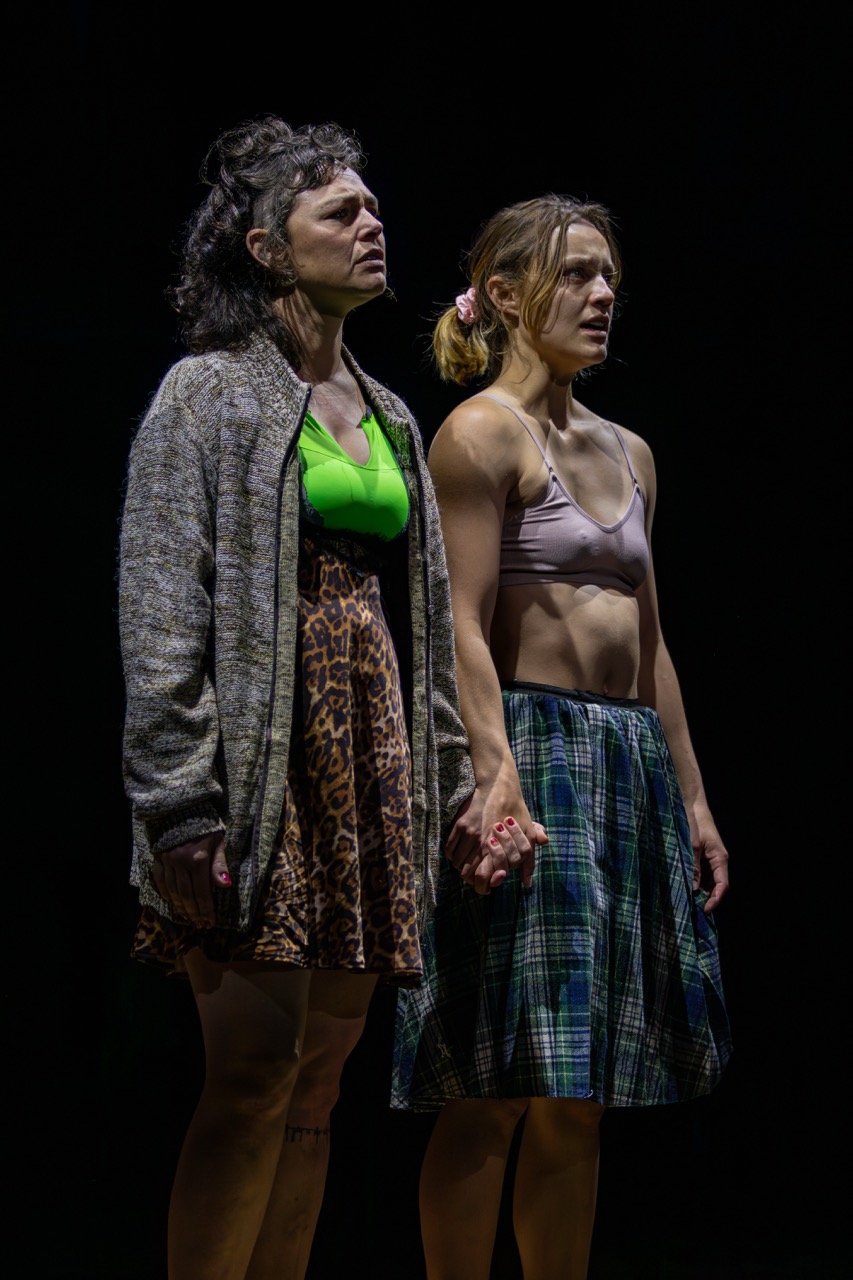
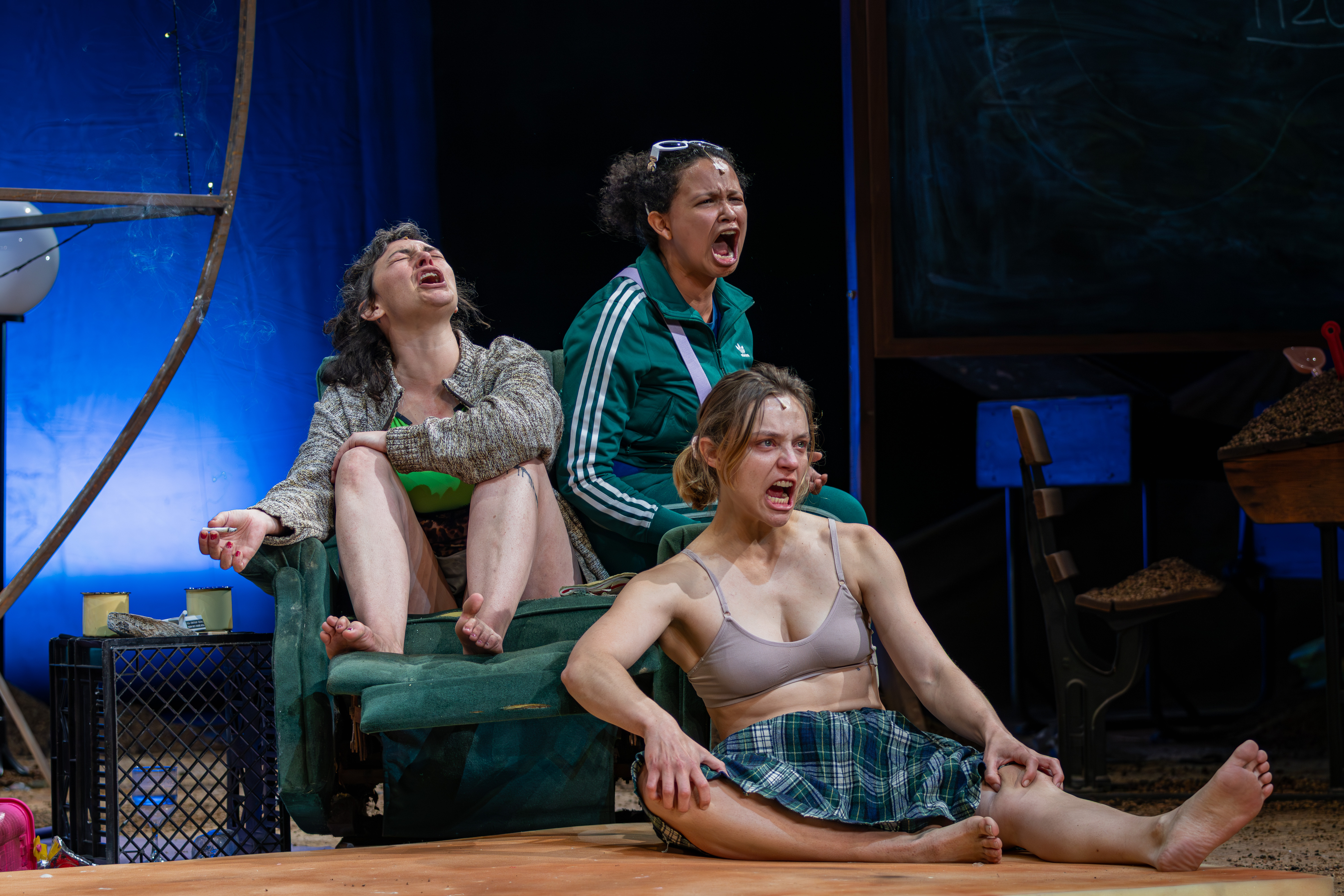
Tinarie van Wyk-Loots and Kristen Raath (left) and Jefferson J Dirks-Korkee (right) in

Dianne du Toit Albertze’s Huis van Sand. Pictured by Jeremeo Le Cordeur

The winning text of the prestigious Reinet Nagtegaal prize, Dianne du Toit Albertze’s Huis van Sand, with her honest portrayal of a dysfunctional family that’s probably not even part of most audiences’ consciousness. She writes about what she knows and where she comes from, the Northern Cape. But she does this in her self-made tongue, which shoots right to the heart and guts of the matter, no pussyfooting around with this one.

It is not a place many of the traditional Woordfees audiences will know. The backdrop is the N7, a route that runs from one end of the country to the other. It is her little spot next to the highway that Sandy knows. She and her daughter share Rodney’s caravan and too much of his life, especially the dark side. They’re trapped and yet the lifestyle is passed on from one generation to the next with the whole family fully engaged. A seemingly never-ending devastating cycle.

What drives Huis van Sand are Albertze’s words, her imagination, and the way she plays wildly with your head and emotions. Throw into the mix director Wolfie Britz’s strong casting and determined direction. With the remarkable Tinarie van Wyk-Loots launching herself body and soul into this one, Sandy’s daughter (Kristen Raath) trying to duck the missiles and resist diving headfirst into the temptations, Jefferson J Dirks-Korkee’s chilly capture of the toxic male scent always hovering menacingly and René Cloete showing she is much more than just an innocent bystander, everything about this production hits you like an onslaught.

Yet this is one you want to struggle and engage with because of the sharp edges and the unblinking gaze at the harsh reality of so many lives. It’s heartwrenching, but that is something this playwright has never turned away from. She stares straight into the skewered glare of too many unseen lives and throws us all in at the deep end. The brilliance is well worth the battle.

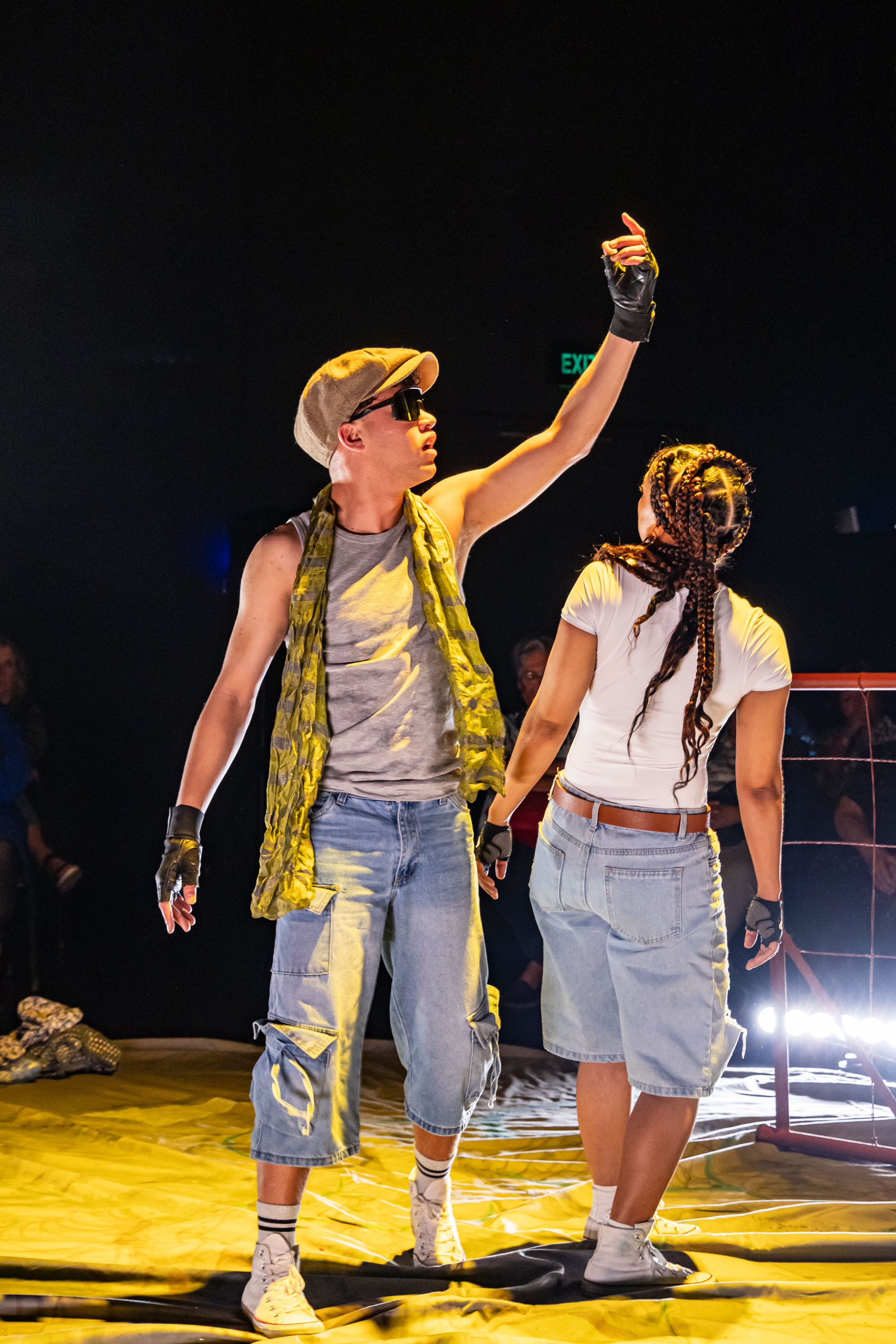
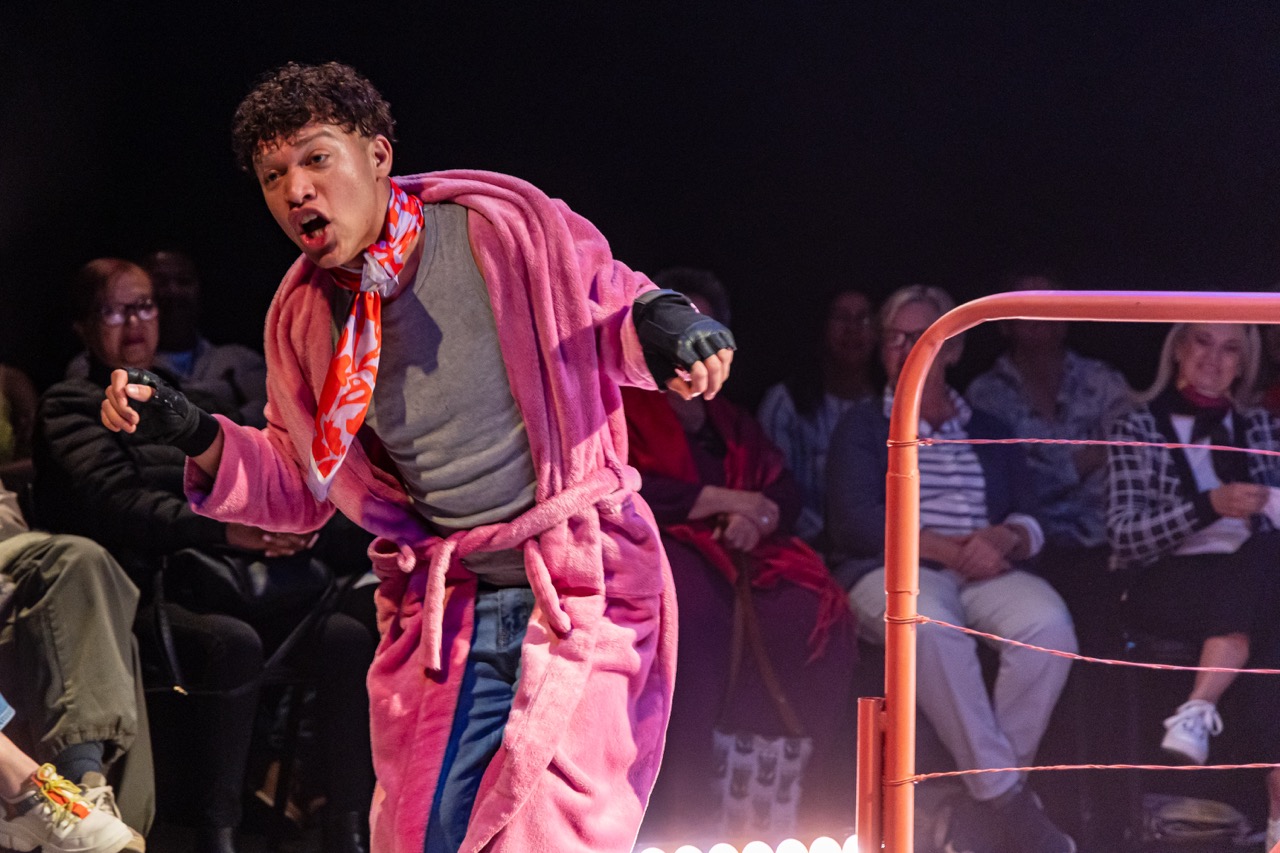
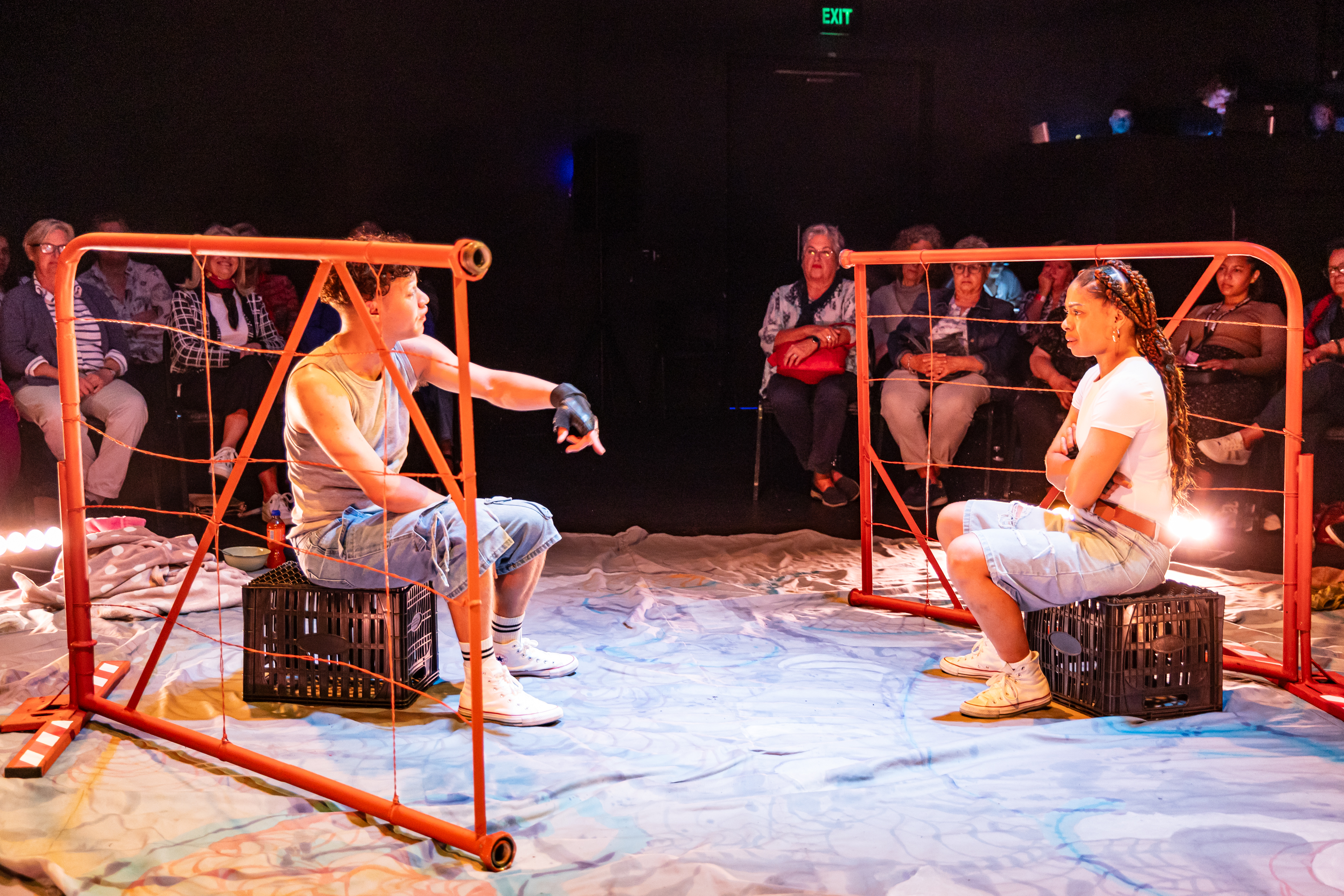
Melissa de Vries as Nadia and Angelo Bergh as her friend Zavie

Walking the same tightrope, is the adaptation by Jolyn Phillips of Ronelda Kampher’s ravaging novel starring two vulnerable yet resilient teen cousins who try their best to navigate a world they don’t understand while instinctively understanding that they are their only protection.

For Nadia (Melissa de Vries) and her chum Zavie (Angelo Bergh) their bond while tenuous and often fragile is what keeps them breathing.

With this one it is again the magnificence of the performances and the staging by Lee-Ann van Rooi that holds the attention as these two baby-adults going about their lives as if it is normal – and for them it is, it’s all they know.

That’s precisely the point. This is their normal, their life and the one Kampher’s words in her searing novel lay bare. Their whole existence is determined by outside factors, never certain or expected. Yet they do know how to grab the small slices of life when given the chance which isn’t often. They should not even be aware of the things happening in their lives, yet that’s the only way they know how to roll.

Kampher’s language is brilliantly captured by Phillips’ adaptation. How she even knew where to start! It’s such a complex and almost crippling story about these children whose future is determined purely by the happenstance of their birth.

Both of them have bucketsful of gifts which will never be realized because there’s simply no support or networks for these drifting families where not one generation manages to get even a foothold on a real life.

If anything good happens in their lives, it is luck and often, at that particular moment, the recipient doesn’t know how to deal with it.

When reading Kampher’s book the first time, you’re in awe of the writing and the storytelling. It’s the way she focused on the stories never told, the way she draws the characters, gives them flesh and emotions, which in this instance are perfectly re-created by the choices of Van Rooi and the adaptation by Phillips.

What a beautiful acting team. I don’t know them, don’t watch television if that’s where they perform, but I do know that they have inhabited these two kids with so much energy and guts, it’s hard to resist.

And that’s the joy of festivals, the opportunities that arise for artists so that when the stars align (a good script, director and actors), nothing can hold them back.

All of these performances should and will hopefully travel. For far too long too many voices have been silenced. We are so much richer as a country, as audiences and as performers when all our stories are shared.

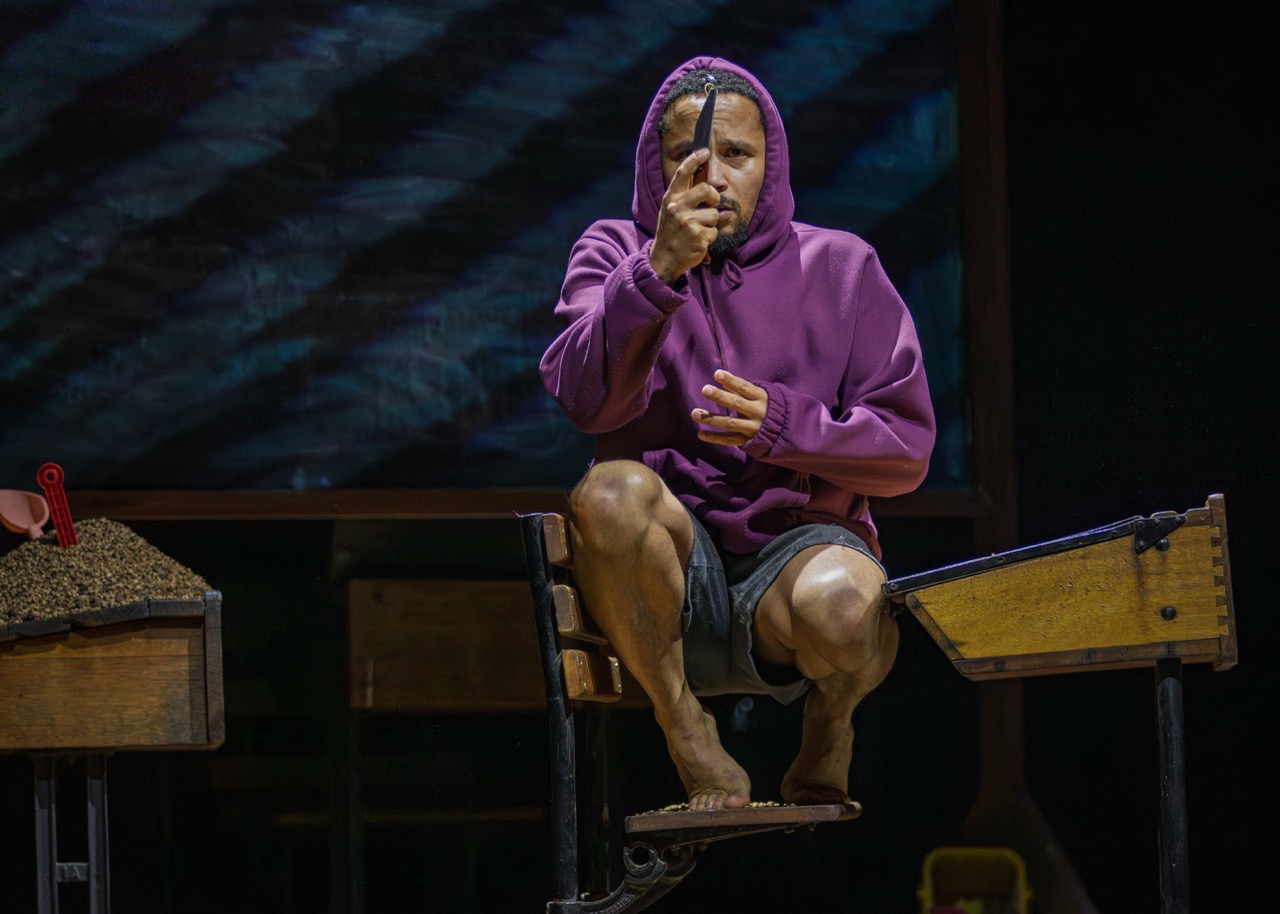
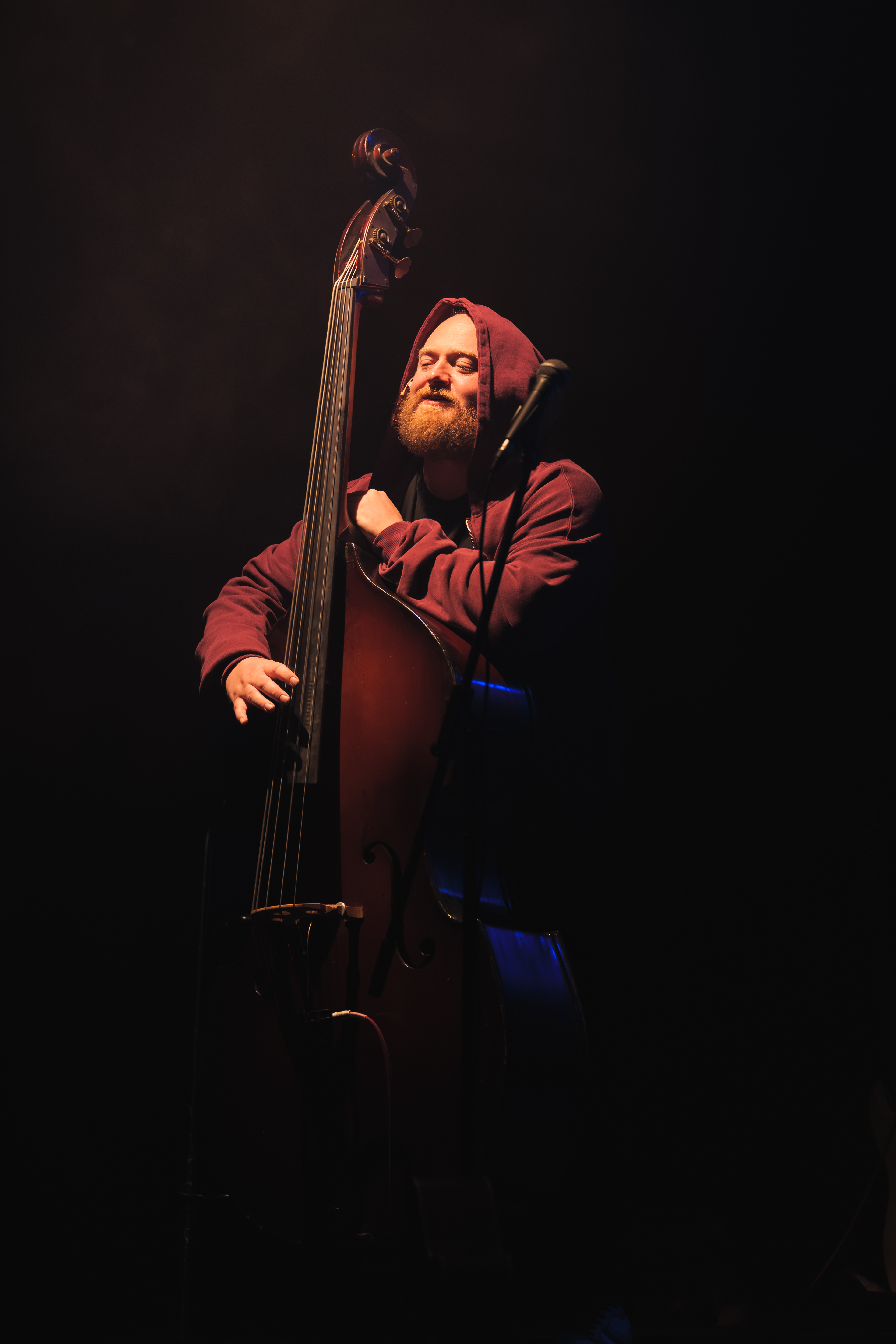
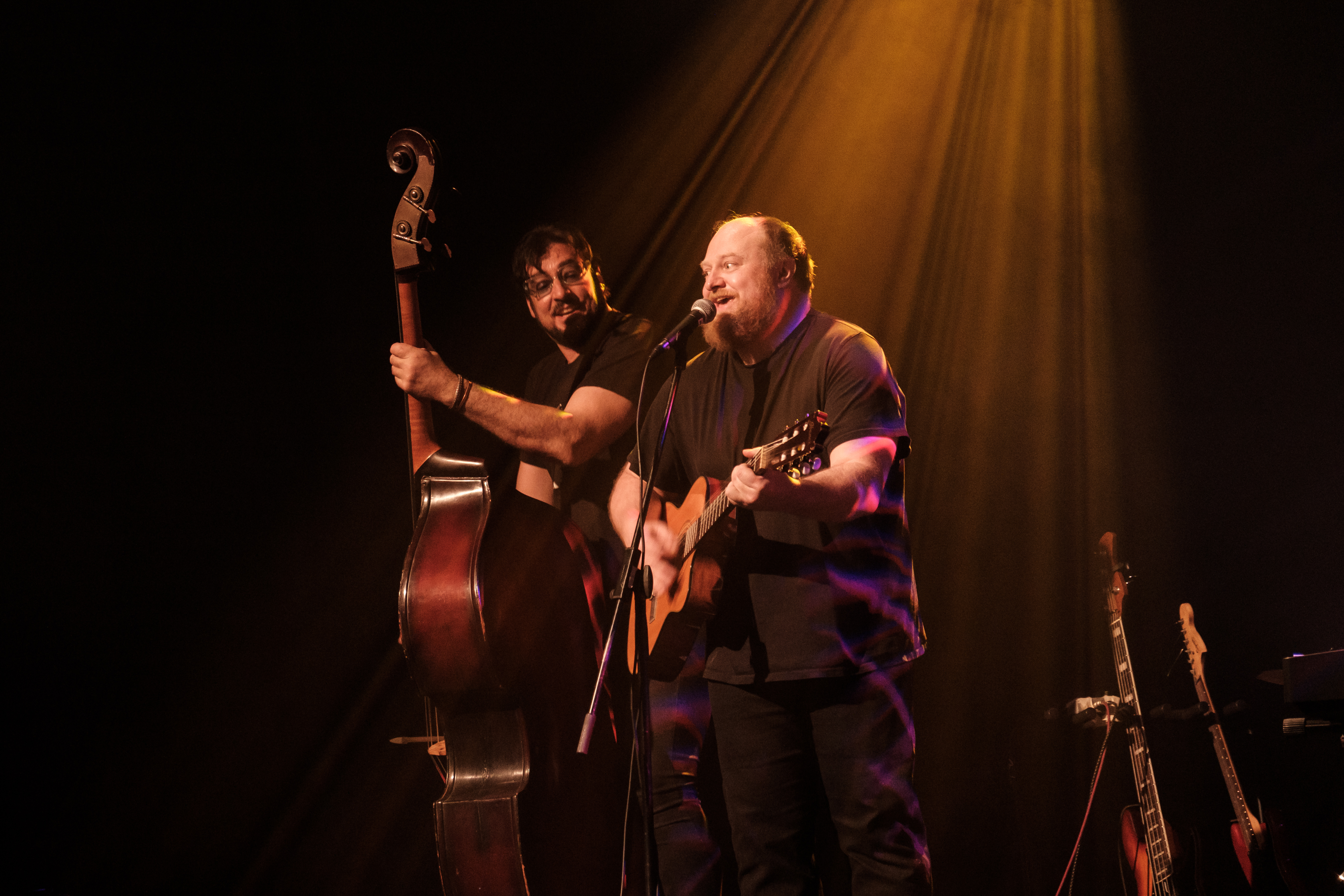
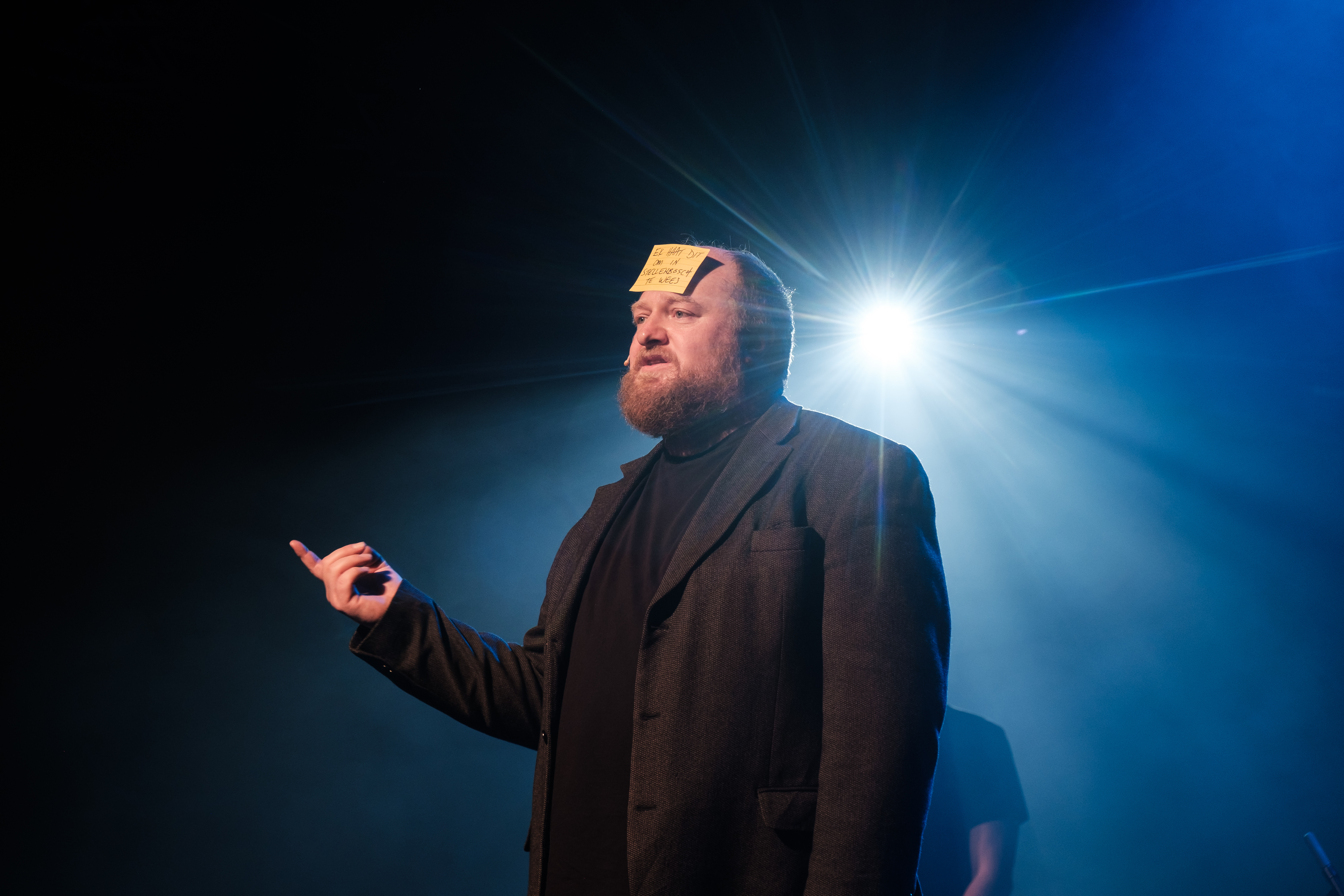
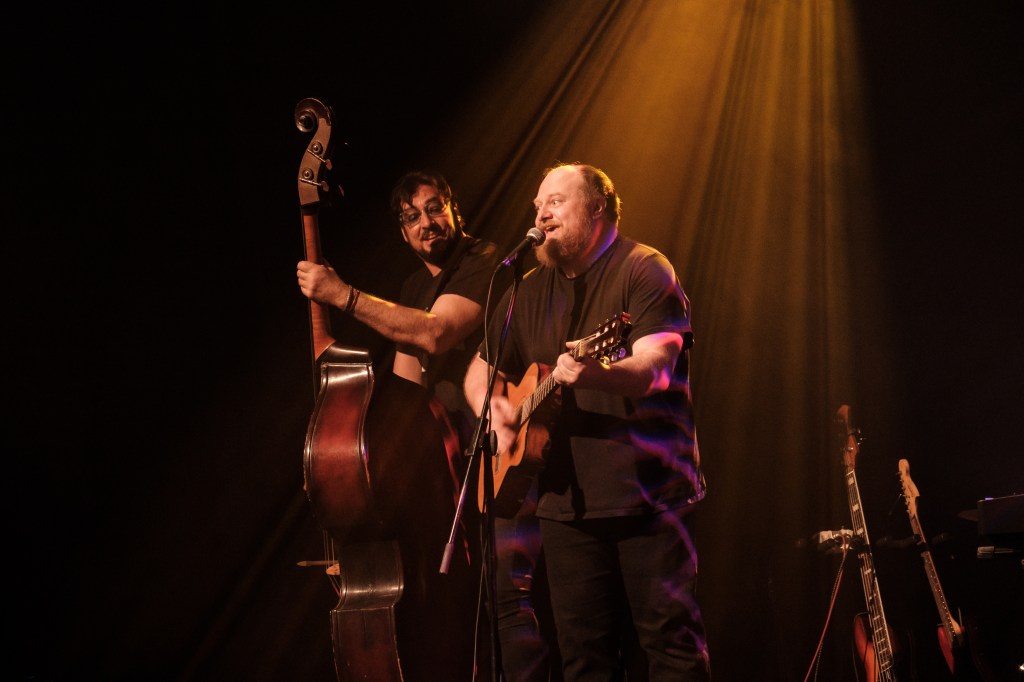
Albert Pretorius (actor) and Schalk Joubert (guitarist) in Ek is nie Danie pictured by Llwellyn de Wet and Gys Loubser.

Writing about stars aligning, another perfect example of this was Ek Is Nie Danie with 21 poems from poet Danie Marais’ four collections woven into a magnificent text that deals with a middle-aged white man struggling.

What four middle-aged men did with what they had, was inspirational. They took something which if not handled with the same delicacy as the poetry, could have been disastrous. But because of deft hands and hearts, it feels as though you are dealing with an emotional vortex, but one driven with artistic insight and instinct which holds the audience tightly and sharply in focus from start to finish.

It worked because of the truly exquisite writing and then the choice of the right participants. The concept was Niel van Deventer’s according to the programme, but then handed to one of our smartest directors, Nico Scheepers. He is given a topic which would turn most people away – the angst and anxiety of ageing white men, not a species that many have much sympathy for.

Yet this company with actor Albert Pretorius and musical director/guitarist Schalk Joubert has shown that, given the right elements, a director who knows how to shape something yet value his actor and musician by allowing them the freedom to be and to do, it will work – and in this instance, explosively.

It’s one of those performances that you want to see again as soon as you leave the theatre. I hope it travels the country.

I took these three stunning plays to give some flavour to the Woordfees which is far too dense and diverse to dilute, but that there’s something for everyone, that’s a certainty and you won’t have to look too far or hard.

They have achieved much in only a short time and in the future with everything changing so rapidly, we can only expect to experience even more.

And then just a small PS: I was asked to interview Nataniël on a book Bloei+Blom and being who he is, the first lunch was booked out swiftly and another date the next day was included and again fully booked. But hey, the more the merrier.

As an interviewer, this is the one date I don’t have nerves. I know I am in safe hands and he is the master of chat.

It was the easiest gig in town. Even though he and I had talked about topics of conversation before the time, once on a roll, and only three questions down, I could sit back, relax and enjoy one of our best (and naturally funniest) conversationalists in action.

There was no way to ask anything else. He was in full flight on his own. He did glance my way once or twice, but there was no interrupting the flow. And even better, he was the one they wanted to see and hear.

I felt blessed, centre stage and could watch the wizard in full flights of fantasy.

*There were many others I loved, many of which I had written on at the Woordfees or previously including Boklied, Seun, Bridling, Kuns, Magda en haar Erhard, Ont-, and always The Ugly Noo Noo …