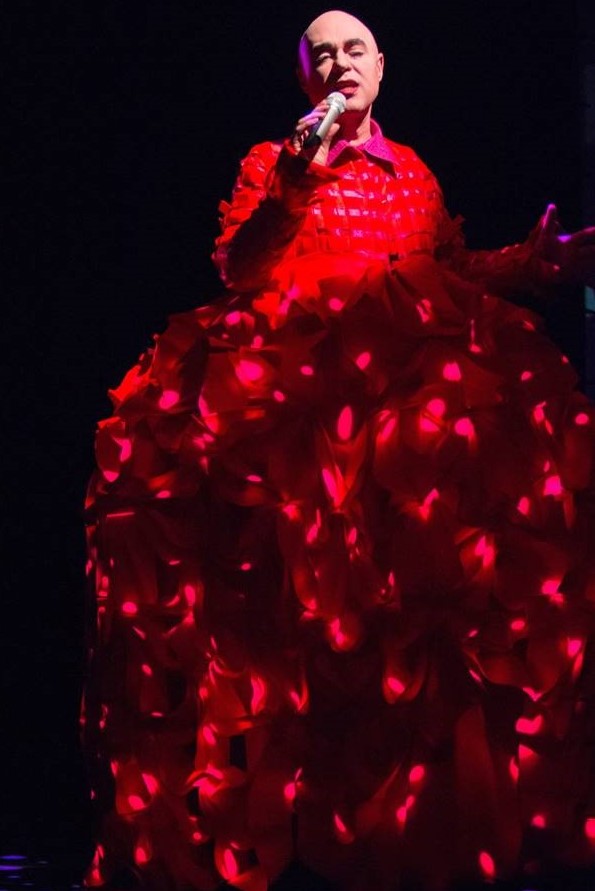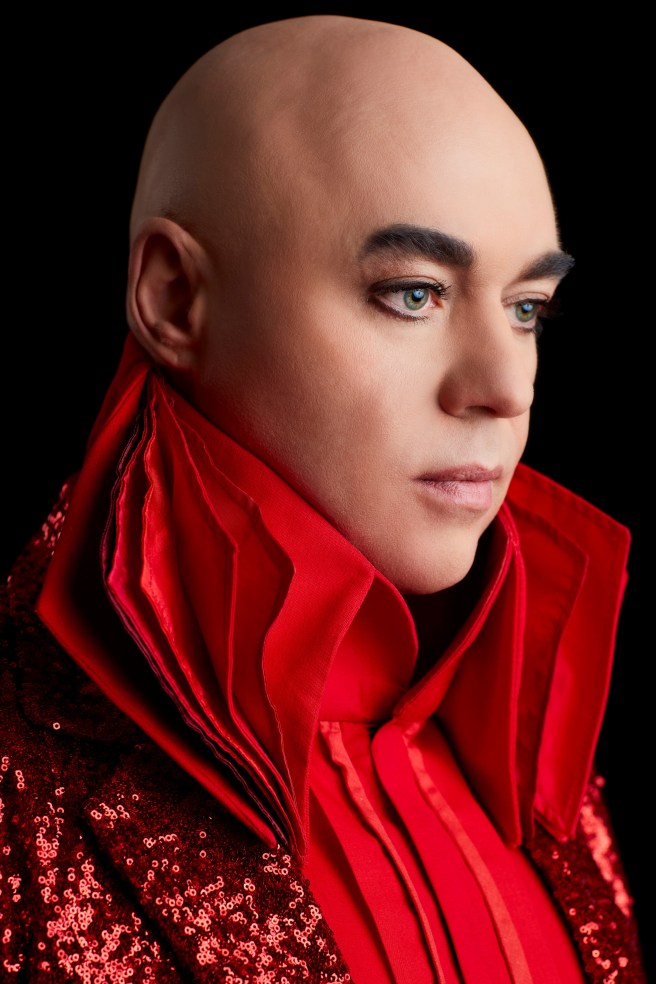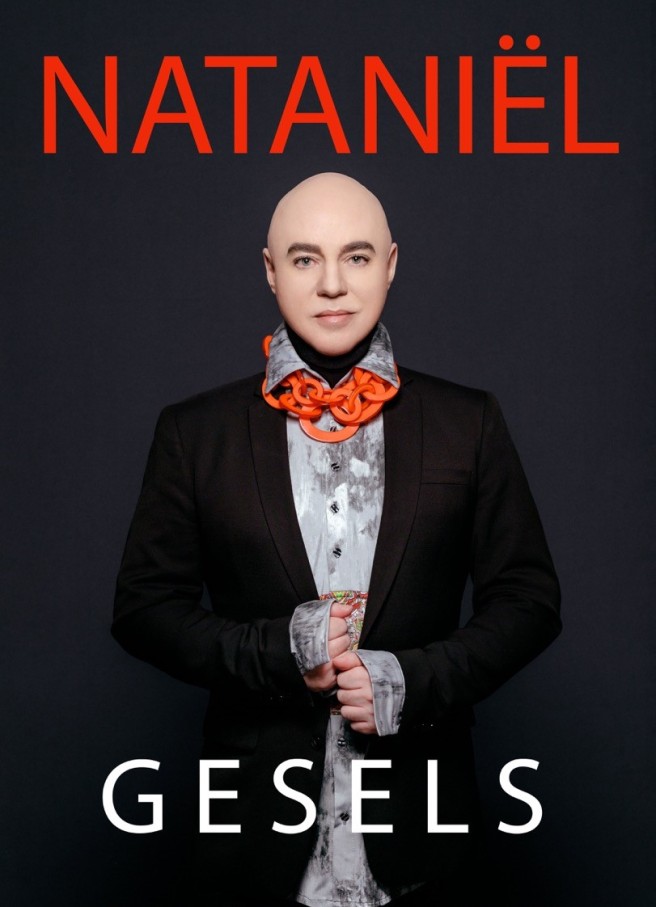
NATANIЁL IS A WIZARD WHEN WORKING WITH WORDS

I never gave much thought to Nataniël’s live talk shows but, because they had become so popular, it was time to investigate. DIANE DE BEER gives her feedback:

So I went to last year’s Fairtree Atterbury Theatre show in Pretoria, and was so impressed that I forgot to take notes. There was little chance of reporting or writing without having  a single note and when he announced the 2024 (he changes topic every year) I was ready to go – which happened a few weeks ago.

It’s always packed, no room for a single late-comer, and while last year’s topic was Pain, this year he focused on our chaotic world and the urge to achieve excellence. “What are we busy doing?” he asked. “What is going on?”

All of this chatter happens at breakneck speed and what I had forgotten was that the auditorium is pitch dark, like in a theatre show. Taking notes would be quite a challenge, but I was determined.

What I hoped to capture would perhaps not be the most accurate version of his magical monologue, but I was hopeful that I would capture the essence and encourage fans to attend future talks.

First off, it’s all in Afrikaans. But that’s always part of his charm. He often complains about a show or a talk which is too serious and not really funny. What escapes him is the way he speaks, his vocabulary and the way he constructs a sentence are unusual and often hysterically funny.

With the focus on the times we live in, he began his talk with one of his irresistible stories which set the tone for the rest of his talk. He can’t but be funny even when he is having a serious conversation. It’s his special formula and what makes you listen while forgetting that you’re actually part of a masterful sermon.

He has always had the gift of the gab. That’s how he makes a living. People hang on  his every word. Why not impart some wisdom while making them laugh? And that’s exactly what he does. Not many can make you smile while telling you how to behave. But he does, and gets paid to do exactly that.

And again, it’s because he knows how to tell a story: whether these are true or fabricated, the life lessons come from the heart – and experience. Being Nataniël, he has an unusual life and people share their secrets. He will juggle and jiggle them around so that even those involved will probably not recognise themselves, and then he will douse it with wit as well as wisdom – and the audience will lap it up.

In the current talk he investigates the need to succeed and sparkle (“prestasie” in Afrikaans, but he was unsure of the English translation as achievement doesn’t quite hit the mark!)

And while fame and celebrity seem to be the hallmark of success in today’s world, he believes there’s more to it than that. Legacy is something that is often talked about yet the individual in question doesn’t experience that, it only comes once they’re dead. “A career is also an achievement,” he suggests.  And at least then, you can share in the satisfaction of having achieved something.

While at school –  something he hated with his whole being – he was often charged by a teacher or someone in authority to participate in a competition of some kind. His response was always, but why? To what end? Who benefits? And what does any of this achieve?

Others again will equate success with money, but having raced through a spectacular career himself, he has had the chance to reflect. For him it has always been the process of getting from beginning to end – whatever the journey might entail. Once you have travelled from one point to another, you can look back, and perhaps make sense of it.

“Success changes your perspective,” he reasons. And for him, 114 productions on (all self-written, music composed, directed and performed), the pain and anxiety have remained. It has never been easy and he still questions the damage accumulated through the years. “It has to impact my health, surely,” he says. “I seem to be in constant pain.”

In his world, he only recognises five iconic individuals: Van Gogh and Leonardo da Vinci, neither of whom lived fabulous lives; Shakespeare, who had to act in his own plays to make a living; Einstein whose famous equation explains the energy released in an atomic bomb; and his grandmother who is the individual most often featured in his stories and the one he credits with influencing his life the most.

“I have tried everything but could never recreate the magic she created in her home and on others.”  That’s what he refers to as a natural achievement – not something one tries to do, it simply happens.

Go and listen when you can. Nataniël is one of those people who lives an interesting life because of who he is. It’s not so much the celebrity status, rather the way he views the world that comes through in his talks.

He is naturally wise, more witty than anyone I know or have encountered, and he knows how to tell stories. More than anything, that has probably most endeared him to audiences.

His spectacular shows are something to witness and experience, I never miss those. These latest talk sessions are something completely different yet no less entertaining. As with his shows, you leave the theatre feeling you have gained something – and for everyone it will be different.

And you will die laughing…

He can’t help himself. Even when serious, his inner clown escapes.

29 June 2024

GESELS 2024

11am + 3pm

Fairtree Atterbury Theatre, Pretoria
No children under 15
Book at: seatme.co.za

SPRING AWAKENING BLOWS INTO GAUTENG’S PIETER TOERIEN THEATRE, MONTECASINO LIKE A BREATH OF FRESH AIR

PICTURES BY CLAUDE BARNARDO.

Niall Griffin dying the costumes wearing protective gear.

When Niall Griffin was invited to take on most of the design elements (set, costumes and lighting) for the Sylvaine Strike-directed Spring Awakening, he was nervous going into the process because living up to the expectations of a legend can be daunting. He tells DIANE DE BEER about the experience, which he describes as the highlight of his career:

Spring Awakening, presented by Cape Town’s Luitingh Alexander Musical Theatre Academy (LAMTA) as their first book musical, also marks the first time that Sylvaine Strike has directed a musical. 

Based on the controversial play that was written in the late 1800s by Frank Wedekind, Spring Awakening delves into the lives of a group of adolescent students discovering their changing bodies, their sexual identities, urges and desires, all while navigating the oppressive and draconian societal norms of the day. 

Under Strike’s visionary direction, this reimagined production (with a very young cast) brings the gripping and emotional story to life as it explores complex themes such as self-discovery, repression and the power of rebellion. 

Niall Griffin, a designer with a mission.

And while there was initial anxiety, once the work began, Griffin knew instantly that he was on safe ground. “The care, respect, trust and sense of magical play that Sylvaine instilled in our journey together are unmatched in my career. I think we both felt an immediate understanding of each other and were both amazed at how perfectly our style and ethos merged,” he says.

“We care immensely for our process, our casts, our team and our audiences, sometimes to our detriment, but finding someone with that same level of care has been one of the greatest gifts of my career.”

Being familiar with the level of detail Strike approaches when making a play, all of the above sounds like a match made in heaven.

The vibrant young cast in Spring Awakening

Accepting the challenge was a no-brainer for a designer who is also described as an industry legend. “There are musicals and then there are musicals. Some are light and frivolous and the perfect escapism and then some hit you harder in a place that truly moves you. Spring Awakening is the latter for me. The little rockstar hit that came out of left field to take Broadway by storm,” is how he describes it.

“It deals with things that we’ve all been through or are going through, both good and bad. All too often, in this day and age, we are driven into false beliefs and horrific mental health issues because we carry such shame from our experiences. The show, as heartbreaking as the story is, leaves one with love, compassion and a sense of togetherness. The human condition is not singular. We are not alone. We all need a little more love in our lives… and who doesn’t love a bit of Victorian-era deliciousness?”

Describing the process, he explains that what began as an exercise in replicating period fabric developed into an exploration on how possible it was to create an entire show from natural fibre. “Our planet has rapidly become saturated with ‘the synthetic’ and I believed this show needed authenticity in every aspect if it was to have the impact it deserved.

“The entirety of the show’s design is manufactured from purely natural fibre. Costumes began as neutral cotton that were dyed with natural dyes. The set is sustainably sourced wood and hessian made from vegetable fibre. It has been an incredibly educational and rewarding process.”

It is that process that piqued my interest, especially when basically the whole look depends on the outcome. Griffin understood that taking on the full production design across set, costume and lighting was a huge undertaking and not for the faint hearted.

“My driving force is to find a seamless synergy between all departments. What I term ‘one organism’. While taking on full production design is huge, it does make knitting a visual together far easier. Even though this show was Sylvaine’s and my ‘maiden voyage’, it was clearly destined, as our sensibilities and aesthetics couldn’t be better matched.”

And there’s the key, something they obviously both understood. “Theatre design to me, at its core, is about designing emotional response. I needed to immerse myself in the emotional journey of the piece, the high and low tides, in order to find its design core,” he notes.

For him texture is far more than paint and dye. “I spent a long time with the score and libretto and, to quote the Gen Z’ers, ‘felt the feels’. This is how I approach the majority of my design work, from a place of emotional honesty. It’s about finding the heart of the piece.”

Describing his process in more detail, he began with the sets, followed by costumes and finally lighting:

“When it comes to scenic design, my favourite moments in theatre are when a space manages to completely morph its texture, feeling and setting without all the ‘big toys’ and flash. A threatening storm can become something else, in mere moments, with a shaft of light breaking through the clouds. I wanted the space to morph seamlessly so that the emotional flow wasn’t interrupted by a clunky scene change. Finding the balance between something that can feel both oppressive and beautiful was a challenge. Using exposed wood was a no-brainer for me. Wood is a material that carries its growth with it forever. Its rings and knots and imperfections are part of it. This felt poetic to me.”

When it came to costuming, he wanted to create a uniform that felt prescribed by an oppressive regime, “a regime trying to erase the individual and force uniformity. I felt this would underpin the narrative journey of our characters rebelling against the blind norm by illustrating how prescribed uniformity cannot erase the burning fire of the individual.

“Every costume, from head to toe, has been lovingly made from scratch. They are all individually hand dyed and aged, and this is where I started to sneak the individual into the uniforms by aging and breaking down each individual’s garments with their own personality. Some of this detail may not be evident to the audience, but it was important to me that the cast could experience their costumes in this way. I truly believe that what the cast feels in their costumes translates into their performances.”

Lighting delivers the final flourish. “Sometimes, at the speed a musical moves, the audience needs to understand an emotional shift quickly, and this is where lighting was vital to me. I wanted the world to feel murky and rich, like an oil painting come to life.”

If the successful runs in Cape Town are an indicator, this has all been achieved, as the visuals will attest.

And Griffin has his final say: “Making theatre, especially non-replica productions, in South Africa in the current climate is hard work. Creating an entire musical from scratch was a feat second to none. I have a team of remarkable artisans that I work closely with and whom I would be nothing without. They all share my level of delivery standards and they all jump into the deep end with my crazy ideas. A tribe second to none. I couldn’t be prouder of the product, and watching audiences experience it in Cape Town has filled me with so much joy.”
* Performances run until 5 May 2024 at Pieter Toerien’s Theatre at Montecasino with shows from Wednesdays to Saturdays at 7:30pm and matinees on Saturdays and Sundays at 2:30pm. Tickets cost from R200 through Webtickets. Please note that Spring Awakening contains mature themes, partial nudity, sexual situations as well as explicit language. No persons under 13.  

DREAMY SINGER/SONGWRITER LUNA PAIGE IS ON THE MOVE WITH MUSIC THAT REFLECTS THE TIME

Stellenbosch singer/songwriter Luna Paige will be in Pretoria and Philadelphia for rare performances to celebrate the launch of two new albums; the one in Afrikaans (Dis die Dors), the other in English (Harmony). DIANE DE BEER chats to the singer whose career she has followed from her early days – with admiration:

Storielied Reunion.Picture: Pierre Rommelare

For singer/songwriter Luna Paige the last few years has been a sharp learning curve. Since her early start in the industry (late 1999), she has been one of the most dedicated artists I know – and she usually does it all herself.

Her first look-in was when she was invited to record three of her songs on a compilation album alongside Lesley Rae Dowling and other female artists at the time. “It is what catapulted me into a music career,” she says. But driven as she is, and one has to be when you drive your own career as she does, she would have found a way.

Since those early days she has released five solo albums and one SAMA-nominated collaborative album. And since 2015, she has released numerous songs digitally  and she believes, she has come into her own this past decade. That is until Covid struck.

She established her own music production company which developed music-driven productions, hosted and organised, concert series and co-ordinated music workshops five years ago. In her capacity at Iluminar Productions, she also represented other musicians and musical groups.

She found herself collaborating with many artists and produced shows such  as Her Blues, Korreltjie Kantel and Smeltkroes. She also played a supporting and promotional role in the popular My Miriam Makeba Story featuring the luminous Sima Mashazi.

Because her business was still young and primarily focussed on servicing art festivals and live entertainment venues and clubs, the pandemic was disastrous as for so many other artists who depend on audiences.

Luna knew it was time to join the workforce and between 2021 and 2024 she worked as a marketer and fundraiser for Paul Roos Gymnasium, a prestige Stellenbosch school. But she’s back in the music business, armed with many new skills and ideas she wants to implement in the music industry – as well as two new albums.

During Covid she had time to reflect, and, coming out of the pandemic, her thinking and that of the world around her, has changed. That is also what her songs reflect; her collaborative intent as well as the fast-paced changes in our society. “The last time I released an album, the world looked a lot different. The digital era is now in full sway. It has affected everything outside of us, but also our own internal way of processing information, and life in general.”

And that is exactly what she sings about.

When you ask Luna about her life, she speaks about the difficulty of packaging herself. “Let’s be honest, I am so many things!” She is a singer-songwriter. She writes in her mother tongue but also in English. She doesn’t compose in a specific genre. “For me, the song, and the story behind it, dictates the genre the song needs to be in. I find my influences from a wide array of genres.”

But then she is also a social worker, an altruist and an organiser. She feels she is a catalyst of sorts. “I know how to bring an interesting group of people together to do great things.” And with those words in mind, I predict exciting performances in the future.

Luna has always had to fight for her place in the industry. Performing isn’t an easy way to make a living. Music is her life, and she has always known that’s where she wants to be. Armed with new skills and insight, she believes that private investment in the arts is essential for its survival. “I believe artists have a huge responsibility to not only expect funds, but to also give back to their own communities. And the causes they believe in.”

While fundraising and marketing something other than herself, she became aware of her own different facets. “I have always seen them as separate things, one not having anything to do with the other. But now I know it’s the combination of these elements that makes me unique.”

She’s excited to explore what she calls “fusion of self”, how it will unfold and the kind of creative endeavours it will lead to.

These two latest album releases also reflect her new-found knowledge, showing the different sides of self.

“My Afrikaans side and my English side. Why? Because I do express myself differently in these two languages. It is interesting to me how I almost have a different voice in each of them,” she explains.

And speaking of voices, Luna also does different voices when she speaks and when she sings. If you have a conversation and have never heard her sing, it sounds like a completely different person.

On her Afrikaans album, Dis die Dors, she pays homage to two iconic poets – Jeanne Goosen and Antjie Krog. Their poems, which she puts to music, touch on the subject of either loneliness or aloneness. “It’s a theme I am quite interested in – especially the difference between the two. The power of the one versus the sadness of the other.”  Both poets, she notes, also touch on our thirst – for something meaningful in what can be a challenging world. “I sing about purpose, about nature’s generous supply of lessons, and about the labels we embrace for our own self-preservation.” She also addresses online nastiness and real-life kindness, and borrowed time.

And as always with the soulful singer, the genres vary from gypsy jazz and world music to folk rock, rock ‘n roll, troubadour-style songs and one typical Luna-style piano rock ballad.

On the English album, Harmony, she included some of the songs released digitally during 2021 and 2022, as they didn’t reach enough people. She believes they deserve a good resting place. She describes the album as bolder in sound and voice. “I am sharing ideas that I have never previously introduced in my music. Ideas about a lot of –isms. In my song Whose life is it anyway I am encouraging freedom of expression, of individualism, freedom from whatever the mainstream demands. In Circle of witches she addresses the sensitivity towards feminism (even from women themselves). “It is a modern take on feminism and why I believe it is still relevant.”

Not one to stand on the sidelines,  Middle Class Shoes  is dedicated to May 29 when we stand in line to vote for our next ruling party. “It is a song about classism – something we don’t acknowledge remotely enough when talking politics in SA,” she says.

Luna Paige. Picture: Nardus Engelbrecht

Real news that feels like fiction, alcohol abuse, the power of owning aloneness as well as her love of the continent all feature. And there’s much more.

What she does with her music is speak her mind. All she asks is that we take the time to listen. And I certainly can’t wait. She has a voice that melts your heart and touches the soul. And she offers wisdom and wit with her thoughtful lyrics.

Much thought and research went into producing these albums and how to package them for this digital age.

What she has decided is to release her music in USB-format.

The 2024-USB will include the two new albums, poster art, lyric sheets and two music videos. The Full Collection-USB, will offer all her releases since 2003, multiple videos and live footage. She will also be selling personalised Luna Paige notebooks – with lyric extracts inside.

Her first performance was in Stellenbosch this past weekend and these two follow in Gauteng and Philadelphia:

Sunday, 14 April. Moonshot Café. Pretoria. 2.30pm. Tickets cost R200 at Quicket. Ticket link: https://qkt.io/tR9Nhd. On stage: Luna Paige and Mauritz Lotz.

Wednesday, 17 April. BV Hall. Philadelphia. 8pm. Pre-drinks and dinner at The Pepper Tree from 5.30 to 7.30pm  (Reservations: (+27) 84 707 3177. Show time: 8pm. Tickets cost R200 at Quicket. Ticket link: https://qkt.io/DAlG8G. On stage: Luna Paige, Mauritz Lotz, Schalk Joubert, Kevin Gibson.

And then she’s off for the rest of the year as she recharges her creative instincts and inspiration. She will be visiting places she has always dreamt of like Italy, Greece, Spain, Portugal and possibly Slovenia. She will be walking and writing, researching business ideas and checking in with artists who work in a social impact sphere.

She will be vlogging for those who wish to follow: https://lunamusic.co.za/blog-and-chat/