
If you haven’t heard of the author Mick Herron and the imaginary men and women who are all part of Slow Horses, it’s time to find those books and to stream the first two seasons of Slow Horses which can be seen on Apple TV now. DIANE DE BEER reveals more:

Those of you who loved the intrigue of John le Carré’s spy novels, lost your heart to his characters with George Smiley leading the pack and still remember Alec Guinness’s portrayal of the seemingly distracted, downtrodden spymaster, will be pleased to know there’s another spy series available to both read and catch on a streaming service.
With a gaping hole left behind by the Le Carré absence, just in time, in steps author Mick Herron. I was told by a friend about the new arrival a few years back, and my husband and I jumped in immediately to tackle the series.
That was a while before the television series was even on the cards.
We were immediately hooked, but for me it was slow going because I had to catch up first with some other freshly published works waiting for review. I was even sent one of the books in the Slow Horses series along the way and quite recently I decided it was time to spoil myself and tackle the last four in the series. And I did so with glee.
Herron is a fantastic writer. His language often has your toes curling, and his characters and their ticks, especially the motley crew who make up the Slow Horses and quickly rule the roost.



Herron’s first thriller, aptly titled Slow Horses, was immediately shortlisted for the CWA Ian Flemming Steel Dagger as well as named one of the 20 best spy novels of all time by the London Daily Telegraph. The second, Dead Lions, won the CWA Goldsboro Gold Dagger, and so the list reads on and on with the awards and praise growing with each new novel in the series.
Once you’ve met the reluctant leader of the pack, Jackson Lamb, you won’t stop smiling at all his antics. He must be one of the most reviled bosses ever created and yet, while he is constantly deriding and humiliating his underlings, he is also first on the scene at any sign of trouble and the one to think up some terrible revenge when even a hair on the head of one of his spooks is pulled out of place.
Slough House, the name of the unappealing offices (if you could reasonably call it that), is where spies from MI5 are sent when they’ve messed up. No one cares what happens to them, borne out by the fact that their boss seems no more than a slouch who has been put on this earth to torture those who are unfortunate enough to serve under him.
While all this might be painting completely the wrong picture, it is difficult not to shout from the rooftops about this exhilarating spy writer who seems to have silently (and sometimes unobserved) risen to the top of the all-time best spy series list. It would be tough to find a reader who disagrees.
What more can one ask for than a spy novel written in a way that’s character-driven yet has a story unfolding which not only keeps you up at night, but also boasts a plot that will keep you engaged as you puzzle your way through the world of espionage?

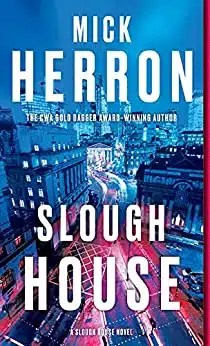


In the end, if I had to pinpoint the most appealing aspect of a Jackson Lamb novel, it would be the language. To prove my point, a small extract which offers some kind of description of Slough House: “Heat rises, as is commonly known, but not always without effort. In Slough House, its ascent is marked by a series of bangs and gurgles, an audible diary of a forced and painful passage through cranky piping, and if you could magic the plumbing out of the structure and view it as a free-standing exoskeleton, it would be all leaks and dribbles: an arthritic dinosaur, its joints angled awkwardly where fractures have messily healed; its limbs a mismatched muddle; its extremities producing explosions of heat in unlikely places; its irregular palpitations a result of pockets of air straining for escape.”
And then about the ethos: “Slough House was a branch of the Service, certainly, but ‘arm’ was pitching it strong. As was ‘finger’, come to that; fingers could be on the button or on the pulse. Fingernails, now those you clipped, discarded, and never wanted to see again. So Slough House was a fingernail of the Service: a fair step from Regent’s Park geographically, and on another planet in most other ways. Slough House was where you ended up when all the bright avenues were closed to you. It was where they sent you when they wanted you to go away, but didn’t want to sack you in case you got litigious about it.”
And then finaly, just something about the feared leader Jackson Lamb: “Breakfast was two pints of water and four Nurofen. Shaving was out of the question, but he released himself from yesterday’s tie with the kitchen scissors and found a fresh suit, which meant one that had been in his actual wardrobe, if not on a hanger”… and it goes on.
I am now waiting patiently for book no ten in the series. In the meantime I could revisit the television series, two seasons of which have been released on Apple TV and are still available to watch with the promise of a third coming later this year.

When you have lost your heart to a series of books, it’s with trepidation that you watch the live version, the characters and stories you have invested in. But with this one, it’s all systems go. While Gary Oldman didn’t pop into my mind as Jackson Lamb, once the actor had inhabited the man, there was no one else who could have stepped into those slippery Lamb shoes with such relish and robust. And ditto to Kristin Scott Thomas in the role of Lamb’s nemesis as she plays his arrogant and disdainful boss at MI5. There are few actresses who can play elegant haughtiness with such ease. And the rest of the cast complete the picture magnificently.
Mick Herron must be thrilled with this adaptation which so sharply captures the essence of both the people and the place of this much loved series. And hopefully we will be able to catch up on the full series – and a few yet to be written, in the years to come.
If any of the above appeals to you, don’t hesitate. It’s a glorious addiction and one I plan to hold onto for as long as possible!
- Published by John Murray, it is distributed by Jonathan Ball locally.











































































 De Beer Necessities