KAROO KAARTE LEADS THE WAY IN THE ARTS WITH A PROJECT DESIGNED AND DESTINED TO ELEVATE AND PROMOTE REAL CHANGE IN COMMUNITIES

South Africans are starting to realise that we have to do it for ourselves. That’s how change will really make an impact. It’s something artists Neil Coppen and Vaughn Sadie put into practice with the establishment of Karoo Kaarte at (and with the help and support of) the Klein Karoo Nasionale Kunstefees and a handful of other funders . DIANE DE BEER spoke to the two art activists about this ongoing dream of theirs:
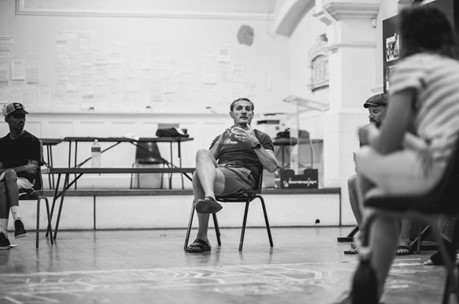
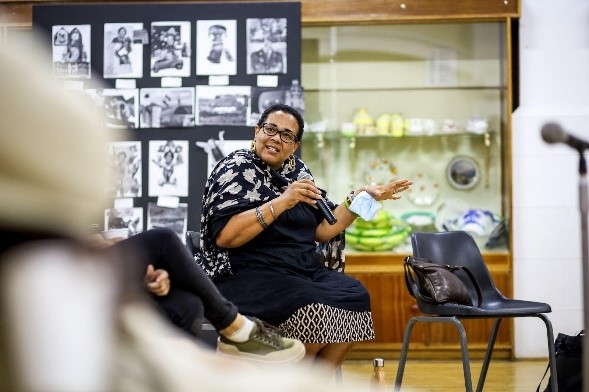
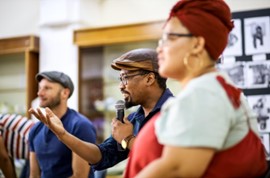
Co-Facilitator Vaughn Sadie leading a discussion with the core team (left) with co-facilitator Neil Coppen during rehearsals for Op Hierie Dag. Photography by Ryan Dammert.
Karoo Kaarte (Karoo Maps) was one of the most intriguing and important productions at this year’s Klein Karoo Nasionale Kunstefees (KKNK).

The project’s name Karoo Kaarte plays on the dual meaning of kaarte in the Oudshoorn context. The English translation of kaarte is maps and in the local vernacular “om kaarte te sny” refers to hanging out and telling both serious and light hearted stories.

Described in the festival guide as the heart of the festival, it was the result of months of research and work done in Oudtshoorn. It was the dream of the late Dr David Piedt, a founding member and Chairman of the KKNK and someone who worked tirelessly for the transformation and renewal of the KKNK over the years.

The project driven by the KKNK was established to make a transformative difference in the Karoo town where the festival is based.

Facilitated by the smart combo of the innovative theatre maker Neil Coppen and the visual artist Vaughn Sadie, the idea was to use the arts in many different ways to change the narrative of the Oudtshoorn community to a more inclusive one.
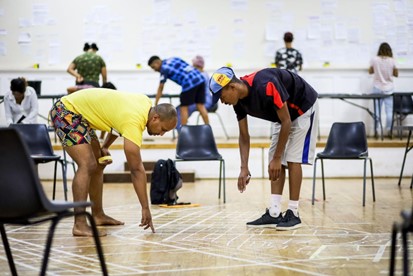
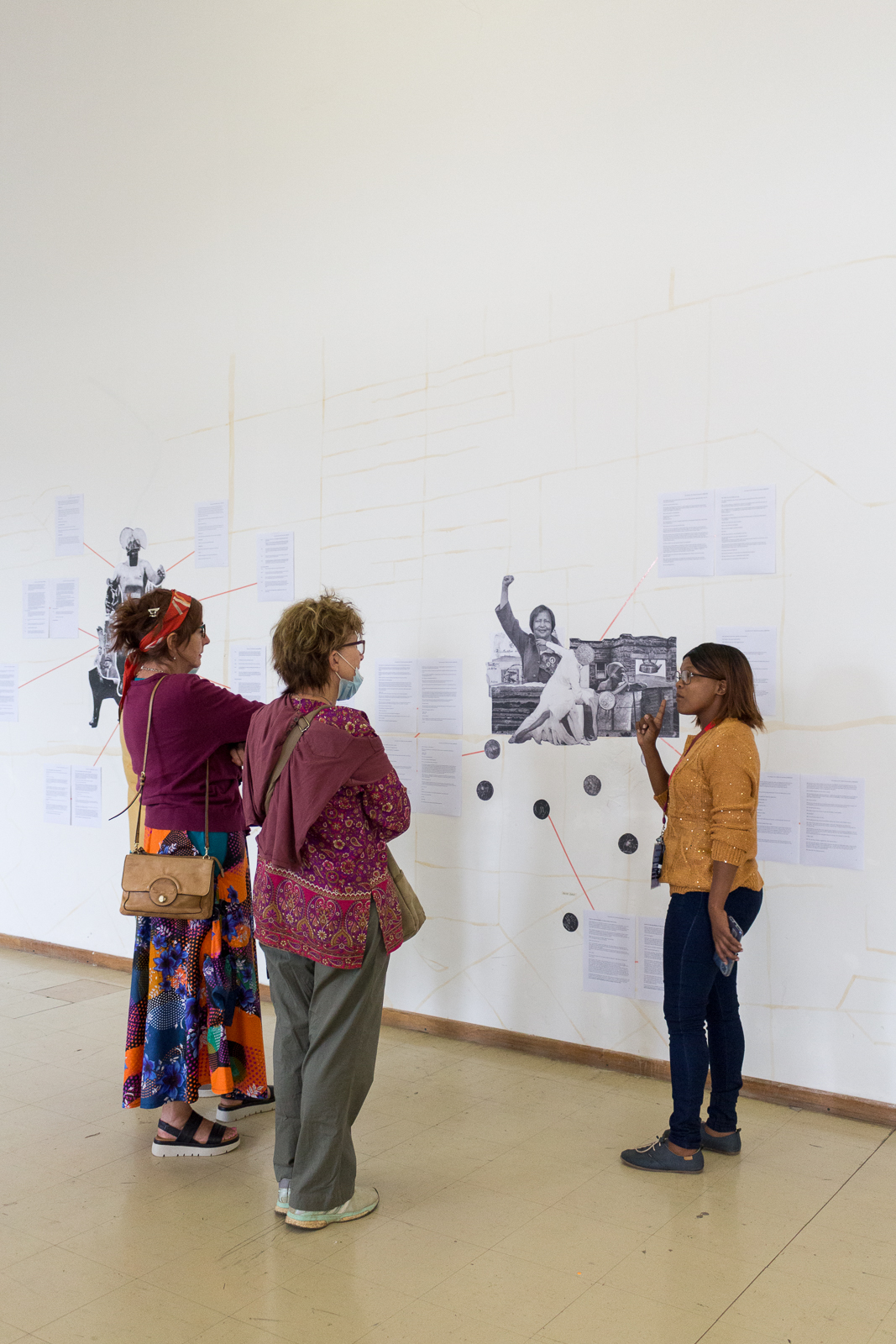
Karoo Kaarte team gathers for the research and creative process used to bring together a range of participants to reimagine the archive as an inclusive community resource. And images and details of the Karoo Kaarte team engaging, over a series of workshops, with Zietske Saaiman’s large-scale map of Oudtshoorn and its many suburbs which she painstakingly demarcated in masking tape on the floor of the CP Nel Museum Hall. Photography by Ryan Dammert and Karoo Kaarte.

Storytelling is one of the most powerful and compelling tools we have as people to bring about change, and it is exactly what was applied in this project in many different forms. The whole community of the town was encouraged to participate and engage in the research projects, which focussed on as many individuals as possible telling their individual stories, and more particularly, how they saw themselves featured in the town.

The whole exercise is about bringing people together. With our past in mind, many of our towns and cities still show the former fault lines and it is wishful thinking to hope that things will slide into normality by itself. This is some of what they were working with to incorporate and bring everyone together to tell their stories and become part of the fabric of this Karoo town.

Coppen explains how it all started: “I’ve worked with Hugo Theart (KKNK Artistic Director) multiple occasions as a producer and across many of our conversations, he always expressed the festival’s need and enthusiasm for developing projects that invested in the Oudtshoorn arts community and deepened the relationship between the festival, residents and local artists.”

 “The Karoo Kaarte Project was born from these conversations and is an expansion and deeper iteration of a variety of projects Vaughn Sadie and I have worked on over the last decade, both in collaboration and separately. As artists and facilitators we both are deeply passionate about, and committed to, initiating public participatory arts and theatre projects across South Africa, creating work that attempts to stimulate empathy, awareness, dialogue and deeper listening through performance and visual arts mediums.”
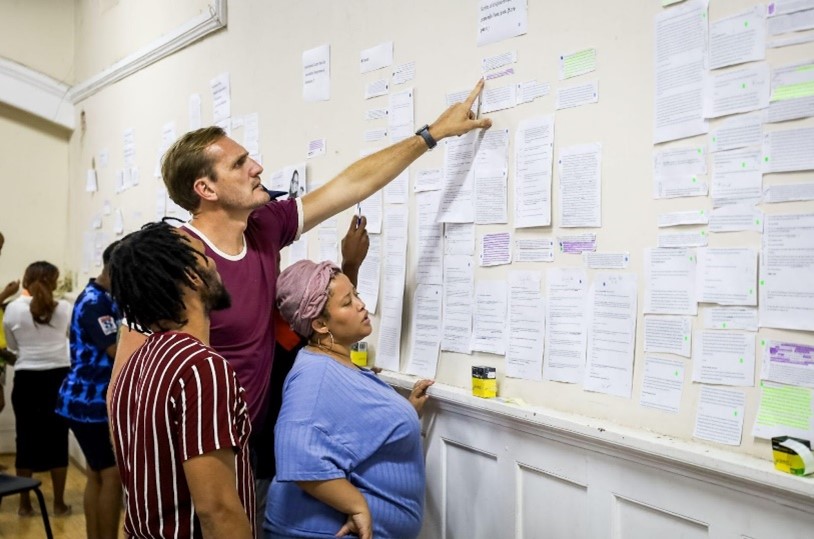
With the help of  the KKNK, their resources and energy, they were able to pull off a project and programme of this depth, complexity and reach. Both Coppen and Sadie moved to Oudtshoorn for six months, collaborating daily with what they  describe as an incredible team of young artists, writers, musicians, performers, arts leaders, activists and educators.

The good news is that this is an ongoing project. With the KKNK, their vision is to establish a solid and effective long-term engagement with the community of Oudtshoorn through the arts and expand the project annually to include and feature more and more local artists at the festival.

A big part of the success depended on the people involved. The process was one of broad consultation, which meant that Coppen and Sadie engaged with around 60 businesspeople, traditional knowledge holders, political leaders, supporters of the festival and artists to reflect on the possibilities of implementing a community-led festival programme for the KKNK in 2022. 

“Once the project began, we selected a core team of Oudtshoorn-based artists, poets, arts leaders, writers, musicians, researchers, facilitators and educators . These participants were guided over the four-month ‘first phase’ of the project through a series of weekly workshops to introduce the project methodologies and processes.

“Essential to the success of these processes was the involvement of leading intangible heritage consultant Deidre Prins-Solani, who facilitated a series of key workshops around developing the project ethos,  harnessing deep listening skills and the importance of preserving and archiving the intangible heritage of the region.” 

The core team participants were then trained in oral history skills and methodologies and, from October 2021, conducted 35 oral histories with a range of residents around the themes of music, land, identity, sexuality, disability, history and place. These unearthed a compelling set of stories and life histories which were and are being collated and used to bolster the existing archives housed in the CP Nel Museum, which means that the history of the town is being broadened to capture as much of the community as possible.

For change to truly manifest, everyone has to claim ownership.

From this body of research the team also generated content in the form of four Zines (small magazines distributed at the Festival), art exhibitions, a theatre production and a musical performance for a week-long community-led programme at the 2022 KKNK Festival, all of which we as festival goers could engage with.

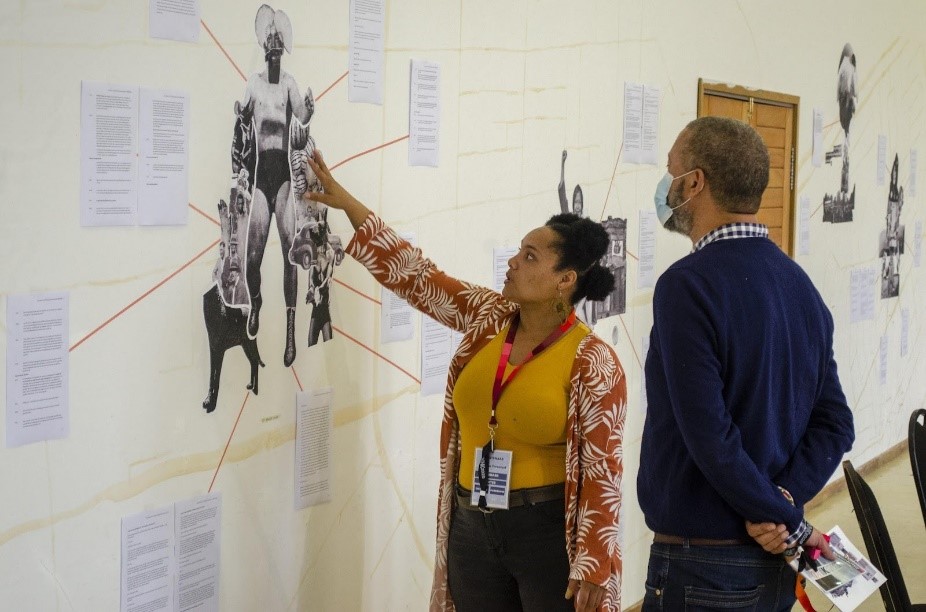
On the art side, a participatory collage process saw the team working with hundreds of images handpicked from the CP Nel Historic archives and a selection from the KKNK’s past 25 years of theatre festival photography, as well as personal images brought to workshops by participants. These collage workshops were held with school learners, unemployed youth in outlying rural areas (in partnership with the Youth Cafe) and the broader public. 

This process was designed as a quick but thought-provoking introduction by capturing how participants from various walks of life imagined themselves, as well as their sense of place and context within the town and outlying areas.

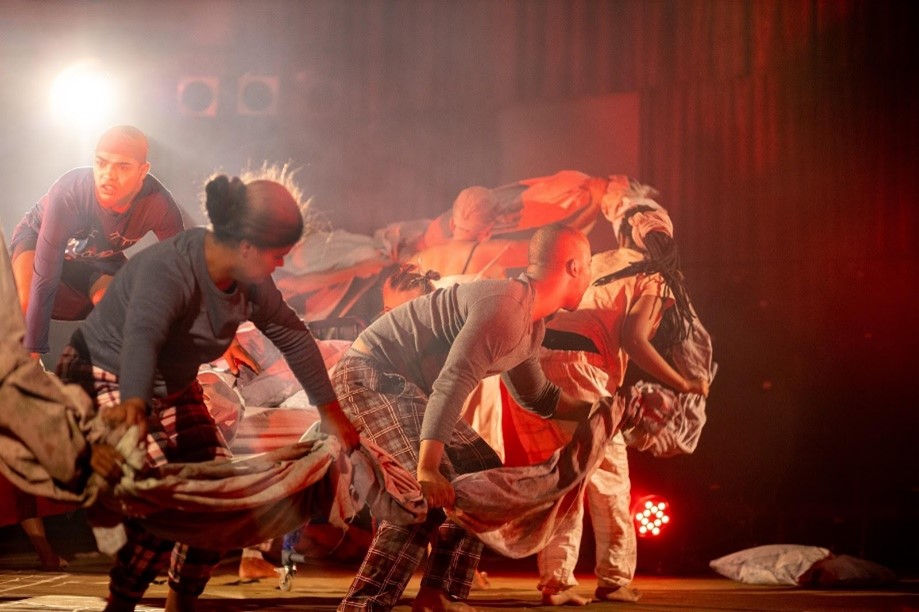
 This then lead to the theatre production Op Hierie Dag and the public arts programme. Both the theatre and arts teams (each featuring around ten participants in their teams) sifted through vast bodies of research to create performances and exhibitions which fall outside of the more stereotypical ones that have come to define the region – and of course many others.

To find musicians, actors, writers and poets for the theatre production, a series of open auditions were hosted covering the town extensively. In the end, the panel saw over 100 people and completed call-backs and workshops to finalise the cast and musicians for the production.

Sadie explains that the visual arts, theatre and music are all invaluable modes of expression for communicating the research. “It’s important to have multiple entry points to make the project accessible to different audiences through different registers.”

“I was deeply inspired by the level of dedication, talent and commitment shown by the whole team and was challenged and changed by creating this work and dreaming alongside all of them. I believe the Karoo Kaarte process proves that collaboration at this scale can yield powerful and exciting creative results,” noted Coppen.

He argues that  much of art and theatre making in the Western world is about individual ego, hierarchies and ownership, while all the outputs of Karoo Kaarte were achieved through deep conversation, consultation and collaboration with dozens and dozens of incredible minds and talents. “It was a process whereby each one of us were encouraged to contribute our respective skill sets and abilities to the mix.”

 The theatre production of Op Hierie Dag, for example, featured many voices and contributions and a text inspired and co-authored by the citizens of Oudtshoorn. “One of the local participants, Tiffany Saterdacht and I worked incredibly hard to wield all these narratives into a coherent theatrical experiences, but the material itself literally stems from thousands of pages of research and interviews that were gathered by the Kaarte core team.”

“In the end there were so many people responsible for its success and reception and who could feel a sense of pride in what they collectively accomplished and saw up there on the stage.”
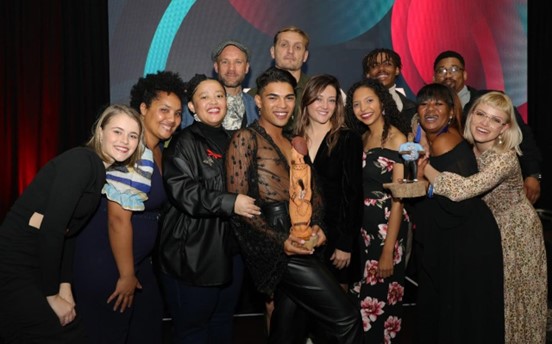
Some of the Karoo Kaarte team members including (L to R) Clarissa Saaiman, Glenisha Tarentaal, Tiffany Saterdaght, Cole Wessels, Zietske Saaiman, Lauren Theodore, Mirinda Ntantiso, Ané Koegelenberg,  and back Theo Witbooi, Janion (Noemwoord) Kennedy Vaughn Sadie and Neil Coppen.

What excites Coppen and Sadie is the talent they unearthed. Many of them were young artists and arts leaders who worked tirelessly at their craft and disciplines for several years and honed their abilities despite the challenges they have faced around lack of access, recognition and platforms.

 They both agreed that many of the participants across this project were some of the most talented and hardworking artists they had the privilege of working with.

If anything, this project set out to try dismantle this misconception that artists and performers from small towns (the fringes of more urban arts centres) are lesser or “amateur”… when all that’s really missing from the equation is the access to space, platforms, mentorship and resources.

 When you are able to offer these elements to these artists and storytellers, they are truly able to shine and receive the sort of recognition that is long overdue to them. So a project like Karoo Kaarte tries to foster and build these platforms and shift the national spotlight to shine on worlds, people and stories that have been excluded from national stages and conversations for way too long. It’s really about treating Klein Karoo based artists and storytellers with the respect, audiences and attention they deserve.

For those of us lucky enough to see some of what they had created, the most impressive was the participants and their enthusiasm.

Thato Mbambe during his solo in the Vallei Klanke concert at the 2022 KKNK festival. Mbambe was one of the successful younger candidates from the audition process to land roles in both the theatre concert and stage production.

If I had one bit of criticism it was about not understanding the breadth of the project. I missed out on the museum collages and I know many were unaware of the musical evening at the end of the festival, one of my highlights of the festival. The result was that even more excitement around the project could have been generated.

 Fortunately, as Coppen states, “the dream is for this process to continue and grow and expand well into the future and we are already dreaming up new processes as a collective for 2023”.
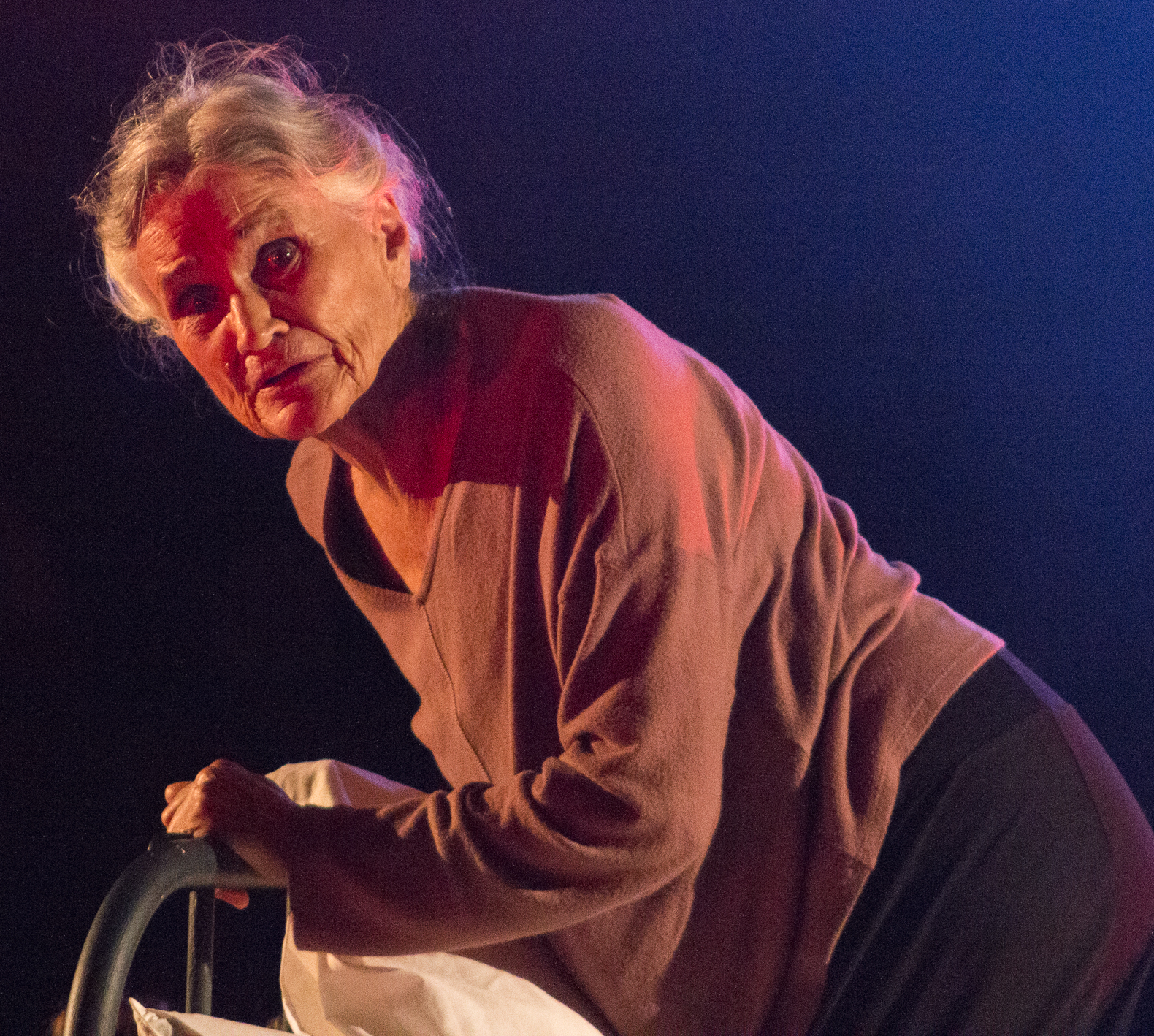
The acclaimed Lida Botha as part of the Op Hierie Dag cast.

That is heartening and I for one will be planning ahead to make sure I witness Karoo Kaarte’s evolvement from start to finish. And I’m crossing fingers that this is a process that will spread to cities and towns across the country.

The six Kanna Award nominations for the theatre production alongside the Kanna Herrie-prys for cutting-edge contribution to the festival saw the Karoo Kaarte team sharing stages and recognition with some of South Africa’s top theatre and arts luminaries, an achievement that further begins to blur the lines between so called “community” artists and those who operate in the “mainstream.”

Karoo Kaarte, a KKNK project, was supported by the ATKV, Nasionale Afrikaanse Teater-inisiatief (NATi), the Oudtshoorn Municipality, the Western Cape Department of Culture and Sport, Mzansi Golden Economy (MGE), the Netherland Embassy of South Africa, the University of Stellenbosch’s Department of Social Impact and Transformation, the C.P. Nel Museum, SON, Business Arts South Africa (BASA) and Absa. Research was supported under the To-Gather programme of the Swiss Arts Council, Pro Helvetia.
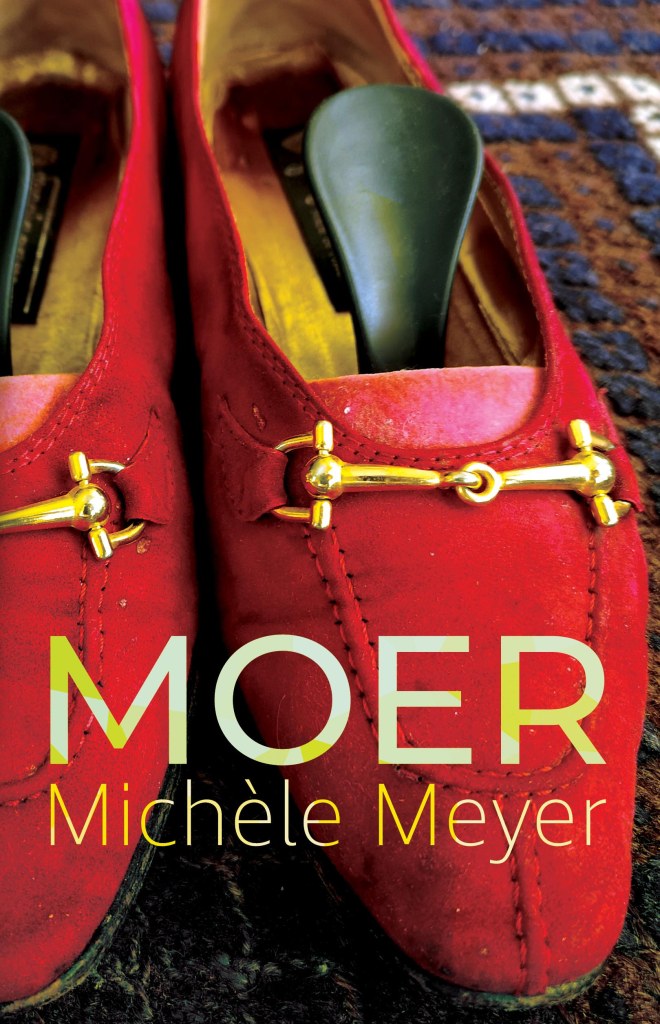
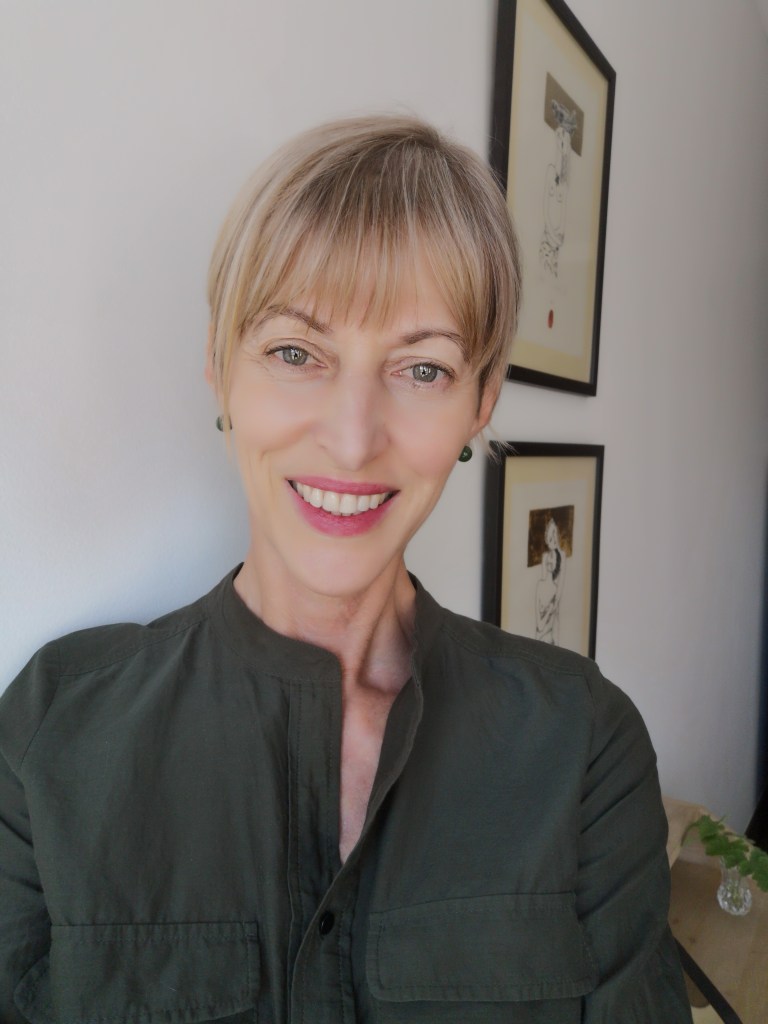
IT’S TIME FOR MOTHERS TO MATTER, SPEAK OUT AND CLAIM THEIR RIGHTFUL STATUS IN THE FAMILY

MOER (Protea Books), the debut novel of Michèle Meyer, tackles the shrine of motherhood and both dismantles and deconstructs the position of family saviour these often battered and bruised women have to uphold. It’s a brave and necessary approach to take, writes DIANE DE BEER:

Mothers of the world are often celebrated in superficial ways, but when it comes to their daily lives and how they have to cope, it is often woman alone.

She isn’t really allowed to complain because so many get on with it and don’t say a word. It is a selfless task, even with the rewards of raising a family. With that comes a responsibility that must be quite terrifying.

And on my part that’s only conjecture, because by choice I didn’t have any. The task for me seemed too daunting and I knew for my sanity I needed to work. For some of us that’s just how it is.

Michèle Meyer’s book MOER (Protea Books) has a title with many meanings, amongst them an old-fashioned word for mother, but also translating to extremely harsh words, and thus giving the indication, certainly to this reader, that this is going to be an interesting read.

And it is so much more. It does indeed deal with motherhood, but is written in quite a novel fashion. The chapters are mostly short and while the characters are all connected and there is a throughline, it’s not a once-upon-a-time story.

It deals with different aspects of being a woman in relation to being a mother. I know that editor Deborah Steinmair guided the decision of how to present this particular story and it’s something author Michèle Meyer eagerly acknowledges.

It is the clever combination of the writing and the compilation that adds power to this/these  particular mother(s) story.

That’s what Meyer achieves. It becomes universal rather than personal, even when it feels almost painfully personal. As her mother was singularly alone in a house filled with husband and children, so many wives/mothers are confronted with children whom they have to raise on their own. Sometimes they are single, but other times the need for help isn’t acknowledged – mentally or physically – and often the means aren’t there and one partner is out in the world earning the family’s keep, while the other keeps the family alive.

It’s a setup that hasn’t changed for far too long with most of the time, the children handed over to the mother to do as she sees fit – and sometimes she has no clue.

In many instances, it is the circumstances not the people involved that turn out to be harrowing, but in others, it’s just the way things have been done for generations with the man of the household making the decisions while everyone else has to comply.

And then, of course, there are many permutations … yet very few are resolved. Meyer’s mother(s), alas, is from a very isolated place. Young and fragile, she is left to her own devices as she tries to face the terrors of motherhood singly. The husband is carving out his career and that is something that takes up all of his time, his wife and his growing brood hardly acknowledged.

And yes, I know in many instances these things can be worked out and dealt with in quite a wholesome manner, but that is still unattainable in most households. Sometimes money helps to alleviate the worst, but there’s not much one can do about an emotional wasteland.

Not many people have the fight to go this one alone, but sometimes, that’s the only option. And for this mother that was it – and her saving grace. Meyer doesn’t save us the hardship of what her mother had to battle to survive. And that’s yet another courageous decision. Mothers are meant to carry the load – without complaints. This one does too, but she knows she has to save her life for the sake of her children and even when losing them at the start of rebuilding her life, she knows she doesn’t have a choice.

A recent story of a single mother who fought for her child on one of the streaming services told a similar story. It was based on a true story of a young woman involved with a weak man she knew she had to shake. She does, but her only option is to work in the service industry cleaning houses, and everything (especially bureaucracy) is against her succeeding. The world isn’t set up to reach out  a helping hand. Instead these women are disregarded, or seen as victims, never worth saving. They have to fight for themselves.

It’s time that more women speak out, tell and share their stories so that others might have the courage to stand up and walk out when often their sanity and their lives are involved.

Because it is a story of mothers, individual readers will read it from different perspectives, and that is what makes this such a smart read.

Meyer’s writing is hard-hitting (many will think personal) and that especially makes it such a brave book and one that will bring relief to many who will (hopefully) no longer feel alone.

RONELDA S KAMFER’S KOMPOUN WILL LEAVE YOU SHATTERED BUT THE BRILLIANCE WITH WHICH SHE WRITES IS LASTING AND WILL BLOW YOUR MIND

As a fan of Ronelda Kamfer’s gut-wrenching poetry, I was excited by the announcement of her first novel, Kompoun (Kwela). There’s something about her writing that holds you in its thrall and instinctively I knew that whichever way she chooses to tell a story, I will be on board. And having declared my subjectivity, I, DIANE DE BEER and the author speak our minds:

Ronelda S Kamfer

With Ronelda S Kamfer you know from the first sentence the kind of story you’re about to drop into.

And if you want to know what’s happening in literature in this country, you have to read this one. As an award-winning poet, this is her first novel, but she says that she doesn’t view the writing in any way as different.

“There was never really a shift. To me the boundaries between poetry and prose are superficial. I felt the story would benefit from a longer form. I wanted to capture more detail than I usually would. 

 “The main differences were the technical aspects of writing a novel. Basic things like ensuring continuity and providing geographical context, etc. But I tend to keep a lot of notes anyway.

“ And that helped. With Kompoun (the title, which is explained by a dictionary entrance on o the word in the front of the book), Nadia and Xavie had a notebook, the landscape had its own notebook, and my feelings had its own little section in a bigger notebook.

“I had a very clear idea of all the different elements that would make up the book eventually,” she explains

The brilliance of the writing and the story lies in the way she catches life, colours it in so many different shades and textures that you have to keep your wits about you, and also tugs constantly at any emotional toughness you think you have.

You should know by the end of page one whether you can stomach this one and if you do, you will be gloriously enriched on many different levels. But believe me, it’s tough.

The young Nadia explains that her Uncle Empty is actually oraait. He hits his wife, but she has too few nice adults in her life to write him off. And right off the bat you take the first hit.

Telling the story is Nadia and she alternates with her cousin Xavie as they reflect on their childhood.

Readers not familiar with Afrikaaps but also the way Ronelda tells the story, will have to pay close attention when reading Kompoun. It is  heart-breaking and often shattering in its pain, yet completely compulsive – and brilliant.

Ronelda’s choice of young narrators also determines how you experience the story. “We are children for such a short time. But it’s a time of our lives where we’re most ourselves in many ways,” she says. “ It’s a beautiful moment, before we start to compromise bit by bit.

“We are more selfish in little ways, but less selfish in the ways that matter most. When we’re children, we are less averse to risk, and that makes us more open, more forgiving and more honest.

“Most adults are calculating and closed off to some extent. Self-preservation becomes the dominant theme in our lives.

“Their resilience in the face of life’s disappointments made the children the ideal storytellers because the story to a large degree is about the struggle to retain your innocence and the desire to live freely, openly and honestly.”

And this is perhaps further explained in the dedication in the front of the book: All the women, who had to say sorry, even when they weren’t sorry

Musing on the difference between the novel and poetry, she felt that the novel required more stamina and concentration for a longer stretch of time. “I get bored very quickly, so my mind would trail off to other things. With poetry everything moves faster. And every new poem feels like its own thing even if it’s part of a collection.

“With the novel I was always aware that every part is a piece of the whole. That’s one of the reasons perhaps why I had to break the book down into these short fragments. So that every chapter could feel like a little project. It kept me engaged. I will always write poetry and I will continue writing novels, but I’m sure I will write other things as well.”

One of the riches of the book is the language but it also restricts the readership as your Afrikaans has to be good to get a grip on the Kaaps. But if you do, it’s like music to the ear.

And for Ronelda, it is who she is and how she expresses herself, as she explains:

“The language is very important, because the story spans across generations and different geographical spaces. It was important to represent all the different variations of Kaaps, whether it was Plattelandse Kaaps or the way it’s spoken in the Western Cape.

“Kaaps is also a very visual language, that relies a lot on metaphors. My mother died 10 years ago and my grandmother a year ago and I see the way they used language as part of my inheritance.

“With Kompoun I managed to come up with some phrases that felt like it came from their mouths. And that is probably one of the most satisfying things for me.”

And for those of us who read it, the way the language is used is such a huge part of the story, as often it hits its target with a speed and velocity that catches you unaware – but has double the impact. It’s simply not translatable.

It has been said that it feels like an autobiographical story, but when you ask Ronelda about the objective of the story, she says it was the book itself.

“I write things because I feel compelled to write them. It’s not a reaction to anything nor a statement. It’s really just the manifestation of a desire. I wanted to see these places and these characters in literature, so I expressed that,” she says.

And that’s  precisely why you are drawn into the lives of these children from the start. In a South African context, it is a familiar world, perhaps harsher than many of us might imagine, but something we can understand.

I have found that the thing that excites me most in any book is originality. They say there are only a few stories to be told, but it is the way the story is told where the creativity lies. That’s true for Ronelda as well.

“I love books and films and music that give me an adrenaline rush. And I get that rush from hearing a truly original thought, or seeing something beautifully observed or understood.

“My aim as a writer is the same as my aim as a consumer of art. I want the reader’s heart to skip a beat.”

And that mine did from start to finish!

I was fascinated by the way I experienced Kompoun. While the story is devastating and, the lives of the children, especially Nadia’s beatings, emotionally and physically painful, the book is powerful rather than painful, as if  by telling the story and not hiding from the truth, the children reclaim their power.

“I think Kompoun is the first book I wrote without any rage; the characters might be fighting but the story is not about rage. For me, it is about profound loss and we have all lost.

“ It is not about whiteness or patriarchy or violence. These things are a product of loss but I understand how someone might read into that first. I think it has to do with empathy, and how you relate to the unfairness of the lives of the characters.

“In some people this need to empathize causes that almost knee-jerk reaction, to look for reasons and to allocate blame. I do that all the time, but I am learning to process things slower and sit with my feelings longer.”

And then she concludes with what she wishes for readers.

“It was important to me that the experience of reading the book would conjure more than just sadness in the reader. These are strong characters who have things they believe in. I felt the character’s rebelliousness was integral to the book.

“It’s not a book about being defeated, it’s a book about emotional and psychological revolution.”

That is exactly what stays with you throughout the reading. This group of cousins, children all at the time, looked out for one another and were born into a generation that decided it was time to talk. And that made the difference. And does similar things for the reader.

If you think you might understand it and get to grips with Kaaps, no one tells a better story about these people and their lives than Ronelda S Kampher. May she never stop telling her stories – it doesn’t matter whether in poems or novels or any other way she comes up with. I will stand in the front of the line.

JM COETZEE’S LIFE AND TIMES OF MICHAEL K IS A STORY THAT RESONATES

PICTURES: Fiona McPherson

Craig Leo and Carlo Daniels in Life and Times of Michael K

DIANE DE BEER

JM COETZEE’S LIFE AND TIMES OF MICHAEL K

ADAPTED AND DIRECTED by Lara Foot

CAST: Sandra Prinsloo, Andrew Buckland, Faniswa Yisa, Craig Leo, Roshina Ratnam, Carlo Daniels, Marty Kintu, Billy Langa and Nolufefe Ntshuntshe with the Handspring Puppet Company

CO-PRODUCTION: Düsseldorfer Schauspielhaus (Germany) and Baxter Theatre

SET DESIGN: Patrick Curtis

LIGHTING DESIGN: Joshua Cutts

ORIGINAL MUSIC COMPOSITION: Kyle Shephard

DIRECTORS OF PHOTOGRAPHY AND FILM: Fiona McPherson and Barrett de Kock

VIDEOGRAPHY AND EDITING: Yoav Dagan

PROJECTION DESIGN: Kirsti Cumming

COSTUMES: Phyllis Midlane

 SOUND DESIGN: Simon Kohler

VENUE: Baxter Theatre

DATES AND TIMES:  7pm nightly until 19 March with Saturday matinees at 2pm on 5, 12 and 19 March

Craig Leo, Nolufefe Ntshuntshe, Carlo Daniels, Faniswa Yisa, Billy Langa in Life and Times of Michael K

It is quite astonishing with the Russian invasion of Ukraine as the backdrop on most minds, how the horror in JM Coetzee’s Life and Times of Michael K is amplified.

Written in 1983 in Coetzee’s sparse yet startling style, the story shines a powerful light on the life of a simple man, afflicted by a disfigurement, standing out without being someone, and being in the world not to engage, but rather flee from others.

That’s where he finds his freedom – in the wild, desolate landscape of a country that doesn’t want him and yet pursues him for crimes not committed or even imagined.

Both Michael K and his mother have lived honourable lives in service of others, he as a gardener and she as a domestic worker who lives under the stairs in an apartment block, like her son, unseen and unheard.

When she falls ill, with war raging around them, she turns to her son to take her “home”, there where she was born and raised, where she believes she once found happiness. And so their harrowing journey begins.

Sandra Prinsloo, Faniswa Yisa, Craig Leo, Roshina Ratnam in Life and Times Of Micheal K

Because of where we find ourselves right now, and looking back through the history of these past 30 years, both nationally and internationally, Michael K’s story hasn’t changed. That’s why it is such a brilliant choice to herald what we are hoping beyond hope, might be better times.

There was a buzzy anticipation on opening night as people moved into the Baxter Theatre for the Lara Foot-adapted and -directed Life and Times of Michael K, a production cleverly staged with the Handspring Puppet Company in a multi-dimensional fashion including performance, film and music – all on a grand scale.

And with a magnificent set which constantly changes with moving as well as still images and lighting that astounds, we’re off into the story and running with the narrative from the start. It’s quite overwhelming as Michael K’s story is told from many different angles and voices with different landscapes as he goes on his long and winding journey. Visually it is spectacular and achieves a moving world that is both elaborate and evocative.

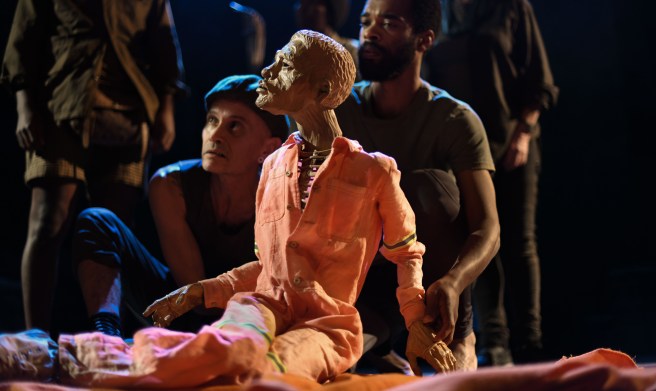
Telling the story, there’s an ensemble playing different characters; the physical Michael K, exquisitely crafted by the Handspring masters happily accompanied by his equally statured mother; the voices and puppeteers; as well as the film, which simply because of scale could be jarring at times rather than just slipping in and out of the narrative – yet all of these combined make it quite difficult to get to the beating heart of the story.

Nolufefe Ntshuntshe, Craig Leo, Carlo Daniels, Roshina Ratnam and Andrew Buckland in Life and Times of Michael K

As the name suggests, this is Michael K’s story. While the character himself can be seen as an insignificant man, that is the point and what Coetzee hopes to uncover in his desolate and desperately haunting tale of a man who is struggling to find and cling to his freedom. Gardening is what moves his world, something that adds rather than detracts from our physical place on this earth.

But even that is not good enough. Somehow it is twisted into an act of terrorism as he is accused of feeding a guerrilla army. He is simply never allowed to be.

Coetzee’s descriptive and detailed telling of Michael K’s battle to survive on this arid land, the way he works with the earth to both feed the soil and his soul, nourishing his freedom, his sole means of survival, doesn’t quite have the impact on stage as it does on the page. The exquisite existential rendering which won Coetzee such applause is somehow missed.

His is a harsh world in which there is mistrust all round. Who is Michael K? Even though he is described as someone who cannot organise a dart game, he is still seen as a threat by those who feel they are in command and have to lead the way.

No one can be left to their own devices. And it is this stranglehold, a man’s desperate struggle to hold on to his freedom, that disappears under the weight of the production, one where the true horror of being Michael K struggles to break through.

Foot has thrown all her energy and skill into this one and there are many memorable moments to witness and remember. It is a worthy production that captures the zeitgeist – a time of pandemics and panicked, power-driven presidents.

What you don’t get is the bewilderment of a man who has found himself in a world that prohibits him from finding his own way and making a life unaffected by those around him. The only way he knows how to breathe and survive.

Thát is the life and times of Michael K.

WRITING IS AUTHOR ERIKA MURRAY-THERON’S SOLACE WHEN MAKING SENSE OF HER LIFE

When Erika Murray-Theron started writing about her life following the Parkinson’s diagnosis of her husband Tom, she couldn’t predict that capturing her thoughts on paper would be her way of coping. Yet writing became her solace and eventually a book titled  Kom Ons Loop Weg (Protea Boekhuis), which she hopes might shed some light for others struggling with debilitating disease. She talks to DIANE DE BEER:

It says everything about author Erika Murray-Theron when she tells you with a twinkle in her eye: “In one year I turned 80, got married, had a knee replacement and launched this book.”

Published by  Protea Boekhuis, the front cover also explains that this is her and her first husband’s journey with Parkinson’s disease.

It all started in 2001 when Erika’s husband Tom was diagnosed. Initially once they were fully immersed in the illness and coping with its progression, Erika started a file on her computer but it was simply meant for her eyes. As someone who had always kept a diary on her life (until her family with five children took over), she knew she needed somewhere she could gather her thoughts and make sense of all the changes they were confronted with on a daily basis.

From the beginning, the onslaught on what had been their life was quite overwhelming, but as one does in these circumstances, you deal and cope. When Tom’s mind was still unaffected, they could make decisions together but eventually, Erika really had to take charge and, as so often with his particular diagnosis, she had to  handle everything with great care when dealing with Tom.

Part of Parkinson’s symptoms can be fears of abandonment, and reality for the couple soon became a very individual experience.

The book deals mostly with the last three years of Tom’s life, which because of the degeneration, were also the most difficult. For Erika it wasn’t just the decisions about where and when to move, how to physically manage their lives, but also to bear such constant and intimate knowledge of Tom’s decline.

Theirs had been a fulfilling marriage and what she was witnessing was the dismantling and slow disintegration of both the physical and intellectual beings of her life partner. And with that comes the loss, which is a slow and debilitating process for both, the one suffering and the carer.

This wasn’t a time to think, she had to do. But she is a writer and from as young as five, she would tell herself stories and end sentences with “she said!”, as though writing a story. “I don’t know where that came from,” explains Erika, and even though she started writing books at a relatively late stage, storytelling has always been a part of her being.

Writing is how she makes sense of things and, during Tom’s illness, it helped her make sense of her feelings and her understanding of what was happening.

She hates being viewed as a victim or as someone who wallows in misery, and given what she had to deal with, not languishing in those emotional places is tough. But with Tom the priority, she managed with the help of her children and friends to cope.

That’s where and why the book became important. Once she caught her breath following her husband’s death in 2014, she knew she had to revisit these last years of their life together – that as well as nurture the memories of happier and easier times.

Erika Murray-Theron.

She had been caught unawares by the deep loss she felt with Tom’s passing away, especially following the struggles of the last years. That also meant that she hadn’t yet mourned the loss even though it had been such a part of her life even before his death. “I knew I had to deal with all of that,” she explains. Now she had time to step back, return to her notes to gather her thoughts of what their life had been.

When she started thinking about writing a book, she was driven by the feeling that her experience could benefit others.

But this also meant more exposure, the one aspect of being an author that doesn’t appeal to Erika. “I am a very accessible person but I don’t like being out there,” is how she explains it.

But telling this story she believed she had to be truthful and honest about their lives, especially the last years that were so tough. It also meant that she had to discuss  this opening up so publicly with her children.

They are a tightknit family, some more private than others, and this was her and Tom’s story and where she was going to concentrate. And even though the book is extraordinary and something Erika doesn’t regret, the publicity surrounding it has been difficult for her. “Many people only see my plight rather than the extraordinary journey,” she says.

What she has done with telling her story, one that no one really wishes on anyone, is to show the resilience of human beings. How we stand up and get going when life is unexpectedly tough. For her it was about finding the meaning and making sense of it as she was gathering her notes and her thoughts to finish the book.

She contacted the editor of her last book at Protea Publishers, Kristèl de Weerd, and gave her the notes which she had already sorted into some kind of order. Writing and the process is something Erika enjoys and especially the final reworking and editing. “I can sit for hours adjusting one paragraph,” she confesses.

That is why the book is such a revelation. When keeping notes, Erika is someone who has depth and detail in the palm of her hand. The title KOM ONS LOOP WEG (loosely translated as Let’s run away) comes from a moment in time when Tom said to her quite unexpectedly and lucidly: “I miss you … I hunger for you… Let’s run away…”

Gideon and Erika

And still her story isn’t completed and if there are any tears to be shed, perhaps this happy note will do it.

Following Tom’s death, a close friend of theirs, Gideon, also lost his wife. He turned to Erika for some help with things he had to sort through – and, she says, she immediately knew that this friendship was going to develop into something different and deeper. Today she is taking a timeout from writing and the newly-weds are making the best of their time together.

For those of us looking on, it feels as if they were blessed with a special gift.

VINCENT PIENAAR’S LIMERENCE HAS A NOSTALGIC RING TO IT WITH A ROGUISH HERO MOST LOVE TO HATE AND YET TOO FEW WOMEN CAN RESIST

THE thing that strikes one most with the two latest of Vincent Pienaar’s novels, is the joy. It’s something that he ascribes to and it works as you jump into what might not be an entirely happy premise and yet, you are taking off on an adventure. DIANE DE BEER gets some thoughts from the author and also speaks her mind:

When reading Vincent Pienaar’s previous book Too Many Tsunamis: a Tale of Love, Light and Incidental Humour (Penguin Books) it felt as though he had found a very specific (and joyous) voice.

It was as if even when dealing with serious issues in some instances, there’s always laughter bubbling just below the surface.

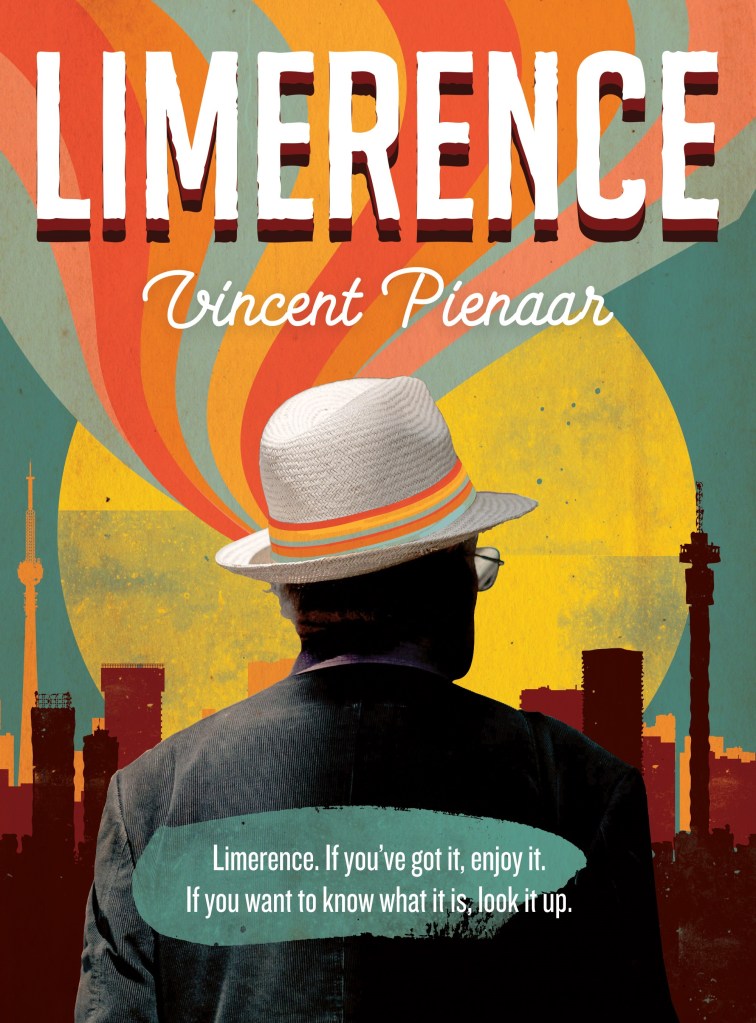
He has done it again in his latest book Limerence (Penguin Books), which is described as something that when you’ve got it, enjoy it. And advises you on the front cover, that if you don’t know what the title means, look it up!

As with the previous book, his first sentence immediately gets your attention: “Did you know that Robert Johnson sold his soul to the devil?”

And then he meanders on to tell you why.

But that is the interesting thing about Pienaar’s storytelling, he jumps into a place, drags you along and has you smiling (if sometimes unwillingly) on the ride.

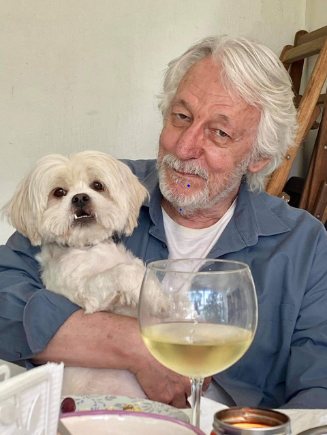
Author Vincent Pienaar and family.

This time it’s the story of a man whom women love to hate but can’t resist. They know he will get away with it over and over again, so when he approaches four women he was involved with, all with a similar proposition, they’re reluctant yet fall for his preposterous proposition – and only start breathing fire when they discover all four of them (yes, the ego always intercepts) have been handed the same will.

Pienaar explains that the story evolved bit by bit, as his stories always do.

“I was amused by the idea of a person giving different people identical last will and testaments.”

And then he allows us to see his wandering mind, to show the process: “Why would he do that? Because he’s not dead and he wants money. As simple as that? No. Greed may be a good enough reason in real life, but in fiction you need more motivation. So he’s in trouble. He needs money quickly. For what? Unpaid debt? Maybe, but not sexy enough. He must want to do it for somebody else. Enter Julie with her three children, enter Sabelo, enter Pieter, enter Mr Downey and on and on.”

That’s when the characters get up and running and sometimes it feels as though they’re dictating where he goes. “My characters never allow me to pull anything together. The women, all from different decades, presented the perfect platform to tell the story of Johannesburg (specifically Hillbrow and Melville and later Yeoville) from the 1970s to the present. But they are all strong, which made their backstories interesting, and how the story evolved is a matter of their making. I really liked the idea of a character sauntering in and out of Melville, infuriating the women endlessly.”

Talking about the title and the obvious delight he finds in words and writing, Pienaar confesses that he liked the idea of  “finding your own voice”. But that’s easier said than done.

While you are trying to find and establish that, you are constantly being shoved into the grammar trap of do’s and don’ts. That he believes (and I agree) “smooths the peaks and valleys of the text onto a pothole-free highway of blandness”. It was a struggle, but having read both books, the Pienaar personality is unashamedly there and he’s having the best time. When an author does that, how can the reader resist?

But back to the title: he was almost finished with a book provisionally named I Love Crazy when a friend introduced him to the word “limerence” and voila, he had his title. “After I found out what it meant I worked it into the story.”

He also struggled to get a name for the main character, until a friend’s dog died. “The dog was named Scout and I decided my main guy would be Scout. This led to Scout (To Kill a Mockingbird), Holly (Breakfast at Tiffany’s), Clarissa (Mrs Dalloway), Daisy (The Great Gatsby), etc. Even Ripley is from the movie.” And the games go on with or without the story, which is part of the fun.

Having published in both Afrikaans and English, he says: “I write competently in Afrikaans, but I write comfortably in English.”

Yert he still thinks his funniest work is Jo’burg die Blues en ʼn Swart Ford Thunderbird and he’s just completed an Afrikaans play inspired by the murder of Charl Kinnear.

But he admits that the voice he has found takes courage and he doesn’t yet have that in Afrikaans. “The Afrikaans grammar Nazis scare the shit out of me.”

If you’re wondering about writing in the time of Covid, “I didn’t want the book to become a dark tale of people darting about in the shadows, jealously guarding six packs of beer under dirty overcoats.” And with that line, he has a full explanation in the front of Limerence.

What he likes pushing to its limit is humour (not necessarily funny) in any work of fiction, no matter how bleak or dismal the story. “It’s what keeps the reader reading (or amused, if you like),” he believes.

I don’t totally agree with that premise, because there are many different things that keep me reading depending on the writing and the story being told. But I do like Pienaar’s intent and style. And I love the way he runs off in all kinds of directions to say something that he finds amusing and wants to include in his story.

He describes this penchant as a noble one.

“If you watch any of the movies in Nora Ephron’s trilogy (When Harry met Sally, You’ve Got Mail, Sleepless in Seattle), it’s all about the playfulness and not about laugh-out-loud funny.”

Pienaar is on a roll and while he feels he has almost stumbled on a style with Tsunami, the next book is provisionally called A Man, a Woman and a little White Dog named Floof. But don’t attach too much importance to the title, that might change, as Limerence reminds us.

 He’s hoping because of the Ephron fan he is, these three might be considered a trilogy – perhaps an homage.

BOOKS ARE THE EASIEST ESCAPE AND FASTEST WAY TO TRAVEL TO ANOTHER COUNTRY OR EVEN WORLD

This has been a wonderful time for African Writers (Tanzanian writer Abdulrazak Gurnah who won this year’s Nobel Prize) and now South African writer Damon Galgut for his Booker Prize win for The Promise, a book, which delights as much for his imaginative storytelling as his innovative way with words (see below). It’s a glorious time to celebrate talent from this continent especially for artistic endeavours, something which has been neglected for far too long by those in power. And more than anyone, it is the writers (and all of the artistic community)who have opened minds and changed societies. If you haven’t yet read the The Promise, buy it now and get reading. And while you’re at it, also get acquainted with the latest Nobel Prize-Winning author by acquiring and reading one of his novels. It’s the one thing we can do in these strange times – read!

Many people, myself among them, feel better at the mere sight of a book.

Jane Smiley, Thirteen Ways of Looking at a Novel

It doesn’t matter how much good streaming is available to us in our brand new world, quiet time with a good book cannot be replaced by any of the noise around us and gives us a chance to escape to somewhere completely different – and we can decide how and where. DIANE DE BEER looks at a few of her most recent choices…

In a time when lots of reading is possible, it’s been great to catch up with books by authors I have neglected for far too long. Damon Galgut is one of those and I sure picked the right one to enter his world.

I have found when reading as much as I do now but also as I grow older, that the thing that interests me most when it comes to choosing books and really getting into the heart of whatever matter the author wishes to explore, is innovative storytelling.

And that’s what moved me most with Galgut’s latest, which already has the accolades and possibility of awards (Booker, for example) streaming in. The topic, our apartheid past, has long not yet been exhausted, but to keep readers engaged you have to find a way to look at familiar tropes and topics that is as innovative as it is engaging.

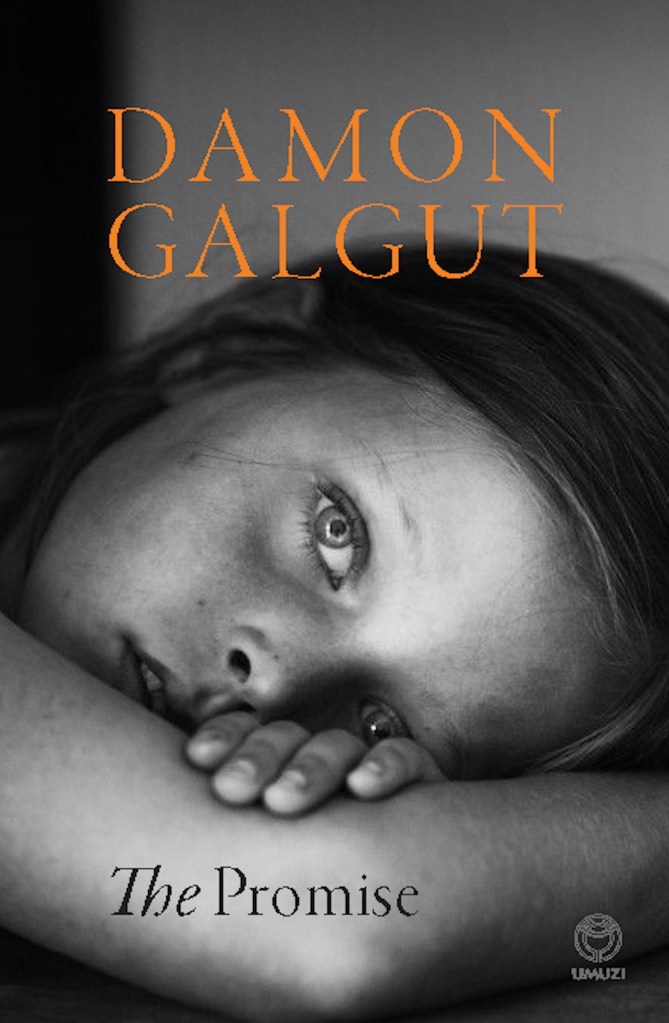
The Promise (UMUZI) does that in spades – for me. I have heard others complaining with passion about his lack of empathy with his characters and more, but none of this came into play for me in his particular telling of the story.

One of the many podcasts I listened to about the novel and the writing is that Galgut was exploring a new way of telling the story. He found the magic carpet for my ride and he loved that he had found a different voice, as did I.

I could feel that even when dealing in very heavy subject matter, especially for readers in this country at this time, there was a lightness about the telling which was joyful to read.

It’s the story of four siblings in a particular family and the events unfold around four funerals of different generations of this same family. This means it is set in different times in a country that underwent huge changes , with a different president , for example, at the telling of each tale. Not that the president and the politics are in the forefront.

What plays out in this particular family is the dictum that where you are born and how you are raised, all have an impact on who you become. And it all circles around a promise that was made a long time ago which has never been kept and has everything to do with the country we live in.

I loved the originality, the elegance of the writing and what lies underneath the story for each individual reader to unwrap.

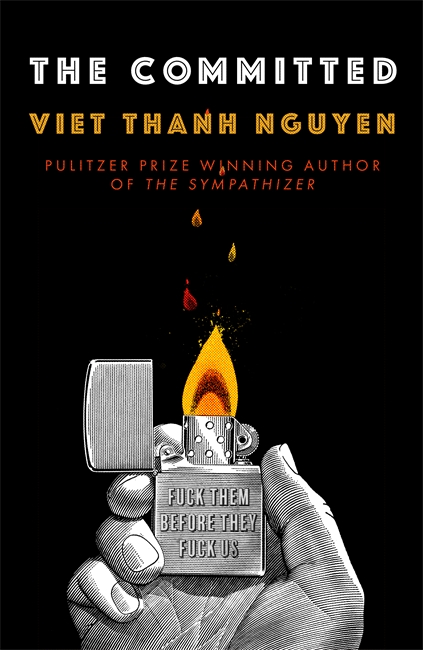
For something completely different, Viet Thanh Nguyen, who wrote so sharply about the Vietnam war in The Sympathizer turns his gaze to a different country – and even continent – France. I couldn’t help smiling in The Committed(Corsair) as he turns his acerbic gaze on the French; and as we have discovered, those who read the first novel, in the way he treated the Americans and turned their interpretation of the Vietnam war on its head, he takes few prisoners.

But while he might be telling the story in colourful gangster style, there’s nothing rough and ready about his opinions of the latest country he has decided to tackle.

Walking through Paris (even today) with even its touristy streets very sharply defined by different races, it’s easy to spot the heart and soul of this majestic city.

And in this time of refugees, Nguyen starts his latest novel with the following penetrating sentence: “We were unwanted, the unneeded, and the unseen, invisible to all but ourselves. Less than nothing we also saw nothing as we crouched blindly in the unlit belly of our ark.”

This is not going to be an easy read and yet, the pace is fast and furious, and you have to get with the programme to keep up with his sharp comments and incisive opinions as he tells a story of corruption, complicity and companionship only if you can bring riches to the table.

“That’s not a French name they would say … All I had to do was change my name. I’ll admit, I tried on some different names, it didn’t feel right. And I thought, I went to your schools, which are my schools. I learned your language, which is my language. I don’t feel Arab at all, except when people call me an Arab. And that’s not enough? Now I have to change my name, which my parents gave me? And I knew this would not be the end. They would never stop. They would not be happy until I married a woman who looked like them, gave them children who looked more like them than me, made friends only with them. Either I could be one hundred percent French or I could just be a dirty Arab, so instead I decided to be one hundred percent gangster.”

It’s a small passage in a large book, but it captures the essence of both the story and the world we currently find ourselves in, where everything that has been done to others has festered and turned into a ferocious beast who has no way of protecting itself or those of us watching.

There’s a third in the trilogy on its way and I can’t wait.

If you’re a Deon Meyer fan there’s no need to read this but if you’ve never met the detective duo Benny Griesel and his partner Vaughn Cupido, get a life.

Most of us read a thriller at some stage of our life and because it has meant big money for many authors (probably in this country as in many others, the only authors who have any chance of making money), there’s a landscape of books to choose from.

South Africans are blessed to have one of the most successful in the world in this genre in our midst – Deon Meyer. Personally, I fell in love with his stories because of the South African landscape he established.

He might be wearing rose-tinted spectacles but I prefer to think not, because what he has done is focus on the characters and no one can argue that while we might have some of the worst politicians in the world (they didn’t really have any role models?), we also have some of the best people.

There’s not a day that goes by that  one of my fellow citizens doesn’t put a smile on my face, and it is that element that Meyer captures so well.

Then of course he also spins a good yarn. He has all the fodder available right under his nose but also in today’s zeitgeist, and he has captured that brilliantly in the past. And again in this latest novel, Donkerdrif (Human&Rouseau), (if you can, read it in Afrikaans, but the translations are good and should be available very soon) which latches onto all the evils that drive our world today: greed, power, money, corruption… and the list is endless.

We know the formula although Meyer is too smart to make it thus, but Benny and Vaughn will win the day and we will be there rooting for them all the way.

Starting this column with a book that is all about the writing and the storytelling, it is perhaps apt that I conclude with one that didn’t succeed for me in especially the familiar way the story unfolds.

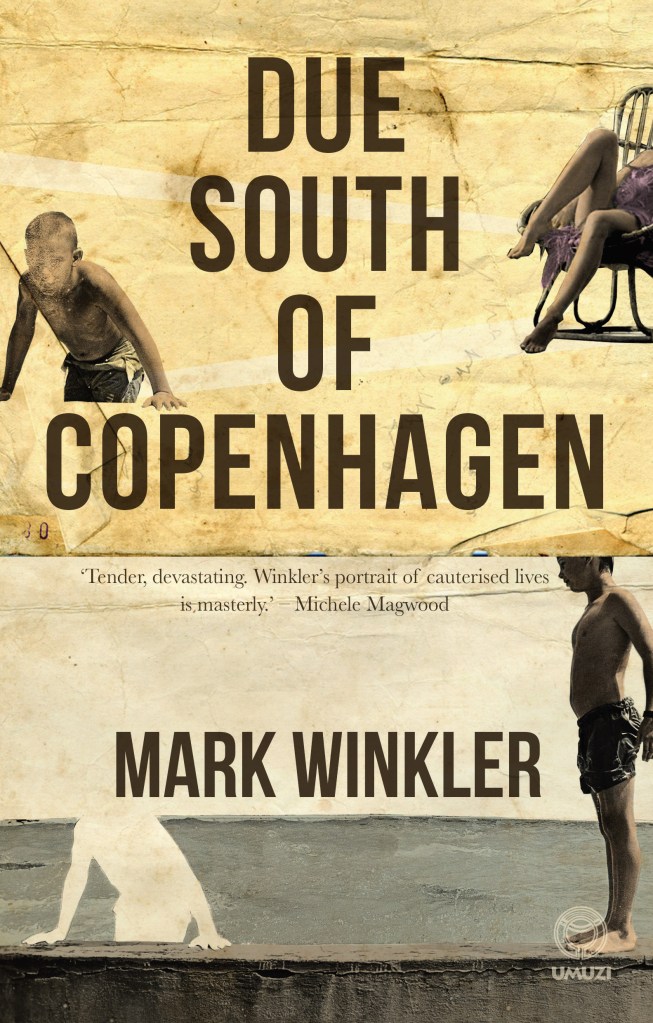
We’re still reading about World War 1 and 2 and I suspect it will go on for a long time, as it should. Lest we forget and the horrors are repeated is the age old explanation and that’s true, but if you are going to focus on telling stories that capture a specific time, you are going to repeat versions of stories that came before which happened for me in mark Winkler’s Due South Of Copenhagen (Umuzi).

After all, the two boys with surnames Fritz and Udengaard aren’t the first with German or German-sounding surnames bullied by their schoolmates even 30 years after the war. So come at it with a fresh angle, a different vantage or you won’t keep my attention. I have heard and seen too many different versions and after a while, you switch off.

Winkler’s snapshot of the past is beautifully captured, he writes masterfully and perhaps from my point of view, it is best read by a younger generation who would not know about these intimate stories set against a larger backdrop.

But for me, the small-town idiosyncrasies of a specific time and place, two youngsters thrown together because of the prejudice against them, wasn’t enough to keep my attention. Because it was well written, I finished the reading, but it was in one ear and out the other as quickly as I turned the last page.

AUTHORS MICHAEL LEWIS AND TA-NEHISI COATES WRITE AND MAKE SENSE OF OUR CRAZY WORLD

DIANE DE BEER

Two of my favourite authors wrote books recently focussing on issues that are part of how we function and why. I want to urge anyone interested in the world and how we view it, to tap into their insight:

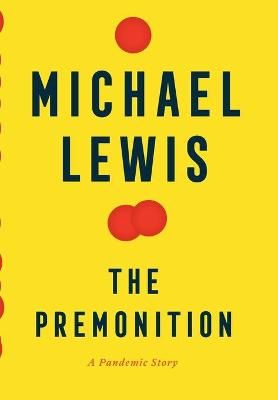
THE PREMONITION:  A PANDEMIC STORY BY MICHAEL LEWIS:

“I would read an 800 page history on the stapler if Michael Lewis wrote it,” writes a New York Times book reviewer and that is pretty much exactly what I feel about Lewis and anything he writes.

His last book, The Fifth Risk, looked at the federal bureaucracy during the Trump years and how things unravelled because of incompetence, or if you want to give them the benefit of the doubt, ignorance.

So it was perhaps justified to expect this latest book, The Premonition: A Pandemic Story, to put all the blame on Trump and his coterie of civil servants. But not so.

What he does is to go and fetch the facts from way before the pandemic, when a group of medical specialists started warning about the possibility of a pandemic like Covid-19 and how best to prepare for it. The problem was that few people were listening and the government specifically didn’t want to listen.

He has a handful of heroes and one of the most intriguing individuals in this story is a California health official, Charity Dean. Lewis has a knack of discovering these characters who seem to almost hand him his story on a plate – but it’s perhaps not that easy. You have to find them and then you have to both listen and pay attention; and that he does quite brilliantly.

He also has the instincts to know which story to follow. And if anything, Dean wasn’t obviously the voice that many would listen to. She admits that who she really is has nothing to do with her exterior, which is apparently more Barbie than Florence Nightingale.

But that’s only part of the story. Two doctors, Richard Hatchett and Carter Mecher, were part of a pandemic planning team set up during the George W. Bush administration and then they hooked up with some other extraordinary individuals who were all extremely good at what they were doing.

Almost by accident these people all get together or connect in some kind of fashion. Rather than predicting what was going to happen, as one might expect, all these people in some kind of form become interested in pandemics and start looking out for the possibility of future disaster(s).

The frightening thing though is not the incompetency of the Trump administration or even Trump’s wild claims during some of the worst times of the pandemic, but rather that this first-world country with all its expertise and some of the best brains in the world was so ill prepared.

 Most of the rest of the world is less alarmed by some of the incompetency in their own countries, having a much more jaundiced eye, but most of us will be surprised that those who constantly hold themselves up as being the best, can do so badly.

It’s worrying when even the “best” fail so miserably. And to this day, people are dying because of a refusal to take the vaccine. How is it possible to keep on refusing to take it seriously even after the high death counts? And now many of those naysayers are starting to die, so it will be interesting to see how that changes the dynamic.

The best of the Lewis style is the way he finds and fetches the story, dresses it up in the most palatable fashion and then allows the story to unfold. It’s powerful and will keep me reading – yes even when the topic doesn’t grab me. I know his storytelling abilities will.

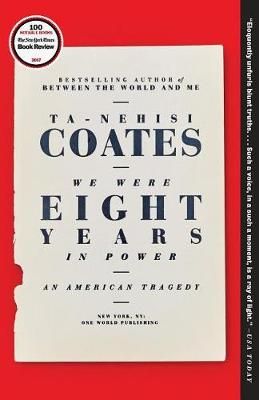
WE WERE EIGHT YEARS IN POWER BY TA-NEHISI COATES (Hamish Hamilton):

In a sense, Ta-Nehisi Coates has a similarly mesmerising voice. He deals in a different world but also with the lives of people; and perhaps that’s the common thread.

This time it is the late Toni Morrison who is quoted on the back page: “I’ve been wondering who might fill the intellectual void that plagued me after James Baldwin died. Clearly it is Ta-Nehisi Coates.”

This one was published in 2017, but I’ve only recently received a copy and can’t resist bringing it to anyone’s attention who doesn’t know about it or is unfamiliar with this particular voice.

The premise is the Obama presidency and what Coates did was to take eight articles written during the eight years of the first black presidency. Before each of these essays, there is as the author explains “a kind of extended blog post, one that attempts to capture why I was writing and where I was in my life at the time.”

He describes what he has put together as almost a “loose memoir”. And at the end of the book, he attempts to assess the post-Obama age in which we find ourselves. He wanted all these eight essays (originally published in The Atlantic) assembled in a single volume.

It’s as smart as it is clever and I can’t think of anyone else I would rather have guide me through that particular time in American history. And because of these times of George Floyd and the renewed urgency of Black Lives Matter, it almost lands with more penetration because of current events than when it was first published.

He deals with so much that is out there right now and for years to come. About reparations, for example, he says the following: “What would it mean for American policy so often rooted in its image as the oldest enlightened republic and pioneer of the free world, to forthrightly note that freedom and enlightenment were only made possible through plunder that stretched from the country’s prehistory up into living memory?”

And that’s just a tiny snippet and sits sweetly next to Prince’s brand new album (posthumously, of course) and the searing lyrics:

“Land of the free, home of the brave

“Oops, land of the free, home of the slaves…”

Coates doesn’t mince his words either. If you want to hear, he will tell it like it is. And if anything, you could read it just to see what he has to say about Trump, the man he describes as America’s first white president. And that already is a fascinating story.

He writes in his incisive epilogue that Barack Obama delivered to black people the hoary message that in working twice as hard as white people, anything is possible. “But Trump’s counter is persuasive  ̶  work half as hard as black people and even more is possible.”

Much was explained about both the Obama and Trump presidency (according to Coates, the result of having had a black president) and again Coates steps up as the voice of a new generation, insightful about the world in which we live in, and more importantly, not one where he sees white supremacy disappearing anytime soon.

It was reported recently that Mitch McConnell expressed initial satisfaction about the Obama presidency because he felt this would put a stop to the kind of complaints heard from the Black Lives Matter movement.

Which says everything about his understanding of the lives of others especially those of colour. And again underlines the importance of this book.

ESCAPE FROM LUBUMBASHI IS ABOUT A REFUGEE’S DETERMINED STRUGGLE TO REUNITE HER FAMILY

The 1951 United Nations Refugee Convention is a key legal document and defines a refugee as: “someone who is unable or unwilling to return to their country of origin owing to a well-founded fear of being persecuted for reasons of race, religion nationality, membership of a particular social group, or political opinion”.

mde

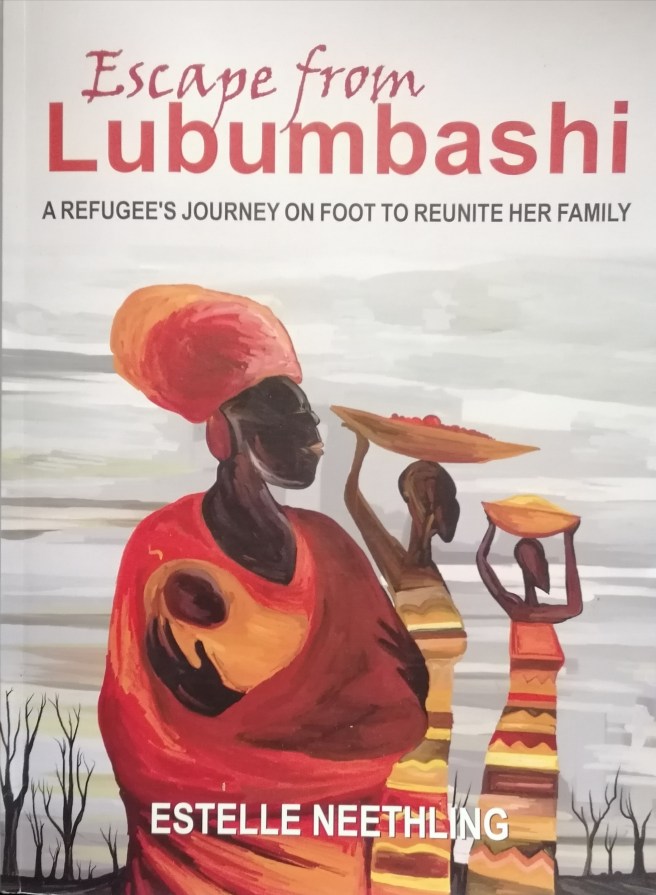
With The Escape from Lubumbashi (published by Unisa Press), author Estelle Neethling tells a story that she felt compelled to share especially of this particular woman and her excruciating journey and circumstances to find a life and home for her family. And more than ever, this is the time to share the stories of refugees she tells DIANE DE BEER :

When author Estelle Neethling first met Adolphine Misekabu, her dignity and obvious honesty struck her forcibly. “From the very first time I saw her sitting in a makeshift classroom at a refugee centre in Cape Town in the mid-2000’s, teaching refugee children,” she says.

At the time Neethling was working for the South African Red Cross Society as the national tracing coordinator (restoring of Family Links Programme, International Committee of the Red Cross).

When the South African Red Cross, where she was based in Cape Town, relocated to Pretoria, she chose to remain in Cape Town. “I felt the need to write about the hardships of the genuine refugee, something I came to know all too well during my 10 years working in the refugee sector, my main mandate being to restore family links in cases where people had been displaced due to conflict and political turmoil over which they had no control.”

She was especially affected by the sorrow felt by women and children. And this is how her book Escape From Lubumbashi: A Refugee’s Journey On Foot To Reunite Her Family was given life.

“My life-changing ten years at the Red Cross also made me realise that there are other forms of displacement and I needed to explore and come to terms with my own personal history of emotional displacement,” she explains.

The author Esteller Neethling.

“Because Misekabu’s story so poignantly represents what the refugee goes through, I wanted her story to be ‘out there’, to combat the scourge of xenophobia so rampant in the world, but particularly among our communities in South Africa. It can be said that displacement – brought even more into focus because of the Covid-19 pandemic – is the theme of our time, second only to the ravages of World War 2.”

And fortunately or so it seems, the world is very slowly waking up to this reality with books like these and more and more real-life stories emerging. It is becoming harder and harder to simply ignore.

For Neethling this dignified woman’s story reflects the power of the human spirit to combat unimaginable challenges. “When Misekabu was finally reunited with her husband, Sepano, in Cape Town after almost two years through a confluence of circumstances, some kind of synchronicity that baffles me to this day, she suffered enormously because of cruel xenophobic attitudes, including the 2008 xenophobic violence that raged in South African for many months.”

And when you read her story, at this stage, this young woman had endured and survived what most of us will never see or experience in a lifetime. In fact, it’s impossible to understand how she motivates herself to keep going. That took willpower and courage, something not asked from many of us

“Emotionally drained at times due to the humiliation inflicted by local people and crime she encountered here after her gruelling search for her husband all the way from Lubumbashi in the DRC, she remained undaunted,” writes the author as she highlights Misekabu’s strength of character. And that’s what it takes once you’re part of that world, one you’re not a willing part of – but without any choice.

“In trains and on buses, when she was called amakwerekwere and other derogatory names, she would speak out: “Excuse me. Are you talking to me? Forget about other people’s business. Think development!” In telling me, she’d add, with eyes flashing: ‘I didn’t come to Cape Town to give up’,” explains Neethling.

She knew that this was a story that needed to be told. But she was also aware of the responsibility towards Misekabu to honour her truth. She was especially aware that she was delving however respectfully, into the life of a highly traumatised human being who had lost all her family, except for her baby, her small brother and eventually her husband.

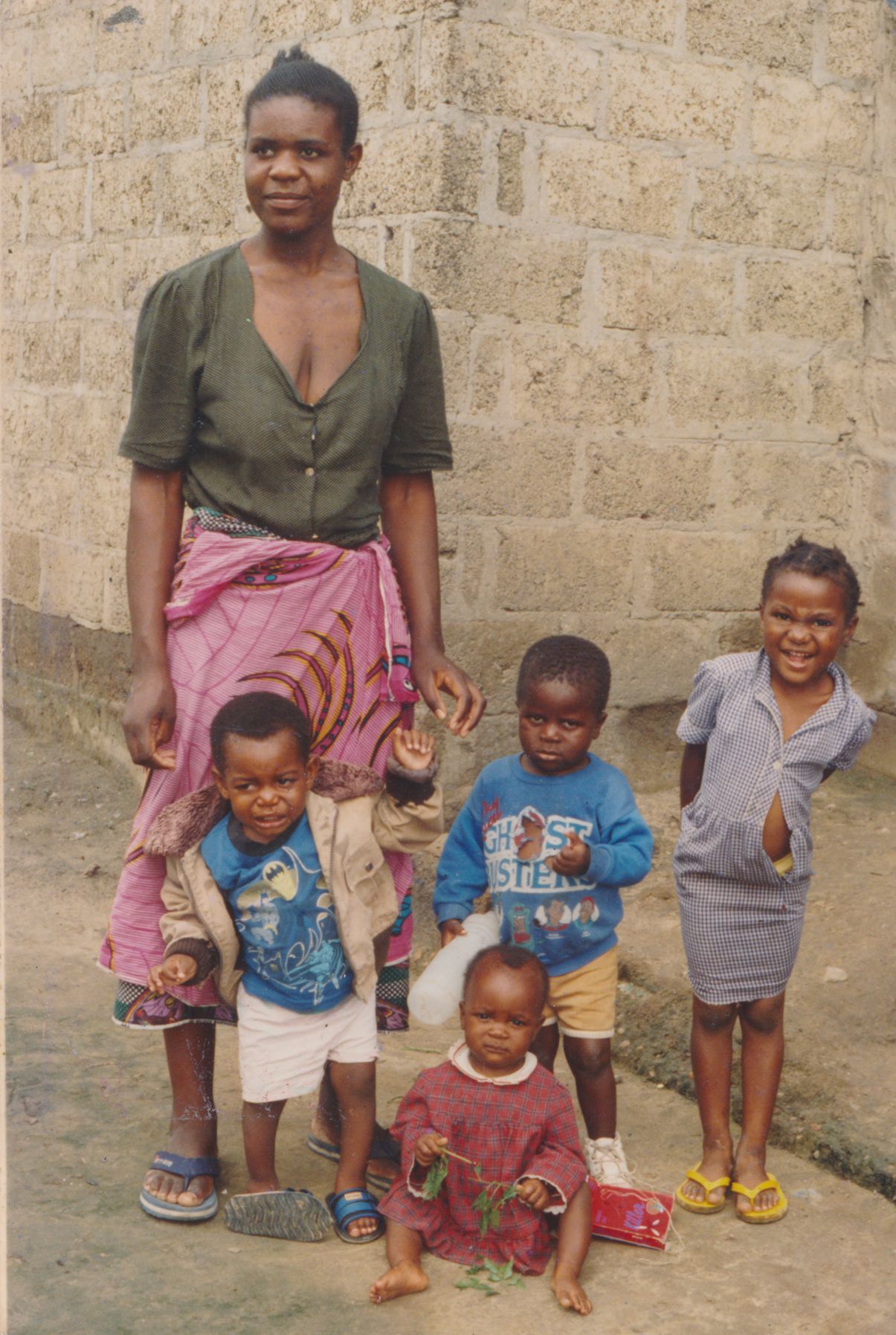
Adolphine in the Meheba-camp in Zambia.

She explains that the enormity of this remarkable woman’s loss was due to the First Congo War during which Mobutu Sese Seko’s ruinous reign destroyed innumerable lives. “Probably only my work with people in crisis made it possible for me to take on such an onerous task, albeit with the utmost respect and sensitivity.

“Misekabu immediately agreed when I initially approached her. The problem of re-traumatisation was always foremost in my mind, but slowly we pieced together her story, because there were times when I needed to do extensive research regarding the history of the times she lived in as a Kasaian, and a member of a family which was persecuted by Mobutu’s army and the factions which supported him.

“Her enduring love, especially for her dead father shone through all our interactions. Nkudimba’s name means ‘man of peace’ was a trained doctor, an internationally recognised artist and a leading politician in opposition to Sese Seko, who had disappeared mysteriously months before she and Sepano had to flee Lubumbashi in 1976.

“Our interactions over four years, with a few intermissions when I had to earn my daily bread, were of course often emotionally draining for me. Undoubtedly these intermissions gave her respite from verbally relating her memories. However, she expressed that our work together had had a healing effect on her. But of course that is an ongoing process,” Neethling stresses.

The impact of reading  her story is one of admiration but also trying to understand why such a gruelling journey, probably the toughest you could ever make on every level possible, is turned into even more of a nightmare because of the impossibly difficult hoops refugees are asked to jump through when applying for the necessary status.

Neethling explains that there are organisations which assist refugees as best they can, but the process to obtain refugee status is gruelling, shared with migrants, persons who have come to South Africa ‘in search of a better life’, some whose goal is to be resettled in an overseas country of their choice.

“The Department of Home Affairs needs to deal with applications to become, first, an asylum seeker, secondly, a recognised refugee and, if it is the final goal, to seek permanent residency. The road to the latter is arduous, very long and not easily achieved.”

And she explains further: “The ‘refugee question’ is convoluted and many refugees become desperate. Some do ‘fall through the cracks’ or remain in the country illegally. Refugees often speak of corruption during their efforts to remain in South Africa. Our country has also had its fair share of troublemakers among these ‘immigrants’ or ‘foreigners’, as they are often called, and those who turn to crime, just as one would find in most groups of people.”

Add to that xenophobia which Neethling describes as a universal problem and based on the difficulty diverse groups have of accepting the ‘otherness’ of people who are strangers to the ways of their adopted country. “Lack of respect for human rights, an absence of tolerance, the burning issue of scarce resources and jobs play a huge part in the cruelty on which xenophobia is based,” she notes.

And how is the family doing now? In many ways fortunately after many years of unthinkable hardship and miraculous survival, three more children were born to Adolphine and Sepano.

Adolphine with her brother Joseph who finally has also received his residency papers.

There was much distress when her young brother, Joseph (five when she fled Lubumbashi with her baby, Ilunga, as a 22-year-old woman) was not granted permanent residency with the rest of the family through some bureaucratic error, but after persistent efforts, he is now also a permanent resident.

But that doesn’t mean their lives aren’t still a daily struggle. Despite being a permanent resident, finding stable work is difficult for this warrior woman. “As a strong, confident woman, a trained teacher, she should in my opinion have more employment opportunities. But as it is, she plays a significant part in assisting refugees and in helping local communities to accept refugees,” Neethling says.

She concludes that the world has in many ways become a perilous place, especially during the Covid-19 pandemic and the effect it has on people and the economy. “My hope for the future is that people will stand up for and support basic human rights. All of us have agency – even the most humble among us. Tolerance and a word of kindness to someone ‘at sea’ in their desperation can go a long way in alleviating distress and even open the door to hope of acceptance – and a good life.”

And as a final word: “The journey with Adolphine started in 2010. Writing her story was an experience I wouldn’t change for the world. However, I always knew it would be difficult to find a publisher, because it is nonfiction, although a memoir in many ways, because most of her story is told in her own words. Further, the book isn’t about a famous person or a politician. Therefore, much of the time it took before I held the book in my hands was harrowing.

I have Unisa Press to thank for believing in Escape from Lubumbashi. When all’s said and done, it is in many ways a life’s work that has become an integral part of my very being.”

And in this time when millions in the world are either refugees or displaced people, all of us have to understand exactly what that means.

At a price of R137, the book can be ordered from Emily Monyai at monyaen@unisa.ac.za or from Johannes Morodi at morodjm@unisa.ac.za.

THE BEST TIME TO ESCAPE INTO A WORLD OF WORDS – PLAYFULLY SOMETIMES WOEFULLY PUT TOGETHER BY WIZARDS – FOR US TO DREAM

IF THERE ARE ANY POSITIVES IN THIS TIME OF PANDEMIC, IT IS THE DETERMINATION OF THE WORLD TO GET VACCINATED AS WELL AS THE TIME IT HAS ALLOWED SOME OF US TO CATCH UP ONOUR READING. HERE IS A MIXED BAG REVIEWED BY DIANE DE BEER… WITH MORE TO COME SOON…

KLARA AND THE SUN BY KAZUO ISHIGURO (FABER):

If, like me, in these isolated times youhave been listening to podcasts on books and authors, it would have been tough avoiding Kazuro Ishiguro interviews talking about his latest book, with one also surfacing on DStv’s BBC World.

Klara and the Sun is an intriguing novel and that’s equalled by some of the author’s insight into his own work. He never talks about robots but instead refers to Klara as an AF (artificial friend), with the friend part being that she was specifically created to serve as company for a teenager – which I suspect is perhaps not the easiest thing to be.

For Ishiguro it was about looking at the future through the eyes of an artificial friend who is watching and listening to the people in her/his environment and reacting to their behaviour. And naturally, this is also the way the author can explore certain types of human behaviour in this imagined world he has created. Something he loves doing.

Quoted on the back cover of the book: “Do you believe in the human heart? I don’t mean simply the organ, obviously. I’m speaking in the poetic sense. The human heart. Do you think there is such a thing? Something that makes each of us special and individual.”

And perhaps more than anything, it is this idea about being special and individual that drives Ishiguro in this particular story. He always dives deep in his novels to scratch almost microscopically at specific human conditions and here he is also looking more closely at gene editing specifically.

Once you start fiddling with who you want to bring into the world, we’re talking about a race that might all have similar characteristics – and who decides what those might be? And who would love to live in an homogenous world like that?

But also, what makes humans so fascinating is their flaws and what they do with them. Choices – for those privileged enough to have those – are what most of our lives are driven by and whether we make the right ones. But for whom?

And typically Ishiguro, while he does concede that this novel offers “pathetically futile hope”, he has no solutions or comments on what he thinks about particular problems. He is simply guiding you down a particular road and asking the questions, hoping to make you think.

What is left unsaid (and these silences, he says, are as much work as what has actually been written) is often where he wants you to play with your imagination and hopefully in this way his other desire is allowed to prosper – that the novel lingers and lingers.

And while he is playing in the future, it is one that is plausible. With everything happening in the AI world, much of what he is writing about isn’t far-fetched. Just think of the pandemic, for example, and fully automated restaurants or the speed at which everything medically is happening.

So as Klara stands in the shop window watching the people go by, her observations might just echo those of the people who made her, but once that is fiddled with, how far can we go? That’s why the question –  poetic as it might be – about individuality becomes important and quite scary.

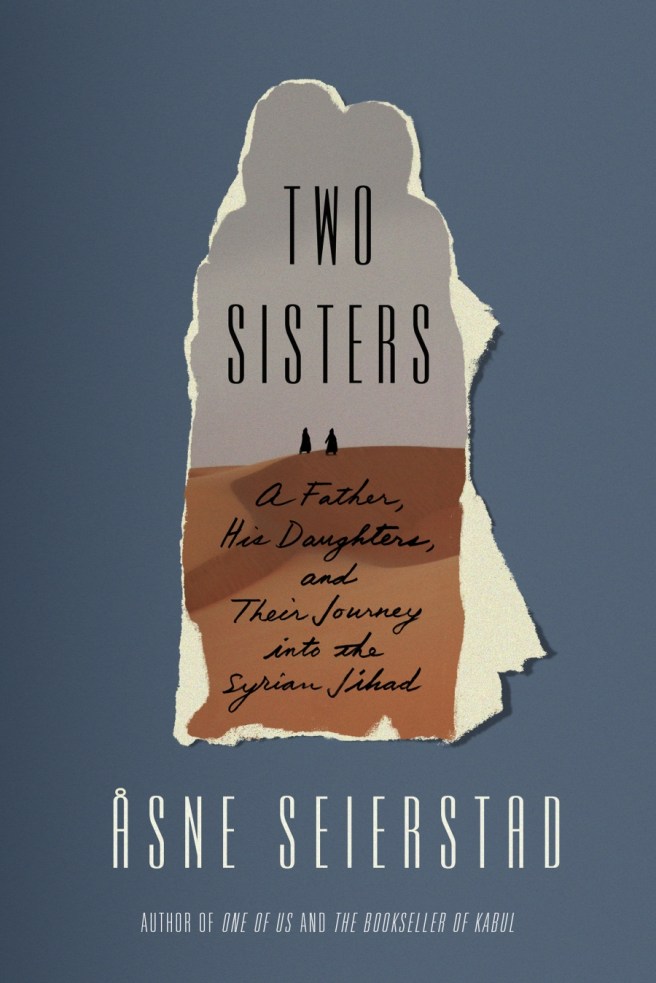
TWO SISTERS: INTO THE SYRIAN JIHAD BY ÅSNE SEIERSTAD (TRANSLATED BY SEÁN KINSELLA) (VIRAGO):

The previous book I have read by this author, One of Us, was about the massacre of young Norwegians, which was also turned into a film. While I found it fascinating, like reading a documentary (which is what it is), I also thought that it could have done with some editing as some things were dealt with in such detail it felt almost as obsessive as the shooter. Perhaps that was exactly the point.

Yet it also showed that Seierstad is a remarkable journalist and her attention is drawn to events that affect especially her own society.  Because of their seemingly successful country, the story and how it unravels reaches across borders and nationalities in a way that captures the terrifying modern world we live in.

Think, for example of Syria, and what has been happening in that country these past few years. For quite some time it dominated headlines, starting with the Arab Spring, but with Covid, you hardly hear anything more about that failed state, which seems to have collapsed. Not only in their world but also in the eyes of those of us who pay attention to what is happening in the world.

Dying has been happening all around us and those embroiled in particular struggles starting pre-covid seem to have taken a back seat – like Syria.

As the title explains, Two Sisters deals with two siblings who travel to Syria to participate in the jihad. And a father sits drinking tea and thinking about his two young daughters. Who would even have imagined that they would want to wage jihad?

In October 2013, teenage sisters Ayan and Leila Juma leave their family home near Oslo. Later they send an email to their family confessing that they are on their way to Syria. They had been planning their “escape” for months –  in secret.

 Think of any family and what they would do if two young children decide to go to a war zone where they join ISIS, at the time and still regarded as one of the most deadly groups operating in what they view as vacuums in many different countries.

While Ayan and Leila’s father decides to follow them to try and bring them back home, by the time he reaches Turkey they have already crossed into Syria. Their story is followed through email and phone contact with the family, who worked closely with the author.

What turns this into such a fascinating read is not only the journey of the two girls and the family tragedy that unfolds as lives are shattered, but also the detailed story about Syria. What is unfolding in what started as part of the Arab Spring is still in progress with no end in sight.

Anyone just watching who says they know what is going on in that tragic war is probably delusional, but at least when reading the tale of these two young women who hope to find a future with men they have never met, embroiled in what some consider a holy war, throws some light.

I just remember watching the fall of Aleppo  ̶   at the time the largest city in Syria being turned into rubble. And when you read about the father crossing into Syria from Turkey and how the family’s funds were being wiped out, another tragedy is playing out just on this border. As with all war, someone is making money.

One can only read in horror as these two young women set a series of events into motion. How could they not? What family does just allow their daughters to slip away …

But that’s the world we live in.

DIE DAO VAN DAAN VAN DER WALT BY LODEWYK G. DU PLESSIS (TAFELBERG):

If you’re steeped in Afrikaans literature, you’ve probably read this one, which won among others the UJ Debut Prize, the Eugene Marais prize; the WA Hofmeyr Prize; the ATKV Prosa prize and the kykNET-Rapport prize for fiction. He didn’t leave much for anyone else in 2019.

But I came to it late and only then discovered that the author was writing under a pseudonym, but had revealed who he was when becoming a serial winner of many of the book prizes available locally.

He fooled me in many different ways, the first being that I so fell for his description of Daan that I didn’t want to read further. It not being my favourite kind of man, I mistook the character of Daan for that of the author. Took me a while and a sheepish grin … I have done this before when something is one of my personal bugbears, so much for objectivity.

Nevertheless, I fortunately spotted my feet of clay and made a u-turn. The language was the thing that initially grabbed me. It’s something that has been popping up all over the show in Afrikaans literature and I’m no specialist in this particular genre, but when a book makes strong enough waves, I jump.

Those fearing for the loss of their mother tongue need not fear, it has been given wings, I suspect –  slowly but surely. Readers especially those as sporadic as this one, are reaping all the benefits. Because it is such a young language still, it has always been the playground of the creatives and gloriously so. It is wonderful to experience the celebration!

But back to Daan, the title is actually your guiding light as it tells you that we are going on both a physical and spiritual journey as the ageing widower and father of two sons reviews his life and the people who were a part of his daily existence – amongst others his wife, whom he starts writing to.

Before too long, this reflective debut novel worked its magic and the praise heaped on it came as no surprise. So if you don’t want to miss out on the important stories that emerge from our country, this is one of them and a most novel and invigorating way of reflecting on a life.

NIGHT FEEDS AND MORNING SONGS – HONEST, FIERCE AND BEAUTIFUL POEMS ABOUT MOTHERHOOD COMPILED BY ANA SAMPSON (TRAPEZE):

With no children of my own and way past my sell-by date, I was stunned that the publisher thought I was a candidate to review this one, but on closer reflection and paging through the book I saw some method in the madness.

The  compiler/collector probably says it best:  “Poetry was a luxurious comfort to me during the newborn days when my bone-deep exhaustion rendered reading a novel a wild and distant fantasy. It was something I could gulp down during a night feed, or while liquidising a blameless vegetable. These poems granted me windows into other dark bedrooms and, when I read about infant-speed toddles, I could see something of our own haphazard progress reflected there.

“As the years passed, I squirrelled away more of these verses. In the company of these poets, I could forgive myself the piled laundry, the toast-for-tea, the not-now-I’m-busy’s and the school-run screeching.

“They helped me to approach some of the tender feelings often buried under the avalanche of weaning and wiping, cheering or chivvying, and give them a moment – those quiet moments that are for some years, so few and precious – to be felt.

“These women invite us into their homes and their hearts, and we understand ourselves- and this deep, wild, ever-evolving bond – better for hearing the voices.”

All of us, with children or without, have had those periods of time where nothing you do gives you enough time to catch up. And especially for young mothers, this is a soft reprieve embraced with the words of other worthy souls, who share their innermost thoughts about something those reading have experienced or might in the future. It’s a great idea. I would have liked a touch more diversity and yet, now we know the gaps, we can look for something to augment that. Or perhaps a local poet or lover of poetry can compile that book, which speaks from all corners of our country and show what we mean by diversity!