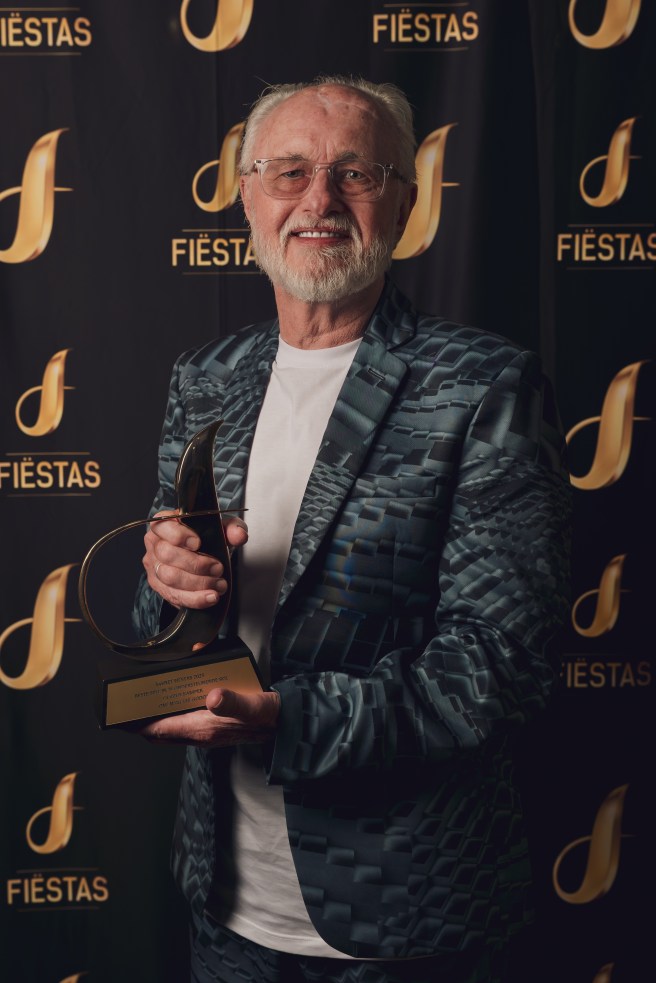
Awards can mean nothing or EVERYTHING. It really depends on each individual and perhaps the most important ingredient is to witness especially the individual artists when they get over their surprise, gather their thoughts and express their wonderment at receiving such accolades.
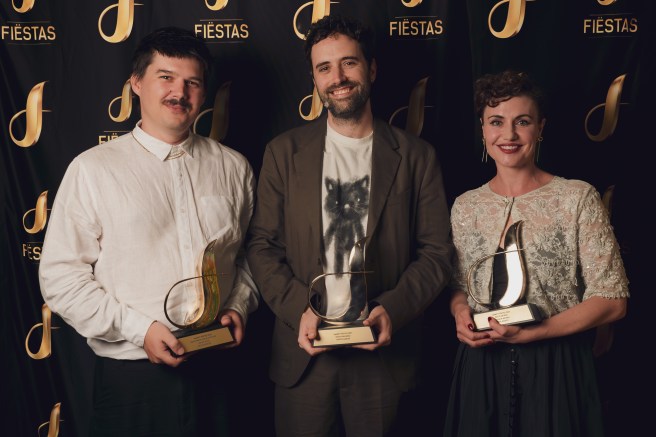
Rocco Pool (Best Design), Christian Olwagen, (Best Festival Production), Rolanda Marais, (Best Actress) all for Hedda Gabler.
Astonished yet astonishing actress Rolanda Marais perhaps captured the moment best when she reflected on the 17-year-old schoolgirl she had been and how she would have experienced this achievement.
It’s one of the most vulnerable yet vibrant careers to choose, as your whole life is always dependent on the vision of others. If a director selects you, if the play is one that shows you at your best, if the audiences come, if they like the play and the cast and the list is endless.
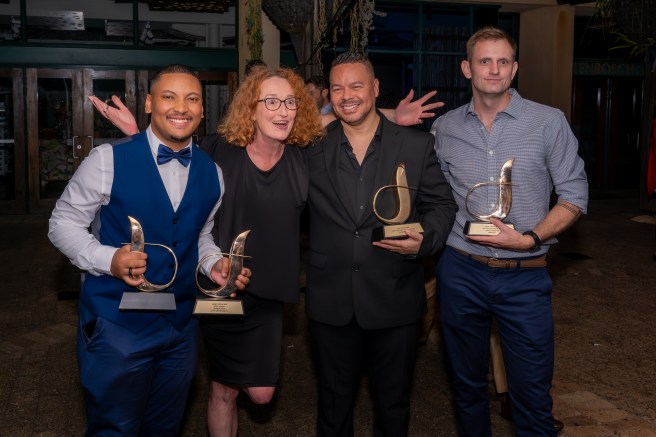
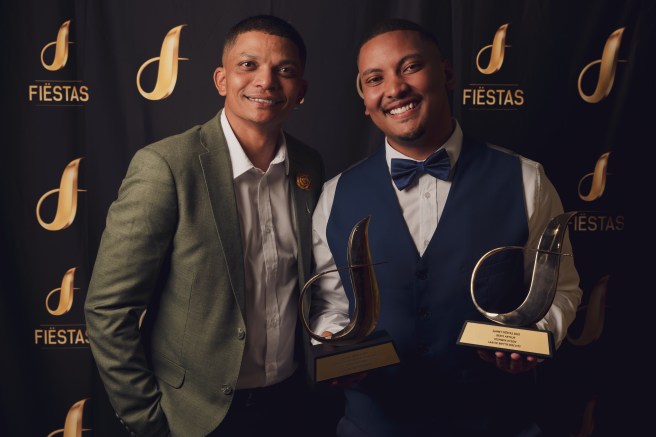
Aardklop Fiësta winners: Joshwin Dyson (Laaitie mettie biscuits for Best Upcoming Artist and Best Actor), Artistic Director Alexa Strachan, Conroy Cupido, (Best Achievement in Classical Music for Die groot Finalé) and Philip Rademeyer (Stinkhout for Best Text ).
And yet, time and again, the actors put themselves on the line and out there to hopefully change the world for some in the audience. They probably do it more than they give themselves credit for and I have often been in awe of what they manage to achieve with too many obstacles for anyone to deal with, let alone create magic.
The Fiëstas panel attended every debut production at seven arts festivals (KKNK, Suidoosterfees, Innibos, Vrystaat Kunstefees, Klein-Karoo Klassique, Momentum Beleggings Aardklop and Toyota Stellenbosch Woordfees) last year. Following an extensive voting process audited by auditors, the winners in 14 categories were determined and announced at the end of last month at a glamorous awards ceremony held at the Kirstenbosch National Botanical Garden in Cape Town.
kykNET also announced that the kykNET Fiëstas will have a new home. After 15 years of management by kykNET, the Tribuo Trust will now coordinate the Fiëstas, with kykNET taking on the role of naming sponsor.
“The decision was made so that the kykNET Fiëstas can continue and flourish as a vibrant celebration of the arts in Afrikaans. kykNET remains the main sponsor and naming sponsor of the Fiëstas,” said Waldimar Pelser, M-Net Channel Director of Premium Channels.
“In discussions with the festival directors, kykNET emphasised that we will strengthen our support for the arts festivals in a way that we hope will also make the festivals more sustainable. We look forward to reimagining the new kykNET Fiëstas together with Tribuo and are excited about the road ahead.”
Karen Meiring, Executive Chairperson of Tribuo, said: “It is an important objective of Tribuo to invest in the future and the sustainability of the entertainment industry’s ecosystem. The kykNET Fiëstas seamlessly align with this goal as the awards recognise and celebrate excellent work. They also encourage crucial audience engagement and honour the people who carry the performing and creative arts. Tribuo looks forward to continuing this project together with kykNET, who remains the naming sponsor.”
The winners are:
BEST ACHIEVEMENT IN CLASSICAL MUSIC
Die groot finale (Momentum Beleggings Aardklop)
BEST CONTEMPORARY MUSIC PRODUCTION
kykNET-konsert (Innibos)
BEST MUSIC-DRIVEN THEATRE
Ontban (Suidoosterfees)
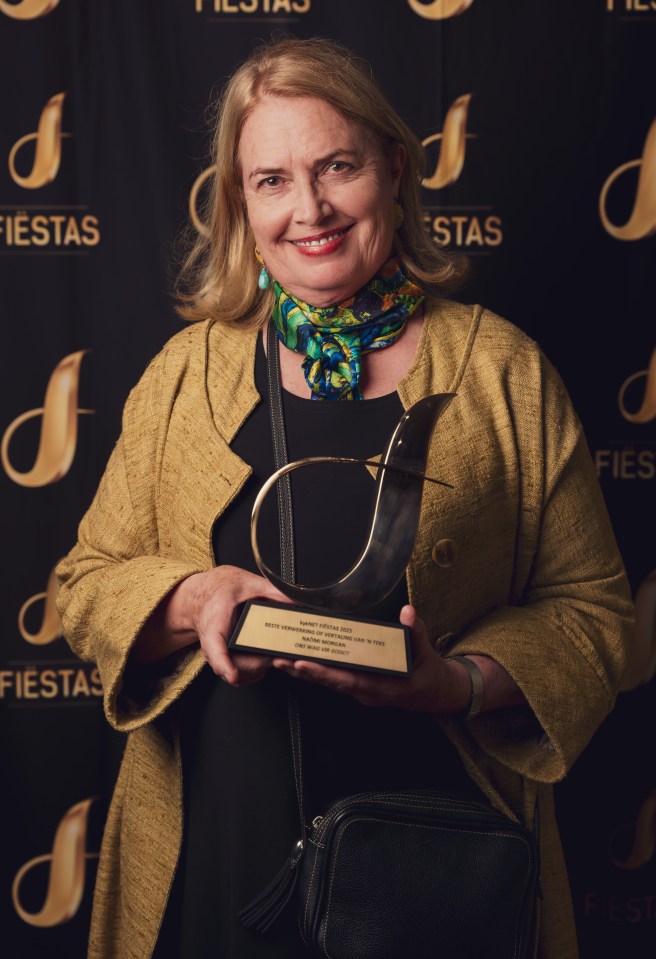
BEST ADAPTATION OR TRANSLATION OF A TEXT
Naòmi Morgan – Ons wag vir Godot (Vrystaat Kunstefees)
BEST NEW TEXT
Philip Rademeyer – Stinkhout (Momentum Beleggings Aardklop)
BEST ACHIEVEMENT IN VISUAL ARTS
Marlene Steyn – Between my i’s: tussen my oë (Toyota Stellenbosch Woordfees)
BEST ACHIEVEMENT IN DESIGN
Rocco Pool – Hedda Gabler (Toyota Stellenbosch Woordfees)
BEST ACTOR IN A SUPPORTING ROLE
Gerben Kamper – Ons wag vir Godot (Vrystaat Kunstefees)
BEST DIRECTION
Dion van Niekerk – Ons wag vir Godot (Vrystaat Kunstefees)
Joshwin Dyson (right) with his playwright/director Christo Davids
The winner of the Blou Fiësta, awarded for commendable work that does not fall into any of the other categories, is the Suidoosterfees project 21. In celebration of the festival’s 21st anniversary, 21 productions were staged, each lasting 21 minutes with a ticket price of R21.
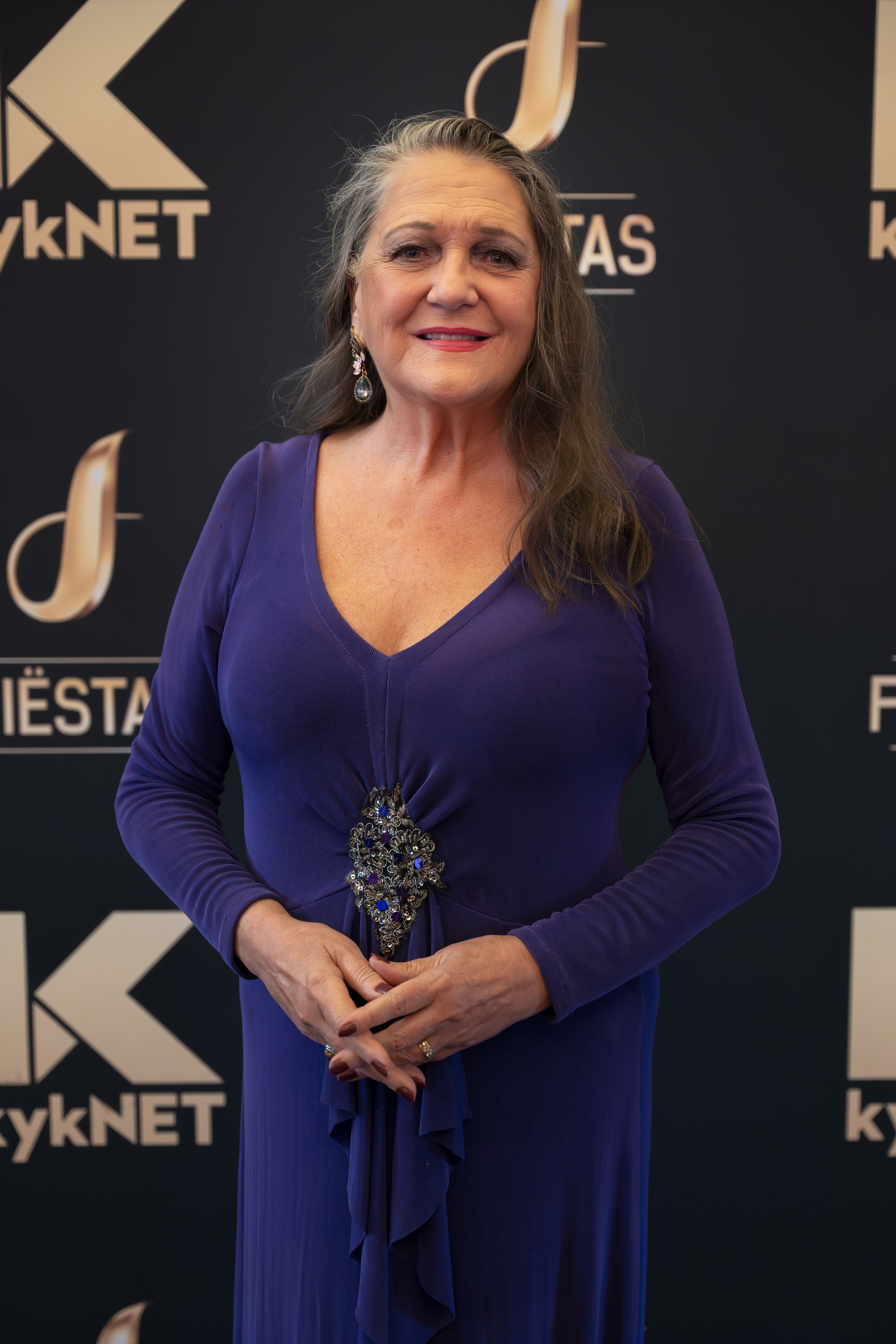
Amanda Strydom and Frank Opperman were honoured for their contributions to the arts.
CAST: Stuart Brown, Léa Blerk, Charlie Bouguenon, Keely Crocker. Kent Jeycocke, Shelley Lothian, Ntshikeng Matooane, Arno Meyer, Sharon Spiegel Wagner, Michael Stray, Justin Swartz, Lucy Tops
SET AND LIGHTING: Niall Griffin
MUSICAL SUPERVISOR: Charl Johan Lingenvelder
CHOREOGRAPHER: Louisa Talbot
SOUND DESIGNER: David Classen
RESIDENT DIRECTOR: Shelley Lothian
DIRECTOR: Greg Karvellas
Producers: Showtime Management and How Now Productions
VENUE: Montecasino Teatro
DATES: Until 13 April
PICTURES: Daniel Manners
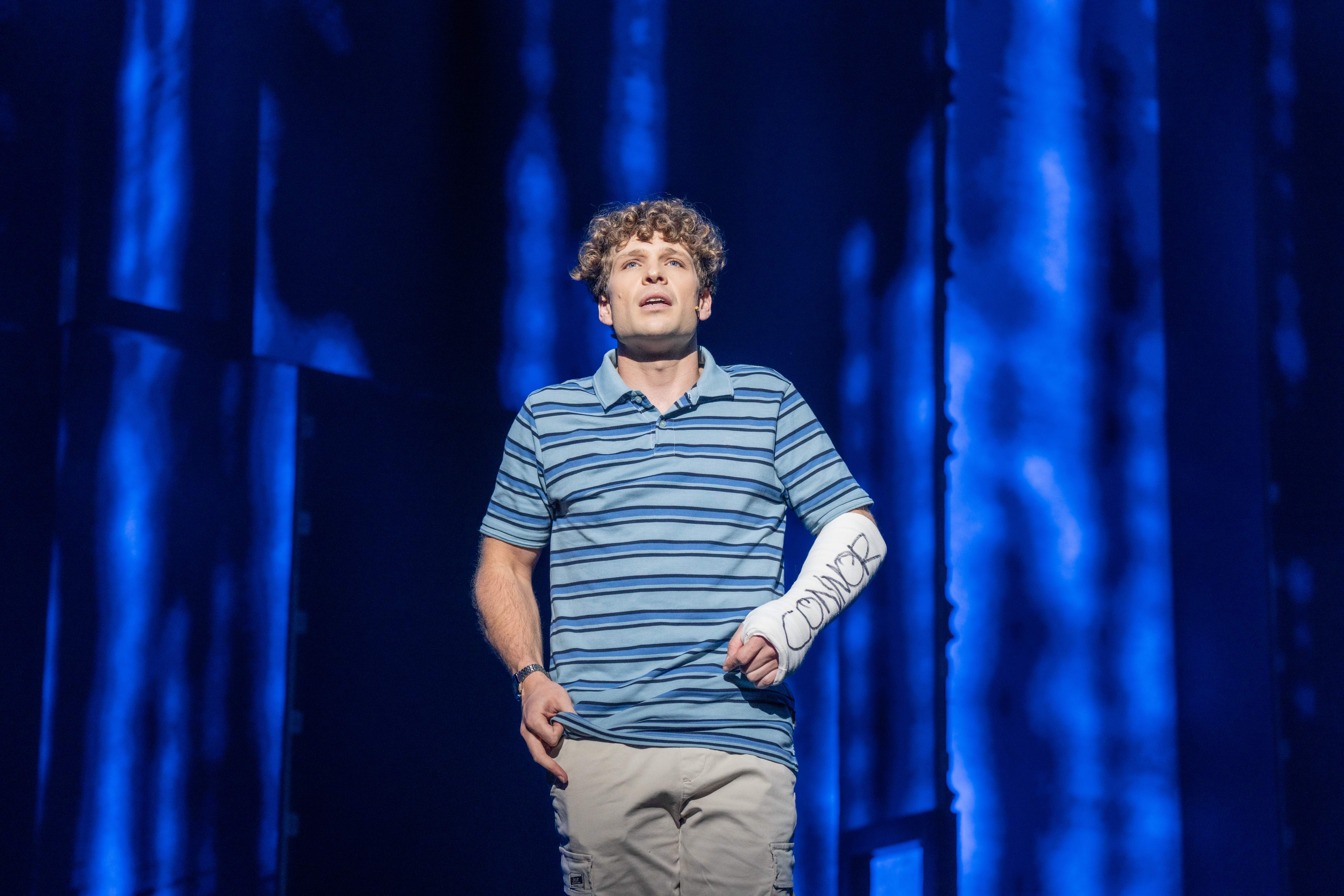
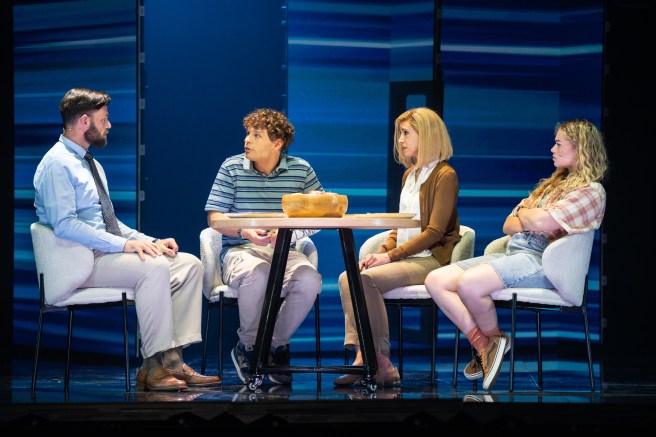
Charlie Bouguenon (Charlie Murphy), Stuart Brown (Evan Hansen),Sharon Spiegel Wagner (Cynthia Murphy) and Keely Crocker (Zoe murphy).
WHAT struck me instantly while watching this musical was that being young a few decades ago was much easier.
No social media, less scrutiny, much less peer pressure because it had to be done person to person rather than through technical means or phones – it was just a much simpler and less stressful life.
What young adults have to contend with at that vulnerable age when you start transitioning into adulthood is quite monstrous. One would think that the huge physical upheaval would be enough to deal with, but now there’s so much more.
It’s a musical with an intimate if weighty story as it deals with depression and hiding from the world at a time when you should reach out rather than go into hibernation, yet it has huge heart.
It’s not often that musicals deal with mental health issues especially targeting teen and young adult audiences, who are particularly vulnerable. These aren’t issues readily discussed and this offers an amazing opportunity to ignite sensitive conversations.
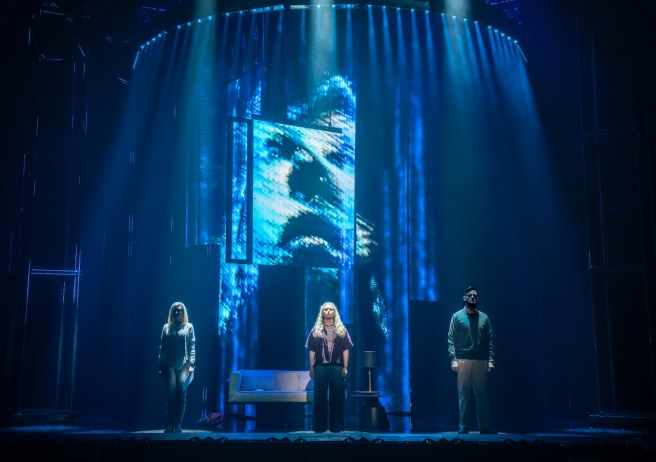
Griffin, who is known for his ingenious designs, has hit the brief spectacularly. It’s all high-tech and could be quite alienating and overwhelming but also allows for the cast to flow in and out of the grand and gleaming structure (above) quite seamlessly.
It also allows the high tech environment we live in to dominate and underlines the world we cannot escape – even if that is exactly what Evan Hansen is trying to do.
That is the genius of the musical. It all feels quite overwhelming, almost as though you have to fight your way to the heart of the story, yet this is where the magic lies. At that centre is a timid and rather terrified young boy who can hardly get out from under the covers.
His way of communicating is to write letters to himself, hence the Dear Evan Hansen title. Many people, young and old, could identify at some stage in their lives with his struggle of dealing with life. His is the universal struggle to be seen.
His mother, a single parent, is so stretched to keep them afloat that she hardly notices her son or witnesses any of his anguish. He feels he has no one to turn to until an incident allows him to find a different persona and a family to hook onto.
This particular production has been gifted the perfect package in Stuart Brown, who engages with the audience and embraces his persona in the title role of Evan Hansen. The way he commands the stage and fills the auditorium with an emotional sensitivity that’s quite astonishing in such a huge space is extraordinary.
There’s nothing showy or superfluous in his approach to the role, he simply is Evan Hansen, which draws even those few souls – including myself – who don’t instinctively engage into the angst-ridden universe of a teenager whose whole being is fearful of the outside world.
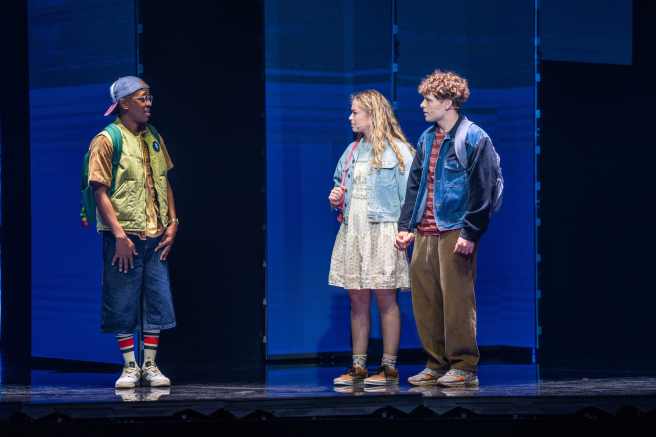
Justin Swartz (Jared Kleinman), Keely Crocker (Zoe Murphy) and Stuart Brown (Evan Hansen) in conversation.
That and the music written by an experienced team of songwriters, Benj Pasek and Justin Paul, who are best known for their Oscar, Grammy and Tony-winning work on La La Land, The Greatest Showman and now this, each of which spawned albums that landed in the Top 10 on the Billboard 200. That’s hard to beat and you could pick up from the audience that many of them knew the music and the lyrics, which would really add to a fuller experience.
There really isn’t much to fault in this production guided by the genius musical instincts of Karvellas supported by Lingenvelder’s music know-how, with a marvellously clever ensemble cast, all with voices that carry the music, it is a story well told.
It’s not just teens but also families that would benefit from the show. Communication, real person-to-person contact and, in this instance parents and children, is the other issue that is explored. These are not traditional topics for musicals and that is what makes this one so intriguing.
It also one of the finest shows to target the teen audience. At their most susceptible to be groomed as future theatre fans, this one ticks all the boxes. There’s a hero who explores and explodes, a story that ventures into almost forbidden territory and a production that unfolds beautifully with many different characters who find what they are looking for, a variety of issues to mine, and for those who want a softer landing, a story of romance.
But more than anything, there’s the glorious music and the explosive performances by an exciting ensemble who push the energy with joyful enthusiasm. You simply have to let go and engage.
Driving back from this year’s pantomime (the children of the kids who first used to accompany me are now my annual companions) I thought it was time that I should write a more personal letter of thanks and admiration rather than the usual review.
Not being at a newspaper any longer and posting on my personal blog, I have the right, I think. Also, between the two of us, you have probably/arguably written and produced more pantomimes than anyone else, definitely in this country and probably out there in the big world too; and I have probably watched and reviewed more than many can claim.
The genre as such isn’t my favourite and you have many other theatrical accomplishments in case anyone should think this is the only thing you do. But because of you, I make a distinction between a panto and a Janice panto, and as I mentioned in the review of Aspoestertjie (currently running in Pretoria), you have raised the bar for anyone who wants to participate in this field.
There isn’t any chance that I would have managed year by year if not for your genius and innovation. Being who you are, I know you would have been bored to death as anyone would have been, if you didn’t set a particular challenge for yourself. And perhaps that was what saved us both.
I was sitting in a packed Joburg Theatre on a Sunday with a show starting at noon and the aircon struggling with the current heat. Watching the audience, there were many kids but many couples or friends without youngsters too. It’s an institution and one you established and nurtured and grew to what it is. Small wonder they don’t want to let you go!
The text, which is always current and probably the thing most cherished by the adults, is as always on the mark with bullies a strong theme. That’s no surprise, but I love the way you wangle to be political without offending anyone.
You always have your finger on the pulse and have managed to work your way with casts which now fully represent the country without too much fanfare, you just did it. And this mirror of our society at a season that has such mass appeal is probably one of your strongest achievements. Few would have managed in such an easy fashion while showing the best of the country without bashing anyone on the head.
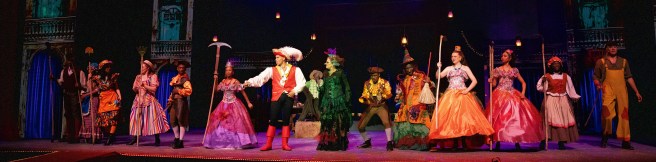
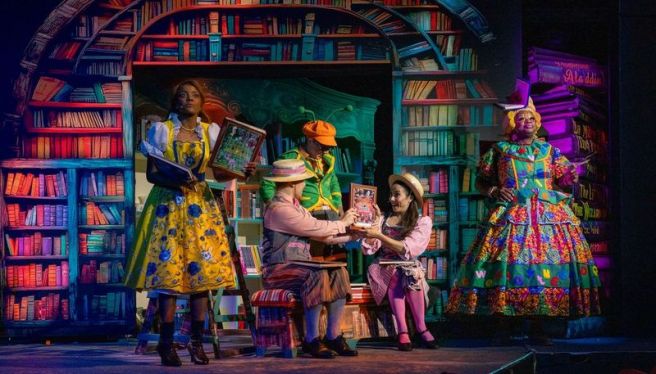
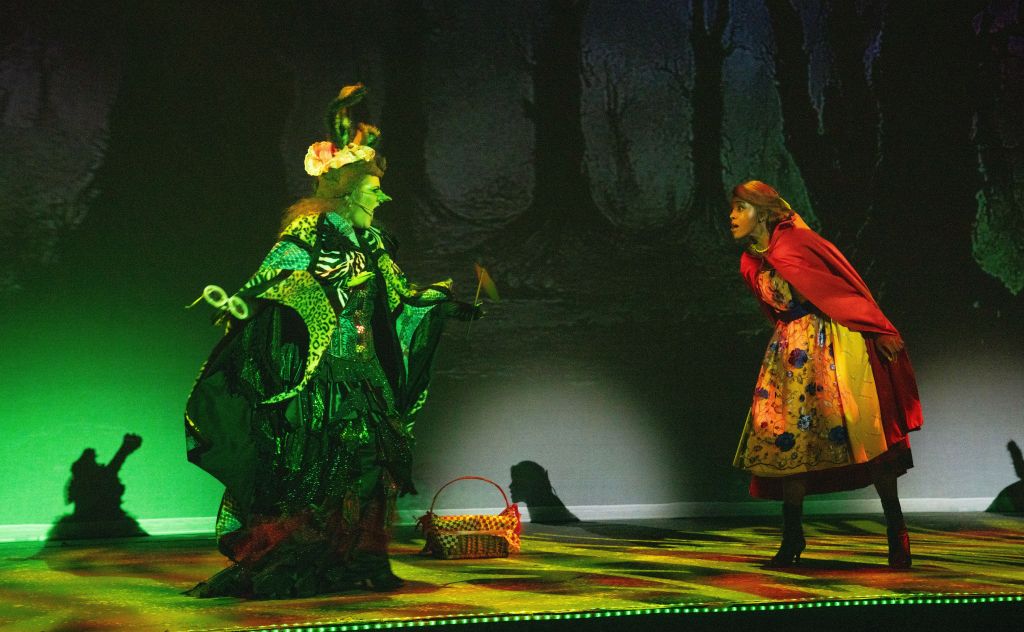
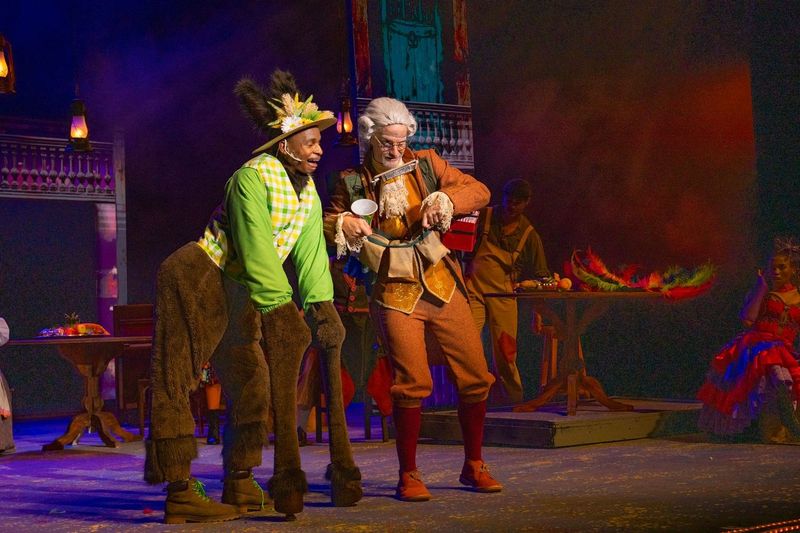
I know this is unfair, but allow me the indulgence. Cast and musicians were fantastic, but there were five that deserve special mention: Bongi Archi (aboveas the Good Fairy (Mama’ama’bali); Virtuous Kandemiri as Beauty-Belle; Judy Ditchfield having an absolute ball as Hectate-Hex, the wicked witch; and Lesedi Rich as Doodlesakkie The Donkey; and lest we forget, Chrissie-Anna Mampoer as the guest newsreader.
Through the decades you have been gifted technological advances, but the wonderment of that is to see how you have applied that in such a wonderful way. This time it’s the way you blend the players from their digital images to the live performers.
Also the sets, the in jokes which some might miss but it doesn’t matter. It keeps viewers on their toes. The six-year-old was curious about some of the adult laughter and that’s also a good thing. There’s a lesson there every once in a while.
I truly loved your Hitchcock moment this time. You managed to display almost all your different skills as well as showing that you’ve still got it – and will always keep forging ahead.
You are an example of a true artist. Someone who could probably have stopped through the years, but you simply cannot resist. For that I’m grateful. Your casting of the young and the old, the experienced and the newbies, each one of them bringing something unique to the stage and the story, also contributes to the success.
Even your choice of Timothy le Roux as assistant director and company manager looks ahead, as you made sure you don’t go without leaving some institutional memory and knowledge behind. If anyone was there to watch and learn it was this artist who started in the arts as a ballet dancer and followed that by crafting and creating his own way on the production side in this very tough profession.
To everyone’s delight, it’s the usual spectacular pantomime, but the reason we could say that time and again from one decade to the next, is you, Janice Honeyman.
And for me to say this about pantomime is all your doing.
Thanks for the magic and the memories!
I don’t have to preach to the converted and for those of you who need to introduce youngsters to the enchantment of live theatre, this is it.
CAST: Afrikaans singer Leah (Aspoestertjie); Marno van der Merwe (Prins Jan-Percy); Carmen Pretorius (stiefma Mevrou Violetta Esterhuizen); Grant Towers en Schoeman Smit (stiefsusters Marabella en Amaranta); Elsje Lourens (Feetjie peetma) as well as Donae Brazer, Duandre Vorster, Jemma Gradwell, Jonathan Raath, Lindi Niemand, Monique Barnard, Rainy van Zyl, Tristin Indigo, Tseamo Mapukata and Zante Marais to complete the ensemble
For the first time in decades Pretoria has a pantomime to be proud of.
Gauteng has grown accustomed to the Janice Honeyman spectaculars at the Joburg Theatre and that is also happening, which meant that my expectations were put on hold when I went to the first preview of this production.
I was also prepared to give them some slack because of the early attendance but it’s a short run and I wanted to get the word out there – especially if, as in this case, it is good.
It’s much better than that. It all starts with the script, which is original and funny – and has some real edge to keep the adults happy while the youngsters get the drift of this thoroughly modern Cinderella tale with many twists and turns.
Add to that a cast that have been rehearsed to within an inch of their lives and there was very little to complain of.
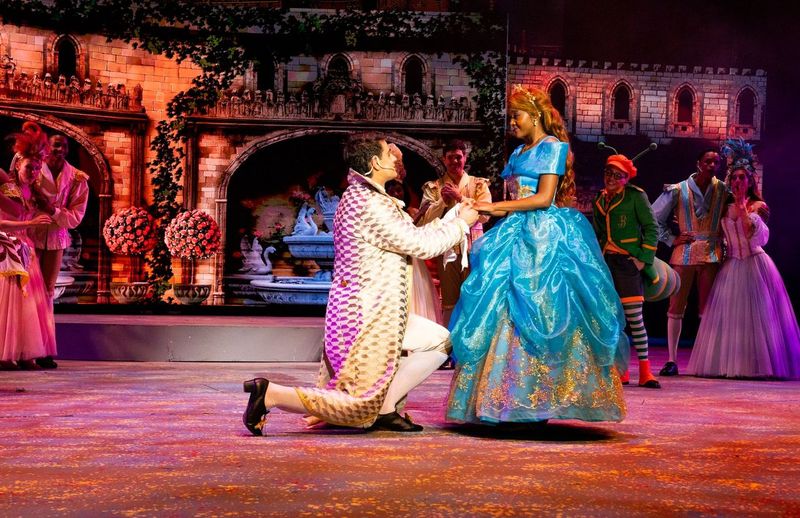
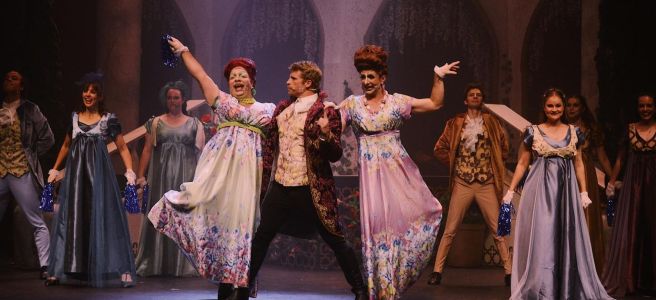
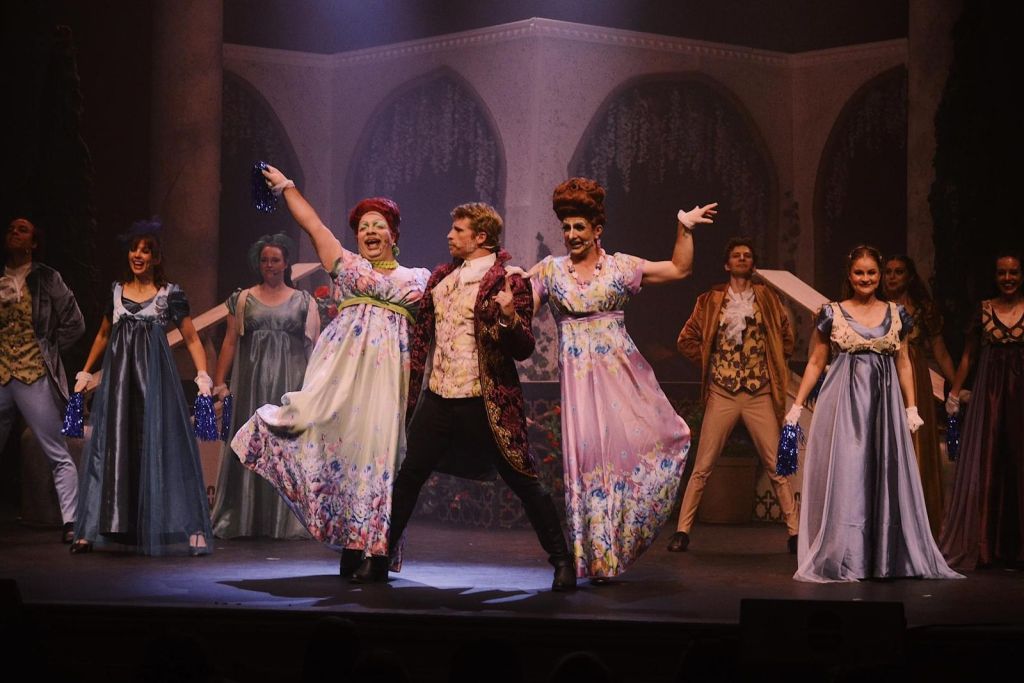
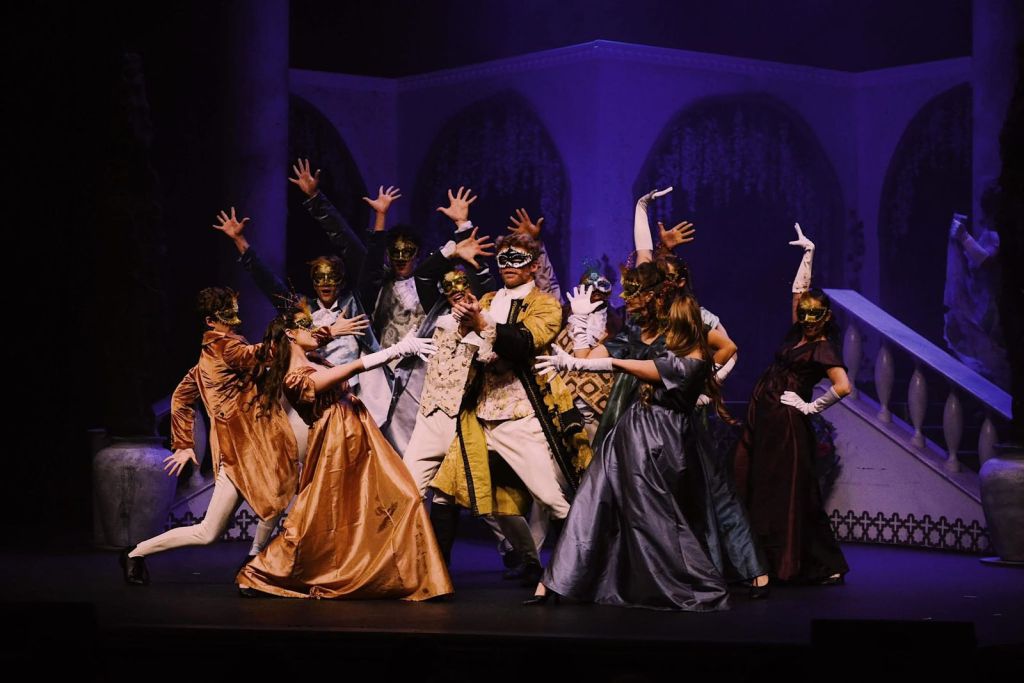
The prince and the two ugly sisters.Let’s all go to the masked ball!
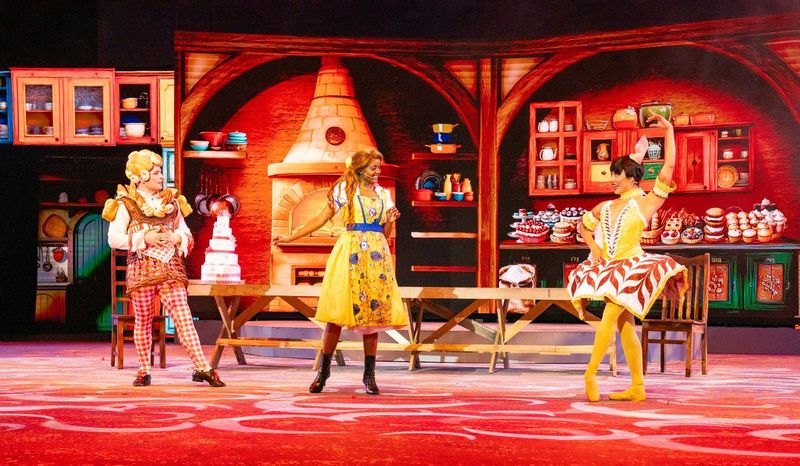
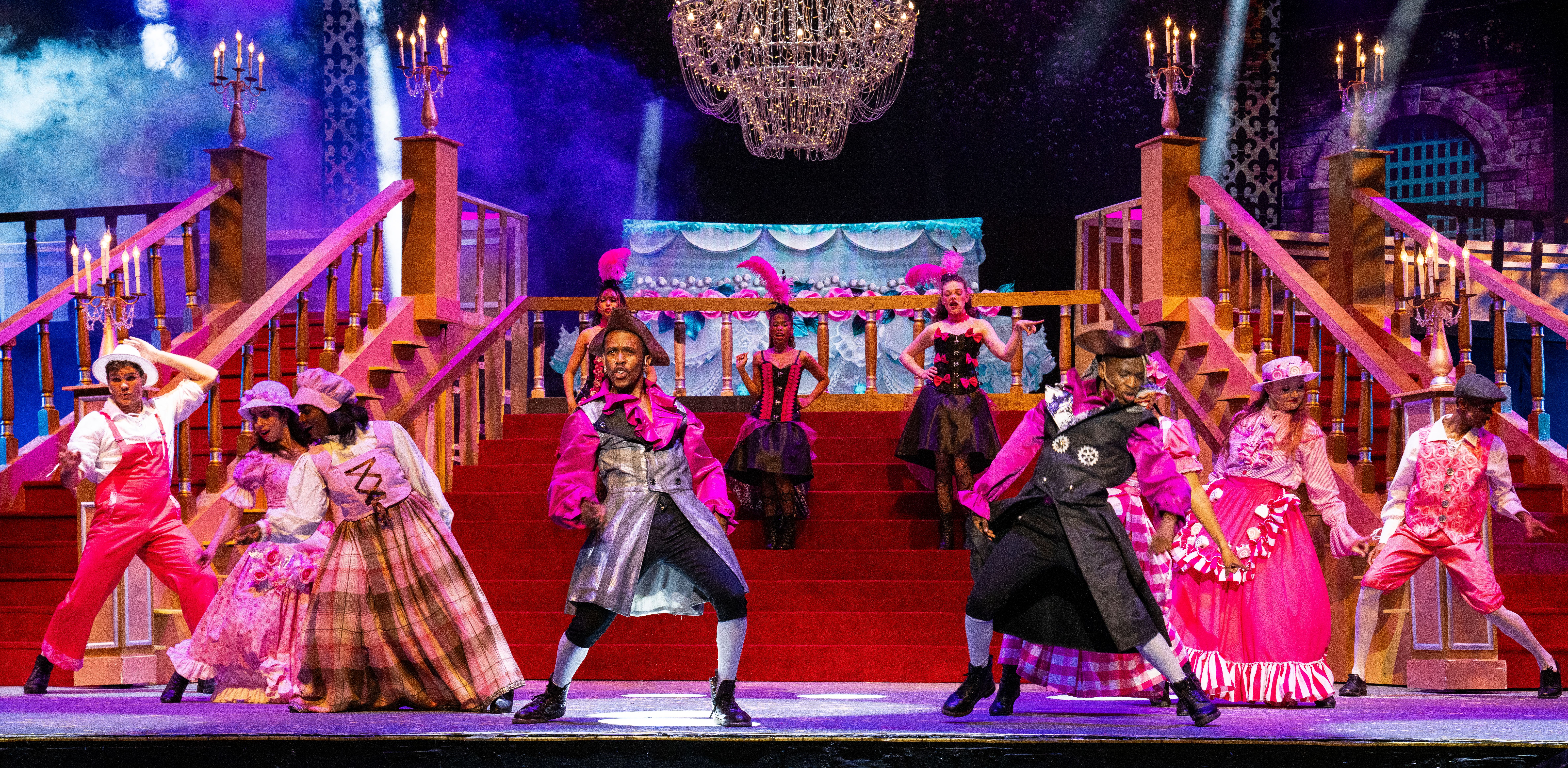
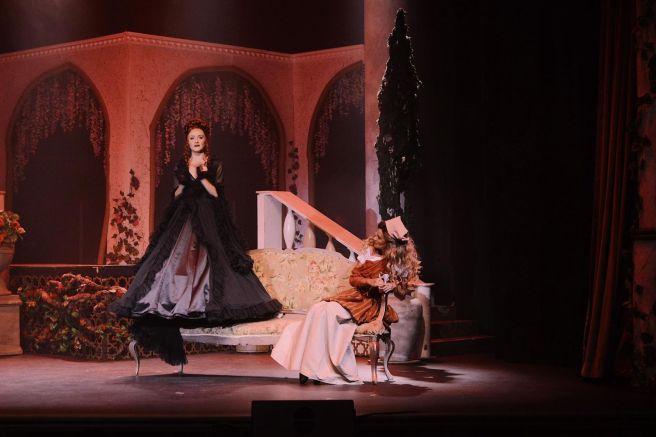
It’s also good to see that they’re prepared to take some chances, like the vibrant, young Elsje Lourens cast as the fairy godmother, Tina Tydreis. She’s the one who has to set the tone and pace of the production and has no problems doing just that. There’s bounce in every move and she immediately engages the audience in her particular telling of this over-the-top tale.
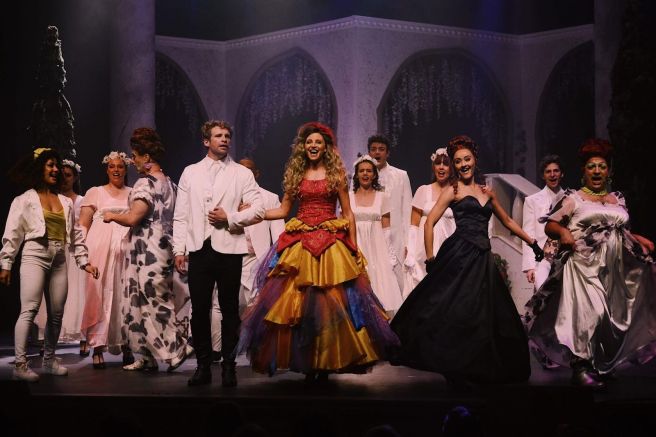
Pantomimes rely heavily on a handful of actors who have to keep everything together. The romantic leads, in this instance Leah and Marno as Cinderella and her prince, have to keep the little hearts racing. I had a youngster right next to me who was terrified she would not witness the final embrace.
With Lourens, the two deliciously decorative ugly sisters (Towers and Smit) and probably the celebrity of the show, Carmen Pretorius as the achingly precious stepmother, they especially knew how to keep the show on its toes and the laughter rolling while playing their parts to the hilt and singing their songs magnificently.
It truly was a treat and I was thrilled that Pretoria finally stood up to challenge their neighbouring city with some panto excellence. I know Ms Honeyman will welcome the competition and she will delight in witnessing the results of the standard she has set other professionals in this particular field.
Pantomime isn’t as easy as it looks. Everyone is having a merry old time but if your cast doesn’t have the energy and elegance to pull it off, the audience won’t engage.
This one did. From the youngsters to a row of elderly women, everyone was shaking with laughter and delight throughout and for me, someone who has seen far too many pantos in her life, the fiesty and fresh approach, and the sheer excellence of the presentation, was a highlight.
It wasn’t that I was expecting to experience doom and gloom, but the standard was unexpected and something that blew me away.
Tseamo Mapukata (as Buttons, centre) has a magnificent voice and the rest of the cast are not too shabby either.
If you have children in the family, gather them and get tickets to join this talented gang in some lovely end-of-year entertainment. There’s not a weak link in sight and I would go especially to hear Tseamo Mapukata who played Buttons sing.
What an exquisite voice. But none of the cast was too shabby.
Let’s hope we hear more from OAK Entertainment in the future, they certainly know how to put on a show!
Three dynamic stars, Ilse Klink, Gina Shmukler and Kate Normington.
CAST: Gina Shmukler, Kate Normington, Ilse Klink, Emmanuel Castis, Matt Newman, Tiaan Rautenbach, Kiruna-Lind Devar, Gianluca Gironi, Ntshikeng Matooane, Sunny Yoon, Chad Baai, Bradley Smith and the rest of the ensemble
SET AND LIGHTING DESIGNER: Denis Hutchinson
MUSICAL DIRECTOR: Charl-Johan Lingenvelder
CHOREOGRAPHER: Duane Alexander
COSTUME DESIGNER: Sue Daniels
SOUND DESIGNER: Mark Malherbe
ASSOCIATE RESIDENT DESIGNER: Timothy Le Roux
PRODUCER: Hazel Feldman, Tony Feldman
DIRECTOR: Janice Honeyman
VENUE: Teatro at Montecasino
DATES: Until June
Kate Normington, Gina Shmukler and Ilse Klink in their ABBA gear with the cast.
It wasn’t that Mamma Mia was the attraction – been there, done that. I was intrigued by the three actors – Gina Shmukler, Ilse Klink and Kate Normington – in the latest production.
Seasoned actors and singer all, they don’t get that many chances in lead roles (there are just not that many starring roles for women once they’re out of their 30s) and I knew this would be a triple threat. These are women with sass who strut when they walk. No shrinking violets here! They would go for this one in unison and grab that stage – as they did, fulfilling my every wish.
Like many musicals, this is also a rather silly if sweet one, but with ABBA’s music, it ticks all the boxes and has an hysterically loyal fanbase, but what I wasn’t expecting were the many youngsters (I’m guessing between 8 and 12!) in the audience.
Kiruna-Lind Devar as Sophie.
Right in front of me were two (again guessing) 12-year-old girls who were totally into the musical from start to finish. At the beginning of each song, they would glance at each other and joyfully sing along – pitch and word perfect! Rather than hinder my experience, I was enchanted by their enthusiasm and it switched me on to the charm of the musical, which might otherwise have felt jaded to this seasoned viewer.
Not for this audience though. When last were you in an auditorium where they were clapping along to almost every song? You cannot but be swayed to lose all your hard-earned cynicism.
Ilse Klink, Gina Shmukler and Kate Normington and the cast.
But back to the show on stage. Can those three women sing – together and individually they rocked and easily generated the star power this kind of show needs. It’s not that they haven’t all had the chance to individually star in shows. But these days, it’s tough to find starring roles for women beyond 40, so when you get them, you’d better make good use of the opportunity.
This is exactly what Klink, Normington and Shmukler do. They know the game and have made full use of this marvellous opportunity. And, like I thought it would, it shows.
They’re directed by another wise and wily artist, Janice Honeyman, who knows all the tricks in the book. And with these three accomplished performers, she would have had loads of fun.
The two lovebirds Gianluca Gironi (Sky) and Kiruna-Lind Devar (Sophie).
They’re well supported by the youngsters, especially the love-struck couple, Kiruna-Lind Devar and Gianluca Gironi, who both have youthful stage appeal and energy.
A personal favourite was the omnipresent, soberly yet strikingly dressed in black, little old Greek lady (Chantal Stanfield), who is a constant presence as she pops up in almost every scene, for no other reason than confirming we’re on a Greek island. This lovely throughline stays amusing, if not relevant to the story.
Tiaan Rautenbach, Emmanuel Castis and Matt Newman as the three Dads.
If you don’t know the story of the young woman who hopes to recreate her mother’s romantic dream and in the process also discover the identity of her birth father, don’t delve any further.
Check the colourful pics, see if it looks like your kind of thing, gather the family or a group of friends and make a night of it.
Chad Baai, Ginaluca Girona, Bradley Smith and the Mamma Mia male ensemble.
Think of titles like Dancing Queen, I have a Dream, Lay all Your Love on Me, Mamma Mia (of course!), Super Trouper, SOS, Our Last Summer, Take A Chance on Me… and many more.
Even if you don’t consider yourself a particular fan, I bet you can sing along to most of these songs. That’s what their music is ultimately about … and so is this musical.
And this time there’s extra punch with these three dynamic dames. They are what makes this show swing.
The ensemble wih the love-struck couple (Scarlett Pay and Dylan Janse van Rensburg) in the front.
REVIEW BY DIANE DE BEER
Pictures: Claude Barnardo
SPRING AWAKENING
Based on the play by Frank Wedekind
Books and lyrics: Steven Sater
Music by: Duncan Sheik
Featuring: Dylan Janse van Rensburg, Scarlett Pay and Jonathan Conrad with Gemma Bisseker, Killian Blerk, Jude Bunyan, Tatum Grace Coleman, Jayden Dickson, Noa Duckitt, Skye Themeda Goss, Ché-Jean Jupp, Gabriella Knight, Jasmine Minter, Tumelo Mogashoa, Hannah Norcott, Nandipa Nyivana, Benjamin Stannard, Tjaart van der Walt, Gerhard van Rooyen (graduates and under-graduates) and playing the two adults, also former students of LAMTA (The Luitingh Alexander Musical Theatre Academy), Francis Chouler and Natalie Robbie
PRODUCERS: Anton Luitingh and Duane Alexander
LIGHTING, SCENIC AND COSTUME DESIGN: Niall Griffin
SOUND DESIGN: David Classen
ASSOCIATE DIRECTOR AND ASSISTANT MUSICAL DIRECTOR: Anton Luitingh
CHOREOGRAPHIC SUPERVISOR: Duane Alexander
VOCAL DESIGNER: Annemari Milazzo
MUSICAL DIRECTOR: Amy Campbell
CHOREOGRAPHY: Anna Olivier and Naoline Quinzin
STAGE MANAGER: Sarah Wolhuter
DIRECTOR: Sylvaine Strike
VENUE: Pieter Toerien Theatre, Montecasino
DATES: May 5
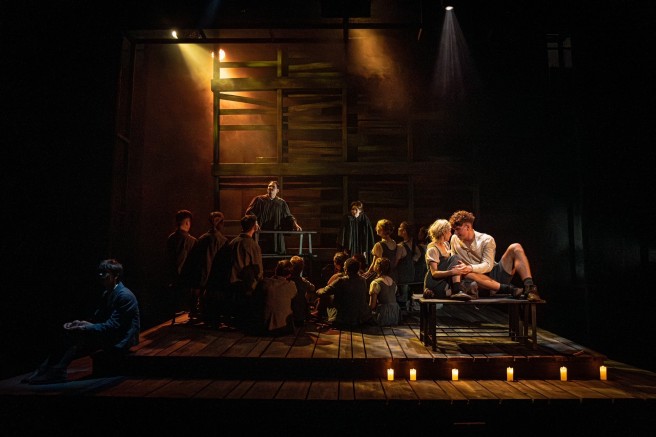
Spring Awakening a production for current times.
Perhaps Spring Awakening is the reason Sylvaine Strike is only now directing her first musical. It was destined to happen with this particular show – and she does it magnificently.
If anyone was up to this specific task, she was. Even more than I knew, because I was unaware of her teaching responsibilities at LAMTA, Luitingh and Alexander’s Musical Theatre Academy in Cape Town that invited Strike to direct.
In her programme notes, she explains that her students understood her approach “tackling the very controversial themes – from a physical rather than a psychological perspective – possible, and ensuring that the sexuality, heartache, and rebellion we activated during the rehearsal process always came first and foremost from the body. This was apt seeing that the impulses of adolescence also spring from this turmoiled yet effervescent well. Whether we explored the private agony of self-consciousness; the damage of self-doubt; the wreckage of hormones on both mind and soul; the pain of parents’ inability to accept a child as they are; or the blossoms of sexuality growing their gentle tendrils of yearning and fantasy throughout adolescence …”
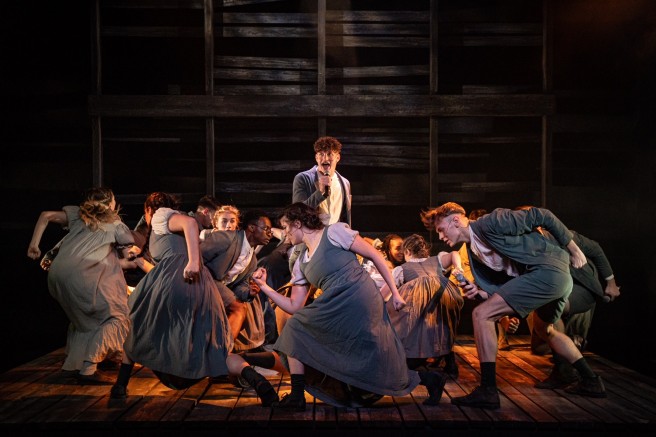
Much of the magic is in the movement.
Her mantra was to seek a physical way to manifest these feelings and to create the characters from that specific place.
And even though I didn’t know any of this before watching this production, it was the movement and the choreography that grabbed and gripped me throughout. It was so clever and crafty to use this in both solo and ensemble numbers and even with the very specific movements of the two adults to exactly capture their strictly restrained and fastidiously maintained lives.
I kept wondering who the choreographers were, as they who would have been completely aligned with Strike’s vision because of her very detailed rehearsal process. Not surprisingly, but also with kudos to the producers and director, they picked two of their talented graduates Olivier and Quinzin, who did an amazing job both incorporating and executing their work to perfection. It adds currency and electricity to the performances that translate masterfully.
But that was just the start of the cohesion of the whole. Again the programme notes capture it best when explaining the electrifying adaptation of Wedekind’s Spring Awakening into a contemporary rock musical, which Strike rightly salutes as the key to the current success of the piece. She is convinced (and I agree) that the sheer brilliance of Steven Sater’s lyrics and Duncan Sheik’s music makes the return of this classic possible and heightens the relevance of the themes as long as there are adolescents in this world.
To pull it off though, it needed the razor-sharp vision of Strike, her pinpoint accuracy in the detail and, more than anything, the artists she surrounds herself with, assigning them to their specific fields of expertise. Even though she and designer Griffin had never worked together, she trusted her instincts and tasked him with all three design elements: lighting, costume and set, all of which establish the feel and the atmosphere of where and how the story unfolds.
It’s brilliant. From the set that transforms with only a few movable parts to the costumes that speak volumes in their simplicity but also carry an underlying theme, as he experimented with the authenticity of the fabric, to the lighting that enhanced what he had already established with the set and the costumes.
All of this would have been superfluous without the right cast. It starts with their youthfulness. Undergraduates and graduates of LAMTA, most were already familiar with the director’s ethos, and it shows. Performances are spectacular and some of the solo moments quite breathtaking.
Spectacular singing with individual tones from Johnathan Conrad and Dylan Janse van Rensburg.
There’s too much to take in and remember in one sitting, but the performer I couldn’t turn away from was the unusual Johnathan Conrad. It needed someone like Strike to cast correctly, but it was as if the theatre gods had handed her a mini Mick Jagger in looks and talent. As the overwrought and picked-upon Moritz Stiefel, his every move, the singing and the presence never faltered – a wonderful foil in a complex production.
The love-struck Scarlett Pay (as Wendla Bergman) and Dylan Janse van Rensburg (Melchior Gabor) are radiant as the couple who cannot resist one another, and their singing captures their hearts’ desires magnificently. Another standout was the luminous Noa Duckitt as Ilse Neuman.
Two standout performances from Noa Duckitt as Ilse and Johnathan Conrad as Moritz Stiefel.
The music holds the show and the singing had to soar for the show to come alive. Again, musical director Amy Campbell teaches at LAMTA and wisely she was in charge and harnessed all her skills to get this working perfectly. More than anything it is the individuality of the different singers surrounded by the more gentle ensemble singing (more often than not) that rocks this one.
Finally it is Strike who pulled it all together. You can have all the talent in the world, but if the story isn’t told with one voice, it has diminishing impact.
Strike doesn’t miss a beat. She has gathered artists young and old around her to tell this striking story that affects us all at some stage in life in the best way she knows how. It has purpose, it holds you in awe from beginning to end, and you are engaged in and enraged with these youngsters as they fight for their right to live their way.
Niall Griffin dying the costumes wearing protective gear.
When Niall Griffin was invited to take on most of the design elements (set, costumes and lighting) for the Sylvaine Strike-directed Spring Awakening, he was nervous going into the process because living up to the expectations of a legend can be daunting. He tells DIANE DE BEER about the experience, which he describes as the highlight of his career:
Spring Awakening, presented by Cape Town’s Luitingh Alexander Musical Theatre Academy (LAMTA) as their first book musical, also marks the first time that Sylvaine Strike has directed a musical.
Based on the controversial play that was written in the late 1800s by Frank Wedekind, Spring Awakening delves into the lives of a group of adolescent students discovering their changing bodies, their sexual identities, urges and desires, all while navigating the oppressive and draconian societal norms of the day.
Under Strike’s visionary direction, this reimagined production (with a very young cast) brings the gripping and emotional story to life as it explores complex themes such as self-discovery, repression and the power of rebellion.
Niall Griffin, a designer with a mission.
And while there was initial anxiety, once the work began, Griffin knew instantly that he was on safe ground. “The care, respect, trust and sense of magical play that Sylvaine instilled in our journey together are unmatched in my career. I think we both felt an immediate understanding of each other and were both amazed at how perfectly our style and ethos merged,” he says.
“We care immensely for our process, our casts, our team and our audiences, sometimes to our detriment, but finding someone with that same level of care has been one of the greatest gifts of my career.”
Being familiar with the level of detail Strike approaches when making a play, all of the above sounds like a match made in heaven.
The vibrant young cast in Spring Awakening
Accepting the challenge was a no-brainer for a designer who is also described as an industry legend. “There are musicals and then there are musicals. Some are light and frivolous and the perfect escapism and then some hit you harder in a place that truly moves you. Spring Awakening is the latter for me. The little rockstar hit that came out of left field to take Broadway by storm,” is how he describes it.
“It deals with things that we’ve all been through or are going through, both good and bad. All too often, in this day and age, we are driven into false beliefs and horrific mental health issues because we carry such shame from our experiences. The show, as heartbreaking as the story is, leaves one with love, compassion and a sense of togetherness. The human condition is not singular. We are not alone. We all need a little more love in our lives… and who doesn’t love a bit of Victorian-era deliciousness?”
Describing the process, he explains that what began as an exercise in replicating period fabric developed into an exploration on how possible it was to create an entire show from natural fibre. “Our planet has rapidly become saturated with ‘the synthetic’ and I believed this show needed authenticity in every aspect if it was to have the impact it deserved.
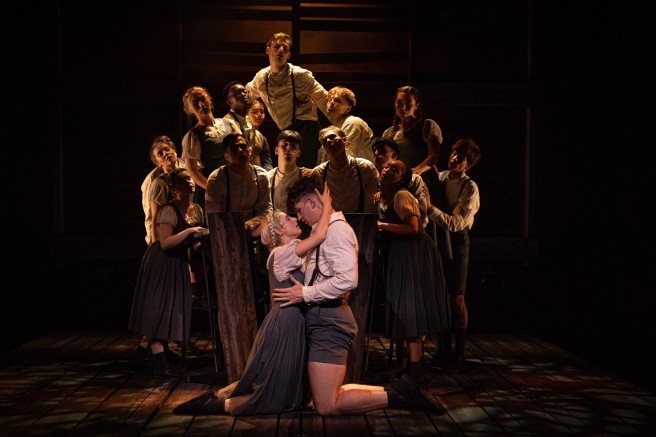
“The entirety of the show’s design is manufactured from purely natural fibre. Costumes began as neutral cotton that were dyed with natural dyes. The set is sustainably sourced wood and hessian made from vegetable fibre. It has been an incredibly educational and rewarding process.”
It is that process that piqued my interest, especially when basically the whole look depends on the outcome. Griffin understood that taking on the full production design across set, costume and lighting was a huge undertaking and not for the faint hearted.
“My driving force is to find a seamless synergy between all departments. What I term ‘one organism’. While taking on full production design is huge, it does make knitting a visual together far easier. Even though this show was Sylvaine’s and my ‘maiden voyage’, it was clearly destined, as our sensibilities and aesthetics couldn’t be better matched.”
And there’s the key, something they obviously both understood. “Theatre design to me, at its core, is about designing emotional response. I needed to immerse myself in the emotional journey of the piece, the high and low tides, in order to find its design core,” he notes.
For him texture is far more than paint and dye. “I spent a long time with the score and libretto and, to quote the Gen Z’ers, ‘felt the feels’. This is how I approach the majority of my design work, from a place of emotional honesty. It’s about finding the heart of the piece.”
Describing his process in more detail, he began with the sets, followed by costumes and finally lighting:
“When it comes to scenic design, my favourite moments in theatre are when a space manages to completely morph its texture, feeling and setting without all the ‘big toys’ and flash. A threatening storm can become something else, in mere moments, with a shaft of light breaking through the clouds. I wanted the space to morph seamlessly so that the emotional flow wasn’t interrupted by a clunky scene change. Finding the balance between something that can feel both oppressive and beautiful was a challenge. Using exposed wood was a no-brainer for me. Wood is a material that carries its growth with it forever. Its rings and knots and imperfections are part of it. This felt poetic to me.”
When it came to costuming, he wanted to create a uniform that felt prescribed by an oppressive regime, “a regime trying to erase the individual and force uniformity. I felt this would underpin the narrative journey of our characters rebelling against the blind norm by illustrating how prescribed uniformity cannot erase the burning fire of the individual.
“Every costume, from head to toe, has been lovingly made from scratch. They are all individually hand dyed and aged, and this is where I started to sneak the individual into the uniforms by aging and breaking down each individual’s garments with their own personality. Some of this detail may not be evident to the audience, but it was important to me that the cast could experience their costumes in this way. I truly believe that what the cast feels in their costumes translates into their performances.”
Lighting delivers the final flourish. “Sometimes, at the speed a musical moves, the audience needs to understand an emotional shift quickly, and this is where lighting was vital to me. I wanted the world to feel murky and rich, like an oil painting come to life.”
If the successful runs in Cape Town are an indicator, this has all been achieved, as the visuals will attest.
And Griffin has his final say: “Making theatre, especially non-replica productions, in South Africa in the current climate is hard work. Creating an entire musical from scratch was a feat second to none. I have a team of remarkable artisans that I work closely with and whom I would be nothing without. They all share my level of delivery standards and they all jump into the deep end with my crazy ideas. A tribe second to none. I couldn’t be prouder of the product, and watching audiences experience it in Cape Town has filled me with so much joy.” * Performances run until 5 May 2024 at Pieter Toerien’s Theatre at Montecasino with shows from Wednesdays to Saturdays at 7:30pm and matinees on Saturdays and Sundays at 2:30pm. Tickets cost from R200 through Webtickets. Please note that Spring Awakening contains mature themes, partial nudity, sexual situations as well as explicit language. No persons under 13.
Another Klein Karoo National Arts Festival has come and gone but what lingers are the artists, their originality, dedication, blood, sweat and tears and delight that they provide in a lopsided world which is difficult to navigate. DIANE DE BEER finds nourishment, inspiration and novelty in the imaginative and ingenious artistry of our creatives:
I have to be honest from the start. Festivals always have a strong emotional impact on me. I am in the fortunate position as an arts journalist to be invited to see as many productions as I can squeeze into the run of an event and at this year’s Klein Karoo Nasionale Kunstefees (KKNK) there was still a post-Covid frisson with the festival at full strength for a second year.
When a festival goes into full swing, it can be quite daunting and I’m not sure whether I want to be there, but as excellent productions and artists climb into my head, I go into full festival mode where I’m simply thrilled at being overwhelmed by the local arts community.
Being an artist isn’t an easy profession, even if many on the outside feel that they had a choice and simply have to bite the bullet. That they have a choice is arguable and to produce excellence year after year, often with few rewards and never under ideal circumstances, can be daunting and not for the fainthearted.
And yet they go full tilt as they battle extreme circumstances like pandemics or vitriolic social media, all in the name of art.
More than anything, whatever anyone says, we cannot resist them. For me it is a huge blessing and privilege to witness and write about our uniquely original creatives.
Post-festival, an overview of the festival is always a personal reminder of and reflection on everything extraordinary, yet it’s tough to choose which among all those actors and productions, to highlight. There are simply too many that demand attention and especially this year, the scope was exceptional.
I always feel I want to bring something of the flavour of a particular festival to those who weren’t there. Perhaps one of my favourite pieces might pop up somewhere and a reader might be encouraged to go, or even more ideally, someone who has always thought about festivals but never attended might be encouraged to go.
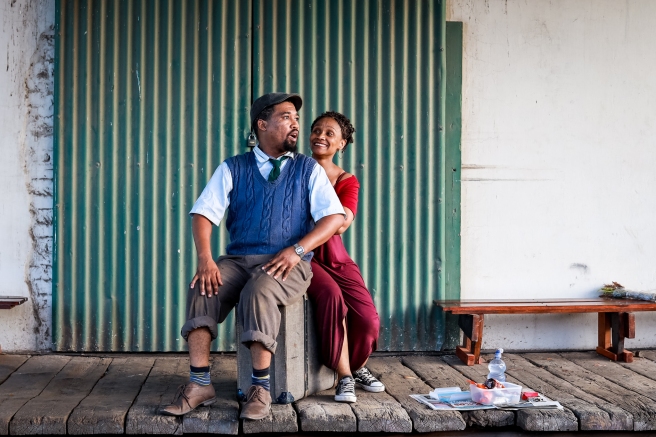
The enchanted Die Swartmerrie withTheo Witbooi and Chantell Phillipus. Pictures: Ryan Dammert.
I have to start with Karoo Kaarte. It’s one of the dream projects of the KKNK, simply ticks all the boxes and grows more impressive every year since its first inception with special mention of last year’s winning production, Droomkrans Kronieke, which landed with such impact because of its energy and precision. How can you not win when developing the underdeveloped artistic talent of the previously disadvantaged by implementing a programme that empowers those who wish to make it in the arts.
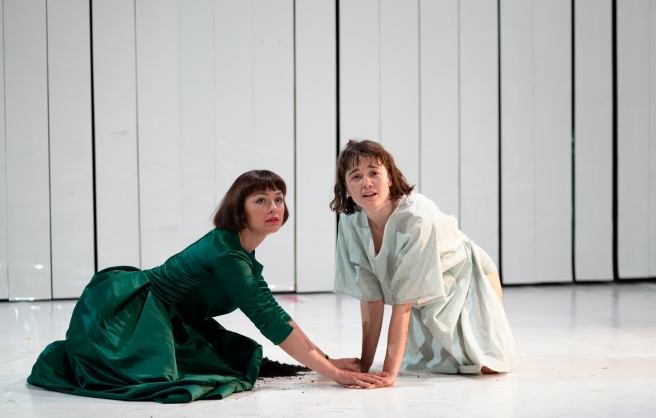
It’s inspiring and this year’s production, Die Swartmerrie, is a site-specific piece set on dilapidated terrain with a set of train tracks, an imagined train, and a rundown platform. Two people, a man and a woman (Theo Witbooi and Chantell Phillipus) are waiting, both traveling but not with the same destination in mind. There is a past, the tracks and possible journey points to a future, but this notion disappears with the wind.
It is breathtakingly beautiful and hauntingly gripping as the two talk and tackle their issues with delicate determination.
Afrikaans is an especially emotive love language and when spoken in the specific Karoo accent, warm and intimate, the sounds are as captivating and meaningful as the actual words being spoken.
I was surprised by this couple alone on stage and also electrified that the team (in this instance Neil Coppen – a facilitator of the whole project with Vaughn Sadie – and Oudtshoorn’s Tiffany Saterdacht) decided to go this route but, of course, this is a company packed with the unexpected, and hopefully it is a production that will become an institution in Oudtshoorn and won’t be limited to the festival. You don’t want to miss out on these performances and such a quality production. They should keep pushing the repeat button and keep it as part of their arsenal.
Karoo Kaarte further packed a punch with its art exhibitions, as well as walking tours done by young Oudtshoorn inhabitants all participating in turning the town’s current and future narrative into an inclusive one. The community is constantly gaining strength thanks to Coppen and Sadie who have invested their creativity in this wonderful way, all the while bringing their local learners on board.
It’s a marvellous investment in the future of this town (and hopefully others across the country will follow) and fingers crossed that a smart investor will see the potential going forward.
Because we were born in such large numbers, our generation is referred to as the baby boomers (born from 1946 to 1964) and probably that’s why ageing and the lifestyles of those growing older has become part of today’s theatre language. We are also fortunate to have some amazing artists who keep on practising their craft while ignoring any barriers that might come their way.
They know how to choose, break out and try new things and simply keep audiences flocking to their performances. Names like Sandra Prinsloo, Antoinette Kellermann, Jana Cilliers, Elzabe Zietsman, Amanda Strydom not only arrive with new productions, they’re also constantly adding skills to their resumés.
Cilliers took up playwrighting for the first time with Veelhoek, a two-hander with herself and Ludwig Binge directed by Marthinus Basson, and the wisdom and writing were quite overwhelming. Who would have thought that, apart from all her other accomplishments, she would now add writing to the list – and then perform it with such clarity as she tells a story that lies close to the heart?
Zietsman is another one who keeps shifting those barriers and I am so delighted that she has added the magnificent Tony Bentel to accompany her on stage. He is one of those pianists who brings much more than just the music to the performance and it shows. Vier Panado’s en ‘n Chardonnay again has Zietsman expounding on life, singing brilliantly and with heart – and cherishing cabaret as it should be performed. The content, which deals with resilience,needs hardly any acting by this actor. Most of it is probably her life which she has shared heartily and hastily over the years. And she will always rise…
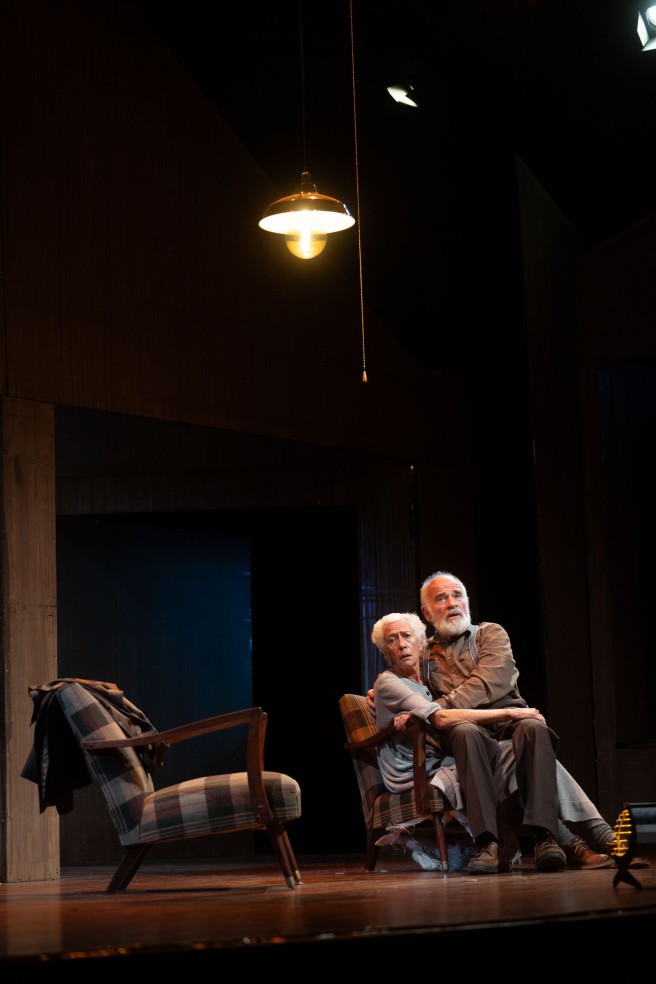
Do we need to say anything more about those two great dames, Sandra Prinsloo and Antoinette Kellermann? How lucky are we to witness them in performance after performance as they just keep surging ahead.
Die stoele with Antoinette Kellermann and Chris van Niekerk. Picture: Hans van der Veen.
Kellermann tackled the Ionescu tour de force Die Stoele, accompanied by a much-too-rare performance by Chris van Niekerk. Marthinus Basson adds genius to the production, which can be seen over and over again as it deals with something we all have to confront – LIFE. The content might be terrifying but to watch, quite hysterical. As always Kellermann is in with everything she’s got and what she does with her body tells a story all its own.
Goed wat wag om te gebeur with an actress I would love to see more of, Emma Kotze and Gideon Lombard.
She’s also a part of the magnificent cast (Kellermann, Emma Kotze and Gideon Lombard) of Philip Rademeyer’s Goed Wat Wag Om te Gebeur. I had seen the English version most recently but also this one a few times, and this latest run proved how good theatre improves with time. It’s the best the production has been and I know the director agrees.
Prinsloo brought her masterful Master Class, a piece of classical theatre, to the festival and, also as is her nature, she teamed up with the exceptional David Viviers in a Teksmark original Op die hoek van Styx en River is Noraper Abuis met die Dood Oorgeslaan (playwright Henque Heymans). It’s a novel work which showed flickers of what it could be in time (always a scarce commodity).
Like Rademeyer’s Goed Wat Wag Om te Gebeur, Monsters, (produced, directed, adapted and translated by Tinarie van Wyk Loots) which has had runs at other festivals previously, found a remarkable rhythm that lifted the text and the performers into another realm . It was rewarding to experience and again I was reminded what a precious entity the different circuits are because single theatres cannot afford to take many risks and festivals add an extra buffer in this precarious world – to the benefit of arts audiences.
Michele Burgers in Monsters. Picture Stephanie M Gericke.
We haven’t seen much of the versatile Michele Burgers, who will hopefully return to stage more often in the future and who was beautifully supported by the talented René Cloete, Ntlanhla Kutu and Elton Landrew.
Die Vegetariër with Tinarie van Wyk Loots and Melissa Myburgh who as young actress has shown her mettle magnificently . Picture: Nardus Engelbrecht
Smartly directed by yet another multi-talented artist, Tinarie van Wyk Loots, she also featured in Jaco Bouwer’s hard-hitting Die Vegetariër (adapted and translated by Willem Anker) which also benefited from another run, as well as in the latest probing Anker text, Patmos, also brilliantly staged and directed by Jaco Bouwer, who always challenges and pushes boundaries with his choice of productions, casts and presentation.
The visually captivating Patmos with Melvyn Minnaar and Tinarie van Wyk Loots. Picturess Hans van der Veen.
Without these art warriors our art landscape would be barren. They keep us returning to theatres time and again with their unique approach, their determination to do their best under trying circumstances, including a lack of time and money, and simply their excellence.
Nataniël, for example, returned from an extensive tour to New Zealand and Australia during the festival yet put together one of his distinctive shows with flamboyant costumes, mind-blowing text and two musicians (Marcel Dednam on Piano and Leon Gropp on guitar) who created a spectacular rhythm to underpin his songs and singing quite magnificently.
I could go on forever, there were simply too many highlights, yet I cannot go without honourable mentions of the following, no less important than those already mentioned:
Jefferson J. Dirks-Korkee in a return of the soul-stretching Rooilug.
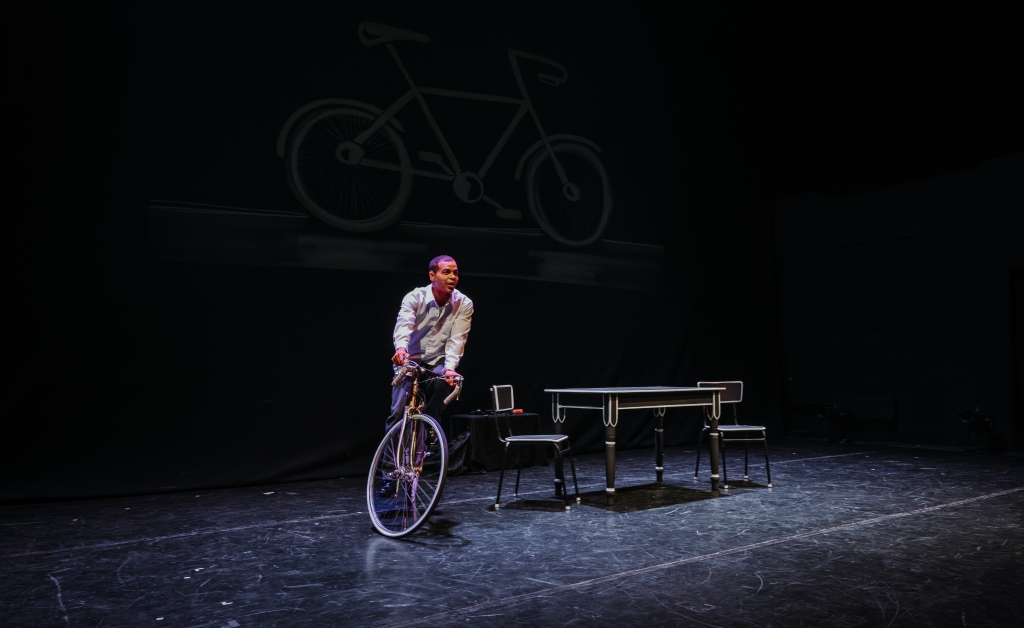
Fietsry vir dommies. Picture: Gys Loubser Hallo, is Bettie wat praat with Dean John Smith.
Marianne Thamm
Solo shows: the return of Rooilug with the delightful Jefferson J. Dirks-Korkee; Fietsry vir Dommies (masterful text by Tiffany Saterdacht and deftly directed by Dean Balie) which showcased the enormous talent of Eldon van der Merwe, who was also rewarded with a Kunste Onbeperk prize for Young Voice. Dean John Smit shone in his now full-length solo production of Hallo, is Bettie wat Praat; the craftily current My Fellow South Africans by Mike van Graan, starring the physically and mentally dextrous Kim Blanché Adonis; Vuisvoos, maar nog regop, where journalist Marianne Thamm delivers a gloves-off and much needed monologue, incisive if laugh-out-loud, on the state of the nation; a shout-out to much missed director, Jenine Collocott, who teamed with actor Klara van Wyk to present the hysterical Monika, it’s me:
The mesmerising ‘n Lewe in die dag van ‘n vrugtevlieg ensomeer with David Viviers and Wessel Pretorius. Picture: Hans van der Veen The Old Man Who Thought He Had a Dog with Merwe van Gent and Angelique Filter.
Double-up: David Viviers and Wessel Pretorius returned as a popular duo in a follow-up to their successful Klara Maas with ‘n Lewe in die die dag van ‘n vrugtevlieg, ensomeer and hopefully many more encores in the future, they were missed; an innovative new duo, Stellenbosch students Angelique Filter and Merwe van Gent, soared with the tragicomedy The Old Man who thought He had a Dog;
The delightfully funny Marc Lottering.KG Mokgadi- Weighing In.
Stand-up (not my speciality) yet: Who can resist the always energetic and enthusiastic funny man Marc Lottering who always delivers?; as well as my comic standout of the festival, KG Mokgadi. It feels as if these two have something more to say than just one-liners.
Ken Jy Vir Dewie with , Joshwin Dyson, Crystal Donna Roberts and Robert Hindley
Productions: The original Ken Jy Vir Dewie was cleverly staged with themes that target the whole family and as the play was dealing with bullying, the setting for everyone, actors and audience alike, was a classroom; and again, it was directed by yet another versatile artist, Margit Meyer-Rödenbeck, who has exchanged Dowwe Dolla for Ouma, again a sign of the times. She cleverly started the play outside with audience and cast waiting to enter the classroom!;
The joyous Braam en die engel with Rehane Abrahams, De Klerk Oelofse and Timothy Isaacs. Picture Hans van der Veen
And Craig Morris grabs the attention in Die Rooi Ballon.
Children’s Theatre: It’s not something I usually see at festivals but, as I did, I was encouraged by the effort made by the KKNK to look after these tiny tots who are of our more enthusiastic audiences: My favourites included Braam en die Engel and Rooi Boeties.Watch out for them as they might travel.
Dance: is back with brilliance because of the clever choice of productions, only two of them but with some of the most innovative names in contemporary dance: Dada Masilo who choreographed one of three pieces, Salomé, for Joburg Ballet; and Grant van Ster and Shaun Oelf with the Figure of 8 Dance Collective (pictured), who brought in other creatives like Nico Scheepers on text, Andi Colombo on lights and Franco Prinsloo on original music. Both companies were sublime.
Lucky Pakkie (Packet): Thanks to the brilliant team of Llandi Beeslaar and Stephanie Gericke, this is another of the KKNK delights because of their dedication and hands-on approach. It needs that because what you have is three lucky packets of four 15-minute productions each; the three sections embrace easy viewing to soft touch to pushing the envelope as much as possible, and artists who cannot manage a full production or perhaps just want to say what they need to say in this time and on this platform are vetted and included in a fun-filled programme.
The original Karli Heine. Picture by Stephanie M Gericke
There are too many to name, but for starters … what about Karli Heine, who turned herself into a pot plant and blew my mind … for script, performance and imagination!
It is impossible to cover everything and I haven’t given the art exhibitions a mention, even though curator Dineke Orton again broke down barriers and took us on a visual trip. But these are just some of my thoughts on a festival that felt like one joyous merry-go-round. Try and catch some of these through the year as they travel to different theatres and festivals.
Here’s holding thumbs!
And finally, on the last day, even the weather seemed out of sorts…
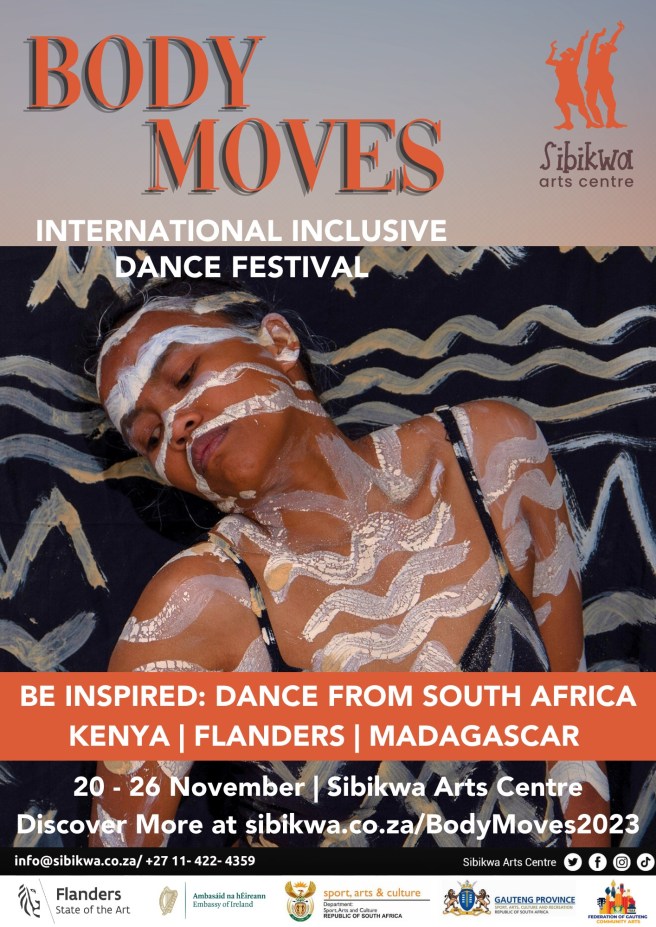
From the whirlwind success of last year’s debut, the Body Moves International Inclusive Dance Festival returns for what promises to be a triumphant second edition.
Set against the backdrop of Disability Awareness Month, the festival showcases an unparalleled array of workshops by esteemed international and local facilitators, live-streamed discussions, and breathtaking afternoon performances on November 25 and 26.
Once again according to the unshakeable Sibikwa mover and shaker Phyllis Klotz, Body Moves steps up the beat, accentuating cultural exchanges and collaborations. With participating companies spanning from Kenya, Madagascar to Ireland, Flanders and various regions of South Africa, the festival embodies the spirit of diversity and unity. Among the highlights:
Flatfoot Company in performance.
Workshops: From a sign workshop with the talented deaf dancer, Andile Vellem of Unmute, to Ondiege Mathew’s exploration of choreography through improvisation, Fanny Vandesande’s deep dive into the lived experiences of people with disabilities, a satellite workshop at Moving Into Dance in Newtown, and more.
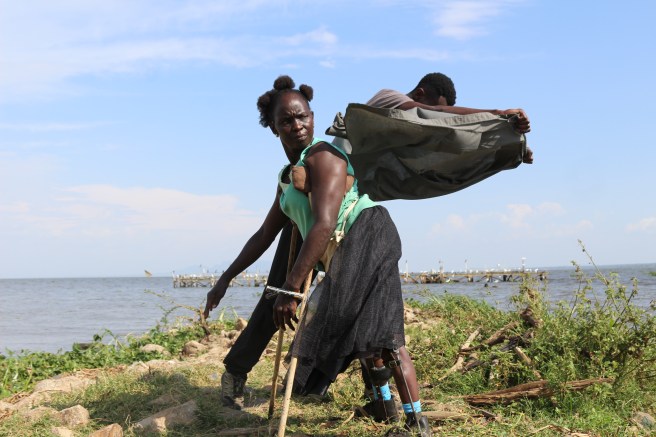
Performances: Featuring works such as Chosen, highlighting the plight of a village through the eyes of a visually impaired dancer; to TWOTFAM, a thought-provoking piece that brings to the forefront the overlooked challenges faced by individuals with disabilities.
Live-Streamed Discussion: To be hosted in partnership with ADDN, at Sibikwa and on the Sibikwa Arts Centre Facebook page, at 6pm on November 23, their aim is engaging conversations inspired by the impactful 5-minute videos from Introdans and Unmute.
Moving away from the hustle of town, yet not too far from the comforts of home, Sibikwa offers a perfect locale for audiences. See below for a detailed line-up of Festival events, or visit sibikwa.co.za/BodyMoves2023.
Mover and shaker Phyllis Klotz, founder of Sibikwa.
Supported by the General Representation of the Government of Flanders, Embassy of Ireland, Department of Sport, Arts & Culture, Gauteng Department of Sport, Arts, Culture & Recreation, and Federation of Gauteng Community Arts, the festival is more than just an event; it’s a celebration of local and international talent, a nod to cultural vibrancy, and a testament to the belief that arts and dance know no bounds.
Tickets for performances at 2.30pm on November 25 and 26 are now available on Quicket link https://qkt.io/BODYMOVES23 at R120 per person. Special group rates apply at R100 for groups of 10 or more. On-the-day tickets will be available at the door for R140. For those travelling from Johannesburg, a shuttle will be available from Rosebank Mall, the price for this ticket (including shuttle and entry) is R250.
For organisations interested in hosting a workshop or for more details, reach out to caryn@sibikwa.co.za. Additional performance and event specifics are available upon request or at sibikwa.co.za/BodyMoves2023.
About Body Moves:
A pioneer in its field, Body Moves Inclusive International Dance Festival seeks to disrupt societal norms, championing inclusive dance and fostering collaboration across borders. It stands as a symbol of hope, understanding, and the transformative power of the arts.
Flatfoot Dance Company has a 28-year history of working in integrated arts. It is particularly well known for its 6-year-old integrated programme fondly referred to as Flatfoot Downie Dance Company. This unique dance programme is unprecedented in South Africa and is a celebration of the power of dance to shift lives and to negotiate difference and inclusivity. This particular dance programme celebrates community across the divide of race, gender and ability.
Title: The Infinite Space Between Us
Choreography: Lliane Loots in collaboration with the dancers
Dancers: Jabu Siphika, Ndumiso ‘Digga’ Dube and Julia Pitt
Short Description of dance work: In an intimate dance journey taken by three dancers, Lliane Loots’s collaborative “the infinite space between us”, delves into how we hold, walk and wheel past or towards one another as we attempt to find or break connections. Working with FLATFOOT’s Jabu Siphika, Ndumiso Dube, and Julia Pitt, Loots’s own on-going choreographic interrogations into the intimate politics of relationships, is given a unique spin as the dancers play around with duet, trio, solo formats – and a wheelchair.
Company: Moving into Dance (Johannesburg)
Happiness in dance.
MID was born in the cruel turbulence of 1978 Apartheid South Africa. It was an artistic response to the destructive policy of apartheid. The vision was to draw on the creative capacity of the human spirit to connect enliven and transcend. In keeping with its founding vision Moving into Dance introduced its ‘Enable Through Dance’ programme in 2016 which seeks to inspire confidence and self-esteem in the physically disabled through creative means especially dance.
Title: Remember our Time
Choreographer: Lesego Dihemo
Short Description of dance work: This piece is a reflection on the change that time brings and how it has affected culture. It is looking back and acknowledging the what we had and celebrating how we have adapted and progressed.
Company: Unmute Dance Theatre (Cape Town)
Unmute Dance Theatre is a company of artists with mixed ability/disability using physical theatre, contemporary and integrated dance to create awareness on accessibility, integration and inclusion of people with disability within the main stream of society. The company came into existence in 2013 after a performance entitled Unmute. Within the past 9 years, Unmute Unmute has developed various inclusive projects that have created access and integrated people with and without disability in one environment.
Title: Isikhalo Sendoda (The Cry of a Man)
Choreographer and Dancer: Andile Vellem
Short Description of dance work: As an African man, culturally, he is not permitted to show emotion or to cry. This dance piece, inspired by his late son, is the beginning of Vellem’s healing.
Short Description of dance work: For most young queer individuals club life is an important element of self-image. The club is a place of refuge, a protected space where they are able, and allowed, to enjoy a little freedom. The nightlife means an opportunity to become self or at least who and how they wish to be seen. While at the same time this is not always a true reflection of their day to day lives. The work explores themes relating to queer bodies escaping into the night.
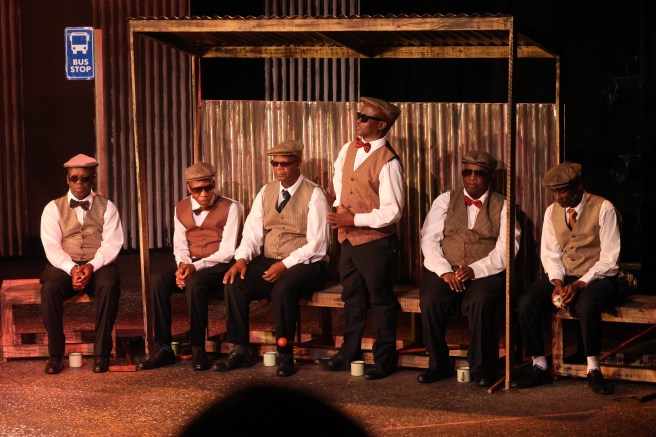
Ga-Rankuwa Requesters.
The Ga-Rankuwa Requesters began in 1984 under the leadership of music composer Lucas Kopaopa. The group initially had 9 male members in total, 8 were visually impaired and 1 was partially sighted. The group worked together at Are Itereleng Centre for the Blind, in Zone 2 in Ga-Rankuwa. After the formation of the group, now known as the Ga-Rankuwa Happy Boys, they released 3 acapella albums. As the group’s journey continued and new members joined and old members left, they formed the Ga-Rankuwa Requesters in 2005. They have entered music competitions convened by the South Africa Disabled Musicians Association and have won a recording deal. Over the past year they have been performing Lifted – Let the Blind Sing at the State Theatre under the musical direction of Zakehele Mabena.
FLANDERS
Title: TWOTFAM The Works Of The Flesh Are Manifest
Choreographer: Fanny Vandesande
Dancer: Anna Dujardin
Music Composition & Performance:Kobe Boom
Short Description of dance work: The works of the flesh are manifest and focuses on the creation of intimacy on stage and the power relations that it carries forward. The performance departs from Anna D’s diary entries, illustrations and poetry, which is presented through movement.
FANNY VANDESANDE is currently conducting research in intimacy, sexual agency, autonomy, and social perception with people living with disability.
MADAGASCAR
Nacelle Somoh (also seen on poster) from Madagascar
Company: Lovatiana
Created in 2002 in Antananarivo by the choreographer Lovatiana Erica Rakotobe. In 2009, people with disabilities were integrated into the company and the company currently has 8 members who work in the artistic, social and educational sectors in Madagascar. The company organises different events, including a multidisciplinary in inclusive festival Miaraka, which takes place every two years.
Title: Chosen
Choreographer: Lovatiana Erica Rakotoba
Dancer: Nacelle Somoh
Short Description of dance work: Dance piece inspired by the story of young children chosen to save the people of the village often threatened by floods.
Short Description of dance work: Re-imagining a Kenyan myth that has previously promoted patriarchal behavior. Nyanam challenges the traditional power play by demystifying myths and suggesting new narratives where women are seen to be empowered and play a stronger role in the hierarchy.
WORKSHOPS (2 to 2 and a half hour in length)
Ondiege Matthew: A mixed abled dance workshop discovering how the body with disability in contrast to the body without a disability explores space, direction, levels and approaches choreography through improvisation.
Lovantiana Erica Rakotoba: The workshop will be based on inclusive dance working through body weight and fluidity and exploring different bodies in space; sharing the choreographic repertoire of the piece running at the Festival.
Andile Vellem: Presenting a sign dance technique workshop established by UNMUTE, using the basics of sign language and finding ways to translate it into creative movement.
Fanny Vandesande: This workshop delves into the difficult challenges people living with disabilities confronts regularly, which includes, intimacy and sexual agency.
Cindy Cummings: This workshop, titled ‘Serious Play’, will focus on the ever-changing dialogue between people. Pairs and small groups will use improvisational structures to experiment with specific tools for this kinesthetic dialogue to reveal how everyday actions can be crafted into a unique and original dance through the lens (and practice) of Noticing.
IRELAND
CINDY CUMMINGS is a freelance dance artist who creates original collaborative works with dance, theatre, visual, sound, literary and media artists around the world for live performance, installation and film. Cindy is based in Kilkenny, Ireland where she has choreographed productions at the National Theatre of Ireland and most recently, with the award-winning Asylum Productions. Currently she is movement director with Equinox Theatre Company at KCAT Arts Centre and is a facilitator on the Inclusive Dance Cork course at Dance Cork Firkin Crane. Since 2007 Cindy has been a member of Aosdána, the affiliation of creative artists in Ireland.
DISCUSSION
To be hosted at Sibikwa, in partnership with ADDN, and live-streamed to Facebook, it promises engaging conversations inspired by the impactful 5-minute videos from Introdans and Unmute.
The AFRICAN DANCE DISABILITY NETWORK (ADDN) is part of a UKRI – AHRC funded research project entitled ‘Encountering disability through contemporary dance in Africa’. It aims to gather academics, artists and educators in a free and open space of community, sharing and support. Their approach is intersectional, considering how disability as an experience sits alongside our ethnic, gendered, racial, class and national identities.
The Head and the Load is about Africa and Africans in the First World War.
That is to say about all the contradictions and paradoxes of colonialism that were heated and compressed by the circumstances of the war.
It is about historical incomprehension (and inaudibility and invisibility).
The colonial logic towards the black participants could be summed up:
“Lest their actions merit recognition,
Their deeds must not be recorded.”’
The Head and the Load aims to recognise and record.
WILLIAM KENTRIDGE
Pictures supplied
SHOW: The Head and the Load
CONCEPT AND DIRECTOR: William Kentridge
COMPOSER: Phillip Miller
MUSIC DIRECTOR AND CO-COMPOSER: Thuthuka Sibisi
CHOREOGRAPHY: Gregory Maqoma
PROJECTION DESIGN: Catherine Meyburgh
COSTUME DESIGN: Greta Goiris
SET DESIGN: Sabine Theunissen
LIGHTING DESIGN: Urs Schönebaum
And the magnificent cast and musicians – with the African premiere dedicated to the original narrator Mncedisi Shabangu who sadly died last year.
DIANE DE BEER reviews:
And the top introduction by Kentridge gives you a pretty good idea of the load the artist, in many different disciplines, (and when not, he brings in others of his ilk) had in his head.
If you’re the one watching, it might just blow your mind. And if you’re familiar with his work, there’s much you will recognise as he often works with the same artists and combines original music with references to the period and composers of the time as well as texts, movement, shadow play and lighting.
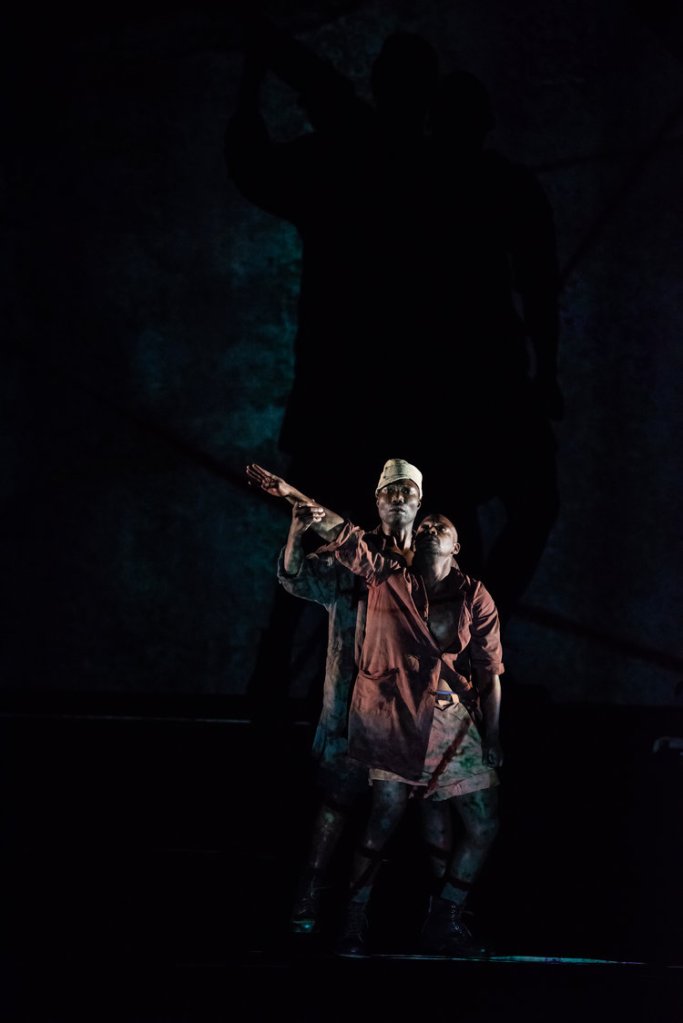
You see a body marching in the distance (they use backstage for the performance because they need that length of space), and just the way he moves already tells you he is a dancer. But not any dancer, one of the best, Gregory Maqoma.
That’s how it runs all through the performers and the musicians. When I hear the brass sounds used in this specific way, it reminds me of the cacophony Emir Kusturica used in his war drama Underground to capture the sounds he associated with war.
And Philip Miller and Thuthuka Sibisi work similarly. They transformed traditional African songs as well as quotations from composers from the time of the war like Ravel, Hindeman, Satie and Schoenberg. It’s varied, as they mimic the different sections of the story, and the way the musicians and the singers use their voices is spectacular.
Just think of wind instruments. They’re used here in the true sense of the word. It’s as if the wind witnesses and blows silently through the space.
But let’s start at the beginning when the show starts. Performers have silently been slipping in and placing themselves inconspicuously in specific spots. And almost in one fell swoop, the giant screen, the lights and the cast come to life.
The audience, in touching distance, are instantly scooped up and almost thrown into the story and the action.
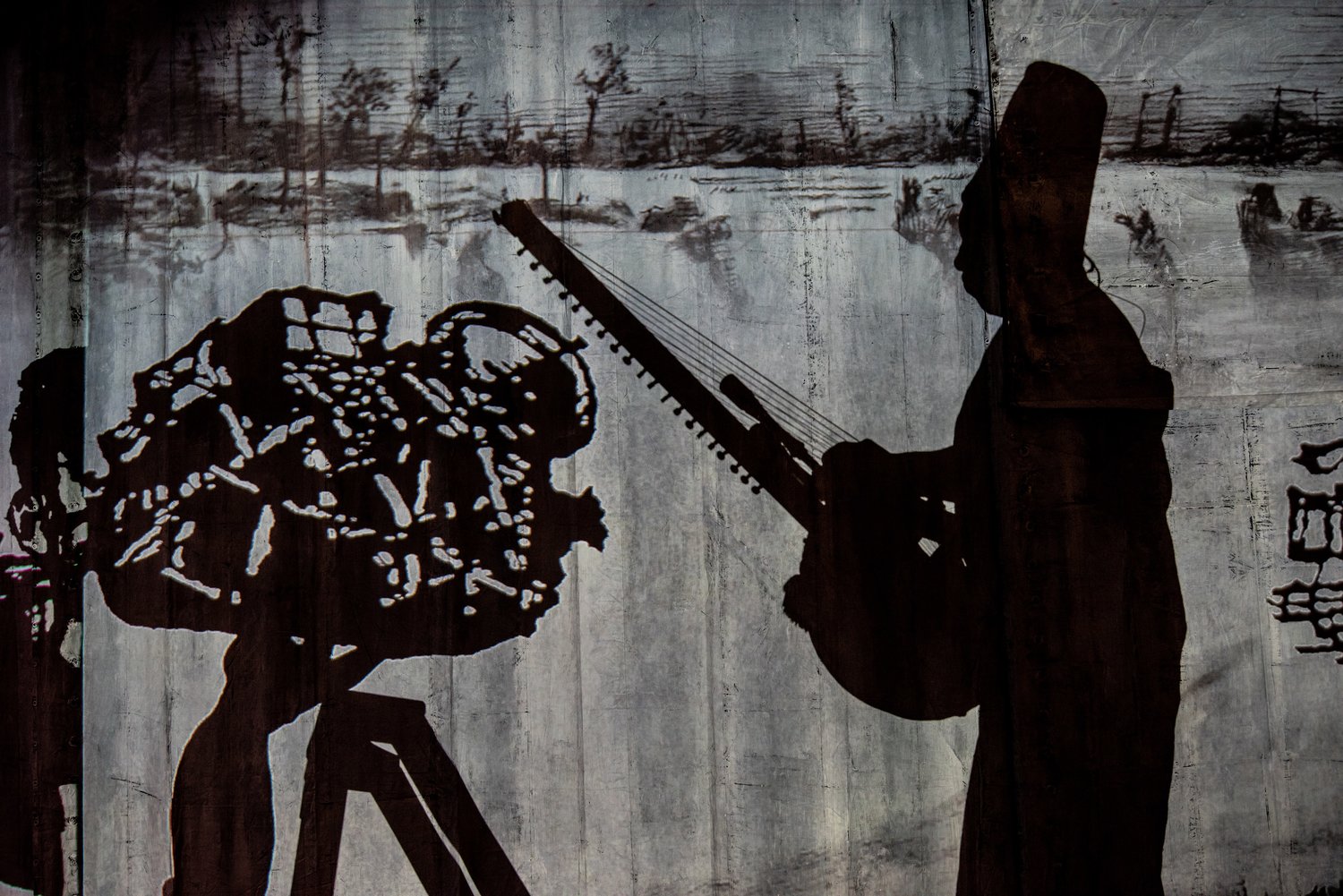
In one spot there’s the most exquisite Vermeer scene with bold Kentridge drawings and sketches, all heightened by the wonderful and magnified shadow play, while individual performers have all, as if magically wound up, started moving. And then the narrator starts with the tale.
Everything is part of the fabric, the texture, the mood and essence of the whole. It’s like a giant storytelling extravaganza yet this has no fairy-tale ending. There’s melancholia and war mania, and there’s the feasting on the foot soldiers as they are put to battle almost deliberately as war fodder. In one of the war reels, the African participants displayed in uniform are barefoot!
Kentridge puts the spotlight on World War One, but this time, he tells and shows it all. This he wants to record. And in full Kentridge splendour, he unravels and reveals everything he wants you to know. With this grand theatrical flourish he imprints the pictures and performances in your mind.
Having waited for Covid restrictions to be lifted to see the production, it has become even more relevant with first the Russian invasion of Ukraine and now also the frightening war in Sudan.
It’s impossible to take all the individual flourishes in and yet, it is an immersive theatrical experience which will linger and almost lay you low. But then the sense of wonder, the way of revealing the relentless horror and the sheer scale of the endeavour, are what keep swirling in your head.
Gauteng is blessed to have Kentridge in its midst and to witness this astounding theatrical avalanche so brilliantly composed and performed, which is – sadly – as relevant today as it was in 1918.


























 De Beer Necessities