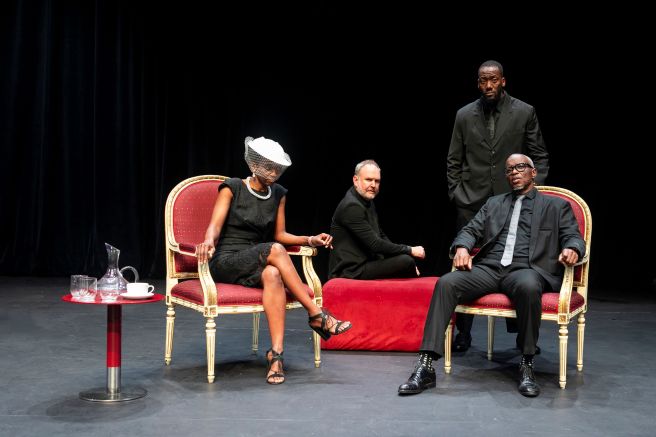
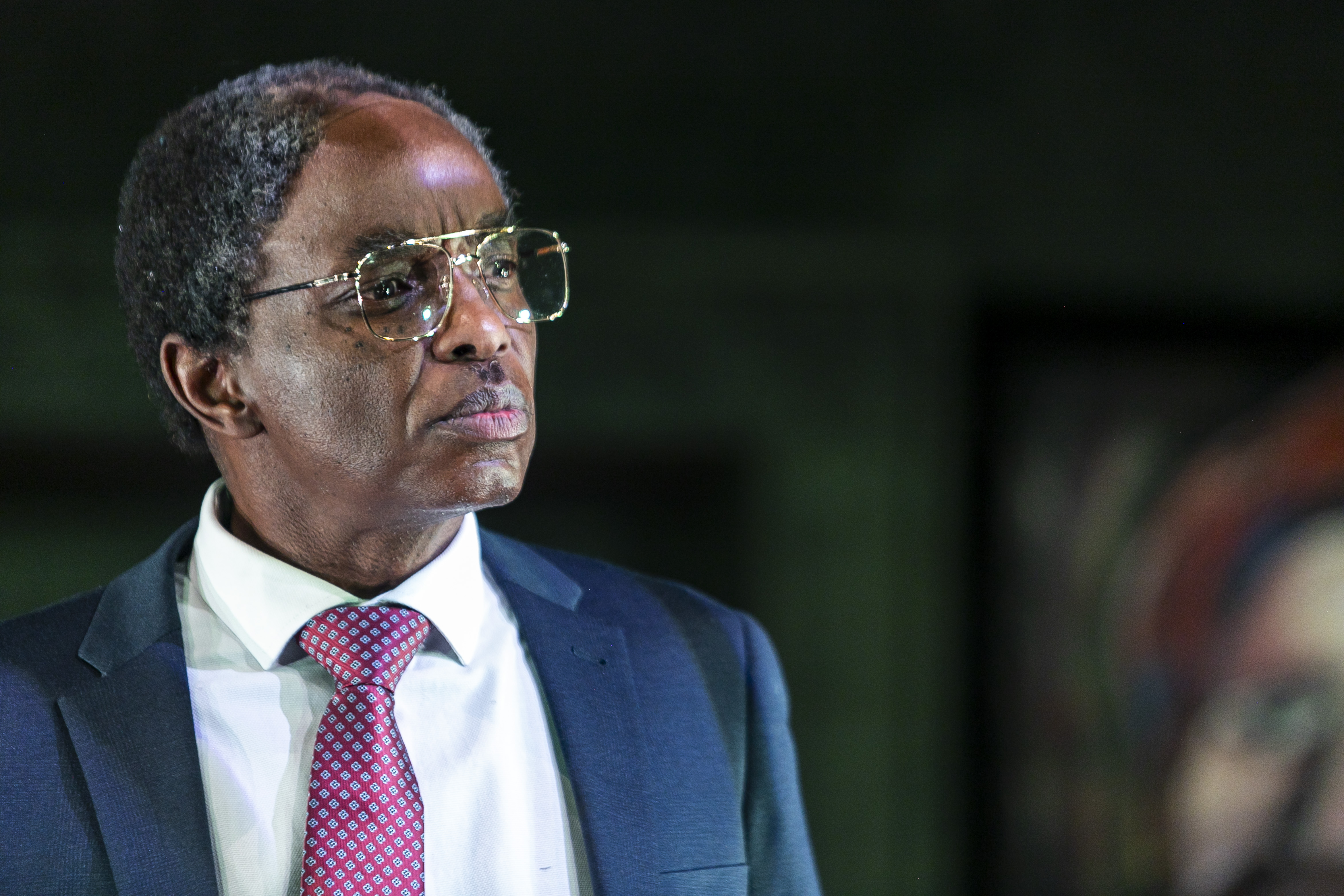
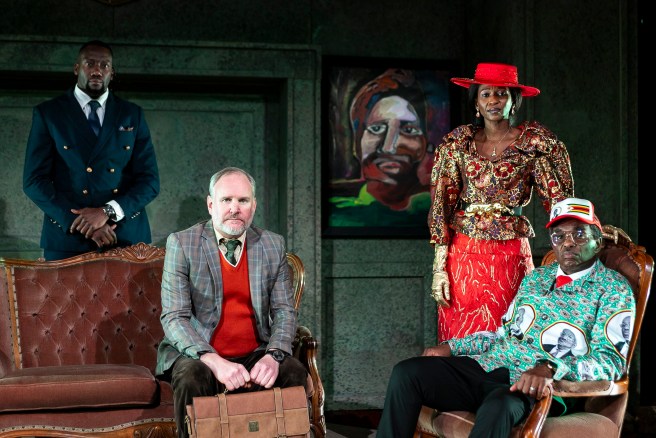
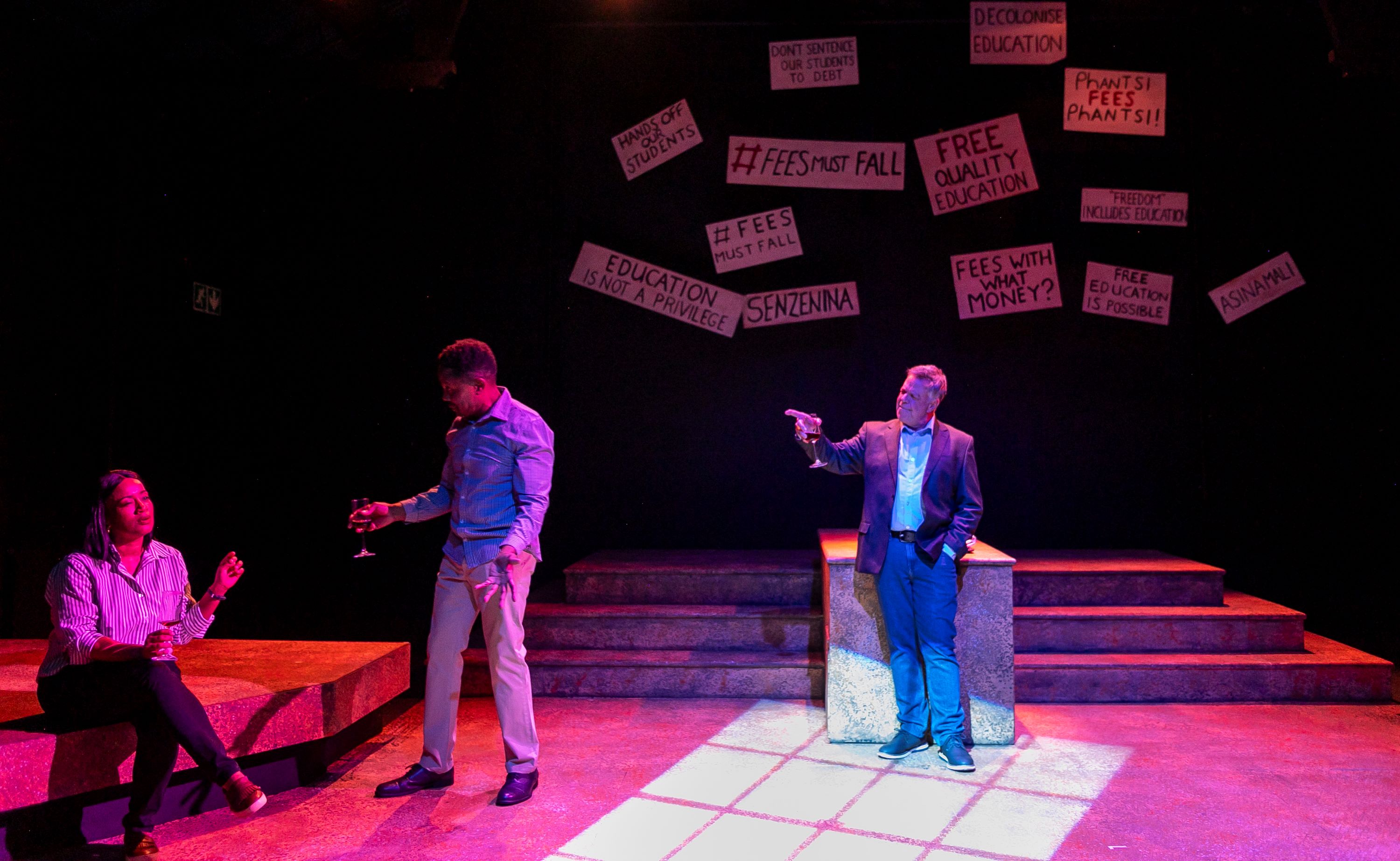
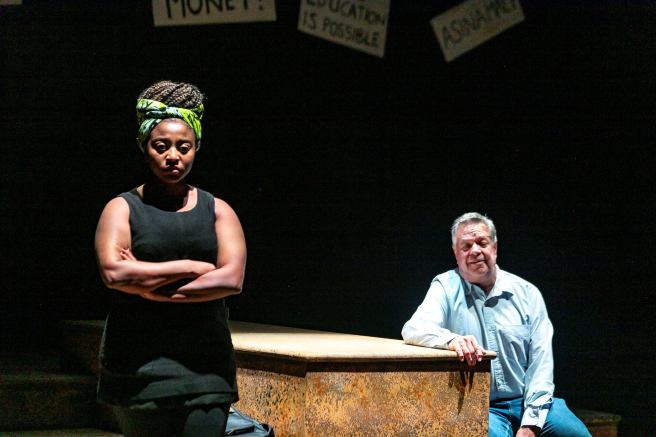
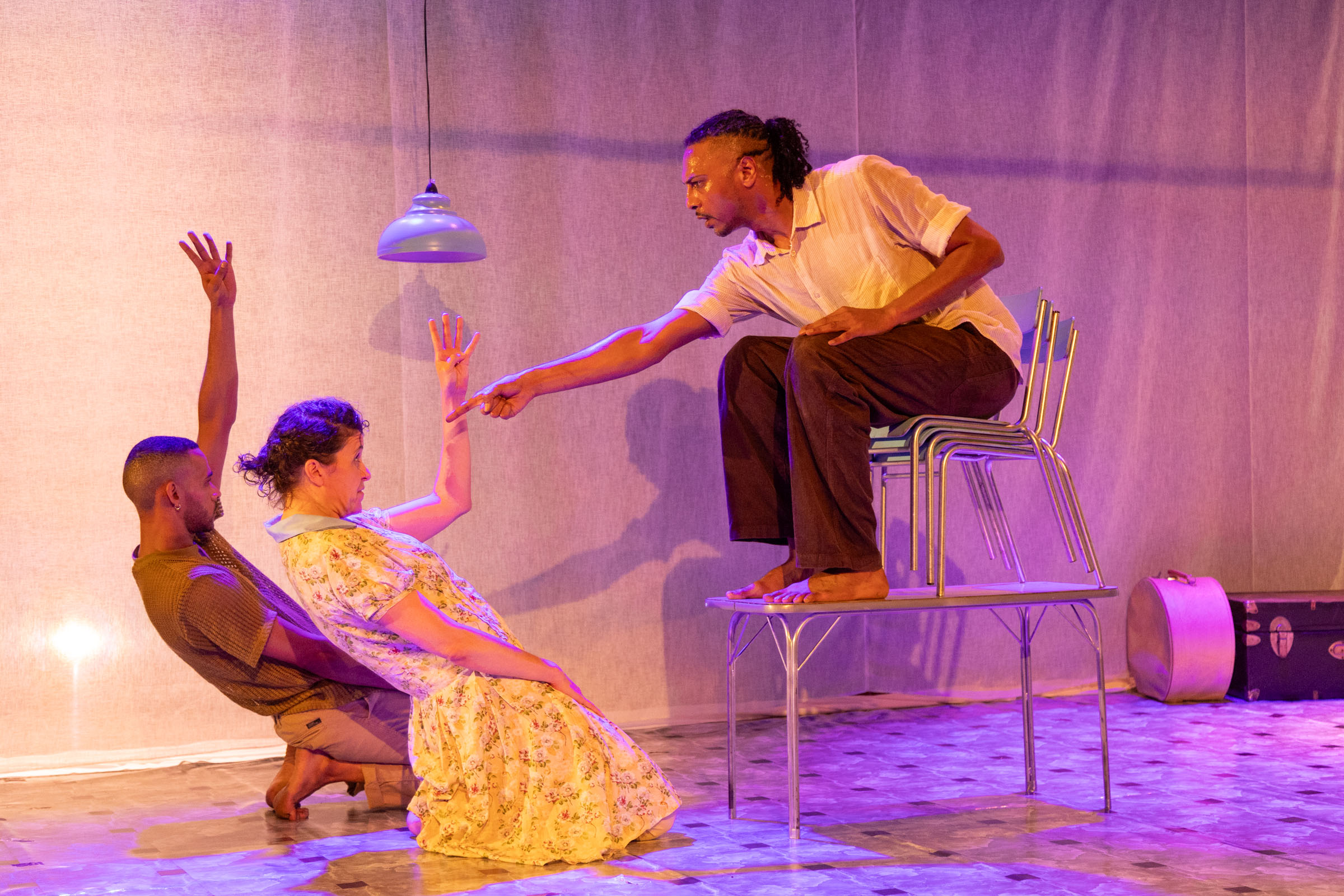
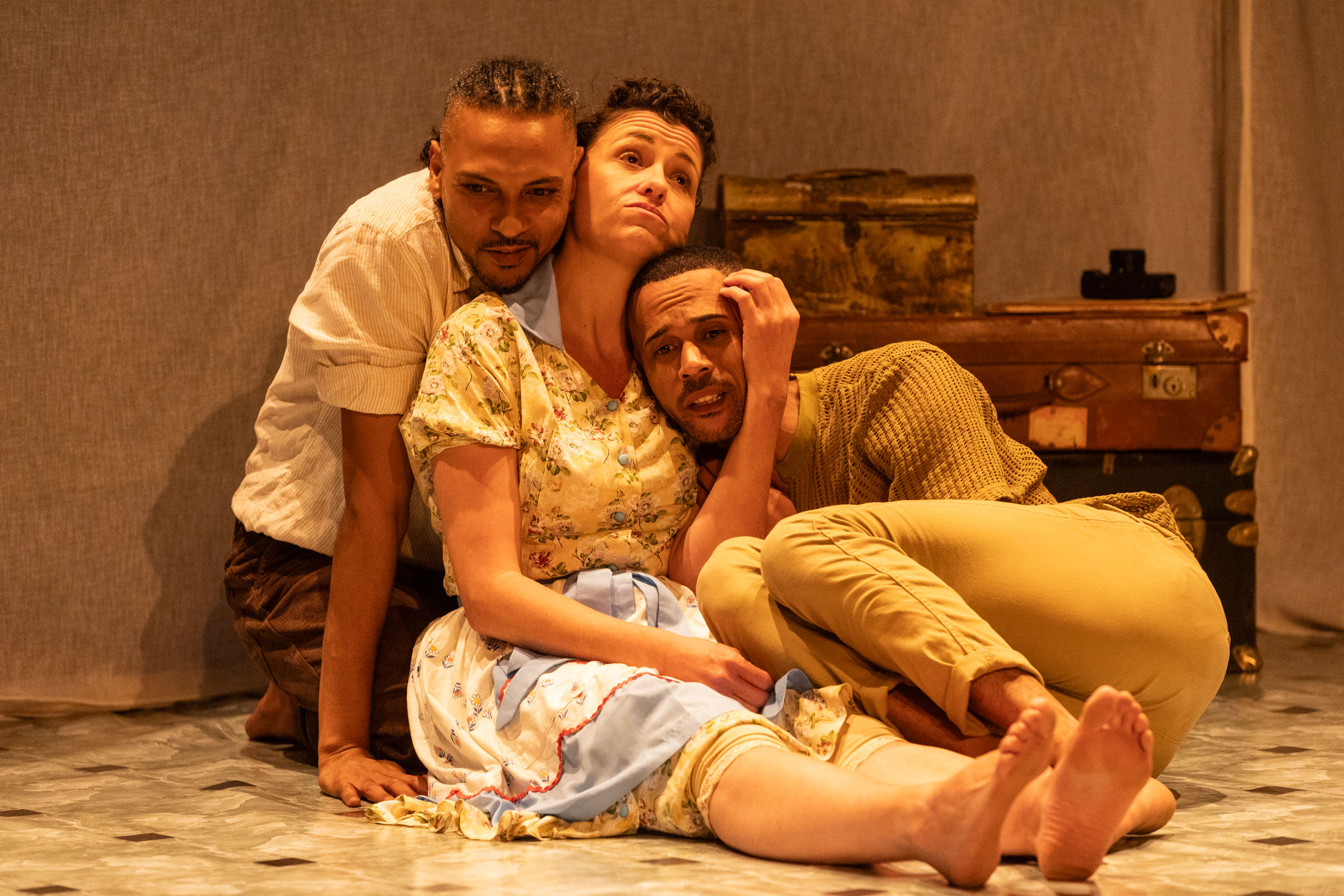
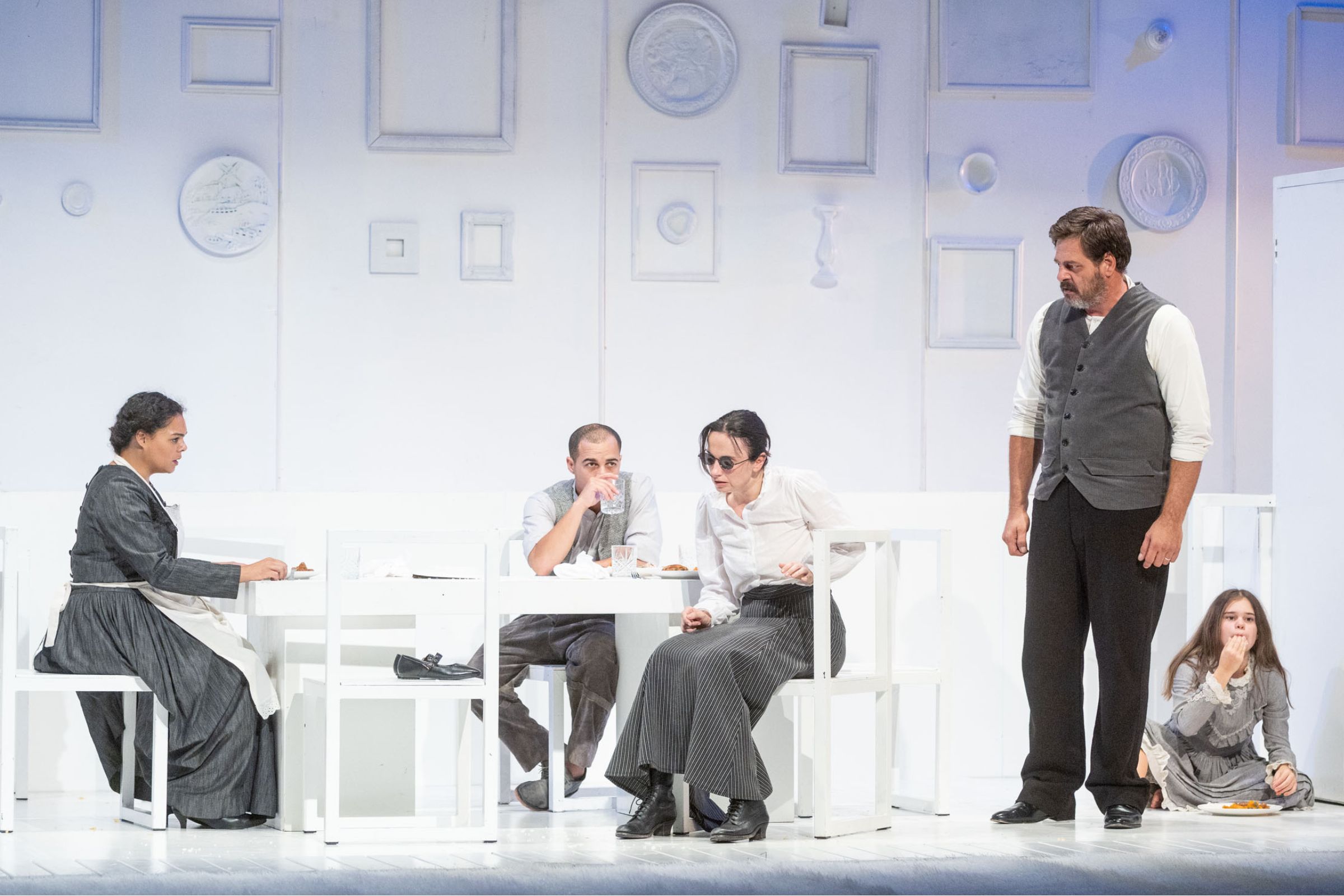
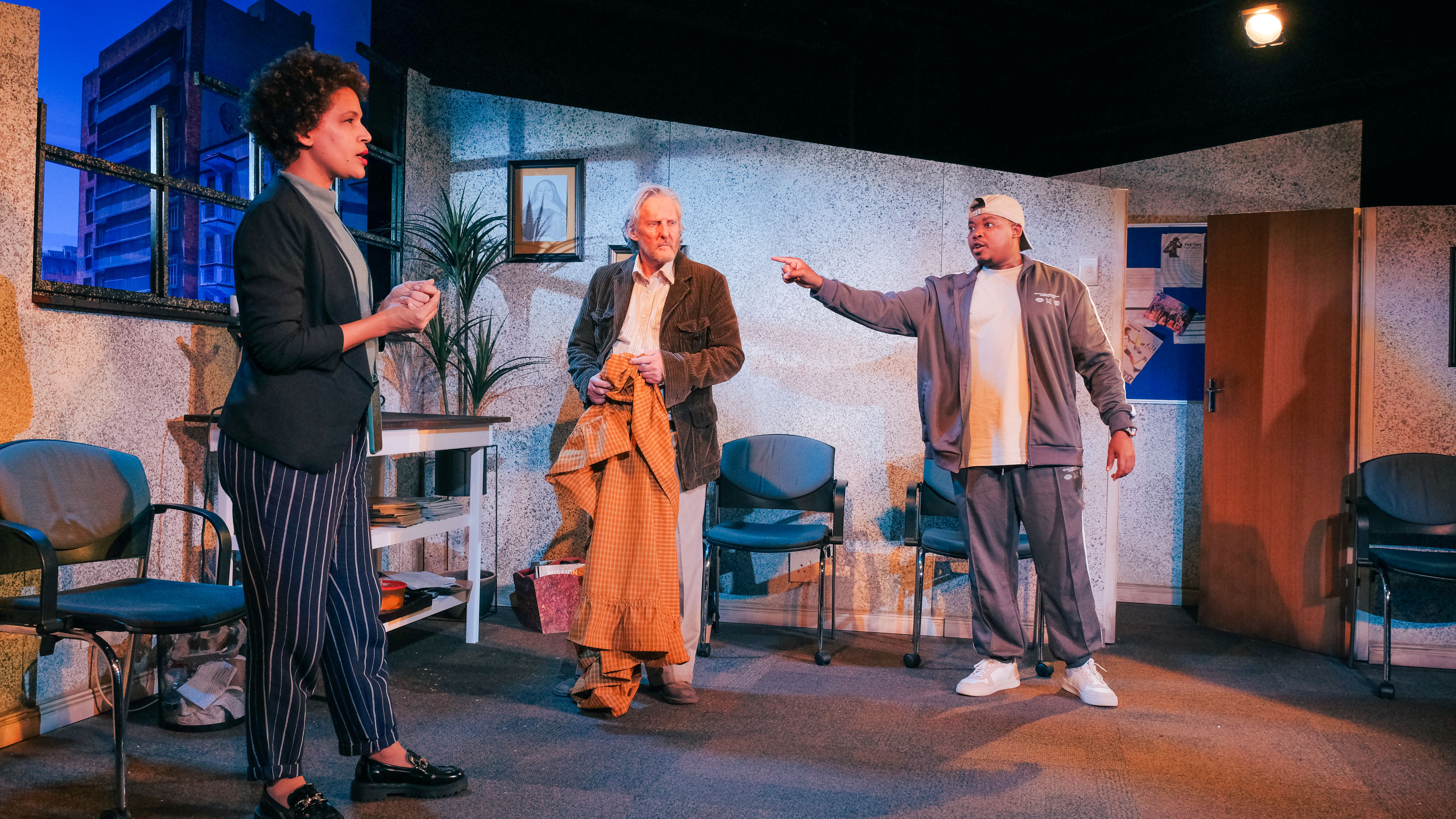
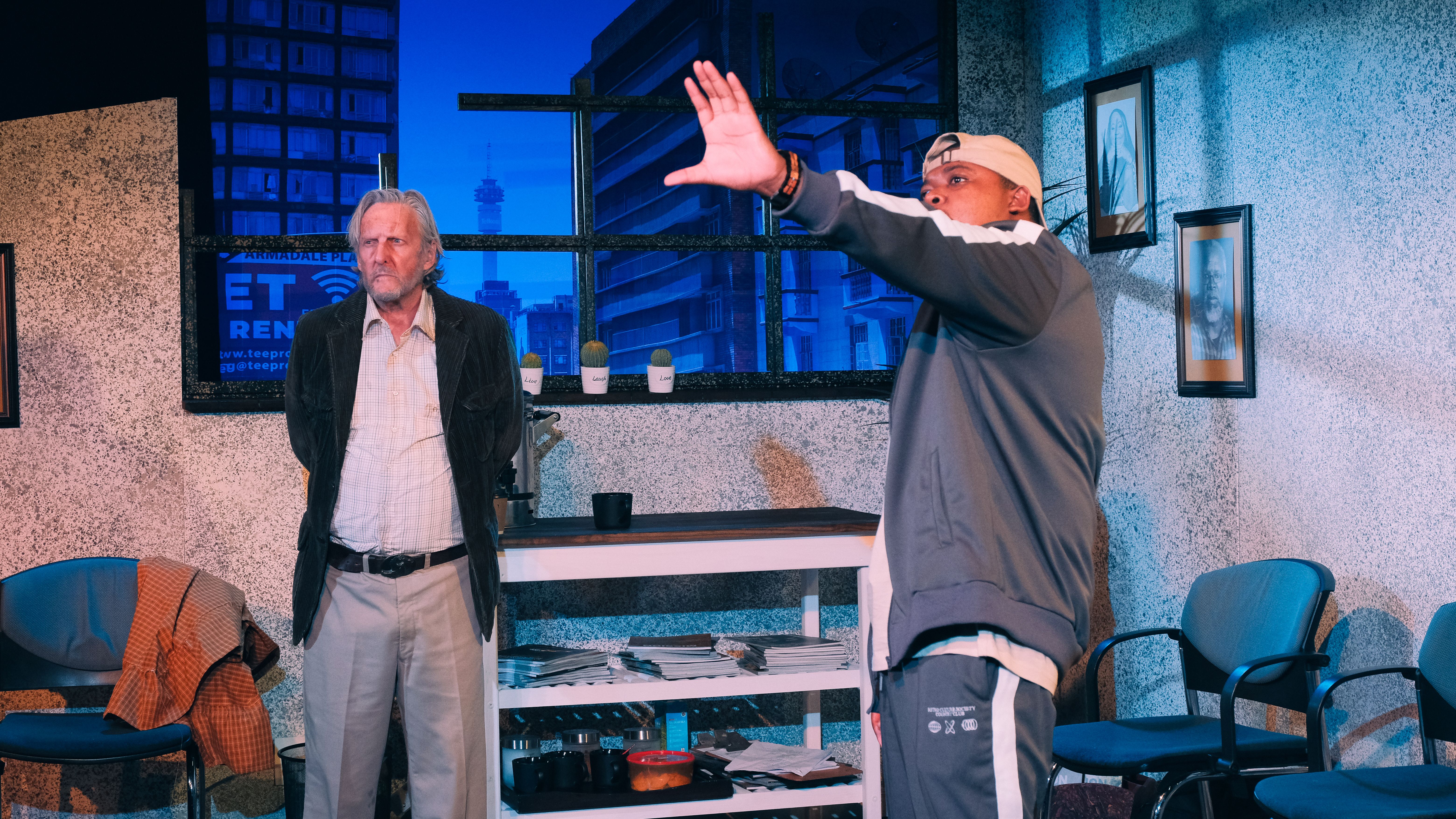
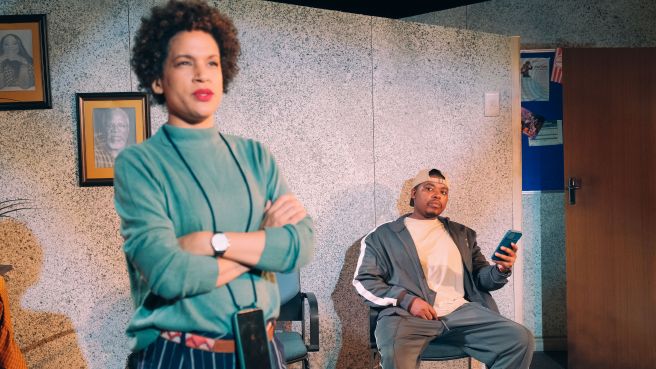
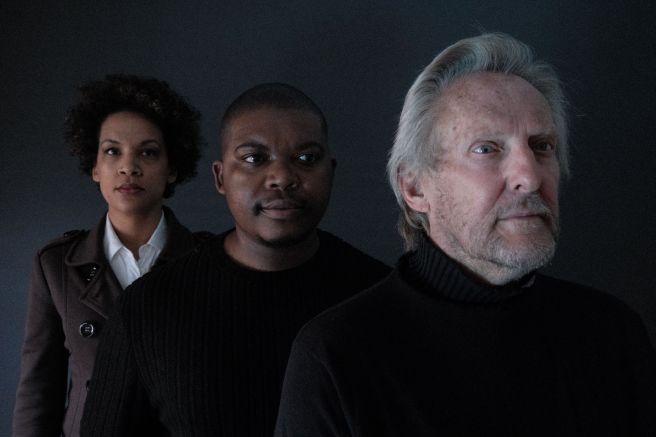
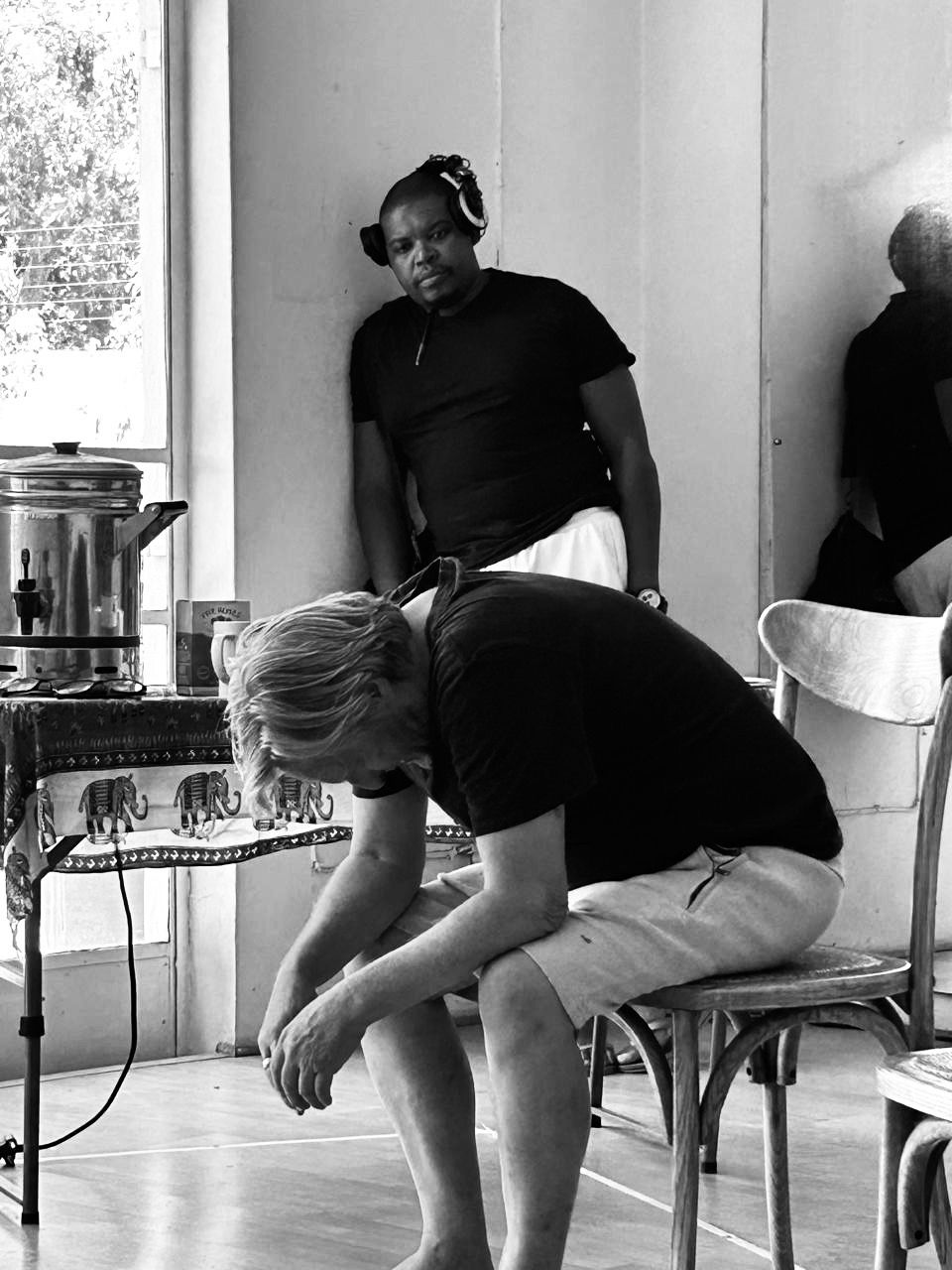
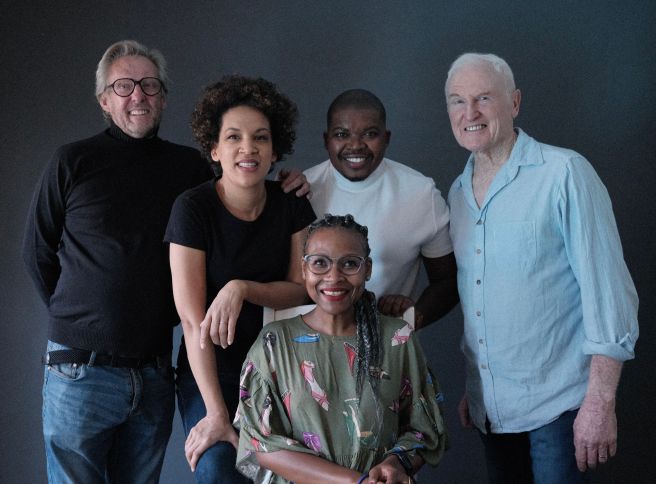
FROM LEFT TO RIGHT: Gontse Ntshegang as Grace, Craig Jackson as the psychiatrist and Farai Chigudu as the bodyguard withThemba Ndaba as Robert Mugabe.
PICTURES: Ngoma KaMphahlele
BREAKFAST WITH MUGABE by FRASER GRACE
DIRECTOR: Calvin Ratladi
PLAYWRIGHT: Fraser Grace
SET DESIGNER: Wilhelm Disbergen
COSTUME DESIGNER: Sheli Masondo
LIGHTING DESIGNER: Denis Hutchinson
CULTURAL DRAMATURGE: Professor Samuel Ravengai
MUSIC: Matthew Macfarlane
ACCENT COACH: Louise-Saint Claire
CAST: Themba Ndaba as Mugabe, Gontse Ntshegang as Grace, Craig Jackson as Andrew Peric and Farai Chigudu as Gabriel
VENUE: Mannie Manim at the Market Theatre
DATES: until August 10
If you are intrigued by the title, this is a play you will want to see. With the name Robert Mugabe having special meaning in South Africa, neighbouring country to Zimbabwe, it was a packed buzzy audience in attendance, always a joy to behold in an industry that’s constantly in battle.
If you google the number of Zimbabweans living in South Africa, they are described as the largest group of foreign migrants in the country. “Some estimates suggest the number could be as high as 3 to 5 million.” And it goes on to say that the influx is primarily due to economic hardship and instability in Zimbabwe.
South Africans will all have some opinion of what occurred in Zimbabwe. Mugabe is still an enigma to many because he started as a saviour in the new democracy in 1980 in a country which was ravaged by civil war. The education system alone can attest to that.
Yet, because of the ambiguities, political perspectives and where you come from will come into play when watching this fierce production. If you are expecting answers to the many questions you might have, what you get is a view of the complications of a system which so clearly exposes the cliché, “you cannot please all of the people all of the time”.
What you have is a deeply troubled man haunted by his actions as a political leader of a country that lay in ruins yet full of hope for a new dawn. The action is heightened from the start as Grace Mugabe (his second wife) has summoned a white psychologist to see her husband. What unfolds all happens in hushed tones, with people looking over their shoulders waiting for some kind of menace.
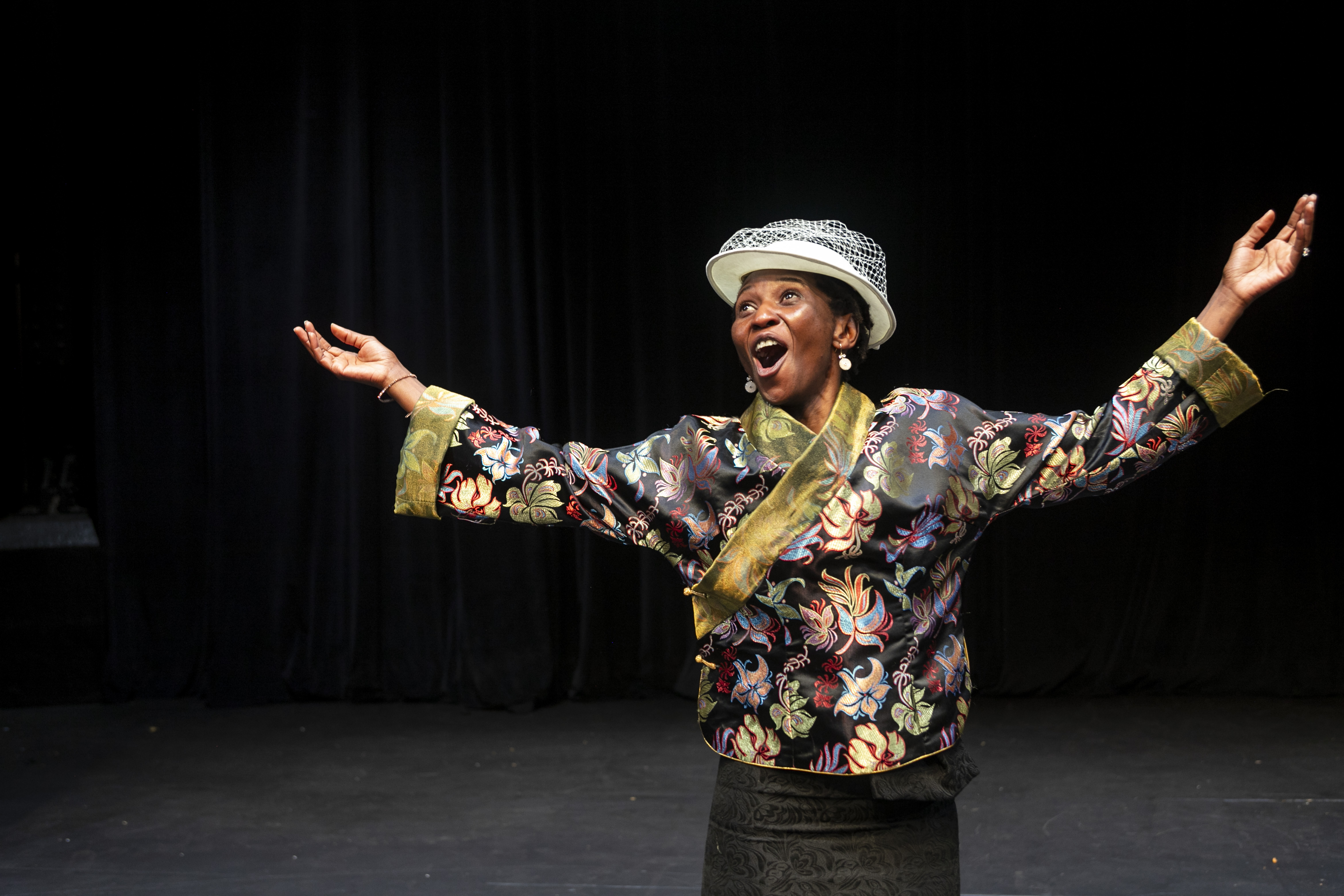
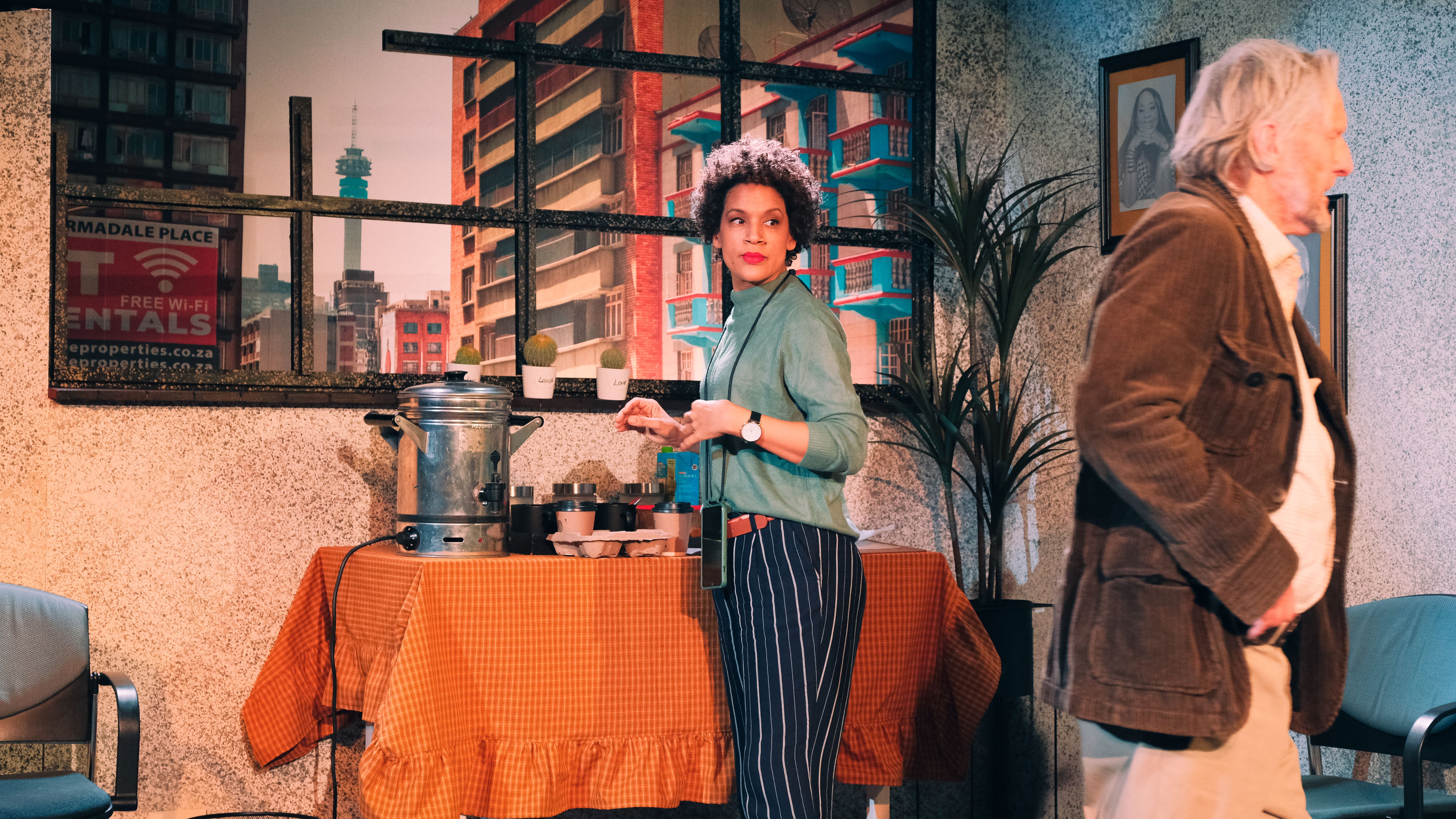
A man who was born to intimidate, Mugabe’s bodyguard, is hovering and watching in constant attendance. A jittery wife at first seems worried about her distressed husband, yet as she almost pounces on her guest, it is clear that she is much more concerned with her own wellbeing as Shopper of the Nation (which is clearly and most deliciously displayed in her glitzy attire) and wants to make sure her own position isn’t threatened. She is after all a secretary, who switched to sycophantic wife.
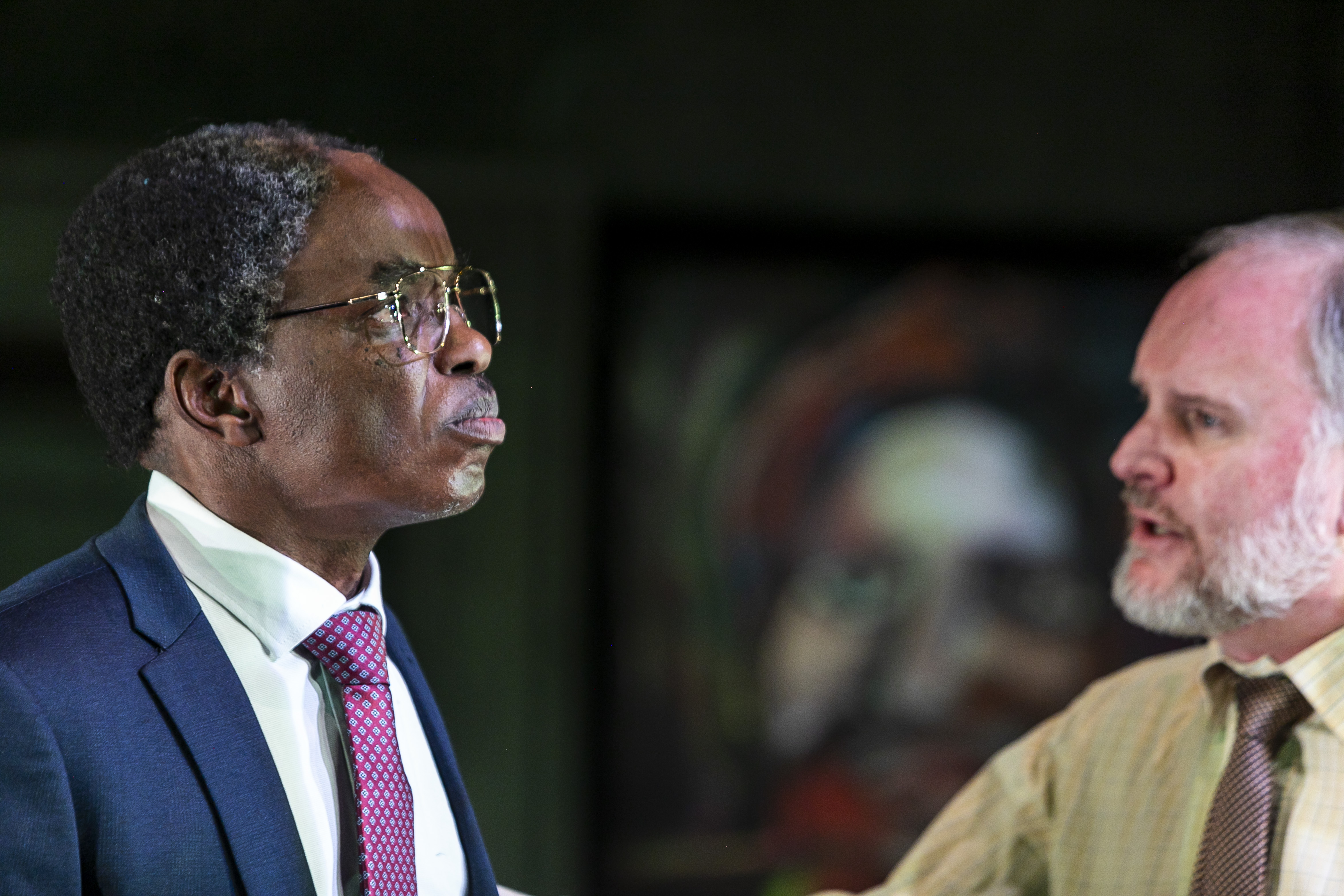
What happens next is like a thriller unspooling in almost Shakespearean fashion. Present are Robert Mugabe, his wife Grace, an English psychiatrist and the ever present bodyguard. The tone is set by an obviously agitated and deeply paranoid leader who, even though haunted by the past, is intent on dissembling reality.
The cast is astounding, from Ndaba’s resolved Mugabe and Jackson’s bewildered yet embattled psychiatrist to the staunch bodyguard portrayed by Chigudu and the glorious Ntshegang, who masterfully displays Grace’s Machiavellian traits as she plays everyone differently.
The writing is a masterpiece. First written at the turn of the century, its relevance seems heightened in today’s world where unfettered power is displayed and celebrated with such candour and even pride. But it’s the way playwright Fraser Grace tackles all the issues, explores the ruthlessness of the regime and manages to stand aside from the writing that makes this hair-raising yet compulsive viewing.
Well done to Greg Homann and The Market for staging this work and for the passion of director Calvin Ratladi, Standard Bank Young Artist for Theatre who held onto his dream of directing this play one day and grabbed the opportunity when he had the chance.
He knew exactly how and with whom it should be told.
“What we love about music is not that it sounds good. What we love about music is that it sounds inevitable. It’s playing the thing that we all know is unfolding. Whether we want to accept it or not …”
Jon Batiste (American Symphony)
This is the quote artist Frieda van den Heever sent me when we started a conversation on email.
I became aware of her as a producer. She was mostly involved with poetry-driven productions, but what I noticed was the sensibility of what is a very tough stage production.
How do you get people to attend poetry productions at a festival where there is so much on the go? But she did and she knew how.
She describes herself as a novice who preaches, because she studied drama not theology. She explains that in Springbok, where she grew up, they called it people’s church when a normal person preached because the preacher couldn’t be there.
“I have been doing it for almost 14 years, and no one has ever asked for my credentials,” she says. Having encountered her on stage, I understand why.
She is part of InVia congregation in Cape Town and describes this community as a group of people who love music and people. Her father was a minister and while she spent most of her free hours as a child in his study rather than on her own, she never thought that she would either enter the church or become a musician like her mother. “I had spent enough time in churches with music in my ears for a lifetime,” was what she thought.
Still, when she read something impactful she always caught herself speaking rather than just reading that passage. She simply couldn’t escape and then there was a time when she didn’t want to any longer. It has always been a juggling game, because it wasn’t something she could practise fulltime. But she missed theatre.
She believes in the power of stories, fables, poetry and metaphors. “Both theology and theatre navigate a place beyond knowledge, something like mysticism, and tell stories that often hold warm truths rather than cold facts,” she explains.
The part of her work that she favours most is what she describes as “accompanying rituals”, including marriages, funerals, christenings and the like. She regards it as her calling to add to the honouring of these events. It’s not that she participates only in religious ceremonies; she is often involved when people aren’t particularly interested in a church but still have a need for some kind of ritual which they share with their loved ones.
She also presents talks and retreats for congregations or groups of people who approach her. These are creative workshops specifically for women, but she stresses, “it has nothing to do with pancakes, crochet and tea parties.”
She knows these certainly have a place, but for her it is about togetherness, breathing, chanting, laughing and crying.
That’s just the beginning of all her activities. She is also involved in yoga and the transformation that ensues and has a deep fascination with people and how they struggle and survive. And while she would have loved to study psychology, a lack of time made her opt for an intensive 14-month course in integral coaching which will be incorporated in her other work.
And still, she keeps going. Once a week, she travels to Stellenbosch, her alma mater, and teaches cabaret facilitating the practical execution and texts of the honours students in the US Drama Department . As a student of the legendary Marthinus Basson, she is delighted that she can pass on her experience to a younger generation.
There’s also her radio work which started on small scale, but her talents were quickly recognized. And she still benefits from her innovative moves during Covid which resulted in her producing programmes in the basement of her home.
That led to her producing most of her radio and television work in her home. It means that she doesn’t have to spend too much time away from her children and allows her to do much of that work early in the morning. “It all happens before the children and the cars have to wake,” she says.
I’m breathless and haven’t yet come to her performance, which is really what I want to promote.
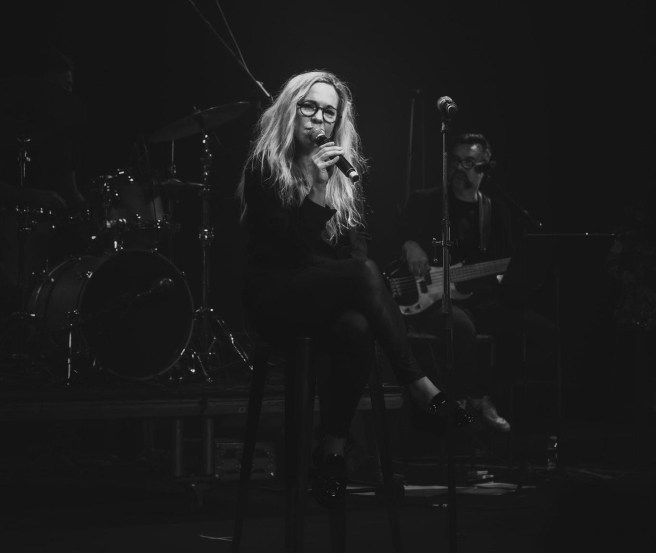
On Wednesday at 7pm, Frieda will be performing at the Fairtree Atterbury Theatre in Lynnwood, Pretoria for the first time in a magnificent production, Spoorsny (tracking) .
“I really went into grief. I sensed that I had to go in if I wanted to come out. I don’t mean that I’m perfect now, but I’ve been through the perfect storm and that moulds one to find more light because I was mining the darkness. I can sense, I almost want to say I can smell light and when I sense it I look for it everywhere. The material for my debut album came from a show I did on what would have been the night of Leon’s (Kruger) 50th birthday. (He had died very suddenly in 2021) I saw the Woordfees was during that time and I didn’t know on which date I was going to perform and then when they sent me the date, I went for it to really celebrate him with this work and this script. I could have gone to sit somewhere in the quiet and the dark which isn’t wrong, I have done it. But for that night I wanted to share what was left of me, so that it could multiply and I’m grateful for that.”
Her previous productions as director, Die Poet – Wie’s Hy?, Die Oerkluts Kwyt and Met Woorde Soos Kerse all shared a particular sensibility that made me aware of a rare director at work. She knows she didn’t have the technical experience, but her affinity with poetry and performance outweighed anything else. I didn’t notice any imperfections with any of those mind-blowing shows.
She works with love, a fine-tuned ear and excellent evalution. Also, part of the package was a childlike “unknowing”, an unwavering belief in the collective intelligence and the process, endless curiosity as well as an excellent production team and artists. Her motto was to always be present in the process. Whatever the requirements, it worked.
If you’re crying halt, there’s more. For 10 years she has been involved in a process with farm workers who boast magnificent voices. Each year she selects 10 of the best and offers them the opportunity to learn and to show off their talent. “I try to bring each individual something, give some of my experience, but I can’t teach them anything about singing. I have worked with voices that compare with the best in the world and it is a burning passion to create more platforms to showcase these voices.”
Her own musical talent, writing and composing songs and performing, has never been the only thing she wants to rely on to make a living. She wanted to be a free spirit when going on stage.
She is much more of a homebody than someone who wants to be out there but she also has a need to be challenged by the alchemy of a live performance. She obviously has a blueprint when she goes on stage, but she also reads the room and has the talent to shape her performance in different ways.
If she had a choice, she would write songs, play music, dance and jam with other voices and instruments all day long. “That feels like the best and most unvarnished version of myself,” she concedes.
To my mind, that is exactly who we watch and listen to during a performance of Spoorsny.
But let me give wordsmith Frieda van den Heever the last word: “The sudden death of my husband in 2021 and the impact of mortality and loss give perspective to everything I do and am. I am much more than a widow and single mom, but it gives context to my decisions and relationships, the spaces I find myself in and how I engage with people. The raw material which emerged in my debut album Skoonveld and formed the platform for the stage show Spoorsny as well as the anthology (published by NB) ‘n Asem Lank says everything about my search for meaning and light.”
In the programme notes online it says that this play is a masterclass in writing and performance – and that is exactly what it is. And the aspects that I found most intriguing as being a born South African, I have been dealing and watched others sharing their trauma in this country for many decades.
Some similarities especially in text will occur, but I am passionate about people creating theatre – especially solo theatre.
Having to travel from Pretoria for most of my theatre, I consider very carefully which plays I want to see whether good or bad, just work that will appeal to me. And this is where theatre sometimes becomes problematic. If you are going to see a play that is 70 minutes long, it becomes a money issue. It has to. Time and travel become a worry.
So I have started coming up with fresh solutions to make my choices easier. With this one, I had already booked for a new musical opening and I thought I could slip this short prodcution into the mix without any difficulty. I see many more plays on one day when attending a festival. And that is what I did and will do more of in the future when the problem rears its head.
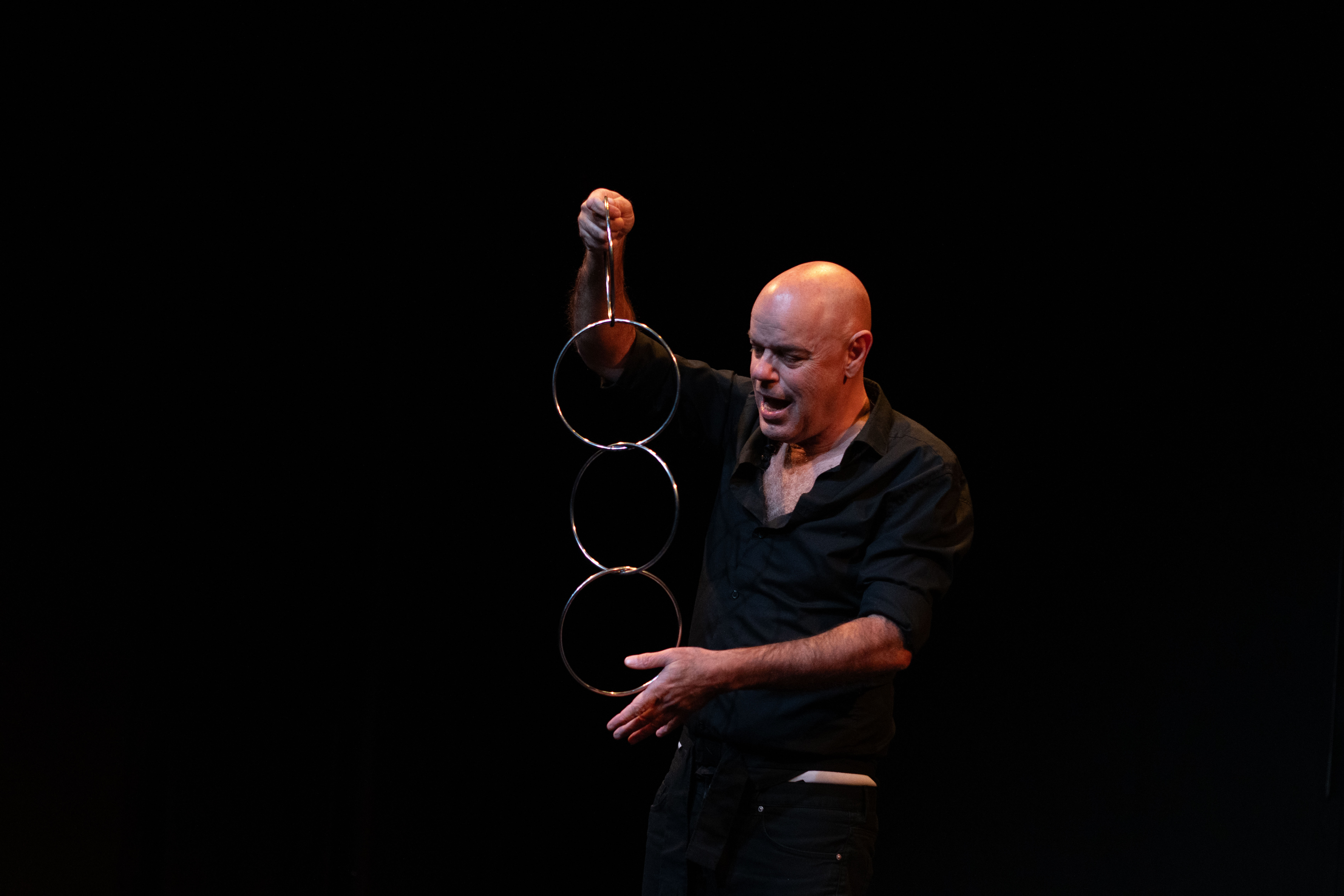
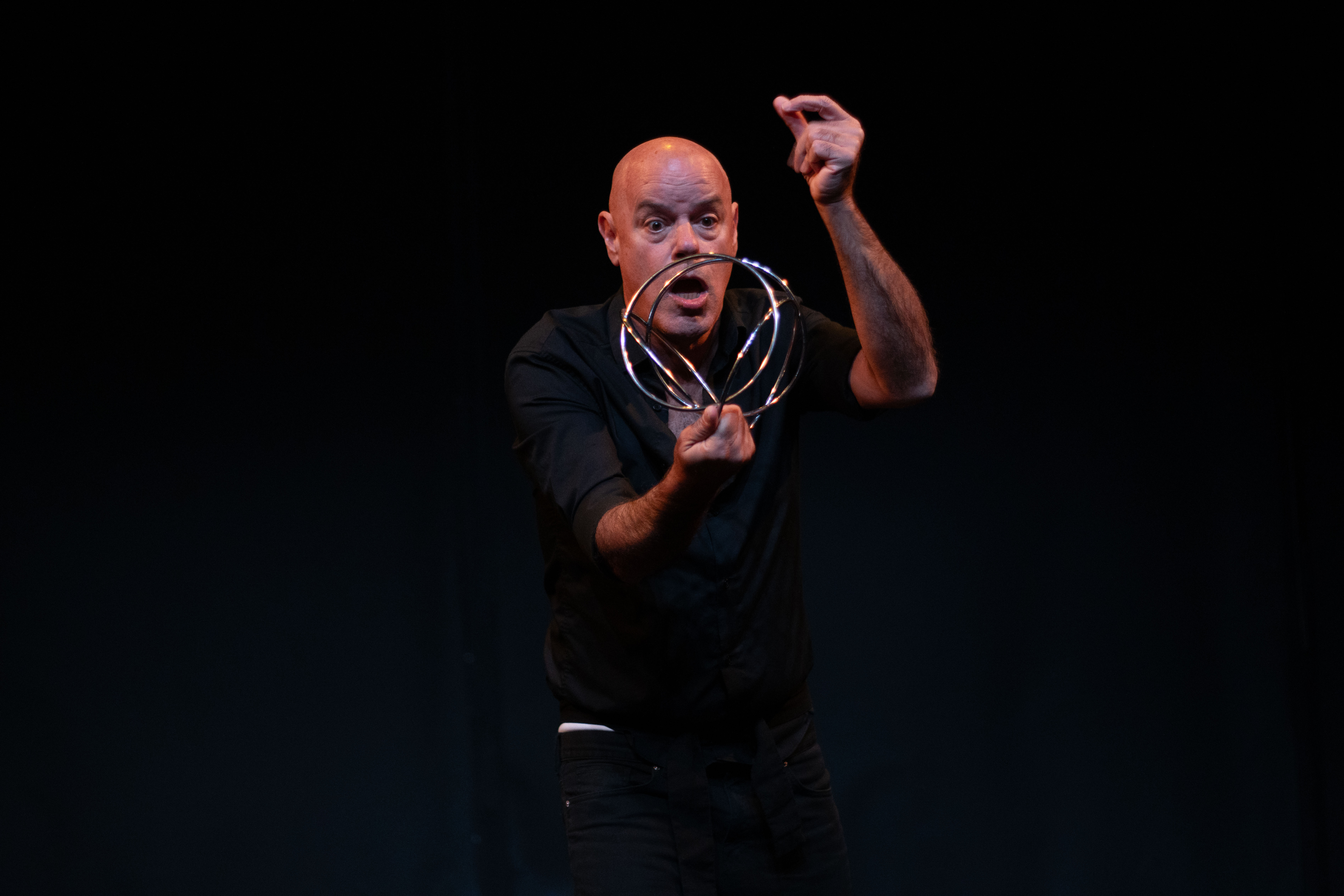
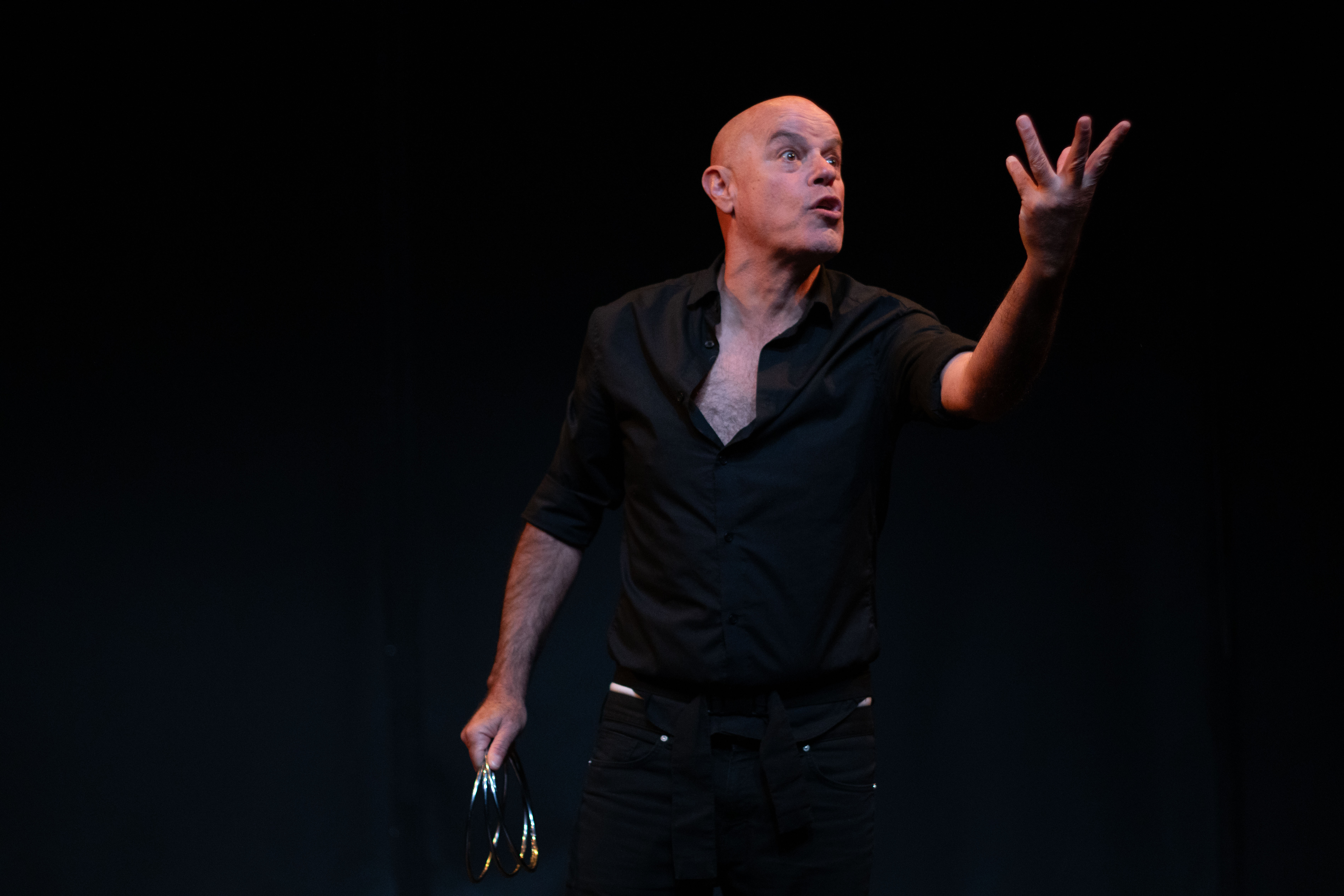
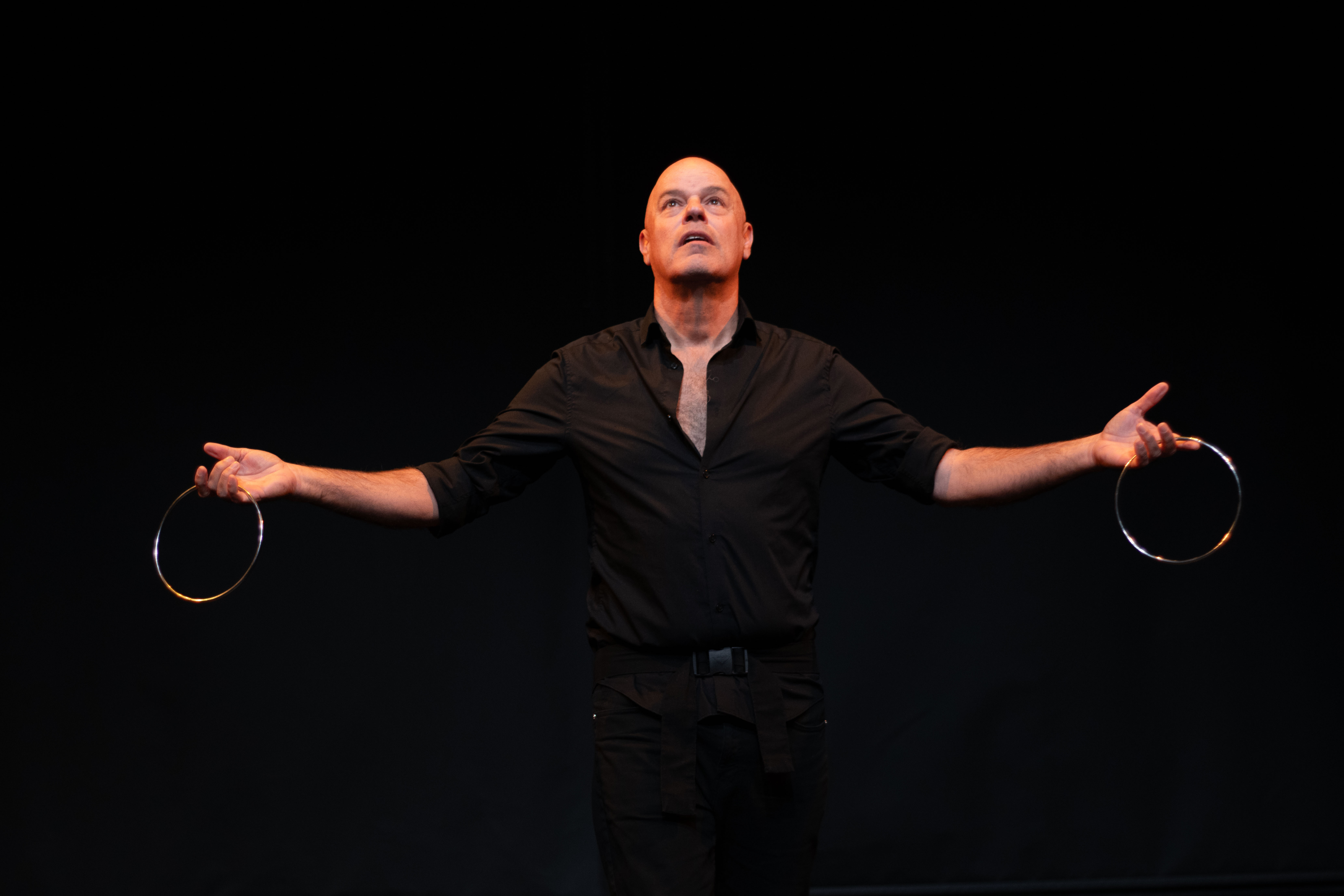
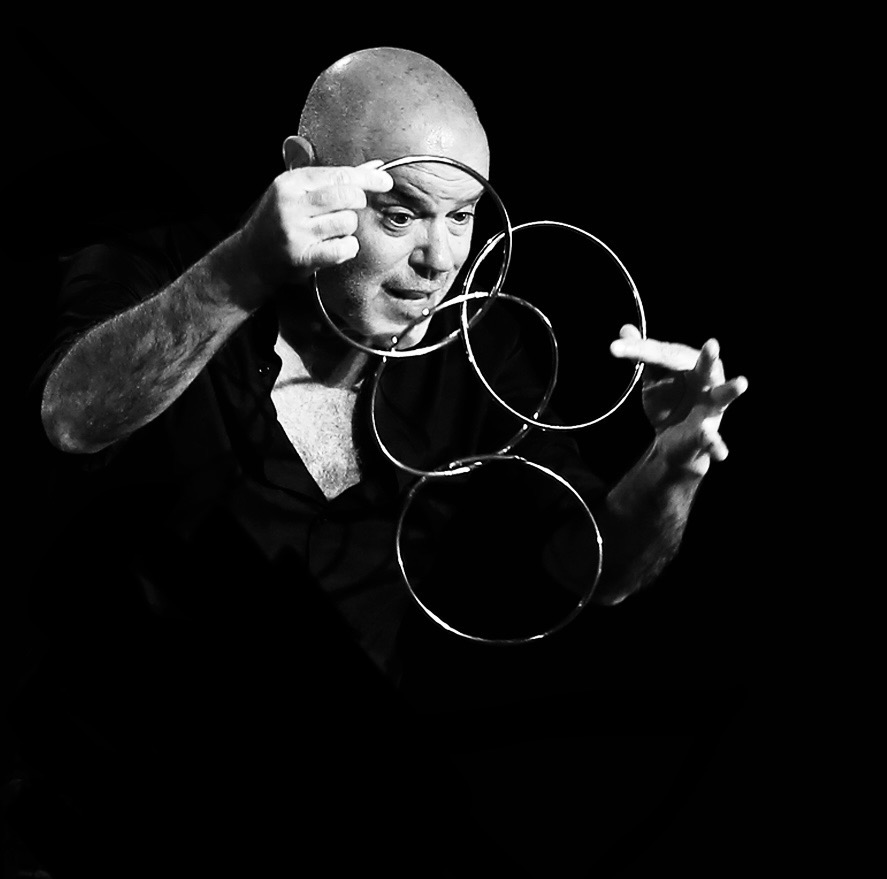
Brincat, who is a first generation South African, is described in many different ways and with many accomplished skills from acting, juggling and magic artistry to fine art, chef, writing and producing one-man shows, it seems.
But this is my first encounter as far as I can tell with this versatile artist. As he’s based in Cape Town and visits the National Arts Festival, while I am based in Pretoria and cover the Afrikaans festivals around the country, his work is unfamiliar to me.
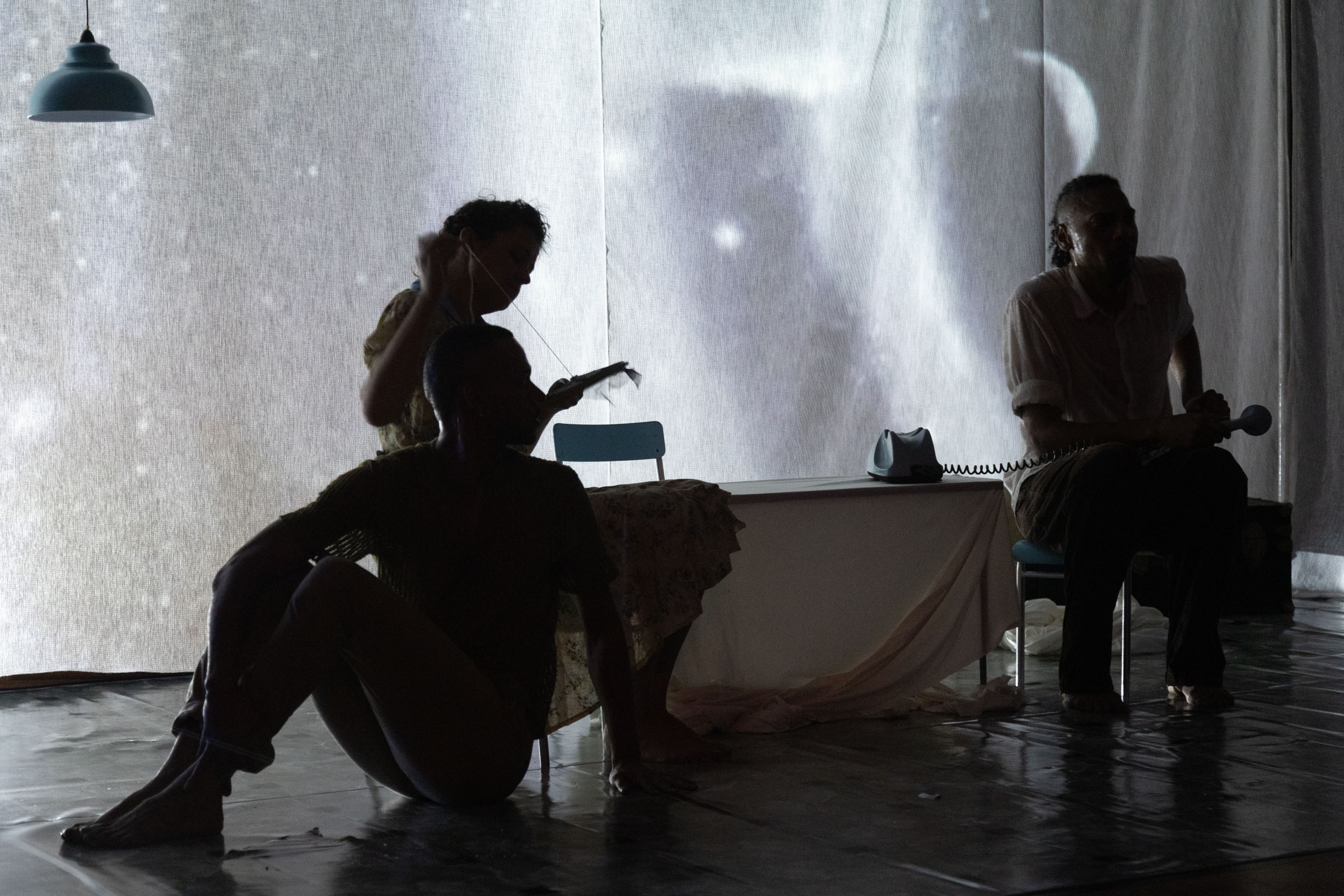
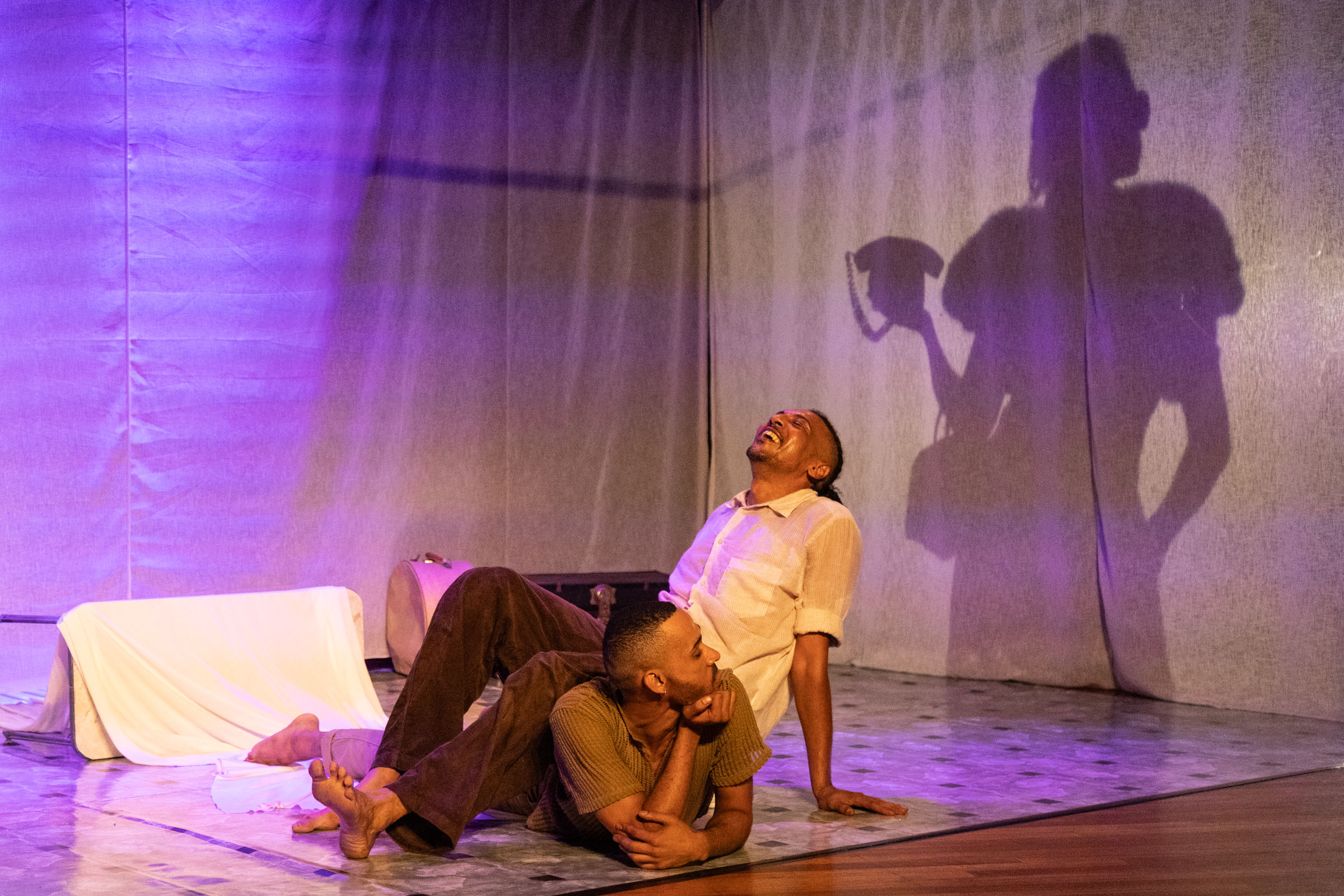
The Moon Looks Delicious from Here is a man’s struggle with identity and finding his own place in what should be his world but isn’t always that straightforward is what he shares and struggles with.
It is familiar territory stretching from the ‘60s tot ’94, but it’s always interesting to discoverhow other people deal with issues that come up for many of us in different ways. It is also fascinating to see how others approach their work, especially when at play, as solo shows can be limiting, depending on the content and how familiar you are with the subject.
He had me from beginning to end; engaging with his audience wasn’t an issue for him even with a most unusual mix on a Sunday afternoon. Half of the 100-plus theatre audience (and I’m guessing numbers) were elderly white couples and the other half were young (between 20 and 35) Black men and women. And throughout there was laughter from different quarters. It was a journey of remembrance for oldies and probably one of illumination for youngsters.
It would have been fascinating to have an audience talk after the show in this instance. This is Brincat sticking his toe in the water and it feels good. Hopefully he will be back so that we can get to know more of his work and his content.
It’s explosive, it’s engaging, it plays with your mind (stretching it this way and that), it’s mesmerising, it sweeps your whole being along and most of all, it’s original and creative in a way that heightens all the senses. And then it shows you everything theatre can be.
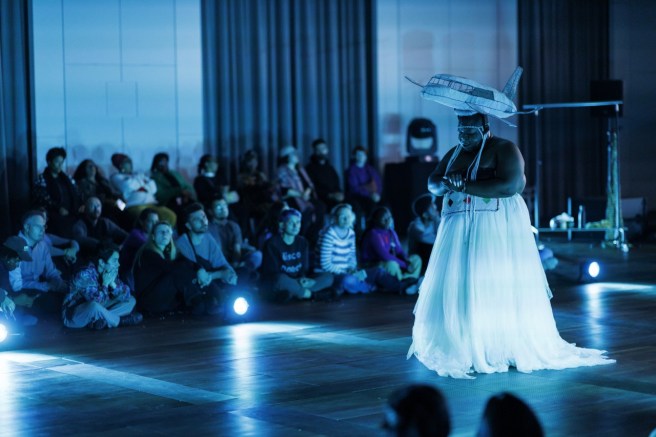
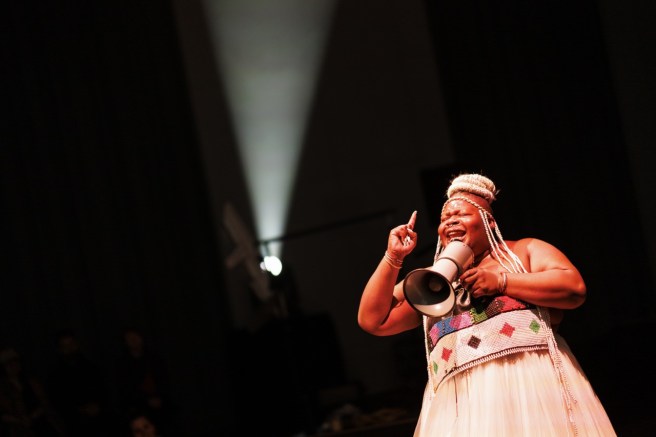
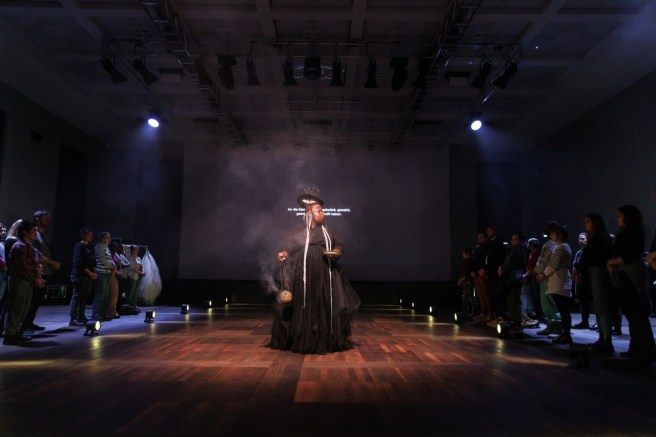
Khoza is a presence not only with the theatricality of their costumes but especially with the way they move, speak, sing, chant and engage their audience from start to finish. There’s no time for your mind to wander or wonder, you’re simply in the moment as you participate in this experience that for most of us would be completely unique.
It’s ritual and rhythm, it’s engaging your whole being. This isn’t something you‘re watching, you’re participating on a level that is here and now. It’s theatre-in-the round with the performer, the one who is leading the way on this exploration of the past where human zoos and exhibitions in Western societies, our societies, turned people into curiosities to be paraded and exploited for the delight of white fetish. That is even difficult to write after seeing this play.
Especially for those of us on the oppressors’ side, while we gasp in horror at the stories, we know what our race has done to people because of the colour of their skin, have seen many plays and read many books about those times, yet, sadly it remains just that. It’s not as though your body can viscerally experience what that must have been like. It’s something that white people to this day never experience. They simply don’t have to navigate a world that plays by rules made for them … still.
How many times have you as a white body thought about how anything that you do on a specific day will be determined by the colour of your skin? Think of Trump’s world in today’s context for example. People are being rounded up and deported even with citizenship because of the way they look.
Khoza suggests that it is a history that is not spoken about and which they are determined to address so that those affected can reclaim, reflect and confront themselves as people. Because it is something that continues to this day, for them it is about the need for spiritual healing and reclaiming violated dignities.
The one thing all of us have felt in our lives is humiliation. For many it is an occasional thing that can be quickly discarded as you move on with your life. For others it is an institutionalized part of their life and there’s no escaping. The only requisite to fall prey to this is the colour of your skin. Everything in our lives to this day is determined by this. Think Black Lives Matter.
It is described as an installation-based performance and for me personally, it was as though my whole body had suddenly been awakened. I felt alerted to the way the world works. Was there anything said that I hadn’t heard before or didn’t know? How many times have I not experienced the Saartjie Baartman story, a woman torn from her family, stripped of her identity as a human being, taken from Africa to Europe and displayed for the Western world to view in a human zoo? We know and sympathise about the atrocities of the past. And again we wonder about those happening all around us, because they’re still there.
What The Black Circus does is change the perspective; it inhabits your body and soul in a way that takes you the the heart of the atrocities. For Khozait is a place of collective healing where the shackles are discarded, and a spiritual connection established.
It’s a difficult experience to write about because it is one to experience rather than to analyse. You want to enter the space knowing just the title.
At the beginning I felt as though I was sitting in a glorious painting. A story of some kind was going to unfold and as with most theatre, I was excited. What I got was so much more. It was unexpected, challenging in the way theatre should be, explosive in performance and presentation, and something that has changed my life. And that is what theatre should be.
I will be looking at and facing the world diffently.
DIANE DE BEER reviews the latest Mike van Graan play
THE GOOD WHITE
DIRECTOR: Greg Homann
PLAYWRIGHT: Mike van Graan
CAST: Shonsani Masutha, Russel Savadier, Vusi Kunene and Renate Stuurman
SET DESIGNER: Patrick Curtis
LX DESIGNER: Themba Stewart
COSTUMES: Nadia Kruger
VENUE: Market Theatre
RUNNING TIME: Until June 1
Pictures: Ngoma Ka Mphahlele
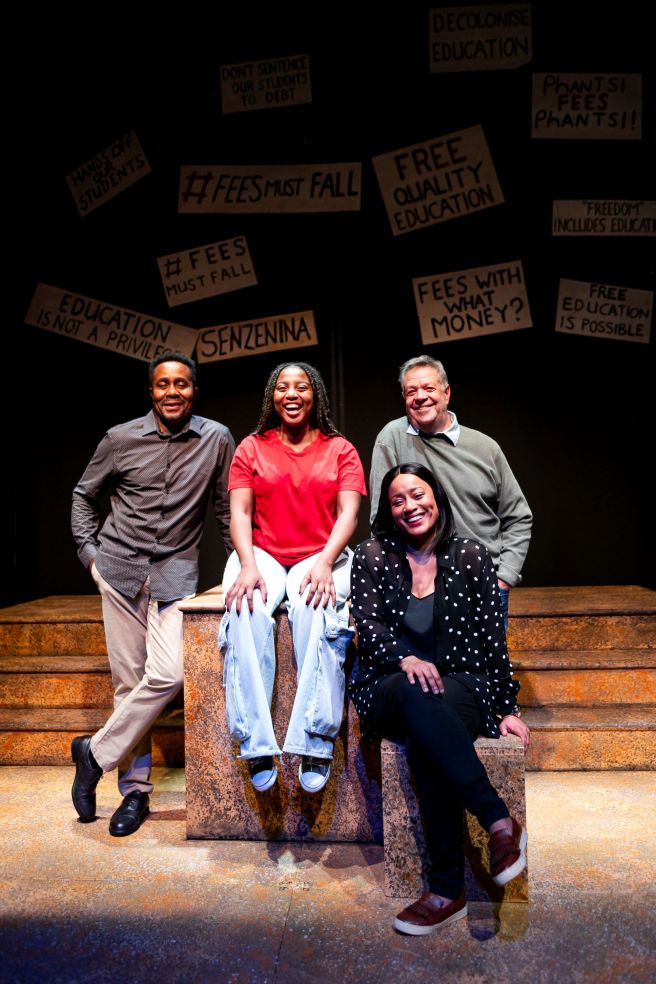
Pair the title with the four characters on stage – Vusi Kunene (Black, pictured right), Russel Savadier (White), Renate Stuurman, (Coloured, pictured left) and Shonsani Masutha, (Black, centre front), — and, in the South African context, sparks will fly.
That is what Mike van Graan’s latest play leans into. He says in the programme notes that he hasn’t written anything but solo shows since 2018 and it feels as though this one has been bubbling under and then just exploded – in the best possible way. It’s an epic piece of writing which will have you gasping as he appeals to each one in the audience, whoever they are, to grapple with the issues – our inner core – of South Africa.
While Nelson Mandela did many things for this nation, coining the phrase Rainbow Nation was arguably not one of them. It is as though he constantly reminds us what we are not, but if you were part of the opening audience on what seemed to be a quiet Sunday afternoon in the theatre, you would have witnessed that we could be.
The perfect quartet: Vusi Kunene, Shonsani Masutha, Russel Savadier and Renate Stuurman.
The audience pretty much reflected the mixed bunch we are and from the deadly silence following the first poem of strength recited by the astonishing Masutha to the immediate participation during the rest of the play, it was as though there was another solo performer on that stage – the audience.
It captured the heartfelt emotions Van Graan has always been able to harness as he tackles the South African nation. And no one does gloves-off like this playwright. Setting the play in academia, he has chosen his boxing ring and then selected his characters to represent every foible in the human race, it felt like. And then he lets them rip.
As always, he doesn’t hold back, everyone and each weakness is held up for scrutiny and the constant audience gasping and finger clicks told you how he hit the mark throughout the play.
Through the years Van Graan has been honing his very own way of dealing with what he views as our fatal flaws and this time it feels as though he has unleashed it all in glorious colour.
It might sound like something you don’t want to hear or see but, because South Africans will all relate to everything, it’s like witnessing the full South African story from Once Upon A Time …Prejudices in all their pitiful hostility, power plays, colour bashing, gender gore, poor vs privilege and the list is endless. He plays all those cards to their fullest.
Those who know his work, also know that he can write and he has never been scared to speak his mind. He does it to the Department of Arts and Culture and he does it on stage. When he has a platform, he steps up and tells it like it is and believe me, he is one of the few who speaks his mind unabashedly whenever he can.
He has been maligned to the high heavens, but nothing has stopped him. And finally, to my mind, here is his magnus opus and it is flawless and delicious to witness. And when (not if) you go and see it, I hope you have the same audience we had; it added to the fun and spectacle of the drama.
Add the director and the cast to complete the perfect coming together. Homann allowed the Van Graan words to do the work, which was the best thing to do. It should be unfettered because you really have to engage and listen to get the full extent, which here you do.
The cast delivers magnificently. I didn’t know Masutha’s work but she made sure I would never forget her. What a performance! From start to finish she’s there with all her energy and might and that’s what her volatile character needs. Stuurman is an old favourite and to my mind, this is her best performance yet. Savadier and Kunene also fit the bill and, as seasoned actors, they never put a foot wrong.
It’s a play I will try to see again towards the end of the run, because there’s just too much to take in at one sitting. It’s something — even though it doesn’t sound like it — that gives hope. If, as Van Graan suggests, this is exactly who we are, at some stage togetherness will take hold. As for now, we are still that dysfunctional family who needs a stern word to set us on the right path – and this is it.
Diversity was the element that dominated this year’s fantastic KKNK Festival (in Oudtshoorn at the beginning of the month) – from the audiences to the artists, also including the plays and performances. DIANE DE BEER reports:
PICTURES: Hans van der Veen (unless otherwise stated.)
On one day you could see a solo show, a play with both words and movement, a translated modern classic and a new work that will outlast some of us watching.
Yet as is often the case at this festival, theatre was what really captured the imagination – and true to the diversity theme, it played out in many ways.
For me it started with a bang with a piece titled Die Een Wat Bly (which can also be seen at the upcoming Cape Town Suidooster) with a cast consisting of the two talented dancers from Figure of 8 Dance Theatre (Grant van Ster and Shaun Oelf) who in this instance combined their extraordinary movement with the insightful words of Wessel Pretorius who seems to deliver an endless stream of brilliance. And the third member of this inspired cast is Daneel van der Walt who is an actor who has emerged these past few years as someone to watch.
Everything seemed to combine beautifully, from the story, how it was written, the excellence of the casting and the way movement underlined and emphasized every emotion so magnificently. I couldn’t resist catching it a second time and it confirmed my initial instincts that all the elements just flowed together seamlessly to present perfect theatre. I could easily watch it again … and again… and again.
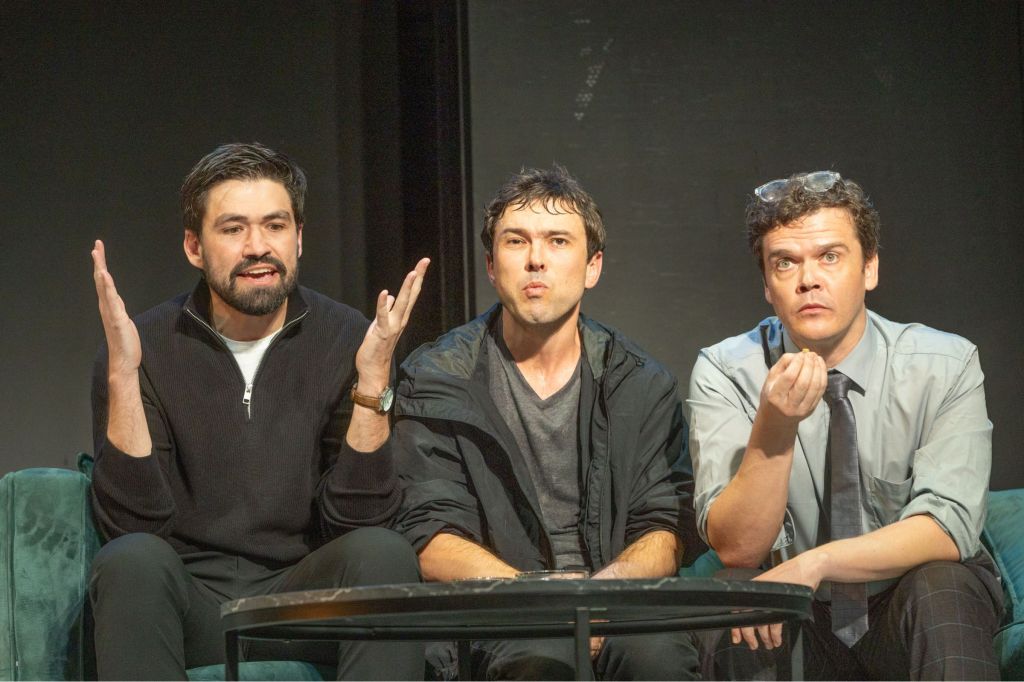
In a different guise, Pretorius performed in Yasmina Reza’s translated text Kuns (which had previously been performed by two of the actors, also directed by Marthinus Basson in the English version titled Art). Pretorius and Wilhelm van der Walt (part of the former cast) were joined by Ludwig Binge in a play that satirises the often achingly precious way people view and talk about art.
Because of the NOW, a time where an anti-wokeness and fake news seem to dominate everything, it worked even better than the first time I saw it and with these three adventurous actors (all three Basson graduates who have established exciting theatre careers), it was perfect for this festival which always celebrates.
Basson also delighted with a play which has been on the circuit for a while, and I was thrilled to finally experience. Who would not be intrigued by a play titled Kruispad, of die legende van die goue vis.
Picture: Nardus Engelbrecht.
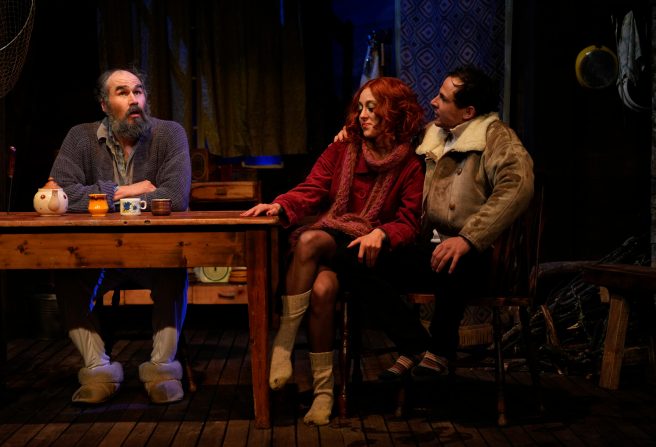
Again the casting blew me away with Eben Genis giving one of his finest performances in the role of the eccentric recluse Oswald whose life is rudely interrupted by two lost and rain-drenched youngsters played by two of the best, Edwin van der Walt and Carla Smith, with a glorious copper-coloured wig which completely changed her character without her having to say a word.
Because it plays with temptation and loyalty, it reminded me of the film Indecent Proposal in which Robert Redford offers to buy Demi Moore for a million dollars for the night.
Masterfully written and performed with great gusto you are never sure what is real or not, whether something is fact or fiction, and in fact when someone is being honest or not. It’s like trying to solve a puzzle that tortures and teases with a few disruptive detours that keep you slightly unbalanced as an audience.
There was so much more in the theatrical realm with solid performances in the Hennie van Greunen translated and directed Annie+Helen with Cintaine Schutte as Annie, the governess/teacher in the Hellen Keller story and Judi Hattingh as the severely damaged teenager who cannot see, hear or talk.
A mighty struggle ensues and from beginning to end, the two actors battle, and sometimes, bruise one another in a fight for something so much more than survival.
I have always been a huge fan when some of our younger directors (and he might take exception to that description) take on the classics, and I was excited to see Speelgoed van Glas translated, directed and designed by Nico Scheepers.
Casting was a further incentive with Annamart van der Merwe, Carla Smith, Ben Albertyn and Mark Elderkin on board, and was also alerted by all the awards they had already received, all of them thoroughly deserved. Van der Merwe’s bravura performance as the brittle mother is bruising as she embodies a woman who is desperately fighting to hold on to the only power available to her, that of motherhood (and in this instance also victimhood).
Her children, especially her son, have no such illusions and their confrontation reminds one of how a home which should be a protected space for a family can become a warzone which holds only fear and a frantic will of those threatened, to flee and find emotional freedom.
It’s devastating writing, smartly translated and, set in the present with a cast who have had the time to hone their craft and honour the play.
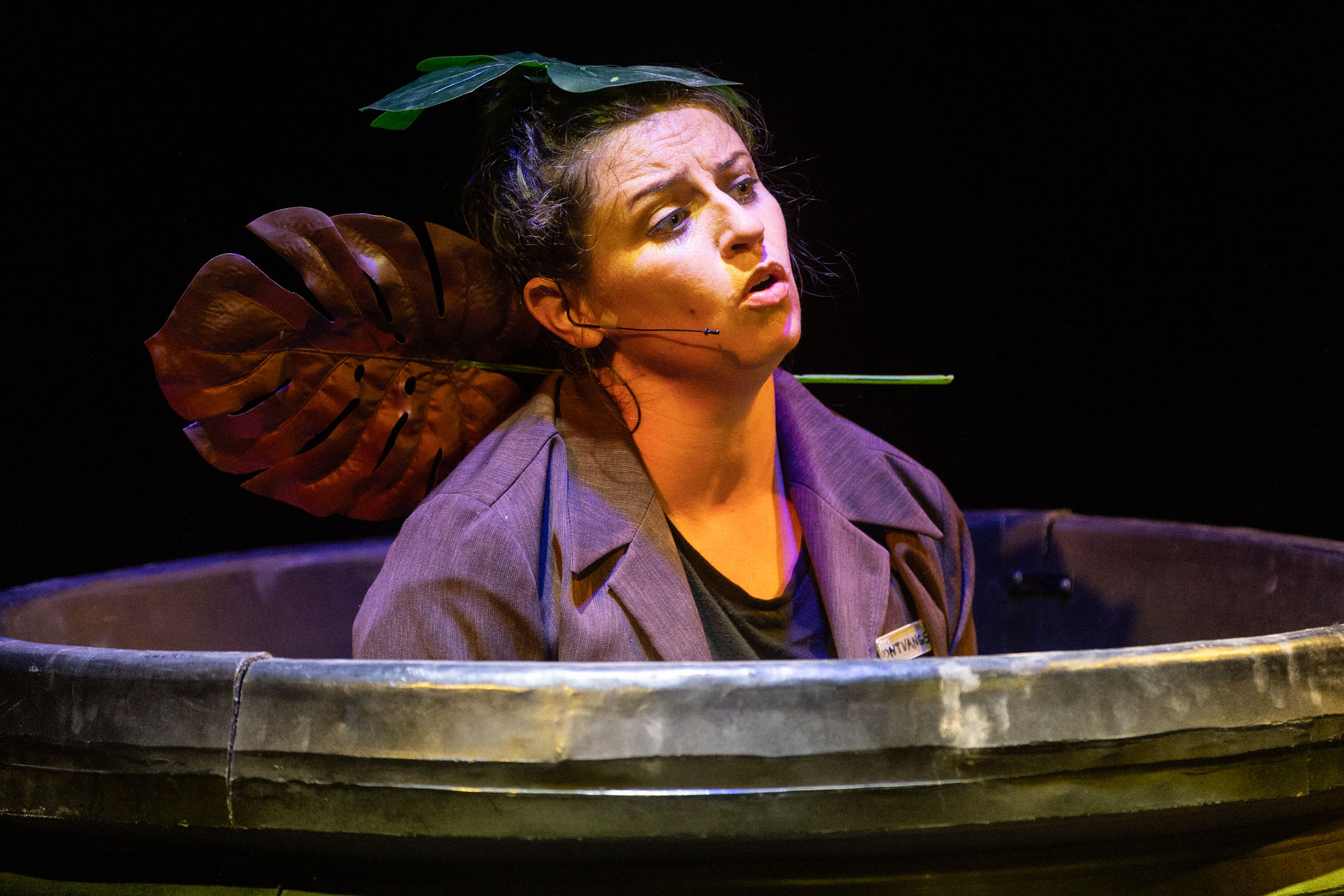
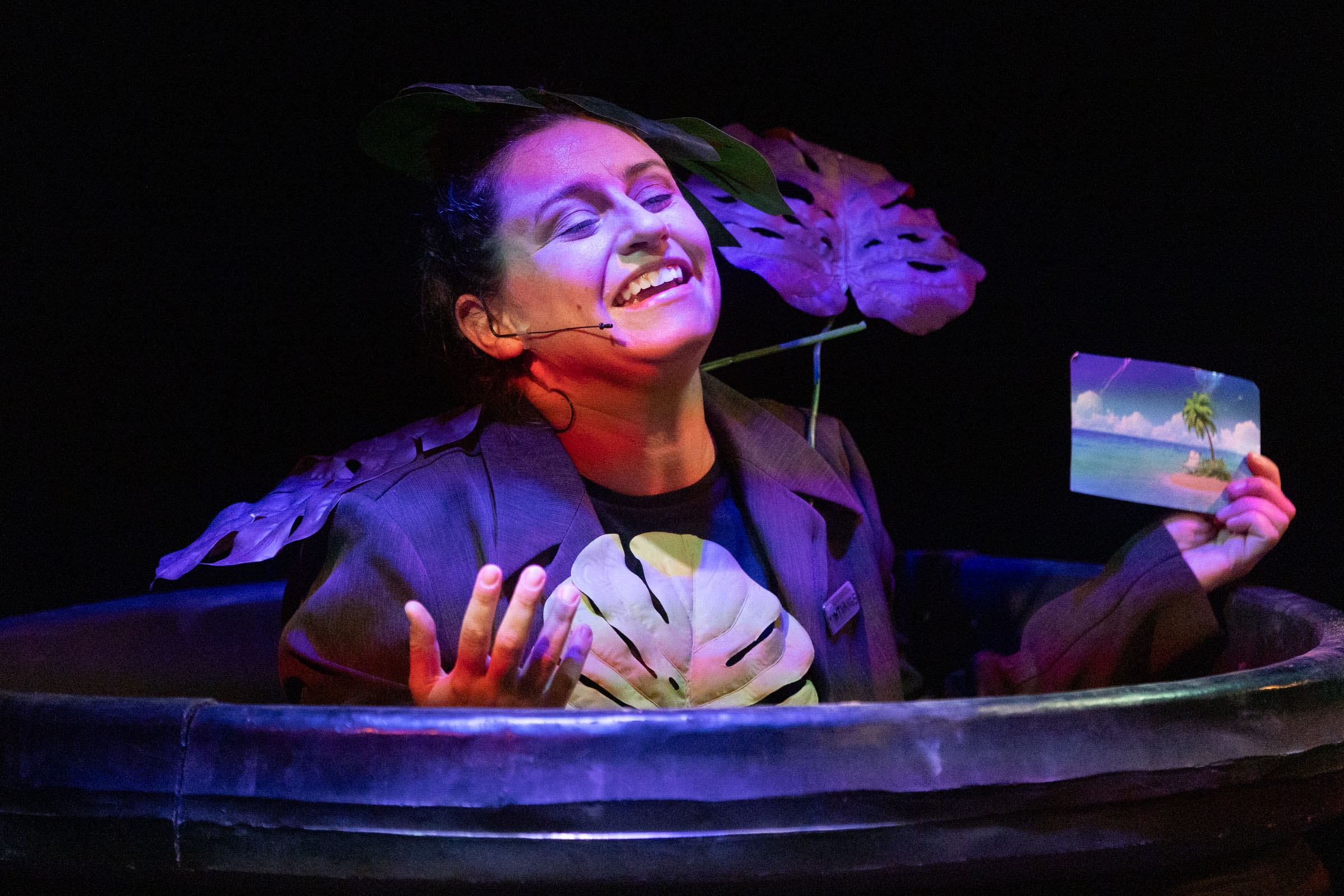
Also Die Potplant: ‘n Tragedie written and played by Karli Heine who changed what had previously been part of something now called Blitsteater into a longer piece had an interesting effect on me. It’s a wonderful idea with a script that’s inventive with underlying pathos – and yet, while it still had the impact and was cleverly stretched into a more comprehensive play, I think I preferred the shorter version.
It might have had something to do with the impact it had the first time round as well as having lost my heart to that version, I was more aware of the padding. Yet Heine is worth watching. She is someone that thinks out of the box as well as having the courage to take chances. You need all of that in this challenging profession.
Another joy at a festival is discovering new talent as well as witnessing the creativity of artists and how they find ways to explore their craft in a world with no boundaries yet many obstacles. Bibi Slippers, who can only be described as a compulsive creative did two shows as part of the Blitsteater (a bit like fast food, fast theatre), but there’s nothing fast about what she does with her imagination.
Picture: Stephanie M. Gericke.
I have always been fascinated by this young woman who has carved her own career in a very individual way. She pops up all over the show and her strengths lie in her words. She knows how to use them and has two spectacular poetry books that run like a thread through her performances.
Everything she does has thought behind it, is usually novel and it works. If anyone wants to see how to be an artist in today’s world and be in command of your own life, this is it.
In similar vein Sandi Dlangalala and Ilana Cilliers combined style and swagger to present an interlude of theatrical magic with Smak. The way they told the story in very little time with their whole being and soul was quite extraordinary.
A regular festival contributor, Llandi Beeslaar, who with her partner has been running a series of short performances by various artists, in the above mentioned Blitsteater, decided it was her turn to shine individually. She was ready to test herself as a comic with her first stand-up piece.
She participates in the arts in different ways, but this is a chance to use her own voice – and that she does with a particular style. Most importantly she has something to say and should keep going while honing her craft. There aren’t enough women in this space and the only thing she lacks is confidence.
Picture: Mia Truter.
A solo performance that stood out was that of singer/songwriter Frieda van den Heever. I first noticed her as producer with a fine sensitivity as well as an imagination which seemed to be strongly independent.Picture
She has obviously decided it is her time and instead of producing others, she staged her own show. She’s got all the goods and probably if you start counting, has more talents than a triple threat. In this her first solo show (that I know of) at a festival, she did the performance as well as the production. She brought in Mauritz Lotz on guitar, but the rest was all done by this astonishing performer.
I’m more of a theatre girl than music, but she blew me away with her presentation, the way she put together her show, her music (on piano as well as singing and songwriting), her lyrics and her singing. I know I can find her album Ontspoor, onlineand that’s what I’ll do.
But to find new music so accessible and a performance that’s fresh, daring and quite darling. I’m a groupie. Once I checked her previous work (which I had seen, with her as producer rather than performer) I understood why I liked the show so much.
Karoo Kaarte is one of my favourite experiences every year at this festival. They pick their battles, how best to explore them and this year they joined forces with the District Six Museum and GALA queer archive and used the Kewpie: Daughter of District Six picture archive as a platform to develop this years’ experience.
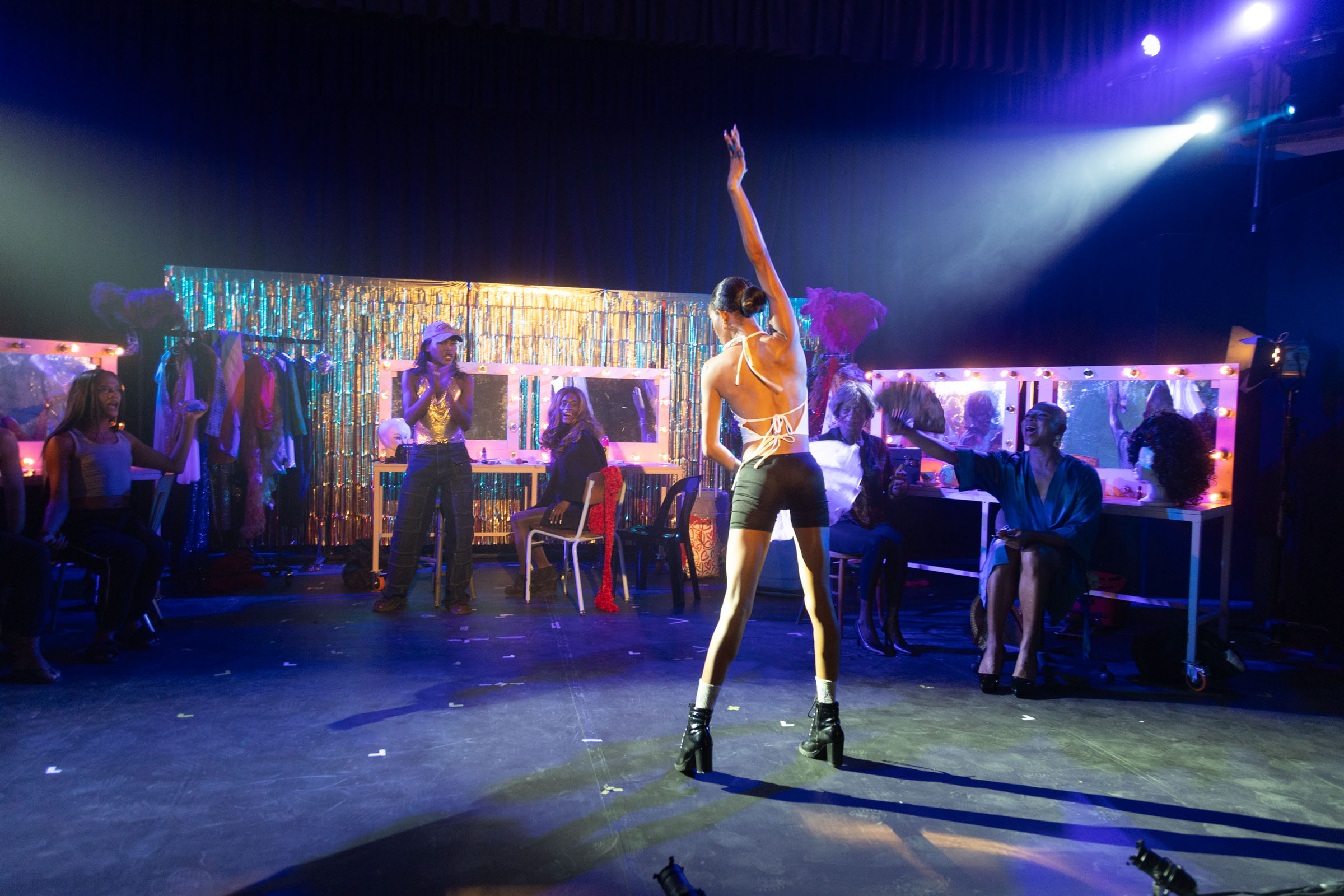
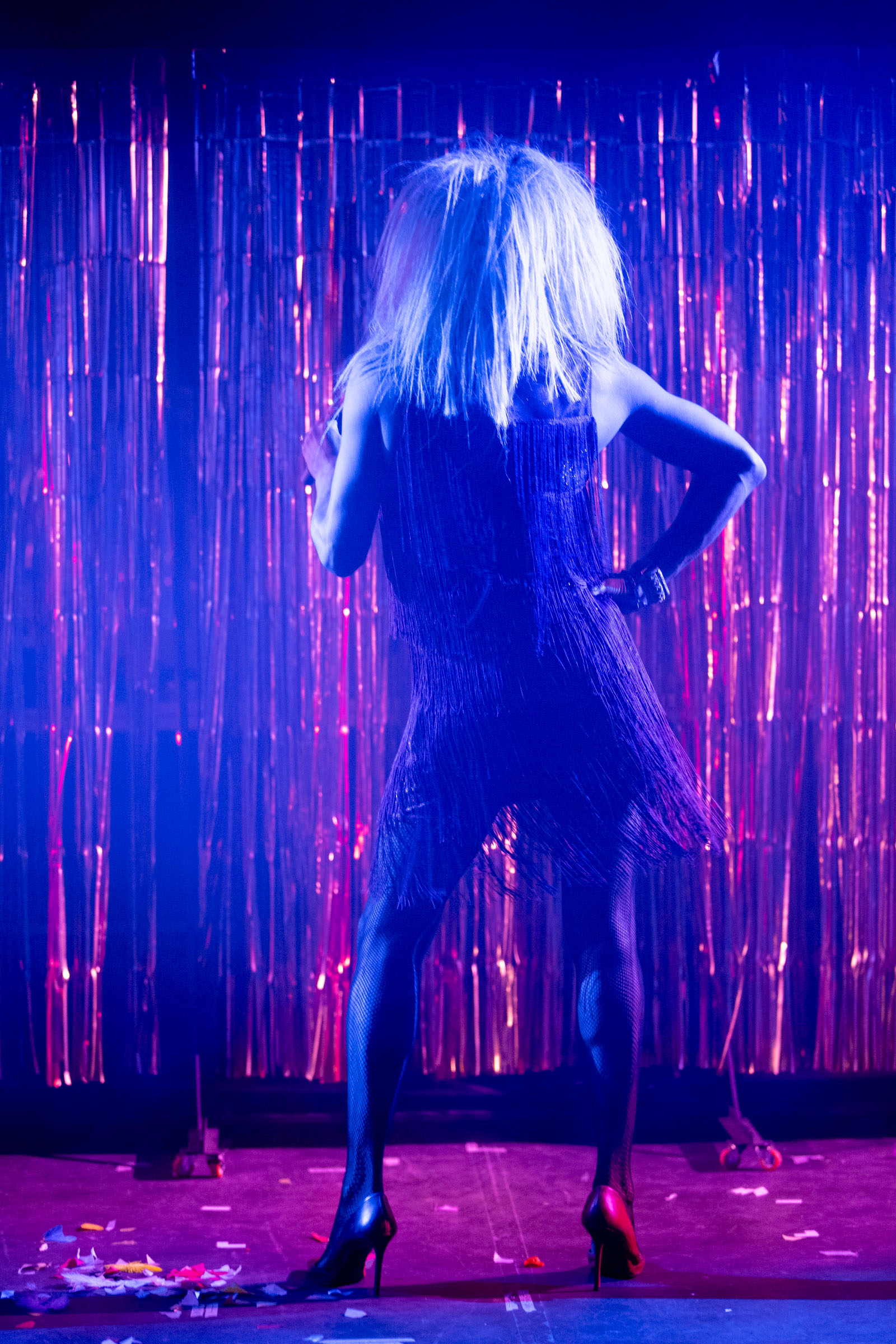
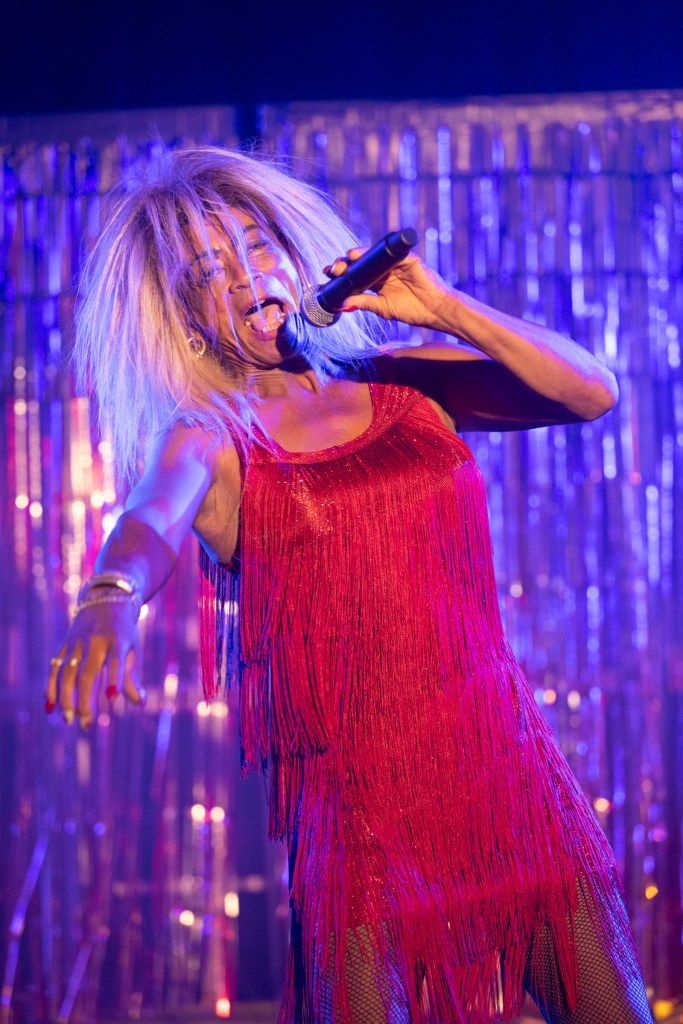
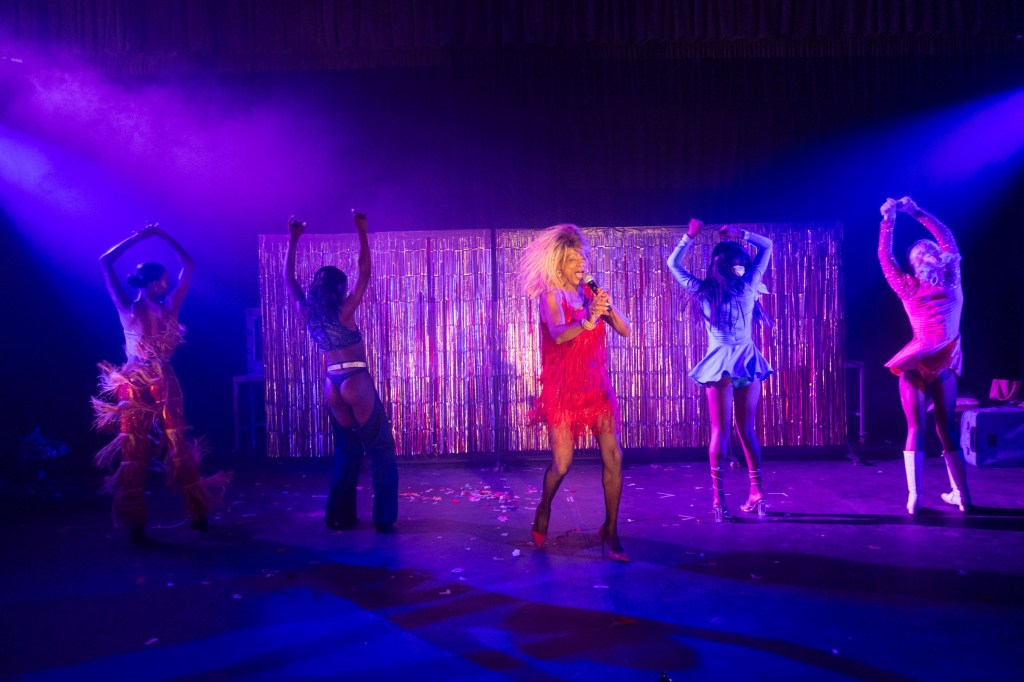
It all culminated in a queer festival with a multi-disciplinary drama titled Kroon en Konfetti which incorporated three elements: Kewpie’s life and legacy as dancer and artist; the rich culture of Oudtshoorn’s beauty competitions called “models”; and 25 personal stories collected from Oudtshoorn’s queer community.
Dressed in all their finery, the “models” all gathered in a dressing room to start their show with the dialogue smart, sassy and with an edge. It was quite magnificent as are all the Karoo Kaarte productions and more than anything it’s the topics they choose to spotlight that’s so important.
Here is deals with a group of people who are already sidelined in a country where prejudice is still rife. With their queer status they are in search and hoping to find safe spaces in their community where they can celebrate their culture, yet behind all the glitz and glamour, the shadow of oppression is hard to ignore.
As always Neil Coppen, Vaughn Sadie and Tiffany Witbooi are the creative team responsible and my only regret – as happens every year – is that I couldn’t participate in all their offerings. It’s one of those projects that’s imaginative and innovative and even more importantly, they’re constantly working with elements that result in real change in a community that has always been neglected.
And then cleverly the festival ended with Nataniël and a company of 10 on the openair stage under the Oudtshoorn night skies. The elements aren’t his friends, but it was a glorious way to end the festival with a performance that showcased new voices and performers as well as the glorious artist himself with stories and songs that suited the occasion.
Tracy-Lee Oliver was the artist he chose to spotlight on the night, and she made full use of the occasion with spunk and singing that added spark to this final show. It was great to see someone step into the limelight with such poise. As usual, making sure he gave his audience all the hysterical stories and masterful songs they expected with his superb band and backup singers, he also paid it forward with this sassy introduction of new voices for this audience.
He first spotted her when she was a contestant on a television show he judged, and astute as he always is when it comes to producing for an occasion, this was where he decided to showcase her – for all the world to witness.
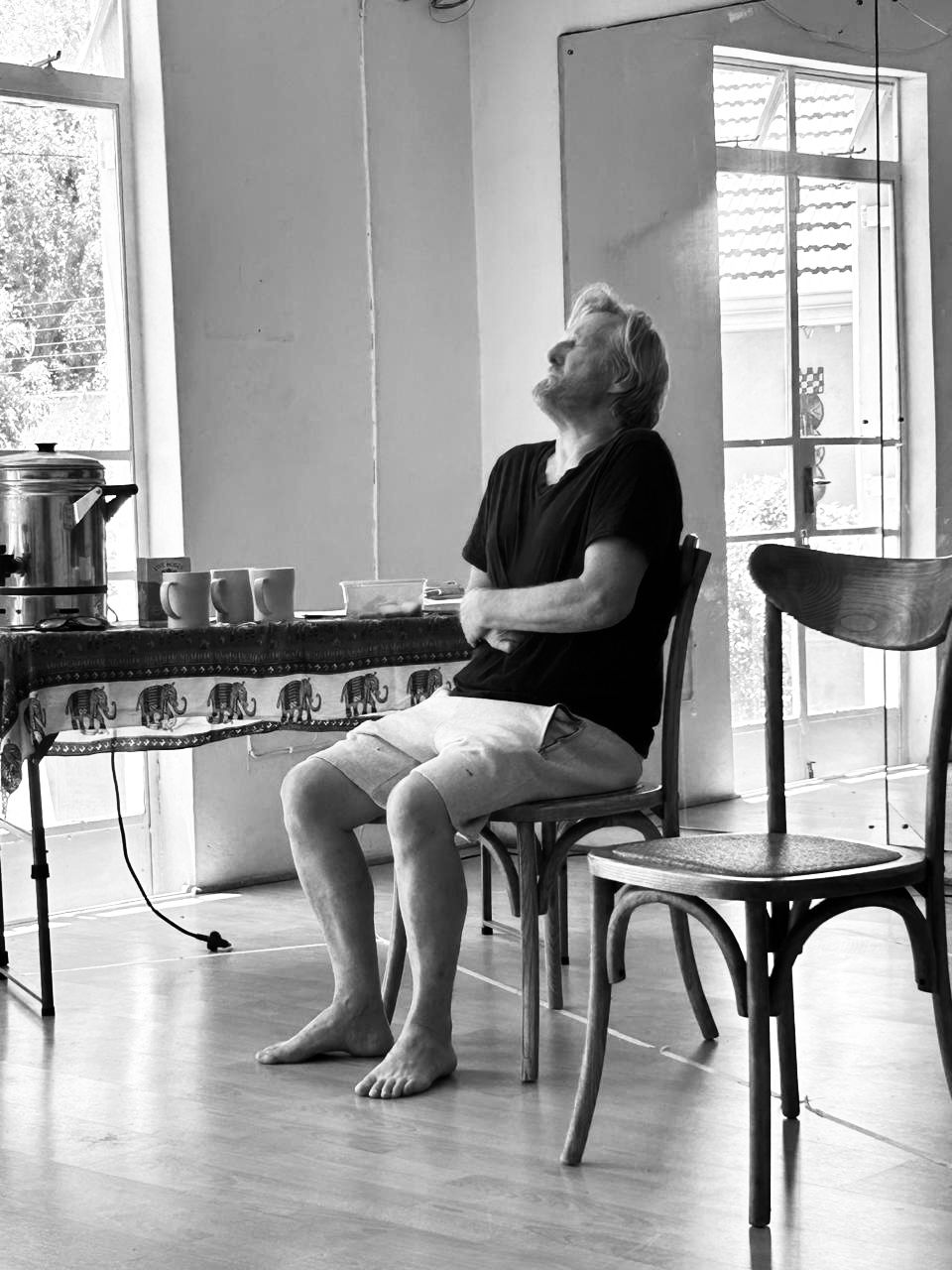
Rehearsal picture.
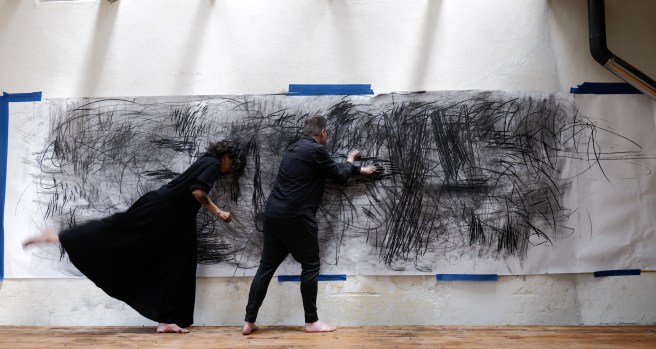
I haven’t even touched on the festival artist Henk Serfontein’s magnificent exhibition Die Stomme Aarde complimented by a performance piece by the artist and his collaborator Hannah Loewenthal as he made a painting to which she contributed while both of them participated in an expressive dance which further enhanced this particular emotional landscape of both the St Jude’s Church as well as the art displayed in this holy space .
It was the perfect example of how art and artists when working with an emotional intelligence can transport you in a way that seldomly happens in what has become quite a cranky world.
Similarly, Mareli Stolp, a pianist with a particular penchant for avant garde music invited animation artist Diek Grobler to illustrate her chosen compositions for a programme Die Gevlerktes. It was a stroke of genius.
The exquisite animation was imaginative in the way it enhanced the music and the listening experience which then also transformed into a visual feast.
I could go on, but this is simply one art lover’s experience …
See if you can catch any of these gems at other festivals and theatres in the year ahead.
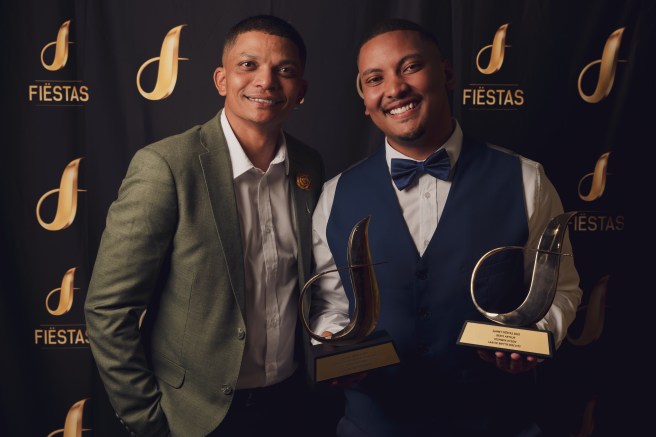
Awards can mean nothing or EVERYTHING. It really depends on each individual and perhaps the most important ingredient is to witness especially the individual artists when they get over their surprise, gather their thoughts and express their wonderment at receiving such accolades.
Rocco Pool (Best Design), Christian Olwagen, (Best Festival Production), Rolanda Marais, (Best Actress) all for Hedda Gabler.
Astonished yet astonishing actress Rolanda Marais perhaps captured the moment best when she reflected on the 17-year-old schoolgirl she had been and how she would have experienced this achievement.
It’s one of the most vulnerable yet vibrant careers to choose, as your whole life is always dependent on the vision of others. If a director selects you, if the play is one that shows you at your best, if the audiences come, if they like the play and the cast and the list is endless.
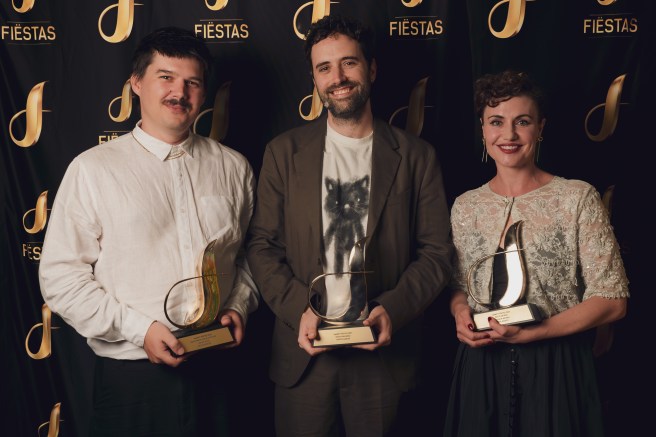
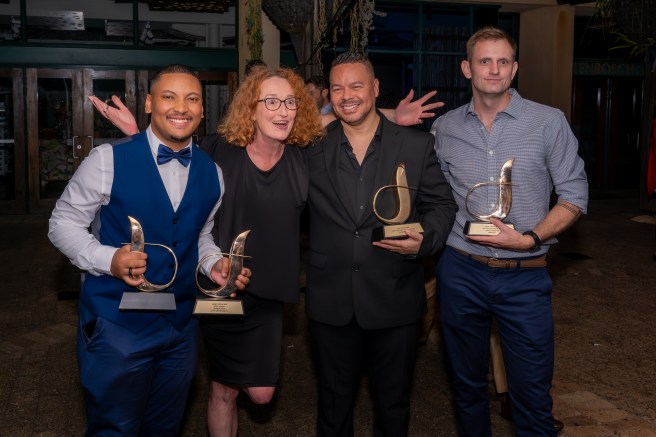
Aardklop Fiësta winners: Joshwin Dyson (Laaitie mettie biscuits for Best Upcoming Artist and Best Actor), Artistic Director Alexa Strachan, Conroy Cupido, (Best Achievement in Classical Music for Die groot Finalé) and Philip Rademeyer (Stinkhout for Best Text ).
And yet, time and again, the actors put themselves on the line and out there to hopefully change the world for some in the audience. They probably do it more than they give themselves credit for and I have often been in awe of what they manage to achieve with too many obstacles for anyone to deal with, let alone create magic.
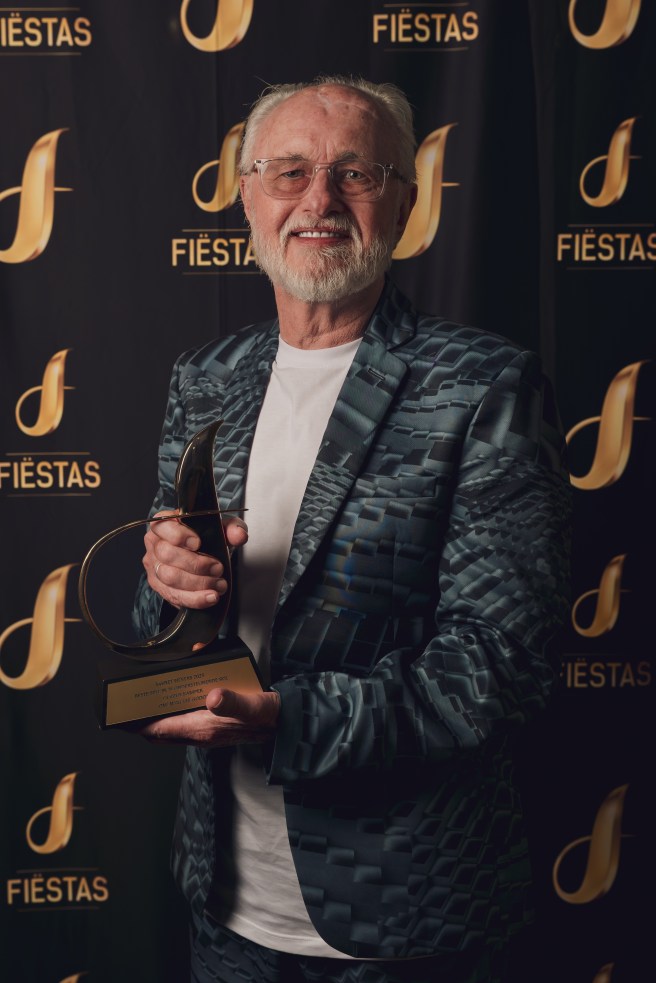
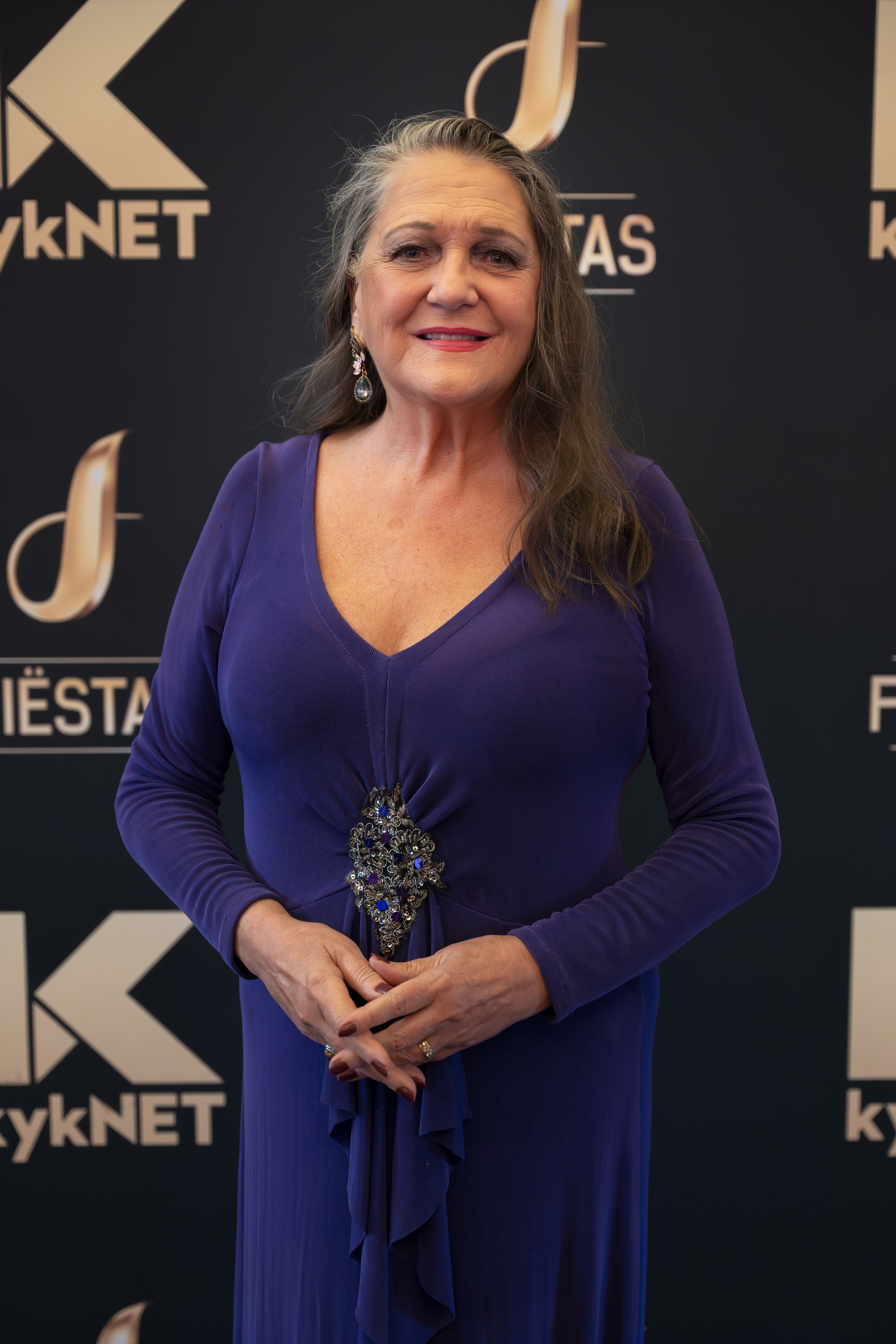
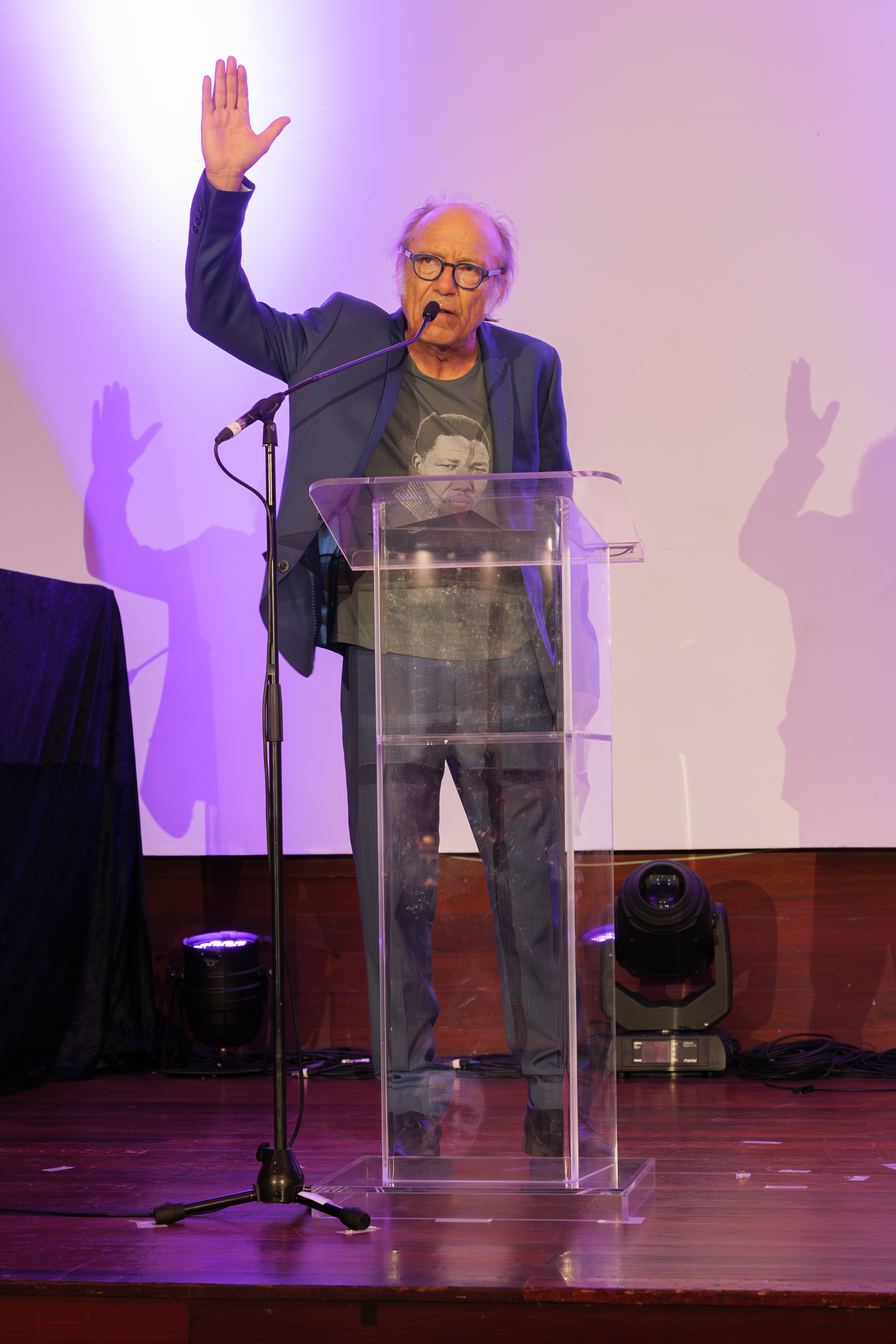
The Fiëstas panel attended every debut production at seven arts festivals (KKNK, Suidoosterfees, Innibos, Vrystaat Kunstefees, Klein-Karoo Klassique, Momentum Beleggings Aardklop and Toyota Stellenbosch Woordfees) last year. Following an extensive voting process audited by auditors, the winners in 14 categories were determined and announced at the end of last month at a glamorous awards ceremony held at the Kirstenbosch National Botanical Garden in Cape Town.
kykNET also announced that the kykNET Fiëstas will have a new home. After 15 years of management by kykNET, the Tribuo Trust will now coordinate the Fiëstas, with kykNET taking on the role of naming sponsor.
“The decision was made so that the kykNET Fiëstas can continue and flourish as a vibrant celebration of the arts in Afrikaans. kykNET remains the main sponsor and naming sponsor of the Fiëstas,” said Waldimar Pelser, M-Net Channel Director of Premium Channels.
“In discussions with the festival directors, kykNET emphasised that we will strengthen our support for the arts festivals in a way that we hope will also make the festivals more sustainable. We look forward to reimagining the new kykNET Fiëstas together with Tribuo and are excited about the road ahead.”
Karen Meiring, Executive Chairperson of Tribuo, said: “It is an important objective of Tribuo to invest in the future and the sustainability of the entertainment industry’s ecosystem. The kykNET Fiëstas seamlessly align with this goal as the awards recognise and celebrate excellent work. They also encourage crucial audience engagement and honour the people who carry the performing and creative arts. Tribuo looks forward to continuing this project together with kykNET, who remains the naming sponsor.”
The winners are:
BEST ACHIEVEMENT IN CLASSICAL MUSIC
Die groot finale (Momentum Beleggings Aardklop)
BEST CONTEMPORARY MUSIC PRODUCTION
kykNET-konsert (Innibos)
BEST MUSIC-DRIVEN THEATRE
Ontban (Suidoosterfees)
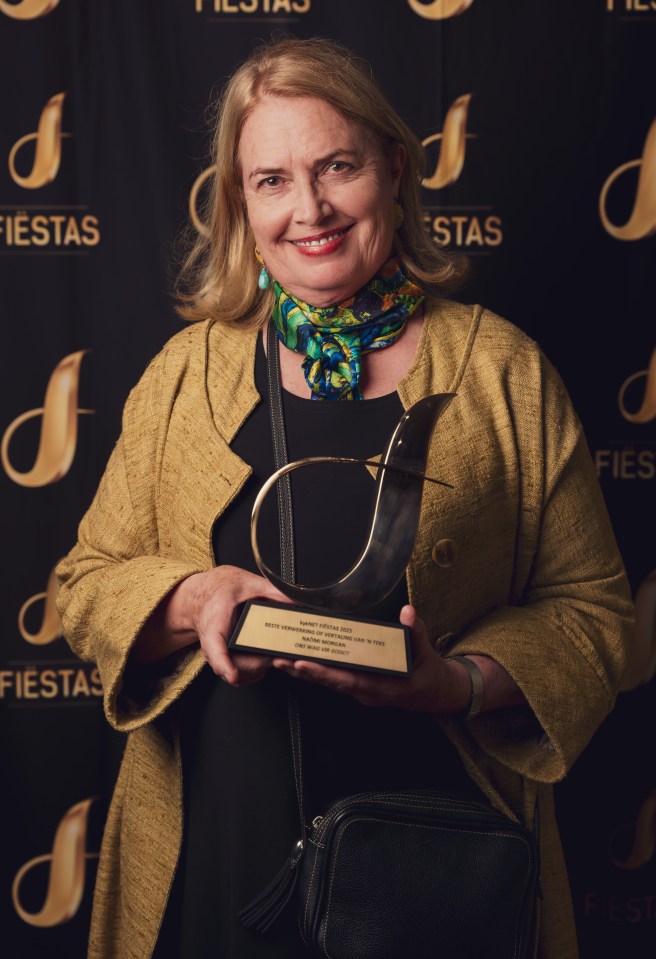
BEST ADAPTATION OR TRANSLATION OF A TEXT
Naòmi Morgan – Ons wag vir Godot (Vrystaat Kunstefees)
BEST NEW TEXT
Philip Rademeyer – Stinkhout (Momentum Beleggings Aardklop)
BEST ACHIEVEMENT IN VISUAL ARTS
Marlene Steyn – Between my i’s: tussen my oë (Toyota Stellenbosch Woordfees)
BEST ACHIEVEMENT IN DESIGN
Rocco Pool – Hedda Gabler (Toyota Stellenbosch Woordfees)
BEST ACTOR IN A SUPPORTING ROLE
Gerben Kamper – Ons wag vir Godot (Vrystaat Kunstefees)
BEST DIRECTION
Dion van Niekerk – Ons wag vir Godot (Vrystaat Kunstefees)
Joshwin Dyson (right) with his playwright/director Christo Davids
The winner of the Blou Fiësta, awarded for commendable work that does not fall into any of the other categories, is the Suidoosterfees project 21. In celebration of the festival’s 21st anniversary, 21 productions were staged, each lasting 21 minutes with a ticket price of R21.
Amanda Strydom and Frank Opperman were honoured for their contributions to the arts.
CAST: André Odendaal, Oarabile Ditsele, Chantal Stanfield
DIRECTOR: Lesedi Job
VENUE: Pieter Toerien’s The Studio at Montecasino
DATES: Until March 16
Everything to my mind seemed aligned for this one. I found the casting as well as the director intriguing, a new local play is always something to be excited about and Paul Slab has a way of climbing into a story.
At the same time, it also makes me nervous. I don’t want to raise my expectations by thinking ahead, but one can hardly prevent it.
Ensemble cast (Chantal Stanfield, André Odendaal and Oarabile Ditsele) and playwright Paul Slabolepszy
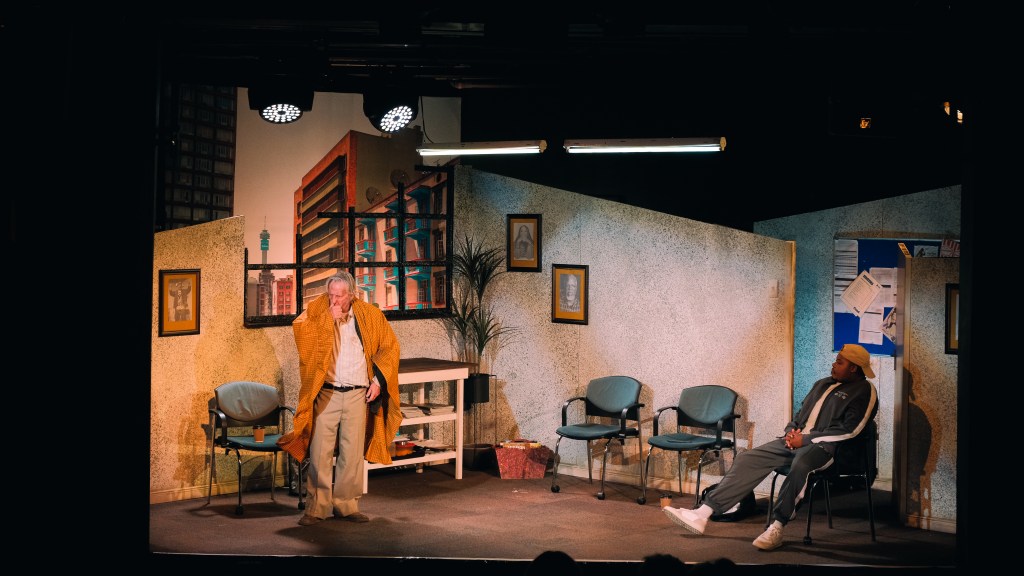
Either way, I was quick to exhale once the actors found their way on stage. One feels it immediately. It’s two actors in a room waiting (rather like a doctor’s waiting room) to be auditioned.
Anyone who knows anything about theatre knows that this is both an exhilarating and a scary experience. Not many of us have to sell ourselves in such a public way each time when applying for a new job. And like most things in life, there’s not really anything that can be done to alleviate the nerves crashing into one another at high speed in these circumstances.
Not only that. If there’s something Paul knows everything about, it’s this. Both as a writer and an actor, it’s a scenario that he has lived most of his life – and one feels all of that when watching the play.
The two hopeful actors (the one at the end of his career, the other excited about the life ahead) who don’t know one another are sitting in a room checking each other out. Times are tough – not only for actors – and this is not a friendly space. There’s no one around trying to soften the gig they’re waiting for.
Every once in a while, a rather officious woman enters and, while she’s charming to the one actor, she bristles when the other asks anything. The tension is palpable.
Already a scary space for all involved, it is also heightened in the South African context. And this is what the playwright handles so well. He plays the moment and not the context, which he leaves to the audience to experience.
It’s subtle yet clichéd but with this clever script and a team who works with everything they’re given, it sweeps you along.
The title could work in two of our languages, English and Afrikaans, and that’s another trick up Slab’s sleeve. He has both languages (as well as three more indigenous languages inluding Sesotho, isiZulu and Tsotsi) flowing throughout and, in this instance appropriately and with some delicious irony in hand as he points to the state of the arts in general.
The choice of actors and director, novel and genius, adds to the grit and weightiness of what we’re dealing with. It’s not an easy world to navigate in current times and if your particular career choice constantly also takes you to the edge of life’s challenges, it can be excruciating.
And yet, that is where these people involved choose to play. That is exactly what this play explores. It’s part of who they are and what they have to do.
Bitter Winter is a fantastic vehicle for someone who has been in the game for some time and knows the territory, the people and their insecurities, and the fears involved. But then he also knows how to capture the magnetism of live theatre, how it cherishes the soul, captures our imagination and makes you think.
It works because everyone pulls together. The acting, the directing and the text all play their part.
I can hear Paul say Local is Lekker in his exuberant manner. And he’s right. When it works this wonderfully, it’s a joy to behold.
Bitter Winter is donating a portion of ticket sales to the Theatre Benevolent Fund and every cent counts.
From left; The cast Chantal Stanfield, Oarabile Ditsele and Andre Odendaal
With Paul Slab (as he is known) himself an artist, both a playwright and an actor, he has turned to his own life experiences with this exploration of an artist’s life. Bitter Winter celebrates the legends of South African theatre while shining a light on the new generation of rising stars making their mark on the global stage.
What he is hoping to share is the sometimes rocky road that many artists are driven to travel in pursuit of their dreams.
It all begins in a venue which is like a home to actors, perhaps often an uncomfortable one, with the characters sitting in an audition room.
It’s about the life of an actor, the struggles and triumphs of those artists who remain deeply committed to their craft despite the challenges they face.It tells the story of two actors, one at the end of a career spent mainly on the classical stage, and another starting out on his journey, with the magic and the madness of this ‘make-believe’ world on full display.
Playwright Paul Slab and director Lesedi Job
According to the producer, Weslee Lauder, the idea of a play with such an important story, especially since local actors have been bearing the brunt of an industry not taken care of by its governing parties, spoke to him
He also liked the concept of youth honouring the elderly, which speaks to a powerful truth.
In life, the young often forget that the paths they walk were paved by generations before them. And here, he believes, it is vital to remember the legacy, wisdom, and sacrifices they’ve left behind—and to show gratitude in every aspect of life.
A seed was planted, according to the playwright, when he heard Lizz Meiring giving a talk a number of years ago about all the vital work that the Theatre Benevolent Fund does, stressing the plight of aging artists in South Africa as they reach the end of their careers. “I was asked after that talk whether I would write a play about it and I jumped right in. Then Covid hit, but I kept working on it. I wrote the piece with Andre Odendaal in mind, who then brought Weslee Lauder in to produce. And here we are!”
Slab had seen Andre, pictured above during rehearsals, in Dop and thought he would be ideal for Jean-Louis. The other two artists went through the audition process.
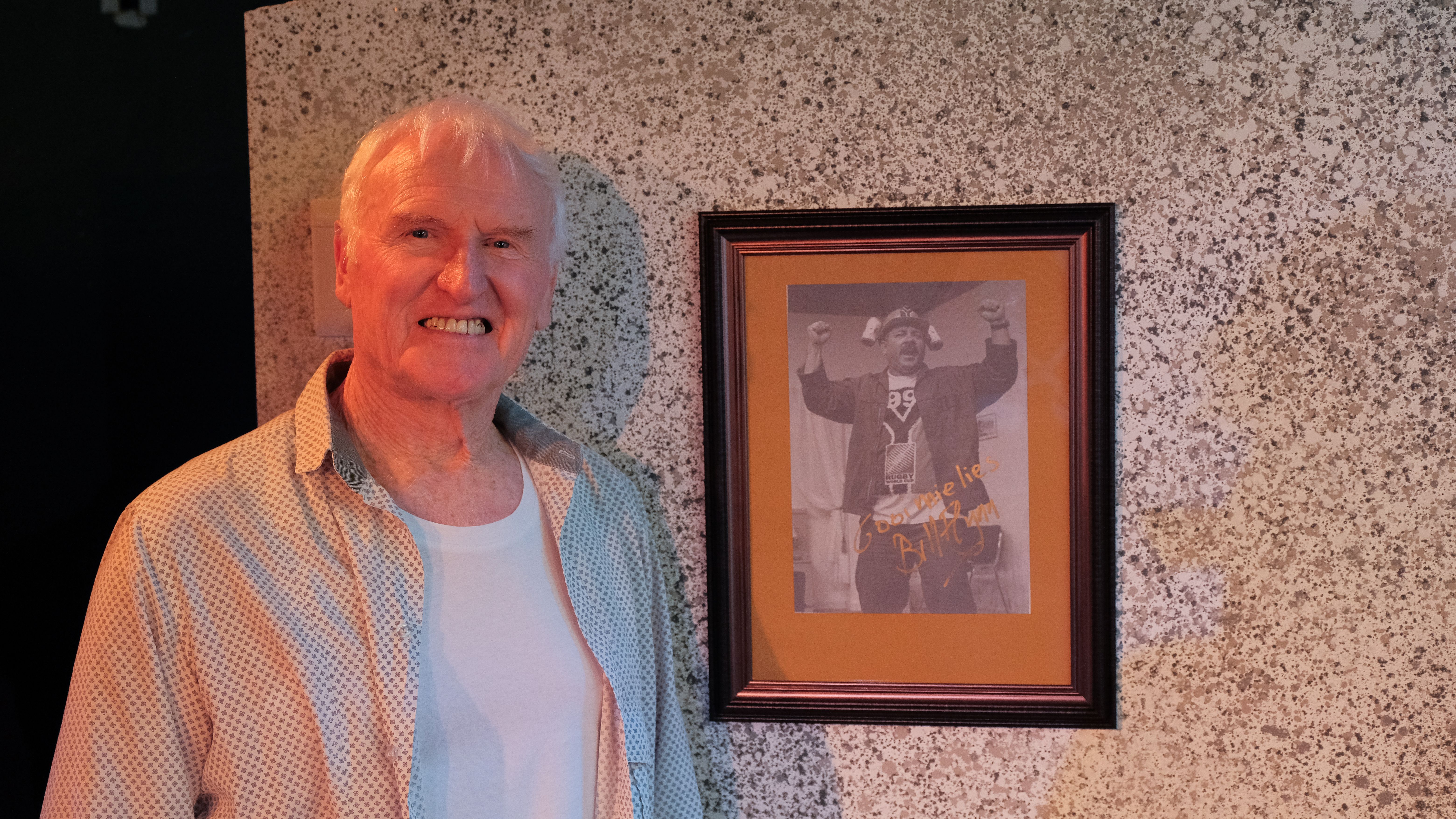
Collaboration comes easily to Paul who always collaborated, especially with his close friend Bill Flynn before his untimely death. “In many instances, it’s the only way to get a show on stage, especially a new play,” he explains While Paul has always enjoyed writing comedy, he is also known for theatre with strong moral values and believes it is especially important right now, given the current state of the world.
It is important to deal with the issues, but to talk about them in such a way for the audience to be receptive. We need to keep writing authentic stories, he says.
Lesedi Job, above with cast members and Paul, was drawn to the play because of the story. She was reminded of her own complex love affair with theatre as an artist. “But as I started working on the play, I became aware of how this is a story that inspires self-reflection and I love telling stories that leave an audience thinking.’’ Telling local stories especially appeals to her because she is passionate about being part of a next generation of storytellers who contribute to the history of South African theatre. “Bitter Winter is the fifth new South African play I am directing and I think this is not only out of choice but also because it is my purpose.”
She is especially affected by the theme of an older generation versus the younger generation. “I am reminded of my mother and her wisdom and the quiet knowledge that comes with age and experience. The other themes are that of the complexity of our identity that is informed by our history, our languages, our traditions and culture as well as our scars. And that of humanity.’’Maya Angelou says: “During bad circumstances, which is the human inheritance, you must decide not to be reduced. You have your humanity, and you must not allow anything to reduce that.” Discussing her processes, she explains she spends a lot of time before the rehearsal process preparing, researching, interrogating and unpacking the script to get a handle on the story, the world and the characters. “Once in the rehearsal room, I download information to the actors and plant seeds for them to think about; allowing an actor to bring themselves and their choices to the creative process.
Chantal Stanfield and Oarabile Ditsele
The process requires planning and thinking on your feet, humility and grace, as the director knows that at times you might not know what to do and to not get stuck on an idea you may have had beforehand.
For Andre Odendaal it’s a love for new South African work. “These opportunities are rare and always special. An authentic voice and a remarkable challenge.’’
His preparation for any character always starts by finding relatable qualities first. “Do I understand the character’s emotional world, what are the points of connection either to my own life or a that I have observed? Then one finds a physical and vocal quality. Here it is an older actor’s so that commonality was easy to find, albeit a very different mind space to my own.”
As for the audience, he hopes that they take home not only a better understanding of the plight of an artist and the commitment but also the joy of watching live theatre.
“A realisation that art feeds the soul.’’
For Oarabile Ditsele, it was a chance to collaborate with people who have shaped the theatrical landscape of South African theatre, people like Andre and, of course, Paul Slab.
None of them had worked on a Slab piece before.
For Chantal Stanfield, it is her first time working on one of the playwright’s plays professionally. She did some curriculum scene work at drama school, but to actually work with him 20 years after she graduated is such a gift.
She loves originating a new piece. “It’s a fresh and daunting challenge with no ‘original cast recording’ to fall back on. We don’t just decide to do this, it is a mad calling that is so fulfilling that we endure the scorn, the rejection, and dismissive attitudes every day.”
Bitter Winter will be on stage at Pieter Toerien’s Studio Theatre at Montecasino from February 20th – March 16th. Bitter Winter is donating a portion of ticket sales to the Theatre Benevolent Fund and every cent counts.
BAND: Charl du Plessis (keyboards); Werner Spies (bass); Juan Oosthuizen (guitar); Peter Auret (drums)
VENUE: Atterbury Theatre with shows tonight at 7pm, tomorrow at 7pm, Saturday at 11am and 3 pm, and Sunday at 3pm; (13 to 16 February Roodepoort Teater; 5 and 6 March, Sand Theatre in Bloemfontein)
If you have followed an artist as closely as I have Nataniël, it’s not only the performance but also the progression that becomes part of the thrill of this spectacular talent.
Time and again, I have been curious at my astonishment at what I am experiencing during one of his shows, but I know it is the constant evolution of what he presents that keeps me enthralled.
He is one of the few who has managed to keep the element of surprise always present and he does this especially with his scripts. He has a mind that keeps on giving stories so fantastical and yet so based in reality that everyone can identify. But what elevates the presentation is his genius with words.
Bilingual and equally adept in English and Afrikaans, he has managed through the years to broaden his audience base in the way he has become comfortable in both. The stories immediately draw you in and the choice of language doesn’t play a part. It is the way his mind wanders, how he tells a story and the unique way he presents and arranges every single sentence.
Originality is one of those elements you either have or don’t. You cannot make it happen if it’s not there. And through the years, his has become stronger as his comfort levels have grown.
What you have now is a performer in total command of his art as he mesmerises his audience with his phenomenally unique storytelling. He is comfortable sharing the personal stories of his life and the way the world has always viewed and treated anyone who isn’t exactly moulded in the image of everyone else. He revels in the differences and through the years has become emboldened and embraces exactly the artist he is and wants to be. And we love him for that.
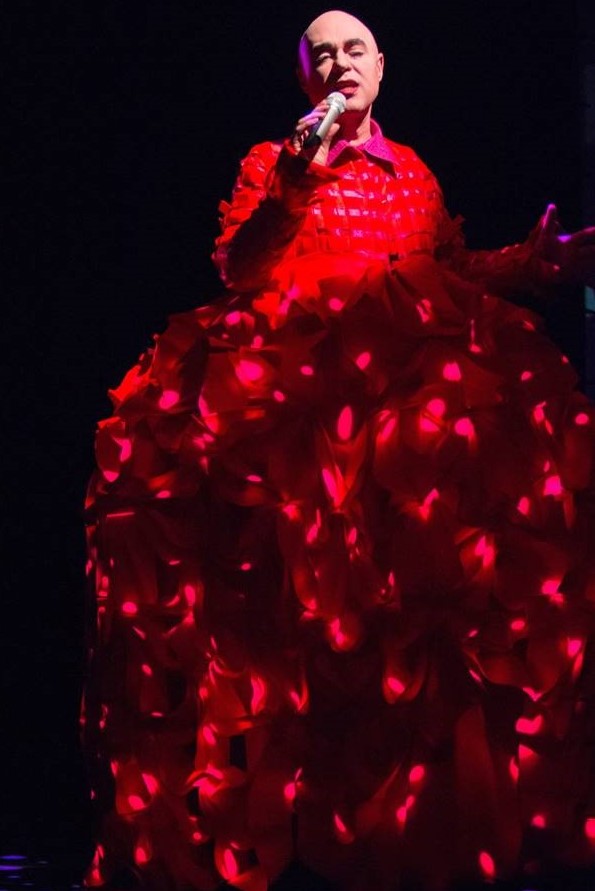
In everything he does, he always opts for the best and this is especially true of his band of class musicians. Headed by the masterful pianist Charl du Plessis, both Spies (bass) and Auret (drums) add to the individuality with their own musical flair. Add to that trio of perfection Juan Oosthuizen whose mastery with the guitar is legendary. Their performance is bliss.
It’s rare to have the accompaniment of such unusual talent, but Nataniël has always been secure in his own performance and knowledge that exquisite music enhances his singing, the real reason he loves performing.
The balance of stories and songs is important because the songs give you a reprieve from the density and sheer delight of the stories as well as a chance to breathe as you appreciate the excellence of what you are witnessing. And with time and maturity, Nataniël’s voice is richer, the music more nuanced and the singer has perfected his authentic sound.
I have always been captivated by what this artist brings to the stage because it is so unique, put together with boundless imagination and because of the inspired stories – a new play with every show he presents – each season is an explosion of the extraordinary. He has been a blessing to local audiences because of who he is and the riches he presents on stage.
The rarity of his creativity is a joy to behold. May he keep being the wonderfully colourful creation who once, twice, or if we’re lucky, three times a year holds us in the palm of his hand as he takes us wandering with wonderment into a world that is as charming as it is complicated.

 De Beer Necessities