SOCIAL MEDIA RUNS CIRCLES AROUND CLUELESS USERS, TURNING THEIR LIVES UPSIDE DOWN

Pictures: Daniel Rutland Manners.

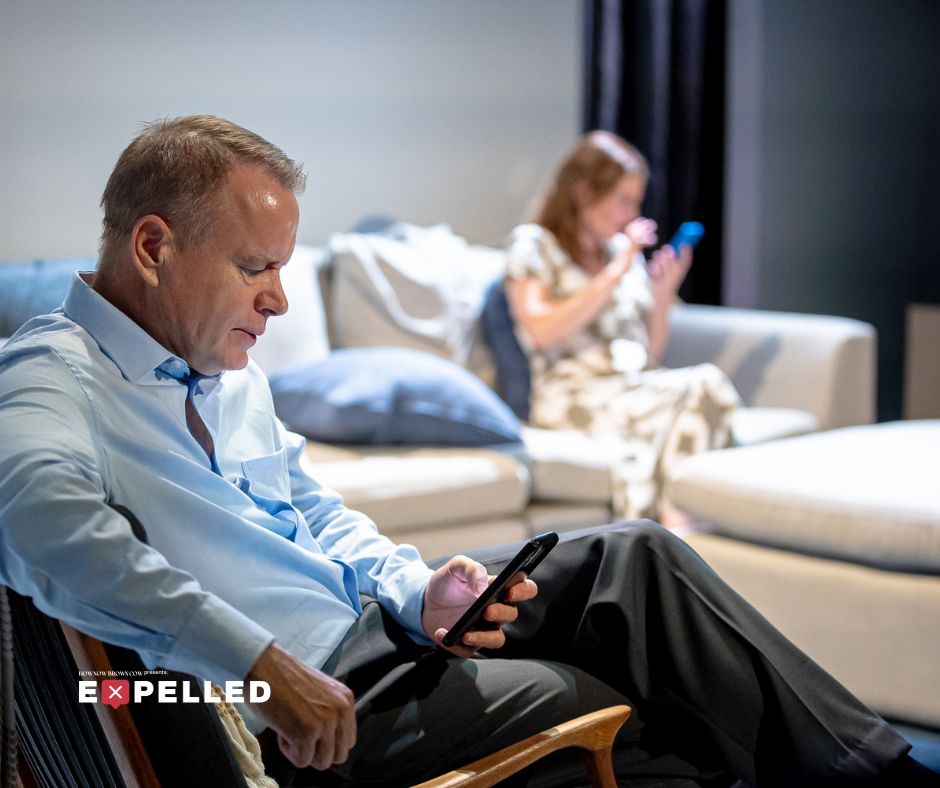
Mother (Charmaine Weir-Smith) and son (Nicholas Hattingh) in selfie mode…

DIANE DE BEER

EXPELLED

Expelled is described as a family drama which focuses on the largely ungoverned world of social media.  Alex, a matric pupil at an elite school, gets caught up in a viral scandal and is suspended. Once shared, lives alter in seconds, what’s seen cannot be unseen.  The ramifications for his family are profound.   

Rosalind Butler’s new South African play

PRODUCERS: How Now Brown Cow Productions in association with The Market

DIRECTOR: Craig Freimond

CAST: Anthony Coleman, Charmaine Weir-Smith and Nicholas Hattingh

VENUE: Mannie Manim Theatre at the Market, Joburg

DATES: Until March 31. Performances will take place Wednesday to Saturday with evening shows at 7pm and matinees on Sunday and Saturday at 3pm. There will be additional schools’ performances at 11am on Thursdays during the run.

Living in an online world.

There are few people who won’t be aware of the devastation of social media on normal lives. We all know there’s the good and the bad but taking into  account the recent banning by the US Senate of the Tik Tok app on government devices, the results are too often disastrous and, apart from this surprising development, with few guardrails.

It is with an eye on the pitfalls that Rosalind Butler wrote this play which Freimond had huge fun putting on stage and screen – which it lends itself to. If you want to know how to get younger audiences to theatre, this is it. You’re talking their language and the play offers the chance to play with different generations and their approach to social media.

With phones an additional accessory, few people can resist writing and sending off messages in abundance and often with more haste than hesitation, which would be a tool to keep in mind. Once you push that button, the harm’s done.

Parents: Charmaine Weir-Smith (right) and Anthony Coleman.

And in this version it’s all done in full colour and with the scenarios taking real issues which will cause havoc as they go viral. We’re living in a world where too many are completely unaware of the sensitivity of certain issues.

Families allow schools to dictate norms while these institutions see their roles as strictly educational, refusing to meddle with the morals of their young charges. It is a recipe for disaster, especially with all the tools available in today’s communication circus where everyone is encouraged to participate.

Butler’s text races off at breakneck speed, almost mirroring the record times messages are sent and read while disrupting and destroying lives. There’s very little chance of pulling back once the release button has been activated. And while we all know and understand the world we live in – fast and furious – we still don’t stick to the safety precautions.

It’s a topic that encourages a contemporary social media approach and Freimond with his cast go at it full tilt. Nothing has to be explained or embroidered because we all know the playing field with all its inviting yet often devastating intrigue.

Phone gymnastics.

The cast is perfect as they play their characters and their often-vacuous natures to perfection – all at different tempo yet with a serious approach only possible in our deranged contemporary landscape that encourages these public meltdowns with humiliating outcomes. Weir-Smith’s mother and wife has captured a type we all recognise, so wrapped and isolated in her own tiny world, she’s completely unaware of the destruction she leaves in her wake.

In turn her husband (Anthonty Coleman) is blinded by his own importance, with his wife and son marginal figures in his corporate universe.

Their son (Nicholas Hattingh) is focussed on the love of his life with no understanding of the effect his public vitriol might have on his mostly invisible life.

We can all see the avalanche of disaster which will soon obliterate this family teetering on the edge already, but, fortunately because of the very nature of social media, many mini scenarios are being replicated all around them.

Because we’re all au fait with social media, it’s fun to witness something so familiar unfold as we recognise and might even have participated in similar scenarios. A good edit (a cut of approx. 15 minutes) would have avoided repetition and landed a near perfect play. It might come across as fun and games, but we all recognise that in many lives it could also be deadly serious.

A CELEBRATION OF KKNK’S TEKSMARK IN GAUTENG

Pictures: Reinhard Bodenstein

Ketsia Velaphi in Tankiso Mamabolo’s Don’t Believe a Word I Say.

Teksmark has been running for a few years now in Cape Town (see previous post) and recently KKNK CEO Hugo Theart decided it was time for Gauteng (with the helpof the well placed Foxwood team providing the venue) to show their stripes – and predictably, they came out in full force. DIANE DE BEER picks a few personal favourites:

Teksmark has been one of my favourite outings from the start because it keeps me in touch with new (and often young) playwrights, what they are thinking about and how they find the words to tell their story.

It has also opened the KKNK’s profile to embrace a much larger slice of the arts and in this somewhat geographically challenged country of ours, we need everyone in the arts community to reach out and hold hands. We have amazing stories to tell, but the audiences are limited and the cohesion of the arts community, nationally, is important.

Director and playwright Obett Motaung (centre with microphone) in conversation with CEO Hugo Theart and his cast.

Obett Motaung cleverly started with a catchy title, A Street Taxi Named Desiree, and plaed with just that. The play is a series of sketches with taxis as the hot and happening topic.

What he does especially smartly is use all the South African tropes that everyone will recognise even those who never use taxis. Coldrinks? Does anyone not know what that means when for example a traffic cop or policeman stops you?

Or the rules that are there, yet not for taxi drivers? The fact that everyone recognised these foibles in the room, says much about the South African landscape.

And this is also what made this such a smart piece of writing. It grabs you with laughter yet slips in quite a few serious issues, again, instantly recognisable.

Christo Davids (playwright) with his cast for Laaitie Mettie Biscuits.

We all know or perhaps think we know the problems special needs individuals face on a daily basis. Some of that is captured in Christo Davids’ courageous text which has him facing rather than ignoring the problems.

His play titled Laaittie Mettie Biscuits is about a differently-wired young man who gets into trouble with the police and because of a misunderstanding and the difficulty society has of dealing with anyone or anything that isn’t “normal”, things quickly get out of hand.

And making the point even more sharply, following the reading, most of the discussion was focussed on the need of a Down syndrome individual to be cast in the role. Anything else would defeat the purpose of the story, no matter the challenges.

Asked about his reason for writing the play, Davids explained that he hoped to spark a different conversation or at least, thinking about people who because of different physical or mental challenges have to operate in a world that didn’t easily acknowledge and make provision for them.

Holding a mirror to society is one of the many positives of theatre and no more so than with this truly brave attempt. Let’s hope that we see it given life on stage.

Tankiso Mamabolo selling her delightful Don’t Believe a Word I Say.

Playwright Tankiso Mamabolo’s says Don’t Believe a Word I Say was written as a play on memory and how we often embellish these remembrances over time, to protect us from trauma or to fill in the gaps that have appeared over time.

She had everyone delighted when she pointed out that the play was written in the style of ADHD, wrote it in fact in exactly the way she thinks – and luckily for those of us watching, she has an imaginative mind worth interrogating.

What do we choose to remember and what devices do we use to reach back? These are the issues she spotlights.

“I have a team of black women dissecting, reminiscing and recreating black girlhood in a way that utilises humour without dehumanising black girls and instead focusses on the nuances of their vulnerabilities with the complete understanding that they are complete bad asses. I wrote a play about my childhood that gives voice to parts of black girlhood that are often overlooked eg, we also can be hopeless romantics despite of the world and what is happening around us.”

And in the process, she gave everyone a lesson in how to present their play. This is someone who knows what to do with an opportunity and I can see it paying off – as does her play.

It’s fun as Tankiso explained, she was featuring young black women, usually an ignored section of society – and think about that! She already has an audience right off. And with her talent, there will be more. She’s got what it takes.

Farce has never been my favourite medium but if anyone can pull it off, it is Nico Luwes. And knowing all the rules to get things off on the wrong foot, which is the key to any farce, Nico also made sure the best ingredient for this kind of performance was in place – the cast.

A cast to die for with playwright Nico Luwes (right)

He pulled out all the stops with Koebaai, ou Koba!: Henrietta Gryffenberg, Tobie Cronje, Elzabé Zietsman, Pietie Beyers, Rina Nienaber, Gert van Niekerk, Peter Terry and Ryno Hattingh, all veterans in the business and some not seen on stage for a very long time.

But the names are recognisable and an audience is out there waiting. They will be salivating to see this ensemble – and we could see why. Yes it will cost, they won’t make much money, but they will draw the crowds.

That’s the thing about this kind of theatre. Because it is sometimes viewed as an easy ask, not enough attention is paid to the staging and performers. But if you do it right, you have a winner as the director/playwright proved here.

Op die hoek van Styx en River is Nora Per Abuis Met die Dood Oorgeslaan by Henque Hymans with David Viviers and Gretha Brazelle.

When everything comes together in a play, it always makes you smile. That’s what happened with Op Die Hoek Van Styx en River is Nora Per Abuis Met die Dood Oorgeslaan written by Henque Heymans staged with actors Grethe Brazelle and David Viviers who meet at some point between life and a transfer to another place.

Their conversation is all about misunderstanding. The instructor is bored with a conversation she has regularly, while the listener doesn’t know that she’s died. This sudden meeting has her completely perplexed.

It’s confusion which turns into a conversation of much merriment and originality.

And … Action! with Jane Mpholo (playwright) and Ronda Mpiti.

And as I run out of space,  I want to include two more remarkable participants: Jane Mpholo’s  And…Action! who wanted to sketch South Africa in full colour but in a bantering, light way, yet still including bite; and another example of how the Teksmark works,  Ek Sal Jou Leer Om Die Melk Te Deel, a play that was accepted previously and now with some work, was featured again most successfully. With a theme of mothers raising the children of others, while not having enough time with her own, it’s something that touches all South Africans in different ways. And again, it makes everyone think especially playwright Lwanda Sindaphi who kept reworking.

Anele Situlweni (sitting) and Maude Sandham in Ek Sal Jou Leer om die Melk te Deel.

As you can see, it is about the people and the plays, the topics that are addressed and argued about, the potential that is discovered and nurtured – and in conclusion, the general health of the theatre industry.

How can we not celebrate?

(Thanks to KKNK, NATi, Foxwood and ATKV.)

KKNK INITIATIVE TO DEVELOP TEXTS AND OFFER PLAYWRIGHTS OPPORTUNITIES, TEKSMARK, ONE OF THE MOST EXCITING ARTISTIC ENDEAVOURS

Pictures: NARDUS ENGELBRECHT.

The delightful cast from Khanya and her Golden Dream.

The 8th Teksmark in collaboration with NATi, the Baxter Theatre Centre and the Het Jan Marais Nasionale Fonds again presented a wealth of 18 scripts by 20 playwrights, performed by 60 actors with 18 directors which was showcased to potential investors with lively discussions following every performance. The brilliant brainchild of Klein Karoo Nasionale Kunstefees artistic director Hugo Theart, generating 125 texts through the years with 36 text ideas becoming fully fledged productions. DIANE DE BEER gives her impressions of her favourites at the most recent market held as always at Cape Town’s Baxter Theatre from August 30 to September 1:

*To follow is a report on the first Gauteng Teksmark which was held earlier this month.

With established writers like Mike van Graan, Philip Rademeyer and Ingrid Winterbach featuring, some celebrated Teksmark virgins like Andi Colombo delivering a second time round and a handful of new finds, all round, it was as always a revealing event.

Some contemporary issues were addressed, some writers ventured into new territory and others expanded on familiar themes yet tackled with a fresh eye. Covid didn’t necessarily feature, but it did offer quite a few playwrights the time to write a new play, which just shows that there is always a silver lining.

Ingrid Winterbach (centre) speaking about her play Moedswil en Muitery with director Gideon Lombard and interviewer Kabous Meiring.

Take insightful writer Ingrid Winterbach for example, probably serious will always be somewhere in the description about her novel writing. Yet when she decided to turn to playwriting again, it was playfulness that became the focus.

With a show of skilful writing, she looked at our past, Jan van Riebeek and his wife Maria in fact, and had some fun as she put a fresh spin on the arrival of the early colonialists with the stated intention of planting a flag.

But we all know there was much more planting intended than what was divulged – and it’s here where she has some fun with her wise words, which she so craftily uses to play devil’s advocate.

Part of the fun of Teksmark is that Theart in discussion with the writers assigns a director and then actors to specific plays and often this is where a meeting of true minds can make real magic. This was indeed what happened with this one as director Gideon Lombard bought into the text and his sassy cast with Wessel Pretorius (who is becoming the Tobie Cronje of his generation) setting the tone for the rest of the team including Hannah Borthwick, Geon Nel and Lombard.

It’s going to be a hit with audiences as the writing, directing and acting all promise sublime merriment.  And then we haven’t even started with setting and style yet.

Prolific playwright Mike van Graan always keeps the South African pulse beating vigorously.

The prolific Mike van Graan hit a high note (while his latest My Fellow South Africans aimed at the ’24 elections was running concurrently at Gauteng’s Theatre on the Square see https://bit.ly/3PdseY7) with his Teksmark offering.

Typically titled The Good White, what I find so appealing about his current work is that he sharply hones in on touchstones in our political life that everyone is aware of but few speak about. And there are no holy cows here.

Some weren’t happy with what they referred to as stereotypes, but in the current state of the world (and it has really come to that if you look around), if our writers don’t have some serious fun with some sharp truths that makes for wincing if weirdly wonderful introspection, how else do we deal with it?

In The Good White, it is especially the older generations that will react because it zooms in specifically on a struggle white man, that rare species who was part of the cause pre ’94. He was considered one of the good guys, as there weren’t that many.

Now he is teaching at University but the students are unaware of his model past and his struggle credentials don’t absolve him anymore and he constantly finds himself moving on quicksand. It’s hilarious if perhaps too close to the bone for some, but that’s always the Van Graan medicine. It cuts deeply across the full spectrum, which means everyone pays and performs.

And clever of him to throw this one into the lion’s den at Teksmark. Why not hear what prospective audiences have to say before it goes on stage?

He has found his niche and no one else is doing it this focussed, and with such fierceness and regularity. Until they listen, I will keep shouting, is his premise.

Packing up in Dying in the Now with Celeste Loots

Two of the most promising texts came from Andi Colombo who had previously made her mark with her first work Dying in the Now and like then, when I wrote about the gentleness, generosity and probing text, she has done it again.

Her writing and the ideas she plays with are exciting and something you want to hold close. Hers is a rare talent which is paying dividends and hopefully she will be encouraged to keep writing

This time she takes a place, Verlorenvlei, which she visits and knows and has obviously given her heart. The name already says it all.

Emma Kotze and Shaun Oelf in Andi Colombo’s Verloren.

Verloren started as a short film which won a Standard Bank ovation prize and Colombo decided to expand the text for the Teksmark. It’s poetic, it catches you by the throat and she deals in issues that are crucial yet in a way human- rather than issue-driven. She is a playwright with a wonderfully rare talent who has stolen my heart.

And someone entering this realm, Nell van der Merwe, captured many hearts not only with her playwriting but also with her obviously overwhelming passion for theatre. It’s all in the writing. There’s a classic feel about her approach to language which is captivating and stops you in your tracks.

It’s almost not about what she’s saying, but how she says it. Whimsical and wise, dealing in myths and fairytales, which she feels is a way to play with the politics of people. And basing her text on Leipoldt’s Die Laaste Aand, Dryfhout deals in much that has gone wrong in this country as it looks at heritage, the entitlement of the ruling class and the changing perceptions and acknowledgement of the painful past inflicted on people.

Others that also made their mark included Sibahle Mabaso with Khanya and her Golden Dream, a family production with many lessons embedded cleverly in the text; Jason Jacobs and Devon Delmars’ Kontrapunt, which is an exciting shift for Jacobs and a clever idea which should be explored further; Praat Gou Weer by exciting theatre contributor, Khanya Viljoen, who interrogates internet dangers; and then included in quite a few texts was gender based violence, the South African scourge which cannot be tackled enough.

As with all the previous years, the excitement was tangible, the texts tantalising and the productions just a taste of their eventual potential. I cannot wait to see which of these will be developed to take on the bigger stages.

What has been clear apart from new playwrights emerging, many who found initial success just keep going and some established names have discovered what an explosive platform this can be. It is constantly expanding and the results simply mean that theatre gains.

Well done to Hugo Theart and his amazing team for this initiative which benefits and reaches far wider than the Klein Karoo Nasionale Kunstefees. And to Baxter CEO Lara Foot for the support.

Read more next week about the first Teksmark held in Gauteng early in November.

THE DREAMY STAGING, CAST, COSTUMES AND LIGHTING ADD FAIRY DUST TO THIS SHAKESPEARE

DIANE DE BEER reviews:

Pictures: Mark Wessels

Caleb Swanepoel (Puck) and Chi Mhende (Oberon/Hippolyta)

A MIDSUMMER NIGHT’S DREAM

DIRECTOR: Geoffrey Hyland

CAST: Chi Mhende (Oberon/Hippolyta), Caleb Swanepoel (Puck), Roberto Kyle (Theseus/Tatiana), Mark Elderin (Bottom), Jock Kleynhans (Demetrius), Aidan Scott (Lysander), Lisa Tredoux (Helena), Kylie Fisher (Hermia), Sizwesandile Mnisi (Egeus/Snug/Faerie), Tankiso Mamabolo (Mechanical Faerie), Tailyn Ramsamy (Flute/Faerie), Zach Esau (Snout/Faerie) and Roland du Preez (Starveling/Faerie)

SET: Jesse Brooks

LIGHTING: Oliver Hauser

COSTUMES: Michaeline Wessels

VENUE: Pieter Toerien’s Montecasino Theatre

DATES: Until November 19

Tailyn Ramsamy (Flute)

It’s not often that a press release is so audacious as to claim that a Shakespeare will be one of the biggest hits of a season!

But with the ingenious Geoffrey Hyland at the helm, aided by his magnificent cast, I have no qualms if they grab those particular bragging rights.

Swept off my feet at the recent Woordfees with this production staged at the openair Libertas Amphitheatre, I was keen to go a second round with these players.

The setting (outside, specifically) might have added an extra sprinkle of magic, but with this Shakespeare, as is usually the case, the players and the play are what count, the director assured me.

And if I look back, even with the magnificent original outdoor setting which lent itself especially to this madcap and weirdly wonderful, romantic bouquet, it was the marvellously talented, youthful cast, fully representative of the clichéd rainbow nation and seen here with such genuine gusto, that stole my heart.

The director was confident that they would pull off the indoor setting and, as we entered the theatre, I immediately loved the stage, which had been transformed into a colourful green space. With a little imagination, you could almost spot the twinkling stars once the auditorium lights went off. And all round there was a sprinkle of fairy dust, I’m sure of it.

That is what brings this colourful play to life so brilliantly. It is the way it has been staged, dressed and lit, as well as an exuberance from the full cast from start to finish. There’s a glorious abundance of brightly coloured cloaks for example, which become part of the emotional impact in the way they are carried and manipulated with every movement. It’s a brightly-coloured, sweeping spectacle.

Robert Kyle (Tatiana) and Mark Elderin (Bottom)

It is in essence a romantic romp and as with any Shakespeare, you have to close off everything around you and take a leap into that world to allow the words to take charge and the actors to whisk you away.

It’s not a play where you want to single out performances because with such a big cast, there are always roles that steal the limelight. But, it is the patchwork of performances, which knits it all together so magnificently. And that is where the true magic lies – the choice of cast. Everyone seemed perfect for their part.

Hyland has quite a few tricks up his sleeve, knows when to throw in a quick slip of a local tongue, trusts audiences to buy into the local accents rather than the Queen’s (sorry, has it changed to King’s?) English, introduces original music which is sung with wonderful whimsy and pushes the production’s energy impulses with great enthusiasm.

It’s difficult not to buy into the dream world of luscious language and love adventures which transports you to a place of laughter and merriment in a way which is a perfect nod to the coming festive season.

Perhaps I was late in discovering Geoffrey Hyland’s theatre smarts, but then it’s not often that plays of this magnitude with so many players are swapped between the Cape and Gauteng.

What a brave move Mr Toerien. And one that hopefully Gauteng audiences will embrace wholeheartedly .

The play absolutely deserves all our attention and accolades. May this be the start of much more touring theatre of this kind.