“It’s about how we become an ensemble, whether we are performers, audience members, or neighbours. It’s how the city performs itself through us, and also how we choose to perform the city. Johannesburg is a place that requires a collective navigation, a mutual reliance, a particular call and responses.” Neo Muyanga, Impressario of the Centre for the Less Good Idea in Maboneng.
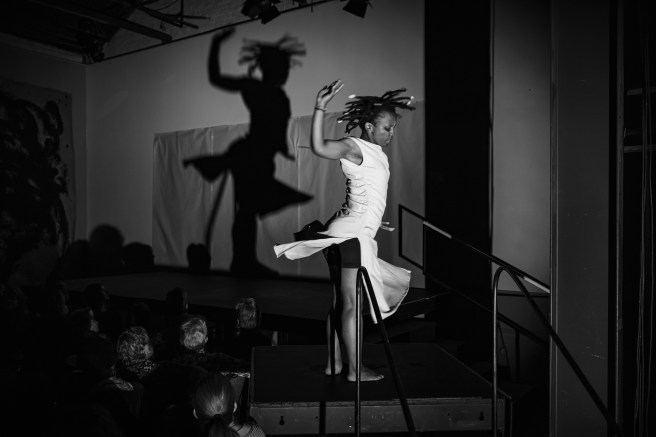
Dancer Thulisile Binda
By DIANE DE BEER
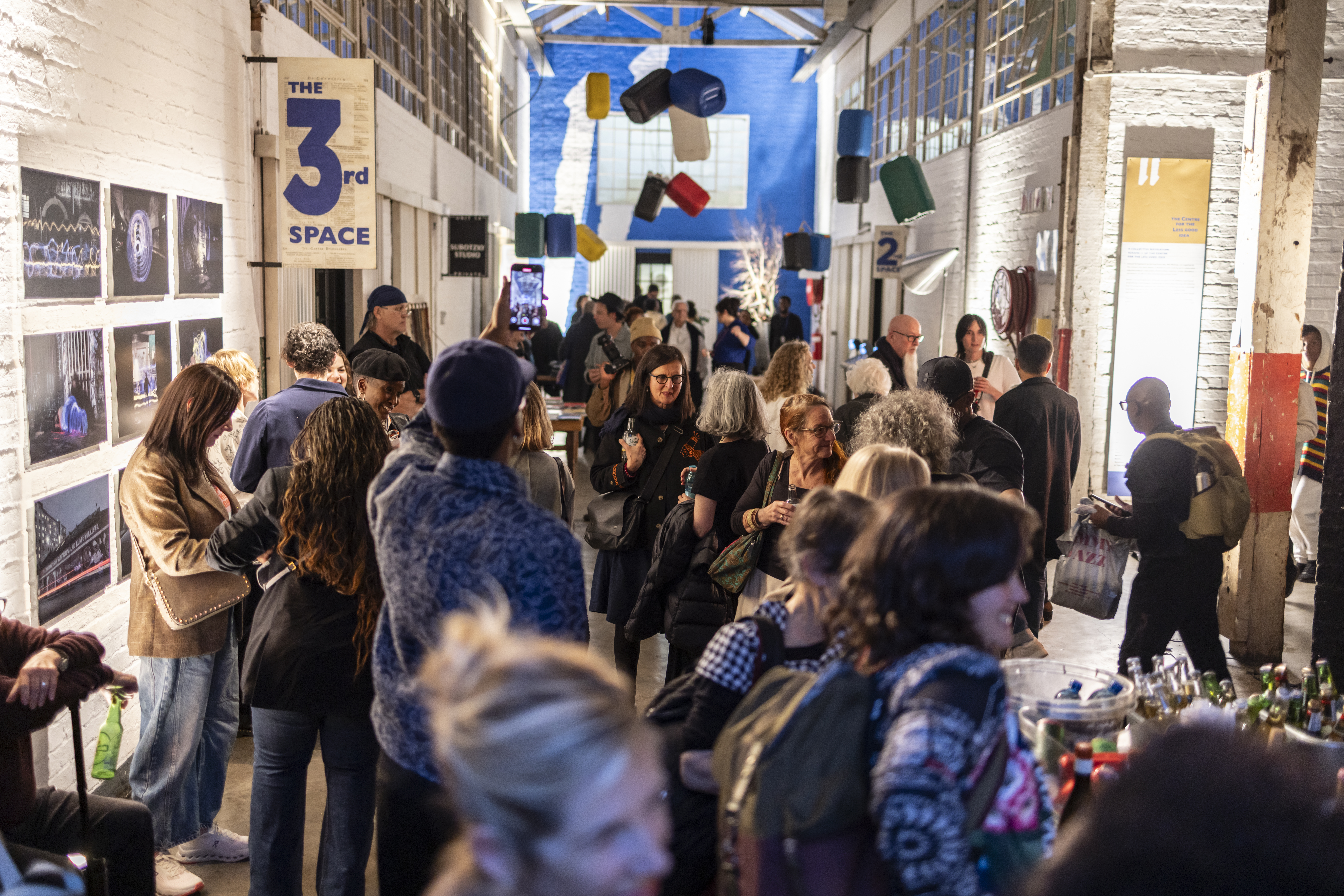
The best would have been to attend all the evenings of the 11th season to experience the full impact of what co-founder and director of The Centre, Bronwyn Lace describes as a multi-limbed, complex organism which she believes is what the Less Good Idea has evolved into. “…our arms reaching into various directions but connected to the same robust body. It makes sense for us to share a season at the end of this year, because we have an abundance of new strategies, forms, and artworks to test, show, and celebrate.”
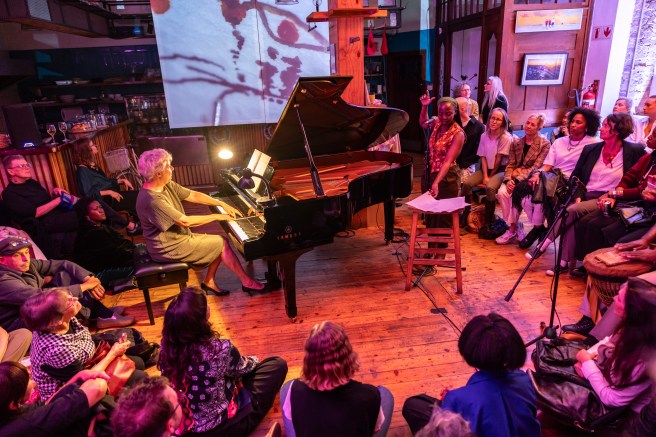
Pianist Jill Richards with vocalist Pertunia Msani.
And it certainly was all of that, exploding with a sense of creative abandon in two hours of exuberant performance which ranged from the glorious musically driven showcase by classically trained improviser Jill Richards who performed magnificently with the Benin drummer, percussionist, composer and arranger Angelo Moiustapha accompanied by the melodic voice of Pertunia Msaniiwith Marcus Neustetter’s digital storytelling adding yet another dimension to the experience. The musicianship was breathtaking.
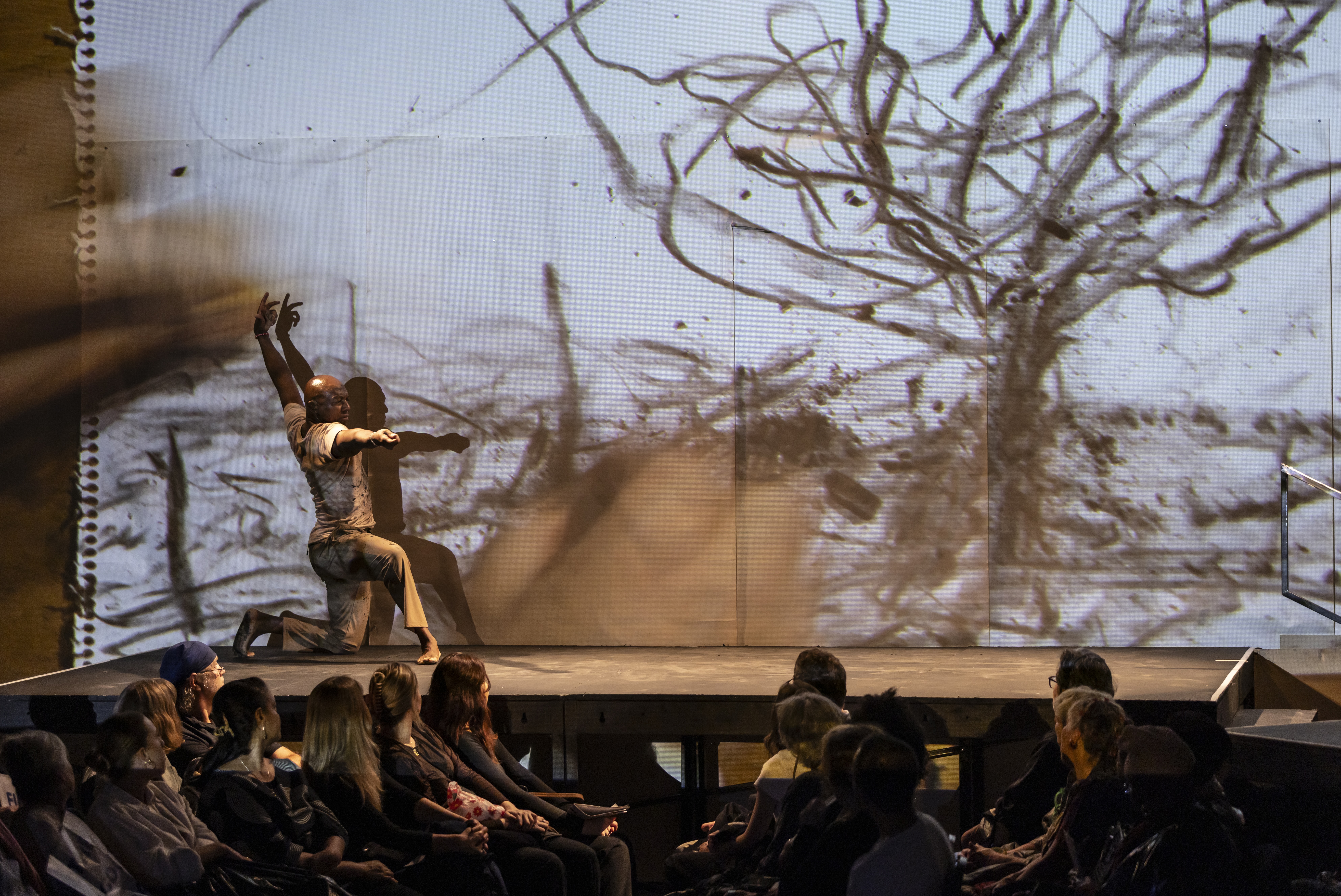
It set the tone for what was to come as the audience moved to William Kentridge’s studio to experience a collection of mindblowing artists, starting with the spiritually immersive Vincent Mantsoe, one of our finest choreographers/dancers in one of his rare local appearances. Translike in his movement and tearing at the soul of those witnessing his deep level of engagement, the evening merged from one artist to another as Kentridge stepped from one stage to the next as he expressed his creativity with body and soul.
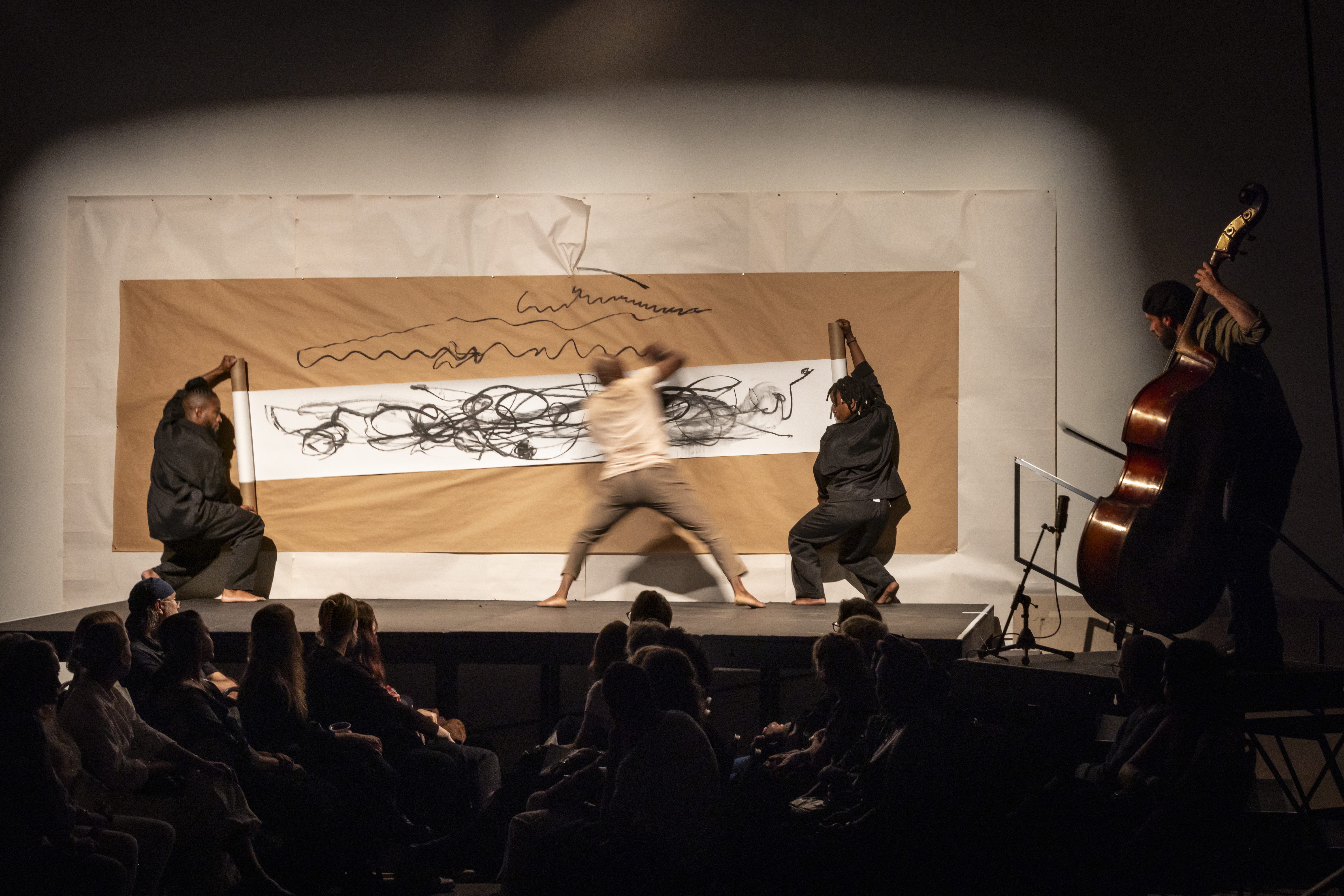
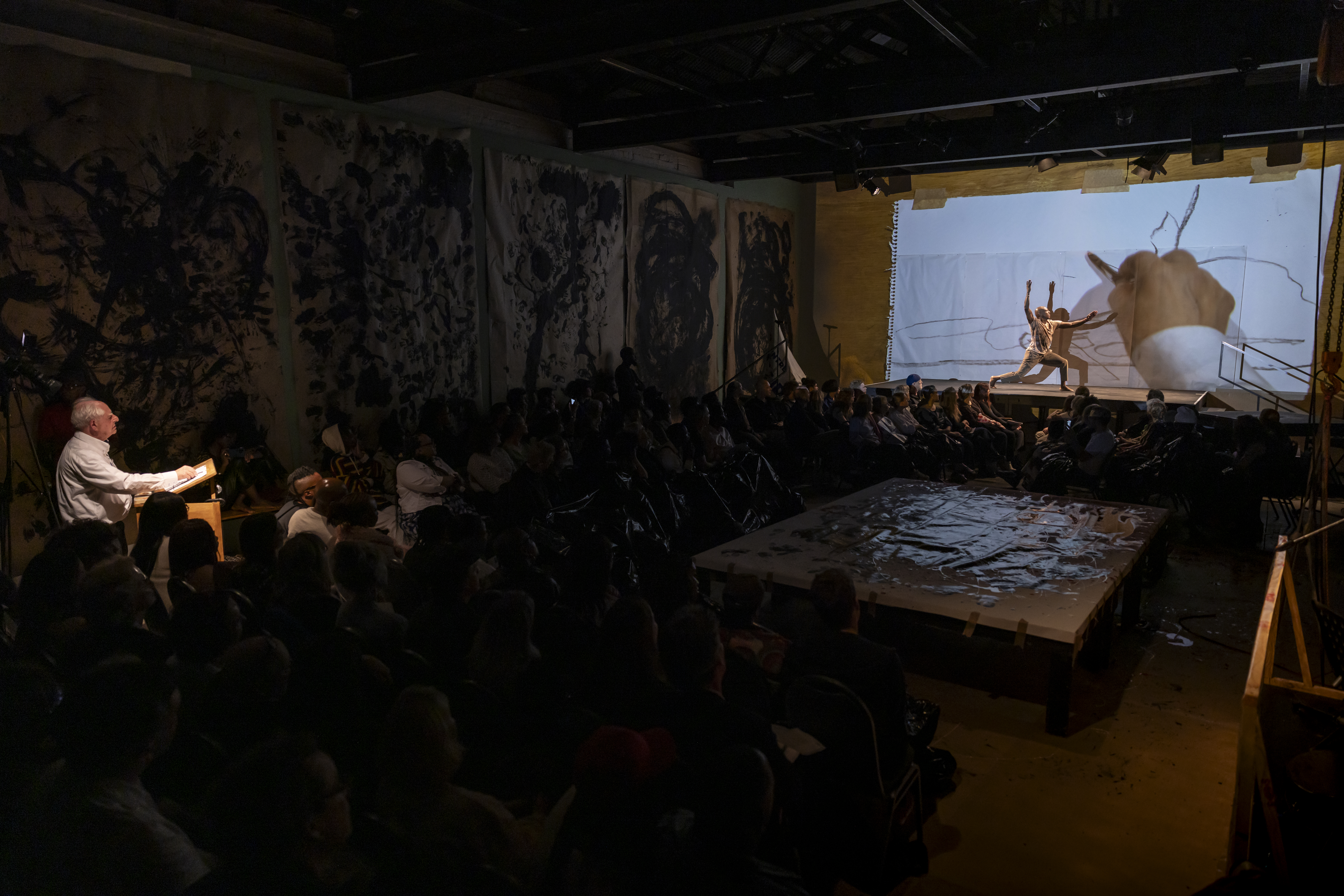
It was all about the merging of art and movement, Moving the Mark, as the event was titled, exploring the relationship between visual art and dance. What they wanted to achieve was to explore the relationship between these unusual pairings and what would emerge.
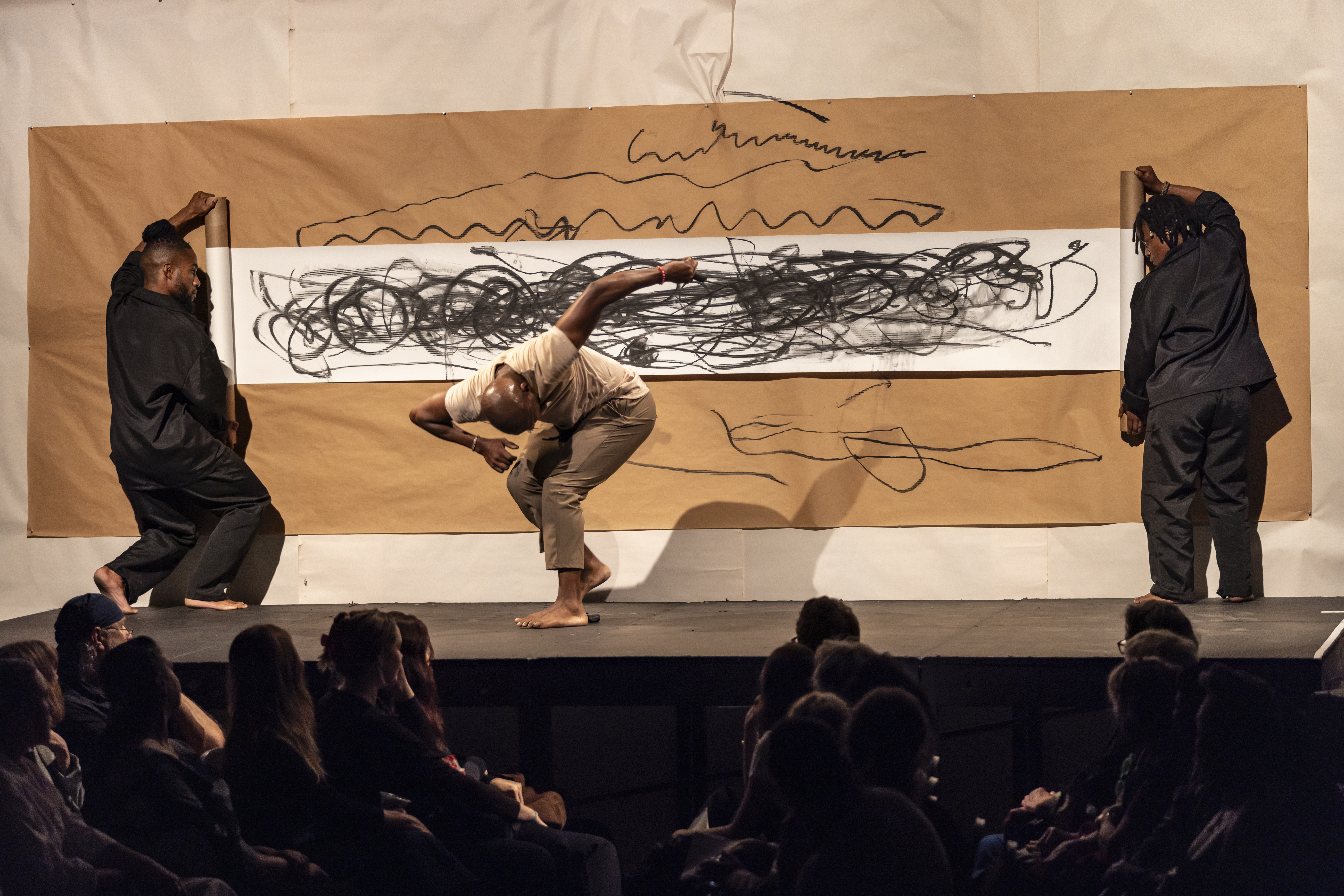
Vincent Mantsoe in action with percussionist Micca Manganye
How would the pure art of collaboration determine new creative decisions for an audience to experience and absorb? What happens when a dancer like Mantsoe mimics the ink stains of an artist like Kentridge, or from a different vantage, when the painter choreographs their brushstrokes?
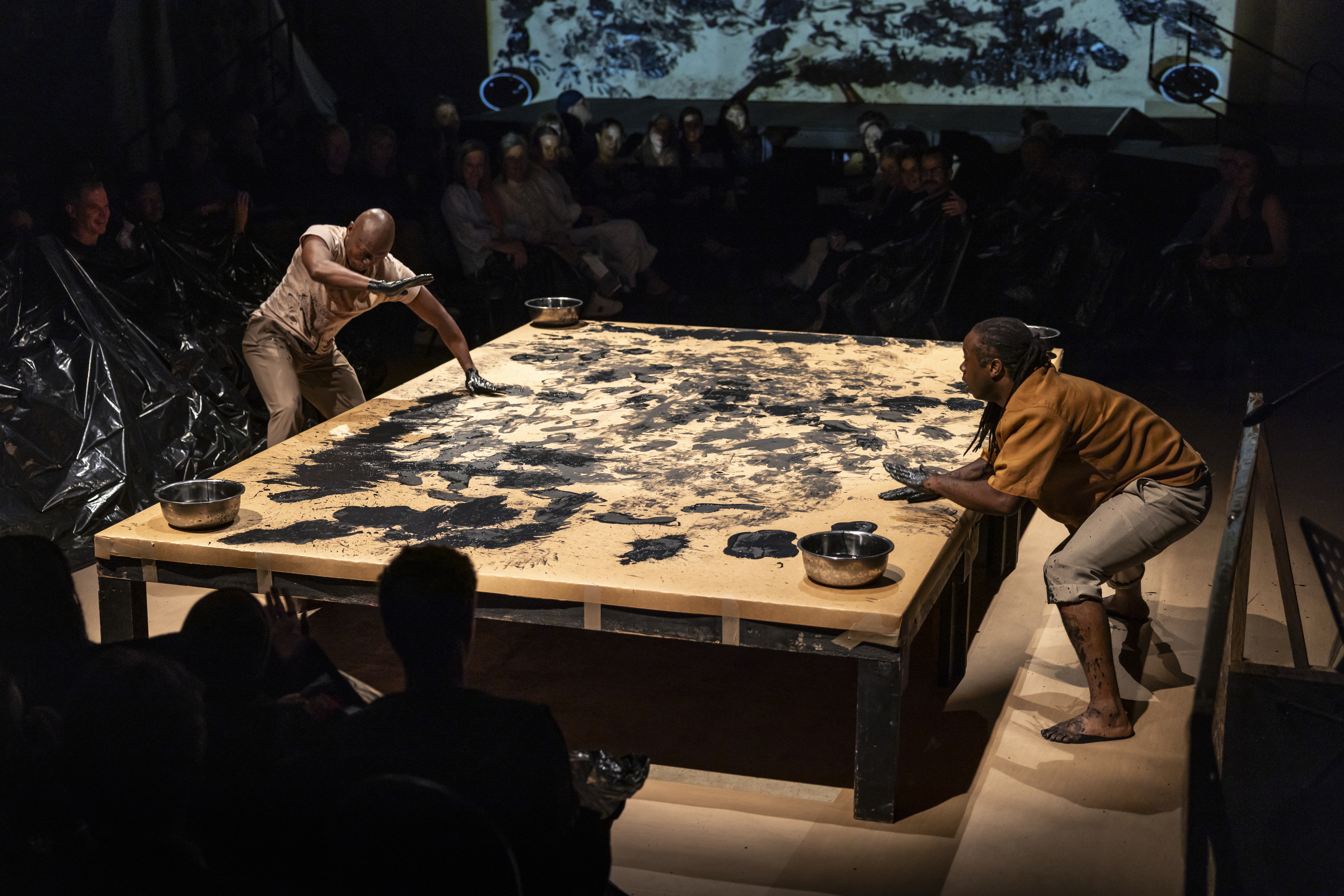
Artist Penny Siopis took to the air in almost trapeze-like fashion, painting her canvas on the floor from up high while choreographer/dramaturg Shannel Winlock-Pailman worked her magic below in mesmerizing fashion, the two artists in total union while expressing their heightened emotions.
All the while, the musical accompaniment captured the experience of the moment, enveloping the audience in the round, some wrapped in black bags to protect them from the explosive expression of art as artists flung paint creatively with fearsome flair.
The Centre for the Less Good Idea is all about the collective voice expressed in collaborative pairings, artists who work in different mediums but have creativity and exploration that binds them, pushing the boundaries, trying different ways of making new work to excite themselves as artists while also challenging and stimulating audiences constantly searching for art and creativity exploring the evolving world we live in.
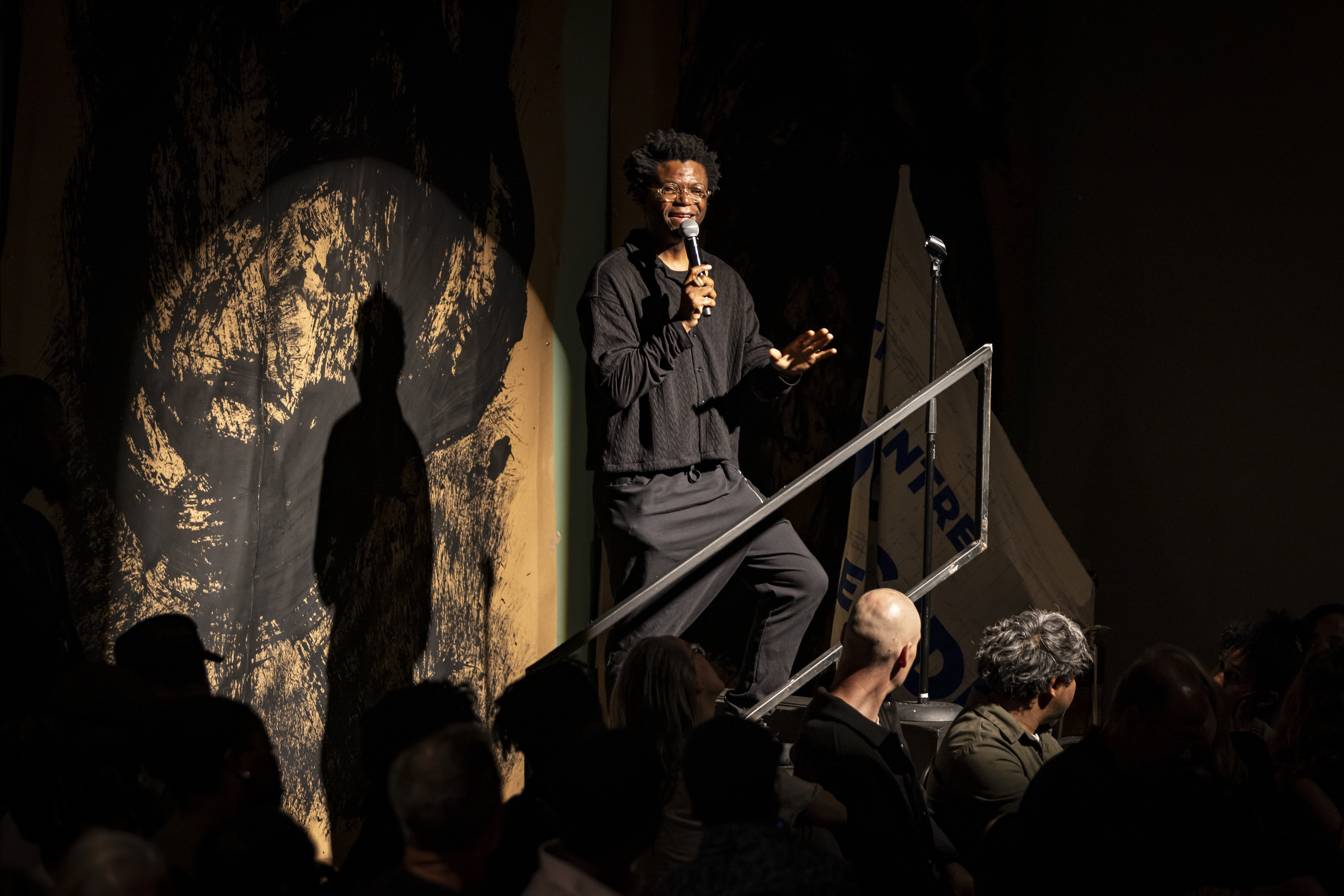
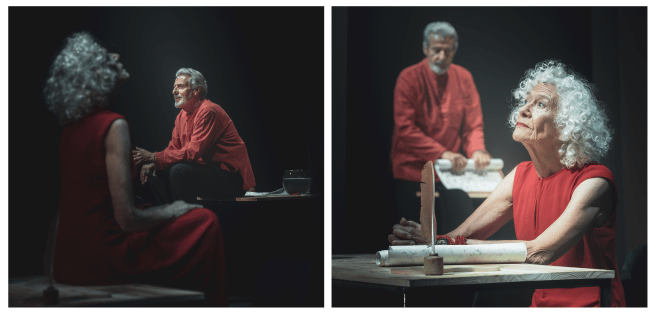
Curator Neo Muyanga (left) and Kentridge (right, in the left corner) choreographing with brushstrokes while Mantsoe is on stage following the moves.
It’s exciting when artists go beyond the expected, and are given free rein to explore their storytelling genres. How can they beat that drum differently? Given the chance to fail is often the best way to reach excellence but the restrictions are many. And more than anything, it is the encouragement to stretch far beyond the boundaries, to take that leap and to experience the beginning of experiments which are allowed to grow and flourish.
This first sold-out performance of the 11th season proved that the audience is willing and determined to experience artists moving the mark. The rest of the season sounded as extraordinary and my wish would have been to witness the full week of extraordinary creativity encouraged to dare to go beyond the expected.
How blessed are Gauteng audiences (who showed their appreciation) to experience these glorious experiments inspired and empowered by William Kentridge who could have staged them anywhere in the world. Kentridge gives us the opportunity to grow together and to expand our idea of what anything and everything is. Step into the void and see what happens comes to mind.
Photographers: Jeremeo Le Cordeur; Llewelyn de Wet and Gys Loubser
The Stellenbosch Woordfees can be quite a daunting prospect because there is so much on offer. It is perhaps easier if you have specific artistic passions, as most of them will be on offer here and it is possible to make a selection. DIANE DE BEER spotlights what caught her fancy
There’s not even a chance that you can include all your darlings in a festival wrap or even try to see them all.
I did my best, was constantly on the move and writing, and still I hear of more productions you just had to see.
Personal favourites (don’t discount others because I probably didn’t see them):
My best theatre productions were stories that turned me into an emotional wreck but did so with authenticity (I know this is a woke word, but …).
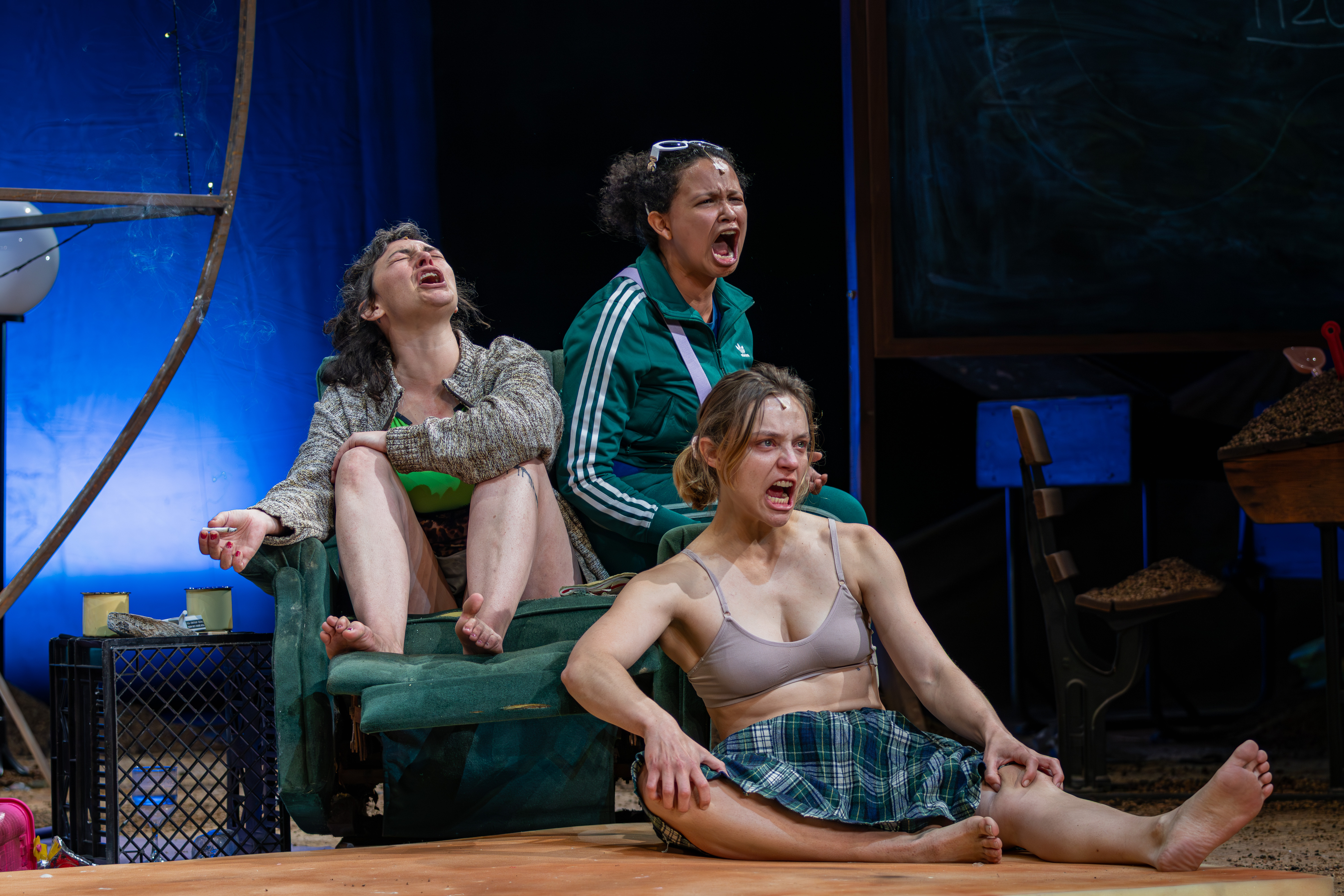
Tinarie van Wyk-Loots and Kristen Raath (left) and Jefferson J Dirks-Korkee(right) in
Dianne du Toit Albertze’s Huis van Sand.Pictured by Jeremeo Le Cordeur
The winning text of the prestigious Reinet Nagtegaal prize, Dianne du Toit Albertze’s Huis van Sand, with her honest portrayal of a dysfunctional family that’s probably not even part of most audiences’ consciousness. She writes about what she knows and where she comes from, the Northern Cape. But she does this in her self-made tongue, which shoots right to the heart and guts of the matter, no pussyfooting around with this one.
It is not a place many of the traditional Woordfees audiences will know. The backdrop is the N7, a route that runs from one end of the country to the other. It is her little spot next to the highway that Sandy knows. She and her daughter share Rodney’s caravan and too much of his life, especially the dark side. They’re trapped and yet the lifestyle is passed on from one generation to the next with the whole family fully engaged. A seemingly never-ending devastating cycle.
What drives Huis van Sand are Albertze’s words, her imagination, and the way she plays wildly with your head and emotions. Throw into the mix director Wolfie Britz’s strong casting and determined direction. With the remarkable Tinarie van Wyk-Loots launching herself body and soul into this one, Sandy’s daughter (Kristen Raath) trying to duck the missiles and resist diving headfirst into the temptations, Jefferson J Dirks-Korkee’s chilly capture of the toxic male scent always hovering menacingly and René Cloete showing she is much more than just an innocent bystander, everything about this production hits you like an onslaught.
Yet this is one you want to struggle and engage with because of the sharp edges and the unblinking gaze at the harsh reality of so many lives. It’s heartwrenching, but that is something this playwright has never turned away from. She stares straight into the skewered glare of too many unseen lives and throws us all in at the deep end. The brilliance is well worth the battle.
Melissa de Vries as Nadia and Angelo Bergh as her friend Zavie
Walking the same tightrope, is the adaptation by Jolyn Phillips of Ronelda Kampher’s ravaging novel starring two vulnerable yet resilient teen cousins who try their best to navigate a world they don’t understand while instinctively understanding that they are their only protection.
For Nadia (Melissa de Vries) and her chum Zavie (Angelo Bergh) their bond while tenuous and often fragile is what keeps them breathing.
With this one it is again the magnificence of the performances and the staging by Lee-Ann van Rooi that holds the attention as these two baby-adults going about their lives as if it is normal – and for them it is, it’s all they know.
That’s precisely the point. This is their normal, their life and the one Kampher’s words in her searing novel lay bare. Their whole existence is determined by outside factors, never certain or expected. Yet they do know how to grab the small slices of life when given the chance which isn’t often. They should not even be aware of the things happening in their lives, yet that’s the only way they know how to roll.
Kampher’s language is brilliantly captured by Phillips’ adaptation. How she even knew where to start! It’s such a complex and almost crippling story about these children whose future is determined purely by the happenstance of their birth.
Both of them have bucketsful of gifts which will never be realized because there’s simply no support or networks for these drifting families where not one generation manages to get even a foothold on a real life.
If anything good happens in their lives, it is luck and often, at that particular moment, the recipient doesn’t know how to deal with it.
When reading Kampher’s book the first time, you’re in awe of the writing and the storytelling. It’s the way she focused on the stories never told, the way she draws the characters, gives them flesh and emotions, which in this instance are perfectly re-created by the choices of Van Rooi and the adaptation by Phillips.
What a beautiful acting team. I don’t know them, don’t watch television if that’s where they perform, but I do know that they have inhabited these two kids with so much energy and guts, it’s hard to resist.
And that’s the joy of festivals, the opportunities that arise for artists so that when the stars align (a good script, director and actors), nothing can hold them back.
All of these performances should and will hopefully travel. For far too long too many voices have been silenced. We are so much richer as a country, as audiences and as performers when all our stories are shared.
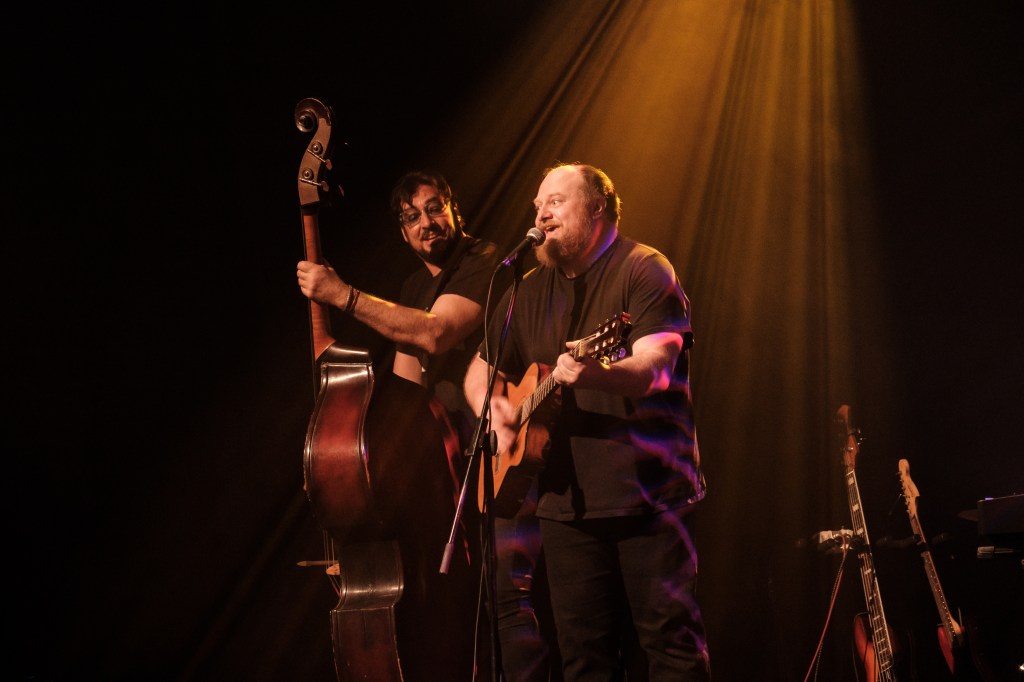
Albert Pretorius (actor) and Schalk Joubert (guitarist) in Ek is nie Danie pictured by Llwellyn de Wet and Gys Loubser.
What four middle-aged men did with what they had, was inspirational. They took something which if not handled with the same delicacy as the poetry, could have been disastrous. But because of deft hands and hearts, it feels as though you are dealing with an emotional vortex, but one driven with artistic insight and instinct which holds the audience tightly and sharply in focus from start to finish.
It worked because of the truly exquisite writing and then the choice of the right participants. The concept was Niel van Deventer’s according to the programme, but then handed to one of our smartest directors, Nico Scheepers. He is given a topic which would turn most people away – the angst and anxiety of ageing white men, not a species that many have much sympathy for.
Yet this company with actor Albert Pretorius and musical director/guitarist Schalk Joubert has shown that, given the right elements, a director who knows how to shape something yet value his actor and musician by allowing them the freedom to be and to do, it will work – and in this instance, explosively.
It’s one of those performances that you want to see again as soon as you leave the theatre. I hope it travels the country.
I took these three stunning plays to give some flavour to the Woordfees which is far too dense and diverse to dilute, but that there’s something for everyone, that’s a certainty and you won’t have to look too far or hard.
They have achieved much in only a short time and in the future with everything changing so rapidly, we can only expect to experience even more.
And then just a small PS: I was asked to interview Nataniël on a book Bloei+Blom and being who he is, the first lunch was booked out swiftly and another date the next day was included and again fully booked. But hey, the more the merrier.
As an interviewer, this is the one date I don’t have nerves. I know I am in safe hands and he is the master of chat.
It was the easiest gig in town. Even though he and I had talked about topics of conversation before the time, once on a roll, and only three questions down, I could sit back, relax and enjoy one of our best (and naturally funniest) conversationalists in action.
There was no way to ask anything else. He was in full flight on his own. He did glance my way once or twice, but there was no interrupting the flow. And even better, he was the one they wanted to see and hear.
I felt blessed, centre stage and could watch the wizard in full flights of fantasy.
*There were many others I loved, many of which I had written on at the Woordfees or previously including Boklied, Seun, Bridling, Kuns, Magda en haar Erhard, Ont-, and always The Ugly Noo Noo …
Like most things in life there are good and bad to small packages, but Aardklop CEO Alexa Strachan has turned her shiny Potchefstroom gem into a star through clever planning, a balancing act of note and enough variety to have everyone laughing and crying – with good food all over the place to boot. DIANE DE BEER speaks her mind:
My husband knows I’m a festival junkie (while he is NOT) but it is a personal indulgence and one that clearly nourishes.
This year was no different. Taking only a handful of my best, it’s not a difficult case to make.
Running down the alphabet as the festival guide does, it’s the overwhelming laughter that blew me away. I’m not a comedy girl so I didn’t know who Alfred Adriaan was but I screamed with laughter from start to finish and he was obviously a festival favourite in the packed auditorium.
With the name of Magda Louw (Desiré Gardner), one would think that I would remember that this is one of my favourite characters, but again, because of the comedy aversion, it just never surfaces. And yet, from the minute she walks on stage in her latest production, Magda Louw en haar Erhard, how Louw can you go?, this time with her husband Erhard (a delightfully Sad Sack performance by Hannes van Wyk), they just bowl you over.
What makes Magda so delightful to embrace is that she doesn’t go on the clichéd South African rant of potholes and politics, she has much more exciting things to deal with like the man constantly shuffling behind her as she leads the way at a faster pace and with much more rhythm, but the two ageing souls give you hope for the future as you realise that life is just a bowl of bubbles if you attack it in the right way.
On the other side of the spectrum there’s the magnificent solo debut by the extraordinary Wilhelm van der Walt, who unassumingly takes the stage and then reaching into a far too familiar past, given new perspective.
There was a time when I could hardly stomach another troepie tirade because it was so dominating in the country that it constantly surfaced on stage. What I realized this time round, is that Van der Walt himself probably never participated in this deadly exercise for so many decades part of our lives and there were certainly many young audiences who needs this insight on our past.
And if it is done with such magnificence, the flashbacks are worth recalling even if the past could be wished away.
How can anyone not be thrilled to experience Antoinette Kellermann and Dawid Minnaar on stage and in this instance in Breyten Breytenbach’s last play, Verwelkingslied, before he died. Although he dedicated the piece to Antoinette Kellermann and Marthinus Basson, she performed with her long-time stage partner Minnaar with Mari Borstlap as director on a set which was reminiscent of some of their earlier work together.
Minnaar is an eerily similar version of the poet in voice and image and immediately you can lose yourself in the meanderings of this philosophical and always poetic (almost) memoir. As the two actors take turns in monologue yet sharing Breytenbach’s feelings on death, one drifts away in the words so magnetic and the voice so penetrating, almost in dreamlike state, the actors and the audience.
The simplicity of the presentation is apt as it holds the depth and strength of the text so delicately. This is where we need the words to wash over us as an audience in almost immersive fashion.
I know that Amanda Strydom first mesmerized me with The Incredible Journey of Tinkerbell van Tonder and was eager to experience the performance all these decades later. Not that I can remember the detail, but with age of both text and performer, it’s as if everything has just found a warmer and gentler place to settle and lay her head down.
Finding your place in the world is a never-ending search and when you are fighting for freedom it is almost impossible – yet not when you’re Nelia Petersen who was handed the struggle together with mother’s milk.
It’s rigorous and robust with Strydom tackling the text and music with equal energy and exuberance. And all these years later, if anything, it is even more brittle and brilliant than before. I could watch this performance any day.
Belofte van Vere was our first production and yet another Breytenbach tribute but, once I witnessed the full cast on stage, they had my full attention. With the musically adventurous Laurinda Hofmeyr on piano, a rare singing appearance from the jazz-infused Ilse Klink, the genius muso Leon Gropp (guitar and voice), the soulful David Klassen (drums), a rhythmic Concord Nkabinde (bass) with the velvet voices of Rolanda Marais and Eben Genis, I knew I would be transformed. And I was.
Performers Eben Genis and Rolanda Marais
This exciting, gifted collection of artists would know how to do Breyten Breytenbach, without frills and fancy tricks, just delivering on their accomplishments and Breyten’s poetry and words. Anything else to my mind would have been unwarranted.
It’s my kind of show with my kind of people and poems. I needed nothing more. For me this was a Breytenbach celebration and I’m certain he would have been honoured.
Combining two dance companies, Cape Town’s magnificent Figure of 8 Dance Theatre who also performed their haunting tribute (Die Een Wat Bly) to the relationship between mothers and sons, the more expansive Wings of Light: Dance of an Angel returned dance to Aardklop in spectacular fashion. The music composed by Mauritz Lotz set the tone for an exquisite performance which showcased both classical and contemporary dance, the perfect rendition for an audience who might not often have the chance to see this kind of performance. It was a rare feat to stage this production and hopefully paved the way for similar ventures in the future.
Festivals have to walk a tightrope of not playing it too safe yet not antagonising their core audiences. With the large auditorium thé venue for one of our best comedians as well as two of the most exciting dance companies in the country, they managed just that.
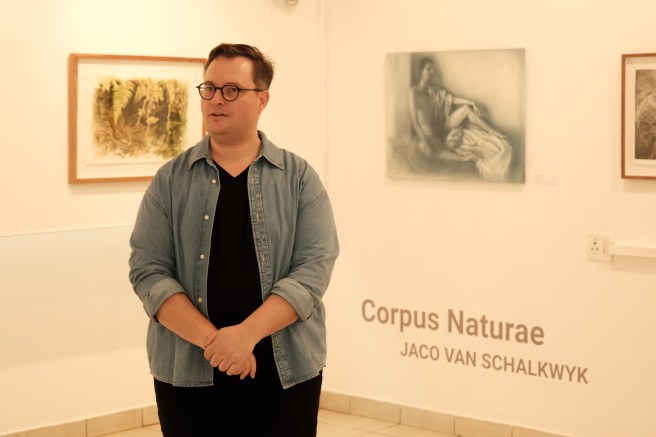
There was also time to slip into the art venues, always something to cherish, and this time it was the festival Artist Jaco van Schalkwyk as well as a challenging group exhibition Vice Versa curated by artist Gwynneth Miller, all of which got the mind racing on a variety of contemporary issues. The renovated campus art museum also featured an exciting range of Nataniël pictures captured by his longest serving photographer Clinton Lubbhe
As an extra fillip, there was the celebratory concert of Nataniël and Charl du Plessis’s 25-year collaboration on stage. And as I had witnessed their initial first performances together, this was quite emotional.
To watch two stratospheric artists develop, dissect and model their artistry as they grow and stretch in different ways is unexpected and artistically adventurous.
There’s Du Plessis’s breathtaking exuberance and excellence on piano, the way he shifts between genres and his approach to his longtime stage companion. Nataniël again exhibits his stagecraft, flips easily from text to music, his stories hilariously funny with a hint of melancholy, or on the musical side, surprising everyone with his superb classical training which he hardly ever shares. They are an unbeatable combination with so many years of performance between them.
Aardklop features youth theatre with their Pronk Podium product, which this year invited its most successful writer/director/producer to present his latest work Doolhof together with the NWU Kampustoneel winner Diereryk directed and written by Pierre-André Viviers, cleverly based on Animal Far.
Every year I am thrilled and struck by the quality of the productions and everyone’s artistry involved. For future artists, this is unequalled training ground and for audiences the ideal opportunity to see how young artists tell their stories and what to expect in the future.
At future festivals, remember to watch out for this special section.
I could go on and on, I even made a turn at the market, something I never do, but I wanted to surprise my favourites at home with some specialty snacks.
As always it was a festival with feisty and fabulous fare on every level.
And the winners for the annual Aardklop festival awards are:
Best Actress: Elzabé Zietsman for Routrip
Best Actor: Wilhelm van der Walt for Seun
Best Director: Nico Scheepers for Seun
Best Overall Production: Seun
Award for most innovative work: The Scullery Quintet: Stir-fried Sonatas
Visual Art: Best Exhibition: Corpus Naturae, Jaco van Schalkwyk
Best Music-driven Production: Amanda Strydom: The incredible journey of Tinkerbell van Tonder
Best Classical Music performance: Road Trip Rhythms
Best Musical-driven performance: The Scullery Quintet
Hartsvriende Beste Produksie: Seun
Best new Afrikaans Script: Nataniël for NATANIËL + CHARL = 25
Best Production: Drama: Seun
Knockout Award: Alfred Adriaan: Positive Strokes
Extra Mile: Riaan Rademan (Technical project manager for Blond Productions)
“What we love about music is not that it sounds good. What we love about music is that it sounds inevitable. It’s playing the thing that we all know is unfolding. Whether we want to accept it or not …”
Jon Batiste (American Symphony)
This is the quote artist Frieda van den Heever sent me when we started a conversation on email.
I became aware of her as a producer. She was mostly involved with poetry-driven productions, but what I noticed was the sensibility of what is a very tough stage production.
How do you get people to attend poetry productions at a festival where there is so much on the go? But she did and she knew how.
She describes herself as a novice who preaches, because she studied drama not theology. She explains that in Springbok, where she grew up, they called it people’s church when a normal person preached because the preacher couldn’t be there.
“I have been doing it for almost 14 years, and no one has ever asked for my credentials,” she says. Having encountered her on stage, I understand why.
She is part of InVia congregation in Cape Town and describes this community as a group of people who love music and people. Her father was a minister and while she spent most of her free hours as a child in his study rather than on her own, she never thought that she would either enter the church or become a musician like her mother. “I had spent enough time in churches with music in my ears for a lifetime,” was what she thought.
Still, when she read something impactful she always caught herself speaking rather than just reading that passage. She simply couldn’t escape and then there was a time when she didn’t want to any longer. It has always been a juggling game, because it wasn’t something she could practise fulltime. But she missed theatre.
She believes in the power of stories, fables, poetry and metaphors. “Both theology and theatre navigate a place beyond knowledge, something like mysticism, and tell stories that often hold warm truths rather than cold facts,” she explains.
The part of her work that she favours most is what she describes as “accompanying rituals”, including marriages, funerals, christenings and the like. She regards it as her calling to add to the honouring of these events. It’s not that she participates only in religious ceremonies; she is often involved when people aren’t particularly interested in a church but still have a need for some kind of ritual which they share with their loved ones.
She also presents talks and retreats for congregations or groups of people who approach her. These are creative workshops specifically for women, but she stresses, “it has nothing to do with pancakes, crochet and tea parties.”
She knows these certainly have a place, but for her it is about togetherness, breathing, chanting, laughing and crying.
That’s just the beginning of all her activities. She is also involved in yoga and the transformation that ensues and has a deep fascination with people and how they struggle and survive. And while she would have loved to study psychology, a lack of time made her opt for an intensive 14-month course in integral coaching which will be incorporated in her other work.
And still, she keeps going. Once a week, she travels to Stellenbosch, her alma mater, and teaches cabaret facilitating the practical execution and texts of the honours students in the US Drama Department . As a student of the legendary Marthinus Basson, she is delighted that she can pass on her experience to a younger generation.
There’s also her radio work which started on small scale, but her talents were quickly recognized. And she still benefits from her innovative moves during Covid which resulted in her producing programmes in the basement of her home.
That led to her producing most of her radio and television work in her home. It means that she doesn’t have to spend too much time away from her children and allows her to do much of that work early in the morning. “It all happens before the children and the cars have to wake,” she says.
I’m breathless and haven’t yet come to her performance, which is really what I want to promote.
On Wednesday at 7pm, Frieda will be performing at the Fairtree Atterbury Theatre in Lynnwood, Pretoria for the first time in a magnificent production, Spoorsny (tracking) .
“I really went into grief. I sensed that I had to go in if I wanted to come out. I don’t mean that I’m perfect now, but I’ve been through the perfect storm and that moulds one to find more light because I was mining the darkness. I can sense, I almost want to say I can smell light and when I sense it I look for it everywhere. The material for my debut album came from a show I did on what would have been the night of Leon’s (Kruger) 50th birthday. (He had died very suddenly in 2021) I saw the Woordfees was during that time and I didn’t know on which date I was going to perform and then when they sent me the date, I went for it to really celebrate him with this work and this script. I could have gone to sit somewhere in the quiet and the dark which isn’t wrong, I have done it. But for that night I wanted to share what was left of me, so that it could multiply and I’m grateful for that.”
Her previous productions as director, Die Poet – Wie’s Hy?, Die Oerkluts Kwyt and Met Woorde Soos Kerse all shared a particular sensibility that made me aware of a rare director at work. She knows she didn’t have the technical experience, but her affinity with poetry and performance outweighed anything else. I didn’t notice any imperfections with any of those mind-blowing shows.
She works with love, a fine-tuned ear and excellent evalution. Also, part of the package was a childlike “unknowing”, an unwavering belief in the collective intelligence and the process, endless curiosity as well as an excellent production team and artists. Her motto was to always be present in the process. Whatever the requirements, it worked.
If you’re crying halt, there’s more. For 10 years she has been involved in a process with farm workers who boast magnificent voices. Each year she selects 10 of the best and offers them the opportunity to learn and to show off their talent. “I try to bring each individual something, give some of my experience, but I can’t teach them anything about singing. I have worked with voices that compare with the best in the world and it is a burning passion to create more platforms to showcase these voices.”
Her own musical talent, writing and composing songs and performing, has never been the only thing she wants to rely on to make a living. She wanted to be a free spirit when going on stage.
She is much more of a homebody than someone who wants to be out there but she also has a need to be challenged by the alchemy of a live performance. She obviously has a blueprint when she goes on stage, but she also reads the room and has the talent to shape her performance in different ways.
If she had a choice, she would write songs, play music, dance and jam with other voices and instruments all day long. “That feels like the best and most unvarnished version of myself,” she concedes.
To my mind, that is exactly who we watch and listen to during a performance of Spoorsny.
But let me give wordsmith Frieda van den Heever the last word: “The sudden death of my husband in 2021 and the impact of mortality and loss give perspective to everything I do and am. I am much more than a widow and single mom, but it gives context to my decisions and relationships, the spaces I find myself in and how I engage with people. The raw material which emerged in my debut album Skoonveld and formed the platform for the stage show Spoorsny as well as the anthology (published by NB) ‘n Asem Lank says everything about my search for meaning and light.”
It’s explosive, it’s engaging, it plays with your mind (stretching it this way and that), it’s mesmerising, it sweeps your whole being along and most of all, it’s original and creative in a way that heightens all the senses. And then it shows you everything theatre can be.
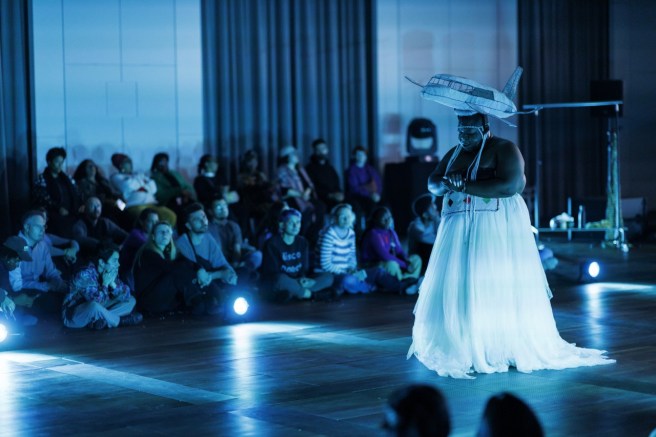
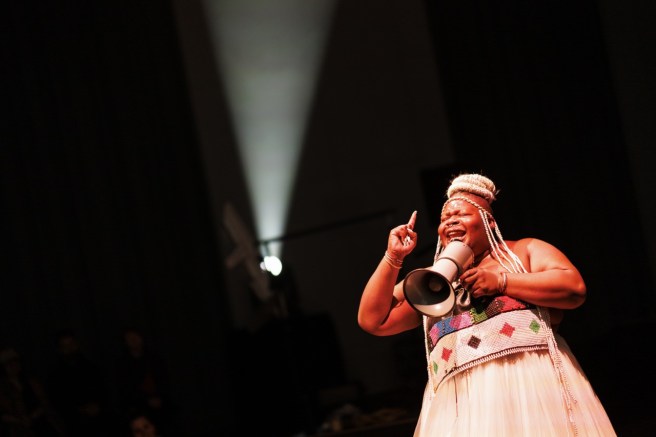
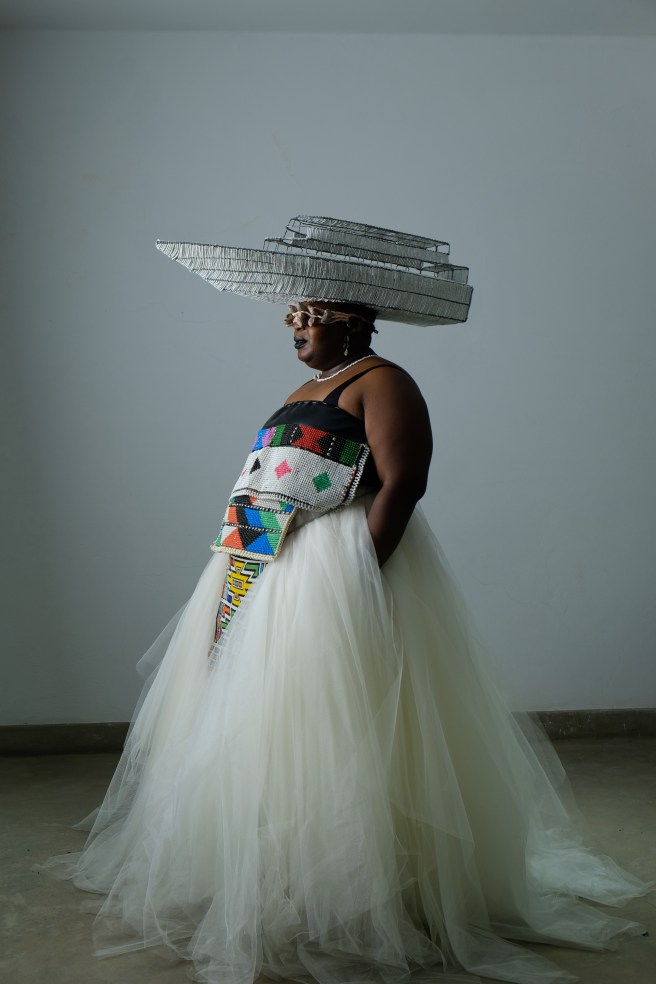
Khoza is a presence not only with the theatricality of their costumes but especially with the way they move, speak, sing, chant and engage their audience from start to finish. There’s no time for your mind to wander or wonder, you’re simply in the moment as you participate in this experience that for most of us would be completely unique.
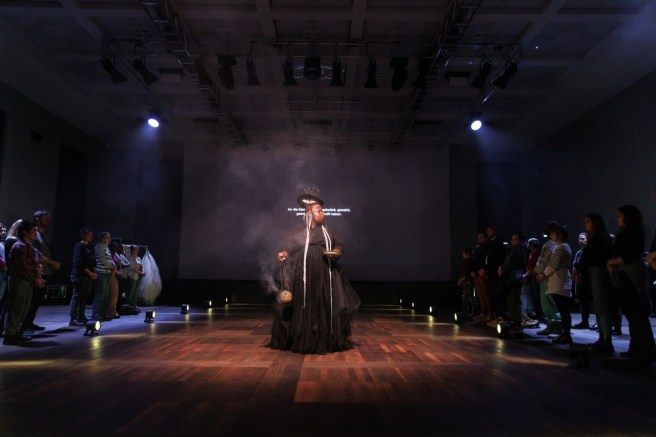
It’s ritual and rhythm, it’s engaging your whole being. This isn’t something you‘re watching, you’re participating on a level that is here and now. It’s theatre-in-the round with the performer, the one who is leading the way on this exploration of the past where human zoos and exhibitions in Western societies, our societies, turned people into curiosities to be paraded and exploited for the delight of white fetish. That is even difficult to write after seeing this play.
Especially for those of us on the oppressors’ side, while we gasp in horror at the stories, we know what our race has done to people because of the colour of their skin, have seen many plays and read many books about those times, yet, sadly it remains just that. It’s not as though your body can viscerally experience what that must have been like. It’s something that white people to this day never experience. They simply don’t have to navigate a world that plays by rules made for them … still.
How many times have you as a white body thought about how anything that you do on a specific day will be determined by the colour of your skin? Think of Trump’s world in today’s context for example. People are being rounded up and deported even with citizenship because of the way they look.
Khoza suggests that it is a history that is not spoken about and which they are determined to address so that those affected can reclaim, reflect and confront themselves as people. Because it is something that continues to this day, for them it is about the need for spiritual healing and reclaiming violated dignities.
The one thing all of us have felt in our lives is humiliation. For many it is an occasional thing that can be quickly discarded as you move on with your life. For others it is an institutionalized part of their life and there’s no escaping. The only requisite to fall prey to this is the colour of your skin. Everything in our lives to this day is determined by this. Think Black Lives Matter.
It is described as an installation-based performance and for me personally, it was as though my whole body had suddenly been awakened. I felt alerted to the way the world works. Was there anything said that I hadn’t heard before or didn’t know? How many times have I not experienced the Saartjie Baartman story, a woman torn from her family, stripped of her identity as a human being, taken from Africa to Europe and displayed for the Western world to view in a human zoo? We know and sympathise about the atrocities of the past. And again we wonder about those happening all around us, because they’re still there.
What The Black Circus does is change the perspective; it inhabits your body and soul in a way that takes you the the heart of the atrocities. For Khozait is a place of collective healing where the shackles are discarded, and a spiritual connection established.
It’s a difficult experience to write about because it is one to experience rather than to analyse. You want to enter the space knowing just the title.
At the beginning I felt as though I was sitting in a glorious painting. A story of some kind was going to unfold and as with most theatre, I was excited. What I got was so much more. It was unexpected, challenging in the way theatre should be, explosive in performance and presentation, and something that has changed my life. And that is what theatre should be.
I will be looking at and facing the world diffently.
DIANE DE BEER reviews the latest Mike van Graan play
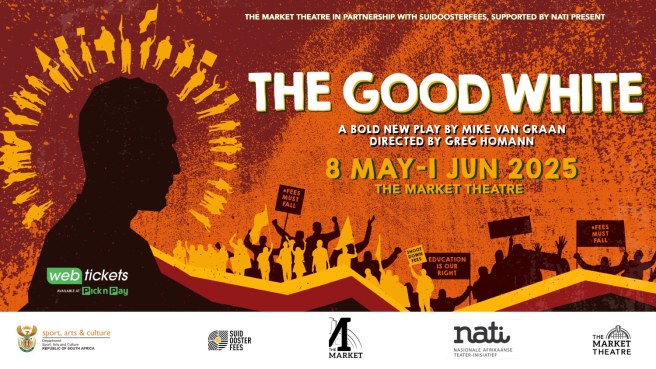
THE GOOD WHITE
DIRECTOR: Greg Homann
PLAYWRIGHT: Mike van Graan
CAST: Shonsani Masutha, Russel Savadier, Vusi Kunene and Renate Stuurman
SET DESIGNER: Patrick Curtis
LX DESIGNER: Themba Stewart
COSTUMES: Nadia Kruger
VENUE: Market Theatre
RUNNING TIME: Until June 1
Pictures: Ngoma Ka Mphahlele
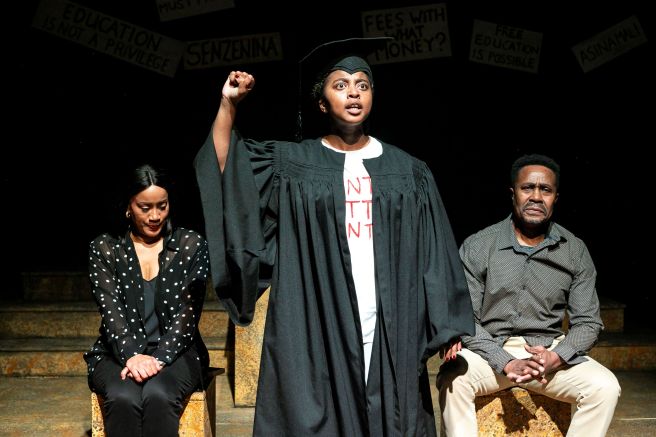
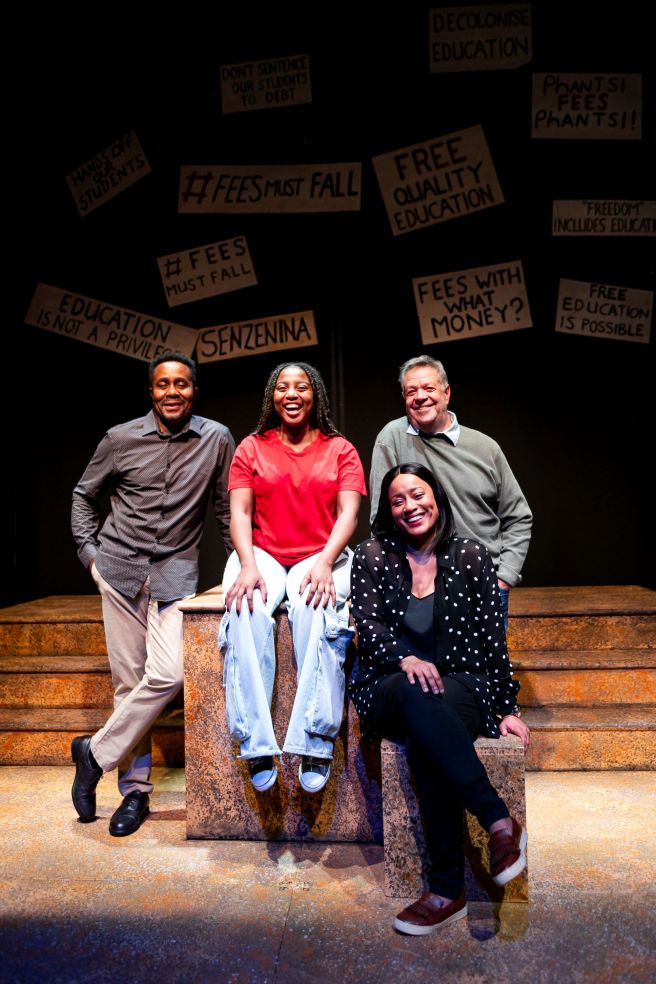
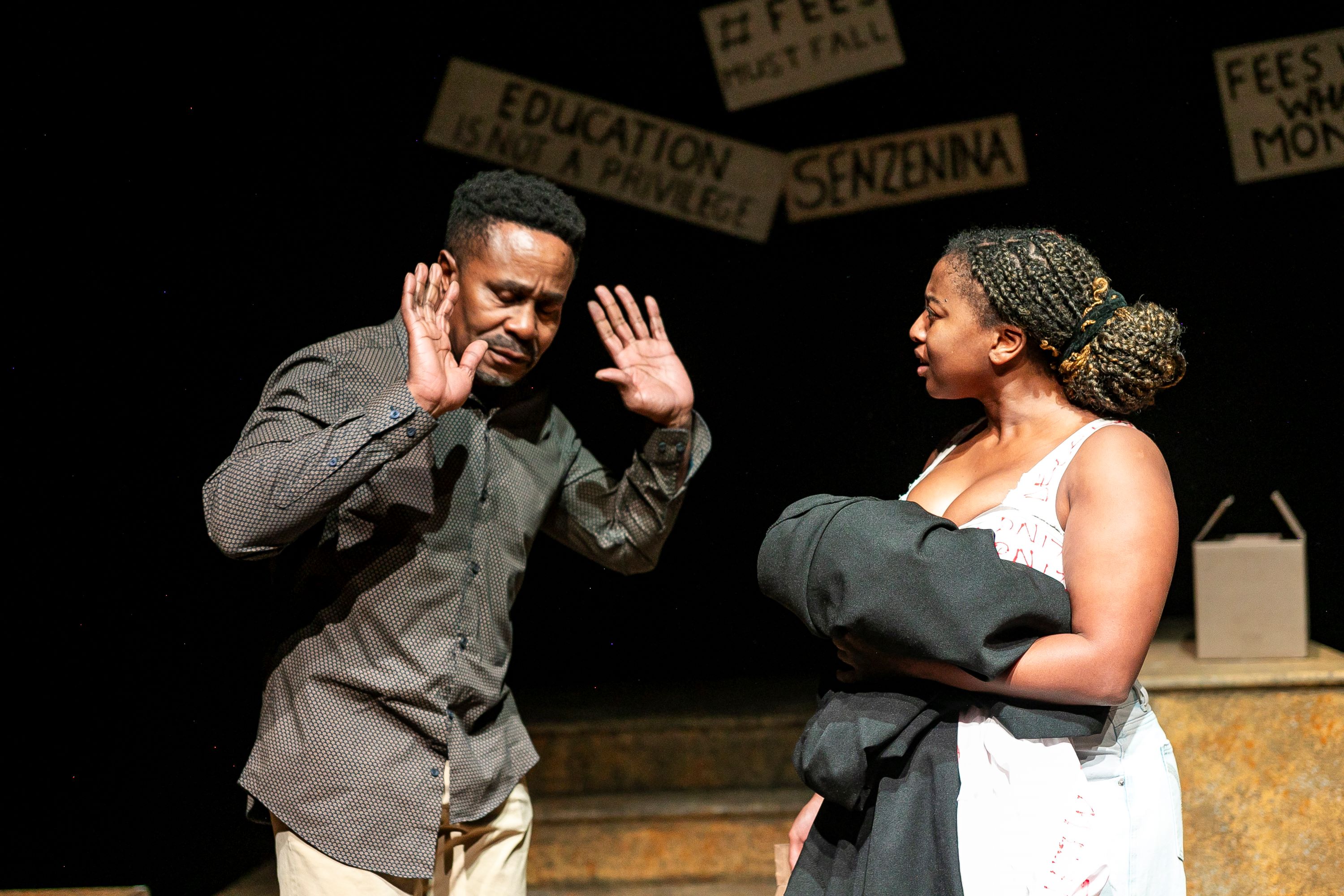
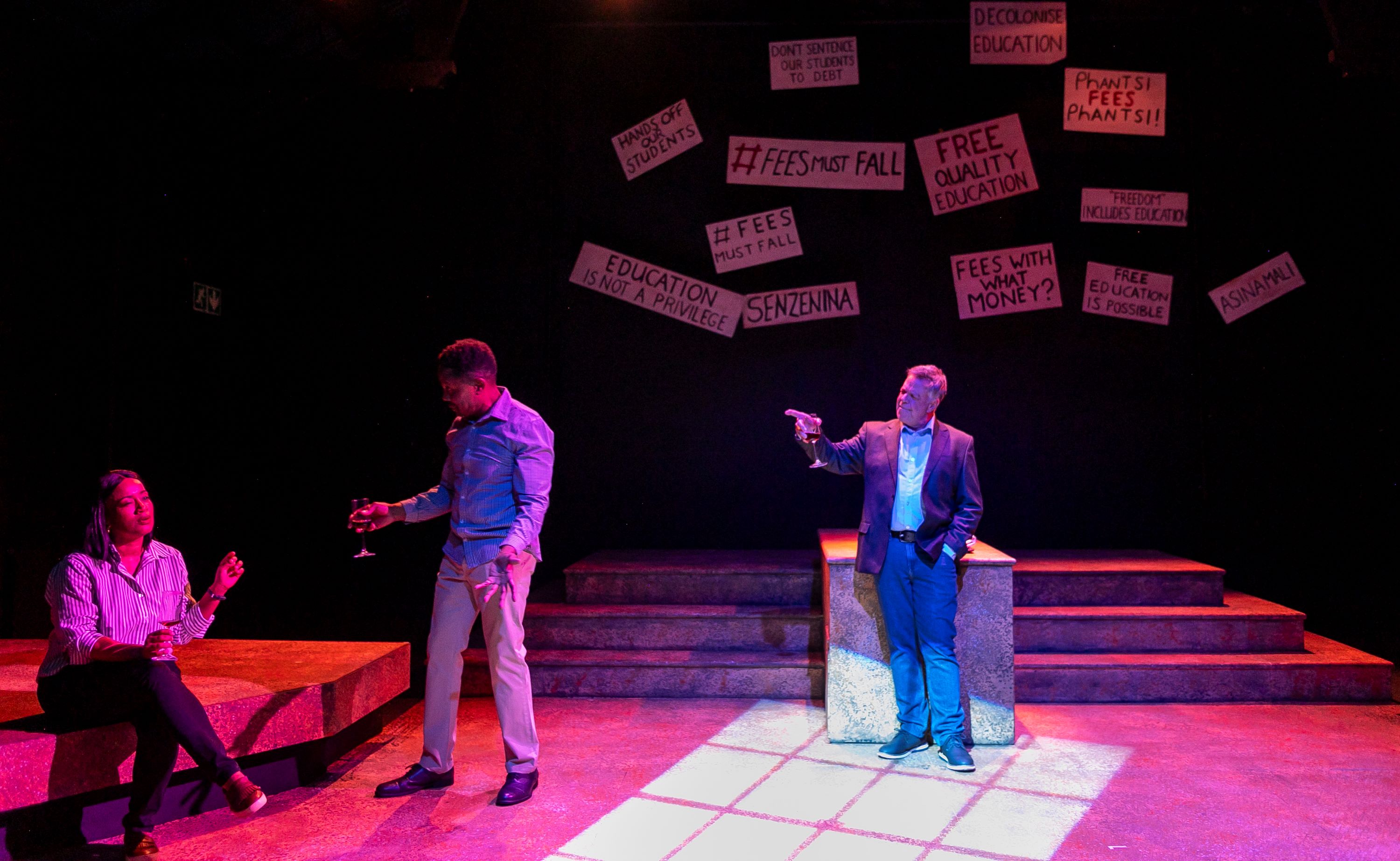
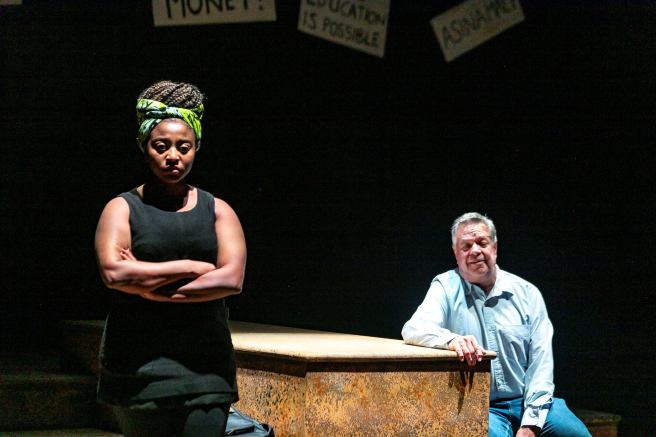
Pair the title with the four characters on stage – Vusi Kunene (Black, pictured right), Russel Savadier (White), Renate Stuurman, (Coloured, pictured left) and Shonsani Masutha, (Black, centre front), — and, in the South African context, sparks will fly.
That is what Mike van Graan’s latest play leans into. He says in the programme notes that he hasn’t written anything but solo shows since 2018 and it feels as though this one has been bubbling under and then just exploded – in the best possible way. It’s an epic piece of writing which will have you gasping as he appeals to each one in the audience, whoever they are, to grapple with the issues – our inner core – of South Africa.
While Nelson Mandela did many things for this nation, coining the phrase Rainbow Nation was arguably not one of them. It is as though he constantly reminds us what we are not, but if you were part of the opening audience on what seemed to be a quiet Sunday afternoon in the theatre, you would have witnessed that we could be.
The perfect quartet: Vusi Kunene, Shonsani Masutha, Russel Savadier and Renate Stuurman.
The audience pretty much reflected the mixed bunch we are and from the deadly silence following the first poem of strength recited by the astonishing Masutha to the immediate participation during the rest of the play, it was as though there was another solo performer on that stage – the audience.
It captured the heartfelt emotions Van Graan has always been able to harness as he tackles the South African nation. And no one does gloves-off like this playwright. Setting the play in academia, he has chosen his boxing ring and then selected his characters to represent every foible in the human race, it felt like. And then he lets them rip.
As always, he doesn’t hold back, everyone and each weakness is held up for scrutiny and the constant audience gasping and finger clicks told you how he hit the mark throughout the play.
Through the years Van Graan has been honing his very own way of dealing with what he views as our fatal flaws and this time it feels as though he has unleashed it all in glorious colour.
It might sound like something you don’t want to hear or see but, because South Africans will all relate to everything, it’s like witnessing the full South African story from Once Upon A Time …Prejudices in all their pitiful hostility, power plays, colour bashing, gender gore, poor vs privilege and the list is endless. He plays all those cards to their fullest.
Those who know his work, also know that he can write and he has never been scared to speak his mind. He does it to the Department of Arts and Culture and he does it on stage. When he has a platform, he steps up and tells it like it is and believe me, he is one of the few who speaks his mind unabashedly whenever he can.
He has been maligned to the high heavens, but nothing has stopped him. And finally, to my mind, here is his magnus opus and it is flawless and delicious to witness. And when (not if) you go and see it, I hope you have the same audience we had; it added to the fun and spectacle of the drama.
Add the director and the cast to complete the perfect coming together. Homann allowed the Van Graan words to do the work, which was the best thing to do. It should be unfettered because you really have to engage and listen to get the full extent, which here you do.
The cast delivers magnificently. I didn’t know Masutha’s work but she made sure I would never forget her. What a performance! From start to finish she’s there with all her energy and might and that’s what her volatile character needs. Stuurman is an old favourite and to my mind, this is her best performance yet. Savadier and Kunene also fit the bill and, as seasoned actors, they never put a foot wrong.
It’s a play I will try to see again towards the end of the run, because there’s just too much to take in at one sitting. It’s something — even though it doesn’t sound like it — that gives hope. If, as Van Graan suggests, this is exactly who we are, at some stage togetherness will take hold. As for now, we are still that dysfunctional family who needs a stern word to set us on the right path – and this is it.
With streaming becoming such a comfortable option, I haven’t been to the movies for a while, but pre-Oscar Awards is always a good time to catch up on as many of the nominated films as possible It always turns the event into something more substantial because you actually know more about the possible winners. I chose these two films – Conclave and A Complete Unknown (Ster Kinekor)and my selections were both extraordinary – both with chances of quite a few Oscars each:
CONCLAVE
DIRECTOR: Edward Berger
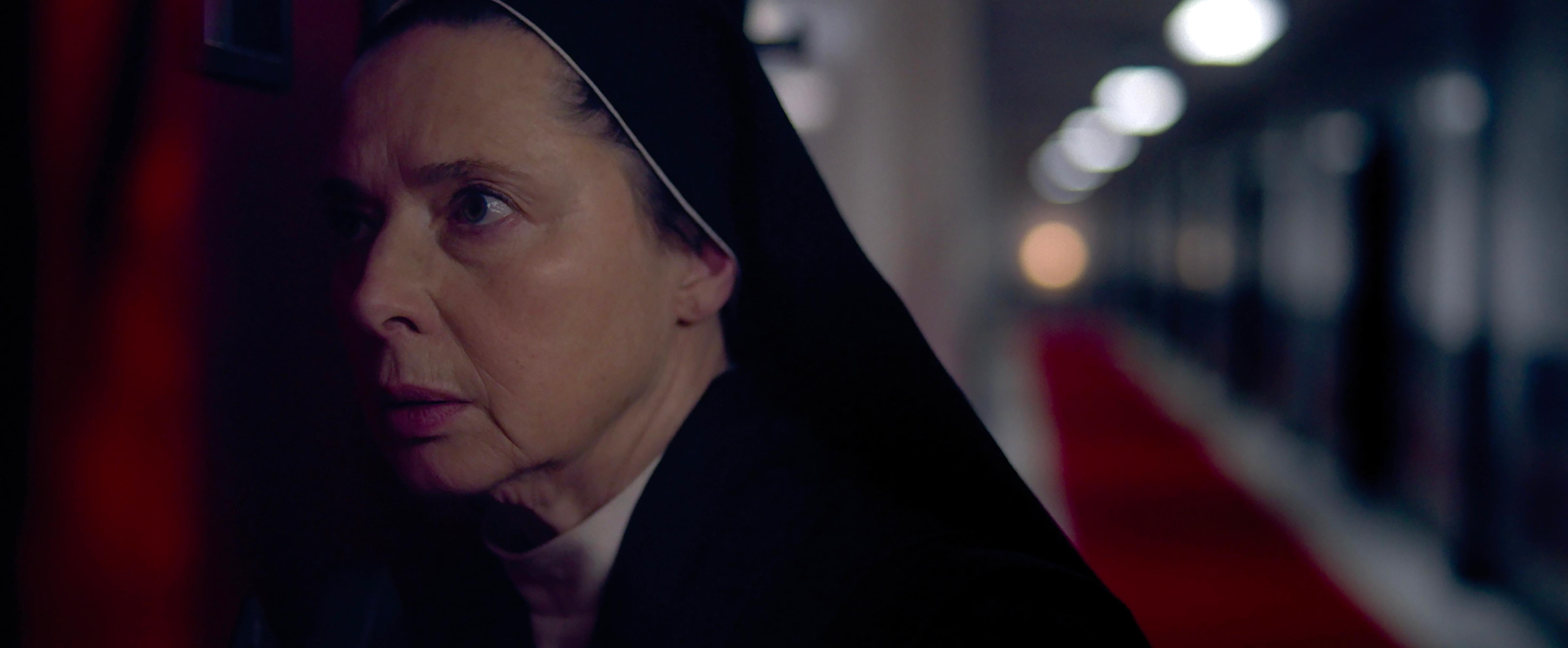
CAST: Ralph Fiennes, Stanley TuccI, Carlos Diehz, John Lithgow, Isabella Rossellini, Sergio Castellitto
How can one not be pulled into this story with such a fantastic cast? And then the secrecy about everything that surrounds the Vatican inside and out?
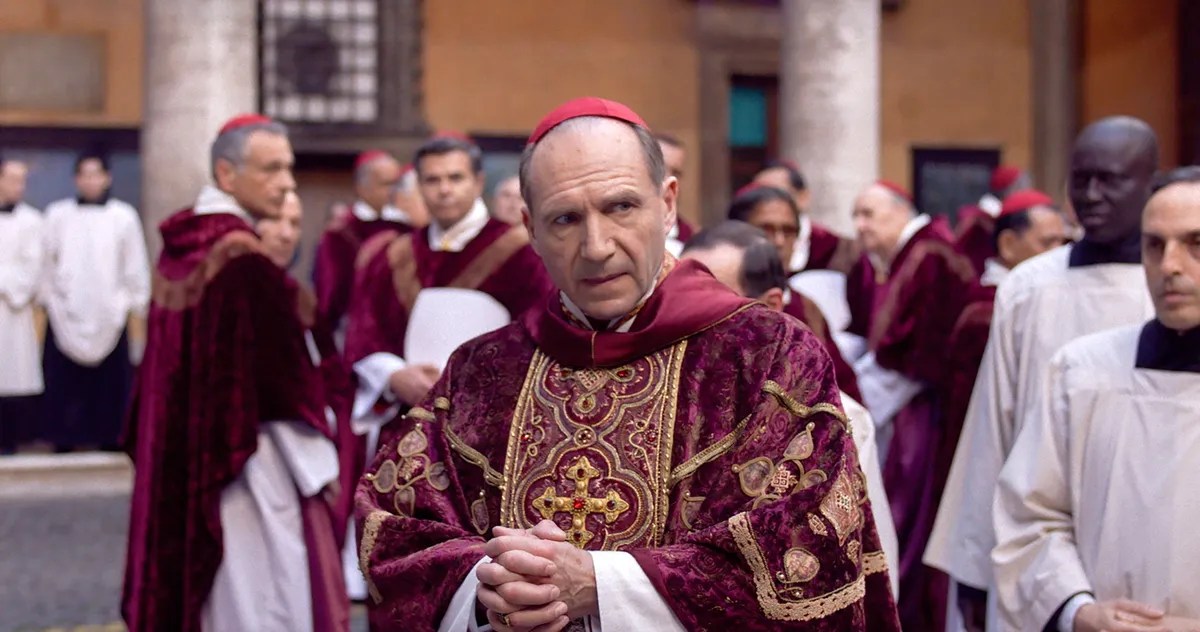
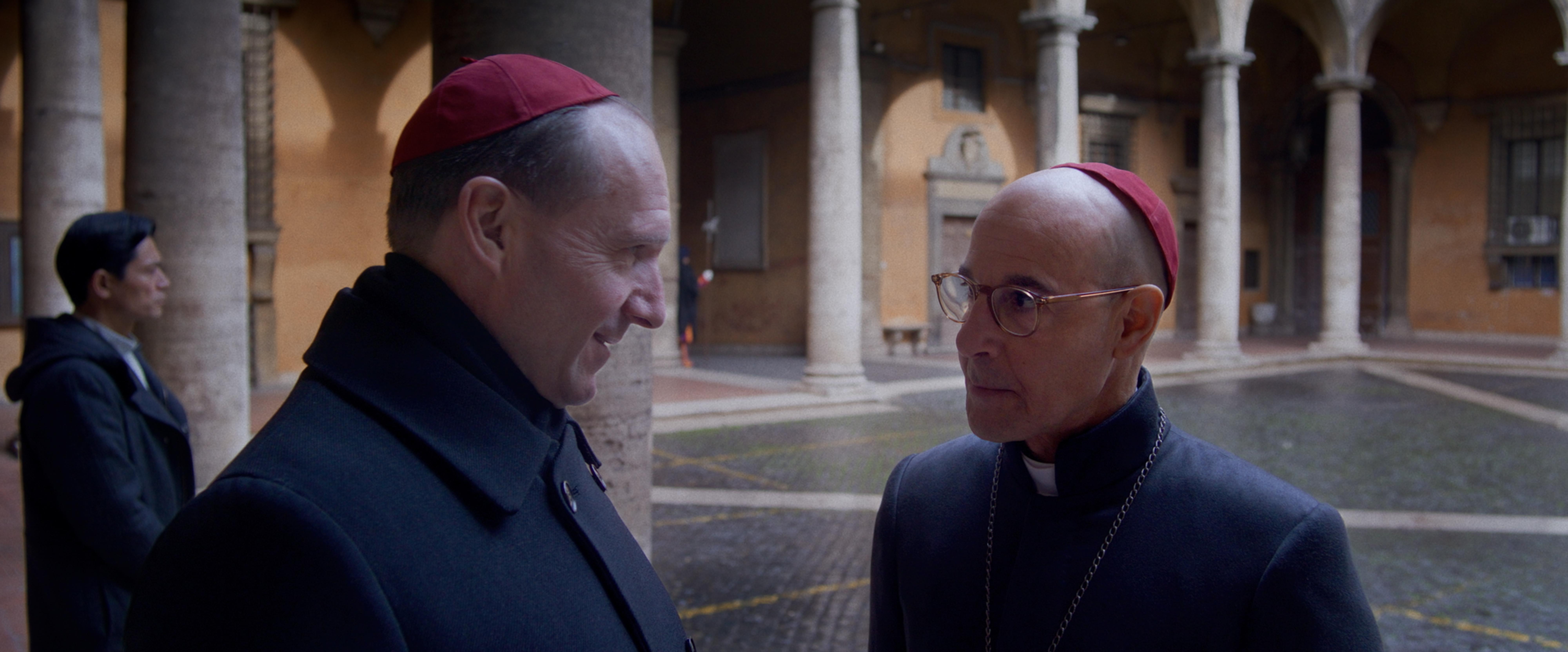
Cardinal Lawrence (Fiennes) leads one of the world’s most secretive and ancient events as the dean who is in charge of the selection of the new Pope.
If you’re not Roman Catholic, it is a religion that comes your way mostly through scandal, the misbehaviour of priests around the world, the lack of action by the church itself when its representatives transgress and the films and books that feature these kinds of missteps, Spotlight being the most recent one that springs to mind.
Perhaps because of the look of the members of the priesthood as so magnificently showcased in this film (already enough reason to see the spectacle), yet because of the visuals as well as the secrecy, I kept thinking of the recent television seasons of The Handmaid’s Tale.
In today’s communication-rich world, any secrecy is immediately viewed with suspicion and becomes rife with rumours and stories emerging. And for those on the outside, how to distinguish between rumour and fact with this particular faith and its powerful leaders is often what draws us to whatever it is that drives the church.
With Conclave. to glimpse the inner workings of one of the most powerful institutions in the world is quite extraordinary. Add this particular cast and the weight of the storytelling is heightened and the final product doesn’t disappoint and leaves you gasping.
The eight Oscar nominations including Best Picture, Best Actor for Ralph Fiennes, Best Writing, Best Production Design, Best Music (original score), Best Costume Design, Best Actress in supporting role (Isabella Rossellini), and Best Editing are all deserved.
It certainly lived up to all that. It has a rich story and is beautifully directed but what really kept me enthralled was the cast and their particular storytelling. If I really had to give only one acknowledgement it would be to the actors.
It was their ensemble performance that kept the intrigue going with especially strong performances by Fiennes (who is the true centre of the movie), Tucci, Diehz, Lithgow, and Rossellini.
As the puzzle unfolds, sometimes painfully slowly yet deliberately, you have to keep your wits about you because you will be kept in suspense right until the end. Again because it is the unfolding that holds the key, I was glad not to have read the book before seeing the movie.
The less you know, the more it will add to the thrill of the viewing. It is a novel story which holds all the intrigue one would expect from such a rich presentation which is all an extremely clever balancing act. Once in a while, I wasn’t too sure whether it was delivering on the expectations surrounding the film.
But pull it all together, and it ticks all the boxes. The best is that you have no idea where it is going or what to expect. And finally, it delivers magnificently in a way that is as relevant in today’s circus as it is unexpected.
It’s one that lies there for quite a while and the more you delve, the better it gets.
A COMPLETE UNKNOWN
DIRECTOR: James Mangold
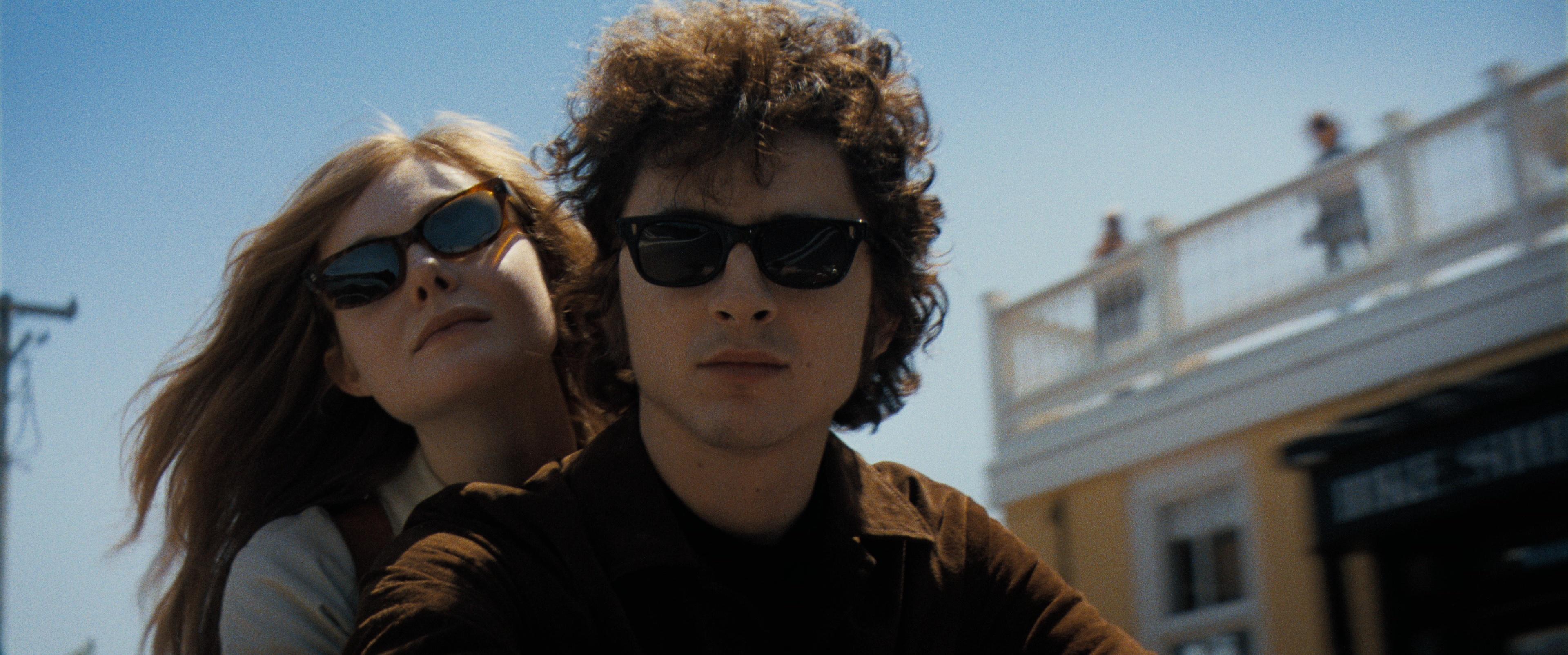
CAST: Timothée Chalamet, Monica Barbaro, Edward Norton, Elle Fanning
I was truly surprised by how much I loved this movie. Of course I know Dylan’s music, but there are as many songs I didn’t recognise.
And while I thought I knew a lot about him, there’s as much that I didn’t know. One has to keep in mind that this isn’t a documentary, it captures a piece, mostly the early part when he first appears on the scene, of his life.
I was even caught unawares by the fact that he turned up at festivals on a racy motorbike. If the women weren’t so mesmerised by die budding artist they would have known that the music was everything in his life. Did he love them? Of course. But he was a performer and everything in his life revolved around that.
It was understood, if unspoken, that the women could be part of all this – but no demands. He wasn’t unfeeling, just unaware and completely wrapped up in his own creative world. That’s where his mind and all his attention was focussed.
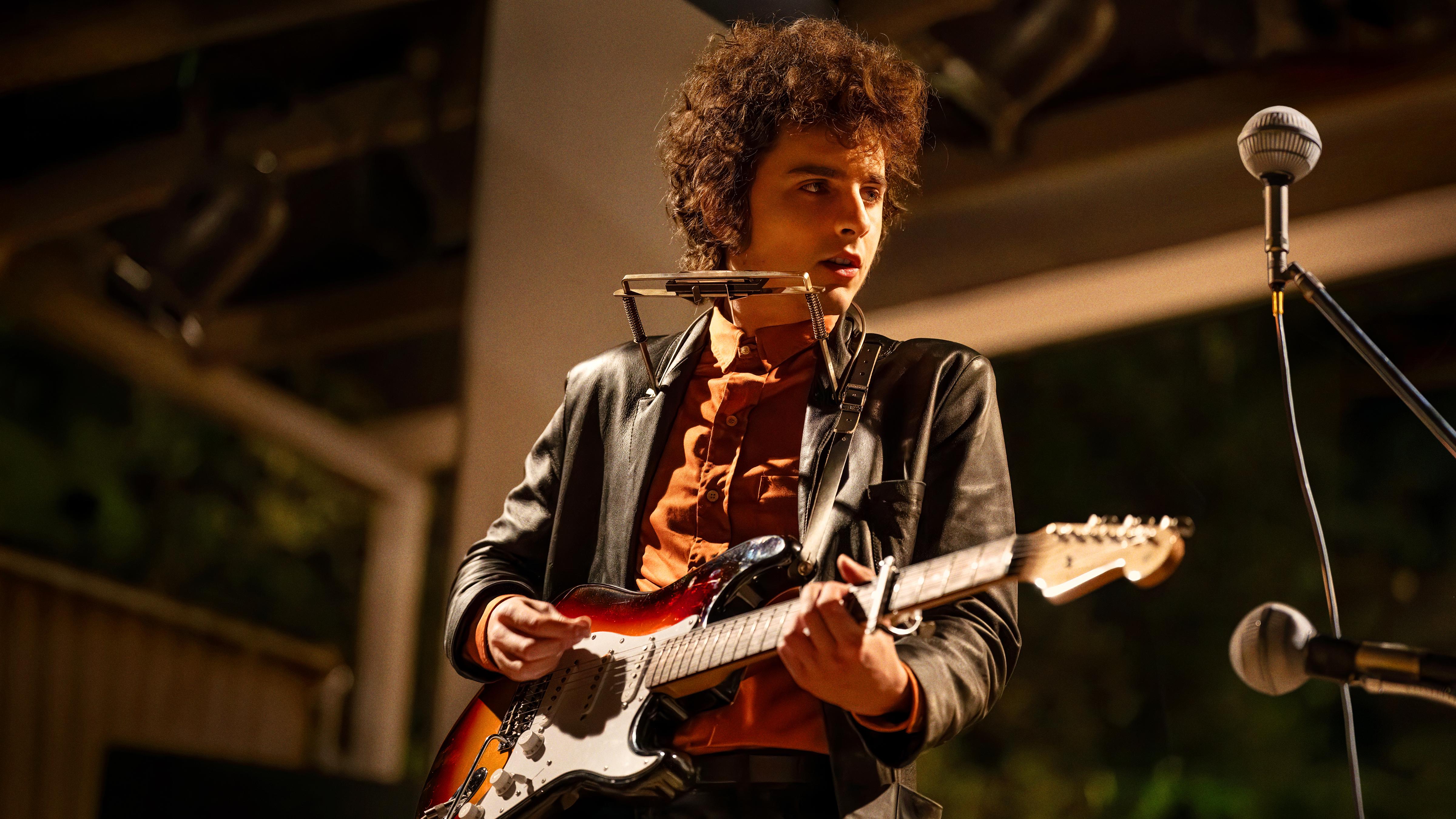
It begins with Chalamet’s performance. He captures the essence and then just goes with it. He is not trying too hard to fake being Dylan. He has something, resembles the wiry, wild-haired singer and has enough of a voice to do the nasal drawl and sing the music well enough.
It centres on his performance and the reason he stole the limelight from the day he first appeared is his star presence – without paying too much attention to that stuff. He’s a lovely actor, has bags full of screen presence and pulls this one off magnificently.
It was as if Mangold with the right script and cast selected the right mood for the film and pulled it off masterfully.
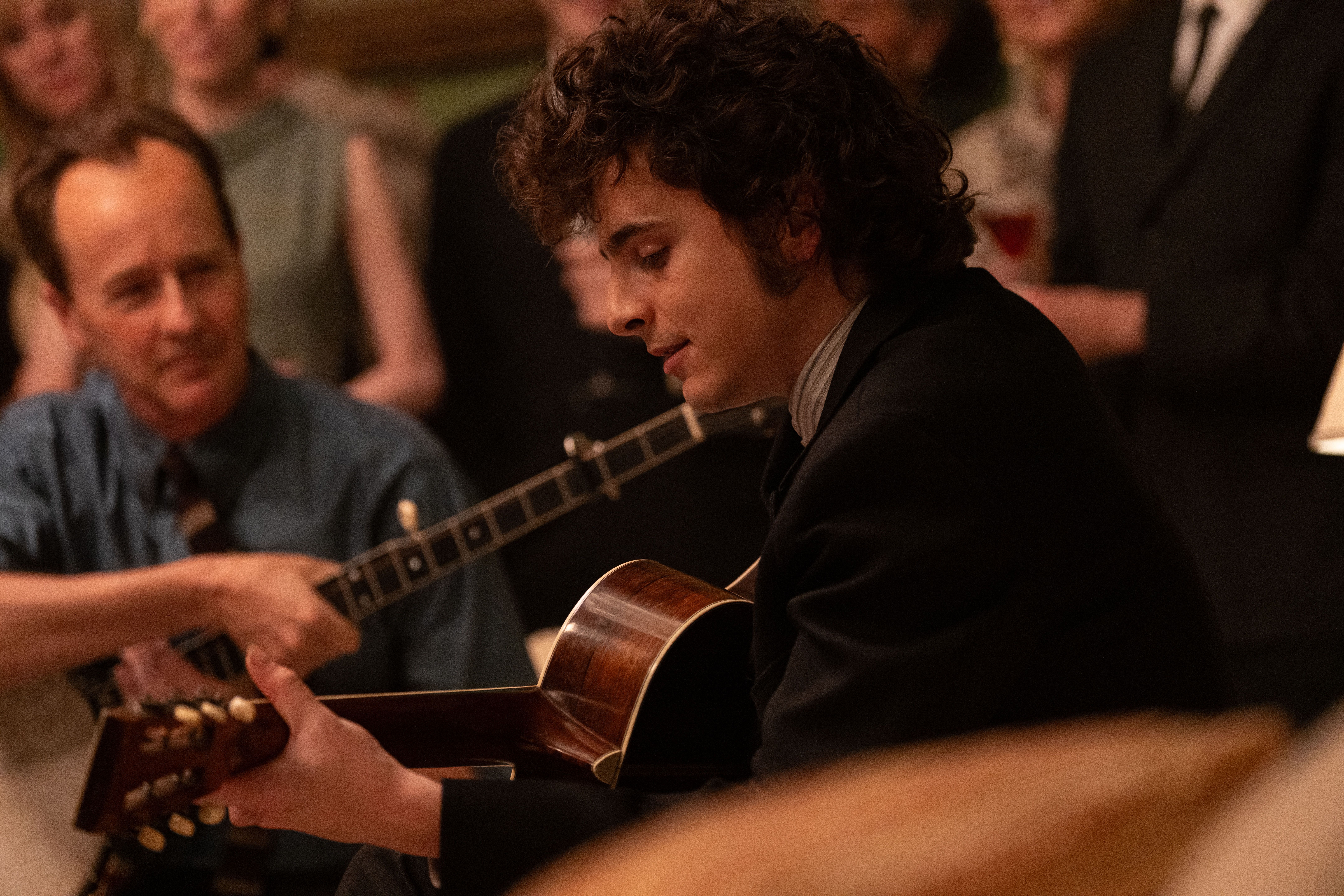
To my mind, Chalamet is the James Dean of his generation. His reach is huge and his future cemented. And because Dylan, as one of the most influential artists of our time, is familiar to most of us, it must have been a challenge to capture his persona. But that he does with astonishing grace and with a strong cast and an especially brilliant performance by the always excellent Edward Norton as Pete Seeger, it’s a story that shines brightly, music that dominates and, for those of us who know some but lack the detail, a blissful few hours to catch up on working-class heroes.
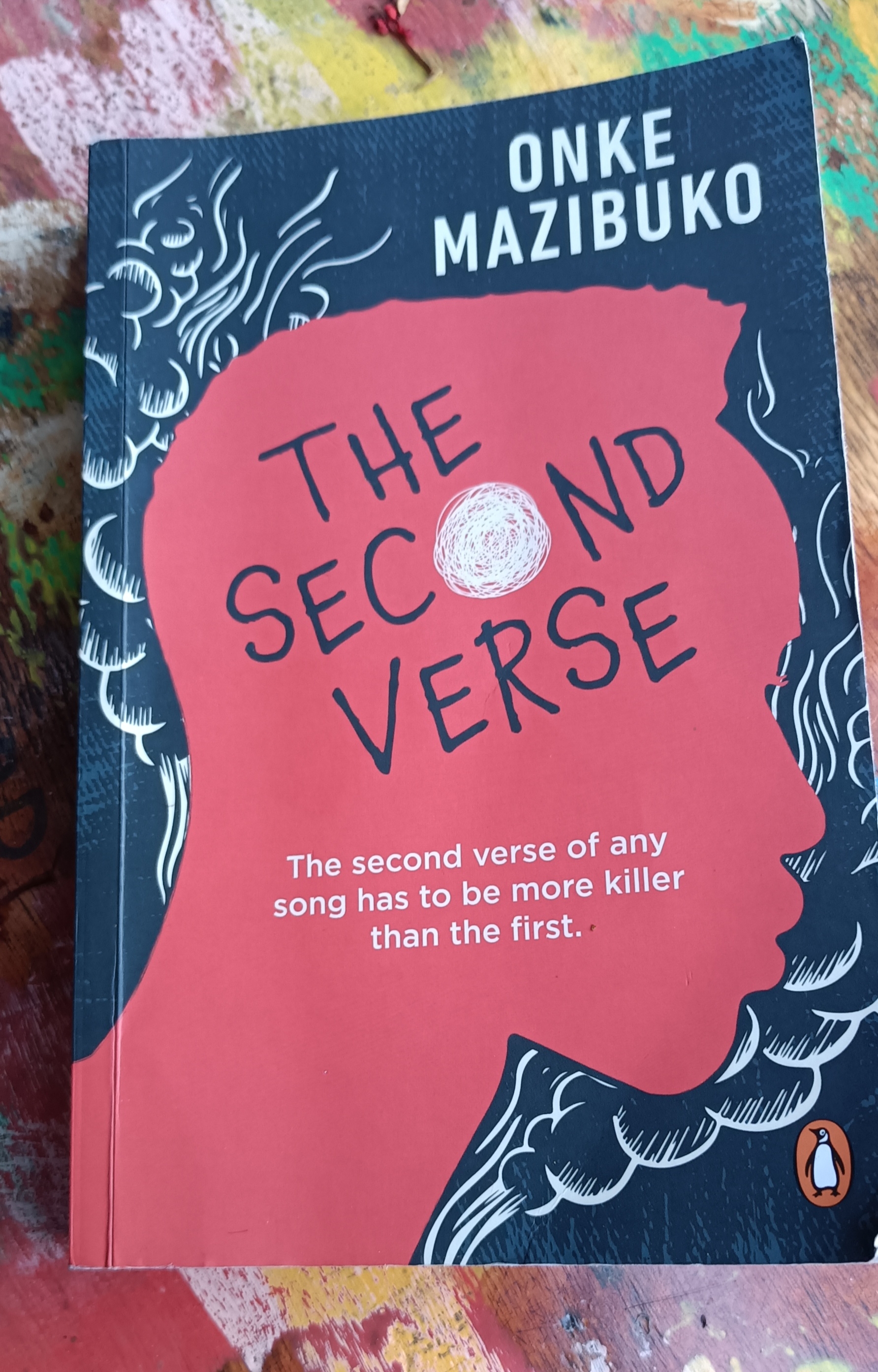
The second verse of any song has to be more killer than the first. Always. The rhythm has to slap. The lyrics must be on point. The feeling intense. And the impact mad-definitive. It’s just the way it is. In the same way, if you do well in life once in a life, then you always have to be better from that point onwards. No doubt.
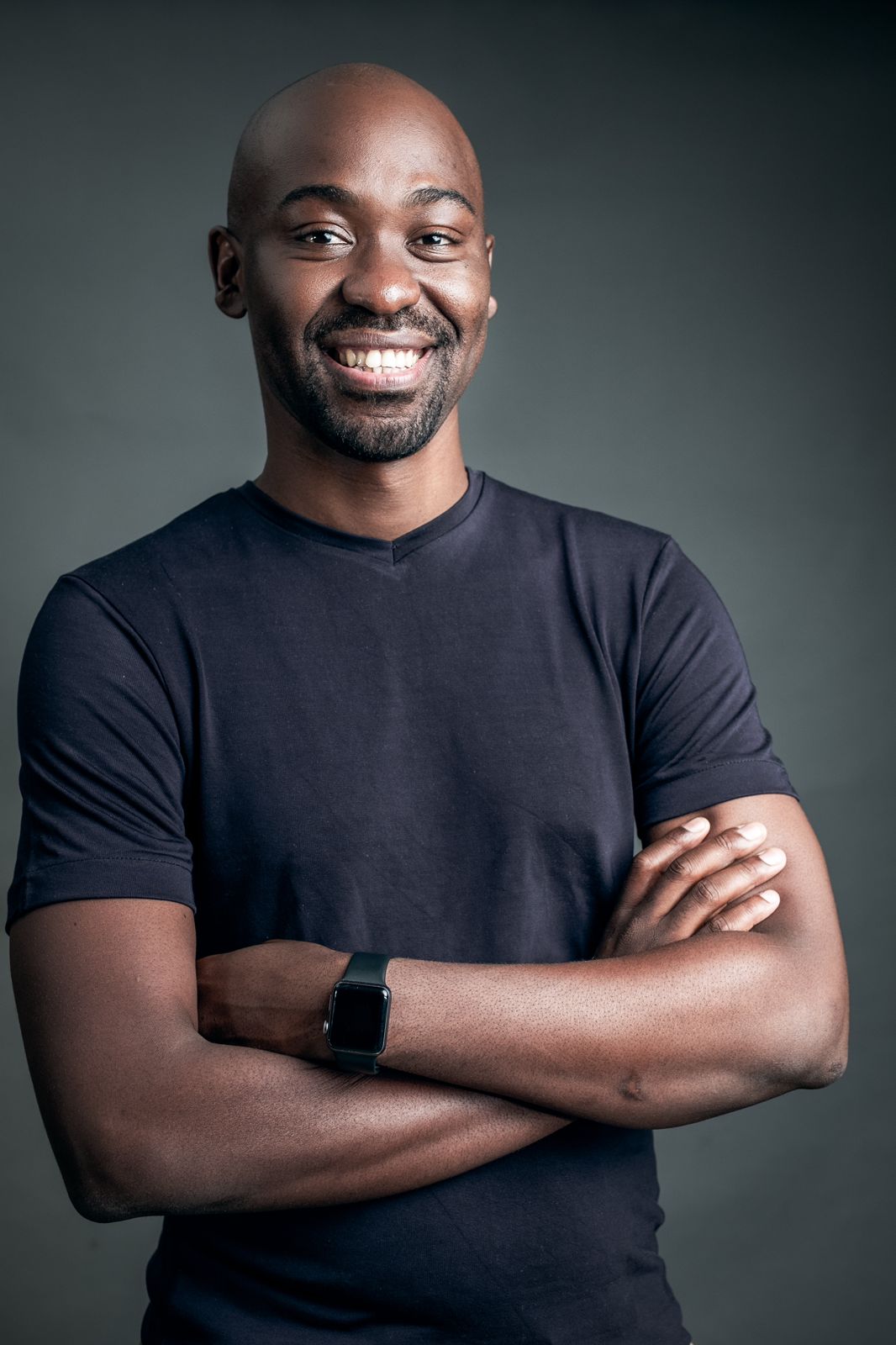
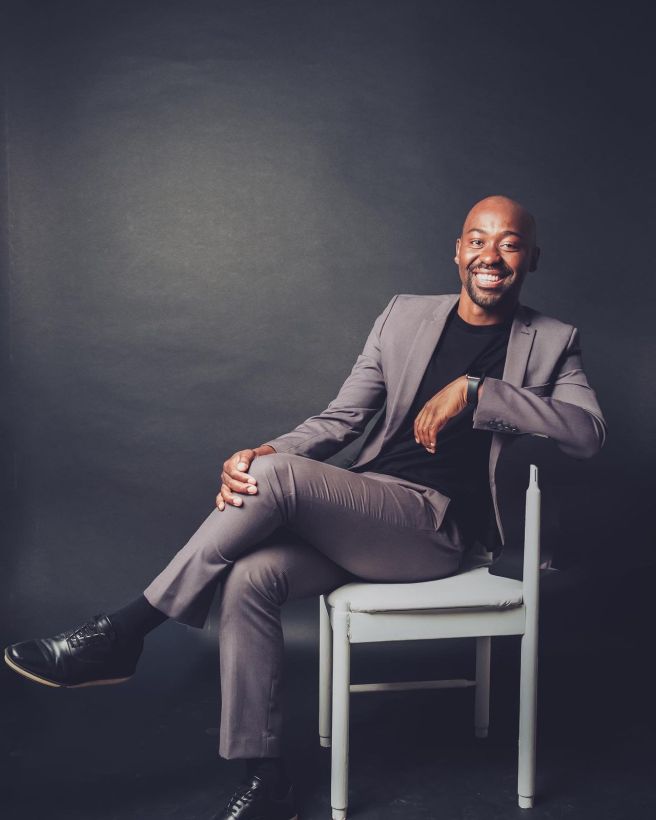
Author Onke Mazibuko is the director of transformation, diversity and inclusion at Johannesburg’s Kingsmead College, he has two master degrees, one in psychology, the other in public health and is busy with a PhD in creative writing. As if all that isn’t daunting enough, he tells DIANE DE BEER about The Second Verse, (Penguin Random) as well as two more books on the horizon – as well as a few other passions in his life:
“Whenever people ask me what I do for a living or who am I, I always feel I’m going to shortchange myself because there’s no one box or title or definition that would do it all justice.
“For example, if I say to people I work in a school as a director of transformation diversity and inclusion, that doesn’t explain that I’m also a writer. And when I say that also, it doesn’t do justice to the fact that I’m also a psychologist, and when I do that, it doesn’t do justice to the fact that I’m also a cyclist.
“I also love cycling, and when I say that, it doesn’t do justice to the fact that I love hiking. And when I do that, it doesn’t do justice to the fact that I’m curious about Buddhism. I’m practising meditation, but I’m not necessarily a Buddhist.
“And then there’s the rapping, the music aspect of it.”
And then he concludes that it’s easiest to say: “I’m a person, I’m a spirit, I am someone who is highly creative and I love learning. There’s nothing I love more than self-expression and learning.”
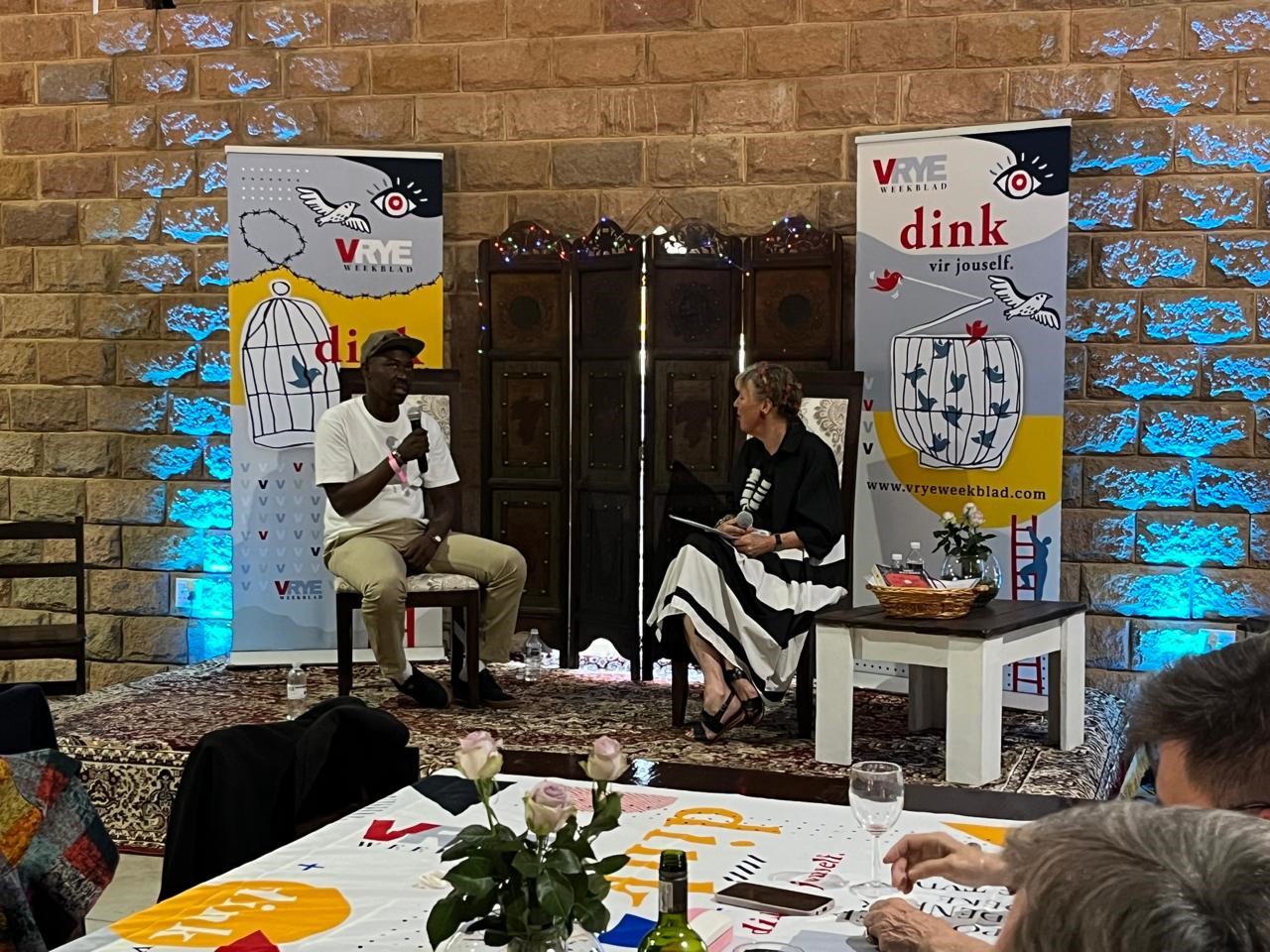
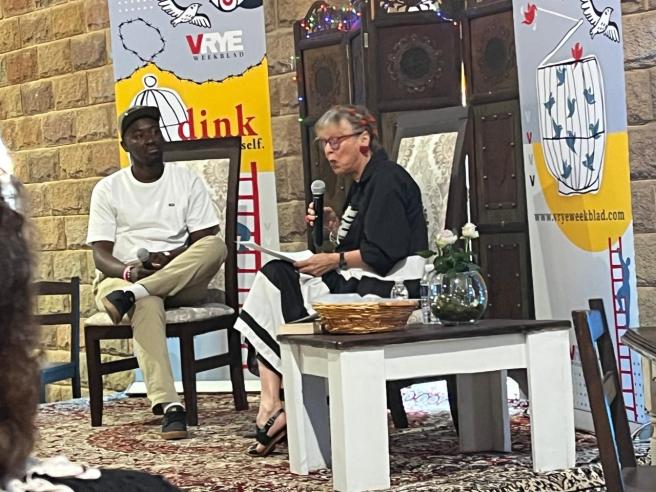
Speaking is the delightful Onke Mazibuko, whom I was privileged to interview in front of a live audience at the recent Vrye Weekblad Book Festival at Cullinan. We hadn’t met before the event apart from a short introductory phone call, but his heartfelt coming-of-age, first novel, The Second Verse (Penguin Random House), told me something about Onke’s youth.
I felt quite strongly that he had experienced the same emotions as his main character Bokang at some stage and that he was a writer I would love to read more of in the future. When asked questions about himself, he easily pours his heart out and shows who he is – as much as is comfortable – but with great sincerity.
“ I also sometimes wonder how I got to where I am because I feel there are things that happened in my life that have taken me off the path. But when I look back, I realise, I’ve never really been off the path as such,” he explains. With so many accomplishments to his name, one wonders what drives him.
“Going back to when I was six years old, all I wanted to be was a cartoonist. I used to enjoy drawing and painting and I remember my parents used to laugh at me (my father was a doctor and my mother was a nurse), thinking that this was cute maybe, and as I got older, I wanted to be a doctor like my father, but when my parents separated when I was 12, I let go of that idea. When I entered high school, it was a difficult time because our financial circumstances had changed because of the separation.
“I went from private schools to government schools and even though there are very good government schools, it was a very big change in my life. We moved from KwaZulu-Natal where I had been in boarding school for eight years and suddenly we were in East London in the Eastern Cape and I was a day scholar.”
That is where the writing started – an emotional response, perhaps a coping mechanism in a life that might have felt as though it was disintegrating.
“I started writing a lot of poetry. Now years later, I’ve become aware that whenever I go through emotionally difficult times, I tend to turn to writing.”
This developed into an interest in learning to rap and taking part in hip-hop events when he attended the University of Cape Town. For the first time he saw his peers getting on stage and doing poetry and he challenged himself to learn to rap and get over his fear of talking in front of people. “I was very shy,” he explains. Getting on stage, enjoying the hip-hop scene, that’s where he forged an identity for himself.
He eventually dropped out of university because he had chosen a specific field for the wrong reasons. And while the hip-hop was going well, at the time, it wasn’t yet commercially viable. “I was not compromising and I felt that I wasn’t going to change my music just to fit into the industry standards.”
And he still takes that stance when making decisions. Something he questions in his writing is when others try to define him. The Second Verse has been branded as young adult, while he feels that, if he had anybody in mind, it was an older reader. “I wanted readers to reflect on their past, look back,” he says.
Leaving university, his life took what some might think of as a sharp left. He went to work for a bank. But this also allowed him to explore his creative side in many ways. He decided to return to his university studies but also kept up the writing. His office and the university were in close proximity and graffiti became another pastime to indulge his creative dreams.
“I would leave home at 7am in the morning dressed in working gear, walk 25 minutes to work. Opening accounts for people, talking to them about home loans etc, doing all these professional things, and at approximately 4pm, would walk about 5 minutes and get to school and attend lectures until about 8 at night.”
Then he would walk home at nighttime, and his creativity would emerge again. He would have his spray cans handy and start tagging and doing throw-ups. Then to bed at about 10 so that he could wake up at 2 in the morning, go and graffiti train carriages and return home to get ready for work, where he would show up with fingers covered in paint.
People didn’t know what he was doing, but he was at work on time. In-between clients, when he got bored, he would write poetry and rap, which passed the time.
He always read a lot, and he remembers reading somewhere that if you are a reader, you are a writer under cover. “If I had to find an origin of when I started writing, I would take it as far back as when I started reading.” When he was at boarding school at the age of 5, “they would read us bedtime stories, and by the time I was in std 1, you had to have your own book.”
Books were always a part of his life. His father’s books were all around the house, in fact, he and his brother’s room was pretty much his father’s library. “We felt we were sleeping in his library rather than that his books were in our room.”
He didn’t do particularly well in writing at high school and this was him trying, so he left school thinking that he couldn’t write, didn’t think it was something special. His sister (who sadly died a few years ago) always played a special mentoring role. She was a lecturer where he was studying and would give him feedback about what his lecturers were saying.
He was in the psychology department and she was in the sociology department, and she would tell him how proud she was of him because the lecturers were always saying how well he wrote.
But it wasn’t until he got to his honours degrees, when they started telling him he could write well. During his psychology studies, he was having emotional struggles and had read that journalling could help him. He has been doing that since 2008 and hardly ever skips his daily journalling. For him it is not about the content but about the practice of making time to be with himself.
The first time he really attempted to write a story, he was 35 years old and was doing a PhD in psychology. He was having problems and again writing became his safe place. In the process, he realised how much he was enjoying the writing.
He also started volunteering at youth-centred NGO’s, while writing another novel which deals with young people. He’s continued seeing clients, not a lot, but he loves the therapy. He also does palm reading, astrology and tarot. When spending time in libraries at 19 after dropping out, he discovered books on astrology, and just read and read.
This side of his career developed organically and he knows now that when he felt his life was falling apart, he was actually gathering knowledge and strength for the future. “Things come around; what I learnt to do at a young age has become part of my life.”
When he isn’t writing, he falls apart. He does a lot of writing exercises, which keeps him healthy and focussed on a routine. Research methods, life experience, everything comes into play.
Mentoring plays a large role in his life. Once he starts talking about the youngsters he mentors, the stories just pour out. Often their stories remind him of his own journey. He is also someone who received scholarships and travel grants – once you’ve received these kind of gifts, you want to do the same for other people.
It was one of his mentees, a young man who had never read a novel and was sent one of the early drafts of The Second Verse, whose response and determination to keep reading, proved to Onke that while he didn’t view his book as great literature, he has the ability to capture emotions. It’s not about the words (in other words), it’s about the storytelling capability.
He was humbled when he received the South African Literary Award for Youth Literature, which confirmed to him that this is the kind of story he should write.
The book was influenced by Catcherin the Rye which at first he hated, but when he read again after dropping out at varsity, he experienced it very differently. Once he realised he was writing a coming-of-age story, he tapped into the most difficult four years of his life – high school. He was discriminated against by both white and Black kids and always made to feel different, creating a yearning to fit in.
His two latest books are a story of two brothers whose sister died and, one he is writing for his PhD in creative writing that follows his years at Transnet and deals with a whistleblower who discovers corruption in a state-owned company. It can’t come too soon.
Stellenbosch singer/songwriter Luna Paige will be in Pretoria and Philadelphia for rare performances to celebrate the launch of two new albums; the one in Afrikaans (Dis die Dors), the other in English (Harmony). DIANE DE BEER chats to the singer whose career she has followed from her early days – with admiration:
Storielied Reunion.Picture: Pierre Rommelare
For singer/songwriter Luna Paige the last few years has been a sharp learning curve. Since her early start in the industry (late 1999), she has been one of the most dedicated artists I know – and she usually does it all herself.
Her first look-in was when she was invited to record three of her songs on a compilation album alongside Lesley Rae Dowling and other female artists at the time. “It is what catapulted me into a music career,” she says. But driven as she is, and one has to be when you drive your own career as she does, she would have found a way.
Since those early days she has released five solo albums and one SAMA-nominated collaborative album. And since 2015, she has released numerous songs digitally and she believes, she has come into her own this past decade. That is until Covid struck.
She established her own music production company which developed music-driven productions, hosted and organised, concert series and co-ordinated music workshops five years ago. In her capacity at Iluminar Productions, she also represented other musicians and musical groups.
She found herself collaborating with many artists and produced shows such as Her Blues, Korreltjie Kantel and Smeltkroes. She also played a supporting and promotional role in the popular My Miriam Makeba Story featuring the luminous Sima Mashazi.
Because her business was still young and primarily focussed on servicing art festivals and live entertainment venues and clubs, the pandemic was disastrous as for so many other artists who depend on audiences.
Luna knew it was time to join the workforce and between 2021 and 2024 she worked as a marketer and fundraiser for Paul Roos Gymnasium, a prestige Stellenbosch school. But she’s back in the music business, armed with many new skills and ideas she wants to implement in the music industry – as well as two new albums.
During Covid she had time to reflect, and, coming out of the pandemic, her thinking and that of the world around her, has changed. That is also what her songs reflect; her collaborative intent as well as the fast-paced changes in our society. “The last time I released an album, the world looked a lot different. The digital era is now in full sway. It has affected everything outside of us, but also our own internal way of processing information, and life in general.”
And that is exactly what she sings about.
When you ask Luna about her life, she speaks about the difficulty of packaging herself. “Let’s be honest, I am so many things!” She is a singer-songwriter. She writes in her mother tongue but also in English. She doesn’t compose in a specific genre. “For me, the song, and the story behind it, dictates the genre the song needs to be in. I find my influences from a wide array of genres.”
But then she is also a social worker, an altruist and an organiser. She feels she is a catalyst of sorts. “I know how to bring an interesting group of people together to do great things.” And with those words in mind, I predict exciting performances in the future.
Luna has always had to fight for her place in the industry. Performing isn’t an easy way to make a living. Music is her life, and she has always known that’s where she wants to be. Armed with new skills and insight, she believes that private investment in the arts is essential for its survival. “I believe artists have a huge responsibility to not only expect funds, but to also give back to their own communities. And the causes they believe in.”
While fundraising and marketing something other than herself, she became aware of her own different facets. “I have always seen them as separate things, one not having anything to do with the other. But now I know it’s the combination of these elements that makes me unique.”
She’s excited to explore what she calls “fusion of self”, how it will unfold and the kind of creative endeavours it will lead to.
These two latest album releases also reflect her new-found knowledge, showing the different sides of self.
“My Afrikaans side and my English side. Why? Because I do express myself differently in these two languages. It is interesting to me how I almost have a different voice in each of them,” she explains.
And speaking of voices, Luna also does different voices when she speaks and when she sings. If you have a conversation and have never heard her sing, it sounds like a completely different person.
On her Afrikaans album, Dis die Dors, she pays homage to two iconic poets – Jeanne Goosen and Antjie Krog. Their poems, which she puts to music, touch on the subject of either loneliness or aloneness. “It’s a theme I am quite interested in – especially the difference between the two. The power of the one versus the sadness of the other.” Both poets, she notes, also touch on our thirst – for something meaningful in what can be a challenging world. “I sing about purpose, about nature’s generous supply of lessons, and about the labels we embrace for our own self-preservation.” She also addresses online nastiness and real-life kindness, and borrowed time.
And as always with the soulful singer, the genres vary from gypsy jazz and world music to folk rock, rock ‘n roll, troubadour-style songs and one typical Luna-style piano rock ballad.
On the English album, Harmony, she included some of the songs released digitally during 2021 and 2022, as they didn’t reach enough people. She believes they deserve a good resting place. She describes the album as bolder in sound and voice. “I am sharing ideas that I have never previously introduced in my music. Ideas about a lot of –isms. In my song Whose life is it anyway I am encouraging freedom of expression, of individualism, freedom from whatever the mainstream demands. In Circle of witches she addresses the sensitivity towards feminism (even from women themselves). “It is a modern take on feminism and why I believe it is still relevant.”
Not one to stand on the sidelines, Middle Class Shoes is dedicated to May 29 when we stand in line to vote for our next ruling party. “It is a song about classism – something we don’t acknowledge remotely enough when talking politics in SA,” she says.
Luna Paige. Picture: Nardus Engelbrecht
Real news that feels like fiction, alcohol abuse, the power of owning aloneness as well as her love of the continent all feature. And there’s much more.
What she does with her music is speak her mind. All she asks is that we take the time to listen. And I certainly can’t wait. She has a voice that melts your heart and touches the soul. And she offers wisdom and wit with her thoughtful lyrics.
Much thought and research went into producing these albums and how to package them for this digital age.
What she has decided is to release her music in USB-format.
The 2024-USB will include the two new albums, poster art, lyric sheets and two music videos. The Full Collection-USB, will offer all her releases since 2003, multiple videos and live footage. She will also be selling personalised Luna Paige notebooks – with lyric extracts inside.
Her first performance was in Stellenbosch this past weekend and these two follow in Gauteng and Philadelphia:
Sunday, 14 April. Moonshot Café. Pretoria. 2.30pm. Tickets cost R200 at Quicket. Ticket link: https://qkt.io/tR9Nhd. On stage: Luna Paige and Mauritz Lotz.
Wednesday, 17 April. BV Hall. Philadelphia. 8pm. Pre-drinks and dinner at The Pepper Tree from 5.30 to 7.30pm (Reservations: (+27) 84 707 3177. Show time: 8pm. Tickets cost R200 at Quicket. Ticket link: https://qkt.io/DAlG8G. On stage: Luna Paige, Mauritz Lotz, Schalk Joubert, Kevin Gibson.
And then she’s off for the rest of the year as she recharges her creative instincts and inspiration. She will be visiting places she has always dreamt of like Italy, Greece, Spain, Portugal and possibly Slovenia. She will be walking and writing, researching business ideas and checking in with artists who work in a social impact sphere.
Another Klein Karoo National Arts Festival has come and gone but what lingers are the artists, their originality, dedication, blood, sweat and tears and delight that they provide in a lopsided world which is difficult to navigate. DIANE DE BEER finds nourishment, inspiration and novelty in the imaginative and ingenious artistry of our creatives:
I have to be honest from the start. Festivals always have a strong emotional impact on me. I am in the fortunate position as an arts journalist to be invited to see as many productions as I can squeeze into the run of an event and at this year’s Klein Karoo Nasionale Kunstefees (KKNK) there was still a post-Covid frisson with the festival at full strength for a second year.
When a festival goes into full swing, it can be quite daunting and I’m not sure whether I want to be there, but as excellent productions and artists climb into my head, I go into full festival mode where I’m simply thrilled at being overwhelmed by the local arts community.
Being an artist isn’t an easy profession, even if many on the outside feel that they had a choice and simply have to bite the bullet. That they have a choice is arguable and to produce excellence year after year, often with few rewards and never under ideal circumstances, can be daunting and not for the fainthearted.
And yet they go full tilt as they battle extreme circumstances like pandemics or vitriolic social media, all in the name of art.
More than anything, whatever anyone says, we cannot resist them. For me it is a huge blessing and privilege to witness and write about our uniquely original creatives.
Post-festival, an overview of the festival is always a personal reminder of and reflection on everything extraordinary, yet it’s tough to choose which among all those actors and productions, to highlight. There are simply too many that demand attention and especially this year, the scope was exceptional.
I always feel I want to bring something of the flavour of a particular festival to those who weren’t there. Perhaps one of my favourite pieces might pop up somewhere and a reader might be encouraged to go, or even more ideally, someone who has always thought about festivals but never attended might be encouraged to go.
The enchanted Die Swartmerrie withTheo Witbooi and Chantell Phillipus. Pictures: Ryan Dammert.
I have to start with Karoo Kaarte. It’s one of the dream projects of the KKNK, simply ticks all the boxes and grows more impressive every year since its first inception with special mention of last year’s winning production, Droomkrans Kronieke, which landed with such impact because of its energy and precision. How can you not win when developing the underdeveloped artistic talent of the previously disadvantaged by implementing a programme that empowers those who wish to make it in the arts.
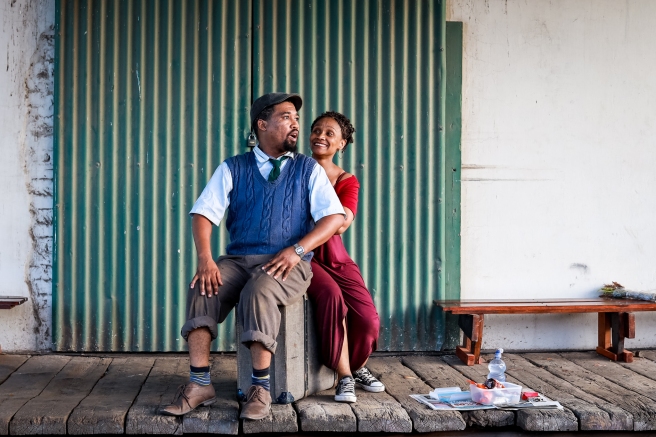
It’s inspiring and this year’s production, Die Swartmerrie, is a site-specific piece set on dilapidated terrain with a set of train tracks, an imagined train, and a rundown platform. Two people, a man and a woman (Theo Witbooi and Chantell Phillipus) are waiting, both traveling but not with the same destination in mind. There is a past, the tracks and possible journey points to a future, but this notion disappears with the wind.
It is breathtakingly beautiful and hauntingly gripping as the two talk and tackle their issues with delicate determination.
Afrikaans is an especially emotive love language and when spoken in the specific Karoo accent, warm and intimate, the sounds are as captivating and meaningful as the actual words being spoken.
I was surprised by this couple alone on stage and also electrified that the team (in this instance Neil Coppen – a facilitator of the whole project with Vaughn Sadie – and Oudtshoorn’s Tiffany Saterdacht) decided to go this route but, of course, this is a company packed with the unexpected, and hopefully it is a production that will become an institution in Oudtshoorn and won’t be limited to the festival. You don’t want to miss out on these performances and such a quality production. They should keep pushing the repeat button and keep it as part of their arsenal.
Karoo Kaarte further packed a punch with its art exhibitions, as well as walking tours done by young Oudtshoorn inhabitants all participating in turning the town’s current and future narrative into an inclusive one. The community is constantly gaining strength thanks to Coppen and Sadie who have invested their creativity in this wonderful way, all the while bringing their local learners on board.
It’s a marvellous investment in the future of this town (and hopefully others across the country will follow) and fingers crossed that a smart investor will see the potential going forward.
Because we were born in such large numbers, our generation is referred to as the baby boomers (born from 1946 to 1964) and probably that’s why ageing and the lifestyles of those growing older has become part of today’s theatre language. We are also fortunate to have some amazing artists who keep on practising their craft while ignoring any barriers that might come their way.
They know how to choose, break out and try new things and simply keep audiences flocking to their performances. Names like Sandra Prinsloo, Antoinette Kellermann, Jana Cilliers, Elzabe Zietsman, Amanda Strydom not only arrive with new productions, they’re also constantly adding skills to their resumés.
Cilliers took up playwrighting for the first time with Veelhoek, a two-hander with herself and Ludwig Binge directed by Marthinus Basson, and the wisdom and writing were quite overwhelming. Who would have thought that, apart from all her other accomplishments, she would now add writing to the list – and then perform it with such clarity as she tells a story that lies close to the heart?
Zietsman is another one who keeps shifting those barriers and I am so delighted that she has added the magnificent Tony Bentel to accompany her on stage. He is one of those pianists who brings much more than just the music to the performance and it shows. Vier Panado’s en ‘n Chardonnay again has Zietsman expounding on life, singing brilliantly and with heart – and cherishing cabaret as it should be performed. The content, which deals with resilience,needs hardly any acting by this actor. Most of it is probably her life which she has shared heartily and hastily over the years. And she will always rise…
Do we need to say anything more about those two great dames, Sandra Prinsloo and Antoinette Kellermann? How lucky are we to witness them in performance after performance as they just keep surging ahead.
Die stoele with Antoinette Kellermann and Chris van Niekerk. Picture: Hans van der Veen.
Kellermann tackled the Ionescu tour de force Die Stoele, accompanied by a much-too-rare performance by Chris van Niekerk. Marthinus Basson adds genius to the production, which can be seen over and over again as it deals with something we all have to confront – LIFE. The content might be terrifying but to watch, quite hysterical. As always Kellermann is in with everything she’s got and what she does with her body tells a story all its own.
Goed wat wag om te gebeur with an actress I would love to see more of, Emma Kotze and Gideon Lombard.
She’s also a part of the magnificent cast (Kellermann, Emma Kotze and Gideon Lombard) of Philip Rademeyer’s Goed Wat Wag Om te Gebeur. I had seen the English version most recently but also this one a few times, and this latest run proved how good theatre improves with time. It’s the best the production has been and I know the director agrees.
Prinsloo brought her masterful Master Class, a piece of classical theatre, to the festival and, also as is her nature, she teamed up with the exceptional David Viviers in a Teksmark original Op die hoek van Styx en River is Noraper Abuis met die Dood Oorgeslaan (playwright Henque Heymans). It’s a novel work which showed flickers of what it could be in time (always a scarce commodity).
Like Rademeyer’s Goed Wat Wag Om te Gebeur, Monsters, (produced, directed, adapted and translated by Tinarie van Wyk Loots) which has had runs at other festivals previously, found a remarkable rhythm that lifted the text and the performers into another realm . It was rewarding to experience and again I was reminded what a precious entity the different circuits are because single theatres cannot afford to take many risks and festivals add an extra buffer in this precarious world – to the benefit of arts audiences.
Michele Burgers in Monsters. Picture Stephanie M Gericke.
We haven’t seen much of the versatile Michele Burgers, who will hopefully return to stage more often in the future and who was beautifully supported by the talented René Cloete, Ntlanhla Kutu and Elton Landrew.
Die Vegetariër with Tinarie van Wyk Loots and Melissa Myburgh who as young actress has shown her mettle magnificently . Picture: Nardus Engelbrecht
Smartly directed by yet another multi-talented artist, Tinarie van Wyk Loots, she also featured in Jaco Bouwer’s hard-hitting Die Vegetariër (adapted and translated by Willem Anker) which also benefited from another run, as well as in the latest probing Anker text, Patmos, also brilliantly staged and directed by Jaco Bouwer, who always challenges and pushes boundaries with his choice of productions, casts and presentation.
The visually captivating Patmos with Melvyn Minnaar and Tinarie van Wyk Loots. Picturess Hans van der Veen.
Without these art warriors our art landscape would be barren. They keep us returning to theatres time and again with their unique approach, their determination to do their best under trying circumstances, including a lack of time and money, and simply their excellence.
Nataniël, for example, returned from an extensive tour to New Zealand and Australia during the festival yet put together one of his distinctive shows with flamboyant costumes, mind-blowing text and two musicians (Marcel Dednam on Piano and Leon Gropp on guitar) who created a spectacular rhythm to underpin his songs and singing quite magnificently.
I could go on forever, there were simply too many highlights, yet I cannot go without honourable mentions of the following, no less important than those already mentioned:
Jefferson J. Dirks-Korkee in a return of the soul-stretching Rooilug.
Fietsry vir dommies. Picture: Gys Loubser Hallo, is Bettie wat praat with Dean John Smith.
Marianne Thamm
Solo shows: the return of Rooilug with the delightful Jefferson J. Dirks-Korkee; Fietsry vir Dommies (masterful text by Tiffany Saterdacht and deftly directed by Dean Balie) which showcased the enormous talent of Eldon van der Merwe, who was also rewarded with a Kunste Onbeperk prize for Young Voice. Dean John Smit shone in his now full-length solo production of Hallo, is Bettie wat Praat; the craftily current My Fellow South Africans by Mike van Graan, starring the physically and mentally dextrous Kim Blanché Adonis; Vuisvoos, maar nog regop, where journalist Marianne Thamm delivers a gloves-off and much needed monologue, incisive if laugh-out-loud, on the state of the nation; a shout-out to much missed director, Jenine Collocott, who teamed with actor Klara van Wyk to present the hysterical Monika, it’s me:
The mesmerising ‘n Lewe in die dag van ‘n vrugtevlieg ensomeer with David Viviers and Wessel Pretorius. Picture: Hans van der Veen The Old Man Who Thought He Had a Dog with Merwe van Gent and Angelique Filter.
Double-up: David Viviers and Wessel Pretorius returned as a popular duo in a follow-up to their successful Klara Maas with ‘n Lewe in die die dag van ‘n vrugtevlieg, ensomeer and hopefully many more encores in the future, they were missed; an innovative new duo, Stellenbosch students Angelique Filter and Merwe van Gent, soared with the tragicomedy The Old Man who thought He had a Dog;
The delightfully funny Marc Lottering.KG Mokgadi- Weighing In.
Stand-up (not my speciality) yet: Who can resist the always energetic and enthusiastic funny man Marc Lottering who always delivers?; as well as my comic standout of the festival, KG Mokgadi. It feels as if these two have something more to say than just one-liners.
Ken Jy Vir Dewie with , Joshwin Dyson, Crystal Donna Roberts and Robert Hindley
Productions: The original Ken Jy Vir Dewie was cleverly staged with themes that target the whole family and as the play was dealing with bullying, the setting for everyone, actors and audience alike, was a classroom; and again, it was directed by yet another versatile artist, Margit Meyer-Rödenbeck, who has exchanged Dowwe Dolla for Ouma, again a sign of the times. She cleverly started the play outside with audience and cast waiting to enter the classroom!;
The joyous Braam en die engel with Rehane Abrahams, De Klerk Oelofse and Timothy Isaacs. Picture Hans van der Veen
And Craig Morris grabs the attention in Die Rooi Ballon.
Children’s Theatre: It’s not something I usually see at festivals but, as I did, I was encouraged by the effort made by the KKNK to look after these tiny tots who are of our more enthusiastic audiences: My favourites included Braam en die Engel and Rooi Boeties.Watch out for them as they might travel.
Dance: is back with brilliance because of the clever choice of productions, only two of them but with some of the most innovative names in contemporary dance: Dada Masilo who choreographed one of three pieces, Salomé, for Joburg Ballet; and Grant van Ster and Shaun Oelf with the Figure of 8 Dance Collective (pictured), who brought in other creatives like Nico Scheepers on text, Andi Colombo on lights and Franco Prinsloo on original music. Both companies were sublime.
Lucky Pakkie (Packet): Thanks to the brilliant team of Llandi Beeslaar and Stephanie Gericke, this is another of the KKNK delights because of their dedication and hands-on approach. It needs that because what you have is three lucky packets of four 15-minute productions each; the three sections embrace easy viewing to soft touch to pushing the envelope as much as possible, and artists who cannot manage a full production or perhaps just want to say what they need to say in this time and on this platform are vetted and included in a fun-filled programme.
The original Karli Heine. Picture by Stephanie M Gericke
There are too many to name, but for starters … what about Karli Heine, who turned herself into a pot plant and blew my mind … for script, performance and imagination!
It is impossible to cover everything and I haven’t given the art exhibitions a mention, even though curator Dineke Orton again broke down barriers and took us on a visual trip. But these are just some of my thoughts on a festival that felt like one joyous merry-go-round. Try and catch some of these through the year as they travel to different theatres and festivals.
Here’s holding thumbs!
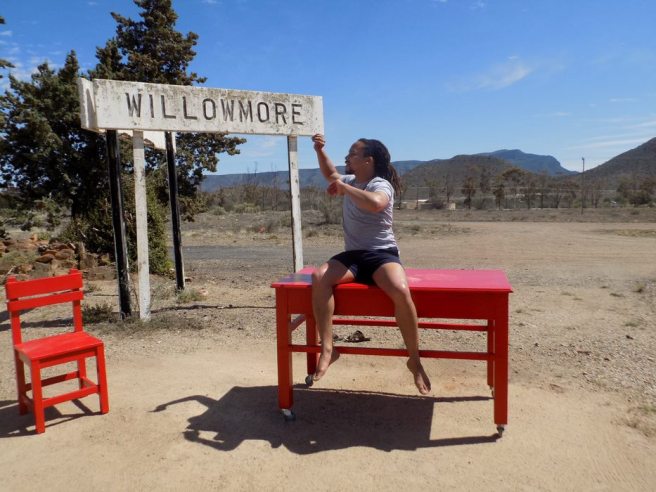
And finally, on the last day, even the weather seemed out of sorts…

















 De Beer Necessities