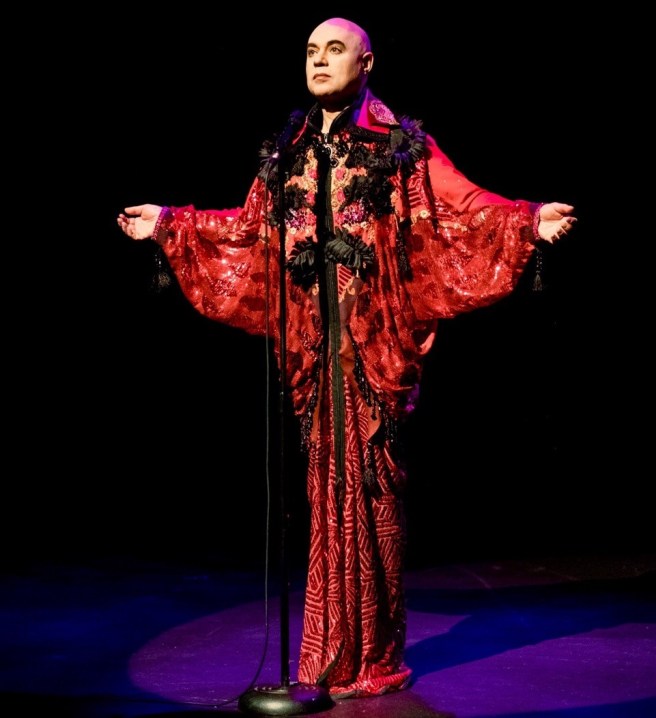

It’s been a remarkable year for Nataniël with his first memoir published in both Afrikaans and English last month and a return to Emperors for his spectacular annual show. Now the sparkler on the tip of the Christmas tree is his end-of-year concert at the Atterbury Theatre in his hometown.
The title, Lily Refuses to Listen, is already worth the price of admission, but especially for those whose spirits are dampened by the distress of today’s world, this is one to opt for. An escape that will have you thinking while laughing and crying from start to finish!
From Tuesday December 3 tot Sunday December 8, Nataniël presents a brand new show at Atterbury Theatre for a limited season of 6 performances only.
“At the end of another year of being bombarded by bad news,” he writes, “damning prophecies, evil politics, corruption, loud neighbours, endless traffic, horrific music, bad advertising and desperate social media,” this is a time to celebrate personal space, personal choices, selective listening, self-care and resilience.
“Out with the bull, in with the beauty!” is his war cry. “Out with the yes, in with the no! Out with the trends, in with the timeless! Out with parties, in with privacy! Out with the ordinary, in with the exclusive!”
“Everybody was screaming as loudly as they could this year,” explains Nataniël as he speaks about the inspiration for this particular show. “Everyone wanted to make sure they would be heard or become famous.”
He also admonishes those who do selective listening. “You have to listen properly,” he says. “I want to tell people that it’s important to listen, not to be intimidated, but to really listen.”
Choice of music is never a problem. He loves Christmas music and often takes old familiar songs and turns them into something individual yet as sacrosanct as the original. Songs from the treasure trove of timeless blues, jazz, soul and pop, as well as original songs will all feature.
Costumes will be to die for, colourful and festive with a contemporary take on a more glorious time.
Lily Refuses To Listen features fantastical stories in both English and Afrikaans, but don’t expect anything to be ordinary or to unfold without exotic names for strange yet wacky and witty creatures and towns with names that remind you that we live in a weird and wonderful world. With this storyteller’s vivid imagination, it’s easy to follow the yellow brick road wherever it leads. And for 90 minutes, what is round might become square, but you would find it difficult to leave.
Nataniël shares the stage with c (piano), Werner Spies (bass) and Peter Auret (drums). Costumes are by Floris Louw and a Kaalkop Christmas Shop will be available in the foyer.
The show is 90 minutes long, with no interval, no cell phones, no shorts and no children under 15.
LILY REFUSES TO LISTEN: 3 – 8 December 2019; Atterbury Theatre; Book at iTickets
In four years Teksmark, a concept thought up by Hugo Theart (artistic director: Kunste Onbeperk) and supported by Cornelia Faasen (CEO of the Nasionale Afrikaanse Teater-inisiatief NATi) as well as Lara Foot (CEO and artistic director of the Baxter Theatre Centre), has gone from strength to strength. Nothing emphasised this more strongly than the last session at this year’s event a few weeks ago. DIANE DE BEER reports:
On the programme four diverse productions, four stories and four genres, all offering challenges to the actors and the audience.
If the idea is to promote theatre (which must be top of the heap), develop South African stage plays and create a platform for writers to showcase their ideas and scripts for possible further development by interested parties, including independent funders, festivals and theatres, it’s a runaway success. Every year the input expands and the products excel.
The idea at the start was to grow Afrikaans playwriting and to create new plays for especially festival stages – with work that would eventually travel to more traditional stages. But with the Baxter’s support, last year Foot encouraged the further expansion of allowing different languages to participate. This includes all the official languages.
This arguably has had unexpected value, not only in the broadening of storytelling possibilities but also in discussions between what in this country is still problematic – different groupings. It is especially exciting because in general those participating are young. This allows them from an early age to participate in complex conversations and hopefully in the future, collaborate, as some stories become South African in a more inclusive way.
Telling our own stories in our own language, as the Afrikaans festivals are well aware of, is critical but can sometimes be isolating. This particular stage by flinging open its doors has expanded the storytelling notion into something quite exuberant as the different voices engage, start conversations and listen to the stories of others – some with many similarities, others not so much. All of this is, apart from anything else, also an exercise in getting to know one another.
Theatre can do that best – and it is the right time. Embracing one another is much more enriching than the other way round. We have tried that with disastrous results – for everyone.
Gretchen Ramsden (front) and René Cloete in Herschelle Benjamin’s Agulhasvlakte.
First on the agenda that final morning was budding young playwright Herschelle Benjamin’s Agulhasvlakte, set in a bio-diversity hotspot where many endangered flowers are at risk of becoming extinct. It’s the story of two sisters, each extinct in the eyes of the other, who are trying to reach out.
He deals in issues of climate change, land reform as well as sibling rivalry and relationships. It is beautiful work by a young cast, René Cloete and Gretchen Ramsden, who should be kept when the play is developed. But the foundation was the exquisite text.
Benjamin, who studied drama at the University of Stellenbosch and has been firmly entrenched in the arts on many different levels. He has been writing plays constantly these past few years and this one in particular, has stepped up a level. It’s about the story and the language, a young man who feels confident enough to take on two female characters, and a play that should travel, is hugely accessible and tells a story so unique yet universal.
A scene from Fresh Meat by Zac Fleishman.
One almost felt sorry for the plays to follow but fortunately, each one brought its own magic. Zac Fleishman, a young man standing firmly on his own two feet but with a surname bristling with theatre history, played with the macabre with a futuristic feel and a story that stretches the mind, always an exciting prospect in a theatrical sense. Who doesn’t want to walk out of a theatre changed?
The text plays with themes of desire, taboo, order and dirt. The writing started with a desire to make historical research and concepts more visible and digestible outside of academic journals and official institutions. With his background, he knew this would be theatre and storytelling. He is currently busy with his Honours in history and playwriting, which means more good things in the future. And to see this particular one play out is an intriguing prospect.
Wian Taljaard and Nicole Holm in Roosmaryn by Ben de Vos.
From one thrill to the next, Beyers de Vos’s Roosmaryn is exactly that. His debut novel reached the Sunday Times fiction long list this year and similar achievements seem possible with his playwriting debut. While he is sticking to crime themes, that’s the only similarity. Writing dialogue was novel for him, but with a lively imagination and a creative writing Masters to his name, this was a blast.
He described it as “a bloody tragedy about ghosts, trauma, guilt, a racist penis and the consequences of violence”. He also had the bonus of Nicole Holm as the protagonist, someone who knows how to grab a stage majestically.
A scene from Karatara by Wilken Calitz (musician and writer) and Shaun Oelf (choreographer and dancer) with Shaun Oelf (sitting), Grant van Ster (looming) and Dean Balie as narrator.
Karatara was the perfect conlcusion of three days of explosive debut dramas by emerging and established playwrights. Dealing with the catastrophic Knysna fires where nine people from the Farleigh community lose their lives close to the Karatara River, this was described as a community’s loss through a combined narrative of dance and drama.
On first reading the text, it held huge promise but was also one of those scripts that could go horribly wrong. But it didn’t. Wilken Calitz (musician and writer) and Shaun Oelf (choreographer and dancer), who comes from that area, combined magnificently and magically. And for the future, they have hit a rich vein.
Gideon Lombard and Emma Kotze in Maansonde by Philip Rademeyer.
Directed by Gideon Lombard, who had earlier given a bravura performance in Philip Rademeyer’s MaanSonde, it was the perfect mix of emotions and movement, narrative and intuition.
It’s a slam dunk of what theatre can accomplish when creativity is allowed to blossom, when theatre makers care and are encouraged, when the platform is an exciting but safe one, and set up for young theatre makers to experiment and learn.
Those of us watching were reminded of the power of live theatre, of telling our stories, of reaching out and coming together.
That’s why theatre will always flourish. As old as the mountains, telling stories keeps renewing itself while communicating in a way that’s as familiar as it is novel, as comforting as it’s challenging, as revolutionary as it drowns you in riches.
The Boy from the Mountain with playwright Thukelo Maka and Kwindla Pearl Antony.
And these weren’t the only young voices to resonate. It was just that the four pieces in their differences had such impact played together in one session. Others during the run included Caitlin Wiggill with her glorious stream-of-consciousness A Prayer Group Called Water Wings; Lwanda Sindaphisa’s I Will Teach You How To Share The Milk zooming in on domestic workers and their two sets of “children”; gay marriages and their all too recognisable problems in Rafiek Mammon’s hilarious Marry-Go-Round; Philip Rademeyer’s disturbing Maansonde; Veronique Jephtas’ brilliantly scathing and personal take on the hair issue in My Kroon se krank; Thukelo Maka’s ritualistic exploration of death in different culutral groups in The Boy of the mountain; and in conclusion Wessel Pretorius’s Valskermstories based on Pascual Wakefield’s personal narrative on dealing with a diagnosis of testicular cancer at the age of 20. He also stars in the production.
Xerophyte landscape with alarmist magpies by Piet Grobler
When book illustrator Piet Grobler was planning his next exhibition, the issues dominating his head space turned into the title of the show, White lies and inconvenient truths. DIANE DE BEER takes a closer look:
First Piet Grobler invited two fellow artists, Marinda du Toit and Corné Joubert, with similar storytelling abilities, to join him at the Tina Skukan Gallery from Sunday November 17 at 11.30am until December 14.
“In times of immediate mass communication, the collective tools of white lies and unspeakable truths seem to protect existing establishments, ridiculous assumptions and ideas and positions of power,” he writes in the invitation to the exhibition, which consists of Joubert’s ceramic objects, Du Toit’s sculptured characters and his own two-dimensional illustrations, all with a playful yet ironic view on this inconvenient truth.
“An interest in language and text, a preference for spontaneous drawing, seemingly nonsensical marks, discarded found objects, chance and happy accidents become the shared characteristic of this collection of visual narratives,” he notes. All of the work is held together by humour even when the messages have serious impact.
Piet Grobler’s Slow Horse
Piet Grobler’s Caucus Race
He derives his inspiration from from folk art, humour, travel, nature, human nature and stories of all kinds. “I have tried, in honour of the truths and the untruths, to simply play when I made my illustrations for this exhibition.”
Talking about his processes, drawings and paintings were done without excessive planning, thought or contemplation and the leftovers and snippets from other more calculated projects supplied him with the materials to make his unique worlds and tell his stories.
“Chance and happy accidents were used and then, I have to confess, fine-tuned and manipulated in order to tell stories that I hope will be funny or moving or interesting takes on truths.”
Praat van die duiwel by Marinda du Toit
Die dye trek die dye aan by Marinda du Toit.
“I have always loved using idioms and metaphors in my titles for my characters,” says Du Toit, emphasizing in the process a layered meaning in the material, posture and title thereof. “The concept is timeless, lies and truths have been (unfortunately) forever part of breathing and being, since religion, politics, people grouping, intolerance within every individual , etc. I just went ahead and made them,” says the artist completely in sync with the concept.
She enjoys being pushed out of her comfort zone, which can happen with the suggestions of others. “It can make you explore things that are not necessarily or naturally part of your reference.
“My work is mostly intuitive. Once I have established the concept, lived with it in my mind for a while and did some research if needed, I start looking at objects connected to the idea and it flows from there,” she further explains.
“I like to comment on issues, and current issues, whether subtly, with humour or directly. I want the viewer to ask questions, shy away, be embarrassed, explore further interpretation.”
She agrees with Grobler that we need to laugh at ourselves. “What always amazes me, is when a joke is derived from a tragic or shocking incident, how we find healing in the macabre by joking about it. I do clowning where the innocence (uninformed/childlike behaviour) of the clown is also a wonderful tool to address and comment on sensitive issues and taboo topics.”
She works with found objects, discarded, or items that are not useful in their primary function any longer. “My characters comment on any pressing issue, or any (assumed) mundane issue, being part of our daily lives as human,” falling neatly into the title of the exhibition.
Ceramic storytelling by Corné Joubert
Joubert, who worked for this one mainly in ceramics, found the theoretical disparity in the title pushed her to explore ideas on the lies we tell and on how lies and truth in general impact her life, environment and relationships. Who decides what is true and fair and how many people must agree on something to make it true?, she asks.
“By looking at history, we know millions of people can be wrong. Inconvenient truths are often tempered by white lies and so the boundaries between truth and lies dissolve, sometimes due to good intentions.”
She work in multiple media. “Images, characters, groups and surface treatments in my work all refer to reactions to my larger world of relationships, occurrences, stories and observations. There is usually a satirical suggestion to my responses. I am a writer and subsequently narrative, text and symbols form a part of my visual language.”
Piet Grobler’s Still life with Zombie Cat, Killer Bird and potted garden
It makes sense to group these three artists together even if they work in different media and different genres. Their visual language is a collective one with a playful yet sharply satirical edge that might appear quite harmless, sometimes even childlike.
Their work elicits a wry smile and while it appears not to take life too seriously, what they’re saying with their work, dispels that myth.
With this specific title, the subversive nature of their art is allowed to flourish in a very specific way. This is a world turned upside down both climatically and in the way some people have chosen to inhabit their space in a particular time of madness and mayhem.
This trio have found a gentler yet no less effective way of making their point in almost sly fashion.
Send in the clowns. It’s time to laugh.
The exhibition will be opened by Johan Myburg, poet and art critic, on Sunday at 11.30 am. There will be a preview of the exhibition on Saturday from 9.30 am to 4 pm and a WALKABOUT presented by Piet Grobler on Saturday November 23 at 10.30 am. The exhibition closes on December 14.
Tina Skukan Gallery
Gallery hours: Tuesday – Friday, 9am to 5pm
Saturday, 9am to 4pm
Closed on Sundays and Mondays
6 Koedoeberg Road, Faerie Glen, Pretoria
Tel: 012 991 1733 or 083 235 3899 rex@tinaskukangallery.co.za www.tinaskukangallery.co.za
We haven’t just gone back to nineteenth-century levels of income inequality, we’re also on a path back to “patrimonial capitalism”, in which the commanding heights of the economy are controlled not by talented individuals but by family dynasties.
From “Why we’re in a New Gilded Age”, The New York Review of Books — 8th of May 2014, Paul Krugman, reviewing Le Capital au XXI e Siècle, Thomas Piketty
And published as an introduction in the printed version of Koningin Lear
DIANE DE BEER
Pictures: Hans van der Veen
The magnificent Antoinette Kellermann
Playwright Tom Lanoye has masterfully taken the iconic Shakespeare tragedy, King Lear, and recast it in a contemporary landscape with the most pressing issues of the 21st century all coming into play – greed and grandiosity leading this particular wolfpack.
He starts with gender, flip-flopping the roles as the title Koningin Lear suggests, and gives the mighty Elizabeth Lear three sons: Greg, the eldest, Henry, the second in line, and Cornald or Corneltjie, her darling child. With the eldest two married, the two wives, Connie, the OTT shopaholic, and Alma, from the wrong side of the tracks and struggling to shrug that off, both play a particular type yet also connive with their husbands to secure future power.
Yet, as the original so smartly shows, greed might be the excess of our time, but there’s nothing new in the world of the top dogs except perhaps technology and the universal scale at which that power grows and disintegrates. It’s no longer a single kingdom on an island, everything and everyone in our universe is connected.
Neels van Jaarsveld and Anna-Mart van der Merwe
When you sneeze – especially if it affects the money markets – the effect takes on tsunami proportions. And this is where director Marthinus Basson ups the ante, being someone who always holds the bigger picture close. With this one it really counts.
The design adds to the dynastic feel of the production, which plays on different levels. Basson emphasises the age we live in with technology. A backdrop of TV screens used in many different ways immediately add urgency and heightens the impact of the precarious nature of what Elizabeth is about to do.
More than anything else, power corrupts. And to play with it almost nonchalantly like this mother does, we all know will have devastating consequences.
Antoinette Kellermann
This a family concern – one that is worrying, because it is not necessarily the best that steps into a leadership position. Family is the determining factor, whether worthy or not.
Just a few minutes in, we already know that Elizabeth’s adviser would have been a better choice to make the handover a smooth and more successful one. For decades Robert Kent has been Elizabeth’s shadow, completely loyal to the family, often at his own cost
Lanoye’s words needed to be transformed in a South African context by someone who could adapt yet not dilute the essence of the playwright’s words. Antjie Krog, who previously worked wonders with the Mamma Medea translation, was the obvious choice. Not only did she have to translate, she had to transfer it to a local context.
Just listening to the language of this magisterial text is sublime, even the way Krog uses swear words or plays with the different characters in the way they use their language. She also knows how South Africans will react to different cars as wealth trophies and that “my losie by Lords” has more impact than Loftus, for example. It is all in the detail and why you can’t read, listen and experience the language and meaning enough.
A scene from Koningin Lear
It’s a play that indulges your sense of disgust at the wealth accumulated by the powerful, their lifestyles, arrogance and disregard for anyone but their immediate family and then only those who find favour. They live by different rules and have no idea of or interest in anything but their own prosperity and anything that affects their well-being.
It is a work of majestic scale and demanded a majestic cast. With Antoinette Kellermann as Koningin Lear, half the battle is won. She is majestic as the matriarch of a business empire that she is in the throes of handing to her three sons. But first she asks for a declaration of their undying love with the results disastrous as she sets in motion a run of revolting, rampant greed and how that unhinges a dynasty in a modern world.
It’s no surprise that Steinhoff is snuck into the text at some point. If you still hadn’t got the drift, that will force you to take notice
Edwin van der Walt in his extraordinary turn as the junkie and the powerful Antoinette Kellermann
We know the original story. It’s the way Lanoye has made this tigress fight until her last breath, the way Kellermann has ingested the text so that she can charge into glorious battle with her character and slay any dragons in her path.
And here her demise doubles up as she doesn’t only hand over all her weapons, her wealth and thus any sway, she also struggles with dementia with age finally catching up, something no money or willpower can change.
As the sons struggle with their inability to conquer the business world, pale shadows of their mother, their wives on the sidelines egg them on and soothe their egos.
It’s like an epic melodrama with a master conductor and performers who know how to play every word in its finest nuance. With the gravitas of André Roothman as Kent and a supreme supporting cast, it’s a play that strikes no false notes. Everything is music to your ears.
The three sons, Neels van Jaarsveld, Wilhelm van der Walt and Edwin van der Walt, with Anna-Mart van der Merwe and Rolanda Marais as the wives, represent a family in freefall. Not only have they not been schooled to take on their heritage, they only register the perks without any of the pitfalls.
On the sidelines, Matthew Stuurman is the carer and very importantly the moral compass who has nothing to gain or lose yet reacts with compassion to someone’s need, not something that registers where money is the only currency.
From start to finish, it is a production that ticks all the boxes. From the content to the language, the design and the staging, the extraordinary choice of cast with Kellermann conquering her most challenging role, it’s theatre to savour – over and over again.
Koningin Lear is on at Cape Town’s Baxter Theatre from November 7 to 16.
From April this year, TUT art graduates, Kutlwano Monyai and Mbhoni Khosa, have been working on a body of work that takes the ideas encountered in The Genesis II’ Xhibition, further. DIANE DE BEER catches them at their latest exhibition, Kopanong Art Studio Residency Programme 2019:
Both, Kutlwano Monyai and Mbhoni Khosa, went through the Pretoria Art Museum education and development programme having been involved with guided tours at the Museum and the facilitation of art-making workshops for visiting groups as education assistants. This qualified them for the Genesis exhibition which was held at the Museum in June last year.
Following this, they were given yet another opportunity to further develop as artists. As part of a group of six artists, they competed for an art residency and were nominated as winners by an independent selection panel to work for four months in the Kopanong Art Studio (from April until July this year) in the Pretoria Art Museum.
They were selected because their work impressed the panel as it showed “a wide breadth of content and an adeptness with the art media in which they specialise”.
A collaborative work: Ghost in the hut.
Because part of the exhibition was going to be collaborative, Monyai and Khosa had an advantage because they had studied together (earning their degrees at TUT last year) and had through their work as educational assistants also become close friends. There would be no barriers even if the process would be a new one.
The envisaged body of work consists of 26 artworks with the two artists contributing ten art works each and six collaborative works. While Khosa’s graphics expand the narrative of Xitsonga traditional beliefs and practices, Monyai plays with the interpretation of dreams through her mixed media artwork with interconnected mapmaking. They were mentored by Thabang Monoa, Connie Leteane and the Culture Officer at the Museum, Mmutle Kgokong.
Releasing bitterness by Kutlwano Monyai.
Already as a young child, Monyai became interested in dreams sparked by her own vivid night-time experiences. Because her mother had similar tendencies, they often talked about their interpretations and growing up, it became part of the artist’s life.
It was natural that her art would be influenced by this way of understanding her world. “I interpret my dreams influenced by tradition and cultural background,” she notes. She remembers nightmares as a child, which her mother would translate as myths and stories, in comforting fashion.
Excessive anxiety by Kutlwano Monyai.
And that became her way of telling her own stories on canvas – interpreting her dreams through mapping and meditation. Her method of making art also plays into the final result because she allows the mapping and her way of throwing paint to determine where and how she meanders her art route.
And apart from layering ideas, she is doing similar things with her different techniques. “I am mapping my own work with spirituality,” she says and with titles like Releasing Bitterness and Excessive Anxiety, it is clear that these are very personal works and that Monyai is working through her own history in quite extraordinary fashion as she holds onto dreams, listens to the stories they tell and then has her own interpretation – and healing process. And she’s happy with every piece, taking a leap into the unknown.
A dance brings happiness to one’s heart by Mbhoni Khosa.
Khosa works quite differently, but he also reaches into his cultural heritage to find inspiration. As a Tsonga his life has been influenced by the neglect of his home city Giyani, former capital of the Gazankulu homeland, but now part of Limpopo. He believes that because they are in the minority as a group, much of the infrastructure was moved post-apartheid.
From having very rich lives, his people, he feels, have been left with nothing and daily life has become a struggle. Yet, he is consoled by who they are as a people and wants to celebrate their happiness in spite of hardships.
“I needed to release my anger,” is how he expresses his starting point when making art. His methods are varied as he uses printmaking, scratching, drawing in stark colours to “define what is left” of their world.
A friend is someone you share a path with by Mbhoni Khosa.
What emerges and what he captures are his people’s joy in life, the way they celebrate and come together, their traditions and culture, all of which he loves. “For me it is a healing process,” he says in gentle tones.
In similar fashion, his titles, including A dance brings happiness to one’s heart and A friend is someone you share a path with express what he is dealing with and where his focus lies.
Collaborating opened a new world for both artists. While they might be dealing with similar topics, they do this very differently yet found a way to blend their art with both finding their signature expressed in the final product.
A collaborative work titled Reaching Out
“Our methods are very different,” says Monyai. “My process is very slow while Khosa is fast.” She was also slightly anxious about working together as she has always made art in isolation. But the two know one another well, fed off each other rather than feel alienated and the collaborative works tell their individual stories – in tandem.
Another learning curve was a lack of funding and how to resolve that. While the space was provided and mentorship included, they had to bring their own materials and look after themselves during the residency. In in the process, explains Khosa, he also learnt to budget for art materials which are hugely expensive. They though the full experience was something that offered huge experience for their future art journey.
Artist in cahoots Mbhoni Khosa and Kutlwano Monyai.
While Monyai is dreaming about future solo exhibitions, she plans to tackle the competitive art world next, while Khosa wants to study further and earn his stripes as an art teacher. “I want to give back,” he says. But he will keep making art.
From November 16, more of their art will form part of the group exhibition at Banele Khoza’s Braamfontein studio and gallery BKhz. To feature in two exhibitions simultaneously, for two so young, is extraordinary.
Listening to these two inspirational artists, their very exciting yet brief career path, it’s clear that they grab every opportunity, do the hard work, and sweep splendidly through doors flung open.
And then they tell visual stories that make your heart sing.
Kopanong Art Studio Residency Programme 2019is on show in the Henry Preiss Hall of the Pretoria Art Museum on Tuesdays to Sundays from 10am to 4pm, with guided tours arranged by appointment. The exhibition will be on show until Sunday, February 2 2020.
Depending on the timing of your visit to the latest Banele Khoza exhibition, 9 – 5. Do artists need structure?, you will be having a unique perspective. DIANE DE BEER speaks to the multi-faceted artist:
“It’s about the process and that’s messy,” says the 25-year-old Banele Khoza whose exhibition is being hosted by the Pretoria Art Museum and the Alliance Française of Pretoria. It also serves as part of Khoza’s prize for winning the 2017 Absa L’Atelier Gerard Sekoto Award which included a three-month residency at the Cite Internationale des Arts in Paris (partly sponsored by the Alliance Française and the French Institute in South Africa).
It’s an annual art competition presented by Absa and the South African National Association for the Visual Arts (SANAVA), focused on artists aged between 21 and 35.
Structure is a word that features strongly in Khoza’s mind at the moment (also pointing to the title of the exhibition) and he is hoping to discover with this present process how it fits into his creative process. At the same time, he is encouraging everyone to share in the journey as he works on many different pieces that have to be completed.
To create 9 – 5, Khoza is hoping to find out what will happen when he structures his creative endeavours to the normalised nine to five schedule for the six weeks of the exhibition which runs until December 7.
A studio in a museum.
The plan is to avoid taking anything home by working in the studio he has re-created on site in the North Gallery of the Pretoria Art Museum. “I want to find out if I would hate it (working this publicly), I want to see if the frustration will translate into my body of work,” explains Khoza.
Even before the official opening when he was setting up the studio which is part of the process and which will be on-going throughout probably changing and growing daily, he was finding it difficult not to keep working beyond the scheduled time. But all of this is an experiment and for this entrepreneurial youngster, it’s excitement on the eve of the exhibition about to unfold.
He is thrilled that the Museum went along with this wild idea of his and that they’re really allowing him to unravel the process, one he isn’t entirely sure of, in his own way. “I know they would have liked more of a studio by the opening, but for me, that’s all part of how this should go,” he says. He is also pleased that his music can be played as part of the show. “It’s about what we listen to and what we get up to,” while creating art.
Notebooks keep the artist happy.
A nook for respite with words for reading and writing.
Studio spaces in the museum
For Banele, the structure isn’t about doing the work, it’s about taking time-out. “I’ve always been afraid of rest,” he says. “It’s always seemed counterproductive in a world that encourages and praises constant output.” He also knows that while his working hours might pile up, the work isn’t always effective.
That has always been part of his being – output. As someone who describes himself as an entrepreneur, curator, former lecturer and the gallery director of the open studio and gallery space, BKhz in Braamfontein, he dabbles with dexterity in many different mediums. His phone is part of his drawing pad and he always carries a number of notebooks in which he constantly jots down memories, thoughts and most recently, also poetry.
How can I not feature Ta-Nehisi Coates? His first novel…The Water Dancer.
Books to read and think about.
Words have always been part of his process but even more so now. “I am reading a lot of poetry,” he explains. While in residency in Paris he realised that the true benefit was everything he was exposed to – people and different spaces. In that way his art is in constant flux – something that is part of his being.
In the corner of the gallery, he has his desk scattered with notebooks but also reading material. The bookcase that frames the picture also reveals his reading interests.
And now, being this public, is about interrupting his usual process – both for himself and the viewer. Everything he does is being done with intent. The process might be new for the artist but he is attacking it with vigour and expectation. It’s about sharing something that’s private. “Usually people only engage with the finished product as if the process is seamless.”
A nook for respite with words for reading and writing.
Studio at work.
He hopes to reveal the imperfections, the struggle of making art while reflecting on his life and where he plans to go next. Not that this prolific artist needs any more avenues. In his young career, he has done more than many attempt in a lifetime – much of it publicly. What is extraordinary about this public approach to his work, is Khosa’s shy demeanour while all the time pushing himself to engage. He does this not only in real life but also on social media. He is a millennial who plays the game to perfection.
His art is difficult to describe because he is constantly changing from fine multiplied line drawings to dreamlike figures, usually solo, he says, but these also change in character and intent as he finds new places to explore and new techniques to decipher and develop.
Clearing his head and his desktop.
That has always been the excitement about his work. While there is a signature style easily recognised, if you are a collector of his work, the versatility is extraordinary – and he is only 25. That’s also why the present process is such a brave one. Not even the artist knows where this will take him.
In the meantime, the two artists in the gallery next to his makeshift studio have been invited to exhibit their work together with a whole group of trained Educational Assistants from the Pretoria Art Museum in his Braamfontein gallery BKhz. “One of my goals is to encourage and promote emerging artists,” he says fully aware of how helping hands were part of his personal journey. That exhibition will be opened on Saturday morning, November 16.
Speaking to him three days into the exhibition, he is having fun. “When it is quiet, it is a time to be still, something I need,” he says as I catch him on his computer. It’s about dreaming and dabbling in a space that allows him to do just that. “People are still a bit hesitant but as I start working more intently, I think they will engage,” he says.
Personally, I can’t wait to see what is going to emerge at the conclusion. Watch this space…
If you haven’t yet made the acquaintance of Ladismith’s Tannie Maria, DIANE DE BEER tells you why you should, in this, Sally Andrew’s third in the series, Death on the Limpopo:
On my first meeting with Tannie Maria, I knew that she was the real deal. It’s easy to lose your heart to any of author Sally Andrew’s characters because the storytelling and writing both have authenticity and a sensibility that make the Karoo and her characters sing.
And by now, says Sally, her small-town characters are well established and she can no longer simply push them around.
Tannie Maria is a kind of agony aunt for the local Klein Karoo Gazette in Ladismith and she tries to lighten her reader’s dilemma with a recipe which should add to a swifter solution of whatever might be bothering them.
Sally describes the other regulars as follows: Jessie, the fiesty young investigative reporter; Hattie a Mary Poppins-like editor and Maria’s boyfriend detective Henk Kannemeyer with the distinctive moustache who keeps a protective watch on the woman who has captured his heart.
Tannie Maria loves Henk Picture: Sean Brown
Much as the people are the ones that steal the show, the backdrop is the Klein Karoo, a landscape that’s always hovering and means as much to Tannie Maria as the food she uses as nourishment for a healthy mind as important as body. Soul food probably describes it best.
Sally Andrew and Bowen Boshier Picture: Andrea Nix
Sally lives(most of the time) with her artist-husband Bowen Boshier in a mudbrick house in a nature reserve in the Klein Karoo. This is where she finds her inspiration, especially when she wanders off on her own and allows nature to play with her over-imaginative mind. It’s also that playful mind that goes into entertainment mode when she plays dress-up for her book launch and introduces some animal characters which she either forgets can talk or puts some words into their mouths.
Black Ducati – not to be messed with.
Sally Andrew and myself at her book launch. Picture: Doreen Gough
The biker outfit she wears to these latest book launches, isn’t random. Her latest invention arrives in the Klein Karoo with a screech of tires in a whirlwind of dust on her black Ducati motorbike. Zabanguni Kani is an investigative journalist from the Daily Maverick described by Sally as “strong, black, no sugar”.
There’s no messing with Zabanguni even in this part of the world where she stands out no matter what and Sally views her as her “inner biker chic” but also “the voice of my hardcore activist youth”. It’s an interesting and lively strand that she introduces into a book that deals more than anything with fathers and daughters.
That is bittersweet but perhaps not coincidental as the author’s father was very ill during the writing of this book and sadly died before the Death on the Limpopo was published. “He helped with historical research for this book, sharing his memories, and recommending books and articles to me,” she writes in the Acknowledgements. “He then listened to the whole manuscript as I read him a draft on his sickbed, two chapters a day. He was my best listener and editor, offering insightful comments. He cried quietly at the good bits and snored loudly during the boring bits.”
None of the darker elements in the writing are a surprise. Because of the main character, one might be forgiven if you don’t take any of this seriously, but the essence of the writing is always hardcore as the writer tackles issues in all three Tannie Maria books including spousal abuse, PTSD and there’s a constant quest for healing as her central character deals with her violent past.
As interesting as her characters and story lines might be, what gives the writing weight is the fact that all of this (perhaps not the sleuthing although she does that in her head) is this unusual writer’s real world and the life she leads.
Sally and her wild mates
Sally (and leadwood) Limpopo. Photo by Peter van Straten.
Sally in the wild.
She and Tannie Maria inhabit the same landscape and encounter the same plants and creatures, all of which play a dominant part in their lives.
Then there’s the writing:
The tar ended, as if a black brush had just run dry, and the wheels of my bakkie gripped the earth beneath us. My bakkie loves dirt roads. My red veldskoene got excited too, and added speed to the accelerator. I slowed them both down. I don’t like to go fast in the veld. You never know where there might be a tortoise or a meerkat crossing the road.
It’s evocative as it creates visual pictures that result in a colourful reading as the story races ahead.
Weerligkoek Picture: Peter van Straten
Sally tries all the recipes herself and for those she doesn’t attempt, she relies on the help of others and sometimes like for this latest book, she finds specialists like Mari-Louise Guy who with her brother has built a cake and recipe book empire in the Cape.
Tannie Maria’s melktert
Mari-Louise for example took the traditional Ladismith recipe provided by Hetty Smit, and then developed the Weerligkoek (Lightning Cake ) which, when reading the recipe, tells you throughout that it is do-able, but seems quite a tough ask. And Sally assures me that the Melktert in the first book is one of the best. And so all her recipes should be, they’re read and experimented with all across the world. Her books are extremely popular and have been translated into many different languages.
You also know, spending some time with the author, that she would not settle for anything but the best. Just doing an interview was quite a mission because she didn’t want to clutter the conversation I was having with her for the Pretoria book launch at Uppercase Books.
I didn’t mind because artists have their own ways, they know what works for them and that’s the right time to indulge their whims.
Anyone who can come up with the Tannie Maria stories and set it in an authentic South African landscape that makes sense, capture the wonders of this country and its people and then do it in a language that has its own rhythms for these particular tales, gets my vote.
Poppy seed rusks
Hopefully Tannie Maria still has much life left in her and will keep sharing her stories rooted in the Klein Karoo (or introducing other nature areas as was done here). She has crept into many hearts as we listen to her advice, dreaming of a coffee and poppy seed rusk that comes from her kitchen.
Aardklop 2019 made great inroads under difficult economic and social circumstances with women stealing the show on many of the stages writes DIANE DE BEER;
One of the problems that Afrikaans festivals battle with is inclusivity. It is less problematic in the Cape (Woordfees and Klein Karoo Nasionale Kunstefees) because Afrikaans is a language spoken by different groups.
Less so in a place like Potchefstroom where English would be the spoken language common to most of the people. But that doesn’t mean trying to embrace the different communities should not be attempted.
You want a whole town to celebrate and share in the advantages of any arts festival. The arts have often been used as inspiration in this country – good times and bad – and can be used as a common language.
Organsier and jewellery maker Seitebaleng Legoale with poet Tlholeho Lekena celebrating their award
This year inroads were made with an art tour (for the second year in succession) to the local township Ikageng. Catching a specially designated shuttle, the Maboneng Township Experience, is the start of an inspired journey.
Founding director Siphiwe Ngwenya who instigated these art tours in Alex, Langa and Joburg previously, was also instrumental in the Ikageng initiative now being run by Seitebaleng Constance Legoale who has started specifically in one designated street where sometimes it is the house of the artist, other times, art is exhibited in specific homes. She believes this is just the beginning.
Poet Tlholeho Lekena in action.
With Carien Brits from the ATKV’s language department as part of the experience, she kickstarts the tour on the shuttle with a talk on language, that spoken most widely in Ikageng (Sesotho) and the culture those making the journey will experience in the township where we are greeted by a local poet Tlholeho Lekena. He does a great introductory poem titled Grey, promoting the absence of white and black while rather focussing on a combination of the two – in essence an absence of colour.
An anguished rape lament
From the different kinds of art, photographs, live poetry and writing put up on the wall raging about rape to the colourful grandmothers who are often the backbone of their self-made families, it is yet another small step to change township into town with none of the often-self-imposed barriers.
Cesillia Ndana in front of her colourful home.
Besie Mogapi shows off her stove with pride
They were rewarded with an Aardklop award for ground-breaking work and hopefully the venture will go from strength to strength.
On the stages, it was the time of especially three women: Sandra Prinsloo, Antoinette Kellermann and Cintaine Schutte. Naturally there was more, but festivals always produce something extraordinary that stands out for different reasons.
Here it was about performance in three very different productions, yet each one with its own challenges and each one very specific to the production.
Sandra Prinsloo Picture: Eye Poetry Photography
Prinsloo stars as Susan Nell in Kamphoer (on at The Baxter in Cape Town until October 26) , a piece that on paper looks tough to transpose to stage. But with the phenomenal Prinsloo working for the first time with insightful director Lara Foot (the production is currently playing at The Baxter in Cape Town), they workshopped the text with scriptwriter Cecilia du Toit, and produced something powerful for especially this time.
It’s a story of violent abuse during a time of war, someone whose rape earned her the damning title of camp whore, a woman left for dead at the side of the road, and finally, after many detours and gentle helping hands from concerned strangers, a chance at retribution.
For Prinsloo and Foot, the X factor was bringing this extraordinary woman to life. It’s not just about what happened to her, but how she experienced her life, something she had no control over. It is the way Nell (Prinsloo) takes you through her life, removes her skin layer for layer as she is violated and tries to rebuild and find a way to regain a measure of what could become a life once again.
It is the way she shares her story, the fragility of what becomes her existence, reaching a hand to help others but never escaping the trauma of her past that has such emotional impact even when she has lost that part of herself – she believes, forever.
If anyone wonders about rape, the lasting effects and the different ways it impacts individual victims, Nell’s story unleashes the horror in a way that removes any questions as it takes you to the core of what this defenceless woman had to endure.
None of this would have come across without the unique text, the choice staging and direction and Prinsloo’s towering presence as Nell.
She gives a performance of such devastating delicacy that the aftershock is shattering.
Cintaine Schutte
In the translated Tien Duisend Ton (which I originally saw in English), and here directed by Nico Scheepers with Cintaine Schutte and Albert Pretorius, the two lovers trying to make sense of their lives, Schutte’s desire for a child with Pretorius slightly dubious, what really matters is the performances.
And while Pretorius does what needs to be done, it is a blossoming Schutte’s performance that has you holding your breath throughout.
It happens at breakneck speed, almost in manic monologue fashion with Schutte’s inflection, her body language, the speed with which she reacts and charges her performance with emotional heft, that has you gasping.
Keep up and don’t lose her as she races off at a speed that’s sometimes exhausting yet always exhilarating. It’s contemporary, young and dealing with issues that many – young and older – struggle with on a daily basis, if they’re blessed to have that kind of luxury which this couple obviously have.
Schutte has been someone to watch from the start but this past year has obviously been her time and perhaps a new confidence is starting to emerge and colour her performances. No longer the new kid on the block and with a series of roles in her repertoire, the range, which is expansive for someone so young, she seems to have a newfound fire which is mesmerising.
And there’s so much more to come.
Antoinette Kellermann Picture: Hans van der Veen
Then there’s also the grand dame of classical theatre Antoinette Kellermann as Elizabeth Lear in charge and in command of the luminous translation of Tom Lanoye’s Koningin Lear by Antjie Krog (on at The Baxter in Cape Town from November 7 to 16) . With the support of a tremendous, choice cast, she inhabits a woman whose power is waning on a business and personal level.
As the story goes, she decides to pass her wealth on to her heirs, but they have to declare undying love before the inheritance can be owned. And that’s when the fun begins.
It’s also the arc she is expected to play, the transformation from start to finish as she first emerges as the powerful matriarch at the top of her game. And yet, from the beginning, there are some unnerving hitches which Kellermann exposes with subtlety because of the crescendo she is aiming for at the end.
With this performance of extremes, she has the mammoth task of getting to grips with a text which drives all of her actions. But Kellerman, being the artist she is, takes on the challenge and triumphs magnificently.
Because of the ambition of the playwright, all the elements had to work together sweetly – and they do. That’s what makes this such a majestic experience.
And these are but a few of the elements and people that made the 2019 Aardklop swing – under difficult economic circumstances – proving once again that the arts do so much more than simply entertain – even as it pulls that off too.
French chefs and their cuisine will always catch the shine internationally. DIANE DE BEER explains the magic:
Chef Vincent Lucas
Michelin-star chef Vincent Lucas is someone who expects diners at his Sainte-Sabine-Born (in Dordogne) restaurant to make a culinary leap and eat what he prepares on the night.
Chef-patron of Etinecelles (sparks), a restaurant that only seats 20 diners, he wants them to take a risk with his “adventures in the land of flavours”.
“That’s where I am King, and I decide for them.” Makes perfect sense to me because I have always thought when visiting a specific restaurant that one should defer to the chef. Especially when visiting Michelin-starred restaurants, it’s a time to experiment and play.
For Lucas it’s a case of challenging diners and not allowing them to become too comfortable. Currently in South Africa as part of So Chef! (A Taste of France in South Africa), this is your chance to meet four talented French chefs who will be travelling the country.
Showing off his skills at an informal lunch at the French Embassy in Pretoria courtesy of the relatively new French Ambassador to South Africa, Aurélien Lechevallier, Lucas talked a little about his food preferences. In South Africa, it starts with local produce.
In preparation for the lunch, he first talked to the resident chefs to find out what they had available. When he heard there was Cape lobster and fresh fish, he could start to play.
As a starter he used bouillon (one of his favourites) as an inspiration. “I love serving a bouillon, but it is very different to the traditional meat or fish-based varieties,” he explains.
Flavours and textures are a big part of his cooking and at home, he uses a wild apple in his garden which is too small to do anything else with. It’s about a fresh explosion and with this type of light, floral based bouillon it combined well with the lobster, onion, hazelnuts for flavour and crunch and mushrooms. Everything is very lightly cooked to keep the it all fresh.
This was followed by the mains; a fish I wasn’t familiar with, sourced from the Cape, called Denti. This was presented with deceptive simplicity with crisp greens including celery, peas and asparagus which was cooked in water used to prepare the fresh maize which pops up the in the dessert. All of this was lightly doused with a beurre blanc.
For many around the table, the highlight was the dessert combining contrasting ingredients such as strawberries in olive oil, lightly sauteéd fresh maize, sweet avo with lime and something he is very fond of, drops of raw meringue. Fresh sage added another texure and taste as we were told to eat the dessert with every ingredient on the plate on the spoon. It’s perhaps the one that most visibly captures his food philosophy which is creating an explosion of contrasting tastes. Sweet, sour and salty is something he’s very comfortable with.
Chef Victor Lucas plating with Prue Leith students
Chef Victor Lucas in action in Prue Leith Kitchen
Some of his other favourites include a peach studded with anchovies as an appetizer or a foie gras seared with coconut for dessert. He is also fond of rolling it in biltong powder for an extra meaty kick.
It was the perfect meal on a Friday afternoon and a thrill to get a taste of contemporary French cuisine. None of the stodginess of cuisine or chef that one might stereotypically expect in these circumstances and the ambassador cheekily suggested that the conversation was as charming as the cuisine and perhaps we should just linger at the table until dinner.
Pretty as a picture in a colourful combo
A study in asparagus by Chef Victor Lucas
But the four chefs are much too busy for that. They are touring the country and Lesotho with So Chef! Offerings still available include eat-alongs which is an immersive food experience where the audience eat along with the participants in a chosen film. (October 16 in Cape Town; October 17 in Johannesburg); disco soupe which is a collective and open cooking session of scrapped or unsold vegetables and fruit to sensitise people to food waste but also to eat healthy and tasty food and to heighten the awareness of the fun of cooking together. (October 19 in Soweto , a brief that fits chef Lucas perfectly as he loves using everything – from the husk to the pulp): workshops to be held at schools through the partnership with the Department of Basic Education and their National Nutrition week; as well as for the general public more specifically at the Alliance Francaise network in South Africa and Lesotho; 4-handed gastronomic dinners to eat at partner restaurants to eat food that a French chef and the restaurant’s chef cook together. (October 18 in Durban at the Sugar Club Restaurant in Umhlanga);
Chef Victor Lucas workshopping with the pupils of Pro Arte
Chef Victor Lucas talking food with Capital Hotel School students
The other three French chefs participating include Joey Atchama, one of the most promising chefs on Reunion islands having won this year’s Best Chef Reunion Island award. His focus is traditional cooking skills and mixing them with rigour and culinary techniques; Frédéric Jaunault who has cooked all over the world, has won the Meilleur Ouvrier de France in the “Fruitier Primeur” category, is French and European champion of sculpture art using fruit and vegetables. He now teaches at the Academy of Fruits and Vegetables and promotes France and its cuisine all over the world; Florion Py completes the quartet with a background of pastry and as head chef working in several 3-star Michelin restaurants. Currently he is teaching at his alma mater Lycée Hyancinthe Friant in the Jura wine-growing region. He is passionate about the history of gastronomy and eager to share his discoveries and his knowledge.
All of this is brought to the South African public and scholars by: The French Institute of South Africa (IFAS), The Alliance Francaise network in Southern Africa; Atout France; The Reunion Island Tourism Board; The Bourgogne-Comté Province; The Lycée Hyancinthe Friant and in partnership with the South African Department of Basic Education.
Musicians: Charl du Plessis (keyboards), Juan Oosthuizen (guitar), Brendan Ross (keyboards, saxophone and vocals), Werner Spies (bass), Peter Auret (drums)
Vocals: Dihan Slabbert and Nicolaas Swart
Costumes: Floris Louw
Venue: Theatre of Marcellus, Emperors Palace
Dates: Until October 27; Fridays and Saturdays at 8pm, Sundays at 3pm12 concerts only; 90 minutes long; no interval; no cellphones, sandals or shorts; no children under 15
No matter how little or how well you know this artist’s work, he surprises you.
How does he do it? I watched in wonderment and awe while experiencing the thrill of a performance that epitomises the excitement of live theatre – and it happens year after year.
It’s like a surprise party. Before the time he has much to say about what won’t be part of the concert, for example, the absence of a set, no more choreography, music that’s not accessible, no overarching story – he doesn’t speak much about what will be part of the show.
That’s Nataniël, someone who works imaginatively and creatively to catch his audience off guard, to always bring something new, not only with message as he moves with the times, but also with his evocative stage craft.
Creative costumes are part of the storytelling.
Following a hiatus last year after more than a decade of annual shows at this theatre, he’s back with a vengeance in a way specifically structured to catch you unawares. The costumes are bigger and even grander in conception than before with many gigantic garments filling the giant-themed landscape.
They are heart stopping, from a different era, in royal fabric and often bright colours, with the result that many are clamouring for an exhibition of his stage couture. The finer detail is difficult to catch from an auditorium.
There’s a costume in front of a backdrop which mirrors the fabric, lamps drop from the sky and moonscapes create a lunar atmosphere, a brilliant blast of red with a sign dropping from the heavens with the word blue – in fact colour plays a huge part as his storytelling both tickles and tortures as he is wont to do. There’s always a sting in many of his tales.
Then the performance and the show, the substance and the visuals, the stories and the songs with musicians of stature who all contribute to the overall artistry, take over.
From the entrance with Nataniël tripping onto stage draped in creature couture which immediately puts you in an imaginary place, this genius storyteller takes you a-wandering in his world of merriment intertwined with melancholy.
Nataniël in full flow
The language, the images he conjures up with his characters and the lives they lead, the way everything unfolds and the music which drifts between blues, jazz and a few pop classics – some original, others re-arranged – all come together sweetly.
Backed by three sassy vocalists or sometimes performing with only the sounds of a lone guitar as accompaniment, Nataniël has through the years found the music that works best for his voice and which accommodate and remark and elaborate on his stories. Sometimes he might google the saddest jazz song in the world (for example), which he then sings and when he can’t find anything for a particular story, he simply writes one.
He has never had a hit, he says only half-forlornly, but he shines when performing live, relaxed in his own skin, crooning with musos who know his style and get into the swing and rhythm (as well as a constant change of costumes for the band too) of his particular vibe. Everyone shines.
The show is presented in a series of montages, almost like paging through an album. The costumes and props do the visual fantasy and the stories fill in the details. These leave you giggling and gasping in turn as as he dips into the often hysterical lives of a woman who has arranged her life to accommodate the elephant in the room, another with blue ribbons whose knitting finds no conclusion and yet another whose names are constantly switched until she owns her identity.
He bookends the show with the history of giants and their place in the world and in conclusion, confronts those who feel larger than life with unchecked power, who believe they are mightier than the law and trample those they regard as lesser human beings and easy to destroy.
Nataniël in song
In each tale, once the laughter dies down, and just before the next song, the sadness of all the hilarity at what is sometimes the horrors we all encounter in normal living, hits you full on. But, with perfect timing, just before you succumb, a stunning new costume, or a song fills the empty space and we move on.
This is an artist who has perfected his craft. None of the normal rules applies. He has used a director on occasion but not for the last decade. He writes all his own scripts, guides his designer in the costumes he hopes to see, plans the lighting which sometimes only show the costumes in full light as the last note rises and designs the stage and anything he needs to accomplish a mood for a story and a song.
It’s transcendent what he achieves and in-between, he tours the platteland with shows and speaking dates, does cooking shows and TV series, and has just published his first book that didn’t first play on stage – in both Afrikaans and English.
It’s his imagination – unchecked – that never lets him down as he draws a world with his visually rich stories (in both English and Afrikaans) while entertaining in a manner few can achieve year in and year out.
When giants waltz, Nataniël says, the earth moves, which may be true. He doesn’t have to rely on size or stature, he gets everything moving with his gigantic creativity and imagination.
That’s the artist he is and it’s joyous to experience this kind of quality.