
Nataniël wears his Art on Stage

DIANE DE BEER

Closet – the remarkable wardrobe of Nataniël (Human&Rousseau, R390):

Nataniel book cover


This past year, 2017, was Nataniël’s 30th year as a solo artist on stage. He celebrated in many ways and amongst others, with this extraordinary encyclopaedia of his stage wardrobe.

“It is beyond logic that I have been able to be this politically incorrect and unashamedly Eurocentric in presentation, content, sound and inspiration, and still managed to go unpunished,” he writes.

He describes the book as both a celebration and a preservation. Books and costumes are what he collects and holds dear. They cover his walls and fill many rooms. “I love them like others would love their children.”

For him his costumes are works of art. “I wouldn’t go on stage, if that wasn’t true,” he explains.


They are conjured by those with creative minds, “crafted by skilful hands, worn by those lucky enough to have been chosen and admired by those who need to escape, travel or dream”. He wanted to document his life, and this, he thought, would be the easiest way to do it. What he didn’t heed was the fact that getting hold of the pictures would be an impossible task. But, he still has every costume which meant that those not captured on film could tell new stories.

Nataniël has written, staged and appeared in more than 80 original stage productions. He has released 17 albums and five DVDs, filmed three TV series (“Edik van Nantes” now being broadcast on DStv’s kykNET, channel 144, on Wednesdays at 8pm), and published 17 books. Together with 28 concert tours, numerous collaborations, food shows and lifestyle talks, he has given more than 6 000 performances.

Whatever he decides to do and whenever he is creating a new show, it always starts with a costume. This is where his fantasy world begins. It began quite simply and organically. He says in his early performance days, he had no role models, no one to look up to or to follow. “I was part of a society that was anxious, conservative, judgemental and fearful.”

He made his own clothes, dressing like fictional characters and with the help of friends, made his own costumes. “I dressed like someone looking for trouble and appeared on stage wearing as little as possible, as tight as possible.” It seemed to work because he caught everyone’s attention and people were talking. That’s a performer’s dream. He had found a formula that worked.

On a trip one day, he bought a magazine somewhere and spotted a faux fur, Dalmatian printed, short-cropped jacket with a large collar and a red lining. The designer was listed as Blue Zoo with a phone number which he called the next day. A new world opened for this young performer. “I could have pieces created that nobody else had. The possibilities were endless: the picture could change as often as I needed it to. The music would become visual. The stories would follow.”

His three designers then dictate the way the book unfolds, with Shani Boerstra from Blue Zoo starting the show. She introduced Nataniël to the wizardry of costumes and how to make the impossible become possible and that is how the structure of his shows developed and evolved. He selects wisely and is intensely loyal with his first designer still creating daywear for him, zips and all, he tells.

She was followed by James Edward Moulder, whose attention to detail and dedication to the understated, blew Nataniël’s mind. His ability to draw was exceptional and he was also tasked with doing the graphics for the show posters and programmes as well as illustrating Nataniël’s book “Tuesday”. When he left for the UK, he told Nataniël about a young fashion student named Floris Louw who had just completed his studies and won every possible award.

Nataniel Red Period
From stage show After Animals, 2015; Coat Floris Louw. Picture: Lorinda van den Berg

For Louw it is all about texture – layers and layers of texture, says Nataniël. It runs from quilting to beading to embroidery to fringing to fraying to plaiting to printing and even welding. The two of them together explored new horizons both in costume and show. “Through the years I have worn crystal, metal, lace, wood, canvas, rope, chains, vinyl X-rays and foam. One costume had a dancer inside, one had to be carried by dancers, one was on wheels, one had hundreds of meters of ribbon, one covered the entire stage, one turned into a backdrop.”

These all served the shows and have very little to do with fashion, yet everything with history. Both the performer and his designer tap into specific periods in the past, which they revisit for different looks and references. “We do occasionally take a breath, exhale and visit minimalism,” he adds.

Having honoured his three designers, he turns to the way his costumes determined his shows. The knee-length coat, for example, evolved because he felt the need for more costume changes. It only appeared about 10 years into his stage career. Because of the nature of his performances, he could only leave the stage so many times for a costume change. Thus, layering came into play – hugely.

Nataniel in Nantes historical setting
Costume from show inspired by historical events, shot in Nantes in historical castle. Pictured by Nataniel’s brother Erik le Roux

Open with a dramatic coat, have a smaller garment underneath and a lighter but striking top or shirt beneath that. A fourth could then be thrown on during a blackout or lighting change. During an instrumental or a guest solo, he could leave and change into another set or two or three!

That was how the “formula” for his current shows started and how the knee-length coat made its first appearance. Nataniël also understands that the cut accentuates your waist, the length adds elegance and the shape is a perfect canvas for detail and play.

Add to all this drama, his love of colour – from red and gold to black and white – and he gives just a small taste of his storytelling with a short story (from a show) on coats (in Afrikaans), all included and elaborating on his closet.

For Nataniël, the stage is his perfect world. This is where he paints his pictures, creates a land where things work the way he imagines they should. Here he allows his imagination to run riot as he tells stories set against extravagant landscapes in which his costumes explode in full splendour.

With more than 300 pictures and a story that explains his creativity, Closet documents a stage career that is as extraordinary as it is explosive. It captures a time, a place and a world that is unique to Nataniël, a reminder of a world-class act.

Full Disclosure: Diane de Beer wrote the foreword in the book.


John le Carré builds on his legacy of Spies

“I have always imagined that

Paradise will be a kind of Library”

Jorge Luis Borges

DIANE DE BEER

A Legacy of Spies by John le Carré (Viking):

A Legacy of Spies1It’s always a treat when a new John le Carré thriller makes its way onto your bookshelf and with a name like this one, which points to the kind of thrillers we first fell in love with like The Spy Who Came in from the Cold and Tinker, Tailor, Soldier, Spy, expectations are high.

It’s John le Carré , no less and writing about Smiley, Peter Guillam and a gang of familiar rogues.

But that was quite some time ago and yet, Le Carré  manages to twist the past and the present together in a tangled web that takes serious attention to unravel.

Not only do you have to reach back a few decades when you last met up with all these characters but then you fast forward to not only a much older and craggier George, but his younger colleague Peter, who himself is retired on a farm in Brittany (he was half French and British), is the one who tells this particular tale.

And it’s some tale as you can imagine. It grabs hold of you right from the start and whirls you through another almost Cold War-style escapade that has you guessing from beginning to end.

It also takes you back to a time when the Cold War ended and everyone was wondering what would happen to writers like Le Carré who made that specific era their specialty. Not to worry though, he focused on that time because that was what we were living. But as astutely as he could dissect that period of time in the world, so he could move on to other issues that the powerful would latch onto as times moved on and political constructs shifted and changed.

John le Carre

At his age, (85!), it makes sense that he looks back but how smart to go to the past yet write about the current world. He pulls us back to a different time and place and points to the way time changes how we behave, what we think and how people and governments run their lives and their daily business.

Don’t think for a second that he lets the reader off the hook. If you were a fan of his earlier novels, you have aged with the author. You will have to grab hold of all those mental faculties to stay with this tale of espionage. It might come from a different age yet it is pulled quite abruptly into today’s world by two children who are on a path of vengeance for their parents who were killed on the wrong side of the Berlin Wall at that time.

It’s Le Carré genius. Not only does he give us the past and characters that we have met before, but it plays out today which gives him many different options to comment on the world as he sees it now. His is never a simple story to tell. There’s much more going on which keeps you on your toes and makes it even more intriguing.

So for those who wondered in the past whether he was going to have anything to write about post Cold War, he’s still at it and to my mind, even got to say quite clearly why Britain should be careful of breaking away from Europe.

This is not someone who has any problem with what or how he wants to write.

A Legacy of Spies is the perfect retro-hangover from someone who wanted to take leave of old friends. Fans will love it.


Swedish writers with something to say, do it with such clarity they grab your heart

“Books are a uniquely

portable magic”

Stephen King

DIANE DE BEER

The Scandal by Fredrik Backman ((Penguin/Michael Joseph)

Scandal cover

How can you resist a book that starts with the following sentence:

Late one evening towards the end of March, a teenager picked up a double-barreled shotgun, walked into the forest, put the gun to someone else’s forehead and pulled the trigger.

Some may be familiar with the writer, Frederik Backman because of his most prominent book thus far, A Man Called Ove , an intriguing look at a man who could not relate to the rest of the world and thus turned most away from him.

This is no different. Beartown is a small town in a large Swedish forest. It is in danger of losing any economic future it might have but there’s one shard of light – a tiny one – but it’s there.

The town, 99.9 percent of it anyway, are fanatical about their ice hockey team. We’re not talking the big leagues, it’s all about the stage that will take them there if they do well. So it’s small town, small odds, and small team. But this seems to be their only hope of not shrinking to a point of no return.

And they’re all set to go with the fighting spirit and the chance of the boys pulling it through. But then bad things happen to good people and good people aren’t always willing to do the right thing.

That’s how much of this story plays out as Backman peels and dissects this town like an onion, one nick at a time. It’s fascinating as he tells the story of generations in a town where everyone is linked to their sporting success in some way whether it is the local bar owner or the mother who cleans the ice rink.

The author has stacked the odds so that everyone seems implicated in a certain act that throws their every decision into question. Are your morals going to hold or are you going to bend them a little with the knowledge that individuals might be wronged but it would be for the greater good?

Haven’t we all wondered about certain people – on a small or larger scale – and how they live with their conscience? They must bend the truth a little to do what they do and get away with it – or so they believe.

All of these issues come into play in this story which affects everyone in the town on some scale.

Because of all of the issues involved, the fact that it is driven by sport, which impacts communities whether in a large city or small town. The author has cleverly reached far and wide to draw on a reading public.

In our family, everyone is reading or has read the book and loved it. It’s that kind of tale. It’s something that people can talk about, discuss and bring their opinions to bear.

What Backman does exceptionally well, is hold your attention. Even if translated, it is tightly written but more than that, it is the way the story is told. Many different characters are brought into the game, to show what specific people do under specific circumstances. There’s mother of the wronged child for example or the father who has both his daughter and the sports team to consider.

It reminded me of the storytelling abilities of Lionel Shriver who takes a contemporary dilemma and pulls it apart by telling a specific tale.

It’s exactly what Backman does here. Whether in a snow covered Swedish town, or a Cape south coast village, the story that is told can unfold similarly which is why it is so enthralling.

If you want a good read that can be passed around the family with good results all round, this is it.

Much more than A Gentleman in Moscow


READING GIVES US

SOMEPLACE TO GO

WHEN WE HAVE TO STAY

WHERE WE ARE

(MASON COOLEY)


DIANE DE BEER


A Gentleman in Moscow by Amor Towles (Hutchinson):

Gentleman in Moscow

It’s always one of the rewards of reading when a book turns out to be so much more than its cover (or even the first few chapters) suggest.

I had been prodded by some remarks from two very different readers to have a closer look at this one, and I’m delighted I did.

More than a third into the book, I was thoroughly enjoying the sweet if sad tale but finding it slightly lightweight. Much of one’s affinity for the novel at the beginning is the main character (and narrator) who is just such a likable fella.

Count Alexander Rostov has led an extraordinary privileged life but it is now 1922, a new regime has taken over in his country and his circumstances are greatly changed. In fact, when he is marched out of the Kremlin across Red Square, this will be the last time he sees the outside world for quite some time.

Instead of his usual luxurious suite, he is taken to an attic room with a window which hardly allows him any view at all. Viewed as an unrepentant aristocrat by a Bolshevik tribunal, he has been sentenced to indefinite house arrest.

That’s where we get to meet this affable man who seems to accept his lot quite graciously, simply gets on with it as we are taken into his inner circle as he shares his life henceforth.

But this is not any life and not the one he was accustomed to in his past life as an aristocrat. He is living in  one of Moscow’s most prestigious and historic hotels and while the clientele has changed as has the government, this is still the place to be seen. Yet as someone who took his daily rituals intensely seriously, a walk in the park, a morning coffee and some such, he is initially put out by this sudden inconvenience.

What starts out as seemingly a minor obstruction, at least for the ingenuous Count Rostov, turns into quite a madcap adventure as different people come into his life to show him new ways of navigating this peculiar and unexpected life-changing world. It’s fun and reads almost like a contemporary fairy tale but what adds substance and weight is the changing Russia that emerges with something new happening on an almost daily basis.

It makes sense then that the hotel becomes a leitmotif for what is transforming in the rest of the country.. While the Count cannot stick his nose outside, he is kept in touch with the reality by those entering the doors of this much revered establishment. It plays out in full to the extent that the identity of the next powerful leader emerges at a dinner that takes place in a sacred dining room and the way the seating arrangements unfold.

It is in the telling of the tale, the language (”of course, there’s now more canvas than cashmere in the room, more gray than gold. But is the patch on the elbow really that much different from  the epaulet on the shoulder?”), the way the characters spill out and over one another, the ages of the different participants and the changing of the guard that doesn’t have to mean the end of anyone’s expectations of inhabiting some kind of world, that keeps one intrigued.

It also reminds us – again – that the more things change, the more they remain the same.


Zakes Mda Tells African Stories that Resonate and Grow Stronger with Time

CION_Maqoma_0235Summertime and the living is easy. DIANE DE BEER kicks off this season of reading and catching up with all those books that were put aside during the year. She starts her holiday reading with two award-winning novels by the erudite Zakes Mda: one old, one new-ish, but both will take you into a world where you can lose yourself – while learning more about our people and this place:


©Siphosihle-Mkhwanazi_CION-29-1-1024x300
Cion


Earlier this year, before I had the luxury of this blog, I had the chance to see the sublime Gregory Maqoma’s Cion at The Market – and very little has surpassed that experience this year.

He explains the creation thus: “I am drawn to Zakes Mda’s character Toloki the professional mourner from his beloved Ways of Dying as he further uncovers in his book Cion the story of the runaway slaves. In my interpretation, Toloki rediscovers death in a modern context, inspired by the universal events that lead to death, not as a natural phenomenon but by decisions of others over the other. We mourn death by creating death. The universe of greed, power, religion has led us to be professional mourners who transform the horror of death and the pain of mourning into a narrative that questions what seems to be normalised and far more brutal in how we experience death and immigration. I am creating this work as a lament, a requiem required to awaken a part of us, the connection to the departed souls.”

Nothing prepares you for the performance by Maqoma who has gathered a group of dancers, musicians and singers who mourn death in a way that both embraces and expunges the horrors of this world.

From the design to the dance to the magnificent music and singing, Maqoma transports you to a place of healing by tearing the horror apart step for step, note by note.

If you ever see Cion is being performed anywhere, don’t hesitate, just go. It’s world class and feeds the soul.


What he left me with, amongst other things, is a realisation that I had never read Ways of Dying, but I had put the book aside for just this kind of timing. Telling the story of Toloki, the professional mourner that so inspired Maqoma, Mda has created something that deeply touches the soul – on every level.

Toloki is a man who spends his life mourning the lives of others while trying to define a life of his own. It’s a story of sadness, of seeing yourself through the eyes of others, but living with a purpose that keeps you going as you bring some reason for hope to the lives of others.

“Death lives with us every day. Indeed our ways of dying are our ways of living,” says Toloki capturing the essence of this haunting tale.

Then Mda highlighted his year when running off with the Sunday Times fiction award for Little Suns (Umuzi) which meant I could simply stick to this amazing author having delved into his past writing and now encouraging him to delve into his family’s past.

It is a love story embedded in a history lesson of sorts. While he seemingly writes about a lame and frail Malangana who searches for his beloved Mthwakazi, Mda writes a searing revision of the past as it was told by the strongmen of that time.

What can you expect from history when the vanquished were not allowed a voice?

He is scathing in his account of colonialism (as he should be), discovering this intriguing tale as he set out to investigate his own roots.

The story is as intriguing as the writing and the characters who take you on this wild ride.

And if you have been hooked, which is a high probability, you might as well close off this chapter with the illuminating Heart of Redness, from a writer who always has the African soul at heart.


Khwezi reclaimed by Redi Tlhabi

We’re halfway through the international campaign, 16 Days of Activism, and today is World Aids Day. Both pertain profoundly to journalist and author Redi Tlhabi’s book about Fezekile Ntsukela Kuzwayo, better known as Khwezi. If you haven’t read it, do it now, writes DIANE DE BEER


Khwezi: The Remarkable Story of Fezekile Ntsukela Kuzwayo by Redi Tlhabi (Jonathan Ball):

khwezi front cover final


Redi Tlhabi showed with her first book, Endings and Beginnings: A Healing Story (Jacana, 2012), that she knows why some people’s experiences cannot go unshared. She also revealed how a journalist can add their own value to something; while personal, their view can also be universal.

In this case, it was clear that Kuzwayo’s story deserved its public frenzy, but that the issue of rape should remain in the international headlines.  It’s an ongoing, horrific tragedy – everywhere.

Yet in conversation, you find that many are still puzzled. Why don’t all women who have been raped come forward? Why, in 2017, does nothing much seem different in the way of hostility, all round? After all, this only prolongs the rape as an ongoing nightmare for the survivor.

M-Net recently broadcast a conversation with director Ryan Murphy (The Feud: Bette and Joan) in which he explained that he was saddened, when speaking to Susan Sarandon and Jessica Lange, to realise exactly that. Indeed, not much has changed since the Hollywood studio era when Bette Davis and Joan Crawford were the stars of the day.

Women aren’t surprised by that. We live with it daily. And Fezekile Kuzwayo represents so much of why that is so. She surely didn’t fully grasp what would happen once she went public about her rape.

That might have been because she had accused one of the most powerful men in the land. But many women living in a country where rape is endemic find the same outcome – in their villages, their churches, their offices. Going public or even speaking about being raped, and, particularly, naming your rapist, is taboo.

In Kuzwayo’s case, she was also confronted by women who, some believe, effectively collaborated against her. Many were shocked and saddened by the ANC Women’s League’s support of Zuma during his rape trial, but few were surprised. The fact of other women not giving support is a painful truth for all too many rape survivors.

702 Redi 2-138ap
Author Redi Tlhabi

Tlhabi’s book is, thus, remarkable for many reasons. One is that it properly situates Kuzwayo for us as it deals with her past, going a long way to explain why “Khwezi” finally decided to claim her life back.

She tells of how, when she was a child and then a young woman living in exile in the ANC camps, she was raped by “uncles” who were supposed to look after her best interests. And while this is an issue that has also been in the public domain, it hasn’t really been fully addressed. This seems to be because of a belief that those who have been “wronged” – in this case, some soldiers of Umkhonto we Sizwe who gave up their lives to fight apartheid – cannot do any wrong themselves.

Kuzwayo tells a very moving story about our world.

I remember reading Tlhabi’s first book and being left open-mouthed that she was writing about 11-year-old girls scared of being raped. At that age, children should be children, but of course, not many live in that protected world – ever.

To make matters worse, once the rape of a child occurs, her whole life is devastated – not as the survivor, but as the someone who can be blamed. This is because not all communities deal appropriately with rape.

It’s something that is explained in great detail in Pumla Dinedo Gqola’s brilliant book A South African Nightmare: Rape, a book that Tlhabi also references and honours.

Yet some men still refuse to take responsibility, or even deal with their accusers. Some flee to “rehab” centres for so-called sexual addiction, while locally, silence and then denial seem to be the preferred route.

Following the unsuccessful trial, Kuzwayo felt she had no choice but to go into exile – again  -where she and her mother were embraced by an empathic community simply not available in her own country. She wasn’t only blamed by Zuma disciples. The media here didn’t treat her much better.

In court, too, the defense implied that a five-year old girl could be implicated in her own rape. What does that say about the society we live in? Please don’t tell me that lawyers are compelled to do “everything” they can to defend their client. There are limits.

That is truly the state of the world we live in today. Women have to explain why and how something happened, what they were wearing and why they were at a certain place at a certain time.

The onus is still on women to explain why and how something happened, what they were wearing and why they were at a certain place at a certain time.

I was recently walking with a young woman when an elderly man made a remark that only she understood. But she retorted in English so that everyone could get her meaning: “Wow, you could be my grandfather. Would you speak like that to your granddaughter?”

I hope he will now think twice about commenting that glibly, and that publicly, in future.

Importantly, her approach also showed there is a new awareness among millenials. They are willing to take the battle on, and to speak their minds.

That is why #MeToo has had such impact, and that is why this book will have relevance for years to come. It speaks about how power relationships are used at the cost of the vulnerable. And that is what Kuzwayo was in so many ways.

Not only did she regard Zuma as an “elderly uncle”. He knew and had honoured her father,  and could tell her stories about the man who “Khwezi” had lost too soon in her young life. She needed that first-hand knowledge about her dad. And so it was a matter of trust that was shattered in several ways too tough to disregard.

It is true, however, that this is also how she found the strength. It was enough. It didn’t matter who had done what to her. This would be the last time. But the other truth is that her “enough” would also shatter what was left of her life.

Meanwhile, the man who she accused of violating her, took a shower.


Visual activist Zanele Muholi pays forward the South African way

DIANE DE BEER

Zanele_Muholi_David_Goldblatt_Embassy_France
Photographers in arms David Goldblatt and Zanele Muholi.

It’s a night to remember when the Ambassador of France to South Africa, Christophe Farnaud, (amidst loud ululating and excitement) honours a South African artist, in this instance visual activist Zanele Muholi, who was awarded the insignia of Chevalier des Arts et des Lettres (Knight in the Order of Arts and Letters) in Pretoria earlier this week.

Muholi is an internationally acclaimed South African photographer whose work is embedded with advocacy on behalf of the lesbian, gay, bisexual, transgender, and intersex (LGBTI) community. As if this award wasn’t honour enough, for those of us gathered the night transformed into something extraordinary, something very South African given our past.

It’s not as though Muholi has had an easy pathway to recognition, but listening to her tell the story of her difficult route to this current recognition, one realises it is the destiny of special artists, that they will find a way.

For Muholi, it was through her mentor, acclaimed photographer David Goldblatt (who incidentally has also received the Chevalier des Arts et des Lettres). She knew about him through the Market Photo Workshop, her other home, which he had founded. Muholi simply turned up at his doorstep one day and announced that he was to be her mentor. ”Usually they find you,” she said. But that was not her way. She knew that he was her man and would be the one to guide her.

That’s how their long journey began and how David and his wife Lily took her in, gave her food and care when she needed it and sponsored her international studies. She pointed to “this old white man” and explained how she got to know that “not all white people are racist!” They have obviously lost touch because, reading through the lines, Muholi didn’t want them to know that she needed money – again. It had been enough.

She didn’t know whether the Goldblatts would attend this special night for her, but of course, he is the mentor, she the protégé and as someone who spotted her talent from the beginning, he will surely never let go.

For many South Africans in the room, it was yet another of those stories that confirmed this country’s unique stance to experience humanity.

Ambassador Farnaud_Zanele_Muholi_Embassy_of_France 02
Ambassador Farnaud honours Zanele Muholi.

The Order of Arts and Letters, established in 1957 by the French Minister of Culture, rewards those who, through their ongoing engagement and creativity, have helped develop the arts and literature in France and throughout the world.

In rewarding Muholi, Ambassador Farnaud explained that France is proud to stand beside those who fight for the rights to be free and equal, whoever they are and wherever they are.

“Your courage is a lesson to all those who are blind to injustices and who forget that the battle against ignorance and hate is never won, but needs to be fought every hour of every day. Through your work, you have given black lesbian and transgender communities here and overseas a new visibility. Marginalization and discrimination take many forms, but one of the most pernicious is the denial that a problem exists. Your efforts to raise the subject of LGBTI rights challenge prejudice and complacency everywhere. You shine a light where there is shadow; your work creates a space where there was none,” he said explaining their desire to honour her thus.

He noted that she preferred to be recognized as a “visual activist” rather than an artist but argued that she was both. Born in 1972, she grew up in Umlazi, a township in Durban. In the early ’90s, as the apartheid system ended and South Africa transitioned to democracy, she moved to Johannesburg and earned a living as a hair stylist, then through her 20s took on human resources jobs.

“You found your vocation when you attended the Market Photo Workshop, founded by David Goldblatt. In 2004 you celebrated your first solo exhibition Visual Sexuality: Only Half the Picture held at the Johannesburg Art Gallery.”

The ambassdador explained that even before her photographic journeys into black female sexualities and genders in Africa she was working as a human rights activist. “In 2002, you co-founded the Forum for Empowerment of Women (FEW), an organization dedicated to providing a safe space for black lesbians. You then spent more than three years researching and documenting hate crimes in order to bring the reality of ‘corrective rape’ assault, HIV and murders of black lesbians to public attention. In 2009 you founded Inkanyiso, a forum that deals with visual arts, activism, media and advocacy.”

Because of her activism, she has earned a global reputation and a long list of awards from institutions around the world. Muholi’s work is now included in major collections including those of MoMa in New York and the Centre Georges Pompidou in Paris, and in many other art institutions in France, most recently in Arles.

Even more impressively, she continues to organize and run photography workshops for young women in various townships. “The gap between the provisions of the progressive constitution of South Africa and the failure to defend the LGBTI community from targeted violence is a constant and powerful theme,” he concluded.

With the formalities out of the way, Maholi was celebrated gloriously by praise singer Annalise Stuurman and drag artist Odidi Mfenyana and blessed by pastors Zungu and Royo concluding a memorable night of a young South African honoured.

If want to see Muholi’s latest work, The Market Photo Workshop is currently hosting Faces and Phases 11, a special project by Photo Workshop Alumnus Zanele Muholi that celebrates the 11th anniversary of her acclaimed portrait series documenting black lesbian and transgender individuals from South Africa and beyond.

She describes the project that started in 2006, as an awareness of “the lack of documentation of her community, and its absence from visual history”, driving her to embark on her series of black and white portraits. Since taking her first image of Busi Sigasa at Constitution Hill, she has captured more than 250 portraits, and is now producing follow-up images of her participants as they go through various phases in their lives.

Zanele Muholi image taken by Sipho Gongxela
Zanele Muholi with Faces and Phases 11.  Picture: Sipho Gongxela


Faces and Phases 11 can be viewed at the Market Photo Workshop, 138 Lilian Ngoyi St (old Bree St), Newtown, Johannesburg from Monday – Saturday: 9am – 5pm; Sunday: 10am – 4pm until February 28 2018.


Jemma Kahn takes you into the mouth of the wolf like the theatre warrior she is

jemma-kahn-in-bocca-al-lupo.jpg
Jemma Kahn in In Bocca Al Lupo in designs by Ella Buter directed by Jane Taylor

It had to come to this in the third of her Kamishibai series which started with The Epicene Butcher, followed by We Didn’t Come to Hell for the Croissants. Now with In Bocca Al Lupo, the innovative Jemma Kahn (2018 Standard Bank Young Artist Award Winner for Theatre) turns the spotlight on herself – sharply – and we get to know where the series comes from and how it started. DIANE DE BEER gives the lowdown on a short run at the end of the month at POPArt in Maboneng:

It’s the perfect way to go if you are creating your own work which probably like for most stage creatives, is all about making a living. She had to turn somewhere new while maintaining the structure that has made this solo series such a rich and rewarding enterprise.

It is about working those changes while not losing the essence of what makes something work in the first place. And this is where Kahn cleverly brough playwright Tertius Kapp on board . Even and especially when telling such a personal story, it is good to have an outside eye. And arguably someone who is not involved with what is being shared on stage.

“After every kamishibai show I say ‘not again’ or rather ‘not again immediately’ but then an idea comes to mind that niggles me. The idea of the multiple boxes came first and then I thought, ‘if there are four, it could be about family – one story, four perspectives.’

“I approached Tertius to write with me because I had enjoyed his story for Croissants so much. I’d also enjoyed our back and forth and I wanted to work with him again. He asked for some writing and I sent him a pile of shit; a few diary-type entries (some which I had written whilst in Japan) and some pretentious descriptive pieces. He thought the kamishibai origin story was a good one. We sat and had a bottle of wine, I told him about The Irishman and he was like ‘whaaaaa? There’s a story here’.”

The partnership was on a roll … again. He hammered it into a 3 Act structure and Kahn sent him writing. “He would say ‘we need to know what happened here’, or ‘did this happen?’ – prompting me. I needed prompting because writing is an impossibly irritating and boring and painful exercise. All I remember was sitting with my forehead mashed against the keyboard howling. Was it hard to be that personal? Yes and no. Again Tertius was very helpful with curating what ended up on the stage.

He told it like it is: “‘Don’t put a wound on stage and expect a plaster.’ he said. So nothing that ended up in the show was emotionally unresolved. Through the process of rehearsals with Jane (Taylor) and then hitting the road alone, I did relive some stuff and sometimes that was painful. Painful but not destructive.”

Jemma Kahn
The 2018 Standard Bank Young Artist Award Winner for Theatre

This is hard stuff, putting yourself out there, but Kahn has always been that girl. She knocks your expectations down quite quickly in Bucca when she shares how unhappy she was in Japan, especially as this is seemingly where her theatre genesis established itself in her mind. But that’s her story, unexpected, with much to say about our world, especially the stage she finds herself on with her particular career choice.

She describes this one as cathartic though because she could learn to love Japan again, “although it nearly killed me. Also it was a way of telling my parents things that were too difficult to say to their faces. And I like remembering my grandmother. I like that strangers know her name because if people know her name she can still be around. I like having her around.”

Kahn might not be the predictable pick for particular roles but it is those quirky choices that often turns a theatre piece on its head and appeals to those who are constantly waiting for the unexpected. In tough times, taking risks though, are often prohibitive – sadly.

But then again, had Kahn’s obvious creative talent been spotted and applied from the start, what she has come up with might never have seen the light of day. She was forced to experiment and explore, and being who she is, she did.

“Good actors are watchable for so many reasons,” responds Kahn. “Whatever the case may be. I’m starting to understand what makes me watchable.  Though I resent the word brave I think that is it. Fearlessness. Of course it’s not real. In real life I have fears. But they are very deep down. Over the course of a show, I can be fearless. “

That’s how it works and those that need that push and can deliver, share the magic with those watching. Which is exactly what Kahn does that makes her performances so exciting. And I haven’t even touched on her visual acuity.

She has street smarts. She picks the right team to surround her, knows and understands the impact of design and colours every corner of a performance in the sharpest shades. Add to that 160 illustrations by Kahn that illustrate her story elaborately and music by the brilliant Charl Johan Lingervelder to set the mood.

It’s a wild ride.

Jemma Kahn2
Jemma Kahn
  • In Bocca Al Lupo can be seen at POPArt in Joburg’s Maboneng Precinct on 29, 30 November and 1 and 2 December at 8pm; as well as 2 and 3 December at 3:30pm.

    Tickets are R 150. Block rates available for groups over 10pax

    Venue: POPArt Theatre, 286 Fox Street, Johannesburg

    Tickets available at : www.popartcentre.co.za

    Running time: 70mins

  • In Cape Town next year at the Alexander Bar from February 28 to March 10.


Graham Weir gives us Moments in Time in Dead Yellow Sands at Market Theatre

DIANE DE BEER

graham-weir-picture-jesse-kramer.jpg
Graham Weir in Dead Yellow Sands Picture: Jesse Kramer

DEAD YELLOW SANDS

DIRECTOR: Bo Petersen

PERFORMER/WRITER: Graham Weir

LIGHTING DESIGN: Darron Araujo

VENUE: Barney Simon at the The Market Theatre, Joburg

UNTIL: December 10  (Tuesday – Saturday at 8.15pm and Sunday at 3.15pm)


It feels like a moment in time.

Now he’s there, talking about different lives, all exposed in a specific shard of light – and as quickly it is all gone, quiet and then as it began – with a young boy’s voice, singing.

It takes a while to catch the monotony and the accent of the voice telling that first tale of a town called Benoni, translated from Hebrew as Son of Sorrow, to get to grips with what is unfolding. But then the tales take you by the hand and the heart and you fall silently into this reverie which seems to be snapshots of sacred yet suffering lives.

It’s in the writing, the telling of the tales, the performance, the lighting, all working together seamlessly to catch an audience moving through at that time. They have to stop, and listen, to immerse themselves in the powerful onslaught of what is unfolding mostly in their mind’s eye.

The actor is capturing different lives and he does this with a slight movement of how he is sitting in a chair, a voice that might shift an octave or a half, and accents. But then there’s the shift in each tale and a light(s) that falls in a different way.

graham-weir.jpg
Graham Weir       Picture: Lungelo Mbulwana

Yet nothing detracts from the essence of each life as it is washed ashore in this crashing of a wave. There’s little trickery and no gilding of these stories. It is all up to  the author who mesmerises with a message he wants those listening, to hear.

It’s hard to explain because these are not lightheartedstories and all have an inherent sadness about a life that has been caught up in some slipstream which is difficult to stop or even divert. And yet, one is left with a feeling of gratitude about what you have and this experience in particular.

While the state of art and artists, their diminishing options as time progresses and they a age are also offered, you are faced with an artist who is battling all those forces and triumphs in a way that is quite extraordinary in the conception and the execution of this performance.

There’s the writing of each particular story, the accent chosen, the character dissected and then there’s Weir’s performance that never falters. It’s quiet and yet each word cuts the air even (or especially) when whispered – or sometimes sung.

The extraordinary lighting on its own colours and shades each individual character vividly.

Written and performed by Weir, it is a piece we are catching at the tail end of huge acclaim. As it jabs at the heart it also lands softly as these characters take you by the hand, draw the curtains just to glimpse a life and then let go.

It’s haunting and magnificently compelling.

A Family Play on Generations of Women

DIANE DE BEER


It’s not often that Cape Town comes to Gauteng but when they do, it is worth taking note as this production was the 2016 Standard Bank Ovation GOLD award winner and it’s easy to see why:


IvanBlazic
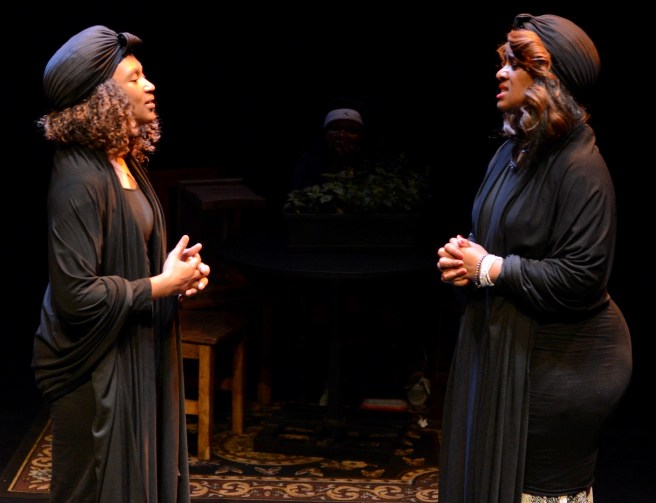
Rebecca Makin-Taylor (daughter) and Michele Belknap (mother) Picture: Ivan Blazic

SILLAGE

DIRECTOR/WRITER: Penny Youngleson

CAST: Rebeccas Makin-Taylor, Michele Belknap

VENUE: POPArt, 286 Fox Street, Maboneng Precinct

DATES: Tonight, Thu and Fri at 8pm at 8pm; Sat at 3.30 and 8pm; Sun at 12 and 3.30pm

Don’t worry about the name, it is explained and scents the play throughout as the story unfolds as if in a set piece that has been part of the mother/daughter relationship for millennia.

In this instance, recognisable and toxic, the younger and older generation square up as if starting off on the same foot but gradually the dance becomes more disheveled, the tone more confrontational and two individuals though bound by blood, antagonistic and attacking rather than supportive and sympathetic.

If they were on the same side, that sharply unravels as each one stands their ground in what seems like a fight in which both have something to lose and little to gain.

Youngleson has again tapped into family mores which in this instance might be mother and daughter but could be played on any scale and in different settings – even the country, as she points out.

Sillage_2
Rebecca Makin-Taylor (daughter) and Michele Belknap (mother) Picture: Ivan Blazic

We live in a world that stands on its head with a world power considering a vote for a sexually accused candidate to secure a political victory. Why would the rest of us remain unscathed? If ever these smaller battles are important and worth rescuing, it’s now.

Everything on Sillage’s playing field is fraught. Even on a generational level, how we do things, when we cannot concede that time might play a part and what was right then, might not be the best approach now and vice versa.

But rational thought isn’t what rules in these instances. It’s the battle, its the wound that has been opened and is festering, and there’s no reaching out as the two women come together to unpack a life that touches and tears at their relationship in tortuous fashion.

It’s an hour-long hugely entertaining lament from two perspectives with two women who when you sit them down, would probably want the same thing but they have long stopped caring about themselves and the other. They’re trapped as they tear each other down at the cost of what could have been.

It is a play best seen with little foreknowledge as it unfolds delicately in front of your eyes with two actors who are intertwined in their thought processes and how they want to impart the story.

Not only has Youngleson written a tone poem that reaches to the heart of this sadly familiar relationship, she has also painted a picture that best displays and allows the characters to detail this daily dance magnificently.

Everything about the production folds into one another with this one as we witness something that is as familiar as it is fatal. It is as funny as it is horrific because the inevitability is what lingers.

And that really makes you think…

Tickets available at : www.popartcentre.co.za

Running time: 60mins