
Freud and CS Lewis tackle Religion – and more – on stage at Theatre on the Square

freudpic3
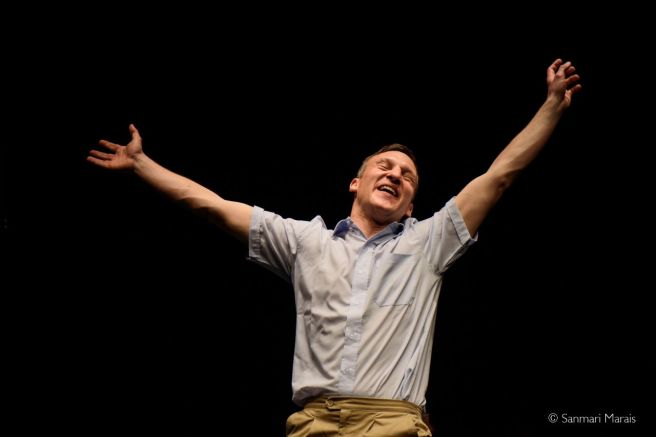
Graham Hopkins, Alan Swerdlow and Antony Coleman


Diane de Beer

Throw the names of actors Graham Hopkins and Antony Coleman into a hat and I pay attention.

There are also the play (Freud’s Last Session) and the director, Alan Swerdlow, that add weight. There’s no way the description “cerebral play with warmth” does this project justice though, it is one of those seasons you will have to take a chance on.

At worst you will have the acting talents of these two extraordinary actors – each in their own right. They have in fact never worked together on stage, only in TV’s Scandal, and Coleman remembers that they were fighting a court case in that particular session while Hopkins recalls the reams and reams of dialogue he had to memorise. “I had to devise a special method of pictograms to get it all down,” he says.

Freud’s Last Session which opens on Tuesday (August 22) at the Auto and General Theatre on the Square in Sandton, running until September 14, was imagined by Marc St Germain following the premise of a meeting between  legendary psychotherapist Dr. Sigmund Freud (Hopkins)  and the rising Oxford don C.S. Lewis (Coleman). He tellingly sets this particular tête–à–tête in London on the eve of World War 2.

The one is famous for his views on sex, the other for his religious beliefs (and the Narnia books, some of his life story captured in the play/film Shadowlands), and this will be much more than talking heads – and with these three artists involved, you’d better believe it.

As these two opinionated men argue about the existence of God, whether the belief in God is merely a childish fantasy, or a crucial element of leading a meaningful life, the BBC keeps interrupting with the latest bulletins on the impending war.

With the possibility of a war looming in the background and foremost in their minds, they might start out with religion, the conflict between science and religion, but their conversation veers to their parents, music, meaning of Hitler – and even the entertainment value of flatulence! It would have to have all that to keep us listening I suspect.

The whole affair is of course heightened because of the Hitler’s presence heavy on the horison, Freud being an 83-year-old Jewish refugee from Vienna and Lewis, a 40-year-old World War 1 veteran, both with their own set of worries.

For both actors, finding their particular persona was top of the agenda and Hopkins notes that there’s not much live footage on Freud, while for Coleman there’s obviously much more. But neither of these two actors would be inclined to go for mimicry, it’s simply finding a truth to the men they’re portraying. “It’s so skilfully written,” explains Hopkins, that their characters are revealed in the conversation.

“It’s what theatre does best,” says Swerdlow as he talks about the actors and the way they give life to the people they play. And in this case, it will be part of the enjoyment of the piece – to watch these two skillful artists at work on the same stage – and playing great men, so often larger than life.

For Hopkins the play deals with that age-old question of why we’re here? “It’s something all of us ask at some stage,” he says and there will be both squabbles and serious, thought-provoking debate.

At the time of our chat, the actors were enjoying their first outing together, both thrilled that they have a rapport with much laughter ensuing during rehearsals. Swerdlow is a director who allows his actors to find their way, especially with two as stage savvy as Hopkins and Coleman. While he worries about the play finding its people, he knows when it does, the audiences will stream in and discover the delights of this rich work.

This is the kind of theatre we don’t get to see that often; it’s quite wordy, its about topics that might blow a few minds, and many managements in these tough times aren’t able to take the risk.

Once in a while like in this instance, Daphne Kuhn allows herself this leap of faith. In the end, to get you to go and to pay attention (and win New York theatre awards), Freud’s Last Sessions has to be entertaining.

This trio (Swerdlow and his actors) are determined to showcase the best and prove a point.


Delicious and Delightful: de food, de chef, de deli

Diane de Beer


LadiesWithKopdoeke1
Rachel and her deli dames


Pictures: Theana Breugem

CarltonChef
Carlton Chef Rachel Botes


What makes a good deli?

We have a few in Pretoria but if you check your favourite, mine happens to be Carlton Café Delicious (Menlo Park Centre, 71, 13th Street, Menlo Park) – it usually has something to do with the chef patron; in this instance,  the fabulous Rachel Botes.

It’s all about quality produce and seasonal food, as it usually is with good chefs across the world, but with Rachel it’s about something more. It is her deep love of food, her instincts of what she wants to present and how, as well as strong roots in terroir which taps into her cultural background.

She never lets up. The deli is always evolving with fresh ideas popping as frequently as her trademark baked goodies that few can resist. She has a demanding clientele who through the years have appreciated the excellence, thus always expecting more. And she doesn’t disappoint.

Reading her daily specials on the blackboard is a treat and often trips you up if you’re expecting that all old favourites will remain on the menu. Because her dishes often defy the description, it’s difficult to resist just checking out what she has come up with.

CarltonTomatoTarts
Carlton Tomato Tarts

She has developed a formidable team around her but as anyone in the competitive restaurant world knows, nothing stays the same for too long. Yet she has been up to the challenges, understanding that well-trained staff will move on to different experiences, sometimes simply dictated by a change in their lives.

A good example is her Friday Dinners, which were inspired by a tough economy and a desire to gift her customers with an enticing option at a competitive price to counter punch financial famine. The options are well thought through, varied and cuisine that would be difficult to replicate with similar excellence both in the kitchen and on monetary grounds.

There’s also the Friday happy hour, which was initiated to celebrate and spotlight a long-awaited liquor licence while simultaneously allowing the creative cuisine minds in the kitchen to explore and experiment. Watch out for some of these favourites to resurface in the new menus.

It’s not only the food that’s fiery, it’s also her choice of wines which she has astutely assumed should be cheap but of supreme quality because they are a daytime deli. She has some of the best sourcing secrets and if you are smart, make a note of your favourites for your own wine cupboard.

CarltonAnchovyToast
Carlton Anchovy Toast

Different folks want different strokes in their desires for their best deli. In mine (or all honesty my partner’s), it is the anchovy toast breakfast (for the past few years and foreseeable future) that is the meal of choice – and would be any time of day, if there wasn’t a cut-off point.

Others cannot make their annual trek to the sea without the Rachel festive specials and it’s a treat of a different kind to watch these goodies being collected.

A few years ago that side of the deli has moved next door and there’s more breathing space all round but it has also allowed Rachel to have her own long table, which is used for separate occasions. You can book the table for a special lunch or evening event allowing the chef supreme to do her own menu.

She’s at her best when given free rein because it allows that cuisine craftiness to shine through.

If you wonder about her not receiving all the accolades her reputation so richly deserves, it is a result of its being a daytime deli. It’s as if the food powers that control these awards don’t take that kind of food finesse into account.

CarltotMarmiteTart
Carlton Marmite Tart

And yet, with everything she does, travelling the country to pass on her skills or to cook on request for people who know what she achieves in the kitchen, is worth experiencing, any time, any place.

If you’re wondering about this ode to a chef, it took some thought to decide when writing about food on this first-time blog, what would I like my first food musings to cover.

Why not someone who has been worth watching over the years, someone who has become a friend, but was first and foremost a chef whose artistry from the start was awe-inspiring?

CarltonBiltong
Carlton Biltong

Whether it is about a table setting, the choice of flowers or table decorations on a particular occasion, deciding to make her own biltong, or the way she has constructed artistic meals in art museums to accompany and illustrate an exhibition. Or simply thinking about the drinks she served all those years when she was waiting for a licence, to make it colourful for her clients who might have preferred a light wine with their lunch.

It’s about the innovation, the innate sense of style, the way she turns everyday meals into something imaginative with sleight of hand to make it special and often spectacular that fills a dreary day with sunshine.

This is a chef who loves to feed people, to have them smile, to add new tastes and textures, to surprise even the toughest critic – but also someone who has learnt to accept that you cannot please all of the people all of the time.

For me though, it is always delicious because this is food that is thought about, has to fit different criteria but in the end, has one goal, to be delicious!


A few book options, old and new:

DIANE DE BEER


Petina Gappah: Rotten Row (Faber & Faber):

rotten rowThis is her Petina Gappah’s third book. The other two titled An Elegy for Easterly, her debut and also short stories like this latest one, followed by The Book of Memory, her first novel which tells the story of a woman incarcerated in a very harsh (are there any that aren’t?) prison in Zimbabwe.

The titles alone would have turned my head, but with this author, it is where she comes from and her writing that grabs you. Why would we not want to read about a neighboring country from someone who has found a unique way of telling her stories and speaking her mind.

Just some bio: She is a Zimbabwean who works as an international lawyer in Geneva and while she doesn’t want to be defined as a specific writer for anyone, she is telling stories about her people and her land. She doesn’t live there full time anymore, but she returns to write and it is obvious in her writing where her heart lies.

It is her extraordinary insight, her obvious fascination with human beings and what they do, her protective nature of her country and its people and the way she shows us their lives that is so appealing. With so many people from across our border working in our country, one has to wonder about their lives back home, how it feels to have to leave your homeland for different reasons but with the same outcomes, and what hope exists to one day return to a country that is home?

She gives us an inkling of that; The life in the ordinary lives of people trying to function in an abnormal situation. Sound familiar?

She introduces the title of this latest book thus: “It is a street redolent with remembrance.” It represents the start of colonialism in that country, but also houses the headquarters of ZANU PF yet the place that most people think of when they hear the name Rotten Row , is the criminal courts. It is all these elements that permeate her stories that are linked by a certain humanity that is a part and party to every life she tells of.

Gappah allows her writing and her stories to show what she doesn’t necessarily want to scream about. In that way, the impact on everyday lives, how people survive, what they have to do to simply get the ordinary done, also shapes her world and the one she wants us to understand.

It’s not about hardship, it’s about life and from Gappah’s point of view, it is always filled with laughter. She knows that this will keep us moving on as we start understanding each other, see one another and view people in a very different light – without judgement.

She is so obviously from this continent, and there’s a writing that bristles with her own sense of place and who she is. And probably because she has distance, it is the sharpness of her gaze that catches the reader unawares.


The following three books all deal with race but with such an individual perspective, it’s compulsive reading. It’s as if individuals have suddenly found a voice and a way of telling their own stories. Perhaps this is a time when it is simply too painful not to speak:

Paul Beatty: The Sellout (One World):

selloutNot knowing much about this book but that it is listed as the Man Booker Prize winner of 2016, I wasn’t too keen to read a novel about modern day slavery, not reports as we see on the news daily, but fiction.

It was only when starting to read and encountering Beatty’s evil sense of humour and the approach he has taken to telling a very specific race story, that my hesitation turned into delight.

I’m not the laugh out loud kind of person even when I think something is funny, but with this one I couldn’t contain the laughter.

Writing about a slave called Hominy, his master tells of the slave’s movie bio: “…from the ages of  eight to eighty, including most notably Black Beauty – Stable Boy (uncredited), War of the Worlds – Paper Boy (uncredited), Captain Blood – Cabin Boy (uncredited), Charlie Chan Joins the Klan – Bus Boy (uncredited). Every film shot in Los Angeles between 1937 and 1964 – Shoeshine Boy (uncredited) Other credits include various roles as Messenger Boy,  Bell Boy, Buss Boy, Pin Boy, Pool Boy, House Boy Box Boy, Copy Boy, Delivery Boy, Boy Toy (stag film). Errand Boy and token  Aerospace Engineer Boy in the Academy Award-winning film Apollo 123.

It’s this kind of writing, showing how it is done, bringing in real names and real incidents that keeps you racing through this one with enthusiasm. We live in such different worlds, where we are born, what colour or race we are, our class designation, that often, we are impervious to the needs or wants of others.  Entitlement encourages many to misunderstand the lives of others. How can you know if you’ve never been in that place, never been aware that it even exists. With our past, we know that when the other is hidden, it is easiest to ignore.

That is what Beatty has done so successfully but with such flair. He is determined to put it all out there but in such a way that while it hits you over the head, it is so cleverly done you are sucked in.

Very few reviews don’t use the word brutal, and that’s true. But then that’s the subject he is dealing with. It’s the year 2017 and we’re still talking about the basics of race here. It is about time that human beings start telling their own stories and tell it the way they want to get it out there.

Paul Beatty has decided to do it with hysterical laughter and he does it magnificently. In the end, when all the noise is silenced, it is excruciatingly entertaining and painfully funny.

How can it not be? And how can anyone resist?

Viet Thanh Nguyen: The Sympathizer (Grove Press):

sympathizerThink about the Vietnam War and the stories that have emerged following the American participation and their final withdrawal.

It’s exactly those stories, told from the vanquished’s point of view while shaping the narrative that compelled this Vietnamese-American writer to come from the victor’s vantage, a story he believed had never been told, not from this particular point.

The narrator is a communist double agent which in the Vietnam scenario already plays all the odds. He is a man “of two minds” says the blurb, “a half-French, half-Vietnamese army captain who arranges to come to America after the fall of Saigon and while building a new life with other Vietnamese refugees in Los Angeles is secretly reporting back to his communist superiors in Vietnam”.

Well that’s the gist of it but of course, there’s much more to this particular story which romps through the American post-war landscape from a chillingly cynical point of view – but one that knows from experience.

One of the devices he uses to expose the way refugees, their lives and their countries are dealt with is to have the narrator act as an adviser on an American film on the Vietnam War. Without naming the film, he picks the one that’s most memorable if you think back to your own experience of the big movie experience of that particular war.

It’s the way he tells the story, the way there are many different hooks that hitch a ride in the contemporary world. Think refugees for example. Nothing has changed from the days that the Japanese were interned during WW2 – and before of course.

Why would the (western) world suddenly react differently. In their world nothing has changed except this horror of people whose lives are being threatened trying to find safe havens. We’ve been there before many times.

It’s as if suddenly people have found a voice, a way of speaking about prejudice and the way they and their people have been trteated without shame for ever.

But the real key to these voices is the way the stories are told. It’s not a guilt trip per se. It’s telling a story with such hilarious fanfare that one cannot resist the ride. The writing is superb, the story opens new windows, has you thinking and understanding in a different way or simply reminds one that everyone is not treated the same in this world not even or especially not in the US of A.

It is a story that needed to be told and one you want to read especially in this world today where we need to turn towards rather than away from one another.

It might not sound that way,  but it’s a fun read – and then it flips your world.


Colson Whitehead: The Underground Railroad (Fleet):

railroadIt’s the kind of book that has similar impact to Tarantino’s Django, he could get away with what he was doing because of who he was, what he had done before and because it was a movie.

It feels as if this novel has also found a new voice, a way of telling the slavery story which is familiar but would make people stop and listen to this particular tale. It might feel like it’s not real, what with an underground railroad (almost Harry Potter-style) that mysteriously disappears and has guards watching out for it and allowing slaves to vanish into a world where they couldn’t be found.

But that’s what it took. How could you get away in a world that belongs to those who are keeping you in chains, where their punishment is the only way that wrongdoing is treated and where their laws are applied in the way that suits them.

Think about living on the other side of that protected curtain or perhaps you do. It is the thought of losing that protection that so many strange things like Brexit and Trump are happening , but that’s a different story.

The way we look at the past is what fashions our future yetmany haven’t been given that right, and it has resulted in enslavement for future generations as well. It is those who have been victimised who have to keep telling their stories the way they want to.

And this is exactly what Whitehead has done here. He has imagined a story that allows him to capture all the horror of his people in the past, and he has in this way inhabited his history in way that unfolds a unique perspective on the past.

As Cora, a slave on a cotton plantation in Georgia dreams of escape as her mother has done before her, she also battles with the way she was discarded by the one who should have protected her. But then she hears about the Underground Railroad, and she knows it is her time to run.

It is a thriller in the real sense of the word, but one is constantly reminded and Whitehead never lets his reader off the hook, that we are dealing in reality here and one that has reverberating repercussions in the contemporary world which is there daily for us all to witness.

It’s brilliantly written, draws you completely into the story but also reminds us like a drumbeat that all things aren’t equal – not in this world – never.


Tim Winton: The Turning (Picador):

turningA few years back, I placed a few Tim Winton books on my bookshelves because I could only manage urgent reading of books that had to be reviewed and could not find the time for these particular books in-between. I knew I wanted to read them but they would have to wait.

What was more dire at the particular time probably local books (from here and the continent) which I’m always partial to and often needs being talked about more than their international counterparts.

With the Hay Book Festival featured on DStv’s BBC World recently, Winton popped up as one of the featured authors and my interest was tweaked – also reminding me of the three Winton  titles on my shelf. Described as a literary Aussie writer, his story was intriguing. The son of  a copper, in fact a traffic cop who dealt mainly in accidents, Winton describes his childhood home as happy and warm but with a strong dose of trauma. This has obviously influenced his work.

I selected The Turning as my first dip into this writer’s storytelling, a collection of short stories yet strongly bound together by particular milieu, characters popping up in more than one tale and a strong sense of place.

This is a mainly white, working class, mostly small town world with the sea as a strong backdrop. There’s a feeling of characters trying to find their place in the world, sometimes turning their back but as often, turning their lives into something quite unexpected.

Almost more than the storytelling itself, it is the way Winton writes that makes you both wince at and wallow in the lives of others. It is recognisable but more importantly, there’s something addictive, almost mesmerising, about someone painting people and their place, both physically and emotionally, in such a discerning and detailed fashion.

The language is seamless yet completely from a novel place as Winton uses everything around him to sketch his characters in full colour. None of the subject matter appealed to me in particular and the book is probably more masculine than feminine or even neutral in nature. Yet, I couldn’t stop reading and it was the kind of book I wanted to pass on to everyone simply because it was such an entrancing read.

Bring on more Winton, both those on my shelf and more. And at the Hay Festival he was talking about his latest book, a kind of memoir (The Boy Behind The Curtain), which is a no brainer.

You like the writing, why would you not get to know the man?


Humanity the winner in Dunkirk

By Diane de Beer

dunkirk3 (002)


DUNKIRK
DIRECTOR: Christopher Nolan
CAST: Kenneth Branagh, Mark Rylance, Fionn Whitehead, Harry Styles, Tom Hardy, Cillian Murphy
RUNNING TIME: 107 minutes


Recently watched Cries from Syria on the Sundance TV channel on DStv (still available) followed by Dunkirk on IMAX (best way to see it) and I was struck how all these years later, the war – whatever shape it takes – remains the same.

If only it was shoot and kill, at least you would be gone and the suffering would be over. It’s not that easy. And as to be expected, it is usually the innocent, those who didn’t want this or see it coming, that pay the highest price.

The Syrian story, still ongoing and getting worse after five years and counting with the Syrian leader whose appalling regime started all this, going even stronger albeit without a livable country and less than half its people, tells the horror.

In Cries of Syria, a young boy (perhaps 8 years old) reaches what he thinks is a place of safety after he has fled his country following years of hardship and fear of dying, crossed the seas with a 50 percent chance of drowning, and stayed in a kind of clearance camp before moving further on foot to find refuge.

He finally reaches what he thinks is perhaps a haven only to find what he describes as the following: “They threw bread at us as if we are dogs!” Eight years old and at the end of a journey crossing half the world to find somewhere safe – and that is what he finds?

All this while the world is watching and talking about the refugee crisis. These are real people being affected – on a daily basis. Not even a toddler’s body discarded by the sea on a beach make a difference.

Perhaps then it is easier to look back at a Dunkirk with the focus on individual stories but also heroism as people go to the rescue of their countrymen in the face of great personal danger.

It was an extraordinary time and because of that, the director wanted to hone in on what it was like to be there. It’s not about huge fighting scenes or masses of people (all 400 000 of them) waiting to die, gathering on a beach with nowhere to go.

He didn’t want to make use of CGI or as little as possible. He wanted it to be up close and personal so that you could experience not the bravado of wars but the intensity, the fight for survival and life. Similarly to that young boy waiting to be fed after years of battling simply to survive.

dunkirk1 (002)
Fionn Whitehead personifies the struggle for survival

He does have the big names but someone like Tom Hardy playing a fighter pilot for example sets off in a plane at the start of the film and then disappears off the screen until right at the end. Kenneth Branagh as the commander, Mark Rylance as the brave boat owner who takes off for Dunkirk to save as many soldiers as he can with the unknown Fionn Whitehead as the young soldier battling for his life, are the few faces we get to see more of.

Yet Dunkirk is not about the actors, who in fact get very little time to speak. It’s about the stories, the way war works, the savagery of thinking you have survived only to be tumbled into yet another crisis which has to be overcome.

Nolan has made many films, most of them in different genres, and he knows what he’s doing whether you’re a fan or not. With this one he set out to tell a very particular story and probably we take from it where we come from and who we are.

We live in a world with not only vicious wars being waged but nuclear battles being threatened by two power-drunk men. This is when we have to ponder the results achieved of those fighting their battles in this way.

Those young men on the beaches didn’t ask to be there at that particular time and whether they fought well or valiantly didn’t define their lives. For each one of them it was probably about getting out at the end – some do and others don’t.

So when given a choice, we shouldn’t turn our heads, we should talk rather than feed that war machine that rules the world in so many ways.

Dunkirk confirms that message in many different ways.

PS: Saw Hokusai, a documentary  of the British Museum exhibition, Hokusai: beyond the Great Wave at Brooklyn Cinema Nouveau, which my sister had just been to see at the British Museum.

Filmed in Japan, the US and the UK, Hokusai focuses on the work, life and times of Katsushika Hokusai, painter and printmaker of the Edo (Modern Tokyo) period. Hokusai is regarded Japan’s greatest artist, who influenced Monet, Van Gogh and other Impressionists.

It was amazing and the cinema quite empty (which isn’t always the case when the artist names are perhaps more familiar) But again I was reminded of this extraordinary privilege we have with these screenings on artists and their current exhibitions.

Similarly for the NT Live theatre productions which allow us to see the latest work at London’s National Theatre or the Young and Old Vic, the Donmar and others.

Check it out. And watch those screening times. These are short runs but all worth seeing. It is as close as you will come this far away to see people like Helen Mirren and Judy Dench on stage while the play is still running in London.

The next screenings to watch out for later this month in Cinema Nouveau around the country is Renoir – Revered and Reviled from August 26; and the theatre productions of  Angels in America Part 1 (starting August 19) and Angels in America Part 2 (starting on September 2).

Nataniël Celebrates 30 Years on Stage

By Diane de Beer

Nataniël celebrates three decades on stage with 30 years, 90 minutes running from Friday August 24 until Sunday September 24 at Theatre of Marcellus, Emperors Palace. He will be joined by Charl du Plessis (piano), Juan Oosthuizen (guitar), Werner Spies (bass), Hugo Radyn (drums), Dihan Slabbert (vocals), and Nicolaas Swart (vocals).The show starts at 8pm from Thursdays to Saturdays, and at 3pm on Sundays. No children under the age of 15 will be permitted.  Fans can also purchase a limited-edition luxury souvenir programme at the show.

Nataniel show pic
30 years, 90 minutes

Even in those early years it was clear that this would never be a problem. Apart from being a mover with a mission, he has always been a solo creative soul that could slip easily between genres, conjure up creative endeavours and, more than anything to keep himself entertained, come up with something completely different and new at the snap of a finger.

That is what keeps so many intrigued. I was always amazed at critics who complained that his shows were always about telling stories followed by songs. That has always just been the packaging for him but once you creep inside that head, nothing stands still and there’s no time for stagnation. The framework might appear the same, but everything inside has been turned upside down and inside out.

For Nataniël it has always been about change, surprising his audience and keeping them entertained. And that is also how he has gone about planning his 30-year celebration. He wants to make some noise for his audience.

His annual show at Emperors (a stripped-down version played in Cape Town at the beginning of the year) 30 Years, 90 Minutes which opens on August 24, will be a display of his life on stage. Not that he thinks people remember things like that. Or that anything of that nature lasts.

Yet he has very loyal fans and he relishes a sense of occasion. Everyone knows about his obsession for example with Christmas and how he turns this into a magical spectacle for himself and those close to him. A similar principle applies

“My career is 30 years old, I’m not dying,” he says about the celebrations. And that is why he will focus on longevity rather than legendary status. “This will be the mother of all celebrations!” That’s all he basically says about the show. In typical Nataniël fashion, he doesn’t reveal too much.

Take him by his word though and get ready to party. Nataniël is serious about the secrecy in which he shrouds his shows. As a journalist, he gives you enough to do a story and there is something of what he will put on stage but on opening night, when you see what he has created, it’s as much a revelation as if you hadn’t been told anything.

That’s his thing, his magic trick. It is all about the unexpected, the way he tells stories, even his song choices and how he performs them. How will they be arranged, musically performed and how will they fit into a show. There’s nothing left to chance for this perfectionist performer.

He wants to celebrate those who performed with him in the past as well as unveil some of who he is for those who perform with him now and weren’t born then. That’s just the way his mind meanders. “It’s about looking ahead,”he says “What will the new chapter look like?”

Rehearsals, when the whole show comes together, that’s some of his happiest moments. That’s what he wants to show. “It opens like a rehearsal,” he says. “I want the audience to know about the process.” He describes the show as a “night of the forgotten”, stories and shows as he went in search of archive material, that he had forgotten about. “Everything that appears on stage has been on stage before – all my favourite elements of the past 30 years.” It even means re-staging some of his biggest flop moments

Those who follow his career will need little encouragement. They know they have a formidable artist in their midst, someone extraordinarily special, who on a night will blow their mind … perhaps their world!

Nataniel CD cover
Packaging is the appeal

But that’s only half of it. Already part of the celebrations, Nataniël also released a celebratory CD this year, One Day In A Castle. “I like that booklet packaging,” he says about his decision to produce it in CD format. He describes this one as one of the most honest productions he has done. “I wasn’t doing it for airtime, didn’t want it to sound plastic-y, wanted lush arrangements and rich sounds,” he says. He’s achieved all that!

And then there’s the book. He cleverly decided to tell his story with visuals – his costumes no less. That’s how he views his world. When he does a show, or thinks up his next story, it is to the costumes he turns first. It’s all about the look, the pictures he will present and how he shows the world his life.

That’s what this costume book represents – the story of his stage shows and, if you listened carefully through the years, his life. But that’s not all. The way he orchestrates his world is a lesson for those trying to forge a career.

Because he is always doing three things at a time, he tends to intertwine, pull those strands together that can work many streams and explore everything in different ways. His last TV show, shot in an old chateau just outside Nantes, also benefited from his extravagant costumes. With his brother Erik, the photographer of these costume pictures, also part of the production team and co-presenter with Nataniël on his Nantes TV series, these costume sessions would conclude each episode while also presenting the chance to capture the images for his book and posterity.

Because of the way his imagination runs wild, each shoot turned into a production itself. Not all the costumes were shot in the charming French countryside and sometimes it would mean building the fantasy he hoped would best tell the tale on his return back home. “We built sets which exploded into a circus in a forest,” he notes. But they also had to recreate some of the sets from previous shows. It’s the kind of detail his precision demands.

His practical side also slips into the equation though. Even if he wants this to be the most exquisite book in the world, he doesn’t want a coffee table book that gathers dust. It must be affordable and something that people will dip into with delight.

Nataniel in costume
Nataniël’s work of art

He has always been clear about his costumes: “It can’t go on stage if it isn’t a work of art,” he says simply.

For him, the costumes are the best representation of his life. “It is the only thing I collect,” he says, which for this super compulsive shopper (generous to a fault, so usually for others) is some confession.

In the end, looking back, he’s shocked. “I have been making a career for 30 years living in obscurity. And I’m not even a politician,” he claims.

And he does giggle when he finds himself in the middle of a shoot, a male in a tutu surrounded by a clutch of colourful chairs! Outside of context, he knows this is ridiculous. But that is his life and that’s why people listen to every word and follow each step he takes.

It is his extraordinary mind, the way he draws the curtain on the way he thinks, embraces the world and invites them to share his fantastical vision.

My Personal Artist

DIANE DE BEER


One of the best things about having a personal blog is that you can basically write about whoever and whatever you like. Hopefully like-minded others will like it too.

fatman1

I have a personal artist.  Someone who creates just for me and the world I inhabit, yet I have never been able to share this because in newspapers or magazines, it would be like promoting my own. Now, however, this is my space and I can. And more than any personal reason, because I believe it is a story worth sharing, as one man lives his life by spilling his emotions into his art – and thus telling his own personal story.

Meet Dries de Beer (or his art persona, Fatman), my husband and someone who spends his life creating anything and everything. It started with two young boys, twins in fact, walking fom Lyttleton into Pretoria’s city centre via the rail tracks for art classes. As he grew older with art as a subject it progressed to cartoons at varsity for the student newspaper and later, through our early years together,  wine lables and birthday cards to personalise gifts for special people.

201002200204
A garden wonderland

Once we had moved into our own home, our personal space, the artist came out to play – big time. It was all about creating a world that was our own and it tumbled out in peculiar yet mesmerising ways. Felling some mighty trees that allowed our garden no sunlight, we were left with eyesore stumps which would be problematic to move – unless you gift wrapped and decorated them to spectacular effect.

A traditional pergola was turned into something that exploded with secrets – if you looked carefully. Ceramic gargoyles were crafted to enhance what could have been just another garden structure. And once these were perched at the end of each jutting pole, a whole fantasy world of ceramic hangings from fishes and their skeletons to chattering heads began to emerge.

Or even a garage cover:Chevron

Ceramics bit the dust and had run a gamut of different applications, daily walks turned into an expedition of found objects which were assimilated in glass tiles, each one telling their own story in a variety of ways.

20170807_16395120170807_163901The sight of a lonely cement garden ball, led to a bright yellow cement mixer and an experiment of creating more than 70 companion pieces which exploded into a garden installation.

In-between there was another ceramic period with unique hand-crafted and painted ceramic zebras, ceramic faces and sculptures that decorate our outside walls and then moving into large found-object sculptures that turn a garden tap into something extraordinary or hid an electric cable running down an outside wall. A lonely and melancholic scrap iron Don Quixote-like man, snatches at your heart when you enter the house

A plain-looking gate, at our car entrance was decorated to a point where it was just a matter of time before a hungry soul discovered that these tiny copper objects would be worth the effort and had a good go removing about half of the decorations. It still takes my breath away every time I have to stop to unlock the gate to enter and this time, what has been left, has also been left well alone.

20170807_16413620170807_16421720170807_164250_HDR

Bins decorated with scrap vinyl make a pretty picture on our pavement on garbage collection days and the tar poles planted in our garden and then painted like bamboo with sculptures at the top are a discovery when you go exploring. Slightly hidden, they’re not there for the lazy viewer.

There’s more, but this is just a glimpse of what happens when someone finds different ways of telling stories.fatman dogs

And those from the lives of others. My personal story has been captured year by year and presented to me on my birthday which handily falls at the end of the year. The past year is explored and exposed in a book of cartoons which expresses the view of someone looking in of what they thought my year was like.

While receiving that particular artwork isn’t a surprise, the way it is done each year is completely new and innovative. What it means is that I have a visual diary of our lives in what is more than a decade of drawings – each set in a treasured book, one of a kind. It is a gift that cannot be duplicated.Collage Book 2 Face 37 to 42

Currently Fatman focuses on faces. It started a few years back when I received a gift wrapped with paper that featured one large oil-crayon drawn male face. These masculine faces popped up a few months later on outside table tops that were thus decorated for fun and visual effect.

Collage Black Book Face 13 to 14

Finally it developed into something else and perhaps more lasting. Last year was the start of what from the outside might seem a compulsion – of sorts. Mini portraits of predominantly male faces filled one notebook after another. Newspaper cuttings are often the reference point but not much more than that and each colourful individual drawing is done at quite a speed. And the results (for me), quite spectacular highlighting the individuality of each individual out there.

For the moment, it is his www.fatmanandcrayons.wordpress.com, which was started to practice on his own, before he got stuck into mine. For both of us blogging is a new outlet and something we hope will be fun as he practices his own art while I can get stuck into the art of others and share their stories and their work.

But I know this is the one I have been waiting to share for the longest time.

Van Graan’s State Fracture Brutally Brilliant

Diane de Beer reviews Mike van Graan’s State of the Nation from a few year’s back but if you’re at the 2018 KKNK, witness the coming together of three artists in away that will blow your mind:


PLAYWRIGHT: Mike van Graan
DIRECTOR: Rob van Vuuren
PERFORMER: Daniel Mpilo Richards
State Fracture pix 1
Daniel Mpilo Richards in State Fracture

The stars have aligned for these three artists, who each in turn contributes to a product that works from start to finish – brutally and brilliantly.

In these unprecedented times in the world, that’s what we need. There’s been enough denial and dismissal of what’s happening in this country because of disappointment, disbelief and disenchantment.

But enough already is what Van Graan seems to say and with all his skills and savvy, he has found the perfect form and performer to speak his mind. When you look at the theatrical landscape, audiences want escape and not many want to be faced with the reality of their daily lives. But on our current political death ride, it’s as if people have had enough of heads in the sand, being polite and are desperately seeking for someone to take the beast by the scruff of the neck

That individual is Van Graan. He has always been a political animal, an activist, someone who has fought for his beliefs and written extensively on everything he sees especially in the arts where hard news was seldom – if never – covered. He has never shied away from being the lone loud voice out there.

That’s why his script is so finely crafted. This is copy he has been writing for years. He knows what he wants to say, has all the hard facts at his fingertips which allowed him to up the ante and put together a solo show that’s as delicious to watch as it is disheartening.

That’s the point though. You can be entertained with quality while also digesting the facts and confronting the issues. Struggle theatre might not always pull in those audiences, but when it is done well, it hits all the marks. Who cannot be passionate when it is about the thing you care about most – freedom.

Add Richards with the insightful guiding hand of Van Vuuren and it’s lift-off. They already proved their theatre smarts in Show Me the Curry but this isn’t just a formula that’s repeated ad nauseum. Each sketch is finely crafted, a mini show of its own, written in a different style allowing the performer the freedom to play around.

Because Van Graan is so adept with words and its theatrical application, he can take a chicken sketch and have you laugh out loud simply for the many phrases he can conjure up to suit the subject; but then he infuses every phrase with punch; and Richard in full physical performance mode, cackles through it hilariously.

It’s never just fun and games and that’s why this searing South African show even as it highlights the horror in blazing colour, also leaves us with hope.

Check Van Graan’s mantra (below) which captures everything he stands for in the world and as Richards sinks his teeth into this stirring soliloquy, you can hear a pin drop. From chicken coop to stirring soapbox, it’s a wild and traumatic ride.

It’s truly the stuff of theatre. It might tear at your gut, but it holds your attention, has your mind racing, asking questions, digesting issues and finally, ready and armed to fight the good fight.


The Patriot 
by Mike van Graan


I am not a patriot
For pointing out naked emperors
For not joining the chorus of praise singers
For allegiance to country, not party
I am anti-transformation
For still sprouting non-racist mantra
For resisting cadre deployment
Choosing delivery not patronage
I am a sellout
For donating my poetry to resistance
For refusing to live in denial
For declining thirty pieces of silver
I am an ultra-leftist
For supporting human rights in Zimbabwe
For not being a millionaire socialist
For saying what others but think
I am a racist
For breaking the silence with a whisper
For preferring thought to propaganda
For standing up amidst the prostrate
For repeated conspiracy with the questions what, how, why
I am a white monopoly capitalist
For marching against corruption
For not looting the people’s purse
Choosing principle above expedience
I am a counter-revolutionary
An enemy of the people
An agent of imperialism
An apartheid spy
A traitor
For not martyring my mind
For not holding my tongue
For not sacrificing my soul
I have been here before
But then as a communist
Marxist
Terrorist
Labels they come and labels they go
Hard on the footsteps of those
Who defend new privilege with old morality
Who appropriate history for contemporary pillaging
Who now crucify the people on their electoral crosses
I have been here before and I shall be here again
For as long as the poor – like Truth – are with us


Explosive emotions at play in Chasing Chairs

Chasing Chairs pic
Theo Landey and Chi Mhende

By DIANE DE BEER


CHASING CHAIRS
Authors: Sue Pam-Grant and DJ Grant
Lighting Design: Michael Maxwell
Director, Set and Costume Design: Sue Pam-GrantC
Cast: Chi Mhende, Theo Landey
Venue: Barney Simon @The Market Theatre
Show times: Tuesdays to Saturdays @ 8.15pm and Sunday @3.15pm
Dates: Until August 6


Sue-Pam Grant is one of those artists who constantly changes colours in the way she tells her stories and presents her work, whether in her paintings, artworks or on stage. That’s what makes her so intriguing.

It’s not only the stories she tells, it’s the way she tells them that becomes an artwork and with her latest version of Chasing Chairs (presented in 2002 at Sandton’s Theatre on the Square), it takes you back to one of her earliest works, Take the Floor where the communication was done through movement not words – most hilariously, yet still hitting all the message marks.

With this current version of Chasing Chairs, Pam -Grant has again got stuck into all the elements available to her as a multi-disciplinary artist. The set is like a painting, an empty white space, obviously a room, but with memory points that are used throughout the performance. There’s a window looking out with wallpaper and views, a changing panorama reflecting the worlds of the two characters, husband and wife, Simon (Landey) and Cat (Mhende), who are living a life and refiguring a relationship minute by minute.

There’s a lot going on and many different places you can lose yourself as you immerse your mind and soul in this transforming tableau.

chasing-chairs4.pngIf you’re a visual person, it’s a feast, from Cat’s outfit and headgear, the style and the colour, to the miniature and normal-sized chair doing a balancing act throughout or the sea change of the wallpaper around the window, a portal to the outside world and an emotional touchpoint for the viewer.

There’s also the dance and the music, Pam-Grant’s choice of text as the husband-and-wife team move in and out of step in a way that reflects their inner worlds, which all keep humming along quite deliciously.

It’s flighty yet furious with serious undertones, as those in relationships will recognise from the daily doggedness of matching two minds that can hopefully meet.

One’s obsession is another’s passion, and chasing chairs upsets the routine that a more rigid mind requires when reaching for stability that won’t rock his world, while the other embraces the chaos of constant change at a pace that keeps her heart racing.

Landey’s boyish demeanour suits the part as he and perfect partner in crime Mhende revel in the dance that explores their daily lives, their longings and explorations of a couple deeply in love yet battling to find an equilibrium that holds that delicate balance we all hope to achieve and then hold on to.

It’s fun to watch while grasping the intricacies of lives in search of a way to both breathe and blend while not bending to breaking point.

It was only in the last gasp that the wistfulness and whimsy of the performance and the text, which lightened what could have been a deeply distressing experience, was displaced with text that moved from shooting stars to a preciousness that jolts us into a reality that we already understood when explored with a playfulness that was joyous to watch.

Pam-Grant is an artist that keeps evolving and exploring the boundaries while unravelling her life in a way that is universal and touches ours deeply. Chasing Chairs is a love story that catches at the heart, elicits a smile throughout and underlines that while tough, fighting for that sentimental soul mate will encourage the flowers to bloom in explosive colour.

*It was sadly a short run, but watch out if it plays anywhere else.