REVIEW BY DIANE DE BEER
PICTURES BY THANDILE ZWELIBANZI
A GOOD HOUSE
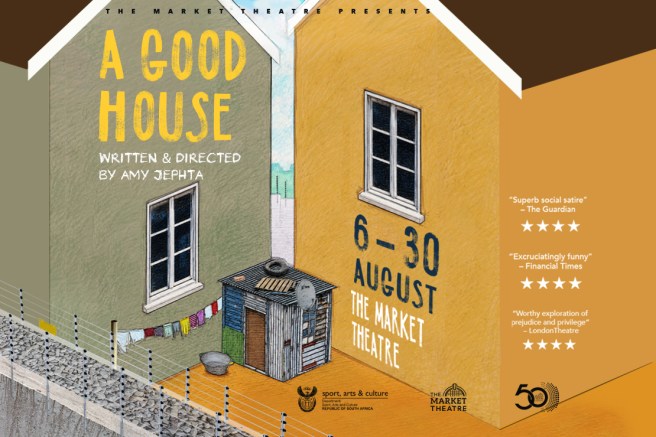
CAST: Homeowners Nhlakanipho Manqele and Lesoko Seabe (Bonolo), and their neighbours Jose Domingo and Mary-Ann Barlow, and Christine van Hees and Conrad Kemp
I was listening to two American podcasters speaking about movies and television recently, talking about the lack of current events featured in any of their fictional TV series or films.
They pointed to Nixon and the Kennedys, for example, who have had so much filmed about their lives – in reality and fictionalized – but said nothing similar was being done about the Trump dynasty.
Fresh from witnessing Amy Jephta’s A Good House, currently playing at Joburg’s Market Theatre, it is all about current South Africa and accompanied by a strong local audience, all ages colours and genders, whose participation was as much fun as the play.
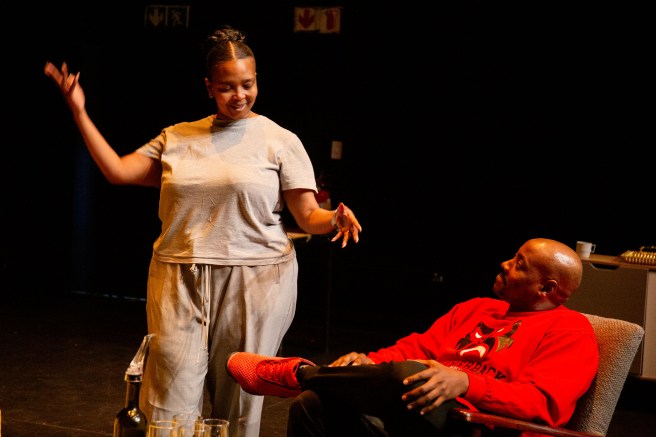
Lesoko Seabe and Nhlakanipho Manqele
I know we’re still a young democracy in global terms, but we’re moving on with some maturity as we head for our fourth decade. We certainly have stories to tell, time to reflect, discussions to be had and people who are still willing to talk to one another.
Are we one big happy family? Of course not. We would be idiots to think that is going to happen with alacrity, but we are busy moving away from those early rainbow phases simply to breathe more easily because we are all still alive and kicking.
In the international stakes though, we’re reaching for the top and it certainly isn’t out of our reach. And if anything, even with a group of cantankerous neighbours trying to make their way in Amy Jephta’s A Good House, it was easy to recognize what was developing on stage.
How good it is to smile at the things we get up to, the way we look at each other and the assurance with which we sometimes say something when we assume we know, but don’t have a clue.

From left: Jose Domingo, Mary-Ann Barlow, Lesoko Seabe and Nhlakanipho Manqele.
Three couples have chosen to live in one of the many gated communities which are such a part of our landscape. Apart from sizing each other up from every angle, what they have in common is their worry, in varying degrees, about a shack which has suddenly appeared on the periphery of their much valued and carefully selected suburb of Stillwater.
Jephta was already rewarded for the play when she was nominated for the prestigious international Susan Smith Blackburn Prize that honours women and writing for the stage. It was described as full of wit, humour, insight and exhilarating tension.
For her, it is a provocative exploration of the meaning of place, the contradictions of belonging and the definitions of community. Conversations are as fast and furious as change, according to the people in the room. It’s sizzling with all that predictable foot-in-the-mouth chatter crashing before its landed as husband and wife stare each other down, while carefully trying to navigate this sacred space which they can’t afford – financially or mentally – and have to try to make work.
Jephta latches on to the shifting terrain our country is still experiencing and has fun at everyone’s expense. No one escapes her sharp gaze, as she has picked her characters with care: men not used to even having to think about biting their tongue; women who know it all; those who feel entitled and those who don’t even know what that means; and others too scared to move.
Colour still looms large in our country and unfamiliar relationships still on shaky ground as people have to play specific games to make their world work. It’s specific algorithms, they say, or, in this instance, agendas. The difference is that they are historical and the patterns hardly noticed by those playing, so ingrained have they become.

Christine von Hees and Conrad Kemp.
Yet the fact that we are dealing, on whatever level, is already large in a world that turns its back on its horrific past as if the generations that follow feel it is their right to ignore or even wipe out the scars of those affected communities whose very existence depended on the goodwill of their enemies.
It is the kind of theatre that’s engaging and healing as writers refuse to let go of the ills of the past that have not yet been dealt with. It’s not just a litany of fingers being pointed at the obvious perpetrators; it’s dealing with a legacy that still has an impact on a country that has survived so much that some say it is enough.
And yet, if you listen carefully, usually those arguing are not the people who have suffered, and thoeirs are the voices that should be listened to.
Jephta is an experienced voice who speaks her mind; her plays grapple with who we are and she bravely has an embracing and nuanced outlook which doesn’t simply take the easy way out. She lines us all up to pull together, no matter where we come from, but hopefully to build rather than break down our future. And all the while, she has us laughing at ourselves.
Congratulations to The Market as well as a production with a stunning writer/director and cast who stand their ground in a space so intimate, you cannot turn away.


