The Impact of Hannelie Coetzee’s Art Resonates in Jozi Buildings and Skylines

Nzunza people
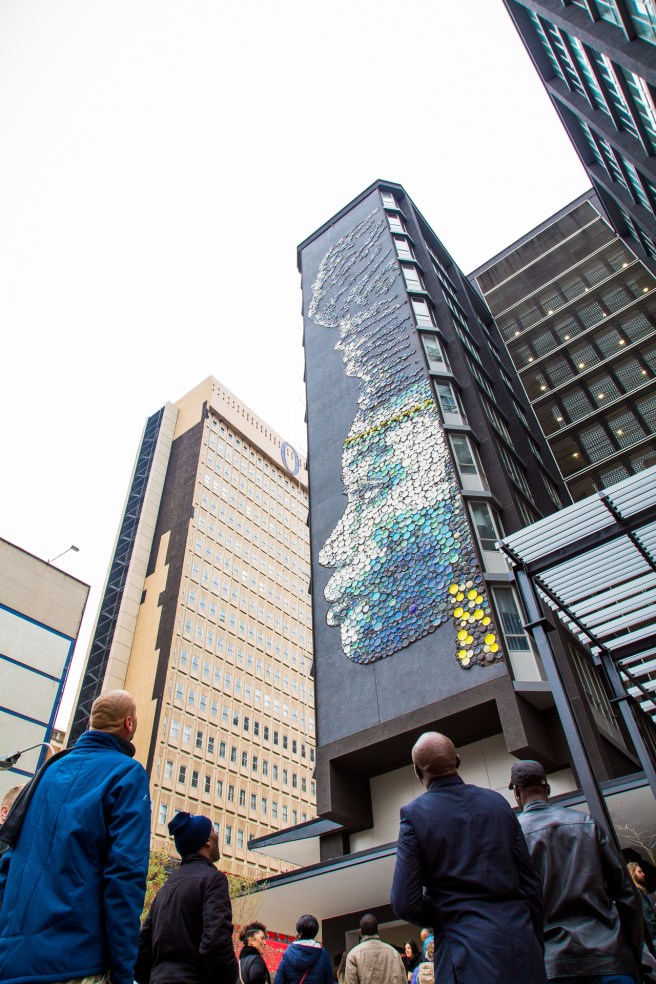
First sight of the Ndzundza/Nzunza Portrait by Hannelie Coetzee On Woman’s Day. Picture City Property

DIANE DE BEER

To have two major artworks unveiled in a week in a world city is quite extraordinary and contemporary African artist Hannelie Coetzee is excited that her adopted and much-loved city Johannesburg is recognising the value of public art.

And she likes to make her mark – spectacularly.

The most visible is the recently unveiled (on Woman’s Day on Thursday August 9) The Ndzundza/Nzunza Portrait (the alternative spelling is inclusive of differing views from the community) commissioned by City Property bringing her historic hair-inspired 10-storey South African artwork to 28 Melle Street in Braamfontein. “I’m grateful to people in the property market who have become patrons of the arts,” she says.

All her projects start with research and she was thrilled that this one came at a time at the end of the year when the building world comes to a standstill, giving her some time to play around with what she wanted to do on such a huge scale. She started scratching around in the area and wider to discover what had happened in this neck of the woods in the past, her richest vein of source material.

When reading what she says about herself on her website, Coetzee explains that she questions the purpose of art as a mere commentary on societal ills and prefers using art to participate in life, solving problems, connecting people and igniting dialogues.

When you talk to her, she describes her modus operandi as partnership orientated as she teams up with either scientists or architects or anyone in a specific field that might help with her enquiries, but then her own personal narrative also filters through the artworks on a specific level.

Having scratched around in her own family history a while back to find her own place in the world and where she was heading, she realised that the Ndzundza/Nzunza Ndebele that she was featuring in this work lived in the Highveld at the same time that the first Coetzee arrived in the Cape – navigating origins and cultures along the way.

But to get to the heart and soul of creating the work, she discovered a young architect, Ndzundza/Nzunza Portrait, who thinks and works differently especially with cities and her ideas around that. “It’s all about making cities healthier,” she notes and that is a big priority for this artist who taps into the historical ecology of the city to find possible solutions for some of the problems of today. She actively creates her partnerships to enhance the insight into eco-systems and hopefully resulting changes will follow. Or at least an awareness. But she also finds people who answers her questions in a way that to her makes sense and dovetails with what might be a specific mission.

Two things happened around Coetzee’s research. The architect had done a master thesis that dealt with hair salon designs in the Joburg CBD and informed her how they would impact the environment. At the same time, Coetzee’s wife Réney Warrington (a curator, novelist and film critic amongst other things), gave her a book Forgotten World by Alex Schoeman et al, because she knew where Coetzee’s head was at.

Nzunza.Ndzundza portrait 2018 by Hannelie Coetzee b
The Ndzundza/Nzunza Portrait at dusk. Picture Hannelie Coetzee

The reason for the use of ceramics in this work is the historical traces discovered on pottery that dated from that time, hence the astonishing use of the colourful ceramic plates to create a picture that will be seen from a distance as well as speak to the community who live there.

What she discovered in Forgotten World was that Swazi and Basotho patterns were found in the Ndzundza/Nzunza pottery patterns. Schoeman and his co-authors had found that in pottery remnants and through oral history which all points to the Ndzundza/Nzunza embrace of a cultural diversity which included other ethnic groups. “Much like Johannesburg today,” she says and one of the reasons she has found her place and lost her heart to Jozi.

Mavhunga also brought a group of Instagrammers to her attention. Their influence on trendy hairstyles inspired her to research old and new hairstyles resulting in a collage of many different styles to show how the old inspires the new. It’s the way she works, to underline how history influences modern trends.

Samantha at Rosebank Firestation Artist Hannelie Coetzee 2018
Samantha at Rosebank Fire Station, artist and photographer Hannelie Coetzee

In similar vein Samantha who was originally exhibited at the 2017 Joburg Art Fair has now been positioned in the foyer of the new Rosebank Fire Station in Baker Street at the behest of ARC architects. Coetzee first encountered Samantha (Mamiled) during walkabouts to the Ferndale stream in Johannesburg as part of her investigation of the city’s water structure then and now. “I study and explore the old ecology on which the city is built and in the process, amongst other things, I discover not only the beauty of nature but interesting people.”

Engaging with her, she discovered that Mamiled frequently visits the stream, on her own and with friends and she would sometimes wash here. That specifically reconnected her with her grandmother who used to take her to a stream as a child. “It’s about memories and moments,” says the artist who also finds pleasure that this work should find a home in a fire station.

Some of the wood used in the artwork comes from the old Rissik Street Post Office that burnt down and the desk that functions as a plinth was part of a castoffs found in an old building she was working in at the time in the Maboneng district. “I often work in these neglected buildings just before they are flipped because of what I find there,” she explains, and it all becomes part of her regenerating mindset.

Samantha made from parquet tiles, shelves and the desk, all salvaged by Coetzee, is 3.2m high and was especially insightful at the Art Fair because one has to stand at some distance to recognise her features. But what she represents and the fact that this fire station had to be built around and in context of the original station which is the second oldest building in Rosebank, all ties into the Coetzee ethos, including that she often works with natural industry waste such as wood and mining core.

With these two insightful Hannelie Coetzee artworks happening quite by chance simultaneously, the visual impact will resonate with vigour and eloquence sharing impactful stories.

The Javett Art Centre at the University of Pretoria Aims to Forge a Partnership between the University and the Public

Javett - UP - View 01~1

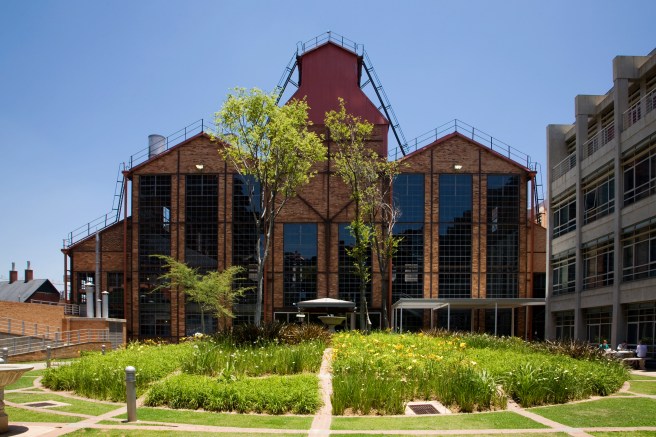
Gauteng’s latest art centre featuring a handful of galleries, something which can stand as a counterpoint to Cape Town’s Zeitz MOCAA and Norval Foundation, is in the process of being built on the edges of the University of Pretoria’s Hatfield and South campuses. Named the Javett Art Centre at the University of Pretoria (Javett-UP) in honour of its philanthropic donor, work started in 2016 and the Centre is set to open in the first half of 2019. DIANE DE BEER spoke to the architect Pieter Mathews whose firm Mathews and Associates designed the Centre as a link to the people: 

Javett Art Centre at UP (Liam Purnell) (2)
Javett Art Centre in the making. (Liam Purnell)


Even before we get to the art, which is really what the Javett Art Centre is all about, there’s the building – and according to lead and concept architect Pieter Mathews it is easily the most challenging project his firm has ever worked on.

Keeping in mind that with these grand art projects, the buildings have become as important as the art featured, the fact that the first concept design was penned at the end of 2012, captures the complexity of the endeavour. With the help of project architect Liam Purnell assisted by two project dedicated architects Carla Spies and Jannes Hattingh, their goal has been to create a space that would activate the connection between art and architecture. That’s also why the specific site (one of three options) was selected, because of the proximity of the Boukunde Building and the Visual Art Building that flank the Art Centre. “It makes sense that those three should be linked,” says Mathews.

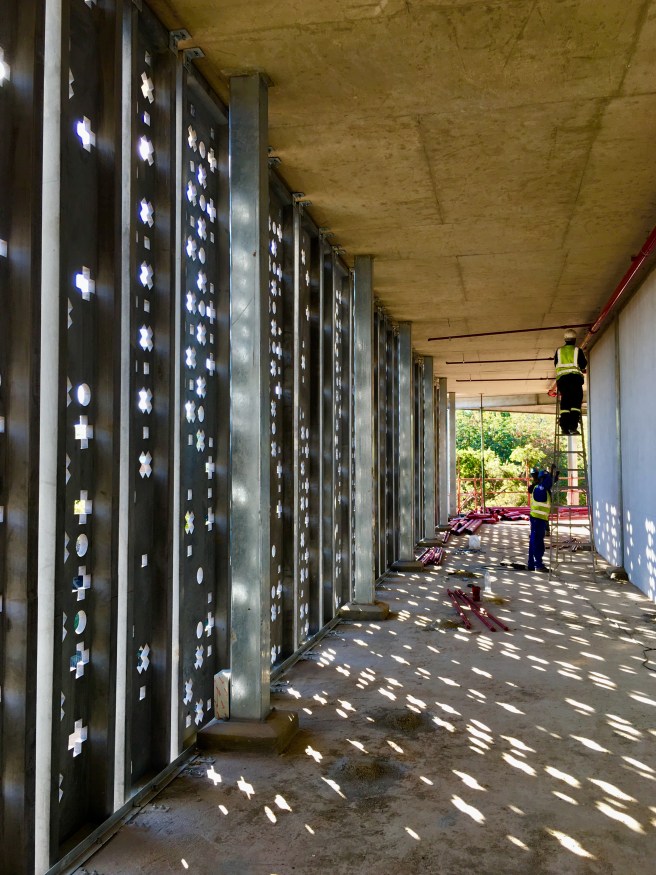
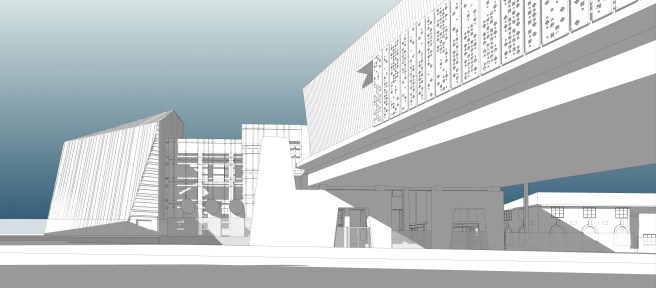
It also complicated the challenge because it meant that they would be building across one of Tshwane’s main arteries, Lynnwood Road and yet, because of their approach, it will heighten the visual appeal as well as the visibility of the centre. They have turned the bridge into a huge feature wrapped in lightweight concrete cloth that reaches across the exterior and interior based on the much-loved shweshwe fabric. This “cloth” displays many different features including a play of light and shadow also turning the bridge into an expansive feature when it is illuminated at night. “It almost looks like fairy lights glistening in the middle of the road,” explains the architect about this design feature which has strong South African connections which embraces all its people.

Javett Art Centre at UP (Liam Purnell) (1)
Shadows in Play at Lynnwood Road. (Liam Purnell).

But the bridge is also the connector between the public and the students and academics, the two campus sites and the diversity which is embraced on campus

The other reason for the site is that while it has one section on the main Hatfield campus, the section that crosses to the far side of Lynnwood Road will offer the public easy access to the galleries as well as a restaurant which will be part of the complex and is planned as an inviting addition for museum visits.

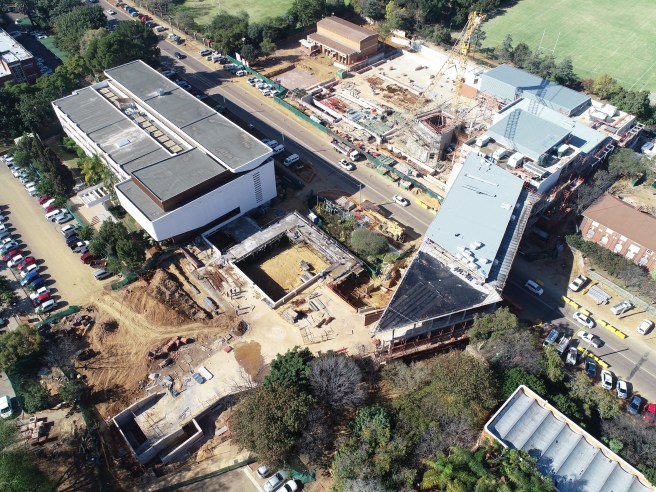
Apart from the bridge, which is also an exhibition space and offers visual invitations to the other galleries, the Mapungubwe gallery – which will house one of the most important collections entrusted to the stewardship of the University of Pretoria – is the other focal point of the Centre, towering into the sky. It adds to the dominance of the building not only because of the design but also its height.

DCIM100MEDIADJI_0098.JPG
The Javett Art Centre at University of Pretoria reaching across Lynnwood Road. (Hein Dedekind)


The building will profoundly change the landscape of the campus as well as the city. When complete, it will comprise nine distinct exhibition spaces, one of which will be housed in the iconic bridge and in addition to the Javett Foundation’s collection of 20th century SA Art and contemporary collections from the University as well as private donors, Director Christopher Till will feature exciting rotating exhibitions and the students, from across the university, will have rolling exhibitions in the dedicated student gallery. The Centre, with its focus on the Art of Africa, will also include a sophisticated restoration department and an auditorium which can be used for performances or public lectures.

Other design features that had to be taken into account were heritage buildings in the vicinity which are reflected in the design of facing walls of the new structure, trees that had to be maintained, the extension of the main artery of the university known as Tukkie Laan and the inclusion of two main squares, the Art Square which embraces both the art and the architecture students on either side and the Museum Square which is the public entrance to the galleries from different public parking spaces.

Javett - UP - View 02~1

Before any of this even started, Mathews, who has just been awarded the Medal of Honour for Visual Arts (Architecture) by the Suid-Afrikaanse Akademie vir Wetenskap en Kuns, went on a 10 day museum tour courtesy of the Mellon Foundation accompanied by the late Stephan Welz who was also instrumental in the appointment of his architectural firm together with Prof Antony Melck and Prof Karel Bakker from the department at UP where Mathews studied. It was a learning curve, an intense museum tour to different world-class institutions visiting everything from their restoration spaces to their storage facilities. They were also introduced to different curators and the way they shaped their exhibitions, all of which had an impact on the final design.

And with something this all-encompassing as the Javett Art Centre, they had to find a unifying leitmotif to bind the various elements like the bridge wrapping, the faceted concrete shell structure of the Mapungubwe “mountain”, galvanised steel pergolas and all the other building elements. The solution was found in the colour scheme determined by the concrete cladding – a natural light grey. When they want to separate various elements, they will use charcoal as the shadow colour.

Javett - UP - View 05~1Anyone who knows the architect, will deem this a perfect fit – not only because of his innovative design skills, but also because he has always combined art with architecture. “I am an ambassador for the visual environment, “ says Mathews whose firm designed amongst others the Nellmapius Bridge on the N1; the New Mussina Bridge as gateway into South Africa (expected completion date end of this year); Transport Architecture TRT stations in the historic sensitive Pretoria CBD, (for example, Rivonia Trial station opposite the Old Synagogue); and various award-winning educational buildings for city schools, including Afrikaans Hoër Meisieskool and a new music centre for Afrikaanse Hoër Seunskool. He and his Cool Capital team also hosted and designed the 2017 South African Pavilion at the Venice Biennale.
He is happy that he and his team have a good hold on this massive project. “I am very confident in the collective brain at work here.”

*The building will be completed by the beginning of next year.

.


RMB Turbine Art Fair in Newtown Cultural Precinct Bubbles with Innovation both Young and Old

Turbine Art Fair
Turbine Art Fair

In the past six years Gauteng has adopted and taken to heart the RMB Turbine Art Fair in Newtown’s cultural precinct. This year running from July 12 to 15, it again bubbles with innovation and artists from across the land trying to make their mark. DIANE DE BEER speaks to a Pretoria gallerist in this, her second fair, about her latest find. And gives some Fair guidelines:


For Ronel van der Vyver reopening her Millenium Gallery in Groenkloof returned her to a space she needed to be. It was time-out for a few years but she’s back with a bang and last year’s Turbine Art Fair was proof of that. “It felt as if I was back in business,” is how this art lover describes this coming home.

It is especially the Fair’s mission statement – that it offers an opportunity to view and buy quality artwork from emerging and established talent in a fun and accessible way, with all pieces for sale priced below R50 000.00 – that appealed to her. That implies a specific market and one where she’s happy to play. It allows some of her established artists to sell work in a specific class while it is also a great time to introduce and push new and younger talent.

Odette Graskie's Human Noise
Odette Graskie’s Human Noise

She felt that even though last year was her first excursion into this market, she hit the mark with her selection including work by the late Braam Kruger. This year she’s excited by a new young artist she has just exhibited in her Groenkloof gallery, Odette Graskie.

This exciting young artist is a studio artist at End Street Studios in Joburg with a degree from the University of Pretoria where her most influential lecturer was Nicola Grobler, who is known for her interactive artworks. Part of the appeal for Van der Vyver was her own affinity to installation and sculpture and what she loves about Graskie’s work is the playfulness.

She explains her most recent exhibition and work that will be shown at the Fair titled Human Noise, as textile artworks that play with the idea of anthropomorphism as a tool to create an emotive response from those who encounter the work. “The figures,” she explains, “are presented in an attempt to anthromorphise emotion, identifying humanity in a psychological sense.”

Odette Graskie's detailed drawings of human intgeraction
Odette Graskie’s detailed drawings of human intgeraction

Her title was inspired by a Raymond Carver quote: I could hear my heart beating. I could hear everyone’s heart. I could hear the human noise we sat there making, not one moving, not even when the room went dark. “I want to confront viewers with uncertainty,” she says. Her figures are suspended with string and displayed in what she describes as a “gymnastics of form”, and despite their not being alive – obviously – even if the viewer rejects interacting, they force certain issues. “The shapes aren’t all inspired by humans, but by shadows and trees passed by on a dark night or waving in the wind in a strange and magical way,” she notes.

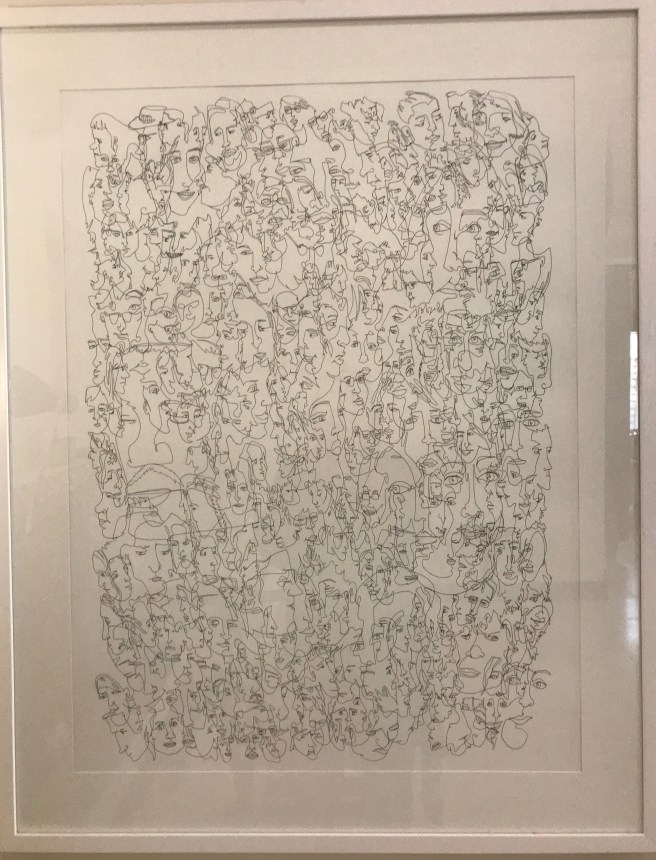
Underpinning these shapes and forms are her drawings which also experiment with her need to dot and detail encounters with others – from strangers in the street to her closest relationships. “Working with such drawings enhances my experience of a moment with someone,” she explains. But she also explores sewing as an artform or rather, as drawing, which she views it to be. “Line is the most crucial factor in my process,” she says.

Enhancing this work which will probably dominate the Millenium stand because of its playful presence perfect for this kind of fair, Van der Vyver also features paper work by Norman Catherine, some brilliant pieces by the Danish based South African artist Doris Bloom and sculpture by Zelda Stroud.

Other highlights at the RMB Turbine Art Fair:

* Throughout the weekend, the RMB Private Bank Talks Programme has walkabouts with celebrities, art professionals and well-known artists including magazine editors, art advisors, curators, #instagrammers, major collectors and successful artists talk about their journeys.  These free walkabouts also include age appropriate options aimed at helping children understand art and sharing a vocabulary that equips them to appreciate and describe it.

Gladioli by Irma Stern

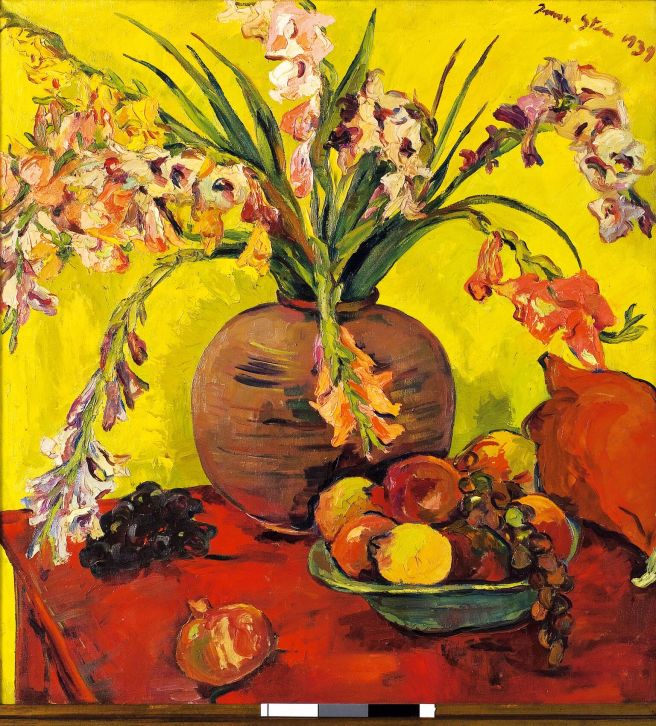
* An exhibition featuring a selection of Irma Stern still lifes from private collections titled Is there Still Life? The Work of Irma Stern will be presented by Strauss & Co. A competition among scholars at tertiary art schools in Gauteng has also been created for artists to submit a still life in a medium of their choice and a selection of the best works will be exhibited alongside the Stern showcase.

* Installations have always been an exciting part of the Fair. Curator, Tamzin Lovell-Miller asks the question “Who are we after this “Post-Truth” time has shaped us?” She pulls together artworks that range from the finely crafted to the augmented virtual, and the interactive physical and digital hoping to inspire and encourage extraordinary new ideas.

* The Graduate Exhibition returns for a 4th year and is specially curated. It features some of the best post-graduate paintings and in 2018 the inclusion of photography from university arts departments across South Africa. The exhibition is curated by Musa N. Nxumalo.

David Koloane Lithograph with watercolour finish

* This landscape. This landscape! The Quintessential Metaphor For Life by David Koloane in collaboration with LL Editions and curated by Ruzy Rusik to celebrate 80 years of artist David Koloane.

* RMB Talent Unlocked has funded a six-month intensive workshop programme for emerging artists, that integrates practical art-making (focusing on process and conceptual development) and professional practice training in collaboration with Assemblage and VANSA.  This exhibition of emerging artists is curated by Fulufhelo Mobadi.


Ticket details:

VIP COCKTAIL PREVIEW:   Thursday 12 July 6 to 9pm: R800 per person. Online bookings only, no tickets will be sold at the door. Canapés and drinks are included in the ticket price.

Friday 13 July 11am to 8pm; Saturday 14 July 10am to 6pm; Sunday 15 July  10am to 5pm.

Tickets: (via Webtickets): ADULTS: R100 online / R120 at the door; R200 online/R250 at the door Weekend pass (Fri, Sat and Sun)

CHILDREN: R50 online U12 /R80 door; R80 online over 12/R100 door

STUDENTS: R80 online/R100 at the door

For safety and convenience, it will be a completely cashless environment.

For more info or to buy tickets: www.turbineartfair.co.za


June is Youth Month as Young Artists Tell their Stories and Share their Worlds through Art at the Pretoria Art Museum

Pictures: Mmutle Arthur Kgokong


June is Youth Month and DIANE DE BEER discovers the Pretoria Art Museum is celebrating that in style:

generation artists
Genesis II’Xhibition 2018 artists from left to right Asma Rahman, Bruce Bowale, Lerato Lodi, Phoka Nyokong, Kutlwano Monyai, Shimane Seemise (Curator), Mbhoni Khosa and Lesedi Ledwaba


Arriving at a walkabout of the Pretoria Art Museum’s Genesis II’Xhibition (on until July 1) on a Saturday morning I am intent on discovering a few things. Everyone living in Pretoria and interested in the art scene will know that the museum is not as lively as it once was, but they will also have to concede that there are many events and exhibitions happening that aren’t well attended.

This was exactly what happened at an exciting exhibition walkabout on Saturday morning. It features work by a group of young Educational Assistants at the Pretoria Art Museum. They are responsible for conducting guided tours and occasionally facilitate art-making workshops as part of the museum’s education and development.

This exhibition is the second installment since it was first implemented in 2003, when the first group of volunteers unconventionally proposed to the art museum to have their own exhibition as a benefit for giving of their time to the museum. The name Genesis was picked to signify the endless possibilities for the participating artists at the outset of their careers. And hopefully it will happen more regularly in future.

Generation6
Nicola Grobler with her art intervention backpack, challenging the young art students to explore and investigate their world.

But I digress, Mmutle Arthur Kgokong, the cultural officer: education and development who hosted the event had cleverly combined another exhibition currently on at the museum by inviting one of the participants to do a live art intervention. Not only did that make the other participants aware of the exhibition but it also introduced the students to yet another avenue in which to practice their art.

In the Public Domain: shifting boundaries between the private and the public, is an exhibition by lecturers at the University of Pretoria that runs until June 24 with a walkabout at 11am on Saturday June 23.  It’s worth popping in if you’re around in Tshwane.

The exhibition deals with the notion of shifting boundaries as thematic interpretation as a stimulus for debate, as this exhibition accesses individual artists’ interpretations of contemporary society.

And what Nicola Grobler did with the young students is introduce her on-going art intervention by bringing a backpack of discoveries in which she piqued the curiosity, with art also a part of the presentation, but more importantly a way of looking at the animal world without making the usual assumptions. And of course, wider implications.

generation 4 pics
A life in art

But then it was back to the young artists and their work. It is impressive to witness the creativity of the TUT art students (and this is just a small section) and their participation in the art world. All of them are aware that this is not the easiest route to follow for a career, but some are doing extra educational studies which will allow them to combine their art with education, while others are already lecturing while finishing their 4th year and yet others are looking at an academic future. All of them are determined to keep at practising their art.

I was again struck by the way that art tells our stories and how we understand and get to know other people when we take the time to experience their storytelling whether on stage or in paintings. How would I have known about this young painter who grew up in a rural area who read himself silly as a youngster and thus started using scripts as part of his paintings? It doesn’t always mean something, but it certainly tells stories as he goes back to his childhood friends and family for inspiration.

Another of the young painters lives in the city centre and sometimes must push himself to attend class because his inspiration is where he lives. He currently uses water gathering as the focus of his work but also incorporates something he calls found scripts/words which he relates to found objects, but these are pamphlets on abortion or Mr Price sales slips, all which start having a conversation with the viewer.

And then there’s an artist who proudly speaks of the techniques he applies to his township etchings. This is provocative work and points to an artist who is someone to watch in the future, but there are quite a few of those in the room. Serious art collectors will know that this is where you catch them – when they’re starting out. Not only is this when you can afford the work but it is also a wonderful way to follow an artist you admire from the start of his career.

Has the Pretoria Art Museum changed these past few decades? Of course, it has. Which public museum or institution is not battling with funding and they can only do as much as their allotted moneys allow. I am also aware that many will be raising their eyebrows that the park has turned into a public space. Cars are being washed on the parking lot in front of the museum and in one corner of the museum grounds, a lively soccer match is being played.

Could it be tidier and more pristine? Perhaps? But I also liked the fact that this very public museum was being surrounded by real life – people earning a living and others taking a break by playing. Now all we have to figure out is how to get those using the public square into the museum. Mmutle Arthur Kgokong was surprised when I mentioned that the perception was that not much was happening. But he had to concede, the real issue was to get art lovers both present and potential to visit the exhibitions and events on offer.

In the meantime, the students and the lecturers are all out there showing their work. Take the time, it will enrich your life.

  • Pretoria Art Museum, Francis Baard and Wessels Streets, Arcadia, Pretoria.

Open Tuesday to Sunday from 10am to 5pm

BBC Earth’s Civilisations and Sci Bono’s Wonder of Rock Art showcase Humanity’s Urge to Create

20180516_160942
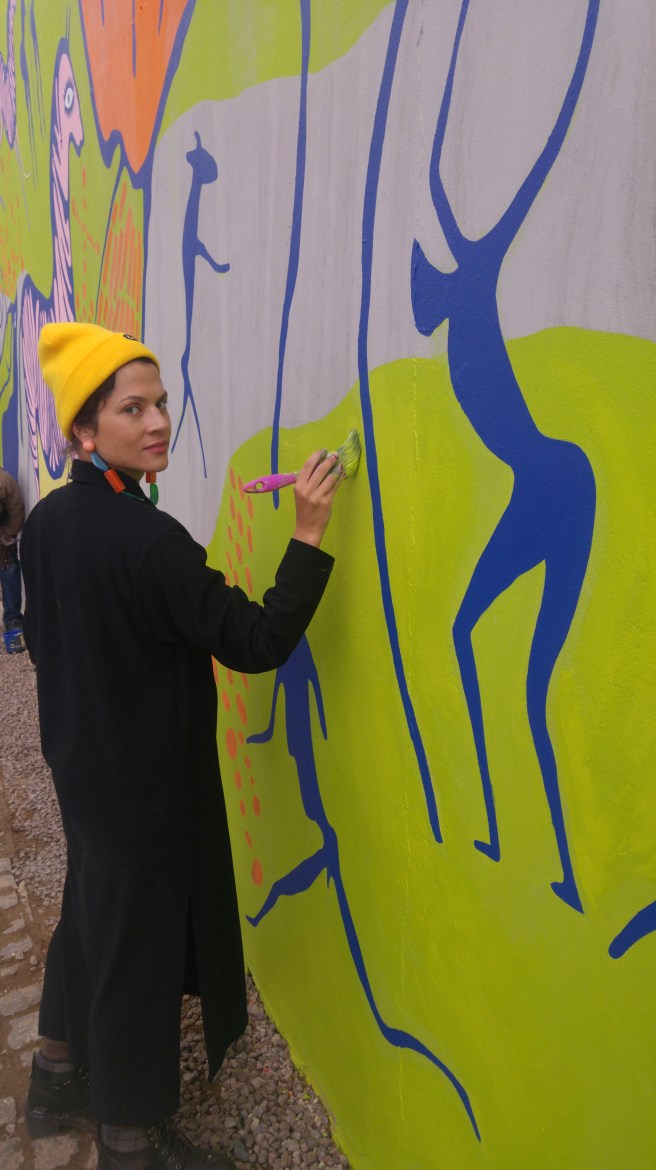
Pretoria artist Celeste Theron was commissioned to paint a mural for the children celebrating the imagery from Lascaux and Southern African rock art.

It’s an amazing and almost startling yet sparkling thing that there’s been an accidental converging of the Sci Bono exhibition Wonders of Rock Art: Lascaux Caves and Africa with the broadcast of the new BBC series Civilisations on DStv’s BBC Earth. DIANE DE BEER takes a closer look:


The Sistine Chapel of prehistory meets the Cradle of Mankind, proclaims a programme presented to the press at the first viewing of these amazing ancient works of art that tell us stories about prehistoric mankind.

It is exactly that reference that makes the exhibition Wonders of Rock Art: Lascaux Caves and Africa such an exciting one. To listen to Dr Tammy Hodgskiss-Reynard, curator of the Origins Centre or Dr Sam Challis, senior rock art researcher at the research institute, their excitement about the exhibitions makes you pay attention to what you are about to see.

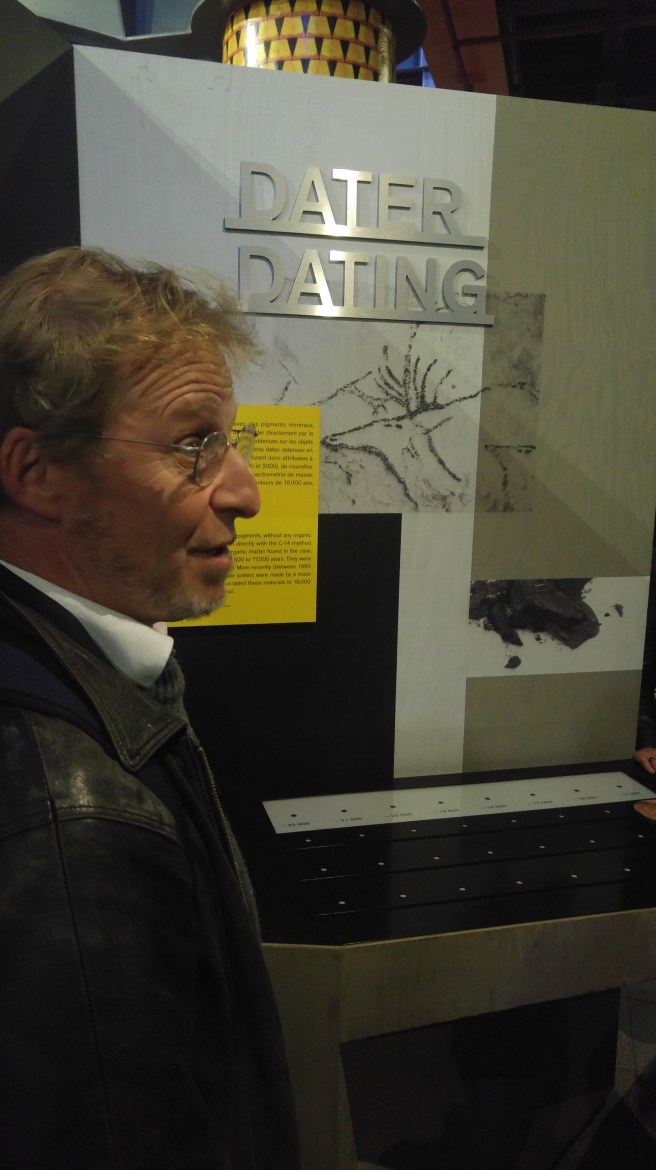
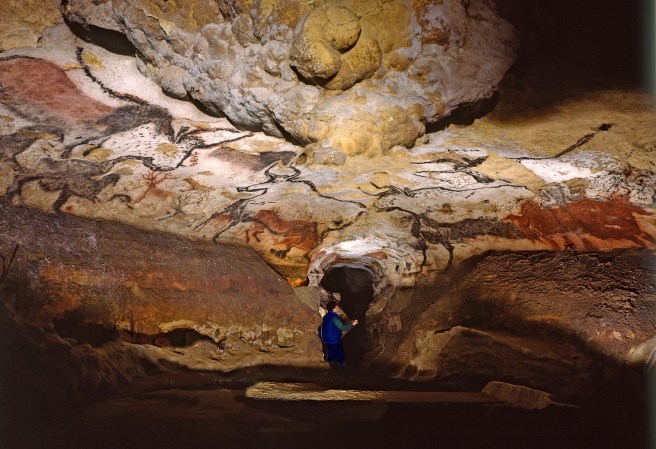
And the importance of the exhibition is highlighted when one understands that even Dr Oliver Retout, CEO of the Lascaux Exhibition has never been in the real caves, where no one is allowed anymore because of their fragility. As he speaks about the originality we are about to see, the replica of a part of the cave which was unveiled and specially made for this exhibition, it becomes clear just how exciting this coming together of African and European rock art from different timescapes is for local viewers.

20180516_150432
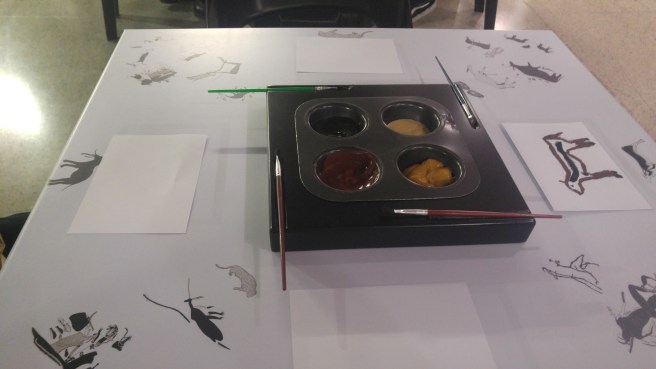
Everything is ready for your own rock art imagination to play.

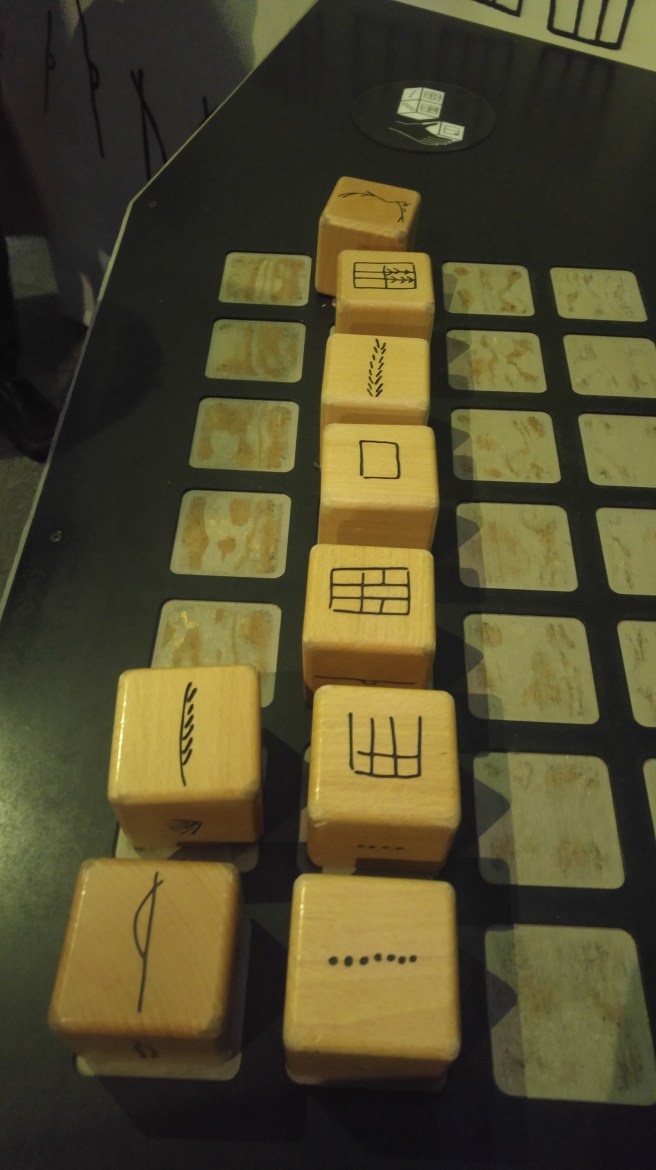
It’s also a great chance for rock art specialists to enthuse the public, especially children, where a large part of the focus is directed with many interactive activities to draw them into the exhibition and to help with their understanding. In fact, you even get to make your own rock drawing and your handprint can forever be part of a mural specially created for this exhibition.

But what was also clear when being taken through the exhibitions by the experts, it is very important to participate and to pay attention to every written word and all the interactive games – whether you are a child or an adult. It is an exhibition that asks for engagement if you want to fully benefit from what is on display. They make it easy, but you must get in there and pay attention – or don’t bother.

Also, if this is something you are interested in or want to know more about, take note of the many talks part of a public lecture series that are being presented during the timespan (from May to October) at the Sci Bono centre starting from 6 to 6.30pm.

20180516_153111
Dr Oliver Retout, CEO of Lascaux Exhibition talks about the miracle of this exhibition where two continents meet.

Here’s a list: 100 Years of rock art research in Mozambique; challenges for the interpretation of Southern Africa prehistory by Décia Muianga on June 14; The  Mind in the Cave: The book behind explaining Lascaux by Sam Challis on June 28; Hunter-gatherers and herders in South Africa: From final to ceramic LSA in the Limpopo basin by Iris Guillemard and Karim Sadr on July 3; Geo-archeology of Ethiopean pottery by Jessie Cauliez on July 17; On the origins of modern cognition and symbolic thinking – roots in the Middle Stone Age by Lyn Wadley on July 19; Rock Art in Uganda by Catherine Namomo on July 26; San religion and rock art by David Pearce on August 2; The Cutting Edge: Khoe-San rock-markings at the Gestoptefontein-Drieskuil engraving complex by Jeremy Hollman on September 6.

It’s an extraordinary event in the heart of Gauteng which we should all be excited about and one that will excite prospective archaeologists in our midst.

While this is happening, the new BBC Earth series Civilisations (the title is a reference to the series written and presented by Kenneth Clark almost 50 years ago and screened in the very early years of the SABC locally, is currently being broadcast on DStv.

Civilisations (Arts)
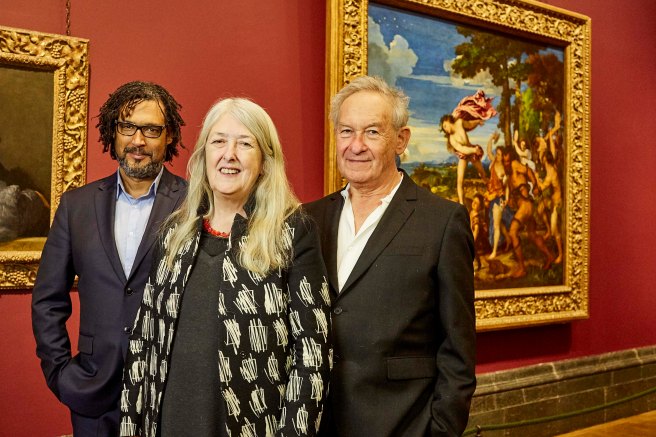
The three Civilisations presenters:, David Olusoga, Mary Beard and Simon Schama

Dropping in on a live interview (on YouTube) with the three presenters, Simon Schama, Mary Beard and David Olusoga, you will discover that this one is an attempt to create a series that is of our times. Just as Kenneth Clark is described as a man of his times which watching that first series will surely show you, the latest one simply by having three presenters already has a much larger and, especially important, wider scope.

In recent years, criticism of Clark had to do with his narrow focus, more specifically only on Europe, and even then, Spain was given a miss – to the great consternation of a country that takes great pride in its art, as it should if you think people like Picasso, El Greco, Goya, Dali and the list goes on.

But that was then and Clark being a man of his time is also credited with opening a world of art to the public. He was, for example, as the head of the National Gallery during World War 2 (at the time only in his 30s!), the one who realised that art would be a great escape for Londoners during those horrific times.

But that was then, and in the new series Schama takes us from the Paleolithic cave painting to the studio of contemporary artist Anslem Kiefer. Olusoga has expertise in Empire and military history and spotlights the relationship between global cultures while looking at the notion of progress. As an eminent classicist, Mary Beard investigates the way we see ourselves in art and at the relationship between art and religion by taking examples not only from Roman and Greek art but also material from China, India and Mexico.

The 9-episode series is something extraordinary and dovetails neatly with the above-mentioned exhibitions, again allowing different parts of the world to be compared while we witness above all why art matters. Art, they believe, is a measure of our humanity and that is what they set out to show – magnificently.

For all three it was important for this follow-up series (this time adding the important s at the end of Civilisations) to go to great lengths to find the right conversations for a new generation.

And as both the exhibition and the series show, humanity simply has an urge to create – come what may.

20180516_153055
Some of the signage at Lascaux which might be unlocked by someone visiting the exhibition.
  • Wonders of Rock Art: Lascaux Caves and Africa at the Sci-Bono Discovery Centre at the corner of Miriam Makeba and Helen Joseph Streets in Newtown until October 1. For more detail, check http://www.scibono.co.za.
  • Civilisations is up to episode 3 and broadcast on Mondays at 8.30pm on BBC Earth, (184). You will probably find the earlier episodes by streaming.


Africa Meets Europe in World of Rock Art in Major Exhibit at the Sci-Bono Centre

In the world of Rock Art, Africa meets Europe for the first time in real life with an exhibition at the Sci-Bono Discovery Centre writes DIANE DE BEER:

Lascaux cave
The Lascaux Caves


“We’re all African,” said French Ambassador to South Africa Christophe Farnaud when introducing the first exhibition of its kind The Wonders of Rock Art: Lascaux and Africa, at Sci-Bono Discovery Centre from May 17 to October 1.

In a first for Africa, European history meets African history with this unprecedented exhibition celebrating the rock art from two continents. The Sci-Bono Discovery Centre in Johannesburg, in collaboration with the French Embassy in Pretoria and the French Institute of South Africa (IFAS), are bringing a replica of the world-famous Lascaux cave paintings and the cave itself to South Africa.

The Palaeolithic cave paintings, found in 1940 in the Lascaux caves near the village of Montignac in Dordogne, southwestern France, are around 17 000 years old and are mostly of large animals native to the region at the time. They are regarded as masterpieces because of their outstanding quality and sophistication. The replica is an exact reproduction of more than 2 000 figures painted on the walls of the caves and was done to protect the caves.

Origins Centre_The Dawn of Art_Object3
Origins Centre: The Dawn of Art

In an exhilarating coming together, they will go on show at the Sci-Bono Discovery Centre in May, alongside prehistoric South African rock art, for a once-in-a-lifetime opportunity to engage with humanity’s earliest impulse for creative expression.

With the world’s first examples of art and symbolism, found in Southern Africa, (more than 100 000 years old), and Europe a home to some of the world’s most well-preserved prehistoric cave-art sites, one of the stakeholders, Mr Rufus Mmutlana, CEO of Gauteng City Region Academy, stressed that the past is a treasure trove of learning and this is where his interest lies.

“The exhibition points to the creativity of our ancestors with storytelling and a particular narrative innately human.” His field of expertise and focus is learning outside of formal education which is why when Dr More Chikane, Sci-Bono Discovery Centre CEO says that it is a place of learning, discovery, wonder but mostly fun because that’s exactly what learning is all about, this exhibition makes perfect sense for young and old.

105_quatrieme_taureau
Bulls in Lauscaux Caves

“It’s about the ingenuity of our ancestors, the way they started developing our first tools which were used for creativity and expression. It was all about making sense of and improving their worlds.”

That has always been the driving force in the world and something everyone can relate to. It is important to understand and experience how our world today was shaped by those ancient ancestors and their art.

This will be the first time that the Lascaux paintings will be exhibited alongside the oldest African art, celebrating the earliest works created by humans on two continents. And while the rock art was executed on different continents and thousands of years apart, the Lascaux and African rock paintings have much in common and point to one essential truth: there’s more that unites and binds us as people and cultures than there is that divides us all of the speakers pointed out.

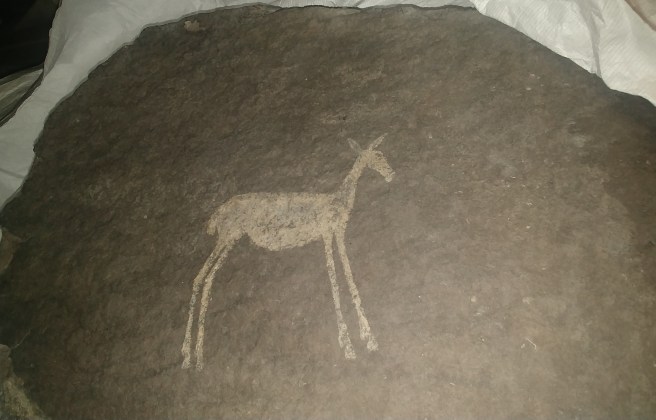
The South African component of the exhibition, The Dawn of Art, is curated by the University of the Witwatersrand’s Rock Art Research Institute, the Origins Centre and IFAS-Recherche. It will include photographs of iconic South African rock art, as well as a display of priceless authentic pieces.

The Lascaux cave replica was meticulously recreated using materials and tools identical to those that the original artists used about 17 000 years ago and was replicated to preserve what has become a World Heritage site yet was closed in 1963 to protect the priceless artwork which was being damaged by the humidity and heat of so many visitors that visibly damaged the artwork.

Origins Centre_RARI
Origins Centre rock art

“We are excited, honoured and proud to host this remarkable, one-of-a-kind exhibition,” says Dr Chakane. “The combined exhibition will be seen nowhere else on earth. The masterpieces by our own African ancestors, viewed alongside those of the ancient Paleolithic Europeans, provide a unique opportunity to experience the very earliest dawn of human creativity.”

French ambassador to South Africa Christophe Farnaud adds: “France is proud to partner with Sci-Bono Discovery Centre to bring the Lascaux International Exhibition to Johannesburg, a first for Africa. As art and symbolism originated in Southern Africa, it will showcase an important part of our shared heritage. The exhibition highlights our long-lasting cooperation in the fields of culture, research and science in South Africa.”

The Lascaux exhibition was created by the Departmental Council of Dordogne, with the support of the Regional Council of New Aquitaine, the French Ministry of Culture and Communication and the European Union. The exhibition’s worldwide tour is organised by the SPL Lascaux International Exhibition.

207_vache_tombant
A falling cow in Lascaux Caves

The Wonders of Rock Art sponsors include French banking group BNP Paribas and its South African subsidiary RCS; global oil and gas company Total South Africa; and Bolloré Transport & Logistics South Africa.

Their contribution will afford learners from disadvantaged communities the opportunity to participate in workshops and to be hosted by Sic-Bono.

 Work will start soon on assembling the exhibition, which opens at the Sci-Bono Discovery Centre at the corner of Miriam Makeba and Helen Joseph Streets in Newtown on May 17.

Ambassador Farnaud concluded that the exhibition will be French, it will be South African, and most importantly, it will be human.


For more information, visit www.scibono.co.za


A Delicate Balance in Artistic Tandem


Pretoria artists Sanna Swart (sculptor) and Lynette ten Krooden (painter) combined their different ways of looking at and interpreting the environment, the cosmos and the universe for an exhibiton titled A Delicate Balance at the Association of Arts Pretoria running until November 1.

DIANE DE BEER spoke to both artists about this collaboration:

Sanna en Lynette
Sanna Swart, Christo Burger( Acustica chamber singers who opened the exhibition) and Lynette ten Krooden

A collaboration between sculptor Sanna Swart and painter Lynette ten Krooden was inevitable.
They live and work in close proximity, deal in and explore the same issues yet work in different media. If you are superstitious or believe in synchronicity, you might think that this collaboration began because the Association if Arts Pretoria celebrates a 70th birthday while Ten Krooden has practised her art for 40 years and Swart has been sculpting for 30! Together their years of making art is on par with that of the Association.

But there’s more to their working together than that even though it is a fun fact to chew on.

Swart wanted to exhibit and with the two artists living and working like neighbours, their minds attuned, she invited an artist she has always looked up to, to collaborate.
“I wouldn’t have had the confidence to do it 10 years ago,” she admits, but these two artists are both in a place with their work which made this such a clever coming together.
delicate balance7
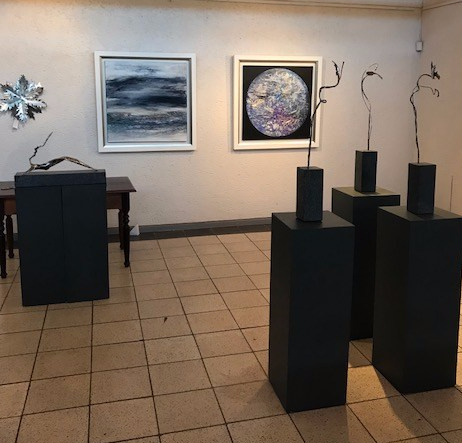
A selection at the Delicate Balance exhibition

They also knew they wanted to exhibit at the Association because of the gallery space. “It’s a space that was constructed specially to show art,” says Swart and there aren’t too many of those around.

When you walk into this exhibition which counter-balances the paintings of the one with the sculptures of the other, it makes complete sense. There’s a synergy that showcases the delicate balance and allows the work to breathe. There’s both a simplicity and a solemnity in the space which benefits the art.

As artists they are also both aware of the beauty of  “the place we call home” and of the fragility and delicate balance between human beings and nature. And that is where their art is focused.

Glacier Fish in stainless steel
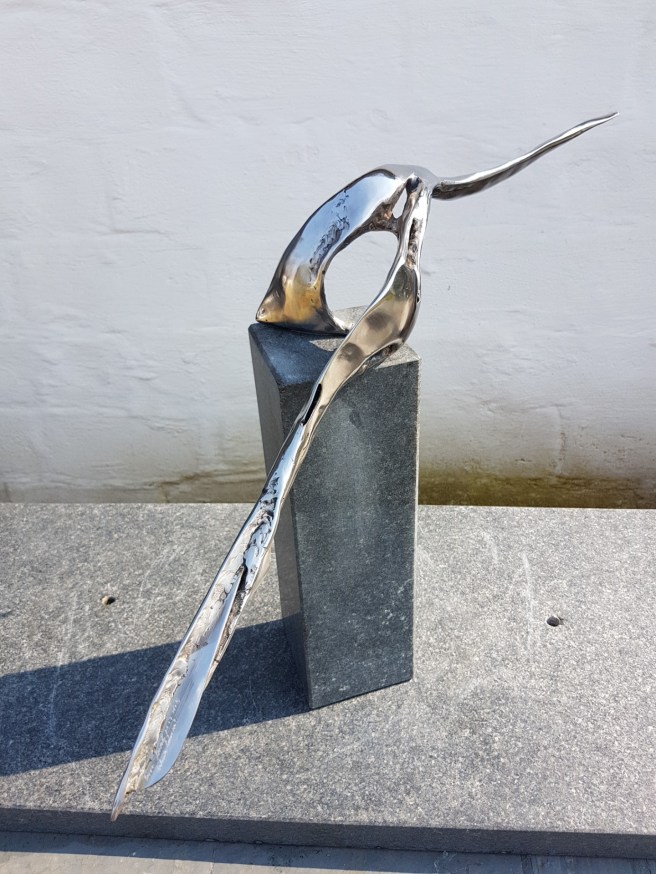
Delicate Balance in stainless steel (Sanna Swart)

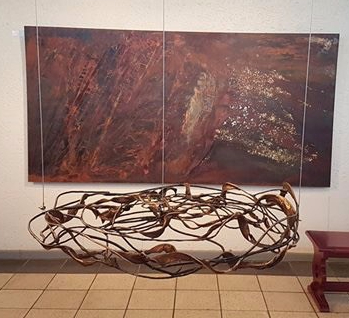
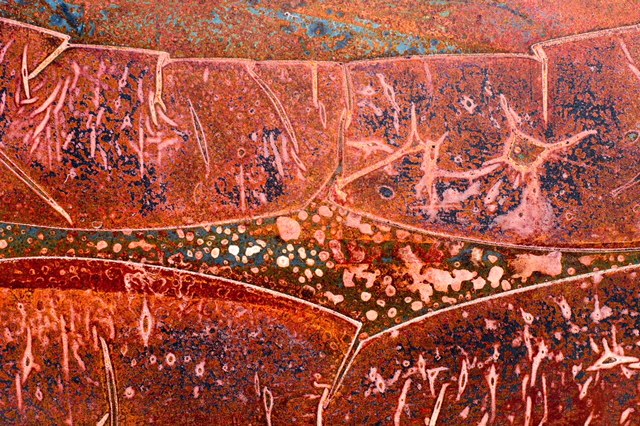
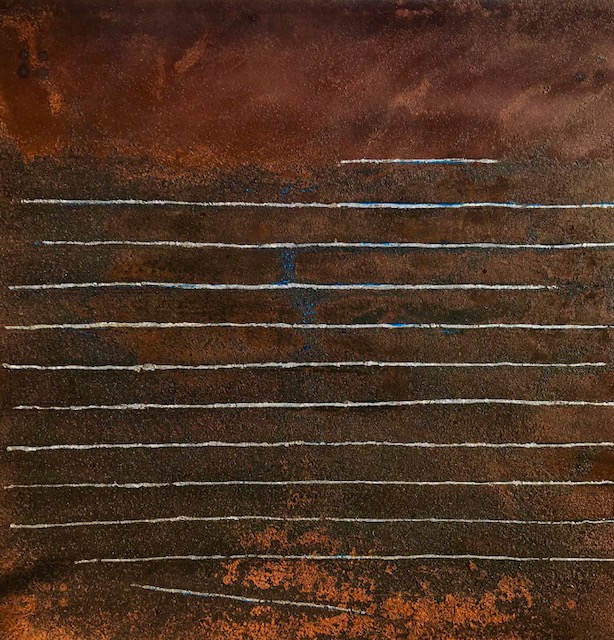
Swart has reclaimed forged stainless steel which she used to work with in her earlier days while Ten Krooden has for many years experimented with gold and silver leaf in her oil based paintings. She also experimented with natural oxidation on mild steel, which brought an even stronger symbiosis between the paintings and sculptures into play. The way the work has been displayed, the subjects each artist has selected, perfectly complement each other.

And it wasn’t as if they worked together in that sense. With an interest in the environment and the way each of us leave a mark whether we choose to or not, they talked about their intent with this exhibition and then worked on their different pieces.

“I was amazed how some of my work reflected some of the things Lynette was working on,” explains Swart as she talks about the way they think about the planet, the environment and how it affects each one of us.
For her specifically returning to stainless steel has been a freeing experience because of the process. “I was working with flat pieces of metal which I could shape and manipulate any way I wanted,” she says.

delicate balance6
KADASTRALE GRENSE/ oxidised steel (Lynette ten Krooden)

Ten Krooden on the other hand was amazed how her working process was given wings as her horisons expanded by this collaboration.

It is a confidence in their combined work that permeates this exhibition. And even though, each piece stands on its own, it is as if working together on an exhibition allowed them to breathe slightly more easily which reflects in the work.

delicate balance5
CELESTIAL GATHERING/ Bronze and stainless steel ( Sanna Swart) COSMIC DELTA/ Oxidised steel and gold leaf ( Lynette ten Krooden)

Some of Ten Krooden’s work encouraged Swart to give a three-dimensional vision to an idea that she picked up in a particular painting, she notes and between them, there was an energy that was greater than its individual force.

They both view themselves as “outsider” artists, not quite part of the establishment, but this coming together obviously had an effect on their work which is perhaps not what they expected to happen. It’s quite explosive.

They describe themselves as contemporary artists, working with the world as we view it today and hopefully making an impact.

Textures
Detail: ARCTIC DESERT (Lynette ten Krooden)

The exhibition runs until Wednesday 1 November 2017.

Association of Arts Pretoria

173 Mackie Street

Nieuw Muckleneuk

Pretoria

Tel:  012 346 3100

artspta@mweb.co.za

www.artspta.co.za

Gallery Hours

Tuesday to Friday:  9am to 6pm; Saturday: 9am to 1pm

Artist Margaret Nel shares Stories with Provocative Paintings at Retrospective

The Pretoria Art Museum, in conjunction with the Association of Arts Pretoria, is presenting a major retrospective exhibition by South African artist Margaret Nel at the Pretoria Art Museum until January 28, featuring a selection of over 70 paintings, spanning a career of over four decades.

Due to popular demand, the Pretoria Art Museum will be hosting a final walkabout of the exhibition A Retrospective: 1970 – 2017 on Saturday,  January 20 as the artist Margaret Nel discusses selected key works from the show.

Entry to the museum is free for those attending the walkabout. Light refreshments will be served before the walkabout commences at 11. Book your spot at info@margaretnel.com by Thursday, January 18 .

For those unable to attend the walkabout, but who still wish to view the exhibition, the show closes on Sunday, January 28.


DIANE DE BEER spoke to the artist just before the opening:

Artist Margaret Nel’s world reflects her artistic mien, from her art to her home and her personal style.

She lives in Pretoria’s famous round house on Tom Jenkins drive and upon entering the space, the way she has fashioned her interiors – from the paintings on the wall (her own work and others) to the interiors – the way she presents herself, all has a specific artistic ambience. It’s almost as if one is moving with and walking into an evolving artwork.

In the process of finalising her exhibition, we chat about a career that stretches from the 70s and is ongoing. “I am always painting,” says Nel. “There’s not a year that goes by without having produced something.” She is already working on an exhibition to be presented at the Oliewenhuis Art Museum in Bloemfontein next year.

Apart from a period in the 80s, when she stepped away from her art because of a young family and life in general, it is what occupies her heart and her mind and what she surrounds herself with. And when perusing the information available on the current exhibition, everything she does is done with a fine eye for planning, not leaving anything to chance.

She has even thought about the criticism ahead of this retrospective. But she’s excited and keen to hear what people think, especially the knowledgeable ones. As someone who shows her work, she knows viewers feel and have the right to criticise. While as a young artist, she might have struggled with that, now it is something she embraces.

She wonders how others will view her progress, something she is quite happy with. “I am confident about my work,” she says softly. And that steely demeanour might have something to do with the fact that while studying and starting her career, female artists always found themselves attached to part of a boy’s club. “We had to deal with that, always in the minority.”

1998_Waiting-for-the-Renaissance
Barren Land: 1998: Waiting for the Renaissance

Now, regarding her work in a retrospective, she is interested to see how it holds up in a solo exhibition. “Usually it is juxtaposed with the work of other artists and then it becomes difficult to judge,” she admits. She realises that certain periods like what she refers to as her Post Modern period could be perceived as out of step but believes the themes are even more relevant. “I touched on subject matter, such as xenophobia and diminishing and compromised natural resources, at a time when these issues were not as relevant as they are currently.”

The original title of the exhibition was Loss as it felt that as a concept, loss was the overarching theme, connecting the five distinct periods that her work falls into, over 40 years.

1970-Tea-time-I
The Outsider: 1970 Tea-time

“Loss of identity and control and loss of mental acuity are covered in the early period titled The Outsider as well as in the second titled Barren Land, where loss of culture and heritage as well as the potential loss of a sustainable future are also explored. The third section titled Incident talks about loss of security and a place of safety, specifically in the South African context but also in the global context.

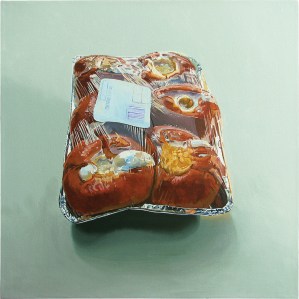
“The fourth section titled Exposed deals with loss of protection from outside elements. And finally, the fifth, deals almost exclusively with universal feminist issues such as loss of identity, and loss of youth, loss of a voice in a male dominated society. I also obliquely speak about domestic abuse in the latest work, a subject very close to my heart and very difficult to comment on in a subtle way. Cuts of meat, enclosed in a fragile skin of plastic which is often shown ripped open is used as a metaphor.”

2013_Isolate_I
Exposed: 2013: Isolate

“I use models, myself included, not to paint portraits but to try to get across an idea. The double portrait of myself where I used a cell phone to capture a ‘selfie’ is titled Isolate and speaks about old age, loss of youth etc etc.” She shows herself as she really is – warts, ageing et all. There’s no fooling about here. Art is a release, therapy, autobiographical if obliquely so and you must face it head-on.

“Ultimately I explore aspects of the human condition that have directly touched me.”

Nel strikes one as someone who makes very specific choices in life. She might seem the introvert when one first meets her, but easily opens up and shares her feelings when she feels comfortable – her choice.

Her reason for showing her work in this large retrospective is also specifically driven. She admits, as artists should, that she wants people to see her work. “And hopefully educate and make people more aware of the issues that I find important.”

2015_Custard-bun-6s
2015: Custard buns

All her paintings have very specific titles, offering the viewer a key to unlock the work and she has detailed descriptions that might further the understanding of the artist’s point of view. But she is as thrilled if other layers or meanings are uncovered and explored by viewers.

“The work can be interpreted on many levels though, even quite superficially, and ultimately it must be left up to the viewer,” she says firmly.


Her art is eye-catching, intriguing, draws you in, challenges and encourages you to engage with many different emotions. This might be her chosen landscape, but with individual interpretations and varied life experiences, different people will react and embrace the work individually.

And that’s how it should be and how it is intended.


Pretoria Art Museum
Cnr Schoeman and Wessels Str
Arcadia Park
Arcadia

Pretoria

Open: Tuesdays to Sundays 10am to 5pm