Tremendous Mantel Trilogy On Thomas Cromwell Comes to an End with Third Man Booker Deservedly in her Sights

The library is inhabited by spirits that come out of the pages at night.

– Isabel Allende


Diane de Beer

bk mirror_and_the_light


The Mirror and The Light by Hilary Mantel (4th Estate):


When the third in Hilary Mantel’s Tudor trilogy landed at home (thanks to the publishers), Covid19 had already surfaced across the world, I had an arts festival to attend and I thought it would be the perfect read for my husband who was staying at home, alone, for 10 days.

On my return, the lockdown hadn’t yet been announced, the book was waiting – and lockdown happened.

Unintentionally, I had in my hands what I think might just be the perfect lockdown read. It’s not every day that you’re excited about starting an 875-page book. For one thing they’re heavy to hold in bed, but Mantel being the writer she is, the topic – an extraordinary one and this third in the trilogy – as had been proven with the first two Booker-winning books, will take you to another world completely.

One which also has plagues it must be said, but then it’s reassuring to know that the world made it through those too – and they don’t play a large role in the story while adding to the overwhelmingly precarious circumstances of everyone except those serving the king – and they have the threat of possible death hanging over their heads all the time.

“But now there are rumours of plague and sweating sickness. It is not wise to allow crowds in the street, or pack bodies into indoor spaces.” Sound familiar?

Hilary Mantel is in a league of her own when it comes to historical writing. The layers of every sentence are mind-boggling, her language pure poetry and her storytelling abilities backed by research that  is painstaking.

It is difficult to explain the full magnitude of her storytelling without it sounding tough to read, too much hard work or simply too much of a drag to even tackle. And I won’t lie, it isn’t easy reading in the sense of just picking up the book and diving into the story. Dealing with Henry VIII and his constantly changing court, depending mostly on his whims, you have to keep your wits about you to know who is who.

But Mantel knows that and she reaches out a helping hand with a very strong listing at the start of the book including all the main players. To give an indication what we’re dealing with, it starts with the heading The Recently Dead with the main topic of the previous book, Anne Boleyn, Queen of England, first on the list.

If you have read the previous two, Wolf Hall and Bring Up The Bodies, you will know that the trilogy while dealing with the reign of Henry VIII, centres on the machinations of Thomas Cromwell, later Lord Cromwell, Secretary to the king, Lord Privy Seal and Vicegerent in Spirituals; that is, the king’s deputy in the English church.

What his job(s) is really about is being constantly on call and responding to the king’s every whim. This is about a ruler and a time when his word and every wish was what everything was about. “Once Henry says, ‘This is my wish,’ it becomes so dear and familiar a wish that he thinks he has always had it. He names his need, and he wants it supplied.” And “He (Cromwell) thinks, I want to be able to locate the knave at a moment’s notice. The king spits at the name of Becket, but give him a year or two and he may change his mind, and make him a saint again. Sad, but those are the times.”

The complete disparity between the king and his immediate circle and the rest of the people reminds strongly of the world we live in today, so glaringly visible during Covid19 where the treatment in so many instances is dependent on good health services. Obamacare is beginning to make sense and when you see the statistics in the US of the disparity in communities worst hit by Covid19 nothing more has to be said. Similarly, the squalid circumstances of our squatter camps. Many people don’t even consider space a luxury.

More than anything though, because you have to pay attention when reading the dense writing of Mantel, it transports you into another world far removed from the one we live in because it is so far back in time (1536 – 1540). In a recent interview with Mantel when the interviewer wanted to know something about the world we find ourselves in now (this was before Covid19), her response was quick as she reminded her audience that she had been living in the 1500s for quite some time. With research, the book took 7 years to write and is described by the author as the “greatest challenge of her writing life”.

But just breathe in some of her writing:

BK Hilary Mantel
Hilary Mantel

“After supper, as a hush falls and the long midsummer day folds itself and disposes to dusk…”

When talking about the latest choice of wife for the king: “Which one will he take? They say the one has brown hair and the one blonde.

“Go for the blonde, is my advice.” …

“His tastes may have changed.” She looks at him as if he is simple. “I do not think blondes go out of style.”

That could be part of any contemporary story.

And this extraordinary thinking by Cromwell on plums: “He used to think that the plums in this country weren’t good enough, and so he has reformed them, grafting scion to rootstock. Now his houses have plums ripening from July to late October, fruits the size of a walnut or a baby’s heart, plums mottled and streaked, stippled and flecked, marbled and rayed, their skins lemon to mustard, russet to scarlet, azure to black, some smooth and some furred like little animals with lilac or white ash; round amber fruits like crimson eggs in a silver net, their flesh firm or melting, honeyed or vinous; his favoured kind the perdrigon and it black , the palest having a yellow skin dotted white, sprinkled red where the sun touches it, its perfumed flesh ripe in late August; then the perdrigon violet and its black sister, favouring east-facing walls, yielding September fruits solid in the hand, their flesh yellow-green and rich, separating easily from the stone…” and it goes on.

The richness of the description says as much about Cromwell’s need to have diversions as about his attention to detail, whether it is the king’s needs or his longing for the riches he was starved of in his rotten and abusive childhood.

And that’s what is so extraordinary about her writing. Mantel tells a story of the time as much about the people as the way they lived. One dithers constantly between caring deeply for or discarding Cromwell for his dastardly deeds. He was doing the kind of dance someone like Dr Fauchi or Governor Cuomo has to do around Donald Trump. It’s not that they want his favour, they need it to serve the nation.

For Cromwell it was about survival. While he accumulated much wealth and an enviable lifestyle at the time, his family savoured his successes after his death rather than him ever having the time. He was simply treading water and even though the reader knows the end of the story and the death of Cromwell from the beginning, it’s with huge sadness that you follow his downfall in the final chapters of a book that masterfully concludes a long sojourn with Thomas Cromwell and the king he served with everything he had.

Perhaps too well, but he never had any choice. And even the outcome was destined. If you have read the first two, this isn’t even an option. And if you haven’t, this is the perfect time to tackle all three. You won’t be sorry – almost guaranteed.

I can’t wait to see where Mantel goes next. Wherever it may be, I will follow.


It’s Time to Catch up with Some Extraordinary Performances both Local and International – all of them Universal

Kev Mike on beach
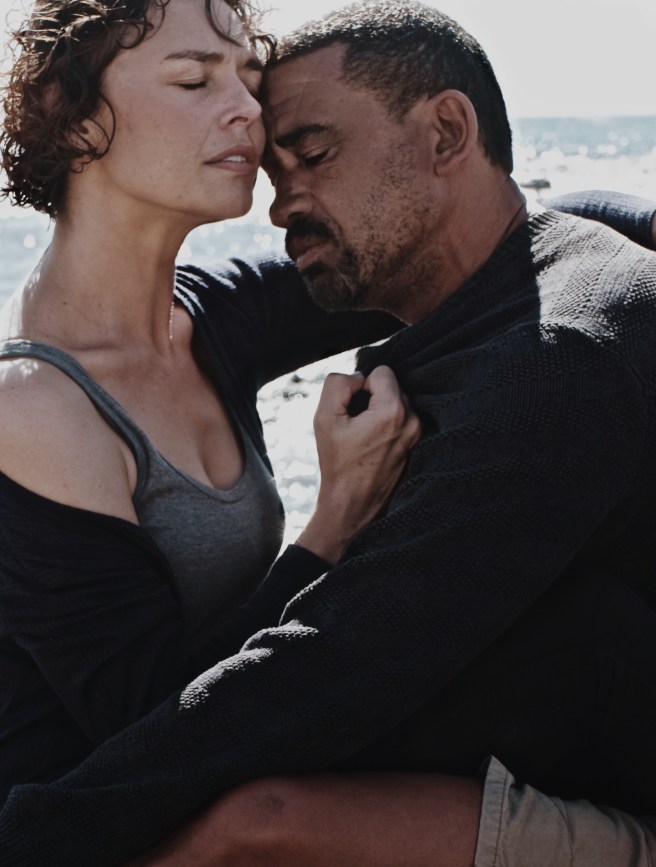
Cody Mountain as Kev and Joel Rosenblatt as Mike in Cut-Out Girls

These are tough times and yet for those of us privileged enough to stream and have other entertainment options like DStv, the options of how to pass the time with reading, movies, theatre, documentaries in-between work, are endless.

DIANE DE BEER reviews three of her current favourites:

We have to start with local and I was thrilled to see when Nicola Hanekom’s debut movie Cut-Out Girls appeared on Box-Office (currently at a mere R25 a movie).

Hanekom is one of our most exciting theatre director/writers who has recently also moved into television and now film, with this, her first feature film. In interviews she explains that she first wrote it as a play, specifically for young actors she was working with at the time.

The audience reaction  was so unexpected (it’s a story about date rape), that she decided it needed a wider audience, and in this instance a film. These are debut film roles for all the youngsters. That’s amazing! And they had to do crowdfunding to make it all happen.

Rape is such a scourge in this country that we are all duty bound to talk about it. Even with this pandemic, around the world, abuse is a huge problem because so many people cannot deal with this kind of pressure and violence is their own release.

And with the young, the world we live in now, it’s not that everyone has to live scared, but they have to live smart. We have to know the dangers out there and how to keep ourselves safe – women and especially young women, who don’t yet have their cynicism radars working fulltime, have to be vigilant.

I remember Redi Thlabi in her book Endings and Beginnings writing about being scared when walking to school at the age of 11, highlighting the parallel universes we live in. Nevertheless, we’re all vulnerable and what Hanekom’s exposé uncovers so smartly, are the monsters within.

It is sometimes the boy next door, the tennis star, the popular personality at school who feels entitled. Because danger is something we live with in this world, we sometimes forget when we have to be on our guard. And this is the aspect Hanekom spotlights.

Being both writer and director and informed by an intimate knowledge of the cast, she could work smartly with a small budget. You certainly don’t feel short-changed and the performances are beautifully balanced.

It’s a film of our time, speaks to both young and old and extends the reach of one of our most innovative artists.

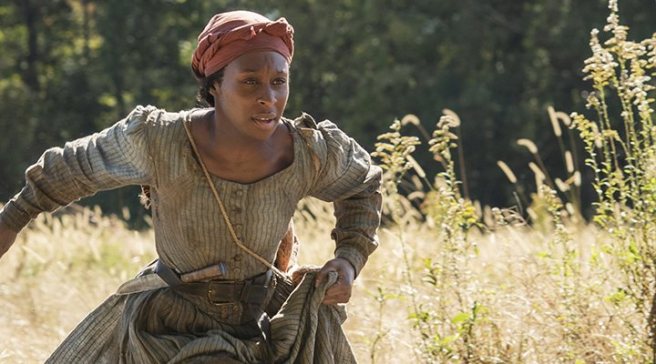
Harriet starring Cynthia Erivo
Harriet starring a powerful Cynthia Erivo

Another film I was keen to see, is also part of the Box-Office collection. Cynthia Erivo stars as Harriet Tubman in Harriet, the woman who not only escapes from slavery herself, but also freed many slaves as part of the underground railroad, a perilous freedom endeavour of that time.

At some point, Harriet says people should not be owned by other people, a sentence that is so obvious yet so ignored – even today – still. That’s why these stories are so important. This is also the time when the people affected (still today) by these abominations are the ones telling the stories. That makes a huge difference in both tone and authenticity.

And for this one specifically, Cynthia Erivo’s performance is epic. She was rewarded with the ONLY Oscar nomination for an actor of colour and also for the best original song, which she both co-wrote and performed. She’s a remarkable talent both as actor and singer. She has a strength of character and a powerful presence, which served the character well and her voice has a quality that stops you in your tracks.

Her rewards have been well deserved and this following huge controversy because she was a British actor playing an American character – but she proved them wrong and hopefully people were big enough to concede and witness her prowess.

The story is a great one but there are problems with the way the story was told – just clumsy and sometimes with too little subtlety and sensitivity. One would think it is a story that almost tells itself especially with Erivo as your talisman.

But it remains a story worthy of your time and money.

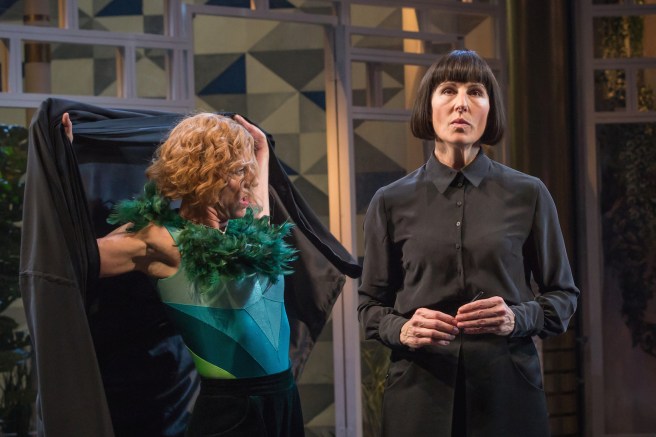
NT Doon Mackichan (Feste) Tamsin Greig (Malvolia). Picture Marc Brenner
Doon Mackichan (Feste) and Tamsin Greig (Malvolia). Picture Marc Brenner

Last on the list is the latest NT Live streaming of 12th Night with Tamsin Greig as the main attraction. But she says herself, this is an ensemble cast as anyone familiar with this Shakespeare comedy will recognise. And while this is a matter of confusingly mistaken and hidden identity throughout, with director Simon Godwin’s gender-fluid production, you really have to keep your wits about you.

Greig is cast as Malvolio (or in this case Malvolia) and hers is the performance on which the play hangs. Not only is the gender switch in these times fun to watch and navigate but with a play that is a dialogue between order and disorder, puritanism and revelry, and finally, control and fear with terror the driver of control, another contemporary evil.

That is how the director viewed it says Greig in an interview which is useful to watch (even with a few spoilers) before getting into the play itself. It’s also part of the NT Live stable on YouTube and easy to find.

We have had our own innovative 12th Night (a Clare Stopford production in 1998 with amongst others Langley Kirkwood, Isadora Verwey, David Dennis and Bo Peterson) and it is a play that lends itself to interpretation as you heighten both the comic and tragic effects at will.

NT Phoebe Fox as Olivia second from the right. Picture Marc Brenner
Phoebe Fox as Olivia second from the right with her entourage. Picture Marc Brenner

This being a first class British cast with some exceptional performances, a set that enhances the fast flow of the story, some excellent songs with a brilliant burlesque interlude stuck in between, Shakespeare can hardly be more contemporary. Just check a striking ensemble stepping out in their 21st Century ubiquitous veils.

It’s sassy and smart with as much laughter as there’s food for thought in a time when gender fluidity and identity could not be more centre stage. It’s exactly where we are now as Shakespeare in his constantly shows us: the more it changes, the more it stays the same.

Catch it on NT Live on YouTube until Thursday at 8pm when Frankenstein starring Benedict Cumberbatch follows. Don’t miss that either.


Authors Fred Khumalo and Petina Gappah Give Voice to Silenced Perspectives in their Latest Novels

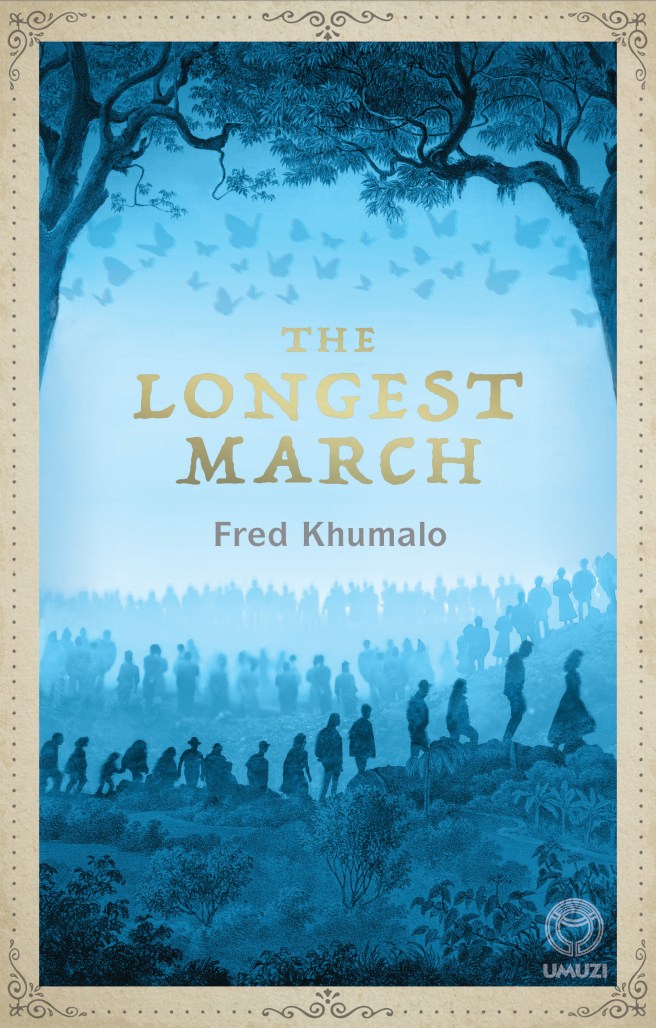
Book The Longest MarchDIANE DE BEER

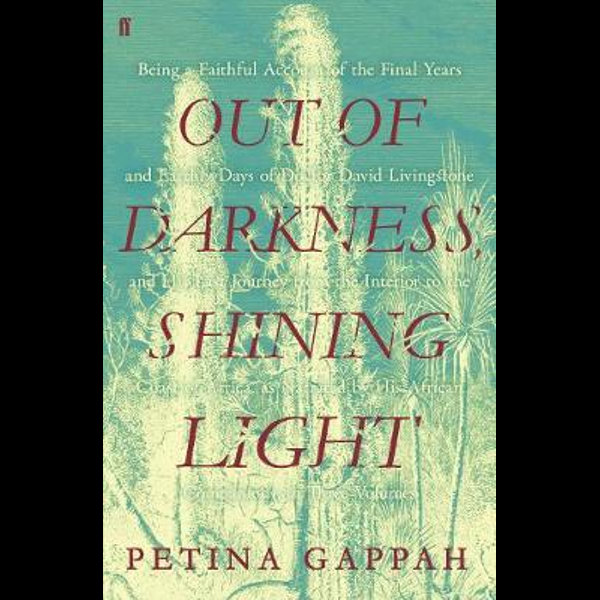
It’s a peculiar thing, synchronicity, but when  it happens, it feels as if it was meant to be. Like reading two books, Fred Khumalo’s The Longest March (Umuzi) and Petina Gappah’s Out of the Darkness, Shining Light (Faber&Faber) in close succession.

Both of these are novels that focus on marches in the past, both retell the stories from another point of view, and both are based on fact with a fictionalised retelling which reimagines what might have happened in much more detail.

It is a time for many to relook at their histories which have always been told from the conqueror’s point of view, and on this continent that means told from a white perspective, often downplaying or more often disregarding any other point of view even when it was their story to tell or there was participation which shouldn’t have been avoided.

Like so many of these stories from our past, depending on the colour of your skin, they come as a complete surprise.

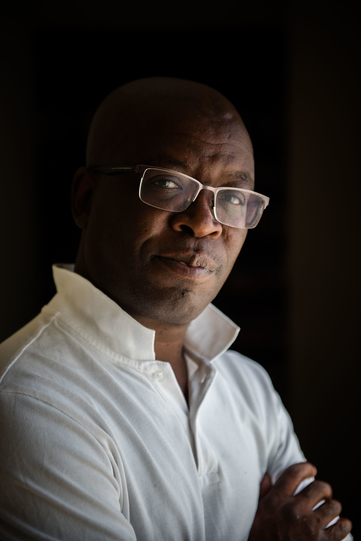
Book Khumalo-pic-resized
Fred Khumalo

I start with Khumalo, because his story is closer to home. The facts weren’t familiar to me, giving the novel a fascinating backdrop. Approximately 120 years ago, 7 000 Zulu mineworkers walked from the gold mines in Jozi to Natal, covering a distance of 500 km over 10 days.

It wasn’t as if these men had a choice. When war is declared between the South African Republic and the British Empire, the mines are shut down and migrant workers are ordered to leave. But, there’s a problem. There are no trains running so the only way to get back home and away from danger is on foot.

Khumalo decides to tell a story with this as a backdrop as one of the miners, Nduku, decides to take his woman back home with him. Again, there’s a problem – she’s white. The only way to achieve this is to make her a mineworker’s wife and all this in spite of the couple having broken off their engagement.

There’s more than enough drama to go around – the physical and emotional journey for both Nduku and Philippa – who have to survive many mostly physical obstacles but also a handful of unseen and unexpected dangers.

It won’t be a South African story if someone doesn’t take advantage of those already in trouble. On the sidelines yet part of the journey is a group who are hoping to cash in on the salaries of these migrant workers on the long march home.

It’s gripping stuff and Khumalo is a supreme storyteller, but more than anything it was the march that really intrigued me. Of course it’s not something that was part of our school history during the apartheid years, and I would be joyous and surprised if it has become part of the curriculum even now.

But to discover and learn about this extraordinary sidebar during one of our many wars at the turn of the century is exhilarating. This is what is supposed to happen in a more enlightened time in a country.

Histories should be re-written and retold to reflect the role of everyone who was part of the story. For far too long the world has listened to too few voices simply because they weren’t there or drowned out by those who held the power.

Book out-of-darkness-shining-light

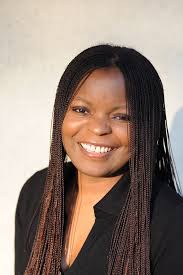
In similar vein, Zimbabwean author Pettina Gappa tells the story of a very different march but with many similarities. Most importantly it is about bringing the main players in this drama from the shadows into the sunlight as the title implies.

Most of us will be familiar with the name Dr David Livingstone but unless you are a history buff, few people will know the story of the body of “Bwana Daudi – the Doctor”.

This is the story of the 69 men and women who carried his remains over 1 500 miles (imagine that!), so that he could be taken back to his homeland across the sea and thus buried in his own country. The heroics of even contemplating that deed make it extraordinary that this wasn’t part of our history.

But of course, never during apartheid and I again, I’m sure it still isn’t taught at schools or university as a general historical lesson. I’m not holding my breath that someone proves me wrong either – perhaps in some specialised field…even that would be good.

Bk Petina Gappah

Gappah is a fascinating writer, not only in the way she tells stories but also in the stories she decides to tell. This one, as you can imagine, is above everything else set in a time of slavery, which brings yet another dimension to the tale. The fact that Dr Livingstone gave his slaves their freedom didn’t mean automatically that that would happen. Sometimes it was also a better life to keep toiling as if you were still in the same circumstances as before.

But also the people’s dedication, that they would even want to carry a white man’s bones so that they could be sent for burial in  his homeland – at that time, is astonishing. In her acknowledgements the author notes that she spent 10 years on historical research. “But,” she writes, “I am under no illusion that this work is in any sense historically accurate. While rooted in historical fact, this novel is above all imaginative fiction.”

She points to a few historians but above all Thomas Pakenham, whose first chapter of The Scramble for Africa sparked the idea for this book as long ago as 1999. She adds that he was also both generous and kind when she consulted him on the project.

She believes she also had the privilege of consulting original letters, photographs, and other documents related to David Livingstone that are collected in all kinds of institutions, including the National Library of Scotland; the Peace Memorial Museum, Zanzibar; the David Livingstone Centre in Blantyre; and the National Archives of Zimbabwe in Harare.

“I especially want to mention the youngest Livingstone enthusiast of them all, dear Tayani Mhizha, who wrote a brilliant International Baccalaureate analytical essay on him at the age of seventeen,” she adds.

She also consulted many different letters and documents that are collected by different institutions around the world and pays homage to Livingstone Online, a programme initiated by all the institutions that are repositories for documents related to his life and travels.

Thanks goodness for technology – again! She concludes by saying: “The historians gave me facts, and my imagination supplied the rest.”

She also illuminates her writing with an introductory quote from The Last Journals of David Livingstone:

I trust in Providence still to help me. I know the four rivers Zambesi, Kafué, Luapula, and Lomamé, their fountains must exist in one region … I pray the good Lord of all to favor me so as to allow me to discover the ancient fountains of Herodotus, and if there is anything in the underground excavations to confirm the precious old documents, the Scriptures of truth, may He permit me to bring it to light, and give me wisdom to make proper use of it.

And then follows a most intriguing tale beginning with the death of Livingstone and those around him, how they made the decision to carry the body and everything else that happened during that final journey to the coast.

It illuminates much about the continent, the people, the period, how certain parts of history have simply been ignored as part of any narrative and the dangers waiting along the way for these intrepid warriors who were determined to do right by a man they felt deserved a final resting place in peace.

If only we would take the time to listen to Africa and its people more closely. It’s one of the reasons I love living on the continent – that people don’t speak with one voice but give us the chance to look at things from different perspectives. And then we can start living with some wisdom.

Giving voice to silenced perspectives has given a whole new way of experiencing the world.

Rock Legends Patti Smith and David Bowie Offer more than the Perfect Escape

Books are a uniquely portable magic.
― Stephen King, On Writing: A Memoir of the Craft


It’s a strange time when being at home alone (with family or perhaps a friend) can become quite demanding, but if you are privileged enough to have the luxury of viewing it as a time to take stock, catch up and get to all those things you love doing but never have time for, this will also be a time to read, read and read as much as you can. It is the perfect escape. This is the start of some suggestions by DIANE DE BEER in random fashion and as eclectic as reading can be for each individual. Hope you find some inspiration:

Book Yr of the Monkey


You have to know when tackling a Patti Smith book titled Year of the Monkey (Bloomsbury) to expect the unexpected.

Nothing about her life will be ordinary or familiar and a willingness to follow her on whatever journey she takes is a prerequisite to starting this equally melancholy and madcap journal.

Someone mentions that anything is possible, after all it is the Year of the Monkey, hence the title of the book which should be another loadstar to where these Smith meanderings might lead you.

It’s been a year of coping both with ageing (her 70th birthday looms) and dying, when her friend the producer, rock critic and manager Sandy Pearlman is hospitalised and yet another close friend and former partner, playwright Sam Shepard, is also deadly ill and needs her help to finish what will be his last book. (If you haven’t read her obituary of Shepard, it’s worth finding online.)

But first things first. Apart from these close encounters with friends and her own mortality, it’s also a helter-skelter time politically with elections in the air (and we all know how that ended) as well as Smith’s tendency to intertwine her different realities. You’d better be on your toes to keep track of her eclectic mind. Some might be fatalistic given her circumstances but others are quite fantastical as she starts communicating with an  inviting hotel sign with the name Dream Inn.

She doesn’t have everyday conversations and even loses a ride when she can’t stop talking even when warned she could only tag along if she didn’t say a word.

Whether you know and like her music or not, your enjoyment of the book depends on whether you fall in love with her eclectic lifestyle, her unusual way of making her way through life and perhaps, the age she’s at, which determines this somewhat fatalistic mood.

Along the way, she always has her camera on hand taking artistic shots of seemingly mundane features like an unmade bed in a nondescript hotel room, a writer’s shoes, a café in Lisbon and anything that catches her fancy or captures her mood.

This is not any ordinary diary but someone musing about a time in her life that finds her at particular crossroads because of circumstances beyond her control. We all know that place, but for someone with Smith’s particular capabilities, it takes what might be for many quite strange detours. It’s as if she allows the universe to dictate, as if finding it difficult to determine her own pathway right at this time.

We all know that feeling of drifting but few would actually take on the physical reality as well. Perhaps the end of a run of New Year concerts helped her along. Spent as she must have been, a time to unwind and throwing herself to the wind might make sense of a world that feels as if it is turning on her. The election of Trump also having some impact here. It is Patti Smith after all, how could it not!

If all this sounds dire because of the loneliness and a certain desolation, it is also a novel way of capturing your own feelings – especially in this time, making sense of a world that seems out of control and lending insight to others who might experience similar feelings without knowing how to get a different grip on life.

And in our present circumstances, this might be the escape some of us have been looking for. It is a writer who uses her imagination to inhabit a world she doesn’t understand – or even want to.

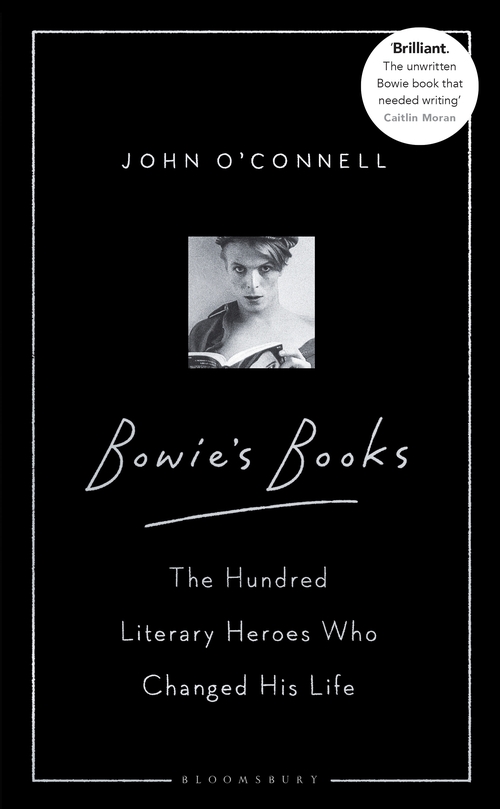
Book Bowie's BooksFor Bowie, one suspects, had he still been living, he would have dipped into one of the many books he loved, far beyond the 100 listed in Bowie’s Books: The Hundred Literary Heroes who Changed His Life by John O’Connel (with illustrations by Luis Paadin) published by Bloomsbury.
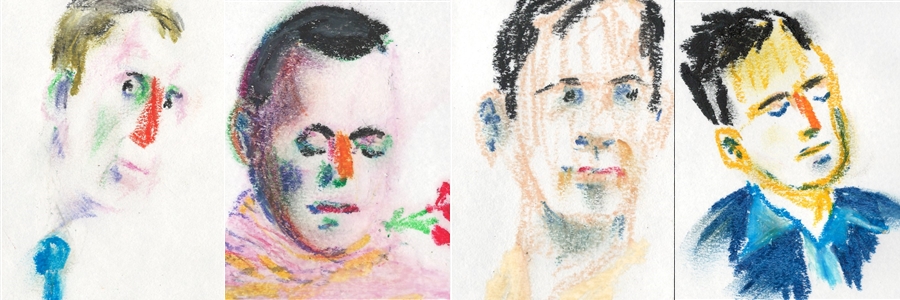
It’s a fascinating read, which tells you much more about Bowie while explaining the books. In the introduction that explains the writing of the book, O’Connel quotes a Sunday Times location report: “Bowie hates aircraft so he mostly travels across the States by train, carrying his mobile bibliothèque in special trunks which open out with all his books neatly displayed on shelves.”

This portable library sported 1 500 titles, more than enough so that he would never run out.

From March 2013, the Victoria and Albert Museum’s exhibition David Bowie Is travelled the world for the next 5 years. To coincide with the show’s first port of call, Ontario, the V&A issued the list on which this book is based, explains the author. It is the 100 books Bowie considered the most important and influential – not, note, his “Favourite books” as such – out of the 1 000s he had read during his life.

Bowie had through his life advertised his bookishness, according to O’Connel, not through interviews “but more obliquely in his work and in the range of masks he wore when he presented it to the public”.

We  learn, for example, that he didn’t do well at school – not through laziness it is surmised, or an inability to retain information, but rather, speculates the author, an impatience with formal education. He enjoyed teaching himself much rather than being taught by someone else.

He loved passing on the knowledge and passionately argued for a book he enjoyed to the extent that he started reviewing books for Barnes and Noble (book stores in the US).

One could also see the influence of different arts and genres in his work, in his songs, his presentations, even his album covers. That’s what makes this such a fascinating read for those who aren’t that familiar with his work

Bowie also liked playing games, says the author – hence the lists. “The V&A list is but one element of a game he enjoyed more than any other – curating his own mythology”.

One of the most incisive quotes in the introduction is something he said to Michael Parkinson during an interview: “I spent an awful lot of my life …actually looking for myself, understanding what I existed for and what made me happy in life and who exactly I was and what were the parts of myself that I was trying to hide from.”

O’Connel emphasises that the role reading played in  this quest cannot be underestimated.

It’s an extraordinary book and one that constantly surprises. The secret is in the way it has been written. With a 100 books to run through, O’Connel rarely gives more than two pages to a book in which he explains the author, who he is and what the book is about.

There’s also the significance to Bowie, a context in some way as well as insight not only into the book but also into Bowie himself.

It’s not necessarily one of those books about books that send you rushing off to read most of them. More importantly, it is about the man who read them and why he found them so significant.

Prue Leith: A Splash of Vibrant Colour

Pictures: Corne Ann Photography.

Prue Leith school

With her recent visit to the Prue Leith Culinary Institute in Centurion, mainly to celebrate their success as well as her 80th birthday, it’s her youthfulness that bowls you over. DIANE DE BEER finds out more about her unstoppable drive:

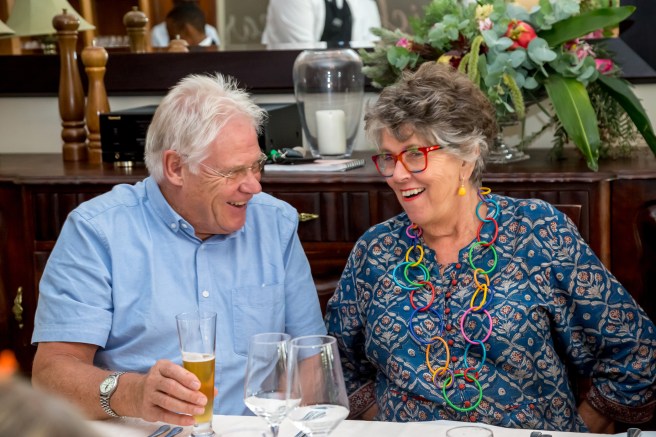
It’s Prue Leith’s constant refrain when talking about yet another venture, “I’m a  commercial woman”, and how fast she runs her life, that keeps her young. The energy obviously rubs off, that and her exuberance, her dazzling embrace of bright colours, and partner John Playfair who never stops the banter, but also gives a helping hand when she moves around the room for book signings.

Prue Leith and partner
Partners in cameraderie John Playfair and Prue Leith.

That’s just who she is. Instead of asking everyone to stand in line, she moves around the room to do the necessary with John in tow for selfies and anything else she might need, the perfect team.

In town for amongst other her birthday celebrations (she wanted to do some of that in Cape Town as well), she admits that she isn’t that happy that everyone knows her age. But when she opened her restaurant in London at the age of 29, she was loud and proud about the achievement.

Ever practical, Prue isn’t too fussed and chats happily about her many endeavours, of which her return to the food world precipitated much of what is bubbling in her booming business sphere.

Prue blowing out the candles...finally!
Hurricane Prue blowing out the candles in her exuberant style.

At the time of her first association with the food world, the British food establishment was in the clutches of Escoffier (but not in the right way, according to Prue), it had become stifled, always sticking to the rules and not taking heed of the great French master’s advice that one had to move with the times. “It was all about following the rules and if it wasn’t Escoffier, it wasn’t cuisine,” she says.

“You would find all the same items on the menus across London,” she says. When she left, she started campaigning in the food world for good school lunches, for example, and another successful launch was her fiction writing, which resulted in a clutch of novels and a revealing memoir. And she’s still writing because it is something she loves.

After a break of 25 years, she was lured back into the food world as a judge on The Great British Menu and discovered a brave new world. “It was so different with the chefs all turning to flavours from the  Middle East, for example,” and she found herself stealing their recipes.

Suddenly chefs were regarded as the great artists they had become and were taken more seriously. All of this appealed to Prue as after 11 years she was lured to The Great British Bake-Off, replacing Mary Berry when the show moved to Channel 4 in March 2017

Prue Leith dessert
An extravaganza of honey festivity, Ode to Bees,  at Prue Leith’s Chef’s Academy as they spotlight the role of bees with some food for thought.

Not only is it one of the most watched shows on British TV, it also has a huge younger demographic. “The children are all watching,” she says, which has brought her new-found fame in the food world. “I was absent for so long and suddenly there are new generations discovering me.”

Prue pretty in red
Prue, pretty in red, casts her much prized eye in the kitchen.

She’s excited about this younger generation who probably all start off baking cupcakes but even if baking is what gets them started, they will follow with cooking meals. She recently participated in the first Junior Bake-Off series with the children ranging in age from 9 to 15 years. “I thought it was unfair, that the younger participants would be at a disadvantage, but it wasn’t the case,” she says.

What she discovered during her conversations with the youngsters is that most of them learnt to bake and cook on Youtube. To her it doesn’t matter how it happens. “The more children bake, the more will cook,” she believes.

Prue Leith and another selfie...
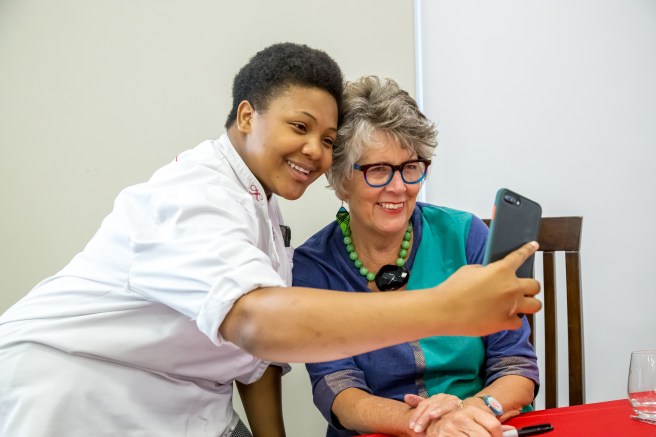
Prue Leith and a selfie with 2nd year student, Obakeng Chiloane.

Even a stop at a petrol station means endless selfie moments says John. But what really excited Prue with her re-entry into the food world was the opening up of new vistas. She published a new recipe book after a long absence and was urged by her publishers to start with an introductory book covering all her favourite recipes, rather than launching into a specific genre.

She followed this with The Vegetarian Kitchen together with her niece, pastry chef and vegetarian Peta Leith. “I have wanted to do this for ages but 25 years ago, my publishers advised that a similar title would not sell,” she says. Even though she is not a vegetarian herself, she has always been partial to vegetables and had a full vegetarian menu alongside the main menu in her Michelin-starred restaurant.

These days, she often opts for vegetables but isn’t preachy about it.

A totally new venture and one she’s eager to promote is her collaboration with eye wear specialists Ronit Fürst. She was quick to make a note of the many people that asked her about the brightly coloured specs she was wearing on Bake-Off.

They were hand painted and expensive but her timing was right when she approached the company to come up with a bright yet more affordable series which is now also available in South Africa. She advises that one simply googles Prue Leith glasses. I did and found a few optometrists in Joburg but with the range available locally, you optometrist should be able to get hold of the distributors. When you see the range, you will want them.

Prue’s advice: “Shoes and handbags spend most of their time under the table. Across a table, people are looking at your face – hence the glasses.” Always the sensible woman.

Prue Leith graduate
A graduate that gives them bragging rights.

And then to a matter of the heart. It took Prue a while before she became involved with a cookery school but from the start, she was hands-on with the Prue Leith College of Food (1997) named Prue Leith Chefs Academy (10 years later) and now another decade on, Prue Leith Culinary Institute. She visited sometimes twice a year and was always aware of what was happening and where she could offer advice.

Prue with the Prue Leith staff
Prue with the female-dominated staff at Prue Leith Culinary Institute: From Left to right: Nicola Eksteen, Executive Chef, Prue Leith CBE, Patron, Maria Dixon, Head of Training, Adele Stiehler-van der Westhuizen, Managing Director, Debby Laatz, Head of Academics .

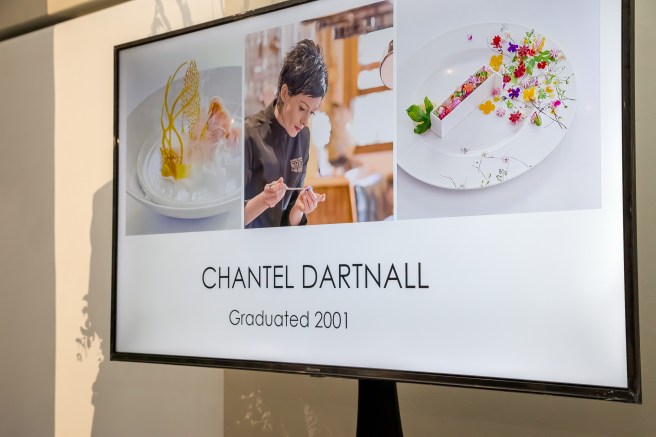
These days with the classy Adele Stiehler-van der Westhuizen as Managing Director and a brilliant female-dominated team of super chefs, Prue hardly has to do more than admire – and she’s smiling.

“I am so proud,” she says and as the trooper she is, she returns enthusiastically to yet another of the many functions hosted on this celebratory visit.

For more info, check http://www.prueleith.co.za

The Klein Karoo Arts Festival Cancelled Because Of the COVID-19 Pandemic

KKNK Dis 8.Waldi en Brendon en kat
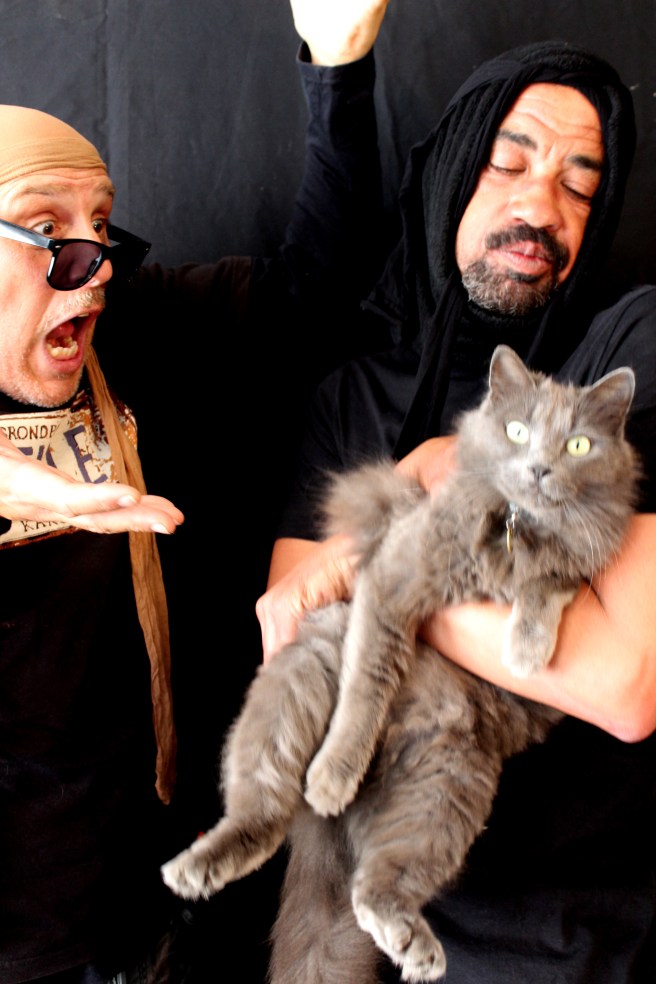
Waldimar Schultz and Brendon Daniels and the cat in Dis 20h15.

Unfortunately the KKNK Festival (promoted in story below) has been cancelled because of the COVID-19 Pandemic with all the Festival heads meeting shortly to find innovative ways forward for the arts. Watch this space….

The story below is no longer valid…

The Klein Karoo National Arts Festival (March 23 to 29)  has made sure that their entertainment package packs real punch. DIANE DE BEER picks a few favourites:

Nicola Hanekom is back at the festival with one of her fearless yet fantastic site-specific pieces Mirre en Aalwyn. She is well known for her work in this genre with her site-specific trilogy (Babel, Lot and Betésda) as well as the harrowing Land van Skedels, which had great success at the KKNK in the past. Vinette Ebrahim, Amalia Uys, Kenley Swart and Hanekom regular Grethe Brazelle star in this much anticipated production set in a dilapidated house just outside Oudtshoorn. Jessie returns to her parents’ home after an absence of many years with magical ideas and confrontation in her heart. During her visit, the family learns hair-raising things about her. Her way of looking at the world upsets the status quo.

Processed with VSCO with m5 preset
Tinarie van Wyk Loots and Brendon Daniels in Opdrifsel.

Opdrifsel, a new script, written and directed by Philip Rademeyer, features Tinarie van Wyk Loots and Brendon Daniels as a couple dealing with the death of their teenage son. They grieve in different ways and battle to understand one another. They have many questions but few answers. There are regrets, accusations, anger, heartache and closed doors. Mainly it is about a couple who are overwhelmed by their sorrow and have to find a way out and forward.

It is so worth watching Rehane Abrahams in in Brandbaar, a translation of her previously performed Womb of Fire. Accompanied in song by Lukhanyiso Skosana, it is a complicated but intriguing text that has to be experienced and explored. It’s about roots as told through different women with complicated backgrounds who find themselves in a world where their whole being in all its fullness is ignored. Directed by Sara Matchett, it is an extraordinary performance.

“We’re looking for the perfect coloureds for the future,” reads the headline in Die Son. Everyone is searching for a place where race and identity aren’t a priority and where you are seen as an individual and not the middle child. Starring Stephren Saayman, Jurgen McEwan, René Cloete, Shamim Gallie, Cole Wessels en Eldine Beukes, Dankie, maar nee dankie! has fun with the issues that dominate so many lives.

KKNK Die vermoeienis van vlerke
Die vermoeienis van vlerke with André Roothman, Chris Gxalaba and Henriëtta Gryfenberg.

Die Vermoeienis van Vlerke: is a translation of Lara Foot’s successful The Inconvenience of Wings which deals with the impact of disabling mood disabilities on friendships and family, directed by the luminous Sylvaine Strike and starring Henriëtta Gryfenberg, André Roothman and Chris Gxalaba in an exciting re-interpretation of this provocative play.

KKNK Wit Isse Colour 2
Ashwin Arendse in Wit Isse Colour directed by Jason Jacobs.

Wit Isse Colour: with writers Ronelda S Kampher and Nathan Trantraal and Jason Jacobs as director, brace yourself for some edgy brilliance. The script is based on Trantraal’s experiences and daily encounters as well as stories from published work in which everything from toxic masculinity to a re-imagined history of Autshumao and Jan van Riebeeck is explored.

Following their first successful outing, Brendon Daniels and Waldemar Schultz in their roles as Francois and Pieter, are planning a bank robbery in Dis 20h15. The problem to begin with is that they don’t know where to start! Pieter involves the worst character he knows, Billy from Cash Invaders, to help with their seemingly failed scheme. Will they pull it off? Will they find a bank? Will it be one they can rob? In this their second outing following Road Trip, let’s see if they can again capture the cameraderie.

KKNK Karatara Shaun Oelf (sitting), Grant van Ster (looming) and Dean Balie as narrator
Karatara with Shaun Oelf (sitting), Grant van Ster (looming) and Dean Balie as narrator.

Karatara, a physical theatre piece with Dean Balie, Shaun Oelf and Grant van Ster was one of my favourites at last year’s Teksmark. Based on the Knysna fires of 2018, it tells the story in dance and drama of a community’s loss. It’s a searing production presented in an excitingly novel way, very accessible yet charged with energy and emotion. A true gem which also explores the imprint of social media, interpersonal relationships, politics, history and the consequences of apartheid. The text is by Wilken Calitz and Shaun Oelf with choreography by Figure of 8 Dance Collective. Gideon Lombard is the director.

KKNK Kraai Wian Taljaard, Stian Bam, Wynand Kotze, Karli Heine
Kraai with Wian Taljaard, Stian Bam, Wynand Kotze, and Karli Heine.

Kraai is a Wessel Pretorius translated and adapted text by prolific and exciting playwright Mike Bartlett. Starring Wian Taljaard, Wynand Kotze, Karli Heine and Stian Bam, the story deals with Johan who decides to take a break from his boyfriend and then meets the woman of his dreams. He brings them all together to test his real feelings. It sounds both hysterical and explosive, the right ingredients for a blow-up.

KKNK Anna-Mart van der Merwe in Terminaal 3
Anna-Mart van der Merwe in Terminaal 3.

Terminaal 3 stars Edwin van der Walt, Anna-Mart van der Merwe, André Roothman, Carla Smith and Stian Bam in this Marthinus Basson-directed and -translated text by Lars Norén, who is regarded as the greatest Swedish playwright since Strindberg. The action is set in a hospital’s waiting room where a young couple are expecting their first-born, while a divorced older couple are waiting to identify the body of their 19-year-old child. The spotlight shines on self-interest and the damage that inflicts on children.

KKNK Zolani Mahola in The One Who Sings
Zolani Mahola in The One Who Sings

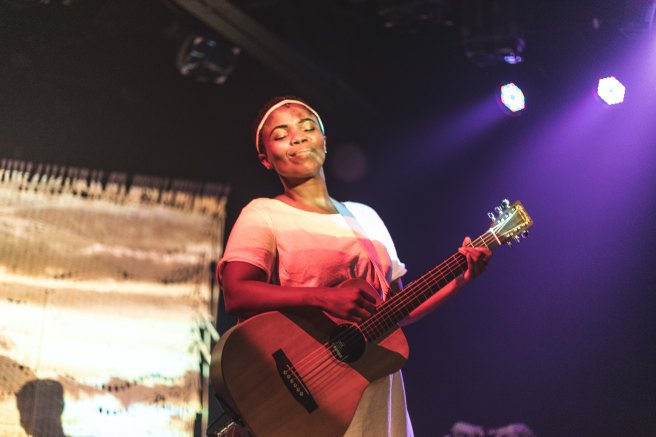
Following her soulful performance as an encore with Yo-Yo Ma at Kirstenbosch recently, Zolani Mahola directed by Faniswa Yisa performs in the The One Who Sings. She tells her personal story of growing up in the Eastern Cape during the ‘80s, a world of exclusion and moving into a more inclusive world in the ‘90s as she starts her professional career. It combines storytelling and song as just this extraordinary voice can achieve.

KKNK Waterbrief Minke Marais
Waterbrief with Minke Marais

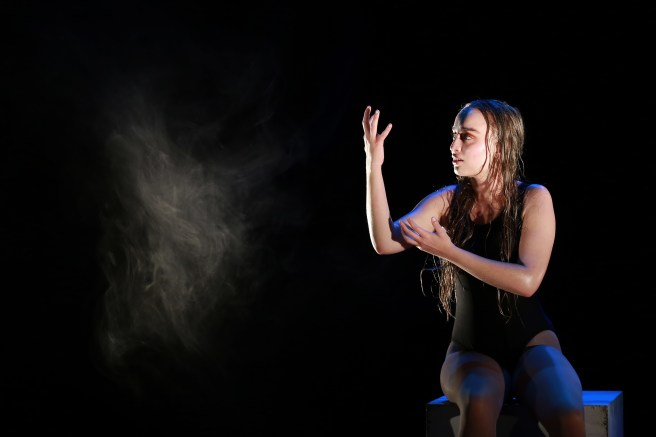
Minke Marais stars in the other-worldly text Waterbrief by Nico Scheepers and tells the story of Nina captured in the montage of her family who will be torn apart without her presence. Enveloped in the blue and white tiles of the swimming pool where she dives, she is drifting – everywhere and nowhere – as she watches her family in distress.

And for those who haven’t seen the much praised Tienduisend Ton, Kamphoer, and Queenie Hulle, they should top the list.

There’s much to recommend in other genres which have to be explored, but something that caught my attention is the David Piedt Conversations. He has a long history with the KKNK and has this year been honoured for his innovative contributions by Kunste Onbeperk, but the more hidden side of this Klein Karoo native is his transformative journey from bitter and challenging political activist to someone who practices forgiveness and reconciliation in his own life as well as on a more public platform. He believes his involvement with the KKNK and as such the arts and Afrikaans, played a huge role.

In conjunction with the Mayo Angelo philosophy: “the greatest tragedy in life is untold stories”, this conversational series aims to create an intimate space where people can listen to one another’s stories and contribute to the cohesion of the democratic South African tapestry.

These conversations start with Piedt and his wife Marjorie who share their emotional history and their personal life’s journey. This is followed with conversations by other Oudtshoorn inhabitants and is set against the backdrop of their experience during apartheid and how that influenced and impacted on their decisions, choices and way of being in the world post 1994.

Ivor Price will lead the discussions.

 There’s also an extremely strong and diverse music programme

And probably the two highlights will be two performances in the Cango Caves, a rare occurrence.

KKNK Karen ZoidFirst will be Karen Zoid Unplugged on March 27, an acoustic performance with guitarist Henry Steel and on March 28 Steinway pianist Charl du Plessis will be playing selections from his first solo album Freehand as well as the music of Rachmaninoff, Chopin, Beethoven and Bach.

This hasn’t happened in 24 years, which won’t happen any time soon – if ever.

KKNK Charl du Plessis

Du Plessis will be the first pianist to present a performance on a Steinway in the Caves on International Piano Day. Strict rules will be applied to avoid any damage to this historical site and for Du Plessis, it is a dream come true. “The space, the acoustics, the darkness and the sounds that will embrace everyone!”

Karen Zoid agrees: “I feel very privileged to perform in the exquisite, historical treasure. Not everyone can say they have performed in a cave!”


Go to www.kknk.co.za and check the full programme for your own selection.


Visionary Dinners by Consumer and Food Sciences at UP Future Africa Campus

A couple of departments from the University of Pretoria combined forces to focus on foraging, future African foods and a South African menu, which embraces not only the skills but also the cuisine worth celebrating on our continent last year. With food memories still lingering and their latest indigenous dinner on the horison, DIANE DE BEER captures the experience:

Future Africa pictured by Kaylan Reddy
Water feature and indigenous plants at UP Future Africa Campus. Pics by Kaylan Reddy.


“Enjoy the fruits of our labour,” invited Sandile Finxa, one of the final year Hospitality Management students from the Department of Consumer and Food Sciences of the University of Pretoria.

They were hosting (and she was responsible for the menu) a special dinner to celebrate our indigenous food of which some of these ingredients were foraged on their Future Africa Campus where the dinner was held.

The Future Africa campus is the new research facility of the university with specially planted gardens purposefully designed and developed to cultivate and produce edible and indigenous plants.

Much of the expertise and help was extended by botanist Jason Sampson from the Department of Plant and Soil Sciences, the man responsible among others for the botanical garden on the main campus of the University of Pretoria which holds a collection of living plants that is scientifically managed for the purposes of education, research, conservation as well as community service.

With all the UP gardens, Future Africa included, the aim is to raise awareness of our indigenous plant heritage and if you’re fortunate to be taken around the campus by Sampson, it becomes a living organism with aloe walks on the Hillcrest campus and his magnificent fully fledged plant wall for the masterfully designed Plant Science building which functions as insulation as well as an aesthetically pleasing feature while also mimicking the natural habitat of some very unique plants.

Future Africa by Kaylan Reddy
Scenes from Future Africa

He is a font of knowledge and with his passion for especially indigenous flora and to the benefit of the Consumer and Food Sciences students, a love of food, he walks you through the Future Africa gardens, still in their infancy but constantly evolving, and if you listen to him talk, have dishes rolling off his tongue.

“We developed a menu to celebrate and use some of these ingredients that we were able to harvest and include them in our menu (like water chestnuts and makataan),” explained associate professor Gerrie Du Rand in charge of the Hospitality Management Final year students who prepared the dinner also under the guidance of Dr Hennie Fisher.

Future Africa4
Some of the Future Africa indigenous gardens.

“What is also exciting about this garden is the fact that many of these plants are unusual and not freely available and it provided our students the opportunity to celebrate these ingredients in a challenging manner with an unusual menu.”

In fact, as Finxa explained, in case you’re wondering who did the harvesting of the products that found their way onto the dinner plates, they had to get into bathing costumes to pick the water chestnuts, but the results were well worth the effort. And the learning experience for the students, many of whom had never heard of some of these ingredients, was invaluable.

With a visiting professor from the US raving about the menu and resulting dinner, it was obvious that this kind of meal could have a huge culinary impact on foreign visitors. But also, local diners. How many of us would think of serving ting in risotto style?

UP menu advisor
Menu advisor Sandile Finxa


The menu was priceless. According to Finxa, the menu was inspired by the gardens of Future Africa. “Each item was made with the intention of highlighting the very rare, but indigenous plants of Africa found within our gardens,” she noted.


Calling our taste buds to attention, the amuse bouche consisted of savoury Msoba panna cotta, a pickled aloe aborescens and spekboom salad with wild African sage croutons. Sounds like a mouthful but the different flavours and textures combined brilliantly.

UP amuse bouche
Amuse bouche: savoury Msoba panna cotta, a pickled aloe aborescens and spekboom salad with wild African sage croutons. Dinner pictures by Marlow du Plessis.

Perusing the menu, she explained the different choices and methods selected. “Umsoba/Msoba, also known as nightshade/nastergal, are traditionally used to make sweet jam. The plant has a savoury flavour and beautiful purple hue and so we adapted it to create a savoury dish instead.”

But it didn’t come easy. After many mishaps to keep the beautiful purple colour, they added some vinegar to the process and voilá. The big-leafed spekboom mixed with the pickled aloe aborescence is a different version of the one that has become so fashionable these past few years and packs an even bigger punch.

UP starter
The starter: a panfried amadumbe gnocchi on African water chestnut mash with roasted balsamic beetroot, guinea-fowl and beetroot extract and biltong dust.

The starter, a panfried amadumbe (root vegetable) gnocchi was served on African water chestnut mash with roasted balsamic beetroot, guinea-fowl and beetroot extract and biltong dust. “Cornstarch was used for the amadumbe instead of flour making it gluten-free and the freshly picked water chestnut (à la swimsuits) with twice the nutritional content, has a sweeter, nuttier taste than the tinned variety and also retains a crunch after being cooked” which adds to the eating pleasure.

UP table deco
Imaginative table setting.

These two introductory dishes telegraphed the splendour of the rest of the dinner. With the mains centred on the seared sous-vide Kudu loin with ting (mabele/sorghum), prepared risotto style most spectacularly, it was embellished with butter-tossed waterblommetjies, rooibos-smoked carrots, creamed morogo and a venison red wine jus.

Showing off the versatility of ting was why it was done risotto-style and it worked magnificently. Could this perhaps be our first African-inspired risotto?

The amaranthus plant (known as Marog) is grown on the university campus and was served in a special Pretoria nostalgia-tinged way – creamed. It was a hearty and inspired presentation.

UP dessert
Dessert: milktart given a playful twist by turning it into a macaron filling with amarula.

Dessert was a traditional milktart given a playful twist by turning it into a macaron filling and with amarula, one of our most loved cream liqueurs paired to create an ice cream. Kiwano (commonly known as African horned cucumber) was turned into a gel, introducing a refreshing flavour and brightness to the dish.

With a sweet packet of glazed makataan as a take-home gift, a Cape-Malay koesister and coffee on the way out, the dinner represented an African taste sensation served in stunning style.
Robertson winery and Fat Bastard sponsored the beverages with grand aplomb.

Future Africa
The spectacular UP Future Africa Campus.

The innovative architecture of the Future Africa room, the flora and fauna from their gardens serving as table decorations, and as close to an early African summer night in Tshwane, mid-winter, all combined magnificently.

If this is where the culinary skills of our future chefs are focussed, bring it on. For too long, we have been serving often exquisite food to our foreign guests but apart from the odd braai or bobotie, not indicative of our very own culinary riches.

What these young students managed to achieve was a dinner flavoured and textured proudly South African.

Combining strengths and forces, Dr Hennie Fisher and Prof Gerrie du Rand and their Consumer and Food Sciences students, director of Future Africa Prof Bernard Slippers and his team as well as inspired botanist and curator Jason Sampson from the Department of Plant and Soil Sciences, all from UP, have established a benchmark in South African cooking which should be expanded joyously.

It was one of the most visionary dinners held by The Department of Consumer and Food Sciences, and again, the head of Consumer and Food Sciences of UP, Prof Buys, in partnership with Chilean Gastronomic Engineer, Prof José Miguel Aguilera, is hosting an evening of indigenous African Cuisine prepared by the final year Hospitality Management Students.

The dinner will consist of four courses, each with a specially selected wine and will be held on Friday, 13 March at the Future Africa Hillcrest UP Campus. Dress is semi-formal, the dinner costs R350 per person, and booking will only be confirmed once payment has been received.

For further enquiries and bookings: email Taylen Kench at u17196982@tuks.co.za


Majak Bredell is an Artist with a Mission

Majak Bredell n1983 study
Majak Bredell – 1983 study

Majak Bredell is one of those artists whose exhibitions feel like an adventure you’re undertaking as she maps out the journey you’re embarking on. DIANE DE BEER tells some of her story:


Majak Bredell - Self portrait 1995 (002)
Majak Bredell – Self portrait 1995

Majak Bredell’s upcoming exhibition(s), MAJAK BREDELL: THE NEW YORK YEARS: 1981-2003, is a case in point. Not being someone who believes in keeping it simple, it is a curated collaboration between the Association of Arts Pretoria and the Pretoria Art Museum suggested by the association’s director Pieter van Heerden.

When you can, go big, is what Majak does well and because of the scope, she was thrilled about the collaboration.

The two part retrospective overview in the two galleries is accompanied by a full-colour catalogue that includes an essay by the curator, Prof. Elfriede Dreyer.

Looking back at her life, when Majak emigrated to New York in 1981 with her husband and two young children, she embarked on a journey that would lead her “from the confines of a traditional marriage on to the riches this world-city had to offer a searching artist.”

Majak Bredell Gesture Drawings
Gesture drawings

The works on show at both the venues cover a period of 22 years that follow the trajectory of the artist’s initial confrontations with issues of belonging and dis-belonging as the chasm between her mother country and her adopted home were mediated in both image and poetry. Several artist’s books with images and bilingual poems resulted from this.

majak poetry
A page from Mother Passage which has been framed for the exhibition.

The Association’s showcase is an introduction together with a book titled Mother Passage, which includes 20 etchings and 20 bilingual poems, all of which she had framed so that it can be viewed in a particular way in the gallery.

The Pretoria Art Gallery covers similar themes and it was helpful to have a curator like Prof Dreyer who could pull things together. “There are so many works,” says Majak, “we could only use half of all the actual pieces.”

She also has a slideshow of all her workbooks and sketches and she was still crossing fingers (at the time of our chat) that she could achieve it technically – so that it could run on a loop. “It’s been put together in no particular order, no narrative, so that people can start watching at any point,” she says and it will take 33 minutes. Nothing is left to chance. She also has text cards throughout her exhibition to guide the viewer. “I’m covering a big arc,” she acknowledges.

This is an artist who very early on in her career knew that she didn’t want to use her art to make a living. “My lifeline couldn’t be diluted,” she says earnestly. She wanted no compromises. Instead she made a living as a graphic artist, something which has also stood her in good stead because she can self-publish her amazing catalogue for example.

Majak Bredell - Study for mother passage (002)
Majak Bredell – Study for Mother Passage

Bredell states in that catalogue accompanying the exhibitions:

“Through art-making I quarreled with the legacy and unyielding demands of the patriarchal Calvinism that shaped my childhood in the 1950s South Africa. This journey, accompanied by Jungian therapy and much reading, eventually led me to a gender shift in the image of the sacred, culminating in my resurrection of ancient notions of the great mother, goddess, the sacred female.

“In this process, I imagined an embodied reflection of those parts of being that had been marginalized or rejected by western monotheism’s misogyny and its casting of the sexual female body into the abyss of so-called original sin. During my sojourn in that great city, art-making remained my passion despite limited exhibition opportunities.

“Longing  for my mother country and the loss of a South African identity eventually precipitated my return to South Africa after a hiatus of almost 23 years.  By which time my identity had shifted to include my New York identity that I wore like a second skin — a double identity I wear to this day.”

Majak Bredell 1998 Arc of Life
1998 Arc of Life

Since her return to South Africa, the themes developed in New York were further elaborated and exhibited:  2009: Alter Images: The Black Madonna & Sisters; 2013: Roll Call: a vindication of the lives and bodies that were destroyed during the centuries-long European witch persecutions; 2016: Codex Magdalene+: towards a new iconography and re-imaging the mythology and legends of Mary Magdalene; and her current works in progress, Earth/Body, that explore dialogues between the human body and the body of the earth.

And underlying all of her work is her quest to emphasise why the gender of God has done such damage to women’s bodies and a sense of self. “I was highly influenced by the writing of the spiritual feminists,” and she rattles off a slew of names as well as the website www.feminismandreligion.com for anyone interested.

Do yourself a favour. Set aside a day, or perhaps two mornings or afternoons to break it up. Visit both exhibitions and do them thoroughly. It will be like reading an extraordinary book by a remarkable woman sharing her soulful story.


majak4
A favourite dress – layers of being. Graphite and charcoal on Arches cover paper

Details of the Pretoria exhibitions:

1: — an introduction to the work
Opening:  Friday 6 March 2020 at 7pm

THE ASSOCIATION OF ARTS PRETORIA
173 Mackie Street
Nieuw Muckleneuk, Pretoria

Opening speaker: Dr Avitha Sooful

Walkabout by the artist:  Wednesday 11 March 2020 at 12 noon

Closing:  Wednesday 25 March 2020 at 3pm


2: — the comprehensive exhibition
Opening:  Saturday 14 March 2020 at 11 am

THE PRETORIA ART MUSEUM
cnr Francis Baard and Wessels Streets
Arcadia Park, Pretoria

Opening speaker: Prof. Elfriede Dreyer

Walkabout by the artist:  Tuesday 24 March 2020 at 11 am.

Closing:  Sunday 14 June 2020

Bredell’s book, SACRED SCARS, will be introduced at the Association of Arts Pretoria at both the opening and at the walkabout.  The artist researched and compiled images that represent humankind’s embodied relationship to the sacred female in art and artefacts dating from pre-history to the early modern period.

#MeToo Movement Marches Forcefully Against Powerful Monsters who For Far Too Long Had Their Way With Women

It’s been a momentous time in the #MeToo sphere with the Harvey Weinstein convictions – finally. And even with two hard hitting books out there detailing all the women and what they have gone through, the jury still found him culpable of only two of the five counts. With many other similar issues swirling about, DIANE DE BEER speaks her mind:

Harvey Weinstein at court
Harvey Weinstein playing the victim at his recent New York trial.


There’s hardly a woman who works professionally that won’t have some kind of memory about sexual harassment. I suppose with everything being aired these past few years, those of us who haven’t suffered sexual abuse should count ourselves lucky.

But I was surprised about my emotional response to Bombshell, the film starring Charlize Theron, Nicole Kidman and Margot Robbie about the horrific abuse by Roger Ailes and many more who were part of the Fox empire.

I had seen and was fascinated by The Loudest Voice, the TV series told with the accent on the bullying tactics of Roger Ailes and the culture of sexy women he created in the Fox Newsroom and on screen.

Bombshell poster
The poster says it all! Power in triplicate!

When Bombshell arrived, I felt I had viewed enough of this particular story, until someone whose judgement I trust told me to see it as this was from the women’s point of view. I didn’t realise the impact that would have on a very personal level which says so much about the culture most women find themselves in at work.

We don’t even notice because it is so prevalent and probably to most of us “normal”, so when seeing this particular film, which shows especially the environment created specifically so that this kind of thing can flourish, my flesh crawled – to my surprise.

But it was no surprise that with the final credits a notice announces that the women received 50 million dollars in damages: while Roger Ailes and another Fox News accused, Bill O’Reilly, received 65 million dollars’ worth of parting packages.

Fox News is the extreme so there’s no turning away from that aspect of the film. And with these three powerful actresses in control, it resonates dramatically and memories came flooding back. “How are the dollies doing?” was a particular rankling phrase coming from a boss or the fact that you were told that your salary increase was determined by the fact that your partner worked in IT. “That means he earns big bucks,” was the feeling. And the list of constant humiliations goes on.


And then when these men are “caught”, they are so powerful that they manoeuvre everything and everyone around them. Read Ronan Farrow’s book (reviewed in this space earlier) Catch and Kill and She Said and see what happened to these award-winning writers in the process of writing the book. It wasn’t only Weinstein who came out guns blazing, he had many who colluded and further made it tough for anyone who wanted to expose his evil practices.

And perhaps what upset me the most was the humiliation that these women, many of them with powerful careers (and not because of Roger Ailes), had to go through on a daily basis. If this is the man who employs you, how does the rest of the world view you? He in fact lays down the rules of how you appear on camera and what you are allowed to say.

Something that was always an unwritten rule in media was that your newspaper had your back if those on the outside were upset with your reporting of the facts – the newspaper would stand up for you and in that way, bring balance to the power dynamic. But that’s not what happened at Fox. When Fox news correspondent Megyn Kelly was taunted by President Trump, it was another stick in the Ailes arsenal to keep her in line.

These constant games are also part of the ritual to keep everyone functioning in place and not to overstep or rock the boat. You learn very early on when to hold back and when to fight for specific rights. Some you win and others you lose.

Others make you smile – wryly. The first time women were really promoted into certain positions was post ’94 when they were included in the list of appropriate candidates because of the neglect in the past.

Suddenly in newspaper offices around the country, women started appearing in management positions and even the first female editors started to emerge. It wasn’t a sudden belief in the ability of women. White men just thought them the lesser of all the evils!

Bombshell Robbie
Bombshell’s Margot Robbie represents the epitome of what Roger Ailes wanted the Fox women to exude.

And so one could go on and on. And that’s why women around the world were thrilled about the Weinstein conviction but…

And said best by the following tweet:

Shailja Patel: @shailapatel: (Kenyan poet, author, feminist, activist, now self-exiled after she accused a fellow Kenyan writer of sexual assualt and was ordered by the court  to pay damages and apologise to the man who assaulted her, so she left the country.)

No guilty verdict of jail sentence, even for life, can restore what Harvey Weinstein stole from his victims. Or repair the harm he inflicted on his decades-long reign of terror over an entire industry. But this is a tiny crack in the wall of impunity. Let patriarchy tremble.

She nails it!. So while we all watch and wait, the battle goes on but at least because of their shining a light so strongly, the #MeToo movement is starting to show results.

Freehand is the Personal Story of Pianist Charl du Plessis and his Life in Music

Freehand Cover

The whirlwind that is pianist Charl du Plessis’s life has meant that more than 20 years into his performance career, he is finally releasing his first solo album. He reveals the thought processes behind Freehand to DIANE DE BEER:


Pianist extraordinaire Charl du Plessis is all about improvisation – not only on the keyboards but also in his life. He has to be. He has that many projects in the air at a given time, and constantly has to juggle.

Stepping off a plane from an international destination, he runs to catch another flight to make a concert as Nataniël’s accompanist the following day and then he rushes from there to catch up with the Charl du Plessis Trio who are also releasing a CD at the Woordfees in March.

But with improv part of his game, he will be performing his latest and first solo album,  Freehand, at the Atterbury Theatre (and in concerts throughout the year across the country) on Sunday at 3pm, followed by a performance in the Cango Caves just outside Oudtshoorn on March 28 at 8pm as part of this year’s Klein Karoo National Arts Festival (KKNK), bookings opening on Saturday (February 21). This hasn’t happened in 24 years and is a rare event, which won’t happen any time soon – if ever.

He will be the first pianist to present a performance in the Caves on International Piano Day. Strict rules will be applied to avoid any damage to this historical site and for Charl, it is a dream come true. “The space, the acoustics, the darkness and the sounds that will embrace everyone!”

The origin of the solo album began with unwinding after concerts and a hectic touring life. Arriving home and wishing to unwind, this Steinway artist would sit and tinkle on one of his two Steinways (one a new acquisition) playing music that’s gentle to his ear. When he felt it was time for a solo album  – finally – it was to these excursions in his mind that he decided to escape to.

He would sit down at the piano, and we all know that end of day feeling, and start playing. This was music that he liked listening to and never to please anyone. It’s mostly gentle and spontaneous, yet once he decided this was the way to go, he would practice improvising according to a specific mood, a moment or an object that would take him to a specific place.

“I didn’t feel I had to prove anything,” he says about this solo attempt – and many of his fans would say about time.

But of his many endeavours, where Charl has also excelled is planning his own career. Any solo career is a challenge as an artist. You only have yourself, your skills and a professionalism which helps you to sell and establish yourself. But mostly you’re always on show.

And one of his attributes is coming up with new ways of making music – classical, jazz and simply a melody that he finds enchanting or a composer he wants to showcase. He would contact a fellow performer or two or three and put together a show.

_DSF5929

What is truly impressive is that these shows always had a specific individuality and originality and never felt forced. This was an unusual yet also deliberate route. And those who know Charl’s work would have expected something as smart as Freehand to go solo with.

He is celebrating two decades as concert pianist in both classical and jazz  spheres. This is not typical but from the start (and I witnessed his first jazz competition in which he competed against some of the top young talent in the country, achieving a brilliant second place), he felt comfortable in both spaces. “I have had true musical satisfaction in combining my passion for various styles in crossover arrangements for multiple projects with my trio, with orchestra or solo,” he writes in his album notes.

This one specifically captures his own voice – an important step for especially solo artists. He describes this way of playing piano almost like an artist doodling or a chef who after a particular stint in the kitchen would crave comfort food not fine dining. And once he knew this was what he was going to do, he turned to fellow musician, the Trio’s drummer, Peter Auret, who is also an award-winning recording engineer, to record this pet project. It took three solid days of spontaneously improvising at the Etienne Rousseau Theatre in Sasolburg  – no rules, no preconceived ideas.

They have worked together before and the reason Charl is comfortable with this particular artist is that he feels no judgement. This was a project that felt very personal, a statement as a first solo album, but Charl also needed it to be far removed from critics, purists and conservatives.

Living and working in this world, especially in South Africa, he knows the pressures. It’s a tiny but hugely critical community and can sometimes inhibit artists to try something new – the essence of being an artist. By chance I heard some critics talk about his first Freehand performances and it was clear that he had found something truly unique to share with an already adoring following. But that’s how you get there.

Once the recordings had been made, the process was still on-going. “I left it before listening for five months because I needed some breathing space and distance,” he explains. Then he was called to choose some tracks because these improvs didn’t yet have titles. Following the completion of the album, which then had to be performed, he had to relearn the pieces that had flowed from his imagination.

“I couldn’t even recognise some of the pieces when I listened to it the first time,” he says. “This is what I love about spontaneous music making: the unpredictable journey, the freshness, the honesty, the energy, the enjoyment,” he concludes in his album notes.

The success has been sweet and he walked off after that Aardklop run with the best musical production award. Something that has been rewarding too which he didn’t take into account was the mobility of the project. “I’m reaching different audiences because I can pack up, travel and play,” he says – from Upington to Vleesbaai and from Shanghai to Switzerland.

Charl knew early on  that he didn’t want to travel the typical classical route. He needed to find a voice that would catch the fancy of audiences – worldwide. He has done exactly that on a stage, probably the most difficult in the world. This is storytelling without words and demands that the audience truly use their imagination.

With all his different projects, Charl has made sure of that – and now for the first time, he hopes to capture them with a very personal story. Listen and make up your mind. I think it is difficult to resist.

For more detail and dates, check https://charlduplessis.com/