Nataniël at Play with Family and Friends

Edik book coverSiblings Nataniël and Erik le Roux partner in a book that captures the magic and mayhem of a French-styled lifestyle based on their four-season television cookery series Edik van Nantes, which finished earlier this year:


DIANE DE BEER


“Except for family, we don’t have things that old,” says Nataniël at a French heritage evening hosted by French ambassador to South Africa, Mr Christophe Farnaud, in celebration of the entertainer/TV personality’s latest book Die Edik van Nantes (Human & Rousseau, R370) co-written by his brother Erik le Roux, who was also co-presenter of the KYKnet cookery/lifestyle/travel programme consisting of four 13-episode seasons.

It all began with the younger Le Roux brother settling in Nantes after marrying Nathalie, who is from the area and introducing Nataniël to this city where he quickly lost his heart. Before that, he says, he only travelled to Paris where he had great adventures – amongst them Paul Gaultier remarking that he was the only overdressed person he had encountered in this city of high fashion.
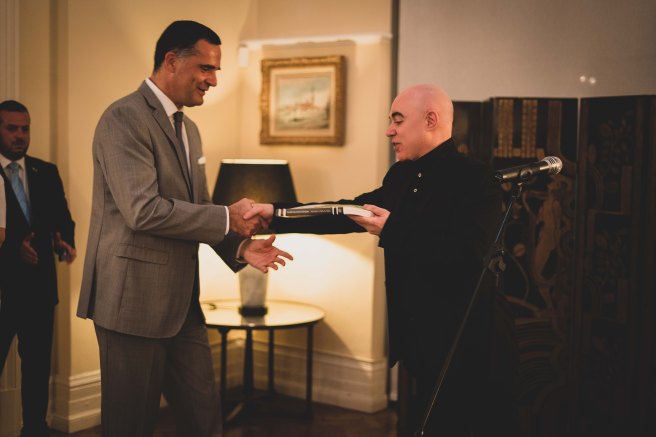
Nataniel and French Ambassador
Nataniël presents his latest book to the French ambassador in SA, Mr Christophe Farnaud

Once the siblings discovered that Nantes was their heritage, their great adventure followed as they searched for their roots, criss-crossing the region all the while cooking with both their French and Afrikaans heritage, coming into play. But they also focused on the arts and culture of the city and region, turning this into much more than just a cooking show.

They were also smart enough to know that you have to have a hook to hang a cooking show on (similarly with a book) to distinguish yourself in a market that’s saturated. “People don’t use recipe books anymore,” says Nataniël, “they cook from the internet. You have to give them more.”

He is amused by some South Africans who feel a sense of betrayal because of his love affair with many things French, but to understand his admiration, you have to understand his sense of adventure and added to that, a journey he could share and experience with his brother. “We could catch up and reconnect,” he says which is why he describes this as one of his happiest work experiences.

Not only could the Le Roux siblings research their heritage as descendants of the French Huguenots, but Nataniël could also discover and explore the culturally rich university city, now the home of family.

He describes Erik as someone who has the technique and experience of professional kitchens while he is a “rough home cook”. Erik notes that he loves eating more than cooking, yet they both acknowledge that food is the way too many hearts and hearty get-togethers with friends and family. “It’s an escape and a way to destress from a hectic stage career,” explains Nataniël, hence the book, which features the lifestyle and recipes the way these were presented in the television series in celebration of a city the artist now calls his second home.

His brother was always going to leave South Africa, because he couldn’t come to terms in a place where old men wear shorts, he notes.
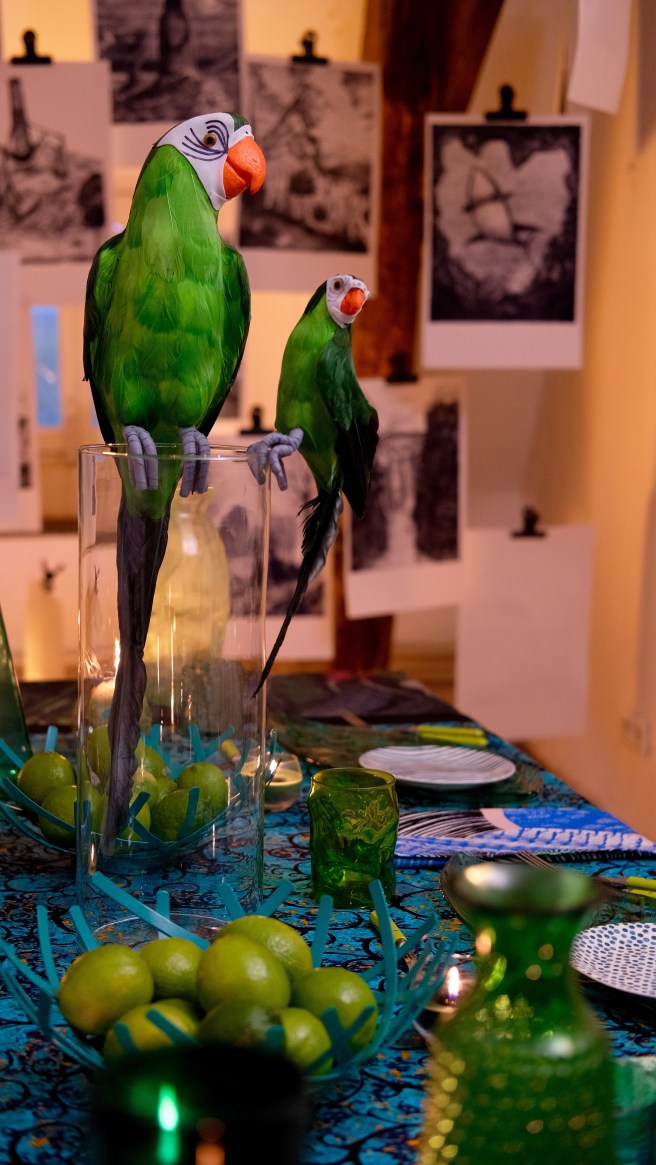
Nataniel's favourite table in the book
Nataniël’s favourite table in the book

And when Nataniël first wanted to visit his brother’s new home, Erik explained that he would hate the industrial city. But determined to recognise the region, it was a quick yet lasting enchantment. To the amusement of everyone at the French Embassy, he explained that Nantes was his French addiction. What he learnt in France was everything about inspiration, aspiration and even more importantly, intimidation!

“I love the way the city has welcomed me and my crew,” he explains. Doors were flung open and he was invited to film in renovated art museums, try their regional cuisine, tweak the recipes for local viewers, discover new ingredients in cafés, bistros and restaurants and share his French passion with his South African television audience. Because of their dedication to capture the essence of the city, these two bald brothers have also become a fixture in this North-Western French city.

Discovering a town that boasts everything from four upmarket paper shops, for example, to the largest puppet building company in the world, Nataniël knows how to flaunt it. He was thrilled to hand the Ambassador his first Afrikaans book on French culture!   “It’s a South African book on France without any lavender or rusted wrought iron,” he says, pointing to an overcrowding in this French oeuvre that he feels has leant too heavily on a specific nostalgia.

And followed that with a piano recital where he was joined in a piano tribute (with She and Emmenez-Moi) to Charles Aznavour by his accompanist, classical and jazz pianist Charl du Plessis (see picture).
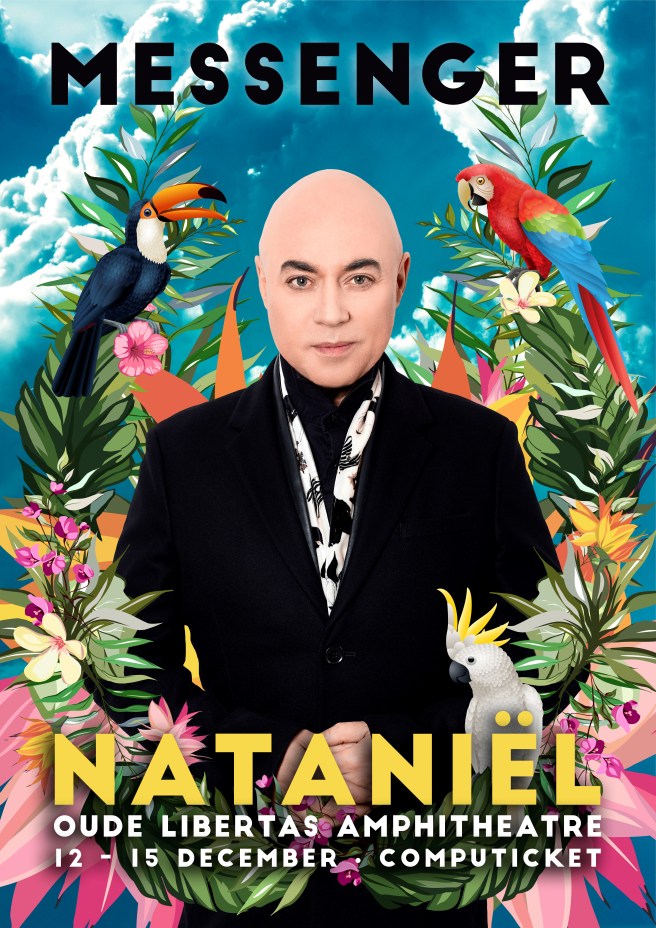
messenger poster

So apart from this latest book, which is already flying off the shelves according to the author, he is also finishing with his last short season in 2018, Messenger, at the Oude Libertas from December 12 to 15, following a short run at Pretoria’s Atterbury Theatre.

“A sign, a message, a suspicion, a proverb, a shock, a revelation, that’s how lives are changed, for the better or worse,” he notes. From the earliest miracles, legends and myths to new discoveries or internet filth, most of humanity live life overwhelmed by fear, trends, tiredness or hysteria. “This is what I wanted to explore, social phenomena that paralyze, surprise and rejuvenate.”

These are his topics of discussion in a show performed in a time usually associated with festivities and inspiration and you will find all of that in these stories told in either Afrikaans or English with music both self-penned (including Messenger, which is completely mesmerising) and established songs, like the soft Duke Ellington jazz ballad  It Shouldn’t Happen to a Dream..

Costumes are original and breath-taking in his own inimitable style and his superb musicians include Du Plessis (piano), Juan Oosthuizen (guitar), Werner Spies (bass) and drummer Peter Auret.

It’s a glorious way to conclude your cultural year with an entertainer who will have you laughing hysterically as he smartly underlines the madness we need to navigate in our modern world.

Booking at Computicket.


Meandering in the Midlands is Magical

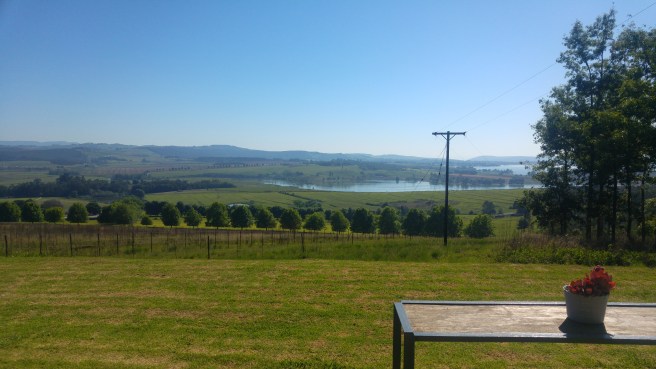
20181111_080313
View of the Midmar dam from Lake House

DIANE DE BEER

In our stressful world, all of us should respond to the need to get away. The Kwazulu-Natal Midlands is around the corner for Gauteng with ‘meander’ the verb that encapsulates this scenically spectacular part of our country:


The Midlands reminds us of a country rich in things to do and places to go.

The choices of how you do it are many and will be determined by what you want to do and how active you want to be. Price also comes into play because this is a popular area for many things, weddings included, as well as the Midlands Meander, which offers a leisurely way of exploring the countryside by crisscrossing the area in search of artisans and artists selling their wares. Like anything else, this has also become commercially driven more than the initial ideals of people making and developing their own, but there’s enough of the real thing left to keep everyone happy.

It’s not always easy to find them but with smart phones, everything is possible today and much of the discomfort is dissolved as you find a map or a phone number which will quickly explain and navigate the route. The roads might also be an obstacle for some, but this is not speed racing and if you amble along, even the challenging ones will be easy to navigate.

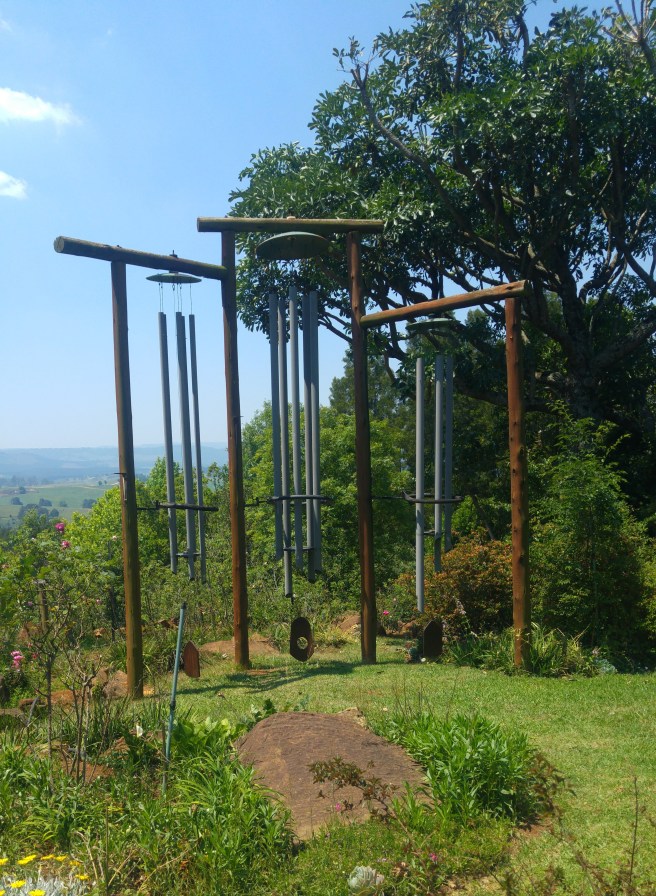
Personal favourites on the Meander included the Terbodore coffee roasters with simply the best coffee to drink (also available online), clothing companies, including well designed and locally made canvas bags and cotton shirts at Dirt Road Traders, irresistible handmade shoes at the Groundcover Leather Company, homemade goat’s cheese with delicious options at Swissland Farm, the extraordinary family-run Culamoya wind chimes and a really cool kitchen shop Cookin at the more commercial end of the Meander at Piggly Wiggly which was really an anomaly on the meander yet hard to resist.

Glorious Culamoya wind chimes

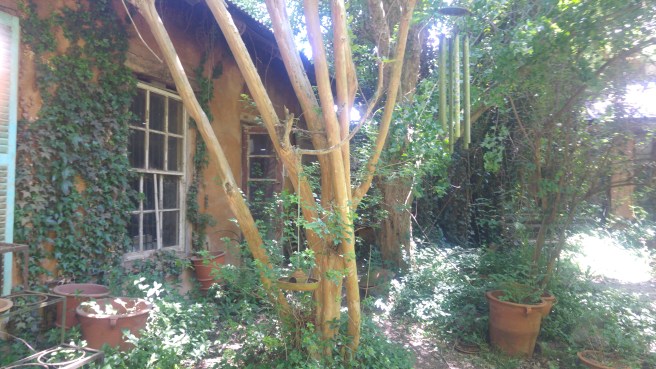
Our favourite by far was Ian Glenny’s Dargle Valley Pottery – everything about it from the pottery to the place. And it’s no secret that there are fairies playing in the woodland area surrounding his house which is an artwork in itself and worth the trip.

But be warned, both the artist and his work will captivate you and you won’t be leaving without one of his beautiful art creations. There are tables full to choose from which makes it really tough.

Ian Glenny's fairyland
Ian Glenny’s fairyland

It is all quite bewitching and one can wander around the pottery and the place for some time and then have wonderfully winding conversations with the artist about his work and his life.

As one of the originators of the Meander, he misses the way it was, but is happy that he still attracts his fair share of visitors. You would be silly not to take the turnoff to his special world.

The special Howick Falls as well as arguably the most evocative Mandela site are both easy to access on the meander.

The Marco Cianfanelli monument

The Marco Cianfanelli monument was constructed to mark the 50th anniversary of Nelson Mandela’s capture by the apartheid police in 1962 – at the site of the capture.

The setting is striking, and you must do a symbolic “long walk” before you are struck by the remarkable image of Nelson Mandela and the rustle of the wind through the columns as you approach which seems to tell its own story. According to the artist, the 50 columns represent the 50 years since his capture, but he also hoped to illustrate the great man’s legacy of inclusiveness by showing how individual structures all come together to complete the perfect whole.

Howick Falls
Howick Falls

The Howick Waterfall is on the edge of the town and you can pop in when you pick up some groceries if you’re staying in a self-catering lodge which is popular in the area. It’s simply a skip and a jump from the car to the viewing point and again evokes a South African scene that’s quite humbling.

If you like traditional wares, this is also a good place to support the local community in their endeavors with even some serenading happening on the side which might just fall gently on your ear.

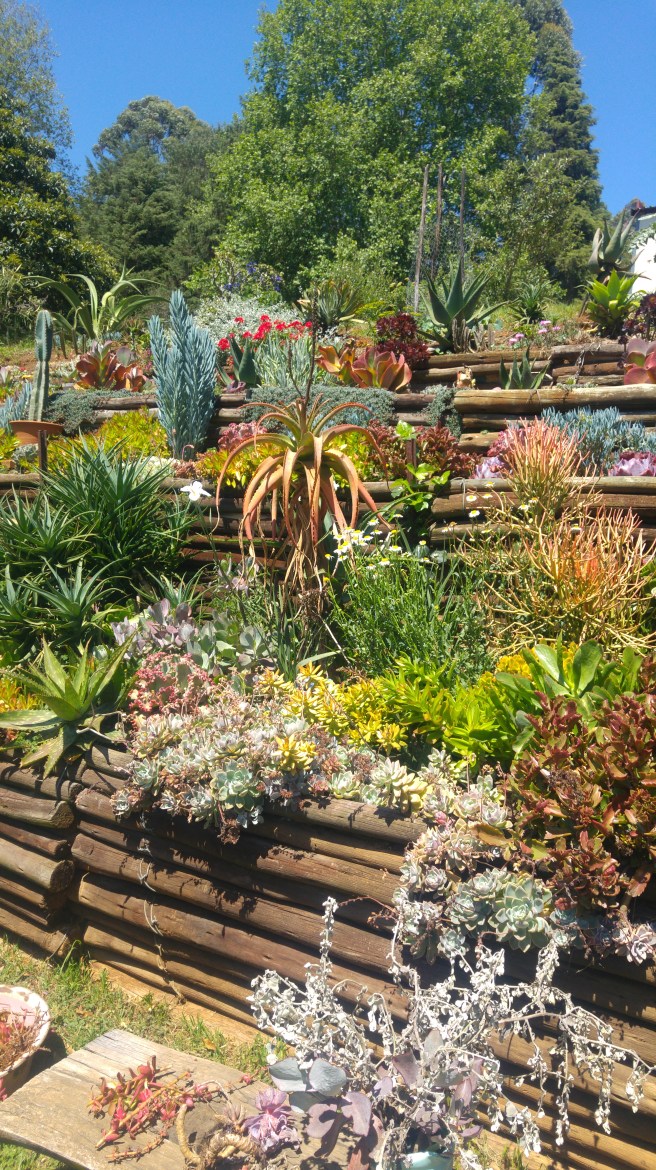
Succulent paradise by Mandy Crooks
Succulent paradise by Mandy Crooks from HillHouse

Hotels, lodges and self-catering cottages are plentiful and depending on what you like and for how many, you should find exactly what you’re looking for. Our first few days were spent in Lake House at Hillhouse Accommodation on a farm owned by two artists. It is situated in Dargle on a hillside (hence the name) overlooking the magnificent Midmar Dam. The cottage we stayed in can house four people but just the two of us filled it easily and the sheer isolation (seemingly) from the rest of the world was almost other-worldl

A higgledy piggledy gravel road takes you up to the cottage and while there are two other houses, one accommodating as many as 12 people, each one is different and slightly unusual to the more commercial venture. This is where the artists come to play with husband Nick the architect and builder and Mandy (Crooks) the one responsible for the interiors. All of the cottages are delightfully individual with a quirkiness that’s unexpected but joyful to experience.

And once there, the indigenous gardens in many hidden spots on the property and Mandy’s artistic succulent obsession are like outdoor galleries.

Hillhouse is situated on the edge of the Meander (was part of it at one time) and Howick is only 10 minutes away. But It felt like total immersion in nature as well as a kind of hideout from the rigours of the real world. You could easily just hide out right here for a few days.

The views at Whispering Waters


Our second port of call, Whispering Waters, is nestled in-between hills and dams with cows munching in every pasture as far as the eye can see. From the minute you wake up, the fields and the water lie invitingly in the early morning light. You can wander up and down hills and dales and warmed by a brisk walk, the dams are inevitable even if we didn’t think so initially, more used to sparkling swimming pools. Once in the water, the spell was cast.

Closer to the Notting Hill Road side of the Meander in Fort Nottingham, this is a more commercially driven property and yet because of the farm setting, it had that Meander appeal. The thatch cottages are spacious with a large kitchen, lounge, dining area and a stoep with a view – and the staff are intent on catering to your every wish.

Food is another Meander obsession, but these can be hit and miss like anywhere else. Howick is best for grocery shopping and our best find for exciting food was the Blueberry Café (with the adjoining brewery with a different kitchen) presenting many choices.

the quinoa and falafel salad with a blueberry sauce
The quinoa and falafel salad with a blueberry sauce

A personal favourite was the quinoa and falafel salad with a blueberry sauce while on the more substantial side, the fillet steak paired with risotto caught my eye. The brewery offers hearty hamburgers or if you want a healthy option, a roasted veggie salad. But there’s much to explore even though we did find it simpler to stick with what works for you.

If you’ve never been this way, it’s a treasure trove to explore in so many different ways. Just another corner of natural loveliness in this diverse land of ours.

Adrienne Sichel Gives Context to SA Contemporary Dance in Body Politics

Adrienne book cover

Kgomotso Moncho – Maripane

Guest Writer


The description that dance is “wordless expression in a world where words are currency,” by poet Lebo Mashile in her unpublished poem, I Dance To Know Who I Am, speaks to the hesitation and sometimes lack of engagement with South African contemporary dance locally.

The poem also encapsulates the transformative experience that dance can be.

Mashile created the poem for the production, Threads, a collaboration with choreographer and anthropologist, Sylvia Glasser and her Moving Into Dance Mophatong Company.

The poem opens veteran dance writer and arts journalist, Adrienne Sichel’s new book, Body Politics: Fingerprinting South African Contemporary Dance (published by Porcupine Press).

Adrianne_Sichel_photo_by_Val_Adamson
Adrianne_Sichel_ Picture: Val_Adamson

The book is a socio-political cultural history that focusses on the roots and evolution of South African contemporary dance from the mid 1970s to 2016.

Whereas the role of protest theatre is known in its engagement with socio-political issues, it may be taken for granted that contemporary dance, through its activist actions, played an important part in the championing of a free and multi-cultural society, during and post- apartheid.

Sichel’s book illuminates this particular cultural history, revealing how prior to democracy, the proponents of contemporary dance were at the fore-front of cultural activism.

“The policy-making Arts and Culture Task Group (ACTAG) process which culminated in the White Paper, the establishment of the Department of Arts and Culture, Science and Technology, as well as the founding of the National Arts Council in 1997, was the handiwork of many politically focussed dancers, educationists, choreographers, researchers and administrators,” she writes.

One of the standout traits of South African contemporary dance is that it is driven by the activist artist.

Adrienne Sichel Book Launch Jhb.

“That’s what gives it its originality and made it attractive to the world. You have people commenting on their society and the human condition. It has overtaken theatre in a way because dancers keep working and make it happen despite the challenges,” says Sichel.

“Paradoxically contemporary dance is an individualistic art form, but in so many ways South African contemporary dance is a collaborative mission to express our cultural and artistic identity. A lot of SA contemporary dance and African contemporary dance is sensorial and experiential. Those dimensions create a much more holistic vibrant art form,” she says.

Body Politics gives context to South African contemporary dance. It captures the collusion of cultures and histories as people explored their roots and their identities of the country and the people they wanted to be pre-1994. It highlights these very rich essences and fingerprints their origins with chapters looking at the birth of Afro-Fusion, subversive storytellers, the birth of theatre dance and what constitutes contemporary African dance.

It features festivals, companies and artists including early pioneers and contemporary players like Glasser, Carly Dibakwane, Robyn Orlin, Alfred Hinkel, Jay Pather, Jeannette Ginslov, Vincent Sekwati Koko Mantswe, Gregory Maqoma, Mamela Nyamza, Nelisiwe Xaba, PJ Sabbagha and many more.


It also includes a collection of Sichel’s published and unpublished journalistic writing. This makes it an important documentation and preservation of a unique artistic heritage and a necessary learning tool.

In mapping the evolution of this remarkable art form and its vocabulary, Sichel moves through terrains of contentious issues of appropriation and ownership, leaving questions to ponder on. Questions similar to the ones she asked herself when contemplating writing this book, like, who has the right to collate and tell this history? Who owns this history?

As a dedicated witness to and advocate for SA contemporary dance for 40 years in an environment that often rejects SA contemporary dance, she has earned the right to tell this history. Her background growing up in the rural Rustenburg exposed to her to a variety of cultures, religions, rituals, political practices and prejudices which fueled her curiosity as an arts journalist.

She co-founded the South African Dance Umbrella as a free democratic platform for all South African dancers and dance forms. She has also created an accessible language to articulate meanings behind movements and the fresh aesthetics of South African contemporary dance, which is no easy feat.

At the Johannesburg launch of the book in September, Sichel said, “What is scary about Body Politics is that it’s very concrete, it is tangible and it can’t be changed. I will be judged, just as I have been judging and evaluating people over the decades.”

She is also acutely aware of the gaps the book leaves and this is perhaps a challenge for the gaps to be filled.

The existence of Body Politics also makes the dearth

of books archiving or capturing cultural history in the country glaring. This is an urgent concern for Sichel.

“So many people did not want to publish this book. We don’t respect our history in this country. There are many narratives and cultural histories that are not being published and also need to be written,” she says.

Sichel’s hopes for dance is that “it keeps informing, transforming and educating.”


c

Miagi Youth Orchestra Is For Our Time

SHMF 2018
The Miagi Orchestra in full musical flow.

DIANE DE BEER

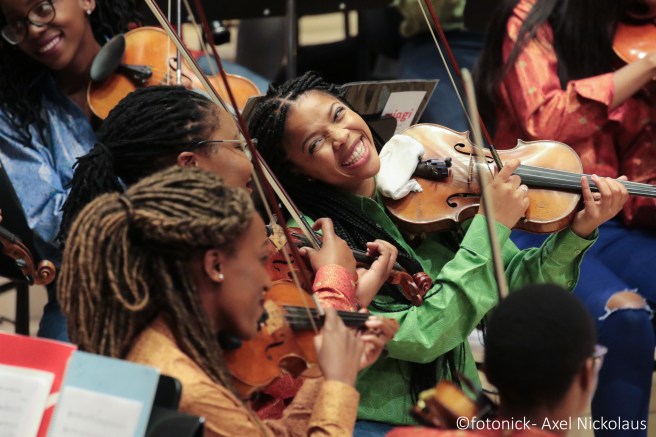
The electric Miagi Orchestra with their primary partner the German Embassy in Pretoria is hosting a Gala Concert on November 30 at 8pm in the ZK Matthews Hall, Unisa, Pretoria continuing their celebrations of Nobel Peace Prize Laureate Nelson Mandela which was part of an earlier European tour. They hope to emulate their international successes and awards locally.

Participating in the event with the orchestra is Just 6 African vocal a cappella ensemble, musician/composer/conductor and Miagi veteran Tshepo Tsotetsi as well as clarinettist Visser Liebenberg and pianist Roelof Temmingh. The conductor is young American Daniel Spaw who was named First Kapellmeister and Associate Music Director at Theater Hof (Germany) in 2017 following a successful period as Kapellmeister at the Landestheater Linz in Austria. The Nashvillian has degrees in both piano and conducting from Indiana University (Bloomington).

Apart from his young age, his truly impressive experience as conductor of opera and musicals, he has worked with orchestras such as the Hofer Symphoniker, the Bruckner Orchester Linz, the National Youth Orchestra of Germany, the Cologne Chamber Orchestra, the Rheinische Philharmonie and the Russian Chamber Philharmonic St. Petersburg.

The programme includes compositions by Beethoven, Just 6 African a cappella vocal ensemble, Tshepo Tsotetsi, Leonard Bernstein, and in conclusion, Improvisations by the ‘MIAGIcians.

SHMF 2018
Exuberant music making.
SHMF 2018
The appreciation of international audiences.

Visser who has been a member of the Miagi Orchestra for the past five years and joined them for this, his second international Miagi tour, is a freelance clarinetist, who performs as a soloist, chamber musician, and an ad-hoc clarinet player for KwaZulu-Natal Philharmonic Orchestra and Cape Town Philharmonic Orchestra. Temmingh, with similar credentials and viewed as one of our exciting young prospects, will join him for the the final exhilarating Riffs, in Bernstein’s Prelude, Fugue and Riffs

Just 6 has toured internationally together with the Miagi Orchestra in 2016 and 2018 and became popular with the larger South African public as finalists in 2017 in SA’s got Talent. They have their roots in gospel music and call their sound Afro-cal Play (African Vocal Play), a mixture of African indigenous sounds as well as smooth harmonies. They have a readymade reputation winning a best a capella award at the Crown Gospel Music Awards, a best a capella album at the Independent National Gospel Music Awards, and best religious song and album at the 2014 Contemporary A Capella Recording Awards. Two of the original members left the group but they have managed to secure two new members to allow them to continue with their Afro-cal-play.

Tsotetsi is both part of the orchestra and has conducted them often with his own compositions. Together with Austrian Jazz composer, trombonist and pianist Christian Muthspiel, he composed Out of South Africa – Symphonic Suite on Themes by Tshepo Tsotetsi which was featured in earlier concerts. He is also the founder of the “New Skool’ movement, the name that also describes his style of music which will be performed on the night. Following the Miagi ethos, it is a mix of different genres with jazz and African sounds dominant.

SHMF 2018
The appreciation of international audiences.

Over the past 18 years Miagi has developed its brand around the uniting of music genres; Western classical, jazz and ancient indigenous/traditional (African classical) and the many vibrant urban South African music styles that developed from the last century until today.

“In this process, we developed our very fine youth orchestra, Miagi Youth Orchestra playing music representing all the above-mentioned genres with eclectic results,” says executive director Robert Brooks.

During their Mandela-driven July/August European tour where, as is customary, they packed the concert halls from Hamburg to Brussels, Amsterdam to Berlin and wowed their audiences, they also. added to their international accolades. At a festive award ceremony on August 3 at the Konzerthaus in Berlin, the Miagi Orchestra was awarded the prestigious Yoeurope-award (Your Europe) of the European Cultural Foundation PRO EUROPA.

The recommended motivation was that both the organisation and its young musicians stand for inspiring support of the necessary dialogue between people of different cultures, colour and religions as well as between Africa and Europe. Previous recipients included Daniel Barenboim, Placido Domingo, Mary Robinson and Mikhail Gorbachev.

I was fortunate to witness this orchestra in Berlin a few years ago and with the critical Berlin audience completely under their spell, Miagi managed to lead them all out onto the city square in front of the impressive Konzerthaus where they joined the musicians in song. It was breathtaking as this group of young South Africans held the Berlin public in the palm of their hands.

Described as the orchestra ‘with a difference’ because of their diverse backgrounds, but also playing with a youthful exuberance that is infectious and inspiring, they are the kind of ambassadors our late President would have endorsed wholeheartedly.

Inexplicably, the Miagi Orchestra have grown their reputation internationally much more successfully than back home. The reasons aren’t clear because their local performances not well attended are magical and capture the spirit of what this diverse orchestra is all about. Their musical talent and expertise are all on display and they always bring more than the music. It is their presence, their obvious joy in performance and the way they present the music which all indicates their contemporary edge which engages audiences of all ages.

The Miagi management team under the leadership of Brooks and creative manager Ingrid Hedlund are driven by a mission that states that they want to unite the power of classical, indigenous and jazz and in this way offer a key to positive social development and to deep understanding among people across all borders.

As their name Miagi so majestically flaunts, music is a great investment – not only in money but also in time.

Booking at Computicket.

African Adaptation of The Little Prince Creatively Engages Young Audiences

The Little Prince Stage Adaptation by guest writer Kgomotso Moncho – Maripane

Picture by Ettione Ferreira Cue Media


©Ettione Ferreira-CueMedia_IFAS_Market_TheLittlePrince_16
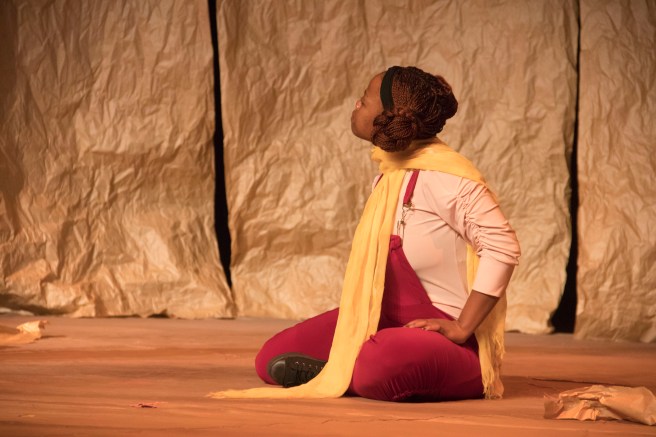
The Little Prince with Khanyisile Ngwabe in the title role 

Antoine de Saint-Exupery’s classic story, The Little Prince is written in such vivid imagery and magical surrealism that it lends itself to the playful theatrics of the stage. But the unconventional text may also be a challenge: Because the book already does a lot of the work with its powerful, provocative images, what else can performance do? What can live bodies add to that?

The Market Theatre Laboratory’s new company, Kwasha, headed by Clara Vaughan who co-directs the stage adaptation of The Little Prince with theatre practitioner and academic, Mwenya Kabwe, employs a physical language to the storytelling.

To prepare for the production, the company did circus training with a circus company called Art of Synergy, working specifically with acrobatics, tumbling, lifting, balancing and counter balancing.

“With the idea of magic being so deeply within the story, with a sense of other worldliness and a suspension of adult rules, the circus feels like a really appropriate form. With the theme of flight also being so strong in the story – flying and crashing, travelling through space – it felt always like the qualities of circus, both in its sense of the unexpected and its sense of magic and of defying gravity, really fit with the themes within the book. It was also very important to make the movement of the play as beautiful and poetic as the language in the book,” says Vaughan.

The play achieves this in its moments of beauty where the movement poetically articulates Saint-Exupery’s moral and philosophical ideas which lean more towards the value of life rather than its meaning. However, in some places, the physicality in the show could be more cohesive for the magic of the book to shine through.

The Little Prince is a European text set in the Sahara desert, whose universal themes resonate worldwide. It is the most translated text outside of religious books, with 300 translations including English, Zulu, Afrikaans and Xhosa.

During the early days of rehearsal for this production, co-director, Kabwe questioned how African languages were used in the show. The importance of this showed how careful thought went into giving this adaptation an African context, but without overthinking it.

“The African adaption of anything is a contentious question to grapple with. There are easy surface ways to do that. I feel like we’re trying to ask other questions about what it means to be staging a European text of this nature here. And how just by working with it, it can be localized. In a way, not taking an overt approach to African adaptation, but letting the work, as we discover what it is, what the ideas are that we’re dealing with speak for themselves. Just the fact that it’s this company, and it’s us and we’re here, already feels like an African adaptation,” Kabwe said.

It is by being authentic to its mechanisms and allowing the individual sensibilities of the cast to come together that this production excels. Its African-ness then comes through inherently.  It’s in the subtle music and the organic flow of the languages.

The open and rustic staging speaks to the bareness of the Sahara. It is also evocative of plays like Mncedisi Shabangu’s Thirteen and Prince Lamla’s Coal Yard whose imaginative exploitation of a minimalist stage are innovative. This feeds into the playfulness of the show that stays with you together with its strong messages. The Little Prince directly confronts the conflict between adult and child relationships and the execution of this production engages the perceived notions of what it means to create for young audiences in this country.

For Vaughan, this extends into her own ideas on creating.

“There are ideas that I really care about in terms of creativity and making – the ways that the world instructs what is good creating – which resonates with ways of theatre making. The ways that people lose their desire to make, or their playfulness around making – losing that internal pleasure that children have. That matters to me. It’s something I have been interested in. As an adult, the story around grown up expectations and expectations of being a grown up, really resonate with my internal tensions about what you choose to take on,” she says.

The Little Prince finishes its nationwide tour in Johannesburg, which started at the National Arts Festival and went to Bloemfontein, Sasolburg and Durban. It runs at the Market Theatre Laboratory until November 25.

Lightness of Being at Louvre Abu Dhabi

Pictures: Diane de Beer

Louvre exterior
The magical play of lightness at the Louvre Abu Dhabi

The Louvre Abu Dhabi celebrates its one-year anniversary this month (November 8). On a flight to Japan recently DIANE DE BEER decided to stop over for a little more than 12 hours to see not only the spectacular art collection but also what has already become yet another iconic museum designed by one of the architecture’s superstars, Jean Nouvel:

Flying with a stopover in Abu Dhabi on a recent trip to Japan, it was the ideal time to try to see one of the world’s finest new museums, the Louvre Abu Dhabi. Depending on your flight times, ours landed at 5.55am in the morning and there was a flight to Japan that night at 10 pm, it couldn’t be more perfect.

A visit to the EAU Embassy in Pretoria and their visa office confirmed that a visa would cost R800 per person (with no special concessions for museum visits and the like) and that there was ample transport to and from the airport to the museum and back.

In fact, if you wanted to, you could also pay a visit to other attractions including the Sheikh Zayed Grand Mosque but on this first-time visit, my focus was very specific. It would mean a break and respite on a too long flight with the opportunity of an amazing art foray, not something I had imagined would be possible.

And then I discovered it was – quite easily. It’s not a cheap stopover for those of us on a budget but it’s worth the money and time with the museum and its art, food for both spirit and soul. On the way there in one of the airport’s black official taxis (a cost of approx. R250 more or less, either way) you get some insight of what this pleasure world is all about as you pass Ferrari World as well as the Formula 1 Circuit and Warner Bros Theme Park which also opened earlier this year.

Louvre under the dome (002)
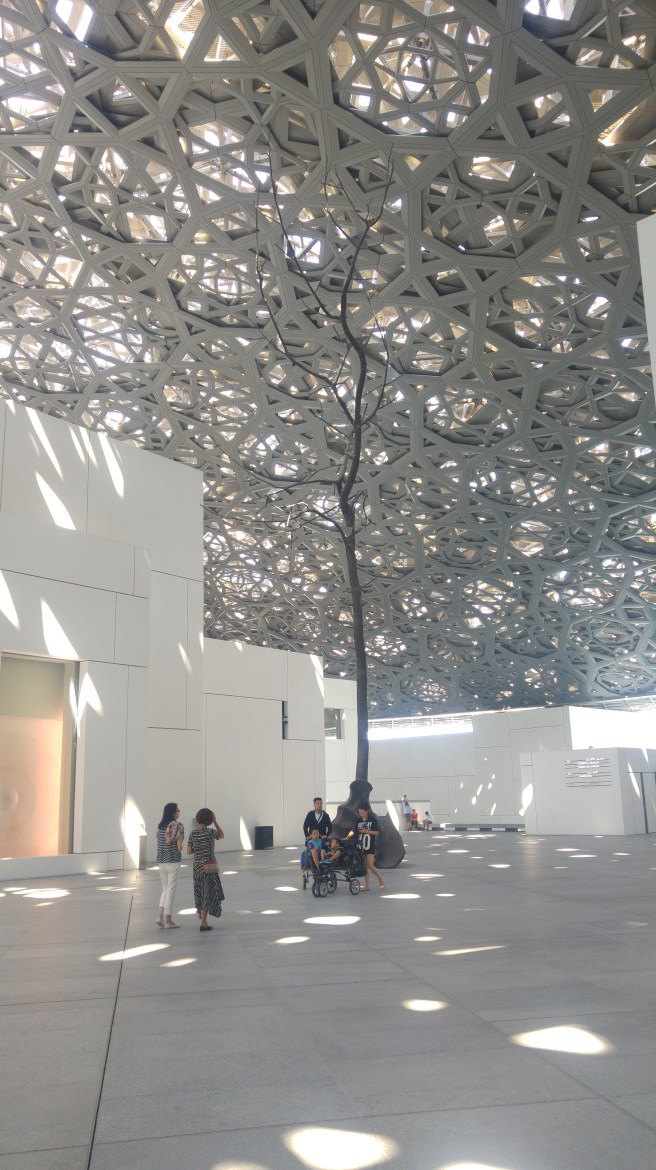
A play of light and people under the magnificent dome.

Many would have seen images of Nouvel’s Louvre building, which seems as if it is floating in the sea with a dome and its “rain of light” created by a complex geometric pattern of stars, but nothing prepares you for the experience. On a visit to Gehry’s Guggenheim Museum in Bilbao, it was all about the architecture and this was almost what I was expecting with this Louvre in the Arab world. But, it is something completely different.

Expectations are high as you arrive but with the Bilbao museum, it is the structure in its completeness that overwhelms you from beginning to end – magically so. With the Louvre, almost blindingly white in the blue seas and skies of Abu Dhabi, the full scale is impossible to see as you arrive. You immediately get the design, the water and the cobalt blue sky but the full impact comes much later – like a gift that reveals itself along the way – little by little until finally it takes your breath away.

It’s as if the architect captures the mystery which seems so much part of the Arabic psyche. As you start walking through the galleries, Nouvel has placed windows which all differ architecturally and show different aspects and angles of the museum – almost like landscape art in constant motion.

As you round a corner or pass from one room to another, it isn’t until you walk into the domed courtyard with all its different outlets onto the sea that the spectacular play of light and the richness of the reward hits you. Nothing else really matters, even if all the heat seems to have gathered under the dome – and I still don’t know if we were particularly sensitive or whether its an issue that needs to be addressed. We certainly could have done with those cooling water mist systems so popular locally at that point.  Yet nothing detracts from the spectacle or the dramatic effect of finally walking into this imaginative play of light.

All of this is a majestic work of art, but then, so is the collection of art inside the different rooms and galleries. What makes it so fascinating is the breadth of the exhibitions and the way Western, Arabic and Asian art come together in such unique fashion. This is about viewing different masters from different parts of the world and how they made art in the past and today, who influences whom and what they have to say about their world.

We often speak about the usual suspects in the art world locally and that can also be said of Western art, and this is what makes this such an enriching experience and worth witnessing. It’s not that we don’t see these types of art in other museums, it’s the coming together that makes the difference especially in our diverse world today. Bring it on, lets share and grow with the diversity and difference.

20181005_110209_HDR~2
The magnificence of the Louvre Abu Dhabi dome with its play of light.

Louvre Abu Dhabi has announced a full season of programming for the 2018-2019 season under the theme World of Exchanges.

International exhibitions will include Japanese Connections: The Birth of Modern Décor (until 24 November 2018), which explores links between Japanese aesthetics and modern French decorative arts; Roads of Arabia (until 16 February 2019), the acclaimed touring exhibition exploring the archaeological and cultural heritage of Saudi Arabia and the Arabian Peninsula; Rembrandt and the Dutch Golden Age: The Leiden Collection and the musée du Louvre (14 February – 14 May 2019) presenting 17th century masterpieces by Rembrandt and artists of his time; and Opening the Album of the World (25 April – 30 July 2019) in collaboration with Musée du quai Branly – Jacques Chirac, tracing early photographic methods from around the globe. The Children’s Museum – also part of the premises – has opened its second exhibition, which looks at real and imaginary animals throughout art history.

Louvre Rain of Light
Louvre Abu Dhabi’s ‘rain of light’ © Louvre Abu Dhabi, Photography: Mohamed Somji

The cost of a ticket is approximately (depending on the exchange rate), R230 per person and if you want an audio guide, that will be another R80 but I felt the information on the work all around the museum was more than adequate and the guide for me personally, removed me rather than brought me closer to the work. So altogether, stopping over, the visa (R800) and the transport (R500) would cost in the region of R2 700 for two people. That doesn’t include any refreshments and you do need some, not at the museum for those on budget but you could indulge in an Abu Dhabi meal if food is a passion and then do some more investigating of the city.

Hotels, especially luxury ones, are also plentiful and to make the excursion more meaningful you could stay over, take a trip to the old city of Dubai (which is about 75 minutes away by car), but this would all take more money and time.

For me, for now, the exceptional art and exquisite building was more than enough and something I wanted to savour. And in the future, there are plans to further expand the galleries to include a Guggenheim and more.

I can’t wait.

A Handful of Holiday Reads With Heart

Outside of a dog, a book is man’s best friend. Inside of a dog it’s too dark to read. 
― 
Groucho MarxThe Essential Groucho: Writings For By And About Groucho Marx


Holidays are on the horison and that means more reading time for many while others might just indulge more than usual. Here are a few old and new, brightly coloured and blue, to make a note of for yourself or as gifts, for those who need to escape:

DIANE DE BEER


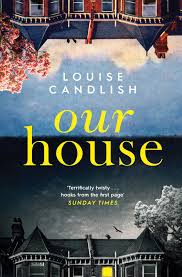
Our House by Louise Candlish (Simon and Schuster):book roy

Imagine returning home one day and finding strangers making it their own. It is probably unthinkable and yet, that is exactly the premise Candlish is working with.

That and an individual who gets into trouble and instead of grabbing someone close to him to help out, he tries to fix it on his own and finds his life spiraling out of control. It’s the stuff nightmares are made of and yet, this story shows just how easily that kind of scenario can play out.

It’s a simple premise yet what makes the read intriguing is the way it it runs away with not only one but a few lives. Fi Lawson’s home on Trinity Avenue is her dream house. It’s where she and her family will grow old and everything she does is focused on this fact, the proverbial white picket fence dream even when it isn’t exactly that.

The point though when reading the book is that most of us can identify or at least imagine arriving home to find it is no longer yours and what this would mean to your life. Or perhaps not and that’s Fi’s problem. Husband Bram is nowhere to be found. Even though there have been problems never on this kind of scale. But once he was discovered en flagrante by his wife in their garden getaway shed, there’s almost no getting away from a life that hasn’t been truthful.

Trapped in a lie of some kind, he plunges from one dizzy height to another as the fall turns catastrophic beyond anything we can imagine.

It’s a dream of a read because while it all seems plausible, its also unimaginable but surely will help you to see why the straight and narrow is such an appealing option. It’s the perfect escape in Gone Girl kind of way.

Circe by Madeline Miller (Bloomsbury Publishing):book circe

Nothing would have drawn me to this book if someone hadn’t pointed to the fact that she had heard a fabulous interview with the author. Generally I like my fiction to be more contemporary as we already live in a world so fantastical, we need writers to make sense of it in some way.

But this caught me unawares and much of it has to do with the reinvention and retelling of an age-old story, one we have all been introduced to but from another point of view. Yes, the men are all still there, but what Miller does so majestically is take the women from the side-lines and cast them centre stage.

Perhaps it is exactly that which kept me in contemporary literature for stories with more relevance for my life, but this time round, Miller caught me delightfully unawares.

Take this following paragraph for example and it is Circe’s thoughts that are set out:

“Later years I would hear a song made of our meeting. I was not surprised by the portrait of myself: the proud witch undone before the hero’s sword, kneeling and begging for mercy. Humbling women seems to be the chief pastime of poets. As if there can be no story unless we crawl and weep.”

But with Miller’s retelling of a tale we’ve heard before, the accents are moved to turn this into a compelling story with a contemporary heartbeat. The reading is poetic, the language mesmerising and more than anything it is the way Circe moves in her world, takes charge of the life she has been “allowed” and turns it in a way that makes it her own choice.

Miller’s is a brave new world which all of us should venture into.

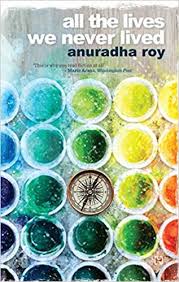
book allAll the Lives We Never Lived by Anuradha Roy (Maclehose Press):

With everything happening to women in India in these current times, reading the stories their women writers are telling is fascinating.  This one starts with the words of a young boy: “In my childhood I was known as the boy whose mother had run off with an Englishman.”

And like so many books from that part of the world there’s a whimsy, a mystical quality and a poetry in the language that captures all the elements that seem to be floating in and around the stories they want to tell. There’s an immediate censure in that opening paragraph. What kind of mother would leave her young child? How does he cope? Where does she go? And why?

Many more questions will emerge while getting to grips with the lives of this unusual and perhaps oddly disconnected family where different members are adopted by passers-by, almost as if they feel the need to lend some kind of attachment.

These are difficult times in the world – similar to now – with many wondering about the state of their universe and how to navigate things that seemed simple in the past. And for Myshkin’s mother, with strangers entering her family’s domain, new vistas seemed to beckon but at a cost to those whose lives hers intertwined.

One of India’s greatest living writer’s proclaims Oprah on the cover and that’s something to live up to. Nevertheless, she tells an impactful story from a specific world and time that resonates strongly in our troubled world today.

And underlining all this, is that it is a story told by a woman allowing her female characters a much stronger say than they might have had previously: “She’s not forward, she’s forceful. She is sure of herself and lives by her own means – runs her own taxi service and her own shop and orders her staff around and bosses her daughters and spits her tobacco juice as far into the corner as any man – I suppose these things mark her out as forward.”

A Little Life by Hanya Yanagihara (Picador):book life

I was given this book by a friend who said she had read halfway but couldn’t see why she should deal with so much suffering. I was intrigued, if she didn’t want to read about such suffering, why did she feel I should? Fortunately I persevered because what this story does superbly is underline the impact of one’s childhood on the adult psyche.

If ever there is a hackneyed phrase it is this and yet, there’s a reason which is what this remarkable story about four classmates who moved to New York to make their way, each in a particular field, some more successful than others, some more deeply scarred that those who might be struggling to make ends meet, sets out to show – perhaps for some too painstakingly.

As we follow in their footstep as they try to make their careers and a lives in the ultimate city to achieve success, it is the reaching out, the turning away, the holding someone upright, the coming together of friends as lovers, and in conclusion, the way people look out for each other, that holds our attention. Finally it is about a life that can be navigated with a little help from a friend.

Older and wiser readers will know that one cannot do it alone, but sometimes, people who have been damaged by blind trust are reluctant to travel that road again. It is a tough life to follow but because these are four such remarkable characters with their hangers on, their lives determined by such recognisable desires, the length of the novel gives the author the chance to make them come alive in a way that invites insight and ownership.

Take your time, because it is a compelling read.

book americanAn American Marriage by Tayari Jones (One World):
We hear daily about the numbers of African-American men jailed in America. We also read about human rights lawyers who spend their time trying to free those who have been unjustly imprisoned in a system that has been designed to make their lives impossible and turn their dreams inside out.

Have you ever wondered what happens to the lives of those who are connected to these innocent victims and how their imprisonment is much more than just an individual punishment? That’s exactly some of what is investigated and explored in what seems like just another well-written fictional tale but is so much more as it homes in on one of the scourges of our world.

It’s about the ultimate love as two people are torn apart with one unable to hang on and still feels responsible for the devastation she leaves behind. But more than that, it is also bringing the personal to what has become a universal story.

In an interview with a white male TV host who was shocked about all these young black men dying at the hands of police in the US, Toni Morrison graciously yet sharply pointed out that this wasn’t new to the African American community, because of social media, it was simply out there to be seen by everyone. It could no longer be an invisible crime.

With the growing statistics of African American incarceration and the abusive prison system in that country, it is also tough to ignore the impact on a people. It is all of this that tragically underlines and holds this particular story which might imply a tale of three ordinary lives but cannot be further from the truth. This is how worlds are destroyed by not valuing the lives of all of the people all of the time.

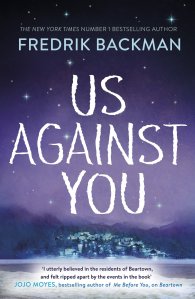
book againstUs Against You by Fredrik Backman (Michael Joseph)
In an earlier post, I had reviewed the prequel to this book then still titled Scandal which later changed to Beartown. It was a fascinating read about a small Swedish town whose livelihood and passion is all focused on their young ice hockey team. Until, a disaster happens which tears the town apart.

Their strongest and most popular hockey player is accused of raping the daughter of the coach of the team. Just that one sentence is loaded with many different implications and that is what the author plays with.

It was a deeply enjoyable book as Backman dissected the town and their reactions to this particular event – and then allowed it to play out. Especially in this time of course, nothing of this seems unfamiliar or surprising and what happened in fact was that the young star player accused by the teenage girl and the deed confirmed by his best friend left town while the girl stayed behind.

This follow-up takes it further as we enter a town that is deeply divided with the most inhabitants accusing the girl (even if just in their minds and attitudes) of causing this great loss to their town and its future.

The upheaval is huge and into that void steps an ambitious politician who knows how to play the pack to his own advantage and a future visibility which will take him to the top. It doesn’t come more cynical than this but that’s the world we live in so tell it like it is.

And Backman loves doing this – very cleverly as he explains how people think and why they do certain things with no empathy for the people they harm in the execution and fulfillment of their own dreams.

It’s really sad yet refreshing to navigate this story of modern living in a world where everyone is out there battling only for him/herself.
It’s a clever story but alas, unlike the last one (and arguably the translation doesn’t help), the writing becomes both preachy and cute. There are too many devices, too many nods to the reader allowing them to participate in the conspiracy and this detracts from the delight that the first novel accrued.

But the story is still on point and those who read the first, will not want to miss this further development.

Saunders has a Specific Way of Telling Stories in Style, Stridency and Sweetness

I read my eyes out and can’t read half enough… The more one reads the more one sees we have to read. – John Adams


DIANE DE BEER

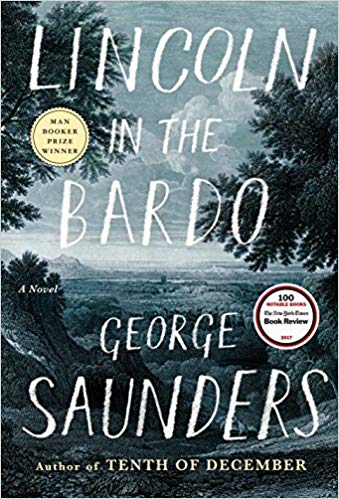
Book lincolnLincoln in the Bardo by George Saunders (Random House):
If you’re familiar with the short story wizard, you will not want to miss his first foray into novel territory.

As is to be expected, this master of imagination and writing has thoroughly thought through his first outing and how to approach it. He does this without the attempt feeling too grueling, because he has a story to tell that’s so smart and so unique, his followers won’t be disappointed. Probably more than anyone, Saunders would have felt the weight of what he was trying to do more than anyone else.

If you have ever listened to an interview with this writer, you will know that he has an exceptional mind, thinks about life in an extraordinary fashion and seems to make interesting choices on whatever catches his fancy – from marrying to writing.

In this instance the title refers to the Lincoln you’re thinking of and it is his son Willie who is trapped in the bardo (the state of limbo which is how the Tibetans refer to this intermediate state between death and moving on). He is the adored 11-year-old son of the man known as the Civil War president who is in there fighting a losing battle with typhoid fever.

His parents are hosting a lavish banquet when Willie dies and his body is taken to Oak Hill Cemetery where he is laid to rest in a marble crypt.

What ensues then is the magnificence of the Saunders mind. He saw a snippet that the president had at least twice visited the crypt at night where he sat and mourned over the body of his cherished son, and this sent this limitless imagination a wandering.

The cemetery is occupied by spirits who, it becomes clear in the reading, don’t want to move on and become the narrative as they tell the story of the father and the young boy by also dwelling on their own state of limbo.

The novel unfolds through their speeches, passing mainly between three vessels consisting of a young gay man who killed himself after his lover rejected him; an ageing reverend; and a printer who was killed in an accident before he and his young wife could consummate their marriage, an event that was on the verge of happening following many years of marital friendship and that’s all.

Willie, like all the children, is expected to pass on quite swiftly but because of his father’s visits, he is reluctant to leave which could mean that he could become trapped in a terrible tangle of almost demonic growth.

The three voices as well as those of contemporaries of Lincoln – whose quotes are used throughout to tell a particular story – make this a magically compelling reading. It’s like seeing a novel, so visual is the Saunders narrative, but you have to keep your mind sharp to keep up with the conversation and the people and events being described.

It’s fascinating and not unexpectedly unlike anything you have ever read which makes it hugely exciting. It’s the kind of book that you should just go with and not worry too much if you’re not quite sure what is happening and why. It does start to make sense as you go on and because of the writing, you can simply wallow in the Saunders literary genius, his way of telling the story and the words and language he picks to convey a certain feeling or mood or describe a rascal or a love affair between an unlikely couple. That’s just the way he tells stories.

The Lincolns in fact don’t even feature on the foreground although it is a story to explain certain things about memory, how people see and view things and how it loses in translation or from which perspective it unfolds.

With memory such a big thing at the moment, it makes you think about history and how we learn things – inadequately – because it came almost all of the time from a white male perspective. Nothing wrong with that perspective as long as it is supplemented and supported with a wide range of ideas and views to cover all the tracks and prejudices that might reside with a particular group.

Exciting times we live in as perspectives shift and trust Saunders to capture this particular mood change that is causing such upheaval all around the world we live in.

Always Another Country – A Memoir of Exile and Home by Sisonke Msimang who Struggles to Recognise Home

The book to read is not the one that thinks for you, but the one that makes you think.

Harper Lee


DIANE DE BEER

always another country

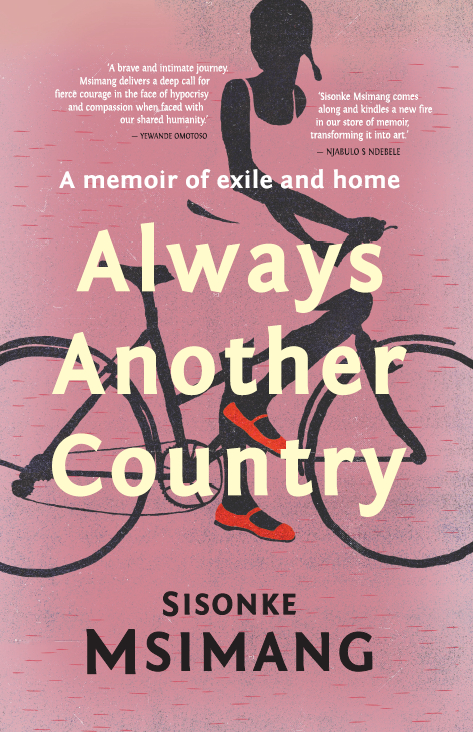
 Always Another Country – A Memoir of Exile and Home by Sisonke Msimang (Jonathan Ball Publishers):

If this book proves one thing, it’s the difficulty of navigating a life in this country. Yet, that’s also what makes living in South Africa so exciting and invigorating. We are always being challenged to grow and expand in every way we can.

And if you take Msimang’s credentials on face value, you could automatically accept that in today’s world, in this time and in this country, she has it made. It’s exactly that which she grapples with and what makes it so intriguing. This is a real life filled with hopes and dreams and expectations and armed with all the values she thought would get her through this life.

The cover guides you into the story as it explains that she writes about her exile childhood in Zambia, Kenya and Canada, her college years in the US, and then returning to South Africa in the 1990s. The road seems already travelled but on a purely superficial level.

It also depends on where you stand, young or old, black or white, man or woman, all of these might influence your reading. What you can be sure of is that she will surprise you and take you on a journey of one woman’s hopes and dreams in a country that has taught us all lessons and always will. No resting for the wicked here –it’s the challenge that this country has given us.

Msimang didn’t have it easy even if it sounds like she did. Her parents were in exile, but they also didn’t have typical exile lives (if that even exists.) Her father, a South African black man who fled his country even before the Rivonia Trials, spent 10 years being trained and fighting as a soldier for the cause. In Lusaka, the closest he has been to his country of birth in 10 years, he meets a Swazi woman who is pursuing her studies and becomes his wife. She loves him, but she is ambivalent about his revolution.

“My sisters and I are freedom’s children, born into the ANC and nurtured within a revolutionary community whose sole purpose is to fight apartheid…On the playground we cradle imaginary AK-47s in our skinny arms and instead of Cops and Robbers, we play Capitalists and Cadres,” writes Msimang.

And if like me you are old and white, you will know how far removed from your world that game was at that time. That’s precisely what makes this such a compulsive read. As someone who grew up schooled in this fashion, living this life outside the borders of the country her family calls its own, once she returns with all life’s experiences part of who she is, what does she make of her country?

This is a place many were taught never to question, never to doubt and then reality sets in. But not just the reality of what some see as a crumbling ANC on different levels, also a country that having now put apartheid behind them, has the opportunity to fashion a brave new world. It’s a story about the obvious and the unexpected.

Msimang’s informative years are unique. She may have benefited from privileges many were denied in her country, but racism doesn’t need oppressive laws to thrive. Think Trump and his ascendancy and what that has meant for African Americans; or Europe’s reaction to refugees streaming into their countries.

She has experienced that, so what happened when returning to South Africa would not have been completely unexpected. And yet for many it was the hope – rainbow children and all those heady dreams and expectations. “South Africa is now free,” she writes about those early days, “and those of us who care about the country are coming to see that the dream of freedom was a sort of home for us. It was a castle we built in the air and inside its walls everyone was a hero. When we first returned from exile the castle stayed firmly in our mind’s eye. We told ourselves we were special, and we sought to build a rainbow nation.” Remember those early days of our young democracy when those kinds of sentiments would not have been out of place.

Even in 2010, the country again reached for that dream and what they thought could be achieved with the euphoria of the sporting world’s love and attention – but sadly it would not last. And like those shattered dreams, Msimang has had to take a step back, re-evaluate her hopes for this homecoming and plan her life accordingly. We can dream a world we want to live in, but this is seldom what we will get. Sometimes it’s neither better or worse – just different.

That’s is how she views her world and then decides to shape it. And that is what you will find when dipping into this extraordinary African adventure. With her earlier life, she had already faced many curve balls, and she was not going to buckle if everything didn’t go her way. She has a clearer view than many about her world, will fight against injustice with every fibre of her being and then tackle the road ahead.

Much of what unfolds in this story is unexpected and contributes to the final rewards of a life reassessed in a world that doesn’t always turn out the way you expect it to – and yet, sometimes it takes you down roads that open up unexpected and unexplored vistas that contribute richly to an already extraordinary life. It’s about grabbing and holding on to the moment – and when you have fought this hard, waited this long and lived the lives of others simply by being a child, that is your natural way of being.

Telling stories in this country adds texture and knowledge as we learn about the lives of people who inhabit our world yet were forced to live in specific way not of their choice. But then they also push on and turn everything on its head.

Author Thuli Nhlapo’s Colour Me Yellow Written With Substantial Heroic Honesty

READING IS A CONVERSATION. All books talk. But a good book listens as well.

Mark Haddon

DIANE DE BEER


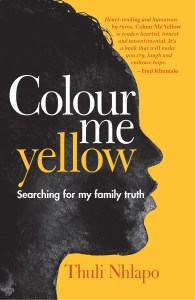
Colour me Yellow by Thuli Nhlapo (Kwela Books):

book colour

It’s so often a matter of birth and where you land on this little planet – in what shape and form that – determines the rest of your life – as this title subtly suggests.

White people are seldom or never called out on the colour of their skin while black men especially in the US approach every morning as they leave their home with a certain trepidation. To be a woman in the #metoo era might be exciting for some but for far too many, they still have a target on their back. Just listen to the horrifying news from India for instance.

You could find yourself as a stateless human being if you’re of a certain ethnicity in Myanmar and whether you’re born in North or South Korea has huge implications.

It’s not only this time although everyone probably feels that of their time, but life seems particularly harsh now. You need all the help you can get, starting with your family, to make it in this world. If you have to battle them as well, life can be extreme.

The only person who knew the whole truth had stayed mum, not once volunteering to talk. The closest she had come to it was when she said: ‘I hated being pregnant with you.’ Hearing that mantra as a child already in a hostile environment doesn’t bode well for your future and it is exactly that story the journalist Thuli Nhlapo was determined to unravel and expose – if only to herself. She knew it had to do with her father but she didn’t know who he really  was and her mother was not going to tell.

In the meantime, from the day she can remember, she was harshly treated by her family. I felt I needed to prove there was absolutely nothing wrong with me – even though I may have been yellow or a boesman, I breathed and bled like any normal human being.

And this starts with her family, those closest to her, her mother and father, who have to mirror the outside world to a child. What chance does she have with those who don’t know her if this is the reaction of those who do?

But one can imagine that in today’s environment where dysfunction is usually a family trait, there are many children who battle with those closest to them, those that should protect them, often in a fight for their life, or as Nhlapo confesses, a struggle for her soul.

Where she has been blessed is that she has an ability to write (was winning as she says, writing and journalism prizes left, right and centre), which also means that she could organise her thoughts, think like a journalist and investigate her own past – with the accent on the identity of her father. As she grew older, this became more and more of a problem with even the spirits rejecting the surname given to her as that of her ‘father’s’. It couldn’t go on this way but her mother was refusing to budge.

It’s an extraordinary tale, but also one of immense fortitude and courage, self-reliance and making it on her own because that was all she knew how to do. When she was struggling with one of her pregnancies, she coped without asking for any help. She ascribes that to being a black woman and that’s just what black women do, but she concedes that the prospective father was out of town – and not a doctor! So that’s what she did, went to hospital and saw a doctor and when he treated her with disregard, she insisted that he do a thorough check-up – and she was right. She knew she was the only one who would be fighting for her life. If she didn’t do it, no one else would step up.

As she forecast, he was lazy in his diagnosis of a miscarriage and she could move on and out and find a doctor who would treat her with care – the care she knew deserved.

Colour me Yellow isn’t an easy book to read but it is written with heroic honesty with a real-life heroine who demands and easily draws your enthusiastic support. It is easy to give as well as a nod to your own much more comfortable life because even without asking, you got what a child needed – her family’s love. It just makes life that much easier and survival not something you have to deal with every day.

But as Nhlapo proves, every life is worth fighting for and finally – for yourself and your children – you will triumph.