Chimamanda Ngozi Adichie On Histories Of Yesterday, Today and Tomorrow

Nigerian author Chimamanda Ngozi Adichie was the keynote speaker at an event hosted by the Nelson Mandela Foundation as part of the “Remembrance period” to mark five years since Madiba’s passing. She explored how histories have shaped the imagination of the future. This was followed by a conversation with Dr. Sebabatso Manoeli and Neo Muyanga on the role of memory and importance of remembering:


Chimamanda and Graca
Chimamanda Ngozi Adichie and Graca Machel © Nelson Mandela Foundation

Diane de Beer


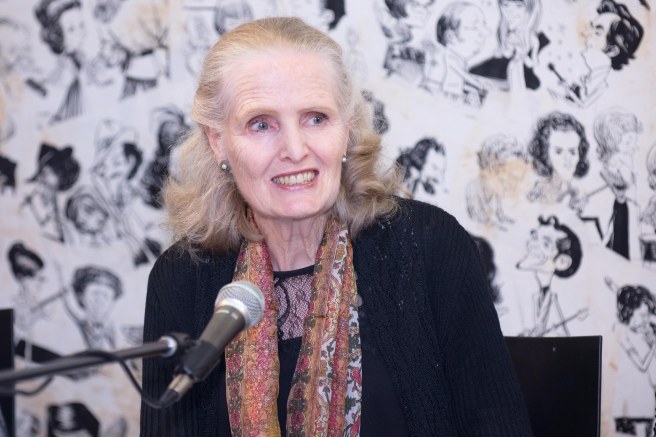
There was envy, said Nigerian writer Chimamanda Ngozi Adichie in Johannesburg on Thursday night, where she was the keynote speaker at the Nelson Mandela Tribute night hosted by the Nelson Mandela Foundation as part of the centenary Living the Legend celebrations. “We wanted a Nigerian Nelson Mandela!”

Fresh from her talk with former First Lady and author Michele Obama, who reinforced the Nelson Mandela legacy when she told Adichie that Nelson Mandela made Barack Obama possible, she switched between the inaccuracies of history and memory, turned to women who need to fight back and also dwelled on being African and the pride that had to be reclaimed.

“But I don’t trust this Rainbow Nation thing,” she said to loud cheers from her predominantly young audience. “I am fiercely Pan African. My visceral sense of protection is high. We haven’t talked it through,” she said, pointing out that we cannot just forget the past as is so often suggested.

Can the process of remembering be scrubbed clean? “They might suppress it but always it will be there,” she warned. “It is important to acknowledge that the process will be messy and long and most of all, that kindness is necessary.”

Returning to Nelson Mandela time and again as was her brief, who and what he represented, speaking about memory and history, she shared that even though he was South African, the world claimed him. “He sparked a belief in what was possible,” she said.
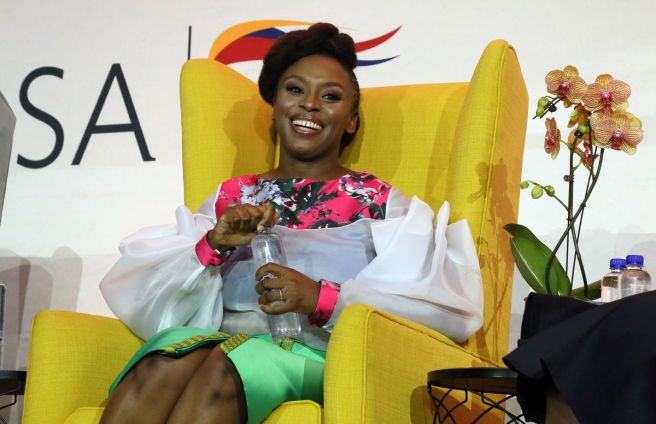
Chimamanda
An ecstatic Chimamanda Ngozi Adichie © Nelson Mandela Foundation

Speaking in a country where heroes are ditched easily, and the memories distorted, she explained that as a storyteller she couldn’t trade in perfection. “Where does absolute perfection exist? Memory, she pointed out was often about how the present configured the past, something that features strongly in our world today. “To avoid the truths we do not like is to avoid grappling with complexity,” she says. “Progress is a journey which doesn’t run in a straight line but in zigzag.”

“I think humanising him, acknowledging that he wasn’t perfect, isn’t denigrating him. When we do that, we realise that there’s a lot that we ourselves can do.”

“It’s about pushing against this idea that perfection is required. The idea of people being heroic is not that they are perfect, it’s that they have done one thing that is remarkable”

That’s it absolutely. Often with history, the facts are there, but the citizens, those who lived it, know it is not the truth. That’s where storytelling becomes the driving force says the storyteller. That’s where the truth often lies. “If human beings were perfect stories wouldn’t exist because our imperfections create the stories we tell.”

Who defines the accepted norm? “It’s about owning who you are and knowing that who you are is enough.” In stories she learnt about the loss of dignity, to be human, is to be valued, she affirmed. “We need to push back against the idea that there is a way that things should be.”

“Our history was invented for us. It’s time for us to reclaim it. I went to a very good school in Nigeria, but I knew very little about Nigerian history. I knew a lot more about the kings and queens of England.”

Changing tack but sticking to her theme of humanity, she said that with our high rates of sexual violence, South Africa needs to grapple with gender stereotypes, but we need to focus on the perpetrators, the boys. It’s no longer good enough to tell the girls to be careful.  “It is time to raise boys differently,” she says. “A woman’s body belongs to her and to her alone. We must insist that men go through a process of learning. Women must be accepted and respected as full human beings – from the boardrooms to the busses.”

As we focus on boys rather than on girls, we could start by saying “Mandela wouldn’t do that!” And switching to fighting talk she insisted that women should never feel shame or guilt because they were a victim of crime.

She also touched on South Africans and their many languages. Traveling from the airport, her driver confessed that he spoke nine languages. “South Africa is in many ways an inspiration to many parts of the African continent,” said Adichie, as she pointed to their confidence and their command of African languages.

“We should own who we are and know that it is enough.”
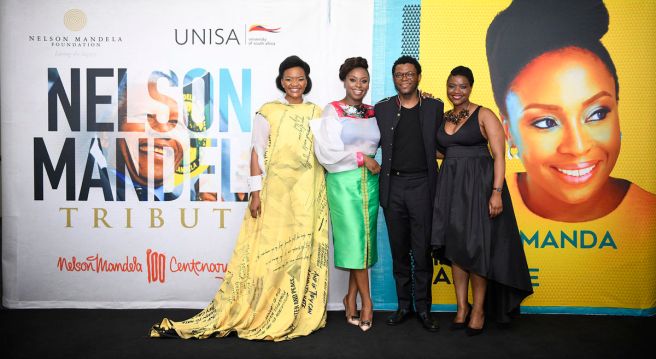
Chimamanda and guests
Facilitator Cathy Mohlahlana, Chimamanda Ngozi Adichie, Neo Muyanga and Dr Sebabatso Mano. © Nelson Mandela Foundation

She was then joined on stage by historian Dr Sebabatso Manoeli and activist, composer and musician Neo Muyanga. Discussing how people could reclaim their history, Dr Manoeli suggested that Europe should be regarded as irrelevant, an idea that Adichie immediately adopted.

“We also need to read against the grain,” noted Muyanga, suggesting that’s how to find history on the margins. “We need to explore alternative narratives as we move away from fact to truth.”

Given the final word by journalist Cathy Mohlahlana, who facilitated the discussion on the importance of memory, Adichie encouraged everyone not just to talk about the wrongs of the current historical narrative, but to find a way to do something – anything – even something tiny.

That’s the way forward.

Nataniël at Play with Family and Friends

Edik book coverSiblings Nataniël and Erik le Roux partner in a book that captures the magic and mayhem of a French-styled lifestyle based on their four-season television cookery series Edik van Nantes, which finished earlier this year:
 

DIANE DE BEER


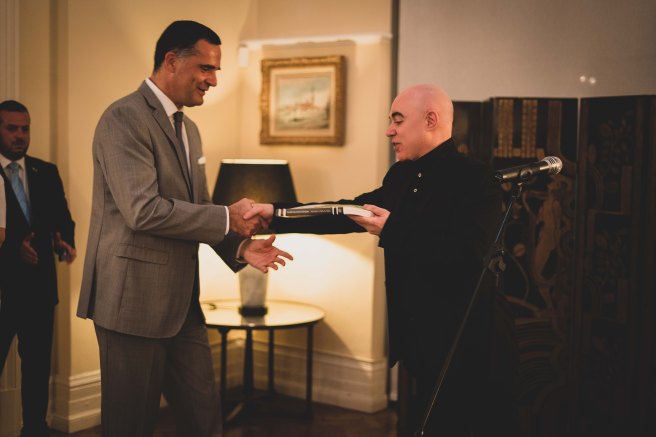
“Except for family, we don’t have things that old,” says Nataniël at a French heritage evening hosted by French ambassador to South Africa, Mr Christophe Farnaud, in celebration of the entertainer/TV personality’s latest book Die Edik van Nantes (Human & Rousseau, R370) co-written by his brother Erik le Roux, who was also co-presenter of the KYKnet cookery/lifestyle/travel programme consisting of four 13-episode seasons.

It all began with the younger Le Roux brother settling in Nantes after marrying Nathalie, who is from the area and introducing Nataniël to this city where he quickly lost his heart. Before that, he says, he only travelled to Paris where he had great adventures – amongst them Paul Gaultier remarking that he was the only overdressed person he had encountered in this city of high fashion.

Nataniel and French Ambassador
Nataniël presents his latest book to the French ambassador in SA, Mr Christophe Farnaud

Once the siblings discovered that Nantes was their heritage, their great adventure followed as they searched for their roots, criss-crossing the region all the while cooking with both their French and Afrikaans heritage, coming into play. But they also focused on the arts and culture of the city and region, turning this into much more than just a cooking show.

They were also smart enough to know that you have to have a hook to hang a cooking show on (similarly with a book) to distinguish yourself in a market that’s saturated. “People don’t use recipe books anymore,” says Nataniël, “they cook from the internet. You have to give them more.”

He is amused by some South Africans who feel a sense of betrayal because of his love affair with many things French, but to understand his admiration, you have to understand his sense of adventure and added to that, a journey he could share and experience with his brother. “We could catch up and reconnect,” he says which is why he describes this as one of his happiest work experiences.

Not only could the Le Roux siblings research their heritage as descendants of the French Huguenots, but Nataniël could also discover and explore the culturally rich university city, now the home of family.

He describes Erik as someone who has the technique and experience of professional kitchens while he is a “rough home cook”. Erik notes that he loves eating more than cooking, yet they both acknowledge that food is the way too many hearts and hearty get-togethers with friends and family. “It’s an escape and a way to destress from a hectic stage career,” explains Nataniël, hence the book, which features the lifestyle and recipes the way these were presented in the television series in celebration of a city the artist now calls his second home.

His brother was always going to leave South Africa, because he couldn’t come to terms in a place where old men wear shorts, he notes.

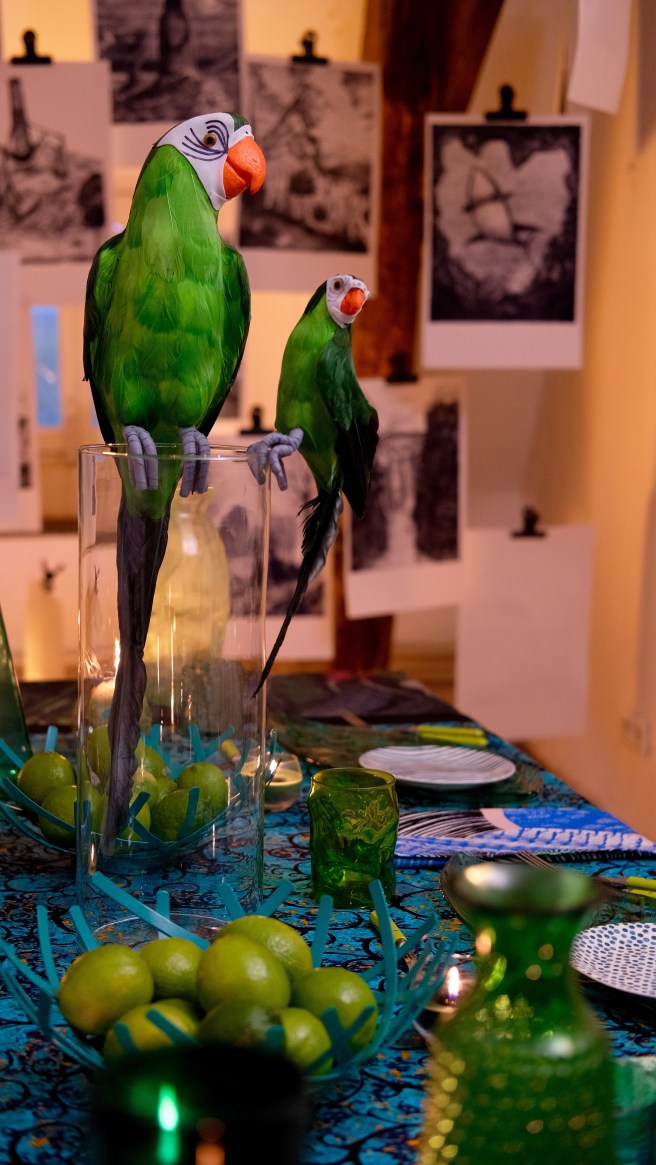
Nataniel's favourite table in the book
Nataniël’s favourite table in the book

And when Nataniël first wanted to visit his brother’s new home, Erik explained that he would hate the industrial city. But determined to recognise the region, it was a quick yet lasting enchantment. To the amusement of everyone at the French Embassy, he explained that Nantes was his French addiction. What he learnt in France was everything about inspiration, aspiration and even more importantly, intimidation!

“I love the way the city has welcomed me and my crew,” he explains. Doors were flung open and he was invited to film in renovated art museums, try their regional cuisine, tweak the recipes for local viewers, discover new ingredients in cafés, bistros and restaurants and share his French passion with his South African television audience. Because of their dedication to capture the essence of the city, these two bald brothers have also become a fixture in this North-Western French city.

Discovering a town that boasts everything from four upmarket paper shops, for example, to the largest puppet building company in the world, Nataniël knows how to flaunt it. He was thrilled to hand the Ambassador his first Afrikaans book on French culture!   “It’s a South African book on France without any lavender or rusted wrought iron,” he says, pointing to an overcrowding in this French oeuvre that he feels has leant too heavily on a specific nostalgia.

And followed that with a piano recital where he was joined in a piano tribute (with She and Emmenez-Moi) to Charles Aznavour by his accompanist, classical and jazz pianist Charl du Plessis (see picture).

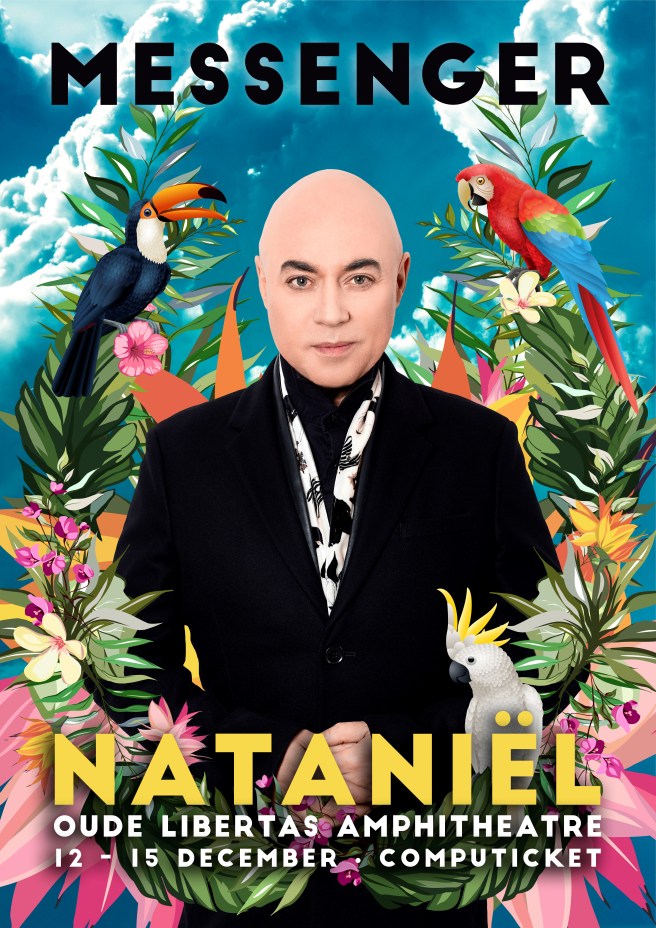
messenger poster

So apart from this latest book, which is already flying off the shelves according to the author, he is also finishing with his last short season in 2018, Messenger, at the Oude Libertas from December 12 to 15, following a short run at Pretoria’s Atterbury Theatre.

“A sign, a message, a suspicion, a proverb, a shock, a revelation, that’s how lives are changed, for the better or worse,” he notes. From the earliest miracles, legends and myths to new discoveries or internet filth, most of humanity live life overwhelmed by fear, trends, tiredness or hysteria. “This is what I wanted to explore, social phenomena that paralyze, surprise and rejuvenate.”

These are his topics of discussion in a show performed in a time usually associated with festivities and inspiration and you will find all of that in these stories told in either Afrikaans or English with music both self-penned (including Messenger, which is completely mesmerising) and established songs, like the soft Duke Ellington jazz ballad  It Shouldn’t Happen to a Dream..

Costumes are original and breath-taking in his own inimitable style and his superb musicians include Du Plessis (piano), Juan Oosthuizen (guitar), Werner Spies (bass) and drummer Peter Auret.

It’s a glorious way to conclude your cultural year with an entertainer who will have you laughing hysterically as he smartly underlines the madness we need to navigate in our modern world.

Booking at Computicket.


Meandering in the Midlands is Magical

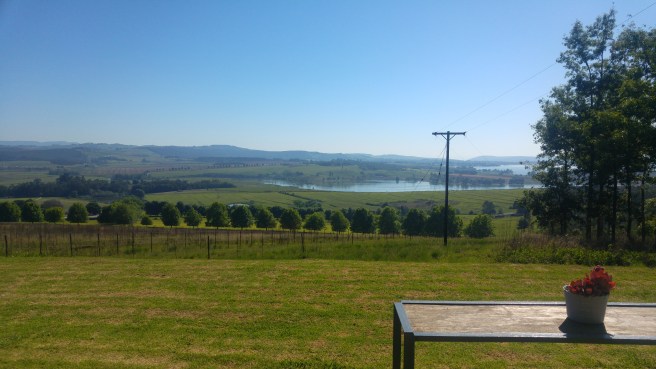
20181111_080313
View of the Midmar dam from Lake House

DIANE DE BEER

In our stressful world, all of us should respond to the need to get away. The Kwazulu-Natal Midlands is around the corner for Gauteng with ‘meander’ the verb that encapsulates this scenically spectacular part of our country:


The Midlands reminds us of a country rich in things to do and places to go.

The choices of how you do it are many and will be determined by what you want to do and how active you want to be. Price also comes into play because this is a popular area for many things, weddings included, as well as the Midlands Meander, which offers a leisurely way of exploring the countryside by crisscrossing the area in search of artisans and artists selling their wares. Like anything else, this has also become commercially driven more than the initial ideals of people making and developing their own, but there’s enough of the real thing left to keep everyone happy.

It’s not always easy to find them but with smart phones, everything is possible today and much of the discomfort is dissolved as you find a map or a phone number which will quickly explain and navigate the route. The roads might also be an obstacle for some, but this is not speed racing and if you amble along, even the challenging ones will be easy to navigate.

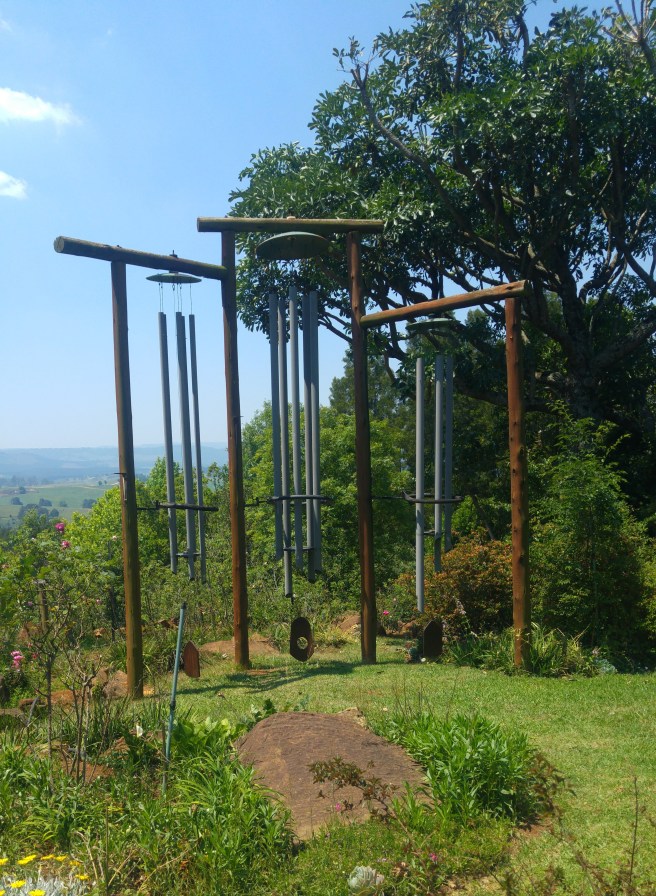
Personal favourites on the Meander included the Terbodore coffee roasters with simply the best coffee to drink (also available online), clothing companies, including well designed and locally made canvas bags and cotton shirts at Dirt Road Traders, irresistible handmade shoes at the Groundcover Leather Company, homemade goat’s cheese with delicious options at Swissland Farm, the extraordinary family-run Culamoya wind chimes and a really cool kitchen shop Cookin at the more commercial end of the Meander at Piggly Wiggly which was really an anomaly on the meander yet hard to resist.

Glorious Culamoya wind chimes

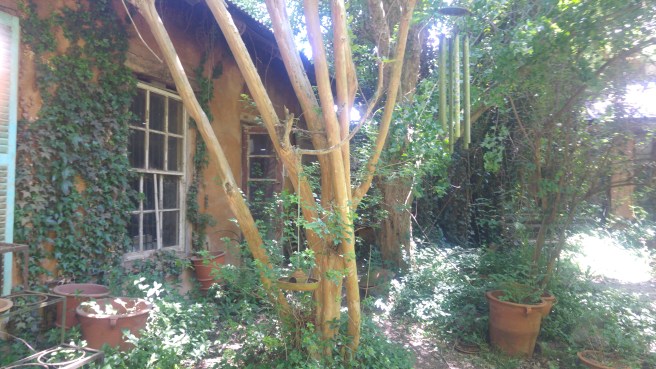
Our favourite by far was Ian Glenny’s Dargle Valley Pottery – everything about it from the pottery to the place. And it’s no secret that there are fairies playing in the woodland area surrounding his house which is an artwork in itself and worth the trip.

But be warned, both the artist and his work will captivate you and you won’t be leaving without one of his beautiful art creations. There are tables full to choose from which makes it really tough.

Ian Glenny's fairyland
Ian Glenny’s fairyland

It is all quite bewitching and one can wander around the pottery and the place for some time and then have wonderfully winding conversations with the artist about his work and his life.

As one of the originators of the Meander, he misses the way it was, but is happy that he still attracts his fair share of visitors. You would be silly not to take the turnoff to his special world.

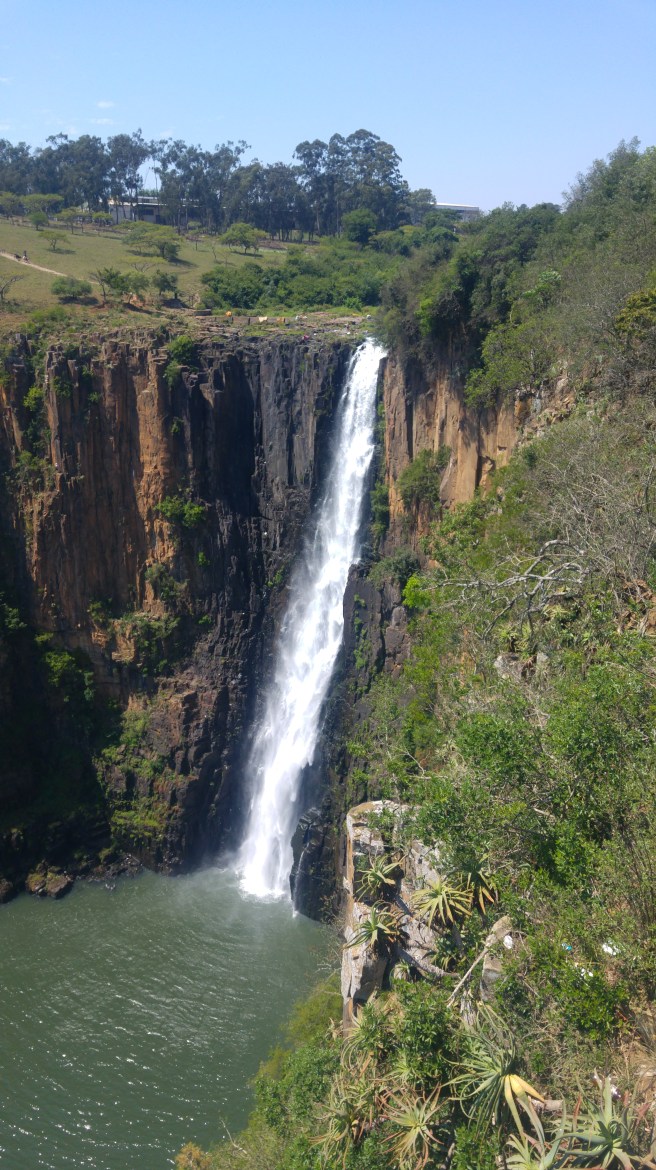
The special Howick Falls as well as arguably the most evocative Mandela site are both easy to access on the meander.

The Marco Cianfanelli monument

The Marco Cianfanelli monument was constructed to mark the 50th anniversary of Nelson Mandela’s capture by the apartheid police in 1962 – at the site of the capture.

The setting is striking, and you must do a symbolic “long walk” before you are struck by the remarkable image of Nelson Mandela and the rustle of the wind through the columns as you approach which seems to tell its own story. According to the artist, the 50 columns represent the 50 years since his capture, but he also hoped to illustrate the great man’s legacy of inclusiveness by showing how individual structures all come together to complete the perfect whole.

Howick Falls
Howick Falls

The Howick Waterfall is on the edge of the town and you can pop in when you pick up some groceries if you’re staying in a self-catering lodge which is popular in the area. It’s simply a skip and a jump from the car to the viewing point and again evokes a South African scene that’s quite humbling.

If you like traditional wares, this is also a good place to support the local community in their endeavors with even some serenading happening on the side which might just fall gently on your ear.

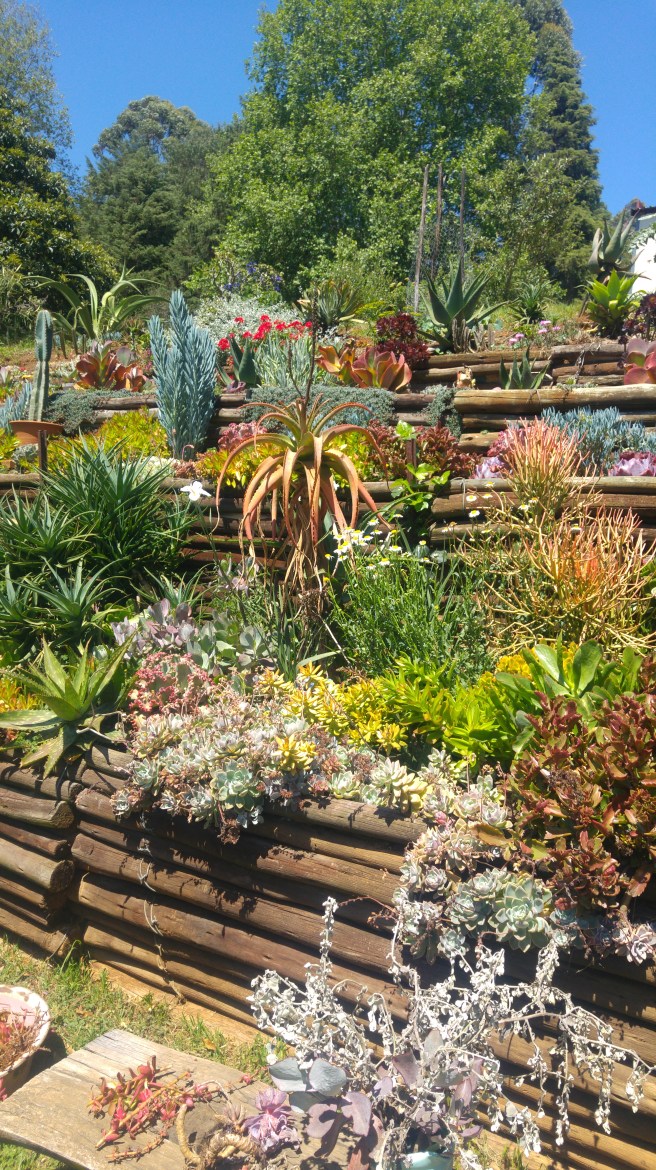
Succulent paradise by Mandy Crooks
Succulent paradise by Mandy Crooks from HillHouse

Hotels, lodges and self-catering cottages are plentiful and depending on what you like and for how many, you should find exactly what you’re looking for. Our first few days were spent in Lake House at Hillhouse Accommodation on a farm owned by two artists. It is situated in Dargle on a hillside (hence the name) overlooking the magnificent Midmar Dam. The cottage we stayed in can house four people but just the two of us filled it easily and the sheer isolation (seemingly) from the rest of the world was almost other-worldl

A higgledy piggledy gravel road takes you up to the cottage and while there are two other houses, one accommodating as many as 12 people, each one is different and slightly unusual to the more commercial venture. This is where the artists come to play with husband Nick the architect and builder and Mandy (Crooks) the one responsible for the interiors. All of the cottages are delightfully individual with a quirkiness that’s unexpected but joyful to experience.

And once there, the indigenous gardens in many hidden spots on the property and Mandy’s artistic succulent obsession are like outdoor galleries.

Hillhouse is situated on the edge of the Meander (was part of it at one time) and Howick is only 10 minutes away. But It felt like total immersion in nature as well as a kind of hideout from the rigours of the real world. You could easily just hide out right here for a few days.

The views at Whispering Waters


Our second port of call, Whispering Waters, is nestled in-between hills and dams with cows munching in every pasture as far as the eye can see. From the minute you wake up, the fields and the water lie invitingly in the early morning light. You can wander up and down hills and dales and warmed by a brisk walk, the dams are inevitable even if we didn’t think so initially, more used to sparkling swimming pools. Once in the water, the spell was cast.

Closer to the Notting Hill Road side of the Meander in Fort Nottingham, this is a more commercially driven property and yet because of the farm setting, it had that Meander appeal. The thatch cottages are spacious with a large kitchen, lounge, dining area and a stoep with a view – and the staff are intent on catering to your every wish.

Food is another Meander obsession, but these can be hit and miss like anywhere else. Howick is best for grocery shopping and our best find for exciting food was the Blueberry Café (with the adjoining brewery with a different kitchen) presenting many choices.

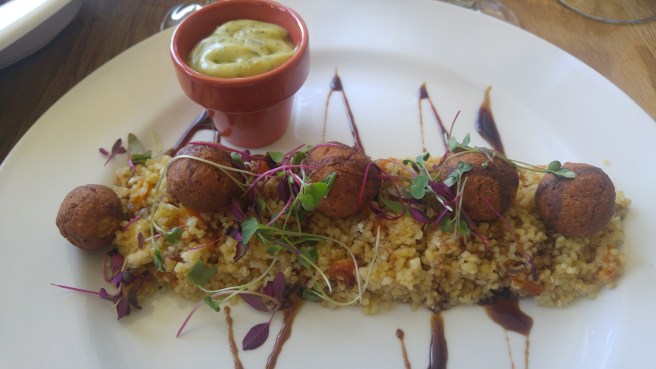
the quinoa and falafel salad with a blueberry sauce
The quinoa and falafel salad with a blueberry sauce

A personal favourite was the quinoa and falafel salad with a blueberry sauce while on the more substantial side, the fillet steak paired with risotto caught my eye. The brewery offers hearty hamburgers or if you want a healthy option, a roasted veggie salad. But there’s much to explore even though we did find it simpler to stick with what works for you.

If you’ve never been this way, it’s a treasure trove to explore in so many different ways. Just another corner of natural loveliness in this diverse land of ours.

Adrienne Sichel Gives Context to SA Contemporary Dance in Body Politics

Adrienne book cover

Kgomotso Moncho – Maripane

Guest Writer


The description that dance is “wordless expression in a world where words are currency,” by poet Lebo Mashile in her unpublished poem, I Dance To Know Who I Am, speaks to the hesitation and sometimes lack of engagement with South African contemporary dance locally.

The poem also encapsulates the transformative experience that dance can be.

Mashile created the poem for the production, Threads, a collaboration with choreographer and anthropologist, Sylvia Glasser and her Moving Into Dance Mophatong Company.

The poem opens veteran dance writer and arts journalist, Adrienne Sichel’s new book, Body Politics: Fingerprinting South African Contemporary Dance (published by Porcupine Press).

Adrianne_Sichel_photo_by_Val_Adamson
Adrianne_Sichel_ Picture: Val_Adamson

The book is a socio-political cultural history that focusses on the roots and evolution of South African contemporary dance from the mid 1970s to 2016.

Whereas the role of protest theatre is known in its engagement with socio-political issues, it may be taken for granted that contemporary dance, through its activist actions, played an important part in the championing of a free and multi-cultural society, during and post- apartheid.

Sichel’s book illuminates this particular cultural history, revealing how prior to democracy, the proponents of contemporary dance were at the fore-front of cultural activism.

“The policy-making Arts and Culture Task Group (ACTAG) process which culminated in the White Paper, the establishment of the Department of Arts and Culture, Science and Technology, as well as the founding of the National Arts Council in 1997, was the handiwork of many politically focussed dancers, educationists, choreographers, researchers and administrators,” she writes.

One of the standout traits of South African contemporary dance is that it is driven by the activist artist.

Adrienne Sichel Book Launch Jhb.

“That’s what gives it its originality and made it attractive to the world. You have people commenting on their society and the human condition. It has overtaken theatre in a way because dancers keep working and make it happen despite the challenges,” says Sichel.

“Paradoxically contemporary dance is an individualistic art form, but in so many ways South African contemporary dance is a collaborative mission to express our cultural and artistic identity. A lot of SA contemporary dance and African contemporary dance is sensorial and experiential. Those dimensions create a much more holistic vibrant art form,” she says.

Body Politics gives context to South African contemporary dance. It captures the collusion of cultures and histories as people explored their roots and their identities of the country and the people they wanted to be pre-1994. It highlights these very rich essences and fingerprints their origins with chapters looking at the birth of Afro-Fusion, subversive storytellers, the birth of theatre dance and what constitutes contemporary African dance.

It features festivals, companies and artists including early pioneers and contemporary players like Glasser, Carly Dibakwane, Robyn Orlin, Alfred Hinkel, Jay Pather, Jeannette Ginslov, Vincent Sekwati Koko Mantswe, Gregory Maqoma, Mamela Nyamza, Nelisiwe Xaba, PJ Sabbagha and many more.


It also includes a collection of Sichel’s published and unpublished journalistic writing. This makes it an important documentation and preservation of a unique artistic heritage and a necessary learning tool.

In mapping the evolution of this remarkable art form and its vocabulary, Sichel moves through terrains of contentious issues of appropriation and ownership, leaving questions to ponder on. Questions similar to the ones she asked herself when contemplating writing this book, like, who has the right to collate and tell this history? Who owns this history?

As a dedicated witness to and advocate for SA contemporary dance for 40 years in an environment that often rejects SA contemporary dance, she has earned the right to tell this history. Her background growing up in the rural Rustenburg exposed to her to a variety of cultures, religions, rituals, political practices and prejudices which fueled her curiosity as an arts journalist.

She co-founded the South African Dance Umbrella as a free democratic platform for all South African dancers and dance forms. She has also created an accessible language to articulate meanings behind movements and the fresh aesthetics of South African contemporary dance, which is no easy feat.

At the Johannesburg launch of the book in September, Sichel said, “What is scary about Body Politics is that it’s very concrete, it is tangible and it can’t be changed. I will be judged, just as I have been judging and evaluating people over the decades.”

She is also acutely aware of the gaps the book leaves and this is perhaps a challenge for the gaps to be filled.

The existence of Body Politics also makes the dearth

of books archiving or capturing cultural history in the country glaring. This is an urgent concern for Sichel.

“So many people did not want to publish this book. We don’t respect our history in this country. There are many narratives and cultural histories that are not being published and also need to be written,” she says.

Sichel’s hopes for dance is that “it keeps informing, transforming and educating.”


c

African Adaptation of The Little Prince Creatively Engages Young Audiences

The Little Prince Stage Adaptation by guest writer Kgomotso Moncho – Maripane

Picture by Ettione Ferreira Cue Media


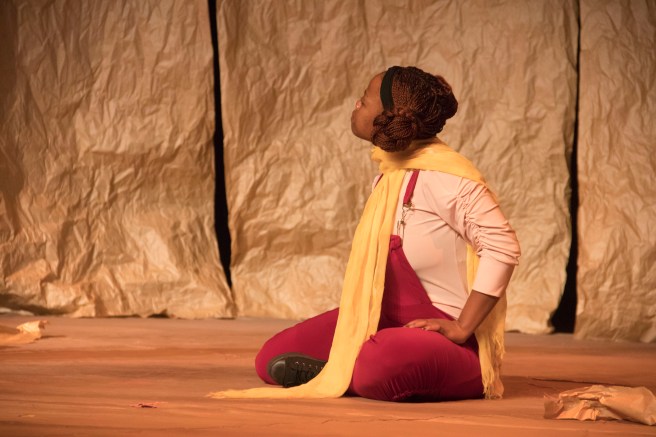
©Ettione Ferreira-CueMedia_IFAS_Market_TheLittlePrince_16
The Little Prince with Khanyisile Ngwabe in the title role 

Antoine de Saint-Exupery’s classic story, The Little Prince is written in such vivid imagery and magical surrealism that it lends itself to the playful theatrics of the stage. But the unconventional text may also be a challenge: Because the book already does a lot of the work with its powerful, provocative images, what else can performance do? What can live bodies add to that?

The Market Theatre Laboratory’s new company, Kwasha, headed by Clara Vaughan who co-directs the stage adaptation of The Little Prince with theatre practitioner and academic, Mwenya Kabwe, employs a physical language to the storytelling.

To prepare for the production, the company did circus training with a circus company called Art of Synergy, working specifically with acrobatics, tumbling, lifting, balancing and counter balancing.

“With the idea of magic being so deeply within the story, with a sense of other worldliness and a suspension of adult rules, the circus feels like a really appropriate form. With the theme of flight also being so strong in the story – flying and crashing, travelling through space – it felt always like the qualities of circus, both in its sense of the unexpected and its sense of magic and of defying gravity, really fit with the themes within the book. It was also very important to make the movement of the play as beautiful and poetic as the language in the book,” says Vaughan.

The play achieves this in its moments of beauty where the movement poetically articulates Saint-Exupery’s moral and philosophical ideas which lean more towards the value of life rather than its meaning. However, in some places, the physicality in the show could be more cohesive for the magic of the book to shine through.

The Little Prince is a European text set in the Sahara desert, whose universal themes resonate worldwide. It is the most translated text outside of religious books, with 300 translations including English, Zulu, Afrikaans and Xhosa.

During the early days of rehearsal for this production, co-director, Kabwe questioned how African languages were used in the show. The importance of this showed how careful thought went into giving this adaptation an African context, but without overthinking it.

“The African adaption of anything is a contentious question to grapple with. There are easy surface ways to do that. I feel like we’re trying to ask other questions about what it means to be staging a European text of this nature here. And how just by working with it, it can be localized. In a way, not taking an overt approach to African adaptation, but letting the work, as we discover what it is, what the ideas are that we’re dealing with speak for themselves. Just the fact that it’s this company, and it’s us and we’re here, already feels like an African adaptation,” Kabwe said.

It is by being authentic to its mechanisms and allowing the individual sensibilities of the cast to come together that this production excels. Its African-ness then comes through inherently.  It’s in the subtle music and the organic flow of the languages.

The open and rustic staging speaks to the bareness of the Sahara. It is also evocative of plays like Mncedisi Shabangu’s Thirteen and Prince Lamla’s Coal Yard whose imaginative exploitation of a minimalist stage are innovative. This feeds into the playfulness of the show that stays with you together with its strong messages. The Little Prince directly confronts the conflict between adult and child relationships and the execution of this production engages the perceived notions of what it means to create for young audiences in this country.

For Vaughan, this extends into her own ideas on creating.

“There are ideas that I really care about in terms of creativity and making – the ways that the world instructs what is good creating – which resonates with ways of theatre making. The ways that people lose their desire to make, or their playfulness around making – losing that internal pleasure that children have. That matters to me. It’s something I have been interested in. As an adult, the story around grown up expectations and expectations of being a grown up, really resonate with my internal tensions about what you choose to take on,” she says.

The Little Prince finishes its nationwide tour in Johannesburg, which started at the National Arts Festival and went to Bloemfontein, Sasolburg and Durban. It runs at the Market Theatre Laboratory until November 25.

Author Thuli Nhlapo’s Colour Me Yellow Written With Substantial Heroic Honesty

READING IS A CONVERSATION. All books talk. But a good book listens as well.

Mark Haddon

DIANE DE BEER


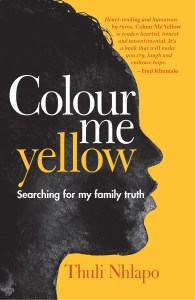
Colour me Yellow by Thuli Nhlapo (Kwela Books):

book colour

It’s so often a matter of birth and where you land on this little planet – in what shape and form that – determines the rest of your life – as this title subtly suggests.

White people are seldom or never called out on the colour of their skin while black men especially in the US approach every morning as they leave their home with a certain trepidation. To be a woman in the #metoo era might be exciting for some but for far too many, they still have a target on their back. Just listen to the horrifying news from India for instance.

You could find yourself as a stateless human being if you’re of a certain ethnicity in Myanmar and whether you’re born in North or South Korea has huge implications.

It’s not only this time although everyone probably feels that of their time, but life seems particularly harsh now. You need all the help you can get, starting with your family, to make it in this world. If you have to battle them as well, life can be extreme.

The only person who knew the whole truth had stayed mum, not once volunteering to talk. The closest she had come to it was when she said: ‘I hated being pregnant with you.’ Hearing that mantra as a child already in a hostile environment doesn’t bode well for your future and it is exactly that story the journalist Thuli Nhlapo was determined to unravel and expose – if only to herself. She knew it had to do with her father but she didn’t know who he really  was and her mother was not going to tell.

In the meantime, from the day she can remember, she was harshly treated by her family. I felt I needed to prove there was absolutely nothing wrong with me – even though I may have been yellow or a boesman, I breathed and bled like any normal human being.

And this starts with her family, those closest to her, her mother and father, who have to mirror the outside world to a child. What chance does she have with those who don’t know her if this is the reaction of those who do?

But one can imagine that in today’s environment where dysfunction is usually a family trait, there are many children who battle with those closest to them, those that should protect them, often in a fight for their life, or as Nhlapo confesses, a struggle for her soul.

Where she has been blessed is that she has an ability to write (was winning as she says, writing and journalism prizes left, right and centre), which also means that she could organise her thoughts, think like a journalist and investigate her own past – with the accent on the identity of her father. As she grew older, this became more and more of a problem with even the spirits rejecting the surname given to her as that of her ‘father’s’. It couldn’t go on this way but her mother was refusing to budge.

It’s an extraordinary tale, but also one of immense fortitude and courage, self-reliance and making it on her own because that was all she knew how to do. When she was struggling with one of her pregnancies, she coped without asking for any help. She ascribes that to being a black woman and that’s just what black women do, but she concedes that the prospective father was out of town – and not a doctor! So that’s what she did, went to hospital and saw a doctor and when he treated her with disregard, she insisted that he do a thorough check-up – and she was right. She knew she was the only one who would be fighting for her life. If she didn’t do it, no one else would step up.

As she forecast, he was lazy in his diagnosis of a miscarriage and she could move on and out and find a doctor who would treat her with care – the care she knew deserved.

Colour me Yellow isn’t an easy book to read but it is written with heroic honesty with a real-life heroine who demands and easily draws your enthusiastic support. It is easy to give as well as a nod to your own much more comfortable life because even without asking, you got what a child needed – her family’s love. It just makes life that much easier and survival not something you have to deal with every day.

But as Nhlapo proves, every life is worth fighting for and finally – for yourself and your children – you will triumph.

African Muckraking: Power to Writing it Like it Is

There’s so much more to a book than just the reading – Maurice Sendak


DIANE DE BEER

AFRICAN MUCKRAKING COV


African Muckraking: 75 Years of Investigative Journalism from Africa edited by Anya Schiffrin with George Lugalambi (Jacana):


South Africans will know exactly what the power of this kind of investigative journalism is following apartheid and now the Zuma years.

There are of course other things involved as well, but nothing can downplay the importance of the freedom of the press and, even when that is sacred, the courage of journalists to tell the hard stories. When powerful people do bad things, they have the means to protect their wrongdoing.

Except from journalists whose lifeblood it is to tell the truth, nothing but the truth. So help us God. And that’s exactly how it works, often.

And nowhere is it more important than in countries where powerful people think they have the right to do things exactly the way they please. It’s not a new thing and it’s absolutely not something that is found in just certain parts of the world. Power corrupts, sadly, and more than ever, politics has become abusive in a way that few could have predicted.

It’s a known fact that African journalists are not recognised around the world, not even on their own continent. In Africa itself it is difficult to reach a broad audience due to the oftentimes low education, literacy problems and income levels of potential audiences. That goes hand in hand with poor distribution possibilities because of inadequate infrastructure, which makes reporting and distribution tough.

In the global North, writes the author in her introduction to the book, the contributions of African journalists are largely unknown – often because of the assumption that good journalism doesn’t originate in Africa. Western audiences trust satellite news, parachute journalists more than they do local reporters, she writes.

“This book aims to dispel that.” She goes on to say that readers should be reminded that journalists really can change the world – and again, we have seen that most recently in our papers and on television, in the unflinching reporting as well as among those who stood up to the SABC and fought for truthful journalism.

In the book she presents 41 pieces of campaigning and/or investigative journalism from around the continent, each with context provided by today’s foremost experts on the continent; in South Africa, for example, Anton Harber and Ferial Haffajee. They don’t come better than that.

When selecting pieces to include in the book, they tried to be inclusive, including excerpts from pamphlets as well as newspapers from a wide range of countries, as well as stories that had impact or covered an important story even if they weren’t classical works of investigative journalism by today’s standards.

It’s stirring stuff on a continent that doesn’t flinch when it comes to horror. She notes that Africa is diverse and newspaper were influenced by colonial powers. They hoped to reflect this diversity, for example, with someone like David Martin who wasn’t born in Africa but still calls it home.

This book followed on Shiffrin’s editing of Global Muckraking (2014) when Harber, then director of the investigative reporting programme at Wits suggested that they edit a book exclusively for African journalists.

Then disaster struck. There was a paucity or often complete absence of records, which pushed her and her crack researcher Vanessa Pope to persevere. Anyone who has worked in newspapers these past few decades will know exactly what that means. When newspaper libraries went digital and as newspaper groups changed ownership, these archives were the first to disintegrate. All of this also bumped into the disastrous lack of funding for the profession, which meant these side issues completely disappeared.

That is exactly what makes this such an amazing read. Not only is every story selected something quite extraordinary (especially given the context and the quality), it is also a reminder of the quality to be found on the continent that is so often ignored in the wider context of the world. Fortunately, we now have the means in a digitally connected world to change that to some extent.

Following the introduction, which highlights significant historical cases of journalism supporting social and political change, she points out that this journal can only hint at the “full constellation of contributions” that African journalists have made to their societies.

But she does encourage readers to get a taste of the powerful work that African muckrakers have done and hopes that the book will contribute to a conversation about the importance of investigative journalism in Africa.

Nobody reading the book will have any doubt about that but the times we live in have also underlined the importance of investigative writing about those who abuse their power at the cost usually of vulnerable people.

It is beautifully set out, which all adds to the power of the pieces which are classified in sections ranging from struggles for independence to corruption; health, rural affairs and environment; mining; and women, for example.

And more than anything, the intent is clearly stated with the first piece written by Sol Plaatje: All We Claim is our Just Dues.

It is riveting from start to finish.


Elize Botha: a Remarkable Book of Letters Reveals the Life of a Remarkable Woman

I am a reader, not because I don’t have a life, but because I choose to have many.

(unknown)


DIANE DE BEER

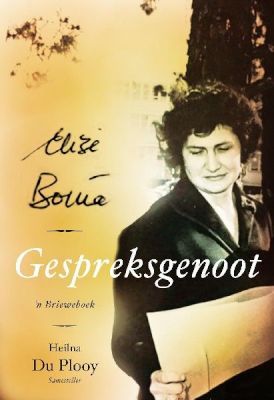
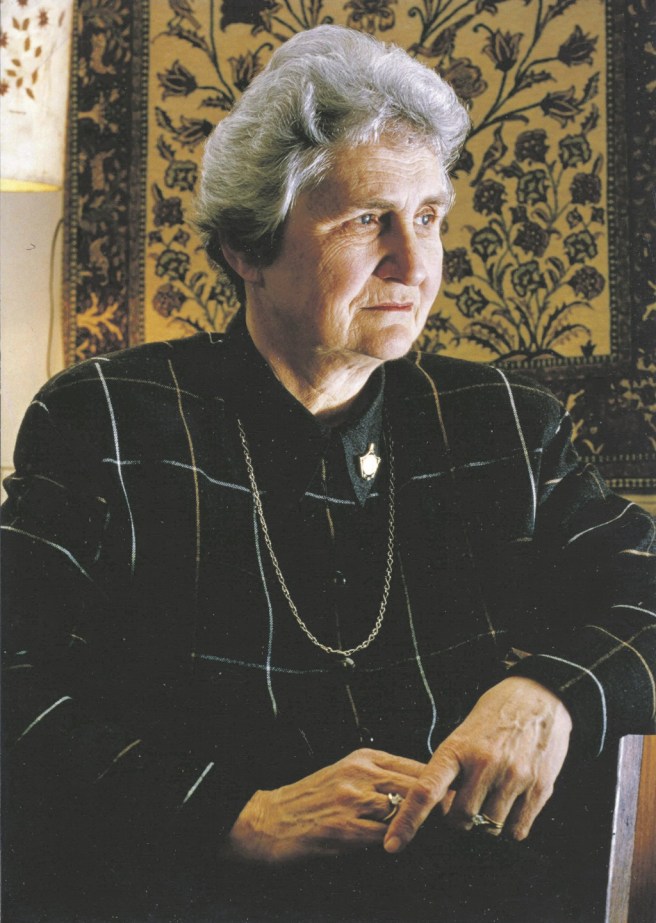
Elize Botha

ELIZE BOTHA: Gespreksgenoot – ‘n Brieweboek by Heilna du Plooy, the co-ordinator (Litera):


This is an unusual and very specific book and obviously you must understand Afrikaans to even think of reading it.

Pay heed to the delightful name: Gespreksgenoot – ‘n Brieweboek (Companion – A Letters Book). What surprised me most was how the letters capture the time, a specific period, and the Afrikaans literary world which because of the politics of the country, was all-important.

Because I wasn’t part of that world yet knew about the people and read some of the books while writing about the arts and interviewed Elize Botha at a specific time, it’s been an amazing read.

The compiler (and the word doesn’t really do justice to what must have been a mammoth task brilliantly executed) who was going to write a biography of Botha, a woman ahead of her time and supremely important in the Afrikaans literary world, was handed the key to much of her letter-writing which was how she kept contact and became close friends with so many writers. Starting to read through the letters, Du Plooy very quickly realised that Botha would be much better served if she could simply put the letters together in a certain fashion to tell the story.

From the beginning, she decided that once a letter had found its way into the book, it would not be censored in any way. It’s either in or out, warts and all. And she needn’t have feared, for those of us on the edges, the finer gossip items are too nuanced and for those who can pick it up, they probably knew it all already. But it’s not that kind of book anyway and Botha was not the kind of person to be entertained unduly by idle gossip. She had far more interesting things to talk about. It is these conversations between those with similar interests – literature – that are so fascinating and educational.

There are many surprises, quite unexpected, I would imagine. For example, the art of letter writing, if anything, points a finger at a lost art since we now rely on the internet and social media to communicate. What a joy to still encounter someone who wrote such meaningful letters – and regularly. It was the way she communicated with those not in her immediate vicinity and what a blessing for us, because she has riches to impart on many levels.

More than anything, it is the way the letters have been written, the language, the topics they discuss and how regularly in extremely busy lives, they still managed to keep up this correspondence. It’s a lost world. The letters are illuminating and sheer joy and point to the loss of something that will never be recovered. Typing an email is just not the same as taking the time to sit down to write a letter to a friend. It’s extremely special and when they really have something to say, and its about something as important and universal as literature, it is something special to share and to experience.

Take, for example, someone like Audrey Blignault, an Afrikaans writer who for those of us who didn’t have better insight might have viewed her in a specific way. There’s a completely different woman who emerges when you follow these two smart people’s writing and exchange of ideas. It’s fascinating to read for example how they were influenced at the time by international writers like Saul Bellow, hardly able to wait for his latest novel; or when discussing someone like Tolstoy, the quality of their ideas is illuminating. It’s like bumping into a mini lecture in the comfort of your home and a real gift to have insight into their thoughts on reading and how it stimulates their inner worlds.

elize botha1

The joy of reading and superior writing is celebrated on every page and though the accent here is on Afrikaans literature in a time when many in this world were fearful for the language, in essence, it is about reading in whichever language you prefer, the appreciation of that language and the art of storytelling. That’s universal and a great advertisement for books, something that can always do with encouraging publicity.

For Botha it would have been unthinkable not to read. Even though as a judge for many different institutions, dealing with books and regarded as one of our finest Afrikaans literary figures, it was part of her daily life, and the way she lived. Most of her career was spent in academia, teaching but also setting the guidelines in her particular field of literary theory and criticism. But she was also very aware that her career was on a slow burn (“a long slow curve,” is how she phrased it) because of being a woman in this time. Hopefully that graph might now be changing with everyone being more vocal about the problems and the social media world keeping a watchful eye.

Starting out in her early days as a journalist, she was also the editor of the Tydskrif vir Letterkunde (Magazine for Literature) from 1973 to 1992. Many celebrated authors published their first work here in the 70’s and 80’s under her guidance and nurturing. She also published often in different spheres – from literary criticism to articles and collections of literary essays. And she traveled often with literary quests as part of these journeys. She featured on every literary committee and academy of the time and for many years was the chairperson of the M-Net Book Awards.

As a woman she was often the first in many different fields, like a board member of Nasionale Pers, the first female chair of the Akademie vir Wetenskap en Kuns (Academy of Science and Art) and finally, the first female chancellor of the University of Stellenbosch, a position she occupied until her untimely death in 2007. But all of this is just a small part of her packed life as any woman who has raised three children in between all this academic superpower will know.

More than anything, says the compiler (colleague and friend), Heilna du Plooy, this collection of letters is also an effort to preserve something that is precious, and to capture people and events and views and insights which can serve as encouragement and a source of survival for others.

It’s a remarkable read about a remarkable woman.

Books that Allow the Words and Actions of Those Involved To Tell the Real Stories

If you want to go for fact rather than fiction, DIANE DE BEER has two examples dealing with events happening on an international front but with relevance here:


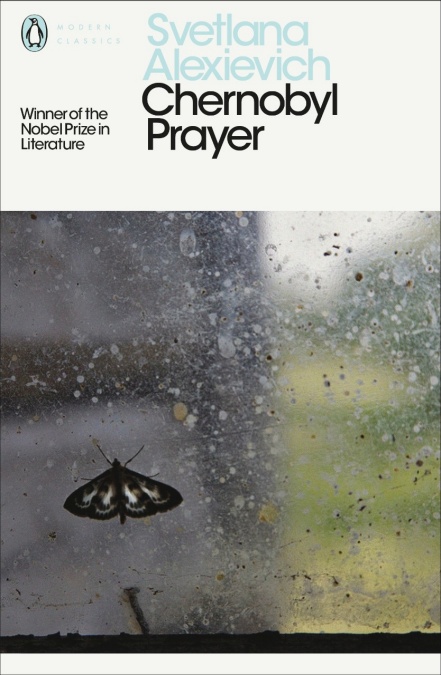
book chernobylChernobyl Prayer by Svetlana Alexievich (Penguin Books):
I first discovered this author with her book celebrated with a Nobel Prize for literature in 2015 –  Secondhand Time: The Last of the Soviets – in which I discovered her unique style. She rejects the term journalist but describes herself as an oral historian. What she does is allow people to tell their stories and something remarkable unfolds. In Russia for example, like in South Africa at more or less the same time and like here, people were expecting their lives to change dramatically with the and dismantling of the UUSR.

It did of course for a handful of oligarchs and the usual suspects and like here the lives of ordinary people were trampled on and they were left gasping for air. It is where she shines her spotlight harshly yet illuminating the lives that are struggling to make sense of what is happening to them.

I picked this one up at a sale recently and was as engrossed in this story told in similar style. Who doesn’t remember Chernobyl? And yet, it’s the name and nuclear disaster that strikes hardest, the rest is hazy. On this particular cover, Julian Barnes is quoted as saying: “The book leaves radiation burns on the brain.”

Being the writer, he captures it magnificently.

“All that remained behind barbed wire was the land. And the graves. Our past our great country,” says one party member who felt he had to help with the clean-up. Another was taken on a cleaning operation without any warning: “On the first day we saw the nuclear power plant from a distance. On the second, we were already clearing the rubbish around it. We were shoveling with ordinary spades…As we said battling the atom with spades! In the twentieth century.”

Then there’s this about the nuclear operator Leonid Toptunov who was on duty that night at the power plant, and pressed the red emergency shutdown button a few minutes before the explosion. It didn’t work…He was treated in Moscow: “To save someone, there has to be a body to start with,” the doctors said throwing up their hands in despair.”

“The most serviceable robots were soldiers,” says another of the clean-up period following the catastrophe which just kept going on and on for those unwittingly commandeered to help in this deathly process.

Women were being tested when breastfeeding and found to be radioactive. Professionals who knew what happens in these situations, asked the right questions. They were told to simply carry on testing and watch the television. Emergency measures were being taken. “I – an engineer with twenty years’ experience, someone who knew the law of physics. I knew every living thing needed to be evacuated from the area, at least temporarily…We were accustomed to believing. I belong to the post-war generation that grew up with the faith.”

It is statements like these and many, many more that tell the full story in the saddest detail, the way the people are led by their noses because they follow their leaders with blind faith – to their deaths. “Everybody knows and still they can’t do anything, not the killers in command and neither those who are doing the dirty work – and then die. That is our world – and the world of most who live on this earth today.”

It is Alexiev’s powerful research and conversations with people on the ground who tell their stories and how and what happened. It is tragic and horrific, even more so than the actual explosion. But at least these unwitting victims can be heard, their stories are being highlighted – and sadly in this world, it probably won’t make a difference.

But now we know – at the very least.

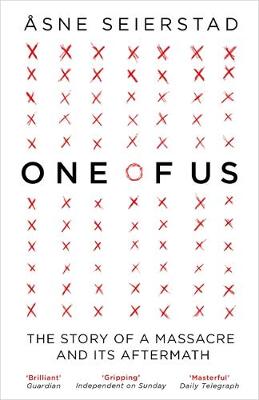
book oneOne of Us by Åsne Seierstad (Virago):

When someone told me they were reading the book about the mass killings in 2011 by Anders Behring Breivik who killed 77 of his fellow Norwegians, young people who were doing their civic duty, on an island, isolated from the world and any immediate help, I didn’t understand why anyone would want to read about this distant tragedy seemingly unrelated to anything here.

Nevertheless, I was given a copy and happy to test my misgivings. Of course it is much more than simply the story of the killings as the author is a journalist who knows how to go about finding and researching her stories, in some instances perhaps too thoroughly but that might also have to do with the translation. The language doesn’t always hold to the subject matter and the focus is sometimes just too much for a particular topic.

And yet, what she does is to walk back in time to Breivik’s childhood, the tug of war between his father and mother, his father’s second and much envied family by the young man, his own isolation in the world and a determined almost frantic effort to be recognised and accepted by almost any peer group.

It is pointed out on the book’s cover that the book shows that “evil is not born but created” (Independent on Sunday) and that is evident in the detailed evidence that Seierstad is at pains to point out.

It is also a story of our time, how people are unable to deal with their own lives and how there is nowhere to turn to. Today’s living is so fast, hardly anyone will notice someone else’s pain, reach out a hand or take the time to even have a conversation. If you grow up in the kind of isolation that is illustrated here, the dark web is almost inevitable if you are determined to make yourself visible.

This is obviously the extreme but if you take this relatively young century into account, people seem to feel more and more that they have to make an impact simply to be seen. That’s a problem of our time which can only get worse.

Is Sitting Pretty a Case of White Afrikaans Woman Sitting Pretty Uncomfortably?

Sitting Pretty Cover Oct- hi res

Sitting Pretty – White Afrikaans Women in Postapartheid South Africa – the title is enough to stop you in your tracks. DIANE DE BEER speaks to author Christi van der Westhuizen about the issues that encouraged her to write this book:


I first heard author/social and political commentator/associate professor in Sociology at University of Pretoria Christi van der Westhuizen chat to Radio 702 host Eusebius McKaiser about her latest book Sitting Pretty – White Afrikaans Women in Postapartheid South Africa (University of KwaZulu-Natal Press) and I was intrigued.

How can I not be, as one of that species whom she describes as both the oppressor (as white) yet also oppressed (woman)? Chatting to her about this academic treatise, she explains that book’s intro, which is the toughest of the lot because she wanted to get all the theoretical stuff out of the way at the start. And if you read it slowly – and again once you’ve read the book, even if like me, you are not au fait with academic speak – you will get there.

Van der Westhuizen has a mind that grapples with life and she had enough given to her to make sure that it will be worth grappling for. She grew up in a female-headed household in 1980s Boksburg when the city council was taken over by the Verwoerdian Conservative Party, and the Afrikaner-Weerstandsbeweging was on the rise. “My experience of alienation as a young woman and a lesbian within a patriarchal and racist context made me ask hard questions. People should know,” she says, “that I’m investigating my own life when writing on these kinds of subjects.”

Christi - pic - FLF
Christi van der Westhuizen

She took her premise from Nelson Mandela who in his inaugural State of the Nation address extended an invitation to South Africans who identify as ‘Afrikaner women’. She starts with that invitation as Mandela re-remembers Afrikaans Poet Ingrid Jonker “and poignantly proffered her ‘glorious vision’ of possibilities of identification:

“She was both a poet and a South African, he said. “She was both an Afrikaner and an African. She was both artist and a human being. In the midst of despair, she celebrated hope. Confronted by death, she asserted the beauty of life. (…) She instructs our endeavours must be about liberation of the woman, the emancipation of the man and the liberty of the child.” He then quoted Jonker’s best known poem, The Child Who Was Shot Dead by Soldiers in Nyanga.

She argues rigorously that Mandela’s invitation to Afrikaner women was “an invocation of the democratic potentialities … amid the ruins of apartheid”. That’s what she wants you to think about, says Van der Westhuizen as she asks whether Jonker’s contemporary counterparts (at least in terms of structural classifications of gender, sexuality, class and race) step into the positions that democratic discourses have prepared for them?

We all know how big an ask the country was given and up to now, how dismally we’ve failed. But Van der Westhuizen believes that the global context hasn’t helped. Because of the neoliberal kind of capitalism that exists today, with its high level of destabilisation and inequality, people feel under attack, which has meant that they have fled into specific enclaves of recognisable identity. It’s a very complex situation.

“Because of all these forces at play, people tend to organise their lives to re-entrench hierarchies and keep oppressive power relations intact.” Previously, she says, the state enforced gender, sexism and racism for us. “Now people are doing it for themselves.”

She is happy that greater diversity exists among white Afrikaans women in the democratic era. For some it is still true that if they don’t adhere to the strict rules laid down mainly by family structures headed by the husband/father, they will be ostracised and banned. But there are those who battle the forces stacked up against them.

Van der Westhuizen points to identity as the main culprit, in those instances where old habits recur, the way the instability and precariousness associated with the current phase of capitalism make people feel threatened and turn inward rather than embracing the diversity that’s out there. There’s no arguing that. Sadly though for those white Afrikaans women given an invitation at the beginning of our democracy to forge different lives. The pressures are many (from family, church, school and society at large) because if you don’t conform. However, that might also plant the seed of resistance.

The book also deals with the fact that this country is unusual as it has two distinct settler groups. “That doesn’t often happen and has its own set of problems, as both groups vie for the spoils of whiteness, with a particular model of heterofemininity attached,” she argues. It’s all fascinating stuff and in a complicated country as ours, with its past, with its diverse cultural groups trying to work together even though all the odds seem stacked against us, it is important to get as much understanding about the issues that confront us.

Van der Westhuizen makes it clear that her study is a qualitative one, which shows what the dominant discourses are that form white Afrikaans women. “If you throw these women together in focus groups, what comes through? It’s about throwing light on what is the mainstream,” she says. “The study also uses dissident voices to do that.”

This was a relief to know, because it was one of my issues when reading this gripping dissertation. I know all over the world conservatism seems to be a dominant force and while locally, amongst both Afrikaans and English speakers, racism seems to be everywhere, it isn’t all pervasive.

But is this where we should be throwing the light? Yes, says Van der Westhuizen and I agree, because white Afrikaans women are the least studied group in the country.

“That isn’t the case for the earlier part of the last century when the Nasionale Manne Party and the Nasionale Vroue Partye (men and women’s parties) folded into one another to form the National Party in the 30s, but after that Afrikaner women seem to disappear from public view and into the home where they were expected to be wives and mothers. But they were homemakers with an edge, as most instilled apartheid’s racism, sexism and homophobia in their children through socialisation in the family,” she concludes.

In a world where the Other is perceived as all-invasive, and many negative ‘isms’ are deployed to subvert challenges from groups with less power, an investigation of a previously dominant group that still holds significant relative power, and the contestations within this group, is fascinating reading.

With its academic slant, it is a tough yet compelling read.