The Suitcase is packed with Stories

The Suitcase 2017
Masasa Mbangeni and Siyabonga Thwala

DIANE DE BEER

THE SUITCASE (by Es’kia Mphahlele)

ADAPTED AND DIRECTED by: James Ngcobo

CAST: Siyabonga Thwala, Masasa Mbangeni, Desmond Dube, John Lata

GUITARIST: Bheki Khoza with singers Gugulethu Shezi, Ndoh Dlamini, Nokukhanya Dlamini

SET DESIGN: Nadya Cohen

LIGHTING DESIGN; Wesley France

COSTUME DESIGN: Nthabiseng Makone

VENUE: Joburg’s Market Theatre

UNTIL: November 26
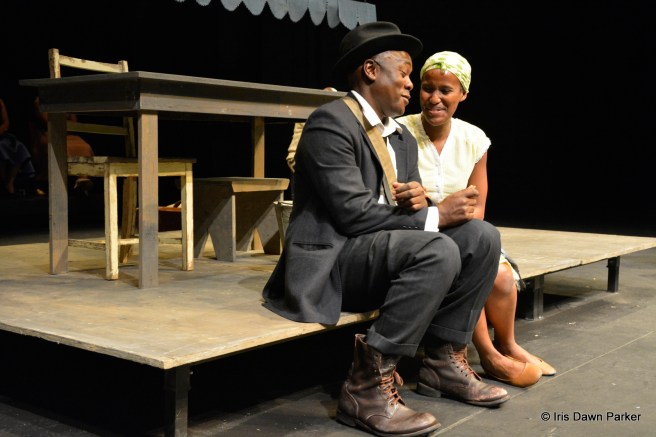
 

The Suitcase 2017
Siyabonga Thwala and Masasa Mbangeni


The audience were vocal in their approval from start to finish with Es’kia Mphalele’s The Suitcase, a reminder of how important and inspirational stories that reflect lives will always be.

This is the third reincarnation of this James Ngcobo production which started at The Baxter more than a decade ago, evolved for the opening of the Soweto Theatre and now this current production, which was revived for a UK tour with original members Thwala and Lata with Dube and Mbangeni, new additions.

And none of its power is lost. If anything, it grows in strength as Ngcobo, adds, takes away, uses the space differently, plays with the pace, and approaches the music from a different perspective, which in this instance with the three women singers, seems to reflect on the times.

Also in sync with the times is the spotlight on the poor and their particular dilemma. For many it is unthinkable not to have somewhere to turn to in times of distress, yet in the real world, that’s a luxury and an option not many are privileged to have.

When you are battling for survival, there usually aren’t any safety nets and that makes every day precarious.
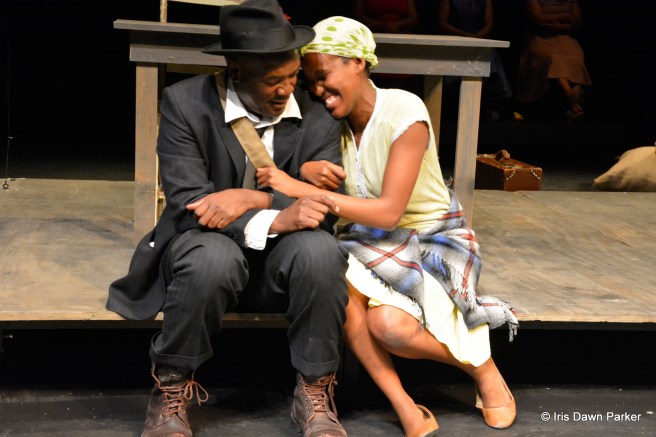
The Suitcase 2017
Siyabonga Thwala and Masasa Mbangeni

For Timi and Namhla, that’s a way of life and they have moved to the big city in pursuit of their dreams. They do still have those and their strongest suit is their love. They’re partners in everything they do and get their strength from one another – until it all becomes too much to bear. But for that desperate chance, says Timi, who seemingly loses hope and yet …

Set in the days of apartheid, it is a reminder of where we come from but also that for these particular people in today’s world, not much has changed. The safety net is still not there and their days are as precarious as they ever were. And that’s sad. The poor seem to get poorer in a world where greed is what drives the powerful.

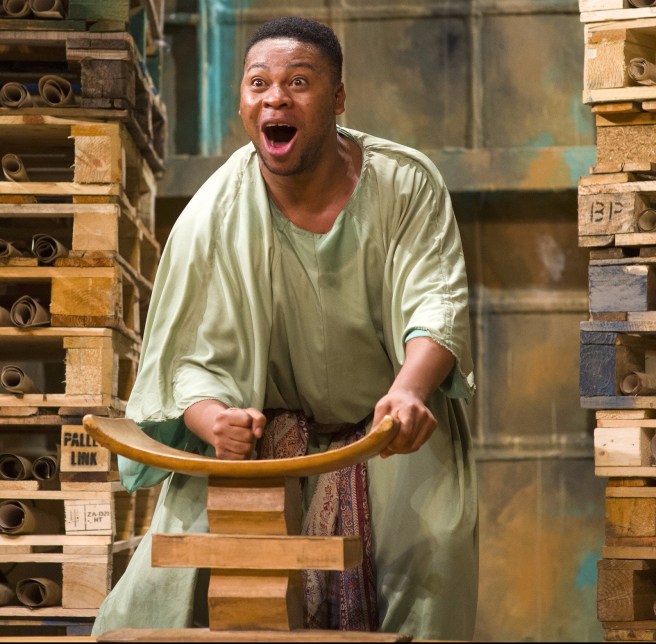
One of the fascinating things about seeing this play in its different incarnations, is Thwala’s growth through the years. He is older and that adds to the substance of the performance. Each step is taken with so much more impetus as if everything this man does determines what comes next.

But all of the sweetness between the two lovebirds is still there, the lifeline that exists in this family and carries them into their future. Masasa with her beautiful depth of voice offers a gentle strength for her man as he struggles to find something to keep them going in their battle for a better life. And it gives her older character a gravitas which adds to the story.

The Suitcase 2017
Ndo Dlamini, John Lata, Desmond Dube and Siyabonga Thwala

As the two narrators as well as numerous other characters, both Dube and Lata are seasoned performers who know when to milk a specific scene and how far to go without stepping completely out of character – and the story demands their kind of tomfoolery.

To hold it all together, there’s the music that is both haunting and heavenly with Khoza’s guitar accompaniment for three sublime voices in unison and solo, holding the show in a very specific ambience. It’s quite something.

The Suitcase is a story, sometimes sublime and sometimes extraordinarily sad, that captures both the good and the bad, and in these specific times, it again underlines the lives of others, and how those without, so often slip through the cracks.
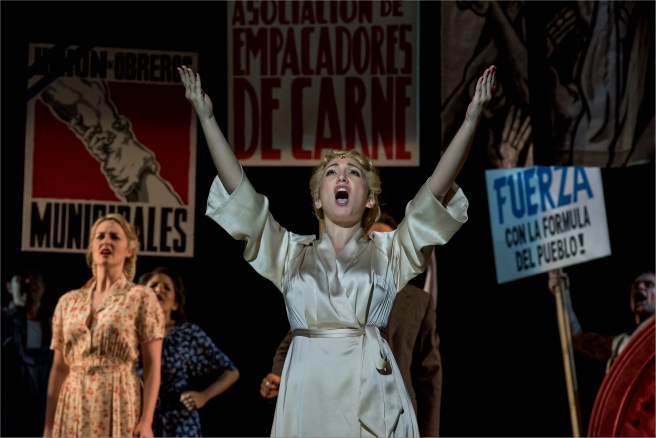
Evita, a musical of our time, then and now, round and round, again and again

DIANE DE BEER


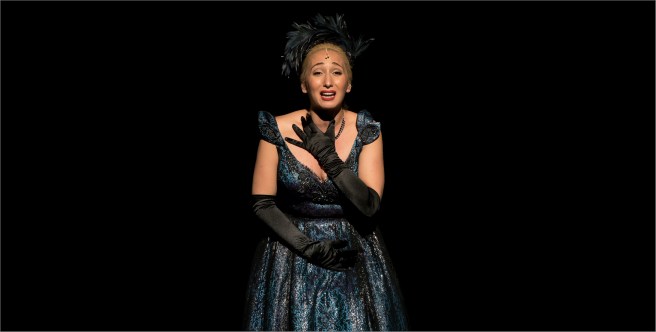
Eva Peron3eva peron2Eva Peron

Pictures: Christiaan Kotze


EVITA

ORIGINAL DIRECTOR: Hal Prince 

RESIDENT DIRECTOR: Anton Luitingh

CAST: Jonathan Roxmouth (Che), Emma Kingston (Eva Peron), Robert Finlayson (Peron), Anton Luitingh (Magaldi), Isabella Jane (Mistress) and ensemble

CHOREOGRAPHER: Larry Fuller (international team)

RESIDENT CHOREOGRAPHER: Duane Alexander

MUSICAL DIRECTOR: Louis Zurnamer

DESIGNER: Timothy Brian O’Brien (international team)

VENUE: Teatro at Montecasino

UNTIL November 26; Cape Town’s Artscape December 1 to January 7


We do know how to do musicals – and do them well –  with some of the best talent around.

More than anything this one is steered by the exceptional Jonathan Roxmouth, who inhabits the spirit of Che with a scheming eye and the knowledge that he has picked his cast of opportunists well, to skewer at heart’s content.

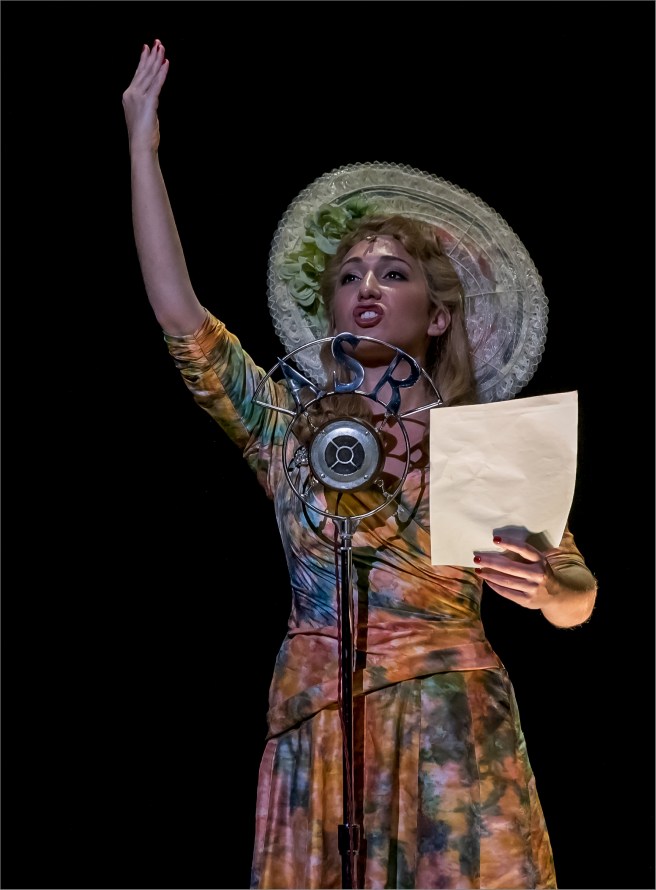
Jonathan Roxmouth in full colour

And then there’s Eva, the Madonna of Argentina, who is played by Kingston (picked by Andrew Lloyd Webber, Tim Rice and Hal Prince) with a harshness that places this musical squarely in the world we find ourselves in today.

It isn’t a pretty story with pretty songs. It is about a people who put their hope in a woman (and her man) who knew their lives intimately because she had lived it before her own clamber to power succeeded.

Everything is tainted with a clinical yet cynical brush which makes this a truly remarkable revival of a production seen here before many times. Perhaps it’s simply the state the world finds itself in at this particular time that has upped the relevance here and now, but there’s no way to witness this one without being aware of the cyclical nature of power and its abusive nature – always at the cost of the people.

It is also again the casting that turns it into the sensation it is, with especially the leads all making their mark magnificently.

Roxmouth is in a class of his own and this role allows him free rein to explore many of his extraordinary powers from the singing to his acting as he slips most comfortably into this particular narrator’s skin. It’s a glorious turn as he grows in confidence and ticks every box perfectly – to the benefit of the production, and those of us witnessing his skills in a blaze of brilliant colour.

Initially I was puzzled by Kingston’s almost screechy approach in the songs but as the musical progressed, her character grew almost bloated in its horror because of the way she approached her. She plays her like someone who understands from the start that she will access everything she needs to maintain this extraordinary life.

Welcome back to Finlayson whose voice is as powerful as it was in his early days and who perfectly fits the Peron persona, while both Luitingh (doing double duty as performer and director with aplomb) and Jane shone in their solo moments as they nail their iconic songs.

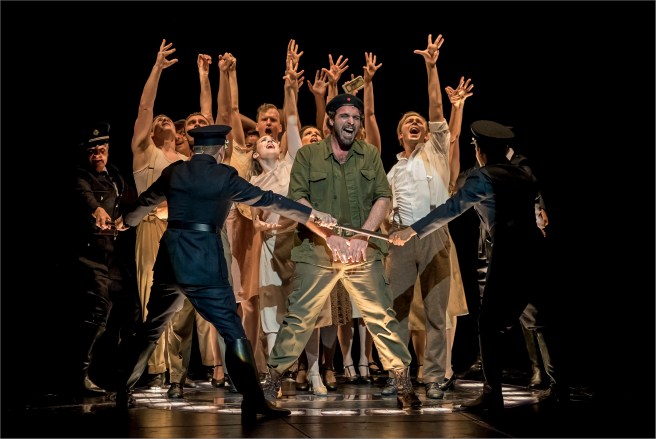
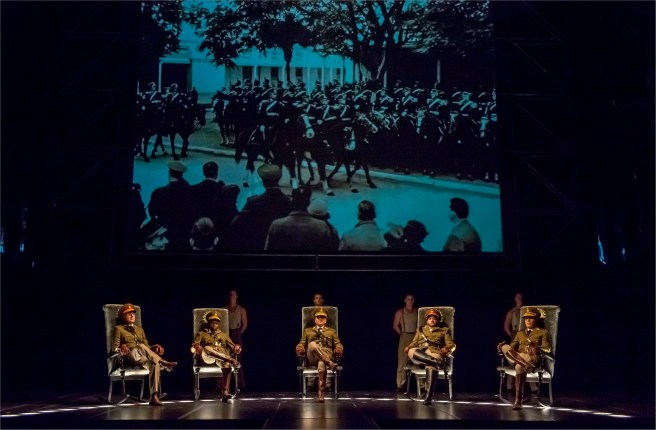
None of this would matter if the ensemble didn’t step up to support the excellence of the soloists – and they do at every turn. There’s enthusiasm and energy as the show is pulled together with an authenticity as real footage of the era and the people is used to great artistic effect.

Evita general scene
Night of the Generals

Because of the times, it is an appropriately dark version of Evita but because almost all the songs have become anthems, the songs will carry it for those who want music rather than message and for those of us wishing for more, it is all there in gruesome splendour and sadly,  it is all so horribly familiar.

It’s a grand spectacle, with lighting and designs cleverly creative, the orchestra, both in full sound and solo moments, beautifully held, and the whole comes together because of the attention to even the tiniest detail.

And while this is an internationally conceived production and the timing adds superbly to the substance, it is Roxmouth, Luitingh and the local gang that pull this one off with such style.


Leap of Faith with The Man Jesus by Whitehead and Toko at Market Theatre

DIANE DE BEER

Pictures: SUZY BERNSTEIN


lebo-toko-by-suzy-bernstein-03.jpg

Lebo Toko in The Man Jesus

THE MAN JESUS

DIRECTOR: Robert Whitehead

ACTOR: Lebo Toko

PLAYWRIGHT: Matthew Hurt

SET AND COSTUME DESIGN: Noluthando Lobese

LIGHTING: Mandla Mtshali

COMPOSER AND SOUND DESIGN: João Renato Orecchia Zúñiga

VENUE: Barney Simon Theatre at Joburg’s Market

UNTIL November 5


The combination of Robert Whitehead as visionary director and Lebo Toko as flamboyant actor is sheer brilliance.

That’s what keeps you glued to the seat, watching perfection as it unfolds on stage. It starts with the vision, the look, the execution, the sound and then of course the performance – how it should play – and how that is pulled out of a hat!

From the minute Toko bounds on stage, rapid-fire stream of consciousness from his mouth, and transformations with the flick of a wrist, tie of a scarf or sound of his voice, he transports you to a fascinating world.

It’s about a man called Jesus, the way he is affecting different characters in that particular scenario and how the story plays out. Think about that time. Palestine writes Whitehead was a country under very harsh Roman rule. The Jews did not accept the “Pax Romana” and this made them difficult to control.

All in all, it was a country in chaos with this man called Jesus further upsetting the rule of law. But with the story comes an array of characters, both men and women, who describe the impact of this man and the way he was doing and saying things.

And a sleight of hand, introducing a South African flavour, with accents, types, characters, indigenous phrases, all turn the content from the beginning into something that could happen now, makes it accessible and intriguing as you try to re-imagine the time and the people and how they experienced what was happening all around them.


The Man Jesus. Starring: Lebohang Toko. Directed by: Robert Whit

In today’s chaotic political environment nationally and internationally, anything seems possible and it is easy to step into that place of people performing miracles, water changed into wine or people following someone who brings hope and dreams they want to cling onto.

With the music and the soundscape, Whitehead establishes a pace and a space enhanced by a set that is imaginatively constructed as it allows for many different settings. But there’s not much time for any of that because Toko is the one that controls and takes the stage.

It is a mesmerising performance that is magnificently reined in yet has that ability constantly, just under the surface, to explode capturing what we are dealing with in these different characters.

To give this performance, the lengthy and wordy script had to become part of Toko’s being and it does. There’s no thinking about what he has to say as it simply flows from one character to the next in different voices, with a variety of inflections which time and again become part of a particular persona.

It is what holds you from beginning to end as he cajoles, charms, chides, coaxes and chastises while telling each individual’s story, how he/she perceived the man Jesus and what was happening in front of their eyes.

It’s an extraordinary double act which needed both the directorial insight and then that possibility of a performance that would inhabit different people without it simply becoming gimmick and not give the audience the real people – which Toko does time and again.

As an actor, Toko has often shown his ability to stand out and grab centre stage, but this is in a different league. He draws you in even while he has you watching in astonishment that he manages to pull this off. When he says theatre is his church, this performance is proof of that.

If anything, the play was a letdown. From the start it hones in on how different people perceived what was happening in their world with the appearance and disruption of the man Jesus. It is what makes it intriguing, gives it a contemporary and cutting edge as you transpose that story, from so long ago, to what is happening wherever you choose to go with the now.

But then, more than halfway into the story, once Jesus sits down to have the last supper with the “gang”, it turns into a more traditional telling of the gospel and a much more predictable play. The scene with Lazarus for example could easily be cut which would benefit the time that at that stage starts to drag.

But that’s my gripe and while it detracted from the overall production, nothing could diminish the brilliance of the sound, design, direction and the acting.

A Delicate Balance in Artistic Tandem


Pretoria artists Sanna Swart (sculptor) and Lynette ten Krooden (painter) combined their different ways of looking at and interpreting the environment, the cosmos and the universe for an exhibiton titled A Delicate Balance at the Association of Arts Pretoria running until November 1.

DIANE DE BEER spoke to both artists about this collaboration:

Sanna en Lynette
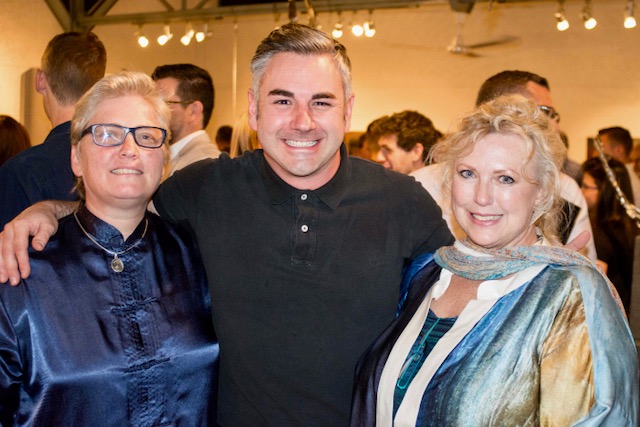
Sanna Swart, Christo Burger( Acustica chamber singers who opened the exhibition) and Lynette ten Krooden

A collaboration between sculptor Sanna Swart and painter Lynette ten Krooden was inevitable.

They live and work in close proximity, deal in and explore the same issues yet work in different media. If you are superstitious or believe in synchronicity, you might think that this collaboration began because the Association if Arts Pretoria celebrates a 70th birthday while Ten Krooden has practised her art for 40 years and Swart has been sculpting for 30! Together their years of making art is on par with that of the Association.

But there’s more to their working together than that even though it is a fun fact to chew on.

Swart wanted to exhibit and with the two artists living and working like neighbours, their minds attuned, she invited an artist she has always looked up to, to collaborate.

“I wouldn’t have had the confidence to do it 10 years ago,” she admits, but these two artists are both in a place with their work which made this such a clever coming together.

delicate balance7
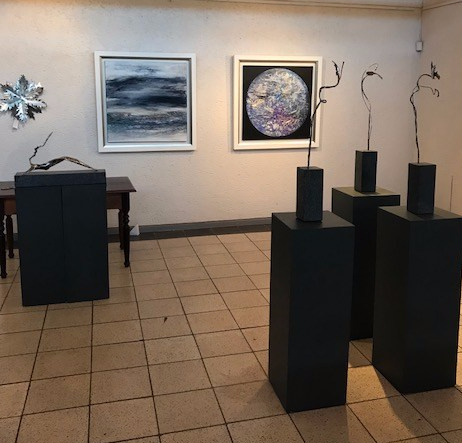
A selection at the Delicate Balance exhibition

They also knew they wanted to exhibit at the Association because of the gallery space. “It’s a space that was constructed specially to show art,” says Swart and there aren’t too many of those around.

When you walk into this exhibition which counter-balances the paintings of the one with the sculptures of the other, it makes complete sense. There’s a synergy that showcases the delicate balance and allows the work to breathe. There’s both a simplicity and a solemnity in the space which benefits the art.

As artists they are also both aware of the beauty of  “the place we call home” and of the fragility and delicate balance between human beings and nature. And that is where their art is focused.

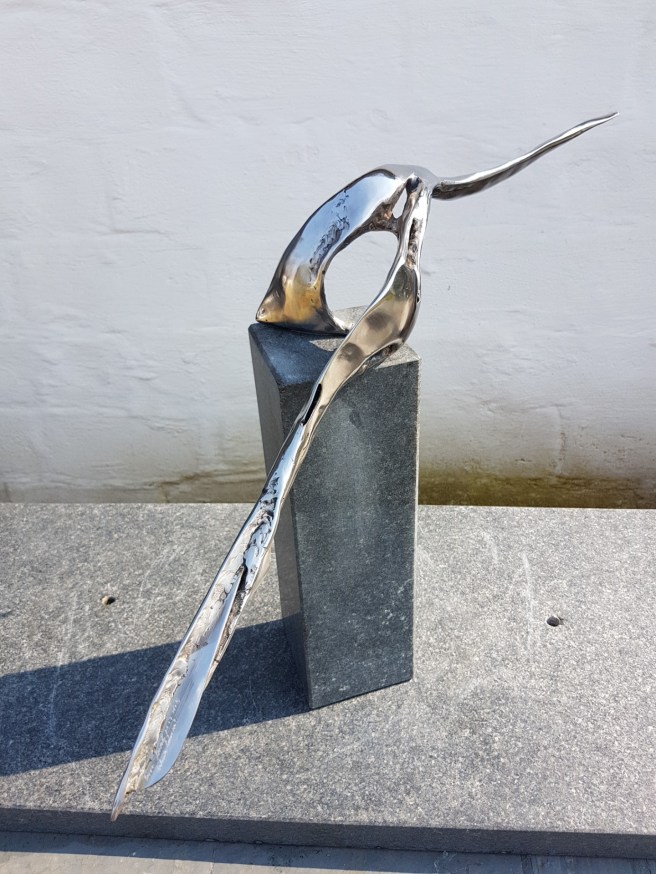
Glacier Fish in stainless steel
Delicate Balance in stainless steel (Sanna Swart)

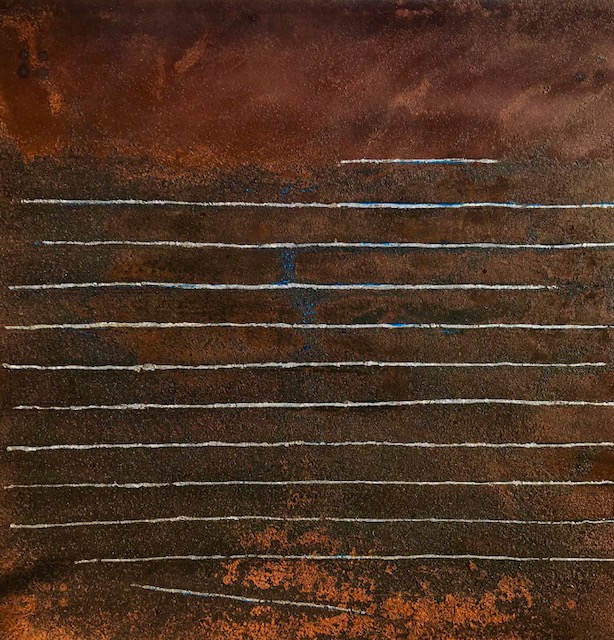
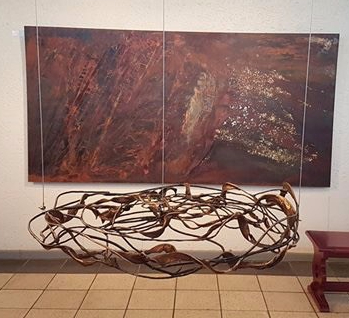
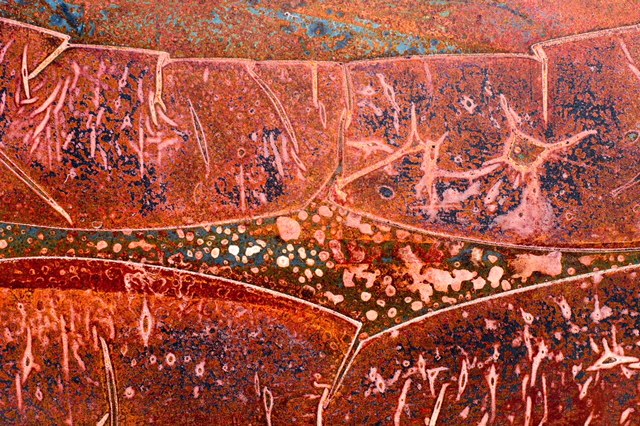
Swart has reclaimed forged stainless steel which she used to work with in her earlier days while Ten Krooden has for many years experimented with gold and silver leaf in her oil based paintings. She also experimented with natural oxidation on mild steel, which brought an even stronger symbiosis between the paintings and sculptures into play. The way the work has been displayed, the subjects each artist has selected, perfectly complement each other.

And it wasn’t as if they worked together in that sense. With an interest in the environment and the way each of us leave a mark whether we choose to or not, they talked about their intent with this exhibition and then worked on their different pieces.

“I was amazed how some of my work reflected some of the things Lynette was working on,” explains Swart as she talks about the way they think about the planet, the environment and how it affects each one of us.
For her specifically returning to stainless steel has been a freeing experience because of the process. “I was working with flat pieces of metal which I could shape and manipulate any way I wanted,” she says.

delicate balance6
KADASTRALE GRENSE/ oxidised steel (Lynette ten Krooden)

Ten Krooden on the other hand was amazed how her working process was given wings as her horisons expanded by this collaboration.

It is a confidence in their combined work that permeates this exhibition. And even though, each piece stands on its own, it is as if working together on an exhibition allowed them to breathe slightly more easily which reflects in the work.

delicate balance5
CELESTIAL GATHERING/ Bronze and stainless steel ( Sanna Swart) COSMIC DELTA/ Oxidised steel and gold leaf ( Lynette ten Krooden)

Some of Ten Krooden’s work encouraged Swart to give a three-dimensional vision to an idea that she picked up in a particular painting, she notes and between them, there was an energy that was greater than its individual force.

They both view themselves as “outsider” artists, not quite part of the establishment, but this coming together obviously had an effect on their work which is perhaps not what they expected to happen. It’s quite explosive.

They describe themselves as contemporary artists, working with the world as we view it today and hopefully making an impact.

Textures
Detail: ARCTIC DESERT (Lynette ten Krooden)

The exhibition runs until Wednesday 1 November 2017.

Association of Arts Pretoria

173 Mackie Street

Nieuw Muckleneuk

Pretoria

Tel:  012 346 3100

artspta@mweb.co.za

www.artspta.co.za

Gallery Hours

Tuesday to Friday:  9am to 6pm; Saturday: 9am to 1pm

With Robert Whitehead’s wisdom and Lebo Toko’s tenacity, it’s a powerful theatrical cocktail

An intriguing play titled The Man Jesus, coupled  with a dynamic duo, director Robert Whitehead and actor Lebo Toko, and you have a potent theatrical mix. DIANE DE BEER speaks to the director and actor pair during rehearsals of the play now running at Joburg’s Market Theatre:

The Man Jesus photographer Brett Rubin
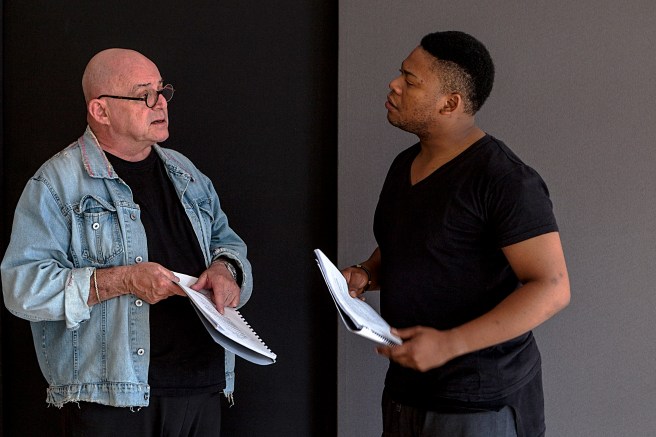
Robert Whitehead (director) and Lebo Toko (actor) discussing The Man Jesus

“It’s a story of possibility,” says Robert Whitehead, about the playThe Man Jesus written by Matthew Hurt, a South African born Irish playwright.

The playwright, the son of a friend of his, asked Whitehead whether he would like to do the play – as an actor. He felt that this was not the part for him to play – and knew he wanted a black actor to tell the story – but he wanted to direct.

And when he talks about the play, he has very specific ideas, understanding that with 12 different characters involved, you didn’t need much more than the story to play out.

He also needed a very special actor to commit to the role. A solo play with Lebo Toko as his pick (last seen in James Ngcobo’s Raisin in the Sun), Whitehead acknowledges that as a trained actor/singer/dancer, (what is commonly known as the triple threat), he wouldneed all those skills to get through this one.

But Toko is up for the challenge. Speaking to them during the early days of rehearsal, there was still a sense of nervousness – but also excitement at pulling this one off.

It’s the first time back at The Market for Whitehead in 12 years and quite a while since he has directed.

Yet with a clear head, he knows that he won’t make use of any electronics or even props. “It’s going to be the actor and a set,” he says simply. It’s all about the text, which was nominated for the Irish Times Best New Play in 2013, and looks back 2 000 years to witness key moments in the life of ‘the man Jesus’, through the eyes of the people who knew him.

“It’s conjecture,” says Whitehead about the thought provoking and challenging script dealing with the man who had an enormous and profound impact on the history of mankind. The Man Jesus traces his life from before his birth to after his death through some dozen characters, both male and female, with whom he came into contact.

Was he a man with magical powers?  Was he a prophet with miraculous skill sets? Or did a few Jews start to realise something else? “That, of course, is entirely up to you.  People should understand that in spite of the title, or because of it, this is a work of imagination.  There was no ‘The New Testament’, ‘The Gospels’, ‘The Early Church’ or any such thing which makes what eventually came into being, so fascinating,” says Whitehead as he points to Christianity.

The Man Jesus starring Lebo Toko directed by Robert Whitehead photographer Brett Rubin (002).jpg

He is intrigued by the times when all of this was playing out specifically because of what followed – and that’s what the play deals with. Everyone was running around trying to figure out what was happening in this “cruelly conquered land”, he notes. And they had to try to make sense of this man called Jesus – and make it work politically.

And for the director and actor the challenge is to latch onto the immediacy of the story and not get stuck in the “sacredness”. “That only came later,” explains Whitehead. This deals with the now of then.

The man they explore was a guy who did weird and freaky things. “How much is mythology? We are telling a story that is expressing the inexpressible.”

For Toko accepting this part is the bravest thing he has ever done in his young life as an actor. “I know I can act, but this is something else,” he says with a shake of his head. And already, as the solo performer, he understands that this is a very lonely world.

But he also gets that what he is experiencing in this rehearsal period is a great learning experience. “I know that the day I leave this classroom, I will leave with something bigger than I understood when starting out.”

Talking about the writing, Whitehead remarks that the text is quite formal and very English. “We have left everyone who they are and where they are, but have changed some words that work better here where we are.”

And, he points out, the obvious and yet … “ours is not a blond Jesus!”

I leave them working the process, still finding their way into the play but also knowing that with Whitehead’s wisdom and Toko’s tenacity, their combined talent will pull this one off.

“It’s all about baby steps,” says Whitehead as he turns to his actor. That’s the exciting thing about this one – and they know that.

It’s not an easy story to tell, but for this theatrical duo, that’s not what they were looking for. They want people to listen and learn, and leave the theatre with something.

That’s what they plan to do.

PICTURES: Brett Rubin

The Man Jesus plays at the Market Theatre’s Barney Simon until Sunday 5 November.


Artist Margaret Nel shares Stories with Provocative Paintings at Retrospective

The Pretoria Art Museum, in conjunction with the Association of Arts Pretoria, is presenting a major retrospective exhibition by South African artist Margaret Nel at the Pretoria Art Museum until January 28, featuring a selection of over 70 paintings, spanning a career of over four decades.

Due to popular demand, the Pretoria Art Museum will be hosting a final walkabout of the exhibition A Retrospective: 1970 – 2017 on Saturday,  January 20 as the artist Margaret Nel discusses selected key works from the show.

Entry to the museum is free for those attending the walkabout. Light refreshments will be served before the walkabout commences at 11. Book your spot at info@margaretnel.com by Thursday, January 18 .

For those unable to attend the walkabout, but who still wish to view the exhibition, the show closes on Sunday, January 28.


DIANE DE BEER spoke to the artist just before the opening:

Artist Margaret Nel’s world reflects her artistic mien, from her art to her home and her personal style.

She lives in Pretoria’s famous round house on Tom Jenkins drive and upon entering the space, the way she has fashioned her interiors – from the paintings on the wall (her own work and others) to the interiors – the way she presents herself, all has a specific artistic ambience. It’s almost as if one is moving with and walking into an evolving artwork.

In the process of finalising her exhibition, we chat about a career that stretches from the 70s and is ongoing. “I am always painting,” says Nel. “There’s not a year that goes by without having produced something.” She is already working on an exhibition to be presented at the Oliewenhuis Art Museum in Bloemfontein next year.

Apart from a period in the 80s, when she stepped away from her art because of a young family and life in general, it is what occupies her heart and her mind and what she surrounds herself with. And when perusing the information available on the current exhibition, everything she does is done with a fine eye for planning, not leaving anything to chance.

She has even thought about the criticism ahead of this retrospective. But she’s excited and keen to hear what people think, especially the knowledgeable ones. As someone who shows her work, she knows viewers feel and have the right to criticise. While as a young artist, she might have struggled with that, now it is something she embraces.

She wonders how others will view her progress, something she is quite happy with. “I am confident about my work,” she says softly. And that steely demeanour might have something to do with the fact that while studying and starting her career, female artists always found themselves attached to part of a boy’s club. “We had to deal with that, always in the minority.”

1998_Waiting-for-the-Renaissance
Barren Land: 1998: Waiting for the Renaissance

Now, regarding her work in a retrospective, she is interested to see how it holds up in a solo exhibition. “Usually it is juxtaposed with the work of other artists and then it becomes difficult to judge,” she admits. She realises that certain periods like what she refers to as her Post Modern period could be perceived as out of step but believes the themes are even more relevant. “I touched on subject matter, such as xenophobia and diminishing and compromised natural resources, at a time when these issues were not as relevant as they are currently.”

The original title of the exhibition was Loss as it felt that as a concept, loss was the overarching theme, connecting the five distinct periods that her work falls into, over 40 years.

1970-Tea-time-I
The Outsider: 1970 Tea-time

“Loss of identity and control and loss of mental acuity are covered in the early period titled The Outsider as well as in the second titled Barren Land, where loss of culture and heritage as well as the potential loss of a sustainable future are also explored. The third section titled Incident talks about loss of security and a place of safety, specifically in the South African context but also in the global context.

“The fourth section titled Exposed deals with loss of protection from outside elements. And finally, the fifth, deals almost exclusively with universal feminist issues such as loss of identity, and loss of youth, loss of a voice in a male dominated society. I also obliquely speak about domestic abuse in the latest work, a subject very close to my heart and very difficult to comment on in a subtle way. Cuts of meat, enclosed in a fragile skin of plastic which is often shown ripped open is used as a metaphor.”

2013_Isolate_I
Exposed: 2013: Isolate

“I use models, myself included, not to paint portraits but to try to get across an idea. The double portrait of myself where I used a cell phone to capture a ‘selfie’ is titled Isolate and speaks about old age, loss of youth etc etc.” She shows herself as she really is – warts, ageing et all. There’s no fooling about here. Art is a release, therapy, autobiographical if obliquely so and you must face it head-on.

“Ultimately I explore aspects of the human condition that have directly touched me.”

Nel strikes one as someone who makes very specific choices in life. She might seem the introvert when one first meets her, but easily opens up and shares her feelings when she feels comfortable – her choice.

Her reason for showing her work in this large retrospective is also specifically driven. She admits, as artists should, that she wants people to see her work. “And hopefully educate and make people more aware of the issues that I find important.”

2015_Custard-bun-6s
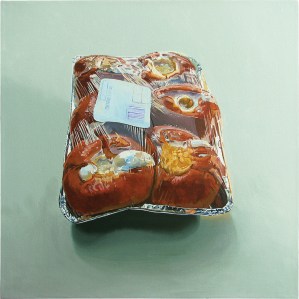
2015: Custard buns

All her paintings have very specific titles, offering the viewer a key to unlock the work and she has detailed descriptions that might further the understanding of the artist’s point of view. But she is as thrilled if other layers or meanings are uncovered and explored by viewers.

“The work can be interpreted on many levels though, even quite superficially, and ultimately it must be left up to the viewer,” she says firmly.


Her art is eye-catching, intriguing, draws you in, challenges and encourages you to engage with many different emotions. This might be her chosen landscape, but with individual interpretations and varied life experiences, different people will react and embrace the work individually.

And that’s how it should be and how it is intended.


Pretoria Art Museum
Cnr Schoeman and Wessels Str
Arcadia Park
Arcadia

Pretoria

Open: Tuesdays to Sundays 10am to 5pm


The Theatrical Side of Season 2 of The Centre For The Less Good Idea

Pics by Stella Olivier

Kgomotso Moncho-Maripane

Guest Writer


Gerard_portrait credit Stella Olivier
Gerard Bester

Gerard Bester describes his role as Associate Director for Season2 of The Centre for the Less Good Idea as dealing with one’s own ego and insecurities.

“It goes in waves, sometimes one feels useless and awful, other times one feels charged and creative,” he says.

It would be forgivable for a theatre enthusiast to romanticise the process in their minds because Bester, together with Nhlanhla Mahlangu and Mwenya Kabwe are theatre geniuses. The three of them drive the theatrical elements for the centre’s second season happening in Maboneng from tomorrow until Saturday.

Launched in March, the Centre is very much about process and exploring secondary ideas that come up when cracks and fissures occur in the initial big idea. It nurtures artists in finding the less good idea, and creates and supports experimental, collaborative and cross-disciplinary arts projects, over two seasons every year.

Founded by William Kentridge in November 2016, it provides a space for short form work whose life does not necessarily belong in a theatre or a gallery.

The first season, curated by performance poet, Lebo Mashile, choreographer/dancer, Gregory Maqoma and young director and playwright, Khayelihle Dom Gumede, pushed the boundaries of alternative spaces and language.

The second season is heavily nuanced by the collision of art and technology as brought in by co-curators, Tegan Bristow; Nhlanhla Mahlangu and urban culture entrepreneur, Jamal Nxedlana.

Bristow is an interactive media artist, lecturer at the Digital Arts Division of the Wits School of the Arts and co-founder of the Fak’ugesi African Digital Innovation Festival. She curated the Post African Futures exhibition for the Goodman Gallery in 2015 out of her research into technology, art and culture in Africa. She’s a supporter and an active player in the futurist movement that is characterising the African arts landscape right now, where science fiction and African futurism are not only themes but the approach, and technology is a medium for creating art. It is art that interrogates the present and shows history’s intrinsic link to the future.

Mwenya_portrait credit Stella Olivier
Mwenya Kabwe

Bristow invited inventive theatre maker and academic, Mwenya Kabwe as part of over 40 Johannesburg based multi-disciplinary practitioners involved in this season.  What they came up with laid the foundation for the sprouting of ideas that came after.

“One of the first conversations that Tegan and I had was about a series of short descriptive futuristic African worlds that I had written for a research project. She liked how they dealt with time and space and for their visual quality. These got called on quite early in the first brainstorming session for Season 2, as points of inspiration to launch from,” Kabwe explains.

She also collaborates with Bristow and musician Cameron Louis Harris, on an interactive performance piece called Jacaranda Time, performed by dancer/choreographer Sonia Radebe and actor Namatshego Khutsoane.

But her shorts are linked to the bigger story of Edward Nkoloso, a Zambian grade school science teacher in the 1960s, who around Zambia’s independence, established a space academy with the objectives of space travel. His story was made popular in urban culture by photographer Cristina de Middel and Ghanaian filmmaker Frances Bodomo’s short film, Afronauts. It’s a story that resonates deeply with Kabwe (who is Zambian herself) which she presents in a production of A Zambian Space Odyssey.

“Edward Nkoloso is presented in the world as a parody in slightly foolish ways of space travel, but he is also being reclaimed as a revolutionary whose metaphor for Zambia’s independence meant literally soaring to new heights and reaching the moon.  A Zambian Space Odyssey is a live proposal in reading him in these two different ways,” says Kabwe.

Known for her experimental, workshopped and directed theatre and performance work, it is her form of writing that she is experimenting with here.

Nhlanhla Mahlangu credit Stella Olivier
Nhlanhla Mahlangu

In addition to curating, Mahlangu, who worked on the first season as one of the musical directors, gets to showcase his seminal solo work, Chant, directed by Bester.

Mahlangu’s ingenuity as a musician sets him apart as a dancer/choreographer and performer. Bester, a performer who’s been called a “Post Modern Anti Hero Character” due to his innate connection to movement and ability to break the fourth wall when engaging an audience, comes also with his arts administration experience.

The two met 20 years ago when Bester was managing a programme Mahlangu was part of as a student and they have worked together ever since. They now revisit Chant, which premiered at the Julidans Festival in Amsterdam where it was commissioned in 2011.

The work is Mahlangu’s ode to the women who raised him.

“Nhlanhla has this extraordinary, rich memory and connection to his own history that speaks beyond the personal. What was an important realization when revisiting the work, was how to really honour the skills that Nhlanhla has and to distill each of those. There’s a new emotional intensity to the piece and the idea is to connect and to hold on to that,” Bester says.

The word Chant and the force behind it is a constant motif in Mahlangu’s work with other titles including The Worker’s Chant and Gqisha! The Chant That Calls, a collaboration with Dom Gumede.

“For me the chant is the literal and the metaphor of the constant endlessness of blackness and struggle. A chant is an endless song that you sing until your body goes into an altered state of consciousness. My work is driven by music and a chant is how I look at black lives, history and future,” Mahlangu explains.

He’s also created a piece inspired by Kabwe’s series of shorts with the music and score based on children’s games that black kids grow up reciting at school and playing in the streets.

“There are deep-seated political connotations to these children’s games and I’m highlighting those,” says Mahlangu.

For more info on the programme and bookings for Season 2 of the Centre for the Less Good Idea (October 11 – 14) visit www.lessgoodidea.com


PS: Afterthought …

DIANE DE BEER


Nataniel costume


Nataniël has just finished his annual season at Emperor’s celebrating his 30 years as a solo artist with a season of 30 Years, 90 Minutes: Nataniël Celebrates 3 Decades On Stage.

One of my treats during these 30 years, has been revisiting a production towards the end of a run.

Because his shows have always been dense both visually and in content, review nights were particularly tense for me. This second time round, without stress, is my particular penchant.

I am not just inhaling and observing a one-off season, but one that has been 30 years in the making, was particularly informative and revealing about his creativity, his innovation and imagination.

That’s the way to do it! “I don’t want to bore people with one thing after another of the past,” he said. This was not going to be a best of…

What it was however was an insight into his mind, his personal favourites and a showcase of what he does best starting with his songs and his stories and then everything that he builds and layers around that.

The arrangements of the cover songs he sang, You’re My World by Cilla Black and Lately by Stevie Wonder ( a song he wished he had written, so perfectly it suits his voice) among others, were completely delicious as was some of his own music like Fall which he described as his personal favourite of what he titles his no-hit wonders!

Nats1

His voice has matured magnificently and he is completely comfortable and confident and  enhances his distinctive voice with the additional sounds of Dihan Slabber and Nicolaas Swart. And he is joined by a spectacular band led by Charl du Plessis (keyboards) and completed by Jean Oosthuizen (guitars), Hugo Radyn (drums) and Werner Spies (bass) who have worked with him for a very long time which means they can push the boundaries- and they do.

It’s a complete package that holds the rest of the show in a soundscape that runs through all the emotional hefts of a Nataniël story. And this was a show of single stories, each one a showcase of this master at spinning a yarn that has you screaming with laughter yet leaves you with a moment of melancholy that runs deep.

He tells a tale of a vision that he was holding on to while making  a truck-load of paper flowers. The repetition of the task was offset by what they were hoping to achieve – only to fail disastrously. Then comes the question. “What happens to you when the most beautiful thing you have ever seen is only real in your imagination? You go mad…”

And then it all becomes clear. The set that has been constructed on stage from the start of the show, is this particular image and with Nataniël’s extraordinary lighting abilities (he changes his costumes instantly with the colour and angle of the lights), he achieves exactly that. Not only for himself though, it’s also a vision for his audience. And it starts with what might seem a silly story about student escapades!

He speaks about extraordinary people doing ordinary things. But he constantly presents us with what seems ordinary – only to surprise us with wonderful stage wizardry.

That is the wonderment of his craft. And why it has been such bliss to watch the growth and explosive evolvement of this artist and his shows. It is a completely immersive adventure as you step into this fantasy landscape once that first note comes at you, usually from a darkened stage which reveals itself.

His shows are always that – a slow reveal.

Yet nothing is slow about his costumes (designed by Floris Louw) that glitter and dazzle, not in the expected fashion though and more Louis IV than Liberace.

This was his final curtain – for now – after 15 years at this venue, and he wanted to leave in style – which of course he did, powerfully.

He also wanted, in typical Nataniël style, to easily segue into his next venture, a smashing book on his costumes called Closet, to be released on October 9. His latest TV series also starts this week on Wednesday, Edik van Nantes 3 on DStv’s kykNET (144) at 8pm with repeats following.

So while he’s stepping off the big stage for just a moment, he leaves you with marvelous memories.

Thirty years of uniquely Nataniël performances have done that. He truly is a national theatrical treasure.

There’s still a chance to catch the show for some: Opera House, Port Elizabeth: 20 and 21 October; and Sand du Plessis, Bloemfontein; 26 to 28 October:

Theatre students from the UK and SA are saying it for themselves – on stage

DIANE DE BEER


It’s time to update this story which is moving into its immediate end phase. There will be more lasting benefits that linger. I first did this interview approximately a month ago in time for the local performances which I witnessed and now the South African students are on their way to Britain for the performance with ODDMANOUT theatre company, in Darlington, UK. I’ve added current details with impressions of the show as well as kept the relevant info on this amazing showcase for a group of young local storytellers. To hitch a ride with this savvy group, know that the theme focusing on young women and their particular problems and potential was chosen long before this current worldwide focus on #me too in the wake of the Weinstein scandal with others tumbling out at the rate of knots:

Picture: Craig Chitima

SONY DSC
Darlington Khoza, Boikobo Masibi, Sinenhlanhla Mgeyi, Ncumisa Ndimeni and Mathews Rantsoma

Walking into one of the Market Theatre’s new-ish rehearsal spaces in Newtown (more than a month ago), I’m confronted with one of the rehearsals for the latest Market Lab collaboration, Encountering the Other, with ODDMANOUT theatre company, in Darlington, UK.

Twelve young people, six from South Africa and six from North East England,  were in the process of coming together in a few days to create a production exploring the realities and possibilities of young women in the current moment in a global context.

But before they got there, the two groups worked separately in their respective countries  creating as much work as they could through their specific processes which in the Lab’s case was mostly improv. “I think where our processes are very much movement based, the UK works much more from a text based space,” explains The Head of the Market Theatre Laboratory, who is also a director on the project, Clara Vaughan. And she confirmed this once the two groups started working together to shape the final product.

Supported by British Council Connect ZA, it is a creative partnership involving both live and digital performance and a coming together of young actors from different countries who can learn from each other both socially and artistically.

And having watched a bit of what the South African Lab students were doing while rehearsing, I know that their enthusiasm, their particular skill sets and their improv abilities would bring extraordinary energy to the project. I did in fact have to check whether this really was improv while watching.

And in the final production, the two groups coming together is so fascinating because of their different approaches and where they come from. The universality of these youngsters’ world is what they worked with most strongly as they played off each others particular energy.

This project came from a strong sense of the shared values of the two organisations: The Market Theatre Lab describes themselves as a creative hub supporting the development and emergence of talented young theatre-makers and contemporary, socially engaged, experimental performing arts.  And having witnessed their work through the years and the graduates moving on to further enrich our theatre landscape, what they’re doing works brilliantly.
ODDMANOUT was established by North East England theatre-makers, Scott Young and Katy Weir to create work with a strong focus on stories of social change and theatre with story-telling at its heart.

And so the twain met.

In the selection of actors who auditioned, the South African contingent split into an equal gender mix, three men and three women: Ncumisa Ndimeni, Mathews Rantsoma, Sinenhlanhla Mgeyi, Darlington Khoza, Tumeka Matintela and Boikobo Masibi.

lab-gender-roles-e1506432235192.jpg
Ncumisa Ndimeni, Sinenhlanhla Mgeyi, Mathews Rantsoma , Boikobo Masibi, Darlington Khoza and Tumeka Matintela

“We simply selected them according to the best auditions,” notes Vaughan. But what that particular mix meant in the rehearsal context, is that both the women and the men benefited in particular ways while exploring issues. “The women for example were surprised that the men had as many body issues as they did,” she says. It also meant that the men were much more aware of sounding sexist. “But we’ve tried to create the safety of a playful environment which will encourage everyone to participate and learn,” explains Vaughan as she includes her fellow director Jacques De Silva.

Because the British contingent were all women it also meant that the three South African men added a distinct flavour to the piece representing both genders while focusing on female issues.

Following two performances of Encountering the Other locally last month, the South African team fly to the UK on Friday (November 17), to host a series of workshops on specifically South African theatre-making techniques with the budding actors from the North East of England. This will be followed by a one-off performance of Encountering the Other at the newly restored Darlington Hippodrome on 27 November.

And they should knock their audience’s socks off. They did ours!

And says Clara Vaughan, the shows with mainly young audiences went fantastically and the Q&A sessions afterwards were vibrant and exploratory.

When last we spoke, she was hoping to make a detour to London for these first-time travelers but she had to find funding. Contact her urgently at clara@marketlab.co.za if you can help.


Aardklop pumping with innovation, imagination and creative possibilities

DIANE DE BEER

With arts festivals still being the surest thing for many actors in this country, many of our best plays are premiered at these events before they start touring to mainstream theatres.

This year’s Aardklop (Potchefstroom’s annual festival from 2 to 8 October) while Afrikaans-driven, has many options for everyone simply interested in the arts and tehatre. An understanding of the language helps with a wider choice of course, but here are a few options worth checking.

Innovation is always part of a festival, and one of the most exciting is a one-on-one theatre experience that opens up all kinds of possibilities.

DEURnis is a one-on-one site-specific theatrical production with a very intimate yet cutting-edge and experimental approach. It involves a single audience member  who views three separate dramatic pieces per package (there are four different ones to choose from), with each of these having one performer and one audience member.

Each piece is is approximately 20 minutes long and written for a particular room/space in a house, so as a viewer, you move from one room to the next to see your three chosen plays.

It is the social issues that permeate the different works that affect individuals in different ways depending who you are. And for those who aren’t interested in gimmicky theatre, that’s exactly the trap they have avoided by aiming for excellence and substance in the texts.

“We have been inundated by people interested in writing for this venture,” says Johan van der Merwe, who with Rudi Sadler has started a production company Theatrerocket responsible for this exciting and well-executed concept.

They understand that the control has to be constant to see that everything works superbly. And as they had many plays to choose from, they have managed to execute their strict code.

It’s a fascinating experience, being the only one in the room in situations with a stranger telling a story that is often inclusive (never intrusive) but affects you as the viewer in very specific ways.

This is not a financial venture for the company. With only single actors and audience members, the numbers don’t add up. But because of the way it has been done, the performance experience the actors (at this stage mostly young) accumulate can’t be calculated. And chatting to a few of them in-between performances, they are equally thrilled by how much they are learning in the process. “Each performance is different because of the reaction of the individual viewing,” says one performer.

Having sat through a day of all of the plays (even a cabaret included), it doesn’t matter which package you choose. They’re all extremely well crafted and in sometimes scary ways, fun to experience. I loved it and more than anything, it is a concept with great potential. Personally I can’t wait to see how Theatrerocket is going to grow and expand this novel experiment.

One of their current quests is to find some older actors who want to participate. “It’s been a problem because most of them have families and the money isn’t the motivating factor here,” explains Van der Merwe.

Among the other shows and events to check out, including their searing production of Reuk van Appels, are the following:

  • The visual arts always feature strongly at this festival. With the title Saamklop (roughly translated as togetherness), it deals with South Africa’s rich history of collaboration, community engagement and artistic freedom. The focus is on artistic collaborations and community art projects exhibited together in a curated exhibition that spans many venues. Participants include the Bag Factory, Keleketla Library, The Found Collective, The Dead Bunny Society, NIROX Foundation Trust, The Artist Proof Studios and the Centre for the Less Good Idea, a William Kentridge initiative. A broad range of artworks, including paintings, drawings, videos, live performances, workshops, poetry and experimental new media projects will be on show. It’s worth traveling for. Curator (from Pretoria) Dr Johan Thom highlights the vital, creative role of community projects and artistic collaborations in contemporary South Africa’s art scene.
  • If you haven’t yet seen Pieter-Dirk Uys do either an Afrikaans or English version of his (in essence) life’s story, The Echo of a Noise, tick that box.  “I allowed myself to investigate the story behind the stories,” he explains.
  • A mover and shaker on the musical front, Charl du Plessis has two noteworthy productions. Stemme vir Môre (Voices of Tomorrow) combines the voices of Noluvuyiso Mpofu (soprano) and Bongani Kubheka (bass baritone) with Du Plessis on piano and features opera highlights. With Veertig Vingers (pictured) which points to four sets of hands, he creates a musical storm. Joining him on keyboards are Elna van der Merwe, Albie van Schalkwyk and Pieter Grobler as they perform favourite tunes from the classical, pop, jazz and rock genres.
  • For those who are au fait with the language, some theatre highlights include the Marthinus Basson directed Asem and Melk en Vleis; Dawid Minnaar in Monsieur Ibrahim en die blomme van die Koran; Weerkaats starring Milan Murray; Klara Maas se Hart is Gebreek, ensomeer: Die Vloeistoftrilogie with Wessel Pretorius, David Viviers; Nêrens, Noord-Kaap starring Albert Pretorius, De Klerk Oelofse and Geon Nel; and Elize Cawood and Wilson Dunster in Mike en Mavis (pictured).

There are more details about the festival or shows available at http://www.aardklop.co.za. Tickets at Computicket.